
Ezekiel 33:24

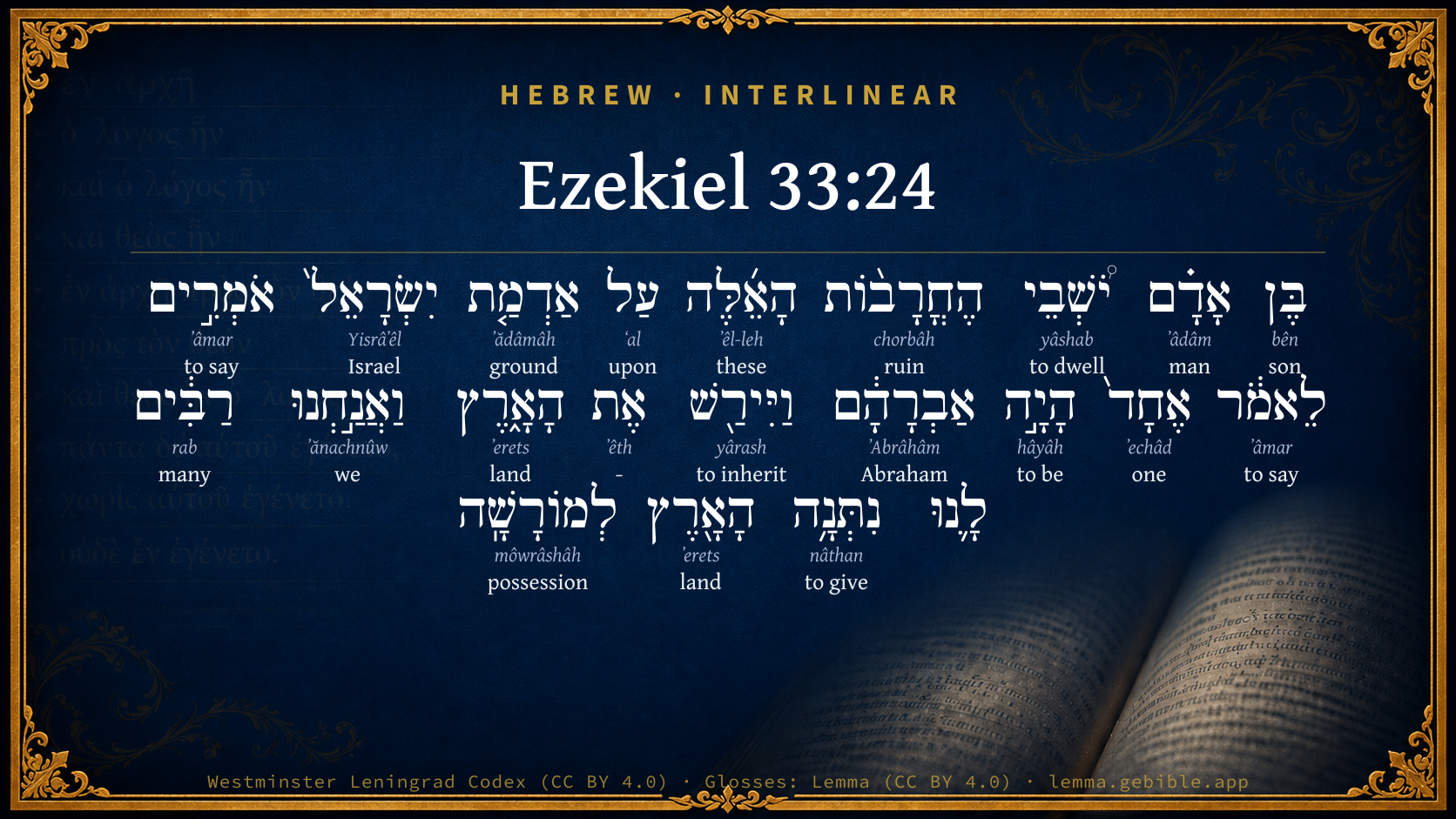
Hebrew (Westminster Leningrad Codex) Ezekiel 33:24 appears in the Hebrew Old Testament. The text above is from the Westminster Leningrad Codex. Each word links to its Strong’s number, a concise gloss, and parsing drawn from the Open Scriptures Hebrew Bible morphology. Click any word for its full Brown-Driver-Briggs (BDB) entry.
Download image
Cite this verse

Ezekiel 33:24 (World English Bible). Public Domain. Lemma interlinear Bible study tool, https://lemma.gebible.app/v/ezekiel/33/24.

Show BibTeX & RIS
BibTeX
RIS
English Translation
Son of man, they who inhabit those waste places in the land of Israel speak, saying, Abraham was one, and he inherited the land: but we are many; the land is given us for inheritance.
World English Bible · Public Domain
Download a study sheet

One document with this verse’s original text, its word-by-word gloss line, the meaning frame, cross-references with their text, attributed commentary, and full source and license credits — printable, and it pastes into notes with its structure intact.

This verse Autodidact and up

Study sheet (.html) Plain text (.txt)

A passage Seminary Student

Up to 50 verses in one chapter. A passage sheet keeps up to 6 commentary sources and 12 cross-references per verse, in the order this page ranks them, and says so on the sheet whenever that leaves anything out. Ask for a single verse and you get the Autodidact verse sheet above.

Everything on this page stays free to read, with no account — the sheet is a download of what is already on screen, not access to it.

Want to remove ads? Support Godless Engineer
Compare translations 3

The same verse in 3 English versions, stacked beneath the original-language interlinear above. Click any original word for its lexicon entry.

Each is an independent rendering of the whole verse — the interlinear is not word-aligned to these translations.

Highlighted words mark where these versions differ — a whole-verse word diff, not a word-by-word alignment.

  • World English Bible Public Domain
    Son of man, they who inhabit those waste places in the land of Israel speak, saying, Abraham was one, and he inherited the land: but we are many; the land is given us for inheritance.
  • King James Version Public Domain
    Son of man, they that inhabit those wastes of the land of Israel speak, saying, Abraham was one, and he inherited the land: but we are many; the land is given us for inheritance.
  • unfoldingWord Literal Text CC BY-SA 4.0
    “Son of man, the ones inhabiting those ruins in the land of Israel are talking and say, ‘Abraham was only one person, and he inherited the land, but we are many! The land has been given to us as a possession.’

unfoldingWord Literal Text — © unfoldingWord, licensed CC BY-SA 4.0. Word-aligned USFM3 via Door43 (git.door43.org/unfoldingWord/en_ult).

Versions to compare (up to 4)

3 of 4 selected

Show all 18 translations

Every available English version of this verse, each an independent rendering of the whole verse.

  • World English Bible Public Domain
    Son of man, they who inhabit those waste places in the land of Israel speak, saying, Abraham was one, and he inherited the land: but we are many; the land is given us for inheritance.
  • Berean Standard Bible Public Domain
    “Son of man, those living in the ruins in the land of Israel are saying, ‘Abraham was only one man, yet he possessed the land. But we are many; surely the land has been given to us as a possession.’
  • Majority Standard Bible Public Domain
    “Son of man, those living in the ruins in the land of Israel are saying, ‘Abraham was only one man, yet he possessed the land. But we are many; surely the land has been given to us as a possession.’
  • King James Version Public Domain
    Son of man, they that inhabit those wastes of the land of Israel speak, saying, Abraham was one, and he inherited the land: but we are many; the land is given us for inheritance.
  • American Standard Version (1901) Public Domain
    Son of man, they that inhabit those waste places in the land of Israel speak, saying, Abraham was one, and he inherited the land: but we are many; the land is given us for inheritance.
  • Revised Version (1885) Public Domain
    Son of man, they that inhabit those waste places in the land of Israel speak, saying, Abraham was one, and he inherited the land: but we are many; the land is given us for inheritance.
  • Geneva Bible (1599) Public Domain
    Sonne of man, these that dwel in the desolate places of the land of Israel, talke and say, Abraham was but one, and hee possessed the lande: but we are many, therefore the lande shall be giuen vs in possession.
  • Douay-Rheims (1899) Public Domain
    Son of man, they that dwell in these ruinous places in the land of Israel, speak, saying: Abraham was one, and he inherited the land, but we are many, the land is given us in possession.
  • Young's Literal Translation Public Domain
    `Son of man, the inhabitants of these wastes on the ground of Israel are speaking, saying: Alone hath been Abraham -- and he possesseth the land, and we `are' many -- to us hath the land been given for a possession.
  • Literal Standard Version CC BY-SA 4.0
    “Son of man, the inhabitants of these ruins on the ground of Israel are speaking, saying, Abraham has been alone—and he possesses the land, and we [are] many—the land has been given to us for a possession.
  • Unlocked Literal Bible CC BY-SA 4.0
    “Son of man, the ones inhabiting those ruins in the land of Israel are talking and say, 'Abraham was only one person, and he inherited the land, but we are many! The land has been given to us as a possession.'
  • unfoldingWord Literal Text CC BY-SA 4.0
    “Son of man, the ones inhabiting those ruins in the land of Israel are talking and say, ‘Abraham was only one person, and he inherited the land, but we are many! The land has been given to us as a possession.’
  • Darby Bible Public Domain
    Son of man, they that inhabit those waste places in the land of Israel speak, saying, Abraham was one, and he inherited this land, and we are many: the land is given us for a possession.
  • World Messianic Bible Public Domain
    “Son of man, those who inhabit the waste places in Eretz-Israel speak, saying, ‘Abraham was one, and he inherited the land; but we are many. The land is given us for inheritance.’
  • Webster's Bible Public Domain
    Son of man, they that inhabit those wastes of the land of Israel speak, saying, Abraham was one, and he inherited the land: but we are many; the land is given to us for inheritance.
  • Free Bible Version CC BY-SA 4.0
    “Son of man, people living among the ruins in Israel are saying, ‘Abraham was only one man, but the country was given to him to own. There's plenty of us, so the country should belong to us.’
  • Bible in Basic English Public Domain
    Son of man, those who are living in these waste places in the land of Israel say, Abraham was but one, and he had land for his heritage: but we are a great number; the land is given to us for our heritage.
  • JPS Tanakh (1917) Public Domain
    'Son of man, they that inhabit those waste places in the land of Israel speak, saying: Abraham was one, and he inherited the land; but we are many; the land is given us for inheritance.

Literal Standard Version (2020), Covenant Press — licensed CC BY-SA 4.0. Text via the HelloAO Bible API (eBible.org). Unlocked Literal Bible (unfoldingWord) — licensed CC BY-SA 4.0. Text via the HelloAO Bible API (eBible.org). unfoldingWord Literal Text — © unfoldingWord, licensed CC BY-SA 4.0. Word-aligned USFM3 via Door43 (git.door43.org/unfoldingWord/en_ult). Free Bible Version, Dr. Jonathan Gallagher — licensed CC BY-SA 4.0. Text via the HelloAO Bible API (eBible.org).

Word by word

More ways to search: Search by grammar → Find every occurrence → Compare this word →

Practice this passage: Drill this verse → Learn its vocabulary →

לְמוֹרָשָֽׁה
môwrâshâh
H4181
“to/for · possession”
Preposition + Noun, Common, Feminine, Singular, Absolute
Part of Speech
Preposition + Noun
Type
Common
Gender
Feminine
Number
Singular
State
Absolute
Full BDB Definition

Origin: from H4180

TWOT: 920e

a possession
  1. בֶּן bên H1121 “son of” Noun, Common, Masculine, Singular, Construct
  2. אָדָ֗ם ʼâdâm H120 “man” Noun, Common, Masculine, Singular, Absolute
  3. יֹ֠שְׁבֵי yâshab H3427 “dwelling” Verb, Qal, Participle Active, Masculine, Plural, Construct
  4. הֶחֳרָב֨וֹת chorbâh H2723 “the · ruins” Particle, Definite Article + Noun, Common, Feminine, Plural, Absolute
  5. הָאֵ֜לֶּה ʼêl-leh H428 “the · these” Particle, Definite Article + Pronoun, Demonstrative, Common, Plural
  6. עַל ʻal H5921 “upon” Preposition
  7. אַדְמַ֤ת ʼădâmâh H127 “ground of” Noun, Common, Feminine, Singular, Construct
  8. יִשְׂרָאֵל֙ Yisrâʼêl H3478 “Israel” Noun, Proper
  9. אֹמְרִ֣ים ʼâmar H559 “saying” Verb, Qal, Participle Active, Masculine, Plural, Absolute
  10. לֵאמֹ֔ר ʼâmar H559 “to say” Preposition + Verb, Qal, Infinitive Construct
  11. אֶחָד֙ ʼechâd H259 “one” Adjective, Cardinal number, Masculine, Singular, Absolute
  12. הָיָ֣ה hâyâh H1961 “to be” Verb, Qal, Perfect, 3rd Person, Masculine, Singular
  13. אַבְרָהָ֔ם ʼAbrâhâm H85 “Abraham” Noun, Proper
  14. וַיִּירַ֖שׁ yârash H3423 “and · to inherit” Conjunction + Verb, Qal, Sequential Imperfect, 3rd Person, Masculine, Singular
  15. אֶת ʼêth H853 “-” Particle, Direct Object
  16. הָאָ֑רֶץ ʼerets H776 “the · land” Particle, Definite Article + Noun, Common, Both, Singular, Absolute
  17. וַאֲנַ֣חְנוּ ʼănachnûw H587 “and · we” Conjunction + Pronoun, Personal, 1st Person, Common, Plural
  18. רַבִּ֔ים rab H7227 “many” Adjective, Adjective, Masculine, Plural, Absolute
  19. נִתְּנָ֥ה nâthan H5414 “to give” Verb, Niphal, Perfect, 3rd Person, Feminine, Singular
  20. הָאָ֖רֶץ ʼerets H776 “the · land” Particle, Definite Article + Noun, Common, Both, Singular, Absolute

About this verse

These counts appear in no published source. They are computed here, from the morphology-tagged text and Lemma’s own curated glosses. What Lemma adds →

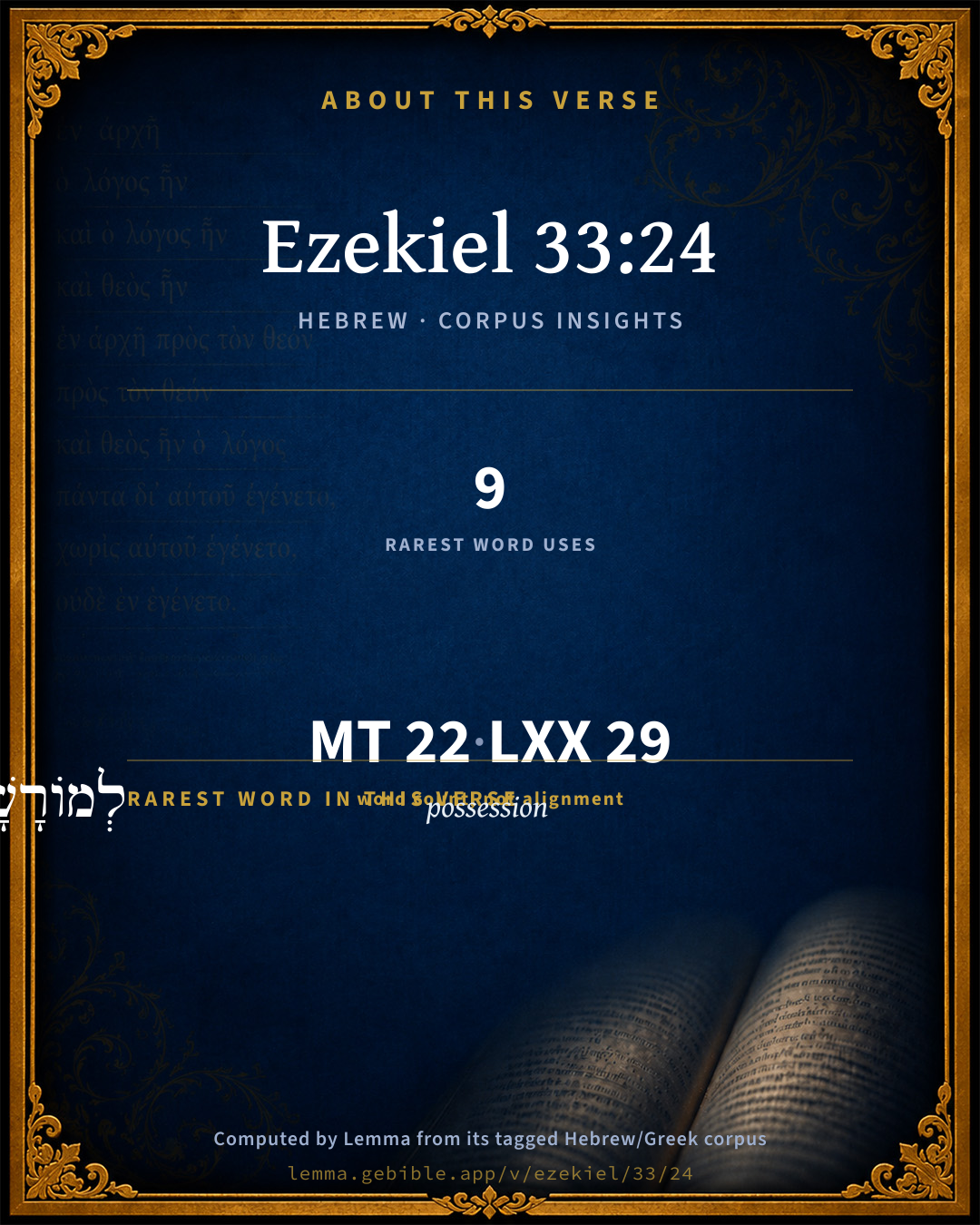
22
words
19
distinct lemmas
Prophets
section

Notable vocabulary

The rarest word here is לְמוֹרָשָֽׁה possession H4181 — appearing just 9 times in the whole Hebrew Bible.

Shared distinctive vocabulary

לְמוֹרָשָֽׁה possession H4181 occurs in 9 verses of the Hebrew Bible. Also found in:

Grammatical profile

  • 6 verbs
  • 9 nouns
  • 2 adjectives
  • 2 pronouns
  • 2 prepositions
  • 1 particle

Verb forms

  • יֹ֠שְׁבֵי Qal · Participle Active
  • אֹמְרִ֣ים Qal · Participle Active
  • לֵאמֹ֔ר Qal · Infinitive Construct
  • הָיָ֣ה Qal · Perfect
  • וַיִּירַ֖שׁ Qal · Sequential Imperfect
  • נִתְּנָ֥ה Niphal · Perfect

Repetition

Words recur within this verse — often emphatic in Hebrew:

  • אֹמְרִ֣ים to say H559 ×2
  • הָאָ֑רֶץ land H776 ×2

Hebrew & Septuagint length

In English translation the verse runs 35 words from the Hebrew and 37 from the Septuagint (LXX English) — closely comparable.

A rough comparison of the two English renderings, which tokenize alike — not a word-level alignment.

Word counts can differ between the Hebrew and the Greek without any difference in meaning — e.g. the Hebrew direct-object marker אֵת has no separate Greek word, and Greek often adds the article ὁ.

In the original languages it is 22 Hebrew tokens and 29 Greek tokens — but the two are counted differently (Hebrew bundles its prefixes and suffixes into one token; the Greek is in lemma form), so that isn’t a like-for-like length.

Cross-references

17

Topical passages linked to Ezekiel 33:24 in the Treasury of Scripture Knowledge — connected by theme and wording, ordered by reader-vote popularity; previews shown in the World English Bible.

  • Isaiah 51:2 Look to Abraham your father, and to Sarah who bore you; for when he was but one I called him, and I blessed him, and made him many.
  • Ezekiel 33:27 Thus shall you tell them, Thus says the Lord Yahweh: As I live, surely those who are in the waste places shall fall by the sword; and him who is in the open field will I give to the animals to be devoured; and those who are in the strongholds and in the caves shall die of the pestilence.
  • Acts 7:5 He gave him no inheritance in it, no, not so much as to set his foot on. He promised that he would give it to him for a possession, and to his seed after him, when he still had no child.
  • Jeremiah 40:7 Now when all the captains of the forces who were in the fields, even they and their men, heard that the king of Babylon had made Gedaliah the son of Ahikam governor in the land, and had committed to him men, and women, and children, and of the poorest of the land, of those who were not carried away captive to Babylon;
  • Ezekiel 36:4 therefore, you mountains of Israel, hear the word of the Lord Yahweh: Thus says the Lord Yahweh to the mountains and to the hills, to the watercourses and to the valleys, to the desolate wastes and to the cities that are forsaken, which are become a prey and derision to the residue of the nations that are round about;
  • Luke 3:8 Bring forth therefore fruits worthy of repentance, and don't begin to say among yourselves, 'We have Abraham for our father;' for I tell you that God is able to raise up children to Abraham from these stones!
  • Jeremiah 39:10 But Nebuzaradan the captain of the guard left of the poor of the people, who had nothing, in the land of Judah, and gave them vineyards and fields at the same time.
  • Matthew 3:9 Don't think to yourselves, 'We have Abraham for our father,' for I tell you that God is able to raise up children to Abraham from these stones.
  • Romans 4:12 The father of circumcision to those who not only are of the circumcision, but who also walk in the steps of that faith of our father Abraham, which he had in uncircumcision.
  • Ezekiel 5:3–4 You shall take of it a few in number, and bind them in your skirts.
  • Ezekiel 11:15 Son of man, your brothers, even your brothers, the men of your relatives, and all the house of Israel, all of them, [are they] to whom the inhabitants of Jerusalem have said, Get you far from Yahweh; to us is this land given for a possession.
  • Ezekiel 34:2 Son of man, prophesy against the shepherds of Israel, prophesy, and tell them, even to the shepherds, Thus says the Lord Yahweh: Woe to the shepherds of Israel who feed themselves! Shouldn't the shepherds feed the sheep?
  • Micah 3:11 Her leaders judge for bribes, And her priests teach for a price, And her prophets of it tell forturnes for money: Yet they lean on Yahweh, and say, Isn't Yahweh in the midst of us? No disaster will come on us.
  • John 8:33 They answered him, "We are Abraham's seed, and have never been in bondage to anyone. How do you say, 'You will be made free?'"
  • John 8:39 They answered him, "Our father is Abraham." Jesus said to them, "If you were Abraham's children, you would do the works of Abraham.
  • Romans 9:7 Neither, because they are Abraham's seed, are they all children. But, "In Isaac will your seed be called."
  • 1 Thessalonians 5:3 For when they are saying, "Peace and safety," then sudden destruction will come on them, like birth pains on a pregnant woman; and they will in no way escape.

Cross-references courtesy of OpenBible.info (CC BY 4.0).

Hebrew and Greek witnesses Masoretic Hebrew ↔ Greek Septuagint

The same verse in the two great witnesses to the Old Testament, shown verse-for-verse.

These are two independent witnesses, not word-aligned to each other, and the Septuagint is shown in lemma (dictionary) form.

Hebrew Ezekiel 33:24 Masoretic · Westminster Leningrad Codex

בֶּן אָדָ֗ם יֹ֠שְׁבֵי הֶחֳרָב֨וֹת הָאֵ֜לֶּה עַל אַדְמַ֤ת יִשְׂרָאֵל֙ אֹמְרִ֣ים לֵאמֹ֔ר אֶחָד֙ הָיָ֣ה אַבְרָהָ֔ם וַיִּירַ֖שׁ אֶת הָאָ֑רֶץ וַאֲנַ֣חְנוּ רַבִּ֔ים לָ֛נוּ נִתְּנָ֥ה הָאָ֖רֶץ לְמוֹרָשָֽׁה

Son of man, they who inhabit those waste places in the land of Israel speak, saying, Abraham was one, and he inherited the land: but we are many; the land is given us for inheritance.

World English Bible · Public Domain

Greek LXX Ezekiel 33:24 Septuagint · lemma form

υἱός ἄνθρωπος ὁ καταοἰκέω ὁ ἐρημόω ἐπί ὁ γῆ ὁ ἰσραήλ λέγω εἷς εἰμί ἀβραάμ καί καταἔχω ὁ γῆ καί ἐγώ πολύς εἰμί ἐγώ δίδωμι ὁ γῆ εἰς κατάσχεσις

Son of man, they that inhabit the desolate places on the land of Israel say, Abram was one, and he possessed the land: and we are more numerous; to us the land is given for a possession.

LXX2012 (modern English Septuagint) · Public Domain

Hebrew: Westminster Leningrad Codex (CC BY 4.0). Greek: Septuagint (public domain); English from LXX2012 (modern English Septuagint) (Public Domain). How the Septuagint differs from the Hebrew →

Targum (Aramaic paraphrase)

1

The Targum is the ancient Jewish Aramaic paraphrase of the Hebrew Scriptures — an interpretive translation, not the Hebrew text itself. Onkelos (literal) and Pseudo-Jonathan (expansive) render the Torah, and Jonathan the Prophets. Coverage is partial: where no permissively-licensed English translation exists for a verse, only the Aramaic is shown. This is verse-level text, not a word-by-word alignment to the Hebrew.

  1. Targum Jonathan Prophets (Joshua–Malachi)
    בַּר אָדָם יָתְבֵי חוּרְבָתָא הָאִילֵן עַל אַרְעָא דְיִשְׂרָאֵל אָמְרִין לְמֵימָר חַד הֲוָה אַבְרָהָם בְּעַלְמָא וִירֵית יַת אַרְעָא וַאֲנַחְנָא סַגִיאִין לָנָא יְהִיבָא אַרְעָא לְמֵירְתָהּ:

    (no public-domain English translation for this verse)

    Targum Jonathan — Aramaic: “Mikraot Gedolot” (public domain). English: “Sefaria Community Translation” (CC0 1.0 (public-domain dedication)); “London "Chaldee Paraphrase," 1871” (public domain). Text via Sefaria.

Commentary

Notes on Ezekiel 33:24 from classic Christian and Jewish commentators (each source and its license shown beneath its notes). The classic Christian expositions comment on the surrounding passage and are grouped to its opening verse, so a note may address several verses; the Jewish commentaries on the Tanakh (Rashi and others) are per-verse, so they appear only where the commentator wrote on this verse.

Lemma curates 59 commentaries, every one of them public domain or Creative Commons licensed, each selected and text-cleaned for this edition rather than reprinted as found. About our sources →

Trapp's Complete Commentary

John Trapp

Eze 33:24 Son of man, they that inhabit those wastes of the land of Israel speak, saying, Abraham was one, and he inherited the land: but we [are] many; the land is given us for inheritance.

Ver. 24. They that inhabit those wastes of the land of lsrael.] Those poor few now left in the land. {2Ki 25:12; 2Ki 25:22 Jer 40:5-6} Surely they are poor, they are foolish, they have lost the fruit of their affliction; Miserrimi facti sunt et pessimi permanent, as Augustine saith of some in his time, They are nevertheless wicked for being wretched.

Speak.] Bubbles of words. Antiquum obtinent. They are no changelings, not at all crest fallen.

Abraham was one.] {a} And no such one but that we may match him. Thus these proud hypocrites hit up their counter for a thousand pounds, and stand upon their comparisons without all shame or sense.

The land is given to us.] And here we will hold our own, for we are well worthy.

{a} Verba faecis populi recitat. Abrahae se conferre, imo praeferre audebant.

John Trapp, A Commentary or Exposition upon All the Books of the Old and New Testament (1647–1656) — public domain. Text from a community e-Sword module.

Joseph Benson's Commentary

Eze 33:24. They that inhabit those wastes of the land of Israel — They that are left behind in the land, that is now wasted with fire and sword: see the margin. Speak, saying, Abraham was one, and inherited the land — Had the privilege of dwelling and feeding his flocks in it; as if he had said, ‘If Abraham, being only a single person, had the whole country of Judea given him, there is much greater reason to conclude, that God will preserve the possession of it to us, who are a numerous part of Abraham’s posterity. These men speak after the vain manner of the Jews, who fondly presume that they have a right to all the promises made to Abraham, without considering the vast difference between them and Abraham, both in faith and practice. The appellation of one is given to Abraham in other parts of Scripture, because he was singled out from the rest of his family, to be the original, or head, of the Jewish nation.” — Lowth.

Joseph Benson's Commentary on the Old and New Testaments (1811–1818) — public domain. Text from a community e-Sword module.

Geneva Bible (1599)

Geneva Bible translators

Thus the wicked think themselves more worthy to enjoy God’s promises than the Saints of God, to whom they were made: and would bind God to be subject to them, though they would not be bound to him.

Geneva Bible (1599) marginal notes — public domain. Text via Bolls.life.

Jamieson, Fausset & Brown

Robert Jamieson, A. R. Fausset & David Brown

they that inhabit . . . wastes of . . . Israel--marking the blindness of the fraction of Jews under Gedaliah who, though dwelling amidst regions laid waste by the foe, still cherished hopes of deliverance, and this without repentance.

Abraham was one . . . but we are many--If God gave the land for an inheritance to Abraham, who was but one (Isa 51:2), much more it is given to us, who, though reduced, are still many. If he, with 318 servants, was able to defend himself amid so many foes, much more shall we, so much more numerous, retain our own. The grant of the land was not for his sole use, but for his numerous posterity.

inherited the land--not actually possessed it (Act 7:5), but had the right of dwelling and pasturing his flocks in it [GROTIUS]. The Jews boasted similarly of their Abrahamic descent in Mat 3:9 and Joh 8:39.

Jamieson, Fausset & Brown — Commentary Critical and Explanatory on the Whole Bible (1871) — public domain (CC PDM 1.0). Text via the HelloAO Bible API.

Adam Clarke's Commentary

Verse 24. Abraham was one] If he was called to inherit the land when he was alone, and had the whole to himself, why may we not expect to be established here, who are his posterity, and are many? They wished to remain in the land and be happy after the Chaldeans had carried the rest away captives.

Adam Clarke's Commentary on the Bible (1810–1826) — public domain. Text from a community e-Sword/MySword module.

Ellicott's Commentary for English Readers

(24) Inhabit those wastes.—It is said in 2Ki_25:12; 2Ki_25:22; Jer_52:16, that the poor of the people were left in the land for vine-dressers and for husband. men, and that these were joined by fugitive Jews from Moab and Ammon and other places. It is to these that the present part of this prophecy (Eze_33:23-29) is addressed, and it is plain that the murder of Gedaliah, and consequent flight into Egypt, had not yet taken place.

Abraham was one . . . we are many.—The argument used by these people was a simple one: the land was promised to Abraham and his seed in perpetuity. He was but one, and the promise was fulfilled; we, his seed, are many, and it cannot fail us. This disposition to rely upon their descent from Abraham was characteristic of the Jews in all ages (see Mat_3:9; Joh_8:33-39). The same tendency to trust in the external privileges given them is apt to be found in all ages among those whose hearts are alienated from God. These Jews, to avoid the force of the prophet’s reproofs, passed from one subterfuge to another. First it was that God would not abandon His holy city and Temple; then that the judgments were so far in the future that they need cause no present alarm; now, when these warnings had all been fulfilled, they clung to the fact that the land was theirs by promise, forgetting the conditions which had been attached from the first to its enjoyment.

A Bible Commentary for English Readers, edited by Charles John Ellicott (1878–1897) — public domain. Text from a community e-Sword module.

The Cambridge Bible for Schools and Colleges

gen. ed. J. J. S. Perowne

24. Regarding those remaining in the land even before the fall of the city, cf. Eze_11:5-12; Eze_11:14-21; Jeremiah 24. Those remaining in the land express their confident hopes. Though reduced in numbers they are still many in comparison of the single individual Abraham. Yet he was multiplied in such a way as to take possession of the land; much more may they hope yet to assert their claims to it. They perhaps hardly argued on mere natural probabilities; they felt themselves the heirs of the promises made to Abraham, and in spite of disasters hoped that Jehovah would fulfil them to them. They display the same temper as the people had always shewn; they have a faith in Jehovah but no knowledge of what Jehovah is (Amo_5:14; Hos_4:1; Jer_4:22; Jer_5:2; Jer_5:4). Another prophet of this age applies the strange history of Abraham and his multiplication to comfort “the few men of Israel” who followed after righteousness, Isa_51:2.

inhabit those wastes] The ruined cities chiefly, Eze_33:27; but cf. Eze_36:4.

the land is given us] Words of confident anticipation.

The Cambridge Bible for Schools and Colleges (gen. ed. J. J. S. Perowne; Cambridge University Press, 1878–1918) — public domain. Text from a community e-Sword module.

John Gill's Exposition

You trust in it, and think to support yourselves by it, and secure your possession and right of it by that means. So the Targum,

"you stand in your strength:''

ye work abomination; that which is abominable to God, and not fit to be named among men; Jarchi interprets it of sodomy: the word is in the feminine gender, and may be rendered, "ye women work abomination"; referring to that unnatural lust the apostle speaks of, Rom 1:26 so Ben Melech:

and ye defile everyone his neighbour's wife; were guilty of adultery; and which was so common, that scarce any were free from it, and therefore is charged upon the whole body of them:

and shall ye possess the land? such vile creatures as these, guilty of the abominations for which the land formerly spewed out its ancient inhabitants, the Canaanites? and the present possessors might expect the same, as being very unworthy inheritors of it, whatever high thoughts they might have of themselves.

John Gill's Exposition of the Whole Bible (1746–1763) — public domain (CC PDM 1.0). Text via the HelloAO Bible API.

Haydock's Catholic Bible Commentary

Places. He has answered those who despaired, ver. 10. Now he turns to the presumptuous, who expected to be treated like Abraham, though they did not imitate his virtues. (Calmet) --- They perhaps entertained these sentiments before the death of Godolias, thinking to establish themselves in the land. Afterwards the prophet Jeremias could not prevail on them to remain, though God promised them security.

George Leo Haydock (1774–1849), Haydock's Catholic Family Bible and Commentary, 1859 edition — public domain. Excludes Psalms (Douay-Rheims chapter numbering differs from Protestant) and Deuterocanonical books (Catholic canon only).

Matthew Poole's English Annotations

They that inhabit; who were left behind, having either hid themselves, but now come out of their holes, or returned from neighbour countries, whither they fled, or permitted by the conqueror to stay and plant vineyards.

Wastes; places once very fruitful and abounding with people, but now by the spoil of the soldiers emptied of inhabitants. and made as a desolate wilderness.

Speak, saying; thus think and speak; thus with vain reasonings they deceive them. selves.

He inherited the land; our father had hereditary right to all this land when but one, and he multiplied to a great company, and so they possessed the land; we children of Abraham, though diminished, are many, and the Divine goodness will surely appear then, and continue to us both right and possession, and we shall fill the land, and recover our former state and privileges.

Is given us; it was given by promise to us the seed, as well as to our progenitor; nay more, it is given us in possession, we dwell in it, when Abraham had not one foot of it in his possession.

For inheritance; the perpetual inheritance is ours. Thus with vain, fallacious arguments they cheat one another.

Matthew Poole's English Annotations on the Holy Bible (1683–1685) — public domain. Text from a community e-Sword/MySword module.

The Pulpit Commentary

They that inhabit thou wastes of the land. The utterance that follows was probably the direct result of what Ezekiel heard from the messenger. He it was who reported the boastful claims of those who had been left in the land by the Chaldean armies the "bad figs" of Jeremiah"s parable, the least worthy representatives of the seed of Abraham. the assassins of Gedaliah, (Jer_41:1, Jer_41:2) who in these "waste places," the dens and eaves in which they found a refuge (or, it may be, the phrase describes the condition of the whole country), led the lives of outlaws and bandits. The very words of their boast are reproduced: "Abraham, when he was yet but one, received the premise of inheritance. We are comparatively many, and are left as the true seed of Abraham. (comp. Mat_3:9) The land is ours, and we will take possession of the estates of the exiles.

The right of the many.

The idea seems to be though Abraham was but one man, yet he was promised Canaan; much more, then, must his descendants have a right to the land, since they now form a numerous nation. This plea is urged against the threat that the Jews shall be expelled from their land. It is not difficult to discover its hollowness. But it is propped up by common fallacies against which we need to be on our guard.

I THE PLEA. It stands on two grounds.

1. That children have a right to their fathers property. This is recognized in law and equity. If a man dies intestate, his family inherits his goods as a matter of course. The same is looked for in regard to the special privileges of Divine grace.

2. That numbers multiply rights. If Abraham had a right to the land, much more must a whole nation of his descendants hold that right. This democratic age glories in the rights of numbers. No doubt the people have rights as against privileged monopolists. Thus it may well be urged in an over-populous country, that the people have certain rights in the land, that there must be some limit at least to landlord monopoly. The same democratic feeling passes over to religion. Christ preached to the people, and "the common people heard him gladly". (Mar_12:37) Hence the idea that privilege in religion is transferred from the monopolist to the multitude, from priest to people, from Israel to the world.

II THE FALLACY.

1. The descendants of Abraham may not be his true children. It was a mistake to make much of descent from the great ancestor. That only condemned the more heavily the sins of his unworthy descendants. John the Baptist rebuked this mistake when he told the proud Jews that God was able to raise up children to Abraham from the very stones of the wilderness. (Mat_3:9) St. Paul pointed out that not all who were of the stock of Israel could be accounted the true Israel of God. (Rom_9:6) They are Abraham"s children who inherit Abraham"s faith.

2. Where no right exists, the number of claimants will not create it. The right to Canaan was only conferred by God"s grace, and only held on condition of faithfulness. It could be and it was withdrawn when that condition was broken. The number who claimed the right could not affect the question as to the desert of the people to retain it. No one merits the kingdom of heaven. If millions claim the privileges of the kingdom, the millions have no right to it. The number of sinners creates no fight to have the pardon of sin. If the whole world deserves destruction, the whole world may be destroyed. Its numbers will not save it. If we appeal to God"s grace, that applies to a single individual. Not a sparrow falls to the ground without his notice. He has infinite love for the most obscure of his subjects. Therefore the multiplication of the number of the guilty will not arouse his pity in a new and special manner.

3. Each individual must seek individual grace. We cannot be made citizens of the kingdom of heaven en masse. We must go single file through the strait gate.

4. There is room in the grace of God for the greatest number. The multitude of applicants can never be too great for infinite bounty. The many can claim no rights. But the gospel is for them, not for the few. Christ came to give his life a ransom "for many". (Mat_20:28)

The Pulpit Commentary (1880–1919), ed. H.D.M. Spence-Jones & Joseph S. Exell — public domain. Text from a community e-Sword module.

John Wesley's Explanatory Notes

They - Who were left behind, now come out of their holes, or returned from neighbouring countries, or permitted by the conqueror to stay and plant vineyards. Wastes - Places once fruitful and abounding with people, but now, made a desolate wilderness. He inherited - Our father had a right to all this land, when but one; we his children though diminished, are many, and the divine goodness will surely continue to us both right and possession. Is given - It was given by promise to us, the seed, as well as to our progenitor; nay more, 'tis given us in possession, whereas Abraham had not one foot of it.

John Wesley, Explanatory Notes Upon the Whole Bible (1754–1765) — public domain. Text via the GEBible commentary corpus.

Rashi

Rabbi Shlomo Yitzchaki (Rashi)

Abraham was one This is one of four things that Rabbi Akiva interpreted [in one way] and which his disciple, Rabbi Shimon ben Yochai, did not interpret as he did. Rabbi Shimon interpreted it in this manner: Abraham, who was commanded with only one commandment [namely circumcision], inherited the land. We, then, who have been commanded with many commandments, should surely have the land given to us for an inheritance (Tosefta Sotah 6:7). This is what the prophet answers them.

Rashi on the Tanakh — English translations: “The Judaica Press complete Tanach with Rashi, translated by A. J. Rosenberg” (CC BY 4.0); “Pentateuch with Rashi's commentary by M. Rosenbaum and A.M. Silbermann, 1929-1934” (public domain); “The Metsudah Tanach series, Lakewood, N.J” (CC BY 4.0); and “The Book of Joshua, Metsudah Publications, 1997” (CC BY 4.0). Text via Sefaria.

Lesson kit

Teaching starters — assembled from the data on this page, not authored interpretation. Every prompt links to the verse data it draws on. Edit before teaching.

Ezekiel, in the Prophets, opens this verse with 22 words (19 distinct Hebrew lemmas). Its most distinctive word is môwrâshâh (“possession”). A historical commentator’s framing appears above. Read the whole chapter for the surrounding context.

Discussion questions

  1. What does “possession” (môwrâshâh) contribute to the verse as a whole?
  2. How does Exodus 6:8, which shares the word «possession», read alongside this verse?
  3. What does the repetition of “to say” (2× in this one verse) do in this verse?
  4. These translations render this verse differently; the difference is in the English rendering, not the original. What questions does that raise?
  5. «יֹ֠שְׁבֵי» is a Qal Participle Active verb. How does that grammatical form shape the action described?
  6. Compare how Trapp's Complete Commentary and Joseph Benson's Commentary read this verse. Where do they agree or differ?

Things to notice

Reading settings

Reading text

Shown beneath each verse's original-language words.

Old Testament
Old Testament edition

Read the OT as the Masoretic Hebrew (MT) or the Greek Septuagint (LXX).

English shown for the Greek Septuagint (in the Hebrew ↔ Greek comparison).

Comparing translations? Open the Compare panel on any verse page to stack up to four side by side.