
1 Kings 17:14

Hebrew (Westminster Leningrad Codex) 1 Kings 17:14 appears in the Hebrew Old Testament. The text above is from the Westminster Leningrad Codex. Each word links to its Strong’s number, a concise gloss, and parsing drawn from the Open Scriptures Hebrew Bible morphology. Click any word for its full Brown-Driver-Briggs (BDB) entry.
Download image
Cite this verse

1 Kings 17:14 (World English Bible). Public Domain. Lemma interlinear Bible study tool, https://lemma.gebible.app/v/1-kings/17/14.

Show BibTeX & RIS
BibTeX
RIS
English Translation
For thus says Yahweh, the God of Israel, The jar of meal shall not empty, neither shall the jar of oil fail, until the day that Yahweh sends rain on the earth.
World English Bible · Public Domain
Download a study sheet

One document with this verse’s original text, its word-by-word gloss line, the meaning frame, cross-references with their text, attributed commentary, and full source and license credits — printable, and it pastes into notes with its structure intact.

This verse Autodidact and up

Study sheet (.html) Plain text (.txt)

A passage Seminary Student

Up to 50 verses in one chapter. A passage sheet keeps up to 6 commentary sources and 12 cross-references per verse, in the order this page ranks them, and says so on the sheet whenever that leaves anything out. Ask for a single verse and you get the Autodidact verse sheet above.

Everything on this page stays free to read, with no account — the sheet is a download of what is already on screen, not access to it.

Want to remove ads? Support Godless Engineer
Compare translations 3

The same verse in 3 English versions, stacked beneath the original-language interlinear above. Click any original word for its lexicon entry.

Each is an independent rendering of the whole verse — the interlinear is not word-aligned to these translations.

Highlighted words mark where these versions differ — a whole-verse word diff, not a word-by-word alignment.

  • World English Bible Public Domain
    For thus says Yahweh, the God of Israel, The jar of meal shall not empty, neither shall the jar of oil fail, until the day that Yahweh sends rain on the earth.
  • King James Version Public Domain
    For thus saith the LORD God of Israel, The barrel of meal shall not waste, neither shall the cruse of oil fail, until the day that the LORD sendeth rain upon the earth.
  • unfoldingWord Literal Text CC BY-SA 4.0
    For thus says Yahweh, the God of Israel, ‘The jar of flour will not finish, and the jug of oil will not lack, up to the day Yahweh gives rain on the face of the ground.’”

unfoldingWord Literal Text — © unfoldingWord, licensed CC BY-SA 4.0. Word-aligned USFM3 via Door43 (git.door43.org/unfoldingWord/en_ult).

Versions to compare (up to 4)

3 of 4 selected

Show all 18 translations

Every available English version of this verse, each an independent rendering of the whole verse.

  • World English Bible Public Domain
    For thus says Yahweh, the God of Israel, The jar of meal shall not empty, neither shall the jar of oil fail, until the day that Yahweh sends rain on the earth.
  • Berean Standard Bible Public Domain
    for this is what the LORD, the God of Israel, says: ‘The jar of flour will not be exhausted and the jug of oil will not run dry until the day the LORD sends rain upon the face of the earth.’”
  • Majority Standard Bible Public Domain
    for this is what the LORD, the God of Israel, says: ‘The jar of flour will not be exhausted and the jug of oil will not run dry until the day the LORD sends rain upon the face of the earth.’”
  • King James Version Public Domain
    For thus saith the LORD God of Israel, The barrel of meal shall not waste, neither shall the cruse of oil fail, until the day that the LORD sendeth rain upon the earth.
  • American Standard Version (1901) Public Domain
    For thus saith Jehovah, the God of Israel, The jar of meal shall not waste, neither shall the cruse of oil fail, until the day that Jehovah sendeth rain upon the earth.
  • Revised Version (1885) Public Domain
    For thus saith the LORD, the God of Israel, The barrel of meal shall not waste, neither shall the cruse of oil fail, until the day that the LORD sendeth rain upon the earth.
  • Geneva Bible (1599) Public Domain
    For thus saith the Lord God of Israel, The meale in the barrel shall not be wasted, neither shall the oyle in the cruse be diminished, vnto the time that the Lord send rayne vpon the earth.
  • Douay-Rheims (1899) Public Domain
    For thus saith the Lord the God of Israel: The pot of meal shall not waste, nor the cruse of oil be diminished, until the day wherein the Lord will give rain upon the face of the earth.
  • Young's Literal Translation Public Domain
    for thus said Jehovah, God of Israel, The pitcher of meal is not consumed, and the dish of oil is not lacking, till the day of Jehovah's giving a shower on the face of the ground.'
  • Literal Standard Version CC BY-SA 4.0
    for thus said YHWH, God of Israel: The pitcher of meal is not consumed, and the dish of oil is not lacking, until the day of YHWH’s giving a shower on the face of the ground.”
  • Unlocked Literal Bible CC BY-SA 4.0
    For Yahweh, the God of Israel, says, 'The jar of meal will not empty, neither will the jug of oil stop flowing, until the day that Yahweh sends rain on the earth.”
  • unfoldingWord Literal Text CC BY-SA 4.0
    For thus says Yahweh, the God of Israel, ‘The jar of flour will not finish, and the jug of oil will not lack, up to the day Yahweh gives rain on the face of the ground.’”
  • Darby Bible Public Domain
    For thus saith Jehovah the God of Israel: The meal in the barrel shall not waste, neither shall the oil in the cruse fail, until the day that Jehovah sendeth rain upon the face of the earth!
  • World Messianic Bible Public Domain
    For the LORD, the God of Israel, says, ‘The jar of meal will not run out, and the jar of oil will not fail, until the day that the LORD sends rain on the earth.’”
  • Webster's Bible Public Domain
    For thus saith the LORD God of Israel, The barrel of meal shall not waste, neither shall the cruse of oil fail, until the day that the LORD sendeth rain upon the earth.
  • Free Bible Version CC BY-SA 4.0
    For this is what the Lord, the God of Israel, says: ‘The jar of flour will not become empty and the jug of olive oil will not run out until the day the Lord sends rain to water the ground.’”
  • Bible in Basic English Public Domain
    For this is the word of the Lord, the God of Israel: The store of meal will not come to an end, and the bottle will never be without oil, till the day when the Lord sends rain on the earth.
  • JPS Tanakh (1917) Public Domain
    For thus saith the LORD, the God of Israel: The jar of meal shall not be spent, neither shall the cruse of oil fail, until the day that the LORD sendeth rain upon the land.'

Literal Standard Version (2020), Covenant Press — licensed CC BY-SA 4.0. Text via the HelloAO Bible API (eBible.org). Unlocked Literal Bible (unfoldingWord) — licensed CC BY-SA 4.0. Text via the HelloAO Bible API (eBible.org). unfoldingWord Literal Text — © unfoldingWord, licensed CC BY-SA 4.0. Word-aligned USFM3 via Door43 (git.door43.org/unfoldingWord/en_ult). Free Bible Version, Dr. Jonathan Gallagher — licensed CC BY-SA 4.0. Text via the HelloAO Bible API (eBible.org).

Word by word

More ways to search: Search by grammar → Find every occurrence → Compare this word →

Practice this passage: Drill this verse → Learn its vocabulary →

וְצַפַּ֥חַת
tsappachath
H6835
“and · jar of”
Conjunction + Noun, Common, Feminine, Singular, Construct
Part of Speech
Conjunction + Noun
Type
Common
Gender
Feminine
Number
Singular
State
Construct
Full BDB Definition

Origin: from an unused root meaning to expand

TWOT: 1952a

jar, jug (for liquids)
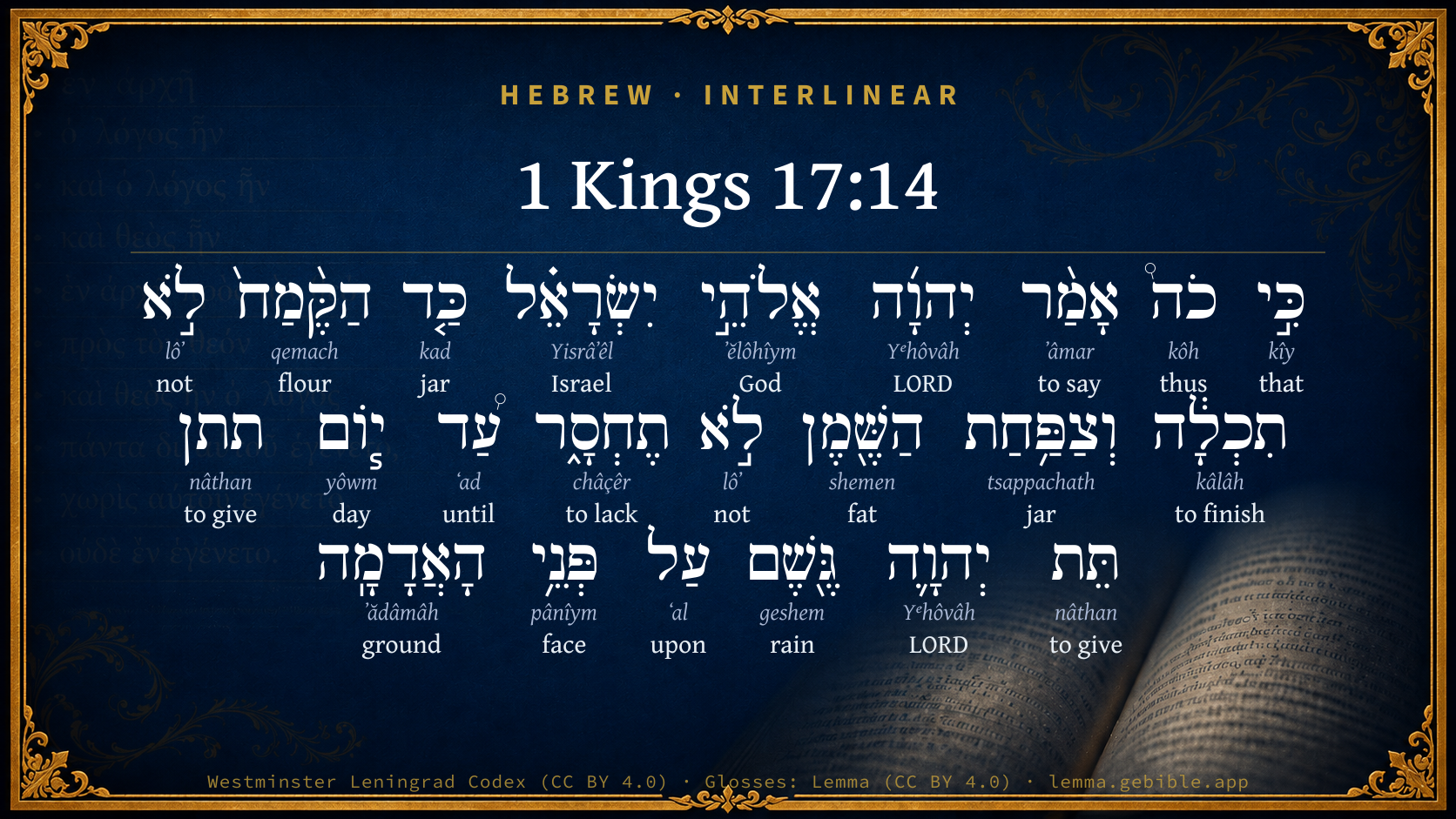
  1. כִּ֣י kîy H3588 “that” Conjunction
  2. כֹה֩ kôh H3541 “thus” Adverb
  3. אָמַ֨ר ʼâmar H559 “to say” Verb, Qal, Perfect, 3rd Person, Masculine, Singular
  4. יְהוָ֜ה Yᵉhôvâh H3068 “LORD” Noun, Proper
  5. אֱלֹהֵ֣י ʼĕlôhîym H430 “God(s) of” Noun, Common, Masculine, Plural, Construct
  6. יִשְׂרָאֵ֗ל Yisrâʼêl H3478 “Israel” Noun, Proper
  7. כַּ֤ד kad H3537 “jar of” Noun, Common, Feminine, Singular, Construct
  8. הַקֶּ֨מַח֙ qemach H7058 “the · flour” Particle, Definite Article + Noun, Common, Masculine, Singular, Absolute
  9. לֹ֣א lôʼ H3808 “not” Particle, Negative
  10. תִכְלָ֔ה kâlâh H3615 “to finish” Verb, Qal, Imperfect, 3rd Person, Feminine, Singular
  11. הַשֶּׁ֖מֶן shemen H8081 “the · fat” Particle, Definite Article + Noun, Common, Masculine, Singular, Absolute
  12. לֹ֣א lôʼ H3808 “not” Particle, Negative
  13. תֶחְסָ֑ר châçêr H2637 “to lack” Verb, Qal, Imperfect, 3rd Person, Feminine, Singular
  14. עַ֠ד ʻad H5704 “until” Preposition
  15. י֧וֹם yôwm H3117 “day of” Noun, Common, Masculine, Singular, Construct
  16. תתן nâthan H5414 “to give” Verb, Qal, Infinitive Construct
  17. תֵּת nâthan H5414 “to give” Verb, Qal, Infinitive Construct
  18. יְהוָ֛ה Yᵉhôvâh H3068 “LORD” Noun, Proper
  19. גֶּ֖שֶׁם geshem H1653 “rain” Noun, Common, Masculine, Singular, Absolute
  20. עַל ʻal H5921 “upon” Preposition
  21. פְּנֵ֥י pânîym H6440 “face(s) of” Noun, Common, Both, Plural, Construct
  22. הָאֲדָמָֽה ʼădâmâh H127 “the · ground” Particle, Definite Article + Noun, Common, Feminine, Singular, Absolute

About this verse

These counts appear in no published source. They are computed here, from the morphology-tagged text and Lemma’s own curated glosses. What Lemma adds →

23
words
20
distinct lemmas
Historical
section

Notable vocabulary

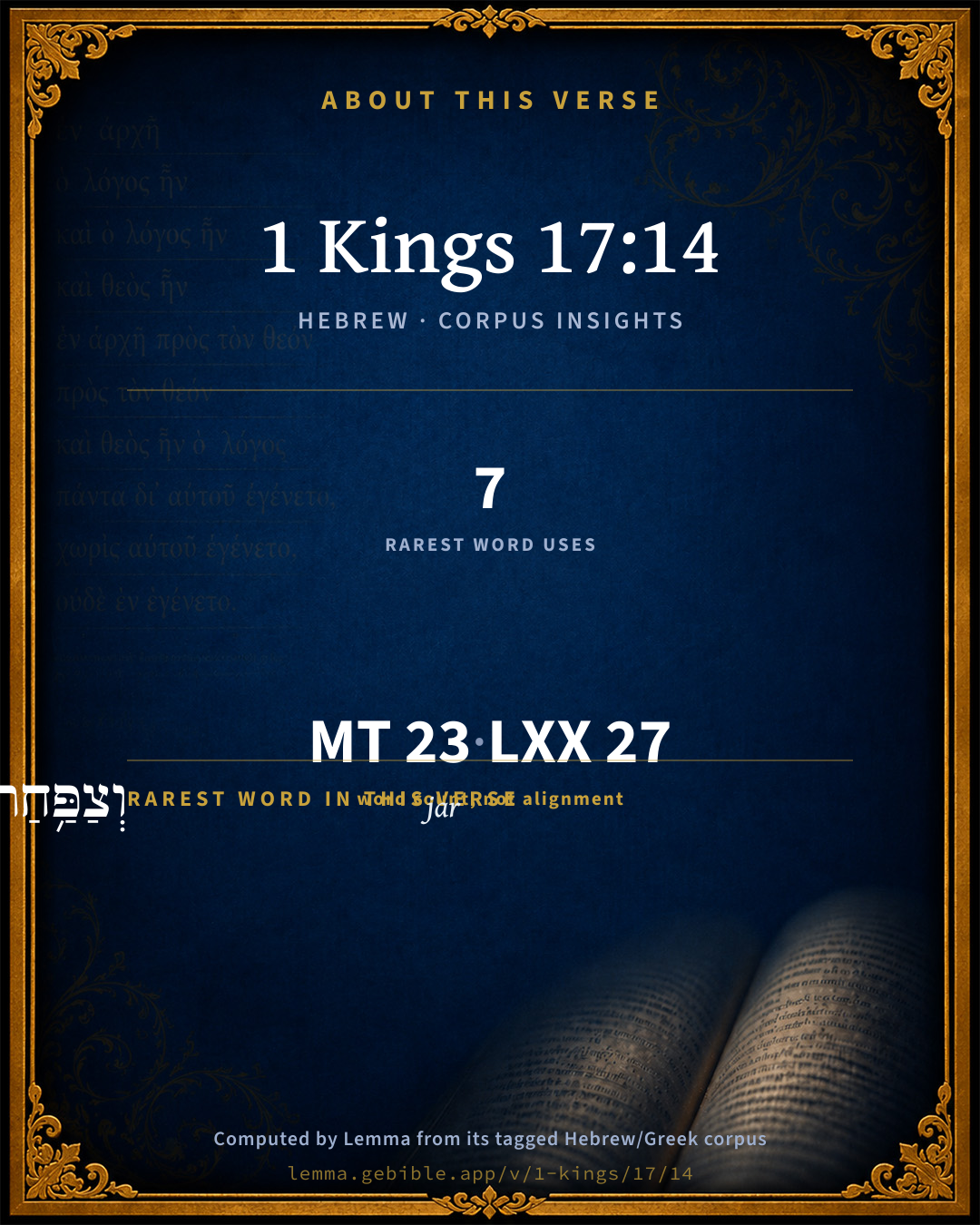
The rarest word here is וְצַפַּ֥חַת jar H6835 — appearing just 7 times in the whole Hebrew Bible.

Shared distinctive vocabulary

וְצַפַּ֥חַת jar H6835 occurs in 7 verses of the Hebrew Bible. Also found in:

Grammatical profile

  • 5 verbs
  • 12 nouns
  • 2 prepositions
  • 1 conjunction
  • 1 adverb
  • 2 particles

Verb forms

  • אָמַ֨ר Qal · Perfect
  • תִכְלָ֔ה Qal · Imperfect
  • תֶחְסָ֑ר Qal · Imperfect
  • תתן Qal · Infinitive Construct
  • תֵּת Qal · Infinitive Construct

Repetition

Words recur within this verse — often emphatic in Hebrew:

  • יְהוָ֜ה LORD H3068 ×2
  • תתן to give H5414 ×2
  • לֹ֣א not H3808 ×2

Hebrew & Septuagint length

In English translation the verse runs 32 words from the Hebrew and 31 from the Septuagint (LXX English) — closely comparable.

A rough comparison of the two English renderings, which tokenize alike — not a word-level alignment.

Word counts can differ between the Hebrew and the Greek without any difference in meaning — e.g. the Hebrew direct-object marker אֵת has no separate Greek word, and Greek often adds the article ὁ.

In the original languages it is 23 Hebrew tokens and 27 Greek tokens — but the two are counted differently (Hebrew bundles its prefixes and suffixes into one token; the Greek is in lemma form), so that isn’t a like-for-like length.

Cross-references

8

Topical passages linked to 1 Kings 17:14 in the Treasury of Scripture Knowledge — connected by theme and wording, ordered by reader-vote popularity; previews shown in the World English Bible.

  • Matthew 15:36–38 and he took the seven loaves and the fish. He gave thanks and broke them, and gave to the disciples, and the disciples to the multitudes.
  • Matthew 14:17–20 They told him, "We only have here five loaves and two fish."
  • 2 Kings 4:42–44 There came a man from Baal Shalishah, and brought the man of God bread of the first fruits, twenty loaves of barley, and fresh ears of grain in his sack. He said, Give to the people, that they may eat.
  • 2 Kings 3:16 He said, Thus says Yahweh, Make this valley full of trenches.
  • 2 Kings 7:1 Elisha said, Hear you the word of Yahweh: thus says Yahweh, Tomorrow about this time shall a measure of fine flour be [sold] for a shekel, and two measures of barley for a shekel, in the gate of Samaria.
  • 1 Kings 17:4 It shall be, that you shall drink of the brook; and I have commanded the ravens to feed you there.
  • 2 Kings 9:6 He arose, and went into the house; and he poured the oil on his head, and said to him, Thus says Yahweh, the God of Israel, I have anointed you king over the people of Yahweh, even over Israel.
  • 2 Kings 4:2–7 Elisha said to her, What shall I do for you? tell me; what have you in the house? She said, Your handmaid has nothing in the house, except a pot of oil.

Cross-references courtesy of OpenBible.info (CC BY 4.0).

Hebrew and Greek witnesses Masoretic Hebrew ↔ Greek Septuagint

The same verse in the two great witnesses to the Old Testament, shown verse-for-verse.

These are two independent witnesses, not word-aligned to each other, and the Septuagint is shown in lemma (dictionary) form.

Hebrew 1 Kings 17:14 Masoretic · Westminster Leningrad Codex

כִּ֣י כֹה֩ אָמַ֨ר יְהוָ֜ה אֱלֹהֵ֣י יִשְׂרָאֵ֗ל כַּ֤ד הַקֶּ֨מַח֙ לֹ֣א תִכְלָ֔ה וְצַפַּ֥חַת הַשֶּׁ֖מֶן לֹ֣א תֶחְסָ֑ר עַ֠ד י֧וֹם תתן תֵּת יְהוָ֛ה גֶּ֖שֶׁם עַל פְּנֵ֥י הָאֲדָמָֽה

For thus says Yahweh, the God of Israel, The jar of meal shall not empty, neither shall the jar of oil fail, until the day that Yahweh sends rain on the earth.

World English Bible · Public Domain

Greek LXX 1 Kings 17:14 Septuagint · lemma form

ὅτι ὅδε λέγω κύριος ὁ ὑδρία ὁ ἄλευρον οὐ ἐκλείπω καί ὁ καψάκης ὁ ἔλαιον οὐ ἐλαττονέω ἕως ἡμέρα ὁ δίδωμι κύριος ὁ ὑετός ἐπί ὁ γῆ

For thus says the Lord, The pitcher of meal shall not fail, and the cruse of oil shall not diminish, until the day that the Lord gives rain upon the earth.

LXX2012 (modern English Septuagint) · Public Domain

On this verse, The Cambridge Bible for Schools and Colleges discusses the Septuagint’s reading. Read the note in Commentary ↓

Hebrew: Westminster Leningrad Codex (CC BY 4.0). Greek: Septuagint (public domain); English from LXX2012 (modern English Septuagint) (Public Domain). How the Septuagint differs from the Hebrew →

Targum (Aramaic paraphrase)

1

The Targum is the ancient Jewish Aramaic paraphrase of the Hebrew Scriptures — an interpretive translation, not the Hebrew text itself. Onkelos (literal) and Pseudo-Jonathan (expansive) render the Torah, and Jonathan the Prophets. Coverage is partial: where no permissively-licensed English translation exists for a verse, only the Aramaic is shown. This is verse-level text, not a word-by-word alignment to the Hebrew.

  1. Targum Jonathan Prophets (Joshua–Malachi)
    אֲרֵי כִדְנַן אֲמַר יְיָ אֱלָהָא דְיִשְׂרָאֵל מָנָא דְקִמְחָא לָא יִגְמַר וּצְלוּחִיתָא דְמִשְׁחָא לָא יֶחְסַר עַד יוֹמָא דְיִתֵּן יְיָ מִטְרָא עַל אַפֵּי אַרְעָא:

    (no public-domain English translation for this verse)

    Targum Jonathan — Aramaic: “Mikraot Gedolot” (public domain). English: “Sefaria Community Translation” (CC0 1.0 (public-domain dedication)); “London "Chaldee Paraphrase," 1871” (public domain). Text via Sefaria.

Commentary

Notes on 1 Kings 17:14 from classic Christian and Jewish commentators (each source and its license shown beneath its notes). The classic Christian expositions comment on the surrounding passage and are grouped to its opening verse, so a note may address several verses; the Jewish commentaries on the Tanakh (Rashi and others) are per-verse, so they appear only where the commentator wrote on this verse.

Lemma curates 59 commentaries, every one of them public domain or Creative Commons licensed, each selected and text-cleaned for this edition rather than reprinted as found. About our sources →

Trapp's Complete Commentary

John Trapp

1Ki 17:14 For thus saith the LORD God of Israel, The barrel of meal shall not waste, neither shall the cruse of oil fail, until the day [that] the LORD sendeth rain upon the earth.

Ver. 14. The barrel of meal shall not waste.] This was hard to believe: but true faith, when it is in heart, will eat its way over all alps of opposition. See 1Ki 17:12.

John Trapp, A Commentary or Exposition upon All the Books of the Old and New Testament (1647–1656) — public domain. Text from a community e-Sword module.

Geneva Bible (1599)

Geneva Bible translators

God receiveth no benefit for the use of his, but he promiseth a most ample recompense for the same.

Geneva Bible (1599) marginal notes — public domain. Text via Bolls.life.

The Cambridge Bible for Schools and Colleges

gen. ed. J. J. S. Perowne

14. God of Israel] Omitted by the LXX., as are also, in the next verse, the words ‘according to the saying of Elijah.’

The Cambridge Bible for Schools and Colleges (gen. ed. J. J. S. Perowne; Cambridge University Press, 1878–1918) — public domain. Text from a community e-Sword module.

John Gill's Exposition

For thus saith the Lord God of Israel,.... Whom the prophet perceived she had knowledge of, and faith in:

the barrel of meal shall not waste, neither shall the cruse of oil fail; that is, the meal in the barrel, and the oil in the cruse, by an hypallage, or change of words:

until the day that the Lord sendeth rain upon the earth; which was assuring her the rain would be sent, and that the Lord, who had the sole command of it, would send it; and that, until that time it should be sent, she would have no lack of provisions, and therefore need not scruple dressing for the prophet first.

John Gill's Exposition of the Whole Bible (1746–1763) — public domain (CC PDM 1.0). Text via the HelloAO Bible API.

Haydock's Catholic Bible Commentary

Until, nor for some time afterwards; otherwise they would still have been in danger of perishing, as the corn could not grow immediately. (Salien, the year before Christ 929.)

George Leo Haydock (1774–1849), Haydock's Catholic Family Bible and Commentary, 1859 edition — public domain. Excludes Psalms (Douay-Rheims chapter numbering differs from Protestant) and Deuterocanonical books (Catholic canon only).

Matthew Poole's English Annotations

Thus saith the Lord God of Israel, in whom I perceive thou trustest.

The barrel of meal, i.e. the meal of the barrel; an hypallage or metonymy. So

the cruse of oil, for the oil of the cruse.

Matthew Poole's English Annotations on the Holy Bible (1683–1685) — public domain. Text from a community e-Sword/MySword module.

Whedon's Commentary on the Bible

Daniel D. Whedon

14. Until… the Lord sendeth rain — It is evident the dearth extended into Phenicia, and Menander (in Josephus) says, that in the reign of Ethbaal there was a want of rain for a whole year.

Daniel D. Whedon (gen. ed.), Commentary on the Old and New Testaments (1874–1909) — public domain. Text from a community e-Sword module.

The Pulpit Commentary

For thus saith the Lord God of Israel The words, "God of Israel," if anything, favour the supposition that he was speaking to one who was not of Israel. See on ver. 1. There the words were addressed to one who was denying the God of Israel The barrel of meal shall not waste, neither shall the cruse of oil fall, until the day that the Lord sendeth Heb. giveth. For teTi (see note on 1Ki_6:19) rain upon the earth. Heb. on the face of the ground. Like expression 1 Kings, Gen_2:5. It has been said that there is not a syllable here to imply a miracle, and it has been contended that this Sareptan household was sustained for over two years simply by the blessing of God on the use of natural means. But clearly, if there was nothing else, there was supernatural knowledge on Elijah"s part. And it cannot be denied that the literal construction of the words points to a "supernatural and inexplicable multiplication of food" (Rawlinson) similar to those of which the Gospels tell. It is just possible that this was a figure of speech, which practically meant no more than the necessaries of life should somehow be provided, directly or indirectly, by God. Nor is this view effectually negatived, as Bahr contends, by Luk_4:26; but, in view of 2Ki_4:44, Mat_14:15-21, Mat_15:32-38, it is extremely improbable. It is curious how many miracles of Elijah and Elisha foreshadowed those of our blessed Lord.

The Pulpit Commentary (1880–1919), ed. H.D.M. Spence-Jones & Joseph S. Exell — public domain. Text from a community e-Sword module.

John Wesley's Explanatory Notes

The barrel, &c. - The meal of the barrel So the cruse of oil for the oil of the cruse.

John Wesley, Explanatory Notes Upon the Whole Bible (1754–1765) — public domain. Text via the GEBible commentary corpus.

unfoldingWord translationNotes

Door43 World Missions Community

Yahweh sends rain

This is an idiom that means Yahweh causes it to rain. AT: "Yahweh causes rain to fall" (See: Idiom)

She and Elijah, along with her household, ate for many days

In the original language it says, "And she and he and her household ate for many days." It is unclear who "he" is. Possible meanings are 1) Elijah, the widow, and her son ate for many days or 2) the widow, her son, and everyone living in her house ate for many days or 3) Elijah, the widow, and everyone living in her house ate for many days.

along with her household

Possible meanings for "household" are 1) this refers only to the widow's son or 2) this refers to other people who live in her house but are not named in the story or 3) this refers to her son and others living in her house.

just as the word of Yahweh had said

Here "word" represents Yahweh himself. AT: "just as Yahweh had said" (See: Metonymy)

translationWords

Israel

send

earth

word of God

unfoldingWord translationNotes — © Distant Shores Media and the Door43 World Missions Community, licensed CC BY-SA 4.0. Source: git.door43.org/Door43/en_tn.

Lesson kit

Teaching starters — assembled from the data on this page, not authored interpretation. Every prompt links to the verse data it draws on. Edit before teaching.

1 Kings, in the Historical, opens this verse with 23 words (20 distinct Hebrew lemmas). Its most distinctive word is tsappachath (“jar”). A historical commentator’s framing appears above. Read the whole chapter for the surrounding context.

Discussion questions

  1. What does “jar” (tsappachath) contribute to the verse as a whole?
  2. 1 Samuel 26:11 shares the word «jar» with this verse. How do the two illuminate each other?
  3. “LORD” occurs 2× in this one verse. What is the effect of the repetition?
  4. These translations render this verse differently. What is at stake in choosing one wording over another?
  5. The verb «אָמַ֨ר» is Qal Perfect. How does its form color the action?
  6. Reading how Trapp's Complete Commentary and Geneva Bible (1599) read this verse, where do the two commentators agree and where do they part?

Things to notice

Reading settings

Reading text

Shown beneath each verse's original-language words.

Old Testament
Old Testament edition

Read the OT as the Masoretic Hebrew (MT) or the Greek Septuagint (LXX).

English shown for the Greek Septuagint (in the Hebrew ↔ Greek comparison).

Comparing translations? Open the Compare panel on any verse page to stack up to four side by side.