
Jeremiah 25:33

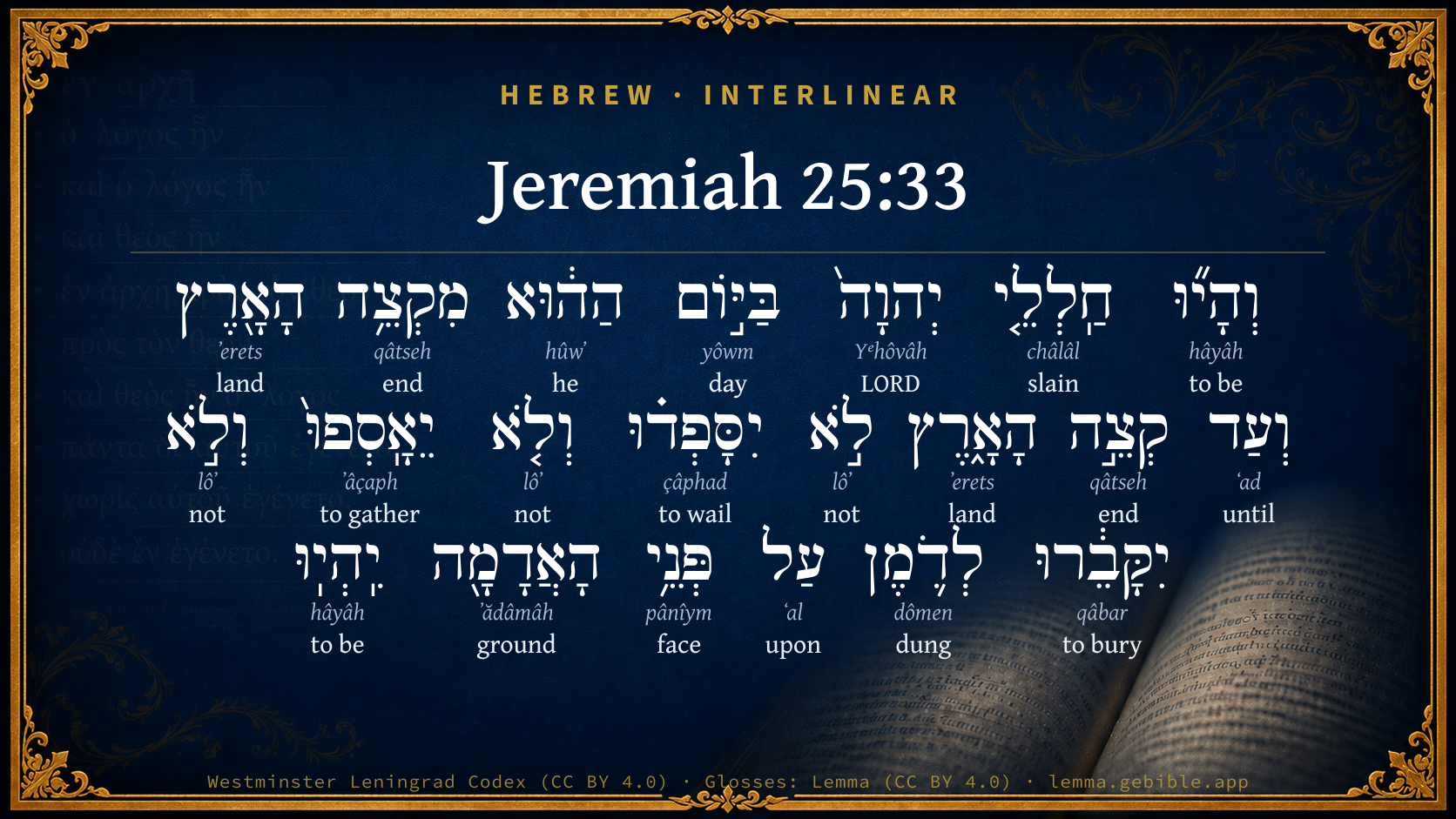
Hebrew (Westminster Leningrad Codex) Jeremiah 25:33 appears in the Hebrew Old Testament. The text above is from the Westminster Leningrad Codex. Each word links to its Strong’s number, a concise gloss, and parsing drawn from the Open Scriptures Hebrew Bible morphology. Click any word for its full Brown-Driver-Briggs (BDB) entry.
Download image
Cite this verse

Jeremiah 25:33 (World English Bible). Public Domain. Lemma interlinear Bible study tool, https://lemma.gebible.app/v/jeremiah/25/33.

Show BibTeX & RIS
BibTeX
RIS
English Translation
The slain of Yahweh shall be at that day from one end of the earth even to the other end of the earth: they shall not be lamented, neither gathered, nor buried; they shall be dung on the surface of the ground.
World English Bible · Public Domain
Download a study sheet

One document with this verse’s original text, its word-by-word gloss line, the meaning frame, cross-references with their text, attributed commentary, and full source and license credits — printable, and it pastes into notes with its structure intact.

This verse Autodidact and up

Study sheet (.html) Plain text (.txt)

A passage Seminary Student

Up to 50 verses in one chapter. A passage sheet keeps up to 6 commentary sources and 12 cross-references per verse, in the order this page ranks them, and says so on the sheet whenever that leaves anything out. Ask for a single verse and you get the Autodidact verse sheet above.

Everything on this page stays free to read, with no account — the sheet is a download of what is already on screen, not access to it.

Want to remove ads? Support Godless Engineer
Compare translations 3

The same verse in 3 English versions, stacked beneath the original-language interlinear above. Click any original word for its lexicon entry.

Each is an independent rendering of the whole verse — the interlinear is not word-aligned to these translations.

Highlighted words mark where these versions differ — a whole-verse word diff, not a word-by-word alignment.

  • World English Bible Public Domain
    The slain of Yahweh shall be at that day from one end of the earth even to the other end of the earth: they shall not be lamented, neither gathered, nor buried; they shall be dung on the surface of the ground.
  • King James Version Public Domain
    And the slain of the LORD shall be at that day from one end of the earth even unto the other end of the earth: they shall not be lamented, neither gathered, nor buried; they shall be dung upon the ground.
  • unfoldingWord Literal Text CC BY-SA 4.0
    And the slain of Yahweh shall be on that day from end of the earth to the end of the earth. They shall not be mourned, and they shall not be gathered, and they shall not be buried. They will be as dung on the face of the ground.

unfoldingWord Literal Text — © unfoldingWord, licensed CC BY-SA 4.0. Word-aligned USFM3 via Door43 (git.door43.org/unfoldingWord/en_ult).

Versions to compare (up to 4)

3 of 4 selected

Show all 18 translations

Every available English version of this verse, each an independent rendering of the whole verse.

  • World English Bible Public Domain
    The slain of Yahweh shall be at that day from one end of the earth even to the other end of the earth: they shall not be lamented, neither gathered, nor buried; they shall be dung on the surface of the ground.
  • Berean Standard Bible Public Domain
    Those slain by the LORD on that day will be spread from one end of the earth to the other. They will not be mourned, gathered, or buried. They will be like dung lying on the ground.
  • Majority Standard Bible Public Domain
    Those slain by the LORD on that day will be spread from one end of the earth to the other. They will not be mourned, gathered, or buried. They will be like dung lying on the ground.
  • King James Version Public Domain
    And the slain of the LORD shall be at that day from one end of the earth even unto the other end of the earth: they shall not be lamented, neither gathered, nor buried; they shall be dung upon the ground.
  • American Standard Version (1901) Public Domain
    And the slain of Jehovah shall be at that day from one end of the earth even unto the other end of the earth: they shall not be lamented, neither gathered, nor buried; they shall be dung upon the face of the ground.
  • Revised Version (1885) Public Domain
    And the slain of the LORD shall be at that day from one end of the earth even unto the other end of the earth: they shall not be lamented, neither gathered, nor buried; they shall be dung upon the face of the ground.
  • Geneva Bible (1599) Public Domain
    And the slaine of the Lord shall be at that day, from one ende of the earth, euen vnto the other ende of the earth: they shall not bee mourned, neither gathered nor buried, but shalbe as the dongue vpon the grounde.
  • Douay-Rheims (1899) Public Domain
    And the slain of the Lord shall be at that day from one end of the earth even to the other end thereof: they shall not be lamented, and they shall not be gathered up, nor buried: they shall lie as dung upon the face of the earth.
  • Young's Literal Translation Public Domain
    And the pierced of Jehovah have been in that day, From the end of the earth even unto the end of the earth, They are not lamented, nor gathered, nor buried, For dung on the face of the ground they are.
  • Literal Standard Version CC BY-SA 4.0
    And the pierced of YHWH have been in that day, || From the end of the earth even to the end of the earth, || They are not lamented, nor gathered, nor buried, || For they are dung on the face of the ground.
  • Unlocked Literal Bible CC BY-SA 4.0
    Then those killed by Yahweh will on that day extend from one end of the earth to the other; they will not be mourned, gathered, or buried. They will be like dung on the ground.
  • unfoldingWord Literal Text CC BY-SA 4.0
    And the slain of Yahweh shall be on that day from end of the earth to the end of the earth. They shall not be mourned, and they shall not be gathered, and they shall not be buried. They will be as dung on the face of the ground.
  • Darby Bible Public Domain
    And the slain of Jehovah shall [be] at that day from [one] end of the earth even unto the [other] end of the earth: they shall not be lamented, neither gathered, nor buried; they shall be dung upon the face of the ground.
  • World Messianic Bible Public Domain
    The slain of the LORD will be at that day from one end of the earth even to the other end of the earth. They won’t be lamented. They won’t be gathered or buried. They will be dung on the surface of the ground.
  • Webster's Bible Public Domain
    And the slain of the LORD shall be at that day from one end of the earth even to the other end of the earth: they shall not be lamented, neither gathered, nor buried; they shall be dung upon the ground.
  • Free Bible Version CC BY-SA 4.0
    Those killed by the Lord at that time will cover the earth from one end to the other. No one will mourn them, or collect them, or bury them. They will be like piles of manure lying on the ground.
  • Bible in Basic English Public Domain
    And at that day, the bodies of those whom the Lord has put to death will be seen from one end of the earth even to the other end of the earth: there will be no weeping for them, their bodies will not be taken up or put to rest in the earth; they will be like waste on the face of the land.
  • JPS Tanakh (1917) Public Domain
    And the slain of the LORD shall be at that day from one end of the earth even unto the other end of the earth; they shall not be lamented, neither gathered, nor buried; they shall be dung upon the face of the ground.

Literal Standard Version (2020), Covenant Press — licensed CC BY-SA 4.0. Text via the HelloAO Bible API (eBible.org). Unlocked Literal Bible (unfoldingWord) — licensed CC BY-SA 4.0. Text via the HelloAO Bible API (eBible.org). unfoldingWord Literal Text — © unfoldingWord, licensed CC BY-SA 4.0. Word-aligned USFM3 via Door43 (git.door43.org/unfoldingWord/en_ult). Free Bible Version, Dr. Jonathan Gallagher — licensed CC BY-SA 4.0. Text via the HelloAO Bible API (eBible.org).

Word by word

More ways to search: Search by grammar → Find every occurrence → Compare this word →

Practice this passage: Drill this verse → Learn its vocabulary →

לְדֹ֛מֶן
dômen
H1828
“to/for · dung”
Preposition + Noun, Common, Masculine, Singular, Absolute
Part of Speech
Preposition + Noun
Type
Common
Gender
Masculine
Number
Singular
State
Absolute
Full BDB Definition

Origin: of uncertain derivation

TWOT: 441a

dung (always of corpses) (figuratively)
  1. וְהָי֞וּ hâyâh H1961 “and · to be” Conjunction + Verb, Qal, Sequential Perfect, 3rd Person, Common, Plural
  2. חַֽלְלֵ֤י châlâl H2491 “slain of” Adjective, Adjective, Masculine, Plural, Construct
  3. יְהוָה֙ Yᵉhôvâh H3068 “LORD” Noun, Proper
  4. בַּיּ֣וֹם yôwm H3117 “in/at the · day” Preposition, Determined + Noun, Common, Masculine, Singular, Absolute
  5. הַה֔וּא hûwʼ H1931 “the · he” Particle, Definite Article + Pronoun, Personal, 3rd Person, Masculine, Singular
  6. מִקְצֵ֥ה qâtseh H7097 “from · end of” Preposition + Noun, Common, Both, Singular, Construct
  7. הָאָ֖רֶץ ʼerets H776 “the · land” Particle, Definite Article + Noun, Common, Both, Singular, Absolute
  8. וְעַד ʻad H5704 “and · until” Conjunction + Preposition
  9. קְצֵ֣ה qâtseh H7097 “end of” Noun, Common, Both, Singular, Construct
  10. הָאָ֑רֶץ ʼerets H776 “the · land” Particle, Definite Article + Noun, Common, Both, Singular, Absolute
  11. לֹ֣א lôʼ H3808 “not” Particle, Negative
  12. יִסָּפְד֗וּ çâphad H5594 “to wail” Verb, Niphal, Imperfect, 3rd Person, Masculine, Plural
  13. וְלֹ֤א lôʼ H3808 “and · not” Conjunction + Particle, Negative
  14. יֵאָֽסְפוּ֙ ʼâçaph H622 “to gather” Verb, Niphal, Imperfect, 3rd Person, Masculine, Plural
  15. וְלֹ֣א lôʼ H3808 “and · not” Conjunction + Particle, Negative
  16. יִקָּבֵ֔רוּ qâbar H6912 “to bury” Verb, Niphal, Imperfect, 3rd Person, Masculine, Plural
  17. עַל ʻal H5921 “upon” Preposition
  18. פְּנֵ֥י pânîym H6440 “face(s) of” Noun, Common, Both, Plural, Construct
  19. הָאֲדָמָ֖ה ʼădâmâh H127 “the · ground” Particle, Definite Article + Noun, Common, Feminine, Singular, Absolute
  20. יִֽהְיֽוּ hâyâh H1961 “to be” Verb, Qal, Imperfect, 3rd Person, Masculine, Plural

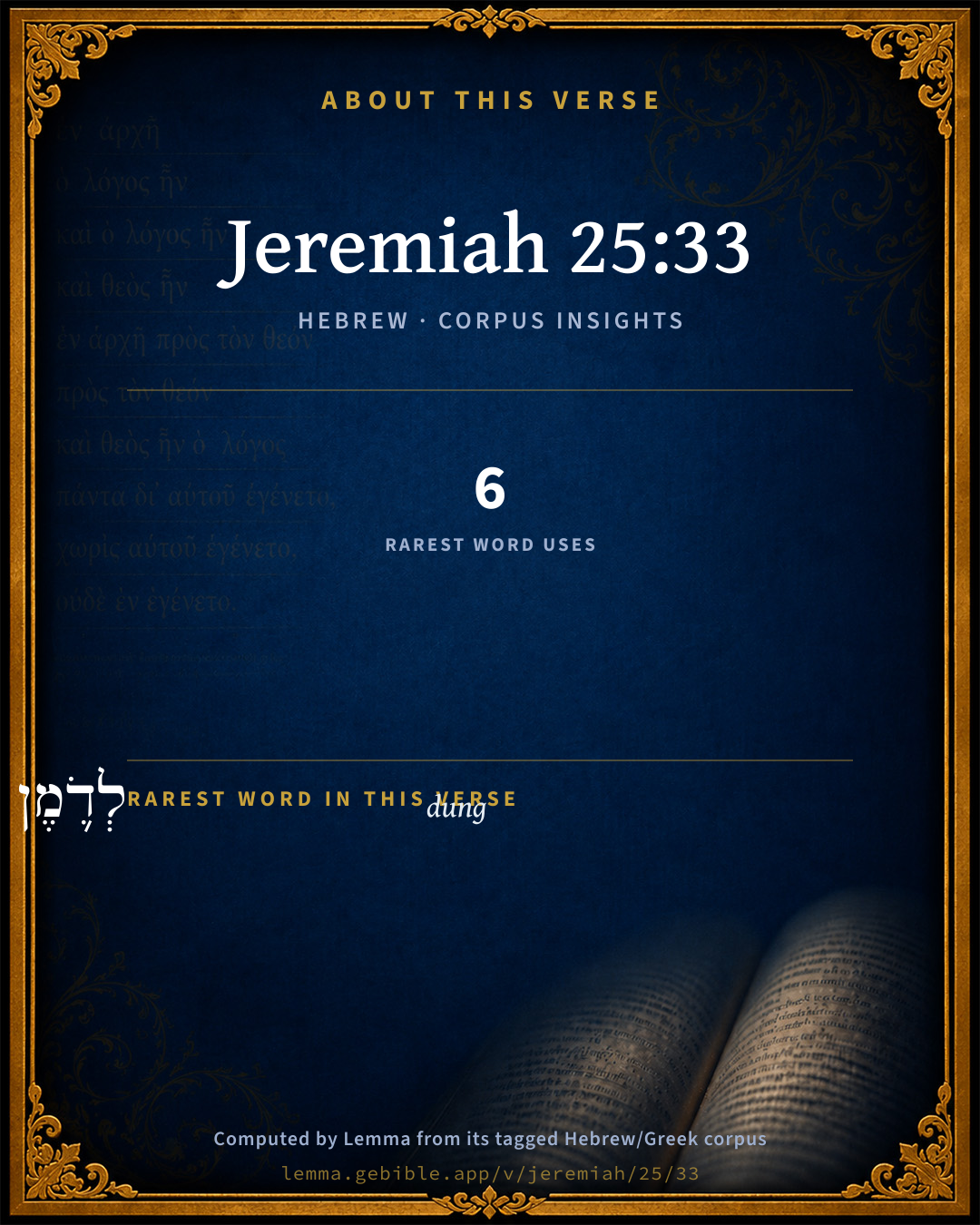
About this verse

These counts appear in no published source. They are computed here, from the morphology-tagged text and Lemma’s own curated glosses. What Lemma adds →

21
words
16
distinct lemmas
Prophets
section

Notable vocabulary

The rarest word here is לְדֹ֛מֶן dung H1828 — appearing just 6 times in the whole Hebrew Bible.

Shared distinctive vocabulary

לְדֹ֛מֶן dung H1828 occurs in 6 verses of the Hebrew Bible. Also found in:

Grammatical profile

  • 5 verbs
  • 9 nouns
  • 1 adjective
  • 1 pronoun
  • 2 prepositions
  • 3 particles

Verb forms

  • וְהָי֞וּ Qal · Sequential Perfect
  • יִסָּפְד֗וּ Niphal · Imperfect
  • יֵאָֽסְפוּ֙ Niphal · Imperfect
  • יִקָּבֵ֔רוּ Niphal · Imperfect
  • יִֽהְיֽוּ Qal · Imperfect

Repetition

Words recur within this verse — often emphatic in Hebrew:

  • וְהָי֞וּ to be H1961 ×2
  • מִקְצֵ֥ה end H7097 ×2
  • הָאָ֖רֶץ land H776 ×2
  • לֹ֣א not H3808 ×3

Cross-references

16

Topical passages linked to Jeremiah 25:33 in the Treasury of Scripture Knowledge — connected by theme and wording, ordered by reader-vote popularity; previews shown in the World English Bible.

  • Isaiah 66:16 For by fire will Yahweh execute judgment, and by his sword, on all flesh; and the slain of Yahweh shall be many.
  • Jeremiah 8:2 and they shall spread them before the sun, and the moon, and all the host of the sky, which they have loved, and which they have served, and after which they have walked, and which they have sought, and which they have worshiped: they shall not be gathered, nor be buried, they shall be for dung on the surface of the earth.
  • Psalms 79:3 Their blood they have shed like water around Jerusalem. There was no one to bury them.
  • Isaiah 5:25 Therefore Yahweh's anger burns against his people, And he has stretched out his hand against them, and has struck them. The mountains tremble, And their dead bodies are as refuse in the midst of the streets. For all this, his anger is not turned away, But his hand is still stretched out.
  • Jeremiah 16:4–7 They shall die grievous deaths: they shall not be lamented, neither shall they be buried; they shall be as dung on the surface of the ground; and they shall be consumed by the sword, and by famine; and their dead bodies shall be food for the birds of the sky, and for the animals of the earth.
  • 2 Kings 9:37 and the body of Jezebel shall be as dung on the face of the field in the portion of Jezreel, so that they shall not say, This is Jezebel.
  • Psalms 83:10 Who perished at Endor, Who became as dung for the earth.
  • Isaiah 34:2–8 For Yahweh has indignation against all the nations, and wrath against all their host: he has utterly destroyed them, he has delivered them to the slaughter.
  • Jeremiah 13:12–14 Therefore you shall speak to them this word: Thus says Yahweh, the God of Israel, Every bottle shall be filled with wine: and they shall tell you, Do we not certainly know that every bottle shall be filled with wine?
  • Jeremiah 25:18–26 [to wit], Jerusalem, and the cities of Judah, and the kings of it, and the princes of it, to make them a desolation, an astonishment, a hissing, and a curse, as it is this day;
  • Ezekiel 39:4–20 You shall fall on the mountains of Israel, you, and all your hordes, and the peoples who are with you: I will give you to the ravenous birds of every sort, and to the animals of the field to be devoured.
  • Zephaniah 2:12 You Cushites also, you will be killed by my sword.
  • Revelation 11:9 From among the peoples, tribes, languages, and nations people will look at their dead bodies for three and a half days, and will not allow their dead bodies to be laid in a tomb.
  • Revelation 14:19–20 The angel thrust his sickle into the earth, and gathered the vintage of the earth, and threw it into the great winepress of the wrath of God.
  • Revelation 19:17–21 I saw an angel standing in the sun. He cried with a loud voice, saying to all the birds that fly in the sky, "Come! Be gathered together to the great supper of God,
  • Jeremiah 9:21–22 For death is come up into our windows, it is entered into our palaces; to cut off the children from outside, [and] the young men from the streets.

Cross-references courtesy of OpenBible.info (CC BY 4.0).

Hebrew and Greek witnesses Masoretic Hebrew ↔ Greek Septuagint

The same verse in the two great witnesses to the Old Testament, shown verse-for-verse.

These are two independent witnesses, not word-aligned to each other, and the Septuagint is shown in lemma (dictionary) form.

Hebrew Jeremiah 25:33 Masoretic · Westminster Leningrad Codex

וְהָי֞וּ חַֽלְלֵ֤י יְהוָה֙ בַּיּ֣וֹם הַה֔וּא מִקְצֵ֥ה הָאָ֖רֶץ וְעַד קְצֵ֣ה הָאָ֑רֶץ לֹ֣א יִסָּפְד֗וּ וְלֹ֤א יֵאָֽסְפוּ֙ וְלֹ֣א יִקָּבֵ֔רוּ לְדֹ֛מֶן עַל פְּנֵ֥י הָאֲדָמָ֖ה יִֽהְיֽוּ

The slain of Yahweh shall be at that day from one end of the earth even to the other end of the earth: they shall not be lamented, neither gathered, nor buried; they shall be dung on the surface of the ground.

World English Bible · Public Domain

Greek LXX Structure differs

In the Septuagint, Jeremiah is about an eighth shorter than the Hebrew and arranges its material differently — the Oracles Against the Nations (Hebrew chapters 46–51) appear in the middle of the Greek book, after 25:13. Because the chapter and verse boundaries do not line up, a verse-for-verse comparison with the Hebrew is not shown.

A verse-for-verse comparison isn’t shown here because the chapters and verses don’t line up. Switch to the LXX edition with the MT / LXX toggle above to read the Greek directly.

On this verse, The Cambridge Bible for Schools and Colleges discusses the Septuagint’s reading. Read the note in Commentary ↓

Hebrew: Westminster Leningrad Codex (CC BY 4.0). Greek: Septuagint (public domain); English from a public-domain English Septuagint. How the Septuagint differs from the Hebrew →

Targum (Aramaic paraphrase)

1

The Targum is the ancient Jewish Aramaic paraphrase of the Hebrew Scriptures — an interpretive translation, not the Hebrew text itself. Onkelos (literal) and Pseudo-Jonathan (expansive) render the Torah, and Jonathan the Prophets. Coverage is partial: where no permissively-licensed English translation exists for a verse, only the Aramaic is shown. This is verse-level text, not a word-by-word alignment to the Hebrew.

  1. Targum Jonathan Prophets (Joshua–Malachi)
    וִיהוֹן קְטִילַיָא רְמַן קֳדָם יְיָ בְּיוֹמָא הַהוּא מִסְיָפֵי אַרְעָא וְעַד סְיָפֵי אַרְעָא לָא יִסְתַּפְּדוּן וְלָא יִתְכַּנְשׁוּן וְלָא יִתְקַבְּרוּן לְזֵיבַל מְבַדֵר עַל אַפֵּי אַרְעָא יְהוֹן:

    (no public-domain English translation for this verse)

    Targum Jonathan — Aramaic: “Mikraot Gedolot” (public domain). English: “Sefaria Community Translation” (CC0 1.0 (public-domain dedication)); “London "Chaldee Paraphrase," 1871” (public domain). Text via Sefaria.

Commentary

Notes on Jeremiah 25:33 from classic Christian and Jewish commentators (each source and its license shown beneath its notes). The classic Christian expositions comment on the surrounding passage and are grouped to its opening verse, so a note may address several verses; the Jewish commentaries on the Tanakh (Rashi and others) are per-verse, so they appear only where the commentator wrote on this verse.

Lemma curates 59 commentaries, every one of them public domain or Creative Commons licensed, each selected and text-cleaned for this edition rather than reprinted as found. About our sources →

Trapp's Complete Commentary

John Trapp

Jer 25:33 And the slain of the LORD shall be at that day from [one] end of the earth even unto the [other] end of the earth: they shall not be lamented, neither gathered, nor buried; they shall be dung upon the ground.

Ver. 33. And the slain of the Lord shall be, &c.] Such an utter destruction of the wicked is expected by the Jews at the coming of their Messiah, as of all people under heaven they are the most apt to work themselves into the fool’s paradise of a sublime dotage, being light, aerial, fanatical.

John Trapp, A Commentary or Exposition upon All the Books of the Old and New Testament (1647–1656) — public domain. Text from a community e-Sword module.

Geneva Bible (1599)

Geneva Bible translators

They which are slain at the Lord’s appointment.

Geneva Bible (1599) marginal notes — public domain. Text via Bolls.life.

Adam Clarke's Commentary

Verse 33. From one end of the earth] From one end of the land to the other. All Palestine shall be desolated by it.

Adam Clarke's Commentary on the Bible (1810–1826) — public domain. Text from a community e-Sword/MySword module.

John Calvin's Commentaries

This verse explains what I have just said; and hence it also appears that the Prophet did not speak of mutual slaughters inflicted by one nation on another, but that he only declared that God’s wrath would spread like a storm so as to extend to all nations and lands. The Prophet no doubt continues the same subject; and we see why he says here, And the slain, of Jehovah shall be in that day, etc.; he calls our attention to God alone; he will speak otherwise hereafter, he does not set here before us the ministers of God’s vengeance, but God himself as acting by himself.

Hence he says, the slain of Jehovah; some read, “the wounded;” and חלל, chelal, means to wound and to kill; but “the slain” is more suitable here. The slain then of Jehovah shall be from one extremity of the earth to the other; as though he had said, that God would not be satisfied with punishing three or four nations, but would shew himself the judge of all the countries of the earth.

Now this passage is worthy of special notice; for we often wonder why God connives at so many crimes committed by men, which none of us would tolerate. But if we consider how dreadful was the tempest of which the Prophet now speaks, we ought to know that God rests for a time, in order that the ungodly and the wicked might be the less excusable. It was at the same time doubtless a sad spectacle, when so many regions and provinces were unceasingly suffering various calamities, when one nation thought itself better off than its neighbors, but presently found itself more cruelly treated. And yet this was generally the case, for God’s wrath extended to the extremities of the earth.

He amplifies the atrocity of the evil by mentioning three things, — They shall not be lamented, nor gathered, nor buried; but they shall be as dung, and shall thus lie on the face of the earth We have said in other places that lamentation does no good to the dead; but as it is what humanity requires, the want of it is rightly deemed a temporal punishment. So when any one is deprived of burial, it is certainly nothing to the dead if his body is not laid in a grave; for we know that God’s holy servants have often been either burnt or hung or exposed to wild beasts; and the whole Church complains that dead bodies were lying around Jerusalem and became food to the birds of heaven and to the beasts of the earth. But these things do not disprove the fact, that burial is an evidence of God’s paternal kindness towards men. For why has he appointed that men should be buried rather than brute animals, except that he designed it to be an intimation of an immortal life? As, then, burial is a sign of God’s favor, it is no wonder that he often declares to the reprobate that their dead bodies would be cast away, so as not to be honored, with a grave.

But we must remember this truth, — that temporal punishments happen in common to God’s children and to aliens; God extends without any difference temporal punishments to his own children and to the unbelieving, and that in order that it may be made evident that our hope ought not to be fixed on this world. But however this may be, it is yet true that when God punishes the unbelieving in this way, he adds at the same time some remark by which it may be understood, that it happens not in vain nor undesignedly, that those are deprived of burial, who deserve that God should exterminate them from the earth, and that their memory should be obliterated, so that they should not be connected among men. But we have said also in another place, that such expressions admit of another meaning, which yet is not at variance with the former, but connected with it, and that is, that so great would be the slaughter, that none would be left to shew this kindness to his friend or to his neighbor or to his brother. For when four or ten or a hundred die, they may be buried; but when God slays by the sword a great number in one day, none are found to take care of burying the dead, as few remain alive, and even they dread their enemies. When therefore the prophets say that those whom God slew would be without lamentation and burial, they intimate that so great would be the number, that all would lie on the ground; for no one would dare to perform this humane act towards the dead, and were all to do their utmost, they would not be able, as the number would be so great.

Thus Jeremiah confirms what we have said, — that God’s vengeance would extend to all lands and all nations, so as to involve in ruin the nobles as well as the common people, and to leave remaining but a small number.

For the same purpose he adds what follows, that they would be as dung on the face of the earth This is added by way of contempt. It was then hardly credible, that so many illustrious, wealthy, and powerful nations could thus in so short a time be destroyed. But the Prophet, in order to shake off this false conceit, says that they would become like dung, that however great their dignity and power, their wealth and strength, might be, they could not yet escape the hand of God, for he would reduce to nothing the glory of the whole world. We now perceive the real meaning of the Prophet. It then follows —

John Calvin's Commentaries (1540-1563) — public domain. Text from the Calvin Translation Society English edition (1840s-50s) via the Christian Classics Ethereal Library (ccel.org). Calvin's coverage is partial (roughly two-thirds of the Bible); uncommented books and verses are honest gaps, never fabricated. The 19th-century editor's footnotes and remarks are omitted so the notes are faithfully Calvin's own voice.

Ellicott's Commentary for English Readers

(33) They shall not be lamented . . .—As in other pictures of slaughter (Jer_8:2; Jer_16:4) the omission of the usual rites of sepulture is brought in as an aggravation of the wretchedness. The corpses of the slain are to lie rotting on the ground. The phrase “slain of the Lord” reproduces Isa_66:16.

A Bible Commentary for English Readers, edited by Charles John Ellicott (1878–1897) — public domain. Text from a community e-Sword module.

The Cambridge Bible for Schools and Colleges

gen. ed. J. J. S. Perowne

33. the slain of the Lord] For the phrase cp. Isa_66:16.

they shall not … gathered] omitted by LXX and apparently inserted here by MT. from Jer_8:2.

The Cambridge Bible for Schools and Colleges (gen. ed. J. J. S. Perowne; Cambridge University Press, 1878–1918) — public domain. Text from a community e-Sword module.

John Gill's Exposition

Howl, ye shepherds, and cry,.... The Targum is,

"howl, ye kings, and cry;''

and the rulers and governors of the nations before threatened with destruction are meant; who are here called upon to lamentation and mourning for the ruin and loss of their kingdoms; though Calvin thinks that this is an apostrophe to the Jewish nation, and the rulers of it. It is no uncommon thing in Scripture to call kings and civil magistrates shepherds; see Jer 23:1;

and wallow yourselves in the ashes, ye principal of the flock; or "roll yourselves in dust", as a token of mourning; as being in the utmost distress, and incapable of helping themselves, and redressing the grievances of their people; and therefore lie down and tumble about as in the greatest anxiety and trouble, the Targum is,

"cover your heads with ashes, ye mighty of the people;''

meaning those who were in the highest posts of honour and profit; the chief as to authority and power, riches and wealth;

for the days of your slaughter and of your dispersions are accomplished; the time is come when they who were the fat of the flock, and were nourished up for slaughter, should be slain. The allusion to shepherds and sheep is still kept up; and such who should escape that, should be scattered up and down the world, as a flock of sheep is by the wolf, or any other beast of prey, when some are seized and devoured, and others dispersed; and this was not the case of the Jews only, but of other nations in their turn;

and ye shall fall like a pleasant vessel; a vessel of worth and value, and so desirable; as vessels of glass, of gems, or of earth, as of Venice glass, of alabaster, of China; which when they fall and are broken, become useless, and are irreparable; signifying hereby, that their desirableness and excellency would not secure them from destruction, and that their ruin would be irretrievable.

John Gill's Exposition of the Whole Bible (1746–1763) — public domain (CC PDM 1.0). Text via the HelloAO Bible API.

Albert Barnes' Notes on the Bible

Lamented - See the marginal reference and Jer 8:2.

Albert Barnes' Notes on the Bible (1834–1885) — public domain. Text from a community e-Sword/MySword module.

Matthew Poole's English Annotations

That those who should be slain by commission from the Lord in this time of his judgments should be in all places, and so numerous, that there should be none left to lament for or to bury the dead; but the dead bodies should lie and rot upon the surface of the earth, and be as muck to it. See the like phrases Jer 16:4.

Matthew Poole's English Annotations on the Holy Bible (1683–1685) — public domain. Text from a community e-Sword/MySword module.

The Pulpit Commentary

The slain of the Lord; i.e. those slain by the Lord, as Isa_66:16, where his sword is further spoken of as the agent (see on ver. 16). They shall not be lamented, etc.; parallel to Jer_8:2 Jer_16:4.

The Pulpit Commentary (1880–1919), ed. H.D.M. Spence-Jones & Joseph S. Exell — public domain. Text from a community e-Sword module.

Lesson kit

Teaching starters — assembled from the data on this page, not authored interpretation. Every prompt links to the verse data it draws on. Edit before teaching.

Jeremiah, in the Prophets, opens this verse with 21 words (16 distinct Hebrew lemmas). Its most distinctive word is dômen (“dung”). A historical commentator’s framing appears above. Read the whole chapter for the surrounding context.

Discussion questions

  1. What does “dung” (dômen) contribute to the verse as a whole?
  2. 2 Kings 9:37 shares the word «dung» with this verse. How do the two illuminate each other?
  3. “to be” occurs 2× in this one verse. What is the effect of the repetition?
  4. These translations render this verse differently; the difference is in the English rendering, not the original. What questions does that raise?
  5. The verb «וְהָי֞וּ» is Qal Sequential Perfect. How does its form color the action?
  6. Reading how Trapp's Complete Commentary and Geneva Bible (1599) read this verse, where do the two commentators agree and where do they part?

Things to notice

Reading settings

Reading text

Shown beneath each verse's original-language words.

Old Testament
Old Testament edition

Read the OT as the Masoretic Hebrew (MT) or the Greek Septuagint (LXX).

English shown for the Greek Septuagint (in the Hebrew ↔ Greek comparison).

Comparing translations? Open the Compare panel on any verse page to stack up to four side by side.