
2 Samuel 15:32

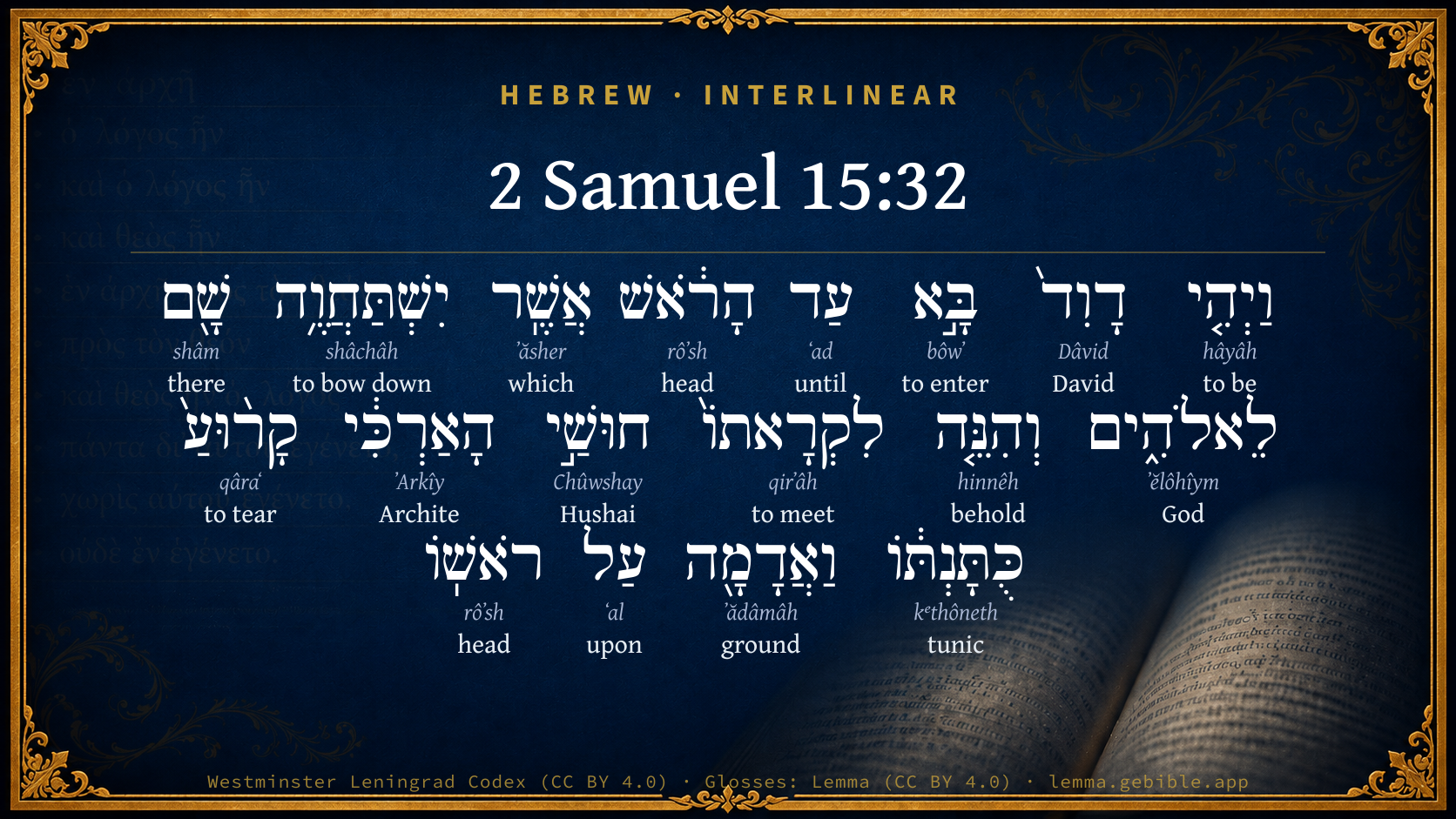
Hebrew (Westminster Leningrad Codex) 2 Samuel 15:32 appears in the Hebrew Old Testament. The text above is from the Westminster Leningrad Codex. Each word links to its Strong’s number, a concise gloss, and parsing drawn from the Open Scriptures Hebrew Bible morphology. Click any word for its full Brown-Driver-Briggs (BDB) entry.
Download image
Cite this verse

2 Samuel 15:32 (World English Bible). Public Domain. Lemma interlinear Bible study tool, https://lemma.gebible.app/v/2-samuel/15/32.

Show BibTeX & RIS
BibTeX
RIS
English Translation
It happened that when David had come to the top [of the ascent], where God was worshiped, behold, Hushai the Archite came to meet him with his coat torn, and earth on his head.
World English Bible · Public Domain
Highlights
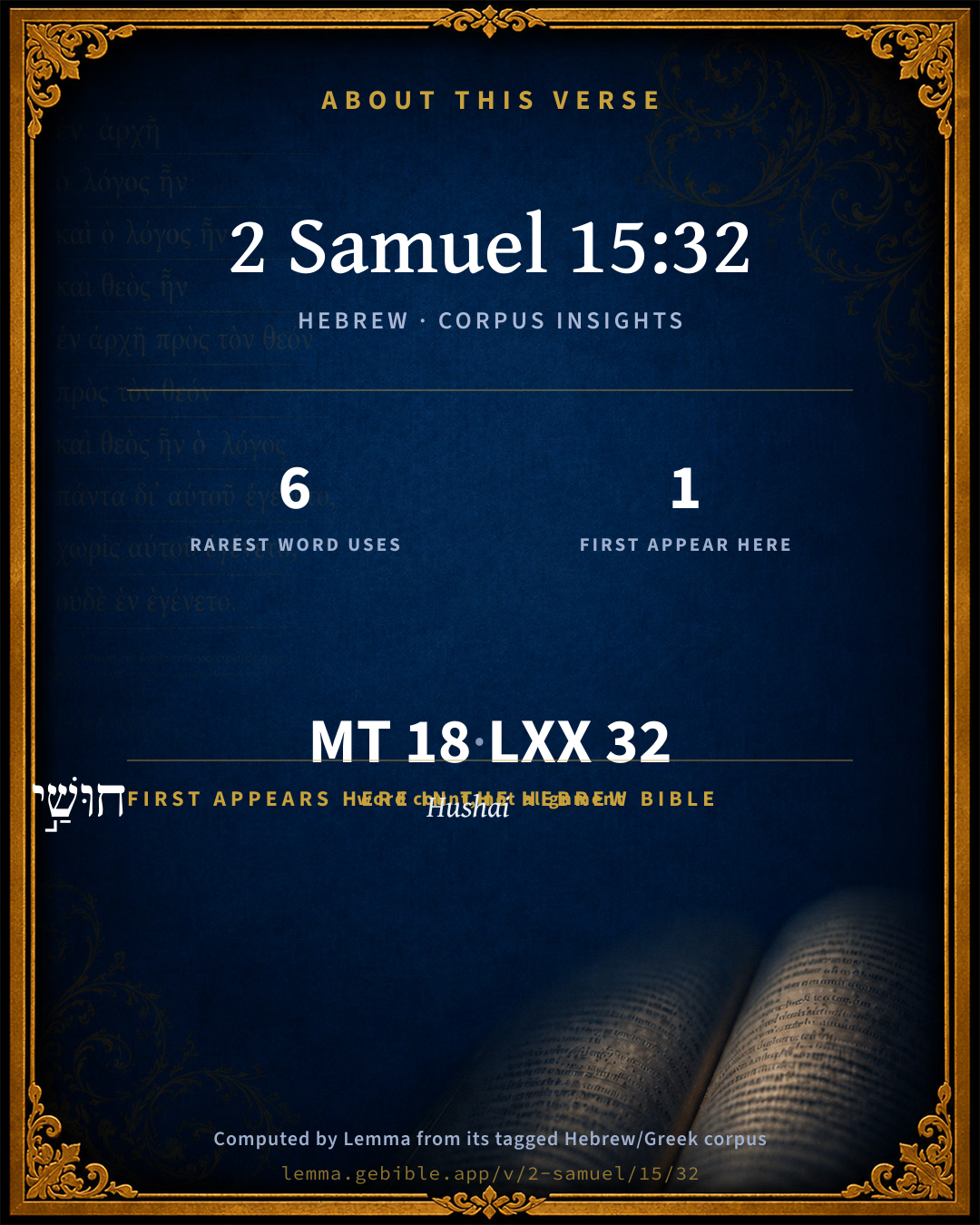
  • 1 first appearance in the Hebrew Bible
Full analysis ↓
Download a study sheet

One document with this verse’s original text, its word-by-word gloss line, the meaning frame, cross-references with their text, attributed commentary, and full source and license credits — printable, and it pastes into notes with its structure intact.

This verse Autodidact and up

Study sheet (.html) Plain text (.txt)

A passage Seminary Student

Up to 50 verses in one chapter. A passage sheet keeps up to 6 commentary sources and 12 cross-references per verse, in the order this page ranks them, and says so on the sheet whenever that leaves anything out. Ask for a single verse and you get the Autodidact verse sheet above.

Everything on this page stays free to read, with no account — the sheet is a download of what is already on screen, not access to it.

Want to remove ads? Support Godless Engineer
Compare translations 3

The same verse in 3 English versions, stacked beneath the original-language interlinear above. Click any original word for its lexicon entry.

Each is an independent rendering of the whole verse — the interlinear is not word-aligned to these translations.

Highlighted words mark where these versions differ — a whole-verse word diff, not a word-by-word alignment.

  • World English Bible Public Domain
    It happened that when David had come to the top [of the ascent], where God was worshiped, behold, Hushai the Archite came to meet him with his coat torn, and earth on his head.
  • King James Version Public Domain
    And it came to pass, that when David was come to the top of the mount, where he worshipped God, behold, Hushai the Archite came to meet him with his coat rent, and earth upon his head:
  • unfoldingWord Literal Text CC BY-SA 4.0
    And it happened, David came to the top, where one would prostrate himself to God there, and behold, meeting him Hushai the Archite. His robe was torn, and dirt on his head.

unfoldingWord Literal Text — © unfoldingWord, licensed CC BY-SA 4.0. Word-aligned USFM3 via Door43 (git.door43.org/unfoldingWord/en_ult).

Versions to compare (up to 4)

3 of 4 selected

Show all 18 translations

Every available English version of this verse, each an independent rendering of the whole verse.

  • World English Bible Public Domain
    It happened that when David had come to the top [of the ascent], where God was worshiped, behold, Hushai the Archite came to meet him with his coat torn, and earth on his head.
  • Berean Standard Bible Public Domain
    When David came to the summit, where he used to worship God, Hushai the Archite was there to meet him with his robe torn and dust on his head.
  • Majority Standard Bible Public Domain
    When David came to the summit, where he used to worship God, Hushai the Archite was there to meet him with his robe torn and dust on his head.
  • King James Version Public Domain
    And it came to pass, that when David was come to the top of the mount, where he worshipped God, behold, Hushai the Archite came to meet him with his coat rent, and earth upon his head:
  • American Standard Version (1901) Public Domain
    And it came to pass, that, when David was come to the top `of the ascent', where God was worshipped, behold, Hushai the Archite came to meet him with his coat rent, and earth upon his head.
  • Revised Version (1885) Public Domain
    And it came to pass, that when David was come to the top of the ascent, where God was worshipped, behold, Hushai the Archite came to meet him with his coat rent, and earth upon his head:
  • Geneva Bible (1599) Public Domain
    Then Dauid came to the toppe of the mount where he worshipped God: and beholde, Hushai the Archite came against him with his coate torne, and hauing earth vpon his head.
  • Douay-Rheims (1899) Public Domain
    And when David was come to the top of the mountain, where he was about to adore the Lord, behold Chusai the Arachite, came to meet him with his garment rent and his head covered with earth.
  • Young's Literal Translation Public Domain
    And it cometh to pass, David hath come unto the top, where he boweth himself to God, and lo, to meet him `is' Hushai the Archite, his coat rent, and earth on his head;
  • Literal Standard Version CC BY-SA 4.0
    And it comes to pass, David has come to the top, where he bows himself to God, and behold, Hushai the Archite [is there] to meet him, [with] his coat torn, and earth on his head;
  • Unlocked Literal Bible CC BY-SA 4.0
    It came about that when David arrived at the top of the road, where God used to be worshiped, Hushai the Arkite came to meet him with his coat torn and earth on his head.
  • unfoldingWord Literal Text CC BY-SA 4.0
    And it happened, David came to the top, where one would prostrate himself to God there, and behold, meeting him Hushai the Archite. His robe was torn, and dirt on his head.
  • Darby Bible Public Domain
    And it came to pass, when David had come to the summit, where he worshipped God, that behold, Hushai the Archite came to meet him with his coat rent, and earth upon his head.
  • World Messianic Bible Public Domain
    When David had come to the top, where God was worshiped, behold, Hushai the Archite came to meet him with his tunic torn and earth on his head.
  • Webster's Bible Public Domain
    And it came to pass, that when David had come to the top of the mount, where he worshiped God, behold, Hushai the Archite came to meet him with his coat rent, and earth upon his head;
  • Free Bible Version CC BY-SA 4.0
    When David arrived at the top of the Mount of Olives, where people worshiped God, there to meet him was Hushai the Archite, with his robe torn and with dust on his head.
  • Bible in Basic English Public Domain
    Now when David had come to the top of the slope, where they gave worship to God, Hushai the Archite came to him in great grief with dust on his head:
  • JPS Tanakh (1917) Public Domain
    And it came to pass, that when David was come to the top of the ascent, where God was wont to be worshipped, behold, Hushai the Archite came to meet him with his coat rent, and earth upon his head.

Literal Standard Version (2020), Covenant Press — licensed CC BY-SA 4.0. Text via the HelloAO Bible API (eBible.org). Unlocked Literal Bible (unfoldingWord) — licensed CC BY-SA 4.0. Text via the HelloAO Bible API (eBible.org). unfoldingWord Literal Text — © unfoldingWord, licensed CC BY-SA 4.0. Word-aligned USFM3 via Door43 (git.door43.org/unfoldingWord/en_ult). Free Bible Version, Dr. Jonathan Gallagher — licensed CC BY-SA 4.0. Text via the HelloAO Bible API (eBible.org).

Word by word

More ways to search: Search by grammar → Find every occurrence → Compare this word →

Practice this passage: Drill this verse → Learn its vocabulary →

הָאַרְכִּ֔י
ʼArkîy
H757
“the · Archite”
Particle, Definite Article + Noun, Gentilic, Masculine, Singular, Absolute
Part of Speech
Particle + Noun
Type
Gentilic
Gender
Masculine
Number
Singular
State
Absolute
Full BDB Definition

Origin: patrial from another place (in Palestine) of similar name with H751

TWOT: None

Archite or Archi = "lengthy" - referring to the home city of Hushai
  1. וַיְהִ֤י hâyâh H1961 “and · to be” Conjunction + Verb, Qal, Sequential Imperfect, 3rd Person, Masculine, Singular
  2. דָוִד֙ Dâvid H1732 “David” Noun, Proper
  3. בָּ֣א bôwʼ H935 “entering” Verb, Qal, Participle Active, Masculine, Singular, Absolute
  4. עַד ʻad H5704 “until” Preposition
  5. הָרֹ֔אשׁ rôʼsh H7218 “the · head” Particle, Definite Article + Noun, Common, Masculine, Singular, Absolute
  6. אֲשֶֽׁר ʼăsher H834 “which” Particle, Relative
  7. יִשְׁתַּחֲוֶ֥ה shâchâh H7812 “to bow down” Verb, Hishtaphel, Imperfect, 3rd Person, Masculine, Singular
  8. שָׁ֖ם shâm H8033 “there” Adverb
  9. לֵאלֹהִ֑ים ʼĕlôhîym H430 “to/for · God(s)” Preposition + Noun, Common, Masculine, Plural, Absolute
  10. וְהִנֵּ֤ה hinnêh H2009 “and · behold” Conjunction + Particle, Demonstrative
  11. לִקְרָאתוֹ֙ qirʼâh H7125 “to meet · him” Preposition + Verb, Qal, Infinitive Construct + Suffix, Personal, 3rd Person, Masculine, Singular
  12. חוּשַׁ֣י Chûwshay H2365 “Hushai” Noun, Proper
  13. קָר֨וּעַ֙ qâraʻ H7167 “torn” Verb, Qal, Participle Passive, Masculine, Singular, Absolute
  14. כֻּתָּנְתּ֔וֹ kᵉthôneth H3801 “tunic · his” Noun, Common, Feminine, Singular, Construct + Suffix, Personal, 3rd Person, Masculine, Singular
  15. וַאֲדָמָ֖ה ʼădâmâh H127 “and · ground” Conjunction + Noun, Common, Feminine, Singular, Absolute
  16. עַל ʻal H5921 “upon” Preposition
  17. רֹאשֽׁוֹ rôʼsh H7218 “head · his” Noun, Common, Masculine, Singular, Construct + Suffix, Personal, 3rd Person, Masculine, Singular

About this verse

These counts appear in no published source. They are computed here, from the morphology-tagged text and Lemma’s own curated glosses. What Lemma adds →

18
words
17
distinct lemmas
Historical
section

Notable vocabulary

The rarest word here is הָאַרְכִּ֔י Archite H757 — appearing just 6 times in the whole Hebrew Bible.

First appearance in Scripture

This word makes its first canonical appearance in the Hebrew Bible here:

  • חוּשַׁ֣י Hushai H2365

Shared distinctive vocabulary

הָאַרְכִּ֔י Archite H757 occurs in 6 verses of the Hebrew Bible. Also found in:

Grammatical profile

  • 5 verbs
  • 8 nouns
  • 2 prepositions
  • 1 adverb
  • 2 particles

Verb forms

  • וַיְהִ֤י Qal · Sequential Imperfect
  • בָּ֣א Qal · Participle Active
  • יִשְׁתַּחֲוֶ֥ה Hishtaphel · Imperfect
  • לִקְרָאתוֹ֙ Qal · Infinitive Construct
  • קָר֨וּעַ֙ Qal · Participle Passive

Repetition

A word recurs within this verse — often emphatic in Hebrew:

  • הָרֹ֔אשׁ head H7218 ×2

Hebrew & Septuagint length

In English translation the verse runs 34 words from the Hebrew and 34 from the Septuagint (LXX English) — the same length.

A rough comparison of the two English renderings, which tokenize alike — not a word-level alignment.

Word counts can differ between the Hebrew and the Greek without any difference in meaning — e.g. the Hebrew direct-object marker אֵת has no separate Greek word, and Greek often adds the article ὁ.

In the original languages it is 18 Hebrew tokens and 32 Greek tokens — but the two are counted differently (Hebrew bundles its prefixes and suffixes into one token; the Greek is in lemma form), so that isn’t a like-for-like length.

Cross-references

14

Topical passages linked to 2 Samuel 15:32 in the Treasury of Scripture Knowledge — connected by theme and wording, ordered by reader-vote popularity; previews shown in the World English Bible.

  • Joshua 16:2 and it went out from Bethel to Luz, and passed along to the border of the Archites to Ataroth;
  • 2 Samuel 1:2 it happened on the third day, that behold, a man came out of the camp from Saul, with his clothes torn, and earth on his head: and so it was, when he came to David, that he fell to the earth, and did obeisance.
  • Psalms 3:3–5 But you, Yahweh, are a shield around me, My glory, and the one who lifts up my head.
  • 2 Samuel 13:19 Tamar put ashes on her head, and tore her garment of various colors that was on her; and she laid her hand on her head, and went her way, crying aloud as she went.
  • 2 Samuel 15:30 David went up by the ascent of the [Mount of] Olives, and wept as he went up; and he had his head covered, and went barefoot: and all the people who were with him covered every man his head, and they went up, weeping as they went up.
  • 2 Samuel 16:16–19 It happened, when Hushai the Archite, David's friend, was come to Absalom, that Hushai said to Absalom, [Long] live the king, [Long] live the king.
  • 1 Kings 8:44–45 If your people go out to battle against their enemy, by whatever way you shall send them, and they pray to Yahweh toward the city which you have chosen, and toward the house which I have built for your name;
  • 1 Kings 11:7 Then did Solomon build a high place for Chemosh the abomination of Moab, on the mountain that is before Jerusalem, and for Molech the abomination of the children of Ammon.
  • Job 1:20–21 Then Job arose, and tore his robe, and shaved his head, and fell down on the ground, and worshiped.
  • Psalms 3:7 Arise, Yahweh! Save me, my God! For you have struck all of my enemies on the cheek bone. You have broken the teeth of the wicked.
  • Psalms 4:1–3 Answer me when I call, God of my righteousness. Give me relief from my distress. Have mercy on me, and hear my prayer.
  • Psalms 50:15 Call on me in the day of trouble. I will deliver you, and you will honor me."
  • Psalms 91:15 He will call on me, and I will answer him. I will be with him in trouble. I will deliver him, and honor him.
  • Luke 19:29 It happened, when he drew near to Bethsphage and Bethany, at the mountain that is called Olivet, he sent two of his disciples,

Cross-references courtesy of OpenBible.info (CC BY 4.0).

Hebrew and Greek witnesses Masoretic Hebrew ↔ Greek Septuagint

The same verse in the two great witnesses to the Old Testament, shown verse-for-verse.

These are two independent witnesses, not word-aligned to each other, and the Septuagint is shown in lemma (dictionary) form.

Hebrew 2 Samuel 15:32 Masoretic · Westminster Leningrad Codex

וַיְהִ֤י דָוִד֙ בָּ֣א עַד הָרֹ֔אשׁ אֲשֶֽׁר יִשְׁתַּחֲוֶ֥ה שָׁ֖ם לֵאלֹהִ֑ים וְהִנֵּ֤ה לִקְרָאתוֹ֙ חוּשַׁ֣י הָאַרְכִּ֔י קָר֨וּעַ֙ כֻּתָּנְתּ֔וֹ וַאֲדָמָ֖ה עַל רֹאשֽׁוֹ

It happened that when David had come to the top [of the ascent], where God was worshiped, behold, Hushai the Archite came to meet him with his coat torn, and earth on his head.

World English Bible · Public Domain

Greek LXX 2 Samuel 15:32 Septuagint · lemma form

καί εἰμί δαυίδ ἔρχομαι ἕως ὁ ροως ὅς προςκυνέω ἐκεῖ ὁ θεός καί ὁράω εἰς ἀπαντή αὐτός χουσι ὁ αρχι ἑταῖρος δαυίδ διαῥήγνυμι ὁ χιτών αὐτός καί γῆ ἐπί ὁ κεφαλή αὐτός

And David came as far as Ros, where he worshipped God: and behold, Chusi the chief friend of David came out to meet him, having torn his garment, and earth was upon his head.

LXX2012 (modern English Septuagint) · Public Domain

Hebrew: Westminster Leningrad Codex (CC BY 4.0). Greek: Septuagint (public domain); English from LXX2012 (modern English Septuagint) (Public Domain). How the Septuagint differs from the Hebrew →

Targum (Aramaic paraphrase)

1

The Targum is the ancient Jewish Aramaic paraphrase of the Hebrew Scriptures — an interpretive translation, not the Hebrew text itself. Onkelos (literal) and Pseudo-Jonathan (expansive) render the Torah, and Jonathan the Prophets. Coverage is partial: where no permissively-licensed English translation exists for a verse, only the Aramaic is shown. This is verse-level text, not a word-by-word alignment to the Hebrew.

  1. Targum Jonathan Prophets (Joshua–Malachi)
    וַהֲוָה דָוִד אֲתָא עַד רֵישׁ טוּרַיָא דִי סְגִיד תַּמָן קֳדָם יְיָ וְהָא לָקָדָמוּתֵיהּ חוּשַׁי אַרְכָּאָה מְבַזְעִין לְבוּשׁוֹהִי וְעַפְרָא רְמֵי בְּרֵישֵׁיהּ:

    (no public-domain English translation for this verse)

    Targum Jonathan — Aramaic: “Mikraot Gedolot” (public domain). English: “Sefaria Community Translation” (CC0 1.0 (public-domain dedication)); “London "Chaldee Paraphrase," 1871” (public domain). Text via Sefaria.

Commentary

Notes on 2 Samuel 15:32 from classic Christian and Jewish commentators (each source and its license shown beneath its notes). The classic Christian expositions comment on the surrounding passage and are grouped to its opening verse, so a note may address several verses; the Jewish commentaries on the Tanakh (Rashi and others) are per-verse, so they appear only where the commentator wrote on this verse.

Lemma curates 59 commentaries, every one of them public domain or Creative Commons licensed, each selected and text-cleaned for this edition rather than reprinted as found. About our sources →

Trapp's Complete Commentary

John Trapp

2Sa 15:32 And it came to pass, that [when] David was come to the top [of the mount], where he worshipped God, behold, Hushai the Archite came to meet him with his coat rent, and earth upon his head:

Ver. 32. Where he worshipped God.] Looking toward the ark which was yet in sight; and himself not like to see it again in haste. His prayer might be like that of Pareus driven from Heidelberg as above said.

“ Da veniam, exaudi gemitus dextramque precantis,

Et pro me gnati suscipe λυπρα tui. ”

Hushai the Archite came to meet him.] As a sensible return of prayer.

John Trapp, A Commentary or Exposition upon All the Books of the Old and New Testament (1647–1656) — public domain. Text from a community e-Sword module.

The Biblical Illustrator

Joseph S. Exell

2Sa_15:32-37

Hushai the Archite came to meet him.

--

Hushai, the kings friend

Contemplate the character of the kings friend. Like other models of friendship--John the Baptist, Jonathan, Ruth--he is conspicuous for sympathy and unselfishness. But there was a special feature in the story of Hushai which teaches us a great and important lesson. He was used as a counteracting influence among the kings enemies.

I. Where they met. The top of Olivet, where David was worshipping. The use David made of his first halt. When we moan and lament, and go about seeking sympathy in our sorrows, we seldom get it. But God sends comfort to the trusting, accepting heart. Worship is the right way to receive chastisement. (Job_1:20; 2Sa_12:19-20.) So angels came to Bethel and Mahanaim. (Gen_31:54; Gen_32:1-2.) Horses and chariots of fire at Dothan (2Ki_6:13-18.) Jonathan at Ziph. (1Sa_23:15; Act_9:17,.) Angels in Gethsemane. When a soul in sorrow can worship there is no sting left. David might have been looking down on his forsaken capital now possessed by his enemies, but instead he looked up to his covenant God. What is the highest worship? Conformity to Gods will, the worship of Jesus Himself. (Luk_22:42-43.)

II. True sympathy from hushai.

1. It goes to meet sorrow and suffering that it may bless and comfort. Apply this in two cases.

(1) Our ordinary friends. Is not our love very often selfish? It does not go to meet, launch out, anticipate. A wholesome thing to ask ourselves, Is anyone better or happier for me? Is Jesus more glorified to-day?

(2) In divine friendship. We too often shut our eyes to the sin and sorrow around us; afraid to look on it because we dont feel able to cope with it. Go to meet Jesus in it; He is the sorrow-bearer. Go reverently and sympathizingly, and ask what you can do to help Him. There was perfect understanding between David and his friend. Hushai didnt mind what seemed a repulse. We want to help our friends and Jesus, in our own way. Our sympathy becomes therefore importunate and misplaced. The tried friend perhaps does not want us, but wants our prayers or our influence. And with regard to our Lord, our hearts may cry out for His visible presence, Let me be with Thee where thou art; but if Jesus has work for us to do in a rebellious world, then must we stay there till He comes back.

III. A mark of true friendship. To live, and speak, and judge, and act for God in an ungodly world. It is a harder thing than dying, but it profits the cause. Some day we shall welcome back the King. Another feature of it. (Verses 35, 36.) Be the Kings remembrancer. Report everything to Him. Use others in this work. Teach young disciples to tell Jesus. (Mat_14:12.)

(1) Jesus notices such. Antipas. (Rev_2:13.) The unknown of Sardis. (Rev_3:4.) (R. E. Faulkner.)

Hushai, the Archite; or a fateful meeting

Hushai strongly wished to accompany David, to whom he was deeply attached. He was troubled greatly at the calamity which had overtaken the king, and the latter was equally troubled to think of the pain and inconvenience Hushai must suffer for his sake in following his changed fortunes. David knew also that Hushai could do better service for him by remaining in the city and counteracting by judicious counsel some of the evil intentions of Absalom. He has great difficulty in persuading Hushai to remain, and has to appear almost rude and even ungrateful in the effort to accomplish his desire. He could bear anything for himself, but he could not permit another to undergo such exhausting experiences for his sake. Hence he puts as his final argument this strong sentence, If thou passest over with me thou wilt be a burden. David suggested that Hushai should assume the character of a friend of Absalom.

I. The meeting. There is in the account of this meeting an illustration of how sometimes we may find unexpectedly useful guidance. Hushai might have been a useful guide, but Absalom Is bent on evil, and Ahithophel helps him in his wickedness. Hushai only seeks to defeat the evil counsel of the latter. This he attempts for Davids sake, as well as Absaloms. Absalom could, if he had been true, have had a most valuable counsellor in Hushai, but, under the circumstances, all Hushai can do is to endeavour to help David, or to give him time to escape, by counselling delay on the part of Absalom. Life is like a many-tracked common or heath; so many paths run side by side or cross each other at different angles. We pass numberless wanderers like ourselves, but here and there we meet casually with some one who is most useful, because he chances to know the direction of the paths, and a word at a perplexing juncture is invaluable. For such guidance we are thankful. Absalom had in Hushai one who would have done his best to counsel him for good, but his heart was set on evil, so that Hushais influence was unavailing.

II. A warning also came to the rebellious son in that, meeting. If David yesterday was followed, loved, and trusted, and is to-day forsaken and hunted, so might he be served when the flush of success has faded. Absalom needed the warning just then, for he was contemplating most dastardly crimes. Just as Hushai meets him unexpectedly, so retribution may meet him also, at the point where he seems to have reached the full extent of his expectation of success. There is indeed that which a French writer calls force cachee, or hidden power, checking us often at the very moment of success wrongly gained. It is not always noticed, but sometimes it comes, startling us with its suddenness. Ahab goes down to seize the vineyard of Naboth, and at the door Elijah meets him with the sentence, In the place where dogs licked the blood of Naboth, shall dogs lick thy blood, even thine The courtiers who wrought against Daniel were themselves doomed to the death they designed for him. If in secular history we discover the operation of this force cachee, how much more in sacred. There the working of the law is laid down thus: The wicked shall fall by his own naughtiness; the ungodly falls into the net he spreads for his neighbours feet. Absalom in meeting wish Hushai comes in contact with one who will lead him into the pit be had dug for his father and king. There was a Divine hand in this, and in the after consultation, when the advice of Ahithophel failed, and that of Hushai was taken. God worked through words. (F. Hastings.)

Hushais diplomacy

Hushais conduct is certainly no model of Christian uprightness. It is therefore curiously instructive to see it made the warrant of a similarly questionable act in modern times. Sir Samuel Morland, Secretary of State to Cromwell, in describing his betrayal of his master to Charles II. says: I called to remembrance Hushais behaviour towards Absalom, which I found not at all blamed in holy writ, and yet his was a larger step than mine. (Dean Stanley.)

.

The Biblical Illustrator, edited by Joseph S. Exell (c. 1880s–1900s) — public domain. Text from a community e-Sword module.

Joseph Benson's Commentary

2Sa 15:32. The top of the mount, where he worshipped — Looking, doubtless, toward Jerusalem, where the ark and tabernacle, which he had made for it, were. Hushai, the Archite came to meet him — Probably he was from Archi, a city in the tribe of Ephraim, (see Jos 16:2,) and coming to Jerusalem, was made one of David’s privy council because of his wisdom; otherwise, it is not likely that Absalom would so readily have entertained him, and admitted him to his secrets. The coming of Hushai just at this time seems to have been ordered by God’s peculiar providence, in answer to David’s prayer mentioned in the preceding verse. With his coat rent, and earth upon his head — In token of his great sorrow on David’s account.

Joseph Benson's Commentary on the Old and New Testaments (1811–1818) — public domain. Text from a community e-Sword module.

Tyndale Open Study Notes

Tyndale Open Resources

15:32 At this point in Israel’s history, people worshiped God at multiple altars across the land. The Tabernacle as it had existed from the time of Joshua and Samuel was gone and the Temple was yet to be built. • An Arkite was possibly a non-Israelite from the region south of Bethel (Josh 16:2).

Tyndale Open Study Notes — © Tyndale Open Resources, licensed CC BY-SA 4.0. Text via the HelloAO Bible API.

Jamieson, Fausset & Brown

Robert Jamieson, A. R. Fausset & David Brown

when David was come to the top of the mount, where he worshipped--looking towards Jerusalem, where were the ark and tabernacle.

Hushai the Archite--A native of Archi, on the frontiers of Benjamin and Ephraim (Jos 16:2). Comparing the prayer against Ahithophel with the counsel to Hushai, we see how strongly a spirit of fervent piety was combined in his character with the devices of an active and far-seeing policy.

Next: 2 Samuel Chapter 16

Jamieson, Fausset & Brown — Commentary Critical and Explanatory on the Whole Bible (1871) — public domain (CC PDM 1.0). Text via the HelloAO Bible API.

Adam Clarke's Commentary

Verse 32. Where he worshipped God] Though in danger of his life, he stops on the top of Mount Olivet for prayer! How true is the adage, Prayer and provender never hinder any man's journey! Reader, dost thou do likewise?

Hushai the Archite] He was the particular friend of David, and was now greatly affected by his calamity.

Adam Clarke's Commentary on the Bible (1810–1826) — public domain. Text from a community e-Sword/MySword module.

Ellicott's Commentary for English Readers

(32) Where he worshipped God.—Rather, where men worship. The original indicates a customary act. David had taken the road over the crest of the Mount of Olives, and there, in all probability, was one of those “high places” which abounded in Israel.

Hushai the Archite.—His place is mentioned in Jos_16:2 as on the border between Ephraim and Benjamin, and he may have been at his own home when the rebellion broke out. His coming appears as the beginning of the answer to David’s prayer in 2Sa_15:31.

A Bible Commentary for English Readers, edited by Charles John Ellicott (1878–1897) — public domain. Text from a community e-Sword module.

The Cambridge Bible for Schools and Colleges

gen. ed. J. J. S. Perowne

32. the top of the mount] The head or top is used here and in ch. 2Sa_16:1 almost as a proper name, and would naturally refer to the highest summit, where the high place would most probably be. David seems to have taken the road leading directly over the hill to Bahurim (see note on ch. 2Sa_3:16) instead of the southern road to Jericho.

where he worshipped God] Where he was wont to worship God: or, where God was wont to be worshipped. The tense indicates that an habitual practice is meant. It was no doubt one of the high places, which seem to have been recognised as legitimate sanctuaries until the Temple was built. Cp. 1Sa_7:17; 1Sa_9:13 note; 1Ki_3:2-4.

Hushai the Archite] “The border of the Archite” (E. V. wrongly Archi) is mentioned as one of the boundary marks between Ephraim and Benjamin (Jos_16:2). A trace of the name is perhaps preserved in Ain Arîk, about six miles W. S. W. of Bethel. As Hushai came to meet David he had probably been absent from the city—perhaps at his native place—when the rebellion broke out, and hastened back to join his master. His coming was in a manner the answer to David’s prayer in 2Sa_15:31.

with his coat rent, &c.] See note on ch. 2Sa_1:2. The term rendered coat denotes the loose shirt or tunic, over which a cloak was usually worn. See the illustrations in Smith’s Dict. of the Bible, I. 454, or Lane’s Modern Egyptians, I. 36.

The Cambridge Bible for Schools and Colleges (gen. ed. J. J. S. Perowne; Cambridge University Press, 1878–1918) — public domain. Text from a community e-Sword module.

John Gill's Exposition

And it came to pass, that when David was come to the top of the mount,.... Of the mount of Olives:

where he worshipped God; by prayer and praise; here very probably he composed and sung the third psalm Psa 3:1, which, as the title shows, was made when he fled from Absalom:

behold, Hushai the Archite came to meet him, with his coat rent, and earth upon his head; in token of mourning, and as a bringer of bad tidings, see Sa2 1:2; perhaps he was an inhabitant of Archi, at least originally, which lay on the borders of the tribe of Ephraim, Jos 16:2; from whence he had his name.

John Gill's Exposition of the Whole Bible (1746–1763) — public domain (CC PDM 1.0). Text via the HelloAO Bible API.

Albert Barnes' Notes on the Bible

Render ... “when David was come to the top of the mount where people worship God.” The top here, and in 2Sa 16:1, is used almost as a proper name. No doubt there was a high-place upon the top of the Mount of Olives.

Albert Barnes' Notes on the Bible (1834–1885) — public domain. Text from a community e-Sword/MySword module.

Haydock's Catholic Bible Commentary

The Lord, before he lost sight of the holy city, where the ark was kept. (Calmet) --- Arachite, a convert, (Menochius) from Arach, or Edessa. (St. Jerome, Trad. in Genesis x.)

George Leo Haydock (1774–1849), Haydock's Catholic Family Bible and Commentary, 1859 edition — public domain. Excludes Psalms (Douay-Rheims chapter numbering differs from Protestant) and Deuterocanonical books (Catholic canon only).

Matthew Poole's English Annotations

He worshipped God; looking towards Jerusalem, where the ark and tabernacle was. Compare 1Ki 8:44,48; Da 6:10.

Matthew Poole's English Annotations on the Holy Bible (1683–1685) — public domain. Text from a community e-Sword/MySword module.

Whedon's Commentary on the Bible

Daniel D. Whedon

32. To the top — Of Mount Olivet.

Where he worshipped God — “Though in danger of his life he stops for prayer! How true is the adage, ‘Prayer and provender never hinder any man’s journey!’” — Clarke.

Hushai the Archite — Like Ahithophel he was one of David’s friends and counsellers, and a native of Archi, a place north of Jerusalem and not far from Ataroth. Jos_16:2.

Daniel D. Whedon (gen. ed.), Commentary on the Old and New Testaments (1874–1909) — public domain. Text from a community e-Sword module.

The Pulpit Commentary

Where he worshipped God; more correctly, where God was worshipped, and so the Revised Version. The summit of the Mount of Olives was one of the many bamoth, or high places, situated on the top of hills, where, in the old Canaanitish time, men had worshipped their heathenish deities. They were still regarded as consecrated places, but the worship had now been transferred to Elohim, the true God. They continued to be hallowed spots, with Levitical priests to minister at them, until the stricter times of Josiah, (2Ki_23:8) when such worship was forbidden; but even then these priests seem to have retained considerable privileges, though their position was inferior to that held by the priests of the temple. It was at this hallowed spot that David"s old friend and privy counselor (ver. 37), Hushai, met him, with his coat rent not the upper garment, but the kuttoneth, the under tunic, the rending of which was a sign of deeper sorrow. We read of "the border of the Archites" (so the Revised Version, rightly) in Jos_16:2, near Bethel, in the tribe of Manasseh; and Hushai"s birthplace was probably there. Vers. 32-37. (THE TOP OF MOUNT OLIVET.)

The friendship of Hushai.

(References: (Jos_16:2; 2Sa_16:16-19 2Sa_17:5-15; 1Ch_27:33; 1Ki_4:16) Like Uriah and Ittai, he may have been of Gentile origin and a proselyte; was far advanced in life (ver. 33), "the king"s friend" or confidential adviser, and doubtless, in disposition, more congenial with David than the cool and calculating Ahithophel. "In him David saw the first gleam of hope. For warlike purposes he was useless; but of political stratagem he was master. The moment before the tidings had come of the treason of Ahithophel. To frustrate his designs, he was sent back just in time to meet Absalom arriving from Hebron" (Stanley). Notice:

1. His opportune presence; in answer to prayer (ver. 31); at a time of need, when others were unfaithful, trouble oppressed, and danger threatened. A faithful friend is one of Heaven"s best gifts. "When friends come to us just at the moment when we want them, and for a purpose which no one else could accomplish as well as they, and for a time which is precisely conterminous with our necessity, it is hard not to look on them as much sent from God as the angels who met Jacob at Mahanaim, or who stood by the open tomb to tell Mary of Christ" (Thorold, "On the Use of Friends").

When true friends meet in adverse hour, "Tis like a sunbeam through a shower; The watery ray an instant seen, The darkly closing clouds between. "(Sir W. Scott.)

"A faithful friend is the medicine of life" (Ecc 6:16, Ecc 6:14). "The Lord has the hearts of all men in his hands, and if he be our Friend he will not let us want friends; yea, will make our most cruel enemies to be our friends" (Guild).

1. His genuine sympathy; voluntarily and appropriately expressed; and adapted to cheer and strengthen. "There are eight chief uses in the gift of friendship viz. counsel, defence, appreciation, correction, society, intercession, aid, sympathy" (2Sa_7:1, 2Sa_7:2; 1Sa_18:1-4)

1. His tested loyalty. Would he prove his fidelity, not by going into exile (ver. 21), but by returning to Jerusalem, professing allegiance to Absalom, endeavouring to frustrate the counsel of Ahithophel, and communicating secretly with David? "The boldness and originality of this step revealed the remarkable genius which, on former occasions, as in the contest with Goliath, had devised methods so original yet simple for the attainment of its object" (Blaikie). This deceptive policy is recorded, but not commended; it was not contrary to the ideas which prevailed among Eastern nations at the time on the subject of veracity; it has been since practised by Christian monarchs, statesmen, and warriors, toward their enemies, in perilous emergencies, as a justifiable stratagem; and often approved, like a skilful choice of weapons in conflict with an enemy, or like a clever move in a game of chess. It ought not, therefore, to be censured in David with undue severity; and "we must not think that the king"s religion was a hypocrisy because it did not bear at once the fruit of the spotless honour and unswerving truth that mark the highest forms of Christian goodness" (Plumptre). But such duplicity cannot be justified on the ground of necessity; or that those against whom it is practised may have (like Absalom) "forfeited all the rights of society" (Delany); or that the end

2. which is aimed at is good. In the light of revelation it must be condemned. (Lev_19:11) "And in this respect we have (in David) a contrast with the Divine Antitype, the Son of David, who in all his sorrows and sufferings retained his holiness, purity, and truth unsullied and undefiled" (Wordsworth).

3. His ready service. (Ver. 37.) He at once complied with the wishes of the king, and evidently without any conception that what he was about to do was morally wrong. "We can hardly excuse his thrusting himself even upon a traitor"s confidence in order to play the traitor; though the picture is characteristic of the East; and this is one of many drawbacks which remind us that the Bible embodies an experience and a tone of sentiment which are not always perfect models for the franker races of the West. At least let us remember, though a friend may ask many things of us, he should not ask us to sacrifice the truth and the right; for these are not ours to give him" (R. Williams).

1. His daring courage. Should his treachery be discovered, he might have to pay the penalty with his head.

2. His skilful and prompt activity. (2Sa_16:16 2Sa_17:7, 2Sa_17:15)

3. His complete success. (2Sa_17:14) "In justifying the ways of God to men, and admiring the issues of his will, we are in no case obliged to approve actions which have nothing but their success to commend them" (Kitto, "Cyc."). D.

The place of worship.

top of the mount where God was worshipped" (Revised Version). This "top of the mount" is one of the most sacred spots in the world the universe. For here the Son of God wept over Jerusalem, which lay full in view at his feet, as he thought of its coming destruction, and declared the cause of it. (Luk_19:41) In David"s time there appears to have been a "high place" there, where men were accustomed to worship God. It seems strange that so near to the tabernacle such a place should have been tolerated, however difficult it was to abolish such set rate worship elsewhere. Perhaps, however, this was simply "a place of prayer", (Act_16:13) not of sacrifice or incense-butting, in which case it would not come under the con, demnation of the Mosaic Law. One can hardly doubt that such places of worship must have been scattered over the land long before the known existence of synagogues. How otherwise could social religion, or religion at all, have been maintained? Three visits a year to the tabernacle or temple, and those of the men only, could not have been sufficient. How also could the sabbaths have been kept as days holy to the Lord? But without attempting to settle such questions, this Scripture may be used as suggesting some thoughts on places of worship.

I THEIR SANCTITY.

1. Because specially set apart and used for the worship of God. Consecrated in the purpose of men, and by their devotions; by the prayers by which they are dedicated, and the worship constantly offered afterwards.

2. Because they are scenes of Divine manifestation and gracious operation. (Exo_20:24; Psa_63:2; Mat_18:20) They are meeting places, not only between men and men, but between God and men, heaven and earth, consecrated by the presence and blessing of God.

II THEIR VALVE.

1. As witnesses.

(1) For God; reminding men of him, and calling on them to worship and serve him.

(2) Of the nature of men; as spiritual, fitted and designed for worship, and immortal.

1. As inviting to rest from ordinary occupations and employment inspiritual exercises.

2. As furnishing valuable opportunities for the exercise of gifts for thegood of others. Gifts of teaching, singing, organization, etc.

3. In uniting men to each other in sacred bonds, and fostering mutual love and service.

4. In promoting piety, holiness, and happiness. The moral virtues, as well as the godliness, of a people depend to a large extent on their places of worship.

III THEIR BLESSED ASSOCIATIONS AND MEMORIES. There "our fathers praised" God; (Isa_64:11) thither "we walked in company"with our own parents and best friends; (Psa_55:14) there many of our most happy and profitable hours have been spent. There, it may be, we were first led to Christ; there we have often met with God, and consciously received his blessing; there we have received instructions and influences which have moulded our character and elevated our lives. There we have been relieved of anxieties, calmed when agitated, comforted when sorrowful, revived when languid, recalled to duty when we have wandered, strengthened in faith and courage when we have become enfeebled. There many a glimpse of heaven has been gained, and many a foretaste of its bliss enjoyed. Many have attended their place of worship from childhood to old age; and esteem it one of the chief blessings of their life. "Planted in the house of the Lord," they "flourish in the courts of our God," and still "bring forth fruit in old age", (Psa_92:13, Psa_92:14) waiting to be transplanted to "the paradise of God". (Rev_2:7)

IV OUR CONSEQUENT DUTY IN RESPECT TO THEM,

1. To be thankful for them.

2. To take our part in establishing and maintaining them.

3. To attend them. Frequently, regularly, punctually. To be negligent in these respects is to dishonour God, and to rob ourselves of blessing.

4. To induce others to do so. Happy the city, happy the land, in which places where men worship God abound, and are attended by crowds of true worshippers! G.W.

The Pulpit Commentary (1880–1919), ed. H.D.M. Spence-Jones & Joseph S. Exell — public domain. Text from a community e-Sword module.

Keil & Delitzsch

C. F. Keil & F. Delitzsch

On David's arrival at the height where people were accustomed to worship, i.e., upon the top of the Mount of Olives, the Archite Hushai came to meet him with his clothes rent and earth upon his head, that is to say, in the deepest mourning (see Sa1 4:12). It is evident from the words וגו אשׁר־ישׁתּחוה that there was a place of worship upon the top of the Mount of Olives, probably a bamah, such as continued to exist in different places throughout the land, even after the building of the temple. According to Sa2 15:37; Sa2 16:16, and Ch1 27:33, Hushai was רעה, a friend of David, i.e., one of his privy councillors. הארכּי (the Archite), if we may judge from Jos 16:2, was the name of a family whose possessions were upon the southern boundary of the tribe of Ephraim, between Bethel and Ataroth. Hushai was probably a very old man, as David said to him (Sa2 15:33, Sa2 15:34), "If thou goest with me, thou wilt be a burden to me. But if thou returnest to the city and offerest Absalom thy services, thou canst bring for me the counsel of Ahithophel to nought. If thou sayest to Absalom, I will be thy servant, O king; servant of thy father (i.e., as regards this) I was that of old, but now I am thy servant." The ו before אני introduces the apodosis both times (vid., Ewald, 348, a.).

Keil & Delitzsch — Biblical Commentary on the Old Testament (1861–1891) — public domain (CC PDM 1.0). Text via the HelloAO Bible API. (Old Testament only.)

unfoldingWord translationNotes

Door43 World Missions Community

It came about

"It happened." This phrase marks the next event in the story line. (See: Introduction of a New Event)

at the top of the road

The word "top" is used here because David went up in elevation and is at the top of a hill. AT: "at the top of the hill" (See: Assumed Knowledge and Implicit Information)

where God used to be worshiped

This can be stated in active form. AT: "where people once worshiped God" (See: Active or Passive)

Hushai

This is the name of a man. (See: How to Translate Names)

Arkite

This is the name of a people group. (See: How to Translate Names)

with his coat torn and earth on his head

This is an act showing shame or repentance. Here the word "earth" means dirt. AT: "He had torn his clothes and put dirt on his head to show that he was very sad" (See: Symbolic Action and Synecdoche)

you will confuse Ahithophel's advice for me

David is suggest to Hushai that he oppose whatever Ahithopel advises. AT: "you can serve me by by opposing Ahithophel's advice" (See: Assumed Knowledge and Implicit Information)

translationWords

God

earth

burden

Absalom

servant

king

advice

unfoldingWord translationNotes — © Distant Shores Media and the Door43 World Missions Community, licensed CC BY-SA 4.0. Source: git.door43.org/Door43/en_tn.

Rashi

Rabbi Shlomo Yitzchaki (Rashi)

Arrived at the summit. At the mountain's summit.

Where he used to bow down to Elokim. Where he used to bow down. When he used to come to Yerusholoyim he would see from that [vantage] point the tent in which the Ark was [placed] and he would bow down.

Rashi on the Tanakh — English translations: “The Judaica Press complete Tanach with Rashi, translated by A. J. Rosenberg” (CC BY 4.0); “Pentateuch with Rashi's commentary by M. Rosenbaum and A.M. Silbermann, 1929-1934” (public domain); “The Metsudah Tanach series, Lakewood, N.J” (CC BY 4.0); and “The Book of Joshua, Metsudah Publications, 1997” (CC BY 4.0). Text via Sefaria.

Lesson kit

Teaching starters — assembled from the data on this page, not authored interpretation. Every prompt links to the verse data it draws on. Edit before teaching.

2 Samuel, in the Historical, opens this verse with 18 words (17 distinct Hebrew lemmas). Its most distinctive word is ʼArkîy (“Archite”). A historical commentator’s framing appears above. Read the whole chapter for the surrounding context.

Discussion questions

  1. The word ʼArkîy carries the sense “Archite.” How does it shape the verse?
  2. The word “Hushai” first appears here in Scripture. What is being introduced at this debut?
  3. Joshua 16:2 shares the word «Archite» with this verse. How do the two illuminate each other?
  4. “head” occurs 2× in this one verse. What is the effect of the repetition?
  5. The translations on this page render this verse differently — a whole-verse word diff, not a word-by-word alignment. What might account for the different wordings?
  6. The verb «וַיְהִ֤י» is Qal Sequential Imperfect. How does its form color the action?
  7. Reading how Trapp's Complete Commentary and The Biblical Illustrator read this verse, where do the two commentators agree and where do they part?

Things to notice

Reading settings

Reading text

Shown beneath each verse's original-language words.

Old Testament
Old Testament edition

Read the OT as the Masoretic Hebrew (MT) or the Greek Septuagint (LXX).

English shown for the Greek Septuagint (in the Hebrew ↔ Greek comparison).

Comparing translations? Open the Compare panel on any verse page to stack up to four side by side.