
2 Chronicles 7:20

Hebrew (Westminster Leningrad Codex) 2 Chronicles 7:20 appears in the Hebrew Old Testament. The text above is from the Westminster Leningrad Codex. Each word links to its Strong’s number, a concise gloss, and parsing drawn from the Open Scriptures Hebrew Bible morphology. Click any word for its full Brown-Driver-Briggs (BDB) entry.
Download image
Cite this verse

2 Chronicles 7:20 (World English Bible). Public Domain. Lemma interlinear Bible study tool, https://lemma.gebible.app/v/2-chronicles/7/20.

Show BibTeX & RIS
BibTeX
RIS
English Translation
then will I pluck them up by the roots out of my land which I have given them; and this house, which I have made holy for my name, will I cast out of my sight, and I will make it a proverb and a byword among all peoples.
World English Bible · Public Domain
Download a study sheet

One document with this verse’s original text, its word-by-word gloss line, the meaning frame, cross-references with their text, attributed commentary, and full source and license credits — printable, and it pastes into notes with its structure intact.

This verse Autodidact and up

Study sheet (.html) Plain text (.txt)

A passage Seminary Student

Up to 50 verses in one chapter. A passage sheet keeps up to 6 commentary sources and 12 cross-references per verse, in the order this page ranks them, and says so on the sheet whenever that leaves anything out. Ask for a single verse and you get the Autodidact verse sheet above.

Everything on this page stays free to read, with no account — the sheet is a download of what is already on screen, not access to it.

Want to remove ads? Support Godless Engineer
Compare translations 3

The same verse in 3 English versions, stacked beneath the original-language interlinear above. Click any original word for its lexicon entry.

Each is an independent rendering of the whole verse — the interlinear is not word-aligned to these translations.

Highlighted words mark where these versions differ — a whole-verse word diff, not a word-by-word alignment.

  • World English Bible Public Domain
    then will I pluck them up by the roots out of my land which I have given them; and this house, which I have made holy for my name, will I cast out of my sight, and I will make it a proverb and a byword among all peoples.
  • King James Version Public Domain
    Then will I pluck them up by the roots out of my land which I have given them; and this house, which I have sanctified for my name, will I cast out of my sight, and will make it to be a proverb and a byword among all nations.
  • unfoldingWord Literal Text CC BY-SA 4.0
    then I will remove them from upon my ground which I gave to them. And this house which I consecrated for my name, I will cast out from before my face, and I will make it a proverb and a taunt among all the peoples.

unfoldingWord Literal Text — © unfoldingWord, licensed CC BY-SA 4.0. Word-aligned USFM3 via Door43 (git.door43.org/unfoldingWord/en_ult).

Versions to compare (up to 4)

3 of 4 selected

Show all 18 translations

Every available English version of this verse, each an independent rendering of the whole verse.

  • World English Bible Public Domain
    then will I pluck them up by the roots out of my land which I have given them; and this house, which I have made holy for my name, will I cast out of my sight, and I will make it a proverb and a byword among all peoples.
  • Berean Standard Bible Public Domain
    then I will uproot Israel from the soil I have given them, and I will banish from My presence this temple I have sanctified for My Name. I will make it an object of scorn and ridicule among all the peoples.
  • Majority Standard Bible Public Domain
    then I will uproot Israel from the soil I have given them, and I will banish from My presence this temple I have sanctified for My Name. I will make it an object of scorn and ridicule among all the peoples.
  • King James Version Public Domain
    Then will I pluck them up by the roots out of my land which I have given them; and this house, which I have sanctified for my name, will I cast out of my sight, and will make it to be a proverb and a byword among all nations.
  • American Standard Version (1901) Public Domain
    then will I pluck them up by the roots out of my land which I have given them; and this house, which I have hallowed for my name, will I cast out of my sight, and I will make it a proverb and a byword among all peoples.
  • Revised Version (1885) Public Domain
    then will I pluck them up by the roots out of my land which I have given them; and this house, which I have hallowed for my name, will I cast out of my sight, and I will make it a proverb and a byword among all peoples.
  • Geneva Bible (1599) Public Domain
    Then will I plucke them vp out of my lande, which I haue giuen them, and this house which I haue sanctified for my Name, will I cast out of my sight, and will make it to be a prouerbe and a common talke among all people.
  • Douay-Rheims (1899) Public Domain
    I will pluck you up by the root out of my land which I have given you: and this house which I have sanctified to my name, I will cast away from before my face, and will make it a byword, and an example among all nations.
  • Young's Literal Translation Public Domain
    and this house that I have sanctified for My name, I cast from before My face, and make it for a proverb, and for a byword, among all the peoples.
  • Literal Standard Version CC BY-SA 4.0
    and this house that I have sanctified for My Name, I cast from before My face, and make it for a proverb and for a byword among all the peoples.
  • Unlocked Literal Bible CC BY-SA 4.0
    then I will uproot them from out of my ground that I have given them. This house that I have set apart for my name, I will cast away from before me, and I will make it a proverb and a joke among all the peoples.
  • unfoldingWord Literal Text CC BY-SA 4.0
    then I will remove them from upon my ground which I gave to them. And this house which I consecrated for my name, I will cast out from before my face, and I will make it a proverb and a taunt among all the peoples.
  • Darby Bible Public Domain
    then will I pluck them up by the roots out of my land which I have given them; and this house, which I have hallowed to my name, will I cast out of my sight, and will make it a proverb and a byword among all peoples.
  • World Messianic Bible Public Domain
    then I will pluck them up by the roots out of my land which I have given them; and this house, which I have made holy for my name, I will cast out of my sight, and I will make it a proverb and a byword among all peoples.
  • Webster's Bible Public Domain
    Then will I pluck them up by the roots out of my land which I have given them; and this house, which I have sanctified for my name, will I cast out of my sight, and will make it to be a proverb and a by-word among all nations.
  • Free Bible Version CC BY-SA 4.0
    then I will pull you up from the land I gave you. I will banish from my presence this Temple I have dedicated to my honor, and I will make it an object lesson of ridicule among the nations.
  • Bible in Basic English Public Domain
    Then I will have this people uprooted out of my land which I have given them; and this house, which I have made holy for my name, I will put away from before my eyes, and make it an example and a word of shame among all peoples.
  • JPS Tanakh (1917) Public Domain
    then will I pluck them up by the roots out of My land which I have given them; and this house, which I have hallowed for My name, will I cast out of My sight, and I will make it a proverb and a byword among all peoples.

Literal Standard Version (2020), Covenant Press — licensed CC BY-SA 4.0. Text via the HelloAO Bible API (eBible.org). Unlocked Literal Bible (unfoldingWord) — licensed CC BY-SA 4.0. Text via the HelloAO Bible API (eBible.org). unfoldingWord Literal Text — © unfoldingWord, licensed CC BY-SA 4.0. Word-aligned USFM3 via Door43 (git.door43.org/unfoldingWord/en_ult). Free Bible Version, Dr. Jonathan Gallagher — licensed CC BY-SA 4.0. Text via the HelloAO Bible API (eBible.org).

Word by word

More ways to search: Search by grammar → Find every occurrence → Compare this word →

Practice this passage: Drill this verse → Learn its vocabulary →

וְלִשְׁנִינָ֖ה
shᵉnîynâh
H8148
“and · to/for · taunt”
Conjunction + Preposition + Noun, Common, Feminine, Singular, Absolute
Part of Speech
Conjunction + Preposition + Noun
Type
Common
Gender
Feminine
Number
Singular
State
Absolute
Full BDB Definition

Origin: from H8150

TWOT: 2422b

sharp word, sharp (cutting) word, taunt, gibe
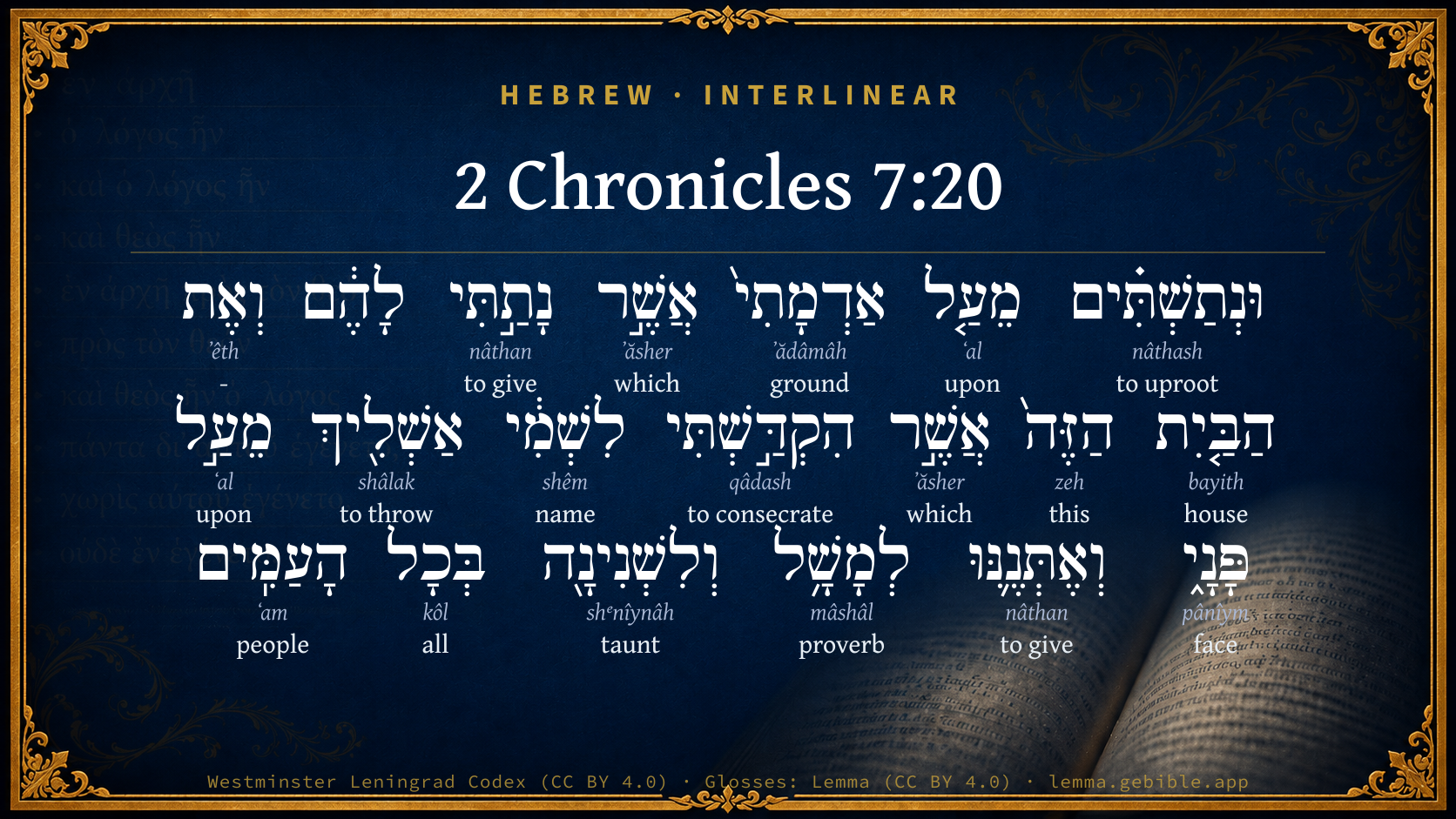
  1. וּנְתַשְׁתִּ֗ים nâthash H5428 “and · to uproot · them” Conjunction + Verb, Qal, Sequential Perfect, 1st Person, Common, Singular + Suffix, Personal, 3rd Person, Masculine, Plural
  2. מֵעַ֤ל ʻal H5921 “from · upon” Preposition + Preposition
  3. אַדְמָתִי֙ ʼădâmâh H127 “ground · my” Noun, Common, Feminine, Singular, Construct + Suffix, Personal, 1st Person, Common, Singular
  4. אֲשֶׁ֣ר ʼăsher H834 “which” Particle, Relative
  5. נָתַ֣תִּי nâthan H5414 “to give” Verb, Qal, Perfect, 1st Person, Common, Singular
  6. וְאֶת ʼêth H853 “and · -” Conjunction + Particle, Direct Object
  7. הַבַּ֤יִת bayith H1004 “the · house” Particle, Definite Article + Noun, Common, Masculine, Singular, Absolute
  8. הַזֶּה֙ zeh H2088 “the · this” Particle, Definite Article + Pronoun, Demonstrative, Masculine, Singular
  9. אֲשֶׁ֣ר ʼăsher H834 “which” Particle, Relative
  10. הִקְדַּ֣שְׁתִּי qâdash H6942 “to consecrate” Verb, Hiphil, Perfect, 1st Person, Common, Singular
  11. לִשְׁמִ֔י shêm H8034 “to/for · name · my” Preposition + Noun, Common, Masculine, Singular, Construct + Suffix, Personal, 1st Person, Common, Singular
  12. אַשְׁלִ֖יךְ shâlak H7993 “to throw” Verb, Hiphil, Imperfect, 1st Person, Common, Singular
  13. מֵעַ֣ל ʻal H5921 “from · upon” Preposition + Preposition
  14. פָּנָ֑י pânîym H6440 “face(s) · my” Noun, Common, Both, Plural, Construct + Suffix, Personal, 1st Person, Common, Singular
  15. וְאֶתְּנֶ֛נּוּ nâthan H5414 “and · to give · him” Conjunction + Verb, Qal, Imperfect, 1st Person, Common, Singular + Suffix, Personal, 3rd Person, Masculine, Singular
  16. לְמָשָׁ֥ל mâshâl H4912 “to/for · proverb” Preposition + Noun, Common, Masculine, Singular, Absolute
  17. בְּכָל kôl H3605 “in/at · all of” Preposition + Noun, Common, Masculine, Singular, Construct
  18. הָעַמִּֽים ʻam H5971 “the · peoples” Particle, Definite Article + Noun, Common, Masculine, Plural, Absolute

About this verse

These counts appear in no published source. They are computed here, from the morphology-tagged text and Lemma’s own curated glosses. What Lemma adds →

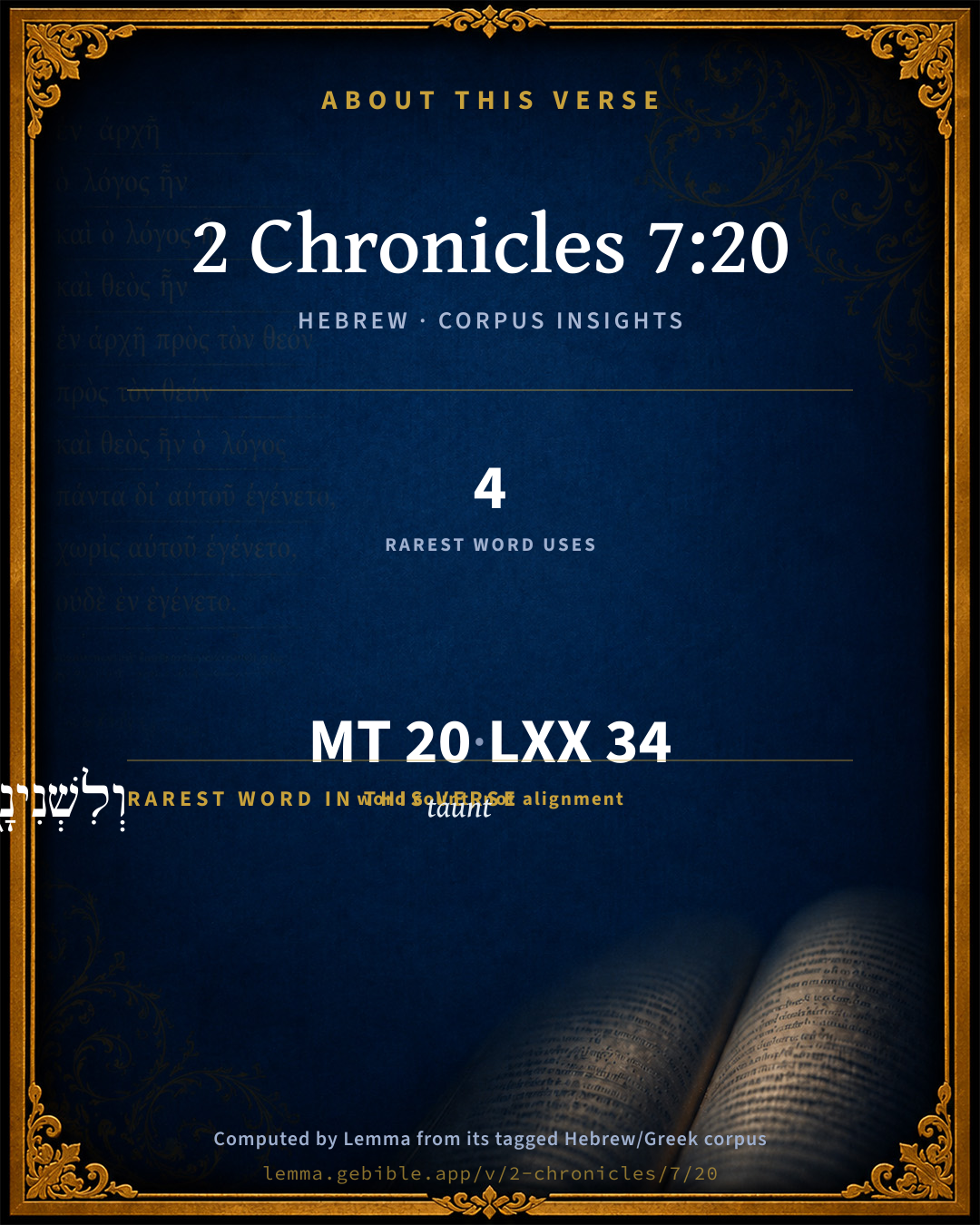
20
words
16
distinct lemmas
Historical
section

Notable vocabulary

The rarest word here is וְלִשְׁנִינָ֖ה taunt H8148 — appearing just 4 times in the whole Hebrew Bible.

Shared distinctive vocabulary

וְלִשְׁנִינָ֖ה taunt H8148 occurs in 4 verses of the Hebrew Bible. Also found in:

Grammatical profile

  • 5 verbs
  • 8 nouns
  • 1 pronoun
  • 3 prepositions
  • 3 particles

Verb forms

  • וּנְתַשְׁתִּ֗ים Qal · Sequential Perfect
  • נָתַ֣תִּי Qal · Perfect
  • הִקְדַּ֣שְׁתִּי Hiphil · Perfect
  • אַשְׁלִ֖יךְ Hiphil · Imperfect
  • וְאֶתְּנֶ֛נּוּ Qal · Imperfect

Repetition

Words recur within this verse — often emphatic in Hebrew:

  • מֵעַ֤ל upon H5921 ×2
  • נָתַ֣תִּי to give H5414 ×2
  • אֲשֶׁ֣ר which H834 ×2

Hebrew & Septuagint length

In English translation the verse runs 49 words from the Hebrew and 42 from the Septuagint (LXX English) — closely comparable.

A rough comparison of the two English renderings, which tokenize alike — not a word-level alignment.

Word counts can differ between the Hebrew and the Greek without any difference in meaning — e.g. the Hebrew direct-object marker אֵת has no separate Greek word, and Greek often adds the article ὁ.

In the original languages it is 20 Hebrew tokens and 34 Greek tokens — but the two are counted differently (Hebrew bundles its prefixes and suffixes into one token; the Greek is in lemma form), so that isn’t a like-for-like length.

Cross-references

15

Topical passages linked to 2 Chronicles 7:20 in the Treasury of Scripture Knowledge — connected by theme and wording, ordered by reader-vote popularity; previews shown in the World English Bible.

  • Deuteronomy 28:37 You shall become an astonishment, a proverb, and a byword, among all the peoples where Yahweh shall lead you away.
  • 2 Kings 17:20 Yahweh rejected all the seed of Israel, and afflicted them, and delivered them into the hand of spoilers, until he had cast them out of his sight.
  • Deuteronomy 29:28 and Yahweh rooted them out of their land in anger, and in wrath, and in great indignation, and cast them into another land, as at this day.
  • 1 Kings 9:7 then will I cut off Israel out of the land which I have given them; and this house, which I have made holy for my name, will I cast out of my sight; and Israel shall be a proverb and a byword among all peoples.
  • 1 Kings 14:15 For Yahweh will strike Israel, as a reed is shaken in the water; and he will root up Israel out of this good land which he gave to their fathers, and will scatter them beyond the River, because they have made their Asherim, provoking Yahweh to anger.
  • Jeremiah 24:9 I will even give them up to be tossed back and forth among all the kingdoms of the earth for evil; to be a reproach and a proverb, a taunt and a curse, in all places where I shall drive them.
  • Jeremiah 45:4 Thus shall you tell him, Thus says Yahweh: Behold, that which I have built will I break down, and that which I have planted I will pluck up; and this in the whole land.
  • Psalms 44:14 You make us a byword among the nations, A shaking of the head among the peoples.
  • Jeremiah 31:28 It shall happen that, like as I have watched over them to pluck up and to break down and to overthrow and to destroy and to afflict, so will I watch over them to build and to plant, says Yahweh.
  • Lamentations 2:15–16 All that pass by clap their hands at you; They hiss and wag their head at the daughter of Jerusalem, [saying], Is this the city that men called The perfection of beauty, The joy of the whole earth?
  • Nehemiah 4:1–4 But it happened that when Sanballat heard that we were building the wall, he was angry, and took great indignation, and mocked the Jews.
  • Psalms 52:5 God will likewise destroy you forever. He will take you up, and pluck you out of your tent, And root you out of the land of the living. Selah.
  • Jeremiah 12:17 But if they will not hear, then will I pluck up that nation, plucking up and destroying it, says Yahweh.
  • Jeremiah 18:7 At what instant I shall speak concerning a nation, and concerning a kingdom, to pluck up and to break down and to destroy it;
  • Jude 1:12 These are hidden rocky reefs in your love feasts when they feast with you, shepherds who without fear feed themselves; clouds without water, carried along by winds; autumn leaves without fruit, twice dead, plucked up by the roots;

Cross-references courtesy of OpenBible.info (CC BY 4.0).

Hebrew and Greek witnesses Masoretic Hebrew ↔ Greek Septuagint

The same verse in the two great witnesses to the Old Testament, shown verse-for-verse.

These are two independent witnesses, not word-aligned to each other, and the Septuagint is shown in lemma (dictionary) form.

Hebrew 2 Chronicles 7:20 Masoretic · Westminster Leningrad Codex

וּנְתַשְׁתִּ֗ים מֵעַ֤ל אַדְמָתִי֙ אֲשֶׁ֣ר נָתַ֣תִּי לָהֶ֔ם וְאֶת הַבַּ֤יִת הַזֶּה֙ אֲשֶׁ֣ר הִקְדַּ֣שְׁתִּי לִשְׁמִ֔י אַשְׁלִ֖יךְ מֵעַ֣ל פָּנָ֑י וְאֶתְּנֶ֛נּוּ לְמָשָׁ֥ל וְלִשְׁנִינָ֖ה בְּכָל הָעַמִּֽים

then will I pluck them up by the roots out of my land which I have given them; and this house, which I have made holy for my name, will I cast out of my sight, and I will make it a proverb and a byword among all peoples.

World English Bible · Public Domain

Greek LXX 2 Chronicles 7:20 Septuagint · lemma form

καί ἐκαἴρω σύ ἀπό ὁ γῆ ὅς δίδωμι αὐτός καί ὁ οἶκος οὗτος ὅς ἁγιάζω ὁ ὄνομα ἐγώ ἀποστρέφω ἐκ πρόσωπον ἐγώ καί δίδωμι αὐτός εἰς παραβολή καί εἰς διήγημα ἐν πᾶς ὁ ἔθνος

then will I remove you from the land which I gave them; and this house which I have consecrated to my name I will remove out of my sight, and I will make it a proverb and a byword among all nations.

LXX2012 (modern English Septuagint) · Public Domain

Hebrew: Westminster Leningrad Codex (CC BY 4.0). Greek: Septuagint (public domain); English from LXX2012 (modern English Septuagint) (Public Domain). How the Septuagint differs from the Hebrew →

Commentary

Notes on 2 Chronicles 7:20 from classic Christian and Jewish commentators (each source and its license shown beneath its notes). The classic Christian expositions comment on the surrounding passage and are grouped to its opening verse, so a note may address several verses; the Jewish commentaries on the Tanakh (Rashi and others) are per-verse, so they appear only where the commentator wrote on this verse.

Lemma curates 59 commentaries, every one of them public domain or Creative Commons licensed, each selected and text-cleaned for this edition rather than reprinted as found. About our sources →

Geneva Bible (1599)

Geneva Bible translators

Which thing declareth that God had more respect to their salvation, than to the advancement of his own glory: and whereas men abuse those things which God hath appointed to set forth his praise, he doth withdraw his graces thence.

Geneva Bible (1599) marginal notes — public domain. Text via Bolls.life.

Adam Clarke's Commentary

Verse 20. Then will I pluck them up by the roots] How completely has this been fulfilled! not only all the branches of the Jewish political tree have been cut off, but the very roots have been plucked up; so that the day of the Lord's anger has left them neither root nor branch.

Adam Clarke's Commentary on the Bible (1810–1826) — public domain. Text from a community e-Sword/MySword module.

Ellicott's Commentary for English Readers

(20) Then will I pluck them up by the roots—i.e., your children (see last verse). (Comp. Deu_29:27.) Vulg. rightly, “evellam vos de terra mea.” The opposite idea is that of planting a nation in a land (Jer_24:6). Kings, “Then will I cut off Israel from upon the face of the land.” The chronicler has softened the severity of the expression, cut off Israel.

Will I cast out of my sight.—Vulg. more literally, “projiciam a facie mea.” The exact phrase occurs nowhere else; but comp. Psa_51:13, which is very similar; also Psa_102:11. Instead of ’ashlik, “I will cast,” Kings has ’ashallah, “I will send,” i.e., throw (Amo_2:5).

And will make it.—A softening down of, and Israel shall become (Kings). Comp. Deu_28:37. So Syriac.

A Bible Commentary for English Readers, edited by Charles John Ellicott (1878–1897) — public domain. Text from a community e-Sword module.

The Cambridge Bible for Schools and Colleges

gen. ed. J. J. S. Perowne

20. sanctified] R.V. hallowed (cf. 2Ch_7:16).

The Cambridge Bible for Schools and Colleges (gen. ed. J. J. S. Perowne; Cambridge University Press, 1878–1918) — public domain. Text from a community e-Sword module.

Rashi

Rabbi Shlomo Yitzchaki (Rashi)

I shall cast from before Me according to the condition between Me and you, viz. (Lev. 26: 14): “But if you do not heed Me.” What does it say there? (verse 31): “And I shall make your sanctuaries desolate.”

and I shall make it a proverb as people compose a proverb about someone who was befallen by misfortune.

and a byword - Heb. וְלִשְׁנִינָה, like (Deut. 6:7): וְשִׁנַּנְתָּם לְבָנֶיךָ, “and you shall teach them.” [It is] an expression of recounting misfortunes. Similarly, the Targum of (Gen. 37:10) וַיְסַפֵּר “And he told,” is וְאִשְׁתָּעֵי, and [the Targum of] וְלִשְׁנִינָה is וּלְשׁוּעֵי.

Rashi on the Tanakh — English translations: “The Judaica Press complete Tanach with Rashi, translated by A. J. Rosenberg” (CC BY 4.0); “Pentateuch with Rashi's commentary by M. Rosenbaum and A.M. Silbermann, 1929-1934” (public domain); “The Metsudah Tanach series, Lakewood, N.J” (CC BY 4.0); and “The Book of Joshua, Metsudah Publications, 1997” (CC BY 4.0). Text via Sefaria.

Lesson kit

Teaching starters — assembled from the data on this page, not authored interpretation. Every prompt links to the verse data it draws on. Edit before teaching.

2 Chronicles, in the Historical, opens this verse with 20 words (16 distinct Hebrew lemmas). Its most distinctive word is shᵉnîynâh (“taunt”). A historical commentator’s framing appears above. Read the whole chapter for the surrounding context.

Discussion questions

  1. How does “taunt” (shᵉnîynâh) shape what this verse is saying?
  2. How does Deuteronomy 28:37, which shares the word «taunt», read alongside this verse?
  3. What does the repetition of “upon” (2× in this one verse) do in this verse?
  4. These translations render this verse differently; the difference is in the English rendering, not the original. What questions does that raise?
  5. «וּנְתַשְׁתִּ֗ים» is a Qal Sequential Perfect verb. How does that grammatical form shape the action described?
  6. Compare how Geneva Bible (1599) and Adam Clarke's Commentary read this verse. Where do they agree or differ?

Things to notice

Reading settings

Reading text

Shown beneath each verse's original-language words.

Old Testament
Old Testament edition

Read the OT as the Masoretic Hebrew (MT) or the Greek Septuagint (LXX).

English shown for the Greek Septuagint (in the Hebrew ↔ Greek comparison).

Comparing translations? Open the Compare panel on any verse page to stack up to four side by side.