2 Kings 25:21

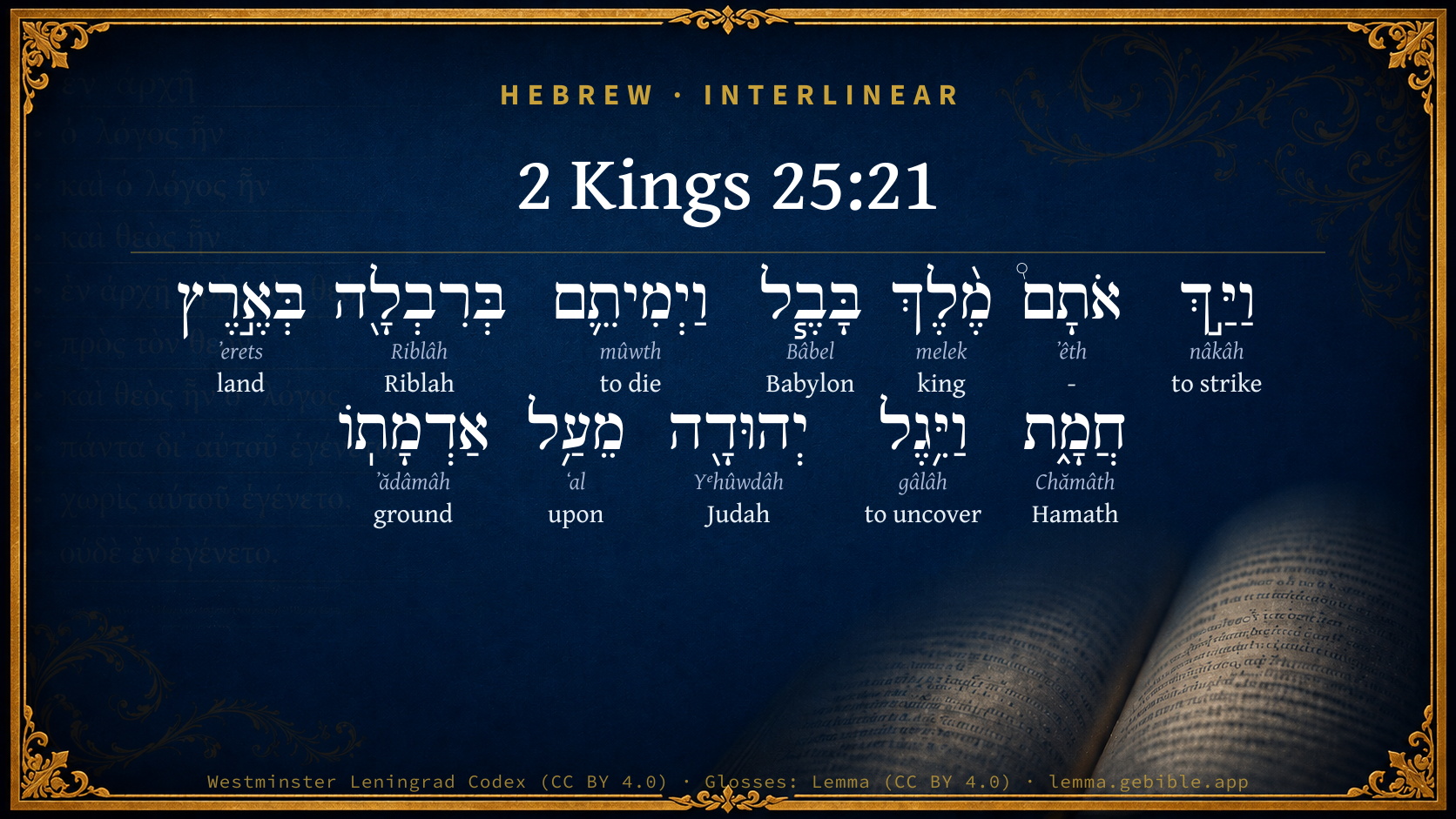
Hebrew (Westminster Leningrad Codex) 2 Kings 25:21 appears in the Hebrew Old Testament. The text above is from the Westminster Leningrad Codex. Each word links to its Strong’s number, a concise gloss, and parsing drawn from the Open Scriptures Hebrew Bible morphology. Click any word for its full Brown-Driver-Briggs (BDB) entry.
Download image
Cite this verse

2 Kings 25:21 (World English Bible). Public Domain. Lemma interlinear Bible study tool, https://lemma.gebible.app/v/2-kings/25/21.

Show BibTeX & RIS
BibTeX
RIS
English Translation
The king of Babylon struck them, and put them to death at Riblah in the land of Hamath. So Judah was carried away captive out of his land.
World English Bible · Public Domain
Download a study sheet

One document with this verse’s original text, its word-by-word gloss line, the meaning frame, cross-references with their text, attributed commentary, and full source and license credits — printable, and it pastes into notes with its structure intact.

This verse Autodidact and up

Study sheet (.html) Plain text (.txt)

A passage Seminary Student

Up to 50 verses in one chapter. A passage sheet keeps up to 6 commentary sources and 12 cross-references per verse, in the order this page ranks them, and says so on the sheet whenever that leaves anything out. Ask for a single verse and you get the Autodidact verse sheet above.

Everything on this page stays free to read, with no account — the sheet is a download of what is already on screen, not access to it.

Want to remove ads? Support Godless Engineer
Compare translations 3

The same verse in 3 English versions, stacked beneath the original-language interlinear above. Click any original word for its lexicon entry.

Each is an independent rendering of the whole verse — the interlinear is not word-aligned to these translations.

Highlighted words mark where these versions differ — a whole-verse word diff, not a word-by-word alignment.

  • World English Bible Public Domain
    The king of Babylon struck them, and put them to death at Riblah in the land of Hamath. So Judah was carried away captive out of his land.
  • King James Version Public Domain
    And the king of Babylon smote them, and slew them at Riblah in the land of Hamath. So Judah was carried away out of their land.
  • unfoldingWord Literal Text CC BY-SA 4.0
    And the king of Babylon struck them and killed them in Riblah in the land of Hamath. And Judah went into exile away from its land.

unfoldingWord Literal Text — © unfoldingWord, licensed CC BY-SA 4.0. Word-aligned USFM3 via Door43 (git.door43.org/unfoldingWord/en_ult).

Versions to compare (up to 4)

3 of 4 selected

Show all 18 translations

Every available English version of this verse, each an independent rendering of the whole verse.

  • World English Bible Public Domain
    The king of Babylon struck them, and put them to death at Riblah in the land of Hamath. So Judah was carried away captive out of his land.
  • Berean Standard Bible Public Domain
    There at Riblah in the land of Hamath, the king of Babylon struck them down and put them to death. So Judah was taken into exile, away from its own land.
  • Majority Standard Bible Public Domain
    There at Riblah in the land of Hamath, the king of Babylon struck them down and put them to death. So Judah was taken into exile, away from its own land.
  • King James Version Public Domain
    And the king of Babylon smote them, and slew them at Riblah in the land of Hamath. So Judah was carried away out of their land.
  • American Standard Version (1901) Public Domain
    And the king of Babylon smote them, and put them to death at Riblah in the land of Hamath. So Judah was carried away captive out of his land.
  • Revised Version (1885) Public Domain
    And the king of Babylon smote them, and put them to death at Riblah in the land of Hamath. So Judah was carried away captive out of his land.
  • Geneva Bible (1599) Public Domain
    And the King of Babel smote them, and slew them at Riblah in the land of Hamath. So Iudah was caried away captiue out of his owne land.
  • Douay-Rheims (1899) Public Domain
    And the king of Babylon smote them, and slew them at Reblatha in the land of Emath: so Juda was carried away out of their land.
  • Young's Literal Translation Public Domain
    and the king of Babylon smiteth them, and putteth them to death in Riblah, in the land of Hamath, and he removeth Judah from off its land.
  • Literal Standard Version CC BY-SA 4.0
    and the king of Babylon strikes them, and puts them to death in Riblah, in the land of Hamath, and he removes Judah from off its land.
  • Unlocked Literal Bible CC BY-SA 4.0
    The king of Babylon put them to death at Riblah in the land of Hamath. In this way, Judah went out of its land into exile.
  • unfoldingWord Literal Text CC BY-SA 4.0
    And the king of Babylon struck them and killed them in Riblah in the land of Hamath. And Judah went into exile away from its land.
  • Darby Bible Public Domain
    and the king of Babylon smote them and put them to death at Riblah in the land of Hamath. Thus Judah was carried away captive out of his land.
  • World Messianic Bible Public Domain
    The king of Babylon attacked them and put them to death at Riblah in the land of Hamath. So Judah was carried away captive out of his land.
  • Webster's Bible Public Domain
    And the king of Babylon smote them, and slew them at Riblah in the land of Hamath. So Judah was carried away out of their land.
  • Free Bible Version CC BY-SA 4.0
    The king of Babylon had them executed at Riblah in the land of Hamath. So the people of Judah had to leave their land.
  • Bible in Basic English Public Domain
    And the king of Babylon put them to death at Riblah in the land of Hamath. So Judah was taken away prisoner from his land.
  • JPS Tanakh (1917) Public Domain
    And the king of Babylon smote them, and put them to death at Riblah in the land of Hamath. So Judah was carried away captive out of his land.

Literal Standard Version (2020), Covenant Press — licensed CC BY-SA 4.0. Text via the HelloAO Bible API (eBible.org). Unlocked Literal Bible (unfoldingWord) — licensed CC BY-SA 4.0. Text via the HelloAO Bible API (eBible.org). unfoldingWord Literal Text — © unfoldingWord, licensed CC BY-SA 4.0. Word-aligned USFM3 via Door43 (git.door43.org/unfoldingWord/en_ult). Free Bible Version, Dr. Jonathan Gallagher — licensed CC BY-SA 4.0. Text via the HelloAO Bible API (eBible.org).

Word by word

More ways to search: Search by grammar → Find every occurrence → Compare this word →

Practice this passage: Drill this verse → Learn its vocabulary →

בְּרִבְלָ֖ה
Riblâh
H7247
“in/at · Riblah”
Preposition + Noun, Proper
Part of Speech
Preposition + Noun
Type
Proper
Full BDB Definition

Origin: from an unused root meaning to be fruitful

TWOT: None

Riblah = "fertility" - a place on the eastern boundary of Israel - a town in the land of Hamath on the great road between Babylon and Palestine
  1. וַיַּ֣ךְ nâkâh H5221 “and · to strike” Conjunction + Verb, Hiphil, Sequential Imperfect, 3rd Person, Masculine, Singular
  2. אֹתָם֩ ʼêth H853 “- · them” Particle, Direct Object + Suffix, Personal, 3rd Person, Masculine, Plural
  3. מֶ֨לֶךְ melek H4428 “king of” Noun, Common, Masculine, Singular, Construct
  4. בָּבֶ֧ל Bâbel H894 “Babylon” Noun, Proper
  5. וַיְמִיתֵ֛ם mûwth H4191 “and · to die · them” Conjunction + Verb, Hiphil, Sequential Imperfect, 3rd Person, Masculine, Singular + Suffix, Personal, 3rd Person, Masculine, Plural
  6. בְּאֶ֣רֶץ ʼerets H776 “in/at · land of” Preposition + Noun, Common, Both, Singular, Construct
  7. חֲמָ֑ת Chămâth H2574 “Hamath” Noun, Proper
  8. וַיִּ֥גֶל gâlâh H1540 “and · to uncover” Conjunction + Verb, Qal, Sequential Imperfect, 3rd Person, Masculine, Singular
  9. יְהוּדָ֖ה Yᵉhûwdâh H3063 “Judah” Noun, Proper
  10. מֵעַ֥ל ʻal H5921 “from · upon” Preposition + Preposition
  11. אַדְמָתֽוֹ ʼădâmâh H127 “ground · his” Noun, Common, Feminine, Singular, Construct + Suffix, Personal, 3rd Person, Masculine, Singular

About this verse

These counts appear in no published source. They are computed here, from the morphology-tagged text and Lemma’s own curated glosses. What Lemma adds →

12
words
12
distinct lemmas
Historical
section

Notable vocabulary

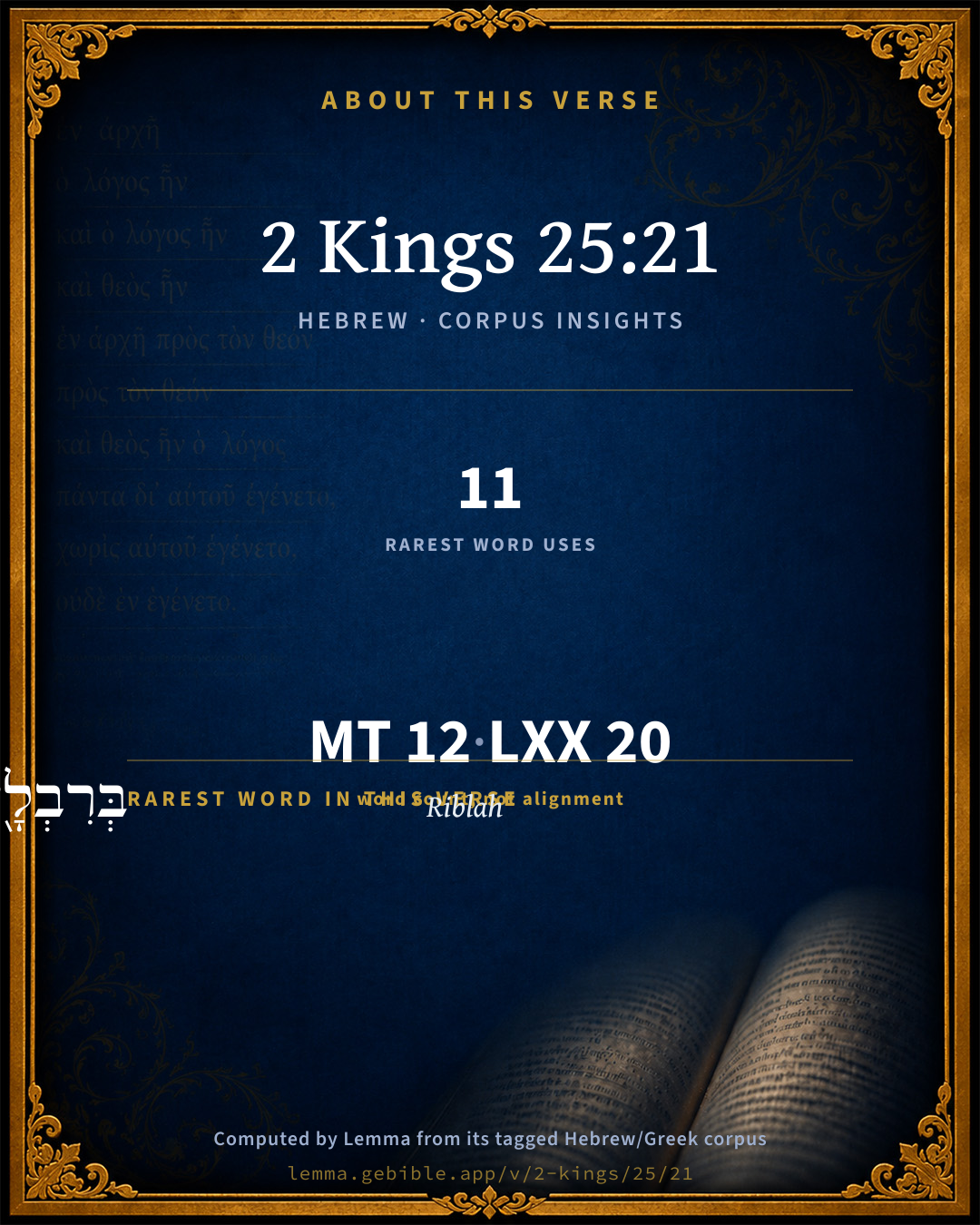
The rarest word here is בְּרִבְלָ֖ה Riblah H7247 — appearing just 11 times in the whole Hebrew Bible.

Shared distinctive vocabulary

בְּרִבְלָ֖ה Riblah H7247 occurs in 11 verses of the Hebrew Bible. Also found in:

Grammatical profile

  • 3 verbs
  • 7 nouns
  • 1 preposition
  • 1 particle

Verb forms

  • וַיַּ֣ךְ Hiphil · Sequential Imperfect
  • וַיְמִיתֵ֛ם Hiphil · Sequential Imperfect
  • וַיִּ֥גֶל Qal · Sequential Imperfect

Hebrew & Septuagint length

In English translation the verse runs 28 words from the Hebrew and 25 from the Septuagint (LXX English) — closely comparable.

A rough comparison of the two English renderings, which tokenize alike — not a word-level alignment.

Word counts can differ between the Hebrew and the Greek without any difference in meaning — e.g. the Hebrew direct-object marker אֵת has no separate Greek word, and Greek often adds the article ὁ.

In the original languages it is 12 Hebrew tokens and 20 Greek tokens — but the two are counted differently (Hebrew bundles its prefixes and suffixes into one token; the Greek is in lemma form), so that isn’t a like-for-like length.

Cross-references

11

Topical passages linked to 2 Kings 25:21 in the Treasury of Scripture Knowledge — connected by theme and wording, ordered by reader-vote popularity; previews shown in the World English Bible.

  • Deuteronomy 28:64 Yahweh will scatter you among all peoples, from the one end of the earth even to the other end of the earth; and there you shall serve other gods, which you have not known, you nor your fathers, even wood and stone.
  • 2 Kings 23:27 Yahweh said, I will remove Judah also out of my sight, as I have removed Israel, and I will cast off this city which I have chosen, even Jerusalem, and the house of which I said, My name shall be there.
  • Leviticus 26:33–35 I will scatter you among the nations, and I will draw out the sword after you: and your land will be a desolation, and your cities shall be a waste.
  • Deuteronomy 4:26 I call heaven and earth to witness against you this day, that you shall soon utterly perish from off the land whereunto you go over the Jordan to possess it; you shall not prolong your days on it, but shall utterly be destroyed.
  • Deuteronomy 28:36 Yahweh will bring you, and your king whom you shall set over you, to a nation that you have not known, you nor your fathers; and there shall you serve other gods, wood and stone.
  • 2 Kings 17:20 Yahweh rejected all the seed of Israel, and afflicted them, and delivered them into the hand of spoilers, until he had cast them out of his sight.
  • Jeremiah 24:9–10 I will even give them up to be tossed back and forth among all the kingdoms of the earth for evil; to be a reproach and a proverb, a taunt and a curse, in all places where I shall drive them.
  • Jeremiah 25:9–11 behold, I will send and take all the families of the north, says Yahweh, and [I will send] to Nebuchadrezzar the king of Babylon, my servant, and will bring them against this land, and against the inhabitants of it, and against all these nations round about; and I will utterly destroy them, and make them an astonishment, and a hissing, and perpetual desolations.
  • Ezekiel 12:25–28 For I am Yahweh; I will speak, and the word that I shall speak shall be performed; it shall be no more deferred: for in your days, rebellious house, will I speak the word, and will perform it, says the Lord Yahweh.
  • Ezekiel 24:14 I, Yahweh, have spoken it: it shall happen, and I will do it: I will not go back, neither will I spare, neither will I repent; according to your ways, and according to your doings, shall they judge you, says the Lord Yahweh.
  • Amos 5:27 Therefore will I cause you to go into captivity beyond Damascus," says Yahweh, whose name is the God of hosts.

Cross-references courtesy of OpenBible.info (CC BY 4.0).

Hebrew and Greek witnesses Masoretic Hebrew ↔ Greek Septuagint

The same verse in the two great witnesses to the Old Testament, shown verse-for-verse.

These are two independent witnesses, not word-aligned to each other, and the Septuagint is shown in lemma (dictionary) form.

Hebrew 2 Kings 25:21 Masoretic · Westminster Leningrad Codex

וַיַּ֣ךְ אֹתָם֩ מֶ֨לֶךְ בָּבֶ֧ל וַיְמִיתֵ֛ם בְּרִבְלָ֖ה בְּאֶ֣רֶץ חֲמָ֑ת וַיִּ֥גֶל יְהוּדָ֖ה מֵעַ֥ל אַדְמָתֽוֹ

The king of Babylon struck them, and put them to death at Riblah in the land of Hamath. So Judah was carried away captive out of his land.

World English Bible · Public Domain

Greek LXX 2 Kings 25:21 Septuagint · lemma form

καί παίζω αὐτός βασιλεύς βαβυλών καί θανατόω αὐτός ἐν δεβλαθα ἐν γῆ αιμαθ καί ἀποοἰκίζω ἰούδας ἐπάνωθεν ὁ γῆ αὐτός

And the king of Babylon struck them and killed them at Reblatha in the land of Aemath. So Juda was carried away from his land.

LXX2012 (modern English Septuagint) · Public Domain

Hebrew: Westminster Leningrad Codex (CC BY 4.0). Greek: Septuagint (public domain); English from LXX2012 (modern English Septuagint) (Public Domain). How the Septuagint differs from the Hebrew →

Targum (Aramaic paraphrase)

1

The Targum is the ancient Jewish Aramaic paraphrase of the Hebrew Scriptures — an interpretive translation, not the Hebrew text itself. Onkelos (literal) and Pseudo-Jonathan (expansive) render the Torah, and Jonathan the Prophets. Coverage is partial: where no permissively-licensed English translation exists for a verse, only the Aramaic is shown. This is verse-level text, not a word-by-word alignment to the Hebrew.

  1. Targum Jonathan Prophets (Joshua–Malachi)
    וּמְחָא יַתְהוֹן מַלְכָּא דְבָבֶל וְקַטְלִינוּן בְּרִבְלָא בְּאַרְעָא דַחֲמָת וּגְלוֹ דְבֵית יְהוּדָה מֵעַל אַרְעֲהוֹן:

    (no public-domain English translation for this verse)

    Targum Jonathan — Aramaic: “Mikraot Gedolot” (public domain). English: “Sefaria Community Translation” (CC0 1.0 (public-domain dedication)); “London "Chaldee Paraphrase," 1871” (public domain). Text via Sefaria.

Commentary

Notes on 2 Kings 25:21 from classic Christian and Jewish commentators (each source and its license shown beneath its notes). The classic Christian expositions comment on the surrounding passage and are grouped to its opening verse, so a note may address several verses; the Jewish commentaries on the Tanakh (Rashi and others) are per-verse, so they appear only where the commentator wrote on this verse.

Lemma curates 59 commentaries, every one of them public domain or Creative Commons licensed, each selected and text-cleaned for this edition rather than reprinted as found. About our sources →

Tyndale Open Study Notes

Tyndale Open Resources

25:21 So the people of Judah were sent into exile from their land: Like the northern kingdom before it (17:5-17), Judah was exiled as punishment for their covenant infidelity. A remnant later returned to the Promised Land in 538 BC (2 Chr 36:22-23; Ezra 1:1–2:20; see also 2 Chr 36:15-21; Jer 25:11; 29:10; Dan 9:2).

Tyndale Open Study Notes — © Tyndale Open Resources, licensed CC BY-SA 4.0. Text via the HelloAO Bible API.

Adam Clarke's Commentary

Verse 21. The king of Babylon smote them] He had, no doubt, found that these had counselled Zedekiah to revolt.

Adam Clarke's Commentary on the Bible (1810–1826) — public domain. Text from a community e-Sword/MySword module.

Ellicott's Commentary for English Readers

(21) The king of Babylon smote them . . .—He was too irritated by the obstinacy of their defence to admire their bravery.

So Judah was carried away . . .—This sentence evidently concludes the whole account of the destruction of Jerusalem and the deportation of the people (comp. 2Ki_17:23; Jer_52:27); and not merely that of the proceedings of Nebuzaradan. The prophecy of Obadiah refers to the heartless behaviour of the Edomites on occasion of the ruin of Judah. (Comp. Psalms 137; Lam_4:21-22.)

A Bible Commentary for English Readers, edited by Charles John Ellicott (1878–1897) — public domain. Text from a community e-Sword module.

The Cambridge Bible for Schools and Colleges

gen. ed. J. J. S. Perowne

21. and slew them [R.V. put them to death] at Riblah] The word is not the same as in verse 7, and the R.V. follows A.V. of Jer_52:27.

So Judah was carried away out of their [R.V. his] land] The A.V. has ‘his own’ in Jeremiah 52. Jeremiah gives the totals of this captivity thus. In the seventh year of Nebuchadnezzar 3023, in the eighteenth year 832, and in the three-and-twentieth year 745, making a total of 4600. Jer_52:28-30.

The Cambridge Bible for Schools and Colleges (gen. ed. J. J. S. Perowne; Cambridge University Press, 1878–1918) — public domain. Text from a community e-Sword module.

Albert Barnes' Notes on the Bible

So Judah was carried away - The kingdom of the two tribes was at an end; and the task of the historian might seem to be accomplished. He still, however, desires to notice two things:

(1) the fate of the remnant 2Ki 25:22-26 left in the land by Nebuzaradan; and

(2) the fate of Johoiachin, who, of all those led into captivity, was the least to blame 2Ki 25:27-30.

Albert Barnes' Notes on the Bible (1834–1885) — public domain. Text from a community e-Sword/MySword module.

Whedon's Commentary on the Bible

Daniel D. Whedon

21. Slew them at Riblah — See on 2Ki_25:6. All these officers and principal citizens were regarded as implicated with Zedekiah in his rebellion, and guilty of treason, and were, therefore, punished with death.

According to Jeremiah there were three different deportations of Jewish exiles: in Nebuchadnezzar’s seventh year, 3,023; in his eighteenth year, 832; and in his twenty-third year, 745; making in all 4,600. These numbers vary very much from the statements of this book of Kings. According to chap. 2Ki_24:13, one deportation alone contained 10,000 captives, and occurred in Nebuchadnezzar’s eighth year. 2Ki_25:12. The difference in the date is but slight, and may be explained by assuming that the different writers began to reckon from different periods of a year; but the numbers in the one or the other passage are undoubtedly corrupt. Most critics incline to think that the numbers in Jeremiah are the more correct. No mention is made in Kings of the third deportation, which occurred, according to Jeremiah, in the twenty-third year of Nebuchadnezzar, and no mention is made in either book of a small deportation, among whom was Daniel and his three friends, which occurred at the time of Nebuchadnezzar’s first invasion of Palestine, and with which the Babylonish captivity of Judah seems really to have begun. But no doubt many that were left in the land proved to be persistently rebellious, and provoked the king of Babylon to order their extirpation.

Daniel D. Whedon (gen. ed.), Commentary on the Old and New Testaments (1874–1909) — public domain. Text from a community e-Sword module.

The Pulpit Commentary

And the King of Babylon smote them, and slew them at Riblah in the land of Hamath. Severities of this kind characterized all ancient warfare. The Assyrian sculptures show us prisoners of war impaled on crosses, beheaded, beaten on the head with maces, and sometimes extended on the ground and flayed. The inscriptions speak of hundreds as thus executed, and mention others as burnt in furnaces, or thrown to wild beasts, or cruelly mutilated. Herodotus says (3. 159) that Darius Hystaspis crucified three thousand prisoners round about Babylon after one of its revolts. That monarch himself, in the Behistun inscription, speaks of many eases where, after capturing rebel chiefs in the field or behind walls, he executed them and their principal adherents (see Colossians 2. Par. 13; Colossians 3. Par. 8, 11). If Nebuchadnezzar contented himself with the execution of between seventy and eighty of the rebel inhabitants of Jerusalee, he cannot be charged with cruelty, or extreme severity, according to the notions of the time. So Judah was carried away out of their land. Jeremiah adds an estimate of the number carried off. These were, he says, (Jer_52:28-30) in the captivity of the seventh (query, seventeenth?) year, 3023; in the captivity of the eighteenth year, 832; and in that of the twenty-third, five years later, 745, making a total of 4600. If we suppose these persons to be men, and multiply by four for the women and children, the entire number will still be no more than 18, 400.

The Pulpit Commentary (1880–1919), ed. H.D.M. Spence-Jones & Joseph S. Exell — public domain. Text from a community e-Sword module.

John Wesley's Explanatory Notes

Out of the land - This compleated their calamity, about eight hundred and sixty years after they were put in possession of it by Joshua.

John Wesley, Explanatory Notes Upon the Whole Bible (1754–1765) — public domain. Text via the GEBible commentary corpus.

Lesson kit

Teaching starters — assembled from the data on this page, not authored interpretation. Every prompt links to the verse data it draws on. Edit before teaching.

2 Kings, in the Historical, opens this verse with 12 words (12 distinct Hebrew lemmas). Its most distinctive word is Riblâh (“Riblah”). A historical commentator’s framing appears above. Read the whole chapter for the surrounding context.

Discussion questions

  1. The word Riblâh carries the sense “Riblah.” How does it shape the verse?
  2. Numbers 34:11 shares the word «Riblah» with this verse. How do the two illuminate each other?
  3. These translations render this verse differently; the difference is in the English rendering, not the original. What questions does that raise?
  4. The verb «וַיַּ֣ךְ» is Hiphil Sequential Imperfect. How does its form color the action?
  5. Reading how Tyndale Open Study Notes and Adam Clarke's Commentary read this verse, where do the two commentators agree and where do they part?

Things to notice

Reading settings

Reading text

Shown beneath each verse's original-language words.

Old Testament
Old Testament edition

Read the OT as the Masoretic Hebrew (MT) or the Greek Septuagint (LXX).

English shown for the Greek Septuagint (in the Hebrew ↔ Greek comparison).

Comparing translations? Open the Compare panel on any verse page to stack up to four side by side.