Jeremiah 27:10

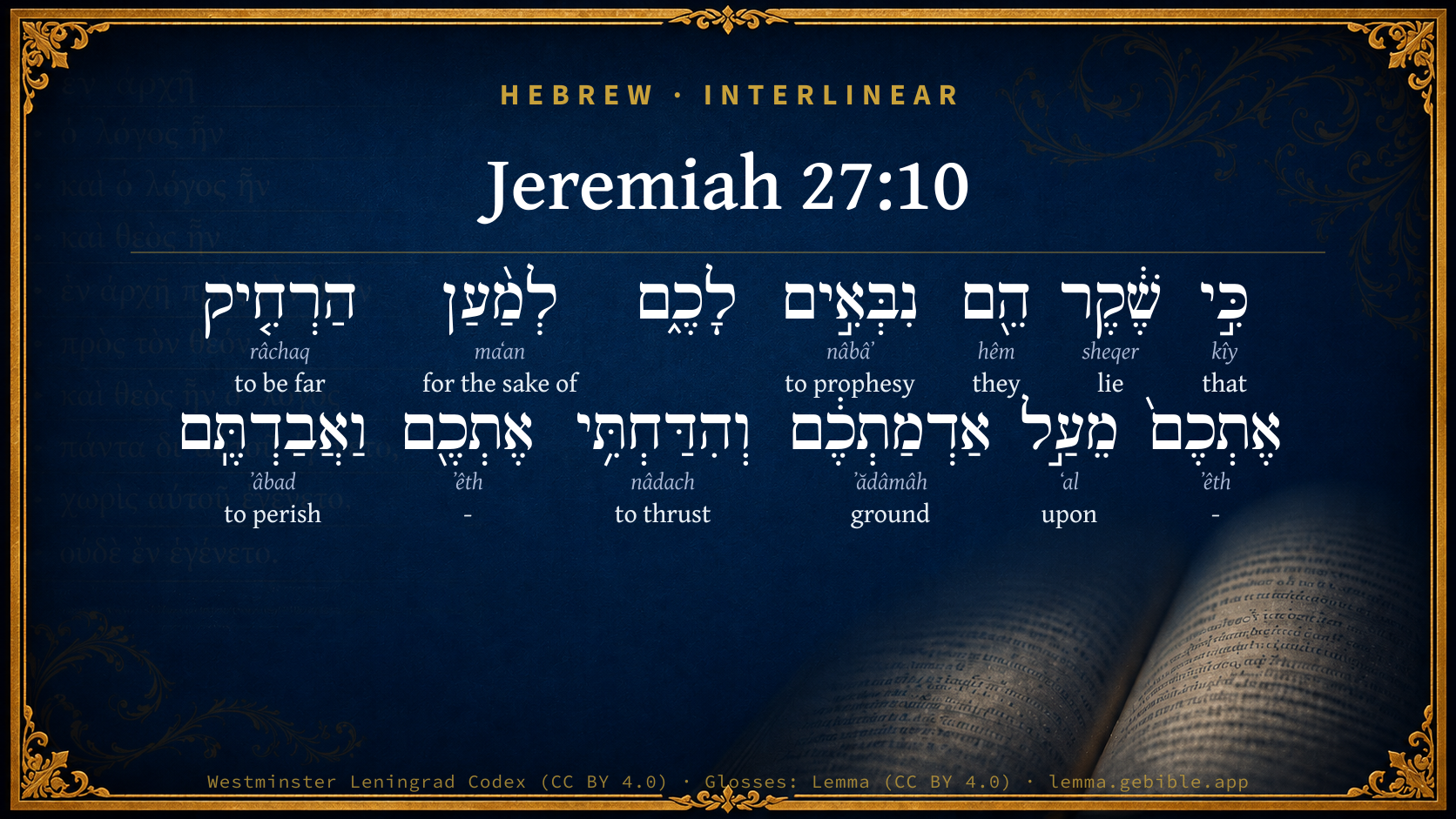
Hebrew (Westminster Leningrad Codex) Jeremiah 27:10 appears in the Hebrew Old Testament. The text above is from the Westminster Leningrad Codex. Each word links to its Strong’s number, a concise gloss, and parsing drawn from the Open Scriptures Hebrew Bible morphology. Click any word for its full Brown-Driver-Briggs (BDB) entry.
Download image
Cite this verse

Jeremiah 27:10 (World English Bible). Public Domain. Lemma interlinear Bible study tool, https://lemma.gebible.app/v/jeremiah/27/10.

Show BibTeX & RIS
BibTeX
RIS
English Translation
for they prophesy a lie to you, to remove you far from your land, and that I should drive you out, and you should perish.
World English Bible · Public Domain
Download a study sheet

One document with this verse’s original text, its word-by-word gloss line, the meaning frame, cross-references with their text, attributed commentary, and full source and license credits — printable, and it pastes into notes with its structure intact.

This verse Autodidact and up

Study sheet (.html) Plain text (.txt)

A passage Seminary Student

Up to 50 verses in one chapter. A passage sheet keeps up to 6 commentary sources and 12 cross-references per verse, in the order this page ranks them, and says so on the sheet whenever that leaves anything out. Ask for a single verse and you get the Autodidact verse sheet above.

Everything on this page stays free to read, with no account — the sheet is a download of what is already on screen, not access to it.

Want to remove ads? Support Godless Engineer
Compare translations 3

The same verse in 3 English versions, stacked beneath the original-language interlinear above. Click any original word for its lexicon entry.

Each is an independent rendering of the whole verse — the interlinear is not word-aligned to these translations.

Highlighted words mark where these versions differ — a whole-verse word diff, not a word-by-word alignment.

  • World English Bible Public Domain
    for they prophesy a lie to you, to remove you far from your land, and that I should drive you out, and you should perish.
  • King James Version Public Domain
    For they prophesy a lie unto you, to remove you far from your land; and that I should drive you out, and ye should perish.
  • unfoldingWord Literal Text CC BY-SA 4.0
    For they are prophesying falsehood to you, so as to remove you far away from on your land, and I will drive you out, and you will perish.

unfoldingWord Literal Text — © unfoldingWord, licensed CC BY-SA 4.0. Word-aligned USFM3 via Door43 (git.door43.org/unfoldingWord/en_ult).

Versions to compare (up to 4)

3 of 4 selected

Show all 18 translations

Every available English version of this verse, each an independent rendering of the whole verse.

  • World English Bible Public Domain
    for they prophesy a lie to you, to remove you far from your land, and that I should drive you out, and you should perish.
  • Berean Standard Bible Public Domain
    For they prophesy to you a lie that will serve to remove you from your land; I will banish you and you will perish.
  • Majority Standard Bible Public Domain
    For they prophesy to you a lie that will serve to remove you from your land; I will banish you and you will perish.
  • King James Version Public Domain
    For they prophesy a lie unto you, to remove you far from your land; and that I should drive you out, and ye should perish.
  • American Standard Version (1901) Public Domain
    for they prophesy a lie unto you, to remove you far from your land, and that I should drive you out, and ye should perish.
  • Revised Version (1885) Public Domain
    for they prophesy a lie unto you, to remove you far from your land; and that I should drive you out and ye should perish.
  • Geneva Bible (1599) Public Domain
    For they prophecie a lie vnto you to cause you to goe farre from your lande, and that I should cast you out, and you should perish.
  • Douay-Rheims (1899) Public Domain
    For they prophesy lies to you: to remove you far from your country, and east you out, and to make you perish.
  • Young's Literal Translation Public Domain
    For falsehood they are prophesying to you, so as to remove you far from off your ground, and I have driven you out, and ye have perished.
  • Literal Standard Version CC BY-SA 4.0
    For they are prophesying falsehood to you, so as to remove you far from your ground, and I have driven you out, and you have perished.
  • Unlocked Literal Bible CC BY-SA 4.0
    For they are prophesying deceit to you in order to send you far away from your lands, for I will drive you away, and you will die.
  • unfoldingWord Literal Text CC BY-SA 4.0
    For they are prophesying falsehood to you, so as to remove you far away from on your land, and I will drive you out, and you will perish.
  • Darby Bible Public Domain
    For they prophesy falsehood unto you, to remove you far from your land, and that I should drive you out, and ye should perish.
  • World Messianic Bible Public Domain
    for they prophesy a lie to you, to remove you far from your land, so that I would drive you out, and you would perish.
  • Webster's Bible Public Domain
    For they prophesy a lie to you, to remove you far from your land; and that I should drive you out, and ye should perish.
  • Free Bible Version CC BY-SA 4.0
    They're prophesying a lie to you that will lead to your removal from your country. I will expel you and you will die.
  • Bible in Basic English Public Domain
    For they say false words to you, so that you may be sent away far from your land, and so that you may be forced out by me and come to destruction.
  • JPS Tanakh (1917) Public Domain
    for they prophesy a lie unto you, to remove you far from your land; and that I should drive you out and ye should perish.

Literal Standard Version (2020), Covenant Press — licensed CC BY-SA 4.0. Text via the HelloAO Bible API (eBible.org). Unlocked Literal Bible (unfoldingWord) — licensed CC BY-SA 4.0. Text via the HelloAO Bible API (eBible.org). unfoldingWord Literal Text — © unfoldingWord, licensed CC BY-SA 4.0. Word-aligned USFM3 via Door43 (git.door43.org/unfoldingWord/en_ult). Free Bible Version, Dr. Jonathan Gallagher — licensed CC BY-SA 4.0. Text via the HelloAO Bible API (eBible.org).

Word by word

More ways to search: Search by grammar → Find every occurrence → Compare this word →

Practice this passage: Drill this verse → Learn its vocabulary →

וְהִדַּחְתִּ֥י
nâdach
H5080
“and · to thrust”
Conjunction + Verb, Hiphil, Sequential Perfect, 1st Person, Common, Singular
Part of Speech
Conjunction + Verb
Stem
Hiphil
Form
Sequential Perfect
Person
1st Person
Gender
Common
Number
Singular
Full BDB Definition

Origin: a primitive root

TWOT: 1304

to impel, thrust, drive away, banish - (Qal) - to impel - to thrust away, banish - (Niphal) - to be impelled - to be thrust out, be banished - banished, outcast (participle) - to be driven away - to be thrust away, thrust aside - (Pual) to be thrust into - thrust (participle) - (Hiphil) - to thrust, move, impel - to thrust out, banish - to thrust away, thrust aside - (Hophal) to be chased, be hunted - chased, hunted (participle)
  1. כִּ֣י kîy H3588 “that” Conjunction
  2. שֶׁ֔קֶר sheqer H8267 “lie” Noun, Common, Masculine, Singular, Absolute
  3. הֵ֖ם hêm H1992 “they” Pronoun, Personal, 3rd Person, Masculine, Plural
  4. נִבְּאִ֣ים nâbâʼ H5012 “prophesying” Verb, Niphal, Participle Active, Masculine, Plural, Absolute
  5. לְמַ֨עַן maʻan H4616 “for the sake of” Preposition
  6. הַרְחִ֤יק râchaq H7368 “to be far” Verb, Hiphil, Infinitive Construct
  7. אֶתְכֶם֙ ʼêth H853 “- · you” Particle, Direct Object + Suffix, Personal, 2nd Person, Masculine, Plural
  8. מֵעַ֣ל ʻal H5921 “from · upon” Preposition + Preposition
  9. אַדְמַתְכֶ֔ם ʼădâmâh H127 “ground · your” Noun, Common, Feminine, Singular, Construct + Suffix, Personal, 2nd Person, Masculine, Plural
  10. אֶתְכֶ֖ם ʼêth H853 “- · you” Particle, Direct Object + Suffix, Personal, 2nd Person, Masculine, Plural
  11. וַאֲבַדְתֶּֽם ʼâbad H6 “and · to perish” Conjunction + Verb, Qal, Sequential Perfect, 2nd Person, Masculine, Plural

About this verse

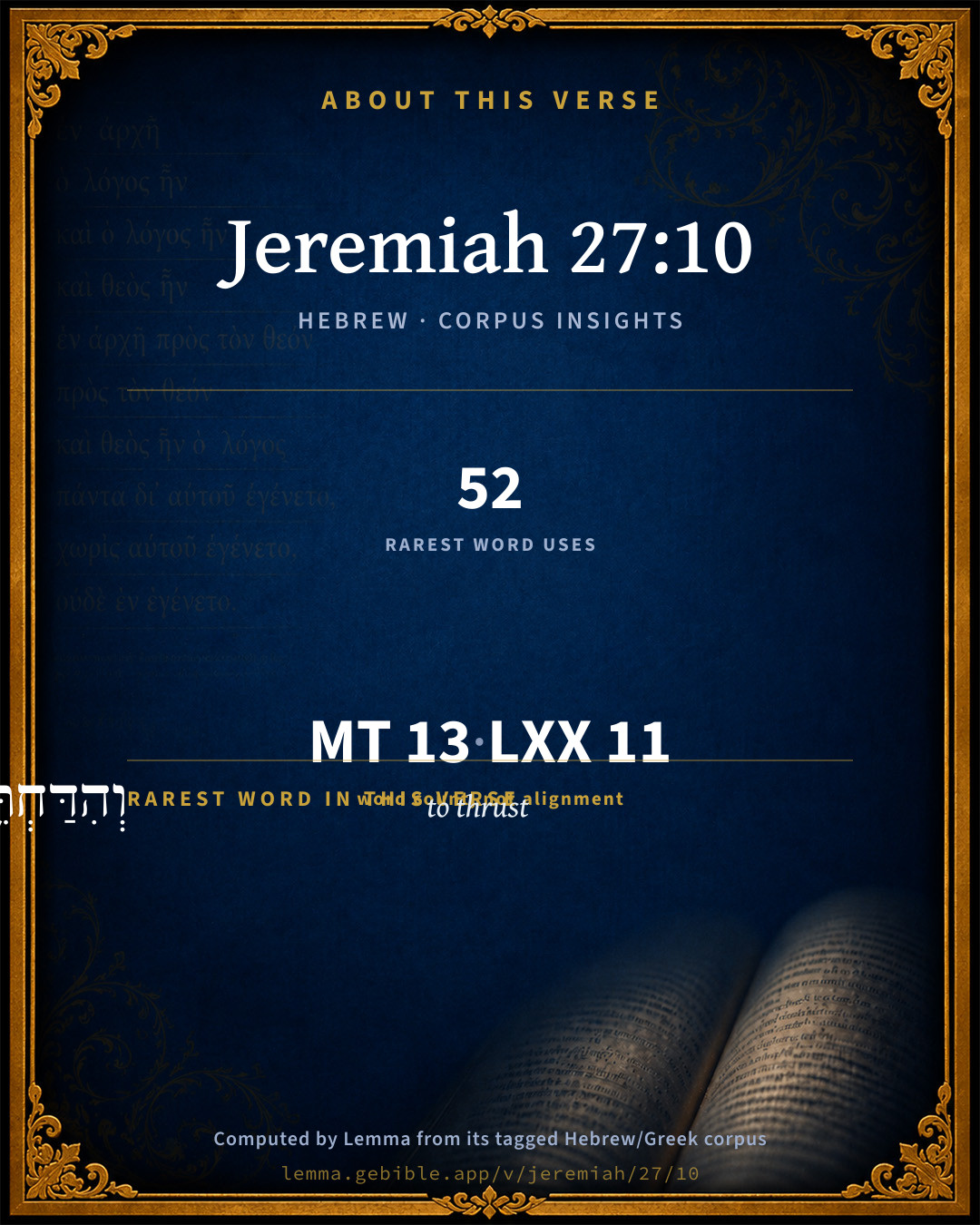
These counts appear in no published source. They are computed here, from the morphology-tagged text and Lemma’s own curated glosses. What Lemma adds →

13
words
11
distinct lemmas
Prophets
section

Shared distinctive vocabulary

וְהִדַּחְתִּ֥י to thrust H5080 occurs in 51 verses of the Hebrew Bible. Also found in:

Grammatical profile

  • 4 verbs
  • 2 nouns
  • 1 pronoun
  • 3 prepositions
  • 1 conjunction
  • 2 particles

Verb forms

  • נִבְּאִ֣ים Niphal · Participle Active
  • הַרְחִ֤יק Hiphil · Infinitive Construct
  • וְהִדַּחְתִּ֥י Hiphil · Sequential Perfect
  • וַאֲבַדְתֶּֽם Qal · Sequential Perfect

Hebrew & Septuagint length

In the original languages it is 13 Hebrew tokens and 11 Greek tokens — but the two are counted differently (Hebrew bundles its prefixes and suffixes into one token; the Greek is in lemma form), so that isn’t a like-for-like length.

Cross-references

6

Topical passages linked to Jeremiah 27:10 in the Treasury of Scripture Knowledge — connected by theme and wording, ordered by reader-vote popularity; previews shown in the World English Bible.

  • Jeremiah 32:31 For this city has been to me a provocation of my anger and of my wrath from the day that they built it even to this day; that I should remove it from before my face,
  • Jeremiah 23:25 I have heard what the prophets have said, who prophesy lies in my name, saying, I have dreamed, I have dreamed.
  • Jeremiah 27:14 Don't listen to the words of the prophets who speak to you, saying, You shall not serve the king of Babylon; for they prophesy a lie to you.
  • Jeremiah 28:16 Therefore thus says Yahweh, Behold, I will send you away from off the surface of the earth: this year you shall die, because you have spoken rebellion against Yahweh.
  • Lamentations 2:14 Your prophets have seen for you false and foolish visions; They have not uncovered your iniquity, to bring back your captivity, But have seen for you false oracles and causes of banishment.
  • Ezekiel 14:9–11 If the prophet be deceived and speak a word, I, Yahweh, have deceived that prophet, and I will stretch out my hand on him, and will destroy him from the midst of my people Israel.

Cross-references courtesy of OpenBible.info (CC BY 4.0).

Hebrew and Greek witnesses Masoretic Hebrew ↔ Greek Septuagint

The same verse in the two great witnesses to the Old Testament, shown verse-for-verse.

These are two independent witnesses, not word-aligned to each other, and the Septuagint is shown in lemma (dictionary) form.

Hebrew Jeremiah 27:10 Masoretic · Westminster Leningrad Codex

כִּ֣י שֶׁ֔קֶר הֵ֖ם נִבְּאִ֣ים לָכֶ֑ם לְמַ֨עַן הַרְחִ֤יק אֶתְכֶם֙ מֵעַ֣ל אַדְמַתְכֶ֔ם וְהִדַּחְתִּ֥י אֶתְכֶ֖ם וַאֲבַדְתֶּֽם

for they prophesy a lie to you, to remove you far from your land, and that I should drive you out, and you should perish.

World English Bible · Public Domain

Greek LXX Structure differs

In the Septuagint, Jeremiah is about an eighth shorter than the Hebrew and arranges its material differently — the Oracles Against the Nations (Hebrew chapters 46–51) appear in the middle of the Greek book, after 25:13. Because the chapter and verse boundaries do not line up, a verse-for-verse comparison with the Hebrew is not shown.

A verse-for-verse comparison isn’t shown here because the chapters and verses don’t line up. Switch to the LXX edition with the MT / LXX toggle above to read the Greek directly.

Hebrew: Westminster Leningrad Codex (CC BY 4.0). Greek: Septuagint (public domain); English from a public-domain English Septuagint. How the Septuagint differs from the Hebrew →

Targum (Aramaic paraphrase)

1

The Targum is the ancient Jewish Aramaic paraphrase of the Hebrew Scriptures — an interpretive translation, not the Hebrew text itself. Onkelos (literal) and Pseudo-Jonathan (expansive) render the Torah, and Jonathan the Prophets. Coverage is partial: where no permissively-licensed English translation exists for a verse, only the Aramaic is shown. This is verse-level text, not a word-by-word alignment to the Hebrew.

  1. Targum Jonathan Prophets (Joshua–Malachi)
    אֲרֵי שִׁקְרָא אִינוּן מִתְנַבָּן לְכוֹן בְּדִיל לְאַרְחָקָא יַתְכוֹן מֵעַל אַרְעֲכוֹן וֶאֱטַלְטֵל יַתְכוֹן וְתֵיבְדוּן:

    (no public-domain English translation for this verse)

    Targum Jonathan — Aramaic: “Mikraot Gedolot” (public domain). English: “Sefaria Community Translation” (CC0 1.0 (public-domain dedication)); “London "Chaldee Paraphrase," 1871” (public domain). Text via Sefaria.

Commentary

Notes on Jeremiah 27:10 from classic Christian and Jewish commentators (each source and its license shown beneath its notes). The classic Christian expositions comment on the surrounding passage and are grouped to its opening verse, so a note may address several verses; the Jewish commentaries on the Tanakh (Rashi and others) are per-verse, so they appear only where the commentator wrote on this verse.

Lemma curates 59 commentaries, every one of them public domain or Creative Commons licensed, each selected and text-cleaned for this edition rather than reprinted as found. About our sources →

Trapp's Complete Commentary

John Trapp

Jer 27:10 For they prophesy a lie unto you, to remove you far from your land; and that I should drive you out, and ye should perish.

Ver. 10. To remove you far from your land.] So it would prove; and such would be the event of their false prophecies.

John Trapp, A Commentary or Exposition upon All the Books of the Old and New Testament (1647–1656) — public domain. Text from a community e-Sword module.

Jamieson, Fausset & Brown

Robert Jamieson, A. R. Fausset & David Brown

to remove you--expressing the event which would result. The very thing they profess by their enchantments to avert, they are by them bringing on you. Better to submit to Nebuchadnezzar, and remain in your land, than to rebel, and be removed from it.

Jamieson, Fausset & Brown — Commentary Critical and Explanatory on the Whole Bible (1871) — public domain (CC PDM 1.0). Text via the HelloAO Bible API.

John Calvin's Commentaries

This verse also confirms what I have said, — that this discourse was designed for the Jews, and that it was peculiarly for them; for what is said here could not be applied to heathen nations. What then had been lately said of augurs, magicians, and diviners, ought no doubt to be understood of those impostors who, under the name of prophets, deceived that miserable people.

He says that they prophesied falsehood Many, no doubt, adduced, for the purpose of opposing him, their own evasions: “Art thou alone to be believed? dost thou alone tell the truth? how dost thou prove that what thou teachest is an oracle from heaven, and that these deceive us?” For so do the ungodly usually clamor, as we see to be the case at this day with the Papists, who cover themselves with a pretense of this kind: for whatever abomination there may be, they cover it over by means of this sophistry alone — that the Scripture is obscure, and that controversy is uncertain, and that therefore nothing is to be believed but what the Church has decreed: so with them the definition of men, as they say, is the only rule of faith; and hence, also, the whole authority of Scripture is by them trodden under foot, as though God had in vain spoken by his own prophets and apostles. There is no doubt but the doctrine of Jeremiah was opposed by such clamors: he however persevered in the course of his office, and boldly condemned the prophets, that they only deceived the Jews by their lies.

He adds, that they may remove you far from your land I have said that this cannot be applied to other nations: but God gave a hope of mercy to his people, provided they willingly obeyed the king of Babylon. It was not indeed a full pardon; yet it was owing to his kindness that God did not treat the Jews with strict justice, but chastised them with gentleness and paternal moderation: for it was an endurable punishment, to remain in their own country and to pay tribute to the king of Babylon. God then would have mitigated the punishment of the people, if only they had willingly undertaken the yoke., This is what Jeremiah now says: “The false prophets seek only this, to drive you far from your country; for they would have you to think that you shall be free from all punishment: but God is prepared to deal gently with you; though he will not wholly pass by your vices, yet your chastisement will be one easily borne, for ye shall remain in your own country. But if ye will believe these impostors, they will lead you away into distant exile; for God says, I will cast you away, and ye shall perish.”

If it be objected again that the Jews could not form a certain opinion, whether Jeremiah was to be believed rather than the others who were many, the answer is at hand: they were themselves conscious of being wicked, and there was no need of long debates to ascertain what was true; for every one found God’s judgment to be against himself, as they had departed from the pure worship of God, and had polluted themselves with many ungodly superstitions, and a license in all kinds of sins had also prevailed among them: they had been warned, not once, nor for one day, but by many prophets, and also continually and for a long time. As then they had thus provoked God’s vengeance by their obstinate wickedness, how could they be in doubt respecting Jeremiah, whether he had, as from the mouth of God, and as a celestial herald declared to them what they deserved? And surely whenever men pretend that they have fallen through error or ignorance, they can always be deprived of this evasion; for their own conscience convicts them, and is sufficient to condemn them.

God adds, that the Jews would perish, except they anticipated extreme judgment, that is, except they submitted to paternal chastisement. This passage deserves to be specially noticed, as we shall presently see again; for we are here taught that whenever God shews some signs of displeasure, there is nothing better for us than to prepare ourselves for patience; for we shall thus ever give place and a free passage to his mercy: but by pertinacity we gain nothing, and do nothing but kindle his wrath more and more. This then is what Jeremiah means when he declares, that they who submitted not to the king of Babylon would perish. It follows —

John Calvin's Commentaries (1540-1563) — public domain. Text from the Calvin Translation Society English edition (1840s-50s) via the Christian Classics Ethereal Library (ccel.org). Calvin's coverage is partial (roughly two-thirds of the Bible); uncommented books and verses are honest gaps, never fabricated. The 19th-century editor's footnotes and remarks are omitted so the notes are faithfully Calvin's own voice.

Ellicott's Commentary for English Readers

(10) To remove you far from your land.—The prophet speaks of what he foresees will be the result of the rebellion to which soothsayers and diviners were urging men, as if it were actually contemplated by them. They are to him like the lying spirit in the mouth of Ahab’s prophets persuading him to go up to Ramoth Gilead to battle, in order that he might perish.

A Bible Commentary for English Readers, edited by Charles John Ellicott (1878–1897) — public domain. Text from a community e-Sword module.

The Cambridge Bible for Schools and Colleges

gen. ed. J. J. S. Perowne

10. to remove you] not of course that this was the false prophets’ aim, but that it would be the result of their advice, if adopted.

The Cambridge Bible for Schools and Colleges (gen. ed. J. J. S. Perowne; Cambridge University Press, 1878–1918) — public domain. Text from a community e-Sword module.

John Gill's Exposition

For they prophesy a lie unto you,.... That which was vain and false, and proved so; though they might not know it was when delivered:

to remove you far from your land; not that they designed it by their prophecies, but so it was eventually; for, standing it out against Nebuchadnezzar, encouraged by the lies and dreams of their prophets, he, in process of time, took them, and carried them captive into Babylon; whereas, had they surrendered at once, they might have continued in their own land, paying a tax or tribute to the king of Babylon:

and that I should drive you out, and ye should perish; drive them out of their own land, and so perish in a foreign land: God is said to do that which his servant or instrument did, being provoked by the sin and disobedience of the people, hearkening to their lying prophets, and not to him.

John Gill's Exposition of the Whole Bible (1746–1763) — public domain (CC PDM 1.0). Text via the HelloAO Bible API.

Albert Barnes' Notes on the Bible

To remove you far ... - That would be the result of their vaticinations.

Albert Barnes' Notes on the Bible (1834–1885) — public domain. Text from a community e-Sword/MySword module.

Haydock's Catholic Bible Commentary

To remove. Hebrew, "that I may," &c. This will be the effect, though contrary to their intention.

George Leo Haydock (1774–1849), Haydock's Catholic Family Bible and Commentary, 1859 edition — public domain. Excludes Psalms (Douay-Rheims chapter numbering differs from Protestant) and Deuterocanonical books (Catholic canon only).

Matthew Poole's English Annotations

Let them come by their pretended knowledge which way they will, what they say is false; and the issue of your belief of what they say will be nothing but your carrying into captivity out of your own country, and your ruin and destruction.

Matthew Poole's English Annotations on the Holy Bible (1683–1685) — public domain. Text from a community e-Sword/MySword module.

Whedon's Commentary on the Bible

Daniel D. Whedon

10. To remove you — This, though not the purpose, would be the result of their counsels: thus bringing about the very consequence they proposed to avert.

Daniel D. Whedon (gen. ed.), Commentary on the Old and New Testaments (1874–1909) — public domain. Text from a community e-Sword module.

The Pulpit Commentary

To remove you far; or, more distinctly, that I may remove you far. So Isa_6:12, "(Until) Jehovah have removed men afar off." The deportation policy of the Assyrians and Babylonians was overruled by God for his own deep purposes.

The Pulpit Commentary (1880–1919), ed. H.D.M. Spence-Jones & Joseph S. Exell — public domain. Text from a community e-Sword module.

Lesson kit

Teaching starters — assembled from the data on this page, not authored interpretation. Every prompt links to the verse data it draws on. Edit before teaching.

Jeremiah, in the Prophets, opens this verse with 13 words (11 distinct Hebrew lemmas). Its most distinctive word is nâdach (“to thrust”). A historical commentator’s framing appears above. Read the whole chapter for the surrounding context.

Discussion questions

  1. How does “to thrust” (nâdach) shape what this verse is saying?
  2. How does Deuteronomy 4:19, which shares the word «to thrust», read alongside this verse?
  3. These translations render this verse differently; the difference is in the English rendering, not the original. What questions does that raise?
  4. «נִבְּאִ֣ים» is a Niphal Participle Active verb. How does that grammatical form shape the action described?
  5. Compare how Trapp's Complete Commentary and Jamieson, Fausset & Brown read this verse. Where do they agree or differ?

Things to notice

Reading settings

Reading text

Shown beneath each verse's original-language words.

Old Testament
Old Testament edition

Read the OT as the Masoretic Hebrew (MT) or the Greek Septuagint (LXX).

English shown for the Greek Septuagint (in the Hebrew ↔ Greek comparison).

Comparing translations? Open the Compare panel on any verse page to stack up to four side by side.