
Jeremiah 27:11

Hebrew (Westminster Leningrad Codex) Jeremiah 27:11 appears in the Hebrew Old Testament. The text above is from the Westminster Leningrad Codex. Each word links to its Strong’s number, a concise gloss, and parsing drawn from the Open Scriptures Hebrew Bible morphology. Click any word for its full Brown-Driver-Briggs (BDB) entry.
Download image
Cite this verse

Jeremiah 27:11 (World English Bible). Public Domain. Lemma interlinear Bible study tool, https://lemma.gebible.app/v/jeremiah/27/11.

Show BibTeX & RIS
BibTeX
RIS
English Translation
But the nation that shall bring their neck under the yoke of the king of Babylon, and serve him, that [nation] will I let remain in their own land, says Yahweh; and they shall till it, and dwell therein.
World English Bible · Public Domain
Download a study sheet

One document with this verse’s original text, its word-by-word gloss line, the meaning frame, cross-references with their text, attributed commentary, and full source and license credits — printable, and it pastes into notes with its structure intact.

This verse Autodidact and up

Study sheet (.html) Plain text (.txt)

A passage Seminary Student

Up to 50 verses in one chapter. A passage sheet keeps up to 6 commentary sources and 12 cross-references per verse, in the order this page ranks them, and says so on the sheet whenever that leaves anything out. Ask for a single verse and you get the Autodidact verse sheet above.

Everything on this page stays free to read, with no account — the sheet is a download of what is already on screen, not access to it.

Want to remove ads? Support Godless Engineer
Compare translations 3

The same verse in 3 English versions, stacked beneath the original-language interlinear above. Click any original word for its lexicon entry.

Each is an independent rendering of the whole verse — the interlinear is not word-aligned to these translations.

Highlighted words mark where these versions differ — a whole-verse word diff, not a word-by-word alignment.

  • World English Bible Public Domain
    But the nation that shall bring their neck under the yoke of the king of Babylon, and serve him, that [nation] will I let remain in their own land, says Yahweh; and they shall till it, and dwell therein.
  • King James Version Public Domain
    But the nations that bring their neck under the yoke of the king of Babylon, and serve him, those will I let remain still in their own land, saith the LORD; and they shall till it, and dwell therein.
  • unfoldingWord Literal Text CC BY-SA 4.0
    But the nation that brings its neck into the yoke of the king of Babylon and serves him, I will let it rest on its land”—the declaration of Yahweh—“and it will cultivate it and dwell in it.’”’”

unfoldingWord Literal Text — © unfoldingWord, licensed CC BY-SA 4.0. Word-aligned USFM3 via Door43 (git.door43.org/unfoldingWord/en_ult).

Versions to compare (up to 4)

3 of 4 selected

Show all 18 translations

Every available English version of this verse, each an independent rendering of the whole verse.

  • World English Bible Public Domain
    But the nation that shall bring their neck under the yoke of the king of Babylon, and serve him, that [nation] will I let remain in their own land, says Yahweh; and they shall till it, and dwell therein.
  • Berean Standard Bible Public Domain
    But the nation that will put its neck under the yoke of the king of Babylon and serve him, I will leave in its own land, to cultivate it and reside in it, declares the LORD.”
  • Majority Standard Bible Public Domain
    But the nation that will put its neck under the yoke of the king of Babylon and serve him, I will leave in its own land, to cultivate it and reside in it, declares the LORD.”
  • King James Version Public Domain
    But the nations that bring their neck under the yoke of the king of Babylon, and serve him, those will I let remain still in their own land, saith the LORD; and they shall till it, and dwell therein.
  • American Standard Version (1901) Public Domain
    But the nation that shall bring their neck under the yoke of the king of Babylon, and serve him, that `nation' will I let remain in their own land, saith Jehovah; and they shall till it, and dwell therein.
  • Revised Version (1885) Public Domain
    But the nation that shall bring their neck under the yoke of the king of Babylon, and serve him, that nation will I let remain in their own land, saith the LORD; and they shall till it, and dwell therein.
  • Geneva Bible (1599) Public Domain
    But the nation that put their neckes vnder the yoke of the King of Babel, and serue him, those wil I let remaine stil in their owne land, saith the Lord, and they shall occupie it, and dwel therein.
  • Douay-Rheims (1899) Public Domain
    But the nation that shall bend down their neck under the yoke of the king Babylon, and shall serve him: Will let them remain in their own land, saith the Lord: and they shall till it, and dwell in it.
  • Young's Literal Translation Public Domain
    And the nation that causeth its neck to enter into the yoke of the king of Babylon, and hath served him -- I have left it on its ground -- an affirmation of Jehovah -- and it hath tilled it, and dwelt in it.'
  • Literal Standard Version CC BY-SA 4.0
    And the nation that causes its neck to enter into the yoke of the king of Babylon, and has served him—I have left it on its ground—a declaration of YHWH—and it has tilled it, and dwelt in it.”
  • Unlocked Literal Bible CC BY-SA 4.0
    But the nation that places its neck under the yoke of the king of Babylon and serves him, I will allow it to rest in its land—this is Yahweh's declaration—and they will cultivate it and make their homes in it.”'”
  • unfoldingWord Literal Text CC BY-SA 4.0
    But the nation that brings its neck into the yoke of the king of Babylon and serves him, I will let it rest on its land”—the declaration of Yahweh—“and it will cultivate it and dwell in it.’”’”
  • Darby Bible Public Domain
    But the nation that bringeth its neck under the yoke of the king of Babylon and serveth him, will I let remain still in its own land, saith Jehovah; and they shall till it, and dwell therein.
  • World Messianic Bible Public Domain
    But the nation that brings their neck under the yoke of the king of Babylon and serves him, that nation I will let remain in their own land,’ says the LORD; ‘and they will till it and dwell in it.’”’”
  • Webster's Bible Public Domain
    But the nations that bring their neck under the yoke of the king of Babylon, and serve him, those will I let remain still in their own land, saith the LORD; and they shall till it, and dwell in it.
  • Free Bible Version CC BY-SA 4.0
    But a nation that submits to the king of Babylon and serves him, I will leave in its own land, to cultivate it and live in it, declares the Lord.
  • Bible in Basic English Public Domain
    But as for that nation which puts its neck under the yoke of the king of Babylon and becomes his servant, I will let that nation keep on in its land, farming it and living in it, says the Lord.
  • JPS Tanakh (1917) Public Domain
    But the nation that shall bring their neck under the yoke of the king of Babylon, and serve him, that nation will I let remain in their own land, saith the LORD; and they shall till it, and dwell therein.'

Literal Standard Version (2020), Covenant Press — licensed CC BY-SA 4.0. Text via the HelloAO Bible API (eBible.org). Unlocked Literal Bible (unfoldingWord) — licensed CC BY-SA 4.0. Text via the HelloAO Bible API (eBible.org). unfoldingWord Literal Text — © unfoldingWord, licensed CC BY-SA 4.0. Word-aligned USFM3 via Door43 (git.door43.org/unfoldingWord/en_ult). Free Bible Version, Dr. Jonathan Gallagher — licensed CC BY-SA 4.0. Text via the HelloAO Bible API (eBible.org).

Word by word

More ways to search: Search by grammar → Find every occurrence → Compare this word →

Practice this passage: Drill this verse → Learn its vocabulary →

בְּעֹ֥ל
ʻôl
H5923
“in/at · yoke of”
Preposition + Noun, Common, Masculine, Singular, Construct
Part of Speech
Preposition + Noun
Type
Common
Gender
Masculine
Number
Singular
State
Construct
Full BDB Definition

Origin: from H5953

TWOT: 1628a

yoke
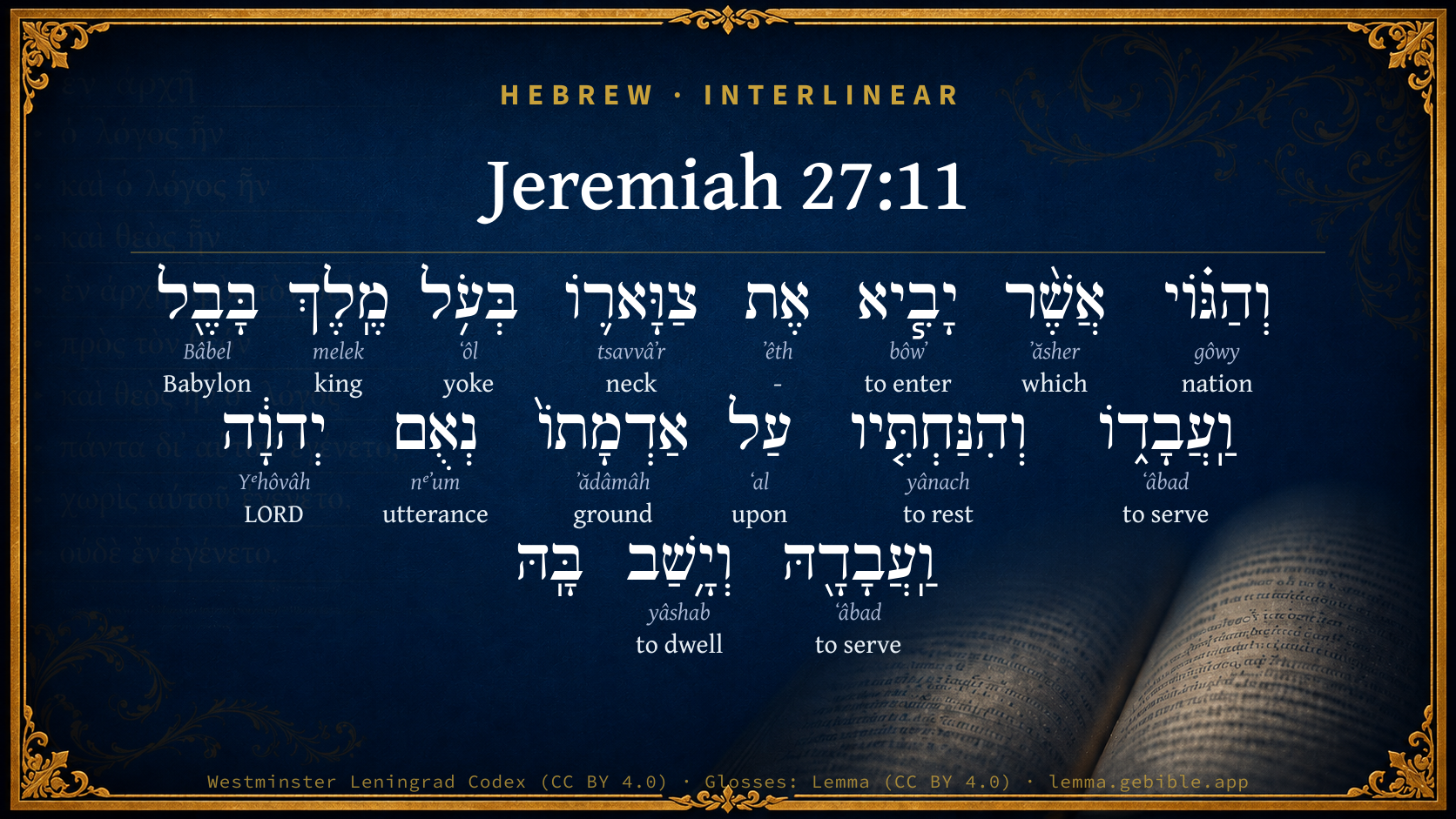
  1. וְהַגּ֗וֹי gôwy H1471 “and · the · nation” Conjunction + Particle, Definite Article + Noun, Common, Masculine, Singular, Absolute
  2. אֲשֶׁ֨ר ʼăsher H834 “which” Particle, Relative
  3. יָבִ֧יא bôwʼ H935 “to enter” Verb, Hiphil, Imperfect, 3rd Person, Masculine, Singular
  4. אֶת ʼêth H853 “-” Particle, Direct Object
  5. צַוָּאר֛וֹ tsavvâʼr H6677 “neck · his” Noun, Common, Masculine, Singular, Construct + Suffix, Personal, 3rd Person, Masculine, Singular
  6. מֶֽלֶךְ melek H4428 “king of” Noun, Common, Masculine, Singular, Construct
  7. בָּבֶ֖ל Bâbel H894 “Babylon” Noun, Proper
  8. וַֽעֲבָד֑וֹ ʻâbad H5647 “and · to serve · him” Conjunction + Verb, Qal, Sequential Perfect, 3rd Person, Masculine, Singular + Suffix, Personal, 3rd Person, Masculine, Singular
  9. וְהִנַּחְתִּ֤יו yânach H3240 “and · to rest · him” Conjunction + Verb, Hiphil, Sequential Perfect, 1st Person, Common, Singular + Suffix, Personal, 3rd Person, Masculine, Singular
  10. עַל ʻal H5921 “upon” Preposition
  11. אַדְמָתוֹ֙ ʼădâmâh H127 “ground · his” Noun, Common, Feminine, Singular, Construct + Suffix, Personal, 3rd Person, Masculine, Singular
  12. נְאֻם nᵉʼum H5002 “utterance of” Noun, Common, Masculine, Singular, Construct
  13. יְהוָ֔ה Yᵉhôvâh H3068 “LORD” Noun, Proper
  14. וַֽעֲבָדָ֖הּ ʻâbad H5647 “and · to serve · her” Conjunction + Verb, Qal, Sequential Perfect, 3rd Person, Masculine, Singular + Suffix, Personal, 3rd Person, Feminine, Singular
  15. וְיָ֥שַׁב yâshab H3427 “and · to dwell” Conjunction + Verb, Qal, Sequential Perfect, 3rd Person, Masculine, Singular

About this verse

These counts appear in no published source. They are computed here, from the morphology-tagged text and Lemma’s own curated glosses. What Lemma adds →

17
words
15
distinct lemmas
Prophets
section

Shared distinctive vocabulary

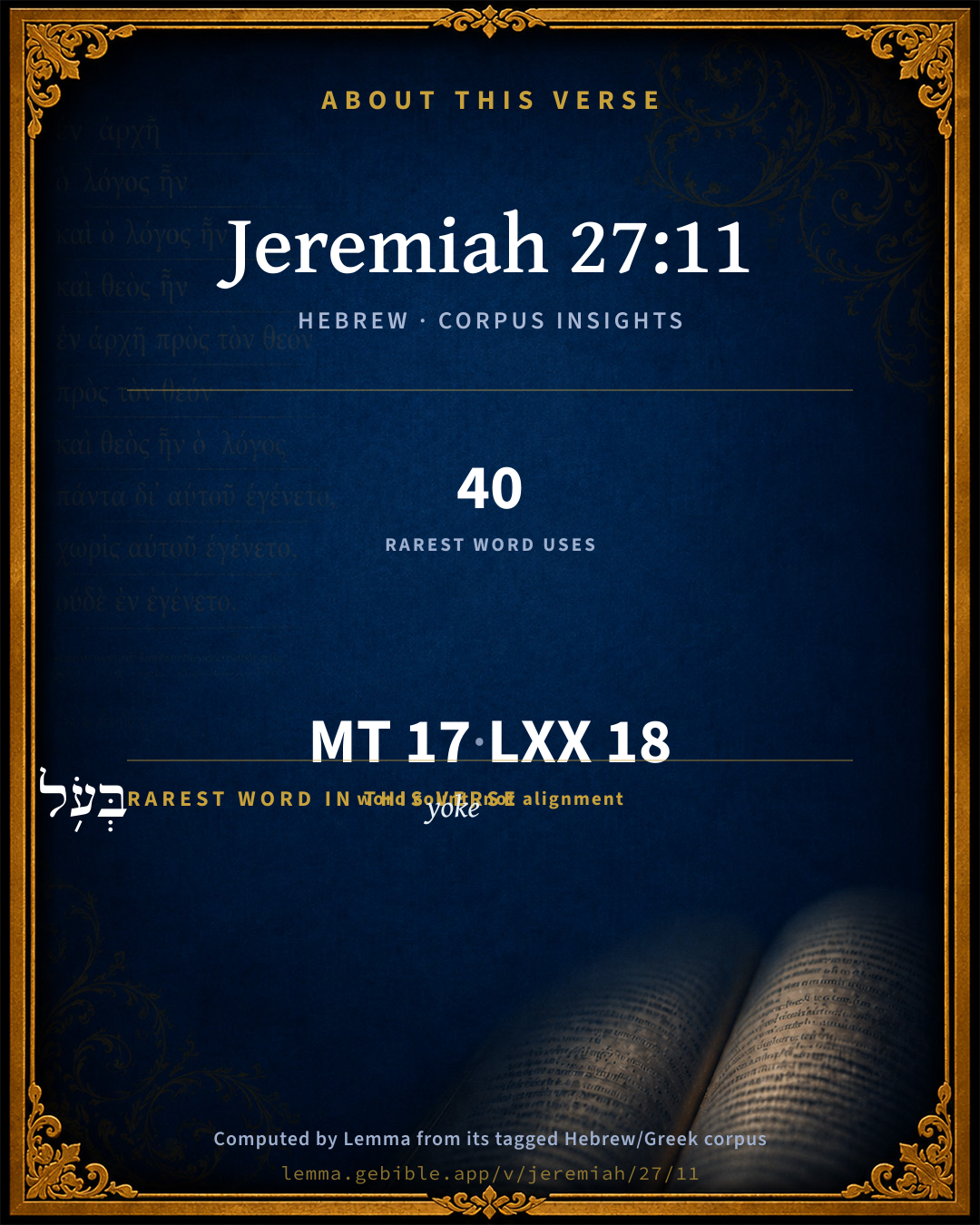
בְּעֹ֥ל yoke H5923 occurs in 34 verses of the Hebrew Bible. Also found in:

Grammatical profile

  • 5 verbs
  • 8 nouns
  • 2 prepositions
  • 2 particles

Verb forms

  • יָבִ֧יא Hiphil · Imperfect
  • וַֽעֲבָד֑וֹ Qal · Sequential Perfect
  • וְהִנַּחְתִּ֤יו Hiphil · Sequential Perfect
  • וַֽעֲבָדָ֖הּ Qal · Sequential Perfect
  • וְיָ֥שַׁב Qal · Sequential Perfect

Repetition

A word recurs within this verse — often emphatic in Hebrew:

  • וַֽעֲבָד֑וֹ to serve H5647 ×2

Hebrew & Septuagint length

In the original languages it is 17 Hebrew tokens and 18 Greek tokens — but the two are counted differently (Hebrew bundles its prefixes and suffixes into one token; the Greek is in lemma form), so that isn’t a like-for-like length.

Cross-references

7

Topical passages linked to Jeremiah 27:11 in the Treasury of Scripture Knowledge — connected by theme and wording, ordered by reader-vote popularity; previews shown in the World English Bible.

  • Jeremiah 21:9 He who remains in this city shall die by the sword, and by the famine, and by the pestilence; but he who goes out, and passes over to the Chaldeans who besiege you, he shall live, and his life shall be to him for a prey.
  • Jeremiah 27:2 Thus says Yahweh to me: Make you bonds and bars, and put them on your neck;
  • Jeremiah 27:8 It shall happen, that the nation and the kingdom which will not serve the same Nebuchadnezzar king of Babylon, and that will not put their neck under the yoke of the king of Babylon, that nation will I punish, says Yahweh, with the sword, and with the famine, and with the pestilence, until I have consumed them by his hand.
  • Jeremiah 38:2 Thus says Yahweh, He who remains in this city shall die by the sword, by the famine, and by the pestilence; but he who goes forth to the Chaldeans shall live, and his life shall be to him for a prey, and he shall live.
  • Jeremiah 27:12 I spoke to Zedekiah king of Judah according to all these words, saying, Bring your necks under the yoke of the king of Babylon, and serve him and his people, and live.
  • Jeremiah 40:9–12 Gedaliah the son of Ahikam the son of Shaphan swore to them and to their men, saying, Don't be afraid to serve the Chaldeans: dwell in the land, and serve the king of Babylon, and it shall be well with you.
  • Jeremiah 42:10–11 If you will still abide in this land, then will I build you, and not pull you down, and I will plant you, and not pluck you up; for I repent me of the evil that I have done to you.

Cross-references courtesy of OpenBible.info (CC BY 4.0).

Hebrew and Greek witnesses Masoretic Hebrew ↔ Greek Septuagint

The same verse in the two great witnesses to the Old Testament, shown verse-for-verse.

These are two independent witnesses, not word-aligned to each other, and the Septuagint is shown in lemma (dictionary) form.

Hebrew Jeremiah 27:11 Masoretic · Westminster Leningrad Codex

וְהַגּ֗וֹי אֲשֶׁ֨ר יָבִ֧יא אֶת צַוָּאר֛וֹ בְּעֹ֥ל מֶֽלֶךְ בָּבֶ֖ל וַֽעֲבָד֑וֹ וְהִנַּחְתִּ֤יו עַל אַדְמָתוֹ֙ נְאֻם יְהוָ֔ה וַֽעֲבָדָ֖הּ וְיָ֥שַׁב בָּֽהּ

But the nation that shall bring their neck under the yoke of the king of Babylon, and serve him, that [nation] will I let remain in their own land, says Yahweh; and they shall till it, and dwell therein.

World English Bible · Public Domain

Greek LXX Structure differs

In the Septuagint, Jeremiah is about an eighth shorter than the Hebrew and arranges its material differently — the Oracles Against the Nations (Hebrew chapters 46–51) appear in the middle of the Greek book, after 25:13. Because the chapter and verse boundaries do not line up, a verse-for-verse comparison with the Hebrew is not shown.

A verse-for-verse comparison isn’t shown here because the chapters and verses don’t line up. Switch to the LXX edition with the MT / LXX toggle above to read the Greek directly.

Hebrew: Westminster Leningrad Codex (CC BY 4.0). Greek: Septuagint (public domain); English from a public-domain English Septuagint. How the Septuagint differs from the Hebrew →

Targum (Aramaic paraphrase)

1

The Targum is the ancient Jewish Aramaic paraphrase of the Hebrew Scriptures — an interpretive translation, not the Hebrew text itself. Onkelos (literal) and Pseudo-Jonathan (expansive) render the Torah, and Jonathan the Prophets. Coverage is partial: where no permissively-licensed English translation exists for a verse, only the Aramaic is shown. This is verse-level text, not a word-by-word alignment to the Hebrew.

  1. Targum Jonathan Prophets (Joshua–Malachi)
    וְעַמָא דְיָעֵיל יַת צַוְרֵיהּ בְּנִיר מַלְכָּא דְבָבֶל וְיִפְלְחִינֵיהּ וְאַשְׁרִינֵיהּ עַל אַרְעֵיהּ אֲמַר יְיָ וְיִפְלְחָהּ וִיתֵיב בָּהּ:

    (no public-domain English translation for this verse)

    Targum Jonathan — Aramaic: “Mikraot Gedolot” (public domain). English: “Sefaria Community Translation” (CC0 1.0 (public-domain dedication)); “London "Chaldee Paraphrase," 1871” (public domain). Text via Sefaria.

Commentary

Notes on Jeremiah 27:11 from classic Christian and Jewish commentators (each source and its license shown beneath its notes). The classic Christian expositions comment on the surrounding passage and are grouped to its opening verse, so a note may address several verses; the Jewish commentaries on the Tanakh (Rashi and others) are per-verse, so they appear only where the commentator wrote on this verse.

Lemma curates 59 commentaries, every one of them public domain or Creative Commons licensed, each selected and text-cleaned for this edition rather than reprinted as found. About our sources →

Trapp's Complete Commentary

John Trapp

Jer 27:11 But the nations that bring their neck under the yoke of the king of Babylon, and serve him, those will I let remain still in their own land, saith the LORD; and they shall till it, and dwell therein.

Ver. 11. But the nations that bring their neck.] When God bids us yoke, it is best to submit. In all his commands there is so much reason for them, that if God did not enjoin them, yet it were best, in self-respects, for us to practise them; since in serving him we shall have the creatures to serve us, &c.

John Trapp, A Commentary or Exposition upon All the Books of the Old and New Testament (1647–1656) — public domain. Text from a community e-Sword module.

Jamieson, Fausset & Brown

Robert Jamieson, A. R. Fausset & David Brown

serve . . . till it--The same Hebrew root expresses "serve" and "till," or "cultivate." Serve ye the king of Babylon, and the land will serve you [CALVIN].

Jamieson, Fausset & Brown — Commentary Critical and Explanatory on the Whole Bible (1871) — public domain (CC PDM 1.0). Text via the HelloAO Bible API.

John Calvin's Commentaries

He seems indeed to speak here indiscriminately of all nations; but the admonition belongs to the Jews alone, as we have said, and as it appears from the context. He seems however to mention the nations, that he might more sharply touch the Jews, as though he had said, “Though God’s promises are not to be extended to heathen nations, yet God will spare the Tyrians and the Moabites, if they submit quietly to the king of Babylon, and take upon them his yoke. If God will spare heathen nations, when yet he has promised them nothing, what may his chosen people expect? But if he will punish nations who err in darkness, what will become of a people who knowingly and wilfully resist God and his judgments?” For obstinacy in the Jews was mad impiety, as though they avowedly designed to carry on war with God; for they knew that Nebuchadnezzar was the executioner of God’s vengeance. When therefore they ferociously attempted to exempt themselves from his power, it was to fight with God, as though they would not submit to his scourges.

We now then perceive why Jeremiah spoke what we here read, not only of the Jews, but also generally of all nations, The nation that brings its neck under the yoke of the king of Babylon, and serves him, I will leave it in its own land We must yet bear in mind what I have before said, that the Jews were the people especially regarded. If, then, they had given place to God’s kindness, he would have graciously spared them, and they would have perpetually enjoyed their own inheritance; but it was their obstinacy that drove them far into exile. And hence he adds, I will leave it in its land; and it shall cultivate it and dwell in it

There is a striking allusion in the word עבד, obed, for it means to serve, and also to cultivate; but there is to be understood a contrast between cultivating the land and that subjection, to which he exhorted the Jews, as though he had said, — “Serve the king of Babylon, that the land may serve you; it will be the reward of your obedience, if you will submit yourselves to the power of the king of Babylon, that the land will submit, to you, and you will compel it to serve you, so that it will bring forth food for you.” We hence see that God promised that the land would serve the people, if they refused not to serve the king of Babylon.

And hence also we may gather useful instruction, — that all the elements would be serviceable to us, were we willingly to obey God, but that on the contrary, the heaven, and the earth, and all the elements will be opposed to us, if we pertinaciously resist God. But Jeremiah speaks here more expressly of the submission which men render to God, when they calmly receive his correction, and acknowledge, while he inflicts punishment, that they justly deserve it, and do not refuse to be chastised by his hand. When, therefore, men thus submit to God’s judgment, they obtain his favor, so that the earth, and heaven, and all the elements will serve them. But the more perversely men exalt themselves and raise their horns against God, the more bondage shall they feel; for their own chains bind them stronger than anything else, when they thus struggle with God and do not humble themselves under his mighty hand. The same thing the Prophet still more clearly confirms when he says, —

John Calvin's Commentaries (1540-1563) — public domain. Text from the Calvin Translation Society English edition (1840s-50s) via the Christian Classics Ethereal Library (ccel.org). Calvin's coverage is partial (roughly two-thirds of the Bible); uncommented books and verses are honest gaps, never fabricated. The 19th-century editor's footnotes and remarks are omitted so the notes are faithfully Calvin's own voice.

Ellicott's Commentary for English Readers

(11) But the nations that bring their neck under the yoke . . .—The advice thus given to the five nations that were seeking an alliance with Judah before the actual invasion, is specifically addressed to Judah in the next verse, and is repeated more fully after the population of Judæa had been carried into captivity, in Jeremiah 29. The first warning had been despised, and the exiles were then reaping the fruit of their self-will, but the principle that obedience was better than resistance remained the same.

A Bible Commentary for English Readers, edited by Charles John Ellicott (1878–1897) — public domain. Text from a community e-Sword module.

John Gill's Exposition

But the nations that bring their neck under the yoke of the king of Babylon, and serve him,.... That at once, and readily, submit unto him, and pay him tribute:

those will I let remain still in their own land, saith the Lord; undisturbed by any other enemy; peaceably dwelling in their own habitations; following their occupations and business of life; and enjoying their substance and estates, only paying the tax imposed on them:

and they shall till it, and dwell therein; manure and cultivate it, and gather and eat the fruit of it, and continue to do so, they and their posterity after them.

John Gill's Exposition of the Whole Bible (1746–1763) — public domain (CC PDM 1.0). Text via the HelloAO Bible API.

Albert Barnes' Notes on the Bible

Nations ... - Rather, the nation.

Albert Barnes' Notes on the Bible (1834–1885) — public domain. Text from a community e-Sword/MySword module.

Haydock's Catholic Bible Commentary

In it. None complied, and though the Idumeans, &c., joined the Chaldeans against Juda, they were punished (Calmet) for their former league, ver. 3. (Haydock)

George Leo Haydock (1774–1849), Haydock's Catholic Family Bible and Commentary, 1859 edition — public domain. Excludes Psalms (Douay-Rheims chapter numbering differs from Protestant) and Deuterocanonical books (Catholic canon only).

Matthew Poole's English Annotations

Those that upon the first summons, or without making any hostile opposition, shall yield themselves servants to the king of Babylon, they shall remain still, and be left in the land to till the ground, and shall dwell therein. It is the time when God is resolved to put an end to the kingdom of Judah for a time, and to the other nations mentioned for ever: there is therefore no resisting of God’s counsels; those that most quietly yield will be in the best condition.

Matthew Poole's English Annotations on the Holy Bible (1683–1685) — public domain. Text from a community e-Sword/MySword module.

Whedon's Commentary on the Bible

Daniel D. Whedon

11. The nations — Literally, the nation.

PREDICTION OF THE SUBJUGATION OF KING ZEDEKIAH, 12-15.

Daniel D. Whedon (gen. ed.), Commentary on the Old and New Testaments (1874–1909) — public domain. Text from a community e-Sword module.

The Pulpit Commentary

The nations that bring their neck, etc. The Hebrew has, "The nation that shall bring its neck," etc.

The duty of non-resistance.

Again and again in various forms Jeremiah recurs to the advice of submission to Nebuchadnezzar. In the present instance he addresses it to representatives of foreign nations, and urges it as politic, while to the Jews he was more anxious to show that it was in accordance with God"s will. Viewed from various standpoints there were several grounds for nonresistance.

I THE WELL OF GOD. This was the highest reason. It could not be fully appreciated by the heathen; yet even they were reminded that the Creator was the supreme disposer of the destiny of nations. The condition of the Jews, however, was peculiar. They were living under a theocracy. The prophets were the ministry of the Divine King. Their utterances were revelations of law for the government of the people. To resist Nebuchadnezzar in opposition to these utterances was to rebel against the decree of the supreme Sovereign of the nation. We do not stand in the same outward circumstances. But we should learn that the first thought in public as well as in private affairs should be as to what is right, what is God"s will; and all considerations of glory etc., should be subordinate to this. We cannot learn God"s will from oracular teachers but we can ascertain it from a devout study of revelation, prayer, and honest thought

II SOUND POLICY. Events proved that Jeremiah was politically as well as morally right. Religious duty lies nearer to useful policy than either fanatic dreamers or worldly statesmen are able to see. History shows that all resistance to the mighty flood of the Babylonian invasion was futile. Timely submission alone could secure a mitigation of its violence. It is foolish for a nation to flourish empty notions of glory above considerations for the welfare of the people. The loyal statesman will care less for the fame of a great name, or the splendor of brilliant achievements, than for the peaceful prosperity of his fellow-countrymen. The first interest of a nation is this peaceful prosperity. There may be times when to maintain it self-defense becomes a duty. But when self-defense cannot secure it, when it is rather hindered than helped by resistance, it is foolish to resist for the sake of mere pride.

III WHOLESOME MORAL GOOD. The Jews were taught that the invasion by Nebuchadnezzar was sent by God as a chastisement for sin. To submit to it was to submit to profitable correction. In the end the nation might hope to be the better for it. We have no right to complain of troubles which our own misconduct has brought upon us. We may" count it all joy" that we have fallen into tribulation if this works our higher and lasting good. Temporal distress should be patiently borne in the prospect of eternal blessedness, material adversity calmly endured when this is the menus of securing inward spiritual good.

The Pulpit Commentary (1880–1919), ed. H.D.M. Spence-Jones & Joseph S. Exell — public domain. Text from a community e-Sword module.

Keil & Delitzsch

C. F. Keil & F. Delitzsch

The people, on the other hand, that bends under the yoke of the king of Babylon shall remain in its own land. For the great Asiatic conquerors contented themselves, in the first place, with thoroughly subjecting the vanquished nations and imposing a tribute; only in the case of stubborn resistance or of insurrection on the part of the conquered did they proceed to destroy the kingdoms and deport their populations. This Zedekiah and the ambassadors that had come to him might have learnt from Nebuchadnezzar's course of action after the capture of Jerusalem under Jehoiachin, as compared with that in Jehoiakim's time, had they not been utterly infatuated by the lying spirit of the false prophets, whose prophecies accommodated themselves to the wishes of the natural heart.

Keil & Delitzsch — Biblical Commentary on the Old Testament (1861–1891) — public domain (CC PDM 1.0). Text via the HelloAO Bible API. (Old Testament only.)

Lesson kit

Teaching starters — assembled from the data on this page, not authored interpretation. Every prompt links to the verse data it draws on. Edit before teaching.

Jeremiah, in the Prophets, opens this verse with 17 words (15 distinct Hebrew lemmas). Its most distinctive word is ʻôl (“yoke”). A historical commentator’s framing appears above. Read the whole chapter for the surrounding context.

Discussion questions

  1. How does “yoke” (ʻôl) shape what this verse is saying?
  2. Genesis 27:40 shares the word «yoke» with this verse. How do the two illuminate each other?
  3. “to serve” occurs 2× in this one verse. What is the effect of the repetition?
  4. These translations render this verse differently. What is at stake in choosing one wording over another?
  5. The verb «יָבִ֧יא» is Hiphil Imperfect. How does its form color the action?
  6. Reading how Trapp's Complete Commentary and Jamieson, Fausset & Brown read this verse, where do the two commentators agree and where do they part?

Things to notice

Reading settings

Reading text

Shown beneath each verse's original-language words.

Old Testament
Old Testament edition

Read the OT as the Masoretic Hebrew (MT) or the Greek Septuagint (LXX).

English shown for the Greek Septuagint (in the Hebrew ↔ Greek comparison).

Comparing translations? Open the Compare panel on any verse page to stack up to four side by side.