Genesis 47:23

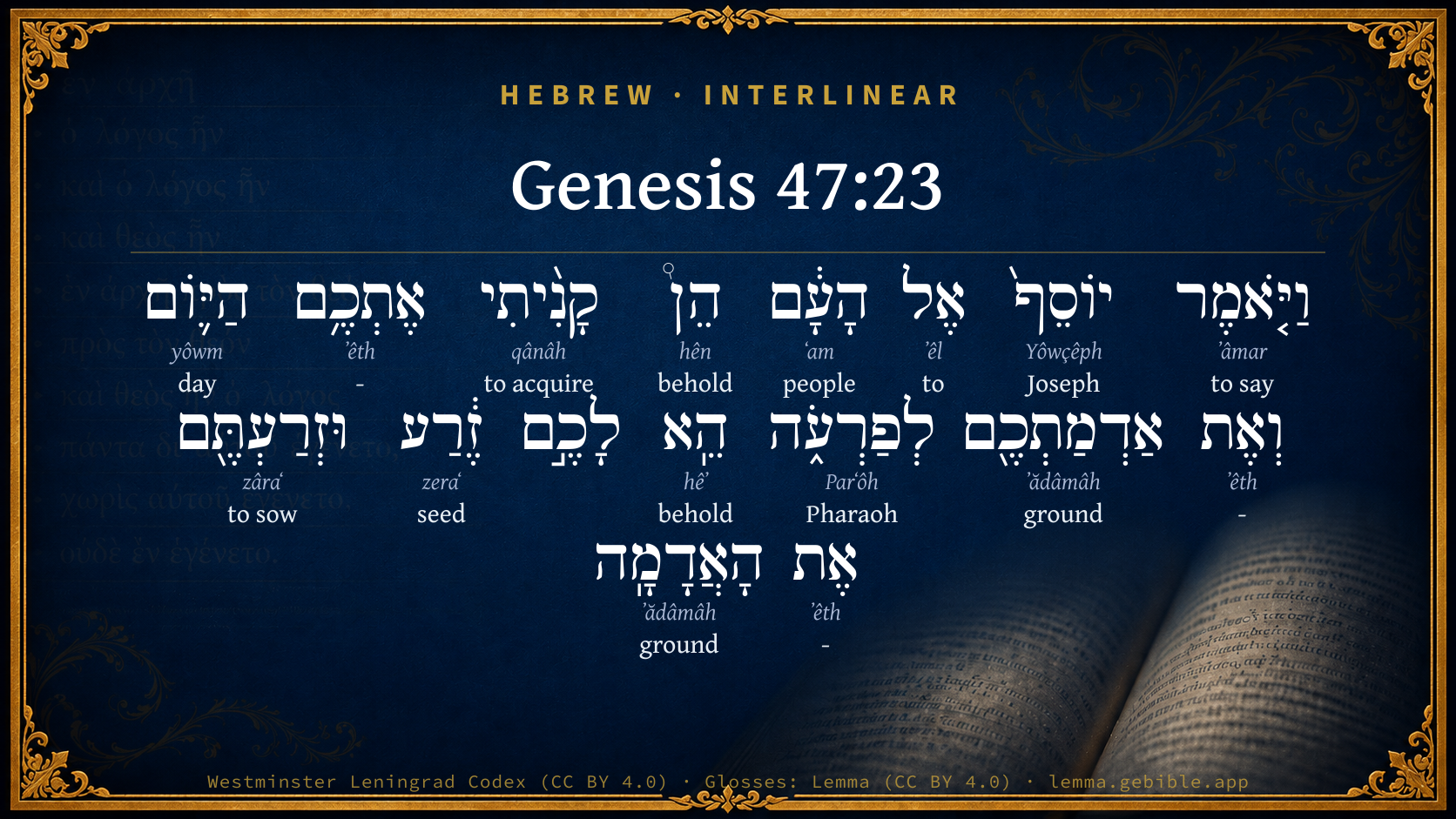
Hebrew (Westminster Leningrad Codex) Genesis 47:23 appears in the Hebrew Old Testament. The text above is from the Westminster Leningrad Codex. Each word links to its Strong’s number, a concise gloss, and parsing drawn from the Open Scriptures Hebrew Bible morphology. Click any word for its full Brown-Driver-Briggs (BDB) entry.
Download image
Cite this verse

Genesis 47:23 (World English Bible). Public Domain. Lemma interlinear Bible study tool, https://lemma.gebible.app/v/genesis/47/23.

Show BibTeX & RIS
BibTeX
RIS
English Translation
Then Joseph said to the people, "Behold, I have bought you and your land today for Pharaoh. Behold, here is seed for you, and you shall sow the land.
World English Bible · Public Domain
Highlights
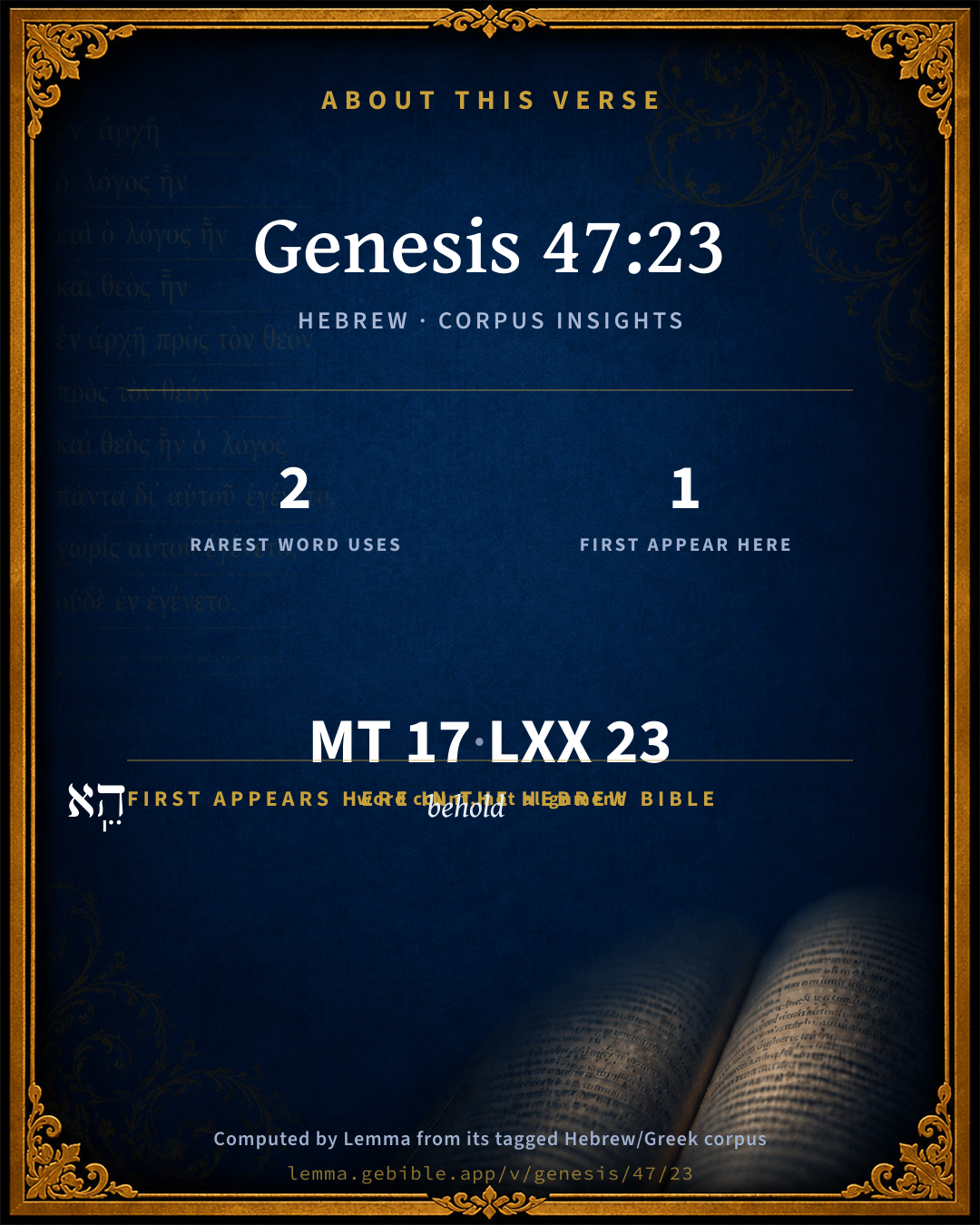
  • 1 first appearance in the Hebrew Bible
Full analysis ↓
Download a study sheet

One document with this verse’s original text, its word-by-word gloss line, the meaning frame, cross-references with their text, attributed commentary, and full source and license credits — printable, and it pastes into notes with its structure intact.

This verse Autodidact and up

Study sheet (.html) Plain text (.txt)

A passage Seminary Student

Up to 50 verses in one chapter. A passage sheet keeps up to 6 commentary sources and 12 cross-references per verse, in the order this page ranks them, and says so on the sheet whenever that leaves anything out. Ask for a single verse and you get the Autodidact verse sheet above.

Everything on this page stays free to read, with no account — the sheet is a download of what is already on screen, not access to it.

Want to remove ads? Support Godless Engineer
Compare translations 3

The same verse in 3 English versions, stacked beneath the original-language interlinear above. Click any original word for its lexicon entry.

Each is an independent rendering of the whole verse — the interlinear is not word-aligned to these translations.

Highlighted words mark where these versions differ — a whole-verse word diff, not a word-by-word alignment.

  • World English Bible Public Domain
    Then Joseph said to the people, "Behold, I have bought you and your land today for Pharaoh. Behold, here is seed for you, and you shall sow the land.
  • King James Version Public Domain
    Then Joseph said unto the people, Behold, I have bought you this day and your land for Pharaoh: lo, here is seed for you, and ye shall sow the land.
  • unfoldingWord Literal Text CC BY-SA 4.0
    Then Joseph said to the people, “Behold, today I have bought you and your land for Pharaoh. Here seed for you so that you can sow the ground.

unfoldingWord Literal Text — © unfoldingWord, licensed CC BY-SA 4.0. Word-aligned USFM3 via Door43 (git.door43.org/unfoldingWord/en_ult).

Versions to compare (up to 4)

3 of 4 selected

Show all 18 translations

Every available English version of this verse, each an independent rendering of the whole verse.

  • World English Bible Public Domain
    Then Joseph said to the people, "Behold, I have bought you and your land today for Pharaoh. Behold, here is seed for you, and you shall sow the land.
  • Berean Standard Bible Public Domain
    Then Joseph said to the people, “Now that I have acquired you and your land for Pharaoh this day, here is seed for you to sow in the land.
  • Majority Standard Bible Public Domain
    Then Joseph said to the people, “Now that I have acquired you and your land for Pharaoh this day, here is seed for you to sow in the land.
  • King James Version Public Domain
    Then Joseph said unto the people, Behold, I have bought you this day and your land for Pharaoh: lo, here is seed for you, and ye shall sow the land.
  • American Standard Version (1901) Public Domain
    Then Joseph said unto the people, Behold, I have bought you this day and your land for Pharaoh: lo, here is seed for you, and ye shall sow the land.
  • Revised Version (1885) Public Domain
    Then Joseph said unto the people, Behold, I have bought you this day and your land for Pharaoh: lo, here is seed for you, and ye shall sow the land.
  • Geneva Bible (1599) Public Domain
    Then Ioseph sayd vnto the people, Behold, I haue bought you this daye, and your lande for Pharaoh: lo, here is seede for you: sowe therefore the grounde.
  • Douay-Rheims (1899) Public Domain
    Then Joseph said to the people: Be- hold as you see, both you and your lands belong to Pharao: take seed and sow the fields,
  • Young's Literal Translation Public Domain
    And Joseph saith unto the people, `Lo, I have bought you to-day and your ground for Pharaoh; lo, seed for you, and ye have sown the ground,
  • Literal Standard Version CC BY-SA 4.0
    And Joseph says to the people, “Behold, I have bought you today and your ground for Pharaoh; behold, seed for you, and you have sown the ground,
  • Unlocked Literal Bible CC BY-SA 4.0
    Then Joseph said to the people, “See, I have bought you and your land today for Pharaoh. Now here is seed for you, and you will plant the land.
  • unfoldingWord Literal Text CC BY-SA 4.0
    Then Joseph said to the people, “Behold, today I have bought you and your land for Pharaoh. Here seed for you so that you can sow the ground.
  • Darby Bible Public Domain
    And Joseph said to the people, Behold, I have bought you this day and your land for Pharaoh: lo, here is seed for you, and sow the land.
  • World Messianic Bible Public Domain
    Then Joseph said to the people, “Behold, I have bought you and your land today for Pharaoh. Behold, here is seed for you, and you shall sow the land.
  • Webster's Bible Public Domain
    Then Joseph said to the people, Behold, I have bought you this day and your land for Pharaoh: lo, here is seed for you, and ye shall sow the land.
  • Free Bible Version CC BY-SA 4.0
    Then Joseph told the people, “Listen to me! Now that I have bought you and your land for Pharaoh, I'm giving you some seed for you to sow the fields.
  • Bible in Basic English Public Domain
    Then Joseph said to the people, I have made you and your land this day the property of Pharaoh; here is seed for you to put in your fields.
  • JPS Tanakh (1917) Public Domain
    Then Joseph said unto the people: 'Behold, I have bought you this day and your land for Pharaoh. Lo, here is seed for you, and ye shall sow the land.

Literal Standard Version (2020), Covenant Press — licensed CC BY-SA 4.0. Text via the HelloAO Bible API (eBible.org). Unlocked Literal Bible (unfoldingWord) — licensed CC BY-SA 4.0. Text via the HelloAO Bible API (eBible.org). unfoldingWord Literal Text — © unfoldingWord, licensed CC BY-SA 4.0. Word-aligned USFM3 via Door43 (git.door43.org/unfoldingWord/en_ult). Free Bible Version, Dr. Jonathan Gallagher — licensed CC BY-SA 4.0. Text via the HelloAO Bible API (eBible.org).

Word by word

More ways to search: Search by grammar → Find every occurrence → Compare this word →

Practice this passage: Drill this verse → Learn its vocabulary →

הֵֽא
hêʼ
H1887
“behold”
Particle, Interjection
Part of Speech
Particle
Type
Interjection
Full BDB Definition

Origin: a primitive particle

TWOT: 461

behold!, lo!
  1. וַיֹּ֤אמֶר ʼâmar H559 “and · to say” Conjunction + Verb, Qal, Sequential Imperfect, 3rd Person, Masculine, Singular
  2. יוֹסֵף֙ Yôwçêph H3130 “Joseph” Noun, Proper
  3. אֶל ʼêl H413 “to” Preposition
  4. הָעָ֔ם ʻam H5971 “the · people” Particle, Definite Article + Noun, Common, Masculine, Singular, Absolute
  5. הֵן֩ hên H2005 “behold” Particle, Demonstrative
  6. קָנִ֨יתִי qânâh H7069 “to acquire” Verb, Qal, Perfect, 1st Person, Common, Singular
  7. אֶתְכֶ֥ם ʼêth H853 “- · you” Particle, Direct Object + Suffix, Personal, 2nd Person, Masculine, Plural
  8. הַיּ֛וֹם yôwm H3117 “the · day” Particle, Definite Article + Noun, Common, Masculine, Singular, Absolute
  9. וְאֶת ʼêth H853 “and · -” Conjunction + Particle, Direct Object
  10. אַדְמַתְכֶ֖ם ʼădâmâh H127 “ground · your” Noun, Common, Feminine, Singular, Construct + Suffix, Personal, 2nd Person, Masculine, Plural
  11. לְפַרְעֹ֑ה Parʻôh H6547 “to/for · Pharaoh” Preposition + Noun, Proper
  12. זֶ֔רַע zeraʻ H2233 “seed” Noun, Common, Masculine, Singular, Absolute
  13. וּזְרַעְתֶּ֖ם zâraʻ H2232 “and · to sow” Conjunction + Verb, Qal, Sequential Perfect, 2nd Person, Masculine, Plural
  14. אֶת ʼêth H853 “-” Particle, Direct Object
  15. הָאֲדָמָֽה ʼădâmâh H127 “the · ground” Particle, Definite Article + Noun, Common, Feminine, Singular, Absolute

About this verse

These counts appear in no published source. They are computed here, from the morphology-tagged text and Lemma’s own curated glosses. What Lemma adds →

17
words
13
distinct lemmas
Pentateuch
section

Notable vocabulary

The rarest word here is הֵֽא behold H1887 — appearing just 2 times in the whole Hebrew Bible.

First appearance in Scripture

This word makes its first canonical appearance in the Hebrew Bible here:

Shared distinctive vocabulary

הֵֽא behold H1887 occurs in 2 verses of the Hebrew Bible. Also found in:

Grammatical profile

  • 3 verbs
  • 7 nouns
  • 2 prepositions
  • 5 particles

Verb forms

  • וַיֹּ֤אמֶר Qal · Sequential Imperfect
  • קָנִ֨יתִי Qal · Perfect
  • וּזְרַעְתֶּ֖ם Qal · Sequential Perfect

Repetition

A word recurs within this verse — often emphatic in Hebrew:

  • אַדְמַתְכֶ֖ם ground H127 ×2

Hebrew & Septuagint length

In English translation the verse runs 29 words from the Hebrew and 27 from the Septuagint (LXX English) — closely comparable.

A rough comparison of the two English renderings, which tokenize alike — not a word-level alignment.

Word counts can differ between the Hebrew and the Greek without any difference in meaning — e.g. the Hebrew direct-object marker אֵת has no separate Greek word, and Greek often adds the article ὁ.

In the original languages it is 17 Hebrew tokens and 23 Greek tokens — but the two are counted differently (Hebrew bundles its prefixes and suffixes into one token; the Greek is in lemma form), so that isn’t a like-for-like length.

Cross-references

13

Topical passages linked to Genesis 47:23 in the Treasury of Scripture Knowledge — connected by theme and wording, ordered by reader-vote popularity; previews shown in the World English Bible.

  • Genesis 41:27 The seven lean and ill-favored cattle that came up after them are seven years, and also the seven empty heads of grain blasted with the east wind; they will be seven years of famine.
  • Genesis 45:6 For these two years the famine has been in the land, and there are yet five years, in which there will be neither plowing nor harvest.
  • Psalms 41:1 Blessed is he who considers the poor: Yahweh will deliver him in the day of evil.
  • Psalms 107:36–37 There he makes the hungry live, That they may prepare a city to live in,
  • Psalms 112:5 It is well with the man who deals graciously and lends. He will maintain his cause in judgment.
  • Proverbs 11:26 People curse someone who withholds grain, But blessing will be on the head of him who sells it.
  • Proverbs 12:11 He who tills his land shall have plenty of bread, But he who chases fantasies is void of understanding.
  • Proverbs 13:23 An abundance of food is in poor people's fields, But injustice sweeps it away.
  • Ecclesiastes 11:6 In the morning sow your seed, And in the evening don't withhold your hand; For you don't know which will prosper, whether this or that, Or whether they both will be equally good.
  • Isaiah 28:24–25 Does he who plows to sow plow continually? does he [continually] open and harrow his ground?
  • Isaiah 55:10 For as the rain comes down and the snow from the sky, and doesn't return there, but waters the earth, and makes it bring forth and bud, and gives seed to the sower and bread to the eater;
  • Matthew 24:45 "Who then is the faithful and wise servant, whom his lord has set over his household, to give them their food in due season?
  • 2 Corinthians 9:10 Now may he who supplies seed to the sower and bread for food, supply and multiply your seed for sowing, and increase the fruits of your righteousness;

Cross-references courtesy of OpenBible.info (CC BY 4.0).

Hebrew and Greek witnesses Masoretic Hebrew ↔ Greek Septuagint

The same verse in the two great witnesses to the Old Testament, shown verse-for-verse.

These are two independent witnesses, not word-aligned to each other, and the Septuagint is shown in lemma (dictionary) form.

Hebrew Genesis 47:23 Masoretic · Westminster Leningrad Codex

וַיֹּ֤אמֶר יוֹסֵף֙ אֶל הָעָ֔ם הֵן֩ קָנִ֨יתִי אֶתְכֶ֥ם הַיּ֛וֹם וְאֶת אַדְמַתְכֶ֖ם לְפַרְעֹ֑ה הֵֽא לָכֶ֣ם זֶ֔רַע וּזְרַעְתֶּ֖ם אֶת הָאֲדָמָֽה

Then Joseph said to the people, "Behold, I have bought you and your land today for Pharaoh. Behold, here is seed for you, and you shall sow the land.

World English Bible · Public Domain

Greek LXX Genesis 47:23 Septuagint · lemma form

εἶπον δέ ιωσηφ πᾶς ὁ αἰγύπτιος ἰδού κτάομαι σύ καί ὁ γῆ σύ σήμερον ὁ φαραώ λαμβάνω ἑαυτοῦ σπέρμα καί σπείρω ὁ γῆ

And Joseph said to all the Egyptians, Behold, I have bought you and your land this day for Pharao; take seed for you, and sow the land.

LXX2012 (modern English Septuagint) · Public Domain

Hebrew: Westminster Leningrad Codex (CC BY 4.0). Greek: Septuagint (public domain); English from LXX2012 (modern English Septuagint) (Public Domain). How the Septuagint differs from the Hebrew →

Targum (Aramaic paraphrase)

2

The Targum is the ancient Jewish Aramaic paraphrase of the Hebrew Scriptures — an interpretive translation, not the Hebrew text itself. Onkelos (literal) and Pseudo-Jonathan (expansive) render the Torah, and Jonathan the Prophets. Coverage is partial: where no permissively-licensed English translation exists for a verse, only the Aramaic is shown. This is verse-level text, not a word-by-word alignment to the Hebrew.

  1. Targum Onkelos Torah (Genesis–Deuteronomy)
    וַאֲמַר יוֹסֵף לְעַמָּא הָא זְבֵנִית יָתְכוֹן יוֹמָא דֵּין וְיָת אַרְעֲכוֹן לְפַרְעֹה הֵא לְכוֹן בַּר זַרְעָא וְתִזְרְעוּן יָת אַרְעָא

    (no public-domain English translation for this verse)

    Targum Onkelos — Aramaic: “Onkelos Genesis” (public domain); “Onkelos Exodus” (public domain); “Onkelos Leviticus” (public domain); “Onkelos Numbers” (public domain); “Onkelos Deuteronomy” (public domain). English: “Sefaria Community Translation” (CC0 1.0 (public-domain dedication)); “J.W. Etheridge. The Targums of Onkelos and Jonathan Ben Uzziel on the Pentateuch. London: Longmans, Green, 1862” (public domain). Text via Sefaria.

  2. Targum Pseudo-Jonathan Torah (Genesis–Deuteronomy)
    וַאֲמַר יוֹסֵף לְעַמָא הָא קָנִיתִי יַתְכוֹן יוֹמָא דֵין וְיַת אַרְעֲכוֹן לְפַרְעה הָא לְכוֹן בַּר זַרְעָא וְתִזְרְעוּן יַת אַרְעָא

    And Joseph said to the people, Behold, I have this day bought you and your land for Pharoh: behold, (I give) you seed corn to sow the land;

    Targum Pseudo-Jonathan — Aramaic: “Targum Jonathan on Genesis” (public domain); “Targum Jonathan on Exodus” (public domain); “Targum Jonathan on Leviticus” (public domain); “Targum Jonathan on Numbers” (public domain); “Targum Jonathan on Deuteronomy” (public domain). English: “The Targum of Jonathan ben Uzziel, trans. J. W. Etheridge, London, 1862” (public domain). Text via Sefaria.

Commentary

Notes on Genesis 47:23 from classic Christian and Jewish commentators (each source and its license shown beneath its notes). The classic Christian expositions comment on the surrounding passage and are grouped to its opening verse, so a note may address several verses; the Jewish commentaries on the Tanakh (Rashi and others) are per-verse, so they appear only where the commentator wrote on this verse.

Lemma curates 59 commentaries, every one of them public domain or Creative Commons licensed, each selected and text-cleaned for this edition rather than reprinted as found. About our sources →

Trapp's Complete Commentary

John Trapp

Gen 47:23 Then Joseph said unto the people, Behold, I have bought you this day and your land for Pharaoh: lo, [here is] seed for you, and ye shall sow the land.

Ver. 23. Lo, seed for you, and ye shall sow.] This was the last of the seven years of famine: they might therefore sow "in hope." {1Co 9:10} Spes alit agricolas.

John Trapp, A Commentary or Exposition upon All the Books of the Old and New Testament (1647–1656) — public domain. Text from a community e-Sword module.

Jamieson, Fausset & Brown

Robert Jamieson, A. R. Fausset & David Brown

Joseph said, Behold, &c.--The lands being sold to the government (Gen 47:19-20), seed would be distributed for the first crop after the famine; and the people would occupy them as tenants-at-will on the payment of a produce rent, almost the same rule as obtains in Egypt in the present day.

Jamieson, Fausset & Brown — Commentary Critical and Explanatory on the Whole Bible (1871) — public domain (CC PDM 1.0). Text via the HelloAO Bible API.

Adam Clarke's Commentary

Verse 23. I have bought you this day and your land for Pharaoh] It fully appears that the kingdom of Egypt was previously to the time of Joseph a very limited monarchy. The king had his estates; the priests had their lands; and the common people their patrimony independently of both. The land of Rameses or Goshen appears to have been the king's land, Ge 47:11. The priests had their lands, which they did not sell to Joseph, Ge 47:22; Ge 47:26; and that the people had lands independent of the crown, is evident from the purchases Joseph made, Ge 47:19; Ge 47:20; and we may conclude from those purchases that Pharaoh had no power to levy taxes upon his subjects to increase his own revenue until he had bought the original right which each individual had in his possessions. And when Joseph bought this for the king he raised the crown an ample revenue, though he restored the lands, by obliging each to pay one fifth of the product to the king, Ge 47:24. And it is worthy of remark that the people of Egypt well understood the distinction between subjects and servants; for when they came to sell their land, they offered to sell themselves also, and said: Buy us and our land, and we and our land will be servants unto Pharaoh, Ge 47:19.

Diodorus Siculus, lib. i., gives the same account of the ancient constitution of Egypt. "The land," says he, "was divided into three parts:

1. One belonged to the PRIESTS, with which they provided all sacrifices, and maintained all the ministers of religion.

2. A second part was the KING'S, to support his court and family, and to supply expenses for wars if they should happen. Hence there were no taxes, the king having so ample an estate.

3. The remainder of the land belonged to the SUBJECTS, who appear (from the account of Diodorus) to have been all soldiers, a kind of standing militia, liable, at the king's expense, to serve in all wars for the preservation of the state."

This was a constitution something like the British; the government appears to have been mixed, and the monarchy properly limited, till Joseph, by buying the land of the people, made the king in some sort despotic. But it does not appear that any improper use was made of this, as in much later times we find it still a comparatively limited monarchy.

Adam Clarke's Commentary on the Bible (1810–1826) — public domain. Text from a community e-Sword/MySword module.

John Calvin's Commentaries

23. Then Joseph said unto the people. Here Moses describes the singular humanity of Joseph, which, as it then repressed all complaints, so, at this time, it justly dispels and refutes the calumnies with which he is assailed. The men, who were entirely destitute, and, in a sense, exiles, he reinstates in their possessions, on the most equitable condition, that they should pay a fifth part of the produce to the king. It is well known that formerly, in various places, kings have demanded by law the payment of tenths; but that, in the time of war, they doubled this tax. Therefore, what injury, can we say, was done to the Egyptians, when Joseph burdened the land, bought for the king, with a fifth part of its income; especially seeing that country is so much richer than others, that with less labor than elsewhere, it brings forth fruit for the maintenance of its cultivators? Should any one object that the king would have acted more frankly had he taken the fifth part of the land; the answer is obvious, that this was useful not only as an example, but also, for the purpose of quieting the people, by shutting the mouths of the captious. And certainly this indirect method, by which Joseph introduced the tax of a fifth part, had no other object than that of inducing the Egyptians to cultivate their lands with more alacrity, when they were convinced that, by such a compact, they were treated with clemency. And to this effect was their confession, which is recorded by Moses, expressed. For, first, they acknowledge that they owe their lives to him; secondly, they do not refuse to be the servants of the king. Whence we gather, that the holy man so conducted himself between the two parties, as greatly to enrich the king, without oppressing the people by tyranny. And I wish that all governors would practice this moderation, that they would only so far study the advantage of kings, as could be done without injury to the people. There is a celebrated saying of Tiberius Caesar, which savored little of tyranny, though he appears to have been a sanguinary and insatiable tyrant, that it is the part of a shepherd to shear the flock, but not to tear off the skin. At this day, however, kings do not believe that they rule freely, unless they not only flay their subjects, but entirely devour them. For they do not generally invest any with authority, except those who are sworn to the practice of slaughter. So much the more does the clemency of Joseph deserve praise, who so administered the affairs of Egypt, as to render the immense gains of the king compatible with a tolerable condition of the people.

John Calvin's Commentaries (1540-1563) — public domain. Text from the Calvin Translation Society English edition (1840s-50s) via the Christian Classics Ethereal Library (ccel.org). Calvin's coverage is partial (roughly two-thirds of the Bible); uncommented books and verses are honest gaps, never fabricated. The 19th-century editor's footnotes and remarks are omitted so the notes are faithfully Calvin's own voice.

Ellicott's Commentary for English Readers

(23) Lo, here is seed for you.—As Joseph would give them seed wherewith to sow their fields only when the famine was nearly over, these arrangements seem to have been completed shortly before the end of the seventh year; and then, with seed it would be necessary also to supply them with oxen to plough the soil, and swine wherewith to trample in the seed (Rawlinson, Egypt, i. 76). A fifth part of the produce would be a very moderate rent, especially as there were no rates or taxes to be paid. The whole expenses of the State had to be defrayed from this rent.

A Bible Commentary for English Readers, edited by Charles John Ellicott (1878–1897) — public domain. Text from a community e-Sword module.

John Gill's Exposition

And it shall come to pass, in the increase,.... When the land shall produce an increase, and it shall be gathered in:

that you shall give the fifth part unto Pharaoh; a fifth part of the increase:

and four parts shall be your own; for the following uses, one part

for seed of the field: to sow again with for the next year: a second part

for your food; for food for themselves: a third part

for them of your household; their servants and maids: and the fourth part

for food for your little ones; for their children, be they young or old; or however four parts of five he proposed they should have for their own use, and for the maintenance of their families, which was a kind and generous proposal, when all might have been demanded, and they and theirs treated as slaves.

John Gill's Exposition of the Whole Bible (1746–1763) — public domain (CC PDM 1.0). Text via the HelloAO Bible API.

Matthew Poole's English Annotations

For this was the last year of the famine, as was noted before.

Matthew Poole's English Annotations on the Holy Bible (1683–1685) — public domain. Text from a community e-Sword/MySword module.

Whedon's Commentary on the Bible

Daniel D. Whedon

23. I have bought you — This fact gave him the opportunity to dictate the future policy of the kingdom as to the royal revenue; a policy which the people were probably now prepared to see the wisdom of, and to which they readily acceded. Gen_47:25.

Daniel D. Whedon (gen. ed.), Commentary on the Old and New Testaments (1874–1909) — public domain. Text from a community e-Sword module.

The Pulpit Commentary

Vers. 23, 24. Then Joseph said unto the people, Behold, I have bought you this day and your land for Pharaoh: lo, here is seed for you, and ye shall sow the land. This proves the time to have been the last year of the famine; and since the people obtained seed from the viceroy, it is reasonable to suppose that they would also have their cattle restored to them to enable them to till the ground. And it shall come to pass in the increase, that ye shall give the fifth part unto Pharaoh, and four parts shall be your own, for seed of the field, and for your food, and for them of your households, and for food for your little ones. This verse is a sufficient refutation of the oft-preferred charge that Joseph had despoiled the Egyptians of their liberties, and converted a free people into a horde of abject slaves. Slave-owners are not usually content with a tax of only twenty percent on the gross revenues of their estates. Nor does it seem reasonable to allege that this was an exorbitant demand on the part either of Joseph or of Pharaoh. If in the seven years of plenty the people could afford to part with a fifth part of their produce, might not an improved system of agriculture enable them, under the new regulations, to pay as much as that in the shape of rent, and with quite as much ease? At all events the people themselves did not consider that they were being subjected to any harsh or unjust exaction.

The Pulpit Commentary (1880–1919), ed. H.D.M. Spence-Jones & Joseph S. Exell — public domain. Text from a community e-Sword module.

unfoldingWord translationNotes

Door43 World Missions Community

and you will plant

"that you might sow"

At the harvest, you must give a fifth to Pharaoh, and four parts will be your own

The word "fifth" is a fraction. AT: "At harvest time you will divide the crops into five parts. You will give one part back to Pharaoh for payment and the four parts are for your own" (See: Fractions)

for food for your households and your children

You can state clearly the understood information. AT: "for food for your households and for food for your children" (See: Ellipsis)

translationWords

harvest

household

unfoldingWord translationNotes — © Distant Shores Media and the Door43 World Missions Community, licensed CC BY-SA 4.0. Source: git.door43.org/Door43/en_tn.

Rashi

Rabbi Shlomo Yitzchaki (Rashi)

הא means the same as הנה “behold”, as (Ezekiel 16:43) “I also lo, (הא) will recompense thy way upon thine head”.

Rashi on the Tanakh — English translations: “The Judaica Press complete Tanach with Rashi, translated by A. J. Rosenberg” (CC BY 4.0); “Pentateuch with Rashi's commentary by M. Rosenbaum and A.M. Silbermann, 1929-1934” (public domain); “The Metsudah Tanach series, Lakewood, N.J” (CC BY 4.0); and “The Book of Joshua, Metsudah Publications, 1997” (CC BY 4.0). Text via Sefaria.

Sforno

Rabbi Ovadia Sforno

I have today purchased you. Since he had purchased both them and their lands he was required to feed them and supply them with seed, but all the produce would belong to him.

Sforno on the Tanakh — English translation: “Yalkut, Sifsei Chachomim Chumash, Metsudah Publications, 2009” (CC BY 4.0). Text via Sefaria.

Lesson kit

Teaching starters — assembled from the data on this page, not authored interpretation. Every prompt links to the verse data it draws on. Edit before teaching.

Genesis, in the Pentateuch, opens this verse with 17 words (13 distinct Hebrew lemmas). Its most distinctive word is hêʼ (“behold”). A historical commentator’s framing appears above. Read the whole chapter for the surrounding context.

Discussion questions

  1. What does “behold” (hêʼ) contribute to the verse as a whole?
  2. The word “behold” first appears here in Scripture. What is being introduced at this debut?
  3. Ezekiel 16:43 shares the word «behold» with this verse. How do the two illuminate each other?
  4. “ground” occurs 2× in this one verse. What is the effect of the repetition?
  5. The translations on this page render this verse differently — a whole-verse word diff, not a word-by-word alignment. What might account for the different wordings?
  6. The verb «וַיֹּ֤אמֶר» is Qal Sequential Imperfect. How does its form color the action?
  7. Reading how Trapp's Complete Commentary and Jamieson, Fausset & Brown read this verse, where do the two commentators agree and where do they part?

Things to notice

Reading settings

Reading text

Shown beneath each verse's original-language words.

Old Testament
Old Testament edition

Read the OT as the Masoretic Hebrew (MT) or the Greek Septuagint (LXX).

English shown for the Greek Septuagint (in the Hebrew ↔ Greek comparison).

Comparing translations? Open the Compare panel on any verse page to stack up to four side by side.