
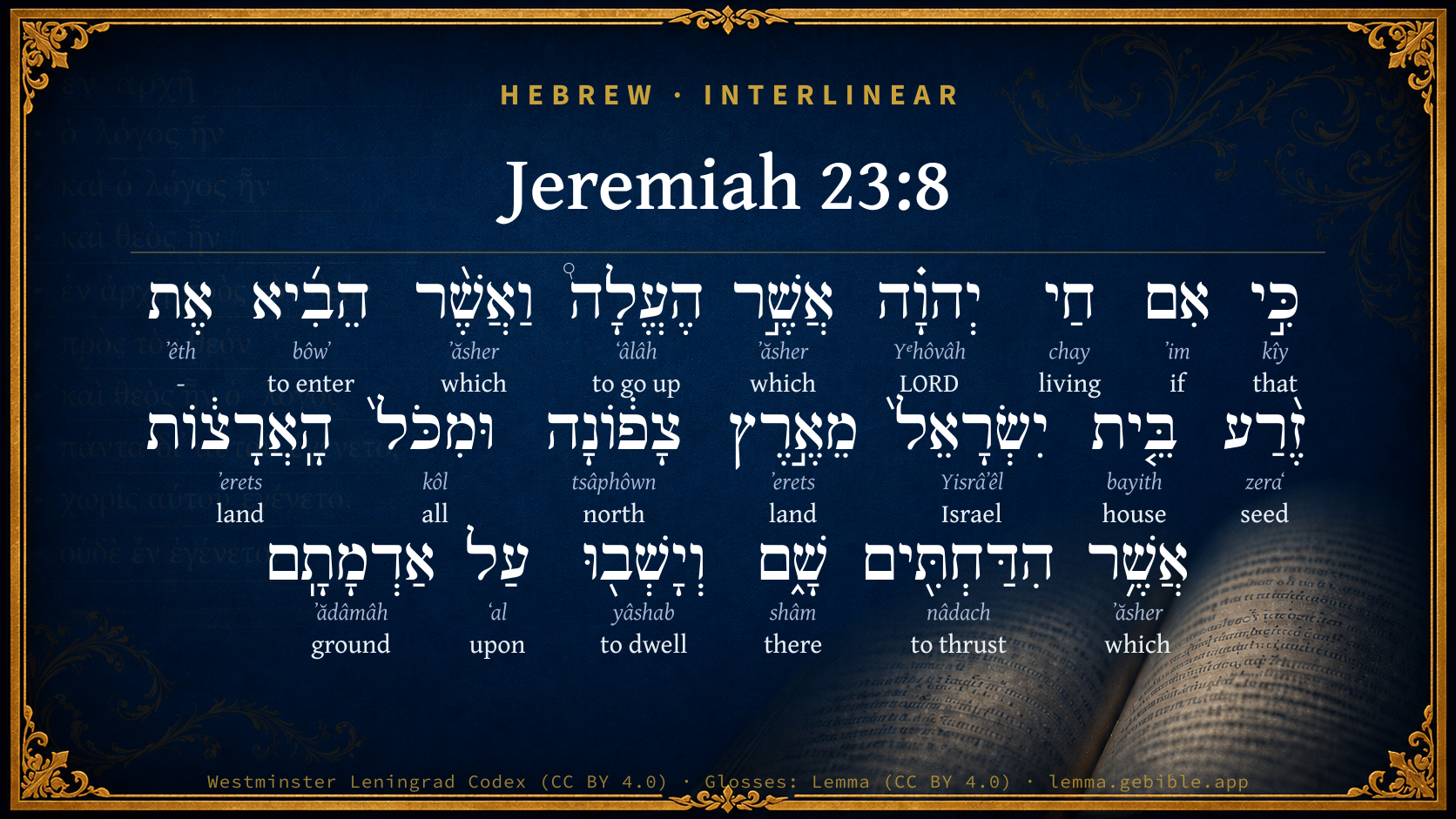
Jeremiah 23:8

Hebrew (Westminster Leningrad Codex) Jeremiah 23:8 appears in the Hebrew Old Testament. The text above is from the Westminster Leningrad Codex. Each word links to its Strong’s number, a concise gloss, and parsing drawn from the Open Scriptures Hebrew Bible morphology. Click any word for its full Brown-Driver-Briggs (BDB) entry.
Download image
Cite this verse

Jeremiah 23:8 (World English Bible). Public Domain. Lemma interlinear Bible study tool, https://lemma.gebible.app/v/jeremiah/23/8.

Show BibTeX & RIS
BibTeX
RIS
English Translation
but, As Yahweh lives, who brought up and who led the seed of the house of Israel out of the north country, and from all the countries where I had driven them. They shall dwell in their own land.
World English Bible · Public Domain
Download a study sheet

One document with this verse’s original text, its word-by-word gloss line, the meaning frame, cross-references with their text, attributed commentary, and full source and license credits — printable, and it pastes into notes with its structure intact.

This verse Autodidact and up

Study sheet (.html) Plain text (.txt)

A passage Seminary Student

Up to 50 verses in one chapter. A passage sheet keeps up to 6 commentary sources and 12 cross-references per verse, in the order this page ranks them, and says so on the sheet whenever that leaves anything out. Ask for a single verse and you get the Autodidact verse sheet above.

Everything on this page stays free to read, with no account — the sheet is a download of what is already on screen, not access to it.

Want to remove ads? Support Godless Engineer
Compare translations 3

The same verse in 3 English versions, stacked beneath the original-language interlinear above. Click any original word for its lexicon entry.

Each is an independent rendering of the whole verse — the interlinear is not word-aligned to these translations.

Highlighted words mark where these versions differ — a whole-verse word diff, not a word-by-word alignment.

  • World English Bible Public Domain
    but, As Yahweh lives, who brought up and who led the seed of the house of Israel out of the north country, and from all the countries where I had driven them. They shall dwell in their own land.
  • King James Version Public Domain
    But, The LORD liveth, which brought up and which led the seed of the house of Israel out of the north country, and from all countries whither I had driven them; and they shall dwell in their own land.
  • unfoldingWord Literal Text CC BY-SA 4.0
    but rather, ‘As Yahweh lives, who brought up and who led the offspring of the house of Israel from the land of the north and from all the lands where I had driven them.’ And they will dwell in their own land.” p

unfoldingWord Literal Text — © unfoldingWord, licensed CC BY-SA 4.0. Word-aligned USFM3 via Door43 (git.door43.org/unfoldingWord/en_ult).

Versions to compare (up to 4)

3 of 4 selected

Show all 18 translations

Every available English version of this verse, each an independent rendering of the whole verse.

  • World English Bible Public Domain
    but, As Yahweh lives, who brought up and who led the seed of the house of Israel out of the north country, and from all the countries where I had driven them. They shall dwell in their own land.
  • Berean Standard Bible Public Domain
    Instead they will say, ‘As surely as the LORD lives, who brought and led the descendants of the house of Israel up out of the land of the north and all the other lands to which He had banished them.’ Then they will dwell once more in their own land.”
  • Majority Standard Bible Public Domain
    Instead they will say, ‘As surely as the LORD lives, who brought and led the descendants of the house of Israel up out of the land of the north and all the other lands to which He had banished them.’ Then they will dwell once more in their own land.”
  • King James Version Public Domain
    But, The LORD liveth, which brought up and which led the seed of the house of Israel out of the north country, and from all countries whither I had driven them; and they shall dwell in their own land.
  • American Standard Version (1901) Public Domain
    but, As Jehovah liveth, who brought up and who led the seed of the house of Israel out of the north country, and from all the countries whither I had driven them. And they shall dwell in their own land.
  • Revised Version (1885) Public Domain
    but, As the LORD liveth, which brought up and which led the seed of the house of Israel out of the north country, and from all the countries whither I had driven them; and they shall dwell in their own land.
  • Geneva Bible (1599) Public Domain
    But the Lord liueth, which brought vp and led the seede of the house of Israel out of the North countrey and from all countryes where I had scattered them, and they shall dwell in their owne lande.
  • Douay-Rheims (1899) Public Domain
    But the Lord liveth, who hath brought out, and brought hither the seed of the house of Israel from the land of the north, and out of all the lands, to which I had cast them forth: and they shall dwell in their own land.
  • Young's Literal Translation Public Domain
    But -- Jehovah liveth, who brought up, And who brought in, the seed of the house of Israel, From the land of the north, And from all the lands whither I drove them, And they have dwelt on their own ground!
  • Literal Standard Version CC BY-SA 4.0
    But—YHWH lives, who brought up, || And who brought in, the seed of the house of Israel, || From the land of the north, || And from all the lands to where I drove them, || And they have dwelt on their own ground!”
  • Unlocked Literal Bible CC BY-SA 4.0
    Instead they will say, 'As Yahweh lives, who brought up and who led back the descendants of the house of Israel from the northern land and all the lands where they had been driven.' Then they will live in their own land.”
  • unfoldingWord Literal Text CC BY-SA 4.0
    but rather, ‘As Yahweh lives, who brought up and who led the offspring of the house of Israel from the land of the north and from all the lands where I had driven them.’ And they will dwell in their own land.” p
  • Darby Bible Public Domain
    but, [As] Jehovah liveth, who brought up and who led back the seed of the house of Israel out of the north country, and from all countries whither I had driven them. And they shall dwell in their own land.
  • World Messianic Bible Public Domain
    but, ‘As the LORD lives, who brought up and who led the offspring of the house of Israel out of the north country, and from all the countries where I had driven them.’ Then they will dwell in their own land.”
  • Webster's Bible Public Domain
    But, the LORD liveth, who brought and who led the seed of the house of Israel out of the north country, and from all countries whither I have driven them; and they shall dwell in their own land.
  • Free Bible Version CC BY-SA 4.0
    Instead they'll say, “On the Lord's life, who led the Israelites back from the northern country and all the other countries where he had exiled them.” Then they'll live in their own country.
  • Bible in Basic English Public Domain
    But, By the living Lord, who took up the seed of Israel, and made them come out of the north country, and from all the countries where I had sent them; and they will be living in the land which is theirs.
  • JPS Tanakh (1917) Public Domain
    but: 'As the LORD liveth, that brought up and that led the seed of the house of Israel out of the north country, and from all the countries whither I had driven them'; and they shall dwell in their own land.

Literal Standard Version (2020), Covenant Press — licensed CC BY-SA 4.0. Text via the HelloAO Bible API (eBible.org). Unlocked Literal Bible (unfoldingWord) — licensed CC BY-SA 4.0. Text via the HelloAO Bible API (eBible.org). unfoldingWord Literal Text — © unfoldingWord, licensed CC BY-SA 4.0. Word-aligned USFM3 via Door43 (git.door43.org/unfoldingWord/en_ult). Free Bible Version, Dr. Jonathan Gallagher — licensed CC BY-SA 4.0. Text via the HelloAO Bible API (eBible.org).

Word by word

More ways to search: Search by grammar → Find every occurrence → Compare this word →

Practice this passage: Drill this verse → Learn its vocabulary →

הִדַּחְתִּ֖ים
nâdach
H5080
“to thrust · them”
Verb, Hiphil, Perfect, 1st Person, Common, Singular + Suffix, Personal, 3rd Person, Masculine, Plural
Part of Speech
Verb
Stem
Hiphil
Form
Perfect
Person
1st Person
Gender
Common
Number
Singular
Full BDB Definition

Origin: a primitive root

TWOT: 1304

to impel, thrust, drive away, banish - (Qal) - to impel - to thrust away, banish - (Niphal) - to be impelled - to be thrust out, be banished - banished, outcast (participle) - to be driven away - to be thrust away, thrust aside - (Pual) to be thrust into - thrust (participle) - (Hiphil) - to thrust, move, impel - to thrust out, banish - to thrust away, thrust aside - (Hophal) to be chased, be hunted - chased, hunted (participle)
  1. כִּ֣י kîy H3588 “that” Conjunction
  2. אִם ʼim H518 “if” Conjunction
  3. חַי chay H2416 “living” Adjective, Adjective, Masculine, Singular, Absolute
  4. יְהוָ֗ה Yᵉhôvâh H3068 “LORD” Noun, Proper
  5. אֲשֶׁ֣ר ʼăsher H834 “which” Particle, Relative
  6. הֶעֱלָה֩ ʻâlâh H5927 “to go up” Verb, Hiphil, Perfect, 3rd Person, Masculine, Singular
  7. וַאֲשֶׁ֨ר ʼăsher H834 “and · which” Conjunction + Particle, Relative
  8. הֵבִ֜יא bôwʼ H935 “to enter” Verb, Hiphil, Perfect, 3rd Person, Masculine, Singular
  9. אֶת ʼêth H853 “-” Particle, Direct Object
  10. זֶ֨רַע zeraʻ H2233 “seed of” Noun, Common, Masculine, Singular, Construct
  11. בֵּ֤ית bayith H1004 “house of” Noun, Common, Masculine, Singular, Construct
  12. יִשְׂרָאֵל֙ Yisrâʼêl H3478 “Israel” Noun, Proper
  13. מֵאֶ֣רֶץ ʼerets H776 “from · land” Preposition + Noun, Common, Both, Singular, Absolute
  14. צָפ֔וֹנָה tsâphôwn H6828 “north · toward” Noun, Common, Feminine, Singular, Absolute + Suffix, Demonstrative
  15. וּמִכֹּל֙ kôl H3605 “and · from · all of” Conjunction + Preposition + Noun, Common, Masculine, Singular, Construct
  16. הָֽאֲרָצ֔וֹת ʼerets H776 “the · lands” Particle, Definite Article + Noun, Common, Both, Plural, Absolute
  17. אֲשֶׁ֥ר ʼăsher H834 “which” Particle, Relative
  18. שָׁ֑ם shâm H8033 “there” Adverb
  19. וְיָשְׁב֖וּ yâshab H3427 “and · to dwell” Conjunction + Verb, Qal, Sequential Perfect, 3rd Person, Common, Plural
  20. עַל ʻal H5921 “upon” Preposition
  21. אַדְמָתָֽם ʼădâmâh H127 “ground · their” Noun, Common, Feminine, Singular, Construct + Suffix, Personal, 3rd Person, Masculine, Plural

About this verse

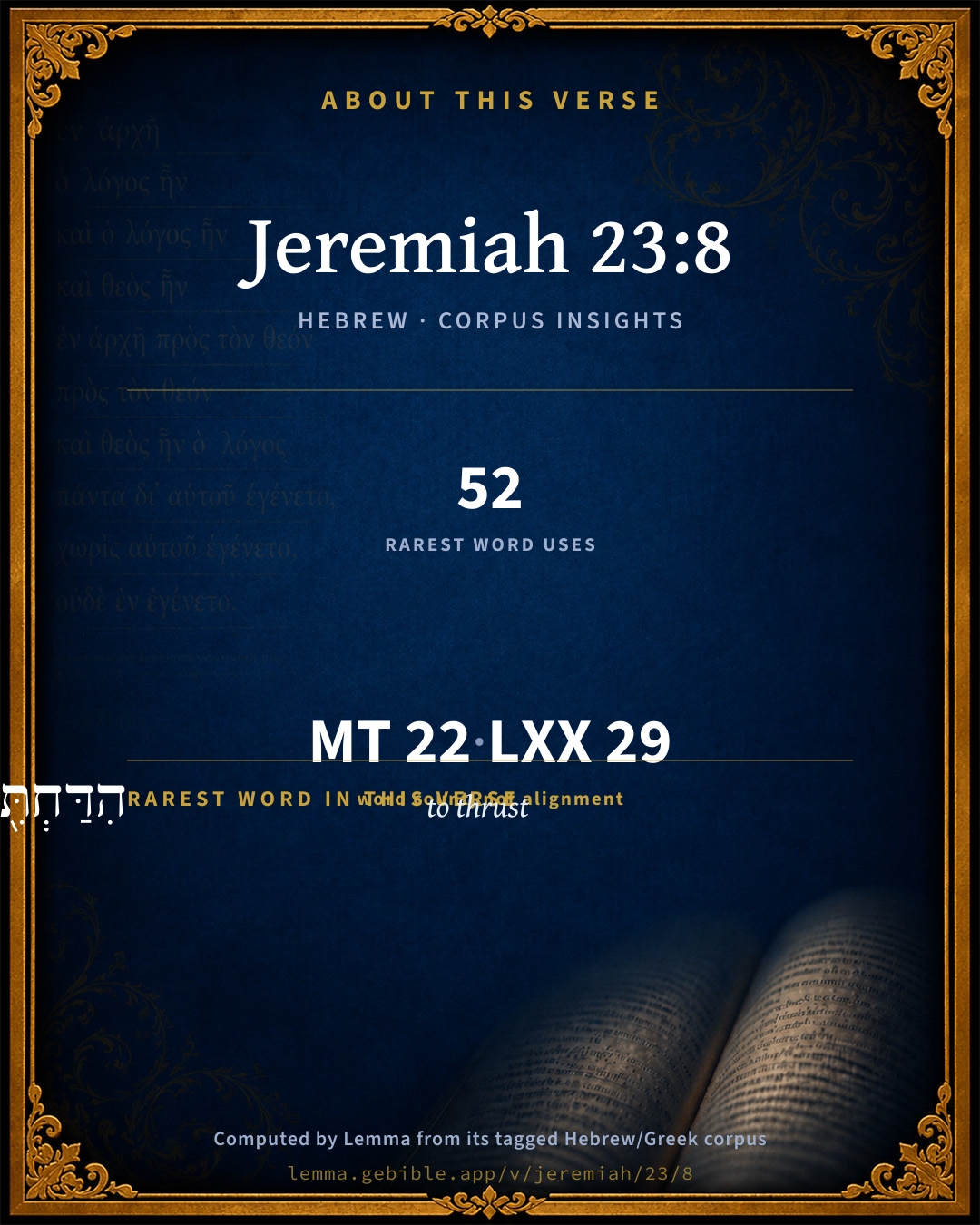
These counts appear in no published source. They are computed here, from the morphology-tagged text and Lemma’s own curated glosses. What Lemma adds →

22
words
19
distinct lemmas
Prophets
section

Shared distinctive vocabulary

הִדַּחְתִּ֖ים to thrust H5080 occurs in 51 verses of the Hebrew Bible. Also found in:

Grammatical profile

  • 4 verbs
  • 9 nouns
  • 1 adjective
  • 1 preposition
  • 2 conjunctions
  • 1 adverb
  • 4 particles

Verb forms

  • הֶעֱלָה֩ Hiphil · Perfect
  • הֵבִ֜יא Hiphil · Perfect
  • הִדַּחְתִּ֖ים Hiphil · Perfect
  • וְיָשְׁב֖וּ Qal · Sequential Perfect

Repetition

Words recur within this verse — often emphatic in Hebrew:

  • מֵאֶ֣רֶץ land H776 ×2
  • אֲשֶׁ֣ר which H834 ×3

Hebrew & Septuagint length

In the original languages it is 22 Hebrew tokens and 29 Greek tokens — but the two are counted differently (Hebrew bundles its prefixes and suffixes into one token; the Greek is in lemma form), so that isn’t a like-for-like length.

Cross-references

11

Topical passages linked to Jeremiah 23:8 in the Treasury of Scripture Knowledge — connected by theme and wording, ordered by reader-vote popularity; previews shown in the World English Bible.

  • Isaiah 43:5–6 Don't be afraid; for I am with you: I will bring your seed from the east, and gather you from the west;
  • Amos 9:14–15 I will bring back the captivity of my people Israel, And they will rebuild the ruined cities, and inhabit them; and they will plant vineyards, and drink wine from them. They shall also make gardens, And eat the fruit of them.
  • Ezekiel 34:13 I will bring them out from the peoples, and gather them from the countries, and will bring them into their own land; and I will feed them on the mountains of Israel, by the watercourses, and in all the inhabited places of the country.
  • Isaiah 14:1 For Yahweh will have compassion on Jacob, and will yet choose Israel, and set them in their own land: and the foreigner shall join himself with them, and they shall cleave to the house of Jacob.
  • Isaiah 27:12–13 It shall happen in that day, that Yahweh will beat off [his fruit] from the flood of the River to the brook of Egypt; and you shall be gathered one by one, you children of Israel.
  • Jeremiah 23:3 I will gather the remnant of my flock out of all the countries where I have driven them, and will bring them again to their folds; and they shall be fruitful and multiply.
  • Ezekiel 36:24 For I will take you from among the nations, and gather you out of all the countries, and will bring you into your own land.
  • Ezekiel 37:25 They shall dwell in the land that I have given to Jacob my servant, in which your fathers lived; and they shall dwell therein, they, and their children, and their children's children, forever: and David my servant shall be their prince for ever.
  • Ezekiel 39:28 They shall know that I am Yahweh their God, in that I caused them to go into captivity among the nations, and have gathered them to their own land; and I will leave none of them any more there;
  • Zephaniah 3:20 At that time will I bring you in, and at that time will I gather you; for I will give you honor and praise among all the peoples of the earth, when I bring back your captivity before your eyes, says Yahweh.
  • Isaiah 65:8–10 Thus says Yahweh, As the new wine is found in the cluster, and one says, Don't destroy it, for a blessing is in it: so will I do for my servants' sake, that I may not destroy them all.

Cross-references courtesy of OpenBible.info (CC BY 4.0).

Hebrew and Greek witnesses Masoretic Hebrew ↔ Greek Septuagint

The same verse in the two great witnesses to the Old Testament, shown verse-for-verse.

These are two independent witnesses, not word-aligned to each other, and the Septuagint is shown in lemma (dictionary) form.

Hebrew Jeremiah 23:8 Masoretic · Westminster Leningrad Codex

כִּ֣י אִם חַי יְהוָ֗ה אֲשֶׁ֣ר הֶעֱלָה֩ וַאֲשֶׁ֨ר הֵבִ֜יא אֶת זֶ֨רַע בֵּ֤ית יִשְׂרָאֵל֙ מֵאֶ֣רֶץ צָפ֔וֹנָה וּמִכֹּל֙ הָֽאֲרָצ֔וֹת אֲשֶׁ֥ר הִדַּחְתִּ֖ים שָׁ֑ם וְיָשְׁב֖וּ עַל אַדְמָתָֽם

but, As Yahweh lives, who brought up and who led the seed of the house of Israel out of the north country, and from all the countries where I had driven them. They shall dwell in their own land.

World English Bible · Public Domain

Greek LXX Structure differs

In the Septuagint, Jeremiah is about an eighth shorter than the Hebrew and arranges its material differently — the Oracles Against the Nations (Hebrew chapters 46–51) appear in the middle of the Greek book, after 25:13. Because the chapter and verse boundaries do not line up, a verse-for-verse comparison with the Hebrew is not shown.

A verse-for-verse comparison isn’t shown here because the chapters and verses don’t line up. Switch to the LXX edition with the MT / LXX toggle above to read the Greek directly.

Hebrew: Westminster Leningrad Codex (CC BY 4.0). Greek: Septuagint (public domain); English from a public-domain English Septuagint. How the Septuagint differs from the Hebrew →

Targum (Aramaic paraphrase)

1

The Targum is the ancient Jewish Aramaic paraphrase of the Hebrew Scriptures — an interpretive translation, not the Hebrew text itself. Onkelos (literal) and Pseudo-Jonathan (expansive) render the Torah, and Jonathan the Prophets. Coverage is partial: where no permissively-licensed English translation exists for a verse, only the Aramaic is shown. This is verse-level text, not a word-by-word alignment to the Hebrew.

  1. Targum Jonathan Prophets (Joshua–Malachi)
    אֱלָהֵין יְהוֹן מִשְׁתְּעָן בִּגְבוּרְתָּא דַייָ דְאַסֵיק וּדְאַיְתֵי יַת זַרְעָא דִבְנֵי יִשְׂרָאֵל מֵאֲרַע צִפּוּנָא וּמִן מְדִינָתָא דְאַגְלֵיתִינוּן לְתַמָן וְיַתְבוּן עַל אַרְעֲהוֹן:

    (no public-domain English translation for this verse)

    Targum Jonathan — Aramaic: “Mikraot Gedolot” (public domain). English: “Sefaria Community Translation” (CC0 1.0 (public-domain dedication)); “London "Chaldee Paraphrase," 1871” (public domain). Text via Sefaria.

Commentary

Notes on Jeremiah 23:8 from classic Christian and Jewish commentators (each source and its license shown beneath its notes). The classic Christian expositions comment on the surrounding passage and are grouped to its opening verse, so a note may address several verses; the Jewish commentaries on the Tanakh (Rashi and others) are per-verse, so they appear only where the commentator wrote on this verse.

Lemma curates 59 commentaries, every one of them public domain or Creative Commons licensed, each selected and text-cleaned for this edition rather than reprinted as found. About our sources →

Trapp's Complete Commentary

John Trapp

Jer 23:8 But, The LORD liveth, which brought up and which led the seed of the house of Israel out of the north country, and from all countries whither I had driven them; and they shall dwell in their own land.

Ver. 8. But the Lord liveth.] See Jer 16:15.

John Trapp, A Commentary or Exposition upon All the Books of the Old and New Testament (1647–1656) — public domain. Text from a community e-Sword module.

John Calvin's Commentaries

He says, from all the lands to which I shall have driven them, and he says this for two reasons, which we shall presently state. The change of person does not obscure the meaning: Live, he says, does Jehovah, who brought out and led his people from the land of the north, and from all the lands to which I had driven them; but there is no ambiguity in the sense.

As to the subject itself, it seems that God in the first place intended to remind the Jews of their sins, as this knowledge was to be the way to repentance, or a preparation for it. For except they were convinced that they were chastised for their sins by God’s hand, they would either have thought that their exile was by chance, or have given way to murmuring complaints as they often did. But God here declares that he was the author of their exile, in order that the Jews might know that God justly punished them for their many and grievous sins. But God, in the second place, shews that it was in his power, whenever he pleased, to restore those whom he had afflicted. It was the same as to raise from death those whom he had slain, according to what is said elsewhere,

“God is he who kills, and who brings to life.” (1 Samuel 2:6.)

Many indeed can destroy, but they cannot heal the wound which they may have made. But with regard to God, he is both a righteous Judge and a merciful Savior. As, then, death is in his power whenever he punishes men for their wickedness, so also he has life in his hand and at his bidding, whenever he intends to shew mercy. We now, then, perceive what the Prophet had in view in saying that the Jews had been driven away by God.

He afterwards adds, They shall dwell in their own land It was necessary that the Jews should have been sustained by this support until the coming of Christ, for they saw that they would be in that inheritance which had been promised to the fathers as a pledge of eternal life and of the heavenly kingdom. It now follows, —

John Calvin's Commentaries (1540-1563) — public domain. Text from the Calvin Translation Society English edition (1840s-50s) via the Christian Classics Ethereal Library (ccel.org). Calvin's coverage is partial (roughly two-thirds of the Bible); uncommented books and verses are honest gaps, never fabricated. The 19th-century editor's footnotes and remarks are omitted so the notes are faithfully Calvin's own voice.

John Gill's Exposition

But, the Lord liveth,.... Or they shall swear by the living God; or declare the power of the Lord, as the Targum, in their redemption by the Messiah:

which brought up and which led the seed of the house of Israel out of the north country, and from all countries whither I had driven them: which respects not only the deliverance of the Jews from Babylon, which lay north of Judea; but the conversion of many of the ten tribes, through the preaching of the Gospel in the several countries where they were, to which the apostles of Christ were sent with it; and also the gathering of them together at the latter day, when they shall turn to the Lord, and return to their own land; as follows:

and they shall dwell in their own land: which has never been fulfilled as yet of the seed of the house of Israel, or of the ten tribes; but will be when all Israel shall be saved. (i) This passage is applied in the Talmud (k) to the days of the Messiah; See Gill on Jer 16:14 and See Gill on Jer 16:15.

(i) This was written about 1730. Although the Jews are now in their land, they remain in unbelief to this present time and this prophecy will yet have a more complete future fulfullment. Editor. (k) T. Bab. Beracot, fol. 12. 2.

John Gill's Exposition of the Whole Bible (1746–1763) — public domain (CC PDM 1.0). Text via the HelloAO Bible API.

Haydock's Catholic Bible Commentary

Land. The deliverance from Egypt and Babylon were emblems of man’s redemption, which was accomplished by far greater miracles.

George Leo Haydock (1774–1849), Haydock's Catholic Family Bible and Commentary, 1859 edition — public domain. Excludes Psalms (Douay-Rheims chapter numbering differs from Protestant) and Deuterocanonical books (Catholic canon only).

Matthew Poole's English Annotations

See Poole "Jer 16:14", where much the same words are to be found. The prophet aggravateth the greatness of that salvation, which should be brought by Christ to all the true Israel of God, by comparing it with the deliverance of the ancient Israel of God out of the land of Egypt; which he saith it should so far transcend and excel, that the deliverance out of Egypt should not be named when this salvation should appear, which should be after their return from Babylon, and when God should gather them from all countries, which was fulfilled when by the preaching of the gospel, not the Gentiles only were converted, but many of the Jews also which were scattered abroad, Jam 1:1; 1Pe 1:1. Possibly part of this promise or prophecy remains yet to be accomplished, for the Jews are not yet come to

dwell in their own land; unless that term be to be expounded of Christians, who during the times of persecution in the primitive church were scattered abroad, but upon the ceasing of those persecutions, when Christian emperors came to have the government, returned to their own countries, where they enjoyed a more still and quiet habitation.

Matthew Poole's English Annotations on the Holy Bible (1683–1685) — public domain. Text from a community e-Sword/MySword module.

John Wesley's Explanatory Notes

They shall dwell - Possibly part of this prophecy remains yet to be accomplished for the Jews are not yet come to dwell in their own land.

John Wesley, Explanatory Notes Upon the Whole Bible (1754–1765) — public domain. Text via the GEBible commentary corpus.

Lesson kit

Teaching starters — assembled from the data on this page, not authored interpretation. Every prompt links to the verse data it draws on. Edit before teaching.

Jeremiah, in the Prophets, opens this verse with 22 words (19 distinct Hebrew lemmas). Its most distinctive word is nâdach (“to thrust”). A historical commentator’s framing appears above. Read the whole chapter for the surrounding context.

Discussion questions

  1. How does “to thrust” (nâdach) shape what this verse is saying?
  2. Deuteronomy 4:19 shares the word «to thrust» with this verse. How do the two illuminate each other?
  3. “land” occurs 2× in this one verse. What is the effect of the repetition?
  4. These translations render this verse differently; the difference is in the English rendering, not the original. What questions does that raise?
  5. The verb «הֶעֱלָה֩» is Hiphil Perfect. How does its form color the action?
  6. Reading how Trapp's Complete Commentary and John Calvin's Commentaries read this verse, where do the two commentators agree and where do they part?

Things to notice

Reading settings

Reading text

Shown beneath each verse's original-language words.

Old Testament
Old Testament edition

Read the OT as the Masoretic Hebrew (MT) or the Greek Septuagint (LXX).

English shown for the Greek Septuagint (in the Hebrew ↔ Greek comparison).

Comparing translations? Open the Compare panel on any verse page to stack up to four side by side.