Deuteronomy 28:21

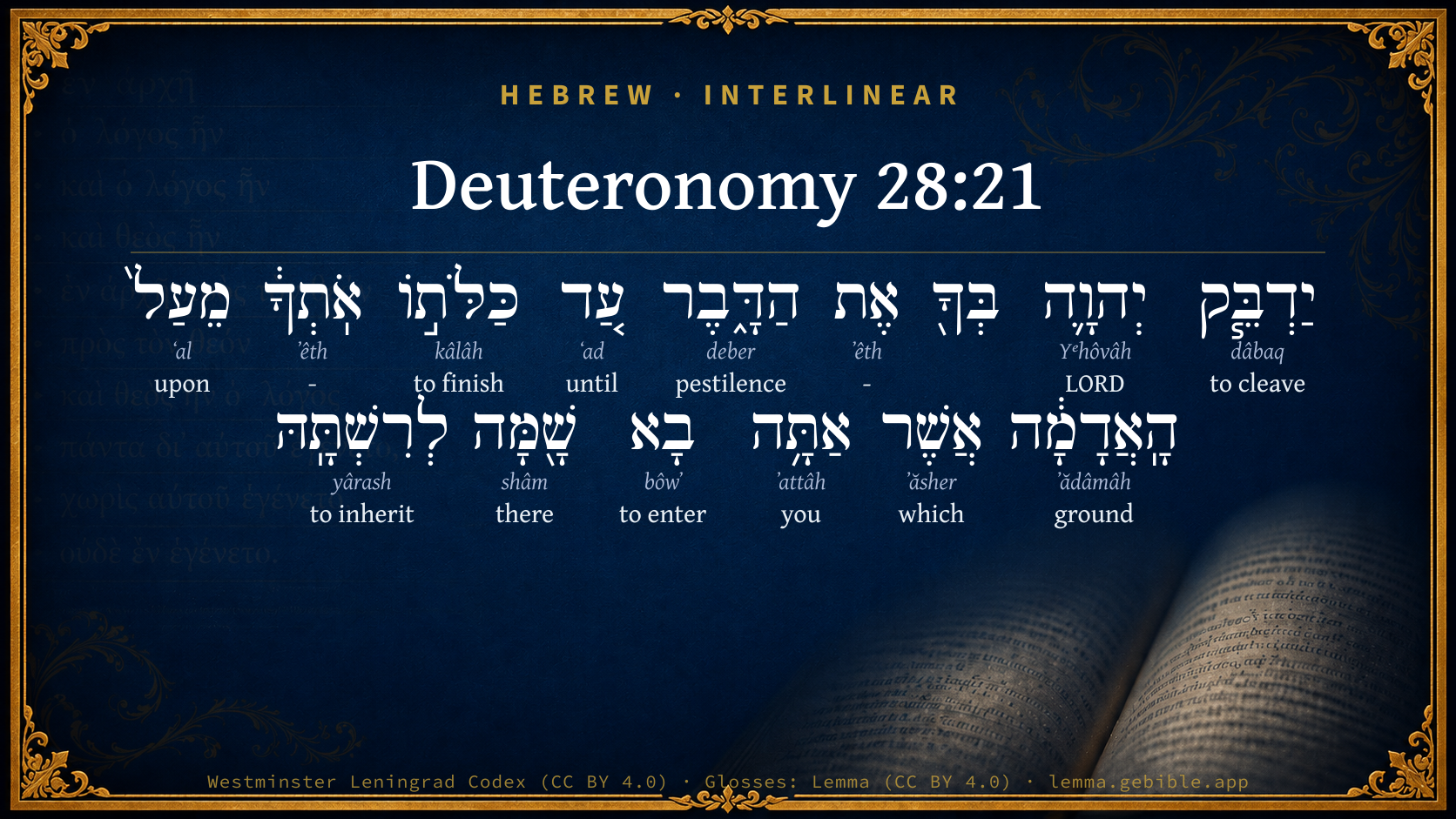
Hebrew (Westminster Leningrad Codex) Deuteronomy 28:21 appears in the Hebrew Old Testament. The text above is from the Westminster Leningrad Codex. Each word links to its Strong’s number, a concise gloss, and parsing drawn from the Open Scriptures Hebrew Bible morphology. Click any word for its full Brown-Driver-Briggs (BDB) entry.
Download image
Cite this verse

Deuteronomy 28:21 (World English Bible). Public Domain. Lemma interlinear Bible study tool, https://lemma.gebible.app/v/deuteronomy/28/21.

Show BibTeX & RIS
BibTeX
RIS
English Translation
Yahweh will make the pestilence cleave to you, until he have consumed you from off the land, where you go in to possess it.
World English Bible · Public Domain
Download a study sheet

One document with this verse’s original text, its word-by-word gloss line, the meaning frame, cross-references with their text, attributed commentary, and full source and license credits — printable, and it pastes into notes with its structure intact.

This verse Autodidact and up

Study sheet (.html) Plain text (.txt)

A passage Seminary Student

Up to 50 verses in one chapter. A passage sheet keeps up to 6 commentary sources and 12 cross-references per verse, in the order this page ranks them, and says so on the sheet whenever that leaves anything out. Ask for a single verse and you get the Autodidact verse sheet above.

Everything on this page stays free to read, with no account — the sheet is a download of what is already on screen, not access to it.

Want to remove ads? Support Godless Engineer
Compare translations 3

The same verse in 3 English versions, stacked beneath the original-language interlinear above. Click any original word for its lexicon entry.

Each is an independent rendering of the whole verse — the interlinear is not word-aligned to these translations.

Highlighted words mark where these versions differ — a whole-verse word diff, not a word-by-word alignment.

  • World English Bible Public Domain
    Yahweh will make the pestilence cleave to you, until he have consumed you from off the land, where you go in to possess it.
  • King James Version Public Domain
    The LORD shall make the pestilence cleave unto thee, until he have consumed thee from off the land, whither thou goest to possess it.
  • unfoldingWord Literal Text CC BY-SA 4.0
    Yahweh will make the plague cling to you until he has finished you from off the land which you are going into to possess it.

unfoldingWord Literal Text — © unfoldingWord, licensed CC BY-SA 4.0. Word-aligned USFM3 via Door43 (git.door43.org/unfoldingWord/en_ult).

Versions to compare (up to 4)

3 of 4 selected

Show all 18 translations

Every available English version of this verse, each an independent rendering of the whole verse.

  • World English Bible Public Domain
    Yahweh will make the pestilence cleave to you, until he have consumed you from off the land, where you go in to possess it.
  • Berean Standard Bible Public Domain
    The LORD will make the plague cling to you until He has exterminated you from the land that you are entering to possess.
  • Majority Standard Bible Public Domain
    The LORD will make the plague cling to you until He has exterminated you from the land that you are entering to possess.
  • King James Version Public Domain
    The LORD shall make the pestilence cleave unto thee, until he have consumed thee from off the land, whither thou goest to possess it.
  • American Standard Version (1901) Public Domain
    Jehovah will make the pestilence cleave unto thee, until he have consumed thee from off the land, whither thou goest in to possess it.
  • Revised Version (1885) Public Domain
    The LORD shall make the pestilence cleave unto thee, until he have consumed thee from off the land, whither thou goest in to possess it.
  • Geneva Bible (1599) Public Domain
    The Lord shall make the pestilence cleaue vnto thee, vntill he hath consumed thee from the land, whither thou goest to possesse it.
  • Douay-Rheims (1899) Public Domain
    May the Lord set the pestilence upon thee, until he consume thee out of the land, which thou shalt go in to possess.
  • Young's Literal Translation Public Domain
    `Jehovah doth cause to cleave to thee the pestilence, till He consume thee from off the ground whither thou art going in to possess it.
  • Literal Standard Version CC BY-SA 4.0
    YHWH causes the pestilence to cleave to you until He consumes you from off the ground to where you are going in to possess it.
  • Unlocked Literal Bible CC BY-SA 4.0
    Yahweh will make the plague cling to you until he destroys you from off the land that you are going in to possess.
  • unfoldingWord Literal Text CC BY-SA 4.0
    Yahweh will make the plague cling to you until he has finished you from off the land which you are going into to possess it.
  • Darby Bible Public Domain
    Jehovah will make the pestilence cleave unto thee, until he have consumed thee from off the land whither thou goest to possess it.
  • World Messianic Bible Public Domain
    The LORD will make the pestilence cling to you, until he has consumed you from off the land where you go in to possess it.
  • Webster's Bible Public Domain
    The LORD shall make the pestilence cleave to thee, until he shall have consumed thee from off the land, whither thou goest to possess it.
  • Free Bible Version CC BY-SA 4.0
    The Lord will give you infectious diseases until he has wiped you out from the country you are entering.
  • Bible in Basic English Public Domain
    The Lord will send disease after disease on you, till you have been cut off by death from the land to which you are going.
  • JPS Tanakh (1917) Public Domain
    The LORD will make the pestilence cleave unto thee, until He have consumed thee from off the land, whither thou goest in to possess it.

Literal Standard Version (2020), Covenant Press — licensed CC BY-SA 4.0. Text via the HelloAO Bible API (eBible.org). Unlocked Literal Bible (unfoldingWord) — licensed CC BY-SA 4.0. Text via the HelloAO Bible API (eBible.org). unfoldingWord Literal Text — © unfoldingWord, licensed CC BY-SA 4.0. Word-aligned USFM3 via Door43 (git.door43.org/unfoldingWord/en_ult). Free Bible Version, Dr. Jonathan Gallagher — licensed CC BY-SA 4.0. Text via the HelloAO Bible API (eBible.org).

Word by word

More ways to search: Search by grammar → Find every occurrence → Compare this word →

Practice this passage: Drill this verse → Learn its vocabulary →

הַדָּ֑בֶר
deber
H1698
“the · pestilence”
Particle, Definite Article + Noun, Common, Masculine, Singular, Absolute
Part of Speech
Particle + Noun
Type
Common
Gender
Masculine
Number
Singular
State
Absolute
Full BDB Definition

Origin: from H1696 (in the sense of destroying)

TWOT: 399b

pestilence, plague - murrain, cattle disease, cattle-plague
  1. יַדְבֵּ֧ק dâbaq H1692 “to cleave” Verb, Hiphil, Imperfect, 3rd Person, Masculine, Singular
  2. יְהוָ֛ה Yᵉhôvâh H3068 “LORD” Noun, Proper
  3. אֶת ʼêth H853 “-” Particle, Direct Object
  4. עַ֚ד ʻad H5704 “until” Preposition
  5. כַּלֹּת֣וֹ kâlâh H3615 “to finish · him” Verb, Piel, Infinitive Construct + Suffix, Personal, 3rd Person, Masculine, Singular
  6. אֹֽתְךָ֔ ʼêth H853 “- · you” Particle, Direct Object + Suffix, Personal, 2nd Person, Masculine, Singular
  7. מֵעַל֙ ʻal H5921 “from · upon” Preposition + Preposition
  8. הָֽאֲדָמָ֔ה ʼădâmâh H127 “the · ground” Particle, Definite Article + Noun, Common, Feminine, Singular, Absolute
  9. אֲשֶׁר ʼăsher H834 “which” Particle, Relative
  10. אַתָּ֥ה ʼattâh H859 “you” Pronoun, Personal, 2nd Person, Masculine, Singular
  11. בָא bôwʼ H935 “entering” Verb, Qal, Participle Active, Masculine, Singular, Absolute
  12. שָׁ֖מָּה shâm H8033 “there · toward” Adverb + Suffix, Demonstrative
  13. לְרִשְׁתָּֽהּ yârash H3423 “to inherit · her” Preposition + Verb, Qal, Infinitive Construct + Suffix, Personal, 3rd Person, Feminine, Singular

About this verse

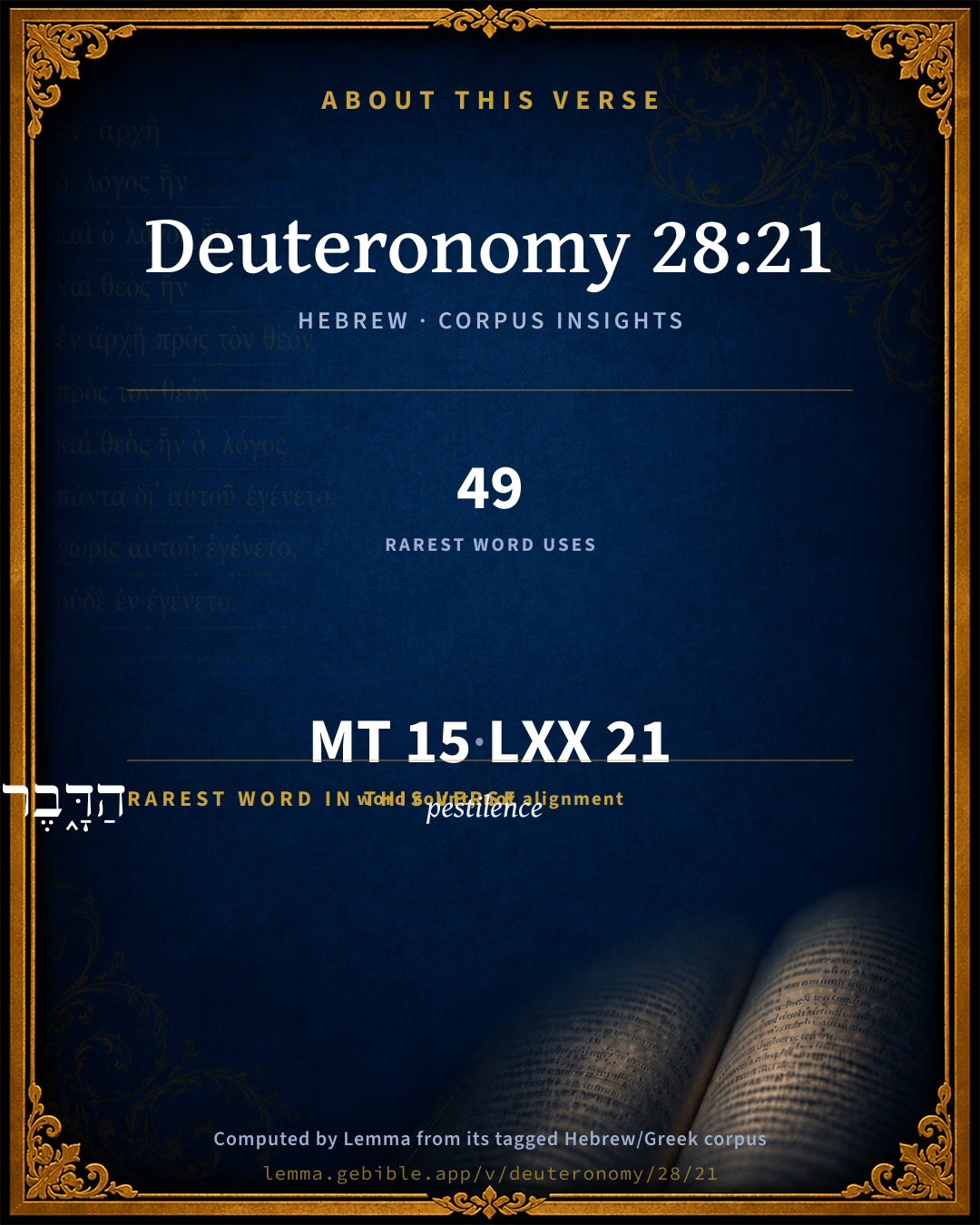
These counts appear in no published source. They are computed here, from the morphology-tagged text and Lemma’s own curated glosses. What Lemma adds →

15
words
13
distinct lemmas
Pentateuch
section

Shared distinctive vocabulary

הַדָּ֑בֶר pestilence H1698 occurs in 48 verses of the Hebrew Bible. Also found in:

Grammatical profile

  • 4 verbs
  • 3 nouns
  • 1 pronoun
  • 3 prepositions
  • 1 adverb
  • 3 particles

Verb forms

  • יַדְבֵּ֧ק Hiphil · Imperfect
  • כַּלֹּת֣וֹ Piel · Infinitive Construct
  • בָא Qal · Participle Active
  • לְרִשְׁתָּֽהּ Qal · Infinitive Construct

Hebrew & Septuagint length

In English translation the verse runs 24 words from the Hebrew and 25 from the Septuagint (LXX English) — closely comparable.

A rough comparison of the two English renderings, which tokenize alike — not a word-level alignment.

Word counts can differ between the Hebrew and the Greek without any difference in meaning — e.g. the Hebrew direct-object marker אֵת has no separate Greek word, and Greek often adds the article ὁ.

In the original languages it is 15 Hebrew tokens and 21 Greek tokens — but the two are counted differently (Hebrew bundles its prefixes and suffixes into one token; the Greek is in lemma form), so that isn’t a like-for-like length.

Cross-references

11

Topical passages linked to Deuteronomy 28:21 in the Treasury of Scripture Knowledge — connected by theme and wording, ordered by reader-vote popularity; previews shown in the World English Bible.

  • Leviticus 26:25 I will bring a sword upon you, that will execute the vengeance of the covenant; and you will be gathered together within your cities: and I will send the pestilence among you; and you will be delivered into the hand of the enemy.
  • Jeremiah 24:10 I will send the sword, the famine, and the pestilence, among them, until they be consumed from off the land that I gave to them and to their fathers.
  • Numbers 14:12 I will strike them with the pestilence, and disinherit them, and will make of you a nation greater and mightier than they.
  • Jeremiah 15:2 It shall happen, when they tell you, Where shall we go forth? then you shall tell them, Thus says Yahweh: Such as are for death, to death; and such as are for the sword, to the sword; and such as are for the famine, to the famine; and such as are for captivity, to captivity.
  • Jeremiah 16:4 They shall die grievous deaths: they shall not be lamented, neither shall they be buried; they shall be as dung on the surface of the ground; and they shall be consumed by the sword, and by famine; and their dead bodies shall be food for the birds of the sky, and for the animals of the earth.
  • Numbers 25:9 Those who died by the plague were twenty-four thousand.
  • 2 Samuel 24:15 So Yahweh sent a pestilence on Israel from the morning even to the time appointed; and there died of the people from Dan even to Beersheba seventy thousand men.
  • Jeremiah 21:6–7 I will strike the inhabitants of this city, both man and animal: they shall die of a great pestilence.
  • Exodus 5:3 They said, "The God of the Hebrews has met with us. Please let us go three days' journey into the wilderness, and sacrifice to Yahweh, our God, lest he fall on us with pestilence, or with the sword."
  • Numbers 16:46–49 Moses said to Aaron, Take your censer, and put fire therein from off the altar, and lay incense thereon, and carry it quickly to the congregation, and make atonement for them: for there is wrath gone out from Yahweh; the plague is begun.
  • Matthew 26:7 a woman came to him having an alabaster jar of very expensive ointment, and she poured it on his head as he sat at the table.

Cross-references courtesy of OpenBible.info (CC BY 4.0).

Hebrew and Greek witnesses Masoretic Hebrew ↔ Greek Septuagint

The same verse in the two great witnesses to the Old Testament, shown verse-for-verse.

These are two independent witnesses, not word-aligned to each other, and the Septuagint is shown in lemma (dictionary) form.

Hebrew Deuteronomy 28:21 Masoretic · Westminster Leningrad Codex

יַדְבֵּ֧ק יְהוָ֛ה בְּךָ֖ אֶת הַדָּ֑בֶר עַ֚ד כַּלֹּת֣וֹ אֹֽתְךָ֔ מֵעַל֙ הָֽאֲדָמָ֔ה אֲשֶׁר אַתָּ֥ה בָא שָׁ֖מָּה לְרִשְׁתָּֽהּ

Yahweh will make the pestilence cleave to you, until he have consumed you from off the land, where you go in to possess it.

World English Bible · Public Domain

Greek LXX Deuteronomy 28:21 Septuagint · lemma form

προςκολλάω κύριος εἰς σύ ὁ θάνατος ἕως ἄν ἐκ ἀναἁλίσκω σύ ἀπό ὁ γῆ εἰς ὅς σύ εἰςπορεύομαι ἐκεῖ κληρονομέω αὐτός

The Lord cause the pestilence to cleave to you, until he shall have consumed you off the land into which you go to inherit it.

LXX2012 (modern English Septuagint) · Public Domain

On this verse, The Cambridge Bible for Schools and Colleges discusses the Septuagint’s reading. Read the note in Commentary ↓

Hebrew: Westminster Leningrad Codex (CC BY 4.0). Greek: Septuagint (public domain); English from LXX2012 (modern English Septuagint) (Public Domain). How the Septuagint differs from the Hebrew →

Targum (Aramaic paraphrase)

2

The Targum is the ancient Jewish Aramaic paraphrase of the Hebrew Scriptures — an interpretive translation, not the Hebrew text itself. Onkelos (literal) and Pseudo-Jonathan (expansive) render the Torah, and Jonathan the Prophets. Coverage is partial: where no permissively-licensed English translation exists for a verse, only the Aramaic is shown. This is verse-level text, not a word-by-word alignment to the Hebrew.

  1. Targum Onkelos Torah (Genesis–Deuteronomy)
    יַדְבֵּק יְיָ בָּךְ יָת מוֹתָא עַד דִישֵׁיצֵי יָתָךְ מֵעַל אַרְעָא דִי אַתְּ עָלֵל לְתַמָן לְמִירְתַהּ

    (no public-domain English translation for this verse)

    Targum Onkelos — Aramaic: “Onkelos Genesis” (public domain); “Onkelos Exodus” (public domain); “Onkelos Leviticus” (public domain); “Onkelos Numbers” (public domain); “Onkelos Deuteronomy” (public domain). English: “Sefaria Community Translation” (CC0 1.0 (public-domain dedication)); “J.W. Etheridge. The Targums of Onkelos and Jonathan Ben Uzziel on the Pentateuch. London: Longmans, Green, 1862” (public domain). Text via Sefaria.

  2. Targum Pseudo-Jonathan Torah (Genesis–Deuteronomy)
    יְאַדֵיק מֵימְרָא דַיְיָ בְּכוֹן יַת מוֹתָא דִישֵׁיצֵי יַתְכוֹן מֵעִילַוֵי אַרְעָא דְאַתּוּן עַלְלִין תַּמָן לְמֵירְתָהּ

    The Word of the Lord will make the pestilence to cleave to you, to consume you from off the land which you are going to inherit.

    Targum Pseudo-Jonathan — Aramaic: “Targum Jonathan on Genesis” (public domain); “Targum Jonathan on Exodus” (public domain); “Targum Jonathan on Leviticus” (public domain); “Targum Jonathan on Numbers” (public domain); “Targum Jonathan on Deuteronomy” (public domain). English: “The Targum of Jonathan ben Uzziel, trans. J. W. Etheridge, London, 1862” (public domain). Text via Sefaria.

Commentary

Notes on Deuteronomy 28:21 from classic Christian and Jewish commentators (each source and its license shown beneath its notes). The classic Christian expositions comment on the surrounding passage and are grouped to its opening verse, so a note may address several verses; the Jewish commentaries on the Tanakh (Rashi and others) are per-verse, so they appear only where the commentator wrote on this verse.

Lemma curates 59 commentaries, every one of them public domain or Creative Commons licensed, each selected and text-cleaned for this edition rather than reprinted as found. About our sources →

Ellicott's Commentary for English Readers

(21) The pestilence.—One of God’s four sore judgments to be sent upon Jerusalem (Eze_14:19-21).

Until he have consumed thee from off the land.—From Deu_28:21-35, inclusive, we seem to be reading of the gradual consumption of Israel “in the land of promise” before any actual captivity.

A Bible Commentary for English Readers, edited by Charles John Ellicott (1878–1897) — public domain. Text from a community e-Sword module.

Trapp's Complete Commentary

John Trapp

Deu 28:21 The LORD shall make the pestilence cleave unto thee, until he have consumed thee from off the land, whither thou goest to possess it.

Ver. 21. The Lord shall make the pestilence.] Which Hippocrates calls Tο θειον, as the falling sickness is called Morbus sacer, as more immediately sent of God.

John Trapp, A Commentary or Exposition upon All the Books of the Old and New Testament (1647–1656) — public domain. Text from a community e-Sword module.

Joseph Benson's Commentary

Deu 28:21-24. Shall make the pestilence cleave to thee — Sometimes Divine Providence shall scourge you by one calamity, and sometimes by another, and they will cut off your people in great numbers. Thy heaven shall be brass — Dry, and shut up from giving rain or dew. The earth iron — Exceeding hard through drought, and barren. The rain of thy land powder and dust — As unprofitable to thy ground or seed as if it were only so much dust. Or rather, by reason of long droughts, dust blown up into the air by winds shall fall in showers instead of rain.

Joseph Benson's Commentary on the Old and New Testaments (1811–1818) — public domain. Text from a community e-Sword module.

Tyndale Open Study Notes

Tyndale Open Resources

28:21 The diseases that afflict (or cling to) Israel would be chronic, not releasing their hold until the nation had succumbed.

Tyndale Open Study Notes — © Tyndale Open Resources, licensed CC BY-SA 4.0. Text via the HelloAO Bible API.

Jamieson, Fausset & Brown

Robert Jamieson, A. R. Fausset & David Brown

pestilence--some fatal epidemic. There is no reason, however, to think that the plague, which is the great modern scourge of the East, is referred to.

Jamieson, Fausset & Brown — Commentary Critical and Explanatory on the Whole Bible (1871) — public domain (CC PDM 1.0). Text via the HelloAO Bible API.

Adam Clarke's Commentary

Verse 21. The pestilence cleave unto thee] ידבק יהוה בך אה הדבר yadbek Yehovah becha eth haddaber, the Lord shall CEMENT the pestilence or plague to thee. Sept., Προσκολλησει Κυριος εις σε τον θανατον, The Lord will GLUE - inseparably attach, the death unto thee. How dreadful a plague it must be that ravages without intermission, any person may conceive who has ever heard the name.

Adam Clarke's Commentary on the Bible (1810–1826) — public domain. Text from a community e-Sword/MySword module.

The Cambridge Bible for Schools and Colleges

gen. ed. J. J. S. Perowne

21. pestilence] Heb. deber, a general word (originally = death); in J, Exo_5:3; Exo_9:15, Hos_13:14, Amo_4:10. See Baldensperger, PEFQ, 1906, 97 ff. LXX here θάνατος.

whither thou goest in to possess it] The usual phrase in the Sg. passages; see on Deu_6:1. For the corresponding Pl. phrase see Deu_4:26.

The Cambridge Bible for Schools and Colleges (gen. ed. J. J. S. Perowne; Cambridge University Press, 1878–1918) — public domain. Text from a community e-Sword module.

John Gill's Exposition

The Lord shall make the rain of thy land powder and dust,.... That is, instead of showers of rain in their season, to water, refresh, and enrich the earth, and make it fruitful; and for want of them, and through the heat of the sun, being dried and parched, and its clods crumbled into dust, this should be raised up into the air by the force of winds, and let down again in showers of dust; whereby the few herbs, plants, or green trees on it would be utterly destroyed: and so the Targum of Jonathan interprets it of the Lord's sending a wind that should raise the dust and earth upon the herbs of their fields. Such ploughing winds, that cast up the earth and sand, and dust, into the air, whereby men and cattle are sometimes covered, are frequent in the eastern countries; of which See Gill on Jon 4:8,

from heaven shall it come down upon thee until thou be destroyed; that is, from the air, up to which the dust is carried by the wind, and then let fall in vast quantities, like showers, which are very destructive.

John Gill's Exposition of the Whole Bible (1746–1763) — public domain (CC PDM 1.0). Text via the HelloAO Bible API.

The Pulpit Commentary

Vers. 21, 22. The afflictive visitations here named are such as destroy life; but the distinctive character of each it is not easy exactly to define. The pestilence is probably a generic term for any fatal epidemic. In the LXX it is usually represented by the general word Odoacer, death. Consumption; literally, wasting; the designation of any species of tabes or marasmus. Fever (tqLD from qlD; to be parched, to glow); inflammation (rtujj, from rrj to burn); burning fever (tjDq from jdq to kindle): different species of pyrexia, the distinction between which has not been determined. The sword. Instead of brj sword, the Vulgate, Arabic, and Samaritan adopt the reading brjo heat, drought; (Gen_31:40) but all the other versions support the reading of the received text, and there is no reason why it should be departed from, more especially as drought is threatened in the verse that follows. Blasting and with mildew; diseases that attack the grain; (Amo_4:9) the former (wOpDvi from pDv to scorch, to blast) a withering or scorching of the ears caused by the east wind; (Gen_41:23) the latter (wOqrye, from qry to be yellowish) the effect produced by a hot wind, which turns the ears yellow, so that they are rendered unproductive.

The Pulpit Commentary (1880–1919), ed. H.D.M. Spence-Jones & Joseph S. Exell — public domain. Text from a community e-Sword module.

Lesson kit

Teaching starters — assembled from the data on this page, not authored interpretation. Every prompt links to the verse data it draws on. Edit before teaching.

Deuteronomy, in the Pentateuch, opens this verse with 15 words (13 distinct Hebrew lemmas). Its most distinctive word is deber (“pestilence”). A historical commentator’s framing appears above. Read the whole chapter for the surrounding context.

Discussion questions

  1. The word deber carries the sense “pestilence.” How does it shape the verse?
  2. Exodus 5:3 shares the word «pestilence» with this verse. How do the two illuminate each other?
  3. These translations render this verse differently; the difference is in the English rendering, not the original. What questions does that raise?
  4. The verb «יַדְבֵּ֧ק» is Hiphil Imperfect. How does its form color the action?
  5. Reading how Ellicott's Commentary for English Readers and Trapp's Complete Commentary read this verse, where do the two commentators agree and where do they part?

Things to notice

Reading settings

Reading text

Shown beneath each verse's original-language words.

Old Testament
Old Testament edition

Read the OT as the Masoretic Hebrew (MT) or the Greek Septuagint (LXX).

English shown for the Greek Septuagint (in the Hebrew ↔ Greek comparison).

Comparing translations? Open the Compare panel on any verse page to stack up to four side by side.