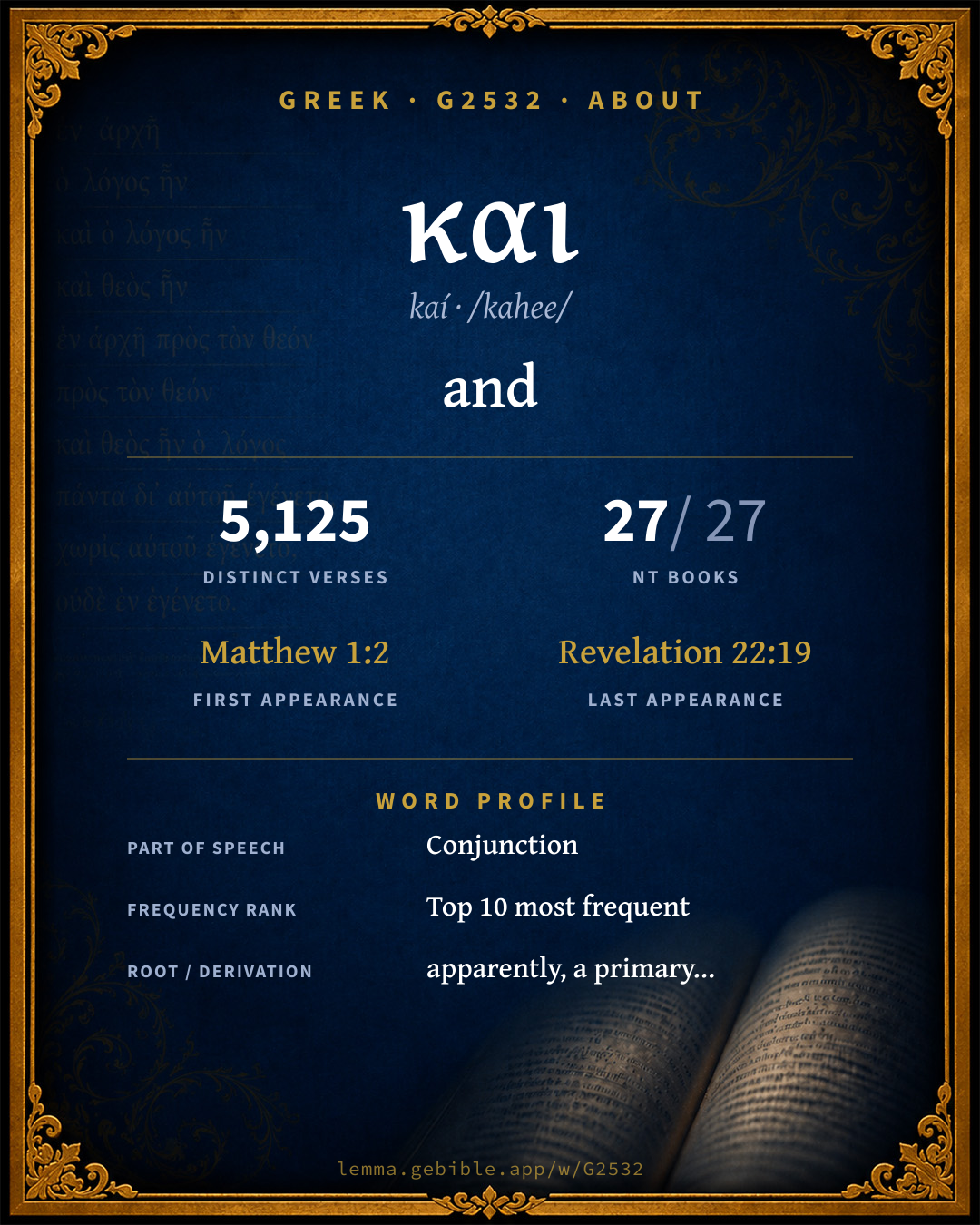
καί
and
Full lexicon entry — Thayer's Greek Lexicon
From Thayer's Greek Lexicon
Where this word appears
Grammar key — what these labels mean
Part of speech
- Conjunction
- A joining word linking words or clauses.
Page 3 of 26 — showing verses 401–600 of 5,125 distinct verses where G2532 appears, across 27 books. Click any verse to open its interlinear word-by-word view. Verse text shown in the World English Bible for context — . Each verse’s Greek form is shown with its reference; the English is not keyword-highlighted, since the data carries no word-level English alignment. Use “Compare translations” on any verse to read it across multiple English versions. This concordance covers the Greek New Testament; Septuagint (Greek Old Testament) occurrences of this word are not indexed here.
Matthew 704 verses
- Matthew 18:26 καὶ conj The servant therefore fell down and kneeled before him, saying, 'Lord, have patience with me, and I will repay you all!'
- Matthew 18:27 καὶ conj The lord of that servant, being moved with compassion, released him, and forgave him the debt.
- Matthew 18:28 καὶ conj "But that servant went out, and found one of his fellow servants, who owed him one hundred denarii, and he grabbed him, and took him by the throat, saying, 'Pay me what you owe!'
- Matthew 18:29 καὶ conj "So his fellow servant fell down at his feet and begged him, saying, 'Have patience with me, and I will repay you!'
- Matthew 18:31 καὶ conj So when his fellow servants saw what was done, they were exceedingly sorry, and came and told to their lord all that was done.
- Matthew 18:33 καὶ conj Shouldn't you also have had mercy on your fellow servant, even as I had mercy on you?'
- Matthew 18:34 καὶ conj His lord was angry, and delivered him to the tormentors, until he should pay all that was due to him.
- Matthew 18:35 καὶ conj So my heavenly Father will also do to you, if you don't each forgive your brother from your hearts for his misdeeds."
- Matthew 19:1 Καὶ καὶ conj conj It happened when Jesus had finished these words, he departed from Galilee, and came into the borders of Judea beyond the Jordan.
- Matthew 19:2 καὶ καὶ conj conj Great multitudes followed him, and he healed them there.
- Matthew 19:3 Καὶ καὶ conj conj Pharisees came to him, testing him, and saying, "Is it lawful for a man to divorce his wife for any reason?"
- Matthew 19:4 καὶ conj He answered, "Haven't you read that he who made them from the beginning made them male and female,
- Matthew 19:5 καὶ καὶ καὶ καὶ conj conj conj conj and said, 'For this cause a man shall leave his father and mother, and shall join to his wife; and the two shall become one flesh?'
- Matthew 19:7 καὶ conj They asked him, "Why then did Moses command us to give her a bill of divorce, and divorce her?"
- Matthew 19:9 καὶ conj I tell you that whoever divorces his wife, except for sexual immorality, and marries another, commits adultery; and he who marries her when she is divorced commits adultery."
- Matthew 19:12 καὶ καὶ conj conj For there are eunuchs who were born that way from their mother's womb, and there are eunuchs who were made eunuchs by men; and there are eunuchs who made themselves eunuchs for the Kingdom of Heaven's sake. He who is able to receive it, let him receive it."
- Matthew 19:13 καὶ conj Then little children were brought to him, that he should lay his hands on them and pray; and the disciples rebuked them.
- Matthew 19:14 καὶ conj But Jesus said, "Allow the little children, and don't forbid them to come to me; for to such belongs the Kingdom of Heaven."
- Matthew 19:15 καὶ conj He laid his hands on them, and departed from there.
- Matthew 19:16 Καὶ conj Behold, one came to him and said, "Good teacher, what good thing shall I do, that I may have eternal life?"
- Matthew 19:19 καὶ καί conj conj 'Honor your father and mother.' And, 'You shall love your neighbor as yourself.'"
- Matthew 19:21 καὶ καὶ καὶ conj conj conj Jesus said to him, "If you want to be perfect, go, sell what you have, and give to the poor, and you will have treasure in heaven; and come, follow me."
- Matthew 19:27 καὶ conj Then Peter answered, "Behold, we have left everything, and followed you. What then will we have?"
- Matthew 19:28 καὶ conj Jesus said to them, "Most assuredly I tell you that you who have followed me, in the regeneration when the Son of Man will sit on the throne of his glory, you also will sit on twelve thrones, judging the twelve tribes of Israel.
- Matthew 19:29 καὶ καὶ conj conj Everyone who has left houses, or brothers, or sisters, or father, or mother, or wife, or children, or lands, for my name's sake, will receive one hundred times, and will inherit eternal life.
- Matthew 19:30 καὶ conj But many will be last who are first; and first who are last.
- Matthew 20:3 καὶ conj He went out about the third hour, and saw others standing idle in the marketplace.
- Matthew 20:4 καὶ καὶ καὶ conj conj conj To them he said, 'You also go into the vineyard, and whatever is right I will give you.' So they went their way.
- Matthew 20:5 καὶ conj Again he went out about the sixth and the ninth hour, and did likewise.
- Matthew 20:6 καὶ conj About the eleventh hour he went out, and found others standing idle. He said to them, 'Why do you stand here all day idle?'
- Matthew 20:7 καὶ conj "They said to him, 'Because no one has hired us.' "He said to them, 'You also go into the vineyard, and you will receive whatever is right.'
- Matthew 20:8 καὶ conj When evening had come, the lord of the vineyard said to his steward, 'Call the laborers and pay them their wages, beginning from the last to the first.'
- Matthew 20:9 καὶ conj "When those who were hired at about the eleventh hour came, they each received a denarius.
- Matthew 20:10 καὶ καὶ conj conj When the first came, they supposed that they would receive more; and they likewise each received a denarius.
- Matthew 20:12 καὶ καὶ conj conj saying, 'These last have spent one hour, and you have made them equal to us, who have borne the burden of the day and the scorching heat!'
- Matthew 20:14 καὶ καὶ conj conj Take that which is yours, and go your way. It is my desire to give to this last just as much as to you.
- Matthew 20:16 καὶ conj So the last will be first, and the first last. For many are called, but few are chosen."
- Matthew 20:17 Καὶ καὶ conj conj As Jesus was going up to Jerusalem, he took the twelve disciples aside, and on the way he said to them,
- Matthew 20:18 καὶ καὶ καὶ conj conj conj "Behold, we are going up to Jerusalem, and the Son of Man will be delivered to the chief priests and scribes, and they will condemn him to death,
- Matthew 20:19 καὶ καὶ καὶ καὶ conj conj conj conj and will hand him over to the Gentiles to mock, to scourge, and to crucify; and the third day he will be raised up."
- Matthew 20:20 καὶ conj Then the mother of the sons of Zebedee came to him with her sons, kneeling and asking a certain thing of him.
- Matthew 20:21 καὶ conj He said to her, "What do you want?" She said to him, "Command that these, my two sons, may sit, one on your right hand, and one on your left hand, in your Kingdom."
- Matthew 20:23 καὶ conj He said to them, "You will indeed drink my cup, and be baptized with the baptism that I am baptized with, but to sit on my right hand and on my left hand is not mine to give; but it is for whom it has been prepared by my Father."
- Matthew 20:25 καὶ conj But Jesus summoned them, and said, "You know that the rulers of the Gentiles lord it over them, and their great ones exercise authority over them.
- Matthew 20:27 καὶ conj Whoever desires to be first among you shall be your bondservant,
- Matthew 20:28 καὶ conj even as the Son of Man came not to be served, but to serve, and to give his life as a ransom for many."
- Matthew 20:29 Καὶ conj As they went out from Jericho, a great multitude followed him.
- Matthew 20:30 καὶ conj Behold, two blind men sitting by the road, when they heard that Jesus was passing by, cried out, "Lord, have mercy on us, you son of David!"
- Matthew 20:32 καὶ καὶ conj conj Jesus stood still, and called them, and asked, "What do you want me to do for you?"
- Matthew 20:34 καὶ καὶ conj conj Jesus, being moved with compassion, touched their eyes; and immediately their eyes received their sight, and they followed him.
- Matthew 21:1 Καὶ καὶ conj conj When they drew near to Jerusalem, and came to Bethsphage, to the Mount of Olives, then Jesus sent two disciples,
- Matthew 21:2 καὶ καὶ conj conj saying to them, "Go into the village that is opposite you, and immediately you will find a donkey tied, and a colt with her. Untie them, and bring them to me.
- Matthew 21:3 καὶ conj If anyone says anything to you, you shall say, 'The Lord needs them,' and immediately he will send them."
- Matthew 21:5 καὶ καὶ conj conj "Tell the daughter of Zion, Behold, your King comes to you, Humble, and riding on a donkey, On a colt, the foal of a donkey."
- Matthew 21:6 καὶ conj The disciples went, and did just as Jesus commanded them,
- Matthew 21:7 καὶ καὶ καὶ conj conj conj and brought the donkey and the colt, and laid their clothes on them; and he sat on them.
- Matthew 21:8 καὶ conj A very great multitude spread their clothes on the road. Others cut branches from the trees, and spread them on the road.
- Matthew 21:9 καὶ conj The multitudes who went before him, and who followed kept shouting, "Hosanna to the son of David! Blessed is he who comes in the name of the Lord! Hosanna in the highest!"
- Matthew 21:10 Καὶ conj When he had come into Jerusalem, all the city was stirred up, saying, "Who is this?"
- Matthew 21:12 Καὶ καὶ καὶ καὶ καὶ conj conj conj conj conj Jesus entered into the temple of God, and drove out all of those who sold and bought in the temple, and overthrew the money-changers' tables and the seats of those who sold the doves.
- Matthew 21:13 καὶ conj He said to them, "It is written, 'My house shall be called a house of prayer,' but you have made it a den of robbers!"
- Matthew 21:14 Καὶ καὶ καὶ conj conj conj The blind and the lame came to him in the temple, and he healed them.
- Matthew 21:15 καὶ καὶ καὶ conj conj conj But when the chief priests and the scribes saw the wonderful things that he did, and the children who were crying in the temple and saying, "Hosanna to the son of David!" they were indignant,
- Matthew 21:16 καὶ καὶ conj conj and said to him, "Do you hear what these are saying?" Jesus said to them, "Yes. Did you never read, 'Out of the mouth of babes and nursing babies you have perfected praise?'"
- Matthew 21:17 καὶ καὶ conj conj He left them, and went out of the city to Bethany, and lodged there.
- Matthew 21:19 καὶ καὶ καὶ καὶ conj conj conj conj Seeing a fig tree by the road, he came to it, and found nothing on it but leaves. He said to it, "Let there be no fruit from you forever!" Immediately the fig tree withered away.
- Matthew 21:20 καὶ conj When the disciples saw it, they marveled, saying, "How did the fig tree immediately wither away?"
- Matthew 21:21 καὶ καὶ conj conj Jesus answered them, "Most assuredly I tell you, if you have faith, and don't doubt, you will not only do what is done to the fig tree, but even if you told this mountain, 'Be taken up and cast into the sea,' it would be done.
- Matthew 21:22 καὶ conj All things, whatever you ask in prayer, believing, you will receive."
- Matthew 21:23 Καὶ καὶ καὶ conj conj conj When he had come into the temple, the chief priests and the elders of the people came to him as he was teaching, and said, "By what authority do you do these things? Who gave you this authority?"
- Matthew 21:27 καὶ καὶ conj conj They answered Jesus, and said, "We don't know." He also said to them, "Neither will I tell you by what authority I do these things.
- Matthew 21:30 καὶ conj He came to the second, and said the same thing. He answered, 'I go, sir,' but he didn't go.
- Matthew 21:31 καὶ conj Which of the two did the will of his father?" They said to him, "The first." Jesus said to them, "Most assuredly I tell you that the tax collectors and the prostitutes are entering into the Kingdom of God before you.
- Matthew 21:32 καὶ καὶ conj conj For John came to you in the way of righteousness, and you didn't believe him, but the tax collectors and the prostitutes believed him. When you saw it, you didn't even repent afterward, that you might believe him.
- Matthew 21:33 καὶ καὶ καὶ καὶ καὶ conj conj conj conj conj "Hear another parable. There was a man who was a master of a household, who planted a vineyard, set a hedge about it, dug a winepress in it, built a tower, leased it out to farmers, and went into another country.
- Matthew 21:35 καὶ conj The farmers took his servants, beat one, killed another, and stoned another.
- Matthew 21:36 καὶ conj Again, he sent other servants more than the first: and they treated them the same way.
- Matthew 21:38 καὶ conj But the farmers, when they saw the son, said among themselves, 'This is the heir. Come, let's kill him, and seize his inheritance.'
- Matthew 21:39 καὶ καὶ conj conj So they took him, and threw him out of the vineyard, and killed him.
- Matthew 21:41 καὶ conj They told him, "He will miserably destroy those miserable men, and will lease out the vineyard to other farmers, who will give him the fruit in its season."
- Matthew 21:42 καὶ conj Jesus said to them, "Did you never read in the Scriptures, 'The stone which the builders rejected, The same was made the head of the corner. This was from the Lord. It is marvelous in our eyes?'
- Matthew 21:43 καὶ conj "Therefore I tell you, the Kingdom of God will be taken away from you, and will be given to a nation bringing forth its fruits.
- Matthew 21:45 καὶ conj When the chief priests and the Pharisees heard his parables, they perceived that he spoke about them.
- Matthew 21:46 καὶ conj When they sought to seize him, they feared the multitudes, because they considered him to be a prophet.
- Matthew 22:1 Καὶ conj Jesus answered and spoke again in parables to them, saying,
- Matthew 22:3 καὶ καὶ conj conj and sent out his servants to call those who were invited to the marriage feast, but they would not come.
- Matthew 22:4 καὶ καὶ conj conj Again he sent out other servants, saying, 'Tell those who are invited, "Behold, I have made ready my dinner. My oxen and my fatlings are killed, and all things are ready. Come to the marriage feast!"'
- Matthew 22:6 καὶ conj and the rest grabbed his servants, and treated them shamefully, and killed them.
- Matthew 22:7 καὶ καὶ conj conj When the king heard that, he was angry, and he sent his armies, destroyed those murderers, and burned their city.
- Matthew 22:9 καὶ conj Go therefore to the intersections of the highways, and as many as you may find, invite to the marriage feast.'
- Matthew 22:10 καὶ καὶ καὶ conj conj conj Those servants went out into the highways, and gathered together as many as they found, both bad and good. The wedding was filled with guests.
- Matthew 22:12 καὶ conj and he said to him, 'Friend, how did you come in here not wearing wedding clothing?' He was speechless.
- Matthew 22:13 καὶ καὶ conj conj Then the king said to the servants, 'Bind him hand and foot, take him away, and throw him into the outer darkness; there is where the weeping and grinding of teeth will be.'
- Matthew 22:16 καὶ καὶ καὶ conj conj conj They sent their disciples to him, along with the Herodians, saying, "Teacher, we know that you are honest, and teach the way of God in truth, no matter who you teach, for you aren't partial to anyone.
- Matthew 22:20 καὶ καὶ conj conj He asked them, "Whose is this image and inscription?"
- Matthew 22:21 καὶ conj They said to him, "Caesar's." Then he said to them, "Give therefore to Caesar the things that are Caesar's, and to God the things that are God's."
- Matthew 22:22 καὶ καὶ conj conj When they heard it, they marveled, and left him, and went away.
- Matthew 22:23 καὶ conj On that day Sadducees (those who say that there is no resurrection) came to him. They asked him,
- Matthew 22:24 καὶ conj saying, "Teacher, Moses said, 'If a man dies, having no children, his brother shall marry his wife, and raise up seed for his brother.'
- Matthew 22:25 καὶ καὶ conj conj Now there were with us seven brothers. The first married and died, and having no seed left his wife to his brother.
- Matthew 22:26 καὶ καὶ conj conj In like manner the second also, and the third, to the seventh.
- Matthew 22:32 καὶ καὶ conj conj 'I am the God of Abraham, and the God of Isaac, and the God of Jacob?' God is not the God of the dead, but of the living."
- Matthew 22:33 καὶ conj When the multitudes heard it, they were astonished at his teaching.
- Matthew 22:35 καὶ conj One of them, a lawyer, asked him a question, testing him.
- Matthew 22:37 καὶ καὶ conj conj Jesus said to him, "'You shall love the Lord your God with all your heart, and with all your soul, and with all your mind.'
- Matthew 22:38 καὶ conj This is the first and great commandment.
- Matthew 22:40 καὶ conj The whole law and the prophets depend on these two commandments."
- Matthew 22:46 καὶ conj No one was able to answer him a word, neither dared any man from that day forth ask him any more questions.
- Matthew 23:1 καὶ conj Then Jesus spoke to the multitudes and to his disciples,
- Matthew 23:2 καὶ conj saying, "The scribes and the Pharisees sat on Moses' seat.
- Matthew 23:3 καὶ καὶ conj conj All things therefore whatever they tell you to observe, observe and do, but don't do their works; for they say, and don't do.
- Matthew 23:4 καὶ conj For they bind heavy burdens that are grievous to be borne, and lay them on men's shoulders; but they themselves will not lift a finger to help them.
- Matthew 23:5 καὶ conj But all their works they do to be seen by men. They make their phylacteries broad, enlarge the fringes of their garments,
- Matthew 23:6 καὶ conj and love the place of honor at feasts, the best seats in the synagogues,
- Matthew 23:7 καὶ καὶ conj conj the salutations in the marketplaces, and to be called 'Rabbi, Rabbi' by men.
- Matthew 23:9 καὶ conj Call no man on the earth your father, for one is your Father, he who is in heaven.
- Matthew 23:12 καὶ conj Whoever exalts himself will be humbled, and whoever humbles himself will be exalted.
- Matthew 23:13 καὶ conj "Woe to you, scribes and Pharisees, hypocrites! For you devour widows' houses, and as a pretense you make long prayers. Therefore you will receive greater condemnation.
- Matthew 23:15 καὶ καὶ καὶ conj conj conj Woe to you, scribes and Pharisees, hypocrites! For you travel around by sea and land to make one proselyte; and when he becomes one, you make him twice as much of a son of Gehenna as yourselves.
- Matthew 23:17 καὶ conj You blind fools! For which is greater, the gold, or the temple that sanctifies the gold?
- Matthew 23:18 καί conj 'Whoever swears by the altar, it is nothing; but whoever swears by the gift that is on it, he is obligated.'
- Matthew 23:20 καὶ conj He therefore who swears by the altar, swears by it, and by everything on it.
- Matthew 23:21 καὶ καὶ conj conj He who swears by the temple, swears by it, and by him who was living in it.
- Matthew 23:22 καὶ καὶ conj conj He who swears by heaven, swears by the throne of God, and by him who sits on it.
- Matthew 23:23 καὶ καὶ καὶ καὶ καὶ καὶ conj conj conj conj conj conj "Woe to you, scribes and Pharisees, hypocrites! For you tithe mint, dill, and cumin, and have left undone the weightier matters of the law: justice, mercy, and faith. But you ought to have done these, and not to have left the other undone.
- Matthew 23:25 καὶ καὶ καὶ conj conj conj "Woe to you, scribes and Pharisees, hypocrites! For you clean the outside of the cup and of the platter, but within they are full of extortion and unrighteousness.
- Matthew 23:26 καὶ conj You blind Pharisee, first clean the inside of the cup and of the platter, that the outside of it may become clean also.
- Matthew 23:27 καὶ καὶ conj conj "Woe to you, scribes and Pharisees, hypocrites! For you are like whitened tombs, which outwardly appear beautiful, but inwardly are full of dead men's bones, and of all uncleanness.
- Matthew 23:28 καὶ καὶ conj conj Even so you also outwardly appear righteous to men, but inwardly you are full of hypocrisy and iniquity.
- Matthew 23:29 καὶ καὶ conj conj "Woe to you, scribes and Pharisees, hypocrites! For you build the tombs of the prophets, and decorate the tombs of the righteous,
- Matthew 23:30 καὶ conj and say, 'If we had lived in the days of our fathers, we wouldn't have been partakers with them in the blood of the prophets.'
- Matthew 23:32 καὶ conj Fill up, then, the measure of your fathers.
- Matthew 23:34 καὶ καὶ καὶ καὶ καὶ conj conj conj conj conj Therefore, behold, I send to you prophets, wise men, and scribes. Some of them you will kill and crucify; and some of them you will scourge in your synagogues, and persecute from city to city;
- Matthew 23:35 καὶ conj that on you may come all the righteous blood shed on the earth, from the blood of righteous Abel to the blood of Zachariah son of Barachiah, whom you killed between the sanctuary and the altar.
- Matthew 23:37 καὶ καὶ conj conj "Jerusalem, Jerusalem, who kills the prophets, and stones those who are sent to her! How often would I have gathered your children together, even as a hen gathers her chickens under her wings, and you would not!
- Matthew 24:1 Καὶ καὶ conj conj Jesus went out from the temple, and was going on his way. His disciples came to him to show him the buildings of the temple.
- Matthew 24:3 καὶ καὶ conj conj As he sat on the Mount of Olives, the disciples came to him privately, saying, "Tell us, when will these things be? What is the sign of your coming, and of the end of the age?"
- Matthew 24:4 καὶ conj Jesus answered them, "Be careful that no one leads you astray.
- Matthew 24:5 καὶ conj For many will come in my name, saying, 'I am the Christ,' and will lead many astray.
- Matthew 24:6 καὶ conj You will hear of wars and rumors of wars. See that you aren't troubled, for all this must happen, but the end is not yet.
- Matthew 24:7 καὶ καὶ καὶ conj conj conj For nation will rise against nation, and kingdom against kingdom; and there will be famines, plagues, and earthquakes in various places.
- Matthew 24:9 καὶ καὶ conj conj Then they will deliver you up to oppression, and will kill you. You will be hated by all of the nations for my name's sake.
- Matthew 24:10 καὶ καὶ καὶ conj conj conj Then many will stumble, and will deliver up one another, and will hate one another.
- Matthew 24:11 καὶ καὶ conj conj Many false prophets will arise, and will lead many astray.
- Matthew 24:12 καὶ conj Because iniquity will be multiplied, the love of many will grow cold.
- Matthew 24:14 καὶ καὶ conj conj This Gospel of the Kingdom will be preached in the whole world for a testimony to all the nations, and then the end will come.
- Matthew 24:18 καὶ conj Let him who is in the field not return back to get his clothes.
- Matthew 24:19 καὶ conj But woe to those who are with child and to nursing mothers in those days!
- Matthew 24:22 καὶ conj Unless those days had been shortened, no flesh would have been saved. But for the sake of the chosen ones, those days will be shortened.
- Matthew 24:24 καὶ καὶ καὶ καὶ conj conj conj conj For there will arise false christs, and false prophets, and they will show great signs and wonders, so as to lead astray, if possible, even the chosen ones.
- Matthew 24:27 καὶ conj For as the lightning comes forth from the east, and is seen even to the west, so will be the coming of the Son of Man.
- Matthew 24:29 καὶ καὶ καὶ conj conj conj But immediately after the oppression of those days, the sun will be darkened, the moon will not give its light, the stars will fall from the sky, and the powers of the heavens will be shaken;
- Matthew 24:30 καὶ καὶ καὶ καὶ conj conj conj conj and then the sign of the Son of Man will appear in the sky. Then all the tribes of the earth will mourn, and they will see the Son of Man coming on the clouds of the sky with power and great glory.
- Matthew 24:31 καὶ καὶ conj conj He will send out his angels with a great sound of a trumpet, and they will gather together his chosen ones from the four winds, from one end of the sky to the other.
- Matthew 24:32 καὶ conj "Now from the fig tree learn this parable. When its branch has now become tender, and puts forth its leaves, you know that the summer is near.
- Matthew 24:33 καὶ conj Even so you also, when you see all these things, know that it is near, even at the doors.
- Matthew 24:35 καὶ conj Heaven and earth will pass away, but my words will not pass away.
- Matthew 24:36 καὶ conj But no one knows of that day and hour, not even the angels of heaven, but my Father only.
- Matthew 24:38 καὶ καὶ conj conj For as in those days which were before the flood they were eating and drinking, marrying and giving in marriage, until the day that Noah entered into the ark,
- Matthew 24:39 καὶ καὶ καὶ conj conj conj and they didn't know until the flood came, and took them all away, so will be the coming of the Son of Man.
- Matthew 24:40 καὶ conj Then two men will be in the field: one will be taken and one will be left;
- Matthew 24:41 καὶ conj two women grinding at the mill, one will be taken and one will be left.
- Matthew 24:43 καὶ conj But know this, that if the master of the house had known in what watch of the night the thief was coming, he would have watched, and would not have allowed his house to be broken into.
- Matthew 24:44 καὶ conj Therefore also be ready, for in an hour that you don't expect, the Son of Man will come.
- Matthew 24:45 καὶ conj "Who then is the faithful and wise servant, whom his lord has set over his household, to give them their food in due season?
- Matthew 24:49 καὶ καὶ conj conj and begins to beat his fellow-servants, and eat and drink with the drunken,
- Matthew 24:50 καὶ conj the lord of that servant will come in a day when he doesn't expect it, and in an hour when he doesn't know it,
- Matthew 24:51 καὶ καὶ καὶ conj conj conj and will cut him in pieces, and appoint his portion with the hypocrites; there is where the weeping and grinding of teeth will be.
- Matthew 25:2 καὶ conj Five of them were foolish, and five were wise.
- Matthew 25:5 καὶ conj Now while the bridegroom delayed, they all slumbered and slept.
- Matthew 25:7 καὶ conj Then all those virgins arose, and trimmed their lamps.
- Matthew 25:9 καὶ καὶ conj conj But the wise answered, saying, 'What if there isn't enough for us and you? You go rather to those who sell, and buy for yourselves.'
- Matthew 25:10 καὶ καὶ conj conj While they went away to buy, the bridegroom came, and those who were ready went in with him to the marriage feast, and the door was shut.
- Matthew 25:11 καὶ conj Afterward the other virgins also came, saying, 'Lord, Lord, open to us.'
- Matthew 25:14 καὶ conj "For it is like a man, going into another country, who called his own servants, and entrusted his goods to them.
- Matthew 25:15 καὶ καὶ conj conj To one he gave five talents, to another two, to another one; to each according to his own ability. Then he went on his journey.
- Matthew 25:16 καὶ conj Immediately he who received the five talents went and traded with them, and made another five talents.
- Matthew 25:18 καὶ conj But he who received the one went away and dug in the earth, and hid his lord's money.
- Matthew 25:19 καὶ conj "Now after a long time the lord of those servants came, and reconciled accounts with them.
- Matthew 25:20 καὶ conj He who received the five talents came and brought another five talents, saying, 'Lord, you delivered to me five talents. Behold, I have gained another five talents besides them.'
- Matthew 25:21 καὶ conj "His lord said to him, 'Well done, good and faithful servant. You have been faithful over a few things, I will set you over many things. Enter into the joy of your lord.'
- Matthew 25:22 καὶ conj "He also who got the two talents came and said, 'Lord, you delivered to me two talents. Behold, I have gained another two talents besides them.'
- Matthew 25:23 καὶ conj "His lord said to him, 'Well done, good and faithful servant. You have been faithful over a few things, I will set you over many things. Enter into the joy of your lord.'
- Matthew 25:24 καὶ καὶ conj conj "He also who had received the one talent came and said, 'Lord, I knew you that you are a hard man, reaping where you did not sow, and gathering where you did not scatter.
- Matthew 25:25 καὶ conj I was afraid, and went away and hid your talent in the earth. Behold, you have what is yours.'
- Matthew 25:26 καὶ καὶ conj conj "But his lord answered him, 'You wicked and slothful servant. You knew that I reap where I didn't sow, and gather where I didn't scatter.
- Matthew 25:27 καὶ conj You ought therefore to have deposited my money with the bankers, and at my coming I should have received back my own with interest.
- Matthew 25:28 καὶ conj Take away therefore the talent from him, and give it to him who has the ten talents.
- Matthew 25:29 καὶ καὶ conj conj For to everyone who has will be given, and he will have abundance, but from him who has not, even that which he has will be taken away.
- Matthew 25:30 καὶ καὶ conj conj Throw out the unprofitable servant into the outer darkness, where there will be weeping and gnashing of teeth.'
- Matthew 25:31 καὶ conj "But when the Son of Man comes in his glory, and all the holy angels with him, then he will sit on the throne of his glory.
- Matthew 25:32 καὶ καὶ conj conj Before him all the nations will be gathered, and he will separate them one from another, as a shepherd separates the sheep from the goats.
- Matthew 25:33 καὶ conj He will set the sheep on his right hand, but the goats on the left.
- Matthew 25:35 καὶ καὶ καὶ conj conj conj for I was hungry, and you gave me food to eat; I was thirsty, and you gave me drink; I was a stranger, and you took me in;
- Matthew 25:36 καὶ καὶ καὶ conj conj conj naked, and you clothed me; I was sick, and you visited me; I was in prison, and you came to me.'
- Matthew 25:37 καὶ καὶ conj conj "Then the righteous will answer him, saying, 'Lord, when did we see you hungry, and feed you; or thirsty, and give you a drink?
- Matthew 25:38 καὶ καὶ conj conj When did we see you as a stranger, and take you in; or naked, and clothe you?
- Matthew 25:39 καὶ conj When did we see you sick, or in prison, and come to you?'
- Matthew 25:40 καὶ conj "The King will answer them, 'Most assuredly I tell you, inasmuch as you did it to one of the least of these my brothers, you did it to me.'
- Matthew 25:41 καὶ καὶ conj conj Then he will say also to those on the left hand, 'Depart from me, you cursed, into the eternal fire which is prepared for the devil and his angels;
About this entry
At a glance — auto-summarized from this page’s data, not written by a person. Every figure links to its source below. This summary describes the numbers; it doesn’t interpret them.
At its core, και (kaí) means “and.” Scripture first uses it in Matthew 1:2. With 5,125 verses in 27 books, it is one of the most common word in the Greek New Testament. Sharing its root, it stands alongside καγω, καιγε and καιπερ. Each statement above links to its evidence; the full detail follows below.
Gloss history
Strong's 1890 vs modern scholarship

About this word
Strong's G2532 catalogs a Greek word from the Greek New Testament.
These counts are not copied from any lexicon or concordance. They are computed here, from the morphology-tagged Greek New Testament. What Lemma adds →
- 5,125
- distinct verses
- The word appears in 5,125 distinct verses.
- 27 / 27
- NT books
- The word appears in 27 of 27 New Testament books.
- #2
- by frequency
- Top 10 most frequent Greek words (rank 2 of 5,347 Greek words by occurrence).
View all 5,125 occurrences in the concordance →
By section of the New Testament
By traditional corpus
Conventional, traditional groupings — biblical authorship is debated, so this is a traditional corpus grouping, not an authorship claim. Some books belong to more than one corpus (Luke is in both the Gospels and the Lukan corpus, and so on), so these shares overlap and need not total 100%. Each figure is a share of the word’s 5,125 distinct verses.
- Gospels 2,619 verses · 51%
- Lukan (Luke–Acts) 1,489 verses · 29%
- Pauline corpus 1,026 verses · 20%
- Johannine 995 verses · 19%
- Revelation 370 verses · 7%
- General (Catholic) Epistles 277 verses · 5%
- Hebrews 173 verses · 3%
How translations render this word
Counts come from each version’s own published word-to-Strong’s tagging or interlinear alignment — an approximate guide to how each version renders this word, not a word-level alignment the data otherwise carries. Because each total is that version’s own tagged count, the per-version totals vary from one another and need not match the appearance or distinct-verse counts above. These counts may also differ from a printed concordance because Lemma counts each distinctly tagged rendering and does not collapse phrase taggings into a single head-word total. This is a fixed set of word-tagged versions (KJV, ASV, BSB, ULT) and does not change with the reading translation you choose elsewhere. Each version’s license is shown beside its name below (and on Sources).
- King James Version: And 8,097×, Also 500×, Even 101×
- American Standard Version: And 7,750×, Also 433×, Even 110×
- Berean Standard Bible: And 5,240×, Then 278×, Also 156×
- unfoldingWord Literal Text: And 7,949×, Also 596×, But 132×
King James Version Public Domain
Renders G2532 across 9,091 tagged occurrences — most commonly:
Plus other, less common renderings. Plus 72 renderings that appear only once — usually multi-word phrases or single function words the recovered tagging swept in, not distinct renderings. Not rendered by a distinct English word in 156 further occurrences.
American Standard Version Public Domain
Renders G2532 across 8,928 tagged occurrences — most commonly:
Plus other, less common renderings. Plus 227 renderings that appear only once — usually multi-word phrases or single function words the recovered tagging swept in, not distinct renderings. Not rendered by a distinct English word in 83 further occurrences.
Berean Standard Bible Public Domain
Renders G2532 across 6,415 tagged occurrences — most commonly:
Plus other, less common renderings. Plus 44 renderings that appear only once — usually multi-word phrases or single function words the recovered tagging swept in, not distinct renderings. Not rendered by a distinct English word in 2,467 further occurrences.
unfoldingWord Literal Text CC BY-SA 4.0
Renders G2532 across 9,016 tagged occurrences — most commonly:
Plus other, less common renderings. Plus 20 renderings that appear only once — usually multi-word phrases or single function words the recovered tagging swept in, not distinct renderings. Not rendered by a distinct English word in 3 further occurrences.
Senses in Thayer's
The 1 sense Thayer's distinguishes for this word, in lexicon order (not ranked by frequency or importance). The full entry — with sub-senses — is in the Lexicon Entry tab.
- and, also, even, indeed, but Frequency count based on 1894 Scrivener Greek New Testament.
Word origin
Origin: apparently, a primary particle, having a copulative and sometimes also a cumulative force
Apparently a primary particle having a copulative and sometimes also a cumulative force; and also even so then too etc.; often used in connection (or composition) with other particles or small words : - and also both but even for if indeed likewise moreover or so that then therefore when yea yet.
— Strong’s Exhaustive Concordance (1890), public domain.
Forms in the corpus
The 5 distinct written forms G2532 takes in the Greek New Testament, most frequent first — each parse links to that case’s occurrences in the concordance.
| Form | Parsing | Example | Uses |
|---|---|---|---|
| καὶ kaì | Conjunction | Matthew 1:2 | 8,661 |
| Καὶ Kaì | Conjunction | Matthew 4:21 | 274 |
| καί kaí | Conjunction | Matthew 15:4 | 29 |
| Καί Kaí | Conjunction | Luke 19:39 | 4 |
| και kai | Conjunction | John 7:53 | 1 |
Same root — word family
Other Thayer's entries built from the same root as G2532, grouped by Strong’s listed origin. These share a root / origin per the lexicon — not necessarily a shared meaning. Each links to that word’s own entry.
Derived from this word
- καγω kagṓ G2504 and I
- καιγε kaíge G2534 and indeed
- καιπερ kaíper G2539 although
- καιτοι kaítoi G2543 and yet
- κακει kakeî G2546 and there
- κακειθεν kakeîthen G2547 of place
- κακεινος kakeînos G2548 and he
- καν kán G2579 and if
Compare all same-root words → Showing 4 of 9 — not the complete family. They share a root, not necessarily a meaning.
Septuagint usage
The same Greek word και appears 47,643 times in the Greek Old Testament (Septuagint), across 18,587 verses in 38 books.
- 47,643
- LXX occurrences
- Tagged occurrences of this Greek word in the Septuagint.
- 18,587
- verses
- Distinct Septuagint verses containing this word.
- 38 / 39
- OT books
- The word appears in 38 of the 39 Old Testament books.
Sample Septuagint occurrences
- Genesis 1:1 καί
- Exodus 1:3 καί
- Leviticus 1:1 καί
- Numbers 1:1 καί
- Deuteronomy 1:1 καί
- Joshua 1:1 καί
- Judges 1:1 καί
- Ruth 1:1 καί
- 1 Samuel 1:1 καί
- 2 Samuel 1:1 καί
- 1 Kings 1:1 καί
- 2 Kings 1:1 καί
Septuagint occurrences (same lexeme)
Every verse where the same Strong’s number (G2532) appears in the Greek Septuagint — showing the first 50 of 18,587. Verse text shown in the World English Bible for context; the Greek form is the matched word — the English is not keyword-highlighted.
- Genesis 1:1 καί In the beginning God created the heavens and the earth.
- Genesis 1:2 καί Now the earth was formless and empty. Darkness was on the surface of the deep. God's Spirit was hovering over the surface of the waters.
- Genesis 1:3 καί God said, "Let there be light," and there was light.
- Genesis 1:4 καί God saw the light, and saw that it was good. God divided the light from the darkness.
- Genesis 1:5 καί God called the light Day, and the darkness he called Night. There was evening and there was morning, one day.
- Genesis 1:6 καί God said, "Let there be an expanse in the midst of the waters, and let it divide the waters from the waters."
- Genesis 1:7 καί God made the expanse, and divided the waters which were under the expanse from the waters which were above the expanse, and it was so.
- Genesis 1:8 καί God called the expanse sky. There was evening and there was morning, a second day.
- Genesis 1:9 καί God said, "Let the waters under the sky be gathered together to one place, and let the dry land appear," and it was so.
- Genesis 1:10 καί God called the dry land Earth, and the gathering together of the waters he called Seas. God saw that it was good.
- Genesis 1:11 καί God said, "Let the earth put forth grass, herbs yielding seed, and fruit trees bearing fruit after their kind, with its seed in it, on the earth," and it was so.
- Genesis 1:12 καί The earth brought forth grass, herbs yielding seed after their kind, and trees bearing fruit, with its seed in it, after their kind: and God saw that it was good.
- Genesis 1:13 καί There was evening and there was morning, a third day.
- Genesis 1:14 καί God said, "Let there be lights in the expanse of sky to divide the day from the night; and let them be for signs, and for seasons, and for days and years;
- Genesis 1:15 καί and let them be for lights in the expanse of sky to give light on the earth," and it was so.
- Genesis 1:16 καί God made the two great lights: the greater light to rule the day, and the lesser light to rule the night. He also made the stars.
- Genesis 1:17 καί God set them in the expanse of sky to give light to the earth,
- Genesis 1:18 καί and to rule over the day and over the night, and to divide the light from the darkness. God saw that it was good.
- Genesis 1:19 καί There was evening and there was morning, a fourth day.
- Genesis 1:20 καί God said, "Let the waters swarm with swarms of living creatures, and let birds fly above the earth in the open expanse of sky."
- Genesis 1:21 καί God created the large sea creatures, and every living creature that moves, with which the waters swarmed, after their kind, and every winged bird after its kind. God saw that it was good.
- Genesis 1:22 καί God blessed them, saying, "Be fruitful, and multiply, and fill the waters in the seas, and let birds multiply on the earth."
- Genesis 1:23 καί There was evening and there was morning, a fifth day.
- Genesis 1:24 καί God said, "Let the earth bring forth living creatures after their kind, cattle, creeping things, and animals of the earth after their kind," and it was so.
- Genesis 1:25 καί God made the animals of the earth after their kind, and the cattle after their kind, and everything that creeps on the ground after its kind. God saw that it was good.
- Genesis 1:26 καί God said, "Let us make man in our image, after our likeness: and let them have dominion over the fish of the sea, and over the birds of the sky, and over the cattle, and over all the earth, and over every creeping thing that creeps on the earth."
- Genesis 1:27 καί God created man in his own image. In God's image he created him; male and female he created them.
- Genesis 1:28 καί God blessed them. God said to them, "Be fruitful, multiply, fill the earth, and subdue it. Have dominion over the fish of the sea, over the birds of the sky, and over every living thing that moves on the earth."
- Genesis 1:29 καί God said, "Behold, I have given you every herb yielding seed, which is on the surface of all the earth, and every tree, which bears fruit yielding seed. It will be your food.
- Genesis 1:30 καί To every animal of the earth, and to every bird of the sky, and to everything that creeps on the earth, in which there is life, I have given every green herb for food." And it was so.
- Genesis 1:31 καί God saw everything that he had made, and, behold, it was very good. There was evening and there was morning, the sixth day.
- Genesis 2:1 καί The heavens and the earth were finished, and all the host of them.
- Genesis 2:2 καί On the seventh day God finished his work which he had made; and he rested on the seventh day from all his work which he had made.
- Genesis 2:3 καί God blessed the seventh day, and made it holy, because he rested in it from all his work which he had created and made.
- Genesis 2:4 καί This is the history of the generations of the heavens and of the earth when they were created, in the day that Yahweh God made earth and the heavens.
- Genesis 2:5 καί No plant of the field was yet in the earth, and no herb of the field had yet sprung up; for Yahweh God had not caused it to rain on the earth. There was not a man to till the ground,
- Genesis 2:6 καί but a mist went up from the earth, and watered the whole surface of the ground.
- Genesis 2:7 καί Yahweh God formed man from the dust of the ground, and breathed into his nostrils the breath of life; and man became a living soul.
- Genesis 2:8 καί Yahweh God planted a garden eastward, in Eden, and there he put the man whom he had formed.
- Genesis 2:9 καί Out of the ground Yahweh God made every tree to grow that is pleasant to the sight, and good for food; the tree of life also in the midst of the garden, and the tree of the knowledge of good and evil.
- Genesis 2:12 καί and the gold of that land is good. There is aromatic resin and the onyx stone.
- Genesis 2:13 καί The name of the second river is Gihon: the same river that flows through the whole land of Cush.
- Genesis 2:14 καί The name of the third river is Hiddekel: this is the one which flows in front of Assyria. The fourth river is the Euphrates.
- Genesis 2:15 καί Yahweh God took the man, and put him into the garden of Eden to dress it and to keep it.
- Genesis 2:16 καί Yahweh God commanded the man, saying, "Of every tree of the garden you may freely eat:
- Genesis 2:17 καί but of the tree of the knowledge of good and evil, you shall not eat of it: for in the day that you eat of it you will surely die."
- Genesis 2:18 καί Yahweh God said, "It is not good that the man should be alone; I will make him a helper suitable for him."
- Genesis 2:19 καί Out of the ground Yahweh God formed every animal of the field, and every bird of the sky, and brought them to the man to see what he would call them. Whatever the man called every living creature, that was its name.
- Genesis 2:20 καί The man gave names to all cattle, and to the birds of the sky, and to every animal of the field; but for man there was not found a helper suitable for him.
- Genesis 2:21 καί Yahweh God caused a deep sleep to fall on the man, and he slept; and he took one of his ribs, and closed up the flesh in its place.
These are occurrences of the same Greek lexeme (G2532) in the Septuagint — not a translation of any one Hebrew word. The store carries no word-level Hebrew↔Greek alignment, so no Hebrew original is asserted here. Counts come from the recovered LXX Strong's tagging — high-frequency vocabulary is well covered, while rare or late forms may be untagged — so they reflect tagged occurrences and may slightly undercount.