
Matthew 24:51

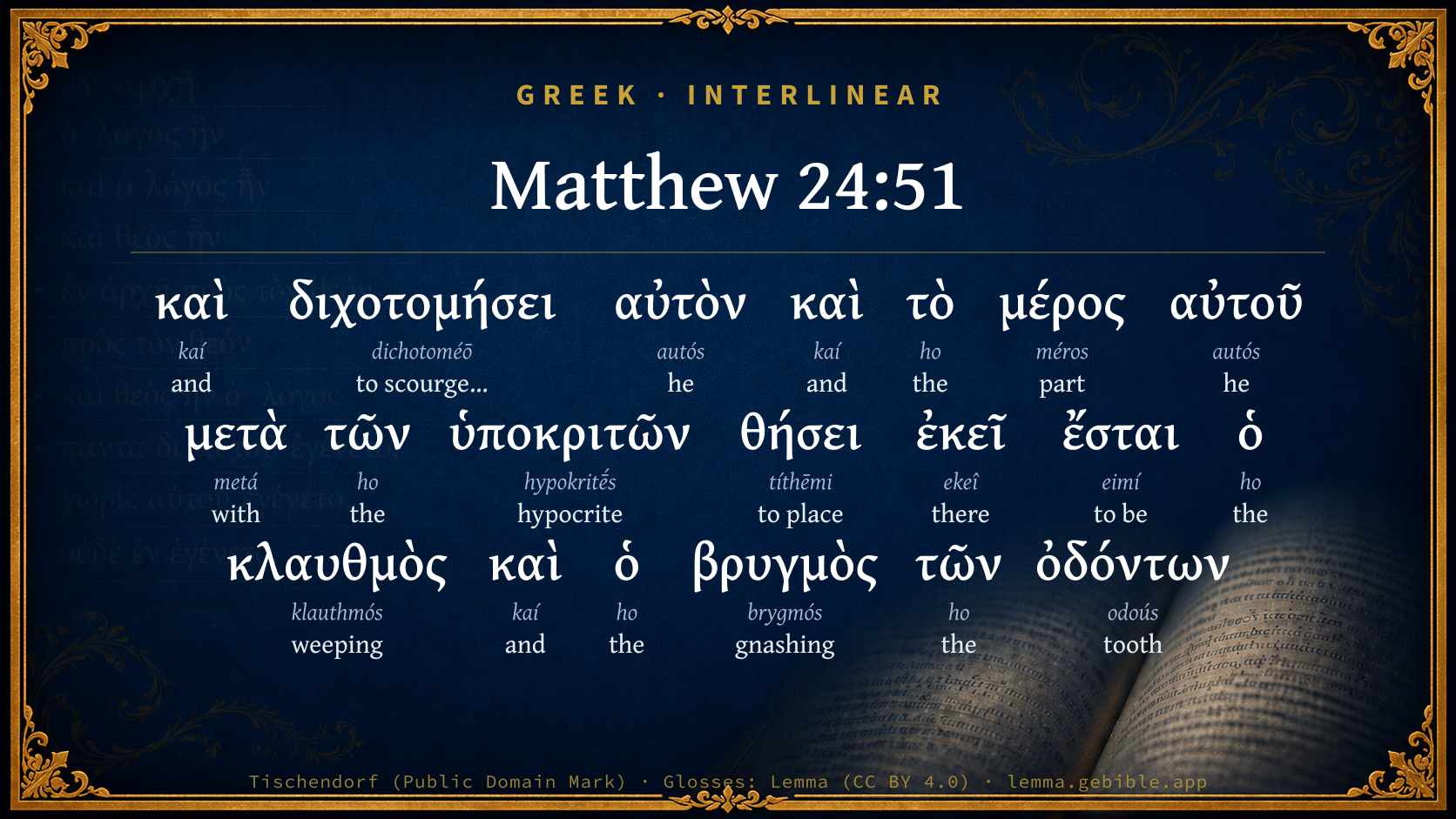
Greek (Tischendorf 8th ed.) Matthew 24:51 appears in the Greek New Testament. The text above is from the Tischendorf 8th edition. Each word links to its Strong’s number and a concise gloss. Click any word for its full Thayer’s Greek Lexicon entry.
Download image
Cite this verse

Matthew 24:51 (World English Bible). Public Domain. Lemma interlinear Bible study tool, https://lemma.gebible.app/v/matthew/24/51.

Show BibTeX & RIS
BibTeX
RIS
English Translation
and will cut him in pieces, and appoint his portion with the hypocrites; there is where the weeping and grinding of teeth will be.
World English Bible · Public Domain
Highlights
  • 1 first appearance in the Greek New Testament
Full analysis ↓
Download a study sheet

One document with this verse’s original text, its word-by-word gloss line, the meaning frame, cross-references with their text, attributed commentary, and full source and license credits — printable, and it pastes into notes with its structure intact.

This verse Autodidact and up

Study sheet (.html) Plain text (.txt)

A passage Seminary Student

Up to 50 verses in one chapter. A passage sheet keeps up to 6 commentary sources and 12 cross-references per verse, in the order this page ranks them, and says so on the sheet whenever that leaves anything out. Ask for a single verse and you get the Autodidact verse sheet above.

Everything on this page stays free to read, with no account — the sheet is a download of what is already on screen, not access to it.

Want to remove ads? Support Godless Engineer
Compare translations 3

The same verse in 3 English versions, stacked beneath the original-language interlinear above. Click any original word for its lexicon entry.

Each is an independent rendering of the whole verse — the interlinear is not word-aligned to these translations.

Highlighted words mark where these versions differ — a whole-verse word diff, not a word-by-word alignment.

  • World English Bible Public Domain
    and will cut him in pieces, and appoint his portion with the hypocrites; there is where the weeping and grinding of teeth will be.
  • King James Version Public Domain
    And shall cut him asunder, and appoint him his portion with the hypocrites: there shall be weeping and gnashing of teeth.
  • unfoldingWord Literal Text CC BY-SA 4.0
    and he will cut him in two and appoint his place with the hypocrites, where there will be weeping and grinding of the teeth.

unfoldingWord Literal Text — © unfoldingWord, licensed CC BY-SA 4.0. Word-aligned USFM3 via Door43 (git.door43.org/unfoldingWord/en_ult).

Versions to compare (up to 4)

3 of 4 selected

Show all 19 translations

Every available English version of this verse, each an independent rendering of the whole verse.

  • World English Bible Public Domain
    and will cut him in pieces, and appoint his portion with the hypocrites; there is where the weeping and grinding of teeth will be.
  • Berean Standard Bible Public Domain
    Then he will cut him to pieces and assign him a place with the hypocrites, where there will be weeping and gnashing of teeth.
  • Majority Standard Bible Public Domain
    Then he will cut him to pieces and assign him a place with the hypocrites, where there will be weeping and gnashing of teeth.
  • King James Version Public Domain
    And shall cut him asunder, and appoint him his portion with the hypocrites: there shall be weeping and gnashing of teeth.
  • American Standard Version (1901) Public Domain
    and shall cut him asunder, and appoint his portion with the hypocrites: there shall be the weeping and the gnashing of teeth.
  • Revised Version (1885) Public Domain
    and shall cut him asunder, and appoint his portion with the hypocrites: there shall be the weeping and gnashing of teeth.
  • Geneva Bible (1599) Public Domain
    And will cut him off, and giue him his portion with hypocrites: there shalbe weeping, and gnashing of teeth.
  • Douay-Rheims (1899) Public Domain
    And shall separate him, and appoint his portion with the hypocrites. There shall be weeping and gnashing of teeth.
  • Young's Literal Translation Public Domain
    and will cut him off, and his portion with the hypocrites will appoint; there shall be the weeping and the gnashing of the teeth.
  • Literal Standard Version CC BY-SA 4.0
    and will cut him off, and will appoint his portion with the hypocrites; there will be the weeping and the gnashing of the teeth.”
  • Unlocked Literal Bible CC BY-SA 4.0
    His master will cut him in pieces and assign him a place with the hypocrites, where there will be weeping and grinding of teeth.
  • unfoldingWord Literal Text CC BY-SA 4.0
    and he will cut him in two and appoint his place with the hypocrites, where there will be weeping and grinding of the teeth.
  • Darby Bible Public Domain
    and shall cut him in two and appoint his portion with the hypocrites: there shall be the weeping and the gnashing of teeth.
  • World Messianic Bible Public Domain
    and will cut him in pieces and appoint his portion with the hypocrites. That is where the weeping and grinding of teeth will be.
  • Webster's Bible Public Domain
    And will cut him asunder, and appoint him his portion with the hypocrites: there shall be weeping and gnashing of teeth.
  • Free Bible Version CC BY-SA 4.0
    He'll cut him to pieces, and treat him in the same way as the hypocrites, sending him to a place where there's crying and gnashing of teeth.”
  • Bible in Basic English Public Domain
    And will have him cut in two, and will give him a part in the fate of the false ones: there will be weeping and cries of sorrow.
  • Text-Critical English NT CC BY 4.0
    and will cut him in two and assign his portion to be with the hypocrites. In that place there will be weeping and gnashing of teeth.
  • Tyndale New Testament (1534) Public Domain
    and wyll devyde him and geve him his rewarde with ypocrites. There shalbe wepinge and gnasshinge of tethe.

Literal Standard Version (2020), Covenant Press — licensed CC BY-SA 4.0. Text via the HelloAO Bible API (eBible.org). Unlocked Literal Bible (unfoldingWord) — licensed CC BY-SA 4.0. Text via the HelloAO Bible API (eBible.org). unfoldingWord Literal Text — © unfoldingWord, licensed CC BY-SA 4.0. Word-aligned USFM3 via Door43 (git.door43.org/unfoldingWord/en_ult). Free Bible Version, Dr. Jonathan Gallagher — licensed CC BY-SA 4.0. Text via the HelloAO Bible API (eBible.org).

Word by word

More ways to search: Search by grammar → Find every occurrence → Compare this word →

Practice this passage: Drill this verse → Learn its vocabulary →

διχοτομήσει
dichotoméō
G1371
“to scourge severely”
Verb, Future, Active, Indicative, 3rd person, Singular
Part of Speech
Verb
Tense
Future
Voice
Active
Mood
Indicative
Person
3rd person
Number
Singular
Full Thayer's Definition

Origin: from a compound of a derivative of G1364 and a derivative of temno (to cut)

TDNT: 05:45,2

1. to cut into two parts a. of the cruel method of punishment used by the Hebrews and others of cutting one in two 2. cut up by scourging, scourge severely
  1. καὶ kaí G2532 “and” Conjunction
  2. αὐτὸν autós G846 “he” Personal pronoun, Accusative, Singular, Masculine
  3. καὶ kaí G2532 “and” Conjunction
  4. τὸ ho G3588 “the” Article, Accusative, Singular, Neuter
  5. μέρος méros G3313 “part” Noun, Accusative, Singular, Neuter
  6. αὐτοῦ autós G846 “he” Personal pronoun, Genitive, Singular, Masculine
  7. μετὰ metá G3326 “with” Preposition
  8. τῶν ho G3588 “the” Article, Genitive, Plural, Masculine
  9. ὑποκριτῶν hypokritḗs G5273 “hypocrite” Noun, Genitive, Plural, Masculine
  10. θήσει títhēmi G5087 “to place” Verb, Future, Active, Indicative, 3rd person, Singular
  11. ἐκεῖ ekeî G1563 “there” Adverb
  12. ἔσται eimí G1510 “to be” Verb, Future, Middle deponent, Indicative, 3rd person, Singular
  13. ὁ ho G3588 “the” Article, Nominative, Singular, Masculine
  14. κλαυθμὸς klauthmós G2805 “weeping” Noun, Nominative, Singular, Masculine
  15. καὶ kaí G2532 “and” Conjunction
  16. ὁ ho G3588 “the” Article, Nominative, Singular, Masculine
  17. βρυγμὸς brygmós G1030 “gnashing” Noun, Nominative, Singular, Masculine
  18. τῶν ho G3588 “the” Article, Genitive, Plural, Masculine
  19. ὀδόντων odoús G3599 “tooth” Noun, Genitive, Plural, Masculine

About this verse

These counts appear in no published source. They are computed here, from the morphology-tagged text and Lemma’s own curated glosses. What Lemma adds →

20
words
13
distinct lemmas
Gospels
section

Notable vocabulary

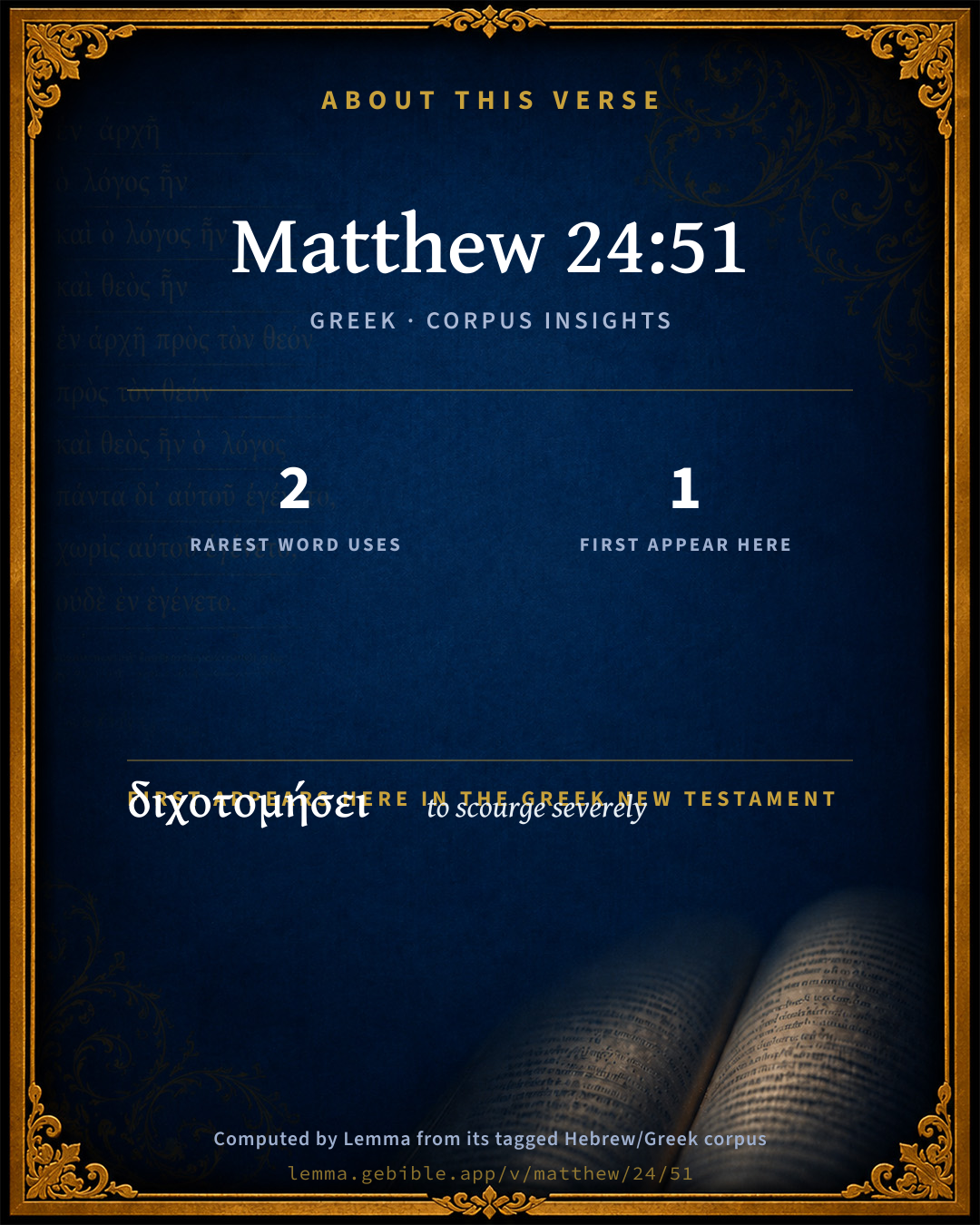
The rarest word here is διχοτομήσει to scourge severely G1371 — appearing just 2 times in the whole Greek New Testament.

First appearance in Scripture

This word makes its first canonical appearance in the Greek New Testament here:

  • διχοτομήσει to scourge severely G1371

Shared distinctive vocabulary

διχοτομήσει to scourge severely G1371 occurs in 2 verses of the Greek New Testament. Also found in:
Repetition

Words recur within this verse:

Cross-references

7

Topical passages linked to Matthew 24:51 in the Treasury of Scripture Knowledge — connected by theme and wording, ordered by reader-vote popularity; previews shown in the World English Bible.

  • Matthew 8:12 but the children of the Kingdom will be thrown out into the outer darkness. There will be weeping and the gnashing of teeth."
  • Luke 12:46 then the lord of that servant will come in a day when he isn't expecting him, and in an hour that he doesn't know, and will cut him in two, and place his portion with the unfaithful.
  • Matthew 22:13 Then the king said to the servants, 'Bind him hand and foot, take him away, and throw him into the outer darkness; there is where the weeping and grinding of teeth will be.'
  • Job 20:29 This is the portion of a wicked man from God, The heritage appointed to him by God."
  • Isaiah 33:14 The sinners in Zion are afraid; trembling has seized the godless ones: Who among us can dwell with the devouring fire? who among us can dwell with everlasting burning?
  • Matthew 25:30 Throw out the unprofitable servant into the outer darkness, where there will be weeping and gnashing of teeth.'
  • Luke 13:28 There will be weeping and gnashing of teeth, when you see Abraham, Isaac, Jacob, and all the prophets, in the Kingdom of God, and yourselves being thrown outside.

Cross-references courtesy of OpenBible.info (CC BY 4.0).

Commentary

Notes on Matthew 24:51 from classic Christian and Jewish commentators (each source and its license shown beneath its notes). The classic Christian expositions comment on the surrounding passage and are grouped to its opening verse, so a note may address several verses; the Jewish commentaries on the Tanakh (Rashi and others) are per-verse, so they appear only where the commentator wrote on this verse.

Lemma curates 59 commentaries, every one of them public domain or Creative Commons licensed, each selected and text-cleaned for this edition rather than reprinted as found. About our sources →

The Biblical Illustrator

Joseph S. Exell

Mat_24:45; Mat_24:51

Who, then, is that faithful and wise servant.

I. The particular relation in which we are here represented as standing to the one that is above us.

II. The representation that is here given of that attitude in which the servant is found who is obedient to his Master. There are terms used particularly descriptive of the conduct of the individual.

1. Fidelity.

2. Wisdom is associated with faithfulness-faithful and wise.

3. Habitual and persevering continuance in well-doing.

III. The blessedness which is included in this benediction of the Master.

1. Blessed at the appearance of Christ, also while he lives, in his present activity.

2. Positive reward.

3. Contrast the deception of the evil servant. (T. Binney, D. D.)

The faithful servant and his reward

I. The character of the faithful servant.

1. The faithful servant is one whose service is sincere.

2. The faithful servant is one whose service is unreserved, limited only by his capability.

3. His service is uniform.

4. His service is according to the prescribed rule, If a man strive for masteries, yet is he not crowned, except he strive lawfully.

5. His service is that of faith-the living faith of the heart in the truth of God as revealed to us in Jesus Christ.

II. His reward. The reward is here made to depend upon the servant being found occupying the position assigned him, with all fidelity, when his Lord cometh. We must not infer that the faithful servant is not blessed prior to his Lords coming, at the hour of death. Nor do his onerous duties diminish, but rather contribute to, the blessedness of the faithful servant. He has to suffer, it is true; but these minister to his blessedness. The master promotes his servant to the highest post of honour because of his fidelity in an inferior position. He is made a ruler. These pleasures will be internally progressive. The reward, however, will not be equal in degree. It is a matter of the first importance to determine whether we are in deed and truth the servants of Christ. (R. Scott.)

The activity of service

Christs departure from this earth is no reason for His Churchs inaction, but the source of her activity. Far from withdrawing His Churchs interests from earth by His withdrawal, He endows it with more effective energies, larger capacities for action. She can do more on earth, and not less, now He is gone. He shows this by picture after picture. He tells us that we are to be a society carefully and shrewdly organized, and this organization is to he formed with a view to work, production, fruit. We are to be organized with a view to our capacities, so to be arranged as to serve best for direct, present, practical usefulness here on earth; we are to be as a house which a householder has left, in which house every one is in his place, each according to his gift; and in this house there will be careful provision, that each shall have his food in due season-food brought him prepared through the hands of officers appointed for that one service, while at the door will ever sit the porter, who will have the office of watching while the others work. How careful, how orderly it all is! No loose shiftiness to fill up an interval. No indifference as to what may be done in the long waiting time. His going does not destroy or diminish the seriousness or care with which the interval is to be organized. How busy it all is to be. What! did we fancy that the haste and urgency of worldly business would conflict with the solemnity of watching for the Lord? Why, this kingdom of His is to be, during all the waiting time, like a house of business. It will be as a merchant house, in which everybody is bent on making all he can out of the money given him. He gives no picture of a Church ever on its knees at some silent shrine, praying for a far-off time. He foresees a body of men busy and intent, absorbed in the practical use of their gifts, bent on turning five talents into ten or two into four. (Canon Scott-Holland.)

The Biblical Illustrator, edited by Joseph S. Exell (c. 1880s–1900s) — public domain. Text from a community e-Sword module.

Bengel's Gnomon

Johann Albrecht Bengel

Mat 24:51. Διχοτομήσει, shall cut him in twain[1076]) A punishment frequent in ancient times, and an appropriate one for those who were διψύχοι, i.e. double-minded. The Hebrew נתח [to divide or cut in pieces] is thus rendered by the LXX. The hypocrite divides his soul and body in the worship of God; wherefore his soul and body shall be divided in eternal perdition. Eternal perdition is called death: all death, however, has this characteristic, that it deprives the body of its soul. Then neither the soul shall rejoice in the companionship of the body, nor the body in that of the soul, but it shall rather increase its death. Then will each of the damned be able to say with truth, “I am torn asunder” (disrumpor): cf. Heb 4:12, as to the force of the word with reference to the wicked. The twofold punishment corresponds to the twofold offence; viz., the cutting in twain to his smiting the men-servants and maid-servants, the portion with the hypocrites to his gluttony and drunkenness.—ὑποκριτῶν, hypocrites) Hypocrisy is a moral evil: the punishment of hypocrites is a specimen of punishment. In the parallel passage, Luk 12:46, we find ἈΠΊΣΤΩΝ, unbelievers or faithless, i.e. those who are not faithful; cf. Mat 24:45.—θήσει, shall appoint) by a judgment, just, severe, and irreversible.

[1076] E. V. “Shall cut him asunder.”—(I. B.)

Bengel's Gnomon of the New Testament — English translation (T&T Clark, Edinburgh, 1860) — public domain. Text from a community e-Sword module.

Expositor's Greek Testament

ed. W. Robertson Nicoll

Mat 24:51 . διχοτομήσει , he will cut him in sunder as with a saw, an actual mode of punishment in ancient times, and many commentators think that this barbarous penalty is seriously meant here. But this can hardly be, especially as in the following clause the man is supposed to be still alive. The probable meaning is: will cut him in two (so to speak) with a whip = thrash him, the base slave, unmercifully. It is a strong word, selected in sympathy with the master’s rage. So Schott: “verberibus multis eam castigavit”. Koetsveld, De Gelijk. , p. 246, and Grimm (Thayer) but with hesitancy. Beza and Grotius interpret: will divide him from the family = dismiss him. μετὰ τῶν ὑποκριτῶν , with the hypocrites, i.e. , eye-servants, who make a great show of zeal under the master’s eye, but are utterly negligent behind his back. In Lk. the corresponding phrase is τῶν ἀπίστων , the unfaithful.

The Expositor's Greek Testament, edited by W. Robertson Nicoll (1897–1910) — public domain. Text from a community e-Sword module.

Geneva Bible (1599)

Geneva Bible translators

To wit, from the rest, or will cut him into two parts, which was a most cruel kind of punishment, wherewith as Justin Martyr witnesseth, Isaiah the Prophet was executed by the Jews: the like kind of punishment we read of, 1 Sam. 15:33 and Dan. 3:29.

Geneva Bible (1599) marginal notes — public domain. Text via Bolls.life.

Adam Clarke's Commentary

Verse 51. Cut him asunder] This refers to an ancient mode of punishment used in several countries. Isaiah is reported to have been sawed ASUNDER. That it was an ancient mode of punishment is evident from what Herodotus says: that Sabacus, king of Ethiopia, had a vision, in which he was commanded μεσους διαταμειν, to cut in two, all the Egyptian priests, lib. ii. And in lib. vii. where Xerxes ordered one of the sons of Pythius μεσον διαταμειν, to be cut in two, and one half placed on each side of the way, that his army might pass through between them. See Raphelius also, in his notes from Herodotus and Polybius. This kind of punishment was used among the Persians: see Da 2:5; Da 3:29. Story of Susannah, ver. 55, 59. See also 2Sa 12:31, and 1Ch 20:3. It may also have reference to that mode of punishment in which the different members were chopped off seriatim, first the feet, then the hands, next the legs, then the arms, and lastly the head. This mode of punishment is still in use among the Chinese. But we find an exact parallel among the Turks, in the following passage from W. Lithgow's Travels, p. 153. London 4to. edit. "If a Turk should happen to kill another Turk, his punishment is thus: After he is adjudged to death, he is brought forth to the market place; and a blocke being brought hither of four foot high, the malifactor is stript naked, and then laid thereon with his belly downward; they draw in his middle together so small with running cords that they strike his body a - two with one blow: his hinder parts they cast to be eaten by hungry dogs kept for the same purpose; and the forequarters and head they throw into a grievous fire, made there for the same end. And this is the punishment for manslaughter."

This is the very same punishment, and for the same offence, as that mentioned by our Lord, the killing of a fellow servant-one of the same nation, and of the same religion.

THE reader has no doubt observed, in the preceding chapter, a series of the most striking and solemn predictions, fulfilled in the most literal, awful, and dreadful manner. Christ has foretold the ruin of the Jewish people, and the destruction of their polity; and in such a circumstantial manner as none else could do, but He, under whose eye are all events, and in whose hands are the government and direction of all things. Indeed he rather declared what he would do, than predicted what should come to pass. And the fulfilment has been as circumstantial as the prediction. Does it not appear that the predicted point was so literally referred to by the occurring fact, by which it was to have its accomplishment, as to leave no room to doubt the truth of the prediction, or the certainty of the event by which it was fulfilled? Thus the wisdom of God, as also his justice and providence, have had a plenary manifestation.

But this wisdom appears, farther, in preserving such a record of the prediction, and such evidence of its accomplishment, as cannot possibly be doubted. The New Testament, given by the inspiration of God, and handed down uncorrupted from father to son, by both friends and enemies, perfect in its credibility and truth, inexpungable in its evidences, and astonishingly circumstantial in details of future occurrences, which the wisdom of God alone could foreknow - that New Testament is the record of these predictions. The history of the Romans, written by so many hands; the history of the Jews, written by one of themselves; triumphal arches, coins, medals, and public monuments of different kinds, are the evidence by which the fulfilment of the record is demonstrated. Add to this the preservation of the Jewish people; a people scattered through all nations, yet subsisting as a distinct body, without temple, sacrifices, or political government; and who, while they attempt to suppress the truth, yet reluctantly stand forth as an unimpeachable collateral evidence, that the solemn record, already alluded to, is strictly and literally true! Who that has ever consulted the Roman historians of the reigns of Vespasian and Titus, the history of Josephus, and the 24th chapter of St. Matthew's Gospel, and who knows any thing of the present state of the Jews over the face of the earth, or even of those who sojourn in England, can doubt for a moment the truth of this Gospel, or the infinite and all - comprehensive knowledge of Him who is its author! Here then is one portion of Divine Revelation that is incontrovertibly and absolutely proved to be the truth of God. Reader! if he, who, while he predicted the ruin of this disobedient and refractory people, wept over their city and its inhabitants, has so, minutely fulfilled the threatenings of his justice on the unbelieving and disobedient, will he not as circumstantially fulfil the promises of his grace to all them that believe? The existence of his revelation, the continuance of a Christian Church upon earth, the certainty that there is one individual saved from his sins by the grace of the Gospel, and walking worthy of his vocation are continued proofs and evidences that he is still the same; that he will fulfil every jot and tittle of that word on which he has caused thee to trust; and save to the uttermost all that come unto the Father by him. The word of the Lord endureth for ever; and they who trust in him shall never be confounded.

Adam Clarke's Commentary on the Bible (1810–1826) — public domain. Text from a community e-Sword/MySword module.

Ellicott's Commentary for English Readers

(51) And shall cut him asunder.—Here also, as in the case of the faithful servant, the words have more than one fulfilment. The form of punishment (one which, in its literal sense, belongs to the inventive cruelty of Eastern kings) would seem here to have been chosen for its figurative fitness. The man had been a hypocrite, double-minded, trying to serve two masters, and his Lord, with the sharp sword of judgment, smites through the false, apparent unity of his life, and reveals its duplicity.

There shall be weeping.—As elsewhere, “the weeping and the gnashing.”

A Bible Commentary for English Readers, edited by Charles John Ellicott (1878–1897) — public domain. Text from a community e-Sword module.

The Cambridge Bible for Schools and Colleges

gen. ed. J. J. S. Perowne

51. shall cut him asunder] See Dan_2:5; Dan_3:29. “The angel of God waiteth with the sword to cut thee in two,” (Susanna, 59.) Comp. also “Multos honesti ordinis aut ad bestias condemnavit, aut serra dissecuit.” Sueton. Calig. 17, quoted by Wetstein, who gives other instances.

his portion with the hypocrites] St Luke has “with the unbelievers.” Such adaptations of the Gentile Evangelist to his readers are always interesting. Hypocrisy was especially a Jewish sin. St Luke adds our Lord’s words on the degrees of punishment, varying with the degrees of responsibility.

The Cambridge Bible for Schools and Colleges (gen. ed. J. J. S. Perowne; Cambridge University Press, 1878–1918) — public domain. Text from a community e-Sword module.

Trapp's Complete Commentary

John Trapp

51 And shall cut him asunder, and appoint him his portion with the hypocrites: there shall be weeping and gnashing of teeth.

Ver. 51. And shall cut him asunder] Gr. διχοτομησει, shall cut him in twain, that is, tear his soul from his body by main force, Job 27:8, throw him out of the world, as it were, by a firma eiectione, and hurl him into hell, there to undergo most exquisite torments, such as they did here that were sawn asunder, Heb 11:36-38; hewn in pieces, as Agag, 1Sa 15:33; torn limb from limb, as Dan 3:29; 2Sa 12:31.

And appoint him his portion with hypocrites] Hypocrites then are the freeholders of hell; other sinners are but as tenants and inmates to them, μερος, id quod in divisione obtigit. Lorin.

John Trapp, A Commentary or Exposition upon All the Books of the Old and New Testament (1647–1656) — public domain. Text from a community e-Sword module.

Whedon's Commentary on the Bible

Daniel D. Whedon

51. Cut him asunder — Separating perhaps head from body; or, in the ancient mode, sawing asunder. Portion — Or place. Hypocrites — Because he was a false servant to his Lord.

Daniel D. Whedon (gen. ed.), Commentary on the Old and New Testaments (1874–1909) — public domain. Text from a community e-Sword module.

The Pulpit Commentary

Shall cut him asunder (dicotomhsei). This mode of death was inflicted in some cases (see 1Sa_15:33 2Sa_12:31 Dan_3:29 Heb_11:37; compare also the account of the execution of Mettius in Livy, 1:28; and Horace, "Sat.," I 1:99). Thus in our own country "quartering," after hanging at least, was once a usual penalty for some offences, such as high treason. The term has been here interpreted to refer to the operation of the cruel scourge, which without metaphor might be said to cut a man to pieces; or "to dismiss from his employment," which seems to be hardly an adequate punishment. The difficulty is that the utter destruction of the malefactor implied in his literal cutting asunder is not consistent with his subsequent consignment to the lot of the hypocrites. Hence the Fathers have variously explained the term to signify separation from the company of saints, or from spiritual grace, or from all the blessings promised to the righteous. But we may take the Lord"s words as applying first to temporal punishment the unrighteous steward shall suffer death as horrible as dichotomy, a severance of body and soul, accompanied with unspeakable tortures; as in the History of Susanna, ver. 55, "The angel of God hath received the sentence of God to cut thee in two." Appoint him his portion with the hypocrites. The Lord drops the parable, and speaks of the terrible reality. The hypocrites are the faithless and deceitful, who, while pretending to do their lord"s work, are mere eye servants, and really neglect and injure it. The remissful steward shares their punishment in the other world. There (ekei) shall be, etc.; i.e. in the place where the hypocrites receive their punishment. (Mat_8:12 Mat_22:13 Mat_25:30) The expression signifies measureless grief and despair.

The Pulpit Commentary (1880–1919), ed. H.D.M. Spence-Jones & Joseph S. Exell — public domain. Text from a community e-Sword module.

John Wesley's Explanatory Notes

And allot him his portion with the hypocrites - The worst of sinners, as upright and sincere as he was once. If ministers are the persons here primarily intended, there is a peculiar propriety in the expression. For no hypocrisy can be baser, than to call ourselves ministers of Christ, while we are the slaves of avarice, ambition, or sensuality. Wherever such are found, may God reform them by his grace, or disarm them of that power and influence, which they continually abuse to his dishonour, and to their own aggravated damnation!

John Wesley, Explanatory Notes Upon the Whole Bible (1754–1765) — public domain. Text via the GEBible commentary corpus.

The People's New Testament

B. W. Johnson

51. And shall cut him asunder. An ancient method of punishment which was practiced among the Israelites. See 1 Sam. 15:33, and 2 Sam. 12:31. The idea here is that very severe punishment shall be inflicted upon him, while weeping and gnashing of teeth would indicate a life of intense suffering. Indeed both these expressions must be regarded as metaphors, indicating nothing more clearly than a terrible and certain punishment.

B. W. Johnson's The People's New Testament with Notes (1889–1891) — public domain. Electronic text from the Christian Classics Ethereal Library (CCEL) ThML edition.

Cambridge Greek Testament for Schools and Colleges

51. διχοτομήσει. See Dan 2:5; Dan 3:29. μένει γὰρ ὁ ἄγγελος τοῦ θεοῦ τὴν ῥομφαίαν ἔχων πρίσαι σε μέσον, (Susanna, 59.) Comp. also ‘Multos honesti ordinis aut ad bestias condemnavit, aut serra dissecuit.’ Sueton. Calig. 17, quoted by Wetstein, who gives other instances.

μετὰ τῶν ὑποκριτῶν. St Luke has μετὰ τῶν ἀπίστων. Such adaptations of the Gentile Evangelist to his readers are always interesting. Hypocrisy was especially a Jewish sin. St Luke adds our Lord’s words on the degrees of punishment, varying with the degrees of responsibility.

Cambridge Greek Testament for Schools and Colleges (Cambridge University Press, 1896; 21 vols, various authors incl. Carr, Maclear, Plummer, Farrar, Lumby, Moule, M. R. James, Simcox) — public domain. Text from a community e-Sword module.

Alford’s Greek Testament

Henry Alford

51.] διχ. refers to the punishment of cutting, or sawing asunder: see Dan 2:5; Dan 3:29: Sus. ver. 59; see also Heb 4:12; Heb 11:37. The expression here is perhaps not without a symbolical reference to that dreadful sundering of the conscience and practice which shall be the reflective torment of the condemned:—and by the mingling and confounding of which only is the anomalous life of the wilful sinner made in this world tolerable.

Henry Alford, The Greek Testament (1849–1861) — public domain. Text from a community e-Sword module.

International Critical Commentary

(L) 51. And shall cut him asunder, and set his portion with the hypocrites; there shall be the wailing and the gnashing of teeth.]—ἐκεῖ ἔσται, κ.τ.λ] See on 8:12.

M the Second Gospel.

LXX. The Septuagint Version.

L the Matthæan Logia.

1 ἀγάπη. See Deissmann, Bible Studies, p. 198 f.

Ass. Mos. Assumption of Moses.

Th. Theodotion.

Class. Rev. Classical Review.

DCG. Dictionary of Christ and the Gospels.

E editorial passages.

Ps.-Sol. The Psalms of Solomon.

S Syriac version: Sinaitic MS.

al i.e. with other uncial MSS.

1 Cf Shabbath 113b. Sanhedrin 91b, and Enoch 61:5 “the day of Elect One.”

B. Babylonian Talmud.

X passages in which Mt. and Lk. agree closely, borrowed from an unknown source or sources.

International Critical Commentary — older volumes (1896–1929), various authors — public domain. Text from a community e-Sword module.

Lesson kit

Teaching starters — assembled from the data on this page, not authored interpretation. Every prompt links to the verse data it draws on. Edit before teaching.

Matthew, in the Gospels, opens this verse with 20 words (13 distinct Greek lemmas). Its most distinctive word is dichotoméō (“to scourge severely”). A historical commentator’s framing appears above. Read the whole chapter for the surrounding context.

Discussion questions

  1. What does “to scourge severely” (dichotoméō) contribute to the verse as a whole?
  2. The word “to scourge severely” first appears here in Scripture. What is being introduced at this debut?
  3. Luke 12:46 shares the word «to scourge severely» with this verse. How do the two illuminate each other?
  4. “the” occurs 5× in this one verse. What is the effect of the repetition?
  5. The translations on this page render this verse differently — a whole-verse word diff, not a word-by-word alignment. What might account for the different wordings?
  6. Reading how The Biblical Illustrator and Bengel's Gnomon read this verse, where do the two commentators agree and where do they part?

Things to notice

  • 1 word makes its first canonical appearance in Scripture here.
  • These translations choose different wording for 10 words in this verse.
  • “the” occurs 5× in this single verse.
  • 13 distinct Greek lemmas span 20 words in this verse.

Reading settings

Reading text

Shown beneath each verse's original-language words.

Old Testament
Old Testament edition

Read the OT as the Masoretic Hebrew (MT) or the Greek Septuagint (LXX).

English shown for the Greek Septuagint (in the Hebrew ↔ Greek comparison).

Comparing translations? Open the Compare panel on any verse page to stack up to four side by side.