
Matthew 21:8

Greek (Tischendorf 8th ed.) Matthew 21:8 appears in the Greek New Testament. The text above is from the Tischendorf 8th edition. Each word links to its Strong’s number and a concise gloss. Click any word for its full Thayer’s Greek Lexicon entry.
Download image
Cite this verse

Matthew 21:8 (World English Bible). Public Domain. Lemma interlinear Bible study tool, https://lemma.gebible.app/v/matthew/21/8.

Show BibTeX & RIS
BibTeX
RIS
English Translation
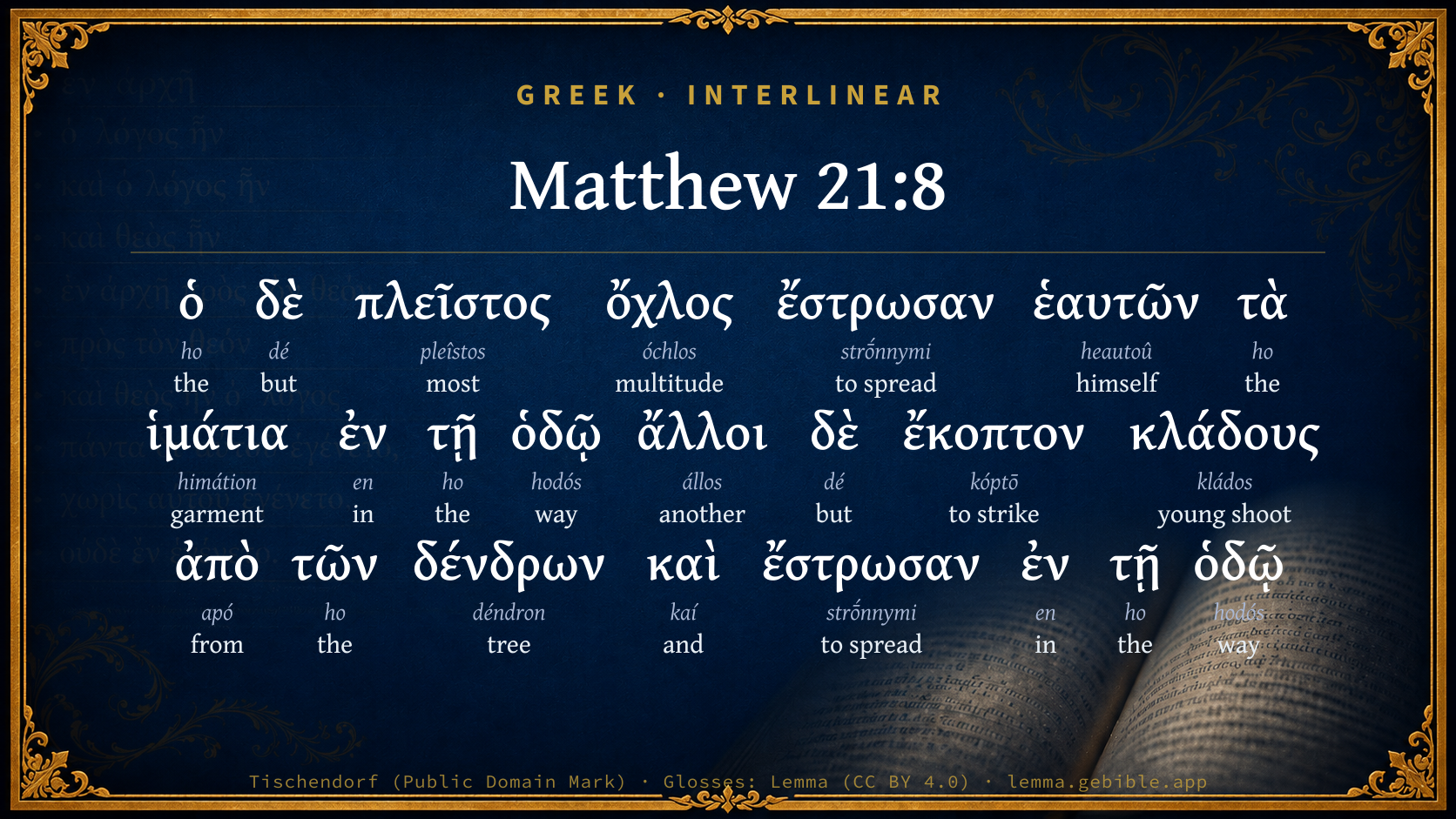
A very great multitude spread their clothes on the road. Others cut branches from the trees, and spread them on the road.
World English Bible · Public Domain
Highlights
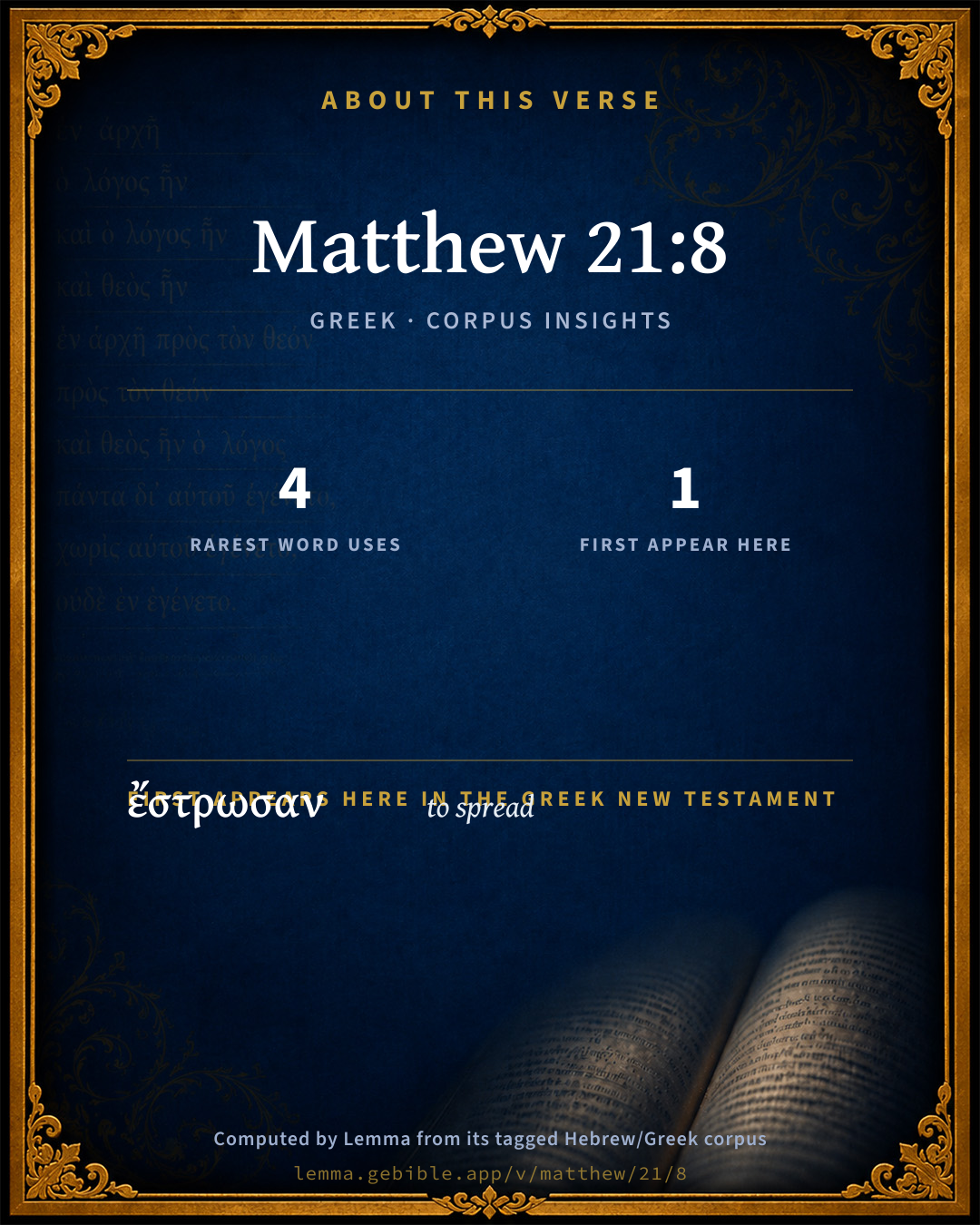
  • 1 first appearance in the Greek New Testament
Full analysis ↓
Download a study sheet

One document with this verse’s original text, its word-by-word gloss line, the meaning frame, cross-references with their text, attributed commentary, and full source and license credits — printable, and it pastes into notes with its structure intact.

This verse Autodidact and up

Study sheet (.html) Plain text (.txt)

A passage Seminary Student

Up to 50 verses in one chapter. A passage sheet keeps up to 6 commentary sources and 12 cross-references per verse, in the order this page ranks them, and says so on the sheet whenever that leaves anything out. Ask for a single verse and you get the Autodidact verse sheet above.

Everything on this page stays free to read, with no account — the sheet is a download of what is already on screen, not access to it.

Want to remove ads? Support Godless Engineer
Compare translations 3

The same verse in 3 English versions, stacked beneath the original-language interlinear above. Click any original word for its lexicon entry.

Each is an independent rendering of the whole verse — the interlinear is not word-aligned to these translations.

Highlighted words mark where these versions differ — a whole-verse word diff, not a word-by-word alignment.

  • World English Bible Public Domain
    A very great multitude spread their clothes on the road. Others cut branches from the trees, and spread them on the road.
  • King James Version Public Domain
    And a very great multitude spread their garments in the way; others cut down branches from the trees, and strawed them in the way.
  • unfoldingWord Literal Text CC BY-SA 4.0
    Now the largest crowd spread their cloaks on the road, and others were cutting branches from the trees and were spreading on the road.

unfoldingWord Literal Text — © unfoldingWord, licensed CC BY-SA 4.0. Word-aligned USFM3 via Door43 (git.door43.org/unfoldingWord/en_ult).

Versions to compare (up to 4)

3 of 4 selected

Show all 19 translations

Every available English version of this verse, each an independent rendering of the whole verse.

  • World English Bible Public Domain
    A very great multitude spread their clothes on the road. Others cut branches from the trees, and spread them on the road.
  • Berean Standard Bible Public Domain
    A massive crowd spread their cloaks on the road, while others cut branches from the trees and spread them on the road.
  • Majority Standard Bible Public Domain
    A massive crowd spread their cloaks on the road, while others cut branches from the trees and spread them on the road.
  • King James Version Public Domain
    And a very great multitude spread their garments in the way; others cut down branches from the trees, and strawed them in the way.
  • American Standard Version (1901) Public Domain
    And the most part of the multitude spread their garments in the way; and others cut branches from the trees, and spread them in the way.
  • Revised Version (1885) Public Domain
    And the most part of the multitude spread their garments in the way; and others cut branches from the trees, and spread them in the way.
  • Geneva Bible (1599) Public Domain
    And a great multitude spred their garments in the way: and other cut downe branches from the trees, and strawed them in the way.
  • Douay-Rheims (1899) Public Domain
    And a very great multitude spread their garments in the way: and others cut boughs from the trees, and strewed them in the way:
  • Young's Literal Translation Public Domain
    and the very great multitude spread their own garments in the way, and others were cutting branches from the trees, and were strewing in the way,
  • Literal Standard Version CC BY-SA 4.0
    and the very great multitude spread their own garments in the way, and others were cutting branches from the trees, and were strewing in the way,
  • Unlocked Literal Bible CC BY-SA 4.0
    Most of the crowd spread their cloaks on the road, and others cut branches from the trees and spread them in the road.
  • unfoldingWord Literal Text CC BY-SA 4.0
    Now the largest crowd spread their cloaks on the road, and others were cutting branches from the trees and were spreading on the road.
  • Darby Bible Public Domain
    But a very great crowd strewed their own garments on the way, and others kept cutting down branches from the trees and strewing them on the way.
  • World Messianic Bible Public Domain
    A very great multitude spread their clothes on the road. Others cut branches from the trees and spread them on the road.
  • Webster's Bible Public Domain
    And a very great multitude spread their garments in the way; others cut down branches from the trees, and strewed them in the way.
  • Free Bible Version CC BY-SA 4.0
    Many people in the crowd spread their cloaks on the road, while others cut branches from the trees and laid them on the road.
  • Bible in Basic English Public Domain
    And all the people put their clothing down in the way; and others got branches from the trees, and put them down in the way.
  • Text-Critical English NT CC BY 4.0
    A very large crowd spread their garments on the road, and others cut down branches from the trees and also spread them on the road.
  • Tyndale New Testament (1534) Public Domain
    And many of the people spreed their garmentes in the waye. Other cut doune braunches from the trees and strawed them in the waye.

Literal Standard Version (2020), Covenant Press — licensed CC BY-SA 4.0. Text via the HelloAO Bible API (eBible.org). Unlocked Literal Bible (unfoldingWord) — licensed CC BY-SA 4.0. Text via the HelloAO Bible API (eBible.org). unfoldingWord Literal Text — © unfoldingWord, licensed CC BY-SA 4.0. Word-aligned USFM3 via Door43 (git.door43.org/unfoldingWord/en_ult). Free Bible Version, Dr. Jonathan Gallagher — licensed CC BY-SA 4.0. Text via the HelloAO Bible API (eBible.org).

Word by word

More ways to search: Search by grammar → Find every occurrence → Compare this word →

Practice this passage: Drill this verse → Learn its vocabulary →

πλεῖστος
pleîstos
G4118
“most”
Adjective, Nominative, Singular, Masculine, Superlative
Part of Speech
Adjective
Case
Nominative
Number
Singular
Gender
Masculine
Degree
Superlative
Full Thayer's Definition

Origin: irregular superlative of G4183

TDNT: None

1. most 2. at the very most
  1. ὁ ho G3588 “the” Article, Nominative, Singular, Masculine
  2. δὲ dé G1161 “but” Conjunction
  3. ὄχλος óchlos G3793 “multitude” Noun, Nominative, Singular, Masculine
  4. ἔστρωσαν strṓnnymi G4766 “to spread” Verb, Aorist, Active, Indicative, 3rd person, Plural
  5. ἑαυτῶν heautoû G1438 “himself” Reflexive pronoun, 3rd person, Genitive, Plural, Masculine
  6. τὰ ho G3588 “the” Article, Accusative, Plural, Neuter
  7. ἱμάτια himátion G2440 “garment” Noun, Accusative, Plural, Neuter
  8. ἐν en G1722 “in” Preposition
  9. τῇ ho G3588 “the” Article, Dative, Singular, Feminine
  10. ὁδῷ hodós G3598 “way” Noun, Dative, Singular, Feminine
  11. ἄλλοι állos G243 “another” Adjective, Nominative, Plural, Masculine
  12. δὲ dé G1161 “but” Conjunction
  13. ἔκοπτον kóptō G2875 “to strike” Verb, Imperfect, Active, Indicative, 3rd person, Plural
  14. κλάδους kládos G2798 “young shoot” Noun, Accusative, Plural, Masculine
  15. ἀπὸ apó G575 “from” Preposition
  16. τῶν ho G3588 “the” Article, Genitive, Plural, Neuter
  17. δένδρων déndron G1186 “tree” Noun, Genitive, Plural, Neuter
  18. καὶ kaí G2532 “and” Conjunction
  19. ἔστρωσαν strṓnnymi G4766 “to spread” Verb, Aorist, Active, Indicative, 3rd person, Plural
  20. ἐν en G1722 “in” Preposition
  21. τῇ ho G3588 “the” Article, Dative, Singular, Feminine
  22. ὁδῷ hodós G3598 “way” Noun, Dative, Singular, Feminine

About this verse

These counts appear in no published source. They are computed here, from the morphology-tagged text and Lemma’s own curated glosses. What Lemma adds →

23
words
15
distinct lemmas
Gospels
section

Notable vocabulary

The rarest word here is πλεῖστος most G4118 — appearing just 4 times in the whole Greek New Testament.

First appearance in Scripture

This word makes its first canonical appearance in the Greek New Testament here:

  • ἔστρωσαν to spread G4766

Shared distinctive vocabulary

πλεῖστος most G4118 occurs in 4 verses of the Greek New Testament. Also found in:
Repetition

Words recur within this verse:

Cross-references

3

Topical passages linked to Matthew 21:8 in the Treasury of Scripture Knowledge — connected by theme and wording, ordered by reader-vote popularity; previews shown in the World English Bible.

  • 2 Kings 9:13 Then they hurried, and took every man his garment, and put it under him on the top of the stairs, and blew the trumpet, saying, Jehu is king.
  • Leviticus 23:40 You shall take on the first day the fruit of goodly trees, branches of palm trees, and boughs of thick trees, and willows of the brook; and you shall rejoice before Yahweh your God seven days.
  • John 12:13 they took the branches of the palm trees, and went out to meet him, and cried out, "Hosanna! Blessed is he who comes in the name of the Lord, the King of Israel!"

Cross-references courtesy of OpenBible.info (CC BY 4.0).

Commentary

Notes on Matthew 21:8 from classic Christian and Jewish commentators (each source and its license shown beneath its notes). The classic Christian expositions comment on the surrounding passage and are grouped to its opening verse, so a note may address several verses; the Jewish commentaries on the Tanakh (Rashi and others) are per-verse, so they appear only where the commentator wrote on this verse.

Lemma curates 59 commentaries, every one of them public domain or Creative Commons licensed, each selected and text-cleaned for this edition rather than reprinted as found. About our sources →

Bengel's Gnomon

Johann Albrecht Bengel

Mat 21:8. Ὁ δὲ πλεῖστος ὄχλος, but the people, who were in great numbers.—ἐν τῇ ὁδῷ, in the way) [i.e in the midst of the way or road]; not only κατὰ τὴν ὁδόν, by the side of the way; for St Luke (Luk 19:36) uses the expression ὑπεστρώννυον, they spread them under, [i.e. so that He should ride over them].—κλάδους, branches) It was customary with the Jews and other ancient nations to manifest their public joy by cutting down branches from trees.

Bengel's Gnomon of the New Testament — English translation (T&T Clark, Edinburgh, 1860) — public domain. Text from a community e-Sword module.

Meyer's Critical & Exegetical Commentary

Heinrich August Wilhelm Meyer

Mat_21:8. Manifestations of respect, such as kings were usually greeted with on entering cities, 2Ki_9:13; Wetsteins note on this passage; Robinson, II. p. 383.

ὁ πλεῖστος ὄχλος] the most of the people, the greatest part of the multitude. Comp. Plat. Rep. p. 397 D; Thuc. vii. 78; Xen. Anab. iii. 2. 36.

ἑαυτῶν] states what the multitude did with their own garments, after the disciples had spread theirs upon the two beasts.

Meyer — Critical and Exegetical Commentary on the New Testament — English translation by Peter Christie, edited by Frederick Crombie (T&T Clark, 1880) — public domain. Text from a community e-Sword module.

Expositor's Greek Testament

ed. W. Robertson Nicoll

Mat 21:8 . ὁ δὲ πλεῖστος ὄχλος , etc., the most part of the crowd, follow the example of the two disciples, and spread their upper garments on the way, as it were to make a carpet for the object of their enthusiasm, after the manner of the peoples honouring their kings ( vide Wetstein, ad loc. ). ἄλλοι δὲ ἔκοπτον : others, a small number comparatively, took to cutting down branches of trees and scattering them about on the way. Had they no upper garments, or did they not care to use them in that way? The branches, if of any size, would not improve the road, neither indeed would the garments. Lightfoot, perceiving this “hoc forsan equitantem prosterneret” thinks they used garments and branches to make booths, as at the feast of tabernacles. It was well meant but embarrassing homage.

The Expositor's Greek Testament, edited by W. Robertson Nicoll (1897–1910) — public domain. Text from a community e-Sword module.

Adam Clarke's Commentary

Verse 8. Cut down branches from the trees] Carrying palm and other branches was emblematical of victory and success. See 1 Mac. xiii. 51; 2 Mac. x. 7; and Re 7:9.

The rabbins acknowledge that the prophecy in Zechariah refers to the Messiah; so Rab. Tancum, and Yalcut Rubeni has a strange story about the ass. "This ass is the colt of that ass which was created in the twilight of the sixth day. This is the ass which Abraham found when he went to sacrifice his son. This is the ass on which Moses rode when he went to Egypt; and this is the ass on which the Messiah shall ride." Some of the Jews seem to think that the zebra is intended; for according to Bab. Sanhedr. fol. 98, when Shapoor, king of Persia, said to Rabbi Samuel: "You say your Messiah will come upon an ass; I will send him a noble horse." To which the rabbi replied, "You have not a horse with a hundred spots (query, streaks) like his ass." See Lightfoot and Schoettgen.

Adam Clarke's Commentary on the Bible (1810–1826) — public domain. Text from a community e-Sword/MySword module.

Ellicott's Commentary for English Readers

(8) And a very great multitude.—Better, the greater part of the multitude. Part of the crowd had come with Him from Galilee, part streamed from Bethany, excited by the recent resurrection of Lazarus (Joh_12:17). Some went before Him, some followed. As they advanced they were met by a fresh crowd pouring forth from Jerusalem. Of the latter, St. John records that they came out with palm-branches in their hands, as if to salute a king with the symbols of his triumph. (Comp. Rev_7:9.)

Spread their garments in the way.—This, again, was a recognised act of homage to a king. So Jehu, when the officers of the army of Israel chose him as their ruler, walked upon the garments which they spread beneath his feet (2Ki_9:13). So Agamemnon, tempted to an act of barbaric pomp, after the manner of Eastern kings, entered his palace at Mycenæ, walking upon costly carpets (Æschylus, Agam. 891).

A Bible Commentary for English Readers, edited by Charles John Ellicott (1878–1897) — public domain. Text from a community e-Sword module.

The Cambridge Bible for Schools and Colleges

gen. ed. J. J. S. Perowne

8. a very great multitude] Rather, the greater part of the crowd.

spread their garments in the way] Instances are recorded of similar acts of respect shewn to Rabbis by their disciples. See Schöttgen, ad loc.

The Cambridge Bible for Schools and Colleges (gen. ed. J. J. S. Perowne; Cambridge University Press, 1878–1918) — public domain. Text from a community e-Sword module.

John Gill's Exposition

And a very great multitude,.... Which consisted partly of the great multitude which followed Christ from Jericho, and partly of the much people that were come up to the feast of the passover from divers parts, and met him from Jerusalem; see Joh 12:12. These, many of them, for it cannot be thought to be done by them all,

spread their garments in the way; either in the middle of the road, instead of carpets, to ride upon; the Persic version adds, "that he might pass over them": this they did, in honour to him as a king. So when Jehu declared to the princes of Israel, that he was anointed king of Israel, they hastened, and took every man his garment, and put it under him, Kg2 9:13 that is, to tread upon; though the Jewish writers (x) say, it was done that he might be higher than them all, suitable to the dignity of a king: and it is reported (y) of Cato Uticensis, the emperor, that his soldiers strewed their garments for him to walk upon: or these garments were spread by the way side. Dr. Lightfoot conjectures, that little tents might be raised by them along the road, upon which they spread their garments to make a show, in imitation of the feast of tabernacles, to which there is a very great resemblance in many things which occur in this account; when they used to spread linen cloth, garments, and fruits, over their booths, for decoration and ornament; as appears from their traditions about these things:

, "if a man spreads a linen cloth over it", (his booth,) because of the sun, or under it, because of the falling of leaves, &c. or spreads it over a canopy, it is not right; but he may spread it over the bedposts (z).''

That is, for ornament, as the commentators observe (a). Again,

, if a man spreads a garment over it, (his booth,) or if he spreads it under it, because of what falls it is not right; but if he spreads it so as that it is, "for ornament", it is right; and so if he covers it according to the tradition of it, and encompasses it with various kinds of fruits, and precious things, and vessels which hang upon it, whether on its walls, or on its covering, so they be for ornament, it is right (b).''

In like manner, the multitude might hang their garments, to make the show the greater, either on such booths, or on the houses and trees, that were upon the road, as they went along.

Others cut down branches from the trees; from the olive trees, as the Persic version expresses it, which grew in great plenty hereabout; and also from the palm trees, the branches of which, with the boughs of other trees, were what the Jews used to carry in their hands on the feast of tabernacles; see Lev 23:40 and the Evangelist John expressly says, that the people which met Christ from Jerusalem at this time, did take branches of palm trees in their hands, Joh 12:13. And though this was not the time of the feast of tabernacles, but of the passover, yet it was common with the Jews to signify their joy upon any occasion, by such ways and methods they used at that least: so upon the cleansing of the tower of Jerusalem, by Simon Maccabeus, the Jews entered into it with thanksgiving, and branches of palm trees:

"And entered into it the three and twentieth day of the second month in the hundred seventy and first year, with thanksgiving, and branches of palm trees, and with harps, and cymbals, and with viols, and hymns, and songs: because there was destroyed a great enemy out of Israel.'' (1 Maccabees 13:51)

Likewise upon purifying the temple, which had been polluted by Antiochus, they kept eight days with gladness as in the feast of tabernacles, and bare branches and fair boughs, and palms also, as in the Apocrypha:

6 And they kept the eight days with gladness, as in the feast of the tabernacles, remembering that not long afore they had held the feast of the tabernacles, when as they wandered in the mountains and dens like beasts. 7 Therefore they bare branches, and fair boughs, and palms also, and sang psalms unto him that had given them good success in cleansing his place. (2 Maccabees 10)

But here it is said,

and they strawed them in the way: not in the middle of the road, which would have been an hindrance to riding; but by the way side, upon, the booths, or houses in the road, in honour of him; just as the Jews (c) say,

"the streets were strewed with myrtles, and the courts with purple, when Mordecai went out of the king's gate.''

(x) R. Levi ben Gersom, & R. Samuel Laniado in loc. (y) Plutarch in Aleibiade. (z) Misn. Succa, c. 1. sect. 3. (a) Maimon. & Bartenora in ib. (b) Maimon. Hilch. Succa, c. 5. sect. 17. (c) Targum in Esther viii. 15.

John Gill's Exposition of the Whole Bible (1746–1763) — public domain (CC PDM 1.0). Text via the HelloAO Bible API.

Trapp's Complete Commentary

John Trapp

8 And a very great multitude spread their garments in the way; others cut down branches from the trees, and strawed them in the way.

Ver. 8. And a very great multitude] Bondinius saith, he was met at this time by 300,000 Jews, some whereof went before Christ, some followed after, according to the solemn rites and reverence used to be given to earthly kings in their most pompous trimuphs. This was the Lord’s own work.

John Trapp, A Commentary or Exposition upon All the Books of the Old and New Testament (1647–1656) — public domain. Text from a community e-Sword module.

Albert Barnes' Notes on the Bible

And a very great multitude ... - Others showed the same respect by throwing their garments before him; others by cutting down branches of trees and casting them in the way. This was the way in which conquerors and princes were often honored. To cast flowers, or garlands, or evergreens before a warrior returning from victory, or a king entering into his kingdom, was a common way of testifying joyful and triumphant feeling. Thus Josephus says that Alexander and Agrippa were received at Jerusalem. So in our own land some of the most acceptable tokens of rejoicing ever bestowed upon Washington were garlands of roses scattered in his path by children. So the path of Lafayette was often strewed with flowers, as a mark of respect and of a nation’s gratitude. John says Joh 12:13 that these branches were branches of the “palm-tree.” The palm was an emblem of “joy and victory.” It was used by the Roman soldiers, as well as the Jews, as a symbol of peace. See 1 Macc. 13:51; 2 Macc. 10:6, 7; Rev 7:9.

The “palm-tree” is common in warm climates, and was abundant in Palestine. The finest grew about Jericho and Engedi. Hence, Jericho was called the city of “palm-trees.” The palm has a long and straight body, a spreading top, and an appearance of very great beauty. It produces an agreeable fruit, a pleasant shade, a kind of “honey” little inferior to the honey of bees, and from it was drawn a pleasant “wine” much used in the East. On ancient coins the palm-tree is often a symbol of Judea. On coins made after Jerusalem was taken, Judea is represented by a female sitting and weeping under a palm-tree. A reference to the palm-tree occurs often in the Bible, and its general form and uses are familiar to most readers.

Strictly speaking, the palm has no branches, but at the summit from forty to eighty twigs or leaf-stalks spring forth. These are referred to in Neh 8:15. The leaves are set around the trunk in circles of about six. The lower row is of great length, and the vast leaves bend themselves in a curve toward the earth: as the circles ascend, the leaves are shorter. In the month of February, there sprout from between the junctures of the lower stalks and the trunk little scales, which develop a kind of bud, the germ of the coming fruit. These germs are contained in a thick and tough skin, not unlike leather. According to the account of a modern traveler, a single tree in Barbary and Egypt bears from fifteen to twenty large clusters of dates, weighing from 15 to 20 lbs. each. The palm-tree lives more than 200 years, and is most productive from the 30th until the 80th year. The Arabs speak of 260 uses to which the different parts of the palm-tree are applied.

The inhabitants of Egypt, Arabia, and Persia depend much on the fruit of the palm-tree for their subsistence. Camels feed on the seed, and the leaves, branches, fibres, and sap are all very valuable.

The “branches” referred to by John Joh 12:13 are the long “leaves” which shoot out from the top of the tree, and which were often carried about as the symbol of victory. Compare the notes at Isa 3:26.

Albert Barnes' Notes on the Bible (1834–1885) — public domain. Text from a community e-Sword/MySword module.

Whedon's Commentary on the Bible

Daniel D. Whedon

8. A very great multitude — No intimation is given that this scene was prepared. Everything seems supernaturally spontaneous; every man performs his part, and is in his place as exactly as the ass and colt. It seems like a drama managed by a sacred and divine power, in which everything moves of itself. Spread their garments in the way — These garments were the abba, or hyke, being the loose blanket or cloak worn over the tunic or shirt. See note on Mat_5:40. To celebrate the arrival of some great hero by spreading carpets, or still more their garments, was a Greek and Roman custom, and is so natural as to be in use in modern times even in Christian countries. Garlands were strewed in Washington’s path by his admiring countrymen. Robinson mentions a striking instance which took place in Bethlehem under his own eye, when the people threw their garments under the feet of the English consul, whose aid they were imploring. In 2Ki_9:13, it was used as a royal honour to a new-made sovereign. Others cut down branches from the trees — Stanley calls attention to the change of the tense in the verb rendered cut, by which it is to be rendered were cutting. That is, while one part were strewing their garments in token of humble affection, the others were cutting the branches of the palm, the emblem of victory, to strew his path. Others still, according to Mar_11:8, cut and strewed mattings or twisted weavings of the palm twigs.

The palm is the most queenly of trees. The ancient coins which bore the inscription Judea Capta, represented Judea as a maiden sitting under a palm. See note on Mat_2:18. Judea was anciently pre-eminently the land of palms. Jericho and Palmyra were both cities of the palm.

The palm rises with a tall, straight shaft, and spreads its leaves like rays from a centre; so that the tree itself has been held an emblem of life. The leaves of the mature tree are six or eight feet long, and when spread out are very broad. In Rev_7:9, palms of victory are borne in the hands of the saints.

The way — “Three pathways lead, and probably always led from Bethany to Jerusalem; one a steep footpath over the summit of Mount Olivet; another by a long circuit over its northern shoulder, down the valley which parts it from Scopus; the third the natural continuation of the road by which mountain travellers always approach the city of Jericho, over the southern shoulder, between the summit which contains the tombs of the prophets, and that called the ‘Mount of Offence.’ There can be no doubt that this last is the road of the entry of Christ, not only because, as just stated, it is and must always have been the usual approach for horsemen and for large caravans, such as then were concerned, but also because this is the only one of the three approaches which meets the requirements of the narrative which follows.” — Stanley.

Daniel D. Whedon (gen. ed.), Commentary on the Old and New Testaments (1874–1909) — public domain. Text from a community e-Sword module.

The Pulpit Commentary

A very great multitude; o de pleistov oclov : Revised Version, the most part of the multitude. This interpretation has classical authority (see Alford), but the words may well mean," the very great multitude;" Vulgate, plurima autem turba. This crowd was composed of pilgrims who were coming to the festival at Jerusalem, and "the whole multitude of the disciples". (Luk_19:37) Spread their garments (imatia ) in the way. Fired with enthusiasm, they stripped off their abbas, as the two disciples had done, and with them made a carpet over which the Saviour should ride. Such honours were often paid to great men, and indeed, as we well know, are offered now on state occasions. Branches from the trees. St. John (Joh_12:13) particularizes palm trees as having been used on this occasion; but there was abundance of olive and other trees, from which branches and leaves could be cut or plucked to adorn the Saviour"s road. The people appear to have behaved on this occasion as if at the Feast of Tabernacles, roused by enthusiasm to unpremeditated action. Of the three routes which lay before him, Jesus is supposed to have taken the southern and most frequented, between the Mount of Olives and the Hill of Offence.

The Pulpit Commentary (1880–1919), ed. H.D.M. Spence-Jones & Joseph S. Exell — public domain. Text from a community e-Sword module.

John Wesley's Explanatory Notes

A great multitude spread their garments in the way - A custom which was usual at the creation of a king, 2 Kings ix, 13.

John Wesley, Explanatory Notes Upon the Whole Bible (1754–1765) — public domain. Text via the GEBible commentary corpus.

The People's New Testament

B. W. Johnson

8. And a very great multitude spread their garments. Vast multitudes were gathered at Jerusalem at the Passover. The law required the assembling of the Jewish nation. Josephus says that several millions were wont to gather. Among these were thousands of Galileans who had heard of Jesus, seen his miracles, and believed in him as their Messiah King. When the people of Bethlehem, during the war between Turkey and Egypt in 1836, sought the protection of the British consul, they “spread their garments in the way” of his horses, in order to do him honor. Cut down branches from the trees. John (12:13) says that these were the branches of palm trees; rather, the wide, spreading, branch-like leaves of the palm tree, well fitted to form a soft, level carpet. The only branches of the palm tree are its leafy crown.

B. W. Johnson's The People's New Testament with Notes (1889–1891) — public domain. Electronic text from the Christian Classics Ethereal Library (CCEL) ThML edition.

Cambridge Greek Testament for Schools and Colleges

8. ὁ πλεῖστος ὄχλος, the greater part of the crowd.

ἔστρωσαν ἑαυτῶν τὰ ἱμάτια. Instances are recorded of similar acts of respect shewn to Rabbis by their disciples. See Schöttgen, ad loc.

Cambridge Greek Testament for Schools and Colleges (Cambridge University Press, 1896; 21 vols, various authors incl. Carr, Maclear, Plummer, Farrar, Lumby, Moule, M. R. James, Simcox) — public domain. Text from a community e-Sword module.

International Critical Commentary

(M) 8. And the very great multitude spread their garments in the way; and others were cutting branches from the trees, and were spreading (them) in the way.] Mk. has: “And many spread their garments on to the way. And others having cut litter from the fields.”—ὁ δὲ πλεῖστος ὄχλος] δέ for καί, as often. For πλεῖστος ὄχλος see on 11:20; and cf. Blass, p. 143.—ἔκοπτον κλάδους] is the substitution of a more ordinary feature for Mk.’s unusual στιβάδας κόψαντες. The editor adds καὶ ἐστρώννυον ἐν τῇ ὁδῷ to make it clear what was done with the branches. In Mk. this is implied in his abrupt participle κόψαντες.

8. ἔστρωσαν, second time] א* D c e ff2 q. ἐστρώννυον, א* B C al b f ff1 g1 2 h S2. In Mk. ἔστρωσαν is read by most MSS., but ἐστρώννυον by D S1 curss. The imperf. is probably genuine in Mk. and in the second clause of Mt. Mt. having altered the imperfect into ἔστρωσαν in clause a, continued with imperfs. ἔκοπτον, ἐστρώννυον in clause b, and in v. 9 ἔκραζον. א* D in Mt. have assimilated ἐστρώννυον to the ἔστρωσαν of clause a, and of Mk., and in Mk. most MSS. have assimilated ἐστρώννυον to Mt.’s clause a. Lk.’s ὑπεστρώννυον shows that he too had the imperf. in his copy of Mk.

International Critical Commentary — older volumes (1896–1929), various authors — public domain. Text from a community e-Sword module.

Lesson kit

Teaching starters — assembled from the data on this page, not authored interpretation. Every prompt links to the verse data it draws on. Edit before teaching.

Matthew, in the Gospels, opens this verse with 23 words (15 distinct Greek lemmas). Its most distinctive word is pleîstos (“most”). A historical commentator’s framing appears above. Read the whole chapter for the surrounding context.

Discussion questions

  1. How does “most” (pleîstos) shape what this verse is saying?
  2. This is the first place “to spread” appears in Scripture (first appears here). What does its debut here establish?
  3. How does Matthew 11:20, which shares the word «most», read alongside this verse?
  4. What does the repetition of “to spread” (2× in this one verse) do in this verse?
  5. These translations render this verse differently; the difference is in the English rendering, not the original. What questions does that raise?
  6. Compare how Bengel's Gnomon and Meyer's Critical & Exegetical Commentary read this verse. Where do they agree or differ?

Things to notice

  • 1 word makes its first canonical appearance in Scripture here.
  • These translations choose different wording for 16 words in this verse.
  • “to spread” occurs 2× in this single verse.
  • 15 distinct Greek lemmas span 23 words in this verse.

Reading settings

Reading text

Shown beneath each verse's original-language words.

Old Testament
Old Testament edition

Read the OT as the Masoretic Hebrew (MT) or the Greek Septuagint (LXX).

English shown for the Greek Septuagint (in the Hebrew ↔ Greek comparison).

Comparing translations? Open the Compare panel on any verse page to stack up to four side by side.