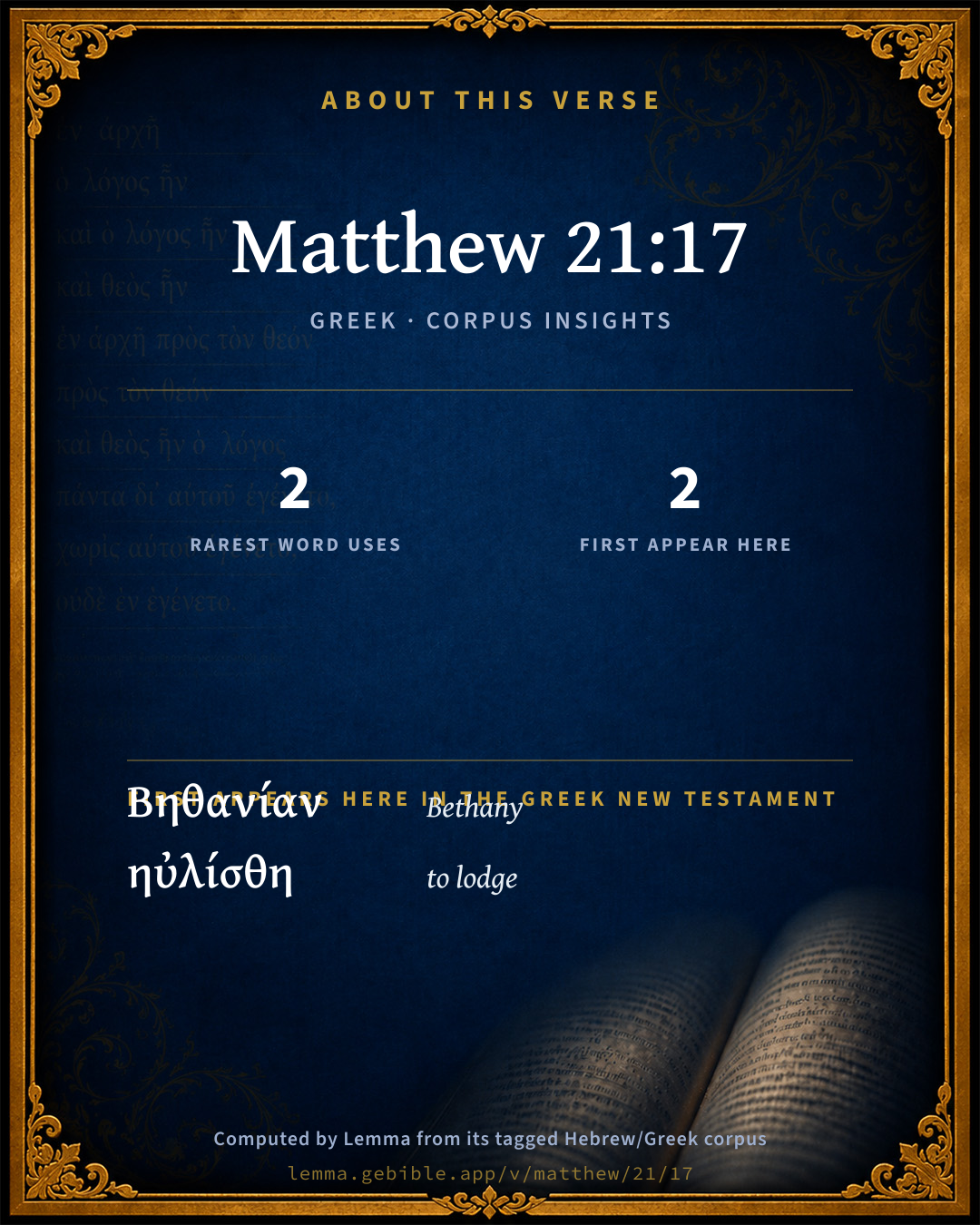
Matthew 21:17

Greek (Tischendorf 8th ed.) Matthew 21:17 appears in the Greek New Testament. The text above is from the Tischendorf 8th edition. Each word links to its Strong’s number and a concise gloss. Click any word for its full Thayer’s Greek Lexicon entry.

Download image
Cite this verse

Matthew 21:17 (World English Bible). Public Domain. Lemma interlinear Bible study tool, https://lemma.gebible.app/v/matthew/21/17.

Show BibTeX & RIS
BibTeX
RIS
English Translation
He left them, and went out of the city to Bethany, and lodged there.
World English Bible · Public Domain
Highlights
  • 2 first appearances in the Greek New Testament
Full analysis ↓
Download a study sheet

One document with this verse’s original text, its word-by-word gloss line, the meaning frame, cross-references with their text, attributed commentary, and full source and license credits — printable, and it pastes into notes with its structure intact.

This verse Autodidact and up

Study sheet (.html) Plain text (.txt)

A passage Seminary Student

Up to 50 verses in one chapter. A passage sheet keeps up to 6 commentary sources and 12 cross-references per verse, in the order this page ranks them, and says so on the sheet whenever that leaves anything out. Ask for a single verse and you get the Autodidact verse sheet above.

Everything on this page stays free to read, with no account — the sheet is a download of what is already on screen, not access to it.

Want to remove ads? Support Godless Engineer
Compare translations 3

The same verse in 3 English versions, stacked beneath the original-language interlinear above. Click any original word for its lexicon entry.

Each is an independent rendering of the whole verse — the interlinear is not word-aligned to these translations.

Highlighted words mark where these versions differ — a whole-verse word diff, not a word-by-word alignment.

  • World English Bible Public Domain
    He left them, and went out of the city to Bethany, and lodged there.
  • King James Version Public Domain
    And he left them, and went out of the city into Bethany; and he lodged there.
  • unfoldingWord Literal Text CC BY-SA 4.0
    And having left them, he went out from the city to Bethany and spent the night there.

unfoldingWord Literal Text — © unfoldingWord, licensed CC BY-SA 4.0. Word-aligned USFM3 via Door43 (git.door43.org/unfoldingWord/en_ult).

Versions to compare (up to 4)

3 of 4 selected

Show all 19 translations

Every available English version of this verse, each an independent rendering of the whole verse.

  • World English Bible Public Domain
    He left them, and went out of the city to Bethany, and lodged there.
  • Berean Standard Bible Public Domain
    Then He left them and went out of the city to Bethany, where He spent the night.
  • Majority Standard Bible Public Domain
    Then He left them and went out of the city to Bethany, where He spent the night.
  • King James Version Public Domain
    And he left them, and went out of the city into Bethany; and he lodged there.
  • American Standard Version (1901) Public Domain
    And he left them, and went forth out of the city to Bethany, and lodged there.
  • Revised Version (1885) Public Domain
    And he left them, and went forth out of the city to Bethany, and lodged there.
  • Geneva Bible (1599) Public Domain
    So hee left them, and went out of the citie vnto Bethania, and lodged there.
  • Douay-Rheims (1899) Public Domain
    And leaving them, he went out of the city into Bethania, and remained there.
  • Young's Literal Translation Public Domain
    And having left them, he went forth out of the city to Bethany, and did lodge there,
  • Literal Standard Version CC BY-SA 4.0
    And having left them, He went forth out of the city to Bethany, and lodged there,
  • Unlocked Literal Bible CC BY-SA 4.0
    Then Jesus left them and went out of the city to Bethany and spent the night there.
  • unfoldingWord Literal Text CC BY-SA 4.0
    And having left them, he went out from the city to Bethany and spent the night there.
  • Darby Bible Public Domain
    And leaving them he went forth out of the city to Bethany, and there he passed the night.
  • World Messianic Bible Public Domain
    He left them and went out of the city to Bethany, and camped there.
  • Webster's Bible Public Domain
    And he left them, and went out of the city into Bethany, and he lodged there.
  • Free Bible Version CC BY-SA 4.0
    Jesus left them and went out of the city to stay at Bethany.
  • Bible in Basic English Public Domain
    And he went away from them, and went out of the town to Bethany, and was there for the night.
  • Text-Critical English NT CC BY 4.0
    And leaving them, he went out of the city to Bethany and spent the night there.
  • Tyndale New Testament (1534) Public Domain
    And he lefte the and wet out of the cite vnto Bethanie and had his abydige there.

Literal Standard Version (2020), Covenant Press — licensed CC BY-SA 4.0. Text via the HelloAO Bible API (eBible.org). Unlocked Literal Bible (unfoldingWord) — licensed CC BY-SA 4.0. Text via the HelloAO Bible API (eBible.org). unfoldingWord Literal Text — © unfoldingWord, licensed CC BY-SA 4.0. Word-aligned USFM3 via Door43 (git.door43.org/unfoldingWord/en_ult). Free Bible Version, Dr. Jonathan Gallagher — licensed CC BY-SA 4.0. Text via the HelloAO Bible API (eBible.org).

Word by word

More ways to search: Search by grammar → Find every occurrence → Compare this word →

Practice this passage: Drill this verse → Learn its vocabulary →

ηὐλίσθη
aulízomai
G835
“to lodge”
Verb, Aorist, Passive deponent, Indicative, 3rd person, Singular
Part of Speech
Verb
Tense
Aorist
Voice
Passive deponent
Mood
Indicative
Person
3rd person
Number
Singular
Full Thayer's Definition

Origin: middle voice from G833

TDNT: None

1. to lodge in the court-yard, esp. at night a. of flocks and shepherds 2. to pass the night in the open air 3. to pass the night, lodge
  1. καὶ kaí G2532 “and” Conjunction
  2. καταλιπὼν kataleípō G2641 “to leave behind” Verb, Aorist, Active, Participle, Nominative, Singular, Masculine
  3. αὐτοὺς autós G846 “he” Personal pronoun, Accusative, Plural, Masculine
  4. ἐξῆλθεν exérchomai G1831 “to come forth” Verb, Aorist, Active, Indicative, 3rd person, Singular
  5. ἔξω éxō G1854 “outside” Adverb
  6. τῆς ho G3588 “the” Article, Genitive, Singular, Feminine
  7. πόλεως pólis G4172 “city” Noun, Genitive, Singular, Feminine
  8. εἰς eis G1519 “into” Preposition
  9. Βηθανίαν Bēthanía G963 “Bethany” Noun, Accusative, Singular, Feminine
  10. καὶ kaí G2532 “and” Conjunction
  11. ἐκεῖ ekeî G1563 “there” Adverb

About this verse

These counts appear in no published source. They are computed here, from the morphology-tagged text and Lemma’s own curated glosses. What Lemma adds →

12
words
11
distinct lemmas
Gospels
section

Notable vocabulary

The rarest word here is ηὐλίσθη to lodge G835 — appearing just 2 times in the whole Greek New Testament.

First appearance in Scripture

These words make their first canonical appearance in the Greek New Testament here:

  • Βηθανίαν Bethany G963
  • ηὐλίσθη to lodge G835

Shared distinctive vocabulary

ηὐλίσθη to lodge G835 occurs in 2 verses of the Greek New Testament. Also found in:

Repetition

A word recurs within this verse:

Cross-references

15

Topical passages linked to Matthew 21:17 in the Treasury of Scripture Knowledge — connected by theme and wording, ordered by reader-vote popularity; previews shown in the World English Bible.

  • John 11:18 Now Bethany was near Jerusalem, about fifteen stadia away.
  • Mark 11:11 Jesus entered into the temple in Jerusalem. When he had looked around at everything, it being now evening, he went out to Bethany with the twelve.
  • Luke 24:50 He led them out as far as Bethany, and he lifted up his hands, and blessed them.
  • John 11:1 Now a certain man was sick, Lazarus from Bethany, of the village of Mary and her sister, Martha.
  • Matthew 16:4 An evil and adulterous generation seeks after a sign, and there will be no sign given to it, except the sign of the prophet Jonah." He left them, and departed.
  • Mark 11:19 When evening came, he went out of the city.
  • Matthew 26:6 Now when Jesus was in Bethany, in the house of Simon the leper,
  • Mark 3:7 Jesus withdrew to the sea with his disciples, and a great multitude followed him from Galilee, from Judea,
  • Mark 11:1 When they drew near to Jerusalem, to Bethsphage and Bethany, at the Mount of Olives, he sent two of his disciples,
  • Luke 8:37–38 All the people of the surrounding country of the Gadarenes asked him to depart from them, for they were very much afraid. He entered into the boat, and returned.
  • Luke 10:38 It happened as they went on their way, he entered into a certain village, and a certain woman named Martha received him into her house.
  • Luke 19:29 It happened, when he drew near to Bethsphage and Bethany, at the mountain that is called Olivet, he sent two of his disciples,
  • John 12:1–3 Then six days before the Passover, Jesus came to Bethany, where Lazarus was, who had been dead, whom he raised from the dead.
  • Jeremiah 6:8 Be instructed, Jerusalem, lest my soul be alienated from you; lest I make you a desolation, a land not inhabited.
  • Hosea 9:12 Though they bring up their children, Yet I will bereave them, so that not a man shall be left. Indeed, woe also to them when I depart from them!

Cross-references courtesy of OpenBible.info (CC BY 4.0).

Commentary

Notes on Matthew 21:17 from classic Christian and Jewish commentators (each source and its license shown beneath its notes). The classic Christian expositions comment on the surrounding passage and are grouped to its opening verse, so a note may address several verses; the Jewish commentaries on the Tanakh (Rashi and others) are per-verse, so they appear only where the commentator wrote on this verse.

Lemma curates 59 commentaries, every one of them public domain or Creative Commons licensed, each selected and text-cleaned for this edition rather than reprinted as found. About our sources →

The Biblical Illustrator

Joseph S. Exell

Mat_21:17

And he lodged there.

The value of domestic happiness

Domestic life like all other external goods, is not necessarily, and of itself, but only under certain conditions, in particular circumstances, a real advantage, and a source of true felicity. Only there where wisdom and virtue dwell, where intelligent well-meaning persons live together, only there dwell peace, satisfaction, and joy. Wherever domestic happiness is found, it shows us persons who are connected together by real, intrinsic love and friendship, who live entirely by each other, and who seek their happiness, their honour, and their force, in the mutual union of their hearts. Domestic happiness supposes a taste for truth, for nature, for graceful simplicity, for serene repose, as they are in contrast with error and art, studied and forced pleasures, and the more ostentatious and poignant diversions.

1. The comfort of domestic life is the most agreeable relief from the burden and heat of the day and its frequently tiresome business.

2. The happiness of domestic life is quiet, peaceful self-enjoyment; a self-enjoyment that is multiplied and ennobled by the intimate participation in all the concernments of this trusty society.

3. The happiness of domestic life is the delightful, free, and intimate association between harmonious and mutually loving souls.

4. The happiness of domestic life is inexhaustible. It renews itself daily, it multiplies itself without end.

5. The happiness of domestic life compensates the want of any other; but no other can compensate the want of that.

6. The enjoyment of domestic happiness is always not less edifying and useful than pleasant.

7. To the enjoyment of domestic happiness, no troublesome, no expensive preparatory provisions and arrangements are needful.

8. The enjoyment of it is never attended by satiety or disgust, by sorrow or remorse.

9. The happiness of domestic life is restricted to no class of men. It is attached neither to station, nor to opulence, nor to elevation and power; confined neither to the palace nor to the cottage. (C. J. Zollikofer.)

The delights of home

If you would enjoy pleasure, innocent, pure, daily-renewing, never disgracing, never cloying; delights worthy of the man and the Christian, seek them not at a distance from you, since they lie at home; seek them not in things which are not in your power; but in what is more your own; seek them in the happiness of domestic life. If you may venture to expect them anywhere, it is certainly there they must be found! (C. J. Zollikofer.)

Mat_21:17-21

And when he saw a fig-tree in the way, He came to it, and found nothing thereon.

The barren fig-tree

I. The destruction of this tree was not an act of injustice. People find it difficult to understand the propriety of punishing an inanimate object for defects which are only possible in higher existences. They argue that, since the fig-tree did not possess freewill, but was simply obeying the law of its kind, our Lords act was capricious. But observe-

1. The supposed force of this objection is due to our treating a metaphorical expression as if it were the language of reality. We speak of doing justice to a picture, when we mean justice to the artist who painted it. The picture itself cannot possibly be treated justly or unjustly, although we may form a true or a false estimate of its merits. Justice and injustice pre-suppose rights to be respected or violated; and rights belong only to a person. In the vegetable world there is no such thing as personality: and no such thing as rights. To talk, therefore, of injustice in blasting or cutting down a tree, is good English if we are in the realms of poetry, but nonsense if in those of moral truth. The tree is there to be made the most of by man. No one has yet maintained that in using it to furnish our houses, or-brighten our hearths, we sin against any law of natural justice. Surely, then, if by its sudden destruction the tree can do more, much more, than minister to our bodily comfort-if in its way it can be made to teach us a moral lesson of the first importance-there is no room for any question of injustice. What is merely material must always be subordinated to the moral and spiritual; and if a tree can be made, by its destruction, to illustrate a moral or spiritual truth, a high honour is put upon it, a noble work given it to do.

II. There was no unusual severity in this act. The truest mercy always sacrifices the lower to the higher. It is not more cruel to destroy a plant in order to teach a great moral truth, than to destroy a plant in order to eat it. If by its destruction the plant does our soul a service there is quite as good a reason for putting it to some sort of distress, in the process of destroying it, as there is if it is wanted to support our bodies. (Canon Liddon.)

Parabolic and prophetic elements in the destruction of the fig-tree

This incident is, from first to last, an acted parable. It would, perhaps, be truer to say, that it is an acted prophecy. In the East action was, and still is, often a more vivid and effective way of communicating truth than language. When a prophet of Israel sat in sackcloth, with dust on his head, by the side of the road along which the royal chariot would pass, his action was a much more powerful rebuke to the monarch for neglect of duty than a sermon would have been-even though it had an introduction, three arguments, and a conclusion. The East as I have said, is traditionally the home of eloquent action; but in all countries and ages-human action is a kind of human language, and it is often much more impressive than words which fall upon the ear. In our intercourse with each other, and in our worship of God, action expresses thought and feeling in a condensed way which often could only be put into very cumbrous and awkward language; and our Lord on this occasion was teaching-teaching in the main by action. He was acting a parable, and no objection can be urged against His action to which teaching by parable-that is to say, by putting forward an imaginary story as if it were literally true-is not always open. What, then, was the lesson which on this occasion He desired to teach? Was it simply the shame and guilt in every responsible creature of Gods hand, of moral unfruitfulness? Did He cause the tree to wither because it was the symbol of nations and of men who do nothing for His glory and nothing for their fellows? That He does punish such unfruitfulness is certain: but this is not the lesson He would teach us here. The time of figs was not yet. To use figurative language, the tree did net sin by not producing figs at a time of the year when they could only have been produced in the open air by what we call a freak of nature, or, rather, in despite of her ordinary rules. The tree was a symbol of that which, in man, is worse sin than a merely fruitless life. It had leaves, you will observe, though it had no fruit. That was the distinction of this particular tree among its fellows ranged along the road, with their bare, leafless, unpromising branches. They held out hopes of nothing beyond what met the eye. This tree, with its abundant leaves, gave promise of fruit that might be well-nigh ripe; and thus it was a symbol of moral or of religious pretentiousness. Not simply as unfruitful, but because, being unfruitful, it was covered with leaves, it was a fitting symbol of that want of correspondence between profession and practice-between claims and reality-between the surface appearances of life and its real direction and purpose-which our Lord condemned so often and so sternly in the men of His time. And, as representing this, it was condemned too. (Canon Liddon.)

Application of this acted parable

I. The fig-tree represented immediately, we cannot doubt, in our Lords intention. The actual state of the Jewish people. The heathen nations, judged from a Divine point of view, were barren enough. Israel was barren also, but then Israel was also pretentious and false. Israel was covered with leaves. The letter of the law-the memories, the sepulchres of the prophets-the ancient sacrifices-the accredited teachers-all were in high consideration. Israel was, to all appearance, profoundly religious. But the searching eye of our Lord found no fruit upon this tree beneath the leaves-no true soul-controlling belief even in the promises of the Messiah, of which they made so much-no true sense of their obligation and of their incapacity to please God. The tree by the roadside was a visible symbol of the moral condition of Israel as it presented itself to the eye of Christ, and there was no longer any reason for suspending the judgment which had been foretold in the Saviours parable: No man eat fruit of thee hereafter for ever. If humanity needed light, strength, peace, consolations, Israel could no longer give them. Israel was hereafter to be a blasted and withered tree on the wayside of history.

II. The parable applies with equal force TO nations or to churches in Christendom which make great pretensions and do little or nothing of real value to mankind. For a time the tree waves its leaves in the wind. It lives on, sustained by the traditional habits and reverence of ages. Men admire the symbol of so many blessings-of so much activity and life. There is nothing to raise a question as to the true state of the case. But, at His own time, Christ passes along the highway-passes to inquire and to judge: some unforeseen calamity, some public anxiety, some shock to general confidence, lifts the leaves of that tree and discovers its real fruitlessnes.

III. To every individual Christian this parable is full of warning. The religious activity of the human soul may be divided, roughly, into leaves and fruit-showy forms of religious activity and interest on the one side, and the direct produce of religious conviction on the other. It is much easier to grow leaves than to grow fruit; and many a mans life veils the absence of fruit by the abundance of leaves. To take an interest in religious questions and discussions is better than to be totally indifferent to them; but mere acquaintance with, and interest in, such proves nothing as to the condition of the conscience-the real tenor of the heart-the deepest movements of the inmost life-the souls state before God and its prospects for eternity. An anxious question for all is, whether the foliage of our Christian life is the covering of fruit beneath that is ripening for heaven, or only a thing of precocious and unnatural growth which has drained away the trees best sap before its time, and made good fruit almost impossible. No show of leaves, no fervour of language, no glow of feeling, no splendour of outward achievements for Christs cause and kingdom, will compensate, in His sight, for the absence of the fruits of the spirit. (Canon Liddon.)

Promise and performance

This parable from history teaches us the worthlessness of religious promises that are never fulfilled, and the guilt of appearing to be fruit-bearers when the eye of God sees nothing but leaves. There is no sin in promises. Cherry-trees must issue their white and fragrant promissory-notes in May, or there would be no payment in delicious fruit at the end of the allotted sixty days. God makes precious promises to us; and a converted heart is only in the line of duty when it makes a solemn promise or covenant to the church and its head, Christ Jesus. There is no sin in a church-covenant honestly made. The sin is in breaking it. How full of leaves was the plausible fig-tree on the way to Bethany! How profuse of promises is many a young professor as he stands up laden with the foliage on which the dew-drops of hope are glistening! How much his pastor expects from him. He makes no reserve when he covenants to consecrate himself, all that he is, and all that he has, to the service of his Redeemer. For a time the glossy leaves of profession make a fair show. But when the novelty of the new position has worn off, and the times of reaction come, then the yoke begins to gall the conscience, and every religious duty becomes an irksome drudgery. The cross loses its charm; prayer loses its power; the Word of God ceases to attract; the very name of Jesus no longer possesses a charm; and church-membership has become a hateful mask, which its owner is ashamed to wear, and yet afraid to fling away. Before the world the fig-tree still bears leaves; but beneath them is utter barrenness. (T. L. Cuyler, D. D.)

Cursing of the fruitless fig-tree

I. The doom of things which do not meet the wants of the time.

II. The terrific prospect of meeting a disappointed Christ.

III. The perfect dominion of the spiritual over the material.

IV. The vast possibilities of undoubting prayer. (J. Parker, D. D.)

The fig-tree cursed

I. The fig-tree flourishing.

1. Its nature, not a common thistle, from which men do not think to gather figs (Mat_7:16). But a fruit-bearing tree.

2. Its situation. By the wayside, provoking attention, and inviting inspection. Such human trees are often more anxious to be noticed than the really fruitful.

3. Its appearance. Covered with leaves. Therefore (Mat_21:19) fruit might be reasonably expected. It made a fair show and a bold promise. Do we in any wise resemble this tree?

II. The fig-tree examined.

1. The Lord was hungry-He needed fruit. He needs our fruitfulness.

2. It was seasonable as respects the tree. It outrivalled and surpassed the rest in forwardness-its time of figs had come.

3. It was carefully conducted; not a casual and distant glance. He knew without going, but went to show His care and awaken thought.

III. The fig-tree withered.

1. Its leaves did not save it. Profession without reality there may be; but there will not long be reality without profession.

2. The Lord cursed it to show how hypocrisy deserves to be treated. By such the world is apt to be deceived, touching the nature of religion. Many have the form of godliness who deny the power. Their end is nigh.

3. Those who persevere in hypocrisy may be bereft of the power of producing fruit. Hypocritical and perfunctory habits destroy this power. Thus spiritual life withers away.

Learn:-

1. To be thankful that we are fruit-trees, not thistles.

2. To be anxious to be fruitful fruit-trees (Gal_5:22; Eph_5:9).

3. It is time for fruit directly the leaves begin to spring. With us now. (J. C. Gray.)

Self-forgetfulness of Christ

Our Lords work lay chiefly in the city; thither, therefore, He repairs betimes, and forgot, for haste, to take His breakfast, as it may seem, for ere He came to the city He was hungry, though it was but a step thither. A good mans heart is where his calling is: such an one when he, is visiting friends or so, is like a fish in the air; whereunto if it leap for recreation or necessity, yet it soon returns to its own element. (John Trapp.)

A fruitful profession

It is said of Rev. Dr. Franklin that he had a passion for fruitfulness. His signet-ring had, for a device, a fruit-bearing tree, with the motto from Psa_1:3. And when near his end, being asked by his son and pastoral successor for some word of condensed wisdom to be treasured up as a remembrance and a prompter, he breathed into his ear the word, Fruitful.

The hunger of Christ

Thou, that givest food to all things living, art Thyself hungry. Martha, Mary, and Lazarus, kept not so poor a house but that Thou mightest have eaten something at Bethany. Whether Thy haste outran Thine appetite, or whether on purpose Thou forbearest repast, to give opportunity to Thine ensuing miracle, I neither ask nor resolve. This was not the first time that Thou wast hungry. As Thou wouldst be a man, so Thou wouldst suffer those infirmities that belong to humanity. Thou earnest to be our High Priest; it was Thy act and intention, not only to intercede for Thy people, but to transfer unto Thyself, as their sins, so their weaknesses and complaints. But what shall we say to this Thine early hunger? The morning, as it is privileged from excess, so from need; the stomach is not wont to rise with the body. Surely, as Thy occasions were, no season was exempted from Thy want. Thou hadst spent the day before in the holy labour of Thy reformation: after a supperless departure, Thou spentest the night in prayer: no meal refreshed Thy toil. What do we think much, to forbear a morsel, or to break a sleep for Thee, who didst thus neglect Thyself for us? (Bishop Hall.)

Withering of the fruitless fig-tree

I. The occurrence which the evangelist describes.

1. The Saviours hunger.

2. The disappointment He met with.

3. The doom He pronounced.

II. The comment made upon it by the disciples. How soon is the fig-tree withered away, etc.

1. When this exclamation was uttered.

2. The feeling with which it was uttered.

III. The reply which this remark called forth from our Lord.

1. A wonderful assertion. If ye have faith, etc.

2. An encouraging promise. And all things whatsoever ye shall ask in prayer, etc. (Expository Outlines.)

Profession

It is no good sign when all the sap goes up the leaves, and is spent that way; nor in a Christian, when all his grace shoots up into woods, a verbal goodness; no reality at all. (Adams.)

Profession

When the Interpreter had done, he takes them out into his garden again, and led them to a tree, whose inside was all rotten and gone, and yet it grew and had leaves. Then said Mercy, What means this? This tree, said he, whose outside is fair, and whose inside is rotten, is it to which many may be compared that are in the garden of God; who with their mouths speak high in behalf of God, but in deed will do nothing for Him; whose leaves are fair, but their heart good for nothing but to be tinder to the devils tinder-box. (Bunyan.)

Profession

Our profession without practice is but hypocritical, making us resemble the stony ground which brought forth a green blade, but no fruit to due maturity; like the fig-tree, which, having leaves but no figs, was accursed; like the tree in the garden, which cumbering the ground with its fruitless presence, was threatened to be cut down; like glow-worms, which have some lustre but no heat-seeing such professors shine with some light of knowledge, but without all warmth of Christian charity. (Downame.)

The Biblical Illustrator, edited by Joseph S. Exell (c. 1880s–1900s) — public domain. Text from a community e-Sword module.

Kretzmann's Popular Commentary

Paul E. Kretzmann

The Cursing of the Fig-Tree. Mat 21:17-22

v. 17. And He left them, and went out of the city into Bethany; and He lodged there.

v. 18. Now in the morning, as He returned into the city, He hungered.

v. 19. And when He saw a fig-tree in the way, He came to it, and found nothing thereon but leaves only, and said unto it. Let no fruit grow on thee hence forward forever. And presently the fig-tree withered away.

Matthew here combines the story of two morning journeys from Bethany, for the sake of the emphasis upon the whole. So far as the enemies were concerned, they were silenced by the quotation of Jesus, they had nothing more to say openly. And the Lord was permitted to go unhindered back and forth between Jerusalem and Bethany. It was on Monday morning that Jesus was hungry on the trip of about two miles to the capital. A fig-tree, standing by itself, in full foliage, suggested fruit to eat. But when He stepped up to it, He found nothing upon it but leaves only. The incident suggested the possibility of a lesson to Jesus. He might be able to bring to the understanding of His disciples the antitype of this fig-tree, the high priests and the scribes in their unbelieving conduct, yea, the whole Jewish nation. And Jesus had also a second lesson in mind, which He imparted to His disciples directly. At His curse the fig-tree at once withered away from the roots up. Apparently, the disciples did not take special note of the fact at this time. They went on to Jerusalem with the Lord, who in His zeal for His work had not even taken time to eat breakfast at Bethany.

Paul E. Kretzmann, Popular Commentary of the Bible (1921–1924) — public domain. Text from a community e-Sword module.

Bengel's Gnomon

Johann Albrecht Bengel

Mat 21:17. Αὐτοὺς, them) Whose perversity has just been mentioned.

Bengel's Gnomon of the New Testament — English translation (T&T Clark, Edinburgh, 1860) — public domain. Text from a community e-Sword module.

Expositor's Greek Testament

ed. W. Robertson Nicoll

Mat 21:17 . Βηθανίαν , Bethany, 15 stadia from Jerusalem (Joh 11:18 ), resting place of Jesus in the Passion week true friends there ( vide Stanley, S. and P.). ηὐλίσθη , passed the night; surely not in the open air, as Wetstein and Grotius think. At passover time quarters could not easily be got in the city, but the house of Martha and Mary would be open to Jesus ( cf. Luk 21:37 ).

The Expositor's Greek Testament, edited by W. Robertson Nicoll (1897–1910) — public domain. Text from a community e-Sword module.

Geneva Bible (1599)

Geneva Bible translators

Christ doth so forsake the wicked, that yet he hath a consideration and regard of his Church.

Geneva Bible (1599) marginal notes — public domain. Text via Bolls.life.

Adam Clarke's Commentary

Verse 17. And he left them (καταλιπων, finally leaving them) and went - into Bethany; and he lodged there.] Bethany was a village about two miles distant from Jerusalem, by Mount Olivet, Joh 11:18; and it is remarkable that from this day till his death, which happened about six days after, he spent not one night in Jerusalem, but went every evening to Bethany, and returned to the city each morning. See Lu 21:37; Lu 22:39; Joh 8:1-2. They were about to murder the Lord of glory; and the true light, which they had rejected, is now departing from them.

Lodged there.] Not merely to avoid the snares laid for him by those bad men, but to take away all suspicion of his affecting the regal power. To the end of this verse is added by the Saxon, [Anglo-Saxon]. And taught them of the kingdom of God. This same reading is found in some MSS., Missals, and one copy of the Itala. It appears also in Wickliff, and my old folio English MS. Bible, and taugt hem of the kyngdom of God; and in two MS. copies of the Vulgate, in my possession: one, duodecimo, very fairly written, in 1300; the other a large folio, probably written in the 11th or 12th century, in which the words are, IBIQUE docebat eos de regno Dei. AND THERE he taught them concerning the kingdom of God.

Adam Clarke's Commentary on the Bible (1810–1826) — public domain. Text from a community e-Sword/MySword module.

Ellicott's Commentary for English Readers

(17) And went out of the city into Bethany.—St. Mark, as already noticed, places the incident that follows on the morning that followed the triumphal entry, and before the cleansing. We have to choose, there being an obvious error of arrangement in one or other of the narratives, between the two, and the probability seems on the whole in favour of the more precise and more vivid record of St. Mark. The lodging at Bethany is explained partly by what we read in Mat_26:6-13, yet more by Joh_11:1-2; Joh_12:1. There He found in the house of the friends who were dear to Him the rest and peace which He could not find in the crowded city. The suppression of the name of those friends in the first three Gospels is every way significant, as suggesting that there were reasons which for a time (probably till the death of Lazarus) led all writers of the records which served as the basis of the Gospel history to abstain from the mention of any facts that might attract attention to them.

A Bible Commentary for English Readers, edited by Charles John Ellicott (1878–1897) — public domain. Text from a community e-Sword module.

The Cambridge Bible for Schools and Colleges

gen. ed. J. J. S. Perowne

17. Bethany] “House of dates,” or, according to Caspari, “Place of shops, or merchant tents,” on the S.E. of the Mount of Olives, see note Mat_21:9. Here Jesus lodged with Lazarus and his sisters.

The Cambridge Bible for Schools and Colleges (gen. ed. J. J. S. Perowne; Cambridge University Press, 1878–1918) — public domain. Text from a community e-Sword module.

John Gill's Exposition

And he left them,.... The high priests and Scribes, confounded and put to silence, and as unworthy of his company and conversation;

and went out of the city; of Jerusalem, partly to prevent being apprehended by his enemies before his time, and partly to remove all suspicion of seizing the city and government, and setting himself up as a temporal prince;

to Bethany; which was about fifteen furlongs from Jerusalem, or almost two miles, Joh 11:18. Hither he went to converse with his dear friends, Lazarus, and Martha, and Mary, who were all of this place, and where he could lodge and rest quietly. The name of the town is variously interpreted: according to some ancient writers (m), it signifies "the house of obedience"; so Christ went from the disobedient and faithless city, to a place of obedience, where he had some faithful and obedient disciples: others read it, and so Munster's Hebrew Gospel, , "the house of affliction"; a suitable place for Christ to go to, who was about to suffer for the sins of his people. The Syriac version renders it , and which is interpreted "an house", or "place of business", as this town of Bethany was. We read (n) of , "the shops of Bethany", which were destroyed three years before Jerusalem, because they made their affairs to stand upon the words of the law; that is, as the gloss explains it, they found that what was forbidden by the wise men, was free by the law: a great trade might be drove here for olives, dates, and figs, which grew hereabout in great plenty: mention is made in the Talmud of (o) , "the figs of Bethany": hence, as Christ departed from this place, the next morning he saw a fig tree. But the true etymology and signification of the name is "the house", or "place of dates", the fruit of the palm tree: hence they that came from Jerusalem to meet Christ, might have their palm tree branches. One part of Mount Olivet abounded with olives, from whence it had its name; another part bore palm trees, and that was called "Bethany", from whence this town over against it had its name; and another part had great plenty of fig trees growing on it, and this called "Bethphage"; and that part of Jerusalem which was nearest to it went by the same name. We read (p) also of , "the washing place of Bethany"; which seems to me to be not a place for the washing and purification of unclean men and women, as Dr. Lightfoot thinks, but for washing of sheep; for the story is, that

"a fox tore a sheep in pieces at the washing place of Bethany, and the affair came before the wise men;''

that is, at Jerusalem, to know whether that sheep might be eaten or no, since that which was torn was forbidden. And some have interpreted "Bethany, an house", or "place of sheep": but so much for this town, and what account is given of it.

And he lodged there; either in the house of Lazarus, and his two sisters, or in that of Simon the leper; for it was eventide when he went out of Jerusalem, as Mark observes. The Ethiopic version adds, "and rested there"; and so Origen (q) reads it; and, according to Harpocratian (r), the word used by the evangelist signifies to lie down, and sleep, and take one's rest. Christ lodged here all night.

(m) Jerom. in loc. Origen. in Joan. p. 131. T. 2. & in Matt. p. 435, 446, 447. T. 1. Ed. Huet. (n) T. Bab. Bava Metzia, fol. 88. 1. (o) T. Bab. Pesachim, fol. 53. 1. & Erubin, fol. 28. (p) T. Bab. Cholin, fol. 53. 1. (q) In Matt. p. 447. (r) Lexic. Decem Orator. p. 55.

John Gill's Exposition of the Whole Bible (1746–1763) — public domain (CC PDM 1.0). Text via the HelloAO Bible API.

Trapp's Complete Commentary

John Trapp

17 And he left them, and went out of the city into Bethany; and he lodged there.

Ver. 17. And he left them] As not willing to lose his labour, to cast away his cost upon men so unthankful, untractable.

Ludit, qui sterili semina mandat humo. (Ovid.)

Went out of the city into Bethany] Haply for safety’ sake: undoubtedly for his delight and to refresh himself with his friend Lazarus, after his hard labour and little success.

John Trapp, A Commentary or Exposition upon All the Books of the Old and New Testament (1647–1656) — public domain. Text from a community e-Sword module.

Haydock's Catholic Bible Commentary

And having viewed all about; (as we read in St. Mark xi. 11,) when the hour of evening was come, he went out of the city into Bethania, as usual, with the 12 apostles. Hence we may collect in how great poverty our Saviour lived, and how far he was from flattering the great ones of this world, since he could not find a friend to offer him his house for a night’s repose, and to ease his fatigued members, but is obliged to go to Bethania, a small village, to the house of Martha and Mary. (St. Jerome)

George Leo Haydock (1774–1849), Haydock's Catholic Family Bible and Commentary, 1859 edition — public domain. Excludes Psalms (Douay-Rheims chapter numbering differs from Protestant) and Deuterocanonical books (Catholic canon only).

Matthew Poole's English Annotations

Luke hath nothing of this passage, but Mark relates it with some variation and additions: the variation is only as to time, as to which the evangelists were not curious. Matthew relates this miracle as done in the morning of the second day, as Christ and his disciples returned from Bethany; so doth Mar 11:12; but Matthew speaks as if the disciples discerned it presently withered; Mark mentions it as not discerned to be withered till the next morning, Mar 11:20. Mark saith, Mar 11:13, for the time of figs was not yet; which breeds a difficulty, why our Saviour should curse the fig tree for having no fruit, when the time for its fruit was not come (of which more by and by). Mark saith, Mar 11:21,22, that Peter calling to remembrance his Master’s cursing the fig tree, saith unto him, Master, behold, the fig tree which thou cursedst is withered away. And Jesus answering saith unto them, Have faith in God. Then repeats the substance of what Matthew hath in Mat 21:21,22; to which Mark addeth, Mar 11:25,26, And when ye stand praying, forgive, if ye have ought against any: that your Father also which is in heaven may forgive you your trespasses. But if ye do not forgive, neither will your Father which is in heaven forgive you your trespasses. When our Lord had been in the temple, and driven out the buyers and sellers there, he went out of the city to be at Bethany, either to avoid the noises of the city, (now very full of people, the passover being so nigh), or to get a more private place for prayer. He returns the next morning; and being hungry, and seeing a fig tree in his way, he goes to it, finds it full of leaves, but no fruit on it. He saith unto it, Never fruit grow on thee more. Mark saith, For the time of figs was not yet. Why then doth our Saviour curse this tree? Some think that by time is here meant season (as indeed the Greek word often signifieth); these would have the meaning to be, for it was not a seasonable year for figs. But this rather augments than abates the difficulty, for why should our Saviour curse it for having no figs, when the year was such as was not seasonable? Others therefore think that οὐ should be οὗ, then the English would be, Where he was was a time of figs. For this it is said;

1. That the Greek spirits and accents were ordinarily left out in ancient copies, which if they be taken away the words are the same.

2. That this was according to truth, for it was a time of green figs, at least; it being near Jerusalem, and but three or four days before the passover, about which time they reaped their corn, as appears from Lev 23:10; Deu 16:9; and it is plain from Son 2:13, that in the beginning of their spring their fig trees put forth green figs.

But when I consider that none of the ancient translations are according to this criticism, but as our translations, I conclude that the ancients understood it οὐ, not οὗ, and it seemeth too bold to interpret the words contrary to their unanimous sense. Others therefore tell us, that fig trees, or at least some kind of them, (like orange trees), had leaves and fruit upon them always, some green, some half ripe, some full ripe; and that these kept on their leaves all the winter: so that our Saviour seeing leaves, might be led to it with an expectation of some fruit put forth the former year, for the time for the ripening of fruit of that kind that year was not come; and finding none, he cursed it; thereby in a type showing what should be done to barren souls, who have only leaves, no true fruit of righteousness. Or what if we should say, that he did not curse it with any respect to its want of fruit, but only to show his Divine power, working a miracle?

And presently the fig tree withered away: as soon as our Saviour had cursed it, it began to wither. Mark tells us this was the next morning, Mar 11:20, which made Peter say, Master, behold, the fig tree which thou cursedst is withered away. Matthew saith, When the disciples saw it, they marvelled, saying, How soon is the fig tree withered away! Upon this our Saviour telleth Peter and the rest, that if they had faith, and doubted not, they should not only do that which he had done to the fig tree, but if they said to that mountain, Be removed and cast into the sea, it should be done. This is interpreted by Mat 21:22,

All things, whatsoever ye shall ask in prayer believing, ye shall receive. We met with the like expression before, Mat 17:20. Mark hath the same, Mar 11:23. Luke hath it, Luk 17:6. It is an expression which ought not to be strained further than to signify, that there is nothing conducive to the glory of God and our own good, but believers may receive at the hand of God, if they can believe without doubting that what they would have shall come to pass. I see no reason to discourse of a faith of miracles as different from other faith; which only thus differed, that the disciples (the apostles I mean) had a power given them, and a promise made to them, that they should be able to work miraculous operations, which is not given to other Christians serving only the particular occasions of that time, to give credit to the gospel. The general proposition is true, and shall be made good to every believer, That whatsoever good is made the matter of a promise, (such are all good things), shall be given to believing souls, praying for them. But there were of old special promises, not made to the people of God in general, but to particular persons, for particular ends; we cannot expect to do or obtain such things now. Nothing is too big for true faith to obtain, but that faith must have a promise to lean upon, and it must be showed by prayer, as Mat 21:22. Mark adds, that it must be also attended with charity, a charitable heart, ready to forgive, and actually forgiving, our brethren their trespasses. But it is no more than we met with in Matthew, Mat 6:14,15, where we opened the sense of those words.

Matthew Poole's English Annotations on the Holy Bible (1683–1685) — public domain. Text from a community e-Sword/MySword module.

Whedon's Commentary on the Bible

Daniel D. Whedon

17. Out of the city into Bethany — The labors of this Sunday (the first day of the Passion Week) were now closed, and Jesus (as we are also told in Mar_11:11) left the city of his treacherous enemies for the night, and lodged with his friends at Bethany. Thus did Jesus by boldly defying the rulers, under popular favour, by day, and retreating from their jurisdiction by night, evade their machinations, and perform his ministry until his hour had come. On the morrow he returned to Jerusalem; and on the way the transaction of the following paragraph took place.

Daniel D. Whedon (gen. ed.), Commentary on the Old and New Testaments (1874–1909) — public domain. Text from a community e-Sword module.

The Pulpit Commentary

He left them. The chief priests had nothing to say in reply to this testimony of Scripture. They feared to arrest him in the face of the enthusiastic multitude; they bided their time, for the present apparently silenced. Jesus, wasting no further argument on these wilfully unbelieving people, turned and left them. The King had no home in his royal city; he sought one in lowly Bethany, where he was always sure of a welcome in the house of Martha and Mary. It is somewhat doubtful whether he availed himself of his friends" hospitality at this time. The term "Bethany" would include the district so called in the vicinity of the town, as in the description of the scene of the Ascension. (Luk_24:50) Lodged (hulisyh). This word, if its strict classical use is pressed, would imply that Jesus passed the night in the open air; but it may mean merely "lodge," or "pass the night," without any further connotation; so no certain inference can be drawn from its employment in this passage. This withdrawal of Jesus obviated all danger of a rising in his favour, which, supported by the vast resources of the temple, might have had momentous consequences at this time of popular concourse and excitement.

Vers. 17-22. The return to the temple.

I THE WALK TO AND FROM BETHANY.

1. The Sunday evening. The Lord left the temple "when he had looked round upon all things." He had no home in the royal city. He went out unto Bethany, and there he lodged, perhaps in the house of Lazarus, perhaps, as many pilgrims did, in a booth on the hillside, or under the shelter of the trees. "The Son of man hath not where to lay his head.

2. Monday. Very early the Lord returned to the city. It seems he had eaten nothing; he hungered on the way. He was poor in this world. Let us learn of him to be content in poverty and hardships.

II THE BARREN FIG TREE.

1. The curse. It stood alone, a conspicuous object. It was full of leaves. The time for figs was not yet, but this tree was singularly forward, precocious; the leaves promised early fruit, "hasty fruit before the summer". (Isa_28:4) It had none; it was barren. The Lord said, "Let no fruit grow on thee henceforward forever;" "and presently the fig tree withered away." The miracle was symbolical, an acted parable. The priests and scribes whom the Lord was about to confront were like that fig tree fair to look upon. They were held in honour, some for their official rank, some for their supposed righteousness, but they brought not forth the fruits of holiness. Such must wither when the Lord"s searching eye is fixed upon them, when he comes seeking fruit. Leaves will not take the place of fruit, outward profession will not atone for the absence of holiness of heart and life. That fig tree was a meet emblem of the hypocrite. There were other trees without fruit; but they made no show of special forwardness they were leafless still. This one tree was conspicuous for its foliage, but it had no fruit hidden beneath its leaves. The other trees might yet bring forth fruit in due time; this one had exhausted itself in leaves. Such a show of life is worthless in the sight of God; it is not life, it is only a false appearance; it may deceive men, it cannot deceive God. "I know thy works, that thou hast a name that thou livest, and art dead." Many professing Christians seem to us like that fig tree. Take we heed to ourselves. The Lord passed on, his hunger unappeased. The whole world was his, the cattle on a thousand hills; yet he hungered, for he had taken our flesh. He suffered as we suffer; he is touched with the feeling of our infirmities. He went on to Jerusalem, to the temple. Now apparently (according to the more exact order of St. Mark) took place that expulsion of unhallowed traffic, the miracles, the hosannas of the children, and the interference of the priests, which have been already related by anticipation in St. Matthew"s Gospel. "When even was come, he went out of the city.

2. The astonishment of the disciples. The words of the Lord produced an immediate effect. The life of the tree, such as it was, was at once arrested; the sap ceased to circulate, the leaves began to wither. But it seems from the more minute account in St. Mark, that the disciples did not observe the result till they passed the tree again in going to Jerusalem on the Tuesday morning. Then they marvelled, saying, "How soon is the fig tree withered away!" We wonder at their wonder. They had seen many wondrous manifestations of the Lord"s mighty power: why should they wonder now? They were still weak in faith as the nine had been when they sought in vain to cast out the evil spirit beneath the Mount of the Transfiguration. The Lord repeats the lesson which he gave them then, "Have faith in God;" doubt not. Doubt destroys the strength of prayer. He that doubteth will not receive anything of the Lord; but if we ask in steadfast, undoubting faith, then there is the blessed promise, "All things are possible to him that believeth," for the prayer of undoubting faith availeth much with God. What was done to the fig tree, the Lord said, was a small thing for faith to do; faith could do things greater far. The psalmist had sung of the Mount Zion, "It cannot be removed: it abideth forever." But the Lord said, pointing, it may be, to the mountains round Jerusalem, "If ye shall say to this mountain, Be thou removed, and be thou cast into the sea, it shall be done." Faith can remove mountains; difficulties vanish before the prayer of faith. Set the Lord"s promises before you when you pray; claim them as your own; realize them, trust in them; pray with persevering importunity, and, doubt not, you shall receive what you ask in faithful prayer. This or that sin may seem like a mountain, rooted deep in the heart, immovable; but pray against it, pray that it may be cast out; pray in faith, believing in God"s power, believing in his love, and it shall be done. It is our want of faith which makes our prayers so weak. If we fully believed that God is able and willing to cleanse us from all unrighteousness, to make us whiter than snow, we should, in our own actual lives, overcome the world, the flesh, and the devil, and be more than conquerors through him who loved us.

LESSONS.

1. Let it be our most earnest effort to be true and faithful, not to seem to be so. Hypocrisy is hateful in the sight of God.

2. Pray for a strong, undoubting faith; it is God"s most precious gift.

3. Pray always; believe in the power of prayer.

The Pulpit Commentary (1880–1919), ed. H.D.M. Spence-Jones & Joseph S. Exell — public domain. Text from a community e-Sword module.

John Wesley's Explanatory Notes

Mark xi, 11, 12.

John Wesley, Explanatory Notes Upon the Whole Bible (1754–1765) — public domain. Text via the GEBible commentary corpus.

Scofield Reference Notes

C. I. Scofield

Bethany

See, Joh 11:1; Joh 11:2; Luk 10:39-42. Cf.; Mar 11:1-11; Luk 19:29-35; Joh 12:1-8. With no other place is the human Christ so tenderly associated, while it also was the place of manifestation of His divine power. Joh 11:43; Joh 11:44.

The Scofield Reference Bible (1917 edition), notes by C. I. Scofield — public domain. Text from a community e-Sword module.

Burkitt's Expository Notes on the New Testament

William Burkitt

Our blessed Saviour having driven the buyers and sellers out of the temple, lodges not that night in Jerusalem, but withdraws to Bethany, a place of retirement from the noise and tumult of the city.

Where, note, Our Lord’s love of solitude and retiredness. How delightful it is to a good man, to dwell sometimes within himself, to take the wings of a dove, and fly away, and be at rest. Yet the next morning our Lord returns to the city: he knew when to be solitary and when to be sociable; when to be alone, and when to converse in company.

In his passage to the city, he espied a fig-tree; and being an hungry (to show the truth of his humanity) he goes to the fig-tree, and finds it full of leaves, but without any fruit. Displeased with this disappointment, he curses the tree which had deceived his expectations. This action of our Saviour, in cursing the barren fig-tree was typical; an emblem of the destruction of Jerusalem in general, and of every person in particular, that satisfies himself with a withered profession, bearing leaves only, but no fruit. As this fig-tree was, so are they, nigh unto cursing.

Learn thence, That such as content themselves with a fruitless profession of religion, are in great danger of having God’s blasting added to their barrenness.

William Burkitt's Expository Notes on the New Testament (1700–1703) — public domain. Text from a community e-Sword module.

The People's New Testament

B. W. Johnson

17. Went to Bethany. Two miles east of Jerusalem. During the eventful week, he seems to have passed his nights, until Thursday, at the congenial home of Lazarus.

B. W. Johnson's The People's New Testament with Notes (1889–1891) — public domain. Electronic text from the Christian Classics Ethereal Library (CCEL) ThML edition.

Cambridge Greek Testament for Schools and Colleges

17. Βηθανίαν. ‘House of dates,’ or, according to Caspari, ‘Place of shops, or merchant tents,’ on the S.E. of the Mount of Olives, see note Mat 21:9. Here Jesus lodged with Lazarus and his sisters.

Cambridge Greek Testament for Schools and Colleges (Cambridge University Press, 1896; 21 vols, various authors incl. Carr, Maclear, Plummer, Farrar, Lumby, Moule, M. R. James, Simcox) — public domain. Text from a community e-Sword module.

Alford’s Greek Testament

Henry Alford

17.] If this is to be literally understood of the village (and not of a district round it, including part of the Mount of Olives; see Luk 21:37), this will be the second night spent at Bethany. I would rather of the two understand it literally, and that the spending the nights on the Mount of Olives did not begin till the next night (Tuesday).

Henry Alford, The Greek Testament (1849–1861) — public domain. Text from a community e-Sword module.

International Critical Commentary

(M) 17. And having left them, He went outside the city to Bethany, and passed the night there.] Mk v. 19 has: “And when it became late they were going outside the city.”—ἐξῆλθεν] aor. for Mk.’s imp. ἐξεπορεύοντο, as often. But Mk. has ἐξῆλθεν in v. 11.—ηὐλίσθη] Lk. has the same verb in a similar connection, 21:37. It occurs from Homer downwards, and is common in the LXX. It is used of men, Apoll. R. 2. 1284; Diod. 13. 6; Hdt. 8. 9, 9. 37, Xen. Cyrop. 4.

International Critical Commentary — older volumes (1896–1929), various authors — public domain. Text from a community e-Sword module.

Lesson kit

Teaching starters — assembled from the data on this page, not authored interpretation. Every prompt links to the verse data it draws on. Edit before teaching.

Matthew, in the Gospels, opens this verse with 12 words (11 distinct Greek lemmas). Its most distinctive word is aulízomai (“to lodge”). A historical commentator’s framing appears above. Read the whole chapter for the surrounding context.

Discussion questions

  1. The word aulízomai carries the sense “to lodge.” How does it shape the verse?
  2. 2 words make their first appearance in Scripture here. What does this debut establish?
  3. How does Luke 21:37, which shares the word «to lodge», read alongside this verse?
  4. What does the repetition of “and” (2× in this one verse) do in this verse?
  5. These translations render this verse differently; the difference is in the English rendering, not the original. What questions does that raise?
  6. Compare how The Biblical Illustrator and Kretzmann's Popular Commentary read this verse. Where do they agree or differ?

Things to notice

  • 2 words make their first canonical appearance in Scripture here.
  • These translations choose different wording for 5 words in this verse.
  • “and” occurs 2× in this single verse.
  • 11 distinct Greek lemmas span 12 words in this verse.

Reading settings

Reading text

Shown beneath each verse's original-language words.

Old Testament
Old Testament edition

Read the OT as the Masoretic Hebrew (MT) or the Greek Septuagint (LXX).

English shown for the Greek Septuagint (in the Hebrew ↔ Greek comparison).

Comparing translations? Open the Compare panel on any verse page to stack up to four side by side.