

Matthew 23:35
Greek (Tischendorf 8th ed.) Matthew 23:35 appears in the Greek New Testament. The text above is from the Tischendorf 8th edition. Each word links to its Strong’s number and a concise gloss. Click any word for its full Thayer’s Greek Lexicon entry.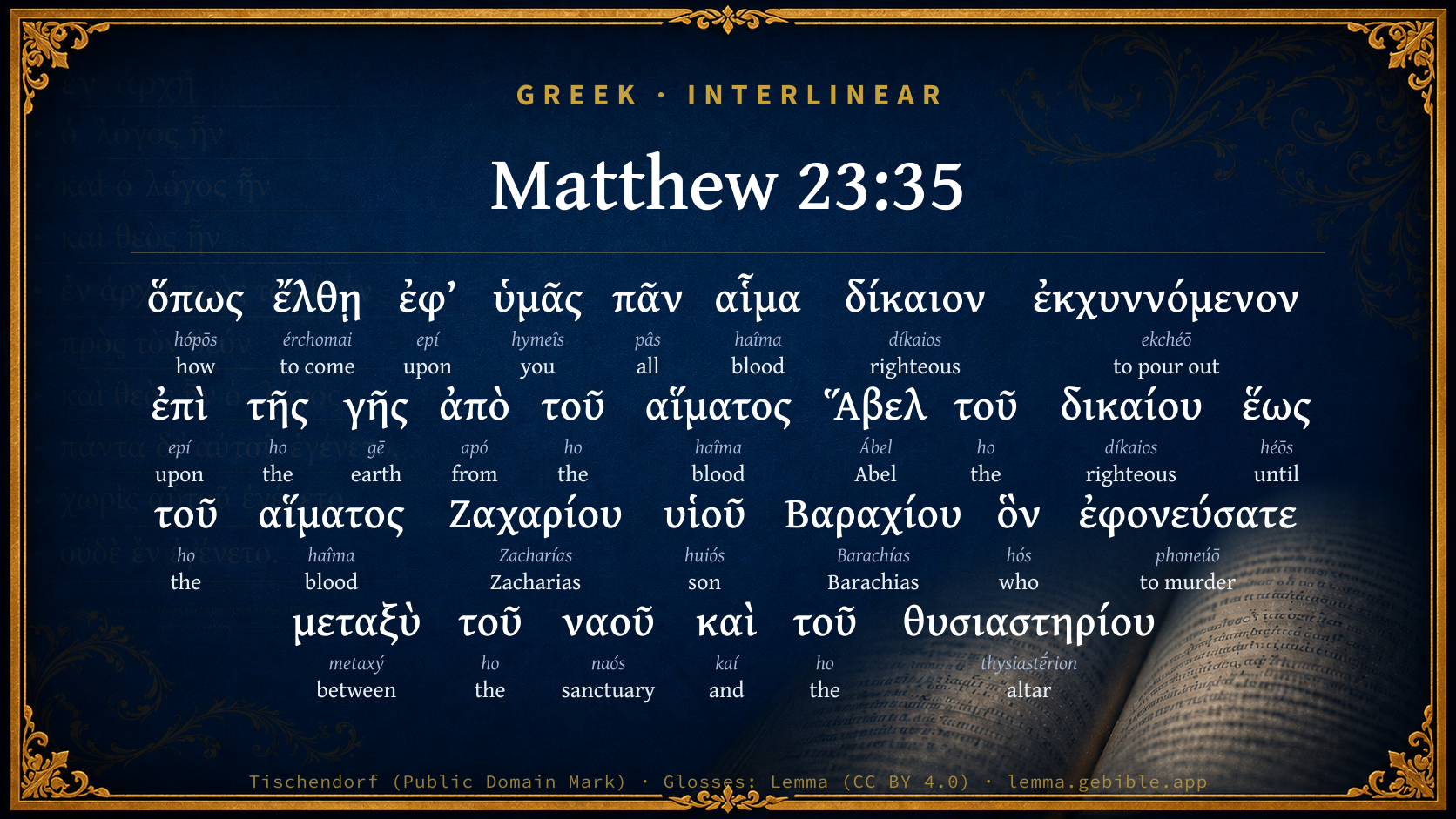
that on you may come all the righteous blood shed on the earth, from the blood of righteous Abel to the blood of Zachariah son of Barachiah, whom you killed between the sanctuary and the altar.
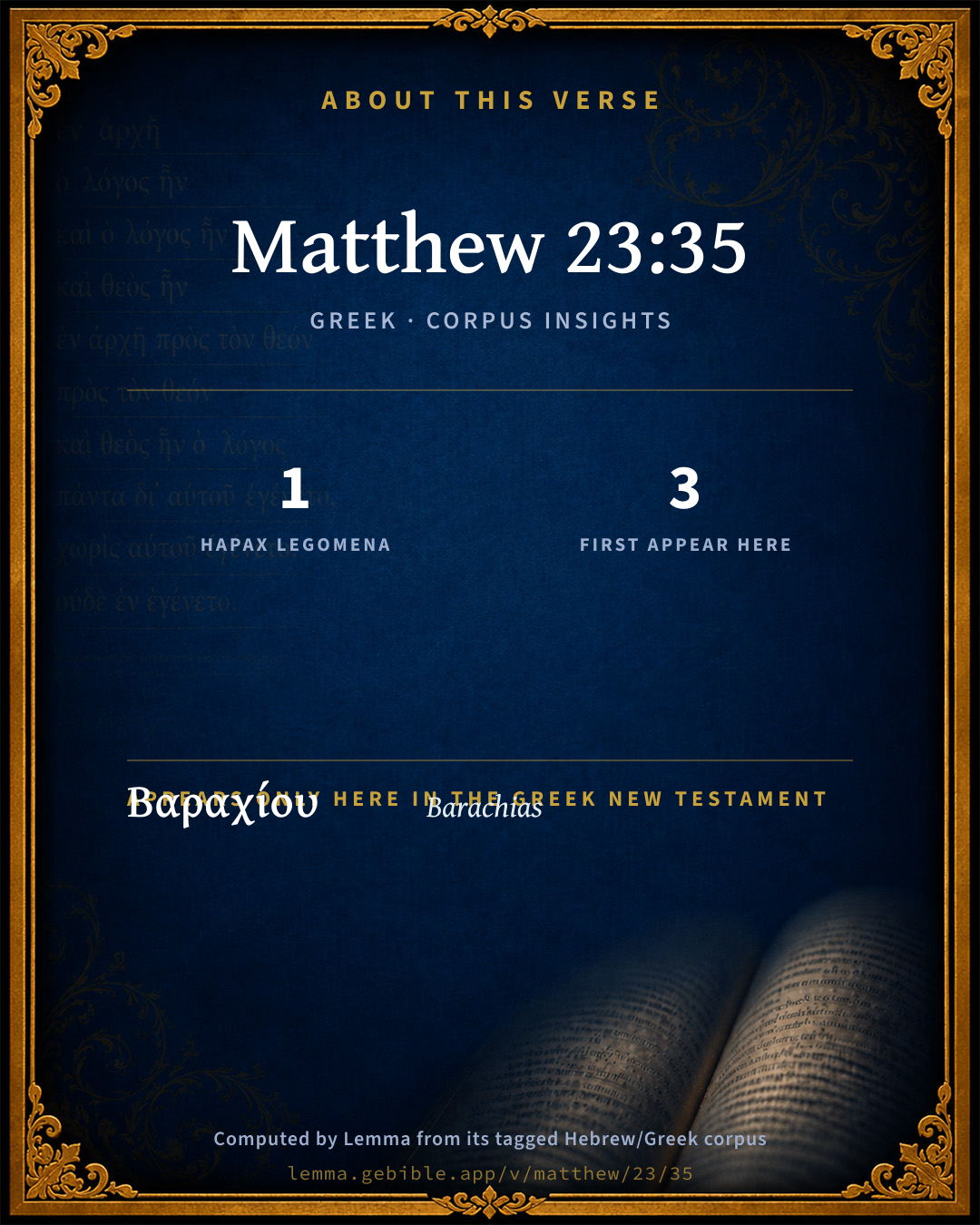
- 1 hapax legomenon — only here in the Greek New Testament
- 3 first appearances in the Greek New Testament
Download a study sheet
One document with this verse’s original text, its word-by-word gloss line, the meaning frame, cross-references with their text, attributed commentary, and full source and license credits — printable, and it pastes into notes with its structure intact.
This verse Autodidact and up
A passage Seminary Student
Up to 50 verses in one chapter. A passage sheet keeps up to 6 commentary sources and 12 cross-references per verse, in the order this page ranks them, and says so on the sheet whenever that leaves anything out. Ask for a single verse and you get the Autodidact verse sheet above.
Everything on this page stays free to read, with no account — the sheet is a download of what is already on screen, not access to it.
Compare translations 3
The same verse in 3 English versions, stacked beneath the original-language interlinear above. Click any original word for its lexicon entry.
Each is an independent rendering of the whole verse — the interlinear is not word-aligned to these translations.
Highlighted words mark where these versions differ — a whole-verse word diff, not a word-by-word alignment.
-
World English Bible Public Domain
that on you may come all the righteous blood shed on the earth, from the blood of righteous Abel to the blood of Zachariah son of Barachiah, whom you killed between the sanctuary and the altar.
-
King James Version Public Domain
That upon you may come all the righteous blood shed upon the earth, from the blood of righteous Abel unto the blood of Zacharias son of Barachias, whom ye slew between the temple and the altar.
-
unfoldingWord Literal Text CC BY-SA 4.0
so that might come upon you all the righteous blood being shed on the earth, from the blood of Abel the righteous to the blood of Zechariah son of Barachiah, whom you killed between the temple and the altar.
unfoldingWord Literal Text — © unfoldingWord, licensed CC BY-SA 4.0. Word-aligned USFM3 via Door43 (git.door43.org/unfoldingWord/en_ult).
Show all 19 translations
Every available English version of this verse, each an independent rendering of the whole verse.
-
World English Bible Public Domain
that on you may come all the righteous blood shed on the earth, from the blood of righteous Abel to the blood of Zachariah son of Barachiah, whom you killed between the sanctuary and the altar.
-
Berean Standard Bible Public Domain
And so upon you will come all the righteous blood shed on earth, from the blood of righteous Abel to the blood of Zechariah son of Berechiah, whom you murdered between the temple and the altar.
-
Majority Standard Bible Public Domain
And so upon you will come all the righteous blood shed on earth, from the blood of righteous Abel to the blood of Zechariah son of Berechiah, whom you murdered between the temple and the altar.
-
King James Version Public Domain
That upon you may come all the righteous blood shed upon the earth, from the blood of righteous Abel unto the blood of Zacharias son of Barachias, whom ye slew between the temple and the altar.
-
American Standard Version (1901) Public Domain
that upon you may come all the righteous blood shed on the earth, from the blood of Abel the righteous unto the blood of Zachariah son of Barachiah, whom ye slew between the sanctuary and the altar.
-
Revised Version (1885) Public Domain
that upon you may come all the righteous blood shed on the earth, from the blood of Abel the righteous unto the blood of Zachariah son of Barachiah, whom ye slew between the sanctuary and the altar.
-
Geneva Bible (1599) Public Domain
That vpon you may come all the righteous blood that was shed vpon the earth, from the blood of Abel the righteous, vnto the blood of Zacharias the sonne of Barachias, whome ye slewe betweene the Temple and the altar.
-
Douay-Rheims (1899) Public Domain
That upon you may come all the just blood that hath been shed upon the earth, from the blood of Abel the just, even unto the blood of Zacharias the son of Barachias, whom you killed between the temple and the altar.
-
Young's Literal Translation Public Domain
that on you may come all the righteous blood being poured out on the earth from the blood of Abel the righteous, unto the blood of Zacharias son of Barachias, whom ye slew between the sanctuary and the altar:
-
Literal Standard Version CC BY-SA 4.0
that on you may come all the righteous blood being poured out on the earth from the blood of Abel the righteous, to the blood of Zacharias son of Barachias, whom you murdered between the temple and the altar:
-
Unlocked Literal Bible CC BY-SA 4.0
The result is that upon you will come all the righteous blood that has been shed on the earth, from the blood of righteous Abel, to the blood of Zechariah son of Barachiah, whom you killed between the sanctuary and the altar.
-
unfoldingWord Literal Text CC BY-SA 4.0
so that might come upon you all the righteous blood being shed on the earth, from the blood of Abel the righteous to the blood of Zechariah son of Barachiah, whom you killed between the temple and the altar.
-
Darby Bible Public Domain
so that all righteous blood shed upon the earth should come upon *you*, from the blood of righteous Abel to the blood of Zacharias son of Barachias, whom ye slew between the temple and the altar.
-
World Messianic Bible Public Domain
that on you may come all the righteous blood shed on the earth, from the blood of righteous Abel to the blood of Zechariah son of Berechiah, whom you killed between the sanctuary and the altar.
-
Webster's Bible Public Domain
That upon you may come all the righteous blood shed upon the earth, from the blood of righteous Abel, to the blood of Zacharias son of Barachias, whom ye slew between the temple and the altar.
-
Free Bible Version CC BY-SA 4.0
As a result, you will be held accountable for the blood of all the good people that has been poured out on the land—from the blood of Abel, who did what was right, to the blood of Zechariah son of Barachiah, whom you killed between the Temple and the altar.
-
Bible in Basic English Public Domain
So that on you may come all the blood of the upright on the earth, from the blood of upright Abel to the blood of Zachariah, son of Barachiah, whom you put to death between the Temple and the altar.
-
Text-Critical English NT CC BY 4.0
As a result, all the righteous blood that has been shed on earth will come upon you, from the blood of righteous Abel to the blood of Zechariah son of Barachiah, whom you murdered between the temple and the altar.
-
Tyndale New Testament (1534) Public Domain
that vpon you maye come all the righteous bloude that was sheed vpon the erth from the bloud of righteous Abell vnto the bloud of zacharias the sonne of Barachias who ye slewe betwene the temple and the altre.
Literal Standard Version (2020), Covenant Press — licensed CC BY-SA 4.0. Text via the HelloAO Bible API (eBible.org). Unlocked Literal Bible (unfoldingWord) — licensed CC BY-SA 4.0. Text via the HelloAO Bible API (eBible.org). unfoldingWord Literal Text — © unfoldingWord, licensed CC BY-SA 4.0. Word-aligned USFM3 via Door43 (git.door43.org/unfoldingWord/en_ult). Free Bible Version, Dr. Jonathan Gallagher — licensed CC BY-SA 4.0. Text via the HelloAO Bible API (eBible.org).
Word by word
More ways to search: Search by grammar → Find every occurrence → Compare this word →
Practice this passage: Drill this verse → Learn its vocabulary →
- Appears 1× in the Greek New Testament
- First appears here
- Part of Speech
- Noun
- Case
- Genitive
- Number
- Singular
- Gender
- Masculine
Full Thayer's Definition
- ὅπως hópōs G3704 “how” Adverb
- ἔλθῃ érchomai G2064 “to come” Verb, Aorist, Active, Subjunctive, 3rd person, Singular
- ἐφ’ epí G1909 “upon” Preposition
- ὑμᾶς hymeîs G5210 “you” Personal pronoun, 2nd person, Accusative, Plural
- πᾶν pâs G3956 “all” Adjective, Nominative, Singular, Neuter
- αἷμα haîma G129 “blood” Noun, Nominative, Singular, Neuter
- δίκαιον díkaios G1342 “righteous” Adjective, Nominative, Singular, Neuter
- ἐκχυννόμενον ekchéō G1632 “to pour out” Verb, Present, Passive, Participle, Nominative, Singular, Neuter
- ἐπὶ epí G1909 “upon” Preposition
- τῆς ho G3588 “the” Article, Genitive, Singular, Feminine
- γῆς gē G1093 “earth” Noun, Genitive, Singular, Feminine
- ἀπὸ apó G575 “from” Preposition
- τοῦ ho G3588 “the” Article, Genitive, Singular, Neuter
- αἵματος haîma G129 “blood” Noun, Genitive, Singular, Neuter
- Ἅβελ Ábel G6 “Abel” Noun, Proper, indeclinable
- τοῦ ho G3588 “the” Article, Genitive, Singular, Masculine
- δικαίου díkaios G1342 “righteous” Adjective, Genitive, Singular, Masculine
- ἕως héōs G2193 “until” Adverb
- τοῦ ho G3588 “the” Article, Genitive, Singular, Neuter
- αἵματος haîma G129 “blood” Noun, Genitive, Singular, Neuter
- Ζαχαρίου Zacharías G2197 “Zacharias” Noun, Genitive, Singular, Masculine
- υἱοῦ huiós G5207 “son” Noun, Genitive, Singular, Masculine
- Βαραχίου Barachías G914 “Barachias” Noun, Genitive, Singular, Masculine
- ὃν hós G3739 “who” Relative pronoun, Accusative, Singular, Masculine
- ἐφονεύσατε phoneúō G5407 “to murder” Verb, Aorist, Active, Indicative, 2nd person, Plural
- μεταξὺ metaxý G3342 “between” Adverb
- τοῦ ho G3588 “the” Article, Genitive, Singular, Masculine
- ναοῦ naós G3485 “sanctuary” Noun, Genitive, Singular, Masculine
- καὶ kaí G2532 “and” Conjunction
- τοῦ ho G3588 “the” Article, Genitive, Singular, Neuter
- θυσιαστηρίου thysiastḗrion G2379 “altar” Noun, Genitive, Singular, Neuter
About this verse
These counts appear in no published source. They are computed here, from the morphology-tagged text and Lemma’s own curated glosses. What Lemma adds →
- 31
- words
- 22
- distinct lemmas
- Gospels
- section
Notable vocabulary
1 hapax legomenon — a word that appears only here in the entire Greek New Testament:
- Βαραχίου Barachias G914
First appearance in Scripture
These words make their first canonical appearance in the Greek New Testament here:
Shared distinctive vocabulary
Ἅβελ Abel G6 occurs in 4 verses of the Greek New Testament. Also found in:
Cross-references
19Topical passages linked to Matthew 23:35 in the Treasury of Scripture Knowledge — connected by theme and wording, ordered by reader-vote popularity; previews shown in the World English Bible.
- 2 Chronicles 24:20–22 The Spirit of God came on Zechariah the son of Jehoiada the priest; and he stood above the people, and said to them, Thus says God, Why disobey you the commandments of Yahweh, so that you can't prosper? because you have forsaken Yahweh, he has also forsaken you.
- Hebrews 11:4 By faith, Abel offered to God a more excellent sacrifice than Cain, through which he had testimony given to him that he was righteous, God bearing witness with respect to his gifts; and through it he, being dead, still speaks.
- Zechariah 1:1 In the eighth month, in the second year of Darius, the word of Yahweh came to Zechariah the son of Berechiah, the son of Iddo, the prophet, saying,
- Genesis 4:8 Cain said to Abel, his brother, "Let's go into the field." It happened, when they were in the field, that Cain rose up against Abel, his brother, and killed him.
- Revelation 18:24 In her was found the blood of prophets and of saints, and of all who have been slain on the earth."
- Jeremiah 26:15 Only know for certain that, if you put me to death, you will bring innocent blood on yourselves, and on this city, and on the inhabitants of it; for of a truth Yahweh has sent me to you to speak all these words in your ears.
- 2 Kings 21:16 Moreover Manasseh shed innocent blood very much, until he had filled Jerusalem from one end to another; besides his sin with which he made Judah to sin, in doing that which was evil in the sight of Yahweh.
- 2 Kings 24:4 and also for the innocent blood that he shed; for he filled Jerusalem with innocent blood: and Yahweh would not pardon.
- Isaiah 26:21 For, behold, Yahweh comes forth out of his place to punish the inhabitants of the earth for their iniquity: the earth also shall disclose her blood, and shall no more cover her slain.
- Jeremiah 26:23 and they fetched forth Uriah out of Egypt, and brought him to Jehoiakim the king, who killed him with the sword, and cast his dead body into the graves of the common people.
- Luke 11:51 from the blood of Abel to the blood of Zachariah, who perished between the altar and the sanctuary.' Yes, I tell you, it will be required of this generation.
- Hebrews 12:24 to Jesus, the mediator of a new covenant, and to the blood of sprinkling that speaks better than that of Abel.
- Genesis 9:5–6 I will surely require your blood of your lives. At the hand of every animal I will require it. At the hand of man, even at the hand of every man's brother, I will require the life of man.
- Numbers 35:33 So you shall not pollute the land in which you are: for blood, it pollutes the land; and no expiation can be made for the land for the blood that is shed therein, but by the blood of him who shed it.
- Deuteronomy 21:7–8 and they shall answer and say, Our hands have not shed this blood, neither have our eyes seen it.
- Jeremiah 2:30 In vain have I struck your children; they received no correction: your own sword has devoured your prophets, like a destroying lion.
- Jeremiah 2:34 Also in your skirts is found the blood of the souls of the innocent poor: you did not find them breaking in; but it is because of all these things.
- Lamentations 4:13–14 [It is] because of the sins of her prophets, [and] the iniquities of her priests, That have shed the blood of the just in the midst of her.
- 1 John 3:11–12 For this is the message which you heard from the beginning, that we should love one another;
Cross-references courtesy of OpenBible.info (CC BY 4.0).
Lesson kit
Teaching starters — assembled from the data on this page, not authored interpretation. Every prompt links to the verse data it draws on. Edit before teaching.
Matthew, in the Gospels, opens this verse with 31 words (22 distinct Greek lemmas). Its most distinctive word is Barachías (“Barachias”). A historical commentator’s framing appears above. Read the whole chapter for the surrounding context.
Discussion questions
- What does “Barachias” (Barachías) contribute to the verse as a whole?
- 1 word here appears nowhere else in the Greek New Testament. Why might the author reach for such rare wording?
- 3 words make their first appearance in Scripture here. What does this debut establish?
- How does Luke 11:51, which shares the word «Abel», read alongside this verse?
- What does the repetition of “blood” (3× in this one verse) do in this verse?
- These translations render this verse differently. What is at stake in choosing one wording over another?
- Compare how Tyndale Open Study Notes and Bengel's Gnomon read this verse. Where do they agree or differ?
Things to notice
- 1 word in this verse appears nowhere else in the Greek New Testament.
- 3 words make their first canonical appearance in Scripture here.
- These translations choose different wording for 13 words in this verse.
- “blood” occurs 3× in this single verse.
- 22 distinct Greek lemmas span 31 words in this verse.
Commentary
Notes on Matthew 23:35 from classic Christian and Jewish commentators (each source and its license shown beneath its notes). The classic Christian expositions comment on the surrounding passage and are grouped to its opening verse, so a note may address several verses; the Jewish commentaries on the Tanakh (Rashi and others) are per-verse, so they appear only where the commentator wrote on this verse.
Lemma curates 59 commentaries, every one of them public domain or Creative Commons licensed, each selected and text-cleaned for this edition rather than reprinted as found. About our sources →
Tyndale Open Study Notes
Tyndale Open Resources
Tyndale Open Study Notes — © Tyndale Open Resources, licensed CC BY-SA 4.0. Text via the HelloAO Bible API.
Bengel's Gnomon
Johann Albrecht Bengel
Bengel's Gnomon of the New Testament — English translation (T&T Clark, Edinburgh, 1860) — public domain. Text from a community e-Sword module.
Meyer's Critical & Exegetical Commentary
Heinrich August Wilhelm Meyer
Meyer — Critical and Exegetical Commentary on the New Testament — English translation by Peter Christie, edited by Frederick Crombie (T&T Clark, 1880) — public domain. Text from a community e-Sword module.
Expositor's Greek Testament
ed. W. Robertson Nicoll
The Expositor's Greek Testament, edited by W. Robertson Nicoll (1897–1910) — public domain. Text from a community e-Sword module.
Geneva Bible (1599)
Geneva Bible translators
Geneva Bible (1599) marginal notes — public domain. Text via Bolls.life.
Adam Clarke's Commentary
Adam Clarke's Commentary on the Bible (1810–1826) — public domain. Text from a community e-Sword/MySword module.
Ellicott's Commentary for English Readers
A Bible Commentary for English Readers, edited by Charles John Ellicott (1878–1897) — public domain. Text from a community e-Sword module.
The Cambridge Bible for Schools and Colleges
gen. ed. J. J. S. Perowne
The Cambridge Bible for Schools and Colleges (gen. ed. J. J. S. Perowne; Cambridge University Press, 1878–1918) — public domain. Text from a community e-Sword module.
John Gill's Exposition
John Gill's Exposition of the Whole Bible (1746–1763) — public domain (CC PDM 1.0). Text via the HelloAO Bible API.
Trapp's Complete Commentary
John Trapp
John Trapp, A Commentary or Exposition upon All the Books of the Old and New Testament (1647–1656) — public domain. Text from a community e-Sword module.
Albert Barnes' Notes on the Bible
Albert Barnes' Notes on the Bible (1834–1885) — public domain. Text from a community e-Sword/MySword module.
Haydock's Catholic Bible Commentary
George Leo Haydock (1774–1849), Haydock's Catholic Family Bible and Commentary, 1859 edition — public domain. Excludes Psalms (Douay-Rheims chapter numbering differs from Protestant) and Deuterocanonical books (Catholic canon only).
Whedon's Commentary on the Bible
Daniel D. Whedon
Daniel D. Whedon (gen. ed.), Commentary on the Old and New Testaments (1874–1909) — public domain. Text from a community e-Sword module.
The Pulpit Commentary
The Pulpit Commentary (1880–1919), ed. H.D.M. Spence-Jones & Joseph S. Exell — public domain. Text from a community e-Sword module.
John Wesley's Explanatory Notes
John Wesley, Explanatory Notes Upon the Whole Bible (1754–1765) — public domain. Text via the GEBible commentary corpus.
Scofield Reference Notes
C. I. Scofield
The Scofield Reference Bible (1917 edition), notes by C. I. Scofield — public domain. Text from a community e-Sword module.
The People's New Testament
B. W. Johnson
B. W. Johnson's The People's New Testament with Notes (1889–1891) — public domain. Electronic text from the Christian Classics Ethereal Library (CCEL) ThML edition.
Cambridge Greek Testament for Schools and Colleges
Cambridge Greek Testament for Schools and Colleges (Cambridge University Press, 1896; 21 vols, various authors incl. Carr, Maclear, Plummer, Farrar, Lumby, Moule, M. R. James, Simcox) — public domain. Text from a community e-Sword module.
Alford’s Greek Testament
Henry Alford
Henry Alford, The Greek Testament (1849–1861) — public domain. Text from a community e-Sword module.
International Critical Commentary
International Critical Commentary — older volumes (1896–1929), various authors — public domain. Text from a community e-Sword module.
Vincent's Word Studies in the New Testament
Marvin R. Vincent
Marvin R. Vincent, Word Studies in the New Testament (1887–1900) — public domain. Text from a community e-Sword/MySword module.