
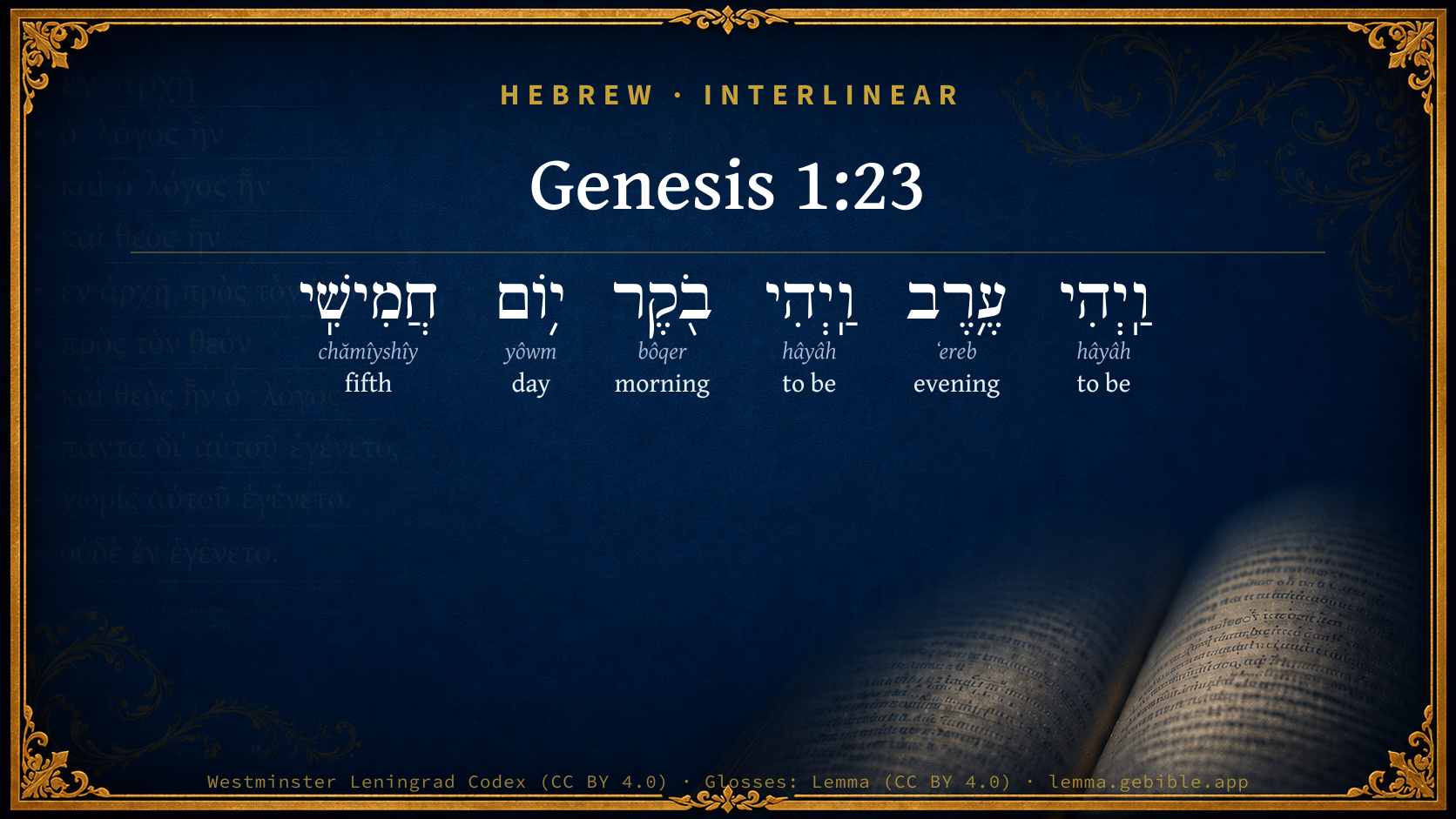
Genesis 1:23

Hebrew (Westminster Leningrad Codex) Genesis 1:23 appears in the Hebrew Old Testament. The text above is from the Westminster Leningrad Codex. Each word links to its Strong’s number, a concise gloss, and parsing drawn from the Open Scriptures Hebrew Bible morphology. Click any word for its full Brown-Driver-Briggs (BDB) entry.
Download image
Cite this verse

Genesis 1:23 (World English Bible). Public Domain. Lemma interlinear Bible study tool, https://lemma.gebible.app/v/genesis/1/23.

Show BibTeX & RIS
BibTeX
RIS
English Translation
There was evening and there was morning, a fifth day.
World English Bible · Public Domain
Highlights
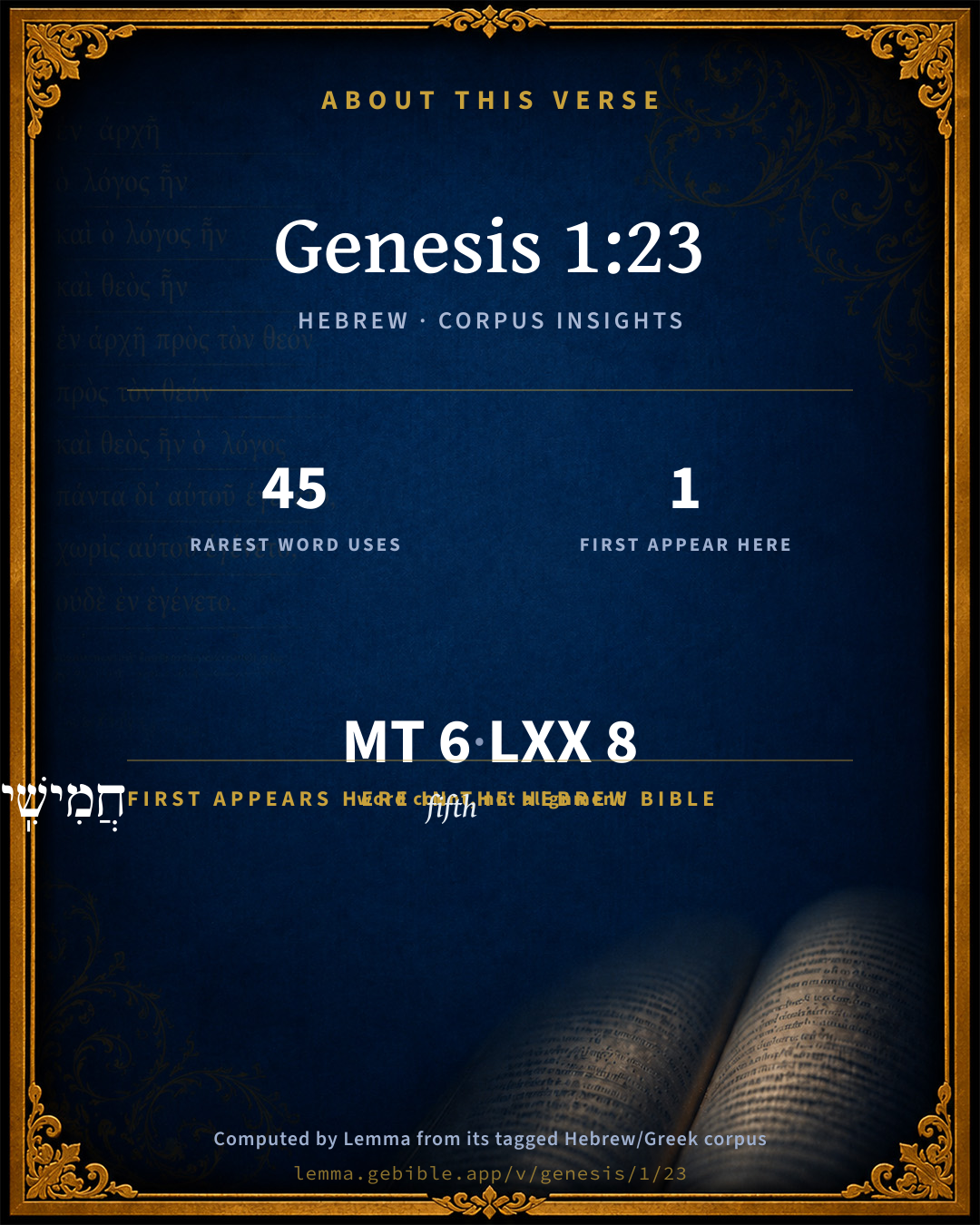
  • 1 first appearance in the Hebrew Bible
Full analysis ↓
Download a study sheet

One document with this verse’s original text, its word-by-word gloss line, the meaning frame, cross-references with their text, attributed commentary, and full source and license credits — printable, and it pastes into notes with its structure intact.

This verse Autodidact and up

Study sheet (.html) Plain text (.txt)

A passage Seminary Student

Up to 50 verses in one chapter. A passage sheet keeps up to 6 commentary sources and 12 cross-references per verse, in the order this page ranks them, and says so on the sheet whenever that leaves anything out. Ask for a single verse and you get the Autodidact verse sheet above.

Everything on this page stays free to read, with no account — the sheet is a download of what is already on screen, not access to it.

Want to remove ads? Support Godless Engineer
Compare translations 3

The same verse in 3 English versions, stacked beneath the original-language interlinear above. Click any original word for its lexicon entry.

Each is an independent rendering of the whole verse — the interlinear is not word-aligned to these translations.

Highlighted words mark where these versions differ — a whole-verse word diff, not a word-by-word alignment.

  • World English Bible Public Domain
    There was evening and there was morning, a fifth day.
  • King James Version Public Domain
    And the evening and the morning were the fifth day.
  • unfoldingWord Literal Text CC BY-SA 4.0
    Then there was evening, and there was morning, the fifth day.

unfoldingWord Literal Text — © unfoldingWord, licensed CC BY-SA 4.0. Word-aligned USFM3 via Door43 (git.door43.org/unfoldingWord/en_ult).

Versions to compare (up to 4)

3 of 4 selected

Show all 18 translations

Every available English version of this verse, each an independent rendering of the whole verse.

  • World English Bible Public Domain
    There was evening and there was morning, a fifth day.
  • Berean Standard Bible Public Domain
    And there was evening, and there was morning—the fifth day.
  • Majority Standard Bible Public Domain
    And there was evening, and there was morning—the fifth day.
  • King James Version Public Domain
    And the evening and the morning were the fifth day.
  • American Standard Version (1901) Public Domain
    And there was evening and there was morning, a fifth day.
  • Revised Version (1885) Public Domain
    And there was evening and there was morning, a fifth day.
  • Geneva Bible (1599) Public Domain
    So the euening and the morning were the fifte day.
  • Douay-Rheims (1899) Public Domain
    And the evening and morning were the fifth day.
  • Young's Literal Translation Public Domain
    and there is an evening, and there is a morning -- day fifth.
  • Literal Standard Version CC BY-SA 4.0
    and there is an evening, and there is a morning—[the] fifth day.
  • Unlocked Literal Bible CC BY-SA 4.0
    This was evening and morning, the fifth day.
  • unfoldingWord Literal Text CC BY-SA 4.0
    Then there was evening, and there was morning, the fifth day.
  • Darby Bible Public Domain
    And there was evening, and there was morning -- a fifth day.
  • World Messianic Bible Public Domain
    There was evening and there was morning, a fifth day.
  • Webster's Bible Public Domain
    And the evening and the morning were the fifth day.
  • Free Bible Version CC BY-SA 4.0
    So there was evening, and then the morning, making day five.
  • Bible in Basic English Public Domain
    And there was evening and there was morning, the fifth day.
  • JPS Tanakh (1917) Public Domain
    And there was evening and there was morning, a fifth day.

Literal Standard Version (2020), Covenant Press — licensed CC BY-SA 4.0. Text via the HelloAO Bible API (eBible.org). Unlocked Literal Bible (unfoldingWord) — licensed CC BY-SA 4.0. Text via the HelloAO Bible API (eBible.org). unfoldingWord Literal Text — © unfoldingWord, licensed CC BY-SA 4.0. Word-aligned USFM3 via Door43 (git.door43.org/unfoldingWord/en_ult). Free Bible Version, Dr. Jonathan Gallagher — licensed CC BY-SA 4.0. Text via the HelloAO Bible API (eBible.org).

Word by word

More ways to search: Search by grammar → Find every occurrence → Compare this word →

Practice this passage: Drill this verse → Learn its vocabulary →

About this verse

These counts appear in no published source. They are computed here, from the morphology-tagged text and Lemma’s own curated glosses. What Lemma adds →

6
words
5
distinct lemmas
Pentateuch
section

First appearance in Scripture

This word makes its first canonical appearance in the Hebrew Bible here:

  • חֲמִישִֽׁי fifth H2549

Shared distinctive vocabulary

חֲמִישִֽׁי fifth H2549 occurs in 44 verses of the Hebrew Bible. Also found in:

Grammatical profile

  • 2 verbs
  • 3 nouns
  • 1 adjective

Verb forms

  • וַֽיְהִי Qal · Sequential Imperfect
  • וַֽיְהִי Qal · Sequential Imperfect

Repetition

A word recurs within this verse — often emphatic in Hebrew:

  • וַֽיְהִי to be H1961 ×2

Hebrew & Septuagint length

In English translation the verse runs 10 words from the Hebrew and 11 from the Septuagint (LXX English) — closely comparable.

A rough comparison of the two English renderings, which tokenize alike — not a word-level alignment.

Word counts can differ between the Hebrew and the Greek without any difference in meaning — e.g. the Hebrew direct-object marker אֵת has no separate Greek word, and Greek often adds the article ὁ.

In the original languages it is 6 Hebrew tokens and 8 Greek tokens — but the two are counted differently (Hebrew bundles its prefixes and suffixes into one token; the Greek is in lemma form), so that isn’t a like-for-like length.

Hebrew and Greek witnesses Masoretic Hebrew ↔ Greek Septuagint

The same verse in the two great witnesses to the Old Testament, shown verse-for-verse.

These are two independent witnesses, not word-aligned to each other, and the Septuagint is shown in lemma (dictionary) form.

Hebrew Genesis 1:23 Masoretic · Westminster Leningrad Codex

וַֽיְהִי עֶ֥רֶב וַֽיְהִי בֹ֖קֶר י֥וֹם חֲמִישִֽׁי

There was evening and there was morning, a fifth day.

World English Bible · Public Domain

Greek LXX Genesis 1:23 Septuagint · lemma form

καί γίγνομαι ἑσπέρα καί γίγνομαι πρωΐ ἡμέρα πέμπτος

And there was evening and there was morning, the fifth day.

LXX2012 (modern English Septuagint) · Public Domain

Hebrew: Westminster Leningrad Codex (CC BY 4.0). Greek: Septuagint (public domain); English from LXX2012 (modern English Septuagint) (Public Domain). How the Septuagint differs from the Hebrew →

Targum (Aramaic paraphrase)

2

The Targum is the ancient Jewish Aramaic paraphrase of the Hebrew Scriptures — an interpretive translation, not the Hebrew text itself. Onkelos (literal) and Pseudo-Jonathan (expansive) render the Torah, and Jonathan the Prophets. Coverage is partial: where no permissively-licensed English translation exists for a verse, only the Aramaic is shown. This is verse-level text, not a word-by-word alignment to the Hebrew.

  1. Targum Onkelos Torah (Genesis–Deuteronomy)
    וַהֲוָה רְמַשׁ וַהֲוָה צְפַר יוֹם חֲמִישָׁאִי

    (no public-domain English translation for this verse)

    Targum Onkelos — Aramaic: “Onkelos Genesis” (public domain); “Onkelos Exodus” (public domain); “Onkelos Leviticus” (public domain); “Onkelos Numbers” (public domain); “Onkelos Deuteronomy” (public domain). English: “Sefaria Community Translation” (CC0 1.0 (public-domain dedication)); “J.W. Etheridge. The Targums of Onkelos and Jonathan Ben Uzziel on the Pentateuch. London: Longmans, Green, 1862” (public domain). Text via Sefaria.

  2. Targum Pseudo-Jonathan Torah (Genesis–Deuteronomy)
    וַהֲוָה רְמַשׁ וַהֲוָה צְפַר יוֹם חֲמִישָׁאֵי

    And it was evening, and it was morning, Day the Fifth.

    Targum Pseudo-Jonathan — Aramaic: “Targum Jonathan on Genesis” (public domain); “Targum Jonathan on Exodus” (public domain); “Targum Jonathan on Leviticus” (public domain); “Targum Jonathan on Numbers” (public domain); “Targum Jonathan on Deuteronomy” (public domain). English: “The Targum of Jonathan ben Uzziel, trans. J. W. Etheridge, London, 1862” (public domain). Text via Sefaria.

Commentary

Notes on Genesis 1:23 from classic Christian and Jewish commentators (each source and its license shown beneath its notes). The classic Christian expositions comment on the surrounding passage and are grouped to its opening verse, so a note may address several verses; the Jewish commentaries on the Tanakh (Rashi and others) are per-verse, so they appear only where the commentator wrote on this verse.

Lemma curates 59 commentaries, every one of them public domain or Creative Commons licensed, each selected and text-cleaned for this edition rather than reprinted as found. About our sources →

Ellicott's Commentary for English Readers

(23) The fifth day.—Upon the work of the first four days geology is virtually silent, and the theories respecting the physical formation of the world belong to other sciences. But as regards the fifth day, its testimony is ample. In the lowest strata of rocks, such as the Cambrian and Silurian, we find marine animals, mollusca, and trilobites; higher up in the Devonian rocks we find fish; in the Carbonaceous period we find reptiles; and above these, in the Permian, those mighty saurians, described in our version as great whales. Traces of birds, even in these higher strata, if existent at all, are rare, but indubitably occur in the Triassic series. We thus learn that this fifth day covers a vast space of time, and, in accordance with what has been urged before as regards vegetation, it is probable that the introduction of the various genera and species was gradual. God does nothing in haste, and our conceptions of His marvellous working are made more clear and worthy of His greatness by the evidence which geology affords.

A Bible Commentary for English Readers, edited by Charles John Ellicott (1878–1897) — public domain. Text from a community e-Sword module.

John Gill's Exposition

And the evening and the morning were the fifth day. The sun now in the firmament, where it was fixed the day before, having gone round the earth, or the earth about that, in the space of twenty four hours; and according to Capellus this was the twenty second of April; or, as others, the fifth of September; and according to Bishop Usher the twenty seventh of October.

And the evening and the morning were the fifth day. The sun now in the firmament, where it was fixed the day before, having gone round the earth, or the earth about that, in the space of twenty four hours; and according to Capellus this was the twenty second of April; or, as others, the fifth of September; and according to Bishop Usher the twenty seventh of October.

Genesis 1:24

gen 1:24

gen 1:24

gen 1:24And God said, let the earth bring forth the living creature after his kind,.... All sorts of living creatures that live and move upon the earth; not that the earth was endued with a power to produce these creatures of itself, without the interposition of God: for though it might be impregnated with a quickening virtue by the Spirit of God, which moved on it whilst a fluid, and had been prepared and disposed for such a production by the heat of the body of light created on the first day, and of the sun on the fourth; yet no doubt it was by the power of God accompanying his word, that these creatures were produced of the earth, and formed into their several shapes. The Heathens had some traditionary notion of this affair: according to the Egyptians, whose sentiments Diodorus Siculus (c) seems to give us, the process was thus carried on; the earth being stiffened by the rays of the sun, and the moist matter being made fruitful by the genial heat, at night received nourishment by the mist which fell from the ambient air; and in the day was consolidated by the heat of the sun, till at length the enclosed foetus having arrived to a perfect increase, and the membranes burnt and burst, creatures of all kinds appeared; of whom those that had got a greater degree of heat went upwards, and became flying fowl; those that were endued with an earthly concretion were reckoned in the class or order of reptiles, and other terrestrial animals; and those that chiefly partook of a moist or watery nature, ran to the place of a like kind, and were called swimmers or fish. This is the account they give; and somewhat like is that which Archelaus, the master of Socrates, delivers as his notion, that animals were produced out of slime, through the heat of the earth liquefying the slime like milk for food (d): and Zeno the Stoic says (e), the grosser part of the watery matter of the world made the earth, the thinner part the air, and that still more subtilized, the fire; and then out of the mixture of these proceeded plants and animals, and all the other kinds; but all this they seem to suppose to be done by the mere efforts of nature; whereas Moses here most truly ascribes their production to the all powerful Word of God:

cattle, and creeping things, and beast of the earth after his kind; the living creatures produced out of the earth are distinguished into three sorts; "cattle", which seem to design tame cattle, and such as are for the use of man, either for carriage, food, or clothing, as horses, asses, camels, oxen, sheep, &c. and "creeping" things, which are different from the creeping things in the sea before mentioned, are such as either have no feet, and go upon their bellies, or are very short, and seem to do so, whether greater or lesser, as serpents, worms, ants, &c,

and the beast of the earth seems to design wild beasts, such as lions, bears, wolves, &c,

and it was so; such creatures were immediately produced.

(c) Bibliothec. l. 1. p. 7. (d) Laert. in Vita Archelai, p. 99. (e) Ib. in Vita Zenonis, p. 524.

John Gill's Exposition of the Whole Bible (1746–1763) — public domain (CC PDM 1.0). Text via the HelloAO Bible API.

The Pulpit Commentary

And the evening and the morning were the fifth day. If of the previous creative days geological science has only doubtful traces, of this it bears irrefragable witness. When the first animal life was Introduced upon our globe may be said to be as yet sub judice. Principal Dawson inclines to claim for the gigantic foraminifer, eozoon canadense, of the Laurentian rocks, the honor of being one of the first aquatic creatures that swarmed in terrestrial waters, though Professor Huxley believes that the earliest life is not represented by the oldest known fossils ("Critiques and Addresses," 9:1873); but, whether then or at some point of time anterior introduced, geology can trace it upwards through the Paleozoic and Mesozoic eras with the result that is here so exactly defined. Throughout the long ages that fill the interval between the Azoic period of our earth"s history and that which witnessed the appearance of the higher animals she is able to detect an unbroken succession of aquatic life, rising gradually from lower to higher forms from the trilobites and mollusks of the Cambrian and Silurian systems, up through the ganoid fishes of the Devonian and the amphibians of the Carboniferous to the saurian reptiles of the Permian periods. At this point certain ornithic tracks in the superincumbent Triassic strata reveal the introduction upon the scene of winged creatures, and with this accession to its strength and Volume the stream of life flows on till the higher animals appear. Thus geology confirms the Scripture record y attesting

(1) the priority of marine animals and birds to land animals;

(2) the existence of a period when the great sea monsters, with the smaller aquatic tribes and winged fowls of the air, were the sole living creatures on the globe; and

(3) that, precisely as Elohim designed life has continued in unbroken succession since the time of its first introduction. It may also be noted that the Palaeontological history of the earth s crust suggests a number of considerations that enable us to form a conception of the fifth day"s work, which, though not contravened by the Mosaic narrative, is yet by it not explicitly disclosed. For example, whereas it might seem to be the teaching of the inspired writer that the tanninim, the tomes, and the birds were created simultaneously, and so were synchronous in their appearance, the testimony of the rocks rather points to a series of creative acts in which successive species of living creatures were summoned into being, as the necessary conditions of existence were prepared for their reception, and indeed with emphasis asserts that the order of creation was not, as in ver. 21, first the great sea monsters, and then the creepers, and then the birds; but first the smaller aquatic tribes, and then the monsters of the deep, and finally the winged creatures of the air. This, however, is not to contradict, but to elucidate, the word of God.

The Pulpit Commentary (1880–1919), ed. H.D.M. Spence-Jones & Joseph S. Exell — public domain. Text from a community e-Sword module.

Lesson kit

Teaching starters — assembled from the data on this page, not authored interpretation. Every prompt links to the verse data it draws on. Edit before teaching.

Genesis, in the Pentateuch, opens this verse with 6 words (5 distinct Hebrew lemmas). Its most distinctive word is chămîyshîy (“fifth”). A historical commentator’s framing appears above. Read the whole chapter for the surrounding context.

Discussion questions

  1. How does “fifth” (chămîyshîy) shape what this verse is saying?
  2. The word “fifth” first appears here in Scripture. What is being introduced at this debut?
  3. Genesis 30:17 shares the word «fifth» with this verse. How do the two illuminate each other?
  4. “to be” occurs 2× in this one verse. What is the effect of the repetition?
  5. These translations render this verse differently; the difference is in the English rendering, not the original. What questions does that raise?
  6. The verb «וַֽיְהִי» is Qal Sequential Imperfect. How does its form color the action?
  7. Reading how Ellicott's Commentary for English Readers and John Gill's Exposition read this verse, where do the two commentators agree and where do they part?

Things to notice

Reading settings

Reading text

Shown beneath each verse's original-language words.

Old Testament
Old Testament edition

Read the OT as the Masoretic Hebrew (MT) or the Greek Septuagint (LXX).

English shown for the Greek Septuagint (in the Hebrew ↔ Greek comparison).

Comparing translations? Open the Compare panel on any verse page to stack up to four side by side.