Matthew 23:2

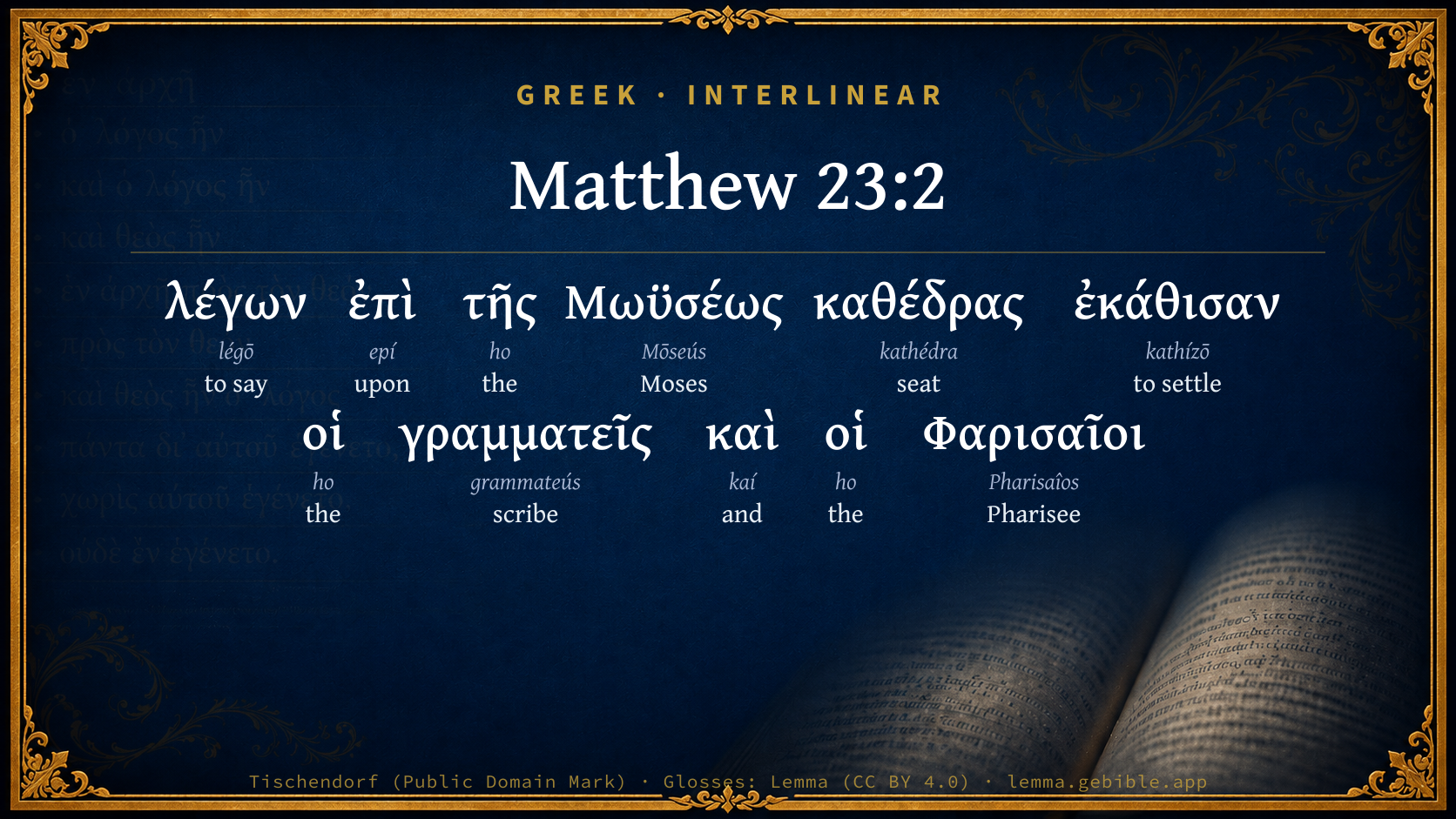
Greek (Tischendorf 8th ed.) Matthew 23:2 appears in the Greek New Testament. The text above is from the Tischendorf 8th edition. Each word links to its Strong’s number and a concise gloss. Click any word for its full Thayer’s Greek Lexicon entry.
Download image
Cite this verse

Matthew 23:2 (World English Bible). Public Domain. Lemma interlinear Bible study tool, https://lemma.gebible.app/v/matthew/23/2.

Show BibTeX & RIS
BibTeX
RIS
English Translation
saying, "The scribes and the Pharisees sat on Moses' seat.
World English Bible · Public Domain
Download a study sheet

One document with this verse’s original text, its word-by-word gloss line, the meaning frame, cross-references with their text, attributed commentary, and full source and license credits — printable, and it pastes into notes with its structure intact.

This verse Autodidact and up

Study sheet (.html) Plain text (.txt)

A passage Seminary Student

Up to 50 verses in one chapter. A passage sheet keeps up to 6 commentary sources and 12 cross-references per verse, in the order this page ranks them, and says so on the sheet whenever that leaves anything out. Ask for a single verse and you get the Autodidact verse sheet above.

Everything on this page stays free to read, with no account — the sheet is a download of what is already on screen, not access to it.

Want to remove ads? Support Godless Engineer
Compare translations 3

The same verse in 3 English versions, stacked beneath the original-language interlinear above. Click any original word for its lexicon entry.

Each is an independent rendering of the whole verse — the interlinear is not word-aligned to these translations.

Highlighted words mark where these versions differ — a whole-verse word diff, not a word-by-word alignment.

  • World English Bible Public Domain
    saying, "The scribes and the Pharisees sat on Moses' seat.
  • King James Version Public Domain
    Saying The scribes and the Pharisees sit in Moses' seat:
  • unfoldingWord Literal Text CC BY-SA 4.0
    saying, “The scribes and the Pharisees sat in the seat of Moses.

unfoldingWord Literal Text — © unfoldingWord, licensed CC BY-SA 4.0. Word-aligned USFM3 via Door43 (git.door43.org/unfoldingWord/en_ult).

Versions to compare (up to 4)

3 of 4 selected

Show all 19 translations

Every available English version of this verse, each an independent rendering of the whole verse.

  • World English Bible Public Domain
    saying, "The scribes and the Pharisees sat on Moses' seat.
  • Berean Standard Bible Public Domain
    “The scribes and Pharisees sit in Moses’ seat.
  • Majority Standard Bible Public Domain
    “The scribes and Pharisees sit in Moses’ seat.
  • King James Version Public Domain
    Saying The scribes and the Pharisees sit in Moses' seat:
  • American Standard Version (1901) Public Domain
    saying, The scribes and the Pharisees sit on Moses seat:
  • Revised Version (1885) Public Domain
    saying, The scribes and the Pharisees sit on Moses’ seat:
  • Geneva Bible (1599) Public Domain
    Saying, The Scribes and the Pharises sit in Moses seate.
  • Douay-Rheims (1899) Public Domain
    Saying: The scribes and the Pharisees have sitten on the chair of Moses.
  • Young's Literal Translation Public Domain
    saying, `On the seat of Moses sat down the scribes and the Pharisees;
  • Literal Standard Version CC BY-SA 4.0
    saying, “On the seat of Moses sat down the scribes and the Pharisees;
  • Unlocked Literal Bible CC BY-SA 4.0
    He said, “The scribes and the Pharisees sit in Moses' seat.
  • unfoldingWord Literal Text CC BY-SA 4.0
    saying, “The scribes and the Pharisees sat in the seat of Moses.
  • Darby Bible Public Domain
    saying, The scribes and the Pharisees have set themselves down in Moses' seat:
  • World Messianic Bible Public Domain
    saying, “The scribes and the Pharisees sit on Moses’ seat.
  • Webster's Bible Public Domain
    Saying, The scribes and the Pharisees sit in Moses's seat.
  • Free Bible Version CC BY-SA 4.0
    “The religious teachers and the Pharisees are responsible as interpreters of the law of Moses,
  • Bible in Basic English Public Domain
    The scribes and the Pharisees have the authority of Moses;
  • Text-Critical English NT CC BY 4.0
    “The scribes and the Pharisees sit on Moses' seat.
  • Tyndale New Testament (1534) Public Domain
    sayinge. The Scribes and the Pharises sit in Moses seate.

Literal Standard Version (2020), Covenant Press — licensed CC BY-SA 4.0. Text via the HelloAO Bible API (eBible.org). Unlocked Literal Bible (unfoldingWord) — licensed CC BY-SA 4.0. Text via the HelloAO Bible API (eBible.org). unfoldingWord Literal Text — © unfoldingWord, licensed CC BY-SA 4.0. Word-aligned USFM3 via Door43 (git.door43.org/unfoldingWord/en_ult). Free Bible Version, Dr. Jonathan Gallagher — licensed CC BY-SA 4.0. Text via the HelloAO Bible API (eBible.org).

Word by word

More ways to search: Search by grammar → Find every occurrence → Compare this word →

Practice this passage: Drill this verse → Learn its vocabulary →

About this verse

These counts appear in no published source. They are computed here, from the morphology-tagged text and Lemma’s own curated glosses. What Lemma adds →

11
words
9
distinct lemmas
Gospels
section

Notable vocabulary

The rarest word here is καθέδρας seat G2515 — appearing just 3 times in the whole Greek New Testament.

Shared distinctive vocabulary

καθέδρας seat G2515 occurs in 3 verses of the Greek New Testament. Also found in:

Repetition

A word recurs within this verse:

Cross-references

6

Topical passages linked to Matthew 23:2 in the Treasury of Scripture Knowledge — connected by theme and wording, ordered by reader-vote popularity; previews shown in the World English Bible.

  • Luke 20:46 "Beware of the scribes, who like to walk in long robes, and love greetings in the marketplaces, the best seats in the synagogues, and the best places at feasts;
  • Mark 12:38 In his teaching he said to them, "Beware of the scribes, who like to walk in long robes, and to get greetings in the marketplaces,
  • Malachi 2:7 For the priest's lips should keep knowledge, and they should seek the law at his mouth; for he is the messenger of Yahweh of Hosts.
  • Ezra 7:6 this Ezra went up from Babylon: and he was a ready scribe in the law of Moses, which Yahweh, the God of Israel, had given; and the king granted him all his request, according to the hand of Yahweh his God on him.
  • Ezra 7:25 You, Ezra, after the wisdom of your God who is in your hand, appoint magistrates and judges, who may judge all the people who are beyond the River, all such as know the laws of your God; and teach you him who doesn't know them.
  • Nehemiah 8:4–8 Ezra the scribe stood on a pulpit of wood, which they had made for the purpose; and beside him stood Mattithiah, and Shema, and Anaiah, and Uriah, and Hilkiah, and Maaseiah, on his right hand; and on his left hand, Pedaiah, and Mishael, and Malchijah, and Hashum, and Hashbaddanah, Zechariah, [and] Meshullam.

Cross-references courtesy of OpenBible.info (CC BY 4.0).

Commentary

Notes on Matthew 23:2 from classic Christian and Jewish commentators (each source and its license shown beneath its notes). The classic Christian expositions comment on the surrounding passage and are grouped to its opening verse, so a note may address several verses; the Jewish commentaries on the Tanakh (Rashi and others) are per-verse, so they appear only where the commentator wrote on this verse.

Lemma curates 59 commentaries, every one of them public domain or Creative Commons licensed, each selected and text-cleaned for this edition rather than reprinted as found. About our sources →

Tyndale Open Study Notes

Tyndale Open Resources

23:2 the Pharisees are the official interpreters of the law of Moses: They transmitted the oral traditions that were associated with the law and thought to be from Moses, and they judged religious and social matters on the basis of these traditions (see 15:2).

Tyndale Open Study Notes — © Tyndale Open Resources, licensed CC BY-SA 4.0. Text via the HelloAO Bible API.

Bengel's Gnomon

Johann Albrecht Bengel

Mat 23:2. Ἐκάθισαν, κ.τ.λ., sit, etc.) Representing Moses, reading and interpreting his law, and even urging more than he enjoined.—οἱ Γραμματεῖς καὶ οἱ Φαρισαῖοι, the Scribes and the Pharisees) The sins which are here enumerated, did not belong all equally to both of these classes; but they had many in common, and participated in many; see Luk 11:45.[983]

[983] 2 And of those sins of the Scribes and Pharisees specified in the discourses of Christ, which are described more fully by Matthew, Mark and Luke, have selected those sins which would most clearly show to the untutored populace why they should beware of the Scribes—viz., their haughtiness, their avarice, and their hypocrisy.—Harm., p. 472.

Bengel's Gnomon of the New Testament — English translation (T&T Clark, Edinburgh, 1860) — public domain. Text from a community e-Sword module.

Meyer's Critical & Exegetical Commentary

Heinrich August Wilhelm Meyer

Mat_23:2. The phrase: to sit in Moses seat (in the seat which Moses had occupied as lawgiver), is borrowed not from Exo_18:13, but refers to the later practice of having chairs for teachers (comp. Act_22:3), and is intended as a figurative mode of describing the functions of one who acts as a public teacher of the Mosaic law, in discharging which functions the teacher may be regarded as the representative and successor of Moses. Accordingly, in Rabbinical writers, one who succeeds a Rabbi as the representative of his school is described as יוֹשֵׁב עַל־כִסְאוֹ. See Vitringa, Synag. p. 165 f.

ἐκάθισαν] have seated themselves, have assumed to themselves the duties of this office. In the whole of this phraseology one cannot fail to detect an allusion to the pretensions and self-seeking character of the Pharisees. Comp. 2Th_2:4.

Meyer — Critical and Exegetical Commentary on the New Testament — English translation by Peter Christie, edited by Frederick Crombie (T&T Clark, 1880) — public domain. Text from a community e-Sword module.

Expositor's Greek Testament

ed. W. Robertson Nicoll

Mat 23:2 . ἐπὶ τ . Μ . καθέδρας , on the seat of Moses, short for, on the seat of a teacher whose function it was to interpret the Mosaic Law. The Jews spoke of the teacher’s seat as we speak of a professor’s chair. ἐκάθισαν , in effect, a gnomic aorist = solent sedere (Fritzsche), not a case of the aorist used as a perfect = have taken and now occupy, etc. (Erasmus). Burton (Syntax) sees in this and other aorists in N. T. a tendency towards use of aorist for perfect not yet realised: “rhetorical figure on the way to become grammatical idiom, but not yet become such,” § 55. οἱ φαρ . Wendt ( L. J. , i., 186) thinks this an addition by the evangelist, the statement strictly applying only to the scribes.

The Expositor's Greek Testament, edited by W. Robertson Nicoll (1897–1910) — public domain. Text from a community e-Sword module.

Geneva Bible (1599)

Geneva Bible translators

We ought to hear whatsoever any wicked teachers teach us purely out of the word of God, yet so that we eschew their evil manners.

Because God appointed the order, therefore the Lord would have his word to be heard even from the mouth of hypocrites and hirelings.

Geneva Bible (1599) marginal notes — public domain. Text via Bolls.life.

Jamieson, Fausset & Brown

Robert Jamieson, A. R. Fausset & David Brown

Saying, The scribes and the Pharisees sit--The Jewish teachers stood to read, but sat to expound the Scriptures, as will be seen by comparing Luk 4:16 with Mat 23:20.

in Moses' seat--that is, as interpreters of the law given by Moses.

Jamieson, Fausset & Brown — Commentary Critical and Explanatory on the Whole Bible (1871) — public domain (CC PDM 1.0). Text via the HelloAO Bible API.

Ellicott's Commentary for English Readers

(2) The scribes and the Pharisees sit in Moses’ seat.—The words were probably spoken of their collective action as represented in the Sanhedrin, rather than of their individual work as interpreters of the Law. As such, they claimed to be the authoritative exponents of the Law, and our Lord recognises (unless we suppose a latent protest in His words, like that which is veiled in the “full well ye reject” of Mar_7:9) their official claim to reverence.

A Bible Commentary for English Readers, edited by Charles John Ellicott (1878–1897) — public domain. Text from a community e-Sword module.

The Cambridge Bible for Schools and Colleges

gen. ed. J. J. S. Perowne

2. sit in Moses’ seat] i. e. succeed him as teachers. For sitting as the posture of a teacher cp. ch. Mat_5:1.

The Cambridge Bible for Schools and Colleges (gen. ed. J. J. S. Perowne; Cambridge University Press, 1878–1918) — public domain. Text from a community e-Sword module.

John Gill's Exposition

Saying, the Scribes and Pharisees,.... The Persic version adds, the priests: but Christ does not here speak of the sanhedrim, or grand council of the nation, and of their legislative power; but of those that were the teachers of the people, and the interpreters of the law; and of those, who, though they corrupted the word with their glosses and traditions, yet retained some truth, and at least came nearer truth, than the Sadducees; who therefore are omitted, and only Scribes and Pharisees mentioned, who gave the literal and traditional sense of the Scriptures; of whom he says, they

sit in Moses's seat: not that they were his successors in his office as a legislator and mediator; though the Persic version reads it, "sit in the place and chair of Moses"; but they read his law, and explained it to the people: this post and place, as yet, they kept in the office they were, and were to continue; and the people were to regard them so far as they spoke consistent with the law, until it had its full accomplishment in Christ. The allusion is not to the chairs in which the sanhedrim sat in trying and determining causes, but to those in which the doctors sat when they expounded the law; for though they stood up when they read the law, or the prophets, they sat down when they preached out of them: this custom of the synagogue was observed by our Lord; see Luk 4:16.

John Gill's Exposition of the Whole Bible (1746–1763) — public domain (CC PDM 1.0). Text via the HelloAO Bible API.

Trapp's Complete Commentary

John Trapp

2 Saying, The scribes and the Pharisees sit in Moses’ seat:

Ver. 2. Sit in Moses’ chair] i.e. Have the ordinary office of teaching the people, but quo iure, by what law, he questioneth not. The priests and Levites should have done it, but the Scribes and Pharisees had for present taken it upon them, stepped into the chair, and there set themselves, {a} Rom 2:20. So Hildebrand and his successors have invaded Peter’s chair, as they call the see of Rome; but what said an ancient? Non habent Petri haereditatem, qui Petri fidem non habent. They have no right to Peter’s chair that have not Peter’s faith. The Index Expurgatorius commands ( sublata fide) endure for the faith, instead of Fidem Petri, the Faith of Peter, to print it Sedem Petri. The seat of Peter, Perfrica frontem, said Calvus to Vatinius, et digniorem te dic qui Praetor fieres quam Catonem, Put on a good face, and say that thou art fitter for the office than Cato himself. (Quintil. lib. ix. cap. 2.) But what a bold face had Barcaena the Jesuit, who, Diabolo advenienti occurrit obviam petiitque ut cathedram eius occuparet, quia erat dignior, meeting the devil, required his chair of him, as one that better deserved it. He had his desire, I doubt not. But if Scribes and Pharisees sat in Moses’ chair, it is no news than for bad men to succeed better; as Timotheus Herulus did Proterius the good Bishop of Alexandria, and as Arminius did Junius in the professor’s place at Leyden.

{a} καθιζω, Sedeo. colloco. I sit, I lie down.

John Trapp, A Commentary or Exposition upon All the Books of the Old and New Testament (1647–1656) — public domain. Text from a community e-Sword module.

Albert Barnes' Notes on the Bible

Scribes and Pharisees - See the notes at Mat 3:7.

Moses’ seat - Moses was the great legislator of the Jews. By him the Law was given. The office of explaining that Law among the Jews devolved on the scribes and Pharisees. In the synagogues they sat while expounding the Law, and rose when they read it. By “sitting in the seat of Moses” we are to understand authority to teach the Law; or, as he taught the nation by giving the Law, so they taught it by explaining it.

Albert Barnes' Notes on the Bible (1834–1885) — public domain. Text from a community e-Sword/MySword module.

Haydock's Catholic Bible Commentary

The Scribes. They, who professed the greatest zeal for the law of Moses, and gloried in being the interpreters of it, sat upon the chair of Moses, succeeded to his authority of governing the people of God, of instructing them in his law, and of disclosing to them his will. Such, therefore, as did not depart from the letter of the law, were called Scribes. But such as professed something higher, and separated themselves from the crowd, as better than the ordinary class of men, were called Pharisees, which signifies, separated. (Origen) --- God preserveth the truth of the Christian religion in the apostolic See of Rome, which in the new law answers to the chair of Moses, notwithstanding the disedifying conduct of some few of its bishops. Yes, though a traitor, as vile as Judas himself, were a bishop thereof, it would not be prejudicial to the integrity of the faith of God’s Church, or to the ready obedience and perfect submission of sincere good Christians, for whom our Lord has made this provision, when he says: do that which they say, but do not as they do. (St. Augustine, Ep. clxv.)

George Leo Haydock (1774–1849), Haydock's Catholic Family Bible and Commentary, 1859 edition — public domain. Excludes Psalms (Douay-Rheims chapter numbering differs from Protestant) and Deuterocanonical books (Catholic canon only).

Whedon's Commentary on the Bible

Daniel D. Whedon

2. Sit in Moses’ seat — By being the transcribers, readers, and teachers of Moses’ words. The seat or cathedra was also used by Grecian philosophers in lecturing, who were thence called cathedrarii. The synagogue expounders stood while reading the very words of the law, but sat while expounding it. These scribes and Pharisees were in no way the successors of Moses by ordination or lineal descent. They had not, any more than the Sadducees or Herodians, a regular organic office. Their seat was not an apostolic throne, an episcopal see, or any successional position whatever. All they had was a reading desk and chair, from which, as from Moses himself, the words of Moses could come forth. The Greek word for sit signifies, have seated themselves.

Daniel D. Whedon (gen. ed.), Commentary on the Old and New Testaments (1874–1909) — public domain. Text from a community e-Sword module.

The Pulpit Commentary

Vers. 2-12. The moral character of the scribes and Pharisees, and warning to Christ"s disciples.

The scribes and the Pharisees sit in Moses" seat. In the seat of the great judge and lawgiver. This is stated as an undoubted fact (ekayisan), with no idea of blame attached. Literally, sat on the seat of Moses from time immemorial. These (meaning not individuals, but the collective body) are the authorized expounders and teachers of the Law; their position is assured; they are not to be displaced. The scribes were the party chiefly denoted; they were of the Pharisaical sect; hence the addition, "and the Pharisees," by which is intimated, not that these latter, qua Pharisees, had any teaching office, but that the former shared their religious opinions. The Sadducees seem to have had no popular influence, and were never recognized as leaders. The Levitical priests never appear in the Gospels as teachers or expositors of the Mosaic system; this function of theirs had devolved upon scribes and lawyers.

HOMILIES BY MARCUS DODS Vers. 2-33. Pharisees and Sadducees.

The Pharisees first appear under this name in Jewish history about the year B.C. 160. There had been Separatists, or Puritans, as far back as the Captivity, but it was alter the return to Palestine that events gave an impulse to the Separatist idea so strong as to consolidate what might otherwise have remained a tendency. The Jews had learned the value of commerce, and it was found impossible, in dealing with foreign merchants, to observe the minute regulations prescribed by the more zealous. The minority, who even pretended to this, were obliged to become Separatists, not only from the Gentiles, but from their own less scrupulous coreligionists. Hence their frequent connection with the scribes. There had always been scribes in Israel, men who could draw state or legal documents. But after the influence of Ezra had stimulated, if it had not created, a desire to know the Law, synagogues were to be found in every town. And a synagogue implied a copy of the Law and a person who could read it. The scribes therefore necessarily became a profession, with just such a curriculum for pupils and candidates as distinguish professions among ourselves. It was inevitable that they should acquire great influence among the people. For in their best days they were the guardians of the Law, and strove unceasingly to make it supreme over every act of every person. Not only did the scribe discharge all the functions of a modern lawyer, but he was appealed to in all circumstances where the application of the law might seem obscure. They were both the makers of the law and its administrators, and they did not scruple, sitting apart; from active life, to enforce on men engaged in it all the wire drawn and fantastic distinctions which their minds, imbecile with attention to the letter of the Law and with unpractical pedantry, could contrive. It was this inconsiderate exercise of their authority which provoked our Lord"s rebuke. But burdensome as was the teaching of the scribes, two causes operated to make them the most popular members of the community.

1. To them was committed the key of the kingdom of heaven; they had power to bind and loose they alone could give a man assurance that he had actually attained to the righteousness required by the Law.

2. The people were at one with them in their grand aim to give the Law absolute sway over the life of every Jew. The Pharisees who did live as the scribes enjoined, were in the eyes of the people the true Israel, the pattern Jews. The scribes and Pharisees, then, though not identical, were closely related, so closely that our Lord subjects them to one common rebuke. The Zealots, who repudiated any king but Jehovah, and refused to pay tribute to Caesar, were the natural result of Pharisaic teaching. And indeed the Pharisees did themselves refuse to swear allegiance to Herod. They may be looked on, therefore, as the national party. Their influence was not solely and throughout evil, for to them and to the scribes was due the knowledge of the Law to which our Lord so often appealed. But the grave defects of their teaching, and its ruinous influences on the religious character, are so distinctly enounced in the Gospels that they need not be dwelt on. The origin of the Sadducees explains their position in the state. It is generally agreed that they take their name from Zadok, who was elevated to the high priesthood by Solomon. It was the same line which inherited the office after the Exile, and through all the changes in the Hebrew state the high priests maintained great influence, and in our Lord"s time we find them still sitting as presidents in the highest court, the Sanhedrin. Still, also, there were grouped round them the Sadducees! It was to this party that men of wealth, men in office, and men of pure priestly descent, attached themselves, although many of the priests leant more to the Pharisees. They lived in luxury, and their morality was not high. At the same time, whether from envy of the popularity of the Pharisees, or from common sense, they resisted the Pharisaic additions to the Law. Thus they refused to accept the doctrine of the resurrection, not being able to find it in the Books of Moses. They are rarely mentioned in the Gospels, because they were mostly in Jerusalem, and their ideas had found no acceptance with the people. From the leaven of Pharisaism, or ultra-legalism, three mischievous results follow.

3. The minute regulations which are extended to the whole of life leave no room for conscience to exercise itself, and accordingly it pines and dies. Minute observances obtain a magnified importance.

4. The bare performance of the duty enjoined is reckoned everything, while the state of heart is overlooked. We shall escape the leaven of the Pharisee if we learn to pay more attention to the heart than to the conduct; if we have so true a delight in pleasing the Lord that we do not consider what men think of us. The leaven of the Sadducees is perhaps even more certainly fatal to true religion. The Pharisee has sincerity, though it is quite superficial; he has zeal, though misdirected; but the Sadducee has neither. He is all for this world, and, save to forward him in it, religion is an encumbrance. His heart is not gladdened with any loving thoughts of God, nor his spirit refreshed by fellowship with the unseen world. If we escape these influences we shall do what few have done. For all men are under the temptation either to make too much of the observances of religion or to make them a mere form. Worldliness deadens a man"s spirit to spiritual impressions, and gradually saps his faith till he ceases to believe in anything but the palpable world with which he has now to do. On the other hand, if the leaven of the Pharisee prevails to the extent of making us fear God more than we love him, and do by constraint what we ought to do because we delight in it, we are in as unwholesome a state as the Sadducee we reprobate. D.

The Pulpit Commentary (1880–1919), ed. H.D.M. Spence-Jones & Joseph S. Exell — public domain. Text from a community e-Sword module.

John Wesley's Explanatory Notes

The scribes sit in the chair of Moses - That is, read and expound the law of Moses, and are their appointed teachers.

John Wesley, Explanatory Notes Upon the Whole Bible (1754–1765) — public domain. Text via the GEBible commentary corpus.

Scofield Reference Notes

C. I. Scofield

sit in

Cf. Ezr 7:6; Ezr 7:25; Ezr 7:26. Jesus’ disciples were to honour the law, but not the hypocritical teachers of it.

The Scofield Reference Bible (1917 edition), notes by C. I. Scofield — public domain. Text from a community e-Sword module.

The People's New Testament

B. W. Johnson

2. The scribes and the Pharisees. Associated because almost all the scribes were of the sect of Pharisees. The scribes, the Jewish scholars, the theologians and lawyers, would naturally be of the religious sect. Sit in the Moses' seat. Are the expounders of the law of Moses.

B. W. Johnson's The People's New Testament with Notes (1889–1891) — public domain. Electronic text from the Christian Classics Ethereal Library (CCEL) ThML edition.

Cambridge Greek Testament for Schools and Colleges

2. ἐπὶ τῆς Μωϋσέως καθέδρας ἐκάθισαν. i.e. succeed him as teachers. For sitting as the posture of a teacher cp. ch. Mat 5:1.

Cambridge Greek Testament for Schools and Colleges (Cambridge University Press, 1896; 21 vols, various authors incl. Carr, Maclear, Plummer, Farrar, Lumby, Moule, M. R. James, Simcox) — public domain. Text from a community e-Sword module.

Alford’s Greek Testament

Henry Alford

2.] Moses’ seat is the office of judge and lawgiver of the people: see Exo 2:13-25: Deu 17:9-13. Our Lord says, ‘In so far as the Pharisees and Scribes enforce the law and precepts of Moses, obey them: but imitate not their conduct.’

ἐκάθισαν must not be pressed too strongly, as conveying blame,—‘have seated themselves;’—it is merely stated here as a matter of fact. Vv. 8, 10 however apply to their leadership as well as their faults; and declare that among Christians there are to be none sitting on the seat of Christ.

Henry Alford, The Greek Testament (1849–1861) — public domain. Text from a community e-Sword module.

International Critical Commentary

2. The scribes and the Pharisees sit on the seat of Moses.] Cf. B. Rosh ha Shanah 25a “Every council of three in Israel is like the council of Moses”; Aboth 1:1 “Moses received … and delivered to Joshua, and Joshua to the elders, and the elders to the prophets, and the prophets to the men of the great synagogue.”— ἐκάθισαν] The aor. is difficult. It may be due to the fact that the editor writes from his own standpoint, and looks back upon the period when the scribes and Pharisees were in power. But Wellhausen speaks of it as a Semiticism.

(L)

International Critical Commentary — older volumes (1896–1929), various authors — public domain. Text from a community e-Sword module.

Vincent's Word Studies in the New Testament

Marvin R. Vincent

Moses ' seat [καθεδρας] . Or chair, as Wyc., in allusion to the practice of teachers sitting.

Marvin R. Vincent, Word Studies in the New Testament (1887–1900) — public domain. Text from a community e-Sword/MySword module.

Lesson kit

Teaching starters — assembled from the data on this page, not authored interpretation. Every prompt links to the verse data it draws on. Edit before teaching.

Matthew, in the Gospels, opens this verse with 11 words (9 distinct Greek lemmas). Its most distinctive word is kathédra (“seat”). A historical commentator’s framing appears above. Read the whole chapter for the surrounding context.

Discussion questions

  1. How does “seat” (kathédra) shape what this verse is saying?
  2. How does Matthew 21:12, which shares the word «seat», read alongside this verse?
  3. What does the repetition of “the” (3× in this one verse) do in this verse?
  4. These translations render this verse differently; the difference is in the English rendering, not the original. What questions does that raise?
  5. Compare how Tyndale Open Study Notes and Bengel's Gnomon read this verse. Where do they agree or differ?

Things to notice

  • These translations choose different wording for 2 words in this verse.
  • “the” occurs 3× in this single verse.
  • 9 distinct Greek lemmas span 11 words in this verse.

Reading settings

Reading text

Shown beneath each verse's original-language words.

Old Testament
Old Testament edition

Read the OT as the Masoretic Hebrew (MT) or the Greek Septuagint (LXX).

English shown for the Greek Septuagint (in the Hebrew ↔ Greek comparison).

Comparing translations? Open the Compare panel on any verse page to stack up to four side by side.