
Matthew 19:28

Greek (Tischendorf 8th ed.) Matthew 19:28 appears in the Greek New Testament. The text above is from the Tischendorf 8th edition. Each word links to its Strong’s number and a concise gloss. Click any word for its full Thayer’s Greek Lexicon entry.
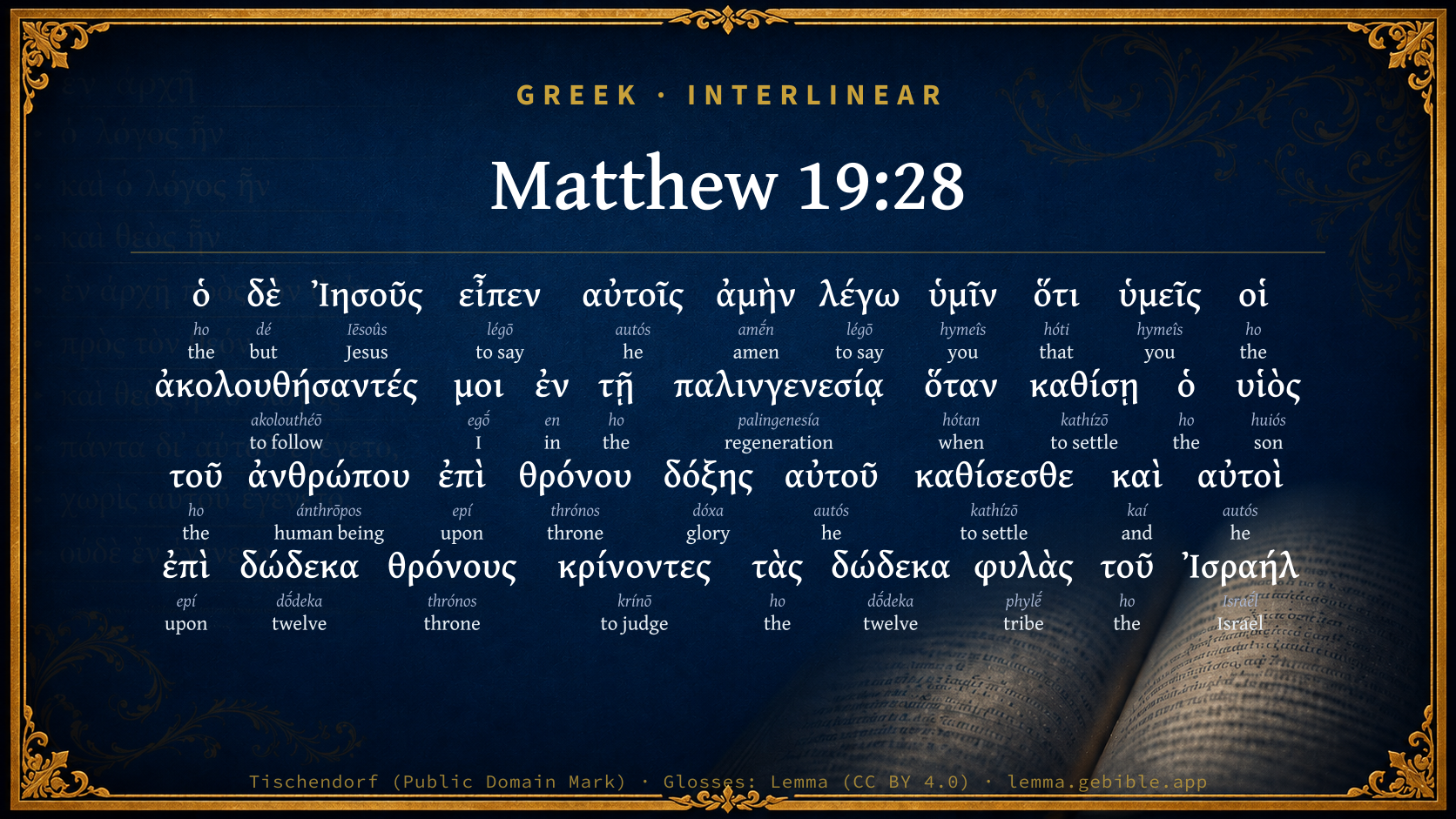
Download image
Cite this verse

Matthew 19:28 (World English Bible). Public Domain. Lemma interlinear Bible study tool, https://lemma.gebible.app/v/matthew/19/28.

Show BibTeX & RIS
BibTeX
RIS
English Translation
Jesus said to them, "Most assuredly I tell you that you who have followed me, in the regeneration when the Son of Man will sit on the throne of his glory, you also will sit on twelve thrones, judging the twelve tribes of Israel.
World English Bible · Public Domain
Highlights
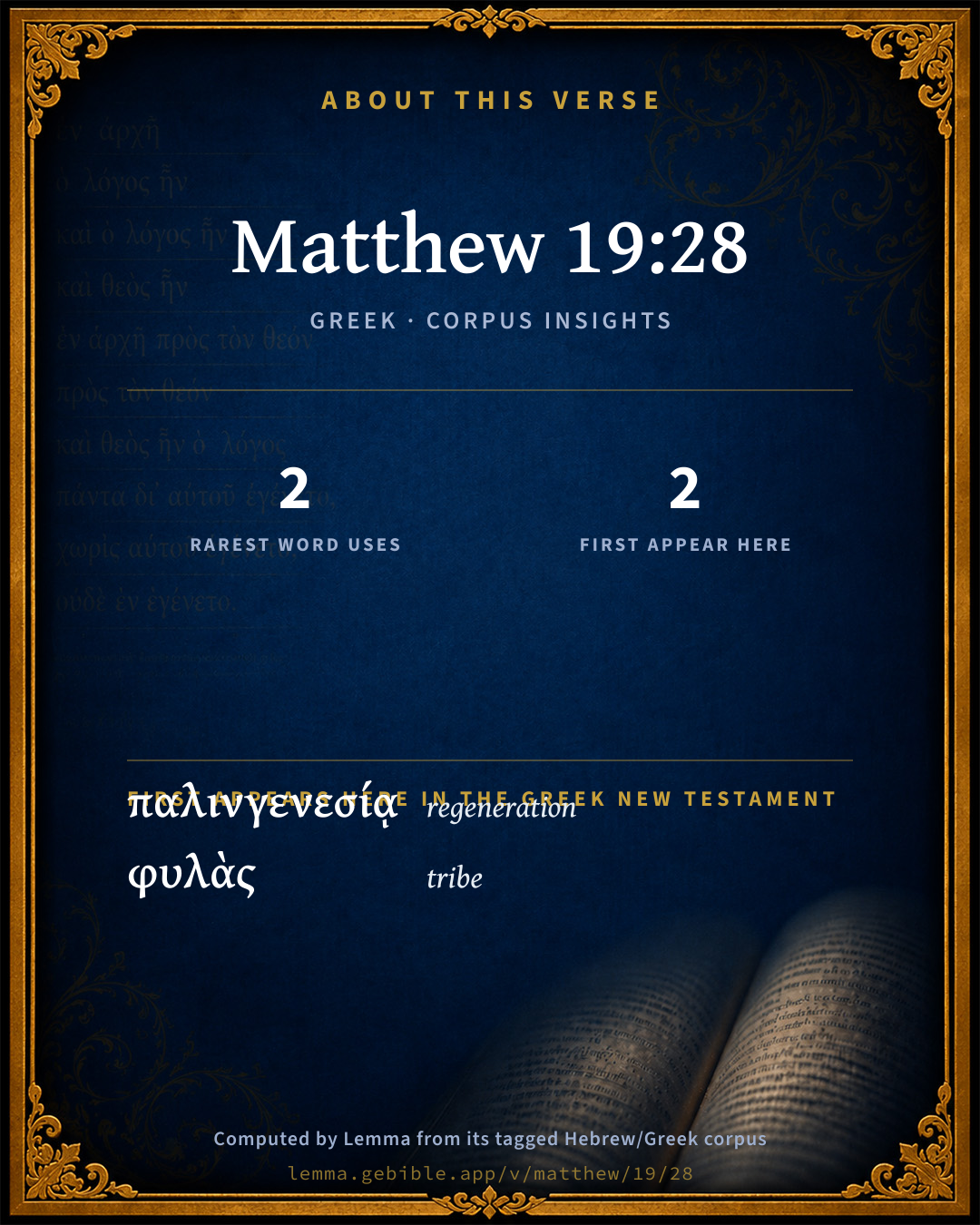
  • 2 first appearances in the Greek New Testament
Full analysis ↓
Download a study sheet

One document with this verse’s original text, its word-by-word gloss line, the meaning frame, cross-references with their text, attributed commentary, and full source and license credits — printable, and it pastes into notes with its structure intact.

This verse Autodidact and up

Study sheet (.html) Plain text (.txt)

A passage Seminary Student

Up to 50 verses in one chapter. A passage sheet keeps up to 6 commentary sources and 12 cross-references per verse, in the order this page ranks them, and says so on the sheet whenever that leaves anything out. Ask for a single verse and you get the Autodidact verse sheet above.

Everything on this page stays free to read, with no account — the sheet is a download of what is already on screen, not access to it.

Want to remove ads? Support Godless Engineer
Compare translations 3

The same verse in 3 English versions, stacked beneath the original-language interlinear above. Click any original word for its lexicon entry.

Each is an independent rendering of the whole verse — the interlinear is not word-aligned to these translations.

Highlighted words mark where these versions differ — a whole-verse word diff, not a word-by-word alignment.

  • World English Bible Public Domain
    Jesus said to them, "Most assuredly I tell you that you who have followed me, in the regeneration when the Son of Man will sit on the throne of his glory, you also will sit on twelve thrones, judging the twelve tribes of Israel.
  • King James Version Public Domain
    And Jesus said unto them, Verily I say unto you, That ye which have followed me, in the regeneration when the Son of man shall sit in the throne of his glory, ye also shall sit upon twelve thrones, judging the twelve tribes of Israel.
  • unfoldingWord Literal Text CC BY-SA 4.0
    And Jesus said to them, “Truly I say to you that in the renewal when the Son of Man sits on his throne of glory, you, the ones having followed me, you also will sit upon 12 thrones, judging the 12 tribes of Israel.

unfoldingWord Literal Text — © unfoldingWord, licensed CC BY-SA 4.0. Word-aligned USFM3 via Door43 (git.door43.org/unfoldingWord/en_ult).

Versions to compare (up to 4)

3 of 4 selected

Show all 19 translations

Every available English version of this verse, each an independent rendering of the whole verse.

  • World English Bible Public Domain
    Jesus said to them, "Most assuredly I tell you that you who have followed me, in the regeneration when the Son of Man will sit on the throne of his glory, you also will sit on twelve thrones, judging the twelve tribes of Israel.
  • Berean Standard Bible Public Domain
    Jesus said to them, “Truly I tell you, in the renewal of all things, when the Son of Man sits on His glorious throne, you who have followed Me will also sit on twelve thrones, judging the twelve tribes of Israel.
  • Majority Standard Bible Public Domain
    Jesus said to them, “Truly I tell you, in the renewal of all things, when the Son of Man sits on His glorious throne, you who have followed Me will also sit on twelve thrones, judging the twelve tribes of Israel.
  • King James Version Public Domain
    And Jesus said unto them, Verily I say unto you, That ye which have followed me, in the regeneration when the Son of man shall sit in the throne of his glory, ye also shall sit upon twelve thrones, judging the twelve tribes of Israel.
  • American Standard Version (1901) Public Domain
    And Jesus said unto them, Verily I say unto you, that ye who have followed me, in the regeneration when the Son of man shall sit on the throne of his glory, ye also shall sit upon twelve thrones, judging the twelve tribes of Israel.
  • Revised Version (1885) Public Domain
    And Jesus said unto them, Verily I say unto you, that ye which have followed me, in the regeneration when the Son of man shall sit on the throne of his glory, ye also shall sit upon twelve thrones, judging the twelve tribes of Israel.
  • Geneva Bible (1599) Public Domain
    And Iesus said vnto them, Verely I say to you, that when the Sonne of man shall sit in the throne of his maiestie, ye which folowed me in the regeneration, shall sit also vpon twelue thrones and iudge the twelue tribes of Israel.
  • Douay-Rheims (1899) Public Domain
    And Jesus said to them: Amen, I say to you, that you, who have followed me, in the regeneration, when the Son of man shall sit on the seat of his majesty, you also shall sit on twelve seats judging the twelve tribes of Israel.
  • Young's Literal Translation Public Domain
    And Jesus said to them, `Verily I say to you, that ye who did follow me, in the regeneration, when the Son of Man may sit upon a throne of his glory, shall sit -- ye also -- upon twelve thrones, judging the twelve tribes of Israel;
  • Literal Standard Version CC BY-SA 4.0
    And Jesus said to them, “Truly I say to you that you who followed Me, in the regeneration, when the Son of Man may sit on a throne of His glory, will sit—you also—on twelve thrones, judging the twelve tribes of Israel;
  • Unlocked Literal Bible CC BY-SA 4.0
    Jesus said to them, “Truly I say to you, in the new age when the Son of Man sits on his glorious throne, you who have followed me will also sit upon twelve thrones, judging the twelve tribes of Israel.
  • unfoldingWord Literal Text CC BY-SA 4.0
    And Jesus said to them, “Truly I say to you that in the renewal when the Son of Man sits on his throne of glory, you, the ones having followed me, you also will sit upon 12 thrones, judging the 12 tribes of Israel.
  • Darby Bible Public Domain
    And Jesus said to them, Verily I say unto you, That *ye* who have followed me, in the regeneration when the Son of man shall sit down upon his throne of glory, *ye* also shall sit on twelve thrones, judging the twelve tribes of Israel.
  • World Messianic Bible Public Domain
    Yeshua said to them, “Most certainly I tell you that you who have followed me, in the regeneration when the Son of Man will sit on the throne of his glory, you also will sit on twelve thrones, judging the twelve tribes of Israel.
  • Webster's Bible Public Domain
    And Jesus said to them, Verily I say to you, that ye who have followed me in the regeneration, when the Son of man shall sit on the throne of his glory, ye also shall sit upon twelve thrones, judging the twelve tribes of Israel.
  • Free Bible Version CC BY-SA 4.0
    Jesus replied, “I tell you the truth: when everything is remade and the Son of man sits on his glorious throne, you who have followed me will also sit on twelve thrones, judging the twelve tribes of Israel.
  • Bible in Basic English Public Domain
    And Jesus said to them, Truly I say to you that in the time when all things are made new, and the Son of man is seated in his glory, you who have come after me will be seated on twelve seats, judging the twelve tribes of Israel.
  • Text-Critical English NT CC BY 4.0
    Jesus said to them, “Truly I say to you, when all things are made new and the Son of Man sits on his throne of glory, you who have followed me will also sit on twelve thrones, judging the twelve tribes of Israel.
  • Tyndale New Testament (1534) Public Domain
    Iesus sayde vnto them: verely I saye to you: when the sonne of man shall syt in the seate of his maieste ye which folowe me in the seconde generacion shall syt also vpon.xii. seates and iudge the.xii. tribes of Israel.

Literal Standard Version (2020), Covenant Press — licensed CC BY-SA 4.0. Text via the HelloAO Bible API (eBible.org). Unlocked Literal Bible (unfoldingWord) — licensed CC BY-SA 4.0. Text via the HelloAO Bible API (eBible.org). unfoldingWord Literal Text — © unfoldingWord, licensed CC BY-SA 4.0. Word-aligned USFM3 via Door43 (git.door43.org/unfoldingWord/en_ult). Free Bible Version, Dr. Jonathan Gallagher — licensed CC BY-SA 4.0. Text via the HelloAO Bible API (eBible.org).

Word by word

More ways to search: Search by grammar → Find every occurrence → Compare this word →

Practice this passage: Drill this verse → Learn its vocabulary →

παλινγενεσίᾳ
palingenesía
G3824
“regeneration”
Noun, Dative, Singular, Feminine
Part of Speech
Noun
Case
Dative
Number
Singular
Gender
Feminine
Full Thayer's Definition

Origin: from G3825 and G1078

TDNT: 12:26,1

1. new birth, reproduction, renewal, recreation, regeneration a. hence renovation, regeneration, the production of a new life consecrated to God, a radical change of mind for the better. The word often used to denote the restoration of a thing to its pristine state, its renovation, as a renewal or restoration of life after death b. the renovation of the earth after the deluge c. the renewal of the world to take place after its destruction by fire, as the Stoics taught d. the signal and glorious change of all things (in heaven and earth) for the better, that restoration of the primal and perfect condition of things which existed before the fall of our first parents, which the Jews looked for in connection with the advent of the Messiah, and which Christians expected in connection with the visible return of Jesus from heaven. e. other uses 1. of Cicero's restoration to rank and fortune on his recall from exile 2. of the restoration of the Jewish nation after exile 3. of the recovery of knowledge by recollection
  1. ὁ ho G3588 “the” Article, Nominative, Singular, Masculine
  2. δὲ dé G1161 “but” Conjunction
  3. Ἰησοῦς Iēsoûs G2424 “Jesus” Noun, Nominative, Singular, Masculine
  4. εἶπεν légō G3004 “to say” Verb, Aorist, Active, Indicative, 3rd person, Singular
  5. αὐτοῖς autós G846 “he” Personal pronoun, Dative, Plural, Masculine
  6. ἀμὴν amḗn G281 “amen” Hebrew transliteration
  7. λέγω légō G3004 “to say” Verb, Present, Active, Indicative, 1st person, Singular
  8. ὑμῖν hymeîs G5210 “you” Personal pronoun, 2nd person, Dative, Plural
  9. ὅτι hóti G3754 “that” Conjunction
  10. ὑμεῖς hymeîs G5210 “you” Personal pronoun, 2nd person, Nominative, Plural
  11. οἱ ho G3588 “the” Article, Nominative, Plural, Masculine
  12. ἀκολουθήσαντές akolouthéō G190 “to follow” Verb, Aorist, Active, Participle, Nominative, Plural, Masculine
  13. μοι egṓ G1473 “I” Personal pronoun, 1st person, Dative, Singular
  14. ἐν en G1722 “in” Preposition
  15. τῇ ho G3588 “the” Article, Dative, Singular, Feminine
  16. ὅταν hótan G3752 “when” Conjunction
  17. καθίσῃ kathízō G2523 “to settle” Verb, Aorist, Active, Subjunctive, 3rd person, Singular
  18. ὁ ho G3588 “the” Article, Nominative, Singular, Masculine
  19. υἱὸς huiós G5207 “son” Noun, Nominative, Singular, Masculine
  20. τοῦ ho G3588 “the” Article, Genitive, Singular, Masculine
  21. ἀνθρώπου ánthrōpos G444 “human being” Noun, Genitive, Singular, Masculine
  22. ἐπὶ epí G1909 “upon” Preposition
  23. θρόνου thrónos G2362 “throne” Noun, Genitive, Singular, Masculine
  24. δόξης dóxa G1391 “glory” Noun, Genitive, Singular, Feminine
  25. αὐτοῦ autós G846 “he” Personal pronoun, Genitive, Singular, Masculine
  26. καθίσεσθε kathízō G2523 “to settle” Verb, Future, Middle, Indicative, 2nd person, Plural
  27. καὶ kaí G2532 “and” Conjunction
  28. αὐτοὶ autós G846 “he” Personal pronoun, Nominative, Plural, Masculine
  29. ἐπὶ epí G1909 “upon” Preposition
  30. δώδεκα dṓdeka G1427 “twelve” Adjective, Numeral (indeclinable)
  31. θρόνους thrónos G2362 “throne” Noun, Accusative, Plural, Masculine
  32. κρίνοντες krínō G2919 “to judge” Verb, Present, Active, Participle, Nominative, Plural, Masculine
  33. τὰς ho G3588 “the” Article, Accusative, Plural, Feminine
  34. δώδεκα dṓdeka G1427 “twelve” Adjective, Numeral (indeclinable)
  35. φυλὰς phylḗ G5443 “tribe” Noun, Accusative, Plural, Feminine
  36. τοῦ ho G3588 “the” Article, Genitive, Singular, Masculine
  37. Ἰσραήλ Israḗl G2474 “Israel” Noun, Proper, indeclinable

About this verse

These counts appear in no published source. They are computed here, from the morphology-tagged text and Lemma’s own curated glosses. What Lemma adds →

38
words
24
distinct lemmas
Gospels
section

Notable vocabulary

The rarest word here is παλινγενεσίᾳ regeneration G3824 — appearing just 2 times in the whole Greek New Testament.

First appearance in Scripture

These words make their first canonical appearance in the Greek New Testament here:

  • παλινγενεσίᾳ regeneration G3824
  • φυλὰς tribe G5443

Shared distinctive vocabulary

παλινγενεσίᾳ regeneration G3824 occurs in 2 verses of the Greek New Testament. Also found in:
Repetition

Words recur within this verse:

  • εἶπεν to say G3004 ×2
  • καθίσῃ to settle G2523 ×2
  • ἐπὶ upon G1909 ×2
  • θρόνου throne G2362 ×2
  • δώδεκα twelve G1427 ×2
  • ὁ the G3588 ×7
  • αὐτοῖς he G846 ×3
  • ὑμῖν you G5210 ×2

Cross-references

27

Topical passages linked to Matthew 19:28 in the Treasury of Scripture Knowledge — connected by theme and wording, ordered by reader-vote popularity; previews shown in the World English Bible.

  • Luke 22:28–30 But you are those who have continued with me in my trials.
  • Matthew 25:31 "But when the Son of Man comes in his glory, and all the holy angels with him, then he will sit on the throne of his glory.
  • 1 Corinthians 6:2–3 Don't you know that the saints will judge the world? And if the world is judged by you, are you unworthy to judge the smallest matters?
  • Revelation 20:4 I saw thrones, and they sat on them, and judgment was given to them. I saw the souls of those who had been beheaded for the testimony of Jesus, and for the word of God, and such as didn't worship the beast nor his image, and didn't receive the mark on their forehead and on their hand. They lived, and reigned with Christ for the thousand years.
  • Isaiah 65:17 For, behold, I create new heavens and a new earth; and the former things shall not be remembered, nor come into mind.
  • Matthew 16:27 For the Son of Man will come in the glory of his Father with his angels, and then he will render to everyone according to his deeds.
  • 2 Timothy 2:12 If we endure, We will also reign with him. If we deny him, He also will deny us.
  • Revelation 2:26–27 He who overcomes, and he who keeps my works to the end, to him I will give authority over the nations.
  • Revelation 3:21 He who overcomes, I will give to him to sit down with me on my throne, as I also overcame, and sat down with my Father on his throne.
  • Revelation 4:4 Around the throne were twenty-four thrones. On the thrones were twenty-four elders sitting, dressed in white garments, with crowns of gold on their heads.
  • Revelation 20:11–15 I saw a great white throne, and him who sat on it, from whose face the earth and the heaven fled away. There was found no place for them.
  • Revelation 21:5 He who sits on the throne said, "Behold, I am making all things new." He said, "Write, for these words of God are faithful and true."
  • Isaiah 66:22 For as the new heavens and the new earth, which I will make, shall remain before me, says Yahweh, so shall your seed and your name remain.
  • Matthew 20:21 He said to her, "What do you want?" She said to him, "Command that these, my two sons, may sit, one on your right hand, and one on your left hand, in your Kingdom."
  • 2 Peter 3:13 But, according to his promise, we look for new heavens and a new earth, in which dwells righteousness.
  • Revelation 7:4 I heard the number of those who were sealed, one hundred forty-four thousand, sealed out of every tribe of the children of Israel:
  • Exodus 24:4 Moses wrote all the words of Yahweh, and rose up early in the morning, and built an altar under the mountain, and twelve pillars for the twelve tribes of Israel.
  • Acts 3:21 whom heaven must receive until the times of restoration of all things, which God spoke long ago by the mouth of his holy prophets.
  • 2 Thessalonians 1:7–10 and to give relief to you that are afflicted with us, when the Lord Jesus is revealed from heaven with his mighty angels in flaming fire,
  • Exodus 15:27 They came to Elim, where there were twelve springs of water, and seventy palm trees: and they encamped there by the waters.
  • Exodus 28:21 The stones shall be according to the names of the children of Israel, twelve, according to their names; like the engravings of a signet, everyone according to his name, they shall be for the twelve tribes.
  • Leviticus 24:5 "You shall take fine flour, and bake twelve cakes of it: two tenth parts of an ephah shall be in one cake.
  • Joshua 3:12 Now therefore take twelve men out of the tribes of Israel, for every tribe a man.
  • 1 Kings 18:31 Elijah took twelve stones, according to the number of the tribes of the sons of Jacob, to whom the word of Yahweh came, saying, Israel shall be your name.
  • Ezra 6:17 They offered at the dedication of this house of God one hundred bulls, two hundred rams, four hundred lambs; and for a sin-offering for all Israel, twelve male goats, according to the number of the tribes of Israel.
  • Revelation 21:12–14 having a great and high wall; having twelve gates, and at the gates twelve angels; and names written on them, which are the names of the twelve tribes of the children of Israel.
  • Revelation 22:2 in the middle of its street. On this side of the river and on that was the tree of life, bearing twelve kinds of fruits, yielding its fruit every month. The leaves of the tree were for the healing of the nations.

Cross-references courtesy of OpenBible.info (CC BY 4.0).

Where the printed editions differ

1 variant

Places in this verse where the major printed Greek editions disagree on the wording in a way that affects the translation — a comparison of editions, not a manuscript-by-manuscript collation. The editions are the modern critical texts (Nestlé-Aland 28/27, SBL, Westcott-Hort, Tregelles, Tyndale House) and the traditional texts behind the KJV (the Textus Receptus and the Byzantine/Majority text). It is not a claim about which reading is original.

  1. Different wording
    ὑμεῖς

    “you yourselves”

    In NA28NA27TynSBLWHTRByz Not in Treg

    αὐτοὶ (autoi) 'they themselves' occurs in a few manuscripts (Treg) instead of ὑμεῖς (humeis) 'you yourselves' in older manuscripts (NA28+NA27+Tyn+SBL+WH+TR+Byz)

Textual data: Translators Amalgamated Greek New Testament (STEPBible TAGNT) · CC BY 4.0.

Commentary

Notes on Matthew 19:28 from classic Christian and Jewish commentators (each source and its license shown beneath its notes). The classic Christian expositions comment on the surrounding passage and are grouped to its opening verse, so a note may address several verses; the Jewish commentaries on the Tanakh (Rashi and others) are per-verse, so they appear only where the commentator wrote on this verse.

Lemma curates 59 commentaries, every one of them public domain or Creative Commons licensed, each selected and text-cleaned for this edition rather than reprinted as found. About our sources →

Tyndale Open Study Notes

Tyndale Open Resources

19:28 you . . . will also sit on twelve thrones: The disciples’ part in judging is a reversal—those who are wealthy and powerful now will be judged by those who are humble and poor (see 19:30). • Judging can mean both ruling and condemning (see Rev 20:4).

Tyndale Open Study Notes — © Tyndale Open Resources, licensed CC BY-SA 4.0. Text via the HelloAO Bible API.

Bengel's Gnomon

Johann Albrecht Bengel

Mat 19:28. Ὁ δὲ Ἰησοῦς εἶπεν αὐτοῖς, κ.τ.λ., but Jesus said unto them, etc.) Peter had joined together we have left all, and we have followed Thee. Our Lord replies to these things separately; for the latter (Mat 19:28) was peculiar to the apostles; the former (Mat 19:29) common to them with others. See Psa 45:10-11.—ὑμεῖς—καὶ ὑμεῖς, ye—ye also) sc. you Twelve.—ἐν τῇ παλιγγενεσίᾳ, in the regeneration) This is to be construed with the following, not the preceding words: for the following after Jesus is usually mentioned alone, without this addition: by which the time of the session, which is immediately spoken of, is suitably marked. There will be a new creation, over which the second Adam will preside, when the whole microcosm of human nature, by means of the resurrection, and also the macrocosm of the universe, will be born again (genesin iteratam habebit). Cf. Act 3:21; Rev 21:5; Mat 26:29.—Regeneration (παλιγγενεσία) and renovation (ἀνακαίνωσις) are joined together in Tit 3:5.—Then we shall be sons; see Luk 20:36; Rom 8:23; 1Jn 3:2.—καθίσεσθε, ye shall sit) The middle voice is used in the case of the disciples, the active, καθίσῃ, in that of the Lord. At the beginning of the judgment the disciples will stand; see Luk 21:36; 2Co 5:10; afterwards, having been absolved from all charges against them, they will sit with Him; see 1Co 6:2.—θρόνους, thrones) Another has taken the throne of Judas; see Act 1:20. Concerning the thrones, cf. Rev 20:4.—κρίνοντες, judging) In the time of the Judges there was a theocracy, concerning which see my exposition of the Apocalypse, p. 553. Thus, in the first millennium, restored Israel, its enemies having been destroyed, will have judges again; see Isa 1:26. The promise, however, given to the apostles, refers to a still more distant period.—δώδεκα, twelve) The number of princes in Num 8:2, etc., and of apostles in Rev 21:12; Rev 21:14, corresponds with that of the tribes of Israel.—φυλὰς, κ.τ.λ., tribes, etc.) to which the apostles had, in the first instance, been sent.

Bengel's Gnomon of the New Testament — English translation (T&T Clark, Edinburgh, 1860) — public domain. Text from a community e-Sword module.

Meyer's Critical & Exegetical Commentary

Heinrich August Wilhelm Meyer

Mat_19:28. This part of the promise is omitted in Mark, but comp. Luk_22:30.

In answer to the question concerning the reward, Jesus, in the first place, promises a special recompense to His disciples, namely, that they should have the honour of being associated with Him in judging the nation at the second coming; then, in Mat_19:29 (comp. Mar_10:29; Luk_18:29), He adds the general promise of a reward to be given to those who for His sake have sacrificed their worldly interests; and finally, in Mat_19:30, He makes a statement calculated to rebuke everything in the shape of false pretensions, and which is further illustrated by the parable in Mat_20:1 ff.

There is no touch of irony throughout this reply of Jesus (in answer to Liebe in Winers exeget. Stud. I. p. 73). Comp. Fleck, de regno div. p. 436 ff.

ἐν τῇ παλιγγενεσίᾳ] in the regeneration, does not belong to ἀκολουθήσαντές μοι (Hilary, explaining the words by baptismal regeneration (Tit_3:5); also Calvin, who understands by παλιγγενεσία the renovation of the world begun in Christs earthly ministry), for the disciples could only have conceived of the renovation of the world as something that was to take place contemporaneously with the actual setting up of the kingdom; the ἀποκατάστασις, Act_3:21, does not represent quite the same idea as the one at present in question. Neither are we, with Paulus, to insert a point after παλιγγεν., and supply ἐστε (you are already in the position of those who have been regenerated, spiritually transformed), which would have the effect of introducing a somewhat feeble and irrelevant idea, besides being incompatible with the abruptness that would thus be imparted to the ὅταν (otherwise one should have expected ὅταν δέ). The words belong to καθίσεσθε, and signify that change by which the whole world is to be restored to that original state of perfection in which it existed before the fall, which renewal, restitutio in integrum, is to be brought about by the coming Messiah (חדוש העולם). See Buxtorf, Lex Talm. p. 712; Bertholdt, Christol. p. 214 f.; Gfrörer, Jahrh. d. Heils, II. p. 272 ff. Comp. Rom_8:19 ff; 2Pe_3:13. When the resurrection is over, and the last judgment is going on (and it is to this part of the scene that the Lord is here referring), this renovation will have already begun, and will be in the course of development, so that Jesus can say with all propriety: ἐν τῇ παλιγγ. Nova erit genesis, cui præerit Adamus secundus, Bengel. Comp. παλιγγενεσία τῆς πατρίδος in Joseph. Antt. xi. 3. 9; παλιγγεν. τῶν ὅλων in Anton. xi. 1. Philo, de mund. p. 1165 C.; leg. ad Caj. p. 1037 B. Augustine, Theophylact, Euthymius Zigabenus, Fritzsche, interpret the expression of the resurrection, in favour of which such passages might be quoted as Long. iii. 4; Lucian, Musc. enc. 7; but this would be to understand it in too restricted a sense, besides being contrary to regular New Testament usage (ἀνάστασις).

ὅταν καθίσῃ, κ.τ.λ.] as judge.

δόξης αὐτοῦ] the throne, that is, on which the Messiah shows Himself in His glory, Mat_25:31.

καὶ αὐτοί (see critical notes): likewise, just as the Messiah will sit on His throne.

καθίσεσθε] you will take your seats upon. Christ, then, is to be understood as already sitting. Moreover, though the promise applies, in a general way, to the twelve disciples, it does not preclude the possibility of one of them failing, through his apostasy, to participate in the fulfilment of the promise; thronum Judae sumsit alius, Act_1:20, Bengel.

κρίνοντες] not: ruling over (Grotius, Kuinoel, Neander, Bleek), but, as the word means and the context requires: judging. As believers generally are to be partakers of the glory and sovereignty of Christ (Rom_8:17; 2Ti_2:12), and are to be associated with Him in judging the non-Christian κόσμος (1Co_6:2), so here it is specially promised to the disciples as such that they shall have the peculiar privilege of taking part with Him in judging the people of Israel. But it is evident from 1Co_6:2 that the people of Israel is conceived of as still forming part of the κόσμος, therefore it will be so far still unconverted, which coincides with the view that the second coming is near at hand, Mat_10:23. It is a mistake, therefore, to take the people of Israel as intended to represent the people of God in the Christian sense (de Wette, Bleek); but it is no less so to suppose that the judging in question is merely of an indirect character, such as that which in Mat_12:41 is ascribed to the queen of the south and the Ninevites (Chrysostom, Euthymius Zigabenus, Erasmus, Maldonatus),a view which does not at all correspond with the picture of the judgment given in the text, although those expositors correctly saw that it is the unbelieving Israel that is meant. This sitting upon twelve thrones belongs to the accidental, Apocalyptic form in which the promise is embodied, though it is not so with regard either to the judging itself or its special reference to the δωδεκάφυλον of Israel (Act_26:7), to which latter the number of the apostles expressly corresponds; for the second coming, instead of subverting the order of things here indicated, will only have the effect of exhibiting it in its perfection, and for the apostles themselves in its glory. It is therefore too rash to infer, as has been done by Hilgenfeld, that this passage bears traces of having been based upon an original document of a strictly Judaeo-Christian character. Even the Pauline Luke (Mat_22:30) does not omit this promise, although he gives it in connection with a different occasion,a circumstance which by Schneckenburger, without sufficient reason, and by Volkmar, in the most arbitrary way possible, is interpreted to the disadvantage of Matthew. It is not the case that Mat_19:28 interferes with the connection (Holtzmann), although Weizsäcker also is disposed to regard it as a manifest interpolation.

Meyer — Critical and Exegetical Commentary on the New Testament — English translation by Peter Christie, edited by Frederick Crombie (T&T Clark, 1880) — public domain. Text from a community e-Sword module.

Expositor's Greek Testament

ed. W. Robertson Nicoll

Mat 19:28 . ἀμὴν : introducing a solemn statement. ὑμεῖς οἱ ἀκ .: not a nominative absolute (Palairet, Observ. ), but being far from the verb, ὑμεῖς is repeated (with καὶ ) after καθίσεσθε . ἐν τ . παλινγενεσίᾳ to be connected with καθίσεσθε following. This is a new word in the Gospel vocabulary, and points to the general renewal “re-genesis (nova erit genesis cui praeerit Adamus ii., Beng.)” in the end of the days, which occupied a prominent place in Jewish apocalyptic hopes. The colouring in this verse is so strongly apocalyptic as to have suggested the hypothesis of interpolation (Weizsäcker), or of a Jewish-Christian source (Hilgenfeld). It is not in the parallels, but something similar occurs in Luk 22:30 . Commentators translate this promise, so strongly Jewish in form, into Christian ideas, according to their taste, reading into it what was not there for the disciples when it was spoken.

The Expositor's Greek Testament, edited by W. Robertson Nicoll (1897–1910) — public domain. Text from a community e-Sword module.

Geneva Bible (1599)

Geneva Bible translators

It is not lost, that is neglected for God’s sake.

The regeneration is taken for that day, wherein the elect shall begin to live a new life, that is to say, when they shall enjoy the heavenly inheritance, both in body and soul.

Geneva Bible (1599) marginal notes — public domain. Text via Bolls.life.

Adam Clarke's Commentary

Verse 28. Ye which have followed me, in the regeneration, when the Son of man shall sit in the throne of his glory, c.] The punctuation which I have observed here, is that which is followed by the most eminent critics: the regeneration is thus referred to the time when Jesus shall sit on the throne of his glory, and not to the time of following him, which is utterly improper.

The regeneration, παλιγγενεσια. Some refer this to the time in which the new heavens and the new earth shall be created, and the soul and body united. The Pythagoreans termed that παλιγγενεσια, when, according to their doctrine of the transmigration or metempsychosis, the soul entered into a new body, and got into a new state of being. Clement, in his Epistle to the Corinthians, calls the restoration of the world, after the deluge, by the same name.

Judging the twelve tribes] From the parallel place, Lu 22:28-30, it is evident that sitting on thrones, and judging the twelve tribes, means simply obtaining eternal salvation, and the distinguishing privileges of the kingdom of glory, by those who continued faithful to Christ in his sufferings and death.

Judging, κρινοντες. Kypke has shown that κρινεσθαι is to be understood in the sense of governing, presiding, holding the first or most distinguished place. Thus, Ge 49:16, Dan shall JUDGE his people, i.e. shall preside in, or rule over them shall occupy a chief place among the tribes. It is well known that the Judges among the Jews were moderators, captains, chief, or head men. The sense therefore of our Lord's words appears to be, that these disciples should have those distinguished seats in glory which seem to belong peculiarly to the first confessors and martyrs. See 1Th 4:14; 1Th 4:16, and particularly Re 20:4-6.

The last-quoted passage brings into view the doctrine of the Millennium, when Jesus, after having formed the new heavens and the new earth, shall reign here gloriously among his ancients 365,000 years; for the thousand years referred to above are certainly prophetical years, in which, it is well known, each day stands for a year.

Others, of no mean note, are of opinion that the regeneration means the conversion of men by the preaching of the Gospel - that sitting on twelve thrones signifies the state of eminent dignity to which the apostles should be raised - and that judging the twelve tribes of Israel, means no more than exercising authority in the Church, and dispensing laws to the people of God. But I confess I do not see the propriety of this application of the terms, as the following verse seems to fix the meaning mentioned above.

Adam Clarke's Commentary on the Bible (1810–1826) — public domain. Text from a community e-Sword/MySword module.

Ellicott's Commentary for English Readers

(28) In the regeneration.—In the only other passage in the New Testament in which the word occurs, it is applied to baptism (Tit_3:5), as the instrument of the regeneration or new birth of the individual believer. Here, however, it clearly has a wider range. There is to be a “new birth” for mankind as well as for the individual. The sorrows through which the world was to pass were to be as the travail-pangs of that passage into a higher life. (See Note on Mat_24:8.) Beyond them there lay, in the thoughts of the disciples, and, though after another pattern, in the mind of Christ, the times of the “restitution of all things” (Act_3:21), the coming of the victorious Christ in the glory of His kingdom. In that triumph the Twelve were to be sharers. Interpreted as they in their then stage of progress would necessarily interpret them, the words suggested the idea of a kingdom restored to Israel, in which they should be assessors of the divine King, not only or chiefly in the great work of judging every man according to his works, but as “judging,” in the old sense of the word, the “twelve tribes of Israel,” redressing wrongs, guiding, governing. As the words that the Son of Man should “sit on the throne of His glory” recalled the vision of Dan_7:14, so these assured them that they should be foremost among those of “the saints of the Most High,” to whom, as in the same vision, had been given glory and dominion (Dan_7:27). The apocalyptic imagery in which the promise was clothed reappears in the vision of the four-and-twenty elders seated on their thrones in Rev_4:4, in the sealing of the hundred and forty-four thousand of all the tribes of Israel in Rev_7:4, and the interpretation of the words here is subject to the same conditions as that of those later visions. What approximations to a literal fulfilment there may be in the far-off future lies behind the veil. They receive at least an adequate fulfilment if we see in them the promise that, in the last triumphant stage of the redeeming work, the Apostles should still be recognised and had in honour, as guiding the faith and conduct of their countrymen; their names should be on the twelve foundations of the heavenly Jerusalem (Rev_21:14); they should be sharers in the throne and glory of its King. The thought on which St. Paul dwells, that the “saints shall judge the world” (1Co_6:2), in like manner refers not only or chiefly to any share which the disciples of Christ shall have in the actual work of the final judgment, but to the assured triumph of the faith, the laws, the principles of action of which they were then the persecuted witnesses. We must not ignore the fact that, in at least one instance, the words, absolute as they were in their form, failed of their fulfilment. The guilt of Judas left one of the thrones vacant. The promise was given subject to the implied conditions of faithfulness and endurance lasting even to the end.

A Bible Commentary for English Readers, edited by Charles John Ellicott (1878–1897) — public domain. Text from a community e-Sword module.

The Cambridge Bible for Schools and Colleges

gen. ed. J. J. S. Perowne

28. the regeneration] “The renewal of things,” “the return to a perfect state,” otherwise called “the restitution of all things,” nearly= the Kingdom of God. Cp. ch. Mat_17:11.

The Cambridge Bible for Schools and Colleges (gen. ed. J. J. S. Perowne; Cambridge University Press, 1878–1918) — public domain. Text from a community e-Sword module.

John Gill's Exposition

And Jesus said unto them,.... To all the disciples whom Peter represented;

verily I say unto you: the thing being something very considerable, and of great moment, Christ uses the asseveration he sometimes does in such cases:

that ye which have followed me. Christ does not deny that they had forsaken all for his sake, nor does he despise it, because it was but little they left, though he does not repeat it; but only takes notice of their following him, which, including their faith in him, their profession of him, and subjection to him, was a much greater action, and of more importance that the other, and therefore is only mentioned, and which our Lord confirms:

in the regeneration. This clause is so placed, that it may be read in connection with the preceding words, and be understood of the disciples following Christ in the regeneration; meaning, not the grace of regeneration, in which they could not be said, with propriety, to follow Christ; and one of them was never a partaker of it: but the new state of things, in the church of God, which was foretold, and is called the time of reformation, or setting all things right, which began upon the sealing up the law, and the prophets, and the ministry of John the Baptist, and of Christ; who both, when they began to preach, declared, that this time, which they call the kingdom of heaven, was at hand, just ushering in. Now the twelve apostles followed Christ herein: they believed, and professed him to be the Messiah; they received, what the Jews called, his new doctrine, and preached it to others; they submitted to the new ordinance of baptism, and followed Christ, and attended him wherever he went, working miracles, preaching the Gospel, and reforming the minds and manners of men. Now this new dispensation is called the regeneration, and which more manifestly took place after our Lord's resurrection, and ascension, and the pouring down of the Spirit; wherefore the phrase may be connected with the following words,

when the Son of man shall sit in the throne of his glory in the regeneration; not in the resurrection of the dead, or at the last judgment, but in this new state of things, which now began to appear with another face: for the apostles having a new commission to preach the Gospel to all the world; and being endued with power from on high for such service, in a short time went every where preaching the word, with great success. Gentiles were converted, as well as Jews, and both brought into a Gospel church state; the ceremonies of the old law being abolished, were disused; and the ordinances of baptism, and the Lord's supper, every where practised; old things passed away, and all things became new: agreeably to this the Syriac version renders the phrase, , "in the new world"; and so the Persic. The Arabic reads it, "in the generation", or "age to come"; which the Jews so often call the world, or age to come, the kingdom of the Messiah, the Gospel dispensation.

When the Son of man shall sit in the throne of his glory, or glorious throne; as he did when he ascended into heaven, and sat down at the right hand of God; and was then exalted as a prince, and made, or declared to be Lord and Christ; and was crowned in human nature, with honour, and glory, and angels, principalities, and powers, made subject to him:

ye also shall sit upon twelve thrones: for though Judas fell from his apostleship, yet Matthias was chosen in his room, and took his place, and made up the number twelve; a metaphorical phrase, setting forth the honour, dignity, and authority of their office and ministry, by which they should be

judging the twelve tribes of Israel; doctrinally and practically; by charging them with the sin of crucifying Christ, condemning them for their unbelief, and rejection of him, denouncing the wrath of God, and the heaviest judgments that should fall upon them, as a nation, for their sin; and by turning from them to the Gentiles, under which judgment they continue to this day. So the doctors among the Jews are represented as sitting and judging others: of "the potters", in Ch1 4:23 they say (l),

"these are the disciples of the law, or the lawyers, for whose sake the world is created, "who sit in judgment", and establish the world; and build, and perfect the ruins of the house of Israel.''

(l) Targuru in 1 Chron. iv. 23.

John Gill's Exposition of the Whole Bible (1746–1763) — public domain (CC PDM 1.0). Text via the HelloAO Bible API.

Trapp's Complete Commentary

John Trapp

28 And Jesus said unto them, Verily I say unto you, That ye which have followed me, in the regeneration when the Son of man shall sit in the throne of his glory, ye also shall sit upon twelve thrones, judging the twelve tribes of Israel.

Ver. 28. Ye which have followed me in the regeneration] As if our Saviour should have said, to forsake all is not enough, unless ye be regenerate; so some sense it. Others by regeneration understand the estate of the gospel, called elsewhere a new heaven and a new earth, 2Pe 3:13; the world to come, Heb 2:5; for God plants the heavens, and lays the foundation of the earth, that he may say to Zion, Thou art my people. There are those who understand by regeneration, the general resurrection (of which also some think Plato had heard, and therefore held, that in the revolution of so many years men should be just in the same estate wherein they were before). These that follow this latter sense, read the text thus, by an alteration of points, "Ye which have followed me, shall, in the regeneration (when the Son of man shall sit in his glory) sit upon twelve thrones," &c.

Ye shall also sit upon twelve thrones] And so many kings. Kings they are here, but somewhat obscure ones, as Melchisedech was; but shall then appear with Christ in glory, far outshining the sun in his strength, higher than all the kings of the earth, Col 3:4; Psa 89:27. When Daniel had described the greatness and glory of all the four monarchies of the world, at last he comes to speak of a kingdom which is the greatest and mightiest under the whole heaven, and that is "the kingdom of the saints of the most high," Dan 7:18. So glorious is their estate even here, what shall it be, then, at that great day? And if the saints (every one of them) shall judge the angels, what shall the apostles do? Surely as they absolved or condemned men in this world, so shall it fare with them at the general judgment.

John Trapp, A Commentary or Exposition upon All the Books of the Old and New Testament (1647–1656) — public domain. Text from a community e-Sword module.

Haydock's Catholic Bible Commentary

In the regeneration. Jesus Christ here calls the general resurrection the regeneration, because there will then be a renovation of the human body, and of the whole world. The promise which is here made to the apostles of sitting on thrones at the general judgment, and passing sentence on the 12 tribes of Israel, must not be understood as limited to the apostles, or to the Jews. For St. Paul says, (1 Corinthians vi. 2. and 3,) that not only he, but also many of the Corinthians to whom he was writing, would judge not merely the 12 tribes, but the whole world, and moreover angels themselves. It is the opinion of many of the Fathers, St. Jerome, St. Augustine, St. Gregory, and others, that all apostolical men, i.e. such as, renouncing the good of this life, adhere to Christ in mind and affection, and by every possible means promote his reign and the propagation of his gospel, will be so far honoured as to sit in judgment with him at the general resurrection. (Tirinus) --- You also shall sit on twelve seats, or thrones, meaning at the general resurrection, when Christ will appear on the throne of his majesty, with his heavenly court, and with his elect, shall condemn the wicked world. (Witham)

George Leo Haydock (1774–1849), Haydock's Catholic Family Bible and Commentary, 1859 edition — public domain. Excludes Psalms (Douay-Rheims chapter numbering differs from Protestant) and Deuterocanonical books (Catholic canon only).

Whedon's Commentary on the Bible

Daniel D. Whedon

28. Ye which have followed — In the inauguration of the apostles, in chapter Mat_16:19, the Lord appointed them rulers of the Church after his ascension, under the symbols of the keys and binding and loosing. Here he affirms the same appointment under the image of thrones and judging. The parallel passage in Luk_22:28-30, is explanatory of this, and should be diligently compared. Ye which have followed me, in the regeneration is explained by Ye which have continued with me in my temptations. In my temptations is antithetical with in the regeneration; the temptations denote the scenes of our Lord’s earthly ministry; the regeneration the state of things after his ascension. In the regeneration — As this regeneration is a plain antithesis to the temptations, the latter term needs a brief analysis. These temptations, first, were primarily our Lord’s own trials in his humiliation state. Their centre was his own person. But, second, they extended to those who followed him, namely, his disciples and believers. And, third, they characterized that period and state of things as a scene of humiliation and subjection. Antithetically to all this, the regeneration was at and after our Lord’s resurrection. It was primarily centered in our Lord’s own renovated person; for he then put off his servant form and put on his immortality. He ascended on high upon his throne of glory; yet to rule over his Church in heaven and earth. Second, that renovation over-spread and included his followers, especially his twelve apostles. By the Pentecostal Spirit they were endowed with power from on high; they entered on the possession of the kingdom appointed, (Luk_22:29;) they received and exercised the power of the keys of that kingdom; they ascended their twelve apostolic thrones as the viceroys of the Lord in his glorification. Thirdly, the Church was renewed and regenerated from the old to the new dispensation. The types and shadows had departed, the reign of the kingdom of God with power was begun. Sit in the throne of his glory — On the right hand of the Majesty on high. Heb_1:3. In that same throne of glory he shall judge the world. Mat_16:27; Mat_25:31. Sit upon twelve thrones — We have already remarked (Mat_10:1) that the number of the apostles was chosen in reference to the twelve tribes of Israel, as a symbolical intimation that Christ was king of Israel, and his apostles were his viceroys over the tribes. After the ascension the sacred number was still preserved, to indicate that the new kingdom was a virtual continuation as well as succession of the twelve tribes. The Son of man then sat upon his throne of glory; that is, his glorified throne; the apostles sat simply upon thrones. That these twelve thrones were their twelve apostolates in the Church on earth is confirmed by the next verse.

Daniel D. Whedon (gen. ed.), Commentary on the Old and New Testaments (1874–1909) — public domain. Text from a community e-Sword module.

The Pulpit Commentary

Verily I say unto you. Christ does not reprove the apostle for his seemingly bold self-assertion, but, replying to Peter"s question, he gives a grand promise to him and his fellow disciples. Ye which have followed me, excluding all the half-hearted, the self-seeking, the Judaizers. In the regeneration (th paliggenesia). The word means "new birth," or "renovation, renewal." It occurs in Tit_3:15 in reference to baptism," through the washing laver of regeneration." It has been variously interpreted in the present passage. Some have connected it with the participle preceding, "ye who have followed me in the regeneration," and explained it to mean the reformation and spiritual renovation commencing with the preaching of John the Baptist, and carried on by the ministry of Christ. But more generally and correctly it is taken with what follows, Ye shall sit, etc. The meaning, however, is still disputed. Some say that the Christian dispensation is intended, and an intimation is given of the work of the apostles in the unseen world in directing and guarding the Church. But this seems hardly to satisfy the language of the promise. Others regard the term as signifying the resurrection, when the mortal shall put on immortality, and we shall be changed, remade, reconstituted. This is true; but it seems more suitable to refer the term to the new creation, the new heaven and the new earth spoken of by Isaiah (Isa_65:17) and by St. John (Rev_21:12; cf. 2Pe_3:10, 2Pe_3:13); This is the reparation of the whole creation described by St. Paul, (Rom_8:19, etc.) which is to take place at the great consummation, and which, remedying all the evils which sin has impressed on the material and spiritual world, on man and his habitation, may well be called new birth. This is the mysterious period when Christ"s promise shall be accomplished. Shall sit. It is not "when he shall come," but when he shall have taken his seat (epi , with genitive) as Judge upon his glorious throne. Ye also (umeiv ... kai umeiv). The pronoun is repeated to give greater emphasis to the amazing assertion. Shall sit upon (kayisesye epi , with accusative); shall be promoted to, taken and placed upon. Twelve thrones. Judas forfeited his position; Matthias and Paul and Barnabas were afterwards added to the apostolic band; so that the number twelve must not be pressed as defining and limiting. Rather it expresses the completeness of the judicial body, regarding not so much the persons as the position of its members. With reference to papal claims, it may be observed that Peter has no preeminence here, no throne to himself; he merely shares with his colleagues in the session. The apostles and those who have been proved to be of like mind with them (for the number is not limited) shall be assessors with Christ, as in an earthly court, where the judge or the prince sits in the centre, and on either side of him are posted his councillors and ministers. Judging. So in Daniel we hear of thrones being placed, and judgment given to the saints; (Dan_7:9, Dan_7:22) "Know ye not," says St. Paul, (1Co_6:2, 1Co_6:3) "that the saints shall judge the world... that we shall judge angels?". (comp. Rev_20:4) Of course, the great Judge is Christ himself. What part his assessors shall take is not revealed. The verb "judge" sometimes signifies "govern or direct," and perhaps may be here used to denote that the saints shall, in the new Messianic kingdom, be Christ"s vicegerents and exercise his authority. The twelve tribes of Israel. There is considerable difficulty in interpreting this portion of the promise. If it means that the beatified apostles shall judge the actual descendants of Abraham, then we must believe that the distinction between Jew and Gentile will be maintained in this regeneration an opinion which seems to be opposed to other texts of Scripture. (see 1Co_12:13 Gal_3:28, etc.) The judging in this case would be condemnation of them for not receiving the gospel. One does not see how this can be held forth as a great and happy reward, however high a position it may imply. More probably Israel means the spiritual Israel, or the whole body of the Church; and the number twelve (as above) imports the complete number of those who are to be judged. They who have followed Christ devotedly and sincerely, as his disciples, shall be placed next to him in his glory, shall have pre-eminence over all others, and be associated with him in assigning their due portion to all believers, or in governing the Church. Nothing is here said about the final judgment of unbelievers and heathen.

"The regeneration.

This may be but another name for the setting up of the kingdom of heaven. As the apostles were to be directly connected with it, the final "restitution of all things" can hardly be meant. It is usual to refer such expressions to the "second coming of Christ;" but he appears to have had in mind the starting of the Messianic kingdom at Pentecost. Understanding Christ to be using Eastern figures of speech, we may see his meaning to be simply this Those who truly and self-sacrificingly follow him shall occupy the chief places of influence in the new kingdom which he proposed soon to establish.

I THE REGENERATION TREATED AS THE ESTABLISHMENT OF THE KINGDOM. Christ sat upon the throne of his glory when he ascended into "heaven, and sat on the right hand of God." Then was "all power given to him in heaven and in earth;" and then the glorious work of regenerating the world was initiated. The new creation, to be completed finally in "the restitution of all things," was commenced. The outpouring of the Spirit on the Day of Pentecost, the miracles performed by his apostles, the destruction of Jerusalem and of "those his enemies who would not that he should reign over them," and the abolition of the Mosaic economy, were the palpable proofs of his exaltation.

II THE REGENERATION TREATED AS INDICATING THE MISSION OF THE KINGDOM. The "kingdom" was to be the supreme renovating, renewing, regenerating force in the world. The "regeneration" may be taken as the time following on our Lord"s resurrection.

1. It was primarily centred in our Lord"s own renovated Person; for he then put off the servant form, and put on his immortality.

2. That renovation overspread and included his followers, especially his twelve apostles. By the Pentecostal Spirit they were endowed with power from on high; they entered on possession of the kingdom appointed.

3. The Church was renewed and regenerated from the old to the new dispensation. The types and shadows had departed, the reign of the kingdom of God with power was begun." There is to be a new birth for mankind. Christ exalted and living, Christ working through his Church and in the might of his Spirit, is now established as the regenerating force of humanity; and these are the times of the "regeneration. R.T.

The Pulpit Commentary (1880–1919), ed. H.D.M. Spence-Jones & Joseph S. Exell — public domain. Text from a community e-Sword module.

John Wesley's Explanatory Notes

In the renovation - In the final renovation of all things: Ye shall sit - In the beginning of the judgment they shall stand, 2 Cor. v, 10. Then being absolved, they shall sit with the Judge, 1 Cor. vi, ii, On twelve thrones - So our Lord promised, without expressing any condition: yet as absolute as the words are, it is certain there is a condition implied, as in many scriptures, where none is expressed. In consequence of this, those twelve did not sit on those twelve thrones: for the throne of Judas another took, so that he never sat thereon.

John Wesley, Explanatory Notes Upon the Whole Bible (1754–1765) — public domain. Text via the GEBible commentary corpus.

Scofield Reference Notes

C. I. Scofield

regeneration

(Greek - ἀπόλλυμι = "re-creation," "making new)." The word occurs once again in Tit 3:5. There it refers to the new birth or a believing person; here to the re-creation of the social order, and renewal of the earth; Isa 11:6-9; Rom 8:19-23 when the kingdom shall come. (See "Kingdom (O.T.),"

(See Scofield "Zec 12:8") See Scofield "1Co 15:24"

judging

Disclosing how the promise Isa 1:26 will be fulfilled when the kingdom is set up. The kingdom will be administered over Israel through the apostles, according to the ancient theocratic judgeship. Jdg 2:18.

The Scofield Reference Bible (1917 edition), notes by C. I. Scofield — public domain. Text from a community e-Sword module.

Kretzmann's Popular Commentary

Paul E. Kretzmann

The answer:

v. 28. And Jesus said unto them, Verily I say unto you, That ye which have followed Me, in the regeneration when the Son of Man shall sit in the throne of His glory, ye also shall sit upon twelve thrones, judging the twelve tribes of Israel.

Jesus does not take occasion here to explain once more what discipleship comprises; He merely makes a statement, a prophecy as to the future. In the regeneration, in the new birth of the world on Judgment Day, when the kingdom of heaven will be finally completed, when the kingdom of glory shall begin, when the Son of Man will Himself sit on His throne to judge the world in righteousness, then the apostles shall sit upon twelve thrones and take part in the administration of Christ’s justice and power upon all believers in Christ, who are the twelve tribes in fact, the true children of Abraham.

Paul E. Kretzmann, Popular Commentary of the Bible (1921–1924) — public domain. Text from a community e-Sword module.

The People's New Testament

B. W. Johnson

28. Ye. The apostles. In the regeneration. At the coming of the Lord the second time. When the Son of man shall sit, etc. In his final triumph over all evil. Shall sit on twelve thrones. Christ shall sit on the throne of his glory and the apostles also shall have thrones. The twelve tribes of Israel. The reference is probably spiritual, rather than literal. The inspired preaching of the apostles presented the conditions of pardon under the New Covenant. Thus they “bind” and “loose,” or “judge.” In judgment, salvation will turn on whether the Jews, or the true Israel (Gal. 3:29), have obeyed the “apostles' doctrine.” The apostles even now judge the church.

B. W. Johnson's The People's New Testament with Notes (1889–1891) — public domain. Electronic text from the Christian Classics Ethereal Library (CCEL) ThML edition.

unfoldingWord translationNotes

Door43 World Missions Community

Truly I say to you

"I tell you the truth." This phrase adds emphasis to what Jesus says next.

in the new age

"in the new time." This refers to when God restores all things. AT: "at the time when God makes all things new" (See: Metonymy)

the Son of Man

Jesus is speaking about himself. (See: First, Second, or Third Person)

sits on his glorious throne

Sitting on his throne represents ruling as a king. His throne being glorious represents his rule being glorious. AT: "sits as king on his glorious throne" or "rules gloriously as king" (See: Metonymy)

sit upon twelve thrones

Here sitting on thrones refers to ruling as kings. The disciples will not be equal to Jesus who is also on a throne. They will receive authority from him. AT: "sit as kings on 12 thrones" (See: Metonymy)

the twelve tribes of Israel

Here "tribes" refers to people from those tribes. AT: "the people of the 12 tribes of Israel" (See: Metonymy)

translationWords

Jesus

amen

Son of Man

throne

glory

judge

twelve tribes of Israel

unfoldingWord translationNotes — © Distant Shores Media and the Door43 World Missions Community, licensed CC BY-SA 4.0. Source: git.door43.org/Door43/en_tn.

Cambridge Greek Testament for Schools and Colleges

28. ἐν τῇ παλινγενεσίᾳ. These words qualify καθίσεσθε, and are themselves defined by ὅταν καθίσῃ κ.τ.λ.

παλινγενεσία, ‘a return to life,’ a new birth. Late and rarely used. It expressed a Stoic thought, ἡ περιοδικὴ παλινγενεσία τῶν ὅλων, ‘the periodic restitution of all things’ (M. Antoninus XI. 1, quoted by Wetstein). Cicero speaks of his return from exile as a παλινγενεσία, ad Attic. VI. 6. Similarly Josephus writes: τὴν ἀνάκτησιν καὶ παλινγενεσίαν τῆς πατρίδος ἑορτάζοντες, Ant. XI. 3. 9. Both of these thoughts find a place in the N.T. meaning of the word. It is the renewed and higher life of the world regenerated by Christ, succeeding the birth-pangs (ὠδῖνες) which the present generation must suffer. Again, it is the spiritual return of Israel from the bondage of the law, which the Apostle calls ζωὴ ἐκ νεκρῶν, Rom 11:15.

Other meanings have been assigned to παλινγενεσία in this passage: (1) The Saviour’s return to glory in His Father’s kingdom. (2) The glorified life of the Apostles after death.

In Tit 3:5 παλινγενεσία is used of the new life the entrance to which is baptism: ἔσωσεν ἡμᾶς διὰ λουτροῦ παλινγενεσίας καὶ ἀνακαινώσεως πνεύματος ἁγίου κ.τ.λ.

καθίσεσθε καὶ αὐτοὶ κ.τ.λ. One aspect of the παλινγενεσία was the new birth of thought which spiritualised every conception. Israel became no longer Israel according to the flesh, to reign was to reign spiritually with Christ. In this spiritual Israel the Apostles have actually sat on thrones. They are the kings and judges of the Church of God.

τὰς δώδεκα φυλάς. Incidentally this expression confirms the connection between the number of the Apostles and the twelve tribes of Israel.

Cambridge Greek Testament for Schools and Colleges (Cambridge University Press, 1896; 21 vols, various authors incl. Carr, Maclear, Plummer, Farrar, Lumby, Moule, M. R. James, Simcox) — public domain. Text from a community e-Sword module.

Alford’s Greek Testament

Henry Alford

28-30.] We may admire the simple truthfulness of this answer of our Lord. He does not hide from them their reward: but tells them prophetically, that in the new world, the accomplishment of that regeneration which He came to bring in (see Act 3:21: Rev 21:5: Mat 26:29), when He should sit (καθίσῃ in the active) on His throne of glory (ἐπ. θρόνου τ. δ. αὐ., the gen. expressing the simple fact of His session on His throne), then they also should sit (καθίσεσθε in the middle) on twelve thrones (ἐπ. δώ. θρόνους, the accus. expressing motion towards, as prescribed for them by another: “shall be promoted to, and take your seats upon …”) judging (see ref. 1 Cor.) the twelve tribes of Israel (see Rev 20:4; Rev 21:12, Rev 21:14:—one throne, Judas’s, another took, Act 1:20). At the same time he informs them, ver. 29, that this reward should not in its most blessed particulars be theirs alone, but that of every one who should deny himself for Him (see 2Ti 4:8): and (ver. 30) cautions them, referring perhaps especially to Judas, but with a view to all, as appears by the following parable, that many first should be last, and last first.

On ver. 29, Stier remarks that the family relations are mentioned by St. Matthew in the order in which they would be left. On the other points requiring notice, see note on Mar 10:29, Mar 10:30.

Meyer’s rendering of ver. 30, joining πρῶτοι with ἔσονται, and thus making ἔσχατοι the subject and πρῶτοι the predicate of the first clause and vice versâ in the second, is not so good as the ordinary one: for whereas the πρῶτοι in the first clause, if it belonged to πολλοί, would naturally lose its article, ἔσχατοι, if it belonged to πολλοί, being divided from it by the predicate πρῶτοι, would take its article as the subject; πολλοὶ δὲ ἔσονται πρῶτοι οἱ ἔσχατοι: and the same of πρῶτοι in the second clause: καὶ ἔσχατοι οἱ πρῶτοι, ch. 20:16, by which Meyer defends his rendering, does not necessitate it, containing the same propositions stated in different order.

Henry Alford, The Greek Testament (1849–1861) — public domain. Text from a community e-Sword module.

International Critical Commentary

(M) 28. And Jesus said to them, Verily I say to you, That.] Mk. has: “Jesus said, Verily I say to you.” Mt. avoids Mk.’s abruptness. Mt. here inserts the following:

(L) Ye who have followed Me, in the regeneration when the Son of Man shall sit on the throne of His glory, ye also shall sit on twelve thrones, judging the twelve tribes of Israel.] Lk. has somewhat similar words in 22:28-30.—παλινγενεσία] After the advent of the Messiah the Jews expected the creation of a new heaven and new earth. Cf. Isa 65:17, Isa 66:22, Deu 32:12 (Onq.), Apoc. Bar 32:6 “the mighty One will renew His creation”; 44:12 “the new world,” cf. Charles’ note on 32:6. παλινγενεσία is used by Philo, Vita Mos. ii. 12, of the renewal of the world after the Flood, and de Mund. xv. of the restoration of the world after being burned. There seems to be no exact Aramaic equivalent. According to Dalman, Words, p. 177, “new world” would be the nearest.—ὅταν καθίση, κ.τ.λ.] cf. Enoch 62:5 “Pain will seize them when they see that Son of Man sit on the throne of His glory”; and see on 16:27.—φυλὰς τοῦ Ἰσραήλ] i.e. those to whom they had preached the gospel; cf. 10:6, 23.

International Critical Commentary — older volumes (1896–1929), various authors — public domain. Text from a community e-Sword module.

Vincent's Word Studies in the New Testament

Marvin R. Vincent

Have followed. "Peter had said together the words we have left, we have followed. Jesus replies to them separately; for the latter was peculiar to the apostles, the former common to them with others" (Bengel).

In the regeneration. The final restitution of all things. To be construed with ye shall sit.

Shall sit [καθιση] . Or shall have taken his seat, which brings out more vividly the solemn inauguration of Christ 's judgment.

Marvin R. Vincent, Word Studies in the New Testament (1887–1900) — public domain. Text from a community e-Sword/MySword module.

Lesson kit

Teaching starters — assembled from the data on this page, not authored interpretation. Every prompt links to the verse data it draws on. Edit before teaching.

Matthew, in the Gospels, opens this verse with 38 words (24 distinct Greek lemmas). Its most distinctive word is palingenesía (“regeneration”). A historical commentator’s framing appears above. Read the whole chapter for the surrounding context.

Discussion questions

  1. What does “regeneration” (palingenesía) contribute to the verse as a whole?
  2. 2 words here appear for the first time in Scripture. What is being introduced at this debut?
  3. Titus 3:5 shares the word «regeneration» with this verse. How do the two illuminate each other?
  4. “to say” occurs 2× in this one verse. What is the effect of the repetition?
  5. These translations render this verse differently; the difference is in the English rendering, not the original. What questions does that raise?
  6. Reading how Tyndale Open Study Notes and Bengel's Gnomon read this verse, where do the two commentators agree and where do they part?

Things to notice

  • 2 words make their first canonical appearance in Scripture here.
  • These translations choose different wording for 19 words in this verse.
  • “to say” occurs 2× in this single verse.
  • 24 distinct Greek lemmas span 38 words in this verse.

Reading settings

Reading text

Shown beneath each verse's original-language words.

Old Testament
Old Testament edition

Read the OT as the Masoretic Hebrew (MT) or the Greek Septuagint (LXX).

English shown for the Greek Septuagint (in the Hebrew ↔ Greek comparison).

Comparing translations? Open the Compare panel on any verse page to stack up to four side by side.