Matthew 24:27

Greek (Tischendorf 8th ed.) Matthew 24:27 appears in the Greek New Testament. The text above is from the Tischendorf 8th edition. Each word links to its Strong’s number and a concise gloss. Click any word for its full Thayer’s Greek Lexicon entry.
Download image
Cite this verse

Matthew 24:27 (World English Bible). Public Domain. Lemma interlinear Bible study tool, https://lemma.gebible.app/v/matthew/24/27.

Show BibTeX & RIS
BibTeX
RIS
English Translation
For as the lightning comes forth from the east, and is seen even to the west, so will be the coming of the Son of Man.
World English Bible · Public Domain
Highlights
  • 1 first appearance in the Greek New Testament
Full analysis ↓
Download a study sheet

One document with this verse’s original text, its word-by-word gloss line, the meaning frame, cross-references with their text, attributed commentary, and full source and license credits — printable, and it pastes into notes with its structure intact.

This verse Autodidact and up

Study sheet (.html) Plain text (.txt)

A passage Seminary Student

Up to 50 verses in one chapter. A passage sheet keeps up to 6 commentary sources and 12 cross-references per verse, in the order this page ranks them, and says so on the sheet whenever that leaves anything out. Ask for a single verse and you get the Autodidact verse sheet above.

Everything on this page stays free to read, with no account — the sheet is a download of what is already on screen, not access to it.

Want to remove ads? Support Godless Engineer
Compare translations 3

The same verse in 3 English versions, stacked beneath the original-language interlinear above. Click any original word for its lexicon entry.

Each is an independent rendering of the whole verse — the interlinear is not word-aligned to these translations.

Highlighted words mark where these versions differ — a whole-verse word diff, not a word-by-word alignment.

  • World English Bible Public Domain
    For as the lightning comes forth from the east, and is seen even to the west, so will be the coming of the Son of Man.
  • King James Version Public Domain
    For as the lightning cometh out of the east, and shineth even unto the west; so shall also the coming of the Son of man be.
  • unfoldingWord Literal Text CC BY-SA 4.0
    For, just as the lightning comes out from the east and shines as far as the west, thus will be the coming of the Son of Man.

unfoldingWord Literal Text — © unfoldingWord, licensed CC BY-SA 4.0. Word-aligned USFM3 via Door43 (git.door43.org/unfoldingWord/en_ult).

Versions to compare (up to 4)

3 of 4 selected

Show all 19 translations

Every available English version of this verse, each an independent rendering of the whole verse.

  • World English Bible Public Domain
    For as the lightning comes forth from the east, and is seen even to the west, so will be the coming of the Son of Man.
  • Berean Standard Bible Public Domain
    For just as the lightning comes from the east and flashes as far as the west, so will be the coming of the Son of Man.
  • Majority Standard Bible Public Domain
    For just as the lightning comes from the east and flashes as far as the west, so will be the coming of the Son of Man.
  • King James Version Public Domain
    For as the lightning cometh out of the east, and shineth even unto the west; so shall also the coming of the Son of man be.
  • American Standard Version (1901) Public Domain
    For as the lightning cometh forth from the east, and is seen even unto the west; so shall be the coming of the Son of man.
  • Revised Version (1885) Public Domain
    For as the lightning cometh forth from the east, and is seen even unto the west; so shall be the coming of the Son of man.
  • Geneva Bible (1599) Public Domain
    For as the lightning commeth out of the East, and is seene into the West, so shall also the comming of the Sonne of man be.
  • Douay-Rheims (1899) Public Domain
    For as lightning cometh out of the east, and appeareth even into the west: so shall the coming of the Son of man be.
  • Young's Literal Translation Public Domain
    for as the lightning doth come forth from the east, and doth appear unto the west, so shall be also the presence of the Son of Man;
  • Literal Standard Version CC BY-SA 4.0
    for as the lightning comes forth from the east, and appears to the west, so will also be the coming of the Son of Man;
  • Unlocked Literal Bible CC BY-SA 4.0
    For as the lightning shines out from the east and flashes all the way to the west, so will be the coming of the Son of Man.
  • unfoldingWord Literal Text CC BY-SA 4.0
    For, just as the lightning comes out from the east and shines as far as the west, thus will be the coming of the Son of Man.
  • Darby Bible Public Domain
    For as the lightning goes forth from the east and shines to the west, so shall be the coming of the Son of man.
  • World Messianic Bible Public Domain
    For as the lightning flashes from the east, and is seen even to the west, so will the coming of the Son of Man be.
  • Webster's Bible Public Domain
    For as the lightning cometh out of the east, and shineth even to the west; so shall also the coming of the Son of man be.
  • Free Bible Version CC BY-SA 4.0
    For the coming of the Son of man will be like the lightning that flashes brightly from east to west.
  • Bible in Basic English Public Domain
    Because as in a thunderstorm the bright light coming from the east is seen even in the west; so will be the coming of the Son of man.
  • Text-Critical English NT CC BY 4.0
    For just as lightning comes from the east and shines to the west, so will be the coming of the Son of Man.
  • Tyndale New Testament (1534) Public Domain
    For as the lightninge cometh out of the eest and shyneth vnto the weest: so shall the comynge of the sonne of man be.

Literal Standard Version (2020), Covenant Press — licensed CC BY-SA 4.0. Text via the HelloAO Bible API (eBible.org). Unlocked Literal Bible (unfoldingWord) — licensed CC BY-SA 4.0. Text via the HelloAO Bible API (eBible.org). unfoldingWord Literal Text — © unfoldingWord, licensed CC BY-SA 4.0. Word-aligned USFM3 via Door43 (git.door43.org/unfoldingWord/en_ult). Free Bible Version, Dr. Jonathan Gallagher — licensed CC BY-SA 4.0. Text via the HelloAO Bible API (eBible.org).

Word by word

More ways to search: Search by grammar → Find every occurrence → Compare this word →

Practice this passage: Drill this verse → Learn its vocabulary →

δυσμῶν
dysmḗ
G1424
“west”
Noun, Genitive, Plural, Feminine
Part of Speech
Noun
Case
Genitive
Number
Plural
Gender
Feminine
Full Thayer's Definition

Origin: from G1416

TDNT: None

1. the setting of the sun 2. the region of the sunset, the west
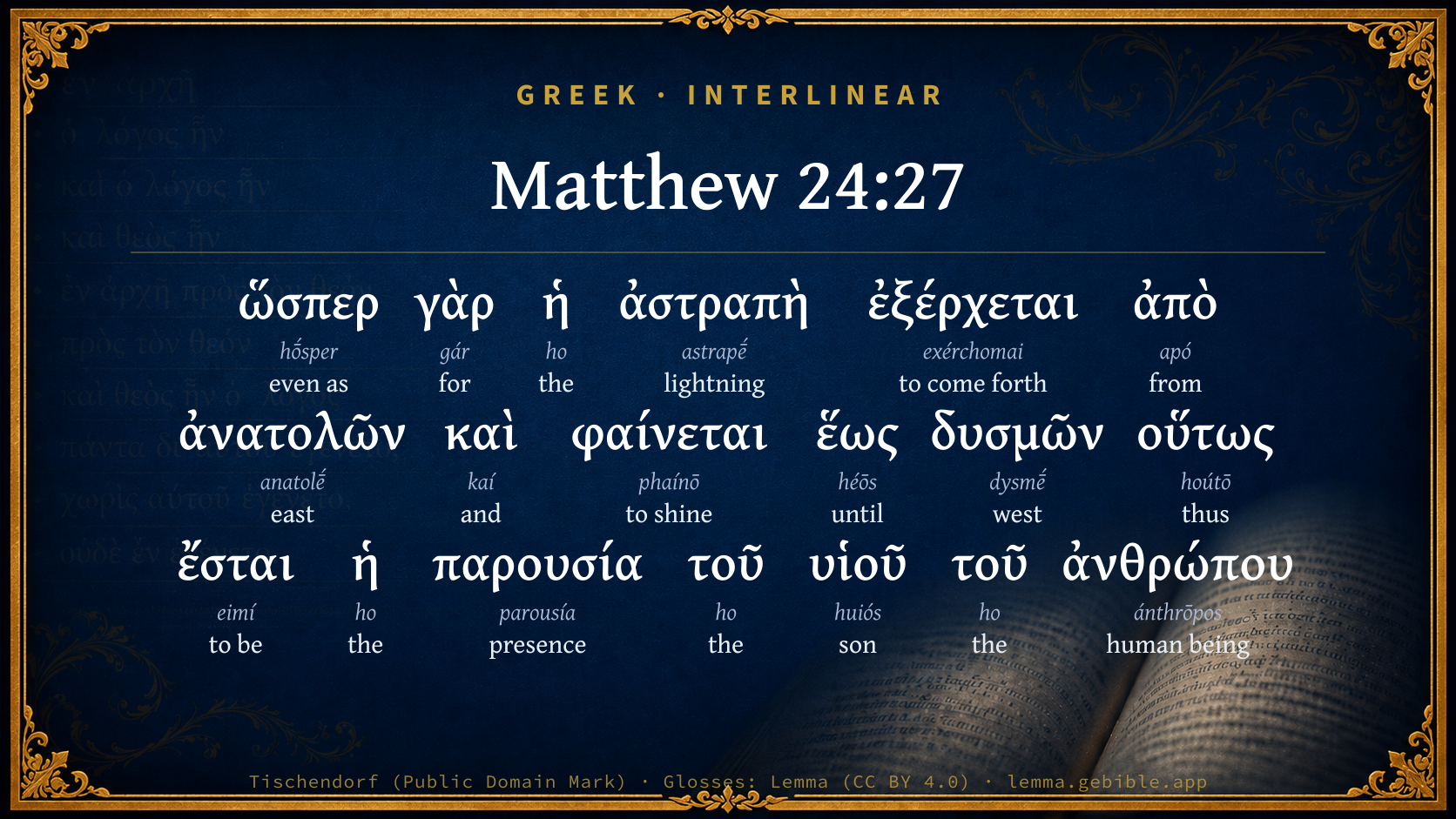
  1. ὥσπερ hṓsper G5618 “even as” Adverb
  2. γὰρ gár G1063 “for” Conjunction
  3. ἡ ho G3588 “the” Article, Nominative, Singular, Feminine
  4. ἀστραπὴ astrapḗ G796 “lightning” Noun, Nominative, Singular, Feminine
  5. ἐξέρχεται exérchomai G1831 “to come forth” Verb, Present, Middle or Passive deponent, Indicative, 3rd person, Singular
  6. ἀπὸ apó G575 “from” Preposition
  7. ἀνατολῶν anatolḗ G395 “east” Noun, Genitive, Plural, Feminine
  8. καὶ kaí G2532 “and” Conjunction
  9. φαίνεται phaínō G5316 “to shine” Verb, Present, Middle or Passive, Indicative, 3rd person, Singular
  10. ἕως héōs G2193 “until” Adverb
  11. οὕτως hoútō G3779 “thus” Adverb
  12. ἔσται eimí G1510 “to be” Verb, Future, Middle deponent, Indicative, 3rd person, Singular
  13. ἡ ho G3588 “the” Article, Nominative, Singular, Feminine
  14. παρουσία parousía G3952 “presence” Noun, Nominative, Singular, Feminine
  15. τοῦ ho G3588 “the” Article, Genitive, Singular, Masculine
  16. υἱοῦ huiós G5207 “son” Noun, Genitive, Singular, Masculine
  17. τοῦ ho G3588 “the” Article, Genitive, Singular, Masculine
  18. ἀνθρώπου ánthrōpos G444 “human being” Noun, Genitive, Singular, Masculine

About this verse

These counts appear in no published source. They are computed here, from the morphology-tagged text and Lemma’s own curated glosses. What Lemma adds →

19
words
16
distinct lemmas
Gospels
section

Notable vocabulary

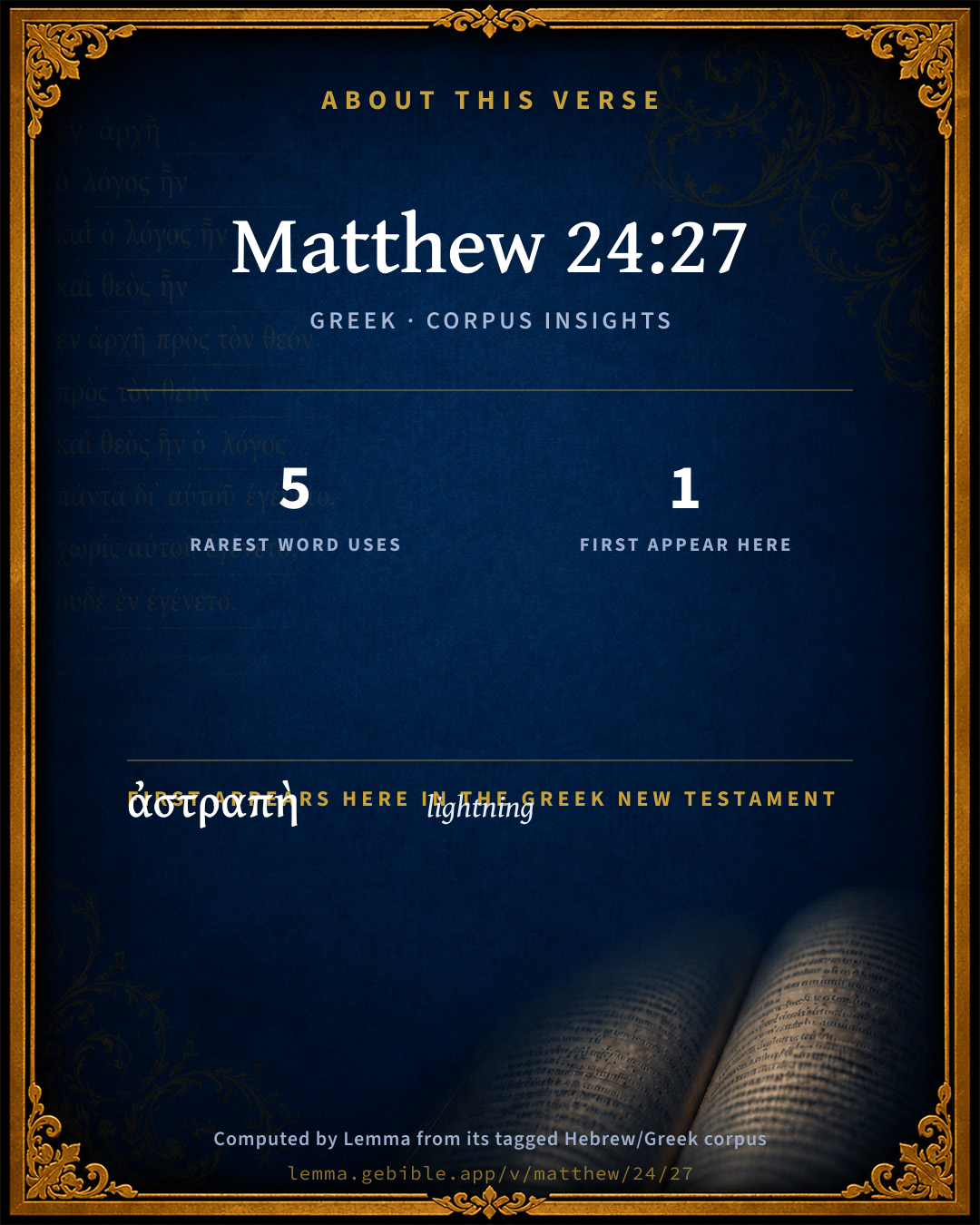
The rarest word here is δυσμῶν west G1424 — appearing just 5 times in the whole Greek New Testament.

First appearance in Scripture

This word makes its first canonical appearance in the Greek New Testament here:

  • ἀστραπὴ lightning G796

Shared distinctive vocabulary

δυσμῶν west G1424 occurs in 5 verses of the Greek New Testament. Also found in:

Repetition

A word recurs within this verse:

Cross-references

12

Topical passages linked to Matthew 24:27 in the Treasury of Scripture Knowledge — connected by theme and wording, ordered by reader-vote popularity; previews shown in the World English Bible.

  • Luke 17:24–37 for as the lightning, when it flashes out of the one part under the sky, shines to the other part under the sky; so will the Son of Man be in his day.
  • Zechariah 9:14 Yahweh will be seen over them; And his arrow will go flash like lightning; And the Lord Yahweh will blow the trumpet, And will go with whirlwinds of the south.
  • Job 37:3 He sends it forth under the whole sky, And his lightning to the ends of the earth.
  • Isaiah 30:30 Yahweh will cause his glorious voice to be heard, and will show the lighting down of his arm, with the indignation of [his] anger, and the flame of a devouring fire, with a blast, and tempest, and hailstones.
  • Malachi 3:2 "But who can endure the day of his coming? And who will stand when he appears? For he is like a refiner's fire, and like launderer's soap;
  • James 5:8 You also be patient. Establish your hearts, for the coming of the Lord is at hand.
  • Malachi 4:5 Behold, I will send you Elijah the prophet before the great and terrible day of Yahweh comes.
  • 2 Peter 3:4 and saying, "Where is the promise of his coming? For, from the day that the fathers fell asleep, all things continue as they were from the beginning of the creation."
  • Job 38:35 Can you send forth lightnings, that they may go? Do they report to you, 'Here we are?'
  • Matthew 16:28 Most assuredly I tell you, there are some standing here who will in no way taste of death, until they see the Son of Man coming in his Kingdom."
  • Matthew 24:37 "As the days of Noah were, so will be the coming of the Son of Man.
  • Matthew 24:39 and they didn't know until the flood came, and took them all away, so will be the coming of the Son of Man.

Cross-references courtesy of OpenBible.info (CC BY 4.0).

Commentary

Notes on Matthew 24:27 from classic Christian and Jewish commentators (each source and its license shown beneath its notes). The classic Christian expositions comment on the surrounding passage and are grouped to its opening verse, so a note may address several verses; the Jewish commentaries on the Tanakh (Rashi and others) are per-verse, so they appear only where the commentator wrote on this verse.

Lemma curates 59 commentaries, every one of them public domain or Creative Commons licensed, each selected and text-cleaned for this edition rather than reprinted as found. About our sources →

The Biblical Illustrator

Joseph S. Exell

Mat_24:27

For as the lightning.

The last conflagration

I. Christs advent shall be sudden. Unexpected by the masses; like the flash that leaps from the bosom of the black cloud, sweeps through the sky, and completes its journey in an instant.

II. Christs advent will be with intense and vivid splendour. The lightning fills the whole world; leaps from the east, and finds its lair only in the remote and distant west. When the searching lightning of that day shall come it will penetrate the cell of the captive, etc. What an arrest will take place. The world will be going on when Christ comes, as it does this moment. There will be signs, and symptoms, and premonitory warnings of Christs advent.

1. Some will say, on seeing them, The whole thing can be explained on the principles of natural science, etc. It may be so; but certainly these scientific objectors seem to be the successors of a class who are a sign of the times, while they say, Where is the promise of His coming? etc.

2. Others will meet all statements on the subject with Wishes it may not be true, etc.

3. Gods own people will say, Come, Lord Jesus; we have been looking for Thee, etc.

4. The testimony of Gods Word as to the accompaniments of this day.

5. What is the lesson from all this? What manner of persons, etc.

6. Seek to promote things that will survive the last fire.

7. The prospect of a dissolving world is a more practical motive force than the prospect of death. This is the apostolic motive power. (J. Cumming, D. D.)

Duty to be done in time of judgment

About sixty years ago, there was in America a universal superstition-not an enlightened belief-that the world was about to close. They believed that the world was about to end, because a total eclipse of the sun took place at noonday. There was all the darkness and the gloom of midnight. It happened that the Congress of the United States was assembled at this hour; half the members of the Congress believed that that dense night, caused by a total eclipse of the sun, was really the darkness that preceded the ushering in the judgment and another state and world. They were in great alarm, and two or three of the most agitated got up at once, and moved that the Congress do adjourn. There was a panic. In the midst of the panic, and while some were proposing an adjournment, an old and venerable Puritan, who had learned noble lessons from the Puritans of England, the salt of the country at that time, rose up and said, Mr. Chairman, we are told that our duties are always imminent, that they are always obligatory. Some in this house are afraid that the last day is come; it may be they are right; I have some suspicion they are so; but as our duties never cease, instead of moving that the house adjourn, as we cannot see in this darkness to do business, I move that the candles be brought in, and that we proceed to the order of the day. That man spoke like a Christian, and he lived like a Christian. And may we be found going on with the orders of the day when the light of the last day shall flash upon this world. (J. Cumming, D. D.)

The coming of the Son of Man

The Rev. Edward Irving was once preaching at Perth. The text was taken from Mat_24:1-51., regarding the coming of the Son of Man. While he was engaged in unfolding his subject, from out of a dark cloud, which obscured the church, there came forth a bright blaze of lightning and a crash of thunder. There was deep stillness in the audience. The preacher paused; and from the stillness and the gloom, his powerful voice, clothed with increased solemnity, pronounced these words: For as the lightning cometh out of the earth, and shineth even unto the west; so shall the coming of the Son of Man be.

Christs second coming

Here are two opposite yet ever-present dangers. One is of fancying that our Saviour and our salvation are to be found in some extraordinary out-of-the-way fashion of religious manifestation: Behold he is in the desert. The other danger is that we shall fancy that our Saviour and our salvation are to be found in particular states of our own interior feeling: Behold he is in the secret chambers. The first was superstition; this is fanaticism.

I. Both Christ and his apostles speak repeatedly of a second coming of the Son of Man in such a sense as forbids us to confound the second with the first. The two are put entirely apart in time, though they are internally and morally connected with each other; the one preparing the way for the other, and each being in fact fragmentary and unintelligible without the other.

II. That coming is personal and literal. We may call signal social revolutions, reforms in government, the emancipation of slaves, or great accessions of knowledge or charity, new comings of Christ. The figure is intelligible; but they are not comings of Him. They may be comings of the impersonal power and principles of His religion-partial blessings reminding us of the one great blessing that includes them all; but He is to come. Ye shall see the Son of Man(not His ideas, but Him) coming in power and great glory. Nor will it do to tamper with Holy Scripture by such a theory of interpretation as that His coming means our going. The death or departure of the individual is one thing; the Bible often mentions that, meaning just what it says. The Lords coming is another.

III. This great coming is to be connected with a separation of the good from the bad, the believers from the deniers, the spiritually alive from the spiritually dead.

IV. There is, however, some reference to a kind of coming of Christ which was to take place in the lifetime of the generation that was on the stage while the saviour was speaking.

V. Inspired writers, apostles, signify their expectation that Christs second advent would take place during their own natural life. Were they mistaken, and mistaken teachers of others? A vast amount of ingenious effort has been made to break the force of this objection with out sacrificing the infallibility of the record. For the most part it has failed by taking the purely external or philological method, and without sounding spiritually the depths of the Evangelic purpose. Let us honestly take the language of honest men in its ordinary acceptation. What, then, shall we say? All difficulties are cleared by the following proposition, which is reasonable and reverential: The purpose of revelation, in this matter, was to create in Christians, not a belief that Christ would come at any particular hour in history, but a belief that He is always at hand, and that all Christians should at all times and in all places be ready, as men that stand with their lamps trimmed and burning, to meet Him personally. The date of the event was no part of the Divine communication. In proportion as we rise, in thought, toward the immensity of the life of God, and have the mind of the Spirit, the whole period of history shrinks, great distances dwindle, epochs are pressed together, and a thousand years are as one day. Besides, the highest authority in modern physical science, in astronomy, and geology, and chemistry, harmonizes singularly enough, as to the issue, with the Apostolic language. It concludes that the machinery of the material universe is wasting, its movements are slackening, its balance is slowly loosening, and that a general catastrophe is inevitable. The sneer of the scientific sceptic of the last century is silenced by the science of to-day. We may say that in the Bible predictions generally, borrowing a phrase from the fine arts, what we may call historical perspective is lost sight of. We are not told at what intervals from each other, or always in just what order, these majestic events, by which eternity seems to open down into time, shall follow on. Chronology is not the object. The facts are what we are to know, and receive, and feed upon in our hearts by faith. The moment we begin to try our petty arithmetic on them we miss the mark, and lose our way. We all know that, even with ourselves, the moments of tremendous peril, when awful events are casting their colossal shadows about us, are just the time when the ordinary measure of succession drops out of sight. We look across the great tract and see other great conjunctions, as if they were nigh at hand. Christ Jesus is not enclosed in time, but time is all in Him. (Bishop Huntington)

Christs second coming a revelation

The essential circumstance in this parable or analogy is not so much the suddenness of the splendour that breaks forth from the cloud, as the wide-reaching and supernatural illumination and revelation which come with it. It annihilates all the darkness of the night and of the storm. Each of all the hidden objects stands out clearly manifest. The daylight comes so slowly that we seldom think of its revealing power. Even when we pause to watch its increase, the world has ample time to grow into its old look of naturalness without any shock to us; and, ere the sun has fully risen and disclosed clearly to our sight the familiar objects around us, we have already well-nigh forgotten that the night ever hid them. But it is not so when the lightning comes. That has no twilight. Its dawn is its fullest day. It transfigures the world at once. It divides the light from the darkness somewhat as we imagine God did at the beginning-separating them perfectly, and leaving no neutral ground between them. (E. E. Johnson, M. A.)

The Biblical Illustrator, edited by Joseph S. Exell (c. 1880s–1900s) — public domain. Text from a community e-Sword module.

Joseph Benson's Commentary

Mat 24:27-28. For as the lightning cometh out of the east, &c. — The coming of the Son of man shall be in a very different manner, and for very different ends from what you are imagining. It shall be like lightning, swift, unexpected, and destructive. His appearance will be as distinguishable from that of every false Christ, as lightning, which shines all round the hemisphere, is from a blaze of straw. What Bishop Pearce observes from Josephus is very memorable, that “the Roman army entered into Judea on the east side of it, and carried on their conquests westward, as if not only the extensiveness of the ruin, but the very route which the army would take, was intended in the comparison of the lightning coming out of the east, and shining even unto the west.” For wheresoever the carcass is, &c. — For though the coming of the Son of man shall be like lightning, swift, spreading, and destructive, yet he will not come personally; his servants only shall come, the Roman armies, who by his command shall destroy this nation as eagles devour their prey. Thus our Lord, after his usual manner, applies a proverbial expression with a particular meaning; and the Romans are very properly compared to eagles, both because eagles are the fiercest birds of prey, and because the Roman ensign was an eagle, to which probably our Lord alluded in this passage.

Joseph Benson's Commentary on the Old and New Testaments (1811–1818) — public domain. Text from a community e-Sword module.

Tyndale Open Study Notes

Tyndale Open Resources

24:27-28 Lightning may be an allusion to the astrological phenomena attending the Messiah’s coming (see 24:29-31; 1 Thes 4:13-18). It is not the suddenness of lightning that is in view but rather the magnitude of its visibility. Very possibly, Jesus gave these sayings to ward off premature excitement regarding the end (1 Thes 4:13–5:10; 2 Thes 2:1-12).

Tyndale Open Study Notes — © Tyndale Open Resources, licensed CC BY-SA 4.0. Text via the HelloAO Bible API.

Bengel's Gnomon

Johann Albrecht Bengel

Mat 24:27. Ἀστραπὴ, lightning) It is not all lightning that is meant, but that which sometimes suddenly fills the whole horizon without previous warning.—ἀπὸ ἀνατολῶν, from the east) The lightning comes also from the other quarters; but in this passage it is said to come from the east. It may be supposed that Christ’s Advent will take place from the east. The interval which is to elapse between the appearance of the Lord’s Advent (see Gnomon on 2Th 2:8) and the Advent itself, enables the actual Advent to be sudden.—τοῦ Υἱοῦʼ Ανθρώπον, of the Son of Man) From this place to Mat 24:44, especially, He is frequently called The Son of Man; cf. ch. Mat 25:31.

Bengel's Gnomon of the New Testament — English translation (T&T Clark, Edinburgh, 1860) — public domain. Text from a community e-Sword module.

Meyer's Critical & Exegetical Commentary

Heinrich August Wilhelm Meyer

Mat_24:27. Reason why they were not to listen to such assertions. The advent of the Messiah will not be of such a nature that you will require to be directed to look here or look there in order to see him; but it will be as the lightning, which, as soon as it appears, suddenly announces its presence everywhere; οὕτως ἔσται ἡ παρουσία ἐκείνη, ὁμοῦ πανταχοῦ φαινομένη διὰ τὴν ἔκλαμψιν τῆς δόξης, Chrysostom. Not as though the advent were not to be connected with some locality or other upon earth, or were to be invisible altogether (R. Hofmann); but what is meant is, that when it takes place, it will all of a sudden openly display itself in a glorious fashion over the whole world. Ebrard (comp. Schott) is wrong in supposing that the point of comparison lies only in the circumstance that the event comes suddenly and without any premonition. For certainly this would not tend to show, as Jesus means to do, that the assertion: he is in the wilderness, etc., is an unwarrantable pretence.

Meyer — Critical and Exegetical Commentary on the New Testament — English translation by Peter Christie, edited by Frederick Crombie (T&T Clark, 1880) — public domain. Text from a community e-Sword module.

Expositor's Greek Testament

ed. W. Robertson Nicoll

Mat 24:27 . ὥσπερ γὰρ , etc.: the coming of the true Messiah, identified with the Son of Man, compared to the lightning, to suggest a contrast between Him and the false Christs as to visibility , and enforce the counsel to pay no heed to those who say: He is here, or He is there.

The Expositor's Greek Testament, edited by W. Robertson Nicoll (1897–1910) — public domain. Text from a community e-Sword module.

Adam Clarke's Commentary

Verse 27. For as the lightning cometh out of the east, and shineth even unto the west] It is worthy of remark that our Lord, in the most particular manner, points out the very march of the Roman army: they entered into Judea on the EAST, and carried on their conquest WESTWARD, as if not only the extensiveness of the ruin, but the very route which the army would take, were intended in the comparison of the lightning issuing from the east, and shining to the west.

Adam Clarke's Commentary on the Bible (1810–1826) — public domain. Text from a community e-Sword/MySword module.

Ellicott's Commentary for English Readers

(27) As the lightning cometh out of the east.—In this and the three preceding verses we are, as it were, on the dim border-land of the primary and the ultimate fulfilments of the words. The disciples in their questions (Mat_24:3) had connected the destruction of Jerusalem with the “coming” of their Lord, and the two are connected even in His own words and thoughts. In whatever way He came, whether in the final destruction of the Temple and polity of Israel, or at the end of the world’s great drama, the advent would be sudden and unlooked-for as the lightning-flash. The crises of the world’s history, which are the “springing and germinant accomplishments” of such words as these, are always unexpected by the great mass of mankind, even though the few whose eyes are opened can discern the signs of the times, and know that their “redemption draweth nigh.”

A Bible Commentary for English Readers, edited by Charles John Ellicott (1878–1897) — public domain. Text from a community e-Sword module.

The Cambridge Bible for Schools and Colleges

gen. ed. J. J. S. Perowne

27. as the lightning] All-pervading, swift, sudden and of dazzling brightness; such shall be the coming of the Son of man.

shineth] Translate, appeareth. The flash is instantly visible in the remotest quarter.

The Cambridge Bible for Schools and Colleges (gen. ed. J. J. S. Perowne; Cambridge University Press, 1878–1918) — public domain. Text from a community e-Sword module.

John Gill's Exposition

For wheresoever the carcass is,.... Not Christ, as he is held forth in the Gospel, crucified and slain, through whose death is the savour of life, and by whom salvation is, and to whom sensible sinners flock, encouraged by the ministry of the word; and much less Christ considered as risen, exalted, and coming in great glory to judgment, to whom the word "carcass" will by no means agree, and but very poorly under the former consideration: but the people of the Jews are designed by it, in their fallen, deplorable, miserable, and lifeless state, who were like to the body of a man, or any other creature, struck dead with lightning from heaven; being destroyed by the breath of the mouth, and brightness of the coming of the son of man, like lightning, just as antichrist will be at the last day:

there will the eagles be gathered together: not particular believers here, or all the saints at the day of judgment; though these may be, as they are, compared to eagles for many things; as their swiftness in flying to Christ, their sagacity and the sharpness of their spiritual sight, soaring on high, and renewing their spiritual strength and youth: but here the Roman armies are intended, whose ensigns were eagles; and the eagle still is, to this day, the ensign of the Roman empire: formerly other creatures, with the eagle, were used for ensigns; but C. Marius, in his second consulship, banished them, and appropriated the eagle only to the legions: nor was it a single eagle that was carried before the army, but every legion had an eagle went before it, made of gold or silver, and carried upon the top of a spear (z): and the sense of this passage is this, that wherever the Jews were, whether at Jerusalem, where the body and carcass of them was, in a most forlorn and desperate condition; or in any other parts of the country, the Roman eagles, or legions, would find them out, and make an utter destruction of them. The Persic version, contrary to others, and to all copies, renders it "vultures". Though this creature is of the same nature with the eagle, with respect to feeding on carcasses: hence the proverb,

"cujus vulturis hoe erit cadaver?''

"what vulture shall have this carcass?" It has a very sharp sight, and quick smell, and will, by both, discern carcasses at almost incredible distance: it will diligently watch a man that is near death; and will follow armies going to battle, as historians relate (a): and it is the eagle which is of the vulture kind, as Aristotle (b) observes, that takes up dead bodies, and carries them to its nest. And Pliny (c) says, it is that sort of eagles only which does so; and some have affirmed that eagles will by no means touch dead carcasses: but this is contrary not only to this passage of Scripture, but to others; particularly to Job 39:30 "her young ones also suck up blood, and where the slain are, there is she": an expression much the same with this in the text, and to which it seems to refer; see also Pro 30:17. Though Chrysostom (d) says, both the passage in Job, and this in Matthew, are to be understood of vultures; he doubtless means the eagles that are of the vulture kind, the Gypaeetos, or vulture eagle. There is one kind of eagles, naturalists say (e), will not feed on flesh, which is called the bird of Jupiter; but, in common, the eagle is represented as a very rapacious creature, seizing, and feeding upon the flesh of hares, fawns, geese, &c. and the rather this creature is designed here; since, of all birds, this is the only one that is not hurt with lightning (f), and so can immediately seize carcasses killed thereby; to which there seems to be an allusion here, by comparing it with the preceding verse: however, the Persic version, though it is literally a proper one, yet from the several things observed, it is not to be overlooked and slighted.

(z) Plin. Nat. Hist. l. 10. c. 4. Alex. ab Alex. Genial. Dier. l. 4. c. 2. (a) Aelian. de Animal. Natura, l. 2. c. 46. (b) De Hist. Animal. l. 9. c. 32. (c) Hist. Nat l. 10. c. 3. (d) In Matt. Homil. 49. (e) Aelian. de Animal. l. 9. c. 10. (f) Plin. Nat. Hist. l. 2. c. 55.

John Gill's Exposition of the Whole Bible (1746–1763) — public domain (CC PDM 1.0). Text via the HelloAO Bible API.

Trapp's Complete Commentary

John Trapp

27 For as the lightning cometh out of the east, and shineth even unto the west; so shall also the coming of the Son of man be.

Ver. 27. So shall also the coming of the Son of man be] Clear and conspicuous, as the lightning cannot be hidden or hindered from being seen all the whole heaven over. Then shall all secret sins be made visible, as things written with the juice of lemons are legible when held to the fire; as visible shall they be, and legible too, as if written with the brightest lightning upon a wall of crystal.

John Trapp, A Commentary or Exposition upon All the Books of the Old and New Testament (1647–1656) — public domain. Text from a community e-Sword module.

Albert Barnes' Notes on the Bible

For as the lightning cometh out of the east ... - This is not designed to denote the quarter from which he would come, but the manner. He does not mean to affirm that the “Son of man” will come from the “east,” but that he will come in a rapid and unexpected manner, like the lightning. Many would be looking for him in the desert, many in secret places; but he said it would be useless to be looking in that manner; it was useless to look to any particular part of the heavens to know where the lightning would next flash. In a moment it would blaze in an unexpected part of the heavens, and shine at once to the other part. So rapidly, so unexpectedly, in so unlooked-for a quarter, would be his coming. See Luk 10:18; Zec 9:14.

The coming of the Son of man - It has been doubted whether this refers to the destruction of Jerusalem, or to the coming at the day of judgment. For the solution of this doubt let it be remarked:

1.That those two events are the principal scenes in which our Lord said he would come, either in person or in judgment.

2.That the destruction of Jerusalem is described as his coming, his act.

3.That these events - the judgment of Jerusalem and the final judgment in many respects greatly resemble each other.

4.That they “will bear,” therefore, to be described in the same language; and,

5.Therefore, that the same words often include both events, as properly described by them.

The words had, doubtless, a primary reference to the destruction of Jerusalem, but they had, at the same time, such an amplitude of meaning as also to express his coming to judgment. See the introduction to Isaiah, section 7, (3).

Albert Barnes' Notes on the Bible (1834–1885) — public domain. Text from a community e-Sword/MySword module.

Matthew Poole's English Annotations

Luke hath much the same, Luk 17:24,37. The disagreement of interpreters about the coming of the Son of man, here spoken of, makes a variety in their interpretation of these verses. Some think the coming of the Son of man here spoken of was his coming to destroy Jerusalem, which, he saith, will be sudden like the lightning, which though the thunder be taken notice of aforehand, as following the lightning, yet is not taken notice of. These interpreters make the carcass, mentioned Mat 24:28, to be the body of the Jewish nation, designed to be destroyed; and the eagles to be the Roman armies. Job saith of the eagle, Job 39:30, where the slain are, there is she, Hab 1:8, saith the same of the Chaldean armies; They shall fly as the eagle that hasteth to eat. Some understand by the coming of Christ here, his coming in his spiritual kingdom. The preaching of the gospel shall be like the lightning; you need not listen after those that say, Lo, here is Christ, or, Lo, he is there, for my gospel shall be preached every where; and where the carcass is, where my death and resurrection shall be preached, all the elect, my sheep that hear my voice and follow me, shall be gathered together. Others understand it of Christ’s coming to judgment, which is compared to lightning for the suddenness and universality of it. There, saith Christ, I shall be, and all my saints shall be gathered together. Luke seemeth to speak of this, Luk 17:24,37. That phrase, Wheresoever the carcass is, there will the eagles be gathered together, is a proverbial speech, signifying that it will need no great labour to bring things together which are naturally joined by an innate desire either of them to the other; so that it is applicable in more cases than one. And whether that discourse in Luke were at the same time when this was I cannot say; our Saviour’s discourse on this argument, Luk 21:1-38; hath not these verses, and is a part of a discourse which is said to have been begun, at least to the Pharisees, Luk 17:20. But I shall further consider what Luke saith when I shall come to that chapter in him.

Matthew Poole's English Annotations on the Holy Bible (1683–1685) — public domain. Text from a community e-Sword/MySword module.

Whedon's Commentary on the Bible

Daniel D. Whedon

27. As the lightning… out of east… unto the west — May we not suppose that the unspeakable splendour of the Son of man (constituting the visible sign, as mentioned in verse thirtieth) will be suspended in the heaven during the entire of one revolution of the earth, so that its flash should extend from east to west, and be visible on all sides of the globe to the alarmed and watching nations? We thus discover in this paragraph one more contrast between the these things of the apostles’ first question, and the end of the world as specified in the second question.

Daniel D. Whedon (gen. ed.), Commentary on the Old and New Testaments (1874–1909) — public domain. Text from a community e-Sword module.

The Pulpit Commentary

As the lightning...east...west. That is, shines from one end of heaven to the other. St. Chrysostom"s comment explains the similitude: "How, then, shineth the lightning? It needs not one to talk of it, it needs not a herald, but even to them in chambers it shows itself in an instant of time throughout the whole world. So shall that coming be, showing itself at once everywhere by reason of the shining forth of his glory." We are told, "every eye shall see him." His advent shall be sudden, universal, unmistakable; in a moment he shall be present, visible in all his power and glory. From the language of this verse probably has been derived the orientation of churches, and the mode adopted of depositing the bodies of deceased Christians, so that they may at the resurrection face the Lord when he comes from the east.

Lightning.

Our Lord compares his coming to a great flash of lightning which blazes out in the east and illumines earth and sky as far as the west. This is in contrast to the notion of an obscure and doubtful appearance, or one that is local and limited, or one the coming of which is so gradual that it can scarcely be discerned. In opposition to these erroneous conceptions, the advent of Christ is to be lightning like. Let us consider its characteristics as they are suggested to us by this startling image.

I VISIBILITY. Bursting out of the darkness of the storm, the lightning blinds us with the brilliancy of its illumination. There is no mistaking the fact that it has come. We may not observe the glow worm; we cannot ignore the lightning. The awful "day of God" at the destruction of Jerusalem has made its impress on all history. Other advents of Christ in judgment, as in the sack of Rome by the Goths, the wreck of the Spanish Armada, etc., have startled the world with their terror. The present more peaceful coming of Christ to heathen nations in the spread of his gospel produces most visible effects in the transformation of degraded fetich-worshipping cannibals into civilized, humane Christians. Our Lord"s words lead us to anticipate that there will be no obscurity about his great final advent. Then every eye shall behold him.

II BREADTH. The lightning flashes from east to west; or its flash is so splendid, that while for a moment it plays in the east, the far-off west is illumined by the radiance it spreads in all directions. There is a greatness in the appearance of Christ. Even when he came in humiliation, he was "a Light to lighten the Gentiles." Perhaps he had some thought of his first appearance in the East, and of the spread of his light to Europe, when he spoke of the lightning shining in this direction. But if it is a strain of fancy to assert that any such idea is to be found in this image, the notion of breadth is certainly there. Christ"s life was lived in the open. As St. Paul boldly said, "This thing was not done in a corner". (Act_26:26) Christ is the Light of the world, and his radiance is spreading over the earth. The last advent will be for all the world to see, and it will concern all mankind.

III SUDDENNESS. Nothing is so sudden or so startling as the lightning. In its very silence it gives us a greater shock than the roaring thunder. There is something peculiarly awful in its momentary blaze of splendour, especially as we know that there is death and destruction in its shaft. In a moment the steeple is shattered, the stout oak is blasted and riven to its core, the strong man is scathed and flung down dead. It is not clear that our Lord meant us to attach any idea of destruction to his image of the lightning. We know that there is a terror in the wrath of the Son. (Psa_2:12) In his advent to judgment Christ must smite down his foes. He is not the incarnation of unruffled amiability which modern hymns represent, although he is not the stern Judge of Byzantine art. Part of the terror of his judgment is its suddenness. We know not when he will come. Yet if we are his true people we need not fear. His sudden advent will be our sudden joy. W.F.A.

The Pulpit Commentary (1880–1919), ed. H.D.M. Spence-Jones & Joseph S. Exell — public domain. Text from a community e-Sword module.

John Wesley's Explanatory Notes

For as the lightning goeth forth - For the next coming of Christ will be as quick as lightning; so that there will not be time for any such previous warning.

John Wesley, Explanatory Notes Upon the Whole Bible (1754–1765) — public domain. Text via the GEBible commentary corpus.

Scofield Reference Notes

C. I. Scofield

Son of man

Also Mat 24:37; Mat 24:39; Mat 24:44. (See Scofield "Mat 8:20").

The Scofield Reference Bible (1917 edition), notes by C. I. Scofield — public domain. Text from a community e-Sword module.

Burkitt's Expository Notes on the New Testament

William Burkitt

There is a threefold coming of Christ spoken of in the New Testament.

1. His coming in his spiritual kingdom by the preaching of the gospel among the Gentiles.

2. His coming to destroy Jerusalem forty years after his ascension.

3. His final coming to judgment at the great day.

All these comings of the Son of man, for their suddenness and unexpectedness, are compared unto lightning, which in a moment breaketh out of the east, and shineth unto the west.

Learn hence, That the coming and appearance of the Lord Jesus Christ, to the judging of the wicked and impenitent sinners, will be a very certain, sudden, and unexpected appearance.

William Burkitt's Expository Notes on the New Testament (1700–1703) — public domain. Text from a community e-Sword module.

The People's New Testament

B. W. Johnson

27. For as the lightning. There will be no doubt about Christ's coming when he does come, no discussion, no need that any one shall tell it. It will be manifest as the flash of lightning across the sky. There can be no mistake. Such language shows how much those err who claim that his coming was at the destruction of Jerusalem.

B. W. Johnson's The People's New Testament with Notes (1889–1891) — public domain. Electronic text from the Christian Classics Ethereal Library (CCEL) ThML edition.

Cambridge Greek Testament for Schools and Colleges

27. φαίνεται, ‘appeareth,’ not ‘shineth,’ A.V. The flash is instantly visible in the opposite quarter of the heaven. Like lightning all-pervading, swift, sudden and of dazzling brightness, shall be the coming of the Son of man.

Cambridge Greek Testament for Schools and Colleges (Cambridge University Press, 1896; 21 vols, various authors incl. Carr, Maclear, Plummer, Farrar, Lumby, Moule, M. R. James, Simcox) — public domain. Text from a community e-Sword module.

International Critical Commentary

(L) 27. For as the lightning goes forth from the east, and appears to the west; so shall be the presence of the Son of Man.] Lk. has: “For as the lightning, when it flashes from the one part under the heaven shines to the other part under the heaven, so shall be the Son of Man.” The idea apparently is that the presence of the Son of Man will be not local, but everywhere visible. See on Luk 17:24, Luk 17:37.

International Critical Commentary — older volumes (1896–1929), various authors — public domain. Text from a community e-Sword module.

Vincent's Word Studies in the New Testament

Marvin R. Vincent

Shineth [φαινεται] . Rev., better, is seen. The coming of the Lord will be a plain, unmistakable fact, like the lightning which lightens both ends of the heaven at once, and is seen of all. It will not be connected with some particular place, but will manifest itself and be recognized over the whole world. Compare Rev 1:7 : "Every eye shall see him."

Marvin R. Vincent, Word Studies in the New Testament (1887–1900) — public domain. Text from a community e-Sword/MySword module.

Lesson kit

Teaching starters — assembled from the data on this page, not authored interpretation. Every prompt links to the verse data it draws on. Edit before teaching.

Matthew, in the Gospels, opens this verse with 19 words (16 distinct Greek lemmas). Its most distinctive word is dysmḗ (“west”). A historical commentator’s framing appears above. Read the whole chapter for the surrounding context.

Discussion questions

  1. What does “west” (dysmḗ) contribute to the verse as a whole?
  2. This is the first place “lightning” appears in Scripture (first appears here). What does its debut here establish?
  3. How does Matthew 8:11, which shares the word «west», read alongside this verse?
  4. What does the repetition of “the” (4× in this one verse) do in this verse?
  5. These translations render this verse differently. What is at stake in choosing one wording over another?
  6. Compare how The Biblical Illustrator and Joseph Benson's Commentary read this verse. Where do they agree or differ?

Things to notice

  • 1 word makes its first canonical appearance in Scripture here.
  • These translations choose different wording for 14 words in this verse.
  • “the” occurs 4× in this single verse.
  • 16 distinct Greek lemmas span 19 words in this verse.

Reading settings

Reading text

Shown beneath each verse's original-language words.

Old Testament
Old Testament edition

Read the OT as the Masoretic Hebrew (MT) or the Greek Septuagint (LXX).

English shown for the Greek Septuagint (in the Hebrew ↔ Greek comparison).

Comparing translations? Open the Compare panel on any verse page to stack up to four side by side.