
Matthew 19:7

Greek (Tischendorf 8th ed.) Matthew 19:7 appears in the Greek New Testament. The text above is from the Tischendorf 8th edition. Each word links to its Strong’s number and a concise gloss. Click any word for its full Thayer’s Greek Lexicon entry.
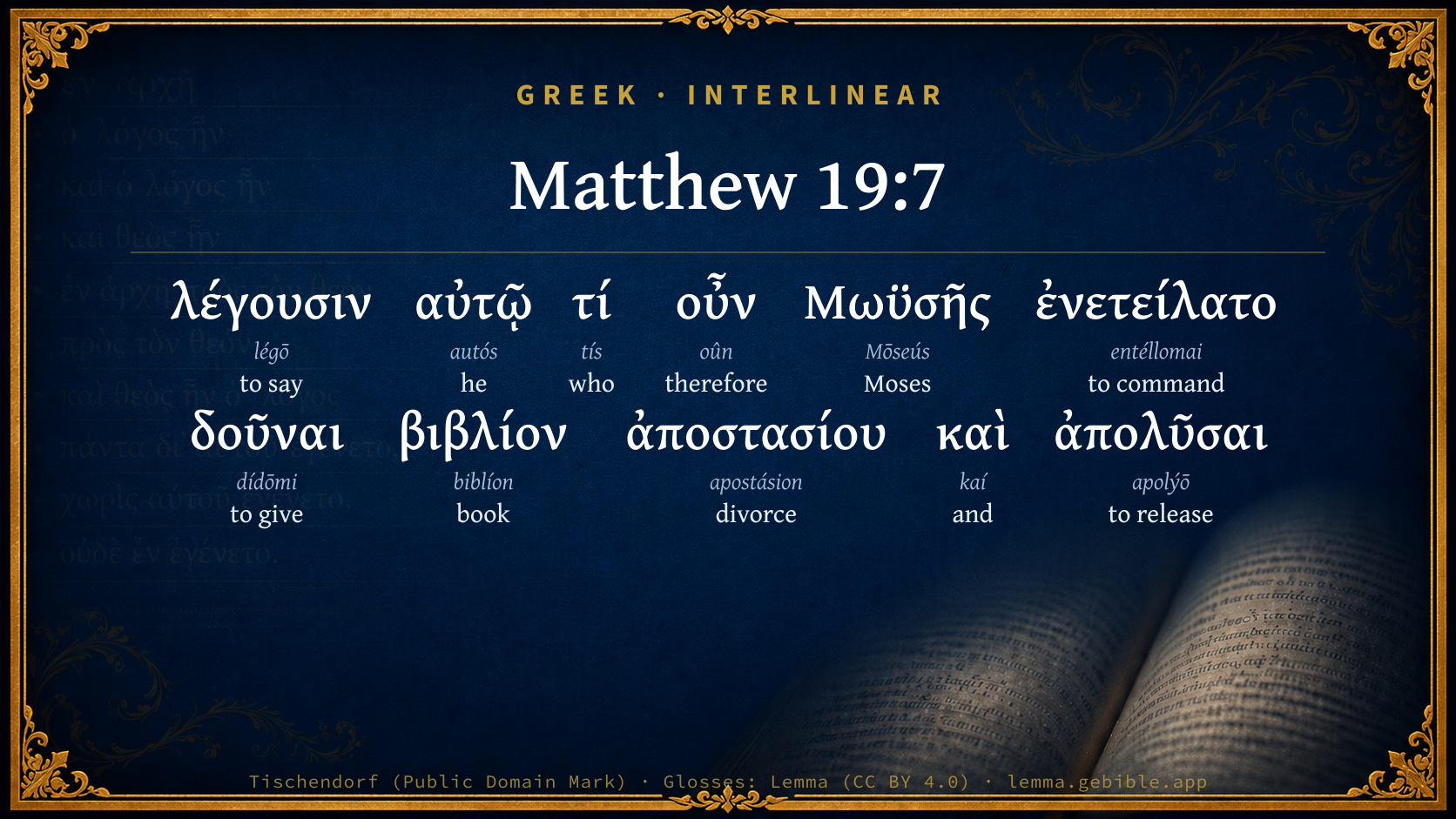
Download image
Cite this verse

Matthew 19:7 (World English Bible). Public Domain. Lemma interlinear Bible study tool, https://lemma.gebible.app/v/matthew/19/7.

Show BibTeX & RIS
BibTeX
RIS
English Translation
They asked him, "Why then did Moses command us to give her a bill of divorce, and divorce her?"
World English Bible · Public Domain
Highlights
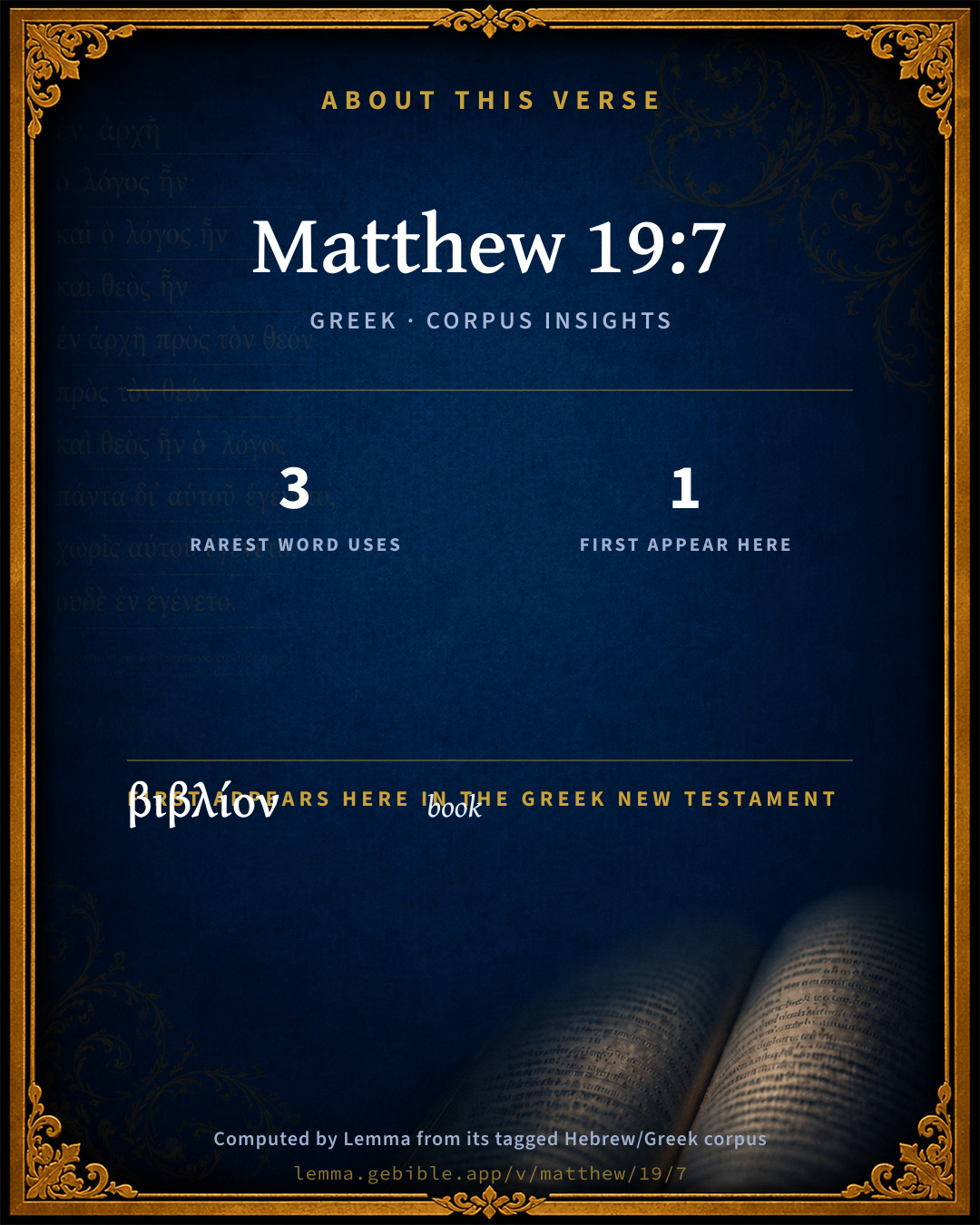
  • 1 first appearance in the Greek New Testament
Full analysis ↓
Download a study sheet

One document with this verse’s original text, its word-by-word gloss line, the meaning frame, cross-references with their text, attributed commentary, and full source and license credits — printable, and it pastes into notes with its structure intact.

This verse Autodidact and up

Study sheet (.html) Plain text (.txt)

A passage Seminary Student

Up to 50 verses in one chapter. A passage sheet keeps up to 6 commentary sources and 12 cross-references per verse, in the order this page ranks them, and says so on the sheet whenever that leaves anything out. Ask for a single verse and you get the Autodidact verse sheet above.

Everything on this page stays free to read, with no account — the sheet is a download of what is already on screen, not access to it.

Want to remove ads? Support Godless Engineer
Compare translations 3

The same verse in 3 English versions, stacked beneath the original-language interlinear above. Click any original word for its lexicon entry.

Each is an independent rendering of the whole verse — the interlinear is not word-aligned to these translations.

Highlighted words mark where these versions differ — a whole-verse word diff, not a word-by-word alignment.

  • World English Bible Public Domain
    They asked him, "Why then did Moses command us to give her a bill of divorce, and divorce her?"
  • King James Version Public Domain
    They say unto him, Why did Moses then command to give a writing of divorcement, and to put her away?
  • unfoldingWord Literal Text CC BY-SA 4.0
    They say to him, “Why then did Moses command to give a certificate of divorce and to divorce her?”

unfoldingWord Literal Text — © unfoldingWord, licensed CC BY-SA 4.0. Word-aligned USFM3 via Door43 (git.door43.org/unfoldingWord/en_ult).

Versions to compare (up to 4)

3 of 4 selected

Show all 19 translations

Every available English version of this verse, each an independent rendering of the whole verse.

  • World English Bible Public Domain
    They asked him, "Why then did Moses command us to give her a bill of divorce, and divorce her?"
  • Berean Standard Bible Public Domain
    “Why then,” they asked, “did Moses order a man to give his wife a certificate of divorce and send her away?”
  • Majority Standard Bible Public Domain
    “Why then,” they asked, “did Moses order a man to give his wife a certificate of divorce and send her away?”
  • King James Version Public Domain
    They say unto him, Why did Moses then command to give a writing of divorcement, and to put her away?
  • American Standard Version (1901) Public Domain
    They say unto him, Why then did Moses command to give a bill of divorcement, and to put `her' away?
  • Revised Version (1885) Public Domain
    They say unto him, Why then did Moses command to give a bill of divorcement, and to put her away?
  • Geneva Bible (1599) Public Domain
    They said to him, Why did then Moses commaund to giue a bill of diuorcement, and to put her away?
  • Douay-Rheims (1899) Public Domain
    They say to him: Why then did Moses command to give a bill of divorce, and to put away?
  • Young's Literal Translation Public Domain
    They say to him, `Why then did Moses command to give a roll of divorce, and to put her away?'
  • Literal Standard Version CC BY-SA 4.0
    They say to Him, “Why then did Moses command to give a roll of divorce, and to put her away?”
  • Unlocked Literal Bible CC BY-SA 4.0
    They said to him, “Why then did Moses command us to give a certificate of divorce and then to send her away?”
  • unfoldingWord Literal Text CC BY-SA 4.0
    They say to him, “Why then did Moses command to give a certificate of divorce and to divorce her?”
  • Darby Bible Public Domain
    They say to him, Why then did Moses command to give a letter of divorce and to send [her] away?
  • World Messianic Bible Public Domain
    They asked him, “Why then did Moses command us to give her a certificate of divorce and divorce her?”
  • Webster's Bible Public Domain
    They say to him, Why did Moses then command to give a writing of divorcement, and to put her away?
  • Free Bible Version CC BY-SA 4.0
    “Then why did Moses give the command that a man could divorce his wife by giving her a written certificate of divorce, and sending her away?” they asked.
  • Bible in Basic English Public Domain
    They say to him, Why then did Moses give orders that a husband might give her a statement in writing and be free from her?
  • Text-Critical English NT CC BY 4.0
    They said to him, “Why then did Moses command us to give her a certificate of divorce and send her away?”
  • Tyndale New Testament (1534) Public Domain
    The sayde they to him: why did Moses commaunde to geve a testimoniall of divorsement and to put hyr awaye?

Literal Standard Version (2020), Covenant Press — licensed CC BY-SA 4.0. Text via the HelloAO Bible API (eBible.org). Unlocked Literal Bible (unfoldingWord) — licensed CC BY-SA 4.0. Text via the HelloAO Bible API (eBible.org). unfoldingWord Literal Text — © unfoldingWord, licensed CC BY-SA 4.0. Word-aligned USFM3 via Door43 (git.door43.org/unfoldingWord/en_ult). Free Bible Version, Dr. Jonathan Gallagher — licensed CC BY-SA 4.0. Text via the HelloAO Bible API (eBible.org).

Word by word

More ways to search: Search by grammar → Find every occurrence → Compare this word →

Practice this passage: Drill this verse → Learn its vocabulary →

About this verse

These counts appear in no published source. They are computed here, from the morphology-tagged text and Lemma’s own curated glosses. What Lemma adds →

11
words
11
distinct lemmas
Gospels
section

Notable vocabulary

The rarest word here is ἀποστασίου divorce G647 — appearing just 3 times in the whole Greek New Testament.

First appearance in Scripture

This word makes its first canonical appearance in the Greek New Testament here:

  • βιβλίον book G975

Shared distinctive vocabulary

ἀποστασίου divorce G647 occurs in 3 verses of the Greek New Testament. Also found in:
Cross-references

7

Topical passages linked to Matthew 19:7 in the Treasury of Scripture Knowledge — connected by theme and wording, ordered by reader-vote popularity; previews shown in the World English Bible.

  • Deuteronomy 24:1–4 When a man takes a wife, and marries her, then it shall be, if she find no favor in his eyes, because he has found some unseemly thing in her, that he shall write her a bill of divorce, and give it in her hand, and send her out of his house.
  • Matthew 5:31 "It was also said, 'Whoever shall put away his wife, let him give her a writing of divorce,'
  • Mark 10:4 They said, "Moses allowed a certificate of divorce to be written, and to divorce her."
  • Malachi 2:16 For I hate divorce," says Yahweh, the God of Israel, "and him who covers his garment with violence!' says Yahweh of Hosts. "Therefore take heed to your spirit, that you don't deal treacherously.
  • Isaiah 50:1 Thus says Yahweh, Where is the bill of your mother's divorce, with which I have put her away? or which of my creditors is it to whom I have sold you? Behold, for your iniquities were you sold, and for your transgressions was your mother put away.
  • Jeremiah 3:8 I saw, when, for this very cause that backsliding Israel had committed adultery, I had put her away and given her a bill of divorce, yet treacherous Judah, her sister, didn't fear; but she also went and played the prostitute.
  • Matthew 1:19 Joseph, her husband, being a righteous man, and not willing to make her a public example, intended to put her away secretly.

Cross-references courtesy of OpenBible.info (CC BY 4.0).

Commentary

Notes on Matthew 19:7 from classic Christian and Jewish commentators (each source and its license shown beneath its notes). The classic Christian expositions comment on the surrounding passage and are grouped to its opening verse, so a note may address several verses; the Jewish commentaries on the Tanakh (Rashi and others) are per-verse, so they appear only where the commentator wrote on this verse.

Lemma curates 59 commentaries, every one of them public domain or Creative Commons licensed, each selected and text-cleaned for this edition rather than reprinted as found. About our sources →

Joseph Benson's Commentary

Mat 19:7-9. They say, Why did Moses then command to give a writing of divorcement, &c. — “If divorce be contrary to the original institution of marriage, as you affirm, how came it that Moses has commanded us to give a bill of divorce? &c. The Pharisees, by calling the law concerning divorce a command, insinuated that Moses had been so tender of their happiness that he would not suffer them to live with bad wives, though they themselves had been willing; but peremptorily enjoined, that such should be put away.” He saith, Moses, because of the hardness of your hearts — Because neither your fathers nor you could bear the more excellent way; suffered, (or permitted,) not commanded, you to put away your wives: but from the beginning it was not so — And the account which Moses himself gives of the original constitution of things, which has now been referred to, proves it to be an irregularity which must have no place under the gospel dispensation. And I say unto you, Whosoever shall put away his wife, except it be for fornication — Which is a fundamental breach of the main article of the marriage covenant, by which they are one flesh; and shall marry another, committeth adultery — Against her that was his former wife, and who continues still to be so in the sight of God. As the law of Moses allowed divorce, for the hardness of men’s hearts, and the law of Christ forbids it, we learn from hence that Christians being under a dispensation of love and liberty, tenderness of heart may justly be expected among them, and that they should not be hard-hearted like the Jews. Indeed there will be no occasion for divorces if we bear with one another, and forgive one another in love, as those that are and hope to be forgiven of God, and have found him reluctant to put us away, Isa 50:1. Divorces are unnecessary if husbands love their wives, and wives be obedient to their husbands, and they dwell together as heirs of the grace of life. These are the laws of Christ, and such as we find not in all the law of Moses.

Joseph Benson's Commentary on the Old and New Testaments (1811–1818) — public domain. Text from a community e-Sword module.

Tyndale Open Study Notes

Tyndale Open Resources

19:7-8 why did Moses say (literally command): The Pharisees thought Jesus had contradicted a command of the law (see Deut 24:1-4), but Moses permitted divorce only as a concession to their hard hearts. Jesus introduced the revolutionary principle that God’s permission is not necessarily his desire (see 1 Cor 6:12). Divorce is never God’s desire (Mal 2:14-16); it is an expression of human sin.

Tyndale Open Study Notes — © Tyndale Open Resources, licensed CC BY-SA 4.0. Text via the HelloAO Bible API.

Bengel's Gnomon

Johann Albrecht Bengel

Mat 19:7. Δοῦναι, to give) St Mark (Mar 10:4) has γράψαι, to write. Moses employs both expressions.—βιβλίον ἀποστασίου, a writing of divorcement) the LXX. use the same phrase.—καὶ, and) sc. thus.

Bengel's Gnomon of the New Testament — English translation (T&T Clark, Edinburgh, 1860) — public domain. Text from a community e-Sword module.

Meyer's Critical & Exegetical Commentary

Heinrich August Wilhelm Meyer

Mat_19:7. Supposed counter-evidence.

ἐνετείλατο] Deu_24:1, in which, indeed, there is no express command, though it may be said to contain κατὰ διάνοιαν the prescription of the bill of divorce. Markand in this his account is certainly more originalrepresents the whole reply of Jesus as beginning with the question as to the law of Moses on the matter (Mat_10:3). Moreover, the more appropriate expression ἐπέτρεψεν, which in Mat_19:8 is ascribed to Jesus (not so in Mark), undoubtedly betrays the influence of riper reflection.

Comp. besides, note on Mat_5:31.

Meyer — Critical and Exegetical Commentary on the New Testament — English translation by Peter Christie, edited by Frederick Crombie (T&T Clark, 1880) — public domain. Text from a community e-Sword module.

Expositor's Greek Testament

ed. W. Robertson Nicoll

Mat 19:7-9 . τί οὖν , etc.: such doctrine could not be directly gainsaid, but a difficulty might be raised by an appeal to Moses and his enactment about a bill of divorce (Deu 24:1 ). The Pharisees seem to have regarded Moses as a patron of the practice of putting away, rather than as one bent on mitigating its evil results. Jesus corrects this false impression.

The Expositor's Greek Testament, edited by W. Robertson Nicoll (1897–1910) — public domain. Text from a community e-Sword module.

Geneva Bible (1599)

Geneva Bible translators

Because political Laws are constrained to bear with some things, it followeth not by and by that God alloweth them.

Geneva Bible (1599) marginal notes — public domain. Text via Bolls.life.

Jamieson, Fausset & Brown

Robert Jamieson, A. R. Fausset & David Brown

They say unto him, Why did Moses then command to give a writing of divorcement, and to put her away?

Jamieson, Fausset & Brown — Commentary Critical and Explanatory on the Whole Bible (1871) — public domain (CC PDM 1.0). Text via the HelloAO Bible API.

Adam Clarke's Commentary

Verse 7. Why did Moses then command to give a writing of divorcement?] It is not an unusual case for the impure and unholy to seek for a justification of their conduct from the law of God itself, and to wrest Scripture to their own destruction. I knew a gentleman, so called, who professed deep reverence for the sacred writings, and, strange as it may appear, was outwardly irreproachable in every respect but one; that was, he kept more women than his wife. This man frequently read the Bible, and was particularly conversant with those places that spoke of or seemed to legalize the polygamy of the patriarchs!

A writing of divorcement] See the form of it in Clarke's note on "Mt 5:31".

Adam Clarke's Commentary on the Bible (1810–1826) — public domain. Text from a community e-Sword/MySword module.

Ellicott's Commentary for English Readers

(7) They say unto him.—The question comes apparently from the advocates of the laxer school. They fell back from what would seem to them a vague abstract principle upon the letter of the Law. Was Moses, the great lawgiver, sanctioning what God had forbidden? Would the Prophet of Nazareth commit Himself to anything so bold as that?

A Bible Commentary for English Readers, edited by Charles John Ellicott (1878–1897) — public domain. Text from a community e-Sword module.

The Cambridge Bible for Schools and Colleges

gen. ed. J. J. S. Perowne

7. a writing of divorcement] See ch. Mat_5:31-32.

The Cambridge Bible for Schools and Colleges (gen. ed. J. J. S. Perowne; Cambridge University Press, 1878–1918) — public domain. Text from a community e-Sword module.

John Gill's Exposition

They say unto him,.... That is the Pharisees, who object the law of Moses to him, hoping hereby to ensnare him, and expose him to the resentment of the people, should he reject that, as they supposed he would;

why did Moses then command to give a writing of divorcement, and put her away? referring to Deu 24:1 which they thought to be a contradiction, and what they knew not how to reconcile to the doctrine Christ had delivered, concerning the original institution of marriage, and the close union there is between a man and his wife, by virtue of it, and which is not to be dissolved by men. Concerning a writing of divorcement and the form, and manner of it; see Gill on Mat 5:31

John Gill's Exposition of the Whole Bible (1746–1763) — public domain (CC PDM 1.0). Text via the HelloAO Bible API.

Trapp's Complete Commentary

John Trapp

7 They say unto him, Why did Moses then command to give a writing of divorcement, and to put her away?

Ver. 7. Why did Moses then command, &c.] Sophister-like they oppose Moses to God, scripture to scripture, as if God were against himself. This is still the guise of graceless heretics; as also to mingle and jumble together truths with falsehoods, that falsehoods may pass the more current. See it in these Pharisees. It was true that Moses commanded (for the honour of the woman, and disgrace of the man) that he should give her an abscessionale, {a} a bill of divorcement. But it was not true that Moses commanded to put her away. He permitted such a thing indeed as a civil magistrate by divine dispensation (better an inconvenience than a mischief), but that makes little for its lawfulness.

{a} A permission or command to depart. ŒD

John Trapp, A Commentary or Exposition upon All the Books of the Old and New Testament (1647–1656) — public domain. Text from a community e-Sword module.

Albert Barnes' Notes on the Bible

Why did Moses ... - To this they objected that Moses had allowed such divorces Deu 24:1; and if he had allowed them, they inferred that they could not be unlawful. See the notes at Mat 5:31.

Albert Barnes' Notes on the Bible (1834–1885) — public domain. Text from a community e-Sword/MySword module.

Haydock's Catholic Bible Commentary

The Pharisees, not satisfied, again attack our Saviour. To this second attack he replies: Moses indeed permitted you to put away your wives on account of the hardness of your hearts, and to prevent a greater evil, lest through your cruelty you should poison them, or put them to violent death; but in the natural law, signified by the beginning, it was not so. (Denis the Carthusian)

George Leo Haydock (1774–1849), Haydock's Catholic Family Bible and Commentary, 1859 edition — public domain. Excludes Psalms (Douay-Rheims chapter numbering differs from Protestant) and Deuterocanonical books (Catholic canon only).

Matthew Poole's English Annotations

Mark reports this a little differently, Mar 10:3 &c., as if Christ had first said unto them. What did Moses command you? And they said, Moses suffered to write a bill of divorcement, and to put her away. And Jesus answered and said unto them, For the hardness of your heart he wrote you this precept, & c. The substance of our Saviour’s answer seemeth to be this: Moses gave you no positive command in the case, he could not make a law directly opposite to the law of my Father; but Moses saw the wantonness and wickedness of your hearts, that you would turn away your wives without any just and warrantable cause; and to restrain your extravagances of cruelty to your wives, or disorderly turning them off upon any occasion, he made a law that none should put away his wife but upon a legal cognizance of the cause, and giving her a bill of divorce. Indeed possibly this bill of divorce was sometimes judicially granted upon irregular causes, and Moses might connive at it for the preventing of greater evils, because you were always a hard hearted and stiff necked people; and you by your traditions have expounded that law beyond Moses’s intention, and made a bill of divorce grantable in cases which he never thought of, nor intended in that law. But the measures of lawfulness are neither to be taken from Moses’s temporary toleration and connivance, nor much less from your traditions and expositions of the law of Moses, but from the original institution of marriage, and from God’s original law relating to it: now God at first made but one woman for one man, and so united them that he styled them one flesh; so as he who puts away his wife, doth as it were divide and tear his own flesh piece from piece, which is barbarous, inhuman, and unnatural. And the law of God was not, that a man should forsake his wife whenever he had a mind to it, but that he should rather forsake his father and mother than his wife; that he should cleave to his wife, living and dwelling with her, as a man of knowledge; not hating his own flesh; loving his wife as his own body, loving and cherishing her, Eph 5:28,29. Now how can this possibly consist with a man’s putting away his wife upon every little and trivial cause of offence or dislike unto her.

Matthew Poole's English Annotations on the Holy Bible (1683–1685) — public domain. Text from a community e-Sword/MySword module.

The Pulpit Commentary

Why did Moses then command? If, as you assert, God ordained that marriage should be indissoluble, how comes it that Moses commanded (eneteilato) us to practise divorce, and prescribed rules as to its conduct? They are referring to Deu_24:1, Deu_24:2. Jesus had escaped the trap which was laid for him, and foiled them by the very words of Scripture and the plain intention of the first institution. But they see their way to opposing the authority of the great lawgiver to the dictum and interpretation of this new Teacher. It cannot be supposed, they argue, that Moses would enjoin a practice condemned by the Word of God; therefore, if you abide by your exposition, you contradict Moses. A writing of divorcement. The man who desired to divorce his wife could not effect this separation by mere word of mouth or by violent ejectment; he must have a written document formally prepared and witnessed, necessitating certain delay and publicity. In regulating the method of divorce and giving rules which prevented it from being undertaken rashly and lightly, Moses could not justly be said to have commanded it. There were also two cases in which he absolutely forbade divorce. (see Deu_22:13-19 Deu_22:28, Deu_22:29)

The Pulpit Commentary (1880–1919), ed. H.D.M. Spence-Jones & Joseph S. Exell — public domain. Text from a community e-Sword module.

John Wesley's Explanatory Notes

Why did Moses command - Christ replies, Moses permitted (not commanded) it, because of the hardness of your hearts - Because neither your fathers nor you could bear the more excellent way. Deut. xxiv, 1; Matt. v, 31; Mark x, 2; Luke xvi, 18.

John Wesley, Explanatory Notes Upon the Whole Bible (1754–1765) — public domain. Text via the GEBible commentary corpus.

Kretzmann's Popular Commentary

Paul E. Kretzmann

An objection and its answer:

v. 7. They say unto Him, Why did Moses, then, command to give a writing of divorcement, and to put her away?

v. 8. He saith unto them, Moses, because of the hardness of your hearts, suffered you to put away your wives; but from the beginning it was not so.

v. 9. And I say unto you, Whosoever shall put away his wife, except it be for fornication, and shall marry another, committeth adultery; and whoso marrieth her which is put away doth commit adultery.

The Pharisees’ reference is to Deu 24:1-4. But they understood neither the intention nor the words of Moses. The purpose of Moses had been to hinder the practice of wholesale and easy divorces, and to offer to the woman at least some show of justice, by subjecting the process of separation in vogue among the Jews to certain rules and restrictions, in order to place the relationship of holy wedlock on a higher plane. Another point: Moses did not command that divorces should be obtained. He only made proper provision to safeguard the woman in case the husband insisted upon a separation. "The Pharisees seem to have regarded Moses as a patron of the practice of putting away, rather than as one bent on mitigating its evil results. " "That was the law of Moses concerning the letter of divorce, and the Jews made use of this law with a vengeance; took wives and chased them away, took others, and regarded the process of marrying and taking wives no differently than a horse-trade. If a man had taken a wife, and she did not please him, he rejected her; and when he had divorced the first wife, and the second one did not suit him (he was sorry on account of the change), he soon wanted another, or desired his first wife again; thus they multiplied divorces. There Moses had placed a bolt in the way, prohibited the remarrying of the first wife; intended to prevent easy divorces; and on account of this addition in the law many kept their first wives."

Jesus very frankly states the reason why Moses, as the lawgiver for the theocracy of the Old Testament, had included this provision, by inspiration of God. The hardness of their hearts, that condition of heart and mind which refuses to submit to the restraint of purity and holiness, and which will probably seek to vent its spite in acts of cruelty against the wife, made such a rule advisable. And permission was only implied, not commanded. It is true, in general, that it is dangerous to permit the least evil, though prudence may seem to require it, because such permission may soon be construed as command. The Lord knew that this method of dealing with the question would prevent greater evils. "Thus, in civil government, in a city, it may often be necessary to wink at the evil doings of a scoundrel and not punish him, though, properly speaking, he should lose his head. But there may be good cause for it, lest, in punishing him, twenty innocent people would be drawn into it and would suffer damage. Because ye are such bad and desperate scoundrels; and cannot keep what God has commanded; in order, then, that no offense happen, nor that ye slay your wives, nor remove them with poison; therefore Moses has, not commanded, but permitted you to do this. Moses, then, has not given you that law on account of your righteousness, honor, and piety, but has suffered it and winked at it on account of the hardness of your hearts. It was not commanded by him, but Moses thought: This people is a proud and evil people, it might commit one murder after another. If they refuse to keep God’s command, let them be divorced, that murder and poison be omitted. Whoever will not keep his wife willingly, let him put her away, lest a worse offense follow. " But the argument from God’s institution of holy wedlock and from the original state of holy matrimony are entirely against such a condition of affairs. So far as Jesus is concerned. He repeats the declaration made in the Sermon on the Mount, chapter 5:31-32. He that for any reason puts away, rejects, his wife, except that of marital unfaithfulness, in which case the marriage tie has already been torn asunder, is an adulterer before God; and, in the same way, he that marries a divorcee, one that has left her husband without Scriptural grounds, is guilty of adultery.

Paul E. Kretzmann, Popular Commentary of the Bible (1921–1924) — public domain. Text from a community e-Sword module.

Burkitt's Expository Notes on the New Testament

William Burkitt

Observe here, The Pharisees’ demand, and our Saviour’s reply. They demand, Why Moses commanded to put away the wife by a bill of divorce?

Where note, The wicked abuse which the Pharisees put upon Moses, as if he had commanded them, whereas he only permitted to put them away. Moses suffered it for the hardness of their hearts; that is, he did not punish it; not allowing it as good, but winking at it as a lesser evil, because the Jews were so barbarously cruel to their wives, as to turn them away upon every disgust.

Now our Saviour, in his reply, refers them again to the primitive institution of marriage, bidding them compare the precept and their practice together; for in the beginning it was not so.

Learn, That according to the word and will of God, nothing can violate the bonds of marriage and justify a divorce between man and wife, but the defiling of the marriage bed by adultery and uncleanness: this is the only case in which man and wife may lawfully part. Whosoever shall put away his wife, except for fornication, committeth adultery.

William Burkitt's Expository Notes on the New Testament (1700–1703) — public domain. Text from a community e-Sword module.

The People's New Testament

B. W. Johnson

7, 8. Why then did Moses command? Deut. 24:1–4. They insinuate that he contradicts Moses.

Moses, for your hardness of heart. Moses “suffered” some things that were not right on account of “the hardness of your heart,” a low state of morals. A people cannot be lifted from moral depravity to a high standard at once. Hence the law permitted some things that were below the perfect standard of Christ. In the beginning. In the beginning there was no divorce and no polygamy. The first polygamist was the race of Cain (Gen. 4:19).

B. W. Johnson's The People's New Testament with Notes (1889–1891) — public domain. Electronic text from the Christian Classics Ethereal Library (CCEL) ThML edition.

unfoldingWord translationNotes

Door43 World Missions Community

They said to him

"The Pharisees said to Jesus"

command us

"command us Jews"

certificate of divorce

This is a document that legally ends the marriage.

For your hardness of heart

The phrase "hardness of heart" is a metaphor that means "stubbornness." AT: "Because of your stubbornness" or "Because you are stubborn" (See: Metaphor)

your hardness ... allowed you ... your wives

Here "you" and "your" are plural. Jesus is speaking to the Pharisees, but Moses gave this command many years earlier to their ancestors. Moses' command applied to all Jewish men in general. (See: Forms of You)

from the beginning

Here "beginning" refers to when God first created man and woman. (See: Metonymy)

I say to you

This adds emphasis to what Jesus says next.

marries another

You can make clear the understood information. AT: "marries another woman" (See: Ellipsis)

and the man who marries a woman who is divorced commits adultery

Many early texts do not include these words. (See: Textual Variants)

translationWords

Moses

command

divorce

hard

heart

sexual immorality

adultery

unfoldingWord translationNotes — © Distant Shores Media and the Door43 World Missions Community, licensed CC BY-SA 4.0. Source: git.door43.org/Door43/en_tn.

Cambridge Greek Testament for Schools and Colleges

7. βιβλίον ἀποστασίου. See ch. Mat 5:31-32.

Cambridge Greek Testament for Schools and Colleges (Cambridge University Press, 1896; 21 vols, various authors incl. Carr, Maclear, Plummer, Farrar, Lumby, Moule, M. R. James, Simcox) — public domain. Text from a community e-Sword module.

Alford’s Greek Testament

Henry Alford

7-9.] In this second question, the Pharisees imagine that they have overthrown our Lord’s decision by a permission of the law, which they call a command (compare ἐνετείλατο, ver. 7, with ἐπέτρεψεν, ver. 8). But He answers them that this was done by Moses on account of their hardness and sinfulness, as a lesser of evils, and belonged to that dispensation which παρεισῆλθεν, Rom 5:20; τῶν παραβάσεων χάριν προσετέθη, Gal 3:19. This He expresses by the ὑμῶν, ὑμῖν, ὑμῶν, as opposed to ἄνθρωπος, and to ἀπʼ ἀρχῆς. Only that πορνεία, which itself breaks marriage, can be a ground for dissolving it. The question, whether demonstrated approaches to πορνεία, short of the act itself, are to be regarded as having the same power, must be dealt with cautiously, but at the same time with full remembrance that our Lord does not confine the guilt of such sins to the outward act only: see ch. 5:28. St. Mark gives this last verse (9) as spoken to the disciples in the house; and his minute accuracy in such matters of detail is well known. This enactment by our Lord is a formal repetition of what He had said before in the Sermon on the Mount, ch. 5:32. Notice, as on ch. 5:32, ἀπολελυμένην without the art., and thus logically confined to the case of her who has been divorced μὴ ἐπὶ πορνείᾳ. This not having been seen, expositors (e.g. of late Bp. Wordsworth) have fallen into the mistake of supposing that the dictum applies to the marrying a woman divorced ἐπὶ πορνείᾳ, which grammatically would require τὴν ἀπολελυμένην. The proper English way of rendering the word as it now stands, would be, a woman thus divorced, viz., μὴ ἐπὶ πορνείᾳ.

Henry Alford, The Greek Testament (1849–1861) — public domain. Text from a community e-Sword module.

International Critical Commentary

(M) 7. They say to Him, Why then did Moses command to give a bill of divorce, and put away (a wife)?] In Mk. this clause occurs earlier in the narrative in the form, “And he answered and said, What did Moses command you? And they said, Moses allowed us to write a bill of divorce, and to put away (a wife).” Mt., as usual, avoids the question in the mouth of the Lord. No Jew would regard Deu 24:1ff. as anything else than a Mosaic command to adopt certain forms in cases of divorce. And yet, as grammatically construed, the passage does not command the giving of a bill of divorce, but assumes that as a matter of practice it will under certain circumstances be given. See Driver, in loc.

7. δοῦναι] S1 S2 introduce a subject “that he that would dismiss his wife should give,” etc.

International Critical Commentary — older volumes (1896–1929), various authors — public domain. Text from a community e-Sword module.

Vincent's Word Studies in the New Testament

Marvin R. Vincent

Writing [βιβλιον] . Rev., bill. The word is a diminutive of biblov, which originally means the inner bark of the papyrus, used for writing, then a book or roll of this bark; hence a paper, bill.

Marvin R. Vincent, Word Studies in the New Testament (1887–1900) — public domain. Text from a community e-Sword/MySword module.

Lesson kit

Teaching starters — assembled from the data on this page, not authored interpretation. Every prompt links to the verse data it draws on. Edit before teaching.

Matthew, in the Gospels, opens this verse with 11 words (11 distinct Greek lemmas). Its most distinctive word is apostásion (“divorce”). A historical commentator’s framing appears above. Read the whole chapter for the surrounding context.

Discussion questions

  1. The word apostásion carries the sense “divorce.” How does it shape the verse?
  2. This is the first place “book” appears in Scripture (first appears here). What does its debut here establish?
  3. How does Matthew 5:31, which shares the word «divorce», read alongside this verse?
  4. The translations on this page render this verse differently — a whole-verse word diff, not a word-by-word alignment. What might account for the different wordings?
  5. Compare how Joseph Benson's Commentary and Tyndale Open Study Notes read this verse. Where do they agree or differ?

Things to notice

  • 1 word makes its first canonical appearance in Scripture here.
  • These translations choose different wording for 10 words in this verse.
  • 11 distinct Greek lemmas span 11 words in this verse.

Reading settings

Reading text

Shown beneath each verse's original-language words.

Old Testament
Old Testament edition

Read the OT as the Masoretic Hebrew (MT) or the Greek Septuagint (LXX).

English shown for the Greek Septuagint (in the Hebrew ↔ Greek comparison).

Comparing translations? Open the Compare panel on any verse page to stack up to four side by side.