Matthew 24:40

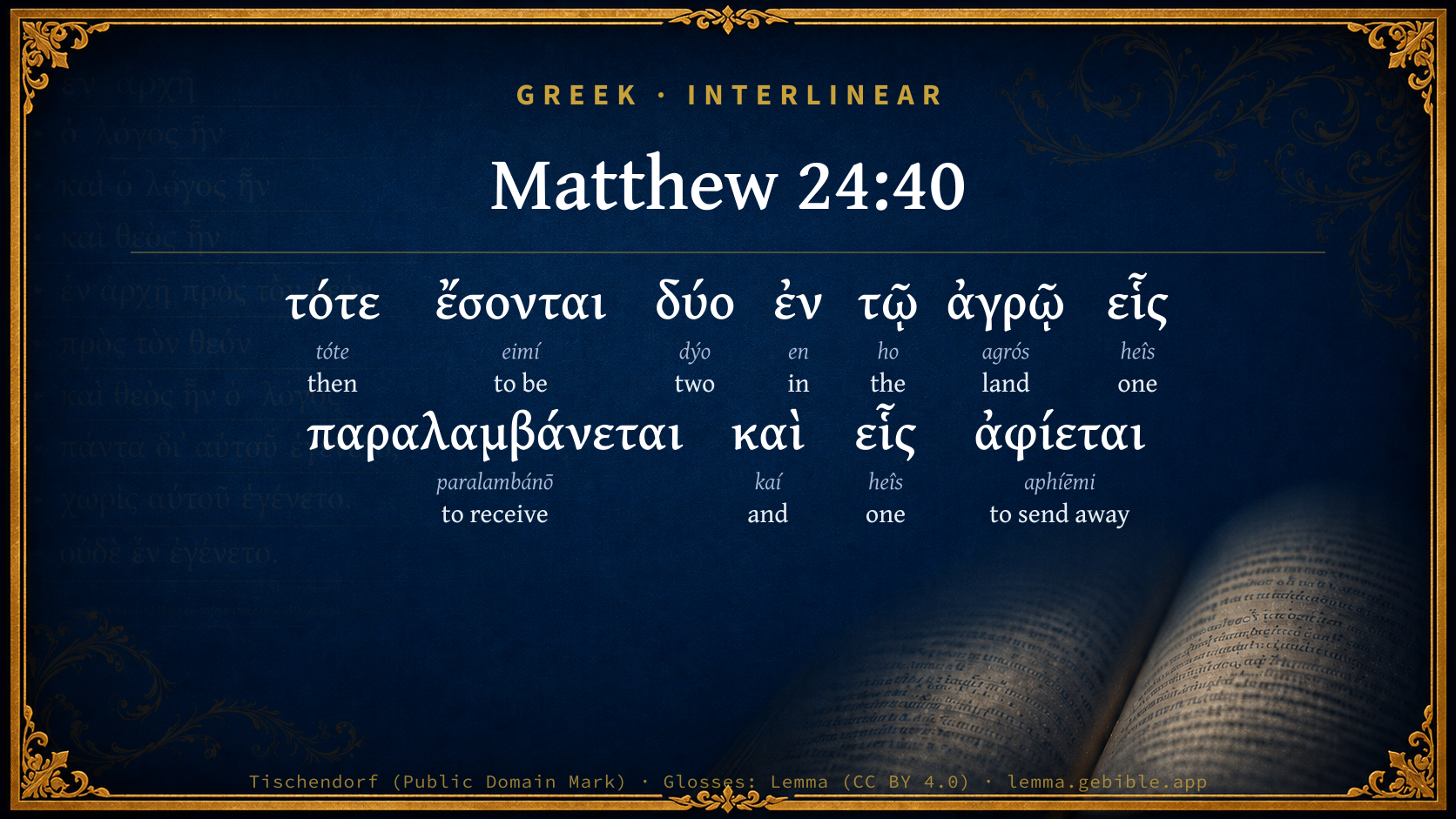
Greek (Tischendorf 8th ed.) Matthew 24:40 appears in the Greek New Testament. The text above is from the Tischendorf 8th edition. Each word links to its Strong’s number and a concise gloss. Click any word for its full Thayer’s Greek Lexicon entry.
Download image
Cite this verse

Matthew 24:40 (World English Bible). Public Domain. Lemma interlinear Bible study tool, https://lemma.gebible.app/v/matthew/24/40.

Show BibTeX & RIS
BibTeX
RIS
English Translation
Then two men will be in the field: one will be taken and one will be left;
World English Bible · Public Domain
Download a study sheet

One document with this verse’s original text, its word-by-word gloss line, the meaning frame, cross-references with their text, attributed commentary, and full source and license credits — printable, and it pastes into notes with its structure intact.

This verse Autodidact and up

Study sheet (.html) Plain text (.txt)

A passage Seminary Student

Up to 50 verses in one chapter. A passage sheet keeps up to 6 commentary sources and 12 cross-references per verse, in the order this page ranks them, and says so on the sheet whenever that leaves anything out. Ask for a single verse and you get the Autodidact verse sheet above.

Everything on this page stays free to read, with no account — the sheet is a download of what is already on screen, not access to it.

Want to remove ads? Support Godless Engineer
Compare translations 3

The same verse in 3 English versions, stacked beneath the original-language interlinear above. Click any original word for its lexicon entry.

Each is an independent rendering of the whole verse — the interlinear is not word-aligned to these translations.

Highlighted words mark where these versions differ — a whole-verse word diff, not a word-by-word alignment.

  • World English Bible Public Domain
    Then two men will be in the field: one will be taken and one will be left;
  • King James Version Public Domain
    Then shall two be in the field; the one shall be taken, and the other left.
  • unfoldingWord Literal Text CC BY-SA 4.0
    Then two will be in the field—one is taken, and one is left.

unfoldingWord Literal Text — © unfoldingWord, licensed CC BY-SA 4.0. Word-aligned USFM3 via Door43 (git.door43.org/unfoldingWord/en_ult).

Versions to compare (up to 4)

3 of 4 selected

Show all 19 translations

Every available English version of this verse, each an independent rendering of the whole verse.

  • World English Bible Public Domain
    Then two men will be in the field: one will be taken and one will be left;
  • Berean Standard Bible Public Domain
    Two men will be in the field: one will be taken and the other left.
  • Majority Standard Bible Public Domain
    Two men will be in the field: one will be taken and the other left.
  • King James Version Public Domain
    Then shall two be in the field; the one shall be taken, and the other left.
  • American Standard Version (1901) Public Domain
    Then shall two man be in the field; one is taken, and one is left:
  • Revised Version (1885) Public Domain
    Then shall two men be in the field; one is taken, and one is left:
  • Geneva Bible (1599) Public Domain
    Then two shall be in the fieldes, the one shalbe receiued, and the other shalbe refused.
  • Douay-Rheims (1899) Public Domain
    Then two shall be in the field: one shall be taken, and one shall be left.
  • Young's Literal Translation Public Domain
    Then two men shall be in the field, the one is received, and the one is left;
  • Literal Standard Version CC BY-SA 4.0
    Then two [men] will be in the field: one is received, and one is left;
  • Unlocked Literal Bible CC BY-SA 4.0
    Then two men will be in a field—one will be taken, and one will be left.
  • unfoldingWord Literal Text CC BY-SA 4.0
    Then two will be in the field—one is taken, and one is left.
  • Darby Bible Public Domain
    Then two shall be in the field, one is taken and one is left;
  • World Messianic Bible Public Domain
    Then two men will be in the field: one will be taken and one will be left.
  • Webster's Bible Public Domain
    Then will two be in the field; the one shall be taken, and the other left.
  • Free Bible Version CC BY-SA 4.0
    Two men will be working in the fields. One will be taken, the other left.
  • Bible in Basic English Public Domain
    Then two men will be in the field; one is taken, and one let go;
  • Text-Critical English NT CC BY 4.0
    Two men will be in the field; one will be taken and one will be left.
  • Tyndale New Testament (1534) Public Domain
    Then two shalbe in the feldes the one shalbe receaved and the other shalbe refused

Literal Standard Version (2020), Covenant Press — licensed CC BY-SA 4.0. Text via the HelloAO Bible API (eBible.org). Unlocked Literal Bible (unfoldingWord) — licensed CC BY-SA 4.0. Text via the HelloAO Bible API (eBible.org). unfoldingWord Literal Text — © unfoldingWord, licensed CC BY-SA 4.0. Word-aligned USFM3 via Door43 (git.door43.org/unfoldingWord/en_ult). Free Bible Version, Dr. Jonathan Gallagher — licensed CC BY-SA 4.0. Text via the HelloAO Bible API (eBible.org).

Word by word

More ways to search: Search by grammar → Find every occurrence → Compare this word →

Practice this passage: Drill this verse → Learn its vocabulary →

About this verse

These counts appear in no published source. They are computed here, from the morphology-tagged text and Lemma’s own curated glosses. What Lemma adds →

11
words
10
distinct lemmas
Gospels
section

Shared distinctive vocabulary

ἀγρῷ land G68 occurs in 34 verses of the Greek New Testament. Also found in:

Repetition

A word recurs within this verse:

Cross-references

3

Topical passages linked to Matthew 24:40 in the Treasury of Scripture Knowledge — connected by theme and wording, ordered by reader-vote popularity; previews shown in the World English Bible.

  • Luke 17:34–37 I tell you, in that night there will be two people in one bed. The one will be taken, and the other will be left.
  • 2 Peter 2:7–9 and delivered righteous Lot, who was very distressed by the lustful life of the wicked
  • 2 Peter 2:5 and didn't spare the ancient world, but preserved Noah with seven others, a preacher of righteousness, when he brought a flood on the world of the ungodly;

Cross-references courtesy of OpenBible.info (CC BY 4.0).

Commentary

Notes on Matthew 24:40 from classic Christian and Jewish commentators (each source and its license shown beneath its notes). The classic Christian expositions comment on the surrounding passage and are grouped to its opening verse, so a note may address several verses; the Jewish commentaries on the Tanakh (Rashi and others) are per-verse, so they appear only where the commentator wrote on this verse.

Lemma curates 59 commentaries, every one of them public domain or Creative Commons licensed, each selected and text-cleaned for this edition rather than reprinted as found. About our sources →

The Biblical Illustrator

Joseph S. Exell

Mat_24:40-41

Two women shall be grinding at the mill.

Routine life

The text speaks of an experience which comes to all of us in our turn, as life gradually builds us round. At first, in our childhood, it is otherwise. This earth seems, then, to have no fixed hardness; the spot on which we stand melts off indefinitely into a dreamlike distance, which is hazy and vague, and peopled with we know not what possibilities, holding within its rays strange fairy worlds which rumours may fill as they will, and everything seems possible, and anything might happen, and no relentless law of undeviating existence has imprisoned our expectations and experience, and the world of our hopes mingles with the world of our senses, and earth and heaven are not afraid of each other; their lines cross without a shock. But, as we grow up, we know how solid and how hard the whole thing becomes. The earth takes its stiff limits and its exact rules; it is seen, and known, and measured-a round ball, rolling in space, compact, and massive, and blind, and entire-a round, rolling ball, and we roll round with it. We are things in it, embedded in it; we belong to it; we have a fixed spot and lot on its surface. To it we are tied; we are bound to definite purposes which we never dream of disputing. So we travel with the moving earth; and our days are settled for us; occupations and holidays repeat themselves, year after year, with stolid regularity, against which gradually we give up protesting; we make up our minds to live out our own parts; and all the emotions that beat against this even tenour of uneventful days-dreams, impulses, alarms, hopes, aspirations-cease to be more than empty visions. The common day closes in upon us, settled and familiar; the common world is about us, with interests that ever increase, with work and play, with rule and habit; and the steady block of endless business fills in all our allotted space of action, fills it in down to every cranny, thick and solid and unyielding. (Canon Scott-Holland.)

Circumstances no index of character

How powerless and immaterial are circumstances for those two! Every single circumstance of life is identical; together they rise at the same hour; right through the day they grind together; at the same hour they go to the evening meal, and at the same hour they sleep. Everything, year after year, repeats itself. They dress alike; they were paid alike; life passed for both on the same level of low, unchanging poverty. To any one looking on they would be wholly alike-two poor women, of the same class, occupation, education, wage, interest, dress. Nothing from end to end of these earthly circumstances could be found to distinguish the one from the other. At the same mill they had turned and turned, to both the earth had been equally harsh and unkind, and no lights shone in upon them, and no changes ever surprised them. On and on together, hand in hand, and face to face, they had ground at the same mill up to the last; and lo! one is for heaven, and one for hell. Within they are as different as black from white, as good from evil; so dominant, so imperial is human character, so free it is from the control of circumstances. Oh, what wide comfort! What can it matter what our conditions may be? Two grinding at the mill; one taken, and the other left. Is there any one who sinks under the sodden monotony of daily routine, who withers under the pressure of everyday sameness; who finds himself chained into that mean, petty, narrow block of circumstances which he knows to be killing out all spiritual emotions in those about him, and yet he cannot break from it, and he dreads to feel creeping over his soul the same melancholy dryness he sees in others? That which kills another may be life to him, if he will use it. He alone is the master And yet, on the other hand, how powerful is circumstance! It is at the mill, at the grinding-there and nowhere else-that the thing has got to be done, the difference is to be created. There, as they ground and ground together, these two poor women built up bit by bit the wall of their separation. It was out of the doing of the same things that one grew readier for the Lord, and the other darkened down to the slothful servant. At the mill, still grinding, the Lord finds them. No one, then, need leave his mill. In the field where men work, there our drama works itself out. Circumstances are nothing, but they are also everything; and we shall discover our weakness if we attempt to ignore them … Strength of character lies not in demanding special circumstances, but in mastering and using any that may be given. Our work and daily contact with our fellows form our scene of action, and God blesses with a peculiar blessing the efforts to put to profit, not some self-selected occasion, but the actual conditions in which we find ourselves. (Canon Scott-Holland.)

Faithful performance of common duties

Philip Henry one day calling upon a tanner, found him so busy tanning a hide that he was not aware of his approach until he tapped him on the back. Starting in confusion, the man exclaimed, Sir, I am ashamed you should find me thus. Philip Henry replied with solemn emphasis, May the Lord Jesus, when he comes, find me discharging with the same faithfulness and zeal the duties of my calling!

The Biblical Illustrator, edited by Joseph S. Exell (c. 1880s–1900s) — public domain. Text from a community e-Sword module.

Tyndale Open Study Notes

Tyndale Open Resources

24:40-41 The term taken most likely means taken in judgment, at AD 70 or at the end of history; left would then mean remaining to enter the new era of either the church (see 21:43; 22:1-14) or the Millennium.

Tyndale Open Study Notes — © Tyndale Open Resources, licensed CC BY-SA 4.0. Text via the HelloAO Bible API.

Bengel's Gnomon

Johann Albrecht Bengel

Mat 24:40,[1065] 41. Παραλαμβάνεται, is taken[1066]) sc. into safety, under protection; see Mat 24:31.—ἀφίεται, is left) sc. in the midst of the dangers, whatever may occur.[1067] The present tense is used with reference to the time of the ΤΌΤΕ, then; and the matter was already present to the Saviour’s eyes.

[1065] τότε, then) at the actual time of the Advent, Mat 24:39. Comp. ch. Mat 25:1.—V. g.

[1066] In the original, assumitur.—(I. B.)

[1067] As was the case with the men at the time of the Deluge.—V. g.

Bengel's Gnomon of the New Testament — English translation (T&T Clark, Edinburgh, 1860) — public domain. Text from a community e-Sword module.

Meyer's Critical & Exegetical Commentary

Heinrich August Wilhelm Meyer

Mat_24:40-41. Τότε] then, when the second advent will have thus suddenly taken place.

παραλαμβάνεται] is taken away, namely, by the angels who are gathering the elect together, Mat_24:31. The use of the present tense here pictures what is future as though it were already taking place. But had this referred to the being caught up in the clouds, mentioned 1Th_4:17 (Theophylact, Euthymius Zigabenus, Jansen), ἀναλαμβάνεται would have been used instead.

ἀφίεται] is left, expressing οὐ παραλαμβάνεται in its positive form. Comp. Mat_23:38, Mat_15:14; Soph. O. R. 599. It is tantamount to saying: away! thou art not accepted. To understand the terms as directly the opposite of each other in the following sense: the one is taken captive, the other allowed to go free (Wetstein, Kuinoel), is grammatically wrong (παραλαμβ. cannot, when standing alone, be taken as equivalent to bello capere, although it is used to denote the receiving of places into surrender, in deditionem accipere, Polyb. ii. 54. 12, iv. 63. 4, iv. 65. 6), and does violence to the context to suit the exigencies of the erroneous reference to the destruction of Jerusalem. Rather compare Joh_14:3. It is no doubt admissible to interpret the expression in the hostile sense: the one is seized (Polyb. iii. 69. 2; similarly Baumgarten-Crusius) or carried off (Mat_4:5; Mat_4:8; Num_23:27; 1Ma_3:37; 1Ma_4:1), namely, to be punished. But the ordinary explanation harmonizes better with the reference to Mat_24:31, as well as with the subsequent parable, Mat_24:45 ff., where the πιστὸς δοῦλος is first introduced.

δύο ἀλήθουσαι, κ.τ.λ.] of two who grind at the mill, one will, etc. For the construction, in which, by means of a μετάβασις ἀπὸ ὅλου εἰς μέρη, the plural-subject is broken up into two separate persons, comp. Hom. Il. vii. 306 f.: τὼ δὲ διακρινθέντε, ὁ μὲν μετὰ λαὸν Ἀχαιῶν ἤϊʼ, ὁ δʼ ἐς Τρώων ὅμαδον κίε. Plat. Phaedr. p. 248 A, al.; see Dissen, ad Pind. Ol. viii. 37; also ad Dem. de cor. p. 237 f. If we were to adopt the usual course of supplying ἔσονται from Mat_24:40, we would require to translate as follows: two will be grinding at the mill. But this supplying of ἔσονται is not at all necessary; as may be gathered from the annexing of the participle, we have in this other case, Mat_24:41, just a different mode of presenting the matter.

ἀλήθουσαι] the hard work usually performed by the lower order of female slaves (Exo_9:5; Isa_47:2; Job_31:10; Ecc_12:3), and such as is still performed in the East by women, either singly or by two working together (Rosenmüller, Morgenl. on Exo_11:5; and on the present passage, Robinson, Paläst. II. p. 405 f.). A similar practice prevailed in ancient Greece, Hermann, Privatalterth. § 24. 8. Hemsterhuis, ad Lucian. Tim. 23. On the un-classical ἀλήθειν (for ἀλεῖν), see Lobeck, ad Phryn. p. 151.

ἐν τῷ μύλῳ] which is not to be confounded (see the critical notes) with μύλωνι (a mill-house), is the millstone (Mat_18:6) of the ordinary household hand-mill. It may denote the lower (Deu_24:6) as well as the upper stone (Isa_47:2), which latter would be more precisely designated by the term ἐπιμύλιον (Deut. as above). It is the upper that is intended in the present instance; the women sit or kneel (Robinson as above), hold the handle of the upper millstone in their hands (hence ἐν τ. μ.: with the millstone), and turn it round upon the lower, which does not move.

Meyer — Critical and Exegetical Commentary on the New Testament — English translation by Peter Christie, edited by Frederick Crombie (T&T Clark, 1880) — public domain. Text from a community e-Sword module.

Expositor's Greek Testament

ed. W. Robertson Nicoll

Mat 24:40-41 graphically illustrate the suddenness of the Parusia . εἷς εἷς (Mat 24:40 ) instead of εἷς ἑτέρος , o μία μία in Mat 24:41 . Of these idioms Herrmann in Viger (p. 6) remarks: “Sapiunt Ebraismum”. παραλαμβάνεται , ἀφίεται , one is taken, one left. The reference may either be to the action of the angels, Mat 24:31 (Meyer), or to the judicial action of the Son of Man seizing some, leaving free others (Weiss-Meyer). The sentences are probably proverbial (Schott), and the terms may admit of diverse application. However applied, they point to opposite destinies. ἀλήθουσαι , grinding: ἀλήθω , late for ἀλέω , condemned by Phryn., p. 151. ἐν τῷ μύλωνι (T. R.), in the mill house . ἐ . τ . μύλῳ (W.H [133] ), in or with the millstone. The reference is to a handmill, which required two to work it when grinding was carried on for a considerable time women’s work ( vide Robinson, i., 485; Furrer, Wand. , p. 97; Benzinger, p. 85, where a figure is given).

The Expositor's Greek Testament, edited by W. Robertson Nicoll (1897–1910) — public domain. Text from a community e-Sword module.

Geneva Bible (1599)

Geneva Bible translators

Against them that persuade themselves that God will be merciful to all men, and do by that means give over themselves to sin, that they may in the meanwhile live in pleasure void of all care.

Geneva Bible (1599) marginal notes — public domain. Text via Bolls.life.

Adam Clarke's Commentary

Verse 40. - 41. Then shall two men - two women - one shall be taken, and the other left.] The meaning seems to be, that so general should these calamities be, that no two persons, wheresoever found, or about whatsoever employed, should be both able to effect their escape; and that captivity and the sword should have a complete triumph over this unhappy people.

Two women shall be grinding] Women alone are still employed in grinding the corn in the east; and it is only when despatch is required, or the uppermost millstone is heavy, that a second woman is added. See Wakefield, and Harmer, Obs. vol. i. 253. That they were formerly thus employed, see Ex 11:5, and the note there. See also Isa 47:2.

Adam Clarke's Commentary on the Bible (1810–1826) — public domain. Text from a community e-Sword/MySword module.

Ellicott's Commentary for English Readers

(40) The one shall be taken.—Literally, the present tense being used to express the certainty of the future, one is taken, and one is left. The form of the expression is somewhat obscure, and leaves it uncertain which of the two alternatives is the portion of the chosen ones. Is the man who is “taken” received into fellowship with Christ, while the other is abandoned? or is he carried away as by the storm of judgment, while the other is set free? On the whole, the use of the Greek word in other passages (as, e.g., in Mat_1:20; Mat_1:24; Mat_12:45; Joh_1:11; Joh_14:3) is in favour of the former interpretation. What is taught in any case is that the day of judgment will be, as by an inevitable law, a day of separation, according to the diversity of character which may exist in the midst of the closest fellowship in outward life.

A Bible Commentary for English Readers, edited by Charles John Ellicott (1878–1897) — public domain. Text from a community e-Sword module.

The Cambridge Bible for Schools and Colleges

gen. ed. J. J. S. Perowne

40. shall be taken] Properly, is taken or withdrawn. For this present for future of certainty see ch. Mat_27:63.

40, 41. Instances like these serve to bring out the reflection that the world’s work will be going on then as now; there is also the thought of a real separation in this life beneath an external sameness.

The Cambridge Bible for Schools and Colleges (gen. ed. J. J. S. Perowne; Cambridge University Press, 1878–1918) — public domain. Text from a community e-Sword module.

John Gill's Exposition

Two women shall be grinding at the mill,.... Though the word women is not in the Greek text, yet it is rightly supplied by our translators, as it is in the Persic version; for the word rendered grinding, is in the feminine gender, and was the work of women, as appears both from the Scripture, Exo 11:5 and from several passages in the Jewish writings, concerning which their canons run thus (p),

"These are the works which a woman is to do for her husband, "she must grind", and bake, and wash, and boil, and make his bed, &c.

And elsewhere it is asked (q),

"how does she grind? she sits at the mill, and watches the flour, but she does not grind, or go after a beast, that so the mill may not stop; but if their custom is to grind at a hand mill, she may grind. The sanhedrim order this to poor people; for if she brings one handmaid, or money, or goods, sufficient to purchase, she is not obliged to grind, &c.

Frequent mention is made, of women grinding together at the same mill: a case is put concerning two women grinding at an hand mill (r), and various rules are given about it; as, that (s).

"a woman may lend her neighbour that is suspected of eating the fruits of the seventh year after time, a meal sieve, a fan, a mill, or a furnace, but she may not winnow, nor "grind with her".

Which it supposes she might do, if she was not suspected: again (t),

"the wife of a plebeian, "may grind" with the wife of a learned man, in the time that she is unclean, but not when she is clean.

Nor was this the custom of the Jews only, for women to grind, but also of other countries, as of the Abyssines (u), and of both Greeks and Barbarians (w):

the one shall be taken, and the other left; as before, one shall be taken by the Romans, and either put to death, or carried captive; and the other shall escape their hands, through the singular providence of God. The Ethiopic version, and Munster's Hebrew Gospel add, "two shall be in one bed, one shall be taken, and the other left"; but these words are not in the copies of Matthew in common, but are taken out of Luk 17:34 though they are in the Cambridge copy of Beza's, and in one of Stephens's,

(p) Misn. Cetubot, c. 5. sect. 5. Vid. T. Bab. Bava Kama, fol. 47. 9. & 48. 1. (q) Maimon. Hilch. Ishot. c. 21. sect. 5, 6. (r) T. Bab. Nidda, fol. 60. 2. (s) Misn. Sheviith, c. 5. 9. & Gittin, c. 5. sect. 9. (t) T. Hieros. Teruinot, fol. 46. 3. T. Bab. Gittin, fol. 61. 2. & Cholin, fol. 6. 2. Misn. Taharot, c. 7. sect. 4. (u) Ludolph. Hist. Ethiop. l. 4. c. 4. (w) Plutarch apud Beza. in loc.

John Gill's Exposition of the Whole Bible (1746–1763) — public domain (CC PDM 1.0). Text via the HelloAO Bible API.

Trapp's Complete Commentary

John Trapp

40 Then shall two be in the field; the one shall be taken, and the other left.

Ver. 40. The one shall be taken, the other left] The Flood took all away in a manner; but at Christ’s coming there shall be found a considerable company of such as shall be saved. He shall separate his saints with a wonderful separation, and make himself to be "admired in all them that believe," 2Th 1:10. How carefully, then, should we work out our salvation, and ensure to ourselves our election by good works.

John Trapp, A Commentary or Exposition upon All the Books of the Old and New Testament (1647–1656) — public domain. Text from a community e-Sword module.

Albert Barnes' Notes on the Bible

Then shall two be in the field ... - The calamity will come suddenly. There will be no escape for those whom it overtakes.

One shall be taken - The word “taken” may mean either to be taken away from the danger - that is, rescued, as Lot was Luk 17:28-29, or to be taken away “by death.” Probably the latter is the meaning.

Albert Barnes' Notes on the Bible (1834–1885) — public domain. Text from a community e-Sword/MySword module.

Haydock's Catholic Bible Commentary

Then of two men, who shall think of nothing less than of going to appear before God, one shall be taken to be placed among the number of the elect, and the other shall be left condemned to eternal fire with the damned, on account of his crimes. (Bible de Vence) --- This example of the men in the field, and of the condition and disposition of men at the period of the deluge, strongly expresses how unexpectedly these evils will rush in upon mankind; and the subsequent account of the two women grinding in the mill, shews how little they were solicitous for their salvation. We are, moreover, taught by these examples, that some of all states and conditions will be saved, whether rich or poor, in ease or labour, or decorated with all the various degrees of worldly honour. The same is mentioned in Exodus, chap. xi, ver. 5. From the first-born of Pharao, who sitteth on his throne, even to the first-born of the handmaid that is at the mill, ... every first-born shall die. (St. John Chrysostom, hom. lxxviii.)

George Leo Haydock (1774–1849), Haydock's Catholic Family Bible and Commentary, 1859 edition — public domain. Excludes Psalms (Douay-Rheims chapter numbering differs from Protestant) and Deuterocanonical books (Catholic canon only).

Matthew Poole's English Annotations

Some refer this to the coming of Christ in his kingdom of grace; some: to his coming in the day of judgment: it is true of both those comings. God shows the freeness of his grace much in the conversion of sinners, and makes discriminations of which we can give no account, as he tells us, Luk 4:25-27. But it seemeth here rather to be understood of that separation which Christ shall make at the day of judgment, of the sheep from the goats, the elect from the reprobates; for of that coming our Saviour seemeth to be speaking, both in the preceding and in the following words.

Matthew Poole's English Annotations on the Holy Bible (1683–1685) — public domain. Text from a community e-Sword/MySword module.

Whedon's Commentary on the Bible

Daniel D. Whedon

40. Then shall two be in the field — See comment on Mat_24:31. The suddenness of separation at the judgment day is here most strikingly described. Two — One is a Christian, the other is a sinner. The holy angels come and snatch one, to bear him to the right hand of Christ. The other is left, to be borne by evil angels to his doom at the left hand.

Daniel D. Whedon (gen. ed.), Commentary on the Old and New Testaments (1874–1909) — public domain. Text from a community e-Sword module.

The Pulpit Commentary

The Lord gives two examples of the suddenness of his advent, and its effect in private life. Shall two be in the field. They shall be working together at their ordinary agricultural occupations, with nothing outwardly to distinguish one from the other, good and bad being mingled together. The one shall be taken (paralambanetai is taken, the present implying certainty), and the other left (afietai , is deft). Christ speaks as though he saw the scene before him. The "taking" implies separation from companions, as Mat_17:1 Mat_18:16, etc. This is the work of the angels (ver. 31). There is some doubt as to the destiny of the two classes named. Are the good "taken" and the evil "left"? or are the evil "taken" and the good "left"? Some suppose that the terms allude to the sudden approach of a hostile army by which some are taken prisoners and others allowed to escape; or, since in the parable the tares are first gathered for the burning, those taken must be the wicked, those left are for storing in the everlasting garner. On the other hand, many commentators understand the verbs in a sense opposite to that mentioned above. As (ver. 31) the angels are sent forth to gather the elect, the "taken" are of this class, who are caught away to meet the Lord and his saints, (1Th_4:17 Joh_14:3) while the others are left for judgment and reprobation. (2Th_1:7-9) Bengel, continuing the reference to the Flood, writes, Assumitur in tutelam (ver. 31), ut Noachus cum domo sua; sinitur in periculis, quicquid obveniat, ut homines in diluvio." The latter interpretation of the two seems to be the correct one. At any rate, it is plain that the nicest discrimination is exercised, and that among men and women, in all conditions of life, a final severance shall then be made, which shall apportion their lot in the other world.

Vers. 40, 41. One taken, and another left.

What our Lord here somewhat obscurely applies to the time of the coming judgment is clearly seen in all ages and in every family where death is plying his erratic craft.

I THE DISTINCTION. There are the greatest possible variations in providence. God does not follow any regimental orders. The ages do not march with the measured tramp of drilled battalions. Families are broken up. Aged men are left, while young men are snatched away. Bad people flourish to a green old age, and some" whom the gods love die early." The useless remain to cumber the ground, and the useful are cut down in the midst of their work.

1. Similarity of external conditions is no guarantee of similarity of fate. The two men are at the same field work, the two women are both alike grinding corn. Yet how different are their fates! We cannot judge of a man"s future by his worldly position.

2. Association in life does not secure association in death. The family is grievously broken; old friends are parted; life partnerships come to an end. Two friends may be very near in life, yet death may make an awful separation, if one is called to the world of light and the other banished to the realm of darkness.

II THE TWOFOLD FATE.

1. The one taken. Whither? There is an eerie vagueness in our Lord"s language. The summons comes, and the most reluctant must obey without a shadow of resistance. But whither does it call? We vainly strive to follow the flight of the passing soul, and the utmost effort of imagination cannot trace it one step beyond the old familiar earthly scenes. A cloud receives the traveller out of sight the moment he takes his departure. Yet we know that there are tremendous possibilities in the unseen, and we know that the blessedness or woe of the future life depends on the conduct of this life. He who is taken has gone "to his own place.

2. The one left.

(1) To what is he left? To grief, desolation, and loneliness but also to God who never leaves, to Christ who is never taken from us.

(2) Why is he left? Perhaps for further work, perhaps for finer chastening, perhaps to give one more opportunity for repentance. But let him consider that his time also must come. Before long all are taken. The distinction is temporal, not final; it is a matter of the postponement of the dreaded end, not of its avoidance.

III THE UNCERTAINTY. Our Lord evidently desires to lay stress on this. We do not know when the final judgment will be. We do not even know when our own last day will come. This, too, may be swift and sudden as the lightning-flash, unexpected as the thief in the night. We never know which will be taken and which left. How often the feeble invalid outlives the strong man who is smitten down by some accident or fatal disease in the midst of his busy life! Such thoughts should not induce a morbid melancholy, or a listless indifference to life. They warn us to be always ready for the summons that shall call us hence. But then he is fit to die who is most truly equipped for the duties of life, and to him the sudden message will be no awful terror, but the trumpet of victory, or, better than that, the Father"s voice calling his child home to himself. W.F.A.

The taken and the left.

This suggests suitable instruction for a time when sudden death visits a family or a Church. At such times there is gracious work to be done, in sympathizing with the smitten and bereaved, and in teaching solemn lessons.

I Illustrate the text in cases of PRESERVATION FROM DANGER. Help toward the nourishing of devout gratitude. Take cases of the few spared from a shipwreck, or recovered from a mine accident. Or case of Luther"s friend Alexis, who was smitten by lightning at his side. All of us can think of friends of our school time or our youth who have been called away. Wherefore are we spared? What is it that God has for us to do? Are we doing it?

II Illustrate the text in cases of RELIGIOUS EXPERIENCE. Help toward nourishing religious anxiety. Take times of mission and revival; the saved and unsaved work together, sit together.

III Illustrate the text in cases of FAMILY BEREAVEMENTS; so bring to view and impress spiritual consolations. Family separations always causing grief and distress. Different scenes at grave-sides beheld by ministers. Extreme distress may be shown only in noble self-restraints; see Abraham"s sorrow over Sarah. What must it be to sever two souls that have grown together in loving, mutual dependence and service through long, long years? It is like tearing the climbing plant from the stem round which it has clung so hard that the two seemed to share a common life. There are three great sources of consolation that may be urged.

1. The "taken" are taken from toil and suffering to rest and peace. All life must be suffering toil; all heaven must be restful toil. Illustrate by the friendship of Christian and Faithful in the "Pilgrim"s Progress." Faithful was taken away to rest by the fire chariot at Vanity Fair.

2. Those "left" are left with abundant provisions of Divine grace. The Hebrew youths in the blazing furnace were not left alone. There are

a. promises to cheer the sadness of the way;

b. there is a lamp to lighten the darkness of the way; and

c. there is a Friend to guide amid the dangers of the way.

3. The "taken" and the "left" will soon be reunited where there is no separation. "A little while;" "We shall know even as we are known; They go no more out forever. R.T.

The Pulpit Commentary (1880–1919), ed. H.D.M. Spence-Jones & Joseph S. Exell — public domain. Text from a community e-Sword module.

John Wesley's Explanatory Notes

One is taken - Into God's immediate protection: and one is left - To share the common calamities. Our Lord speaks as having the whole transaction present before his eyes.

John Wesley, Explanatory Notes Upon the Whole Bible (1754–1765) — public domain. Text via the GEBible commentary corpus.

unfoldingWord translationNotes

Door43 World Missions Community

Connecting Statement:

Jesus begins to tell his disciples to be ready for his return.

Then

This is when the Son of Man comes.

one will be taken, and one will be left

Possible meanings are 1) the Son of Man will take one away to heaven and will leave the other on earth for punishment or 2) the angels will take one away for punishment and leave the other for blessing. (See: Active or Passive)

mill

a tool for grinding

Therefore

"Because what I have just said is true"

be on your guard

"pay attention"

translationWords

lord

unfoldingWord translationNotes — © Distant Shores Media and the Door43 World Missions Community, licensed CC BY-SA 4.0. Source: git.door43.org/Door43/en_tn.

Cambridge Greek Testament for Schools and Colleges

40, 41. Instances like these serve to bring out the reflection that the world’s work will be going on then as now; there is also the thought of a real separation in this life beneath an external sameness.

40. παραλαμβάνεται, ‘is taken or withdrawn.’ For this present for future of certainty see ch. Mat 27:63.

Cambridge Greek Testament for Schools and Colleges (Cambridge University Press, 1896; 21 vols, various authors incl. Carr, Maclear, Plummer, Farrar, Lumby, Moule, M. R. James, Simcox) — public domain. Text from a community e-Sword module.

International Critical Commentary

(L) 40. Then shall there be two in the field; one is taken away, and one is left. Lk. has: “I say to you, on this night there shall be two upon one bed. The one shall be taken away, and the other shall be left.” In Mt. the παραλαμβάνεται refers back to ἐπισυνάξουσι (v. 31). The Son of Man will come as unexpectedly as did the Flood. Just as this surprised men in their ordinary pursuits, and snatched them from their pleasures; so will the angels surprise men at work, and summon the elect from their daily toil. “Three things,” said Johanan ben Zaccai, “come unexpectedly, the Messiah, a discovery, and a scorpion,” B. Sanh 97a.

International Critical Commentary — older volumes (1896–1929), various authors — public domain. Text from a community e-Sword module.

Vincent's Word Studies in the New Testament

Marvin R. Vincent

Shall be taken - left. Both verbs are in the present tense, which makes the saying more lively. One is taken and one if left. So Rev.

Marvin R. Vincent, Word Studies in the New Testament (1887–1900) — public domain. Text from a community e-Sword/MySword module.

Lesson kit

Teaching starters — assembled from the data on this page, not authored interpretation. Every prompt links to the verse data it draws on. Edit before teaching.

Matthew, in the Gospels, opens this verse with 11 words (10 distinct Greek lemmas). Its most distinctive word is agrós (“land”). A historical commentator’s framing appears above. Read the whole chapter for the surrounding context.

Discussion questions

  1. How does “land” (agrós) shape what this verse is saying?
  2. Matthew 6:28 shares the word «land» with this verse. How do the two illuminate each other?
  3. “one” occurs 2× in this one verse. What is the effect of the repetition?
  4. The translations on this page render this verse differently — a whole-verse word diff, not a word-by-word alignment. What might account for the different wordings?
  5. Reading how The Biblical Illustrator and Tyndale Open Study Notes read this verse, where do the two commentators agree and where do they part?

Things to notice

Reading settings

Reading text

Shown beneath each verse's original-language words.

Old Testament
Old Testament edition

Read the OT as the Masoretic Hebrew (MT) or the Greek Septuagint (LXX).

English shown for the Greek Septuagint (in the Hebrew ↔ Greek comparison).

Comparing translations? Open the Compare panel on any verse page to stack up to four side by side.