
Matthew 21:3

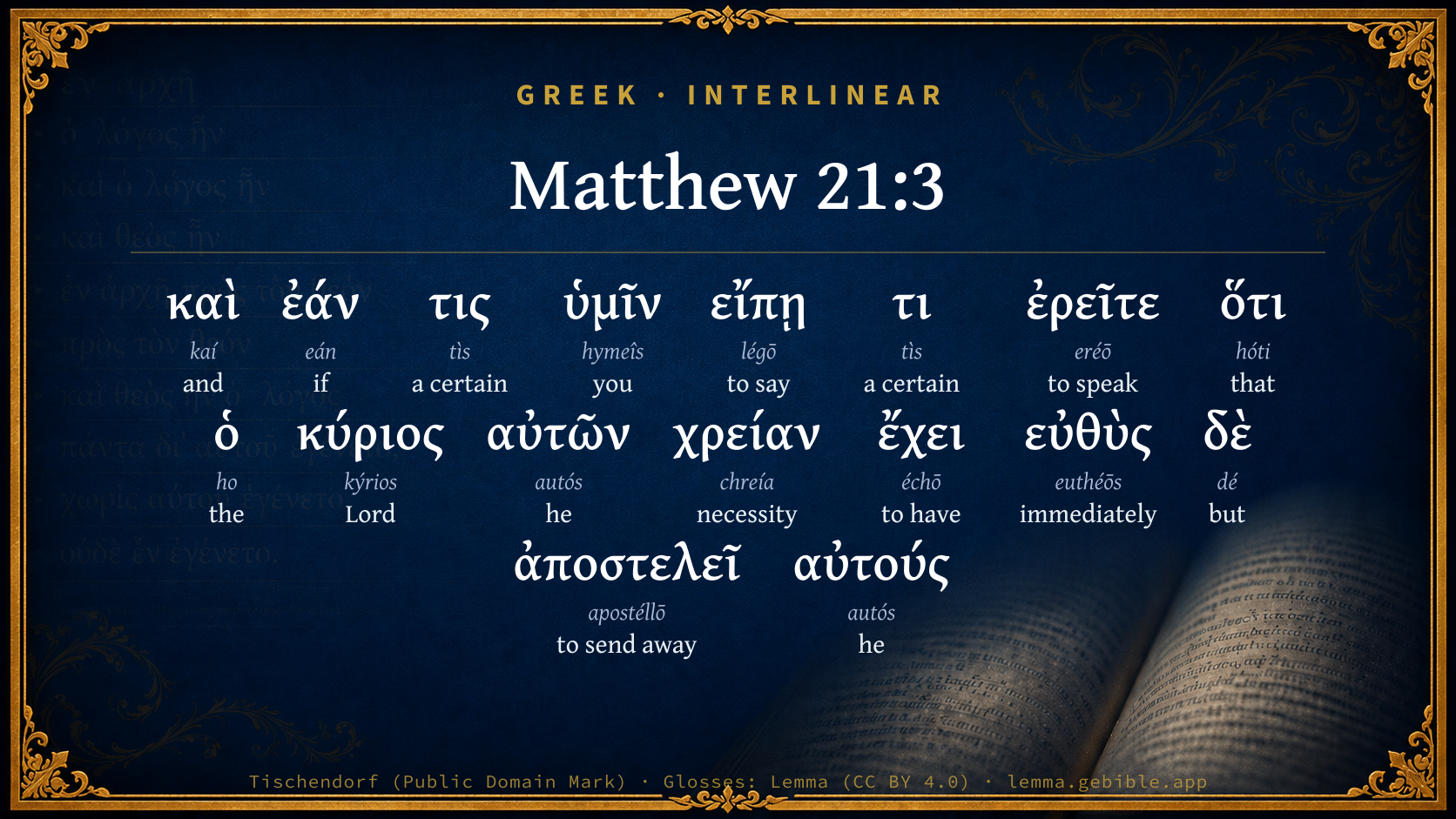
Greek (Tischendorf 8th ed.) Matthew 21:3 appears in the Greek New Testament. The text above is from the Tischendorf 8th edition. Each word links to its Strong’s number and a concise gloss. Click any word for its full Thayer’s Greek Lexicon entry.
Download image
Cite this verse

Matthew 21:3 (World English Bible). Public Domain. Lemma interlinear Bible study tool, https://lemma.gebible.app/v/matthew/21/3.

Show BibTeX & RIS
BibTeX
RIS
English Translation
If anyone says anything to you, you shall say, 'The Lord needs them,' and immediately he will send them."
World English Bible · Public Domain
Download a study sheet

One document with this verse’s original text, its word-by-word gloss line, the meaning frame, cross-references with their text, attributed commentary, and full source and license credits — printable, and it pastes into notes with its structure intact.

This verse Autodidact and up

Study sheet (.html) Plain text (.txt)

A passage Seminary Student

Up to 50 verses in one chapter. A passage sheet keeps up to 6 commentary sources and 12 cross-references per verse, in the order this page ranks them, and says so on the sheet whenever that leaves anything out. Ask for a single verse and you get the Autodidact verse sheet above.

Everything on this page stays free to read, with no account — the sheet is a download of what is already on screen, not access to it.

Want to remove ads? Support Godless Engineer
Compare translations 3

The same verse in 3 English versions, stacked beneath the original-language interlinear above. Click any original word for its lexicon entry.

Each is an independent rendering of the whole verse — the interlinear is not word-aligned to these translations.

Highlighted words mark where these versions differ — a whole-verse word diff, not a word-by-word alignment.

  • World English Bible Public Domain
    If anyone says anything to you, you shall say, 'The Lord needs them,' and immediately he will send them."
  • King James Version Public Domain
    And if any man say ought unto you, ye shall say, The Lord hath need of them; and straightway he will send them.
  • unfoldingWord Literal Text CC BY-SA 4.0
    And if anyone says anything to you, you will say, ‘The Lord has need of them,’ and immediately he will send them.”

unfoldingWord Literal Text — © unfoldingWord, licensed CC BY-SA 4.0. Word-aligned USFM3 via Door43 (git.door43.org/unfoldingWord/en_ult).

Versions to compare (up to 4)

3 of 4 selected

Show all 19 translations

Every available English version of this verse, each an independent rendering of the whole verse.

  • World English Bible Public Domain
    If anyone says anything to you, you shall say, 'The Lord needs them,' and immediately he will send them."
  • Berean Standard Bible Public Domain
    If anyone questions you, tell him that the Lord needs them, and he will send them right away.”
  • Majority Standard Bible Public Domain
    If anyone questions you, tell him that the Lord needs them, and he will send them right away.”
  • King James Version Public Domain
    And if any man say ought unto you, ye shall say, The Lord hath need of them; and straightway he will send them.
  • American Standard Version (1901) Public Domain
    And if any one say aught unto you, ye shall say, The Lord hath need of them; and straightway he will send them.
  • Revised Version (1885) Public Domain
    And if any one say aught unto you, ye shall say, The Lord hath need of them; and straightway he will send them.
  • Geneva Bible (1599) Public Domain
    And if any man say ought vnto you, say ye, that the Lord hath neede of them, and straightway he will let them goe.
  • Douay-Rheims (1899) Public Domain
    And if any man shall say anything to you, say ye, that the Lord hath need of them: and forthwith he will let them go.
  • Young's Literal Translation Public Domain
    and if any one may say anything to you, ye shall say, that the lord hath need of them, and immediately he will send them.'
  • Literal Standard Version CC BY-SA 4.0
    and if anyone may say anything to you, you will say that the LORD has need of them, and immediately He will send them.”
  • Unlocked Literal Bible CC BY-SA 4.0
    If anyone says anything to you about that, you will say, 'The Lord has need of them,' and that person will immediately send them with you.”
  • unfoldingWord Literal Text CC BY-SA 4.0
    And if anyone says anything to you, you will say, ‘The Lord has need of them,’ and immediately he will send them.”
  • Darby Bible Public Domain
    And if any one say anything to you, ye shall say, The Lord has need of them, and straightway he will send them.
  • World Messianic Bible Public Domain
    If anyone says anything to you, you shall say, ‘The Lord needs them,’ and immediately he will send them.”
  • Webster's Bible Public Domain
    And if any man shall say aught to you, ye shall say, The Lord hath need of them; and immediately he will send them.
  • Free Bible Version CC BY-SA 4.0
    If anyone asks you what you're doing, just tell them, ‘The Lord needs them,’ and they will send them right away.”
  • Bible in Basic English Public Domain
    And if anyone says anything to you, you will say, The Lord has need of them; and straight away he will send them.
  • Text-Critical English NT CC BY 4.0
    If anyone says anything to you, say, ‘The Lord has need of them.’ And immediately he will send them.”
  • Tyndale New Testament (1534) Public Domain
    And if eny man saye ought vnto you saye ye that the lorde hath neade of them: and streyght waye he will let them go.

Literal Standard Version (2020), Covenant Press — licensed CC BY-SA 4.0. Text via the HelloAO Bible API (eBible.org). Unlocked Literal Bible (unfoldingWord) — licensed CC BY-SA 4.0. Text via the HelloAO Bible API (eBible.org). unfoldingWord Literal Text — © unfoldingWord, licensed CC BY-SA 4.0. Word-aligned USFM3 via Door43 (git.door43.org/unfoldingWord/en_ult). Free Bible Version, Dr. Jonathan Gallagher — licensed CC BY-SA 4.0. Text via the HelloAO Bible API (eBible.org).

Word by word

More ways to search: Search by grammar → Find every occurrence → Compare this word →

Practice this passage: Drill this verse → Learn its vocabulary →

χρείαν
chreía
G5532
“necessity”
Noun, Accusative, Singular, Feminine
Part of Speech
Noun
Case
Accusative
Number
Singular
Gender
Feminine
Full Thayer's Definition

Origin: from the base of G5530 or G5534

TDNT: None

1. necessity, need 2. duty, business
  1. καὶ kaí G2532 “and” Conjunction
  2. ἐάν eán G1437 “if” Conditional
  3. τις tìs G5100 “a certain” Indefinite pronoun, Nominative, Singular, Masculine
  4. ὑμῖν hymeîs G5210 “you” Personal pronoun, 2nd person, Dative, Plural
  5. εἴπῃ légō G3004 “to say” Verb, Aorist, Active, Subjunctive, 3rd person, Singular
  6. τι tìs G5100 “a certain” Indefinite pronoun, Accusative, Singular, Neuter
  7. ἐρεῖτε eréō G2046 “to speak” Verb, Future, Active, Indicative, 2nd person, Plural
  8. ὅτι hóti G3754 “that” Conjunction
  9. ὁ ho G3588 “the” Article, Nominative, Singular, Masculine
  10. κύριος kýrios G2962 “Lord” Noun, Nominative, Singular, Masculine
  11. αὐτῶν autós G846 “he” Personal pronoun, Genitive, Plural, Masculine
  12. ἔχει échō G2192 “to have” Verb, Present, Active, Indicative, 3rd person, Singular
  13. εὐθὺς euthéōs G2112 “immediately” Adverb
  14. δὲ dé G1161 “but” Conjunction
  15. ἀποστελεῖ apostéllō G649 “to send away” Verb, Future, Active, Indicative, 3rd person, Singular
  16. αὐτούς autós G846 “he” Personal pronoun, Accusative, Plural, Masculine

About this verse

These counts appear in no published source. They are computed here, from the morphology-tagged text and Lemma’s own curated glosses. What Lemma adds →

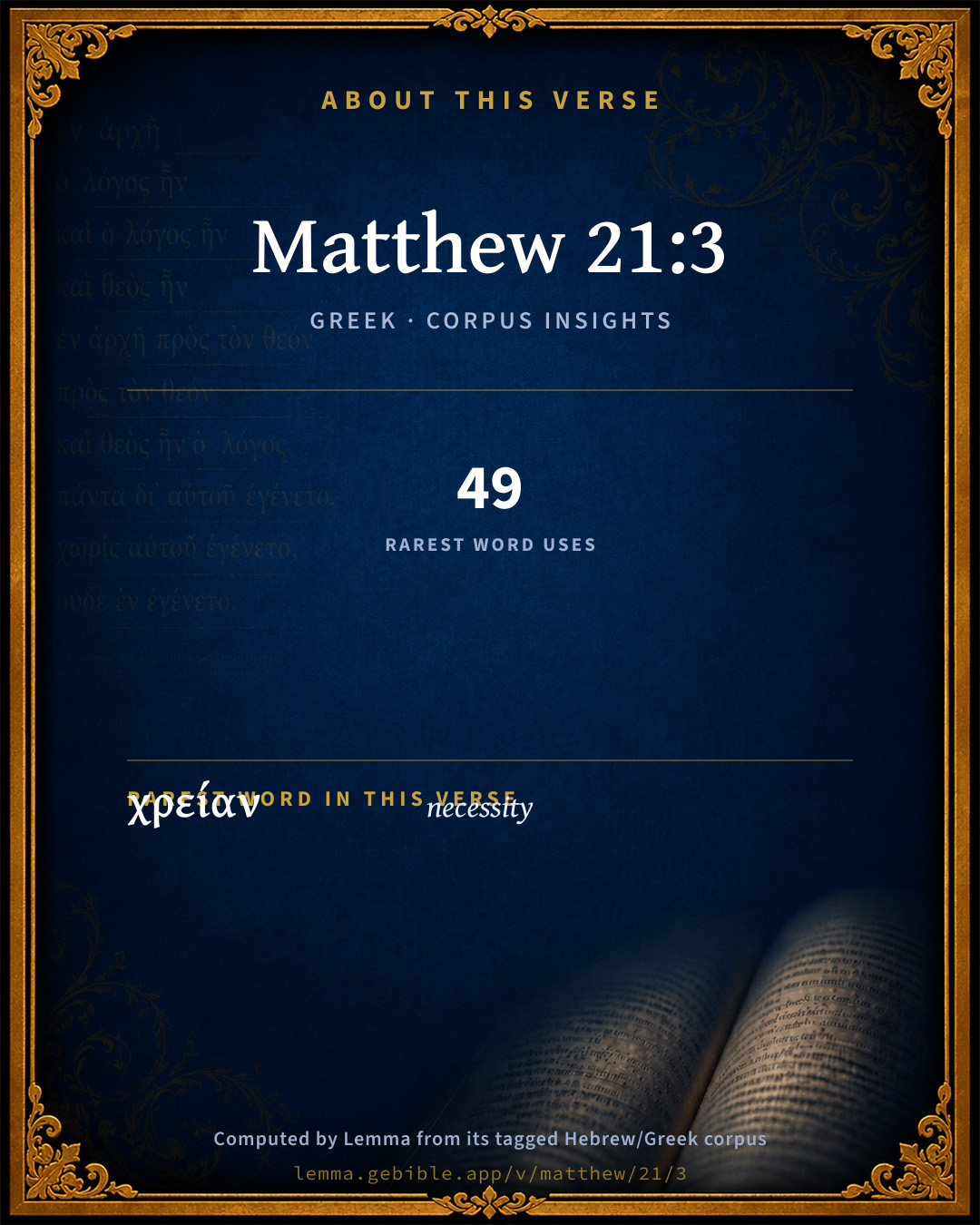
17
words
15
distinct lemmas
Gospels
section

Shared distinctive vocabulary

χρείαν necessity G5532 occurs in 47 verses of the Greek New Testament. Also found in:
Repetition

Words recur within this verse:

  • τις a certain G5100 ×2
  • αὐτῶν he G846 ×2

Cross-references

16

Topical passages linked to Matthew 21:3 in the Treasury of Scripture Knowledge — connected by theme and wording, ordered by reader-vote popularity; previews shown in the World English Bible.

  • Acts 17:25 neither is he served by men's hands, as though he needed anything, seeing he himself gives to all life and breath, and all things.
  • 2 Corinthians 8:1–2 Moreover, brothers, we make known to you the grace of God which has been given in the assemblies of Macedonia;
  • John 3:35 The Father loves the Son, and has given all things into his hand.
  • 2 Corinthians 8:9 For you know the grace of our Lord Jesus Christ, that, though he was rich, yet for your sakes he became poor, that you through his poverty might become rich.
  • Psalms 50:10–11 For every animal of the forest is mine, And the cattle on a thousand hills.
  • Ezra 1:5 Then rose up the heads of fathers' [houses] of Judah and Benjamin, and the priests, and the Levites, even all whose spirit God had stirred to go up to build the house of Yahweh which is in Jerusalem.
  • Ezra 7:27 Blessed be Yahweh, the God of our fathers, who has put such a thing as this in the king's heart, to beautify the house of Yahweh which is in Jerusalem;
  • Psalms 24:1 The earth is Yahweh's, with its fullness; The world, and those who dwell therein.
  • Haggai 2:8–9 The silver is mine, and the gold is mine,' says Yahweh of Hosts.
  • John 17:2 even as you gave him authority over all flesh, he will give eternal life to all whom you have given him.
  • 1 Samuel 10:26 Saul also went to his house to Gibeah; and there went with him the host, whose hearts God had touched.
  • 1 Kings 17:9 Arise, get you to Zarephath, which belongs to Sidon, and dwell there: behold, I have commanded a widow there to sustain you.
  • Ezra 1:1 Now in the first year of Cyrus king of Persia, that the word of Yahweh by the mouth of Jeremiah might be accomplished, Yahweh stirred up the spirit of Cyrus king of Persia, so that he made a proclamation throughout all his kingdom, and [put it] also in writing, saying,
  • 2 Corinthians 8:16 But thanks be to God, who puts the same earnest care for you into the heart of Titus.
  • 1 Chronicles 29:14–16 But who am I, and what is my people, that we should be able to offer so willingly as this? For all things come of you, and of your own have we given you.
  • James 1:17 Every good gift and every perfect gift is from above, coming down from the Father of lights, with whom can be no variation, nor turning shadow.

Cross-references courtesy of OpenBible.info (CC BY 4.0).

Commentary

Notes on Matthew 21:3 from classic Christian and Jewish commentators (each source and its license shown beneath its notes). The classic Christian expositions comment on the surrounding passage and are grouped to its opening verse, so a note may address several verses; the Jewish commentaries on the Tanakh (Rashi and others) are per-verse, so they appear only where the commentator wrote on this verse.

Lemma curates 59 commentaries, every one of them public domain or Creative Commons licensed, each selected and text-cleaned for this edition rather than reprinted as found. About our sources →

Tyndale Open Study Notes

Tyndale Open Resources

21:3 Jesus was revealing himself as the Lord who, as king of Israel, ascends to Mount Zion on a donkey (21:5; see Zech 9:9).

Tyndale Open Study Notes — © Tyndale Open Resources, licensed CC BY-SA 4.0. Text via the HelloAO Bible API.

Bengel's Gnomon

Johann Albrecht Bengel

Mat 21:3. Ὁ Κύριος, the Lord) The owners of the ass were devoted to Jesus.[901]—εὐθέως δὲ, but immediately) i.e. You will not need many words.—[902]ἀποστέλλει, he sends)[903] The present tense is used because the event was sure and speedy, as they were already prepared to send it: cf. Mar 4:29, εὐθέως ἀποστέλλει τὸ δρέπανον, immediately he sendeth the sickle.—See ibid. Mat 11:6, καὶ ἀφῆκαν αὐτούς, and they let them go.

[901] χρείαν ἔχει, hath need) How great were the needs of so great a Lord!—V. g.

[902] Such is the reading also of Griesbach and Scholz. E. M. reads ἀποστελεῖ (the future), rendered therefore in E. V. “he will send.” In his App. Crit. Bengel writes—

[903] Ἀποστελεῖ is the reading of BDbc Vulg. Orig. and Rec. Text, and so Lachm. and Tischend. Ἀποστέλλει is read by CLXZΔ d.—ED.

“ἀποστέλλει) Comp. Er. ed. i. et seqq.; Stop. Aug. i. 2: Bodl. 1, 2, 7; Bu. Byz. Cov. i. Cypr. Gal.; Gehl, Go. Laud. 1, 2, 5; Lin. Lips. Mont. manu prima, M. 1, Mose. N. 1, Par. 1, 3, 4, 7, 8; Per. Roe. Steph. omn. vss. 1, 2, Wh. 1 nonnulli codd. upud Er. vel etiam Barb, decem, et Cam. item Chrys. Theophyl. Cant. latine, Syr. Accedunt Evangelistaria, Aug. 4 (in quo cum verbum hoc jam λ simplici scriptum fuisset, λ alterum est suppletum), Bodl. 4, 5, Land. 4, Wh. 3. Itaque ἀποστέλλει Matthæi, et ἀποστελεῖ Marci se mutuo confirmant, nam librarii videntur lectionem ἀποστελεῖ publica Matthæi recitatione ad Marcum traduxisse, et aliquando ἀποστελεῖ a Marco ad Matthæum retulisse. Vid. Gnom. (ἀποστελεῖ) Lat. et inde Er. vel etiam Parisini et Seldiaui aliquot, cum Bodl. 6, Cant, græce, Gon. Hunt. 2 Magd. et perpaucis aliis.”—(I. B.)

Bengel's Gnomon of the New Testament — English translation (T&T Clark, Edinburgh, 1860) — public domain. Text from a community e-Sword module.

Expositor's Greek Testament

ed. W. Robertson Nicoll

Mat 21:3 . ἐάν τις , etc. Of course it was to be expected that the act would be challenged. ἐρεῖτε , ye shall say, future with imperative force. ὅτι , recitative, introducing in direct form the words of the Master. ὸ Κύριος , the Lord or Master; not surely = Jehovah (Alford, G. T.), but rather to be taken in same sense as in Mat 8:25 , or in Mat 21:30 of this chap. αὐτῶν χρείαν ἔχει , hath need of them; in what sense? Looking to the synop. narratives alone, one might naturally infer that the need was physical , due to the fatigue of a toilsome, tedious ascent. But according to the narrative in 4th Gospel the starting point of the day’s journey was Bethany (Mat 12:1 ; Mat 12:12 ). The prophetic reference in Mat 21:4 suggests a wholly different view, viz. , that the animals were needed to enable Jesus to enter Jerusalem in a manner conformable to prophetic requirements, and worthy of the Messianic King. One is conscious of a certain reluctance to accept this as the exclusive sense of the χρεία . Lutteroth suggests that Jesus did not wish to mix among the crowd of pilgrims on foot lest His arrival should be concealed and the interest awakened by His presence lessened.

The Expositor's Greek Testament, edited by W. Robertson Nicoll (1897–1910) — public domain. Text from a community e-Sword module.

Geneva Bible (1599)

Geneva Bible translators

He that shall say anything to you, shall let them go, to wit, the ass and the colt.

Geneva Bible (1599) marginal notes — public domain. Text via Bolls.life.

Adam Clarke's Commentary

Verse 3. The Lord (the proprietor of all things) hath need of them] Jesus is continually humbling himself, to show us how odious pride is in the sight of God: but in his humility he is ever giving proofs of his almighty power, that the belief of his divinity may be established.

Adam Clarke's Commentary on the Bible (1810–1826) — public domain. Text from a community e-Sword/MySword module.

Ellicott's Commentary for English Readers

(3) The Lord hath need of them.—Simple as the words are, they admit of three very different interpretations. “The Lord” may be used either (1) in the highest sense as equivalent to Jehovah, as though the ass and the colt were claimed for His service; or (2) as referring to Christ in the special sense in which He was spoken of as “the Lord” by His disciples; or (3) as pointing to Him, but only in the language which all men would acknowledge, and without any special claim beyond that of being the Master whom the disciples owned as in a lower sense their Lord. Of these (3) is all but excluded by the facts of the case. The words involve a claim to more than common authority, and the claim is recognised at once. In favour of (2) we have the numerous instances in which the disciples and the evangelists not only address their Master as “Lord,” but speak of Him as “the Lord” (Mat_28:6; Mar_16:19; Luk_10:1; Luk_17:6; Luk_18:6; Joh_11:2; Joh_13:13; Joh_20:2; Joh_20:13; Joh_20:18; Joh_20:20; Joh_20:25; Joh_21:7; Joh_21:12). For (1), lastly, we have our Lord’s use of the word as a synonym for God (Mar_5:19; Mar_13:20). On the whole (2) appears to commend itself as most in accordance with the customary language of the disciples. On the very probable assumption that the owners of the colt were, in some sense, themselves disciples, they would recognise the full import of the words thus addressed to them, and obey without hesitation.

A Bible Commentary for English Readers, edited by Charles John Ellicott (1878–1897) — public domain. Text from a community e-Sword module.

The Cambridge Bible for Schools and Colleges

gen. ed. J. J. S. Perowne

3. The account leads to the inference that the owner of the ass was an adherent of Jesus who had perhaps not yet declared himself. The number of such secret followers was probably very large.

The Cambridge Bible for Schools and Colleges (gen. ed. J. J. S. Perowne; Cambridge University Press, 1878–1918) — public domain. Text from a community e-Sword module.

John Gill's Exposition

And if any man say ought unto you,.... As, what business have you with the ass and colt? why do you loose them? as certain persons, the owners of them did, as Mark and Luke relate;

ye shall say, the Lord hath need of them: he that is our Lord, and your Lord, and the Lord of these creatures, and of all things else, wants them for his present service;

and straightway he will send them: which is either a continuation of what the disciples should say to any that should ask them the reason of their loosing the ass and colt, in order to make them easy: that the Lord who had need of them, as soon as he had done with them, would send them back to their proper owners, safe and well: or they are spoken for the encouragement of the disciples to go, and not be disheartened, though they should be thus examined; for immediately upon saying, that the Lord stood in need of them, and had an use for them at that time, the owner thereof, without any more words, would immediately send them along with them; which latter rather seems to be the sense of the clause; and which is confirmed by Mark: a very clear proof is this of the omniscience of Christ. He knew, that there were an ass, and a colt, in such a village, fastened to such a door, just at the entrance into the town: he knew the owners of it would examine the disciples about loosing and taking them away, and prepares them to give an answer; and he knew that the minds of these owners would be immediately wrought upon, and inclined to let them go directly and quietly.

John Gill's Exposition of the Whole Bible (1746–1763) — public domain (CC PDM 1.0). Text via the HelloAO Bible API.

Trapp's Complete Commentary

John Trapp

3 And if any man say ought unto you, ye shall say, The Lord hath need of them; and straightway he will send them.

Ver. 3. The Lord hath need of them] The Lord of all, both beasts and hearts; for else how could he so soon have obtained the ass of her master? Some read the text thus: "The Lord hath need of them, and will presently send them back again;" to teach us to be no further burdensome or beholden to others than needs must.

John Trapp, A Commentary or Exposition upon All the Books of the Old and New Testament (1647–1656) — public domain. Text from a community e-Sword module.

Albert Barnes' Notes on the Bible

The Lord hath need of them - This means no more than the “master” has need of them. The word “Lord” often means no more than “master” as opposed to servant, Mat 10:24; Eph 6:5; 1Pe 3:5-6. The word is sometimes used in the Bible as applied to God, or as a translation of the name Yahweh. Its common use is a mere title of respect given by an inferior to a superior, by a servant to a master, by a disciple to a teacher. As a title of “high respect” it was given to Christ, or the Messiah. The persons to whom these disciples were sent were probably acquainted with the miracles of Jesus and favorably disposed toward him He had attracted great notice in that region, particularly by raising Lazarus from the dead, and most of the people regarded him as the Messiah.

Albert Barnes' Notes on the Bible (1834–1885) — public domain. Text from a community e-Sword/MySword module.

Haydock's Catholic Bible Commentary

The Lord hath need. Not our Lord, or your Lord, but the Lord, viz. of all, both of the beasts and of their masters, and of every creature. Christ here discovers two of his own attributes, his omniscience and his supreme dominion. Now this was done not by accident, not through novelty or to avoid fatigue, but as the evangelist declares, to accomplish the prophecy of Isaias and of Zarcharias.

George Leo Haydock (1774–1849), Haydock's Catholic Family Bible and Commentary, 1859 edition — public domain. Excludes Psalms (Douay-Rheims chapter numbering differs from Protestant) and Deuterocanonical books (Catholic canon only).

Whedon's Commentary on the Bible

Daniel D. Whedon

3. If any man say aught — Whether owner or not. The Lord — This may imply that the owner was a follower of Jesus, and would recognize the fact that the taking of the ass was for his use. But the phrase any man seems to imply that such would be the power of that name, that the mind of any questioner would be supernaturally silenced by this answer.

Daniel D. Whedon (gen. ed.), Commentary on the Old and New Testaments (1874–1909) — public domain. Text from a community e-Sword module.

The Pulpit Commentary

Say aught unto you. This might naturally be expected. Christ foresaw the opposition, and instructed the disciples how to overcome it with a word. The Lord; Kuriov , equivalent to "Jehovah," or the King Messiah. Doubtless the owner of the animals was a disciple, and acknowledged the claims of Jesus. His presence here was a providentially guided coincidence. If he was a stranger; as others suppose, be must have been divinely prompted to acquiesce in the appropriation of his beasts. He will send them. Some manuscripts read, "he sends them," here, as in St. Mark. The present is more forcible, but the future is well attested. The simple announcement that the asses were needed for God"s service would silence all refusal. The disciples, indeed, were to act at once, as executing the orders of the supreme Lord, and were to use the given answer only in case of any objection. Throughout the transaction Christ assumes the character of the Divine Messiah, King of his people, the real Owner of all that they possess.

HOMILIES BY R. TUCK Ver. 3. Ready response to Divine claims.

"Straightway he will send them." It does not at once appear whether our Lord made a claim on this animal, in a general way, for the service of God, or in a particular way, as a personal favour to himself. He must have been well known in the neighbourhood of Bethany, and it is quite conceivable that the man distinctly lent the animal to Jesus. It was not a working animal, and there was no loss of its labour, or its mother"s, in this use of it by Jesus. What stands out to view, as suggestive of helpful thoughts and useful lessons, is the ready response of this good man. Think of it as a Divine claim, and he presents an example of prompt, trustful, unquestioning obedience. Think of it as a request from the great Teacher, and then you have revealed a secret disciple, or at least one who felt the fascination of our Lord"s presence.

I READY RESPONSE TO DIVINE CLAIMS AS AN EXAMPLE. There was no questioning or dispute; no hesitation or doubt; no anxiety, even, as to how the animals would be brought back again. There was no anxiety as to what was to be done with them; no fear as to any injury coming to them; the man did not even suggest that the colt would be of no use, for he had not been "broken in." It is beautiful and suggestive that the simple sentence, "The Lord hath need of them," sufficed to quiet and satisfy him. He could shift all the responsibility on the Lord. "He knows everything; he controls everything. What I have to do is to obey. Depend upon it, the rest will all come right." So away at once, and away cheerfully, went the animals. That is a noble example indeed. We spoil so much of our obedience by criticizing the things we are called to do, or give, or bear. Then we hesitate, question, doubt, and do languidly at last what we do. If we know what God"s will is, that should always be enough. We have nothing to do with the how or the why. Send the animals at once if you know that "the Lord hath need of them.

II READY RESPONSE TO DIVINE CLAIMS AS A REVELATION OF CHARACTER. I like this man. I seem to know this man. His act reveals him. A simple-hearted sort of man, whose natural trustfulness has not been spoilt. An open-hearted, generous sort of man, with very little "calculation" in him. He reminds one of Nathanael, "in whom was no guile." And simple souls somehow get the best of life. R.T.

The Pulpit Commentary (1880–1919), ed. H.D.M. Spence-Jones & Joseph S. Exell — public domain. Text from a community e-Sword module.

The People's New Testament

B. W. Johnson

3. The Lord hath need of them. It is probable that the owner was a disciple.

B. W. Johnson's The People's New Testament with Notes (1889–1891) — public domain. Electronic text from the Christian Classics Ethereal Library (CCEL) ThML edition.

Cambridge Greek Testament for Schools and Colleges

3. The account leads to the inference that the owner of the ass was an adherent of Jesus who had perhaps not yet declared himself. The number of such secret followers was perhaps very large.

Cambridge Greek Testament for Schools and Colleges (Cambridge University Press, 1896; 21 vols, various authors incl. Carr, Maclear, Plummer, Farrar, Lumby, Moule, M. R. James, Simcox) — public domain. Text from a community e-Sword module.

Alford’s Greek Testament

Henry Alford

3.] τὴν κ. τ. ἀπ., i.e. Bethphage. Mark and Luke mention the πῶλος only, adding “whereon never yet man sat” (see note on Mark): John ὀνάριον. Justin Martyr (Apolog. i. 32, p. 63) connects this verse with the prophecy in Gen 49:11, δεσμεύων πρὸς ἄμπελον τὸν πῶλον αὐτοῦ, καὶ τῇ ἕλικι τὸν πῶλον τῆς ὄνου αὐτοῦ.

ὁ κύριος, here, ‘the LORD,’ Jehovah (see reff.): most probably a general intimation to the owners, that they were wanted for the service of God. I cannot see how this interpretation errs against decorum, as Stier (ii. 332, edn. 2) asserts. The meanest animals might be wanted for the service of the Lord Jehovah. And after all, what difference is there as to decorum, if we understand with him ὁ κύρ. to signify “the King Messiah”? The two disciples were perhaps Peter and John: compare Mar 14:13 and Luk 22:8.

Henry Alford, The Greek Testament (1849–1861) — public domain. Text from a community e-Sword module.

International Critical Commentary

(M) 3. And if any one say anything to you, you shall say that the Lord hath need of them; and straightway he will send them.] Mk. has: “And if any one say to you, Why do ye this? Say, The Lord hath need of it and straightway sends it again here” (= will return it). Mt., as often, omits πάλιν.—εὐθὺς δέ] for καὶ εὐθύς, as often. In Mk. the subject of ἀποστέλλει seems to be ὁ κύριος. “The Lord needs it, and will soon return it.” Mt. seems to make the sentence mean, “and (at your words) he (the man who spoke to you) will send it.”

International Critical Commentary — older volumes (1896–1929), various authors — public domain. Text from a community e-Sword module.

Vincent's Word Studies in the New Testament

Marvin R. Vincent

The Lord [ο κυριος] . From kurov, supreme power, authority. Hence kuriov, one having authority, Lord, owner, ruler. In classical Greek, used of the gods, and in inscriptions applied to different gods, as Hermes, Zeus, etc.; also of the head of the family, who is Lord, [κυριος] of the wife and children (1Sa 1:8, Sept.); while to the slaves he is despothv. In the Pauline writings, however, the master of slaves is called both despothv (1Ti 6:1, 2; Tit 2:9; 1Pe 2:18), and kuriov (Eph 6:9; Col 4:1).

In the Septuagint it is used by Sarah of her husband (Gen 18:12; compare 1Pe 3:6). Joseph is called Lord of the country (Gen 42:33), and is addressed by his brethren as my Lord (xlii. 10). It is applied to God (Gen 18:27; Exo 4:10). In the New Testament it is a name for God (Mt 1:20, 22, 24; Mt 2:15; Act 11:16; Act 12:11, 17; Revelation 1 8). As applied to Christ, it does not express his divine nature and power. These are indicated by some accompanying word or phrase, as my God (Joh 20:28); of all (Act 10:36); to the glory of God the Father (Phi 2:11); of glory (1Co 2:8); so that, as a title of Christ, Lord is used in the sense of Master or Ruler, or in address, Sir (Mt 22:43, 45; Luk 2:11; Luk 6:46; Joh 13:13, 14; 1Co 8:6). O kuriov, the Lord, is used of Christ by Matthew only once (xxi. 3) until after the resurrection (xxviii. 6). In the other gospels and in the Acts it occurs far oftener. Nevertheless, in the progress of Christian thought in the New Testament, the meaning develops toward a specific designation of the divine Savior, as may be seen in the phrases Jesus Christ our Lord, Our Lord Jesus Christ, Our Lord, Jesus our Lord.

Marvin R. Vincent, Word Studies in the New Testament (1887–1900) — public domain. Text from a community e-Sword/MySword module.

Lesson kit

Teaching starters — assembled from the data on this page, not authored interpretation. Every prompt links to the verse data it draws on. Edit before teaching.

Matthew, in the Gospels, opens this verse with 17 words (15 distinct Greek lemmas). Its most distinctive word is chreía (“necessity”). A historical commentator’s framing appears above. Read the whole chapter for the surrounding context.

Discussion questions

  1. The word chreía carries the sense “necessity.” How does it shape the verse?
  2. Matthew 3:14 shares the word «necessity» with this verse. How do the two illuminate each other?
  3. “a certain” occurs 2× in this one verse. What is the effect of the repetition?
  4. These translations render this verse differently; the difference is in the English rendering, not the original. What questions does that raise?
  5. Reading how Tyndale Open Study Notes and Bengel's Gnomon read this verse, where do the two commentators agree and where do they part?

Things to notice

  • These translations choose different wording for 12 words in this verse.
  • “a certain” occurs 2× in this single verse.
  • 15 distinct Greek lemmas span 17 words in this verse.

Reading settings

Reading text

Shown beneath each verse's original-language words.

Old Testament
Old Testament edition

Read the OT as the Masoretic Hebrew (MT) or the Greek Septuagint (LXX).

English shown for the Greek Septuagint (in the Hebrew ↔ Greek comparison).

Comparing translations? Open the Compare panel on any verse page to stack up to four side by side.