
Matthew 21:7

Greek (Tischendorf 8th ed.) Matthew 21:7 appears in the Greek New Testament. The text above is from the Tischendorf 8th edition. Each word links to its Strong’s number and a concise gloss. Click any word for its full Thayer’s Greek Lexicon entry.
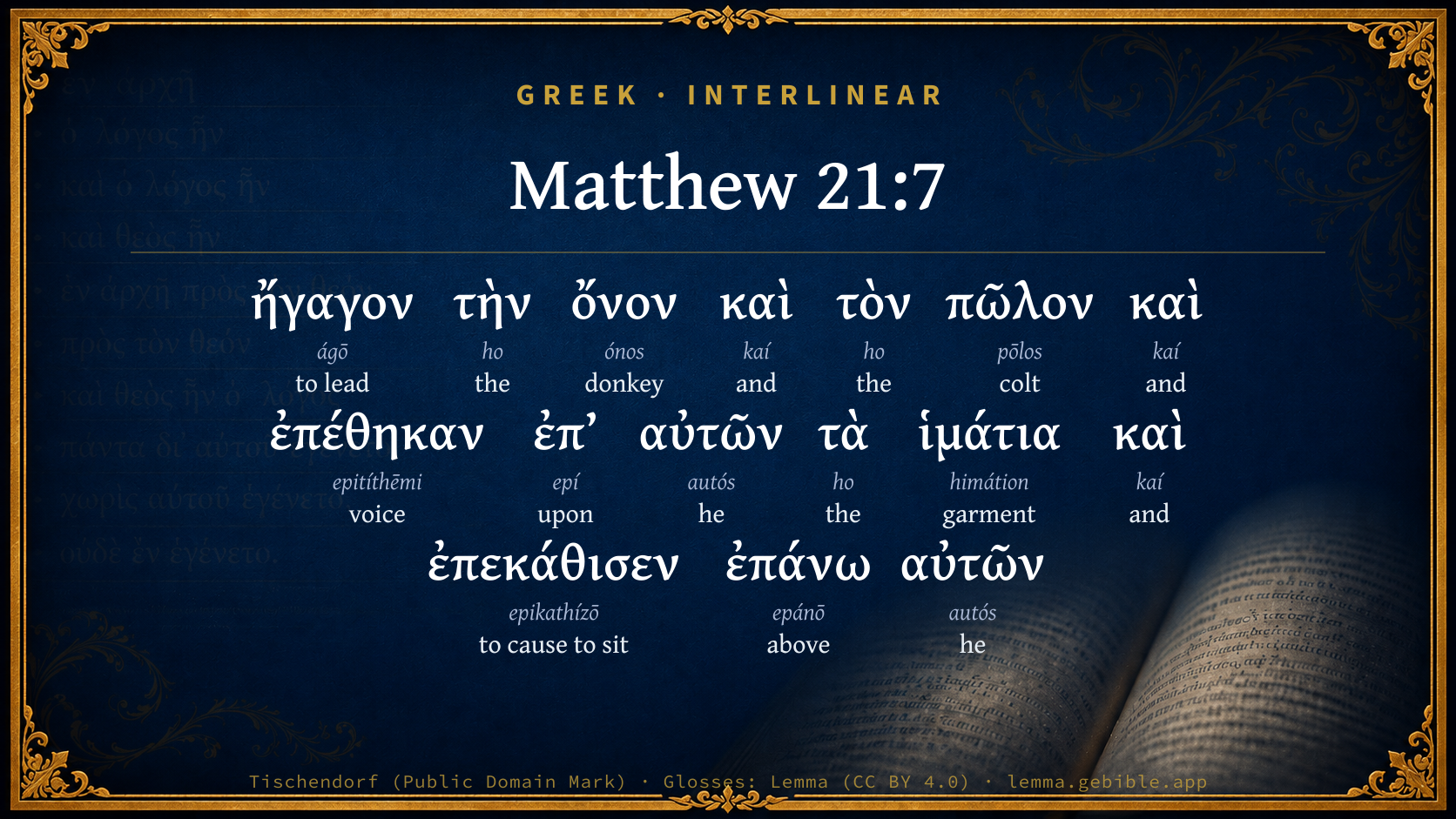
Download image
Cite this verse

Matthew 21:7 (World English Bible). Public Domain. Lemma interlinear Bible study tool, https://lemma.gebible.app/v/matthew/21/7.

Show BibTeX & RIS
BibTeX
RIS
English Translation
and brought the donkey and the colt, and laid their clothes on them; and he sat on them.
World English Bible · Public Domain
Highlights
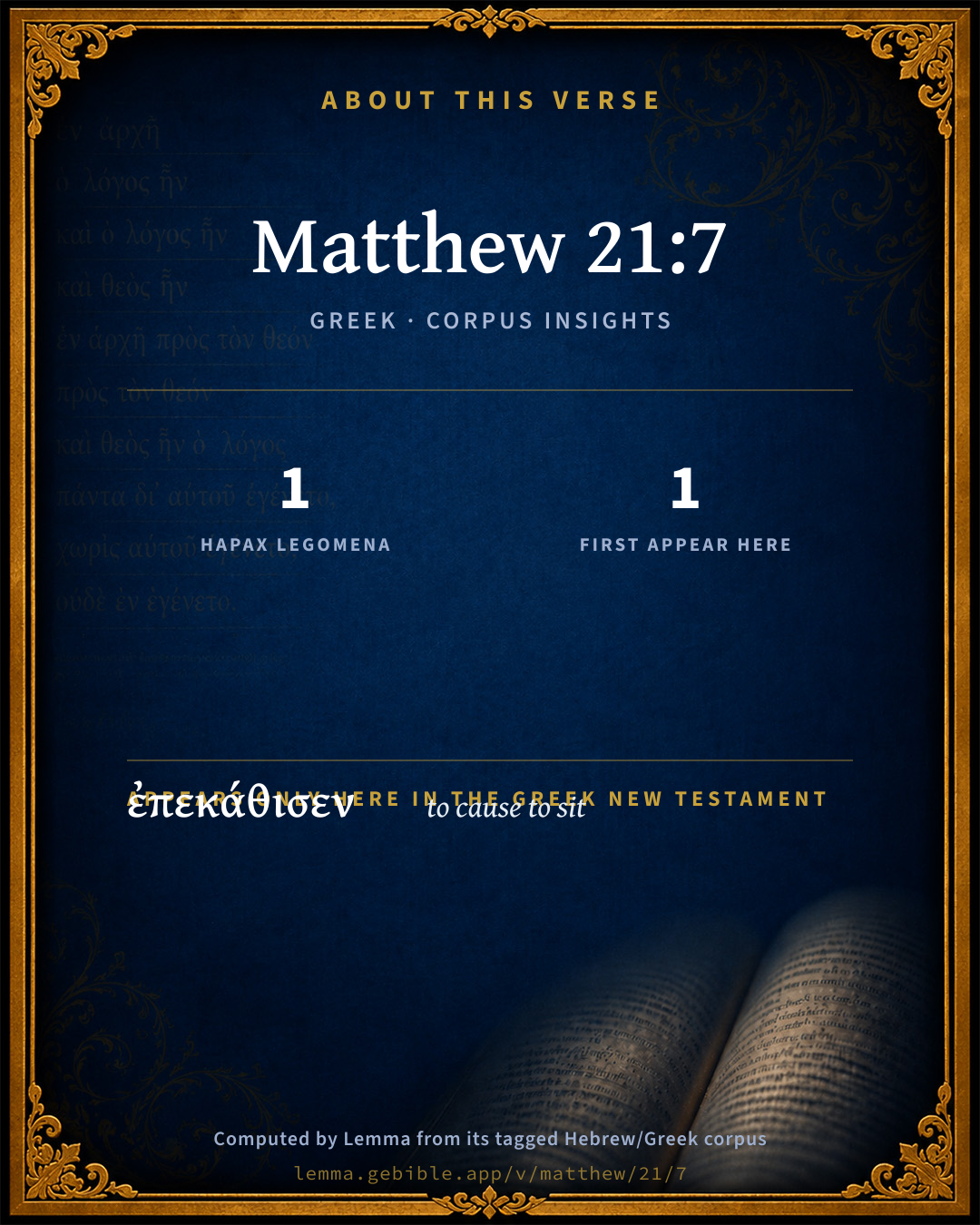
  • 1 hapax legomenon — only here in the Greek New Testament
  • 1 first appearance in the Greek New Testament
Full analysis ↓
Download a study sheet

One document with this verse’s original text, its word-by-word gloss line, the meaning frame, cross-references with their text, attributed commentary, and full source and license credits — printable, and it pastes into notes with its structure intact.

This verse Autodidact and up

Study sheet (.html) Plain text (.txt)

A passage Seminary Student

Up to 50 verses in one chapter. A passage sheet keeps up to 6 commentary sources and 12 cross-references per verse, in the order this page ranks them, and says so on the sheet whenever that leaves anything out. Ask for a single verse and you get the Autodidact verse sheet above.

Everything on this page stays free to read, with no account — the sheet is a download of what is already on screen, not access to it.

Want to remove ads? Support Godless Engineer
Compare translations 3

The same verse in 3 English versions, stacked beneath the original-language interlinear above. Click any original word for its lexicon entry.

Each is an independent rendering of the whole verse — the interlinear is not word-aligned to these translations.

Highlighted words mark where these versions differ — a whole-verse word diff, not a word-by-word alignment.

  • World English Bible Public Domain
    and brought the donkey and the colt, and laid their clothes on them; and he sat on them.
  • King James Version Public Domain
    And brought the ass, and the colt, and put on them their clothes, and they set him thereon.
  • unfoldingWord Literal Text CC BY-SA 4.0
    brought the donkey and the colt and put their cloaks on them, and he sat upon them.

unfoldingWord Literal Text — © unfoldingWord, licensed CC BY-SA 4.0. Word-aligned USFM3 via Door43 (git.door43.org/unfoldingWord/en_ult).

Versions to compare (up to 4)

3 of 4 selected

Show all 19 translations

Every available English version of this verse, each an independent rendering of the whole verse.

  • World English Bible Public Domain
    and brought the donkey and the colt, and laid their clothes on them; and he sat on them.
  • Berean Standard Bible Public Domain
    They brought the donkey and the colt and laid their cloaks on them, and Jesus sat on them.
  • Majority Standard Bible Public Domain
    They brought the donkey and the colt and laid their cloaks on them, and Jesus sat on them.
  • King James Version Public Domain
    And brought the ass, and the colt, and put on them their clothes, and they set him thereon.
  • American Standard Version (1901) Public Domain
    and brought the ass, and the colt, and put on them their garments; and he sat thereon.
  • Revised Version (1885) Public Domain
    and brought the ass, and the colt, and put on them their garments; and he sat thereon.
  • Geneva Bible (1599) Public Domain
    And brought the asse and the colt, and put on them their clothes, and set him thereon.
  • Douay-Rheims (1899) Public Domain
    And they brought the ass and the colt, and laid their garments upon them, and made him sit thereon.
  • Young's Literal Translation Public Domain
    brought the ass and the colt, and did put on them their garments, and set `him' upon them;
  • Literal Standard Version CC BY-SA 4.0
    brought the donkey and the colt, and put on them their garments, and set [Him] on them;
  • Unlocked Literal Bible CC BY-SA 4.0
    They brought the donkey and the colt and put their cloaks on them, and Jesus sat upon the cloaks.
  • unfoldingWord Literal Text CC BY-SA 4.0
    brought the donkey and the colt and put their cloaks on them, and he sat upon them.
  • Darby Bible Public Domain
    brought the ass and the colt and put their garments upon them, and he sat on them.
  • World Messianic Bible Public Domain
    and brought the donkey and the colt and laid their clothes on them; and he sat on them.
  • Webster's Bible Public Domain
    And brought the ass and the colt, and put on them their clothes, and they set him thereon.
  • Free Bible Version CC BY-SA 4.0
    They brought back the donkey and the colt. They placed their cloaks on them, and he sat on them.
  • Bible in Basic English Public Domain
    And got the ass and the young one, and put their clothing on them, and he took his seat on it.
  • Text-Critical English NT CC BY 4.0
    They brought the donkey and the colt and laid on them their garments, and Jesus sat on them.
  • Tyndale New Testament (1534) Public Domain
    and brought the asse and the colte and put on them their clothes and set him theron.

Literal Standard Version (2020), Covenant Press — licensed CC BY-SA 4.0. Text via the HelloAO Bible API (eBible.org). Unlocked Literal Bible (unfoldingWord) — licensed CC BY-SA 4.0. Text via the HelloAO Bible API (eBible.org). unfoldingWord Literal Text — © unfoldingWord, licensed CC BY-SA 4.0. Word-aligned USFM3 via Door43 (git.door43.org/unfoldingWord/en_ult). Free Bible Version, Dr. Jonathan Gallagher — licensed CC BY-SA 4.0. Text via the HelloAO Bible API (eBible.org).

Word by word

More ways to search: Search by grammar → Find every occurrence → Compare this word →

Practice this passage: Drill this verse → Learn its vocabulary →

ἐπεκάθισεν
epikathízō
G1940
“to cause to sit”
Verb, Aorist, Active, Indicative, 3rd person, Singular
Part of Speech
Verb
Tense
Aorist
Voice
Active
Mood
Indicative
Person
3rd person
Number
Singular
Full Thayer's Definition

Origin: from G1909 and G2523

TDNT: None

1. to cause to sit upon, to set upon 2. to sit upon
  1. ἤγαγον ágō G71 “to lead” Verb, Aorist, Active, Indicative, 3rd person, Plural
  2. τὴν ho G3588 “the” Article, Accusative, Singular, Feminine
  3. ὄνον ónos G3688 “donkey” Noun, Accusative, Singular, Feminine
  4. καὶ kaí G2532 “and” Conjunction
  5. τὸν ho G3588 “the” Article, Accusative, Singular, Masculine
  6. πῶλον pōlos G4454 “colt” Noun, Accusative, Singular, Masculine
  7. καὶ kaí G2532 “and” Conjunction
  8. ἐπέθηκαν epitíthēmi G2007 “voice” Verb, Aorist, Active, Indicative, 3rd person, Plural
  9. ἐπ’ epí G1909 “upon” Preposition
  10. αὐτῶν autós G846 “he” Personal pronoun, Genitive, Plural, Masculine
  11. τὰ ho G3588 “the” Article, Accusative, Plural, Neuter
  12. ἱμάτια himátion G2440 “garment” Noun, Accusative, Plural, Neuter
  13. καὶ kaí G2532 “and” Conjunction
  14. ἐπάνω epánō G1883 “above” Adverb
  15. αὐτῶν autós G846 “he” Personal pronoun, Genitive, Plural, Masculine

About this verse

These counts appear in no published source. They are computed here, from the morphology-tagged text and Lemma’s own curated glosses. What Lemma adds →

16
words
11
distinct lemmas
Gospels
section

Notable vocabulary

1 hapax legomenon — a word that appears only here in the entire Greek New Testament:

  • ἐπεκάθισεν to cause to sit G1940

First appearance in Scripture

This word makes its first canonical appearance in the Greek New Testament here:

  • ἐπεκάθισεν to cause to sit G1940

Shared distinctive vocabulary

ὄνον donkey G3688 occurs in 5 verses of the Greek New Testament. Also found in:
Repetition

Words recur within this verse:

  • τὴν the G3588 ×3
  • καὶ and G2532 ×3
  • αὐτῶν he G846 ×2

Cross-references

3

Topical passages linked to Matthew 21:7 in the Treasury of Scripture Knowledge — connected by theme and wording, ordered by reader-vote popularity; previews shown in the World English Bible.

  • 2 Kings 9:13 Then they hurried, and took every man his garment, and put it under him on the top of the stairs, and blew the trumpet, saying, Jehu is king.
  • Mark 11:4–8 They went away, and found a young donkey tied at the door outside in the open street, and they untied him.
  • Luke 19:32–35 Those who were sent went away, and found things just as he had told them.

Cross-references courtesy of OpenBible.info (CC BY 4.0).

Commentary

Notes on Matthew 21:7 from classic Christian and Jewish commentators (each source and its license shown beneath its notes). The classic Christian expositions comment on the surrounding passage and are grouped to its opening verse, so a note may address several verses; the Jewish commentaries on the Tanakh (Rashi and others) are per-verse, so they appear only where the commentator wrote on this verse.

Lemma curates 59 commentaries, every one of them public domain or Creative Commons licensed, each selected and text-cleaned for this edition rather than reprinted as found. About our sources →

Bengel's Gnomon

Johann Albrecht Bengel

Mat 21:7. Ἐπεκάθισεν,[911] He sat upon) becomingly; His disciples attending on Him;[912] see Luk 19:35. The Persian kings were rather placed by others, than themselves got on horseback. See Brisson.—ἐπάνω αὐτῶν, on them) though, strictly speaking, on the foal; see Mar 11:2-3; Joh 12:14-15.

[911] BC Origen read, as Beng., ἐπεκάθισεν, He sat: abcd also have ‘sedebat:’ D has ἐκάθητο. Vulg. has imposuerunt; and so Rec. Text ἐπεκάθισαν, they set Him thereon. This last plainly comes through Harmonists from Luk 19:35, ἐπβίβασαν, they set Jesus thereon.—ED.

[912] That is, His disciples helped Him to mount, which harmonises the statements, that He sat upon the colt, in Matt., and that His disciples set Him on, in Luke.—ED.

Bengel's Gnomon of the New Testament — English translation (T&T Clark, Edinburgh, 1860) — public domain. Text from a community e-Sword module.

Meyer's Critical & Exegetical Commentary

Heinrich August Wilhelm Meyer

Mat_21:7. They spread their outer garments upon both animals, being uncertain which of them Jesus intended to mount.

The (second) ἐπάνω αὐτῶν must necessarily be referred, with Theophylact, Euthymius Zigabenus, Castalio, Beza, Homberg, Fritzsche, Winer, p. 165 [E. T. 219], to the garments, in which case it is clear from Mat_21:5 that Jesus sat upon the foal. Were we to refer αὐτῶν to the animals, the result would be the absurd idea (which Strauss, B. Bauer, Volkmar make use of against Matthew) that Jesus mounted both of them at once, not one after the other (Fritzsche, Fleck), seeing that κ. ἐπεκάθισεν ἐπ. αὐτῶν denotes the instantaneous, finished act which followed the spreading of the garments. To suppose (Ebrard, Olshausen), by way of justifying the reference to the animals, that we have here a loose form of speech, corresponding to the German phrase: he leaps from the horses, and such like, is out of the question, for the simple reason that no such σύλληψις can be assumed in the case of Mat_21:5, all the less so that, from this verse, it would appear that it was the dam on which Jesus rode, with the foal walking by her side.

Meyer — Critical and Exegetical Commentary on the New Testament — English translation by Peter Christie, edited by Frederick Crombie (T&T Clark, 1880) — public domain. Text from a community e-Sword module.

Expositor's Greek Testament

ed. W. Robertson Nicoll

Mat 21:7-11 . τὴν ὄνον καὶ τὸν πῶλον : that both were brought is carefully specified in view of the prophetic oracle as understood by the evangelist to refer to two animals, not to one under two parallel names. ἐπέθηκαν : the two disciples spread their upper garments on the two beasts, to make a seat for their Master. καὶ ἐπεκάθισεν ἐπ . αὐτῶν : if the second αὐτῶν be taken to have the same reference as the first the meaning will be that Jesus sat upon both beasts (alternately). But this would require the imperfect of the verb instead of the aorist. It seems best, with many ancient and modern interpreters, to refer the second αὐτῶν to the garments, though on this view there is a certain looseness in the expression, as, strictly speaking, Jesus would sit on only one of the mantles, if He rode only on one animal. Fritzsche, while taking the second ἀ . as referring to ἱμάτια , thinks the evangelist means to represent Jesus as riding on both alternately.

The Expositor's Greek Testament, edited by W. Robertson Nicoll (1897–1910) — public domain. Text from a community e-Sword module.

Geneva Bible (1599)

Geneva Bible translators

Upon their garments, not upon the ass and the colt.

Their uppermost garments.

Geneva Bible (1599) marginal notes — public domain. Text via Bolls.life.

Adam Clarke's Commentary

Verse 7. And put on them their clothes] Thus acknowledging him to be their king, for this was a custom observed by the people when they found that God had appointed a man to the kingdom. When Jehu sat with the captains of the army, and Elisha the prophet came, by the order of God, to anoint him king over Israel, as soon as he came out of the inner chamber into which the prophet had taken him to anoint him, and they knew what was done, every man took his garment, and spread it under him on the top of the steps, and blew the trumpets, saying, "Jehu is king." 2Kg 9:13.

And they set him thereon.] Και επεκαθισεν επανω αυτων, and he sat upon them; but instead of επανω αυτων, upon THEM, the Codex Bezae, seven copies of the Itala, some copies of the Vulgate, and some others, read επ' αυτον, upon him, i.e. the colt. This is most likely to be the true reading; for we can scarcely suppose that he rode upon both by turns, - this would appear childish; or that he rode upon both at once, for this would be absurd. Some say he sat on both; for "the ass that was tied up was an emblem of the Jews bound under the yoke of the law; and the colt that had not been tied represented the Gentiles who were not under the law; and that Jesus Christ's sitting on both represented his subjecting the Jews and the Gentiles to the sway of his evangelical sceptre." He who can receive this saying, let him receive it.

Adam Clarke's Commentary on the Bible (1810–1826) — public domain. Text from a community e-Sword/MySword module.

Ellicott's Commentary for English Readers

(7) They set him thereon—i.e., on the garments which served as a saddle. Our Lord rode on the colt, and the ass followed, or went along by His side. St. Mark and St. Luke mention the colt only.

A Bible Commentary for English Readers, edited by Charles John Ellicott (1878–1897) — public domain. Text from a community e-Sword module.

The Cambridge Bible for Schools and Colleges

gen. ed. J. J. S. Perowne

7. put on them their clothes] Their upper garments, the abbas of modern Arabs. Cp. with this the throne extemporised for Jehu, 2Ki_9:13.

The Cambridge Bible for Schools and Colleges (gen. ed. J. J. S. Perowne; Cambridge University Press, 1878–1918) — public domain. Text from a community e-Sword module.

John Gill's Exposition

And brought the ass and the colt,.... To Jesus, as Mark and Luke add, and who only make mention of the colt: both were undoubtedly brought; the colt being unloosed and taken away, the ass, its dam, followed after:

and put on them their clothes; their loose upper garments, to be instead of saddles and trappings, and that Christ might sit thereon with ease and decency: the other evangelists say, that they cast their garments on the colt; and the Syriac version here reads, "they put their garments on the colt, and Jesus rode upon it": but as both were brought, it is clear from hence, that their clothes were put upon both; not knowing which Christ would choose to ride on. And it should seem, that it was not unusual to put garments on asses to ride on; for the Targumist on Jdg 5:10 represents the princes of Israel as riding upon asses, strewed or saddled with all kind of "painted garments". The Persic version, without the least colour of authority from the original text, renders it, "and Jesus put his own garment on the colt, and sat thereon"; which is ridiculous, as well as contrary to truth:

and they sat him thereon, or "on them": meaning either on the ass and colt, that is, on one of them, or both successively, or on the clothes they put upon them.

John Gill's Exposition of the Whole Bible (1746–1763) — public domain (CC PDM 1.0). Text via the HelloAO Bible API.

Trapp's Complete Commentary

John Trapp

7 And brought the ass, and the colt, and put on them their clothes, and they set him thereon.

Ver. 7. And put on them their clothes] Teaching us to honour God with the best of our substance, and to dedicate ourselves wholly to the Lord our God. Jonathan stripped himself, for his friend David, of the robe that was upon him, and his garments, even to his sword and his belt, 1Sa 18:4. Christ suspended his glory for a season, laid aside his rich and royal robes, borrowed humanity of us, that he might clothe us with his righteousness. And shall we think much to clothe him in his naked members, to part with anything for his sake and service?

And they set him thereon] They that make religion dance attendance to policy (saith one) these set the ass upon Christ, not Christ upon the ass. Thus did Jehu, and before him Jeroboam, cui gravior iactura regionis, quam religionis. to whom it was more serious to lose the kingdom than religion. Thus do all our Machiavellians and the world’s wizards, whose rule is, Philosophandum sed paucis; Religiosum oportet esse, sed non religentem, &c. But what saith the father? Deum siquis parum metuit, valde contemnit. And one thing, said Luther, that will be the ruin of religion is worldly policy, that would have all well however, and seeks to procure the public peace, by impious and unlawful counsels and courses, Quae vult omnia redigere in ordinem, et publicae tranquillitati impiis consiliis mederi.

John Trapp, A Commentary or Exposition upon All the Books of the Old and New Testament (1647–1656) — public domain. Text from a community e-Sword module.

Albert Barnes' Notes on the Bible

And put on them their clothes - This was done as a token of respect, 2Ki 9:13.

Albert Barnes' Notes on the Bible (1834–1885) — public domain. Text from a community e-Sword/MySword module.

Haydock's Catholic Bible Commentary

Sit thereon. St. Jerome reprobates the opinion of those who suppose that Christ rode upon both the ass and the colt, though without sufficient reason. The Greek indeed, epano auton, upon them, may be referred either to the beasts or to Greek: ta imatia, the garments; but the very general sentiment is, that he first sat upon the ass for a short time, and then mounted the colt. It may be asked why Jesus, who through humility had during his whole life travelled on foot, and in no one previous instance is found to have allowed himself the convenience of riding, should on this occasion enter Jerusalem riding? One reason was, as mentioned in note on ver. 4, supra, to fulfil the prophecy of Zarcharias, who had given this mark of the Messias. Hence St. John (Chrysostom, hom. lxvi.) challenges the Jews to shew him any other king of theirs, who had entered Jerusalem riding on an ass. Other reasons were, to give a faint specimen of his real kingly dignity before he suffered; to be publicly acknowledged for the Messias; to confirm the faith of his disciples; and to leave his enemies no excuse for their incredulity. On this, as on all other occasions, magnificence is admirably blended with humility, in our Saviour’s actions. Even in this his triumph, we cannot help admiring his humility, in riding upon an ass. (Jansenius) --- The glorious reception he met with from the people, was perfectly voluntary on their parts, the genuine effusions of their hearts, and as such, infinitely superior to the vain and often forced parade bestowed upon earthly princes; and is commemorated in the blessing and distributing palms in the Catholic Church, on Palm-Sunday, all over the Christian world.

George Leo Haydock (1774–1849), Haydock's Catholic Family Bible and Commentary, 1859 edition — public domain. Excludes Psalms (Douay-Rheims chapter numbering differs from Protestant) and Deuterocanonical books (Catholic canon only).

Matthew Poole's English Annotations

Mark saith, Mar 11:7-10, And they brought the colt to Jesus, and cast their garments on him; and he sat upon him. And many spread their garments in the way: and others cut down branches off the trees, and strawed them in the way. And they that went before, and they that followed, cried, saying, Hosanna; Blessed is he that cometh in the name of the Lord: blessed be the kingdom of our father David, that cometh in the name of the Lord: Hosanna in the highest. Luke hath it yet with more circumstances, Luk 19:35-40; And they brought him to Jesus: and they cast their garments upon the colt, and they set Jesus thereon. And as they went, they spread their clothes in the way. And when he was come nigh, even now at the descent of the Mount of Olives, the whole multitude of the disciples began to rejoice and praise God with a loud voice for all the mighty works that they had seen; saying, Blessed be the King that cometh in the name of the Lord: peace in heaven, and glory in the highest. And some of the Pharisees from among the multitude said unto him, Master, rebuke thy disciples. And he answered and said unto them, I tell you that, if these should hold their peace, the stones would immediately cry out. John also gives us some account of this, Joh 12:12,13; On the next day much people that were come to the feast, when they had heard that Jesus was coming to Jerusalem, took branches of palm trees, and went forth to meet him, and cried, Hosanna: Blessed is the King of Israel that cometh in the name of the Lord. They bring the ass and the colt to Jesus, who had no saddle, no costly furniture for him; they were glad to lay on the ass’s back some of their garments, and to set Christ upon the colt. And in a kind of a natural country triumph, made up without any kind of art, some threw their clothes in his way, some cut down boughs of trees, (palm trees, saith John), with these they bestrew the way. Christ at Bethany, in his journey, had done a famous miracle, raising up Lazarus from the dead. John saith, Joh 12:18, the fame of this made many that were in Jerusalem, who were come thither against the passover time, (for, Joh 12:1, it was but six days before the passover), go out to meet him; and, joined with those who came along with him from Bethany, they cried all along as they came, Hosanna to the Son of David: Blessed is he that cometh in the name of the Lord; Hosanna in the highest. Blessed be the kingdom of our father David. Peace in heaven, and glory in the highest. Many of these expressions, seem to be taken out of Psa 118:24-26. Their laying the garments upon the ass, and throwing them in the way, was a custom they used towards princes, as appears not only by many records out of profane authors, but from 2Ki 9:13, where the like was done to Jehu, upon his being anointed king over Israel. For the acclamations, they were also such as were usual to princes. Whether Hosanna signifieth, Save now, or, Help, we pray; or whether it was a term by which they expressed their desire of good success or prosperity to the person to whom they applied it; or whether it was the name of some song used in their festivals, or it signifies boughs, &c., is not much material: they by this acclamation acknowledged him a King, the Son of David; they blessed him, they wished him peace, honour, and glory. This was the acclamation of the multitude, who doubtless had but a small and imperfect knowledge of the Divine nature of Christ, but yet looked on him as the Son of David, as the Messiah. The Pharisees (some of which it seemeth had mixed themselves with this multitude) were troubled at the acclamation, and (as Luke tells us) speak to Christ to rebuke them; but he answereth, If these should hold their peace, the stones would immediately cry out. It is a proverbial expression, the sense of which is alone to be attended. The sense is this: The time is come, set by my Father for the publication of my kingdom, and declaring what I am; and when God’s time is come the thing must come to pass, by one means or another. If these children of Abraham should hold their peace, God is able of these stones to raise up children to Abraham, and they should do the same thing, publish me as the Son of David, the King in Zion.

Matthew Poole's English Annotations on the Holy Bible (1683–1685) — public domain. Text from a community e-Sword/MySword module.

Whedon's Commentary on the Bible

Daniel D. Whedon

7. Put on them their clothes — The clothes were put by the disciples on the beasts by way of a saddle. Both beasts were brought, not because our Lord was expected literally to ride both in the course of a journey of two miles’ length, but to exhibit the appearance of a regal relay. Set him thereon — From which cavillers have objected that the language makes him seated on both animals at once. To obviate this, some have made the word them refer to the clothes. But this is an unnatural evasion of an imaginary difficulty.

He was literally seated on one at a time, but virtually mounted upon both, as they were both his riding equipment. They were a common conveyance upon which he was borne.

Mark describes the colt as one whereon never man sat. This was not, we think, as Hengstenberg maintains, to indicate humility, but sacredness. So Luk_23:53. Our Lord was “laid in a sepulchre that was hewn in stone, wherein never man was laid before.” And so our Lord was born of a pure virgin. His birth, his triumph, his tomb, were thus alike. His appearance, his history, and his departure are thus indicated to be above the level of ordinary humanity.

Daniel D. Whedon (gen. ed.), Commentary on the Old and New Testaments (1874–1909) — public domain. Text from a community e-Sword module.

The Pulpit Commentary

Brought the ass. The unbroken foal would be more easily subdued and guided when its mother was with it; such an addition to the ridden animal would usually be employed to carry the rider"s luggage. They put on them ( epanw autwn) their clothes (imatia). The two disciples, stripping off their heavy outer garments, abbas, or burnouses, put them as trappings on the two beasts, not knowing on which their Master meant to ride. They set him thereon (epanw autwn). Thus the received text, and the Vulgate, Et eum desuper sedere fecerunt. But most modern editors, with great manuscriptural authority, read, "he sat thereon." Some have taken the pronoun autwn to refer to the beasts, and Alford supports the opinion by the common saying, "The postilion rode on the horses," when, in fact, he rode only one of the pair. But the analogy is erroneous. The postilion really guides and controls both; but no one contends that Christ kept the mother ass in hand while mounted on the colt. The pronoun is more suitably referred to the garments, which formed a saddle for the Saviour, or housings and ornamental appendages. (comp. 2Ki_9:13) He came invested with a certain dignity and pomp, yet in such humble guise as to discountenance all idea of temporal sovereignty.

The Pulpit Commentary (1880–1919), ed. H.D.M. Spence-Jones & Joseph S. Exell — public domain. Text from a community e-Sword module.

John Wesley's Explanatory Notes

They set him thereon - That is, on the clothes.

John Wesley, Explanatory Notes Upon the Whole Bible (1754–1765) — public domain. Text via the GEBible commentary corpus.

The People's New Testament

B. W. Johnson

7. They set him thereon. Hitherto he had entered the holy city on foot; this day he would enter as David and the judges of Israel were wont—riding on the ass.

B. W. Johnson's The People's New Testament with Notes (1889–1891) — public domain. Electronic text from the Christian Classics Ethereal Library (CCEL) ThML edition.

Cambridge Greek Testament for Schools and Colleges

7. τὰ ἱμάτια. Their upper garments, the abbas of modern Arabs. Cp. with this the throne extemporised for Jehu, 2Ki 9:13.

Cambridge Greek Testament for Schools and Colleges (Cambridge University Press, 1896; 21 vols, various authors incl. Carr, Maclear, Plummer, Farrar, Lumby, Moule, M. R. James, Simcox) — public domain. Text from a community e-Sword module.

Alford’s Greek Testament

Henry Alford

7.] In Mark, εὗρον πῶλον δεδεμένον πρὸς θύραν ἔξω ἐπὶ τοῦ ἀμφόδου. Our Lord sat on the foal (Mark, Luke), and the mother accompanied, apparently after the manner of a sumpter, as prophets so riding would be usually accompanied (but not of course doing the work of a sumpter).

In the last αὐτῶν, probably the animals, not the garments, are to be understood. Thus we say, ‘the postilion rode on the horses.’ Meyer objects to this interpretation, that no such latitude of expression is found in ver. 5. But I cannot see how this affects the matter. Even if we take ἐπάνω αὐτῶν of the garments, the former ἐπʼ αὐτῶν will require similar latitude of interpretation. That this riding and entry were intentional on the part of our Lord, is clear: and also that He did not thereby mean to give any countenance to the temporal ideas of His Messiahship, but solemnly to fulfil the Scriptures respecting Him, and to prepare the way for his sufferings, by a public avowal of His mission. The typical meaning also is not to be overlooked. In all probability the evening visit to the temple was on the very day when the Paschal Lamb was to be taken up—i.e. set apart for the sacrifice.

8,

Henry Alford, The Greek Testament (1849–1861) — public domain. Text from a community e-Sword module.

International Critical Commentary

(M) 7. And brought the ass and the colt, and placed upon them their clothes, and He sat upon them.] Mk. has: “And bring the colt to Jesus, and place upon it their clothes; and He sat upon it.”—ἤγαγον] aor. for Mk.’s hist. pres., as often.—τὴν ὄνον καί] for the insertion, see on v. 3.—ἐπέθηκεν] aor. for Mk.’s hist. pres., as often.—ἑπʼ αὐτῶν] Mt., in modifying the passage, is not quite careful to make the details harmonious, The Lord could not ride on both animals, and there was no need, therefore, to place clothes on both.—τὰ ἱμάτια] Mk., who adds αὐτῶν, almost certainly means that the disciples managed to find some raiment, which they threw over the colt’s back. Mt. writes τὰ ἱμάτια simply as though he understood it to refer to the saddle cloths of the animals.—ἐπάνω αὐτῶν] If the editor had not just said that they placed clothing upon them, we might take ἐπάνω αὐτῶν here to refer to the ἱμάτια. But he may have meant it to refer to the animals, regardless of the impossibility of riding more than one at a time.

International Critical Commentary — older volumes (1896–1929), various authors — public domain. Text from a community e-Sword module.

Vincent's Word Studies in the New Testament

Marvin R. Vincent

Set him thereon. But the preferable reading is ejpekaqisen, he took his seat upon.

A very great multitude [ο πλειστος οχλος] . The A. V. is wrong. The reference is not to the size, but to the proportionate part of the multitude which followed him. Hence Rev., correctly, The most part of the multitude.

Their garments [εαυτων] . Lit., "their own garments." The disciples spread their garments on the beasts; the multitude strewed their own garments in the way. Dr. Edward Robinson, cited by Dr. Morison, speaking of the inhabitants of Bethlehem who had participated in the rebellion of 1834, says : "At that time, when some of the inhabitants were already imprisoned, and all were in deep distress, Mr. Farrar, then English consul at Damascus, was on a visit to Jerusalem, and had rode out with Mr. Nicolayson to Solomon 's Pools. On their return, as they rose the ascent to enter Bethlehem, hundreds of people, male and female, met them, imploring the consul to interfere in their behalf, and afford them his protection; and all at once, by a sort of simultaneous movement, they spread their garments in the way before the horses."

The variation of tenses is not preserved in the English versions. Spread their garments, aorist tense, denoting one definite act. Cut down, spread in the way, imperfects, denoting continued action. As Jesus advanced, they kept cutting branches and spreading them, and the multitude kept crying.

Marvin R. Vincent, Word Studies in the New Testament (1887–1900) — public domain. Text from a community e-Sword/MySword module.

Lesson kit

Teaching starters — assembled from the data on this page, not authored interpretation. Every prompt links to the verse data it draws on. Edit before teaching.

Matthew, in the Gospels, opens this verse with 16 words (11 distinct Greek lemmas). Its most distinctive word is epikathízō (“to cause to sit”). A historical commentator’s framing appears above. Read the whole chapter for the surrounding context.

Discussion questions

  1. What does “to cause to sit” (epikathízō) contribute to the verse as a whole?
  2. This verse holds 1 word here found nowhere else in the Greek New Testament. What might the rare word draw attention to?
  3. The word “to cause to sit” first appears here in Scripture. What is being introduced at this debut?
  4. Matthew 21:2 shares the word «donkey» with this verse. How do the two illuminate each other?
  5. “the” occurs 3× in this one verse. What is the effect of the repetition?
  6. The translations on this page render this verse differently — a whole-verse word diff, not a word-by-word alignment. What might account for the different wordings?
  7. Reading how Bengel's Gnomon and Meyer's Critical & Exegetical Commentary read this verse, where do the two commentators agree and where do they part?

Things to notice

  • 1 word in this verse appears nowhere else in the Greek New Testament.
  • 1 word makes its first canonical appearance in Scripture here.
  • These translations choose different wording for 11 words in this verse.
  • “the” occurs 3× in this single verse.
  • 11 distinct Greek lemmas span 16 words in this verse.

Reading settings

Reading text

Shown beneath each verse's original-language words.

Old Testament
Old Testament edition

Read the OT as the Masoretic Hebrew (MT) or the Greek Septuagint (LXX).

English shown for the Greek Septuagint (in the Hebrew ↔ Greek comparison).

Comparing translations? Open the Compare panel on any verse page to stack up to four side by side.