
Matthew 22:37

Greek (Tischendorf 8th ed.) Matthew 22:37 appears in the Greek New Testament. The text above is from the Tischendorf 8th edition. Each word links to its Strong’s number and a concise gloss. Click any word for its full Thayer’s Greek Lexicon entry.
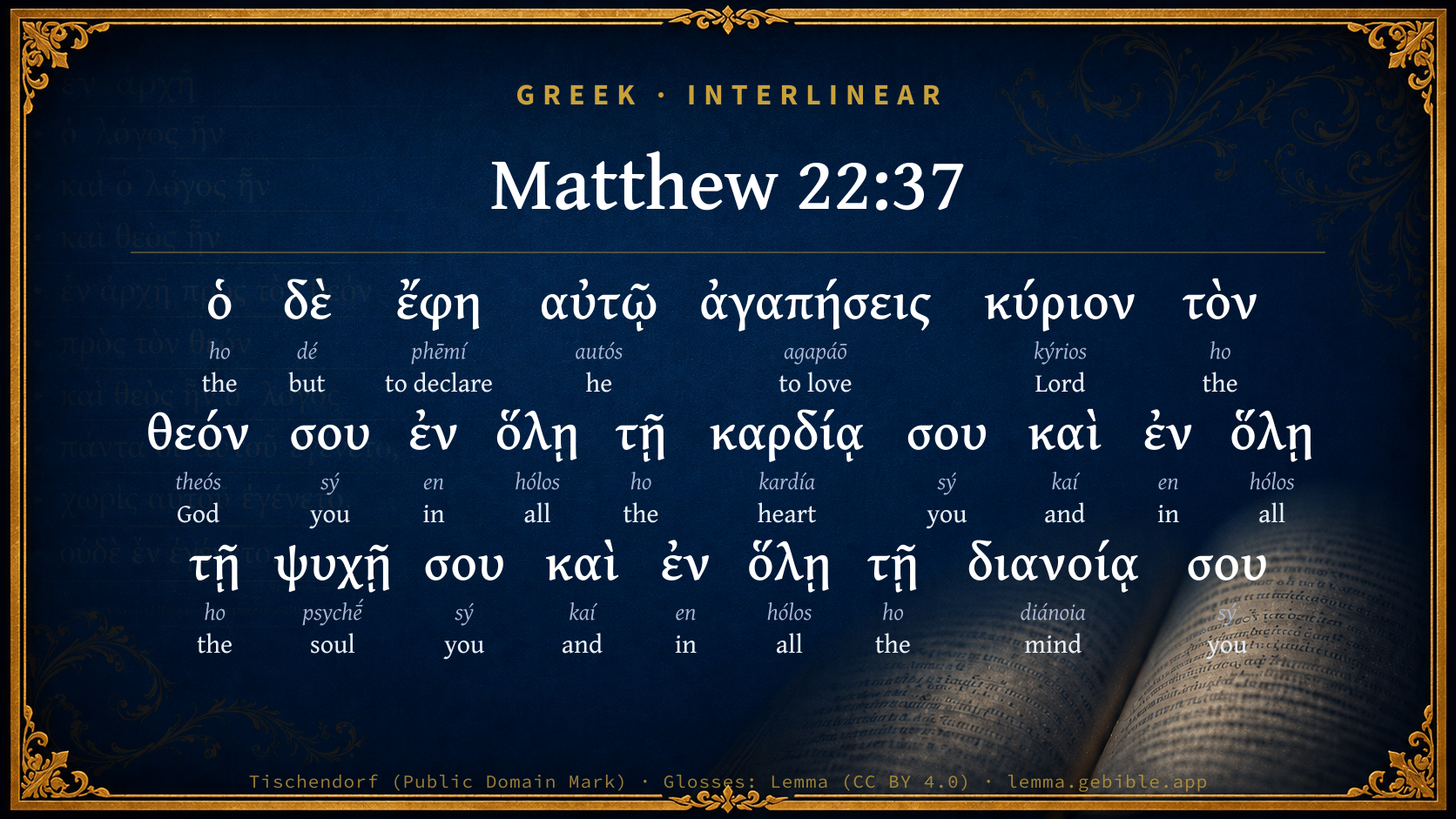
Download image
Cite this verse

Matthew 22:37 (World English Bible). Public Domain. Lemma interlinear Bible study tool, https://lemma.gebible.app/v/matthew/22/37.

Show BibTeX & RIS
BibTeX
RIS
English Translation
Jesus said to him, "'You shall love the Lord your God with all your heart, and with all your soul, and with all your mind.'
World English Bible · Public Domain
Highlights
  • 1 first appearance in the Greek New Testament
Full analysis ↓
Download a study sheet

One document with this verse’s original text, its word-by-word gloss line, the meaning frame, cross-references with their text, attributed commentary, and full source and license credits — printable, and it pastes into notes with its structure intact.

This verse Autodidact and up

Study sheet (.html) Plain text (.txt)

A passage Seminary Student

Up to 50 verses in one chapter. A passage sheet keeps up to 6 commentary sources and 12 cross-references per verse, in the order this page ranks them, and says so on the sheet whenever that leaves anything out. Ask for a single verse and you get the Autodidact verse sheet above.

Everything on this page stays free to read, with no account — the sheet is a download of what is already on screen, not access to it.

Want to remove ads? Support Godless Engineer
Compare translations 3

The same verse in 3 English versions, stacked beneath the original-language interlinear above. Click any original word for its lexicon entry.

Each is an independent rendering of the whole verse — the interlinear is not word-aligned to these translations.

Highlighted words mark where these versions differ — a whole-verse word diff, not a word-by-word alignment.

  • World English Bible Public Domain
    Jesus said to him, "'You shall love the Lord your God with all your heart, and with all your soul, and with all your mind.'
  • King James Version Public Domain
    Jesus said unto him, Thou shalt love the Lord thy God with all thy heart, and with all thy soul, and with all thy mind.
  • unfoldingWord Literal Text CC BY-SA 4.0
    But he said to him, “You will love the Lord your God with your whole heart, and with your whole soul, and with your whole mind.

unfoldingWord Literal Text — © unfoldingWord, licensed CC BY-SA 4.0. Word-aligned USFM3 via Door43 (git.door43.org/unfoldingWord/en_ult).

Versions to compare (up to 4)

3 of 4 selected

Show all 19 translations

Every available English version of this verse, each an independent rendering of the whole verse.

  • World English Bible Public Domain
    Jesus said to him, "'You shall love the Lord your God with all your heart, and with all your soul, and with all your mind.'
  • Berean Standard Bible Public Domain
    Jesus declared, “‘Love the Lord your God with all your heart and with all your soul and with all your mind.’
  • Majority Standard Bible Public Domain
    Jesus declared, “‘Love the Lord your God with all your heart and with all your soul and with all your mind.’
  • King James Version Public Domain
    Jesus said unto him, Thou shalt love the Lord thy God with all thy heart, and with all thy soul, and with all thy mind.
  • American Standard Version (1901) Public Domain
    And he said unto him, Thou shalt love the Lord thy God with all thy heart, and with all thy soul, and with all thy mind.
  • Revised Version (1885) Public Domain
    And he said unto him, Thou shalt love the Lord thy God with all thy heart, and with all thy soul, and with all thy mind.
  • Geneva Bible (1599) Public Domain
    Iesus sayd to him, Thou shalt loue the Lord thy God with all thine heart, with all thy soule, and with all thy minde.
  • Douay-Rheims (1899) Public Domain
    Jesus said to him: Thou shalt love the Lord thy God with thy whole heart, and with thy whole soul, and with thy whole mind.
  • Young's Literal Translation Public Domain
    And Jesus said to him, `Thou shalt love the Lord thy God with all thy heart, and with all thy soul, and with all thine understanding --
  • Literal Standard Version CC BY-SA 4.0
    And Jesus said to him, “You will love the LORD your God with all your heart, and with all your soul, and with all your understanding—
  • Unlocked Literal Bible CC BY-SA 4.0
    Jesus said to him, “'Love the Lord your God with all your heart, with all your soul, and with all your mind.'
  • unfoldingWord Literal Text CC BY-SA 4.0
    But he said to him, “You will love the Lord your God with your whole heart, and with your whole soul, and with your whole mind.
  • Darby Bible Public Domain
    And he said to him, Thou shalt love [the] Lord thy God with all thy heart, and with all thy soul, and with all thy understanding.
  • World Messianic Bible Public Domain
    Yeshua said to him, “‘You shall love the Lord your God with all your heart, with all your soul, and with all your mind.’
  • Webster's Bible Public Domain
    Jesus said to him, Thou shalt love the Lord thy God with all thy heart, and with all thy soul, and with all thy mind.
  • Free Bible Version CC BY-SA 4.0
    Jesus told them, “‘Love the Lord your God in all you think, in all you feel, and in all you do.’
  • Bible in Basic English Public Domain
    And he said to him, Have love for the Lord your God with all your heart, and with all your soul, and with all your mind.
  • Text-Critical English NT CC BY 4.0
    Jesus said to him, “ ‘Yoʋ shall love the Lord yoʋr God with all yoʋr heart, with all yoʋr soul, and with all yoʋr mind.’
  • Tyndale New Testament (1534) Public Domain
    Iesus sayde vnto him: love the Lorde thy God with all thine herte with all thy soule and with all thy mynde.

Literal Standard Version (2020), Covenant Press — licensed CC BY-SA 4.0. Text via the HelloAO Bible API (eBible.org). Unlocked Literal Bible (unfoldingWord) — licensed CC BY-SA 4.0. Text via the HelloAO Bible API (eBible.org). unfoldingWord Literal Text — © unfoldingWord, licensed CC BY-SA 4.0. Word-aligned USFM3 via Door43 (git.door43.org/unfoldingWord/en_ult). Free Bible Version, Dr. Jonathan Gallagher — licensed CC BY-SA 4.0. Text via the HelloAO Bible API (eBible.org).

Word by word

More ways to search: Search by grammar → Find every occurrence → Compare this word →

Practice this passage: Drill this verse → Learn its vocabulary →

διανοίᾳ
diánoia
G1271
“mind”
Noun, Dative, Singular, Feminine
Part of Speech
Noun
Case
Dative
Number
Singular
Gender
Feminine
Full Thayer's Definition

Origin: from G1223 and G3563

TDNT: 20:03,6

1. the mind as a faculty of understanding, feeling, desiring 2. understanding 3. mind, i.e. spirit, way of thinking and feeling 4. thoughts, either good or bad
  1. ὁ ho G3588 “the” Article, Nominative, Singular, Masculine
  2. δὲ dé G1161 “but” Conjunction
  3. ἔφη phēmí G5346 “to declare” Verb, Imperfect, Active, Indicative, 3rd person, Singular
  4. αὐτῷ autós G846 “he” Personal pronoun, Dative, Singular, Masculine
  5. ἀγαπήσεις agapáō G25 “to love” Verb, Future, Active, Indicative, 2nd person, Singular
  6. κύριον kýrios G2962 “Lord” Noun, Accusative, Singular, Masculine
  7. τὸν ho G3588 “the” Article, Accusative, Singular, Masculine
  8. θεόν theós G2316 “God” Noun, Accusative, Singular, Masculine
  9. σου sý G4771 “you” Personal pronoun, 2nd person, Genitive, Singular
  10. ἐν en G1722 “in” Preposition
  11. ὅλῃ hólos G3650 “all” Adjective, Dative, Singular, Feminine
  12. τῇ ho G3588 “the” Article, Dative, Singular, Feminine
  13. καρδίᾳ kardía G2588 “heart” Noun, Dative, Singular, Feminine
  14. σου sý G4771 “you” Personal pronoun, 2nd person, Genitive, Singular
  15. καὶ kaí G2532 “and” Conjunction
  16. ἐν en G1722 “in” Preposition
  17. ὅλῃ hólos G3650 “all” Adjective, Dative, Singular, Feminine
  18. τῇ ho G3588 “the” Article, Dative, Singular, Feminine
  19. ψυχῇ psychḗ G5590 “soul” Noun, Dative, Singular, Feminine
  20. σου sý G4771 “you” Personal pronoun, 2nd person, Genitive, Singular
  21. καὶ kaí G2532 “and” Conjunction
  22. ἐν en G1722 “in” Preposition
  23. ὅλῃ hólos G3650 “all” Adjective, Dative, Singular, Feminine
  24. τῇ ho G3588 “the” Article, Dative, Singular, Feminine
  25. σου sý G4771 “you” Personal pronoun, 2nd person, Genitive, Singular

About this verse

These counts appear in no published source. They are computed here, from the morphology-tagged text and Lemma’s own curated glosses. What Lemma adds →

26
words
14
distinct lemmas
Gospels
section

Notable vocabulary

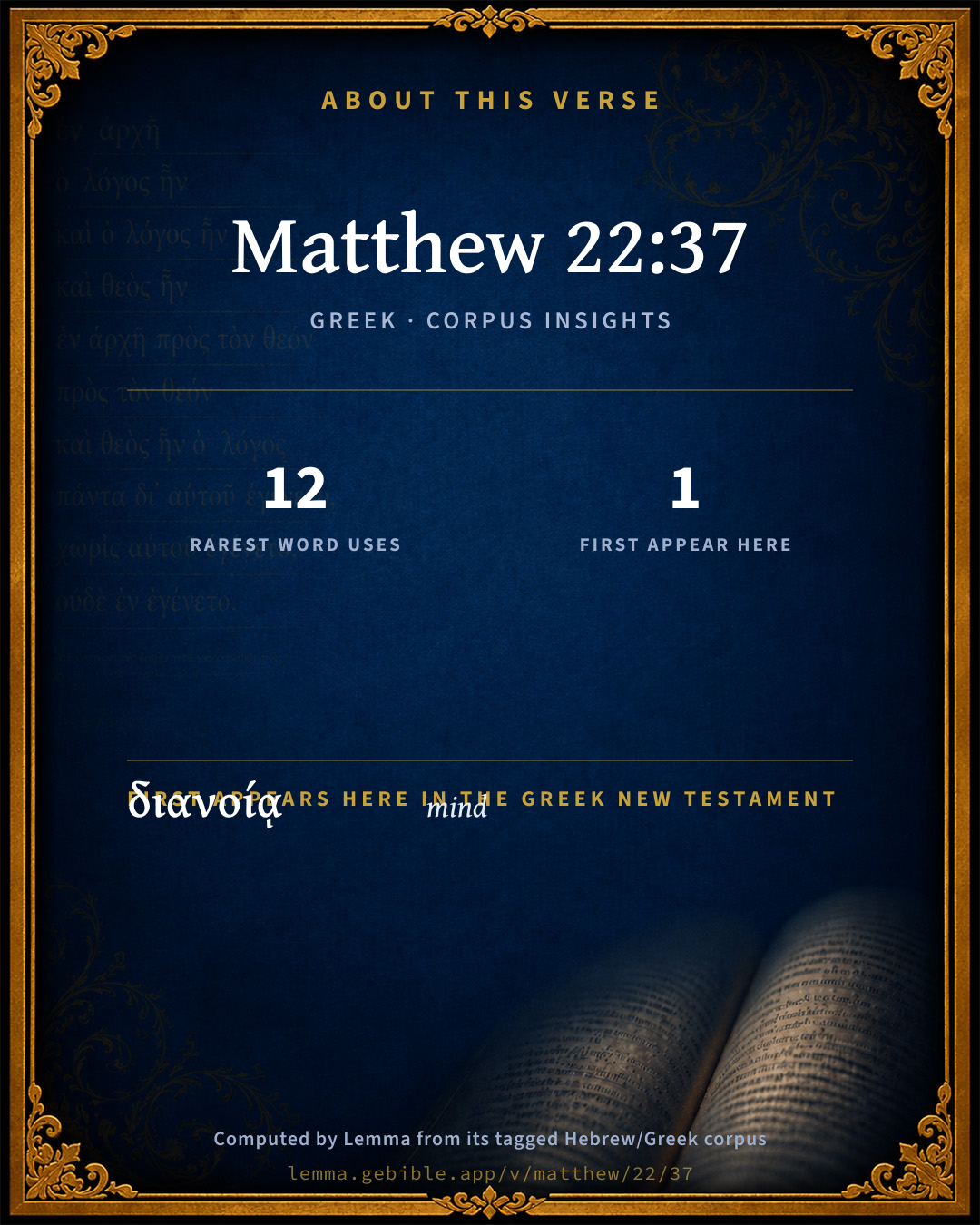
The rarest word here is διανοίᾳ mind G1271 — appearing just 12 times in the whole Greek New Testament.

First appearance in Scripture

This word makes its first canonical appearance in the Greek New Testament here:

  • διανοίᾳ mind G1271

Shared distinctive vocabulary

διανοίᾳ mind G1271 occurs in 12 verses of the Greek New Testament. Also found in:
Repetition

Words recur within this verse:

Cross-references

9

Topical passages linked to Matthew 22:37 in the Treasury of Scripture Knowledge — connected by theme and wording, ordered by reader-vote popularity; previews shown in the World English Bible.

  • Mark 12:29–30 Jesus answered, "The greatest is, 'Hear, Israel, the Lord our God, the Lord is one:
  • Luke 10:27 He answered, "You shall love the Lord your God with all your heart, with all your soul, with all your strength, and with all your mind; and your neighbor as yourself."
  • Deuteronomy 6:5 and you shall love Yahweh your God with all your heart, and with all your soul, and with all your might.
  • Deuteronomy 10:12 Now, Israel, what does Yahweh your God require of you, but to fear Yahweh your God, to walk in all his ways, and to love him, and to serve Yahweh your God with all your heart and with all your soul,
  • Mark 12:33 and to love him with all the heart, and with all the understanding, with all the soul, and with all the strength, and to love his neighbor as himself, is more important than all whole burnt offerings and sacrifices."
  • Deuteronomy 30:6 Yahweh your God will circumcise your heart, and the heart of your seed, to love Yahweh your God with all your heart, and with all your soul, that you may live.
  • 1 John 5:2–5 By this we know that we love the children of God, when we love God and keep his commandments.
  • Hebrews 10:16–17 "This is the covenant that I will make with them: 'After those days,' says the Lord, 'I will put my laws on their heart, I will also write them on their mind;'" then he says,
  • Romans 8:7 because the mind of the flesh is hostile towards God; for it is not subject to God's law, neither indeed can it be.

Cross-references courtesy of OpenBible.info (CC BY 4.0).

Commentary

Notes on Matthew 22:37 from classic Christian and Jewish commentators (each source and its license shown beneath its notes). The classic Christian expositions comment on the surrounding passage and are grouped to its opening verse, so a note may address several verses; the Jewish commentaries on the Tanakh (Rashi and others) are per-verse, so they appear only where the commentator wrote on this verse.

Lemma curates 59 commentaries, every one of them public domain or Creative Commons licensed, each selected and text-cleaned for this edition rather than reprinted as found. About our sources →

Joseph Benson's Commentary

Mat 22:37-40. Jesus said, Thou shalt love the Lord thy God with all thy heart — Concerning this first and great commandment, and the words wherewith Moses prefaced it, see note on Deu 6:5; and for the elucidation of this whole paragraph, see the notes on Mar 12:28-34, where the conversation which our Lord had with this scribe is related more at large. On these two commandments hang all the law and the prophets — That is, they contain the substance or abridgment of all the religious and moral duties contained in the law and the prophets, which therefore may be all said to hang or depend on them. The expression, says Dr. Whitby, is a metaphor taken from a custom mentioned by Tertullian of hanging up their laws in a public place to be seen of all men; and it imports that in these precepts is compendiously contained all that the law and prophets require, in reference to our duty to God and man; for though there be some precepts of temperance which we owe to ourselves, yet are they such as we may be moved to perform from the true love of God and of our neighbour; whom if we truly love we cannot be wanting in them. For the love of God will make us humble and contented with our lot; it will preserve us from all intemperance, impatience, and unholy desires; it will make us watchful over ourselves, that we may keep a good conscience, and solicitous for our eternal welfare. And the love of our neighbour will free us from all angry passions, envy, malice, revenge, and other unkind tempers: so that both taken together will introduce into us the whole mind that was in Christ, and cause us to walk as he walked.

Joseph Benson's Commentary on the Old and New Testaments (1811–1818) — public domain. Text from a community e-Sword module.

Tyndale Open Study Notes

Tyndale Open Resources

22:37 Jesus answers from the Shema (Deut 6:4-9), one of the core statements of God’s covenant with Israel (The first Hebrew word of Deut 6:4-9 is shema‘, “hear”).

Tyndale Open Study Notes — © Tyndale Open Resources, licensed CC BY-SA 4.0. Text via the HelloAO Bible API.

Bengel's Gnomon

Johann Albrecht Bengel

Mat 22:37. Ἀγαπήσεις, κ.τ.λ., thou shalt love, etc.) Moses repeats this in Deu 6:8, from the Decalogue in Ib. Mat 5:10; and it is frequently repeated in the same book, of which it is the sum, the last time with a most solemn adjuration; Ib. 30:19, 20.—ἐν ὅλῃ καρδίᾳ σου καὶ ἐν ὅλῃ ψυχῇ σου, καὶ ἐν ὅλῃ τῇ διανοίᾳ σου,[972] with all thy heart, and with all thy soul, and with all thy mind. Those who have copied or collated MSS., have for the most part treated the article with indifference; but as far as can be gathered from MSS. lately collated, St Matthew introduced the article only in the last clause. In the Hebrew it is ובכל מאדך, q.d., and with all thy strength (et in omni validitate tuג). The LXX. render it καὶ ἐξ ὅλης τῆς δυνάμεώς σου, and with all thy might. In St Mark it is, ΚΑῚ ἘΞ ὍΛΗς Τῆς ΔΙΑΝΟΊΑς ΣΟΥ, ΚΑῚ ἘΞ ὍΛΗς Τῆς ἸΣΧΎΟς ΣΟΥ, and with all thy mind and with all thy strength. In St Luk 10:27, it is καὶ ἐξ ὅλης τῆς ἰσχύος σου καὶ ἐξ ὅλης τῆς διανοίας σου, one Hebrew word, מאד[973] being expressed by two Greek ones. [sc. ἸΣΧΎΟς, strength, and διανοίας, mind, or understanding.] Even the Hebrew accents[974] distinguish this third clause from the two previous ones, which are closely united. They all form an epitasis,[975] with which St Matthew’s introduction of the article only in the third clause agrees. John James Syrbius, Philos. primæ, Part I., ch. i., § 1, thus expresses himself,—“Of ALL those things which are ever found in man, there are three fundamental principles, idea, desire, and emotion.” ALL ought to be animated and governed by the love of God.

[972] E. M. has ἐν ὅλῃ τῇ καρδίᾳ σου, καὶ ἐν ὅλῃ τῇ ψυχῇ σου, καὶ ἐν ὅλῃ τῇ διανοίᾳ σου.—(I. B.)

[973] מְאד— 1)subst. m. strength, force, from the root אוּד. No. 3, Deu 6:5, “And thou shalt love Jehovah thy God with all thy heart, with all thy mind, וּבְכל מְא̇דֶף, and with all thy strength,” i.e. in the highest degree. Gesenius.—(I. B.)

[974] For some account of the Hebrew accents, see p. 132, f. n. 5.—(I. B.)

[975] See explanation of technical terms in Appendix—(I. B.)

DZ. support the articles before καρδιά, and before διανοίᾳ: the reading of B. is doubtful. Only inferior uncial MSS. Δ., etc., omit the articles.—ED.

Bengel's Gnomon of the New Testament — English translation (T&T Clark, Edinburgh, 1860) — public domain. Text from a community e-Sword module.

Expositor's Greek Testament

ed. W. Robertson Nicoll

Mat 22:37 . ἀγαπήσεις , etc. Jesus replies by citing Deu 6:5 , which inculcates supreme, devoted love to God, and pronouncing this the great ( μεγάλη ) and greatest, first ( πρώτη ) commandment. The clauses referring to heart, soul, and mind are to be taken cumulatively, as meaning love to the uttermost degree; with “all that is within” us ( πάντα τὰ ἐντός μου , Psa 103:1 ). This commandment is cited not merely as an individual precept, but as indicating the spirit that gives value to all obedience.

The Expositor's Greek Testament, edited by W. Robertson Nicoll (1897–1910) — public domain. Text from a community e-Sword module.

Geneva Bible (1599)

Geneva Bible translators

The Hebrew text readeth, Deut. 6:5, with thine heart, soul, and strength: and in Mark 12:30 and Luke 10:27 we read with soul, heart, strength and thought.

Geneva Bible (1599) marginal notes — public domain. Text via Bolls.life.

Adam Clarke's Commentary

Verse 37. Thou shalt love the Lord] This is a subject of the greatest importance, and should be well understood, as our Lord shows that the whole of true religion is comprised in thus loving God and our neighbour.

It may not be unnecessary to inquire into the literal meaning of the word love. αγαπη, from αγαπαω, I love, is supposed to be compounded either of αγαν and ποιειν, to act vehemently or intensely; or, from αγειν κατα παν, because love is always active, and will act in every possible way; for he who loves is, with all his affection and desire, carried forward to the beloved object, in order to possess and enjoy it. Some derive it from αγαν and παυεσθαι, to be completely at rest, or, to be intensely satisfied; because he who loves is supremely contented with, and rests completely satisfied in, that which he loves. Others, from αγαν and παω, because a person eagerly embraces, and vigorously holds fast, that which is the object of his love. Lastly, others suppose it to be compounded of αγαω, I admire, and παυομαι, I rest, because that which a man loves intensely he rests in, with fixed admiration and contemplation. So that genuine love changes not, but always abides steadily attached to that which is loved.

Whatever may be thought of these etymologies, as being either just or probable, one thing will be evident to all those who know what love means, that they throw much light upon the subject, and manifest it in a variety of striking points of view. The ancient author of a MS. Lexicon in the late French king's library, under the word αγαπη, has the following definition: σπαϚος προθεσις επι τη φιλια του φιλουμενου - Σομψυχια. "A pleasing surrender of friendship to a friend: - an identity or sameness of soul." A sovereign preference given to one above all others, present or absent: a concentration of all the thoughts and desires in a single object, which a man prefers to all others. Apply this definition to the love which God requires of his creatures, and you will have the most correct view of the subject. Hence it appears that, by this love, the soul eagerly cleaves to, affectionately admires, and constantly rests in God, supremely pleased and satisfied with him as its portion: that it acts from him, as its author; for him, as its master; and to him, as its end. That, by it, all the powers and faculties of the mind are concentrated in tho Lord of the universe. That, by it, the whole man is willingly surrendered to the Most High: and that, through it, an identity, or sameness of spirit with the Lord is acquired-the man being made a partaker of the Divine nature, having the mind in him which was in Christ, and thus dwelling in God, and God in him.

But what is implied in loving God with all the heart, soul, mind, strength, c., and when may a man be said to do this?

1. He loves God with all his heart, who loves nothing in comparison of him, and nothing but in reference to him: - who is ready to give up, do, or suffer any thing in order to please and glorify him:-who has in his heart neither love nor hatred, hope nor fear, inclination, nor aversion, desire, nor delight, but as they relate to God, and are regulated by him.

2. He loves God with all his soul, or rather, εν ολη τη ψυχη, with all his life, who is ready to give up life for his sake - to endure all sorts of torments, and to be deprived of all kinds of comforts, rather than dishonour God: - who employs life with all its comforts, and conveniences, to glorify God in, by, and through all: - to whom life and death are nothing, but as they come from and lead to God, From this Divine principle sprang the blood of the martyrs, which became the seed of the Church. They overcame through the blood of the Lamb, and loved not their lives unto the death. See Re 12:11.

3. He loves God with all his strength (Mr 12:30 Lu 10:27) who exerts all the powers of his body and soul in the service of God: - who, for the glory of his Maker, spares neither labour nor cost - who sacrifices his time, body, health, ease, for the honour of God his Divine Master: - who employs in his service all his goods, his talents, his power, credit, authority, and influence.

4. He loves God with all his mind (intellect - διανοια) who applies himself only to know God, and his holy will: - who receives with submission, gratitude, and pleasure, the sacred truths which God has revealed to man: - who studies no art nor science but as far as it is necessary for the service of God, and uses it at all times to promote his glory - who forms no projects nor designs but in reference to God and the interests of mankind: - who banishes from his understanding and memory every useless, foolish, and dangerous thought, together with every idea which has any tendency to defile his soul, or turn it for a moment from the centre of eternal repose. In a word, he who sees God in all things - thinks of him at all times - having his mind continually fixed upon God, acknowledging him in all his ways - who begins, continues, and ends all his thoughts, words, and works, to the glory of his name: - this is the person who loves God with all his heart, life, strength, and intellect. He is crucified to the world, and the world to him: he lives, yet not he, but Christ lives in him. He beholds as in a glass the glory of the Lord, and is changed into the same image from glory to glory. Simply and constantly looking unto Jesus, the author and perfecter of his faith, he receives continual supplies of enlightening and sanctifying grace, and is thus fitted for every good word and work. O glorious state! far, far, beyond this description! which comprises an ineffable communion between the ever-blessed Trinity and the soul of man!

Adam Clarke's Commentary on the Bible (1810–1826) — public domain. Text from a community e-Sword/MySword module.

Ellicott's Commentary for English Readers

(37) Thou shalt love the Lord thy God.—In St. Mark’s report (Mar_12:29) our Lord’s answer begins with the Creed of Israel (“Hear, O Israel, the Lord our God is one Lord”), and so the truth is in its right position as the foundation of the duty. It is significant (1) that the answer comes from the same chapter (Deu_6:4-5) which supplied our Lord with two out of His three answers to the Tempter (see Notes on Mat_4:4; Mat_4:7); and (2) that He does but repeat the answer that had been given before by the “certain lawyer” who stood up tempting Him, in Luk_10:25. In their ethical teaching the Pharisees had grasped the truth intellectually, though they did not realise it in their lives, and our Lord did not shrink, therefore, so far, from identifying His teaching with theirs. Truth was truth, even though it was held by the Pharisees and coupled with hypocrisy.

A Bible Commentary for English Readers, edited by Charles John Ellicott (1878–1897) — public domain. Text from a community e-Sword module.

The Cambridge Bible for Schools and Colleges

gen. ed. J. J. S. Perowne

37. See Deu_6:5.

heart … soul … mind] St Mark and St Luke add “strength.” In Deut. the words are heart … soul … might. Heart includes the emotions, will, purpose; soul, the spiritual faculties; mind, the intellect, the thinking faculty. This greatest commandment was written on the phylactery which the “lawyer” was probably wearing. See ch. Mat_23:5.

St Mark (Mar_12:32-34) adds the lawyer’s rejoinder and the commendation of Jesus, “thou art not far from the Kingdom of God.”

The Cambridge Bible for Schools and Colleges (gen. ed. J. J. S. Perowne; Cambridge University Press, 1878–1918) — public domain. Text from a community e-Sword module.

John Gill's Exposition

On these two commandments hang all the law and the prophets. Not that all that is contained in the five books of Moses, and in the books of the prophets, and other writings of the Old Testament, is comprehended in, and is reducible to these two precepts; for there are many things delivered by way of promise, written by way of history, &c. which cannot, by any means, be brought into these two general heads: but that everything respecting duty that is suggested in the law, or is more largely explained and pressed in any of the writings of the prophets, is summarily comprehended in these two sayings: hence love is the fulfilling of the law; see Rom 13:8. The substance of the law is love; and the writings of the prophets, as to the preceptive part of them, are an explanation of the law, and an enlargement upon it: hence the Jews have a saying (c), that "all the prophets stood on Mount Sinai", and received their prophecies there, because the sum of them, as to the duty part, was then delivered. Beza thinks, that here is an allusion to the "phylacteries", or frontlets, which hung upon their foreheads and hands, as a memorial of the law. And certain it is, that the first of these commands, and which is said to be the greatest, was written in these phylacteries. Some take the phrase, "on these hang all the law and the prophets", to be a mere Latinism, but it is really an Hebraism, and often to be met with in the Jewish writings: so Maimonides says (d),

"the knowledge of this matter is an affirmative precept, as it is said, "I am the Lord thy God"; and he that imagines there is another God besides this, transgresses a negative, as it is said, "thou shalt have no other Gods before me"; and he denies the fundamental point, for this is the great foundation, , "on which all hang":

and so the word is used in many other places (e). The sense is plainly this, that all that are in the law and prophets are consistent with, and dependent on these things; and are, as the Persic version renders the word, "comprehended" in them, and cannot be separated from them,

(c) Jarchi in Isa. xlviii. 16. & in Mal. i. 1. (d) Hilch. Yesode Hatorah, c. 1. sect. 6. (e) Vid. Abkath Rokel. l. 1. p. 3.

John Gill's Exposition of the Whole Bible (1746–1763) — public domain (CC PDM 1.0). Text via the HelloAO Bible API.

Trapp's Complete Commentary

John Trapp

37 Jesus said unto him, Thou shalt love the Lord thy God with all thy heart, and with all thy soul, and with all thy mind.

Ver. 37. Thou shalt love the Lord] God must be loved and honoured by us, η ολος η μη ολως, saith one; truly, that there be no halting, and totally, that there be no halving; he will not divide with the devil, as the Circassians are said to divide their whole life between rapine and religion. God’s service must be the totum hominis, Ecc 12:13, and the bonum hominis, Mic 6:8. We should love him infinitely; which, because we cannot, we must love him unfeignedly; but how far short we come in loving him with all our heart, soul, strength, &c. (which yet the Papists affirm feasible), appears by our lives, which, do what we can, are fuller of sins than the firmament is of stars or the furnace of sparks.

John Trapp, A Commentary or Exposition upon All the Books of the Old and New Testament (1647–1656) — public domain. Text from a community e-Sword module.

Whedon's Commentary on the Bible

Daniel D. Whedon

37. Jesus said — Jesus gave him not only that which is greatest, but that which, if properly kept, will indeed keep the whole. Heart… soul… mind — All the affections and powers of the man.

Daniel D. Whedon (gen. ed.), Commentary on the Old and New Testaments (1874–1909) — public domain. Text from a community e-Sword module.

The Pulpit Commentary

Thou shalt love the Lord thy God; Kurion ton sou . (Deu_6:5, from the Septuagint, with some slight variation) Christ enunciates the two great moral precepts of God"s Law, not, indeed, stated in these words in the Decalogue, but implied throughout, and forming the basis of true religion. Heart... soul... mind. The Septuagint has "mind, soul, strength." The expressions mean generally that God is to be loved with all our powers and faculties, and that nothing is to be preferred to him. It is difficult to define with any precision the signification of each term used, and much unprofitable labour has been expended in the endeavour to limit their exact sense. "Quum," as Grotius says, "vocum multarum cumulatio nihil quam intensius studium designet." It is usual to explain thus: Heart; which among the Hebrews was considered to be the seat of the understanding, is here considered as the home of the affections and the seat of the will. Soul; the living powers, the animal life. Mind; diamoia , intellectual powers. These are to be the seat and abode of the love enjoined.

The Pulpit Commentary (1880–1919), ed. H.D.M. Spence-Jones & Joseph S. Exell — public domain. Text from a community e-Sword module.

John Wesley's Explanatory Notes

Deut. vi, 5.

John Wesley, Explanatory Notes Upon the Whole Bible (1754–1765) — public domain. Text via the GEBible commentary corpus.

The People's New Testament

B. W. Johnson

37, 38. Thou shalt love the Lord thy God, etc. Freely quoted from Deut. 6:5. A demand for supreme love for God.

This is the first and great. Great, because it embraces all others; first, in that it precedes the second that he is about to name. He who loves God supremely cannot live in disobedience to him.

B. W. Johnson's The People's New Testament with Notes (1889–1891) — public domain. Electronic text from the Christian Classics Ethereal Library (CCEL) ThML edition.

unfoldingWord translationNotes

Door43 World Missions Community

General Information:

Jesus quotes a verse from Deuteronomy as the greatest commandment.

with all your heart, with all your soul, and with all your mind

These three phrases are used together to mean "completely" or "earnestly." Here "heart" and "soul" are metonyms for a person's inner being. (See: Metonymy and Doublet)

the great and first commandment

Here "great" and "first" mean the same thing. They emphasize that this is the most important commandment. (See: Doublet)

translationWords

Jesus

lord

God

heart

soul

mind

command

unfoldingWord translationNotes — © Distant Shores Media and the Door43 World Missions Community, licensed CC BY-SA 4.0. Source: git.door43.org/Door43/en_tn.

Cambridge Greek Testament for Schools and Colleges

37. See Deu 6:5.

καρδίᾳ … ψυχῇ … διανοία. St Mark and St Luke add ἰσχύς. In Deut. the words are heart … soul … might. καρδία includes the emotions, will, purpose; ψυχή, the spiritual faculties; διάνοια the intellect, the thinking faculty. This greatest commandment was written on the phylactery which the ‘lawyer’ was probably wearing. See ch. Mat 23:5.

St Mark (Mar 12:32-34) adds the lawyer’s rejoinder and the commendation of Jesus, ‘thou art not far from the Kingdom of God.’

Cambridge Greek Testament for Schools and Colleges (Cambridge University Press, 1896; 21 vols, various authors incl. Carr, Maclear, Plummer, Farrar, Lumby, Moule, M. R. James, Simcox) — public domain. Text from a community e-Sword module.

Alford’s Greek Testament

Henry Alford

37. κύρ. τ. θ. σου] Not, ‘The LORD as thy God,’—but the LORD thy God.

Henry Alford, The Greek Testament (1849–1861) — public domain. Text from a community e-Sword module.

International Critical Commentary

37. And He said to him, Thou shalt love the Lord thy God with all thy heart, and with all thy soul, and with all thy mind.] Mk. has: “Jesus answered that the first is, Hear, O Israel; The Lord our God is one Lord: And thou shalt love the Lord thy God from all thy heart, and from all thy soul, and from all thy mind, and from all thy strength.” The quotation is from Deu 6:5. The LXX. has “from all thy mind (διανοίας), and from all thy soul, and from all thy power (δυνάμεως).” But A F Luc have καρδίας for διανοίας. Mk. seems to have conflated the two renderings, and to have substituted ἰσχύος for δυνάμεως. Mt., remembering the fact that there were only three clauses in the original, retains only the first three from Mk., and assimilates to the Hebrew by substituting ἐν for ἐκ.

(M?)

37. διανοίᾳ] c S1 S2 have “power” (c. virtute) = ἰσχῦι from Mk. S1 S2 also have “from” for ἐν throughout, assimilating to Mk. (and the Pesh. VS. of Dt.).

International Critical Commentary — older volumes (1896–1929), various authors — public domain. Text from a community e-Sword module.

Lesson kit

Teaching starters — assembled from the data on this page, not authored interpretation. Every prompt links to the verse data it draws on. Edit before teaching.

Matthew, in the Gospels, opens this verse with 26 words (14 distinct Greek lemmas). Its most distinctive word is diánoia (“mind”). A historical commentator’s framing appears above. Read the whole chapter for the surrounding context.

Discussion questions

  1. What does “mind” (diánoia) contribute to the verse as a whole?
  2. The word “mind” first appears here in Scripture. What is being introduced at this debut?
  3. Mark 12:30 shares the word «mind» with this verse. How do the two illuminate each other?
  4. “all” occurs 3× in this one verse. What is the effect of the repetition?
  5. The translations on this page render this verse differently — a whole-verse word diff, not a word-by-word alignment. What might account for the different wordings?
  6. Reading how Joseph Benson's Commentary and Tyndale Open Study Notes read this verse, where do the two commentators agree and where do they part?

Things to notice

  • 1 word makes its first canonical appearance in Scripture here.
  • These translations choose different wording for 6 words in this verse.
  • “all” occurs 3× in this single verse.
  • 14 distinct Greek lemmas span 26 words in this verse.

Reading settings

Reading text

Shown beneath each verse's original-language words.

Old Testament
Old Testament edition

Read the OT as the Masoretic Hebrew (MT) or the Greek Septuagint (LXX).

English shown for the Greek Septuagint (in the Hebrew ↔ Greek comparison).

Comparing translations? Open the Compare panel on any verse page to stack up to four side by side.