Matthew 25:10

Greek (Tischendorf 8th ed.) Matthew 25:10 appears in the Greek New Testament. The text above is from the Tischendorf 8th edition. Each word links to its Strong’s number and a concise gloss. Click any word for its full Thayer’s Greek Lexicon entry.
Download image
Cite this verse

Matthew 25:10 (World English Bible). Public Domain. Lemma interlinear Bible study tool, https://lemma.gebible.app/v/matthew/25/10.

Show BibTeX & RIS
BibTeX
RIS
English Translation
While they went away to buy, the bridegroom came, and those who were ready went in with him to the marriage feast, and the door was shut.
World English Bible · Public Domain
Download a study sheet

One document with this verse’s original text, its word-by-word gloss line, the meaning frame, cross-references with their text, attributed commentary, and full source and license credits — printable, and it pastes into notes with its structure intact.

This verse Autodidact and up

Study sheet (.html) Plain text (.txt)

A passage Seminary Student

Up to 50 verses in one chapter. A passage sheet keeps up to 6 commentary sources and 12 cross-references per verse, in the order this page ranks them, and says so on the sheet whenever that leaves anything out. Ask for a single verse and you get the Autodidact verse sheet above.

Everything on this page stays free to read, with no account — the sheet is a download of what is already on screen, not access to it.

Want to remove ads? Support Godless Engineer
Compare translations 3

The same verse in 3 English versions, stacked beneath the original-language interlinear above. Click any original word for its lexicon entry.

Each is an independent rendering of the whole verse — the interlinear is not word-aligned to these translations.

Highlighted words mark where these versions differ — a whole-verse word diff, not a word-by-word alignment.

  • World English Bible Public Domain
    While they went away to buy, the bridegroom came, and those who were ready went in with him to the marriage feast, and the door was shut.
  • King James Version Public Domain
    And while they went to buy, the bridegroom came; and they that were ready went in with him to the marriage: and the door was shut.
  • unfoldingWord Literal Text CC BY-SA 4.0
    But, they going away to buy, the bridegroom came, and the prepared entered with him into the wedding feast, and the door was shut.

unfoldingWord Literal Text — © unfoldingWord, licensed CC BY-SA 4.0. Word-aligned USFM3 via Door43 (git.door43.org/unfoldingWord/en_ult).

Versions to compare (up to 4)

3 of 4 selected

Show all 19 translations

Every available English version of this verse, each an independent rendering of the whole verse.

  • World English Bible Public Domain
    While they went away to buy, the bridegroom came, and those who were ready went in with him to the marriage feast, and the door was shut.
  • Berean Standard Bible Public Domain
    But while they were on their way to buy it, the bridegroom arrived. Those who were ready went in with him to the wedding banquet, and the door was shut.
  • Majority Standard Bible Public Domain
    But while they were on their way to buy it, the bridegroom arrived. Those who were ready went in with him to the wedding banquet, and the door was shut.
  • King James Version Public Domain
    And while they went to buy, the bridegroom came; and they that were ready went in with him to the marriage: and the door was shut.
  • American Standard Version (1901) Public Domain
    And while they went away to buy, the bridegroom came; and they that were ready went in with him to the marriage feast: and the door was shut.
  • Revised Version (1885) Public Domain
    And while they went away to buy, the bridegroom came; and they that were ready went in with him to the marriage feast: and the door was shut.
  • Geneva Bible (1599) Public Domain
    And while they went to bye, the bridegrome came: and they that were readie, went in with him to the wedding, and the gate was shut.
  • Douay-Rheims (1899) Public Domain
    Now whilst they went to buy, the bridegroom came: and they that were ready, went in with him to the marriage, and the door was shut.
  • Young's Literal Translation Public Domain
    `And while they are going away to buy, the bridegroom came, and those ready went in with him to the marriage-feasts, and the door was shut;
  • Literal Standard Version CC BY-SA 4.0
    And while they are going away to buy, the bridegroom came, and those ready went in with him to the wedding feasts, and the door was shut;
  • Unlocked Literal Bible CC BY-SA 4.0
    While they went away to buy, the bridegroom came, and those who were ready went with him to the marriage feast, and the door was shut.
  • unfoldingWord Literal Text CC BY-SA 4.0
    But, they going away to buy, the bridegroom came, and the prepared entered with him into the wedding feast, and the door was shut.
  • Darby Bible Public Domain
    But as they went away to buy, the bridegroom came, and the [ones that were] ready went in with him to the wedding feast, and the door was shut.
  • World Messianic Bible Public Domain
    While they went away to buy, the bridegroom came, and those who were ready went in with him to the wedding feast, and the door was shut.
  • Webster's Bible Public Domain
    And while they were going to buy, the bridegroom came; and they that were ready, went in with him to the marriage, and the door was shut.
  • Free Bible Version CC BY-SA 4.0
    While they went to buy oil, the bridegroom arrived, and those who were ready went in with him to the wedding, and the door was locked shut.
  • Bible in Basic English Public Domain
    And while they went to get oil, the master came; and those who were ready went in with him to the feast: and the door was shut.
  • Text-Critical English NT CC BY 4.0
    But while they were on their way to buy it, the bridegroom came, and those who were ready went in with him to the wedding feast. Then the door was shut.
  • Tyndale New Testament (1534) Public Domain
    And whill they went to bye the brydgrome came: and they that were redy went in with him to the weddinge and the gate was shett vp:

Literal Standard Version (2020), Covenant Press — licensed CC BY-SA 4.0. Text via the HelloAO Bible API (eBible.org). Unlocked Literal Bible (unfoldingWord) — licensed CC BY-SA 4.0. Text via the HelloAO Bible API (eBible.org). unfoldingWord Literal Text — © unfoldingWord, licensed CC BY-SA 4.0. Word-aligned USFM3 via Door43 (git.door43.org/unfoldingWord/en_ult). Free Bible Version, Dr. Jonathan Gallagher — licensed CC BY-SA 4.0. Text via the HelloAO Bible API (eBible.org).

Word by word

More ways to search: Search by grammar → Find every occurrence → Compare this word →

Practice this passage: Drill this verse → Learn its vocabulary →

νυμφίος
nymphíos
G3566
“bridegroom”
Noun, Nominative, Singular, Masculine
Part of Speech
Noun
Case
Nominative
Number
Singular
Gender
Masculine
Full Thayer's Definition

Origin: from G3565

TDNT: 22:19,7

1. a bridegroom
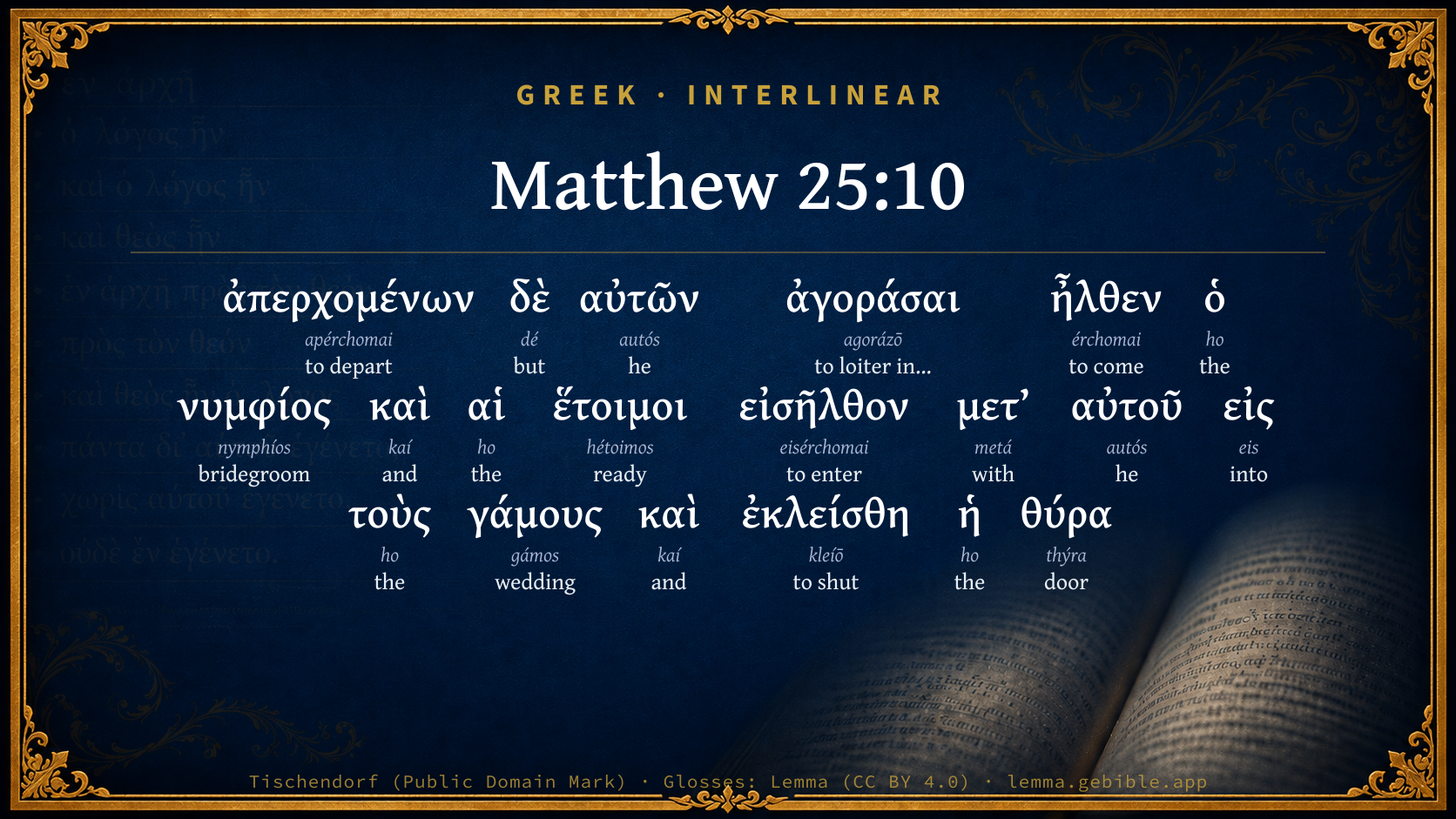
  1. ἀπερχομένων apérchomai G565 “to depart” Verb, Present, Middle or Passive deponent, Participle, Genitive, Plural, Feminine
  2. δὲ dé G1161 “but” Conjunction
  3. αὐτῶν autós G846 “he” Personal pronoun, Genitive, Plural, Feminine
  4. ἀγοράσαι agorázō G59 “to loiter in marketplace” Verb, Aorist, Active, Infinitive
  5. ἦλθεν érchomai G2064 “to come” Verb, Aorist, Active, Indicative, 3rd person, Singular
  6. ὁ ho G3588 “the” Article, Nominative, Singular, Masculine
  7. καὶ kaí G2532 “and” Conjunction
  8. αἱ ho G3588 “the” Article, Nominative, Plural, Feminine
  9. ἕτοιμοι hétoimos G2092 “ready” Adjective, Nominative, Plural, Feminine
  10. εἰσῆλθον eisérchomai G1525 “to enter” Verb, Aorist, Active, Indicative, 3rd person, Plural
  11. μετ’ metá G3326 “with” Preposition
  12. αὐτοῦ autós G846 “he” Personal pronoun, Genitive, Singular, Masculine
  13. εἰς eis G1519 “into” Preposition
  14. τοὺς ho G3588 “the” Article, Accusative, Plural, Masculine
  15. γάμους gámos G1062 “wedding” Noun, Accusative, Plural, Masculine
  16. καὶ kaí G2532 “and” Conjunction
  17. ἐκλείσθη kleíō G2808 “to shut” Verb, Aorist, Passive, Indicative, 3rd person, Singular
  18. ἡ ho G3588 “the” Article, Nominative, Singular, Feminine
  19. θύρα thýra G2374 “door” Noun, Nominative, Singular, Feminine

About this verse

These counts appear in no published source. They are computed here, from the morphology-tagged text and Lemma’s own curated glosses. What Lemma adds →

20
words
15
distinct lemmas
Gospels
section

Notable vocabulary

The rarest word here is νυμφίος bridegroom G3566 — appearing just 16 times in the whole Greek New Testament.

Shared distinctive vocabulary

νυμφίος bridegroom G3566 occurs in 12 verses of the Greek New Testament. Also found in:

Repetition

Words recur within this verse:

Cross-references

16

Topical passages linked to Matthew 25:10 in the Treasury of Scripture Knowledge — connected by theme and wording, ordered by reader-vote popularity; previews shown in the World English Bible.

  • Luke 13:25 When once the master of the house has risen up, and has shut the door, and you begin to stand outside, and to knock at the door, saying, 'Lord, Lord, open to us!' then he will answer and tell you, 'I don't know you or where you come from.'
  • Matthew 24:44 Therefore also be ready, for in an hour that you don't expect, the Son of Man will come.
  • Luke 12:36–37 Be like men watching for their lord, when he returns from the marriage feast; that, when he comes and knocks, they may immediately open to him.
  • 1 Peter 1:13 Therefore, prepare your minds for action, be sober and set your hope fully on the grace that will be brought to you at the revelation of Jesus Christ--
  • Genesis 7:16 Those who went in, went in male and female of all flesh, as God commanded him; and Yahweh shut him in.
  • Psalms 95:11 Therefore I swore in my wrath, "They won't enter into my rest."
  • Amos 8:12–13 They will wander from sea to sea, And from the north even to the east; They will run back and forth to seek the word of Yahweh, And will not find it.
  • Matthew 25:6 But at midnight there was a cry, 'Behold! The bridegroom is coming! Come out to meet him!'
  • 2 Timothy 4:8 From now on, there is stored up for me the crown of righteousness, which the Lord, the righteous judge, will give to me on that day; and not to me only, but also to all those who have loved his appearing.
  • Hebrews 3:18–19 To whom did he swear that they wouldn't enter into his rest, but to those who were disobedient?
  • Revelation 22:20 He who testifies these things says, "Yes, I come quickly." Amen! Yes, come, Lord Jesus.
  • Numbers 14:28–34 Tell them, As I live, says Yahweh, surely as you have spoken in my ears, so will I do to you:
  • Matthew 25:20–23 He who received the five talents came and brought another five talents, saying, 'Lord, you delivered to me five talents. Behold, I have gained another five talents besides them.'
  • Revelation 1:7 Behold, he is coming with the clouds, and every eye will see him, including those who pierced him. All the tribes of the earth will mourn over him. Even so, Amen.
  • Revelation 22:11–12 He who acts unjustly, let him act unjustly still. He who is filthy, let him be filthy still. He who is righteous, let him do righteousness still. He who is holy, let him be holy still."
  • Colossians 1:12 giving thanks to the Father, who made us fit to be partakers of the inheritance of the saints in light;

Cross-references courtesy of OpenBible.info (CC BY 4.0).

Commentary

Notes on Matthew 25:10 from classic Christian and Jewish commentators (each source and its license shown beneath its notes). The classic Christian expositions comment on the surrounding passage and are grouped to its opening verse, so a note may address several verses; the Jewish commentaries on the Tanakh (Rashi and others) are per-verse, so they appear only where the commentator wrote on this verse.

Lemma curates 59 commentaries, every one of them public domain or Creative Commons licensed, each selected and text-cleaned for this edition rather than reprinted as found. About our sources →

The Biblical Illustrator

Joseph S. Exell

Mat_25:10

And the door was shut.

The shut door

I. Exclusion.

1. Necessary for the sake of the redeemed. One guest who does not enter into the spirit of your festivity robs your friends of their joy.

2. Necessary when we regard the sinner himself.

II. Finality of exclusion. The word here used for shut does not mean simply to close to, but to shut that it cannot be opened-to lock. The door is open now. (D. F. Jarman, B. A.)

The closed door

I. The characters in danger of this great calamity.

1. The mere religious professor.

2. The procrastinating.

II. What is the door which is shut.

1. The door of repentance will be shut.

2. The door of religious opportunity and of hope.

3. The door of glory, honour, and immorality will be shut. (D. Moore.)

The door was shut

1. The door of heaven was shut.

2. The door of mercy was shut.

3. The door of hope was shut.

4. The door of hell was shut. (W. Hare, M. A.)

The gates closed

Two readings of the text. I am glad some gates will be closed.

1. The persecutions of this world cannot get through the gate of heaven.

2. The fatigues of life will not get through the gate.

3. The bereavements of life will not get through the gate.

There will be some persons who will come up to that gate at last who will not be admitted.

1. The outrageously wicked and abandoned most certainly cannot get in.

2. The door of heaven will not open to those who are depending upon their morality for salvation.

3. The gate of heaven will not open for the merely hollow professor.

4. All infidels and sceptics will be kept out. (Dr. Talmage.)

Lost opportunities

1. Let us consider how easily this may happen with respect to outward blessings and opportunities in life. Take education; friendship; wealth; personal capacity; the value of these is often missed till it is too late. Thus as the years pass, we listen in life to the sound of the closing doors as, one after another, they strike upon the ear of the soul and of the conscience.

2. The door is shut for each of us as we draw our last breath. There is no repentance in the grave. (Canon Liddon.)

The door an emblem of separation

A door is a barrier which often separates two very unlike scenes. On one side, for instance, are green fields, and bright sunshine, and running streams, and happy laughter. On the other, the manacled forms of listless prisoners, the dark cell, the moan of despair, the vision of death. Or, outside are wild, sobbing, wintry winds, driving showers of hail and sleet, homeless wanderers, friendless outcasts; inside, bright light, abundant food, a warm hearth, and a cheerful circle of friends. Between such opposite scenes as these there is only a door. The real question in all such cases is, Can I open that door? Can I pass through it? If not, all the waters of the sea, all the mountains of the world, could not form a stronger barrier. (G. Tugwell, M. A.)

The door was sheer rejection of the wicked

Dreadful to be read or heard; but much more so to be experienced. Oh, foolish virgins; foolish indeed. All their labour is now lost, and they themselves too. Separated from the wise virgins, their fellows, and from God.

I. The door primarily the door of heaven, and with it the door of

(1) opportunity;

(2) pity;

(3) hope.

II. Awfulness of this.

(1) It is God who shuts the door.

(2) No other way of entrance.

(3) Might once have entered.

(4) Others are in and we shut out.

III. Improvement.

(1) Terror of wicked.

(2) Happiness of saints.

(3) Distinction between saints and sinners is a lasting one. (B. Beddome, A. M.)

Lost opportunities

In the spiritual world as well as in the natural world there is a seedtime, and unless you sow your seed in the seed-time it will rot in the ground. What would you think of the farmer who said, It is not quite convenient for me to sow the corn at the time when the other farmers are sowing it. I very much prefer to enjoy myself, and go my own way, and do what I like. God is a God of love and mercy, and He is also omnipotent, and He certainly would not wish that my wife and children should starve for want of food; so I will sow my seed in the summer, and then God in His omnipotent mercy will cause it to bring forth a harvest, and I shall have a supply, and my wife and children will be provided with food. Do you think this mans strange idea about the love of God will alter the facts of the case? I tell you that while he is talking thus he is deliberately violating the laws of God revealed by nature, and as he deliberately violates the laws of God on selfish grounds, without the slightest necessity, and wantonly, that man shall put his seed into the ground and talk about the love of God, and his seed shall rot before his eyes and his children shall die of starvation, the love of God notwithstanding. You must sow at the right time, or it will not spring up. (H. P. Hughes, M. A.)

Shut doors

Thus, as the years pass, we listen in life to the sound of the closing doors as, one after another, they strike upon the ear of the soul and of the conscience. We hear them proclaiming that a something which once was ours, and for the use of which we still have to answer, is ours no longer. We hear them more often, we hear them louder, as the time flies past; and thus in their frequency and their urgency they lead us up towards a climax when there will be the closing of a door and none beyond it-the door of our individual probation at death, the door of all probations at the last judgment. Place the last judgment in the light of that aspect of life on which we have been dwelling, and it is seen in its essential character and principle to be not an innovating catastrophe as much as the result to which the lesser catastrophes of life steadily point onward. It is the final term of many experiences which lead up to it. As by a continuous analogy it exhibits visibly, and on a scale of unimagined vastness, that judgment of God which is ever going forward invisibly, and, with individuals, bringing to a close first one and then another sphere and department of our responsibility, until the account is sufficiently made up to be closed in whatever sense, until the time has come when all accounts can be closed, and the last hour for the world of moral beings of their probation has clearly sounded in the providence of God. (Canon Liddom)

The feeling of exclusion

The poet Cowper tells us that, when under conviction of sin, he dreamed that he was walking in Westminster Abbey, waiting for prayers to begin. Presently I heard the ministers voice, and hastened towards the choir. Just as I was upon the point of entering, the iron gate under the organ was flung in my face, with a jar that made the Abbey ring. The noise awakened rue; and a sentence of excommunication from all the churches upon earth could not have been so dreadful to me as the interpretation which I could not avoid putting upon this dream.

Too late

Have you not felt a fainting of heart, and a bitterness of spirit, when, after much preparation for an important journey, you have arrived at the appointed place, and found that the ship or train by which you had intended to travel had gone with all who were ready at the appointed time, and left you behind? Can you multiply finitude by infinitude? Can you conceive the dismay which will fill your soul if you come too late to the closed door of heaven, and begin the hopeless cry, Lord, Lord, open to us? (Win. Arnot.)

The door of doom

A lady, who heard Whitefield in Scotland preach on these words, being placed between two dashing young men, but at a considerable distance from the pulpit, witnessed their mirth, and overheard one say, in a low tone, to the other, Well, what if the door be shut? Another will open. Thus they turned off the solemn words of warning. Mr. Whitefield had not proceeded far when he said, It is possible there may be some careless, trifling person here to-day, who may ward off the force of this impressive subject by lightly thinking, What matter if the door be shut? Another will open. The two young men were paralyzed, and looked at each other. Mr. Whitefield proceeded: Yes: another will open. And I will tell you what door it will be: it will be the door of the bottomless pit!-the: door of hell!-the door which conceals from the eyes of angels the horrors of damnation!

The duty of watching for the Lords coming

Many things should make us look and long for the Lords coming. A sense of justice should have this effect. He suffered here; should He not rejoice here? He was put to shame here; should he not be glorified here? He was judged and condemned here; should He not rule and reign here? He laboured here; should He not rest here? Love to Christ should have the same effect. When a friend whom we greatly love is absent, dont we often think of him? and if we hope that he will soon return, do we not long for it, and count the months and days that intervene? If you are expecting a friend, say from India, does not your nimble mind seem to go with him all the way home? You say, Now he is passing the Sunderbunds, now crossing the Bay of Bengal, now at the Point de Galle, now in the Indian Ocean, now in the Red Sea, now passing through the Desert, now in the Mediterranean, and now sighting our shores. If we did not so often go to the Bible, with a veil upon our faces-an extinguisher upon our heads-we should see that the thought of Christs coming was far more present to the mind of the early Christians than it is to ours. (John Milne.)

The benefits of watching for the Lords coming

It quickens to care and diligence. He was a shrewd man who said, The eye of the master is worth a dozen overseers. I remember once living at a place where a large number of people were constantly employed in keeping the walks, grounds, and gardens in order. The proprietor was absent, and everything had a sleepy, slovenly look. But when tidings came that he would soon return, all became awake, earnest, and active. The pruning, the rolling, the weeding, the sweeping, went on amain; none rested till all was ready; and all were gratified by the look and word of approval, when the master came. And so, if we constantly felt, I know not the day or hour that my Lord may come, it would exercise a salutary influence on our whole character and conduct. It would keep us from much sin and folly; it would keep us from wearying and despondency; it would keep us always ready, in that frame of mind, and that employment of time, in which we should like Him to find us. It would keep us from being absorbed with earthly things; it would regulate our affections, connections, and recreations. Shall I go where I would not like my Lord to find me? Shall I tie myself to those whom I must leave behind when the Lord comes? If you were always watching, you would have a constant sense of readiness, and so a constant peace of mind. If you were always watching, it would have an effect on those among whom you live; it would either condemn or awaken them. We know the watchman on the streets at night. He has his lamp; he is on the outlook; he is not sauntering idly along; he has an object. But, you say, would not all these ends be answered by thinking of death, that it will come, and may come at any time,-oh! how suddenly in these last times, both on land and sea? Well, in many respects this would have the same effect. But do you habitually watch for death? Is it always present to your thoughts, influencing your whole character and conduct? If your mind is like mine, you will honestly answer No. Death is not a pleasant object of contemplation,-that death-struggle, that death-dew, that parting with loved friends, that cold, lonely grave! But, blessed be the Lord, He does not bid us watch for death; He bids us watch for Himself. (John Milne.)

Uncertainty of the time of our Lords advent a motive for watching

Take heed of slackening the spring, of weakening the motive, by introducing the idea that a long period must elapse, that great changes and revolutions must take place, before the Lord can come. Take heed of this, for it will certainly diminish your freshness, spirituality, love, and zeal. I marvel at the presumption of mortal men, who take it upon them to fix how near, or how distant, that coming is. Christ, when on earth, said distinctly, No man knows it; angels do not know it; I myself know it not. He says, All that My Father hath showed Me, I have made known to you, but this a thing which My Father at present has not seen fit to show Me. He has kept it in His own power. We can see the Divine wisdom of this reticence. The element of uncertainty is just the tempering of the spring,-what gives it an unchanging elasticity in all generations. If men knew the exact time, the whole world would be on the qui vive. Flesh and blood could then take cognizance of it; and this high, holy, spiritual motive would degenerate into a mere carnal, sensational thing. (John Milne.)

The Biblical Illustrator, edited by Joseph S. Exell (c. 1880s–1900s) — public domain. Text from a community e-Sword module.

Joseph Benson's Commentary

Mat 25:10-12. While they went to buy — While they made some unsuccessful efforts to obtain oil, and light their lamps; the bridegroom came, and they that were ready — They who had put on the wedding- garment, who had an interest in Christ’s obedience unto death, and were renewed by his Spirit, who had recovered the divine likeness, the whole image of God stamped upon their soul; who had done and suffered the whole will of God unto the end, while they had kept themselves unspotted from the world: they, (to speak in the language of Christ,) whose loins were girded, and their lamps burning, and themselves like unto men waiting for their Lord, went in with him to the marriage — For blessed are the dead that die in the Lord, they rest from their labours, and their works follow them: and those that are found of him in peace, without spot, and blameless, in whatever way he comes to them, shall enter into the joy of their Lord, and sit down at the marriage-feast with patriarchs and prophets, and all the company of heaven. And the door was shut — The door of salvation, of pardoning mercy, and divine acceptance; the door of repentance, faith, and holiness; of grace and glory. This is always shut at death. It is universally acknowledged among Protestants, that as death leaves us judgment finds us. And surely then it is shut, when the final sentence is passed at the great day, and the eternal Judge has fixed the states of mankind for ever. Then all entrance into the heavenly city will be for ever precluded, and he that is filthy must remain filthy still. Afterward came also the other virgins — After the door was shut and bolted against them by the irreversible decree of Heaven, they came to enter, that is, they came too late, and therefore when they would have inherited the blessing, they were rejected, and found no place for repentance. For he answered, &c. — He was heard answering from within, I know you not — Ye pretended to be my friends, and to do me honour: but you have not acted as friends, nor do I acknowledge you as such.

Joseph Benson's Commentary on the Old and New Testaments (1811–1818) — public domain. Text from a community e-Sword module.

Bengel's Gnomon

Johann Albrecht Bengel

Mat 25:10. Ἀπερχομένων δὲ αὐτῶν, but whilst they were going) Their danger arose from the circumstance on which they asked advice.[1087]—ΑἹ ἝΤΟΙΜΑΙ, they that were ready) The prudent were ready.[1088]

[1087] They came short of entering by but a little, yet they did come short.—V. g.

[1088] Ἐκλείσθη, was shut) Hardly any one, whilst the door is still open, can realise by thought, how great will be the lamentation of those who shall stand outside when the doors are once shut. How often a mere trifle, as we should think, forms the boundary between wisdom and folly: and yet the decision we come to is of the utmost importance to us. There are—1) those who enjoy an abundant entrance into the eternal kingdom of joy: 2) those who, as it were rescued from shipwreck, are brought to shore: 3) those who are openly hurried along on the broad way to destruction: 4) those who, though having been very close to the obtaining of salvation, yet suffer themselves to lose it. The condition of these last is lamentable above that of all others.—V. g.

Bengel's Gnomon of the New Testament — English translation (T&T Clark, Edinburgh, 1860) — public domain. Text from a community e-Sword module.

Meyer's Critical & Exegetical Commentary

Heinrich August Wilhelm Meyer

Mat_25:10 f. While they were going away, came (not: advenerat, Fritzsche).

εἰσῆλθον μετʼ αὐτοῦ] namely, into the house of the bride, whither the bridegroom was on his way, and to which the maids were conducting him, with a view to the celebration of the marriage. The idea of the bridegrooms house being that referred to (see on Mat_25:1) is precluded by the correlation in which ἦλθν ὁ νυμθίος and εἰσῆλθον μετʼ αὐτοῦ stand to each other.

κύριε, κύριε] expressive of most urgent and anxious entreaty. Comp. Mat_7:21.

Meyer — Critical and Exegetical Commentary on the New Testament — English translation by Peter Christie, edited by Frederick Crombie (T&T Clark, 1880) — public domain. Text from a community e-Sword module.

Expositor's Greek Testament

ed. W. Robertson Nicoll

Mat 25:10 . ἀπερχομένων , etc. The foolish took the advice and went to buy, and in so doing acted in character ; foolish in that as in not having a good supply of oil. They should have gone on without oil , the great matter being to be in time. By reckoning this as a point in their folly we bring the foolish virgins into analogy with the foolish builder in chap. Mat 7:26 . Vide notes there, and also The Parabolic Teaching of Christ , p. 505 f. Of course, on this view the oil has no significance in the spiritual sphere. It plays a great part in the history of interpretation. For Chrys. and Euthy., the lamp = virginity, and the oil = pity, and the moral is: continence without charity worthless; a good lesson. “Nothing,” says the former, “is blinder than virginity without pity; thus the people are used to call the merciless dark ( σκοτεινούς ),” Hom. lxxviii. ἐκλείσθη ἡ θύρα , the door was shut, because all the guests were supposed to be within; no hint given by the wise virgins that more were coming. This improbable in the natural sphere.

The Expositor's Greek Testament, edited by W. Robertson Nicoll (1897–1910) — public domain. Text from a community e-Sword module.

Adam Clarke's Commentary

Verse 10. While they went to buy, the bridegroom came] What a dismal thing it is, not to discover the emptiness of one's heart of all that is good, till it is too late to make any successful application for relief! God alone knows how many are thus deceived.

And they that were ready] They who were prepared - who had not only a burning lamp of an evangelical profession, but had oil in their vessels, the faith that works by love in their hearts, and their lives adorned with all the fruits of the Spirit.

The door was shut.] Sinners on a death-bed too often meet with those deceitful merchants, who promise them salvation for a price which is of no value in the sight of God. Come unto me, says Jesus, and buy: there is no salvation but through his blood - no hope for the sinner but that which is founded upon his sacrifice and death. The door was shut-dreadful and fatal words! No hope remains. Nothing but death can shut this door; but death may surprise us in our sins, and then despair is our only portion.

Adam Clarke's Commentary on the Bible (1810–1826) — public domain. Text from a community e-Sword/MySword module.

Ellicott's Commentary for English Readers

(10) While they went to buy.—The words imply that had they gone earlier, as the wise virgins, by hypothesis, had done, all would have been well. The mistake lay in their not having gone before. It is too late, in other words, to have recourse to the ordinary means of grace for the formation of character, to ordinances, sacraments, rules of life, at the moment of the crisis in personal or national life, which answers to the coming of the bridegroom. The door is then shut, and is no longer opened even to those who knock.

A Bible Commentary for English Readers, edited by Charles John Ellicott (1878–1897) — public domain. Text from a community e-Sword module.

The Cambridge Bible for Schools and Colleges

gen. ed. J. J. S. Perowne

10. went in with him to the marriage] Rather, to the marriage feast. The happiness of the blest is often described by the image of a great supper, cp. ch. Mat_26:29.

The Cambridge Bible for Schools and Colleges (gen. ed. J. J. S. Perowne; Cambridge University Press, 1878–1918) — public domain. Text from a community e-Sword module.

John Gill's Exposition

And while they went to buy,.... The foolish virgins so far took the advice of the wise, as to go forth to buy oil for themselves: they not only had some thoughts about it, and resolutions to do it, but they really did go out to buy; which may design their attendance on the word and ordinances, where they stopped: they did not go to Christ for grace, for if they had gone directly to him, they had met him; but they went another way, and missed him; they took buying in a proper sense, and thought to have obtained grace by their own works: wherefore, though they went to buy, they did not, nor could they, their attempts were vain and fruitless; and while they were employing themselves in this way, to no purpose,

the bridegroom came; in person, to raise the saints that were dead, to change the living ones, to espouse them all openly, and take them all to himself, and to judge the world; for this must be understood of his second and personal coming:

and they that were ready; not by a mere profession of religion, or submission to Gospel ordinances, or by an external righteousness, or negative holiness, and abstinence from the grosser sins of life, or an outward humiliation for them, or by a dependence on the absolute mercy of God; but through being clothed with the wedding garment, washed in the blood of Christ, being regenerated and sanctified, and having the oil of grace in their hearts, a spiritual knowledge of Christ, faith in him, and interest in him: such are ready for every good work, and to give a reason of their faith and hope, to confess Christ, and suffer for his sake; and are ready for death and eternity, and to meet the bridegroom, and for the marriage of the Lamb, to enter into the new Jerusalem. The Jews say (s), that

"the Jerusalem of the world to come, is not as the Jerusalem of this world: the Jerusalem of this world, everyone may go into it that will; but the Jerusalem of the world to come, none may go into it, but , "those that are prepared for it".''

And these

went in with him to the marriage: the Syriac reads it, "into the wedding house", and the Persic, "the nuptial parlour"; the marriage chamber, where the bridegroom and bride celebrated their marriage; kept their marriage feast; and where were received the bridemaids, and friends of the bridegroom, called in Talmudic language, , "the children of the bridechamber" (t). Such as were these that went in: and the marriage may here denote, either heaven, Christ's Father's house, and the mansions of glory in it, which the saints shall enter into along with Christ; or the act of celebrating the marriage between Christ and the Lamb, and the whole body of the elect; when these virgins will not be bare spectators and witnesses, but parties concerned; and which will only be a publication before his Father and the holy angels, of what has been already done: for these were secretly betrothed to him from everlasting, and were particularly espoused to him, one by one, in conversion; but it now will be declared of them all together, that they are his spouse and bride: or the marriage feast, or supper, is here intended; and which designs not the provision of the Gospel in Christ's house, or church on earth, in general, nor the ordinance of the Lord's supper in particular, nor the feast in the latter day, but the heavenly glory; and happy are those, who are called to the marriage supper of the Lamb, and who will be ready when he comes; these shall partake of it: they will go in with Christ, and be for ever with him, and never return more.

And the door was shut: which expresses both the happy and comfortable case of the wise virgins, and the sad and miserable state of the foolish ones. The door being shut, the wise virgins will at once be freed from the disagreeable company of profane sinners, and formal professors; their state and condition will be everlastingly settled, their communion with Christ will be free and uninterrupted, and that, for ever; no enemy of their souls can follow them, to give them any disturbance; and they shall never return to a state of sin, sorrow, and imperfection: and it also represents, the woeful and miserable condition of the foolish virgins, in whatsoever sense the word "door" is taken. The church is a door, Sol 8:9, and an open one, to receive in proper persons, and will be so more especially in the latter day; but this will be shut, when all the elect of God are called and gathered in; there will be no longer a church state on earth, or ordinances. Christ himself is called a door, Joh 10:7, he is the door into the church and into the blessings of grace, and into heaven itself; and which stands open in the ministry of the word, to receive sinners, but will now be shut; Christ will be no more preached, and held forth in the word, as God's salvation: and there is the door of faith, Act 14:27, which is the Gospel, so called, because faith is hereby let into the soul, and souls are by it let into the doctrine of faith; and this is sometimes an open door, when ministers have a fair opportunity of preaching it, and have freedom and liberty in it; when attention is given to it, and many souls are gathered in by it; and this will be shut when Christ comes; there will be no more preaching; and there is also the door of hope, Hos 2:15, which now stands open, whilst the Gospel church state lasts: whilst Christ is preached, the word and ordinances administered, and whilst there is life, and Christ not yet come, there is hope of salvation, pardon, and eternal life; but when Christ comes, either by death, or at judgment, and finds persons in a graceless state, there is then no hope: add to all this, that the door of Christ's heart is now open, to receive all coming sinners; but then will be shut, against all their cries, entreaties, and importunities: it will be shut by himself, who opens and no man shuts, shuts and no man opens; and that against all wicked and profane sinners, all hypocrites and formal professors; even all without his righteousness, and the grace of the Spirit of God.

(s) T. Bab. Bava Bathra, fol. 75. 2. (t) T. Bab. Succa, fol. 45. 2. & Sanhedrin, fol. 97. 2.

John Gill's Exposition of the Whole Bible (1746–1763) — public domain (CC PDM 1.0). Text via the HelloAO Bible API.

Trapp's Complete Commentary

John Trapp

10 And while they went to buy, the bridegroom came; and they that were ready went in with him to the marriage: and the door was shut.

Ver. 10. And they that were ready went in, &c.] The bridegroom waits no man’s leisure: love is impatient by delays, leaps over all impediments, those mountains of Bether, or division, Son 2:17, that it may have not a union only, but a unity with the beloved.

And the door was shut] Opportunity is headlong, and once lost, irrecoverable. It behoves us, therefore, to be abrupt in the work of repentance, Dan 4:27, as a work of greatest haste; lest we cry out, as he once, All too late, all too late; or as a great lady of this land did lately upon her death bed, Time, time! a world of wealth for an inch of time. We lack not time so much as waste it. Remember that upon this moment depends eternity. God hath hanged the heaviest weights upon the weakest wires.

John Trapp, A Commentary or Exposition upon All the Books of the Old and New Testament (1647–1656) — public domain. Text from a community e-Sword module.

Albert Barnes' Notes on the Bible

Went in with him to the marriage - The “marriage-feast.” The marriage ceremony took place before the bride left her father’s house, but a feast was given at the house of her husband, which was also called the “marriage,” or a part of the marriage solemnities. This part of the parable doubtless represents the entrance of those who “are ready,” or prepared, into the kingdom of God, when the Son of man shall come. They will be ready who have repented of their sins; who truly believe on the Lord Jesus; who live a holy life; and who wait for his coming. See Mar 16:16; Joh 5:24; Act 3:19; Rev 22:11; 2Pe 3:11-12; 1Ti 6:17-19; 2Ti 4:6-8.

The door was shut - No more could be admitted to the marriage-feast. So, when the truly righteous shall all be received into heaven, the door will be closed against all others. There will be no room for preparation afterward, Rev 22:11; Ecc 11:3; Ecc 9:10; Mat 25:46.

Albert Barnes' Notes on the Bible (1834–1885) — public domain. Text from a community e-Sword/MySword module.

Haydock's Catholic Bible Commentary

And the door was shut. After the final day of judgment, there will be no room for prayers and good works. (St. Jerome) --- For, after having received those within its walls, who have put on in some degree the nature of the angels, the gate to the city of bliss is closed for ever. (St. Augustine)

George Leo Haydock (1774–1849), Haydock's Catholic Family Bible and Commentary, 1859 edition — public domain. Excludes Psalms (Douay-Rheims chapter numbering differs from Protestant) and Deuterocanonical books (Catholic canon only).

Whedon's Commentary on the Bible

Daniel D. Whedon

10. And the door was shut — As the door of heaven must be closed to all who are arrested by the sleep of death before they have secured peace with God.

Daniel D. Whedon (gen. ed.), Commentary on the Old and New Testaments (1874–1909) — public domain. Text from a community e-Sword module.

The Pulpit Commentary

While they went to buy. They followed the advice given them. Whether they were successful or not is left untold; the issue would have been the same in either case; their return would have been too late. The opportunity they had had was not properly used; when preparation was comparatively easy they had neglected to make it; they had been once converted, so to speak, and rested in that fact, and thought it sufficient for all time, omitting to seek for daily supplies of grace, and now they find themselves miserably deceived. There is a certain wilful forgetfulness and negligence which can never be remedied on this side the grave. They that were ready. The five wise virgins who had made provision for the meeting, had renewed the grace of God in their hearts, and kept it alive by diligence and perseverance, according to the apostle"s counsel. (2Pe_1:4-8) Went in with him to the marriage (toumouv , the marriage feast). They not only duly met the bridegroom on his way, but accompanied him into the joyful scene, the bridal feast, the type of all spiritual happiness. (Rev_19:9) "This world," says "Pirke Aboth," "is like the vestibule, the world to come is like the dining chamber: prepare thyself in the vestibule, that thou mayest be able to enter into the dining chamber." Well says the Son of Sirach, "Let nothing hinder thee to pay thy vow in due time, and defer not until death to be justified" (Ecc 18:22). The door was shut. (Luk_13:25) It is customary in the East, at great entertainments, to close the doors when all the guests are assembled. So at our universities, during the dinner hour, the gates of the colleges are always shut. Scott, in "Old Mortality", (Mt 8 note) remarks that this custom was rigorously observed in Scotland. When the door is shut in the parable, there is no more entrance for any one. Trench quotes St. Augustine"s saying, "Non inimicus intrat, nec amicus exit." Christ is the door by which our prayers reach God; through him alone they prevail; when this is closed the access to the heavenly throne is barred.

The warning of the shut door.

We need not push the meaning of our Lord"s figure to extremes. The shut door properly belongs to the picture he is painting. It is just what actually did happen in such cases. Those not actually in the procession were excluded when the house was reached. "Those virgins had failed in that which could alone give them a claim to admission. Professing to be bridesmaids, they had not been in the bridal procession, and so, in truth and righteousness, he could only answer from within, "Verily I say unto you, I know you not." This, not only in punishment, but in the right order of things. We have a way of shirting everything away to the mysterious "day of judgment." But our Lord is not thinking of that; he was thinking of the opportunities that come to men in the course of Christian living. The warning is a general one. All things are in limitation. Nothing but comes to an ending. That ending is always uncertain. So we must be ready for everything, and take full advantage of it while we have it. Van Lennep explains the shutting of the door in a way that suggests our present point: "While they went to purchase oil, the procession moved to the house of the bridegroom. The door was then shut, in order to avoid the danger arising from violent men, who might make an irruption, rob, and carry off costly garments, jewellery, and even the bride herself!

I THERE IS THE "SHUT DOOR" OF RELIGIOUS PRIVILEGE. Illustrate by special times of "mission" or "revival." It we do not respond while the mission is in progress, presently the door is shut, the mission is closed, and we are left out in the cold. Or take a valued and honoured ministry. If we fail to yield to gracious persuasions, presently the lips are sealed in death the "door is shut.

II THERE IS THE "SHUT DOOR" OF RELIGIOUS DISCIPLINE. This sets the truth in relation to Christian professors. Dispensations of providence bring Divine correctings and chastisings. If we do not respond, the affliction passes, the door of disciplinary opportunity is shut; and we are left outside, unsanctified.

III THERE IS THE "SHUT DOOR" OF RELIGIOUS DUTIES. Christ carries on his work of grace in us, partly, by the duties he calls us to perform. They are duties belonging to his service, but they are also agencies used in carrying on his work. If we shrink from doing them, our opportunity is taken away, given to others, and, for us, the "door is shut. R.T.

The Pulpit Commentary (1880–1919), ed. H.D.M. Spence-Jones & Joseph S. Exell — public domain. Text from a community e-Sword module.

Burkitt's Expository Notes on the New Testament

William Burkitt

Observe here, 1. Christ will come at the great day to his people as a Bridegroom, and to the wicked as a Judge. The relation now begun betwixt Christ and his church shall then be publicly solemnized.

Observe, 2. The qualifications of the persons who shall enter with the Bridegroom into heaven: Such as were ready went in with him. The readiness is two-fold, habitual and actual; habitual readiness consists in the state of the persons, justified and pardoned; in the frame of the heart, sanctified and renewed; and in the course of life, universally and perseveringly holy and righteous, consists our actual preparation.

Observe, 3. The doleful condition of such as were unready: the door is shut against them: the door of repentance, the door of hope, the door of salvation, all shut, eternally shut, and by him that shutteth and none can open.

Learn hence, The utter impossibility of ever getting our condition altered by us, when the day of grace and salvation is once over with us. Woe to such souls, who, by the folly of their own delays, have caused the door of conversion and remission to be everlastingly shut against their own souls.

William Burkitt's Expository Notes on the New Testament (1700–1703) — public domain. Text from a community e-Sword module.

The People's New Testament

B. W. Johnson

10. And while they went going to buy, the bridegroom came. They were now seeking to obtain the oil in the only legitimate way, and all would have been well if they had attended to it at the proper time, but it was now too late. There is no encouragement to death-bed repentance. The door was shut. The door of the marriage feast chamber. The door of the kingdom stands open now, in life, to every mortal, but it will not always be so. The day of opportunity for everything passes.

B. W. Johnson's The People's New Testament with Notes (1889–1891) — public domain. Electronic text from the Christian Classics Ethereal Library (CCEL) ThML edition.

unfoldingWord translationNotes

Door43 World Missions Community

Connecting Statement:

Jesus concludes the parable about the ten virgins. (See: Parables)

they went away

"the five foolish virgins went away"

to buy

The understood information can be stated clearly. AT: "to buy more oil" (See: Ellipsis)

those who were ready

These are the virgins who had extra oil.

the door was shut

This can be stated in active form. AT: "the servants shut the door" (See: Active or Passive)

open for us

This implicit information can be stated explicitly. AT: "open the door for us so we can come inside" (See: Assumed Knowledge and Implicit Information)

Truly I say to you

"I tell you the truth." This adds emphasis to what the master says next.

I do not know you

"I do not know who you are." This is the end of the parable.

you do not know the day or the hour

Here "day" and "hour" refer to an exact time. The implied information can be stated explicitly. AT: "you do not know the exact time when the Son of Man will return" (See: Metonymy and Assumed Knowledge and Implicit Information)

translationWords

feast

virgin

lord

amen

watch

day

hour, hours

unfoldingWord translationNotes — © Distant Shores Media and the Door43 World Missions Community, licensed CC BY-SA 4.0. Source: git.door43.org/Door43/en_tn.

Cambridge Greek Testament for Schools and Colleges

10. εἰς τοὺς γάμους. To the marriage feast, as ch. Mat 22:2. The happiness of the blest is often described by the image of a great supper, cp. ch. Mat 26:29.

Cambridge Greek Testament for Schools and Colleges (Cambridge University Press, 1896; 21 vols, various authors incl. Carr, Maclear, Plummer, Farrar, Lumby, Moule, M. R. James, Simcox) — public domain. Text from a community e-Sword module.

Alford’s Greek Testament

Henry Alford

10-12.] We are not told that they could not buy—that the shops were shut—but simply that it was too late—for that time. For it is not the final coming of the Lord to judgment, when the day of grace will be past, that is spoken of,—except in so far as it is hinted at in the background, and in the individual application of the parable (virtually, not actually) coincides, to each man, with the day of his death. This feast is the marriage supper of Rev 19:7-9 (see also ib. 21:2); after which these improvident ones gone to buy their oil shall be judged in common with the rest of the dead, ibid. 20:12, 13.

Observe here, οὐκ οἶδα ὑμ. is very different, as the whole circumstances are different, from οὐδέποτε ἔγνων ὑμ. in ch. 7:23, where the ἀποχωρεῖτε ἀπʼ ἐμοῦ binds it to the πορεύεσθε ἀπʼ ἐμοῦ in our ver. 41, and to the time of the final judgment, spoken of in that parable. (See the note at the end of the chapter.)

Henry Alford, The Greek Testament (1849–1861) — public domain. Text from a community e-Sword module.

International Critical Commentary

10. And whilst they went to buy, the bridegroom came; and those who were ready went in with him to the marriage-feast, and the door was shut.]

(L)

International Critical Commentary — older volumes (1896–1929), various authors — public domain. Text from a community e-Sword module.

Vincent's Word Studies in the New Testament

Marvin R. Vincent

And while they went [απερχομενων] . A present participle, and very graphic : while they are going away.

They that were ready [αι ετοιμοι] . Lit., the ready or prepared ones.

To the marriage [γαμους] . Marriage - feast, as Mt 22:2, 3, 4; and so Rev.

Marvin R. Vincent, Word Studies in the New Testament (1887–1900) — public domain. Text from a community e-Sword/MySword module.

Lesson kit

Teaching starters — assembled from the data on this page, not authored interpretation. Every prompt links to the verse data it draws on. Edit before teaching.

Matthew, in the Gospels, opens this verse with 20 words (15 distinct Greek lemmas). Its most distinctive word is nymphíos (“bridegroom”). A historical commentator’s framing appears above. Read the whole chapter for the surrounding context.

Discussion questions

  1. What does “bridegroom” (nymphíos) contribute to the verse as a whole?
  2. Matthew 9:15 shares the word «bridegroom» with this verse. How do the two illuminate each other?
  3. “the” occurs 4× in this one verse. What is the effect of the repetition?
  4. These translations render this verse differently; the difference is in the English rendering, not the original. What questions does that raise?
  5. Reading how The Biblical Illustrator and Joseph Benson's Commentary read this verse, where do the two commentators agree and where do they part?

Things to notice

Reading settings

Reading text

Shown beneath each verse's original-language words.

Old Testament
Old Testament edition

Read the OT as the Masoretic Hebrew (MT) or the Greek Septuagint (LXX).

English shown for the Greek Septuagint (in the Hebrew ↔ Greek comparison).

Comparing translations? Open the Compare panel on any verse page to stack up to four side by side.