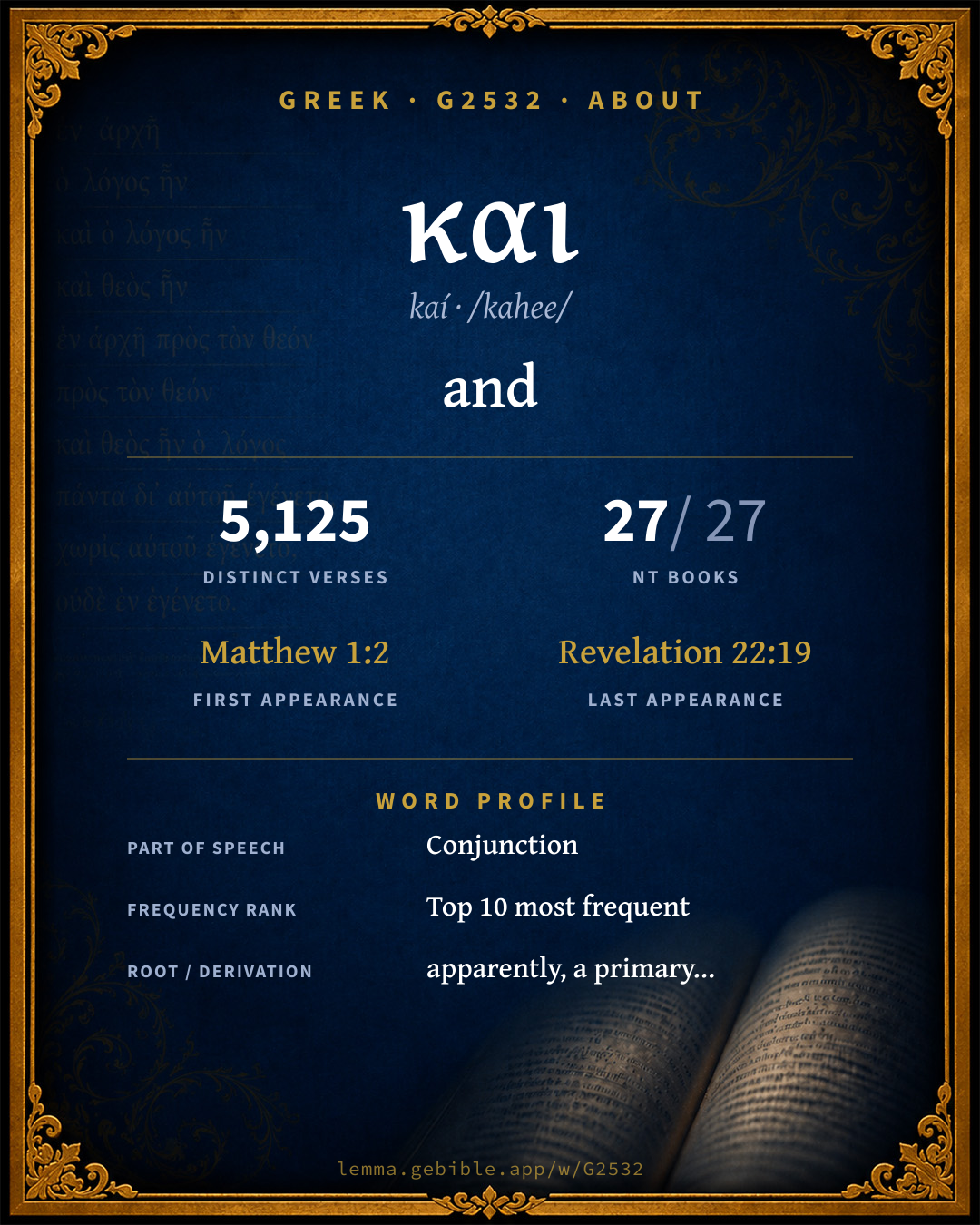
καί
and
Full lexicon entry — Thayer's Greek Lexicon
From Thayer's Greek Lexicon
Where this word appears
Grammar key — what these labels mean
Part of speech
- Conjunction
- A joining word linking words or clauses.
Every verse where G2532 appears in the Book of Hebrews — 173 distinct verses. Click any verse to open its interlinear word-by-word view. Verse text shown in the World English Bible for context — . Each verse’s Greek form is shown with its reference; the English is not keyword-highlighted, since the data carries no word-level English alignment. Use “Compare translations” on any verse to read it across multiple English versions. This concordance covers the Greek New Testament; Septuagint (Greek Old Testament) occurrences of this word are not indexed here.
Hebrews
- Hebrews 1:1 καὶ conj God, having in the past spoken to the fathers through the prophets at many times and in various ways,
- Hebrews 1:2 καὶ conj has at the end of these days spoken to us by his Son, whom he appointed heir of all things, through whom also he made the worlds.
- Hebrews 1:3 καὶ conj His Son is the radiance of his glory, the very image of his substance, and upholding all things by the word of his power, when he had by himself made purification for our sins, sat down on the right hand of the Majesty on high;
- Hebrews 1:5 καὶ καὶ conj conj For to which of the angels did he say at any time, "You are my Son, Today have I become your father?" and again, "I will be to him a Father, And he will be to me a Son?"
- Hebrews 1:6 καὶ conj Again, when he brings in the firstborn into the world he says, "Let all the angels of God worship him."
- Hebrews 1:7 καὶ καὶ conj conj Of the angels he says, "Who makes his angels winds, And his servants a flame of fire."
- Hebrews 1:8 καὶ conj but of the Son he says, "Your throne, O God, is forever and ever; The scepter of uprightness is the scepter of your Kingdom.
- Hebrews 1:9 καὶ conj You have loved righteousness, and hated iniquity; Therefore God, your God, has anointed you with the oil of gladness above your fellows."
- Hebrews 1:10 καί καὶ conj conj And, "You, Lord, in the beginning, laid the foundation of the earth. The heavens are the works of your hands.
- Hebrews 1:11 καὶ conj They will perish, but you continue. They all will grow old like a garment does.
- Hebrews 1:12 καὶ καὶ καὶ conj conj conj As a mantle you will roll them up, And they will be changed; But you are the same. Your years will not fail."
- Hebrews 2:2 καὶ καὶ conj conj For if the word spoken through angels proved steadfast, and every transgression and disobedience received a just recompense;
- Hebrews 2:4 καὶ καὶ καὶ conj conj conj God also bearing witness with them, both by signs and wonders, and by various works of power, and by gifts of the Holy Spirit, according to his own will?
- Hebrews 2:7 καὶ conj You made him a little lower than the angels; You crowned him with glory and honor.
- Hebrews 2:9 καὶ conj But we see him who has been made a little lower than the angels, Jesus, because of the suffering of death crowned with glory and honor, that by the grace of God he should taste of death for everyone.
- Hebrews 2:10 καὶ conj For it became him, for whom are all things, and through whom are all things, in bringing many children to glory, to make the author of their salvation perfect through sufferings.
- Hebrews 2:11 καὶ conj For both he who sanctifies and those who are sanctified are all from one, for which cause he is not ashamed to call them brothers,
- Hebrews 2:13 καὶ καὶ καὶ conj conj conj Again, "I will put my trust in him." Again, "Behold, here am I and the children whom God has given me."
- Hebrews 2:14 καὶ καὶ conj conj Since then the children have shared in flesh and blood, he also himself in like manner partook of the same, that through death he might bring to nothing him who had the power of death, that is, the devil,
- Hebrews 2:15 καὶ conj and might deliver all of them who through fear of death were all their lifetime subject to bondage.
- Hebrews 2:17 καὶ conj Therefore he was obligated in all things to be made like his brothers, that he might become a merciful and faithful high priest in things pertaining to God, to make atonement for the sins of the people.
- Hebrews 3:1 καὶ conj Therefore, holy brothers, partakers of a heavenly calling, consider the Apostle and High Priest of our confession, Jesus;
- Hebrews 3:2 καὶ conj who was faithful to him who appointed him, as also was Moses in all his house.
- Hebrews 3:5 καὶ conj Moses indeed was faithful in all his house as a servant, for a testimony of those things which were afterward to be spoken,
- Hebrews 3:6 καὶ conj but Christ is faithful as a Son over his house; whose house we are, if we hold fast our confidence and the glorying of our hope firm to the end.
- Hebrews 3:9 καὶ conj Where your fathers tested me by proving me, And saw my works for forty years.
- Hebrews 3:10 καὶ conj Therefore I was displeased with that generation, And said, 'They always err in their heart, But they didn't know my ways;'
- Hebrews 3:19 καὶ conj We see that they were not able to enter in because of unbelief.
- Hebrews 4:2 καὶ conj For indeed we have had good news preached to us, even as they also did, but the word they heard didn't profit them, because it wasn't mixed with faith by those who heard.
- Hebrews 4:4 καὶ conj For he has said this somewhere about the seventh day, "God rested on the seventh day from all his works;"
- Hebrews 4:5 καὶ conj and in this place again, "They will not enter into my rest."
- Hebrews 4:6 καὶ conj Seeing therefore it remains that some should enter therein, and they to whom the good news was before preached failed to enter in because of disobedience,
- Hebrews 4:10 καὶ conj For he who has entered into his rest has himself also rested from his works, as God did from his.
- Hebrews 4:12 καὶ καὶ καὶ καὶ καὶ καὶ καὶ conj conj conj conj conj conj conj For the word of God is living, and active, and sharper than any two-edged sword, and piercing even to the dividing of soul and spirit, of both joints and marrow, and is able to discern the thoughts and intentions of the heart.
- Hebrews 4:13 καὶ καὶ conj conj There is no creature that is hidden from his sight, but all things are naked and laid open before the eyes of him with whom we have to do.
- Hebrews 4:16 καὶ conj Let us therefore draw near with boldness to the throne of grace, that we may receive mercy, and may find grace for help in time of need.
- Hebrews 5:1 καὶ conj For every high priest, being taken from among men, is appointed for men in things pertaining to God, that he may offer both gifts and sacrifices for sins.
- Hebrews 5:2 καὶ καὶ conj conj The high priest can deal gently with those who are ignorant and going astray, because he himself is also surrounded with weakness.
- Hebrews 5:3 καὶ καὶ conj conj Because of this, he must offer sacrifices for sins for the people, as well as for himself.
- Hebrews 5:4 καὶ καὶ conj conj Nobody takes this honor on himself, but he is called by God, just like Aaron was.
- Hebrews 5:5 καὶ conj So also Christ didn't glorify himself to be made a high priest, but it was he who said to him, "You are my Son. Today I have become your father."
- Hebrews 5:6 καὶ conj As he says also in another place, "You are a priest forever, After the order of Melchizedek."
- Hebrews 5:7 καὶ καὶ καὶ conj conj conj He, in the days of his flesh, having offered up prayers and petitions with strong crying and tears to him who was able to save him from death, and having been heard for his godly fear,
- Hebrews 5:9 καὶ conj Having been made perfect, he became to all of those who obey him the author of eternal salvation,
- Hebrews 5:11 καὶ conj About him we have many words to say, and hard to interpret, seeing you have become dull of hearing.
- Hebrews 5:12 καὶ καὶ conj conj For when by reason of the time you ought to be teachers, you again need to have someone teach you the rudiments of the first principles of the oracles of God. You have come to need milk, and not solid food.
- Hebrews 5:14 καὶ conj But solid food is for those who are full grown, who by reason of use have their senses exercised to discern good and evil.
- Hebrews 6:1 καὶ conj Therefore leaving the doctrine of the first principles of Christ, let us press on to perfection--not laying again a foundation of repentance from dead works, of faith toward God,
- Hebrews 6:2 καὶ conj of the teaching of baptisms, of laying on of hands, of resurrection of the dead, and of eternal judgment.
- Hebrews 6:3 καὶ conj This will we do, if God permits.
- Hebrews 6:4 καὶ conj For concerning those who were once enlightened and tasted of the heavenly gift, and were made partakers of the Holy Spirit,
- Hebrews 6:5 καὶ conj and tasted the good word of God, and the powers of the age to come,
- Hebrews 6:6 καὶ καὶ conj conj and then fell away, it is impossible to renew them again to repentance; seeing they crucify the Son of God for themselves again, and put him to open shame.
- Hebrews 6:7 καὶ καὶ conj conj For the land which has drunk the rain that comes often on it, and brings forth a crop suitable for them for whose sake it is also tilled, receives blessing from God;
- Hebrews 6:8 καὶ καὶ conj conj but if it bears thorns and thistles, it is rejected and near being cursed, whose end is to be burned.
- Hebrews 6:9 καὶ καὶ conj conj But, beloved, we are persuaded of better things for you, and things that accompany salvation, even though we speak like this.
- Hebrews 6:10 καὶ καὶ conj conj For God is not unrighteous, so as to forget your work and the labor of love which you showed toward his name, in that you served the saints, and still do serve them.
- Hebrews 6:12 καὶ conj that you won't be sluggish, but imitators of those who through faith and patience inherited the promises.
- Hebrews 6:14 καὶ conj saying, "Most surely I will bless you, and I will surely multiply you."
- Hebrews 6:15 καὶ conj Thus, having patiently endured, he obtained the promise.
- Hebrews 6:16 καὶ conj For men indeed swear by a greater one, and in every dispute of theirs the oath is final for confirmation.
- Hebrews 6:19 καὶ καὶ conj conj This hope we have as an anchor of the soul, a hope both sure and steadfast and entering into that which is within the veil;
- Hebrews 7:1 καὶ conj For this Melchizedek, king of Salem, priest of God Most High, who met Abraham returning from the slaughter of the kings and blessed him,
- Hebrews 7:2 καὶ καὶ conj conj to whom also Abraham divided a tenth part of all (being first, by interpretation, king of righteousness, and then also king of Salem, which is king of peace;
- Hebrews 7:4 καὶ conj Now consider how great this man was, to whom even Abraham, the patriarch, gave a tenth out of the best spoils.
- Hebrews 7:5 καὶ conj They indeed of the sons of Levi who receive the priest's office have a commandment to take tithes of the people according to the law, that is, of their brothers, though these have come out of the loins of Abraham,
- Hebrews 7:6 καὶ conj but he whose genealogy is not counted from them has taken tithes of Abraham, and has blessed him who has the promises.
- Hebrews 7:8 καὶ conj Here people who die receive tithes, but there one receives tithes of whom it is testified that he lives.
- Hebrews 7:9 καὶ καὶ conj conj So to say, through Abraham even Levi, who receives tithes, has paid tithes,
- Hebrews 7:11 καὶ conj Now if there was perfection through the Levitical priesthood (for under it the people have received the law), what further need was there for another priest to arise after the order of Melchizedek, and not be called after the order of Aaron?
- Hebrews 7:12 καὶ conj For the priesthood being changed, there is of necessity a change made also in the law.
- Hebrews 7:15 καὶ conj This is yet more abundantly evident, if after the likeness of Melchizedek there arises another priest,
- Hebrews 7:18 καὶ conj For there is an annulling of a foregoing commandment because of its weakness and uselessness
- Hebrews 7:20 καὶ conj Inasmuch as he was not made priest without the taking of an oath
- Hebrews 7:21 καὶ conj (for they indeed have been made priests without an oath), but he with an oath by him that says of him, "The Lord swore and will not change his mind, 'You are a priest forever, According to the order of Melchizedek'".
- Hebrews 7:22 καὶ conj By so much has Jesus become the collateral of a better covenant.
- Hebrews 7:23 καὶ conj Many, indeed, have been made priests, because they are hindered from continuing by death.
- Hebrews 7:25 καὶ conj Therefore he is also able to save to the uttermost those who draw near to God through him, seeing he ever lives to make intercession for them.
- Hebrews 7:26 καὶ καὶ conj conj For such a high priest was fitting for us: holy, guiltless, undefiled, separated from sinners, and made higher than the heavens;
- Hebrews 8:2 καὶ conj a minister of the sanctuary, and of the true tabernacle, which the Lord pitched, not man.
- Hebrews 8:3 καὶ καὶ conj conj For every high priest is appointed to offer both gifts and sacrifices. Therefore it is necessary that this high priest also have something to offer.
- Hebrews 8:5 καὶ conj who serve a copy and shadow of the heavenly things, even as Moses was warned by God when he was about to make the tabernacle, for he said, "See, you shall make everything according to the pattern that was shown to you on the mountain."
- Hebrews 8:6 καὶ conj But now he has obtained a more excellent ministry, by so much as he is also the mediator of a better covenant, which has been enacted on better promises.
- Hebrews 8:8 καὶ καὶ conj conj For finding fault with them, he said, "Behold, the days come," says the Lord, "That I will make a new covenant with the house of Israel and with the house of Judah;
- Hebrews 8:10 καὶ καὶ καὶ conj conj conj "For this is the covenant that I will make with the house of Israel. After those days," says the Lord; "I will put my laws into their mind, I will also write them on their heart. I will be to them a God, And they will be to me a people.
- Hebrews 8:11 καὶ καὶ conj conj They will not teach every man his fellow citizen, Every man his brother, saying, 'Know the Lord,' For all will know me, From the least of them to the greatest of them.
- Hebrews 8:12 καὶ conj For I will be merciful to their unrighteousness. I will remember their sins and lawless deeds no more."
- Hebrews 8:13 καὶ conj In that he says, "A new covenant," he has made the first old. But that which is becoming old and grows aged is near to vanishing away.
- Hebrews 9:1 καὶ conj Now indeed even the first covenant had ordinances of divine service, and an earthly sanctuary.
- Hebrews 9:2 καὶ καὶ conj conj For there was a tabernacle prepared. In the first part were the lampstand, the table, and the show bread; which is called the Holy Place.
- Hebrews 9:4 καὶ καὶ καὶ conj conj conj having a golden altar of incense, and the ark of the covenant overlaid on all sides with gold, in which was a golden pot holding the manna, Aaron's rod that budded, and the tables of the covenant;
- Hebrews 9:7 καὶ conj but into the second the high priest alone, once in the year, not without blood, which he offers for himself, and for the errors of the people.
- Hebrews 9:9 καὶ conj which is a symbol of the present age, where gifts and sacrifices are offered that are incapable, concerning the conscience, of making the worshipper perfect;
- Hebrews 9:10 καὶ καὶ conj conj being only (with meats and drinks and various washings) fleshly ordinances, imposed until a time of reformation.
- Hebrews 9:11 καὶ conj But Christ having come as a high priest of the coming good things, through the greater and more perfect tabernacle, not made with hands, that is to say, not of this creation,
- Hebrews 9:12 καὶ conj nor yet through the blood of goats and calves, but through his own blood, entered in once for all into the Holy Place, having obtained eternal redemption.
- Hebrews 9:13 καὶ καὶ conj conj For if the blood of goats and bulls, and the ashes of a heifer sprinkling those who have been defiled, sanctify to the cleanness of the flesh:
- Hebrews 9:15 Καὶ conj For this reason he is the mediator of a new covenant, since a death has occurred for the redemption of the transgressions that were under the first covenant, that those who have been called may receive the promise of the eternal inheritance.
- Hebrews 9:19 καὶ καὶ καὶ καὶ conj conj conj conj For when every commandment had been spoken by Moses to all the people according to the law, he took the blood of the calves and the goats, with water and scarlet wool and hyssop, and sprinkled both the book itself and all the people,
- Hebrews 9:21 καὶ καὶ conj conj Moreover he sprinkled the tabernacle and all the vessels of the ministry in like manner with the blood.
- Hebrews 9:22 καὶ καὶ conj conj According to the law, nearly everything is cleansed with blood, and apart from shedding of blood there is no remission.
- Hebrews 9:27 καὶ conj Inasmuch as it is appointed for men to die once, and after this, judgment,
- Hebrews 9:28 καὶ conj so Christ also, having been once offered to bear the sins of many, will appear a second time, without sin, to those who are eagerly waiting for him for salvation.
- Hebrews 10:4 καὶ conj For it is impossible that the blood of bulls and goats should take away sins.
- Hebrews 10:5 καὶ conj Therefore when he comes into the world, he says, "Sacrifice and offering you didn't desire, But a body did you prepare for me;
- Hebrews 10:6 καὶ conj In whole burnt offerings and sacrifices for sin you had no pleasure.
- Hebrews 10:8 καὶ καὶ καὶ conj conj conj Previously saying, "Sacrifices and offerings and whole burnt offerings and sacrifices for sin you didn't desire, neither had pleasure in them" (those which are offered according to the law),
- Hebrews 10:11 Καὶ καὶ conj conj Every priest indeed stands day by day ministering and often offering the same sacrifices, which can never take away sins,
- Hebrews 10:15 καὶ conj The Holy Spirit also testifies to us, for after saying,
- Hebrews 10:16 καὶ conj "This is the covenant that I will make with them: 'After those days,' says the Lord, 'I will put my laws on their heart, I will also write them on their mind;'" then he says,
- Hebrews 10:17 καὶ καὶ conj conj "I will remember their sins and their iniquities no more."
- Hebrews 10:20 καὶ conj by the way which he dedicated for us, a new and living way, through the veil, that is to say, his flesh;
- Hebrews 10:21 καὶ conj and having a great priest over the house of God,
- Hebrews 10:23 καὶ conj let us hold fast the confession of our hope unyieldingly. For he who promised is faithful.
- Hebrews 10:24 καὶ καὶ conj conj Let us consider how to provoke one another to love and good works,
- Hebrews 10:25 καὶ conj not forsaking our own assembling together, as the custom of some is, but exhorting one another; and so much the more, as you see the Day approaching.
- Hebrews 10:27 καὶ conj but a certain fearful expectation of judgment, and a fierceness of fire which will devour the adversaries.
- Hebrews 10:29 καὶ καὶ conj conj How much worse punishment, do you think, will he be judged worthy of, who has trodden under foot the Son of God, and has counted the blood of the covenant with which he was sanctified an unholy thing, and has insulted the Spirit of grace?
- Hebrews 10:30 καὶ conj For we know him who said, "Vengeance belongs to me," says the Lord, "I will repay." Again, "The Lord will judge his people."
- Hebrews 10:33 καὶ conj partly, being exposed to both reproaches and oppressions; and partly, becoming partakers with those who were treated so.
- Hebrews 10:34 καὶ καὶ καὶ conj conj conj For you both had compassion on me in my chains, and joyfully accepted the plundering of your possessions, knowing that you have for yourselves a better possession and an enduring one in the heavens.
- Hebrews 10:37 καὶ conj "In a very little while, He who comes will come, and will not wait.
- Hebrews 10:38 καὶ conj But the righteous will live by faith. If he shrinks back, my soul has no pleasure in him."
- Hebrews 11:4 καὶ conj By faith, Abel offered to God a more excellent sacrifice than Cain, through which he had testimony given to him that he was righteous, God bearing witness with respect to his gifts; and through it he, being dead, still speaks.
- Hebrews 11:5 καὶ conj By faith, Enoch was taken away, so that he wouldn't see death, and he was not found, because God translated him. For he has had testimony given to him that before his translation he had been well pleasing to God.
- Hebrews 11:6 καὶ conj Without faith it is impossible to be well pleasing to him, for he who comes to God must believe that he exists, and that he is a rewarder of those who seek him.
- Hebrews 11:7 καὶ conj By faith, Noah, being warned about things not yet seen, moved with godly fear, prepared an ark for the saving of his house, through which he condemned the world, and became heir of the righteousness which is according to faith.
- Hebrews 11:8 καὶ conj By faith, Abraham, when he was called, obeyed to go out to the place which he was to receive for an inheritance. He went out, not knowing where he went.
- Hebrews 11:9 καὶ conj By faith, he lived as an alien in the land of promise, as in a land not his own, dwelling in tents, with Isaac and Jacob, the heirs with him of the same promise.
- Hebrews 11:10 καὶ conj For he looked for the city which has the foundations, whose builder and maker is God.
- Hebrews 11:11 καὶ καὶ conj conj By faith, even Sarah herself received power to conceive, and she bore a child when she was past age, since she counted him faithful who had promised.
- Hebrews 11:12 καὶ καὶ καὶ conj conj conj Therefore as many as the stars of the sky in multitude, and as innumerable as the sand which is by the sea shore, were fathered by one man, and him as good as dead.
- Hebrews 11:13 καὶ καὶ καὶ conj conj conj These all died in faith, not having received the promises, but having seen them and embraced them from afar, and having confessed that they were strangers and pilgrims on the earth.
- Hebrews 11:15 καὶ conj If indeed they had been thinking of that country from which they went out, they would have had enough time to return.
- Hebrews 11:17 καὶ conj By faith, Abraham, being tested, offered up Isaac. Yes, he who had gladly received the promises was offering up his one and only son;
- Hebrews 11:19 καὶ καὶ conj conj accounting that God is able to raise up even from the dead. Figuratively speaking, he also did receive him back from the dead.
- Hebrews 11:20 καὶ conj By faith, Isaac blessed Jacob and Esau, even concerning things to come.
- Hebrews 11:21 καὶ conj By faith, Jacob, when he was dying, blessed each of the sons of Joseph, and worshiped, leaning on the top of his staff.
- Hebrews 11:22 καὶ conj By faith, Joseph, when his end was near, made mention of the departure of the children of Israel; and gave instructions concerning his bones.
- Hebrews 11:23 καὶ conj By faith, Moses, when he was born, was hidden for three months by his parents, because they saw that he was a beautiful child, and they were not afraid of the king's commandment.
- Hebrews 11:28 καὶ conj By faith, he kept the Passover, and the sprinkling of the blood, that the destroyer of the firstborn should not touch them.
- Hebrews 11:32 Καὶ καὶ καὶ conj conj conj What more shall I say? For the time would fail me if I told of Gideon, Barak, Samson, Jephthah, David, Samuel, and the prophets;
- Hebrews 11:36 καὶ καὶ conj conj Others were tried by mocking and scourging, yes, moreover by bonds and imprisonment.
- Hebrews 11:38 καὶ καὶ καὶ conj conj conj (of whom the world was not worthy), wandering in deserts, mountains, caves, and the holes of the earth.
- Hebrews 11:39 καὶ conj These all, having had testimony given to them through their faith, didn't receive the promise,
- Hebrews 12:1 καὶ καὶ conj conj Therefore let us also, seeing we are surrounded by so great a cloud of witnesses, lay aside every weight and the sin which so easily entangles us, and let us run with patience the race that is set before us,
- Hebrews 12:2 καὶ conj looking to Jesus, the author and perfecter of faith, who for the joy that was set before him endured the cross, despising shame, and has sat down at the right hand of the throne of God.
- Hebrews 12:5 καὶ conj and you have forgotten the exhortation which reasons with you as with children, "My son, don't take lightly the chastening of the Lord, Nor faint when you are reproved by him;
- Hebrews 12:8 καὶ conj But if you are without discipline, of which all have been made partakers, then are you illegitimate, and not children.
- Hebrews 12:9 καὶ καὶ conj conj Furthermore, we had the fathers of our flesh to chasten us, and we paid them respect. Shall we not much rather be in subjection to the Father of spirits, and live?
- Hebrews 12:12 καὶ conj Therefore, lift up the hands that hang down and the feeble knees,
- Hebrews 12:13 καὶ conj and make straight paths for your feet, so that which is lame may not be dislocated, but rather be healed.
- Hebrews 12:14 καὶ conj Follow after peace with all men, and the sanctification without which no man will see the Lord,
- Hebrews 12:15 καὶ conj looking carefully lest there be any man who falls short of the grace of God; lest any root of bitterness springing up trouble you, and thereby the many be defiled;
- Hebrews 12:17 καὶ conj For you know that even when he afterward desired to inherit the blessing, he was rejected, for he found no place for a change of mind though he sought it diligently with tears.
- Hebrews 12:18 καὶ καὶ καὶ καὶ conj conj conj conj For you have not come to a mountain that might be touched, and that burned with fire, and to blackness, darkness, tempest,
- Hebrews 12:19 καὶ καὶ conj conj the sound of a trumpet, and the voice of words; which those who heard it begged that not one more word should be spoken to them,
- Hebrews 12:21 καί καὶ conj conj and so fearful was the appearance, that Moses said, "I am terrified and trembling."
- Hebrews 12:22 καὶ καὶ conj conj But you have come to Mount Zion, and to the city of the living God, the heavenly Jerusalem, and to innumerable hosts of angels,
- Hebrews 12:23 καὶ καὶ καὶ conj conj conj to the general assembly and assembly of the firstborn who are enrolled in heaven, to God the Judge of all, to the spirits of just men made perfect,
- Hebrews 12:24 καὶ καὶ conj conj to Jesus, the mediator of a new covenant, and to the blood of sprinkling that speaks better than that of Abel.
- Hebrews 12:26 καὶ conj whose voice shook the earth, then, but now he has promised, saying, "Yet once more I will shake not only the earth, but also the heavens."
- Hebrews 12:28 καὶ conj Therefore, receiving a Kingdom that can't be shaken, let us have grace, through which we serve God acceptably, with reverence and awe,
- Hebrews 12:29 καὶ conj for our God is a consuming fire.
- Hebrews 13:3 καὶ conj Remember those who are in bonds, as bound with them; and those who are ill-treated, since you are also in the body.
- Hebrews 13:4 καὶ καὶ conj conj Let marriage be held in honor among all, and let the bed be undefiled: but God will judge the sexually immoral and adulterers.
- Hebrews 13:8 καὶ καὶ conj conj Jesus Christ is the same yesterday, today, and forever.
- Hebrews 13:9 καὶ conj Don't be carried away by various and strange teachings, for it is good that the heart be established by grace, not by food, through which those who were so occupied were not benefited.
- Hebrews 13:12 καὶ conj Therefore Jesus also, that he might sanctify the people through his own blood, suffered outside of the gate.
- Hebrews 13:16 καὶ conj But don't forget to be doing good and sharing, for with such sacrifices God is well pleased.
- Hebrews 13:17 καὶ καὶ conj conj Obey your leaders and submit to them, for they watch on behalf of your souls, as those who will give account, that they may do this with joy, and not with groaning, for that would be unprofitable for you.
- Hebrews 13:22 καὶ conj But I exhort you, brothers, endure the word of exhortation, for I have written to you in few words.
- Hebrews 13:24 καὶ conj Greet all of your leaders and all the saints. The Italians greet you.
About this entry
At a glance — auto-summarized from this page’s data, not written by a person. Every figure links to its source below. This summary describes the numbers; it doesn’t interpret them.
At its core, και (kaí) means “and.” Scripture first uses it in Matthew 1:2. With 5,125 verses in 27 books, it is one of the most common word in the Greek New Testament. Sharing its root, it stands alongside καγω, καιγε and καιπερ. Each statement above links to its evidence; the full detail follows below.
Gloss history
Strong's 1890 vs modern scholarship

About this word
Strong's G2532 catalogs a Greek word from the Greek New Testament.
These counts are not copied from any lexicon or concordance. They are computed here, from the morphology-tagged Greek New Testament. What Lemma adds →
- 5,125
- distinct verses
- The word appears in 5,125 distinct verses.
- 27 / 27
- NT books
- The word appears in 27 of 27 New Testament books.
- #2
- by frequency
- Top 10 most frequent Greek words (rank 2 of 5,347 Greek words by occurrence).
View all 5,125 occurrences in the concordance →
By section of the New Testament
By traditional corpus
Conventional, traditional groupings — biblical authorship is debated, so this is a traditional corpus grouping, not an authorship claim. Some books belong to more than one corpus (Luke is in both the Gospels and the Lukan corpus, and so on), so these shares overlap and need not total 100%. Each figure is a share of the word’s 5,125 distinct verses.
- Gospels 2,619 verses · 51%
- Lukan (Luke–Acts) 1,489 verses · 29%
- Pauline corpus 1,026 verses · 20%
- Johannine 995 verses · 19%
- Revelation 370 verses · 7%
- General (Catholic) Epistles 277 verses · 5%
- Hebrews 173 verses · 3%
How translations render this word
Counts come from each version’s own published word-to-Strong’s tagging or interlinear alignment — an approximate guide to how each version renders this word, not a word-level alignment the data otherwise carries. Because each total is that version’s own tagged count, the per-version totals vary from one another and need not match the appearance or distinct-verse counts above. These counts may also differ from a printed concordance because Lemma counts each distinctly tagged rendering and does not collapse phrase taggings into a single head-word total. This is a fixed set of word-tagged versions (KJV, ASV, BSB, ULT) and does not change with the reading translation you choose elsewhere. Each version’s license is shown beside its name below (and on Sources).
- King James Version: And 8,097×, Also 500×, Even 101×
- American Standard Version: And 7,750×, Also 433×, Even 110×
- Berean Standard Bible: And 5,240×, Then 278×, Also 156×
- unfoldingWord Literal Text: And 7,949×, Also 596×, But 132×
King James Version Public Domain
Renders G2532 across 9,091 tagged occurrences — most commonly:
Plus other, less common renderings. Plus 72 renderings that appear only once — usually multi-word phrases or single function words the recovered tagging swept in, not distinct renderings. Not rendered by a distinct English word in 156 further occurrences.
American Standard Version Public Domain
Renders G2532 across 8,928 tagged occurrences — most commonly:
Plus other, less common renderings. Plus 227 renderings that appear only once — usually multi-word phrases or single function words the recovered tagging swept in, not distinct renderings. Not rendered by a distinct English word in 83 further occurrences.
Berean Standard Bible Public Domain
Renders G2532 across 6,415 tagged occurrences — most commonly:
Plus other, less common renderings. Plus 44 renderings that appear only once — usually multi-word phrases or single function words the recovered tagging swept in, not distinct renderings. Not rendered by a distinct English word in 2,467 further occurrences.
unfoldingWord Literal Text CC BY-SA 4.0
Renders G2532 across 9,016 tagged occurrences — most commonly:
Plus other, less common renderings. Plus 20 renderings that appear only once — usually multi-word phrases or single function words the recovered tagging swept in, not distinct renderings. Not rendered by a distinct English word in 3 further occurrences.
Senses in Thayer's
The 1 sense Thayer's distinguishes for this word, in lexicon order (not ranked by frequency or importance). The full entry — with sub-senses — is in the Lexicon Entry tab.
- and, also, even, indeed, but Frequency count based on 1894 Scrivener Greek New Testament.
Word origin
Origin: apparently, a primary particle, having a copulative and sometimes also a cumulative force
Apparently a primary particle having a copulative and sometimes also a cumulative force; and also even so then too etc.; often used in connection (or composition) with other particles or small words : - and also both but even for if indeed likewise moreover or so that then therefore when yea yet.
— Strong’s Exhaustive Concordance (1890), public domain.
Forms in the corpus
The 5 distinct written forms G2532 takes in the Greek New Testament, most frequent first — each parse links to that case’s occurrences in the concordance.
| Form | Parsing | Example | Uses |
|---|---|---|---|
| καὶ kaì | Conjunction | Matthew 1:2 | 8,661 |
| Καὶ Kaì | Conjunction | Matthew 4:21 | 274 |
| καί kaí | Conjunction | Matthew 15:4 | 29 |
| Καί Kaí | Conjunction | Luke 19:39 | 4 |
| και kai | Conjunction | John 7:53 | 1 |
Same root — word family
Other Thayer's entries built from the same root as G2532, grouped by Strong’s listed origin. These share a root / origin per the lexicon — not necessarily a shared meaning. Each links to that word’s own entry.
Derived from this word
- καγω kagṓ G2504 and I
- καιγε kaíge G2534 and indeed
- καιπερ kaíper G2539 although
- καιτοι kaítoi G2543 and yet
- κακει kakeî G2546 and there
- κακειθεν kakeîthen G2547 of place
- κακεινος kakeînos G2548 and he
- καν kán G2579 and if
Compare all same-root words → Showing 4 of 9 — not the complete family. They share a root, not necessarily a meaning.
Septuagint usage
The same Greek word και appears 47,643 times in the Greek Old Testament (Septuagint), across 18,587 verses in 38 books.
- 47,643
- LXX occurrences
- Tagged occurrences of this Greek word in the Septuagint.
- 18,587
- verses
- Distinct Septuagint verses containing this word.
- 38 / 39
- OT books
- The word appears in 38 of the 39 Old Testament books.
Sample Septuagint occurrences
- Genesis 1:1 καί
- Exodus 1:3 καί
- Leviticus 1:1 καί
- Numbers 1:1 καί
- Deuteronomy 1:1 καί
- Joshua 1:1 καί
- Judges 1:1 καί
- Ruth 1:1 καί
- 1 Samuel 1:1 καί
- 2 Samuel 1:1 καί
- 1 Kings 1:1 καί
- 2 Kings 1:1 καί
Septuagint occurrences (same lexeme)
Every verse where the same Strong’s number (G2532) appears in the Greek Septuagint — showing the first 50 of 18,587. Verse text shown in the World English Bible for context; the Greek form is the matched word — the English is not keyword-highlighted.
- Genesis 1:1 καί In the beginning God created the heavens and the earth.
- Genesis 1:2 καί Now the earth was formless and empty. Darkness was on the surface of the deep. God's Spirit was hovering over the surface of the waters.
- Genesis 1:3 καί God said, "Let there be light," and there was light.
- Genesis 1:4 καί God saw the light, and saw that it was good. God divided the light from the darkness.
- Genesis 1:5 καί God called the light Day, and the darkness he called Night. There was evening and there was morning, one day.
- Genesis 1:6 καί God said, "Let there be an expanse in the midst of the waters, and let it divide the waters from the waters."
- Genesis 1:7 καί God made the expanse, and divided the waters which were under the expanse from the waters which were above the expanse, and it was so.
- Genesis 1:8 καί God called the expanse sky. There was evening and there was morning, a second day.
- Genesis 1:9 καί God said, "Let the waters under the sky be gathered together to one place, and let the dry land appear," and it was so.
- Genesis 1:10 καί God called the dry land Earth, and the gathering together of the waters he called Seas. God saw that it was good.
- Genesis 1:11 καί God said, "Let the earth put forth grass, herbs yielding seed, and fruit trees bearing fruit after their kind, with its seed in it, on the earth," and it was so.
- Genesis 1:12 καί The earth brought forth grass, herbs yielding seed after their kind, and trees bearing fruit, with its seed in it, after their kind: and God saw that it was good.
- Genesis 1:13 καί There was evening and there was morning, a third day.
- Genesis 1:14 καί God said, "Let there be lights in the expanse of sky to divide the day from the night; and let them be for signs, and for seasons, and for days and years;
- Genesis 1:15 καί and let them be for lights in the expanse of sky to give light on the earth," and it was so.
- Genesis 1:16 καί God made the two great lights: the greater light to rule the day, and the lesser light to rule the night. He also made the stars.
- Genesis 1:17 καί God set them in the expanse of sky to give light to the earth,
- Genesis 1:18 καί and to rule over the day and over the night, and to divide the light from the darkness. God saw that it was good.
- Genesis 1:19 καί There was evening and there was morning, a fourth day.
- Genesis 1:20 καί God said, "Let the waters swarm with swarms of living creatures, and let birds fly above the earth in the open expanse of sky."
- Genesis 1:21 καί God created the large sea creatures, and every living creature that moves, with which the waters swarmed, after their kind, and every winged bird after its kind. God saw that it was good.
- Genesis 1:22 καί God blessed them, saying, "Be fruitful, and multiply, and fill the waters in the seas, and let birds multiply on the earth."
- Genesis 1:23 καί There was evening and there was morning, a fifth day.
- Genesis 1:24 καί God said, "Let the earth bring forth living creatures after their kind, cattle, creeping things, and animals of the earth after their kind," and it was so.
- Genesis 1:25 καί God made the animals of the earth after their kind, and the cattle after their kind, and everything that creeps on the ground after its kind. God saw that it was good.
- Genesis 1:26 καί God said, "Let us make man in our image, after our likeness: and let them have dominion over the fish of the sea, and over the birds of the sky, and over the cattle, and over all the earth, and over every creeping thing that creeps on the earth."
- Genesis 1:27 καί God created man in his own image. In God's image he created him; male and female he created them.
- Genesis 1:28 καί God blessed them. God said to them, "Be fruitful, multiply, fill the earth, and subdue it. Have dominion over the fish of the sea, over the birds of the sky, and over every living thing that moves on the earth."
- Genesis 1:29 καί God said, "Behold, I have given you every herb yielding seed, which is on the surface of all the earth, and every tree, which bears fruit yielding seed. It will be your food.
- Genesis 1:30 καί To every animal of the earth, and to every bird of the sky, and to everything that creeps on the earth, in which there is life, I have given every green herb for food." And it was so.
- Genesis 1:31 καί God saw everything that he had made, and, behold, it was very good. There was evening and there was morning, the sixth day.
- Genesis 2:1 καί The heavens and the earth were finished, and all the host of them.
- Genesis 2:2 καί On the seventh day God finished his work which he had made; and he rested on the seventh day from all his work which he had made.
- Genesis 2:3 καί God blessed the seventh day, and made it holy, because he rested in it from all his work which he had created and made.
- Genesis 2:4 καί This is the history of the generations of the heavens and of the earth when they were created, in the day that Yahweh God made earth and the heavens.
- Genesis 2:5 καί No plant of the field was yet in the earth, and no herb of the field had yet sprung up; for Yahweh God had not caused it to rain on the earth. There was not a man to till the ground,
- Genesis 2:6 καί but a mist went up from the earth, and watered the whole surface of the ground.
- Genesis 2:7 καί Yahweh God formed man from the dust of the ground, and breathed into his nostrils the breath of life; and man became a living soul.
- Genesis 2:8 καί Yahweh God planted a garden eastward, in Eden, and there he put the man whom he had formed.
- Genesis 2:9 καί Out of the ground Yahweh God made every tree to grow that is pleasant to the sight, and good for food; the tree of life also in the midst of the garden, and the tree of the knowledge of good and evil.
- Genesis 2:12 καί and the gold of that land is good. There is aromatic resin and the onyx stone.
- Genesis 2:13 καί The name of the second river is Gihon: the same river that flows through the whole land of Cush.
- Genesis 2:14 καί The name of the third river is Hiddekel: this is the one which flows in front of Assyria. The fourth river is the Euphrates.
- Genesis 2:15 καί Yahweh God took the man, and put him into the garden of Eden to dress it and to keep it.
- Genesis 2:16 καί Yahweh God commanded the man, saying, "Of every tree of the garden you may freely eat:
- Genesis 2:17 καί but of the tree of the knowledge of good and evil, you shall not eat of it: for in the day that you eat of it you will surely die."
- Genesis 2:18 καί Yahweh God said, "It is not good that the man should be alone; I will make him a helper suitable for him."
- Genesis 2:19 καί Out of the ground Yahweh God formed every animal of the field, and every bird of the sky, and brought them to the man to see what he would call them. Whatever the man called every living creature, that was its name.
- Genesis 2:20 καί The man gave names to all cattle, and to the birds of the sky, and to every animal of the field; but for man there was not found a helper suitable for him.
- Genesis 2:21 καί Yahweh God caused a deep sleep to fall on the man, and he slept; and he took one of his ribs, and closed up the flesh in its place.
These are occurrences of the same Greek lexeme (G2532) in the Septuagint — not a translation of any one Hebrew word. The store carries no word-level Hebrew↔Greek alignment, so no Hebrew original is asserted here. Counts come from the recovered LXX Strong's tagging — high-frequency vocabulary is well covered, while rare or late forms may be untagged — so they reflect tagged occurrences and may slightly undercount.