
Matthew 20:6

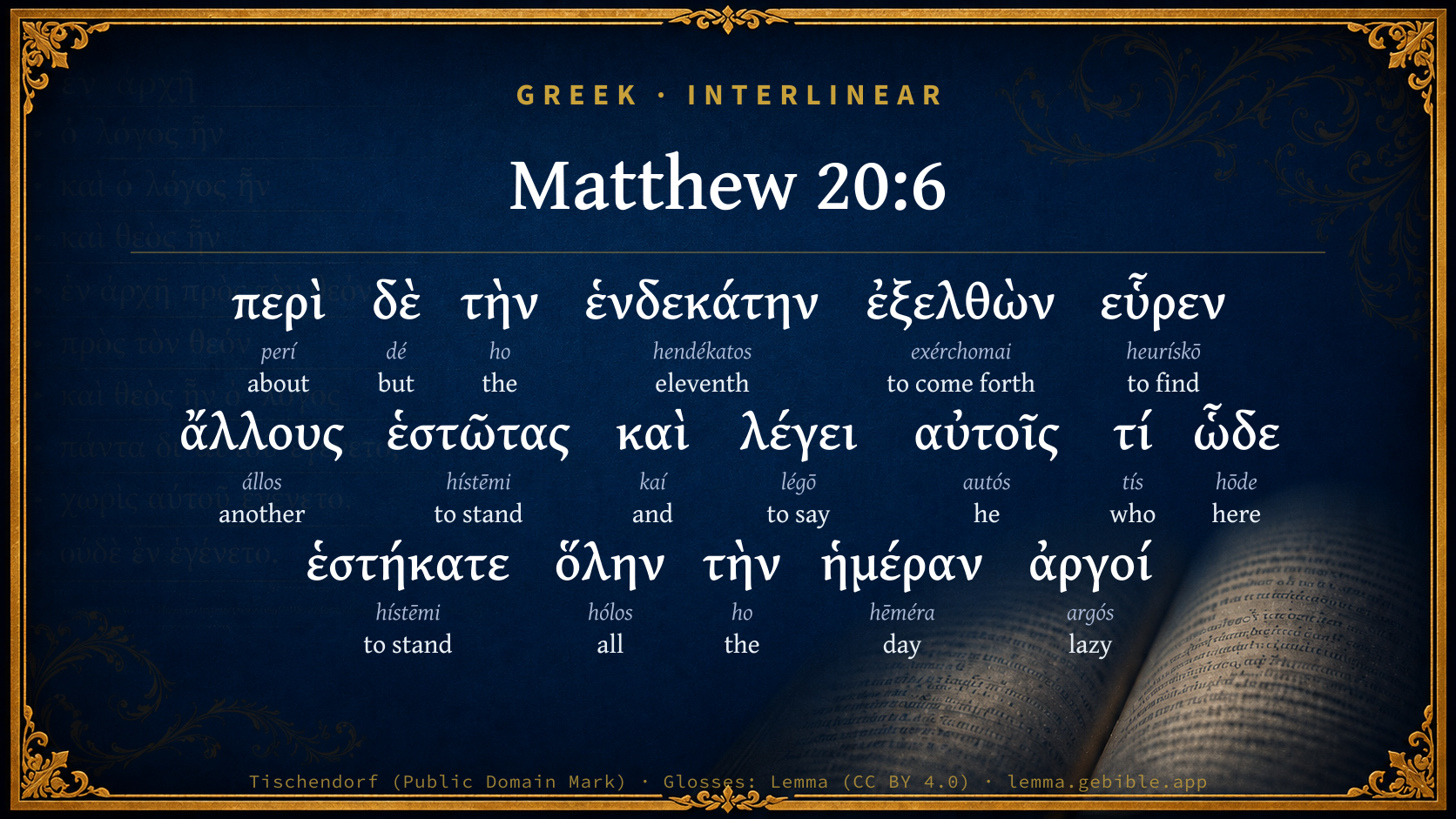
Greek (Tischendorf 8th ed.) Matthew 20:6 appears in the Greek New Testament. The text above is from the Tischendorf 8th edition. Each word links to its Strong’s number and a concise gloss. Click any word for its full Thayer’s Greek Lexicon entry.
Download image
Cite this verse

Matthew 20:6 (World English Bible). Public Domain. Lemma interlinear Bible study tool, https://lemma.gebible.app/v/matthew/20/6.

Show BibTeX & RIS
BibTeX
RIS
English Translation
About the eleventh hour he went out, and found others standing idle. He said to them, 'Why do you stand here all day idle?'
World English Bible · Public Domain
Highlights
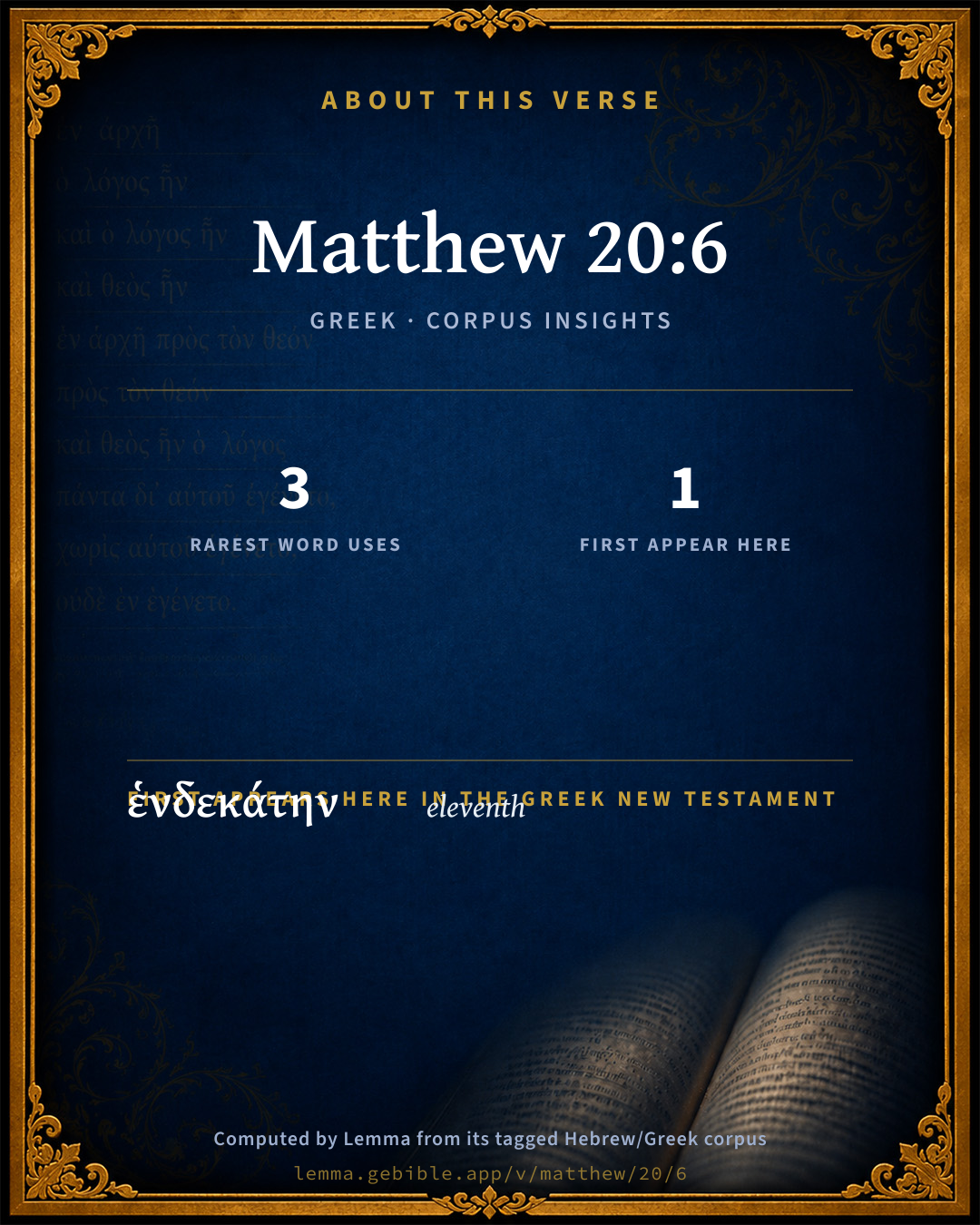
  • 1 first appearance in the Greek New Testament
Full analysis ↓
Download a study sheet

One document with this verse’s original text, its word-by-word gloss line, the meaning frame, cross-references with their text, attributed commentary, and full source and license credits — printable, and it pastes into notes with its structure intact.

This verse Autodidact and up

Study sheet (.html) Plain text (.txt)

A passage Seminary Student

Up to 50 verses in one chapter. A passage sheet keeps up to 6 commentary sources and 12 cross-references per verse, in the order this page ranks them, and says so on the sheet whenever that leaves anything out. Ask for a single verse and you get the Autodidact verse sheet above.

Everything on this page stays free to read, with no account — the sheet is a download of what is already on screen, not access to it.

Want to remove ads? Support Godless Engineer
Compare translations 3

The same verse in 3 English versions, stacked beneath the original-language interlinear above. Click any original word for its lexicon entry.

Each is an independent rendering of the whole verse — the interlinear is not word-aligned to these translations.

Highlighted words mark where these versions differ — a whole-verse word diff, not a word-by-word alignment.

  • World English Bible Public Domain
    About the eleventh hour he went out, and found others standing idle. He said to them, 'Why do you stand here all day idle?'
  • King James Version Public Domain
    And about the eleventh hour he went out, and found others standing idle, and saith unto them, Why stand ye here all the day idle?
  • unfoldingWord Literal Text CC BY-SA 4.0
    Now, having gone out about the eleventh, he found others standing, and he says to them, ‘Why have you stood here idle the whole day?’

unfoldingWord Literal Text — © unfoldingWord, licensed CC BY-SA 4.0. Word-aligned USFM3 via Door43 (git.door43.org/unfoldingWord/en_ult).

Versions to compare (up to 4)

3 of 4 selected

Show all 19 translations

Every available English version of this verse, each an independent rendering of the whole verse.

  • World English Bible Public Domain
    About the eleventh hour he went out, and found others standing idle. He said to them, 'Why do you stand here all day idle?'
  • Berean Standard Bible Public Domain
    About the eleventh hour he went out and found still others standing around. ‘Why have you been standing here all day long doing nothing?’ he asked.
  • Majority Standard Bible Public Domain
    About the eleventh hour he went out and found still others standing idle. ‘Why have you been standing here all day long doing nothing?’ he asked.
  • King James Version Public Domain
    And about the eleventh hour he went out, and found others standing idle, and saith unto them, Why stand ye here all the day idle?
  • American Standard Version (1901) Public Domain
    And about the eleventh `hour' he went out, and found others standing; and he saith unto them, Why stand ye here all the day idle?
  • Revised Version (1885) Public Domain
    And about the eleventh hour he went out, and found others standing; and he saith unto them, Why stand ye here all the day idle?
  • Geneva Bible (1599) Public Domain
    And he went about the eleuenth houre, and found other standing idle, and sayd vnto them, Why stand ye here all the day idle?
  • Douay-Rheims (1899) Public Domain
    But about the eleventh hour he went out and found others standing, and he saith to them: Why stand you here all the day idle?
  • Young's Literal Translation Public Domain
    And about the eleventh hour, having gone forth, he found others standing idle, and saith to them, Why here have ye stood all the day idle?
  • Literal Standard Version CC BY-SA 4.0
    And about the eleventh hour, having gone forth, he found others standing idle and says to them, Why have you stood here idle all day?
  • Unlocked Literal Bible CC BY-SA 4.0
    Once more about the eleventh hour he went out and found others standing idle. He said to them, 'Why do you stand here idle all the day long?'
  • unfoldingWord Literal Text CC BY-SA 4.0
    Now, having gone out about the eleventh, he found others standing, and he says to them, ‘Why have you stood here idle the whole day?’
  • Darby Bible Public Domain
    But about the eleventh [hour], having gone out, he found others standing, and says to them, Why stand ye here all the day idle?
  • World Messianic Bible Public Domain
    About the eleventh hour he went out and found others standing idle. He said to them, ‘Why do you stand here all day idle?’
  • Webster's Bible Public Domain
    And about the eleventh hour he went out, and found others standing idle, and saith to them, Why stand ye here all the day idle?
  • Free Bible Version CC BY-SA 4.0
    At 5 p.m. he went out and found others standing there. ‘Why are you standing around all day doing nothing?’ he asked them.
  • Bible in Basic English Public Domain
    And about the eleventh hour he went out and saw others doing nothing; and he says to them, Why are you here all the day doing nothing?
  • Text-Critical English NT CC BY 4.0
    About the eleventh hour he went out and found others standing idle and said to them, ‘Why have you been standing here idle all day?’
  • Tyndale New Testament (1534) Public Domain
    And he went out aboute the eleventhe houre and founde other stondynge ydell and sayde vnto them: Why stonde ye here all the daye ydell?

Literal Standard Version (2020), Covenant Press — licensed CC BY-SA 4.0. Text via the HelloAO Bible API (eBible.org). Unlocked Literal Bible (unfoldingWord) — licensed CC BY-SA 4.0. Text via the HelloAO Bible API (eBible.org). unfoldingWord Literal Text — © unfoldingWord, licensed CC BY-SA 4.0. Word-aligned USFM3 via Door43 (git.door43.org/unfoldingWord/en_ult). Free Bible Version, Dr. Jonathan Gallagher — licensed CC BY-SA 4.0. Text via the HelloAO Bible API (eBible.org).

Word by word

More ways to search: Search by grammar → Find every occurrence → Compare this word →

Practice this passage: Drill this verse → Learn its vocabulary →

ἑνδεκάτην
hendékatos
G1734
“eleventh”
Adjective, Accusative, Singular, Feminine
Part of Speech
Adjective
Case
Accusative
Number
Singular
Gender
Feminine
Full Thayer's Definition

Origin: ordinal from G1733

TDNT: None

1. eleventh
  1. περὶ perí G4012 “about” Preposition
  2. δὲ dé G1161 “but” Conjunction
  3. τὴν ho G3588 “the” Article, Accusative, Singular, Feminine
  4. ἐξελθὼν exérchomai G1831 “to come forth” Verb, Aorist, Active, Participle, Nominative, Singular, Masculine
  5. εὗρεν heurískō G2147 “to find” Verb, Aorist, Active, Indicative, 3rd person, Singular
  6. ἄλλους állos G243 “another” Adjective, Accusative, Plural, Masculine
  7. ἑστῶτας hístēmi G2476 “to stand” Verb, Perfect, Active, Participle, Accusative, Plural, Masculine
  8. καὶ kaí G2532 “and” Conjunction
  9. λέγει légō G3004 “to say” Verb, Present, Active, Indicative, 3rd person, Singular
  10. αὐτοῖς autós G846 “he” Personal pronoun, Dative, Plural, Masculine
  11. τί tís G5101 “who” Interrogative pronoun, Accusative, Singular, Neuter
  12. ὧδε hōde G5602 “here” Adverb
  13. ἑστήκατε hístēmi G2476 “to stand” Verb, Perfect, Active, Indicative, 2nd person, Plural
  14. ὅλην hólos G3650 “all” Adjective, Accusative, Singular, Feminine
  15. τὴν ho G3588 “the” Article, Accusative, Singular, Feminine
  16. ἡμέραν hēméra G2250 “day” Noun, Accusative, Singular, Feminine
  17. ἀργοί argós G692 “lazy” Adjective, Nominative, Plural, Masculine

About this verse

These counts appear in no published source. They are computed here, from the morphology-tagged text and Lemma’s own curated glosses. What Lemma adds →

18
words
16
distinct lemmas
Gospels
section

Notable vocabulary

The rarest word here is ἑνδεκάτην eleventh G1734 — appearing just 3 times in the whole Greek New Testament.

First appearance in Scripture

This word makes its first canonical appearance in the Greek New Testament here:

  • ἑνδεκάτην eleventh G1734

Shared distinctive vocabulary

ἑνδεκάτην eleventh G1734 occurs in 3 verses of the Greek New Testament. Also found in:
Repetition

Words recur within this verse:

  • ἑστῶτας to stand G2476 ×2
  • τὴν the G3588 ×2

Cross-references

7

Topical passages linked to Matthew 20:6 in the Treasury of Scripture Knowledge — connected by theme and wording, ordered by reader-vote popularity; previews shown in the World English Bible.

  • John 9:4 I must work the works of him who sent me, while it is day. The night is coming, when no one can work.
  • Acts 17:21 Now all the Athenians and the strangers living there spent their time in nothing else, but either to tell or to hear some new thing.
  • Hebrews 6:12 that you won't be sluggish, but imitators of those who through faith and patience inherited the promises.
  • Proverbs 19:15 Slothfulness casts into a deep sleep. The idle soul shall suffer hunger.
  • Luke 23:40–43 But the other answered, and rebuking him said, "Don't you even fear God, seeing you are under the same condemnation?
  • Ecclesiastes 9:10 Whatever your hand finds to do, do it with your might; for there is no work, nor device, nor knowledge, nor wisdom, in Sheol, where you are going.
  • Ezekiel 16:49 Behold, this was the iniquity of your sister Sodom: pride, fullness of bread, and prosperous ease was in her and in her daughters; neither did she strengthen the hand of the poor and needy.

Cross-references courtesy of OpenBible.info (CC BY 4.0).

Where the printed editions differ

1 variant

Places in this verse where the major printed Greek editions disagree on the wording in a way that affects the translation — a comparison of editions, not a manuscript-by-manuscript collation. The editions are the modern critical texts (Nestlé-Aland 28/27, SBL, Westcott-Hort, Tregelles, Tyndale House) and the traditional texts behind the KJV (the Textus Receptus and the Byzantine/Majority text). It is not a claim about which reading is original.

  1. Extra text
    ἀργούς

    “idle”

    In TRByz Not in NA28NA27TynSBLWHTreg

    ἀργούς (argous) 'idle' is only in traditional manuscripts (TR+Byz)

Textual data: Translators Amalgamated Greek New Testament (STEPBible TAGNT) · CC BY 4.0.

Commentary

Notes on Matthew 20:6 from classic Christian and Jewish commentators (each source and its license shown beneath its notes). The classic Christian expositions comment on the surrounding passage and are grouped to its opening verse, so a note may address several verses; the Jewish commentaries on the Tanakh (Rashi and others) are per-verse, so they appear only where the commentator wrote on this verse.

Lemma curates 59 commentaries, every one of them public domain or Creative Commons licensed, each selected and text-cleaned for this edition rather than reprinted as found. About our sources →

The Biblical Illustrator

Joseph S. Exell

Mat_20:6

Why stand ye here all the day idle?

Spiritual idleness

I. The evil censured. Spiritual idleness. Often accompanied with great secular activity, and a flaming profession. Consists in neglect-of lifes mission; the souls salvation and sanctification (Php_2:12-13); works for the spiritual benefit of others seeking in order to save them that are lost (1Co_10:24). This neglect is highly criminal.

1. As injurious to ones self. Deteriorates the moral nature.

2. As injurious to others.

3. As disobedience to the Divine summons, Go work, etc. Christ came to do the Fathers will, and summons us to follow Him.

II. The continuance and aggravation of the evil. All the day idle, etc. Youth, manhood, age. The reproach increases with the passing months and years.

1. When so much work for yourself and others ought to have been done.

2. When others have been so long labouring.

3. When there has been so much time and opportunity-eleventh hour-market place.

4. When the working day is drawing to a dose.

III. The excuses offered for the evil. Why stand ye? asks the Master, and what are the usual replies?-

1. We have not been invited by the minister, etc. Dont wait for such invitations-offer)-our services-I must work, etc.

2. We lack the necessary qualifications, etc.

3. We lack opportunity, etc.

4. We give money, etc. This will not be accepted by the Master as a substitute for personal service. You cannot do this work by proxy. Work for Christ is personal, and cannot be delegated to others, etc.

IV. The motives go abandon the evil.

1. The urgency of the work.

2. The activity of Satan and his emissaries.

3. The honour and pleasure of active service. Work in which the Son of Man was employed when on earth. No less happy than honourable.

4. The assurance of Divine help. May be difficulties you fear to meet, but God will strengthen and direct, etc.

5. The brevity of lifes golden opportunity. Difficulty increases with delay. You will get accustomed to idleness and it will become chronic. Whether early or late in the day, begin Now.

6. The promise of reward. Present; future-in and for. Whatsoever is right that shall ye receive. They that turn, etc. (Alfred Tucker.)

Standing idle

The text contains-

I. An implication-That there is work to be done.

1. Knowledge to acquire-of God, self, etc.

2. Blessing, to secure. Pardon, etc.

3. Duties to discharge. Notwithstanding, many are idle.

II. An expostulation. Why stand ye who are active, rational, responsible, rewardable creatures? Why stand ye here idle? Here on a theatre of action. In this the day of your probation. In this state of uncertainty. Why stand ye? Standing not working.

III. An inquiry? Why? Some are idle because they have no work. Some do not like the master. Some do not love the work. Some imagine themselves unable to work. Some do not like the wages. Some no man hath hired. Does not the Bible, memory, and conscience supply instances in which He would have hired you, but you were unwilling to have your old Master and desert His work, etc. (W. Atherton.)

Idleness deteriorates the moral nature

Here lies what was once a bar of iron, but the joint action of air and water has reduced it to a bar of rust. It has now no strength, and consequently no value. To how many varied and useful purposes it might have been put some years ago and in its work have found its strength, beauty, and preservation; but it is too late now; it will soon be blended with the earth upon which it passively lies, a striking emblem of the man who through sloth and love of ease refuses to face the hammer and anvil of active life and honest work; who flies from the purifying tire of lifes adversities, and who will fight no battle for truth and the higher interests of his soul. (Anon.)

Lazy Christians

A lazy Christian shall always want four things, viz., comfort, content, confidence, and assurance. God hath made separation between joy and idleness, between assurance and laziness, and therefore it is impossible for thee to bring these together. (T. Brooks.)

A busy man is troubled but with one devil, but the idle man with a thousand. (Anon.)

Idleness a sin

Idleness is a sin, for it involves disobedience to Christs command, Go into My vineyard and work. It is a sin, for it shows an utter want of sympathy with the Master, who went about doing good, and who expected His followers to do good to all as they have opportunity. It is a sin, for it indicates a selfish love of ease; and a Divine woe is pronounced on all who are at ease in Zion. It is a sin, for it reveals a callous heart, insensible to the woes of a lost world. Every idler in the church is a sinner, for to him that knoweth to do good and doeth it not, to him it is sin. Alas! how many sinners are found in Zion, and what must be their doom when the Master cometh to judge the unfaithful servants who have hid their talent in place of using it! (W. Durant.)

Busy about nothing

The bee and the butterfly are both busy creatures; there is an activity that ends in nothing; there are lives that store no honey,

Working and rusting

Two ploughshares were once made by the same blacksmith, in the same smithy, from the same kind of iron, and they were bought by the same farmer. He took them home; one he took into instant employment, but he left the other unemployed for twelve months in a barn, till the poor thing got covered with rust: at last the farmer had occasion for another ploughshare, so he drew it forth from its laziness and obscurity, and sent it into the field, where it met its old fellowploughshare. Why, said the lazy one, what has kept you so bright? I declare I am quite ashamed to be seen. Ah! said the bright ploughshare, it is labour and exercise that has kept me bright. Your rest and idleness has been injurious to you; but when you have been driven a few times through the earth, you will lose your rust and become beautiful and bright too. (Blind Amos.)

Busy idleness

There is such a thing as laborious idleness. Busy? So was the shepherd on the Alps, mentioned by Dugald Stewart, who spent fifteen years of life learning to balance a pole on his chin: and the philosopher sagely remarks how much good, had they been directed to a noble object, this diligence and perseverance would have accomplished. Busy: So have I seen the millers wheel, which went round and round: but idly, grinding no corn. Busy? So, in a way, was the Russian who, facing the winters cold, nor regarding the cost of massive slabs brought at great labour from frozen lake and river, built him an icy palace, within whose glittering, translucent wails, wrapped in furs and shining in jewels, rank and beauty held their revelry., and the bowl and the laugh and the song went round. But width soft breath, and other music, and opening buds, spring returned; and then before the eves that had gazed with wonder on the crystal walls of that fairy palace as they gleamed by night with a thousand lights, or flashed with the radiance of gems in the bright sunshine, it dissolved, nor left a rack behind; its pleasures, vanity; its expense, vexation of spirit. Busy? be, in a way, are the children who, when the tide is at the ebb, with merry laughter and rosy cheeks and nimble hands build a castle of the moist sea sand-the thoughtless urchins, types of lovers of pleasure and of the world so intent on their work as not to see how the treacherous, silent tide has crept around them, not merely to sap and undermine, and with one rude blow of her billow demolish the work of their hands, but to cut off their retreat to the distant shore, and drown their frantic screams and cries for help in the roar of its remorseless waves. From a death-bed, where all he toiled and sinned and sorrowed for is slipping from his grasp, fading from his view, such will his life seem to the busiest worldling; he spends his strength for naught, and his labour for that which profiteth not. With an eye that pities because it foresees our miserable doom, God calls us from such busy trifling, from a life of laborious idleness, to a service which is as pleasant as it is profitable, as graceful as it is dutiful, saying, Work out your salvation-Work while it is called to-day, seeing that the night cometh when no man can work. (Dr. Guthrie.)

Standings idle

Have you never thought with extreme sadness of the many men and women upon our earth whose lives are useless? Have you never reflected upon the millions of people who waste in nothingness their thoughts, affections, energies, all their powers, which frivolity dissipates as the sand of the desert absorbs the water which is sent upon it from the sky? These beings pass onward, without even asking themselves toward what end they journey, or for what reason they were placed here below. (Eugene Bersier.)

Activity out of Christ vain

All activity out of Christ, all labour that is not labour in His Church, is in His sight a standing idle. (Archbishop Trench.)

Proverbs on idleness

Evil thoughts intrude in an unemployed mind as naturally as worms are generated in a stagnant pool. No pains, no gains. No sweat, no sweet. No mill, no meal. An idle brain is the devils workshop. He that would eat the kernel, must crack the nut.

Idleness unprofitable

It would be thought a hard government that should tax its people one-tenth part of their time, to be employed in its service; but idleness taxes many of us much more. Sloth, by bringing on disease, absolutely shortens life. Sloth, like rust, consumes faster than labour wears: while the used key is always bright. How much more time than is necessary do we spend in sleep, forgetting that the sleeping fox catches no poultry, and there will be sleeping enough in the grave! (Franklin.)

Work for all in Gods vineyard

A good minister, now in heaven, once preached to iris congregation a powerful sermon founded upon the words, Why stand ye here all the day idle? The sermon did good to many, among whom was a lady who went to the minister the next day, and said, Doctor, I want a spade. We should be happy to put spades into the hands of all our idle friends. There are Sunday-school spades. Mission-room spades, Tract-distribution spades, Sick-visitation spades, etc.. etc. Who will apply for them?

Idleness

Idleness was one of the sins of Sodom, and it is often the forerunner of temporal and eternal ruin. No evil is more common, though none is more dangerous.

I. To whom the charge of idleness is applicable.

1. It will in a certain sense apply to all unconverted men, who with respect to the highest interests of life, may be said to be always idle.

a. They are content to do nothing at all for God; nothing that He approves, nothing that He will accept,

b. They do nothing for their own souls, any more than for the glory of God.

c. They do nothing for their generation, according to the will of God.

d. They do nothing to any good purpose, or that will turn to account another day.

2. It will apply in too many instances, even to Christians themselves, of whom there are but few who can be applauded for their diligence and fidelity.

II. Point out the inexcusableness of such conduct.

1. The talents committed to our trust require to be occupied and must be finally accounted for.

2. The want of a capacity to labour in the Lords vineyard cannot be pleaded with success.

3. We are placed in a situation where our services are expected and required.

4. We have lost too much time already. (B. Beddome.)

Labourers not loiterers

Jacob saw the angels, some ascending, others descending, but none standing still. God hath made Behemoth to play in the water, not so men; they must be doing, that will keep in with God. (John Trapp.)

The inexcusable idleness

I. Why? The vineyard is so spacious.

II. The reward is so liberal.

III. The Master is so kind.

IV. The hour of working is so short. (J. T. Van Osberzee, D. D.)

Satans work and wages

While the Lord of heaven is employing various means and instruments to engage labourers into His vineyard, Satan is going through the earth, with the pleasures of sin in one hand, and the allurements of the world in the other, to engage poor deluded souls into his thorny wilderness. Would you startle if we could now summon forward the Prince of Hell, and say, Well, Devil, and what wilt thou give? Listen. Hear that hoarse murmur from the pit: I will find them work that they love. It shall please their senses, gratify their appetites, indulge their passions, and delight their grossly carnal hearts. Every one shall find the pleasure for which he lusts, his own besetting sin; the swine shall have husks and mire. And what more? I will exempt them from the persecutions of religion, the contempt of the world, the reproach of the cross of Christ, from the irksome discharge of duty, and the gloomy services of piety. Go on. What more? I will keep them in the fashion; lind them abundance of associates: for wide is my gate, broad is my way, and many there are that enter therein. But what will be their food? The chaff of worldly pleasure and deceitfulness of sin, producing disappointment and dissatisfaction. What their drink? … The gall of hitter reflections, tormenting passions, reproaches of reason, and dread anticipations. Where do they rest? Nowhere. Like a troubled sea, they cannot rest. They lie down in sorrow. But what wages, Devil, wilt thou give? … Darkness, outer-darkness, blackness of darkness. A bad master, hard disgraceful work, and tremendous wages! Why stand ye here all the day idle? Set to work. Have you sinned? now repent. Are you in the world? come out and be separate. Have you time? use it. Powers? employ them. A Bible? read it. A throne of grace? fall down before it. Is there a God? serve Him. A Saviour? believe in him. (W. Atherton.)

Divine sovereignty

Is it not lawful for me to do what I will with mine own? We shall divide Gods gifts into five classes:-

I. Gifts temporal. What a difference in men personally; one is born like Saul, head and shoulders taller than the rest; another like Zaccheus. So in mental gifts; what a difference exists! The differences of mens conditions in this world. God is ruler and shall He not do as He will with His own. Bless God that thou hast more than others, and thank Him also that He has given thee less than others; for thou hast a higher burden.

II. Gifts saving.

1. The fallen angels not redeemed.

2. Note, again, God chose the Israelitish race and left the Gentiles for years in darkness.

3. Why is it that God has sent His word to us, while a multitude of people are still without it.

4. Why do some listen to the truth and others not. Salvation is of the Lord alone.

III. Gifts honourable.

1. One man hath the gift of knowledge, another hath little.

2. Office.

3. Utterance.

IV. Gifts of usefulness.

V. Gift comfortable. (C. H. Spurgeon.)

The Biblical Illustrator, edited by Joseph S. Exell (c. 1880s–1900s) — public domain. Text from a community e-Sword module.

Joseph Benson's Commentary

Mat 20:6-7. And about the eleventh hour — About five in the afternoon; he went and found others standing idle — Others are hired into the vineyard in old age, when the day of life is almost wholly spent, and there is but one hour of the twelve remaining. “None are hired at the twelfth hour: when life is done, opportunity is done; but while there is life, there is hope. There is hope for old sinners; for, if in sincerity they turn to God, they shall doubtless be accepted: true repentance is never too late. And, 2d, There is hope of old sinners, that they may be brought to repentance. Nothing is too hard for Almighty grace to do, that can change the Ethiop’s skin and the leopard’s spots. A man may be born again when he is old; and the old man which is corrupt may be put off. Yet let none, upon this presumption, put off their repentance till they are old. These were sent into the vineyard, it is true, at the eleventh hour; but nobody had hired them, or offered to hire them before. The Gentiles came in at the eleventh hour, but it was because the gospel had not been preached to them. Those that have had gospel offers made them at the third and sixth hour, and have resisted and refused them, will not have that to say for themselves, at the eleventh hour, which these had, No man hath hired us: nor can they be sure that any man will hire them at the ninth or eleventh hour. And therefore, not to discourage any, but to awaken all, be it remembered, that now is the accepted time, now is the day of salvation: and, if we will hear his voice, it must be today.” — Henry.

Joseph Benson's Commentary on the Old and New Testaments (1811–1818) — public domain. Text from a community e-Sword module.

Bengel's Gnomon

Johann Albrecht Bengel

Mat 20:6. Τὴν ἑνδεκάτην, the eleventh) The article is emphatic, as it does not occur in the case of the ninth, sixth, or even third hour.—ὃλην τὴν ἡμέραν, all the day) They could not offer themselves for hire elsewhere.

Bengel's Gnomon of the New Testament — English translation (T&T Clark, Edinburgh, 1860) — public domain. Text from a community e-Sword module.

Expositor's Greek Testament

ed. W. Robertson Nicoll

Mat 20:6 . περὶ δὲ τὴν ἑνδεκ .: the δὲ marks this final procedure as noteworthy. We begin to wonder at all this hiring, when we see it going on even at the last hour . Is the master a humorist hiring out of benevolence rather than from regard to the exigencies of the work? Some have thought so (Olshausen, Goebel, Koetsveld), and there seems good ground for the suggestion, though even this unusual procedure may be made to appear probable by conceiving the master as anxious to finish the work on hand that day, in which case even an hour’s work from a sufficient number of willing hands may be of value. τί ὧδε ἑστήκατε , etc., why stand ye here ( ἑστήκ ., perfect active, neuter in sense, and used as a present) all the day idle? The question answers itself: no man would stand all the day in the market-place idle unless because he wanted work and could not get it.

The Expositor's Greek Testament, edited by W. Robertson Nicoll (1897–1910) — public domain. Text from a community e-Sword module.

Geneva Bible (1599)

Geneva Bible translators

The last hour: for the day was twelve hours long, and the first hour began at the Sun rising.

Geneva Bible (1599) marginal notes — public domain. Text via Bolls.life.

Jamieson, Fausset & Brown

Robert Jamieson, A. R. Fausset & David Brown

And about the eleventh hour--but one hour before the close of the working day; a most unusual hour both for offering and engaging

and found others standing idle, and saith, Why stand ye here all the day idle?--Of course they had not been there, or not been disposed to offer themselves at the proper time; but as they were now willing, and the day was not over, and "yet there was room," they also are engaged, and on similar terms with all the rest.

Jamieson, Fausset & Brown — Commentary Critical and Explanatory on the Whole Bible (1871) — public domain (CC PDM 1.0). Text via the HelloAO Bible API.

Adam Clarke's Commentary

Verse 6. Eleventh] Five o'clock in the evening, when there was only one hour before the end of the Jewish day, which, in matters of labour, closed at six.

Adam Clarke's Commentary on the Bible (1810–1826) — public domain. Text from a community e-Sword/MySword module.

Ellicott's Commentary for English Readers

(6) About the eleventh hour.—The working day, which did not commonly extend beyond twelve hours (Joh_11:9), was all but over, and yet there was still work to be done in the vineyard, all the more urgent because of the lateness of the hour. The labourers who had been first hired were not enough. Is there not an implied suggestion that they were not labouring as zealously as they might have done? They were working on their contract for the day’s wages. Those who were called last of all had the joy of feeling that their day was not lost; and that joy and their faith in the justice of their employer gave a fresh energy to their toil.

A Bible Commentary for English Readers, edited by Charles John Ellicott (1878–1897) — public domain. Text from a community e-Sword module.

The Cambridge Bible for Schools and Colleges

gen. ed. J. J. S. Perowne

6. the eleventh hour] The various hours may be referred in the first instance to the call of a Paul, a Barnabas, or a Timothy, who adopted the Cause later than the Twelve. In a secondary and less immediate sense they seem to indicate the successive periods at which the various nations were admitted to the Church of Christ. Was it unjust that European nations should have equal privileges with the Jews in the Church of Christ, or that Paul should be equal to Peter?

The Cambridge Bible for Schools and Colleges (gen. ed. J. J. S. Perowne; Cambridge University Press, 1878–1918) — public domain. Text from a community e-Sword module.

John Gill's Exposition

They say unto him, because no man hath hired us,.... This may be fitly applied to the Gentiles, who hundreds of years were neglected by God; he overlooked the times of their ignorance, took no notice of them in their state of stupidity, blindness, and irreligion; but suffered them to walk in their own ways, sent no prophets to instruct them, nor messages, nor messengers to them; till at length the Jews, having rejected and crucified the Messiah, and persecuted his apostles, and contradicted, and blasphemed the Gospel, they were ordered to go to the Gentiles, and preach it to them:

he saith unto them, go ye also into the vineyard: the Gospel was made the power of God unto salvation to them; they were called by grace, became of the same body the church, were fellow heirs with the believing Jews, partakers of the same promises and privileges, in a Gospel church state, and were equally labourers in the Lord's vineyard:

and whatsoever is right, that shall ye receive; with the rest of the labourers in it. This clause is left out in the Vulgate Latin, and in Munster's Hebrew Gospel; nor is it in Beza's most ancient Greek copy, though in all the rest; nor is it in the Persic version, which has added, "and they went", as they were bidden, into the vineyard, the call being effectual; but is retained in the Syriac, Arabic, and Ethiopic versions.

John Gill's Exposition of the Whole Bible (1746–1763) — public domain (CC PDM 1.0). Text via the HelloAO Bible API.

Trapp's Complete Commentary

John Trapp

6 And about the eleventh hour he went out, and found others standing idle, and saith unto them, Why stand ye here all the day idle?

Ver. 6. And about the eleventh hour] About five o’clock in the afternoon; when it was well nigh time to leave work. Nunquam sero si serio. Never too late if in earnest. Howbeit delays are dangerous, opportunities are abrupt and headlong, and, if once past, irrecoverable. If, therefore, ye will inquire, inquire; return, come, Isa 21:12. They that say men may repent hereafter, say truly, but not safely. They that allege these here that came in at the eleventh hour, must consider that these were never called till then. But now God calleth, yea, "commandeth all men everywhere to repent," Act 17:30. And now he is more peremptory, sure, than ever heretofore. See Heb 2:3. How many are daily taken away in their offers and essays, before they have prepared their hearts to cleave to God!

John Trapp, A Commentary or Exposition upon All the Books of the Old and New Testament (1647–1656) — public domain. Text from a community e-Sword module.

Albert Barnes' Notes on the Bible

The eleventh hour - About five o’clock in the afternoon, or when there was but one working hour of the day left.

Albert Barnes' Notes on the Bible (1834–1885) — public domain. Text from a community e-Sword/MySword module.

Whedon's Commentary on the Bible

Daniel D. Whedon

6. Eleventh — Leaving but one hour for the next hired to labour in. All the day idle — And, therefore, busy serving the devil, or in danger of being so.

Daniel D. Whedon (gen. ed.), Commentary on the Old and New Testaments (1874–1909) — public domain. Text from a community e-Sword module.

The Pulpit Commentary

The eleventh hour; the hour before sunset, say about 5 p.m., leaving only one hour for work, when it would be most unusual to engage labourers. Idle. The word is omitted in some manuscripts. There is some reproach in the master"s question. Where were they earlier in the day, when he was hiring labourers for his vineyard? Why were they not in the marketplace, like their comrades, looking out for employment? Such questions, like many, others in the parable, are left unanswered. We see from the universal use of the term, "the eleventh hour," to express the close of the day of grace, how widely has prevailed the interpretation of the parable which applies it to the various stages of the life of the individual. (See on this below)

The eleventh hour a type of old age.

This treatment illustrates the suggestiveness of Scripture figures. They start thought on lines that lead away from their immediate connections.

I AT THE ELEVENTH HOUR THERE IS STILL WORK TO BE DONE. Froude says, "Beautiful is old age beautiful as the slow dropping mellow autumn of a rich and glorious summer. In the old man Nature has fulfilled her work; she loads him with her blessings; she fills him with the fruits of a well spent life; and, surrounded by his children and his children"s children, she rocks him away to a grave, to which he is followed with blessings. God forbid we should not call it beautiful! If old age were only beautiful, it would be a power we could ill afford to lose. For all beauty is akin to truth, and all truth is akin to God; and so all beauty is a shadow of him, a message from him, a help towards him. This sin-filled world wants all the truth, all the love, all the beauty it can get, in order to dispel the darkness, the hate, and the ugliness of its evil. We become as the things on which we look, and God keeps old men and women among us in order that we may see, and feel, and be lifted higher by their grace. The aged are kept among us because of the work they can do. One thing they can check our hurry. Young folk want everything at once. The aged seem to say, "Quietly. One thing at a time. Good things are worth waiting for." And they are kept in order to link together the generations. What a world it would be if the people came and went in complete generations, and there was no blending of one with the other, so that experience might tone ardour! And the aged among us witness for God. They tell us of the God who "fed them all their life long; the God who redeemed them from evil.

II AT THE ELEVENTH HOUR GOD DOES CALL MEN TO HIS SERVICE. He proves the riches of his grace in the conversion of old men and old women. A marvel of grace, indeed, when all the long ten hours of the day of life have been spent in the service of self, A saved old man is the witness that God can "save unto the uttermost.

III AT THE ELEVENTH HOUR IS AN ALMOST HOPELESS TIME FOR BEGINNING A LIFE WORK. It is unsuitable for any beginnings. The sun is in the wrong quarter of the heavens. "The night cometh when no man can work." And the ability is low. The "eleventh hour" is time to be weary, and go to the long rest. R.T.

The social difficulty of the workless.

Civilization works cruelly for some classes of society. It improves the condition of the few; it multiplies the miseries of the many. One thing it does gathers great masses of people into the cities, where the demand for workers must be limited, and the thousands must be "workless." Scatter the people over the land, and every man can find work which will provide him with a simple living. Mass the people in a few centres, and, as they cannot earn by work, all they can do is prey on one another, either in the bad sense of criminality, or in the very doubtful sense of scheming to take all advantage of philanthropy and charity.

I THE WORKLESS WHO CANNOT WORK.

1. These include persons born into disability blind, deaf and dumb, lame, weak in intellect, etc. Of such it is only necessary to say that they are society"s charge; and society is hound to provide for all who are physically incapable of work. This is simple citizen duty, society duty; it is the claim of the human brotherhood.

2. These include persons who are able to work, but cannot find work to do. They divide into:

(1) Skilled workmen, whose trade has gone out of fashion or has left the country.

(2) Unskilled workmen, labourers, only a limited number of whom can ever be required in one district.

(3) Workmen whose trade is hopelessly overstocked, such as clerks, who can do nothing but write and sum. These workless classes make the great social problem of the day. Some would say that the Church of Christ must solve the problem. But it is not her mission; nor has she, in any sense, capacity for so doing. It belongs to national government. It is a society evil, with which society must deal. And in some way the nation must find out how to turn the stream of population that has long set strongly toward the great cities, and make it flow back upon the land. Village industrial centres provide the only hope for the million workless ones among us.

II THE WORKLESS WHO WILL NOT WORK. "If a man will not work, neither shall he eat." We might reasonably desire that legislation should deal rigorously with all such. Every man who can work and will not should lose his right of personal liberty, should be treated as a lunatic, cared for by the state, and kept from all chance of propagating his miserable species. R.T.

The Pulpit Commentary (1880–1919), ed. H.D.M. Spence-Jones & Joseph S. Exell — public domain. Text from a community e-Sword module.

John Wesley's Explanatory Notes

About the eleventh hour - That is, very late; long after the rest were called.

John Wesley, Explanatory Notes Upon the Whole Bible (1754–1765) — public domain. Text via the GEBible commentary corpus.

Cambridge Greek Testament for Schools and Colleges

6. ὥραν after ἑνδεκάτην and ἀργοὺς after ἑστῶτας omitted on the highest evidence.

6. περὶ τὴν ἑνδεκάτην. The various hours may be referred in the first instance to the call of a Paul, a Barnabas, and a Timothy, who adopted the Cause later than the Twelve. In a secondary and less immediate sense they seem to indicate the successive periods at which the various nations were admitted to the Church of Christ. Was it unjust that European nations should have equal privileges with the Jews in the Church of Christ, or that Paul should be equal to Peter?

Note the reproach conveyed by ἀργοί. Even they to whom no message has come may do some ἔργον for Christ. See Rom 2:10; Rom 2:14.

Cambridge Greek Testament for Schools and Colleges (Cambridge University Press, 1896; 21 vols, various authors incl. Carr, Maclear, Plummer, Farrar, Lumby, Moule, M. R. James, Simcox) — public domain. Text from a community e-Sword module.

International Critical Commentary

6. And about the eleventh hour (= 5 p.m.) he went out, and found others standing; and he saith to them, Why have you stood all the day unemployed?]

(L)

International Critical Commentary — older volumes (1896–1929), various authors — public domain. Text from a community e-Sword module.

Lesson kit

Teaching starters — assembled from the data on this page, not authored interpretation. Every prompt links to the verse data it draws on. Edit before teaching.

Matthew, in the Gospels, opens this verse with 18 words (16 distinct Greek lemmas). Its most distinctive word is hendékatos (“eleventh”). A historical commentator’s framing appears above. Read the whole chapter for the surrounding context.

Discussion questions

  1. The word hendékatos carries the sense “eleventh.” How does it shape the verse?
  2. The word “eleventh” first appears here in Scripture. What is being introduced at this debut?
  3. Matthew 20:9 shares the word «eleventh» with this verse. How do the two illuminate each other?
  4. “to stand” occurs 2× in this one verse. What is the effect of the repetition?
  5. These translations render this verse differently; the difference is in the English rendering, not the original. What questions does that raise?
  6. Reading how The Biblical Illustrator and Joseph Benson's Commentary read this verse, where do the two commentators agree and where do they part?

Things to notice

  • 1 word makes its first canonical appearance in Scripture here.
  • These translations choose different wording for 14 words in this verse.
  • “to stand” occurs 2× in this single verse.
  • 16 distinct Greek lemmas span 18 words in this verse.

Reading settings

Reading text

Shown beneath each verse's original-language words.

Old Testament
Old Testament edition

Read the OT as the Masoretic Hebrew (MT) or the Greek Septuagint (LXX).

English shown for the Greek Septuagint (in the Hebrew ↔ Greek comparison).

Comparing translations? Open the Compare panel on any verse page to stack up to four side by side.