
Matthew 24:14

Greek (Tischendorf 8th ed.) Matthew 24:14 appears in the Greek New Testament. The text above is from the Tischendorf 8th edition. Each word links to its Strong’s number and a concise gloss. Click any word for its full Thayer’s Greek Lexicon entry.
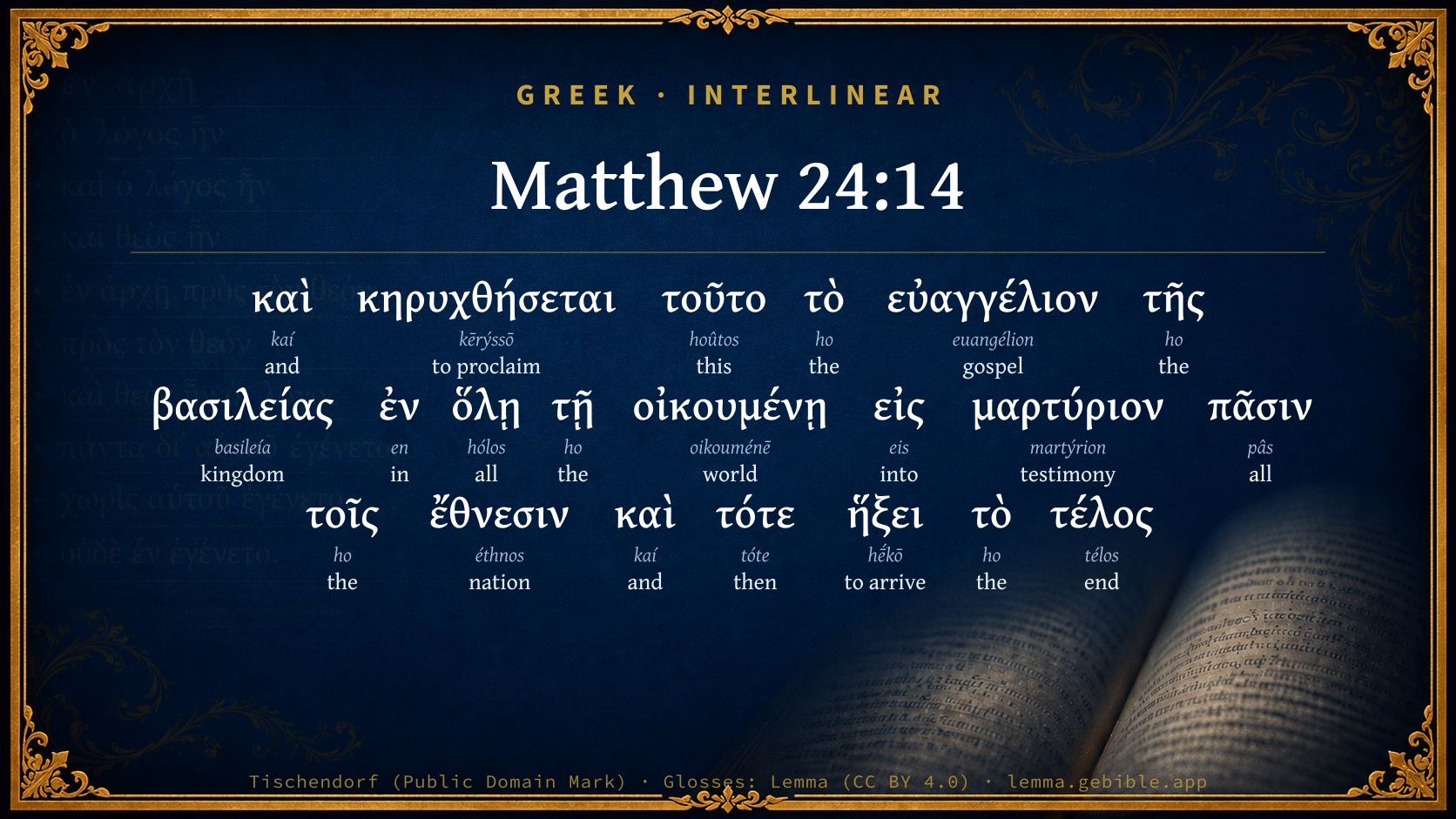
Download image
Cite this verse

Matthew 24:14 (World English Bible). Public Domain. Lemma interlinear Bible study tool, https://lemma.gebible.app/v/matthew/24/14.

Show BibTeX & RIS
BibTeX
RIS
English Translation
This Gospel of the Kingdom will be preached in the whole world for a testimony to all the nations, and then the end will come.
World English Bible · Public Domain
Highlights
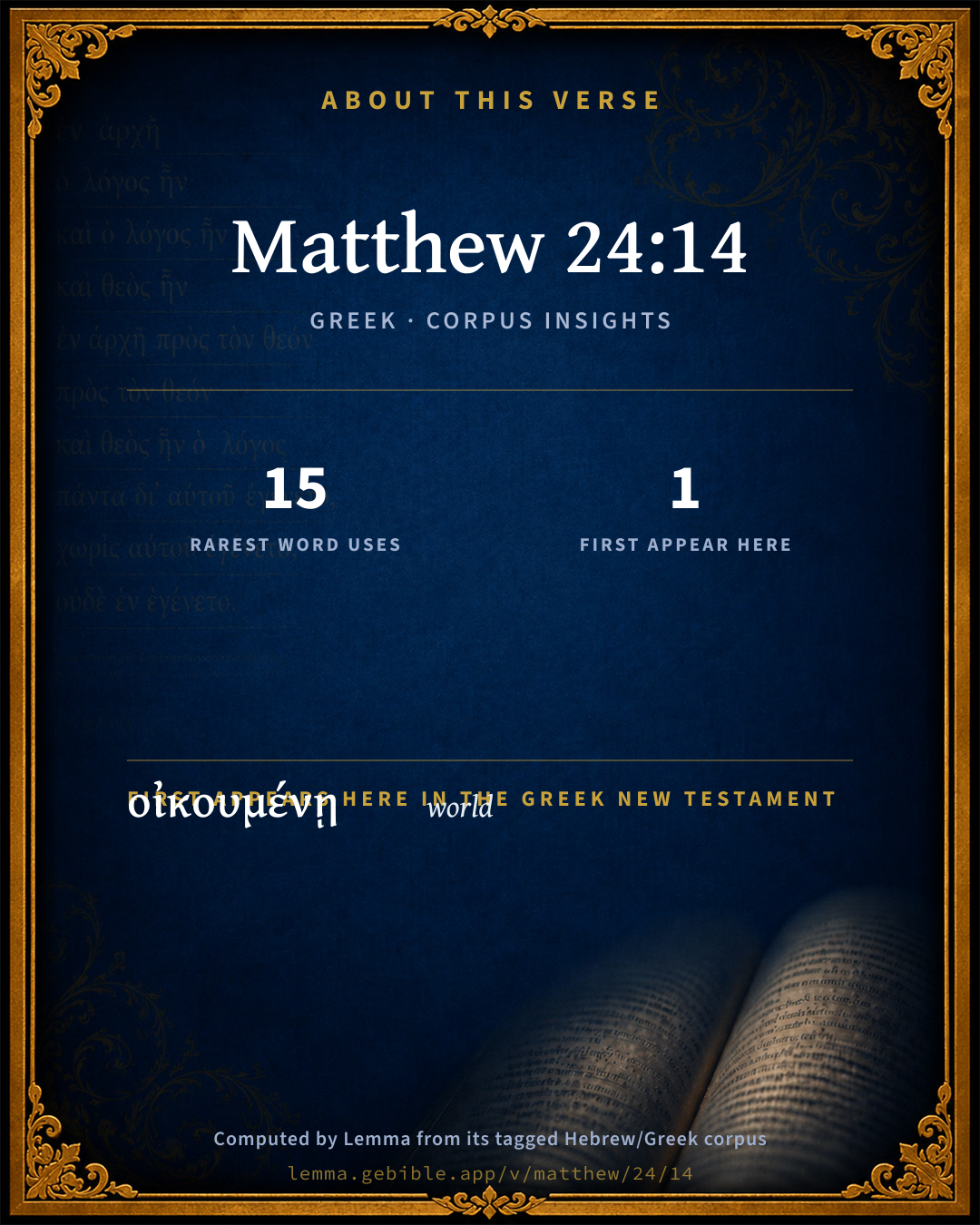
  • 1 first appearance in the Greek New Testament
Full analysis ↓
Download a study sheet

One document with this verse’s original text, its word-by-word gloss line, the meaning frame, cross-references with their text, attributed commentary, and full source and license credits — printable, and it pastes into notes with its structure intact.

This verse Autodidact and up

Study sheet (.html) Plain text (.txt)

A passage Seminary Student

Up to 50 verses in one chapter. A passage sheet keeps up to 6 commentary sources and 12 cross-references per verse, in the order this page ranks them, and says so on the sheet whenever that leaves anything out. Ask for a single verse and you get the Autodidact verse sheet above.

Everything on this page stays free to read, with no account — the sheet is a download of what is already on screen, not access to it.

Want to remove ads? Support Godless Engineer
Compare translations 3

The same verse in 3 English versions, stacked beneath the original-language interlinear above. Click any original word for its lexicon entry.

Each is an independent rendering of the whole verse — the interlinear is not word-aligned to these translations.

Highlighted words mark where these versions differ — a whole-verse word diff, not a word-by-word alignment.

  • World English Bible Public Domain
    This Gospel of the Kingdom will be preached in the whole world for a testimony to all the nations, and then the end will come.
  • King James Version Public Domain
    And this gospel of the kingdom shall be preached in all the world for a witness unto all nations; and then shall the end come.
  • unfoldingWord Literal Text CC BY-SA 4.0
    And this gospel of the kingdom will be preached in the whole world for a testimony to all the nations, and then the end will come.

unfoldingWord Literal Text — © unfoldingWord, licensed CC BY-SA 4.0. Word-aligned USFM3 via Door43 (git.door43.org/unfoldingWord/en_ult).

Versions to compare (up to 4)

3 of 4 selected

Show all 19 translations

Every available English version of this verse, each an independent rendering of the whole verse.

  • World English Bible Public Domain
    This Gospel of the Kingdom will be preached in the whole world for a testimony to all the nations, and then the end will come.
  • Berean Standard Bible Public Domain
    And this gospel of the kingdom will be preached in all the world as a testimony to all nations, and then the end will come.
  • Majority Standard Bible Public Domain
    And this gospel of the kingdom will be preached in all the world as a testimony to all nations, and then the end will come.
  • King James Version Public Domain
    And this gospel of the kingdom shall be preached in all the world for a witness unto all nations; and then shall the end come.
  • American Standard Version (1901) Public Domain
    And this gospel of the kingdom shall be preached in the whole world for a testimony unto all the nations; and then shall the end come.
  • Revised Version (1885) Public Domain
    And this gospel of the kingdom shall be preached in the whole world for a testimony unto all the nations; and then shall the end come.
  • Geneva Bible (1599) Public Domain
    And this Gospel of the kingdome shalbe preached through the whole world for a witnes vnto all nations, and then shall the end come.
  • Douay-Rheims (1899) Public Domain
    And this gospel of the kingdom, shall be preached in the whole world, for a testimony to all nations, and then shall the consummation come.
  • Young's Literal Translation Public Domain
    and this good news of the reign shall be proclaimed in all the world, for a testimony to all the nations; and then shall the end arrive.
  • Literal Standard Version CC BY-SA 4.0
    and this good news of the kingdom will be proclaimed in all the world, for a testimony to all the nations, and then will the end arrive.
  • Unlocked Literal Bible CC BY-SA 4.0
    This gospel of the kingdom will be preached in the whole world as a testimony to all the nations. Then the end will come.
  • unfoldingWord Literal Text CC BY-SA 4.0
    And this gospel of the kingdom will be preached in the whole world for a testimony to all the nations, and then the end will come.
  • Darby Bible Public Domain
    And these glad tidings of the kingdom shall be preached in the whole habitable earth, for a witness to all the nations, and then shall come the end.
  • World Messianic Bible Public Domain
    This Good News of the Kingdom will be preached in the whole world for a testimony to all the nations, and then the end will come.
  • Webster's Bible Public Domain
    And this gospel of the kingdom shall be preached in all the world, for a testimony to all nations; and then shall the end come.
  • Free Bible Version CC BY-SA 4.0
    The good news of the kingdom will be proclaimed around the whole world so everyone will be able to hear it, and then the end will come.
  • Bible in Basic English Public Domain
    And this good news of the kingdom will be given through all the world for a witness to all nations; and then the end will come.
  • Text-Critical English NT CC BY 4.0
    And this gospel of the kingdom will be proclaimed in the whole world as a testimony to all nations, and then the end will come.
  • Tyndale New Testament (1534) Public Domain
    And this gladtidingees of the kyngdome shalbe preached in all the worlde for a witnes vnto all nacions: and then shall the ende come.

Literal Standard Version (2020), Covenant Press — licensed CC BY-SA 4.0. Text via the HelloAO Bible API (eBible.org). Unlocked Literal Bible (unfoldingWord) — licensed CC BY-SA 4.0. Text via the HelloAO Bible API (eBible.org). unfoldingWord Literal Text — © unfoldingWord, licensed CC BY-SA 4.0. Word-aligned USFM3 via Door43 (git.door43.org/unfoldingWord/en_ult). Free Bible Version, Dr. Jonathan Gallagher — licensed CC BY-SA 4.0. Text via the HelloAO Bible API (eBible.org).

Word by word

More ways to search: Search by grammar → Find every occurrence → Compare this word →

Practice this passage: Drill this verse → Learn its vocabulary →

οἰκουμένῃ
oikouménē
G3625
“world”
Noun, Dative, Singular, Feminine
Part of Speech
Noun
Case
Dative
Number
Singular
Gender
Feminine
Full Thayer's Definition

Origin: feminine participle present passive of G3611 (as noun, by implication of G1093 )

TDNT: 07:37,7

1. the inhabited earth a. the portion of the earth inhabited by the Greeks, in distinction from the lands of the barbarians b. the Roman empire, all the subjects of the empire c. the whole inhabited earth, the world d. the inhabitants of the earth, men 2. the universe, the world
  1. καὶ kaí G2532 “and” Conjunction
  2. κηρυχθήσεται kērýssō G2784 “to proclaim” Verb, Future, Passive, Indicative, 3rd person, Singular
  3. τοῦτο hoûtos G3778 “this” Demonstrative pronoun, Nominative, Singular, Neuter
  4. τὸ ho G3588 “the” Article, Nominative, Singular, Neuter
  5. εὐαγγέλιον euangélion G2098 “gospel” Noun, Nominative, Singular, Neuter
  6. τῆς ho G3588 “the” Article, Genitive, Singular, Feminine
  7. βασιλείας basileía G932 “kingdom” Noun, Genitive, Singular, Feminine
  8. ἐν en G1722 “in” Preposition
  9. ὅλῃ hólos G3650 “all” Adjective, Dative, Singular, Feminine
  10. τῇ ho G3588 “the” Article, Dative, Singular, Feminine
  11. εἰς eis G1519 “into” Preposition
  12. μαρτύριον martýrion G3142 “testimony” Noun, Accusative, Singular, Neuter
  13. πᾶσιν pâs G3956 “all” Adjective, Dative, Plural, Neuter
  14. τοῖς ho G3588 “the” Article, Dative, Plural, Neuter
  15. ἔθνεσιν éthnos G1484 “nation” Noun, Dative, Plural, Neuter
  16. καὶ kaí G2532 “and” Conjunction
  17. τότε tóte G5119 “then” Adverb
  18. ἥξει hḗkō G2240 “to arrive” Verb, Future, Active, Indicative, 3rd person, Singular
  19. τὸ ho G3588 “the” Article, Nominative, Singular, Neuter
  20. τέλος télos G5056 “end” Noun, Nominative, Singular, Neuter

About this verse

These counts appear in no published source. They are computed here, from the morphology-tagged text and Lemma’s own curated glosses. What Lemma adds →

21
words
16
distinct lemmas
Gospels
section

Notable vocabulary

The rarest word here is οἰκουμένῃ world G3625 — appearing just 15 times in the whole Greek New Testament.

First appearance in Scripture

This word makes its first canonical appearance in the Greek New Testament here:

  • οἰκουμένῃ world G3625

Shared distinctive vocabulary

οἰκουμένῃ world G3625 occurs in 15 verses of the Greek New Testament. Also found in:
Repetition

Words recur within this verse:

Cross-references

23

Topical passages linked to Matthew 24:14 in the Treasury of Scripture Knowledge — connected by theme and wording, ordered by reader-vote popularity; previews shown in the World English Bible.

  • Revelation 14:6 I saw an angel flying in mid heaven, having an eternal Gospel to proclaim to those who dwell on the earth, and to every nation, tribe, language, and people.
  • Romans 10:18 But I say, didn't they hear? Yes, most assuredly, "Their sound went out into all the earth, Their words to the ends of the world."
  • Romans 16:25–26
  • Mark 16:15–16 He said to them, "Go into all the world, and preach the Gospel to the whole creation.
  • Luke 24:47 and that repentance and remission of sins should be preached in his name to all the nations, beginning at Jerusalem.
  • Colossians 1:23 if it is so that you continue in the faith, grounded and steadfast, and not moved away from the hope of the Gospel which you heard, which is being proclaimed in all creation under heaven; of which I, Paul, was made a servant.
  • Matthew 9:35 Jesus went about all the cities and the villages, teaching in their synagogues, and preaching the Gospel of the Kingdom, and healing every disease and every sickness among the people.
  • Matthew 10:7 As you go, preach, saying, 'The Kingdom of Heaven is at hand!'
  • Matthew 24:6 You will hear of wars and rumors of wars. See that you aren't troubled, for all this must happen, but the end is not yet.
  • Matthew 4:23 Jesus went about in all Galilee, teaching in their synagogues, preaching the Gospel of the Kingdom, and healing every disease and every sickness among the people.
  • Romans 15:18–21 For I will not dare to speak of any things except those which Christ worked through me, for the obedience of the Gentiles, by word and deed,
  • Colossians 1:6 which has come to you; even as it is in all the world and is bearing fruit and growing, as it does in you also, since the day you heard and knew the grace of God in truth;
  • Ezekiel 7:10 Behold, the day, behold, it comes: your doom is gone forth; the rod has blossomed, pride has budded.
  • Acts 17:6 When they didn't find them, they dragged Jason and certain brothers before the rulers of the city, crying, "These who have turned the world upside down have come here also,
  • Revelation 3:10 Because you kept my command to endure, I also will keep you from the hour of testing, which is to come on the whole world, to test those who dwell on the earth.
  • Ezekiel 7:5–7 Thus says the Lord Yahweh: An evil, an only evil; behold, it comes.
  • Acts 20:25 Now, behold, I know that you all, among whom I went about preaching the Kingdom of God, will see my face no more.
  • Revelation 16:14 for they are spirits of demons, performing signs; which go forth to the kings of the whole inhabited earth, to gather them together for the war of that great day of God, the Almighty.
  • Matthew 24:3 As he sat on the Mount of Olives, the disciples came to him privately, saying, "Tell us, when will these things be? What is the sign of your coming, and of the end of the age?"
  • Luke 4:5 The devil, leading him up on a high mountain, showed him all the kingdoms of the world in a moment of time.
  • Acts 1:2 until the day in which he was received up, after he had given commandment through the Holy Spirit to the apostles whom he had chosen.
  • Matthew 18:19 Again, assuredly I tell you, that if two of you will agree on earth concerning anything that they will ask, it will be done for them by my Father who is in heaven.
  • Acts 11:28 One of them named Agabus stood up, and indicated by the Spirit that there should be a great famine all over the world, which also happened in the days of Claudius.

Cross-references courtesy of OpenBible.info (CC BY 4.0).

Commentary

Notes on Matthew 24:14 from classic Christian and Jewish commentators (each source and its license shown beneath its notes). The classic Christian expositions comment on the surrounding passage and are grouped to its opening verse, so a note may address several verses; the Jewish commentaries on the Tanakh (Rashi and others) are per-verse, so they appear only where the commentator wrote on this verse.

Lemma curates 59 commentaries, every one of them public domain or Creative Commons licensed, each selected and text-cleaned for this edition rather than reprinted as found. About our sources →

The Biblical Illustrator

Joseph S. Exell

Mat_24:14

And this gospel of the kingdom shall be preached in all the world for a witness.

The gospel of the kingdom

I. gospel-good news, God spell-the information God has to tell us. An epitome of the news. Familiarity with the message takes aways its edge, and blunts its impressions.

II. It is not merely a gospel, good news, but a gospel of something very specific-of a kingdom. This kingdom is composed first of moral and next of personal elements-The kingdom of God is not, etc. Who are the personal subjects of this kingdom? Men of every rank and every clime. The gospel is not so cramped as we sometimes think.

III. This kingdom, thus composed, shall overflow all kingdoms. Heathendom is gradually dying out over all the world. Mahometanism is almost gone; the crescent wanes over all the earth, etc. The gospel shall be preached to all the world as a witness. Not to convert all nations, etc. (J. Cumming, D. D.)

The controlling influence of the gospel

I. The kingdom of Christ, as a kingdom of control, set up in the hearts of His followers.

1. It controls the opinions. They who are under this kingdom are obliged to believe all the truths of the Bible.

2. It controls the will. God makes it criminal to choose the evil and refuse the good.

3. It controls the belief of mankind. The subjects of this kingdom are called upon to trust in Christ, and in Him only, for salvation.

4. It controls the affections-Thou shalt love, etc. It controls the temper, pride, and all those feelings which are akin to it.

II. There is infinite mercy in such control.

1. Without it the opinions of mankind have ever been tossed to and fro by every wind of doctrine.

2. There is mercy in a control being exercised over the will. Man is in a wilderness of sin, etc.

3. Were it not for this, every man might form a system of belief for himself, etc.

4. Mans affections are collected to one point.

III. The gospel shall be preached for witness. Of human depravity. Of the method of reconciliation with God, etc. (R. Watson.)

The gospel of the kingdom

I. The subject of the text. The gospel. The gospel of the kingdom.

II. The mode of its communication. The gospel of the kingdom is to be preached. It must be preached freely, plainly, affectionately, faithfully.

III. The extent of its diffusion. The whole world stands in need of it. The gospel is the only remedy for it. It is expressly designed for all.

IV. The great end of its publication, As a witness. It shall witness to mans mind, state, etc.

1. The responsibility of having the gospel preached to us.

2. Our duty to labour for its diffusion among those who possess it not. (J. Burns, D. D.)

I. The King is our Lord Jesus Christ,

II. The seat of this kingdom is the soul.

III. The spirit of this kingdom is wise and beneficent and holy. Every kingdom has its peculiar character.

IV. The progress of His kingdom is unostentatious; irresistible, yet noiseless, like many of the mightier forces in nature.

IV. The boundaries of His kingdom are the boundaries of the dwellings of human kind.

1. Submit to Christ as a King.

2. Seek the extension of His kingdom by personal exertions, by pecuniary contributions, by payer. (Anon.)

The gospel a witness

1. That there are ends to be answered by the publication of the gospel, over and above the gathering in of a remnant from the mass of human kind. The statement is simply that the gospel is to be preached for a witness.

2. We are bound to ascertain the nature of this witness, in order that we may understand the responsibleness laid on all who ever heard the gospel, and the ends which are answered by its publication.

3. You are sufficiently acquainted with the nature of the gospel to regard it as an authoritative account of all that is benevolent, and all that is awful in Deity.

4. It is not an uncertain and unaccredited witness, but one which carries with it its credentials in all its marchings over the face of the globe.

5. The witness of the gospel hereafter. The gospel is now a witness to warn and direct; hereafter it will accuse and condemn. (H. Melvill, B. D.)

The universal witness

The preaching of the gospel throughout the world testifies-

1. To the unchanging mercy of God. He is the same as He was before the flood-would have been warned of the end of their evil courses. Men shall be without excuse.

2. To the character and mission of Christ. Men who accept the gospel shall prove that He is the Saviour.

3. To the invincible hostility of men. They shall have in their own characters a vindication of Gods past judgments.

Universal adaptation of the gospel to mens needs

The gospel is a plant which is not affected by earthly changes. It is the same in the temperate as in the torrid zone, and as in the frigid. It does not seem to be scorched by heat, or benumbed by cold. Age does not diminish the freshness of its bloom; soil does not affect its nature; climate does not modify its peculiar properties. Among the frost-bound latitudes of North America, and the burning sands of Africa, or the fertile plains of India, we find it still shooting up the same plant of renown, the same vine of the Lords right-hand planting, the same tree of life, raised up from the beginning of time, whose leaves were for the healing of the nations, and under which all kindreds, and tribes, and tongues, and people shall one day rejoice, when privileged to take shelter under its all-covering shade, and draw refreshing nourishment from its perennial fruits. (Dr. Duff.)

Vitality of the gospel

See what vitality the gospel has! Plunge her under the wave, and she rises the purer from her washing; thrust her in the fire, and she comes out the more bright for her burning; cut her in sunder, and each piece shall make another church; behead her, and like the hydra of old, she shall have a hundred heads for every one you cut away. She cannot die, she must live; for she has the power of God within her. (C. H. Spurgeon)

The Biblical Illustrator, edited by Joseph S. Exell (c. 1880s–1900s) — public domain. Text from a community e-Sword module.

Joseph Benson's Commentary

Mat 24:14. This gospel of the kingdom — Namely, of the kingdom of God; shall be preached in all the world — Not universally; this is not yet done; but in general, through the several parts of the world, and not only in Judea. And this was done by St. Paul and the other apostles, before Jerusalem was destroyed; for a witness to all nations that I am the Christ. And then shall the end come — Of the city and temple: that is, when all nations shall, or may be convinced, by the preaching of the gospel, of the crying sin of the Jews in crucifying the Lord of glory; then shall the justice of God bring these dreadful judgments upon that people. The Acts of the Apostles, it must be observed, contain only a small part of the history of a small number of the apostles, and yet even in that history we see the gospel was widely disseminated, and had taken root in the most considerable parts of the Roman empire. As early as in the reign of Nero, as we learn from Tacitus, (Annal., l. 15.) the Christians were grown so numerous at Rome as to raise the jealousy of the government, and the first general persecution was commenced against them, under pretence of their having set fire to the city, of which the emperor himself was really guilty, but wished to transfer the blame and odium of the action on the poor innocent Christians. Clement, who was contemporary and a fellow-labourer with Paul, says of him, (see his 1st Epistle to the Corinthians,) that he was a preacher both in the east and west, and that he taught the whole world righteousness. And if such were the labours of one apostle, though the chief of them, what were the united labours of them all? It appears indeed from the writers of the history of the church, that before the destruction of Jerusalem the gospel was not only preached in the Lesser Asia, Greece, and Italy, the great theatres of action then in the world; but likewise propagated as far north as Scythia; as far south as Ethiopia; as far east as Parthia and India; as far west as Spain and Britain.

Joseph Benson's Commentary on the Old and New Testaments (1811–1818) — public domain. Text from a community e-Sword module.

Tyndale Open Study Notes

Tyndale Open Resources

24:14 throughout the whole world: This anticipates the expansive Gentile mission (see 21:43; 28:16-20). There will be a delay prior to the end, however short or long, during which the Good News will spread significantly throughout the nations. • The end will be signaled by a “sacrilegious object” (24:15), furious persecution (24:16-28), and finally the sign of the Son of Man (24:29-31).

Tyndale Open Study Notes — © Tyndale Open Resources, licensed CC BY-SA 4.0. Text via the HelloAO Bible API.

Bengel's Gnomon

Johann Albrecht Bengel

Mat 24:14.[1039] Τοῦτο τὸ Εὐαγγέλιον τῆς Βασιλείας, THIS Gospel of the Kingdom) sc. which Jesus preached.—ἥξει, shall come) The verb ἥκειν does not signify merely to approach, but to arrive, nay, actually to be present.[1040]—τὸ τέλος, the end) spoken of in the following verses, on which account we find οὖν, therefore, in the next verse. Before that end, Peter, Paul, and others alluded to in Mat 24:9, had concluded their apostolate.

[1039] κηρυχθήσεται) This was accomplished before the destruction of Jerusalem. Col 1:23.—V. g.

[1040] ἔρχομαι denotes progress to, or arrival at, a place; ἥκω, that the progress has been effected, and the arrival taken place; so that ἥκω must be rendered, not I come, but I am come.—(I. B.)

Bengel's Gnomon of the New Testament — English translation (T&T Clark, Edinburgh, 1860) — public domain. Text from a community e-Sword module.

Meyer's Critical & Exegetical Commentary

Heinrich August Wilhelm Meyer

Mat_24:14. Having just uttered the words εἰς τέλος, Christ now reveals the prospect of a most encouraging state of matters which is immediately to precede and usher in the consummation indicated by this εἰς τέλος, namely, the preaching of the gospel throughout the whole world in spite of the hatred and apostasy previously mentioned (Mat_24:9-10 ff.); ὅτι οὐδὲν τῶν δεινῶν περιγενήσεται τοῦ κηρύγματος, Euthymius Zigabenus. The substantial fulfilment of this prediction is found in the missionary labours of the apostles, above all in those of Paul; comp. Act_1:9; Rom_1:14; Rom_10:18; Rom_15:19; Mat_28:19; Col_1:23; Clem. 1 Corinthians 5.

τοῦτο τὸ εὐαγγ.] According to de Wette, the author here (and Mat_26:13) so far forgets himself as to allude to the gospel which he was then in the act of writing. The τοῦτο here may be accounted for by the fact that Christ was there and then engaged in preaching the gospel of the Messiahs kingdom, inasmuch as eschatological prediction undoubtedly constitutes an essential part of the gospel. Consequently: hoc evangelium, quod nuntio.

ἐν ὅλῃ τῇ οἰκουμ.] must not be limited to the Roman empire (Luk_2:1), but should be taken quite generally: over the whole habitable globe, a sense which is alone in keeping with Jesus consciousness of His Messianic mission, and with the πᾶσι τοῖς ἔθνεσι which follows.

εἰς μαρτύριον, κ.τ.λ.] in order that testimony may be borne before all nations, namely, concerning me and my work, however much they may have hated you for my names sake. The interpretation of the Fathers: εἰς ἔλεγχον, is therefore substantially in accordance with the context (Mat_24:9), though there was no need to import into the passage the idea of the condemnation of the heathen, which condemnation would follow as a consequence only in the case of those who might be found to reject the testimony. There are other though arbitrary explanations, such as. ut nota illis esset pertinacia Judaeorum (Grotius), or: ut gentes testimonium dicere possint harum calamitatum et insignis pompae, qua Jesus Messias in has terras reverti debeat (Fritzsche), or: ita ut crisin aut vitae aut mortis adducat (Dorner).

καὶ τότε] and then, when the announcement shall have been made throughout the whole world.

τὸ τέλος] the end of the troubles that are to precede the Messiahs advent, correlative to ἀρχή, Mat_24:8. Comp. Mat_24:6; consequently not to be understood in this instance either as referring to the end of the world (Ebrard, Bleek, Dorner, Hofmann, Lange, Cremer), which latter event, however, will of course announce its approach by catastrophes in nature (Mat_24:29) immediately after the termination of the dolores Messiae.

Meyer — Critical and Exegetical Commentary on the New Testament — English translation by Peter Christie, edited by Frederick Crombie (T&T Clark, 1880) — public domain. Text from a community e-Sword module.

Expositor's Greek Testament

ed. W. Robertson Nicoll

Mat 24:14 asserts the same thing with regard to the preaching of the gospel of the kingdom: time for preaching it in the whole world, o all nations, before the end. Assuming that the terminus is the same this statement seems inconsistent with that in Mat 10:23 . But the aim is different in the two cases. On the earlier occasion Jesus wished to ensure that all Israel should hear the gospel before the end came; therefore He emphasised the shortness of the time. Here He wishes to impress on the disciples that the end will not be for a good while; therefore He emphasises the amount of preaching that can be done. Just on this account we must not strain the phrases ἐν ὅλῃ τ . οἰκ ., πᾶσιν τοῖς ἔθ . They simply mean: extensively even in the heathen world. But they have the merit of setting before the disciples a large programme to occupy their minds and keep them from thinking too much of the coming catastrophe.

The Expositor's Greek Testament, edited by W. Robertson Nicoll (1897–1910) — public domain. Text from a community e-Sword module.

Geneva Bible (1599)

Geneva Bible translators

Through all that part that is dwelt in.

Joyful tidings of the kingdom of heaven.

Geneva Bible (1599) marginal notes — public domain. Text via Bolls.life.

Adam Clarke's Commentary

Verse 14. And this Gospel of the kingdom shall be preached in all the world] But, notwithstanding these persecutions, there should be a universal publication of the glad tidings of the kingdom, for a testimony to all nations. God would have the iniquity of the Jews published every where, before the heavy stroke of his judgments should fall upon them; that all mankind, as it were, might be brought as witnesses against their cruelty and obstinacy in crucifying and rejecting the Lord Jesus.

In all the world, εν ολη τη οικουμενη. Perhaps no more is meant here than the Roman empire; for it is beyond controversy that πασαν την οικουμενην, Lu 2:1, means no more than the whole Roman empire: as a decree for taxation or enrolment from Augustus Caesar could have no influence but in the Roman dominions; but see on Lu 2:1. Tacitus informs us, Annal. l. xv., that, as early as the reign of Nero, the Christians were grown so numerous at Rome as to excite the jealousy of the government; and in other parts they were in proportion. However, we are under no necessity to restrain the phrase to the Roman empire, as, previously to the destruction of Jerusalem, the Gospel was not only preached in the lesser Asia, and Greece, and Italy, the greatest theatres of action then in the world; but was likewise propagated as far north as SCYTHIA; as far south as ETHIOPIA; as far east as PARTHIA and INDIA; and as far west as SPAIN and BRITAIN. On this point, Bishop Newton goes on to say, That there is some probability that the Gospel was preached in the British nations by St. Simon the apostle; that there is much greater probability that it was preached here by St. Paul; and that there is an absolute certainty that it was planted here in the times of the apostles, before the destruction of Jerusalem. See his proofs. Dissert. vol. ii. p. 235, 236. edit. 1758. St. Paul himself speaks, Col 1:6; Col 1:23, of the Gospel's being come into ALL THE WORLD, and preached TO EVERY CREATURE under heaven. And in his Epistle to the Romans, Ro 10:18, he very elegantly applies to the lights of the Church, what the psalmist said of the lights of heaven. Their sound went into ALL THE EARTH, and their words unto the END of the WORLD. What but the wisdom of God could foretell this? and what but the power of God could accomplish it?

Then shall the end come.] When this general publication of the Gospel shall have taken place, then a period shall be put to the whole Jewish economy, by the utter destruction of their city and temple.

Adam Clarke's Commentary on the Bible (1810–1826) — public domain. Text from a community e-Sword/MySword module.

Ellicott's Commentary for English Readers

(14) Shall be preached in all the world.—The words must not be strained beyond the meaning which they would have for those who heard them, and they were certain to see in “all the world” (literally, the inhabited earth, as in Luk_2:1; Act_11:28) neither more nor less than the Roman empire; and it was true, as a matter of fact, that there was hardly a province of the empire in which the faith of Christ had not been preached before the destruction of Jerusalem. Special attention should be given to the words, “a witness unto all the nations,” i.e., to all the Gentiles, as an implicit sanction of the work of which St. Paul was afterwards the great representative. So taken, the words prepare the way for the great mission of Mat_28:19.

A Bible Commentary for English Readers, edited by Charles John Ellicott (1878–1897) — public domain. Text from a community e-Sword module.

The Cambridge Bible for Schools and Colleges

gen. ed. J. J. S. Perowne

14. preached in all the world] Cp. ch. Mat_10:23 and Col_1:5-6, “the gospel; which is come unto you, as it is in all the world.” The principle is at last established that the Gospel may be preached to Jew and Gentile alike.

The Cambridge Bible for Schools and Colleges (gen. ed. J. J. S. Perowne; Cambridge University Press, 1878–1918) — public domain. Text from a community e-Sword module.

John Gill's Exposition

And this Gospel of the kingdom,.... Which Christ himself preached, and which he called and sent his apostles to preach, in all the cities of Judah; by which means men were brought into the kingdom of the Messiah, or Gospel dispensation; and which treated both of the kingdom of grace and glory, and pointed out the saints' meetness for the kingdom of heaven, and their right unto it, and gives the best account of the glories of it:

shall be preached in all the world; not only in Judea, where it was now confined, and that by the express orders of Christ himself; but in all the nations of the world, for which the apostles had their commission enlarged, after our Lord's resurrection; when they were bid to go into all the world, and preach the Gospel to every creature; and when the Jews put away the Gospel from them, they accordingly turned to the Gentiles; and before the destruction of Jerusalem, it was preached to all the nations under the heavens; and churches were planted in most places, through the ministry of it:

for a witness unto all nations; meaning either for a witness against all such in them, as should reject it; or as a testimony of Christ and salvation, unto all such as should believe in him:

and then shall the end come; not the end of the world, as the Ethiopic version reads it, and others understand it; but the end of the Jewish state, the end of the city and temple: so that the universal preaching of the Gospel all over the world, was the last criterion and sign, of the destruction of Jerusalem; and the account of that itself next follows, with the dismal circumstances which attended it.

John Gill's Exposition of the Whole Bible (1746–1763) — public domain (CC PDM 1.0). Text via the HelloAO Bible API.

Trapp's Complete Commentary

John Trapp

14 And this gospel of the kingdom shall be preached in all the world for a witness unto all nations; and then shall the end come.

Ver. 14. For a witness unto all nations] While, with Moses, it slayeth the Egyptian, sayeth the Israelite, is a savour of life to some, of death to others, who shall be left without excuse by the Gospel preached to them, as those that by their obstinacy have wilfully cut the throats of their own poor souls, refusing to be reformed, hating to be healed. Sure it is that the last sentence shall be but a more manifest declaration of that judgment which the Lord in this life, most an end, by his word hath passed upon people.

John Trapp, A Commentary or Exposition upon All the Books of the Old and New Testament (1647–1656) — public domain. Text from a community e-Sword module.

Albert Barnes' Notes on the Bible

And this gospel of the kingdom shall be preached in all the world - The evidence that this was done is to be chiefly derived from the New Testament, and there it is clear. Thus Paul declares that it was preached to every creature under heaven Col 1:6, Col 1:23; that the faith of the Romans was spoken of throughout the whole world Rom 1:8; that he preached in Arabia Gal 1:17, and at Jerusalem, and round about unto Illyricum Rom 15:19. We know also that He traveled through Asia Minor, Greece, and Crete; that he was in Italy, and probably in Spain and Gaul, Rom 15:24-28. At the same time, the other apostles were not idle; and there is full proof that within thirty years after this prophecy was spoken, churches were established in all these regions.

For a witness unto all nations - This preaching the gospel indiscriminately to “all” the Gentiles shall be a proof to them, or a witness, that the division between the Jews and Gentiles was about to be broken down. Hitherto the blessings of revelation had been confined to the Jews. They were the special people of God. His messages had been sent to them only. When, therefore, God sent the gospel to all other people, it was proof, or “a witness unto them,” that the special Jewish economy was at an end.

Then shall the end come - The end of the Jewish economy; the destruction of the temple and city.

Albert Barnes' Notes on the Bible (1834–1885) — public domain. Text from a community e-Sword/MySword module.

Haydock's Catholic Bible Commentary

This gospel ... shall be preached in the whole world, to serve as a testimony to all nations, of the solicitude of heaven in having the doctrine of salvation announced to them. This then is a fifth sign, and not till then shall the consummation come. --- And then shall the consummation come. The end of the world, says St. Jerome. The destruction of Jerusalem, says St. John Chrysostom and others. (Witham) --- If the final destruction of Jerusalem be here meant, the gospel had been preached throughout the major part of the then known world. See Romans x. and Colossians i. 6, 23. If the end of the world, there is the greatest probability that the true faith will have been announced to every part of the globe, before that period.

George Leo Haydock (1774–1849), Haydock's Catholic Family Bible and Commentary, 1859 edition — public domain. Excludes Psalms (Douay-Rheims chapter numbering differs from Protestant) and Deuterocanonical books (Catholic canon only).

Matthew Poole's English Annotations

So saith Mark, Mar 13:10. Some think that the end mentioned in the close of this verse refers to the destruction of Jerusalem; others, that it refers to the day of judgment. If we take world (as it is often taken) for the Gentiles in opposition to the Jews, synecdochically, the whole being put for a great part, it is most certain, that before Jerusalem was destroyed, the gospel, which is here called the gospel of the kingdom, either because it shows the way to the kingdom of God, or because it is that sacred instrument by which Christ subdueth men’s hearts to himself, was preached to the world, that is, to the Gentiles, and that to a great part of them. Paul alone had carried it from Jerusalem to Illyricum. The Romans’ faith was spoken of throughout the world, Rom 1:8. Paul saith it was preached to every creature, Col 1:23; Rom 10:18; 15:16; Col 1:6; 1Ti 3:16. But others choose by the end here to understand the end of the world.

Matthew Poole's English Annotations on the Holy Bible (1683–1685) — public domain. Text from a community e-Sword/MySword module.

Whedon's Commentary on the Bible

Daniel D. Whedon

14. Gospel of the kingdom — The doctrines of Messiah’s universal kingdom. Shall be preached in all the world — In all nations, and thereby the Messiah’s universal kingdom, become universally acknowledged. Mark says the Gospel must be published among all nations. It is certainly difficult to study these various phrases, Gospel of the kingdom in all the world — unto all nations — among all nations, without seeing the necessity of bringing them into association with those many texts which describe the conversion of the world to Christianity. Certainly the narratives of the travels of the apostles into distant countries, as late tradition has specified, are too scanty, if not too apocryphal, to be quoted as the fulfilment of this verse. For a Witness — Witness that all men might believe. Joh_1:7. Our Lord does not here say, as some construe his words, that the Gospel shall be preached for a witness against all nations, but to all nations. Assuredly God does not send the Gospel to increase men’s condemnation. This would make it intentionally the poison rather than the bread of life. Then shall the end come — What end? Unless our Lord answered very deceptively, he meant the end about which they inquired, namely, the end of the world. Nor is it of the slightest consequence to argue that our Lord here does not say that all the world will be converted, and that its conversion will last a long mundane period. To describe the millennium is not his purpose. He alludes to it, in order to show his disciples that the tribulation of the destruction of Jerusalem is not the tribulation of the judgment; for the predestined universal spread of the Gospel stands between them. The millennium first, and then the second advent.

We may also add that there is a sort of perspective in prophecy. The nearer event, as in a painting, is drawn full size, but the more distant dwindles to a point. See note on Mat_23:39.

On the whole, perhaps, all this paragraph is clear. Commotions and persecutions shall come, but these are not the tokens of the END. On the contrary, you shall be preserved from their power, that you may secure that universal Gospel diffusion for which the Church is founded and suffers, and which lies between the destruction of Jerusalem and the end of the world.

Daniel D. Whedon (gen. ed.), Commentary on the Old and New Testaments (1874–1909) — public domain. Text from a community e-Sword module.

The Pulpit Commentary

This gospel of the kingdom. The good news of the coming of Messiah"s kingdom what we call in short, "the gospel God was in Christ reconciling the world unto himself". (2Co_5:19) He calls it "this", (Mat_26:13) because it is that which he preached, which it was the object of his incarnation to set forth. In all the world (en olh th oikoumenh , in all the inhabited earth). Before the taking of Jerusalem, the gospel had been carried into all parts of the then known world. We have very uncertain information about the labours of most of the apostles, but if we may judge of their extent from what we know of St. Paul"s, we should say that very few quarters of the Roman world were left unvisited. "Their sound went out into all the earth, and their words unto the ends of the inhabited world". (Rom_10:18) St. Paul testifies that the gospel was preached to every kingdom under heaven. (Col_1:6, Col_1:23) He himself carried it to Arabia, Syria, Asia Minor, Greece, Illyricum, Rome, Spain. (see Rom_15:19, Rom_15:24, 28 Gal_1:17 Php_1:13, etc.) A witness unto all the nations. That both Jews and Gentiles might have the opportunity of receiving or rejecting Christ. The witness should be for or against them according to the use made of this opportunity. If the gospel thus delivered contained this utterance of our Lord"s, the fulfilment of the predictions would lead to belief in him, and could fail to win acceptance only by reason of invincible prejudice or wilful perversity. Shortly, the truth is that the gospel will be everywhere offered, but not everywhere received. And then, when all these signs, especially the one last named, shall have appeared, shall the end come, primarily of Jerusalem, secondarily of this world or this age. Nothing is said of the effect of missionary efforts in early days or in time to come. We know that there was no national conversion in the primitive era, however common individual conversion may have been. So in the present age we are not to expect more than that Christian missions shall reach the uttermost parts of the earth, and that all nations shall have the offer of salvation, before the final appearance of Christ. The success of these efforts at universal evangelization is a mournful problem. "When the Son of man cometh, shall he find the faith upon the earth?". (Luk_18:8)

The gospel witness.

The expression, "in all the world," can only mean the "world" as men then thought of it. Our Lord"s statement is verified in the fact that there was "hardly a province of the vast Roman empire in which the gospel had not been preached before the destruction of Jerusalem." The "world" is an altogether larger idea to us; but the gospel has to be preached to "all the world" as we apprehend it. The Apostle Paul uses very broad terms. He speaks of the gospel as having gone out into all the earth; (Rom_10:18) as being present in all the world; and as having been preached in the hearing of every creature which is under heaven. (Col_1:6, Col_1:23) A difficulty is suggested. These representations do not seem to match the facts in the apostolic age or in any other age. The gospel has not actually reached every part of the earth yet; and it has been effective unto the salvation of but a minority of the human race. Some have thought they could find explanation in the limitation "for a witness;" as if the conversion of "all nations" were not the design of the gospel preaching. This idea may, however, be presented in an exaggerated form. We may see the reasonable senses in which the gospel is a witness to all nations.

I THE GOSPEL WITNESS IS A WITNESS FOR GOD. The right knowledge of God comes, always has come, always must come, by revelation. A creature, limited by the senses and sense relations, cannot reach the apprehension of unseen things without help. Such a creature, having the help of revelation, is yet constantly disposed to materialize its apprehension: this is seen in the disposition to make visible symbols of the unseen God. This tendency takes the coarser forms of idolatry, and the more refined forms of philosophy. The gospel, then, is a witness, because it is a fresh and corrective declaration of what God is, what God thinks, and what God requires.

II THE GOSPEL WITNESS IS A WITNESS AGAINST IDOLATRY. This may be illustrated by St. Paul"s work at Lystra and at Athens. Take such points as these.

1. Preach the gospel, and men see that the true God asks for love. So it witnesses against all religions of fear.

2. Preach the gospel, and men see that the true God can only be served by righteousness. So it witnesses against all immoralities of rites and ceremonies.

III THE GOSPEL WITNESS IS A WITNESS CONCERNING MEN. Preach it, and the "thoughts of many hearts will be revealed." It will prove everywhere a "discerner of the thoughts and intents of the heart." What is strange is that, wherever the gospel is preached, men are discovered to themselves, and know that they are sinners. That is the beginning of the gospel mission. R.T.

The Pulpit Commentary (1880–1919), ed. H.D.M. Spence-Jones & Joseph S. Exell — public domain. Text from a community e-Sword module.

John Wesley's Explanatory Notes

This Gospel shall be preached in all the world - Not universally: this is not done yet: but in general through the several parts of the world, and not only in Judea And this was done by St. Paul and the other apostles, before Jerusalem was destroyed. And then shall the end come - Of the city and temple. Josephus's History of the Jewish War is the best commentary on this chapter. it is a wonderful instance of God's providence, that he, an eye witness, and one who lived and died a Jew, should, especially in so extraordinary a manner, be preserved, to transmit to us a collection of important facts, which so exactly illustrate this glorious prophecy, in almost every circumstance. Mark xiii, 10.

John Wesley, Explanatory Notes Upon the Whole Bible (1754–1765) — public domain. Text via the GEBible commentary corpus.

Scofield Reference Notes

C. I. Scofield

kingdom

world

kingdom (See Scofield "Mat 3:2").

world oikoumene = inhabited earth.

(See Scofield "Luk 2:1")

The Scofield Reference Bible (1917 edition), notes by C. I. Scofield — public domain. Text from a community e-Sword module.

Burkitt's Expository Notes on the New Testament

William Burkitt

Here our blessed Saviour comforts his disciples with a threefold consideration.

1. That his gospel, how hated and persecuted soever, should be plainly and persuasively preached: The gospel of the kingdom shall be preached. Therefore called the gospel of the kingdom, because it discovers the way to the kingdom of heaven.

Observe, 2. The extent of the gospel’s publication, It shall be preached unto all nations, that is, to the Gentile world; not only among the Jews, but among the chief and principal nations of the Gentiles.

Observe, 3. The design and end of the gospel’s publication, and that is, for a witness or testimony; namely, for a witness of God’s grace and mercy offered to sinners, and of their obstinacy who reject it.

Learn thence, That the preaching of the gospel, wherever it comes, proves a testimony to them to whom it comes. To the humble and teachable, it is a testimony for, to the scorners and despisers, it is a testimony against; or in the words of the apostle, To some it is the savour of death unto death; to others, the savour of life unto life. 2Co 2:16

William Burkitt's Expository Notes on the New Testament (1700–1703) — public domain. Text from a community e-Sword module.

The People's New Testament

B. W. Johnson

14. This gospel of the kingdom, etc. The gospel was preached throughout the Roman empire, “the world” of the New Testament, before a.d. 70. Then the end shall come. Of the Jewish state.

B. W. Johnson's The People's New Testament with Notes (1889–1891) — public domain. Electronic text from the Christian Classics Ethereal Library (CCEL) ThML edition.

Cambridge Greek Testament for Schools and Colleges

14. ὅλῃ τῇ οἰκουμένῃ. The frequent and increasing use of ὅλος for πᾶς must be regarded as a modernism. See Geldart’s Modern Greek, p. 184, 187. Possibly the similarity in sound to Hebr. Col may have had an influence.

ἡ οἰκουμένη (γῆ). ‘The inhabited earth’ originally the Hellenic portion of the world, (Dem. and Æsch.), later the Roman Empire, and the whole world: τὸ τῆς ὅλης οἰκουμένης σχῆμα, Polyb. I. 4. 6; in Heb 2:5, of the future age—the world of Christianity: οὐ γὰρ ἀγγέλοις ὑπέταξεν τὴν οἰκουμένην τὴν μέλλουσαν. The adjective οἰκουμενικός, not in N.T., is frequent in later ecclesiastical use.

Cambridge Greek Testament for Schools and Colleges (Cambridge University Press, 1896; 21 vols, various authors incl. Carr, Maclear, Plummer, Farrar, Lumby, Moule, M. R. James, Simcox) — public domain. Text from a community e-Sword module.

Alford’s Greek Testament

Henry Alford

14.] We here again have the pregnant meaning of prophecy. The Gospel had been preached through the whole ‘orbis terrarum,’ and every nation had received its testimony, before the destruction of Jerusalem: see Col 1:6, Col 1:23: 2Ti 4:17. This was necessary not only as regarded the Gentiles, but to give to God’s people the Jews, who were scattered among all these nations, the opportunity of receiving or rejecting the preaching of Christ. But in the wider sense, the words imply that the Gospel shall be preached in all the world, literally taken, before the great and final end come. The apostasy of the latter days, and the universal dispersion of missions, are the two great signs of the end drawing near.

Henry Alford, The Greek Testament (1849–1861) — public domain. Text from a community e-Sword module.

International Critical Commentary

(M) 14. And this gospel of the kingdom shall be preached in all the world for a testimony to all the nations, and then shall come the end.] Mar 13:10 has: “And to all the nations must first the gospel be preached.”—τὸ τέλος] i.e. the fall of Jerusalem and the end of the world. The editor defines τὸ εὐαγγέλιον by adding τῆς βασιλείας, and somewhat limits the conception of the preaching to all nations by inserting εἰς μαρτύριον, which he borrows from Mk v. 9.—πᾶσιν τοῖς ἔθνεσιν] for Mk.’s harsh εἰς πάντα τὰ ἔθνη; see on 10:18.

International Critical Commentary — older volumes (1896–1929), various authors — public domain. Text from a community e-Sword module.

Vincent's Word Studies in the New Testament

Marvin R. Vincent

World [τη οικουμενη] . Lit., the inhabited. The whole inhabitable globe. Rev., in margin, inhabited earth.

Marvin R. Vincent, Word Studies in the New Testament (1887–1900) — public domain. Text from a community e-Sword/MySword module.

Lesson kit

Teaching starters — assembled from the data on this page, not authored interpretation. Every prompt links to the verse data it draws on. Edit before teaching.

Matthew, in the Gospels, opens this verse with 21 words (16 distinct Greek lemmas). Its most distinctive word is oikouménē (“world”). A historical commentator’s framing appears above. Read the whole chapter for the surrounding context.

Discussion questions

  1. How does “world” (oikouménē) shape what this verse is saying?
  2. This is the first place “world” appears in Scripture (first appears here). What does its debut here establish?
  3. How does Luke 2:1, which shares the word «world», read alongside this verse?
  4. What does the repetition of “the” (5× in this one verse) do in this verse?
  5. These translations render this verse differently; the difference is in the English rendering, not the original. What questions does that raise?
  6. Compare how The Biblical Illustrator and Joseph Benson's Commentary read this verse. Where do they agree or differ?

Things to notice

  • 1 word makes its first canonical appearance in Scripture here.
  • These translations choose different wording for 5 words in this verse.
  • “the” occurs 5× in this single verse.
  • 16 distinct Greek lemmas span 21 words in this verse.

Reading settings

Reading text

Shown beneath each verse's original-language words.

Old Testament
Old Testament edition

Read the OT as the Masoretic Hebrew (MT) or the Greek Septuagint (LXX).

English shown for the Greek Septuagint (in the Hebrew ↔ Greek comparison).

Comparing translations? Open the Compare panel on any verse page to stack up to four side by side.