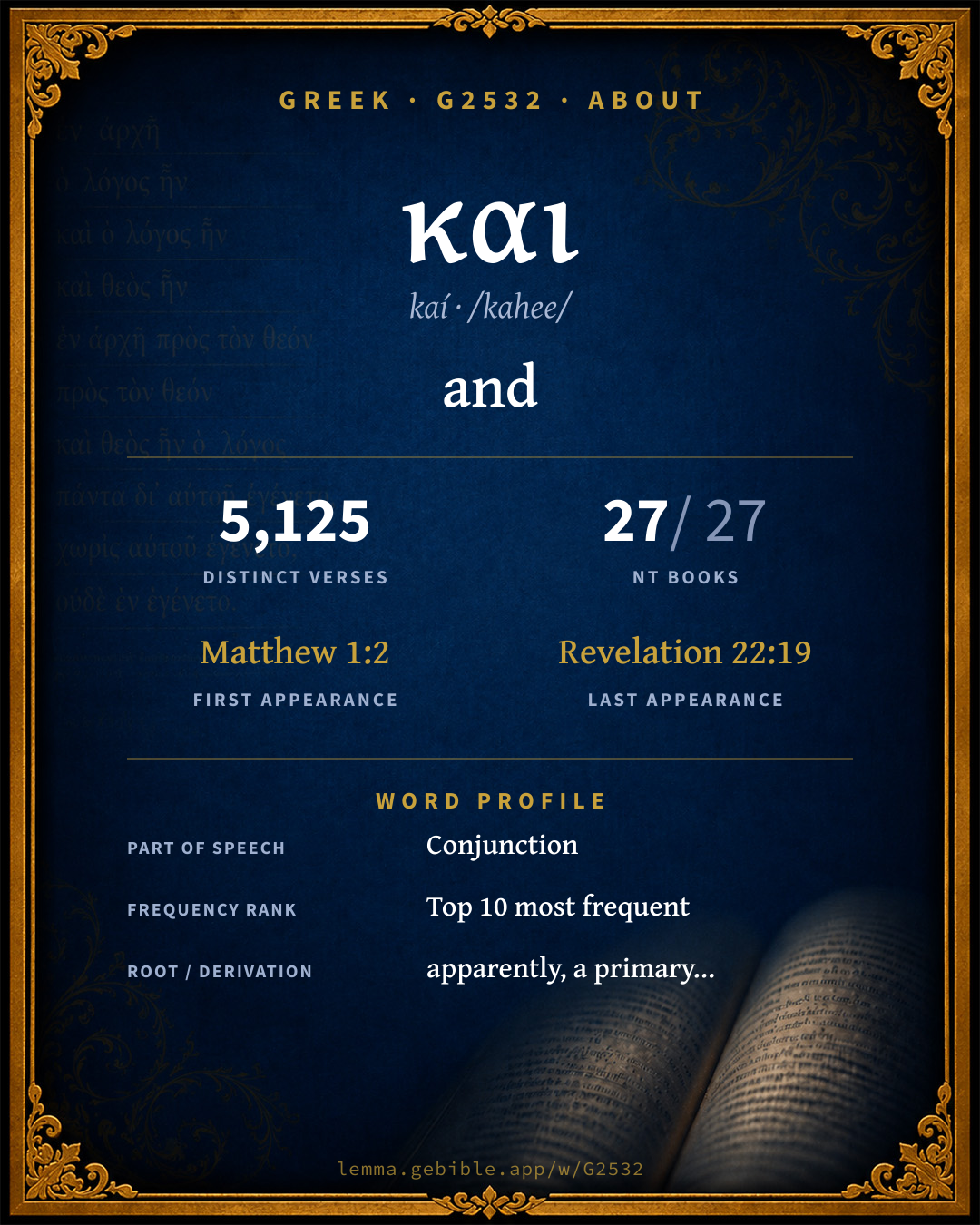
καί
and
Full lexicon entry — Thayer's Greek Lexicon
From Thayer's Greek Lexicon
Where this word appears
Grammar key — what these labels mean
Part of speech
- Conjunction
- A joining word linking words or clauses.
Every verse where G2532 appears in the Book of Romans — 191 distinct verses. Click any verse to open its interlinear word-by-word view. Verse text shown in the World English Bible for context — . Each verse’s Greek form is shown with its reference; the English is not keyword-highlighted, since the data carries no word-level English alignment. Use “Compare translations” on any verse to read it across multiple English versions. This concordance covers the Greek New Testament; Septuagint (Greek Old Testament) occurrences of this word are not indexed here.
Romans
- Romans 1:5 καὶ conj through whom we received grace and apostleship, for obedience of faith among all the nations, for his name's sake;
- Romans 1:6 καὶ conj among whom you are also called to belong to Jesus Christ;
- Romans 1:7 καὶ καὶ conj conj to all who are in Rome, beloved of God, called to be saints: Grace to you and peace from God our Father and the Lord Jesus Christ.
- Romans 1:12 καὶ conj that is, that I with you may be encouraged in you, each of us by the other's faith, both yours and mine.
- Romans 1:13 καὶ καὶ καὶ conj conj conj Now I don't desire to have you unaware, brothers, that I often planned to come to you, and was hindered so far, that I might have some fruit among you also, even as among the rest of the Gentiles.
- Romans 1:14 καὶ καὶ conj conj I am debtor both to Greeks and to foreigners, both to the wise and to the foolish.
- Romans 1:15 καὶ conj So, as much as is in me, I am eager to preach the Gospel to you also who are in Rome.
- Romans 1:16 καὶ conj For I am not ashamed of the Gospel of Christ, for it is the power of God for salvation for everyone who believes; for the Jew first, and also for the Greek.
- Romans 1:18 καὶ conj For the wrath of God is revealed from heaven against all ungodliness and unrighteousness of men, who suppress the truth in unrighteousness,
- Romans 1:20 καὶ conj For the invisible things of him since the creation of the world are clearly seen, being perceived through the things that are made, even his everlasting power and divinity; that they may be without excuse.
- Romans 1:21 καὶ conj Because, knowing God, they didn't glorify him as God, neither gave thanks, but became vain in their reasoning, and their senseless heart was darkened.
- Romans 1:23 καὶ καὶ καὶ καὶ conj conj conj conj and traded the glory of the incorruptible God for the likeness of an image of corruptible man, and of birds, and four-footed animals, and creeping things.
- Romans 1:25 καὶ καὶ conj conj who exchanged the truth of God for a lie, and worshiped and served the creature rather than the Creator, who is blessed forever. Amen.
- Romans 1:27 καὶ καὶ conj conj Likewise also the men, leaving the natural function of the woman, burned in their lust toward one another, men doing what is inappropriate with men, and receiving in themselves the due penalty of their error.
- Romans 1:28 καὶ conj Even as they refused to have God in their knowledge, God gave them up to a reprobate mind, to do those things which are not fitting;
- Romans 1:32 καὶ conj who, knowing the ordinance of God, that those who practice such things are worthy of death, not only do the same, but also approve of those who practice them.
- Romans 2:3 καὶ conj Do you think this, O man who judges those who practice such things, and do the same, that you will escape the judgment of God?
- Romans 2:4 καὶ καὶ conj conj Or do you despise the riches of his goodness, forbearance, and patience, not knowing that the goodness of God leads you to repentance?
- Romans 2:5 καὶ καὶ conj conj But according to your hardness and unrepentant heart you are treasuring up for yourself wrath in the day of wrath, revelation, and of the righteous judgment of God;
- Romans 2:7 καὶ καὶ conj conj to those who by patience in well-doing seek for glory and honor and incorruptibility, eternal life;
- Romans 2:8 καὶ καὶ conj conj but to those who are self-seeking, and don't obey the truth, but obey unrighteousness, will be wrath and indignation,
- Romans 2:9 καὶ καὶ conj conj oppression and anguish, on every soul of man who works evil, on the Jew first, and also on the Greek.
- Romans 2:10 καὶ καὶ καὶ conj conj conj But glory and honor and peace to every man who works good, to the Jew first, and also to the Greek.
- Romans 2:12 καὶ καὶ conj conj For as many as have sinned without law will also perish without the law. As many as have sinned under the law will be judged by the law.
- Romans 2:15 καὶ καὶ conj conj in that they show the work of the law written in their hearts, their conscience testifying with them, and their thoughts among themselves accusing or else excusing them)
- Romans 2:17 καὶ καὶ conj conj Indeed you bear the name of a Jew, and rest on the law, and glory in God,
- Romans 2:18 καὶ καὶ conj conj and know his will, and approve the things that are excellent, being instructed out of the law,
- Romans 2:20 καὶ conj a corrector of the foolish, a teacher of babies, having in the law the form of knowledge and of the truth.
- Romans 2:27 καὶ καὶ conj conj Won't the uncircumcision which is by nature, if it fulfills the law, judge you, who with the letter and circumcision are a transgressor of the law?
- Romans 2:29 καὶ conj but he is a Jew who is one inwardly, and circumcision is that of the heart, in the spirit not in the letter; whose praise is not from men, but from God.
- Romans 3:4 καὶ conj May it never be! Yes, let God be found true, but every man a liar. As it is written, "That you might be justified in your words, And might prevail when you come into judgment."
- Romans 3:8 καὶ καὶ conj conj Why not (as we are slanderously reported, and as some affirm that we say), "Let us do evil, that good may come?" Those who say so are justly condemned.
- Romans 3:9 καὶ conj What then? Are we better than they? No, in no way. For we previously charged both Jews and Greeks, that they are all under sin.
- Romans 3:14 καὶ conj "Whose mouth is full of cursing and bitterness."
- Romans 3:16 καὶ conj Destruction and misery are in their ways.
- Romans 3:17 καὶ conj The way of peace, they haven't known."
- Romans 3:19 καὶ conj Now we know that whatever things the law says, it speaks to those who are under the law, that every mouth may be closed, and all the world may be brought under the judgment of God.
- Romans 3:21 καὶ conj But now apart from the law, a righteousness of God has been revealed, being testified by the law and the prophets;
- Romans 3:23 καὶ conj for all have sinned, and fall short of the glory of God;
- Romans 3:26 καὶ conj to demonstrate his righteousness at this present time; that he might himself be just, and the justifier of him who has faith in Jesus.
- Romans 3:29 καὶ καὶ conj conj Or is God the God of Jews only? Isn't he the God of Gentiles also? Yes, of Gentiles also,
- Romans 3:30 καὶ conj since indeed there is one God who will justify the circumcised by faith, and the uncircumcised through faith.
- Romans 4:3 καὶ conj For what does the Scripture say? "Abraham believed God, and it was accounted to him for righteousness."
- Romans 4:6 καὶ conj Even as David also pronounces blessing on the man to whom God counts righteousness apart from works,
- Romans 4:7 καὶ conj "Blessed are they whose iniquities are forgiven, Whose sins are covered.
- Romans 4:9 καὶ conj Is this blessing then pronounced on the circumcised, or on the uncircumcised also? For we say that faith was accounted to Abraham for righteousness.
- Romans 4:11 καὶ conj He received the sign of circumcision, a seal of the righteousness of the faith which he had while he was in uncircumcision, that he might be the father of all those who believe, though they be in uncircumcision, that righteousness might also be accounted to them.
- Romans 4:12 καὶ καὶ conj conj The father of circumcision to those who not only are of the circumcision, but who also walk in the steps of that faith of our father Abraham, which he had in uncircumcision.
- Romans 4:14 καὶ conj For if those who are of the law are heirs, faith is made void, and the promise is made of no effect.
- Romans 4:16 καὶ conj For this cause it is of faith, that it may be according to grace, to the end that the promise may be sure to all the seed, not to that only which is of the law, but to that also which is of the faith of Abraham, who is the father of us all.
- Romans 4:17 καὶ conj As it is written, "I have made you a father of many nations." This is in the presence of him whom he believed: God, who gives life to the dead, and calls the things that are not, as though they were.
- Romans 4:19 καὶ καὶ conj conj Without being weakened in faith, he didn't consider his own body, already having been worn out, (he being about a hundred years old), and the deadness of Sarah's womb.
- Romans 4:21 καὶ καὶ conj conj and being fully assured that what he had promised, he was able also to perform.
- Romans 4:22 καὶ conj Therefore it also was "reckoned to him for righteousness."
- Romans 4:24 καὶ conj but for our sake also, to whom it will be accounted, who believe in him who raised Jesus, our Lord, from the dead,
- Romans 4:25 καὶ conj who was delivered up for our trespasses, and was raised for our justification.
- Romans 5:2 καὶ καὶ conj conj through whom we also have our access by faith into this grace in which we stand. We rejoice in hope of the glory of God.
- Romans 5:3 καὶ conj Not only this, but we also rejoice in our sufferings, knowing that suffering works perseverance;
- Romans 5:7 καὶ conj For one will hardly die for a righteous man. Yet perhaps for a righteous person someone would even dare to die.
- Romans 5:11 καὶ conj Not only so, but we also rejoice in God through our Lord Jesus Christ, through whom we have now received the reconciliation.
- Romans 5:12 καὶ καὶ conj conj Therefore, as sin entered into the world through one man, and death through sin; and so death passed to all men, because all sinned.
- Romans 5:14 καὶ conj Nevertheless death reigned from Adam until Moses, even over those whose sins weren't like Adam's disobedience, who is a foreshadowing of him who was to come.
- Romans 5:15 καὶ καὶ conj conj But the free gift isn't like the trespass. For if by the trespass of the one the many died, much more did the grace of God, and the gift by the grace of the one man, Jesus Christ, abound to the many.
- Romans 5:16 καὶ conj The gift is not as through one who sinned: for the judgment came by one to condemnation, but the free gift came of many trespasses to justification.
- Romans 5:17 καὶ conj For if by the trespass of the one, death reigned through the one; so much more will those who receive the abundance of grace and of the gift of righteousness reign in life through the one, Jesus Christ.
- Romans 5:18 καὶ conj So then as through one trespass, all men were condemned; even so through one act of righteousness, all men were justified to life.
- Romans 5:19 καὶ conj For as through the one man's disobedience many were made sinners, even so through the obedience of the one will many be made righteous.
- Romans 5:21 καὶ conj that as sin reigned in death, even so might grace reign through righteousness to eternal life through Jesus Christ our Lord.
- Romans 6:4 καὶ conj We were buried therefore with him through baptism to death, that just like Christ was raised from the dead through the glory of the Father, so we also might walk in newness of life.
- Romans 6:5 καὶ conj For if we have become united with him in the likeness of his death, we will also be part of his resurrection;
- Romans 6:8 καὶ conj But if we died with Christ, we believe that we will also live with him;
- Romans 6:11 καὶ conj Thus also consider yourselves also to be dead to sin, but alive to God in Christ Jesus our Lord.
- Romans 6:13 καὶ conj Neither present your members to sin as instruments of unrighteousness, but present yourselves to God, as alive from the dead, and your members as instruments of righteousness to God.
- Romans 6:19 καὶ conj I speak in human terms because of the weakness of your flesh, for as you presented your members as servants to uncleanness and to wickedness upon wickedness, even so now present your members as servants to righteousness for sanctification.
- Romans 7:4 καὶ conj Therefore, my brothers, you also were made dead to the law through the body of Christ, that you would be joined to another, to him who was raised from the dead, that we might bring forth fruit to God.
- Romans 7:6 καὶ conj But now we have been discharged from the law, having died to that in which we were held; so that we serve in newness of the spirit, and not in oldness of the letter.
- Romans 7:10 καὶ conj The commandment, which was for life, this I found to be for death;
- Romans 7:11 καὶ conj for sin, finding occasion through the commandment, deceived me, and through it killed me.
- Romans 7:12 καὶ καὶ καὶ conj conj conj Therefore the law indeed is holy, and the commandment holy, and righteous, and good.
- Romans 7:23 καὶ conj but I see a different law in my members, warring against the law of my mind, and bringing me into captivity under the law of sin which is in my members.
- Romans 8:2 καὶ conj For the law of the Spirit of life in Christ Jesus made me free from the law of sin and of death.
- Romans 8:3 καὶ conj For what the law couldn't do, in that it was weak through the flesh, God did, sending his own Son in the likeness of sinful flesh and for sin, he condemned sin in the flesh;
- Romans 8:6 καὶ conj For the mind of the flesh is death, but the mind of the Spirit is life and peace;
- Romans 8:11 καὶ conj But if the Spirit of him who raised up Jesus from the dead dwells in you, he who raised up Christ Jesus from the dead will also give life to your mortal bodies through his Spirit who dwells in you.
- Romans 8:17 καὶ καὶ conj conj and if children, then heirs; heirs of God, and joint-heirs with Christ; if indeed we suffer with him, that we may also be glorified with him.
- Romans 8:21 καὶ conj that the creation itself also will be delivered from the bondage of decay into the liberty of the glory of the children of God.
- Romans 8:22 καὶ conj For we know that the whole creation groans and travails in pain together until now.
- Romans 8:23 καὶ καὶ conj conj Not only so, but ourselves also, who have the first fruits of the Spirit, even we ourselves groan within ourselves, waiting for adoption, the redemption of our body.
- Romans 8:24 καὶ conj For we were saved in hope, but hope that is seen is not hope. For who hopes for that which he sees?
- Romans 8:26 καὶ conj In the same way, the Spirit also helps our weaknesses, for we don't know how to pray as we ought. But the Spirit himself makes intercession for us with groanings which can't be uttered.
- Romans 8:29 καὶ conj For whom he foreknew, he also predestined to be conformed to the image of his Son, that he might be the firstborn among many brothers.
- Romans 8:30 καὶ καὶ καὶ καὶ conj conj conj conj Whom he predestined, those he also called. Whom he called, those he also justified. Whom he justified, those he also glorified.
- Romans 8:32 καὶ conj He who didn't spare his own Son, but delivered him up for us all, how would he not also with him freely give us all things?
- Romans 8:34 καὶ conj Who is he who condemns? It is Christ who died, yes rather, who was raised from the dead, who is at the right hand of God, who also makes intercession for us.
- Romans 9:2 καὶ conj that I have great sorrow and unceasing pain in my heart.
- Romans 9:4 καὶ καὶ καὶ καὶ καὶ conj conj conj conj conj who are Israelites; whose is the adoption, the glory, the covenants, the giving of the law, the service, and the promises;
- Romans 9:5 καὶ conj of whom are the fathers, and from whom is Christ as concerning the flesh, who is over all, God, blessed forever. Amen.
- Romans 9:9 καὶ conj For this is a word of promise, "At the appointed time I will come, and Sarah will have a son."
- Romans 9:10 καὶ conj Not only so, but Rebecca also conceived by one, by our father Isaac.
- Romans 9:15 καὶ conj For he said to Moses, "I will have mercy on whom I have mercy, and I will have compassion on whom I have compassion."
- Romans 9:17 καὶ conj For the Scripture says to Pharaoh, "For this very purpose I caused you to be raised up, that I might show in you my power, and that my name might be published abroad in all the earth."
- Romans 9:22 καὶ conj What if God, willing to show his wrath, and to make his power known, endured with much patience vessels of wrath made for destruction,
- Romans 9:23 καὶ conj and that he might make known the riches of his glory on vessels of mercy, which he prepared beforehand for glory,
- Romans 9:24 καὶ καὶ conj conj us, whom he also called, not from the Jews only, but also from the Gentiles?
- Romans 9:25 καὶ καὶ conj conj As he says also in Hosea, "I will call them 'my people,' which were not my people; And her 'beloved,' who was not beloved."
- Romans 9:26 καὶ conj "It will be that in the place where it was said to them, 'You are not my people,' There they will be called 'children of the living God.'"
- Romans 9:28 καὶ conj For He will finish the work and cut it short in righteousness, Because the LORD will make a short work upon the earth."
- Romans 9:29 καὶ καὶ conj conj As Isaiah has said before, "Unless the Lord of Hosts had left us a seed, We would have become like Sodom, And would have been made like Gomorrah."
- Romans 9:33 καὶ καὶ conj conj even as it is written, "Behold, I lay in Zion a stumbling stone and a rock of offense; And no one who believes in him will be disappointed."
- Romans 10:1 καὶ conj Brothers, my heart's desire and my prayer to God is for Israel, that they may be saved.
- Romans 10:3 καὶ conj For being ignorant of God's righteousness, and seeking to establish their own righteousness, they didn't subject themselves to the righteousness of God.
- Romans 10:8 καὶ conj But what does it say? "The word is near you, in your mouth, and in your heart;" that is, the word of faith, which we preach:
- Romans 10:9 καὶ conj that if you will confess with your mouth the Lord Jesus, and believe in your heart that God raised him from the dead, you will be saved.
- Romans 10:12 καὶ conj For there is no distinction between Jew and Greek; for the same Lord is Lord of all, and is rich to all who call on him.
- Romans 10:18 καὶ conj But I say, didn't they hear? Yes, most assuredly, "Their sound went out into all the earth, Their words to the ends of the world."
- Romans 10:20 καὶ conj Isaiah is very bold, and says, "I was found by those who didn't seek me. I was revealed to those who didn't ask for me."
- Romans 10:21 καὶ conj But as to Israel he says, "All day long I stretched out my hands to a disobedient and contrary people."
- Romans 11:1 καὶ conj I ask then, Did God reject his people? May it never be! For I also am an Israelite, a descendant of Abraham, of the tribe of Benjamin.
- Romans 11:3 καὶ conj "Lord, they have killed your prophets, they have broken down your altars; and I am left alone, and they seek my life."
- Romans 11:5 καὶ conj Even so then at this present time also there is a remnant according to the election of grace.
- Romans 11:8 καὶ conj According as it is written, "God gave them a spirit of stupor, eyes that they should not see, and ears that they should not hear, to this very day."
- Romans 11:9 καὶ καὶ καὶ καὶ conj conj conj conj David says, "Let their table be made a snare, and a trap, A stumbling block, and a retribution to them.
- Romans 11:10 καὶ conj Let their eyes be darkened, that they may not see. Bow down their back always."
- Romans 11:12 καὶ conj Now if their fall is the riches of the world, and their loss the riches of the Gentiles; how much more their fullness?
- Romans 11:14 καὶ conj if by any means I may provoke to jealousy those who are my flesh, and may save some of them.
- Romans 11:16 καὶ καὶ καὶ conj conj conj If the first fruit is holy, so is the lump. If the root is holy, so are the branches.
- Romans 11:17 καὶ conj But if some of the branches were broken off, and you, being a wild olive, were grafted in among them, and became partaker with them of the root and of the richness of the olive tree;
- Romans 11:22 καὶ καὶ conj conj See then the goodness and severity of God. Toward those who fell, severity; but toward you, goodness, if you continue in his goodness; otherwise you also will be cut off.
- Romans 11:24 καὶ conj For if you were cut out of that which is by nature a wild olive tree, and were grafted contrary to nature into a good olive tree, how much more will these, which are the natural branches, be grafted into their own olive tree?
- Romans 11:26 καὶ conj and so all Israel will be saved. Even as it is written, "There will come out of Zion the Deliverer, And he will turn away ungodliness from Jacob.
- Romans 11:27 καὶ conj This is my covenant to them, When I will take away their sins."
- Romans 11:29 καὶ conj For the gifts and the calling of God are irrevocable.
- Romans 11:31 καὶ καὶ conj conj even so these also have now been disobedient, that by the mercy shown to you they may also obtain mercy.
- Romans 11:33 καὶ καὶ καὶ conj conj conj Oh the depth of the riches both of the wisdom and the knowledge of God! How unsearchable are his judgments, and his ways past tracing out!
- Romans 11:35 καὶ conj "Or who has first given to him, And it will be repaid to him again?"
- Romans 11:36 καὶ καὶ conj conj For of him, and through him, and to him, are all things. To him be the glory for ever! Amen.
- Romans 12:2 καὶ καὶ καὶ conj conj conj Don't be conformed to this world, but be transformed by the renewing of your mind, so that you may prove what is the good, well-pleasing, and perfect will of God.
- Romans 12:14 καὶ conj Bless those who persecute you; bless, and don't curse.
- Romans 13:3 καὶ conj For rulers are not a terror to the good work, but to the evil. Do you desire to have no fear of the authority? Do that which is good, and you will have praise from the same,
- Romans 13:5 καὶ conj Therefore you need to be in subjection, not only because of the wrath, but also for conscience' sake.
- Romans 13:6 καὶ conj For this reason you also pay taxes, for they are ministers of God's service, attending continually on this very thing.
- Romans 13:9 καὶ conj For the commandments, "You shall not commit adultery," "You shall not murder," "You shall not steal," "You shall not give false testimony," "You shall not covet," and whatever other commandments there are, are all summed up in this saying, namely, "You shall love your neighbor as yourself."
- Romans 13:11 Καὶ conj Do this, knowing the time, that it is already time for you to awaken out of sleep, for salvation is now nearer to us than when we first believed.
- Romans 13:13 καὶ καὶ καὶ conj conj conj Let us walk properly, as in the day; not in reveling and drunkenness, not in sexual promiscuity and lustful acts, and not in strife and jealousy.
- Romans 13:14 καὶ conj But put on the Lord Jesus Christ, and make no provision for the flesh, for its lusts.
- Romans 14:6 καὶ καὶ καὶ conj conj conj He who observes the day, observes it to the Lord; and he who does not observe the day, to the Lord he does not observe it. He who eats, eats to the Lord, for he gives God thanks. He who doesn't eat, to the Lord he doesn't eat, and gives God thanks.
- Romans 14:7 καὶ conj For none of us lives to himself, and none dies to himself.
- Romans 14:9 καὶ καὶ καὶ conj conj conj For to this end Christ died, rose, and lived again, that he might be Lord of both the dead and the living.
- Romans 14:10 καὶ conj But you, why do you judge your brother? Or you again, why do you despise your brother? For we will all stand before the judgment seat of Christ.
- Romans 14:11 καὶ conj For it is written, "'As I live,' says the Lord, 'to me every knee will bow. Every tongue will confess to God.'"
- Romans 14:14 καὶ conj I know, and am persuaded in the Lord Jesus, that nothing is unclean of itself; except that to him who considers anything to be unclean, to him it is unclean.
- Romans 14:17 καὶ καὶ καὶ conj conj conj for the Kingdom of God is not eating and drinking, but righteousness, peace, and joy in the Holy Spirit.
- Romans 14:18 καὶ conj For he who serves Christ in these things is acceptable to God and approved by men.
- Romans 14:19 καὶ conj So then, let us follow after things which make for peace, and things by which we may build one another up.
- Romans 15:1 καὶ conj Now we who are strong ought to bear the weaknesses of the weak, and not to please ourselves.
- Romans 15:3 καὶ conj For even Christ didn't please himself. But, as it is written, "The reproaches of those who reproached you fell on me."
- Romans 15:4 καὶ conj For whatever things were written before were written for our learning, that through patience and through encouragement of the Scriptures we might have hope.
- Romans 15:5 καὶ conj Now the God of patience and of encouragement grant you to be of the same mind one with another according to Christ Jesus,
- Romans 15:6 καὶ conj that with one accord you may with one mouth glorify the God and Father of our Lord Jesus Christ.
- Romans 15:7 καὶ conj Therefore receive one another, even as Christ also received you, to the glory of God.
- Romans 15:9 καὶ conj and that the Gentiles might glorify God for his mercy. As it is written, "Therefore will I give praise to you among the Gentiles, And sing to your name."
- Romans 15:10 καὶ conj Again he says, "Rejoice, you Gentiles, with his people."
- Romans 15:11 καὶ καὶ conj conj Again, "Praise the Lord, all you Gentiles! Let all the peoples praise him."
- Romans 15:12 καὶ καὶ conj conj Again, Isaiah says, "There will be the root of Jesse, He who arises to rule over the Gentiles; On him will the Gentiles hope."
- Romans 15:13 καὶ conj Now may the God of hope fill you with all joy and peace in believing, that you may abound in hope, in the power of the Holy Spirit.
- Romans 15:14 καὶ καὶ καὶ conj conj conj I myself am also persuaded about you, my brothers, that you yourselves are full of goodness, filled with all knowledge, able also to admonish others.
- Romans 15:18 καὶ conj For I will not dare to speak of any things except those which Christ worked through me, for the obedience of the Gentiles, by word and deed,
- Romans 15:19 καὶ καὶ conj conj in the power of signs and wonders, in the power of God's Spirit; so that from Jerusalem, and around as far as to Illyricum, I have fully preached the Gospel of Christ;
- Romans 15:21 καὶ conj But, as it is written, "They will see, to whom no news of him came. They who haven't heard will understand."
- Romans 15:22 καὶ conj Therefore also I was hindered these many times from coming to you,
- Romans 15:24 καὶ conj whenever I journey to Spain, I will come to you. For I hope to see you on my journey, and to be helped on my way there by you, if first I may enjoy your company for a while.
- Romans 15:26 καὶ conj For it has been the good pleasure of Macedonia and Achaia to make a certain contribution for the poor among the saints who are at Jerusalem.
- Romans 15:27 καὶ καὶ conj conj Yes, it has been their good pleasure, and they are their debtors. For if the Gentiles have been made partakers of their spiritual things, they owe it to them also to serve them in fleshly things.
- Romans 15:28 καὶ conj When therefore I have accomplished this, and have sealed to them this fruit, I will go on by way of you to Spain.
- Romans 15:30 καὶ conj Now I beg you, brothers, by our Lord Jesus Christ, and by the love of the Spirit, that you strive together with me in your prayers to God for me,
- Romans 15:31 καὶ conj that I may be delivered from those who are disobedient in Judea, and that my service which I have for Jerusalem may be acceptable to the saints;
- Romans 16:2 καὶ καὶ καὶ conj conj conj that you receive her in the Lord, in a way worthy of the saints, and that you assist her in whatever matter she may need from you, for she herself also has been a helper of many, and of my own self.
- Romans 16:3 καὶ conj Greet Prisca and Aquila, my fellow workers in Christ Jesus,
- Romans 16:4 καὶ conj who for my life, laid down their own necks; to whom not only I give thanks, but also all the assemblies of the Gentiles.
- Romans 16:5 καὶ conj Greet the assembly that is in their house. Greet Epaenetus, my beloved, who is the first fruits of Achaia to Christ.
- Romans 16:7 καὶ καὶ καὶ conj conj conj Greet Andronicus and Junias, my relatives and my fellow prisoners, who are notable among the apostles, who also were in Christ before me.
- Romans 16:9 καὶ conj Greet Urbanus, our fellow worker in Christ, and Stachys, my beloved.
- Romans 16:12 καὶ conj Greet Tryphaena and Tryphosa, who labor in the Lord. Greet Persis, the beloved, who labored much in the Lord.
- Romans 16:13 καὶ καὶ conj conj Greet Rufus, the chosen in the Lord, and his mother and mine.
- Romans 16:14 καὶ conj Greet Asyncritus, Phlegon, Hermes, Patrobas, Hermas, and the brothers who are with them.
- Romans 16:15 καὶ καὶ καὶ καὶ conj conj conj conj Greet Philologus and Julia, Nereus and his sister, and Olympas, and all the saints who are with them.
- Romans 16:17 καὶ καὶ conj conj Now I beg you, brothers, look out for those who are causing the divisions and occasions of stumbling, contrary to the doctrine which you learned, and turn away from them.
- Romans 16:18 καὶ καὶ conj conj For those who are such don't serve our Lord, Jesus Christ, but their own belly; and by their smooth and flattering speech, they deceive the hearts of the innocent.
- Romans 16:21 καὶ καὶ καὶ conj conj conj Timothy, my fellow worker, greets you, as do Lucius, Jason, and Sosipater, my relatives.
- Romans 16:23 καὶ καὶ conj conj Gaius, my host and host of the whole assembly, greets you. Erastus, the treasurer of the city, greets you, as does Quartus, the brother.
- Romans 16:25 καὶ conj
About this entry
At a glance — auto-summarized from this page’s data, not written by a person. Every figure links to its source below. This summary describes the numbers; it doesn’t interpret them.
At its core, και (kaí) means “and.” Scripture first uses it in Matthew 1:2. With 5,125 verses in 27 books, it is one of the most common word in the Greek New Testament. Sharing its root, it stands alongside καγω, καιγε and καιπερ. Each statement above links to its evidence; the full detail follows below.
Gloss history
Strong's 1890 vs modern scholarship

About this word
Strong's G2532 catalogs a Greek word from the Greek New Testament.
These counts are not copied from any lexicon or concordance. They are computed here, from the morphology-tagged Greek New Testament. What Lemma adds →
- 5,125
- distinct verses
- The word appears in 5,125 distinct verses.
- 27 / 27
- NT books
- The word appears in 27 of 27 New Testament books.
- #2
- by frequency
- Top 10 most frequent Greek words (rank 2 of 5,347 Greek words by occurrence).
View all 5,125 occurrences in the concordance →
By section of the New Testament
By traditional corpus
Conventional, traditional groupings — biblical authorship is debated, so this is a traditional corpus grouping, not an authorship claim. Some books belong to more than one corpus (Luke is in both the Gospels and the Lukan corpus, and so on), so these shares overlap and need not total 100%. Each figure is a share of the word’s 5,125 distinct verses.
- Gospels 2,619 verses · 51%
- Lukan (Luke–Acts) 1,489 verses · 29%
- Pauline corpus 1,026 verses · 20%
- Johannine 995 verses · 19%
- Revelation 370 verses · 7%
- General (Catholic) Epistles 277 verses · 5%
- Hebrews 173 verses · 3%
How translations render this word
Counts come from each version’s own published word-to-Strong’s tagging or interlinear alignment — an approximate guide to how each version renders this word, not a word-level alignment the data otherwise carries. Because each total is that version’s own tagged count, the per-version totals vary from one another and need not match the appearance or distinct-verse counts above. These counts may also differ from a printed concordance because Lemma counts each distinctly tagged rendering and does not collapse phrase taggings into a single head-word total. This is a fixed set of word-tagged versions (KJV, ASV, BSB, ULT) and does not change with the reading translation you choose elsewhere. Each version’s license is shown beside its name below (and on Sources).
- King James Version: And 8,097×, Also 500×, Even 101×
- American Standard Version: And 7,750×, Also 433×, Even 110×
- Berean Standard Bible: And 5,240×, Then 278×, Also 156×
- unfoldingWord Literal Text: And 7,949×, Also 596×, But 132×
King James Version Public Domain
Renders G2532 across 9,091 tagged occurrences — most commonly:
Plus other, less common renderings. Plus 72 renderings that appear only once — usually multi-word phrases or single function words the recovered tagging swept in, not distinct renderings. Not rendered by a distinct English word in 156 further occurrences.
American Standard Version Public Domain
Renders G2532 across 8,928 tagged occurrences — most commonly:
Plus other, less common renderings. Plus 227 renderings that appear only once — usually multi-word phrases or single function words the recovered tagging swept in, not distinct renderings. Not rendered by a distinct English word in 83 further occurrences.
Berean Standard Bible Public Domain
Renders G2532 across 6,415 tagged occurrences — most commonly:
Plus other, less common renderings. Plus 44 renderings that appear only once — usually multi-word phrases or single function words the recovered tagging swept in, not distinct renderings. Not rendered by a distinct English word in 2,467 further occurrences.
unfoldingWord Literal Text CC BY-SA 4.0
Renders G2532 across 9,016 tagged occurrences — most commonly:
Plus other, less common renderings. Plus 20 renderings that appear only once — usually multi-word phrases or single function words the recovered tagging swept in, not distinct renderings. Not rendered by a distinct English word in 3 further occurrences.
Senses in Thayer's
The 1 sense Thayer's distinguishes for this word, in lexicon order (not ranked by frequency or importance). The full entry — with sub-senses — is in the Lexicon Entry tab.
- and, also, even, indeed, but Frequency count based on 1894 Scrivener Greek New Testament.
Word origin
Origin: apparently, a primary particle, having a copulative and sometimes also a cumulative force
Apparently a primary particle having a copulative and sometimes also a cumulative force; and also even so then too etc.; often used in connection (or composition) with other particles or small words : - and also both but even for if indeed likewise moreover or so that then therefore when yea yet.
— Strong’s Exhaustive Concordance (1890), public domain.
Forms in the corpus
The 5 distinct written forms G2532 takes in the Greek New Testament, most frequent first — each parse links to that case’s occurrences in the concordance.
| Form | Parsing | Example | Uses |
|---|---|---|---|
| καὶ kaì | Conjunction | Matthew 1:2 | 8,661 |
| Καὶ Kaì | Conjunction | Matthew 4:21 | 274 |
| καί kaí | Conjunction | Matthew 15:4 | 29 |
| Καί Kaí | Conjunction | Luke 19:39 | 4 |
| και kai | Conjunction | John 7:53 | 1 |
Same root — word family
Other Thayer's entries built from the same root as G2532, grouped by Strong’s listed origin. These share a root / origin per the lexicon — not necessarily a shared meaning. Each links to that word’s own entry.
Derived from this word
- καγω kagṓ G2504 and I
- καιγε kaíge G2534 and indeed
- καιπερ kaíper G2539 although
- καιτοι kaítoi G2543 and yet
- κακει kakeî G2546 and there
- κακειθεν kakeîthen G2547 of place
- κακεινος kakeînos G2548 and he
- καν kán G2579 and if
Compare all same-root words → Showing 4 of 9 — not the complete family. They share a root, not necessarily a meaning.
Septuagint usage
The same Greek word και appears 47,643 times in the Greek Old Testament (Septuagint), across 18,587 verses in 38 books.
- 47,643
- LXX occurrences
- Tagged occurrences of this Greek word in the Septuagint.
- 18,587
- verses
- Distinct Septuagint verses containing this word.
- 38 / 39
- OT books
- The word appears in 38 of the 39 Old Testament books.
Sample Septuagint occurrences
- Genesis 1:1 καί
- Exodus 1:3 καί
- Leviticus 1:1 καί
- Numbers 1:1 καί
- Deuteronomy 1:1 καί
- Joshua 1:1 καί
- Judges 1:1 καί
- Ruth 1:1 καί
- 1 Samuel 1:1 καί
- 2 Samuel 1:1 καί
- 1 Kings 1:1 καί
- 2 Kings 1:1 καί
Septuagint occurrences (same lexeme)
Every verse where the same Strong’s number (G2532) appears in the Greek Septuagint — showing the first 50 of 18,587. Verse text shown in the World English Bible for context; the Greek form is the matched word — the English is not keyword-highlighted.
- Genesis 1:1 καί In the beginning God created the heavens and the earth.
- Genesis 1:2 καί Now the earth was formless and empty. Darkness was on the surface of the deep. God's Spirit was hovering over the surface of the waters.
- Genesis 1:3 καί God said, "Let there be light," and there was light.
- Genesis 1:4 καί God saw the light, and saw that it was good. God divided the light from the darkness.
- Genesis 1:5 καί God called the light Day, and the darkness he called Night. There was evening and there was morning, one day.
- Genesis 1:6 καί God said, "Let there be an expanse in the midst of the waters, and let it divide the waters from the waters."
- Genesis 1:7 καί God made the expanse, and divided the waters which were under the expanse from the waters which were above the expanse, and it was so.
- Genesis 1:8 καί God called the expanse sky. There was evening and there was morning, a second day.
- Genesis 1:9 καί God said, "Let the waters under the sky be gathered together to one place, and let the dry land appear," and it was so.
- Genesis 1:10 καί God called the dry land Earth, and the gathering together of the waters he called Seas. God saw that it was good.
- Genesis 1:11 καί God said, "Let the earth put forth grass, herbs yielding seed, and fruit trees bearing fruit after their kind, with its seed in it, on the earth," and it was so.
- Genesis 1:12 καί The earth brought forth grass, herbs yielding seed after their kind, and trees bearing fruit, with its seed in it, after their kind: and God saw that it was good.
- Genesis 1:13 καί There was evening and there was morning, a third day.
- Genesis 1:14 καί God said, "Let there be lights in the expanse of sky to divide the day from the night; and let them be for signs, and for seasons, and for days and years;
- Genesis 1:15 καί and let them be for lights in the expanse of sky to give light on the earth," and it was so.
- Genesis 1:16 καί God made the two great lights: the greater light to rule the day, and the lesser light to rule the night. He also made the stars.
- Genesis 1:17 καί God set them in the expanse of sky to give light to the earth,
- Genesis 1:18 καί and to rule over the day and over the night, and to divide the light from the darkness. God saw that it was good.
- Genesis 1:19 καί There was evening and there was morning, a fourth day.
- Genesis 1:20 καί God said, "Let the waters swarm with swarms of living creatures, and let birds fly above the earth in the open expanse of sky."
- Genesis 1:21 καί God created the large sea creatures, and every living creature that moves, with which the waters swarmed, after their kind, and every winged bird after its kind. God saw that it was good.
- Genesis 1:22 καί God blessed them, saying, "Be fruitful, and multiply, and fill the waters in the seas, and let birds multiply on the earth."
- Genesis 1:23 καί There was evening and there was morning, a fifth day.
- Genesis 1:24 καί God said, "Let the earth bring forth living creatures after their kind, cattle, creeping things, and animals of the earth after their kind," and it was so.
- Genesis 1:25 καί God made the animals of the earth after their kind, and the cattle after their kind, and everything that creeps on the ground after its kind. God saw that it was good.
- Genesis 1:26 καί God said, "Let us make man in our image, after our likeness: and let them have dominion over the fish of the sea, and over the birds of the sky, and over the cattle, and over all the earth, and over every creeping thing that creeps on the earth."
- Genesis 1:27 καί God created man in his own image. In God's image he created him; male and female he created them.
- Genesis 1:28 καί God blessed them. God said to them, "Be fruitful, multiply, fill the earth, and subdue it. Have dominion over the fish of the sea, over the birds of the sky, and over every living thing that moves on the earth."
- Genesis 1:29 καί God said, "Behold, I have given you every herb yielding seed, which is on the surface of all the earth, and every tree, which bears fruit yielding seed. It will be your food.
- Genesis 1:30 καί To every animal of the earth, and to every bird of the sky, and to everything that creeps on the earth, in which there is life, I have given every green herb for food." And it was so.
- Genesis 1:31 καί God saw everything that he had made, and, behold, it was very good. There was evening and there was morning, the sixth day.
- Genesis 2:1 καί The heavens and the earth were finished, and all the host of them.
- Genesis 2:2 καί On the seventh day God finished his work which he had made; and he rested on the seventh day from all his work which he had made.
- Genesis 2:3 καί God blessed the seventh day, and made it holy, because he rested in it from all his work which he had created and made.
- Genesis 2:4 καί This is the history of the generations of the heavens and of the earth when they were created, in the day that Yahweh God made earth and the heavens.
- Genesis 2:5 καί No plant of the field was yet in the earth, and no herb of the field had yet sprung up; for Yahweh God had not caused it to rain on the earth. There was not a man to till the ground,
- Genesis 2:6 καί but a mist went up from the earth, and watered the whole surface of the ground.
- Genesis 2:7 καί Yahweh God formed man from the dust of the ground, and breathed into his nostrils the breath of life; and man became a living soul.
- Genesis 2:8 καί Yahweh God planted a garden eastward, in Eden, and there he put the man whom he had formed.
- Genesis 2:9 καί Out of the ground Yahweh God made every tree to grow that is pleasant to the sight, and good for food; the tree of life also in the midst of the garden, and the tree of the knowledge of good and evil.
- Genesis 2:12 καί and the gold of that land is good. There is aromatic resin and the onyx stone.
- Genesis 2:13 καί The name of the second river is Gihon: the same river that flows through the whole land of Cush.
- Genesis 2:14 καί The name of the third river is Hiddekel: this is the one which flows in front of Assyria. The fourth river is the Euphrates.
- Genesis 2:15 καί Yahweh God took the man, and put him into the garden of Eden to dress it and to keep it.
- Genesis 2:16 καί Yahweh God commanded the man, saying, "Of every tree of the garden you may freely eat:
- Genesis 2:17 καί but of the tree of the knowledge of good and evil, you shall not eat of it: for in the day that you eat of it you will surely die."
- Genesis 2:18 καί Yahweh God said, "It is not good that the man should be alone; I will make him a helper suitable for him."
- Genesis 2:19 καί Out of the ground Yahweh God formed every animal of the field, and every bird of the sky, and brought them to the man to see what he would call them. Whatever the man called every living creature, that was its name.
- Genesis 2:20 καί The man gave names to all cattle, and to the birds of the sky, and to every animal of the field; but for man there was not found a helper suitable for him.
- Genesis 2:21 καί Yahweh God caused a deep sleep to fall on the man, and he slept; and he took one of his ribs, and closed up the flesh in its place.
These are occurrences of the same Greek lexeme (G2532) in the Septuagint — not a translation of any one Hebrew word. The store carries no word-level Hebrew↔Greek alignment, so no Hebrew original is asserted here. Counts come from the recovered LXX Strong's tagging — high-frequency vocabulary is well covered, while rare or late forms may be untagged — so they reflect tagged occurrences and may slightly undercount.