Matthew 23:29

Greek (Tischendorf 8th ed.) Matthew 23:29 appears in the Greek New Testament. The text above is from the Tischendorf 8th edition. Each word links to its Strong’s number and a concise gloss. Click any word for its full Thayer’s Greek Lexicon entry.
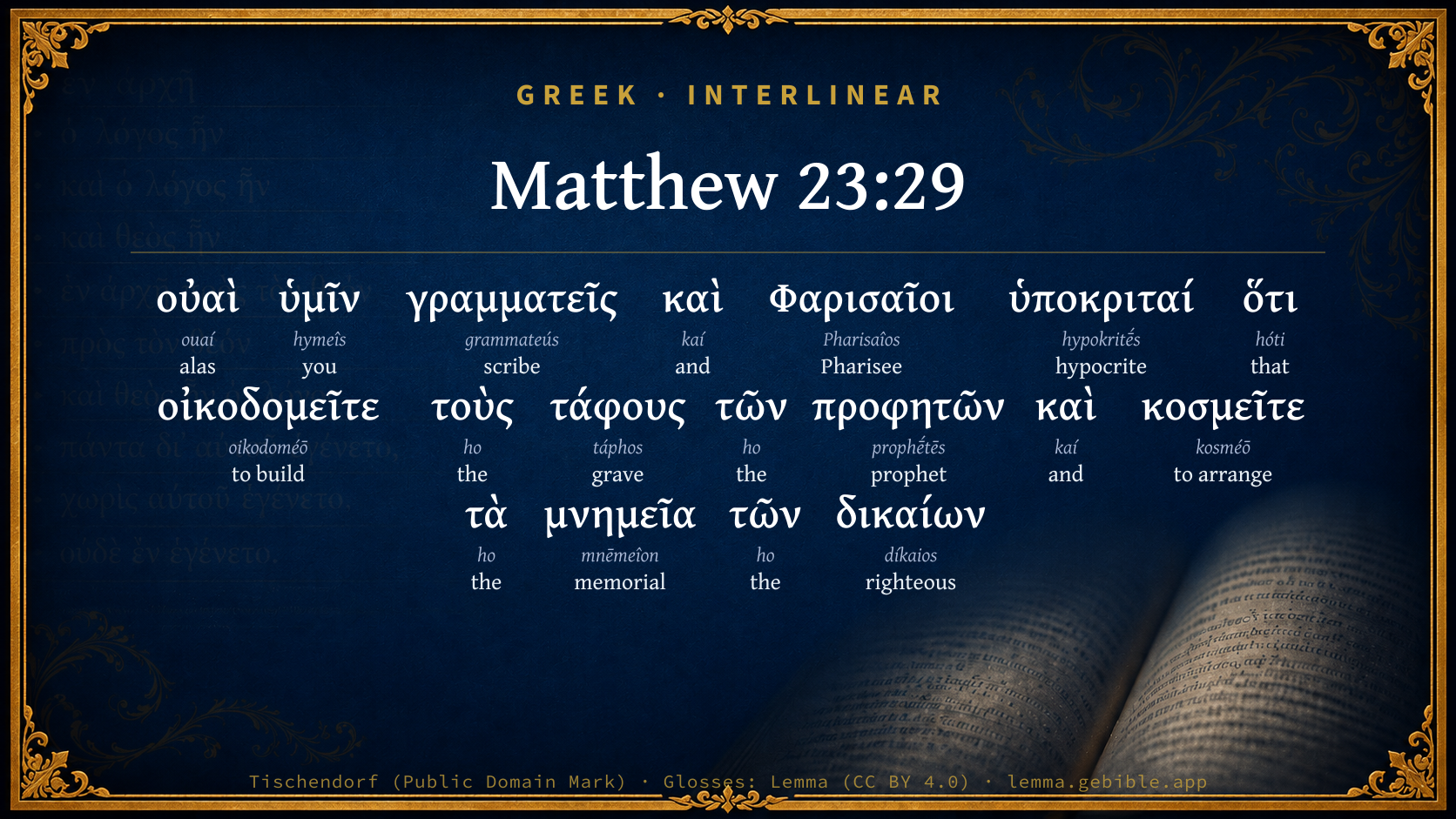
Download image
Cite this verse

Matthew 23:29 (World English Bible). Public Domain. Lemma interlinear Bible study tool, https://lemma.gebible.app/v/matthew/23/29.

Show BibTeX & RIS
BibTeX
RIS
English Translation
"Woe to you, scribes and Pharisees, hypocrites! For you build the tombs of the prophets, and decorate the tombs of the righteous,
World English Bible · Public Domain
Download a study sheet

One document with this verse’s original text, its word-by-word gloss line, the meaning frame, cross-references with their text, attributed commentary, and full source and license credits — printable, and it pastes into notes with its structure intact.

This verse Autodidact and up

Study sheet (.html) Plain text (.txt)

A passage Seminary Student

Up to 50 verses in one chapter. A passage sheet keeps up to 6 commentary sources and 12 cross-references per verse, in the order this page ranks them, and says so on the sheet whenever that leaves anything out. Ask for a single verse and you get the Autodidact verse sheet above.

Everything on this page stays free to read, with no account — the sheet is a download of what is already on screen, not access to it.

Want to remove ads? Support Godless Engineer
Compare translations 3

The same verse in 3 English versions, stacked beneath the original-language interlinear above. Click any original word for its lexicon entry.

Each is an independent rendering of the whole verse — the interlinear is not word-aligned to these translations.

Highlighted words mark where these versions differ — a whole-verse word diff, not a word-by-word alignment.

  • World English Bible Public Domain
    "Woe to you, scribes and Pharisees, hypocrites! For you build the tombs of the prophets, and decorate the tombs of the righteous,
  • King James Version Public Domain
    Woe unto you, scribes and Pharisees, hypocrites! because ye build the tombs of the prophets, and garnish the sepulchres of the righteous,
  • unfoldingWord Literal Text CC BY-SA 4.0
    Woe to you, scribes and Pharisees, hypocrites! For you build the tombs of the prophets and decorate the tombs of the righteous.

unfoldingWord Literal Text — © unfoldingWord, licensed CC BY-SA 4.0. Word-aligned USFM3 via Door43 (git.door43.org/unfoldingWord/en_ult).

Versions to compare (up to 4)

3 of 4 selected

Show all 19 translations

Every available English version of this verse, each an independent rendering of the whole verse.

  • World English Bible Public Domain
    "Woe to you, scribes and Pharisees, hypocrites! For you build the tombs of the prophets, and decorate the tombs of the righteous,
  • Berean Standard Bible Public Domain
    Woe to you, scribes and Pharisees, you hypocrites! You build tombs for the prophets and decorate the monuments of the righteous.
  • Majority Standard Bible Public Domain
    Woe to you, scribes and Pharisees, you hypocrites! You build tombs for the prophets and decorate the monuments of the righteous.
  • King James Version Public Domain
    Woe unto you, scribes and Pharisees, hypocrites! because ye build the tombs of the prophets, and garnish the sepulchres of the righteous,
  • American Standard Version (1901) Public Domain
    Woe unto you, scribes and Pharisees, hypocrites! for ye build the sepulchres of the prophets, and garnish the tombs of the righteous,
  • Revised Version (1885) Public Domain
    Woe unto you, scribes and Pharisees, hypocrites! for ye build the sepulchres of the prophets, and garnish the tombs of the righteous,
  • Geneva Bible (1599) Public Domain
    Wo be vnto you, Scribes and Pharises, hypocrites: for ye build the tombes of the Prophets, and garnish the sepulchres of the righteous,
  • Douay-Rheims (1899) Public Domain
    Woe to you scribes and Pharisees, hypocrites; that build the sepulchres of the prophets, and adorn the monuments of the just,
  • Young's Literal Translation Public Domain
    `Wo to you, Scribes and Pharisees, hypocrites! because ye build the sepulchres of the prophets, and adorn the tombs of the righteous,
  • Literal Standard Version CC BY-SA 4.0
    Woe to you, scribes and Pharisees, hypocrites! Because you build the graves of the prophets, and adorn the tombs of the righteous,
  • Unlocked Literal Bible CC BY-SA 4.0
    Woe to you, scribes and Pharisees, hypocrites! For you build the tombs of the prophets and decorate the tombs of the righteous.
  • unfoldingWord Literal Text CC BY-SA 4.0
    Woe to you, scribes and Pharisees, hypocrites! For you build the tombs of the prophets and decorate the tombs of the righteous.
  • Darby Bible Public Domain
    Woe to you, scribes and Pharisees, hypocrites, for ye build the sepulchres of the prophets and adorn the tombs of the just,
  • World Messianic Bible Public Domain
    “Woe to you, scribes and Pharisees, hypocrites! For you build the tombs of the prophets and decorate the tombs of the righteous,
  • Webster's Bible Public Domain
    Woe to you, scribes and Pharisees, hypocrites! because ye build the tombs of the prophets, and garnish the sepulchers of the righteous,
  • Free Bible Version CC BY-SA 4.0
    What a disaster is coming on you religious teachers and Pharisees, you hypocrites! You build tombs as memorials to the prophets, and decorate the tombs of the good,
  • Bible in Basic English Public Domain
    A curse is on you, scribes and Pharisees, false ones! because you put up buildings for housing the dead bodies of the prophets, and make fair the last resting-places of good men, and say,
  • Text-Critical English NT CC BY 4.0
    “Woe to you, scribes and Pharisees, hypocrites! For you build the tombs of the prophets and adorn the graves of the righteous,
  • Tyndale New Testament (1534) Public Domain
    Wo be vnto you Scribes and Pharises ypocrites: ye bylde the tombes of the Prophetes and garnisshe the sepulchres of the righteous

Literal Standard Version (2020), Covenant Press — licensed CC BY-SA 4.0. Text via the HelloAO Bible API (eBible.org). Unlocked Literal Bible (unfoldingWord) — licensed CC BY-SA 4.0. Text via the HelloAO Bible API (eBible.org). unfoldingWord Literal Text — © unfoldingWord, licensed CC BY-SA 4.0. Word-aligned USFM3 via Door43 (git.door43.org/unfoldingWord/en_ult). Free Bible Version, Dr. Jonathan Gallagher — licensed CC BY-SA 4.0. Text via the HelloAO Bible API (eBible.org).

Word by word

More ways to search: Search by grammar → Find every occurrence → Compare this word →

Practice this passage: Drill this verse → Learn its vocabulary →

τάφους
táphos
G5028
“grave”
Noun, Accusative, Plural, Masculine
Part of Speech
Noun
Case
Accusative
Number
Plural
Gender
Masculine
Full Thayer's Definition

Origin: from G2290

TDNT: None

1. burial 2. a grave, a sepulchre
  1. οὐαὶ ouaí G3759 “alas” Interjection
  2. ὑμῖν hymeîs G5210 “you” Personal pronoun, 2nd person, Dative, Plural
  3. γραμματεῖς grammateús G1122 “scribe” Noun, Vocative, Plural, Masculine
  4. καὶ kaí G2532 “and” Conjunction
  5. Φαρισαῖοι Pharisaîos G5330 “Pharisee” Noun, Vocative, Plural, Masculine
  6. ὑποκριταί hypokritḗs G5273 “hypocrite” Noun, Vocative, Plural, Masculine
  7. ὅτι hóti G3754 “that” Conjunction
  8. οἰκοδομεῖτε oikodoméō G3618 “to build” Verb, Present, Active, Indicative, 2nd person, Plural
  9. τοὺς ho G3588 “the” Article, Accusative, Plural, Masculine
  10. τῶν ho G3588 “the” Article, Genitive, Plural, Masculine
  11. προφητῶν prophḗtēs G4396 “prophet” Noun, Genitive, Plural, Masculine
  12. καὶ kaí G2532 “and” Conjunction
  13. κοσμεῖτε kosméō G2885 “to arrange” Verb, Present, Active, Indicative, 2nd person, Plural
  14. τὰ ho G3588 “the” Article, Accusative, Plural, Neuter
  15. μνημεῖα mnēmeîon G3419 “memorial” Noun, Accusative, Plural, Neuter
  16. τῶν ho G3588 “the” Article, Genitive, Plural, Masculine
  17. δικαίων díkaios G1342 “righteous” Adjective, Genitive, Plural, Masculine

About this verse

These counts appear in no published source. They are computed here, from the morphology-tagged text and Lemma’s own curated glosses. What Lemma adds →

18
words
14
distinct lemmas
Gospels
section

Notable vocabulary

The rarest word here is τάφους grave G5028 — appearing just 7 times in the whole Greek New Testament.

Shared distinctive vocabulary

τάφους grave G5028 occurs in 7 verses of the Greek New Testament. Also found in:

Repetition

Words recur within this verse:

Cross-references

2

Topical passages linked to Matthew 23:29 in the Treasury of Scripture Knowledge — connected by theme and wording, ordered by reader-vote popularity; previews shown in the World English Bible.

  • Luke 11:47–48 Woe to you! For you build the tombs of the prophets, and your fathers killed them.
  • Acts 2:29 "Brothers, I may tell you freely of the patriarch David, that he both died and was buried, and his tomb is with us to this day.

Cross-references courtesy of OpenBible.info (CC BY 4.0).

Commentary

Notes on Matthew 23:29 from classic Christian and Jewish commentators (each source and its license shown beneath its notes). The classic Christian expositions comment on the surrounding passage and are grouped to its opening verse, so a note may address several verses; the Jewish commentaries on the Tanakh (Rashi and others) are per-verse, so they appear only where the commentator wrote on this verse.

Lemma curates 59 commentaries, every one of them public domain or Creative Commons licensed, each selected and text-cleaned for this edition rather than reprinted as found. About our sources →

The Biblical Illustrator

Joseph S. Exell

Mat_23:29; Mat_23:33; Mat_23:36

How can ye escape the damnation of hell?

-

The difficulty of escaping the damnation of hell

I. What your situation actually is.

1. You are even now under sentence of condemnation.

2. You need to be awakened, no man will escape a danger he does not perceive.

3. In order to escape final condemnation you must pursue religion with perseverance.

II. The obstacles.

1. The effect of sin is to make men blind to their own sins.

2. The sinner often seeks deliverance in a way in which it cannot be obtained.

3. The unbelieving heart will not submit to God until its opposition be removed.

4. The fascinating power of worldly objects.

5. Then you say the difficulties are so great that you have not courage to make the attempt to escape. (E. Payson, D. D.)

Pretence vain

To pretend holiness when there is none is a vain thing. What were the foolish virgins better for their blazing lamps when they wanted oil? What is the lamp of profession without the oil of saving grace? What comfort will a show of holiness yield at last? Will painted gold enrich? Painted wine refresh him that is thirsty? Will painted holiness be a cordial at the hour of death? A pretence of sanctification is not to be rested in. Many ships have had the name of Hope, the Safeguard, the Triumph, yet have been cast away upon the rocks; so many who have had the name of saintship have been cast into hell. (T. Watson.)

Suspension and infliction of judgments

1. It is not right that God should punish one generation for the sins of another.

2. It is just that God should punish all generations for their own sins.

3. God might if He pleased pass by the sins of all generations; He might punish them hereafter, not here.

4. It is right that God should punish one generation and not another. He has always acted as a Sovereign in sparing or punishing particular generations. God delayed to destroy the Egyptians.

5. When God does spare one generation and punish another He always has some good reason for both sparing and punishing.

6. The sins of one generation may be a good reason why God should punish the sins of another.

7. It is criminal and foolish for one generation to imitate the sins of a former.

8. It is well for the present generation to discountenance open vices prevailing.

9. Sinners always are the troublers of the world. (N. Emmons, D. D.)

The Biblical Illustrator, edited by Joseph S. Exell (c. 1880s–1900s) — public domain. Text from a community e-Sword module.

The Preacher's Complete Homiletical Commentary

Joseph S. Exell (gen. ed.)

CRITICAL NOTES

Mat_23:29. Build the tombs, etc.—See R.V. A portion of the temple offerings were devoted to this purpose.

Mat_23:31. The children.—You inherit their wickedness in compassing the death of the prophet of the Lord (Carr).

Mat_23:32. Fill ye up, etc.—Or, more literally, “And ye! fill ye up the measure of your fathers!” The Saviour’s heart was heaving, and He felt the inadequacy of all common modes of expression to convey the commotion of His emotions. Hence the brokenness, abruptness, and boldness of His phraseology (Morison).

Mat_23:33. Generation.—Offspring (R.V.). Damnation of hell, or, judgment of Gehenna. This expression, the “judgment of hell” was not invented by our Saviour. It was current among the Rabbis. See Wetstein in loc.

Mat_23:34. Wherefore.—Therefore (R.V.). That solemn “therefore” looks back to the whole preceding context, and forward to the whole subsequent. Because the rulers professed abhorrence of their father’s deeds, and yet inherited their spirit, they, too, would have their prophets, and would slay them. Christ’s desire is that all should find in His gospel the savour of life; but His purpose is that, if it be not that to any, it shall be to them the savour of death (Maclaren). Prophets.—Under direct inspiration, like those of old, which may especially refer to the Apostles.—Wise men.—Like a Stephen or an Apollos. Scribes.—Such as Mark and Luke, and many a faithful man since, whose pen has loved to write the Name above every name (ibid.).

Mat_23:35. Zacharias.—If the reading “son of Barachias” be retained (it is omitted in the Sinaitic MS.) a difficulty arises; for the Zacharias, whose death “in the court of the house of the Lord” is recorded 2Ch_24:20-22, was the son of Jehoiada. The words, however, do not occur in Luk_11:51, and are possibly interpolated. Zechariah the prophet was a son of Barachias: but of his death no record is preserved. Another explanation has been offered. At the commencement of the Jewish war with Vespasian a Zacharias, son of Baruch, was slain in the temple by two zealots (Jos., B. J., IV. Mat_23:4). Accordingly, many commentators have thought that Jesus spoke prophetically of that event. The coincidence is remarkable, but the explanation is hardly probable (Carr). We need not wriggle and twist to try to avoid admitting that the calling of the martyred Zacharias, “the son of Barachias,” is an error of some one’s, who confused the author of the prophetic book with the person whose murder is narrated in 2 Chronicles 24. We do not know who made the mistake, or how it appears in our text, but it is not honest to try to slur it over (Maclaren). Dr. Plumptre says that the omission of the words “son of Barachiah” in the Sinaitic MS. betrays the hand of a corrector cutting the knot of the difficulty. Altar.—Viz., of burnt-offering before the temple.

Mat_23:36. All these things shall come.—Viz., in their penalty.

Mat_23:37. O Jerusalem, Jerusalem!—See R.V. In the original Jerusalem is not spoken to, but spoken of; and therefore if any interjection should be desired, ah! would be better than O! (Morison). I.—He is a young man of little more than thirty; but His personal consciousness runs back through all the ages of the past, through all the times of the killing of the prophets and stoning of the messengers of God, from Abel on to Zechariah: and not only so, but this Son of Israel speaks in the most natural way as the brooding mother of them all through all their generations (Gibson).

Mat_23:38. Your house.—The temple, which Jesus was leaving (Mat_24:1). It was no longer “My Father’s house.”

Mat_23:39. Till ye shall say.—In the future general conversion of Israel (Romans 11; Zec_12:10; Isa_66:20) (Lange). Blessed, etc.—Psa_118:26. They would say so when reciting the Hallel at the Passover, but without applying the words to Jesus (Bengel).

MAIN HOMILETICS OF THE PARAGRAPH.—Mat_23:29-39

Cumulative transgression.—This last accusation of the scribes and Pharisees is one which stands by itself. Probably, because in some respects it is also the worst. Just there when their true spirit was worst, they declare it to be best (Mat_23:30). It is with this assertion the Saviour now deals. His way of doing so is marked, first, by great wisdom; secondly, by great faithfulness; thirdly, by tenderest love.

I. Great wisdom.—This is shown, on the one hand, in the way of insight. He sees at once the true value of this idle respect for the dead. On the one hand, there is nothing to be lost by it from the point of view of the scribes. A dead prophet, in some senses, is a prophet no more. He can no longer disturb such men as the Pharisees by the holiness of his life, or the faithfulness of his reproaches, or the success of his mission. There is no reason to them, therefore, against making much of his memory. There is much reason rather, for doing so, with their views and desires. The names in question, by this time, have become popular names. It would cause these men, therefore, to become popular also, if they took up the same line. And that, as we know, was, above all things, the thing they desired (Mat_23:5-7, etc.). In reality, therefore, they were the same kind of men as their fathers had been; animated by the same spirit, though in different ways, because under a different set of conditions (Mat_23:31). On the other hand, by great foresight. The Saviour beheld, only too clearly, all that was about to be done. Who were to come in His name, even men equal in every way (Mat_23:34) to any before. How they would be dealt with, even with at least equal cruelty (ibid.) to any before; and so with even greater pertinacity (“city to city,” etc.) than ever before. And in this, therefore, would appear to be the full answer to the preceding assertion of change. If they were honouring those dead witnesses, as affirmed, they were not treating living witnesses in that way. If they had not used their fangs for a time, it would soon be seen that they were very far from being without them. Both true “serpents” themselves, in short, and the “offspring of vipers” as well, Jesus here both sees and foresees them to be (Mat_23:33, R.V.).

II. Great faithfulness.—Things being so, these men must be taught clearly all that was implied on their part. All that was implied, on the one hand, in regard to their guilt. Continuance in evil implies not only progression—it implies rapid progression—in sin. To disobey, and be warned, and punished—and then to be delivered and spared for a time—and then to be guilty over again of that same disobedience—is to do more, very much more, than twice as bad as before. And this is true even where the repetition may be regarded as being of a representative kind, as where the children, e.g., have been warned in the person of their fathers; and where the sin of the fathers has been repeated, as it were, in the person of their offspring. Such children are more responsible, and therefore, when they do sin, are also more guilty, than they would have otherwise been. Hence, therefore, the fulness of the guilt resting on the “generation” before Him (Mat_23:31). Hence, therefore, what He tells them, next, of the awful severity of its doom. The true inheritor (as He has shown) of the spirit of the past, it is also the heir of its judgments. Of all overt sin nothing is like the persecution of God’s representatives in proving enmity against Him. In regard to nothing, consequently, is He wont to exact a stricter account. Never yet had there been a generation which inherited so large an amount of responsibility on this score. Never yet a generation which added to it so much responsibility of its own. So the event would only too fully make plain. Upon it, therefore, is to descend, in all its fulness, what had been held back for so long. This is the rule with the long-suffering judgment of God. The “generation” which finally “fills” the cup (Mat_23:32) has to exhaust it as well.

III. Tenderest love.—As this meekest of Kings foresees these terrible griefs and foretells them, a sorrow of almost equal intensity seizes on Himself. What a sight is here of the past! What a sight, on His side, to begin! Often and often in bygone ages, with yearning affections—see how much is revealed here of the mysterious depths both of His nature and heart!—would He have gathered together the “children” of “Jerusalem” under His wings. What a sight on their side as well! Just as often, with invincible aversion, had His love been rejected! What a sight, therefore, in both respects, of the future! Never, now, can He make such offers again. Never, either, as things are, will they see Him again. When He does come (for come He will), nothing shall be as it was. Their “house” will be gone! Their spirit changed! And this cry in His ears: “Blessed be He that cometh in the name of the Lord” (Mat_23:38-39).

See, therefore, at the last, what it is that Jesus asks from the worst! That they should accept His love as it is! Here is the great lesson of all! Here, where the Saviour is the severest, He is also most loving of all. On the other hand, however, we must not cancel the obverse side of this coin. Here, where He is most loving, He is also severest of all (Psa_101:1; Rom_11:22). Let no man dream, because of Christ’s love, that it is good to continue in sin. Not even that love can cause this to be true!

HOMILIES ON THE VERSES

Mat_23:29-32. The penalty of prophesying.—It must have appeared to be in itself a very seemly thing, this honouring of the great and good men of former generations, to whom the religion of Israel owed so much. It must, therefore, have been startling to such men to hear Christ’s sarcastic comment upon this apparently praiseworthy movement, and to find Him denouncing it as an aggravation of the sin of those who were promoting it, and basing on it a charge against them of insincerity and hypocrisy. It was true, doubtless, as any cynic in Jerusalem might have pointed out to them, that those prophets, whom they were so eager to honour now that they were dead, had met with very different treatment while they were living. But their answer would have been, “We sorrowfully confess it. That is the very reason for this zeal in sepulchre building. We mean by this to dissociate ourselves from the conduct of our fathers. It is our way of putting on permanent record our protest against their sin, and our conviction that if we had been in the day of our fathers, we would not have been partakers with them in the blood of the prophets. It expresses a genuine national repentance and desire to make reparation.” And there were obvious and indisputable facts which seemed to go a considerable way to justify such an attitude. They were fairly entitled to say, “Is there not an immense difference between our religious condition ‘to-day and that of our fathers who persecuted the prophets? What were the sins which the prophets rebuked? Were they not idolatry, the worship of Jehovah fearfully corrupted by the admixture of polluted rites adopted from the Canaanite and Phœnician religions, altars on high places and in sacred groves, associated with gross licentiousness? Have we not changed all that? If the prophets were to come back today, is there a single one of these points on which they could challenge our conduct? Are not their demands carried out by us most scrupulously? Where, then, is the insincerity in our honouring them, since we are obeying them?” And so far the defence would have been plausible. Yet our Lord sets it aside. He tells them, “You are labouring under a self-complacent delusion. You have no sympathy with the spirit of those you are professing to honour; you have no true sense of the moral grandeur of those men and of their protest; your reverence is taught by the precept of men, not by the prompting of your own hearts. Your homage is merely conventional. You are manifesting the very same spirit as your fathers, and in this very matter of monument-building, instead of severing yourselves from them you are in reality serving yourselves—heirs to their sin.” With biting irony He says, “There is a peculiar propriety in your building the tombs of those whom your fathers slew. You are completing their work. They killed, and you bury; the spirit is the same.” Christ does not here state explicitly the ground of this condemnatory judgment. But we know the principle on which it was based. Apart from that sure moral insight by which He discerned beneath the smooth and decorous surface of their life the working of the same spirit—the same tempers and vices, the same outwardness and formalism—which had characterised ancient Israel, His condemnation was justified by their attitude towards Himself. The way in which they treated Him, the living Prophet, was an infallible indication of the way in which they would have treated the prophets, whom they professed to honour, if they had been in their day. The spirit and conduct which Christ thus reprobated is not confined to the Pharisees of Jerusalem. It is an exemplification of a constant tendency of human nature.

I. Why were the prophets hated in their own day?—

1. They proclaimed new and unpopular truth.—Mr. John Morley remarks that the popular teacher in any department is he who is most in accord with the average sentiment of his day, who happens to chime in most harmoniously with its prepossessions, or most effectually to nurse and exaggerate them. That is precisely what the prophets were not.

2. They made powerful application of moral and religious truth to human life.—If it is a thankless and dangerous task to attack men’s traditional preconceptions, it is still more dangerous to touch their selfish interests. And that is what the prophets did, not in mere harmless generalities which hurt nobody, but with definite pointed application to particular prevalent sins and social wrongs.

3. The true prophet of God bore no outward sign by which he could be recognised as such.—It needed a heart in sympathy with God to discern a true prophet.

II. Why were they honoured by later generations?—That, too, is in accordance with human nature. It is not only that death softens all animosities. There was more than that in the reaction of feeling towards the prophets. A dead prophet is no longer to be dreaded. He is no longer dangerous in the way of drawing attention to the existing evils or stirring men’s minds to ask inconvenient questions. Truth and real greatness have in them vitality and permanence which compel men at last to recognise them. The true poet sometimes, despite the depreciation of contemporary critics, becomes a classic, and then he is awarded the conventional admiration of those who could never of themselves have discovered in him anything to admire. So it was with the prophets of Israel. Men inspired by the same Spirit which spoke in the prophets and in Christ may come to us, and we may prove as blind to every token of the Divine in them, and as deaf and unresponsive to their message, as did the Israelites in Old Testament history, or the Pharisees in the time of Christ. Our reverence for the past will be proved not by our being mere imitators of those who were great because they imitated none, not by standing immovably on their position and repeating their phrases, but by going forward in their spirit, welcoming all fresh light, proving all things, and holding fast that which is good.—A. O. Johnston, M.A.

Mat_23:31-32. Judicial abandonment.—

1. Christ’s enemies shall not want a witness of their malicious opposing of Him; yea, from their own words and purposes He shall bring matter of conviction against them—their never-dying worm shall breed in their own bosom. “Ye are against yourselves witnesses.”

2. Christ will give over desperate enemies to their own malicious disposition, and will defy them, as here He saith, “Fill ye up the measure of your fathers.”

3. There is a measure set to be filled up with the transgressions of the Lord’s enemies, and till this cup be full to the lip, they shall be suffered to go on; but when this cup is full, then the cup of God’s wrath shall be full also, and run over upon them to their destruction. Therefore saith He, “Fill ye up the measure”; that is, Go on till you kill Me, as your fathers did the prophets.—David Dickson.

Mat_23:32. A terrible command!—Then come the awful words; bidding that generation “fill up the measure of the fathers.” They are like the other command to Judas to do his work quickly. They are more than permission, they are command; but such a command as, by its laying bare of the true character of the deed in view, is love’s last effort at prevention.—A. Maclaren, D.D.

Mat_23:33. The sin that hath never forgiveness.—I think that the most awful word which has ever been written by a human pen is, “the wrath of the Lamb.” There is something which always seems very terrible when I open this chapter. These words are doubly awful on the lips of the patient and forgiving Christ. There is a sin which remains unconquerable, even by the love and pity of the Incarnate Word; which remains insoluble even in the menstruum of the grace of Christ; and which defies every effort of the Redeemer to transfigure its hideous form and make it, transformed, the attendant and minister of the eternal triumph of His cross. There is a sin which can draw down on a man, even from the Divine lips, the sentence, “It had been better for that man if he had never been born.”

I. We will endeavour to identify the spiritual condition on which this hateful epithet is branded by John the Baptist and by the Lord. In each case the term is aimed expressly, by name, at the same class, and presents a vivid image of the same sin. This is surely a very important indication to guide us in determining what this unpardonable sin may be. It is the sin of these vipers, be they who they may. It is the spirit which searches for love that it may wound it, for grace that it may poison it, for life that it may kill it, lest the world should live anew by grace, be comforted and cherished by love, and link itself on by hope to the bliss and glory of heaven. It is the spirit which, seeing this love incarnate on its Divine errand, seeing the world’s death-pallor tinged with the rosy glow, and the rigid limbs stirring under the currents of a new-born life, said straightway, “This is of the devil”; and stung the Divine One—though it could not touch the fountain of His power, the love which drew Him from heaven to Calvary—even unto death (see Mat_3:7; Mat_12:10-14; Mat_12:22-24; Mat_12:34; Mat_23:13-15). “Then the Pharisees went out, and held a council against Him, that they might destroy Him” (Mat_12:14). Mark the occasion. A man made whole on the Sabbath day—a great healing accomplished, a great burden lifted, a great joy poured into a sad, weary heart, a great ray of the love of God sent streaming into the darkness of the world. But a Pharisaic regulation had been broken. Perish the healing, perish the Healer, but let the rule of the Pharisees live! Do you wonder at the sequel? “Wherefore I say unto you, all manner of sin and blasphemy shall be forgiven unto men,” etc. In this chapter it is precisely the same. It is the wrongs and miseries of others, of hearts bruised under the heel of the Pharisees’ insolence, and bleeding from the strokes of their rods, which stir the Saviour’s indignation.

II. What lies at the root of this state of mind and spirit? Whence does it spring? Not from the perversities, infirmities, lusts, and vices which belong to the prodigal’s character, and are unveiled in the prodigal’s life (cf. 1Jn_1:5-10 with the spirit of the Pharisee in Luk_18:10-14). The sin which saith, “I have no sin,” remaineth. Even against God’s love it is hard as adamant and cold as death. The Pharisee’s spirit, which would dash fiercely the cup of life from the lips of a dying world, lest its own privilege should perish; which would brand the spirit of the Divine Healer, Teacher, and Saviour of the world, as devilish, and hunt it from the earth, stung to death with its viperous fang; which holds every wide gospel proclamation an intolerable insult, and every healing touch of Divine love a bitter pain—it is this, and nothing which a poor lost soul can brood over in its anguish, which is the unpardonable sin. This was the python on which the sun-bright Saviour rained the arrows of His indignation and hate. “Ye serpents,” etc.—J. Baldwin Brown, B.A.

Holy indignation.—I heartily sympathise with Adam Smith, who said, as a man who had made excuses for a bad character left the company, “I can breathe more freely now. I cannot bear that man; he has no moral indignation in him.” The mind of Christ is far too seldom followed in the conduct of our social relations.—United Presbyterian Magazine.

Faithful preaching.—Said Robert Morris to Dr. Rush, “I like that preaching best which drives a man into the corner of his pew and makes him think the devil is after him.”—Thwing.

Mat_23:34-35. The process of condemnation.—

1. Our Lord, in the face of His enemies, avowed Himself to be God, having authority to send out prophets, and to bestow gifts on men.

2. Our Lord knoweth how His servants will be served in every place they come unto, and what measure of sufferings each of them will meet with from the wicked.

3. The Lord’s servants (albeit they know that sufferings abide them) must, notwithstanding, go on in their message; for this is the forewarning given unto His servants also, “I send you prophets, and some of them ye shall kill,” etc.

4. They who go on in the course of any sin, do subscribe unto the sins of such as before them did follow that sort of sin, and justly may be condemned and punished as guilty of the sin of others, which they do approve; for so Christ reckoneth, saying, “That on you may come all the blood,” etc.

5. The sufferers for righteousness, from the beginning of the world, are all in the rank of martyrs, and their sufferings are kept in fresh remembrance. “From righteous Abel unto Zacharias,” etc.

6. Raging persecutors look neither to place nor person nor consequence of their cruelty, but as blind beasts do follow forth their own fury; for “betwixt the porch and the altar” was Zacharias slain.—David Dickson.

Mat_23:35. Nemesis!—In whose mind was the intent or design that is referred to when it is said, “That upon you might come all the righteous blood shed upon the earth”? If we view the subject philosophically, and as regards the theological substrate that underlies the free-and-easy phraseology, we must at once answer, with Calvin, In the mind of God. It would be contrary to sound theology, and to sound philosophy, to ignore the agency of God in the matter—His intentional agency, and thus His intent. He “suffered” them to walk in their own ways (Act_14:16). He did not deem it right to break in upon the mental and moral constitution. He had given them, that He might arrest the murderous strokes that were about to fall. On the contrary, He had long continued to maintain, and He intended still to maintain, that constitution; and when He foresaw that they would madly persist in abusing it, and bid defiance to His righteousness and grace, He resolved that by “suffering” them meanwhile, as long as wisdom would permit, and then by-and-by bringing on them, after their cup of iniquity was full, the consummation of the doom which was their due, He would turn them to account, as beacons in His universe. There is, however, nothing in all this of the nature of unconditional intent, purpose, or decree. And it is noteworthy, besides, that in the connection of Mat_23:34-35 the reference to the action of God is only theologically and philosophically implied, not formally expressed. There is, instead, express reference to the action of the scribes and Pharisees themselves. They acted in their own infatuated way, in order that all the righteous blood shed on the earth might come upon them; that is, they acted as if they were intending and desiring that the blood might come on them. They were like those who “love death” and “seek” it—“seek destruction” (Pro_8:36; Pro_17:19; Pro_21:6). They did not, indeed, “formally”—as logicians speak—love, seek, and intend their own death and destruction. But they “formally” loved, sought, and intended that which God had connected with death and destruction. And thus, while dashing along in their loved career, they “materially”—as logicians phrase it—and “virtually” rushed voluntarily upon their deserved retribution.—J. Morison, D.D.

Mat_23:36. Forewarned!—It is a special motive unto repentance to tell men of the propinquity of judgment.—David Dickson.

National catastrophes.—It takes centuries for the mass of heaped-up sin to become top-heavy; but when it is, it buries one generation of those who have worked at piling it up, beneath its down-rushing avalanche.

“The mills of God grind slowly,

But they grind exceeding small.”

The catastrophes of national histories are prepared for by continuous centuries. The generation that laid the first powder-horn-full of the train are dead and buried long before the explosion which sends constituted order and institutions sky-high. The misery is that often the generation which has to pay the penalty has begun to wake to the sin, and would be glad to mend it, if it could. England in the seventeenth century, France in the eighteenth, America in the nineteenth, had to reap harvests from sins sown long before. Such is the law of the judgment wrought out by God’s providence in history. But there is another judgment, begun here and perfected hereafter, in which fathers and sons shall each bear their own burden, and reap accurately the fruit of what they have sown. “The soul that sinneth, it shall die.”—A. Maclaren, D.D.

Mat_23:37. The Saviour’s sorrow over a sinful world.—These words form the concluding portion of our Saviour’s last public discourse. They were the last utterances from His lips in the temple—they mark the end of His ministry. His subject has been the wickedness of the Pharisees, and His words have risen into a vehement and terrible invective. But this stern work is hard for the gentle Christ. He cannot, without pain, go on with this denouncing of doom upon His chosen people. All at once He breaks down; the pentup pity, the infinite compassion, leapt from His aching heart, and the language of His spurned affection, the ineffable sadness of His sympathising spirit, came wailing forth in the melting tenderness of this most sorrowful apostrophe, “O Jerusalem, Jerusalem! thou that killest the prophets,” etc. The text reveals the heart of Christ.

I. See how earnestly Jesus desires to save the guilty.—Jerusalem is under the shadow of death. But she does not realise it; she does not know her danger. It is not always easy to warn men of their peril. Jerusalem had been warned; the Son of God had pleaded with her, He had wept over her, He had invited her to repent; and the end of all is this confession of defeat: “I would … and ye would not.” You will see how, in His opening words, “O Jerusalem, Jerusalem!” His love shines out.

1. It is not diminished by any wickedness.

2. It is not chilled by perversity.

3. It is not outwearied by delay.—At this very hour if Jerusalem had repented, all heaven would have been jubilant.

II. See how tenderly He gives shelter and rest to those who come.—“Even as a hen,” etc.

III. See how, in spite of all the love of God and Christ, some men will perish.—“I would … and ye would not,” and you have your way. I sometimes think this is the saddest and darkest word in all the Book. Oh! the awful dignity of the human will—this great and dreadful power in me that can flaunt itself in the face of a gracious God and defeat His purpose.—W. J. Woods, B.A.

Christ a Shelter.—I. The first thing suggested by this symbol is the idea of danger.—Great as was the political calamity that menaced them, their greatest danger was spiritual; the danger shared by all, in every age, who have broken the law, but have not accepted the Saviour. Infraction of law must be followed by infliction of penalty.

II. The symbol of a shelter is so presented as to set forth the glory of Him who is thus revealed.—The overshadowing wing of omnipotence is spread in your defence.

III. This symbol of a shelter illustrates in the highest degree the condescending tenderness of Christ.—It does so by its homely simplicity, as well as by its ineffable pathos.

IV. This symbol of Christ is so set forth as to suggest the idea of a shelter, afforded by one who interposes His own life between us and danger.—Christ is a shelter to trusting souls only by interposing His own life between them and the shock of doom.

V. Note the ends to be attained by the sinner’s flight to the Saviour.—It is obvious that the immediate result is safety. But it would be a radical mistake to suppose that the gospel urges men to seek safety only for safety’s sake. Safety in Christ is the first step to practical godliness.

VI. This symbol of Christ is drawn in such a way as to show that man is responsible in the matter of his own salvation.—C. Stanford, D.D.

Mat_23:38. The departure of Christ from the temple.—

I. The close of a mournful past.

II. The sign of a miserable present.

III. The token of a sad futurity.—J. P. Lange, D.D.

The desolate temple.—Every Christian temple in which Christ is not preached, is empty; so is every heart in which He does not live.—Heubner.

Mat_23:39. Christ hiding Himself.—

1. It is righteousness with Christ to smite them with judicial blindness who refuse obstinately to acknowledge Him when He offers Himself unto them; as here He saith, “Ye shall not see Me henceforth”; that is, you shall not perceive Me to be the Messiah; for otherwise bodily they did see Him, and did crucify Him, but they saw not who He was; for had they known, they would not have crucified the God of glory.

2. At last, Christ’s most cruel enemies shall see and know and acknowledge Him to be that blessed Messiah; for all knees shall bow to Him, and all tongues shall confess to Him, and these His adversaries among the rest shall say, Now we see that Jesus is the blessed Son of God, and the true Lamb of God, hills and mountains fall on us, and hide us from the wrath of the Lamb; yonder is the blessed Saviour, who came in the name of the Lord.—David Dickson.

The Preacher's Complete Homiletical Commentary (gen. ed. Joseph S. Exell; Funk & Wagnalls, c. 1892) — public domain (pre-1929). A full-Bible homiletical/sermon-outline anthology covering 65 of 66 books (2 John is absent from the source module). Text from a community e-Sword module.

Tyndale Open Study Notes

Tyndale Open Resources

23:29 By building and decorating the tombs for the prophets, the teachers of religious law and Pharisees showed outward solidarity with the prophets, while inwardly they were of the same sinful character as their ancestors who had murdered the prophets.

Tyndale Open Study Notes — © Tyndale Open Resources, licensed CC BY-SA 4.0. Text via the HelloAO Bible API.

Bengel's Gnomon

Johann Albrecht Bengel

Mat 23:29.[1009] Ὅτι οἰκοδομεῖτε—τῶν προφητῶν—κοσμεῖτε—τῶν δικαίων, because ye build—of the prophets—and garnish—of the righteous) (see ver 35). This was all that they did in memorial of the ancient prophets and righteous men, without observing their words or imitating their deeds; with a resemblance to their fathers in their dispositions; with a contempt of the Messiah, to whom those prophets had borne witness. Understand, therefore, only, as in ch. Mat 24:38. Scripture is wont to call those who have died in the Lord righteous, rather than saints;[1010] see Luk 14:14, and Heb 12:23.

[1009] ὅτι οἰκοδομεῖτε) A hypocrite brings guilt on himself, even in respect to those things which are not unrighteous or wrong in themselves.—V. g.

[1010] In Latin, “saint” and “holy” are both expressed by the same word, “sanctus.”—(I. B.)

Bengel's Gnomon of the New Testament — English translation (T&T Clark, Edinburgh, 1860) — public domain. Text from a community e-Sword module.

Meyer's Critical & Exegetical Commentary

Heinrich August Wilhelm Meyer

Mat_23:29 ff. Comp. Luk_11:47 ff.

The οἰκοδομεῖν of the tombs of the prophets and the κοσμεῖν of the sepulchres of the righteous (the Old Testament saints, comp. Mat_23:35; Mat_13:17; Heb_11:23); this preserving and ornamenting of the sacred tombs by those who pretended to be holy was accompanied with the self-righteous declaration of Mat_23:30. On the ancient tombs of a more notable character, see, in general, Robinson, Pal. II. p. 175 ff., and on the so-called tombs of the prophets still existing, p. 194. Tobler, Topogr. v. Jerus. II. p. 227 ff.

εἰ ἤμεθα, κ.τ.λ.] not: if we had been, but: if we were (comp. on Joh_11:21), if we were living in the time of our fathers, certainly we would not be, etc.

ὥστε μαρτυρεῖτε ἑαυτοῖς, κ.τ.λ.] Thus (inasmuch as you say τῶν πατέρων ἡμῶν) you witness against yourselves (dative of reference, Jam_5:3), that you are the sons, etc. υἱοί contains a twofold meaning. From τῶν πατέρ. ἡμ., in which the Pharisees point to their bodily descent, Jesus likewise infers their kinship with their fathers in respect of character and disposition. There is a touch of sharpness in this pregnant force of υἱοί, the discourse becoming more and more impassioned. When you thus speak of your fathers, you yourselves thereby testify to your own kinship with the murderers of the prophets. De Wettes objection, that this interpretation of υἱοί would be incompatible with what is said by way of vindicating themselves at Mat_23:30, does not apply, because Jesus feels convinced that their character entirely belies this self-righteous utterance, and because He wishes to make them sensible of this conviction through the sting of a penetration that fearlessly searches their hearts and reads their thoughts.

ἐν τῷ αἵ αἵματι] i.e. the crime of shedding their blood. On αἷμα in the sense of caedes, see Dorvill. ad Charit. p. 427. For ἐν, see on Gal_6:6.

Meyer — Critical and Exegetical Commentary on the New Testament — English translation by Peter Christie, edited by Frederick Crombie (T&T Clark, 1880) — public domain. Text from a community e-Sword module.

Expositor's Greek Testament

ed. W. Robertson Nicoll

Mat 23:29-33 . Final woe (Luk 11:47-48 ), dealing with yet another phase of hypocrisy and a new form of the contrast between without and within; apparent zeal for the honour of deceased prophets, real affinity with their murderers.

Mat 23:29 . οἰκοδομεῖτε , may point to repair or extension of old buildings, or to new edifices, like some modern monuments, the outcome of dilettante hero-worship. τάφους , μνημεῖα , probably synonyms, though there may have been monuments to the dead apart from burying places, to which the former word points. προφητῶν and δικαίων are also practically synonymous, though the latter is a wider category. κοσμεῖτε points to decoration as distinct from building operations. Fürrer ( Wanderungen , p. 77) suggests that Jesus had in view the tomb of Zechariah, the prophet named in the sequel, in the valley of Jehoshaphat, which he describes as a lovely little temple with ornamental half and quarter pillars of the Ionic order.

The Expositor's Greek Testament, edited by W. Robertson Nicoll (1897–1910) — public domain. Text from a community e-Sword module.

Geneva Bible (1599)

Geneva Bible translators

Hypocrites when they go most about to cover their wickedness, then do they by the just judgment of God, shame themselves.

Geneva Bible (1599) marginal notes — public domain. Text via Bolls.life.

Adam Clarke's Commentary

Verse 29. Ye build the tombs of the prophets] It appears that, through respect to their memory, they often repaired, and sometimes beautified, the tombs of the prophets. M. De la Valle, in his Journey to the Holy Land, says, that when he visited the cave of Machpelah, he saw some Jews honouring a sepulchre, for which they have a great veneration, with lighting at it wax candles and burning perfumes. See Harmer, vol. iii. p. 416. And in ditto, p. 424, we are informed that building tombs over those reputed saints, or beautifying those already built, is a frequent custom among the Mohammedans.

Adam Clarke's Commentary on the Bible (1810–1826) — public domain. Text from a community e-Sword/MySword module.

Ellicott's Commentary for English Readers

(29) Ye build the tombs . . .—Four conspicuous monuments of this kind are seen to the present day at the base of the Mount of Olives, in the so-called Valley of Jehoshaphat, the architecture of which, with its mixture of debased Doric and Egyptian, leads archæologists to assign them to the period of the Herodian dynasty. These may, therefore, well have been the very sepulchres of which our Lord spoke, and to which, it may be, He pointed. They bear at present the names of Zechariah, Absalom, Jehoshaphat, and St. James; but there is no evidence that these were given to them when they were built, and the narratives of earlier travellers vary in reporting them. It may be noticed, however, that of these four names, Zechariah is the only one that belonged to a prophet, and the reference to the death of a martyr-prophet of that name in Mat_23:35, makes it probable that the name may have been, as it were, suggested by the monument on which the Pharisees were lavishing their wealth and their skill at the very time when they were about to imbrue their hands in the blood of One who was, even in the judgment of many of their own class, both a “prophet” and a “righteous” man.

Garnish.—Better, adorn—as, e.g., with columns, cornices, paintings, or bas-reliefs. Even these acts, natural and legitimate in themselves, were part of the “hypocrisy” or “unreality” of the Pharisees. They did not understand, and therefore could not rightly honour, the life of a prophet or just man. They might have learnt something from the saying of a teacher of their own in the Jerusalem Talmud, that “there is no need to adorn the sepulchres of the righteous, for their words are their monuments.” In somewhat of the same strain wrote the Roman historian: “As the faces of men are frail and perishable, so are the works of art that represent their faces; but the form of their character is eternal, and this we can retain in memory, and set forth to others, not by external matter and skill of art, but by our own character and acts” (Tacitus, Agricola, c. 46).

A Bible Commentary for English Readers, edited by Charles John Ellicott (1878–1897) — public domain. Text from a community e-Sword module.

The Cambridge Bible for Schools and Colleges

gen. ed. J. J. S. Perowne

29. build the tombs of the prophets, &c.] Luk_11:47-48. A portion of the Temple-offerings was devoted to this purpose. See Lightfoot, Hor. Hebr. ad loc.

The Cambridge Bible for Schools and Colleges (gen. ed. J. J. S. Perowne; Cambridge University Press, 1878–1918) — public domain. Text from a community e-Sword module.

John Gill's Exposition

And say, if we had been in the days of our fathers,.... Their ancestors and predecessors: signifying, that if they had lived in the times they did, or had been in the same post and office with them, they should have opposed, at least not consented to their measures:

we would not have been partakers with them in the blood of the prophets; would not have joined them in persecuting the prophets, and in shedding their blood, and putting them to death; but would have received them as the prophets of the Lord, have hearkened to their advice and message, and have honoured and obeyed them as such; and this they thought they sufficiently declared, by building and adorning their tombs.

John Gill's Exposition of the Whole Bible (1746–1763) — public domain (CC PDM 1.0). Text via the HelloAO Bible API.

Trapp's Complete Commentary

John Trapp

29 Woe unto you, scribes and Pharisees, hypocrites! because ye build the tombs of the prophets, and garnish the sepulchres of the righteous,

Ver. 29. Ye build the tombs, &c.] And lost their cost, because they received not their doctrine. So do the Papists to this day in their pretended honouring the ancient saints and martyrs, whose religion and practices they persecute in the true professors. {a} How much better Rabus Crispen, the French chronicler, Knox, Foxe, and others, who have raised the martyrs, as so many Phoenixes, out of their ashes again, by recording their holy lives and Christian deaths! And how shall Cope and Kemp stink for ever in the nostrils of all good people! The former for fouling so much fair paper in railing at, and casting reproach upon, the holy martyrs of the Protestant religion, in his sixth dialogue especially: the latter for disgracing them some few years since, excusing the gunpowder traitors at the same time, in a sermon at St Mary’s in Cambridge.

{a} Vetus est morbus quo mortui sancti coluntur, vivi contemnuntur.

John Trapp, A Commentary or Exposition upon All the Books of the Old and New Testament (1647–1656) — public domain. Text from a community e-Sword module.

Albert Barnes' Notes on the Bible

Ye build the tombs of the prophets - That is, you build sepulchres or tombs ever the prophets that have been slain. This they did professedly from veneration and respect for their character. This is often done at the East at the present day, and indeed elsewhere. Among the Muslims it is a common way of showing respect for any distinguished man to build a tomb for him. By doing this, they profess respect for his character and veneration for his memory. So the Pharisees, by building tombs in this manner, professedly approved of the character and conduct of the prophets, and disapproved of the conduct of their fathers in killing them.

And garnish ... - That is, adorn or ornament. This was done by rebuilding them with more taste, decorating them, and keeping them neat and clean. The original word means, also, to show any proper honor to the memory of the dead, as by speaking well of them, praying near them, or rearing synagogues near them in honor of their memory.

Albert Barnes' Notes on the Bible (1834–1885) — public domain. Text from a community e-Sword/MySword module.

Haydock's Catholic Bible Commentary

Build the sepulchres, &c. This is not blamed, as if it were in itself evil to build or adorn the monuments of the prophets; but the hypocrisy of the Pharisees is here taxed; who, whilst they pretended to honour the memory of the prophets, were persecuting even unto death the Lord of the prophets. (Challoner) --- Jesus Christ foresaw that they would shortly accomplish the wickedness of their fathers in shedding his blood, as their fathers did the blood of the prophets. (St. Hilary) --- And although they seemed to honour the prophets, and to abhor the murder of the just, it was merely that in their persecution of Jesus Christ he might appear to the people neither a prophet, nor just. (Menochius)

George Leo Haydock (1774–1849), Haydock's Catholic Family Bible and Commentary, 1859 edition — public domain. Excludes Psalms (Douay-Rheims chapter numbering differs from Protestant) and Deuterocanonical books (Catholic canon only).

Matthew Poole's English Annotations

Luke hath it, Luk 11:47, Woe unto you! for ye build the sepulchres of the prophets, and your fathers killed them. Truly ye bear witness that ye allow the deeds of your fathers: for they indeed killed them, and ye build their sepulchres. It is plain by our Saviour’s discourse, that the Pharisees were at great charge oft times to rebuild or adorn the sepulchres of the Lord’s prophets, who had been slain by the Jews in former ages for testifying the truth of God, and the sepulchres of other righteous men dying for their righteousness. This they did like a company of hypocrites, to persuade the world of what they also said, that had they lived in the times of those prophets and other good men, they would have had no hand in their blood.

Matthew Poole's English Annotations on the Holy Bible (1683–1685) — public domain. Text from a community e-Sword/MySword module.

Whedon's Commentary on the Bible

Daniel D. Whedon

29. Build the tombs of the prophets — The EIGHTH WOE is pronounced upon their ancestral hypocrisy. When the men looked into the history of Israel they took not the side of those who murdered the holy men of old, whose tombs are round Jerusalem. No, they were on the side of the prophets and martyrs. So they gave themselves much imaginary credit for being about as good as those holy martyrs.

Daniel D. Whedon (gen. ed.), Commentary on the Old and New Testaments (1874–1909) — public domain. Text from a community e-Sword module.

The Pulpit Commentary

Vers. 29-32. Eighth woe against hypocritical honour paid to departed worthies. (Luk_11:47)

Ye build the tombs of the prophets, and garnish the sepulchres of the righteous; or, adorn the monuments of the just. In the last woe Christ had spoken of sepulchres; he speaks of them here again, giving an unexpected view of the seeming honours paid to departed saints. The sumptuous mausoleums and tombs found e.g. round Jerusalem, and bearing the names of celebrated men (such as Zechariah, Absalom, Jehoshaphat), sufficiently attest the practice of the Jews in this matter. But the Pharisees" motives in acting thus were not pure; they were not influenced by respect for the prophets or repentance for national sins, but by pride, hypocrisy, and self-sufficiency. The present was a great age for building; witness Herod"s magnificent undertakings; and probably many gorgeous tombs in honour of ancient worthies were now erected or renovated.

Building the tombs of the prophets.

In the rather vulgar architectural restoration which went on during the days of the Herods, it might often be seen that old, venerated, but ruinous tombs were being rebuilt and decorated afresh. The process was significant of behaviour which is often repeated in other places and in other ages.

I GOOD MEN, ILL TREATED DURING THEIR LIFETIME, ARE HONOURED AFTER THEIR DEATH. The world venerates its own martyrs. In course of time, it comes to lavish extravagant honours on the men whom it treated as the very scum of the earth during their lifetime. Most conspicuous has this been in the case of Jesus Christ himself despised, rejected, insulted, crucified while on earth, yet now at least respected, even by those who have not learnt to love him. No doubt this admits of explanation. There are characters which men do not quickly understand or appreciate. A life is not complete until it is finished, and the whole meaning of it cannot be read until we can see it as a whole. A great man is in advance of his age, and only the later age, which has been in some measure educated up to him by the very influence of his life and teaching, is in a position to comprehend him. But while all this is natural, it is not the less unfortunate. What is the use of honours heaped on the grave of the silent dead? The laurels we pile on their tombs cannot bring joy to those who are no longer with us. There is a grim irony in the common custom of waiting for their death before recognizing the merits of the best men. The applause that, bursts out so rapturously after they have left the stage is of no comfort to them now. It would have been better to have shown them more kindness during their lifetime. In homelier regions much heartbreaking might be spared, and many bitter regrets avoided, if we would take care to show the affection and forbearance for our dear ones in their lifetime which we shall vainly yearn to render them when it is too late.

II THEY WHO HONOUR THE DEAD MAY BE UNGENEROUS TO THE LIVING. The Jews venerated their ancient prophets, and yet they persecuted contemporary prophets. The very qualities which made the great dead so glorious in their eyes were seen in John the Baptist and Jesus, only to be treated with contempt or even with anger. In the Christian Church it has been the fashion to look back with semi-adoration on "the Fathers;" but possibly men as good and great have been living in our own day. Descendants of the Puritans, who were the champions of freedom a century or two ago, have been most repressive towards those who have inherited the liberty-loving spirit of the Puritans. But in commemorating the deeds of Christian heroism of the past, we condemn ourselves if we will not give every encouragement to the true heroes of the present. Now it must never be forgotten that the prophets were unpopular in their day; that they protested against prevalent beliefs and fashionable practices; that they denounced the sins of social and religious leaders. The disposition to honour such men should justify itself by allowing a larger liberty to the advanced thinkers and the earnest reformers of our own times. W.F.A.

Vers. 29-39. Judgment and mercy.

We come now to the eighth and last of this series of woes denounced by Christ against the wicked, which stands in striking contrast to the eighth and last of the Beatitudes. (cf. Mat_5:10-12) Note

I THAT INSTEAD OF THE FATHERS COME UP THE CHILDREN OF THE WICKED.

1. The fathers of the wicked were the persecutors of the good.

(1) The older Pharisees were guilty of the blood of the more ancient prophets. Rulers, civil and ecclesiastical alike, were persecutors. Note:

(a) Rulers are generally what the people will have them. "Like people. like priest". (cf. Isa_24:2 Jer_5:30, 31 Hos_4:9)

(b) So contrariwise, people are demoralized by their rulers.

(2) They slew the righteous because of their righteousness. So it was in the case of Abel. (cf. 1Jn_3:12) And for having reproved the iniquity of the people, Zechariah was slain by order of King Joash. (see 2Ch_24:20, 2Ch_24:21)

2. The children of wickedness confess while they denounce their fathers.

(1) By building the tombs of the prophets, and garnishing the sepulchres of the righteous, the Pharisees disavowed the deeds of their fathers who had persecuted them. But this was precisely what their fathers did with the tombs of the prophets whom the grandfathers had slain. Note: It is a sign of a hypocrite to profess veneration for all good men excepting those among whom he lives.

(2) The cases of Abel and Zechariah are cited as belonging to a series destined to be continued. By sending his prophets and scribes, apostles and evangelists, (cf. Mat_13:52 Luk_11:49) Jesus gave these hypocrites the opportunity to prove themselves by the very deeds they professed to abhor, the children of their wicked fathers. Accordingly, as he predicted, they "killed" the two Jameses; "crucified" Andrew and Peter; "stoned" Stephen and Paul; "scourged" Peter, John, and Paul; and others they "persecuted from city to city". (see Act_8:1 Act_9:2) Being the "offspring of vipers," they were "serpents," and, together with their fathers, the brood of the original serpent. (cf. Mat_3:7 Mat_12:34 Joh_8:44) Note: The same providence of God is an opportunity for a man to prove himself a hero or a rascal.

(3) "Ye build," etc. Note: Hypocrites incur guilt in matters not wrong in themselves. Building the sepulchres of the righteous is a cheap affectation of righteousness. The dead Pharisee was burying his dead when he honoured the dead messenger and dishonoured the living message.

II THAT THE SINS OF AGES MAY BE VISITED UPON A SINGLE GENERATION.

1. Judgment is provoked by persistent impenitence.

(1) There is a measure of iniquity which provokes judgment. As when the "fourth" transgression is added to the third. (see Amo_1:3, etc.)

(2) Wickedness may be so encouraged as to render repentance and reformation utterly hopeless. (see Jer_13:23)

(3) Judgment is deferred until the measure of iniquity which provokes it is full. (see Gen_15:16)

(4) The measure is full when that point is reached beyond which it is inconsistent with the character of a wise and righteous government, though founded in mercy, to extend impunity.

(5) He who commits any sin is partaker with all who have committed the same. So the iniquity of the fathers is visited upon their children.

2. Its severity follows in the wake of mercy.

(1) The hen clucking her chickens under her wing when the hawk is overhead is a fine figure to set forth the merciful protection which Jesus would extend to Jerusalem against the Roman eagle, did her children but know the day of their visitation. (cf. Psa_91:4 Mal_4:2)

(2) That sinners are not gathered to Christ is owing wholly to their wickedness. (of. Psa_81:11, Psa_81:12) "Fill ye up," etc., is a word of permission, not a command; as if he had. said, "I contend with you no longer: I leave you to yourselves.

(3) "The tears of Jesus are the last issues of defeated love, and tell sinners," Thou hast despised my blood that would have saved thee; thou shalt yet have my tears that do only lament thee lost (Howe).

(4) Punishment equal to the accumulated woes brought upon men for resisting the truth and persecuting its preachers in all past ages, came upon this generation for putting to death One infinitely greater than all the prophets.

III THAT A CHRISTLESS HORSE IS A WOEFUL DESOLATION.

1. So it proved in the days of the fathers.

(1) The blood of Zechariah, like that of Abel, cried for vengeance. The last words of Zechariah were, "The Lord see, and require it". (cf. Gen_4:10 2Ch_24:22)

(2) Vengeance came when "the host of Syria came to Judah and Jerusalem, and destroyed all the princes of the people from among the people." A people deprived of princely rulers princely in the moral sense is in a sorry case.

(3) But the temple was not desolated by the Babylonians until after the sins of the people had provoked God to take away the glory of his own blessed presence.

2. So it proved in the days of their children.

(1) As the blood of Jehoiada returned upon the head of his murderers in the Babylonian invasion, so did that of Jesus return upon their children in the Roman invasion.

(2) As the Babylonians did not demolish the first temple until after the Shechinah had abandoned it, so neither did the Romans destroy the second temple until after Jesus had left it.

(3) It is remarkable that, in leaving the temple, he followed the course indicated by the Shechinah (Ezekiel 10). It stood first upon the threshold. So did Jesus when he uttered his pathetic lamentation. Then it removed to the east of the city to the Mount of Olives. So did Jesus. From the Mount of Olives it ascended into heaven. After the ascension of Jesus came the abomination of desolation spoken of by the Prophet Daniel.

(4) "Your house." So the temple is now termed not "God"s house" any longer. (cf. Exo_32:7, where God says to Moses, "Thy people "Is left unto you to the Jews especially since they can no longer seek salvation there.

(5) The Jews still carry the curse of Cain the murderer of Abel the "mark" of the "fugitive and vagabond.

3. The children of wickedness are not exclusively Jewish.

(1) For the blood of the martyrs of Jesus shed by the pagan Romans desolation was poured upon Daniel"s "desolator". (see Dan_9:27) The barbarians were the instruments of retribution.

(2) The mystical Babylon revived in the papacy is reserved for retribution for the blood of the martyrs which is found in her. (see Rev_6:11 Rev_17:6 Rev_18:24 Rev_19:20)

(3) Individual offenders are reserved to the judgment of the last day. "So terrible is God"s judgment that when he punishes a sinner he seems to punish all sin in him" (Quesnel).

IV THAT THE LONG SUFFERING OF CHRIST IS SALVATION.

1. The Jews will yet see Christ in his glory.

(1) This they have clamoured for.

(2) The contrast to his first coming in humiliation will be great.

2. They will all acknowledge him then.

(1) Formerly the babes perfected praise when the rulers refused it. (see Mat_21:9)

(2) The rulers then will cry, "Hosanna!" The words, "Blessed is he!" are a confession of the Messiahship of Jesus. (see Rom_11:26, Rom_11:27)

(3) If they do not say, "Blessed is he!" in penitence then, they will say it by constraint in perdition. J.A.M.

The Pulpit Commentary (1880–1919), ed. H.D.M. Spence-Jones & Joseph S. Exell — public domain. Text from a community e-Sword module.

Kretzmann's Popular Commentary

Paul E. Kretzmann

The eighth woe:

v. 29. Woe unto you, scribes and Pharisees, hypocrites! because ye build the tombs of the prophets, and garnish the sepulchers of the righteous,

v. 30. and say, If we had been in the days of our fathers, we would not have been partakers with them in the blood of the prophets.

v. 31. Wherefore ye be witnesses unto yourselves that ye are the children of them which killed the prophets.

v. 32. Fill ye up, then, the measure of your fathers.

v. 33. Ye serpents, ye generation of vipers, how can ye escape the damnation of hell?

The actual and reputed graves of the prophets of the Old Testament were held in great veneration by the Jews of the time of Christ, a sign which usually characterizes a dead orthodoxy: building tombs and decorating graves while actually rejecting the words of the prophets thus honored by an outward show. And all this is accompanied by much show of sanctimoniousness. They bitterly deplore the fact that the fathers showed so little discrimination and were so hasty in their actions—a trait found to this day in a generation that imagines itself far beyond the people of a few centuries ago in the matter of understanding and knowledge, especially of the Scriptures, and in humaneness. All of which only went to show that they had their fathers’ spirit as well as their blood, that as children of murderers of prophets they would have little compunction, and no hesitation, about filling up the measure of their fathers, exceeding them in cruelty and bloodthirstiness, in killing the Savior. In view of such baseness and hypocrisy, the Lord can hardly find epithets to express His contempt of such wickedness. Serpents, offspring of vipers, He calls them, for whom it will be impossible to escape the damnation of hell.

The Pharisees and Sadducees

Although there were a number of parties or sects among the Jews, all of which had their adherents among the common people, such as the Herodians, the Essenes, and the political parties of various times, yet none were so influential nor exerted their sway over the people for a longer period of time than the Pharisees and Sadducees.

The most powerful of the Jewish sects was that of the Pharisees, the representatives of extreme Hebraism, the orthodoxists among the Jews.. Their members were selected only from the richer and more distinguished ranks of society. They adhered strictly to the literal sense of the Mosaic Law. To the authority of Scriptures they added that of tradition, the rules and regulations of the elders. But they introduced also some of the speculative tenets from the philosophy or religion of the Eastern nations. These ideas had been adopted by the Jews during the exile, and were founded upon the Persian dualism. The doctrine of fate or predestination, of angels and demons, and of a future state of rewards and punishments, were among the newly formulated articles of belief. The Pharisees tried to compromise between the revealed religion and these obscure tenets, adopting those parts which were not expressly condemned in the Old Testament. Since they believed in fate, they maintained that it cooperated in every action of man, and stated that to act what is right or the contrary, is principally in the power of man. They moderated the doctrine of the transmigration of souls in so far as to say that all souls are incorruptible, but the souls of good men only are removed into other bodies, while the souls of bad men are subject to eternal punishment.

Their doctrine is repeatedly referred to in the New Testament, since Christ was often obliged to expose the falseness of their claims, to warn against the leaven of their false doctrine. Mat 16:12; Mar 8:15. They adhered with the greatest severity to the 613 precepts of the Great Synagogue, thereby making their own lives and those of their followers an intolerable burden. Incidentally they disregarded entirely the evil condition and the wicked desires of the heart, priding themselves only on their external show of holiness. They lived meanly and fasted oftener than the Law required; they despised delicacies in diet, Luk 18:12. They forbade even the most necessary works and deeds of mercy on the Sabbath, Mat 12:1-8; Mat 9:1-38; Mat 10:1-42; Mat 11:1-30; Mat 12:1-50; Mat 13:1-58; Luk 13:14-16; Mar 2:27; Joh 7:23. Christ calls their slavish adhering to the traditions of the elders a vain worship, Mar 7:2-9.

These doctrines were continually revealed in the feigned virtue of the Pharisees’ lives; in fact, the two were so closely related that a sharp division is hardly possible. The passage above. Mat 23:1-39, is a complete denunciation of the hypocrisy of the Pharisees. They managed to cast sand into the eyes of the people to such an extent that whatsoever they did about divine worship, prayers, and sacrifices was accepted without question, and many cities gave great attestation to them on account of their entire virtuous conduct. Since they interpreted all the prophecies referring to the greatness of the Messiah’s kingdom as foretelling a temporal empire, they never ceased in their attempts to regain political influence, succeeding, at times, for a brief period. They appeared before the multitude with their fasting. Mar 2:18. To eat with unwashen hands was in their eyes a transgression equal to the vilest sins, Mar 7:2-7. They feared defilement by the touch of a great sinner, Luk 7:36-50, and always strove to carry out the Law in its full strictness, Joh 8:2-11.

Since they thus both in their doctrine and in their religious practices held a position which was directly opposed to Christ, it is not surprising that they were filled with venomous hatred toward the Nazarene. They tempted Him, Mat 16:1; Mar 8:11; they tried to entangle Him in His talk, Mat 22:15; Mar 12:13; Luk 20:20; they took counsel to destroy Him, Mar 3:6; Joh 11:47-53. And after having succeeded in removing the Master, they persecuted the disciples in the same way, Mat 23:34; Act 7:58; Act 8:3; Act 9:1-2; Gal 1:13; Act 23:6-9. It is the world-old story of righteousness and truth being hated by unrighteousness and hypocrisy.

The bitter enemies of the Pharisees and their opponents in doctrine, but united with them in their hatred of Christ, were the Sadducees, the representatives of the extreme ultra-development of Hellenism, with Greek characteristics. They were recruited only from the richest people, with leanings toward pagan culture. They were the rationalists among the Jews, with modern tenets of philosophy. They denied the immortality of the soul and the resurrection of the body. Mat 22:23-33; Mar 12:18-27. They maintained that there is no angel or spirit, Act 23:8. They accepted the books of Moses only and rejected all traditions, saying that the Jews were to esteem those observances to be obligatory which are in the written Word, but are not to, observe what is derived from the tradition of the forefathers. Since they did not believe in an afterlife, they rejected the idea of future rewards or punishments. On account of the small number of their followers and the narrow scope of their influence, they are not alluded to so often in Scriptures as are the Pharisees.

Christ was obliged, for the sake of the truth, to warn against their false doctrines, Mat 16:6-12. He confuted them and their doctrine of marriage, a problem which they had invented to mock Him, Mat 22:32. Upon other occasions, also, the Sadducees were exposed and their arguments overthrown with the same decisive frankness, Mat 16:4; Mat 3:7. And therefore their relation toward the Prophet of Nazareth was anything but friendly. To be termed a wicked and adulterous generation, Mat 16:3-4, and be told that they knew not the Scriptures nor the power of God, Mat 22:29; Mar 12:24, roused their anger in such a measure that they gladly joined with the Pharisees in the council, the Synedrion, consulting how they might take Jesus by subtlety and kill Him, Mat 26:3-4. And after the death of Jesus they persecuted His disciples. Act 4:12; Act 5:18, since the most influential in the nation belonged to their sect, Act 5:17. But the Word of God remained victorious.

Paul E. Kretzmann, Popular Commentary of the Bible (1921–1924) — public domain. Text from a community e-Sword module.

Burkitt's Expository Notes on the New Testament

William Burkitt

This is the eighth woe denounced by our blessed Saviour against the Pharisees for their grand hypocrisy, in pretending great honour to the saints departed, building their tombs, and garnishing their sepulchres, and declaring against their fathers impiety, That had they lived in their days, they would not have been partakers with them in the blood of the prophets.

Now their hypocrisy appeared in three particulars.

1. In that they continued in their own wickedness, and yet recommended the saints departed; they magnify the saints, but multiply their sins, and instead of imitating their virtues, they content themselves with garnishing their sepulchres.

2. In professing great respect to the dead saints, and at the same time persecuting the living. Palpable hypocrisy! And yet as gross as it is, it prevails to this day. The church of Rome, who magnify martyrs, and canonize saints departed, have yet added to their numbers, by shedding of their blood.

3. In taking false measures of their love to the saints departed, from their building their tombs, and garnishing their sepulchres; whereas the best evidence of our love unto them is the imitating their virtues, and cherishing their followers. It is gross hypocisy to pay respect to the relics of saints, and veneration to their images; and at the same time to persecute and afflict their followers.

Learn hence, 1. That the world has all along loved the dead saints better than living ones. Mortui non mordent. The dead saints example, how bright soever, is not so scorching and troublesome at a distance; and he himself no longer stands in other men’s light; whereas the living saints example is a cutting reproof to sin and vice.

Observe, 2. That there is a certain civility in human nature, which leads men to a just commendation of the dead, and to a due estimation of their worth. The Pharisees here though they persecuted the prophets whilst alive, yet had they a mighty veneration for their piety and virtue after they were dead, and thought no honour too great to be done unto them.

Note, 3. That it is the grossest hypocrisy to pretend to love goodness, and yet hate and persecute good men. These hypocritical Pharisees pretended highly to piety and religion, and at the same time killed the prophets, and stoned them that were sent unto them.

4. That the highest honour we can pay to the saints departed, is not by raising monuments, and building tombs to their memory; but by a careful imitation of their piety and virtue, following the holiness of their lives, and their patience and constancy at their deaths.

William Burkitt's Expository Notes on the New Testament (1700–1703) — public domain. Text from a community e-Sword module.

The People's New Testament

B. W. Johnson

29, 30. Ye build the tombs of the prophets, etc. They honored the prophets and saints by building monuments to them, instead of following their teaching, or imitating their lives. Even Herod the Great, a monster of wickedness, rebuilt the tomb of David.

B. W. Johnson's The People's New Testament with Notes (1889–1891) — public domain. Electronic text from the Christian Classics Ethereal Library (CCEL) ThML edition.

unfoldingWord translationNotes

Door43 World Missions Community

of the righteous

This nominal adjective can be stated as an adjective. AT: "of the righteous people" (See: Nominal Adjectives)

in the days of our fathers

"during the time of our forefathers"

we would not have been participants with them

"we would not have joined with them"

shedding the blood of

Here "blood" refers to life. To shed blood means to kill. AT: "killing" or "murdering" (See: Metonymy)

you are sons

Here "sons" means "descendants."

translationWords

woe

scribe

Pharisee

hypocrite

grave

prophet

righteous

day

ancestor

bloodshed

testimony

son

unfoldingWord translationNotes — © Distant Shores Media and the Door43 World Missions Community, licensed CC BY-SA 4.0. Source: git.door43.org/Door43/en_tn.

Cambridge Greek Testament for Schools and Colleges

29. κοσμεῖτε τὰ μνημεῖα τῶν δικαίων. Lightfoot (Hor. Hebr. ad loc.) quotes from the Jerusalem Gemara: ‘They do not adorn the sepulchres of the righteous, for their own sayings are their memorial.’ Yet it appears, on the same authority (Lightfoot, Hor. Hebr.), that a portion of the Temple-offerings was devoted to the purpose of building the tombs of the prophets. So that the Jews with a show of reverence disobeyed the noble precepts of their own traditions.

Cambridge Greek Testament for Schools and Colleges (Cambridge University Press, 1896; 21 vols, various authors incl. Carr, Maclear, Plummer, Farrar, Lumby, Moule, M. R. James, Simcox) — public domain. Text from a community e-Sword module.

Alford’s Greek Testament

Henry Alford

29-33.] The guilt resting on these present Pharisees, from being the last in a progressive series of generations of such hypocrites and persecutors, forms the matter of the last Woe. The burden of this hypocrisy is, that they, being one with their fathers, treading in their steps, but vainly disavowing their deeds, were, by the very act of building the sepulchres of the prophets, joined with their prophet-persecuting acts, convicting themselves of continuity with their fathers’ wickedness. See, as clearly setting forth this view, Luk 11:47, Luk 11:48. ‘(Sit licet divus, dummodo non vivus). Instead of the penitent confession, “We have sinned, we and our fathers,” this last and worst generation in vain protests against their participation in their fathers’ guilt, which they are meanwhile developing to the utmost, and filling up its measure (Act 7:52).’ Stier (ii. 453). Again notice the emphasis, which is now markedly on νἱοί; thus bringing out that relation in all its fulness and consequences.

πληρώσατε, imper., fill ye also (as well as they) the measure (of iniquity) of your fathers.

Ver. 33 repeats almost verbatim the first denunciation of the Baptist—in this, the last discourse of the Lord: thus denoting the unchanged state of these men, on whom the whole preaching of repentance had now been expended. One weighty difference however there is: then it was, τίς ὑπέδειξεν ὑμῖν φυγεῖν; the wonder was, how they bethought themselves of escaping—now, πῶς φύγητε; how shall ye escape?

On ὄφεις, see Rev 12:9.

Henry Alford, The Greek Testament (1849–1861) — public domain. Text from a community e-Sword module.

International Critical Commentary

29. Woe to you, scribes and Pharisees, hypocrites! for ye build the tombs of the prophets, and adorn the sepulchres of the just.] Luk 11:47 has: “Woe to you! for ye build the sepulchres of the prophets, but your fathers killed them.”

(L)

International Critical Commentary — older volumes (1896–1929), various authors — public domain. Text from a community e-Sword module.

Vincent's Word Studies in the New Testament

Marvin R. Vincent

Tombs of the prophets. By this name are called four monuments at the base of the Mount of Olives, in the valley of Jehosaphat; called at present the tombs of Zechariah, Absalom, Jehosaphat, and St. James. Two of them are monoliths cut out of the solid rock; the others are merely excavations, with ornamental portals. "They appear," says Dr. Thomson, "to be quite extensive, consisting of winding or semicircular galleries, passing under the mountain more than a hundred feet from east to west, and terminating in a rotunda about eighty feet from the entrance. There is no authority for the name which they commonly bear." Possibly they were in sight of our Lord when he spoke, and were pointed to by him. The reference would be all the more telling, if, as has been conjectured, the Pharisees were engaged in constructing the tombs of Zechariah and Absalom at the time that the Lord addressed them, and that the chambered sepulchres of James and Jehosaphat, lying between those two, were the sepulchres which they were garnishing at their entrances.

Marvin R. Vincent, Word Studies in the New Testament (1887–1900) — public domain. Text from a community e-Sword/MySword module.

Lesson kit

Teaching starters — assembled from the data on this page, not authored interpretation. Every prompt links to the verse data it draws on. Edit before teaching.

Matthew, in the Gospels, opens this verse with 18 words (14 distinct Greek lemmas). Its most distinctive word is táphos (“grave”). A historical commentator’s framing appears above. Read the whole chapter for the surrounding context.

Discussion questions

  1. What does “grave” (táphos) contribute to the verse as a whole?
  2. Matthew 23:27 shares the word «grave» with this verse. How do the two illuminate each other?
  3. “the” occurs 4× in this one verse. What is the effect of the repetition?
  4. The translations on this page render this verse differently — a whole-verse word diff, not a word-by-word alignment. What might account for the different wordings?
  5. Reading how The Biblical Illustrator and The Preacher's Complete Homiletical Commentary read this verse, where do the two commentators agree and where do they part?

Things to notice

Reading settings

Reading text

Shown beneath each verse's original-language words.

Old Testament
Old Testament edition

Read the OT as the Masoretic Hebrew (MT) or the Greek Septuagint (LXX).

English shown for the Greek Septuagint (in the Hebrew ↔ Greek comparison).

Comparing translations? Open the Compare panel on any verse page to stack up to four side by side.