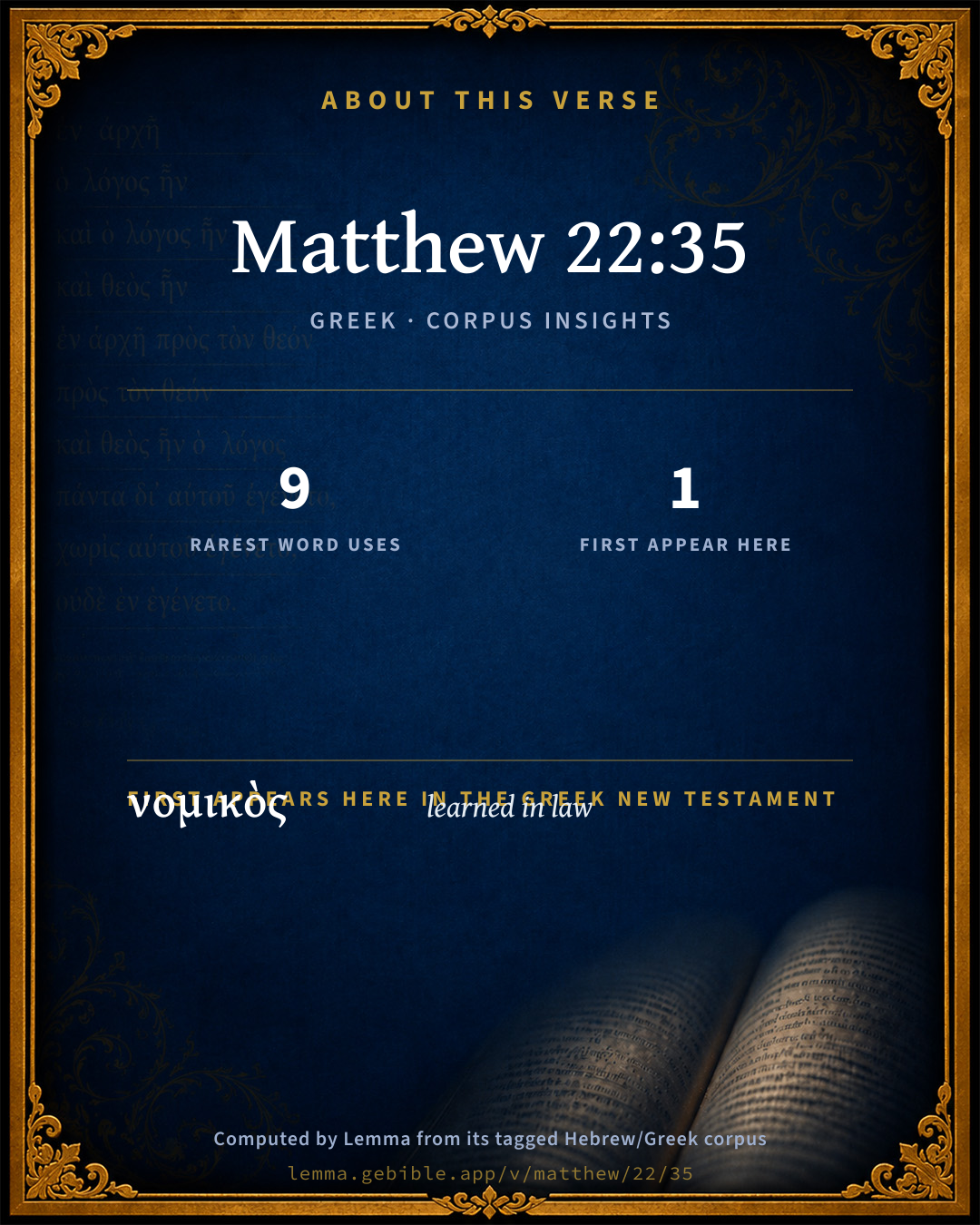
Matthew 22:35

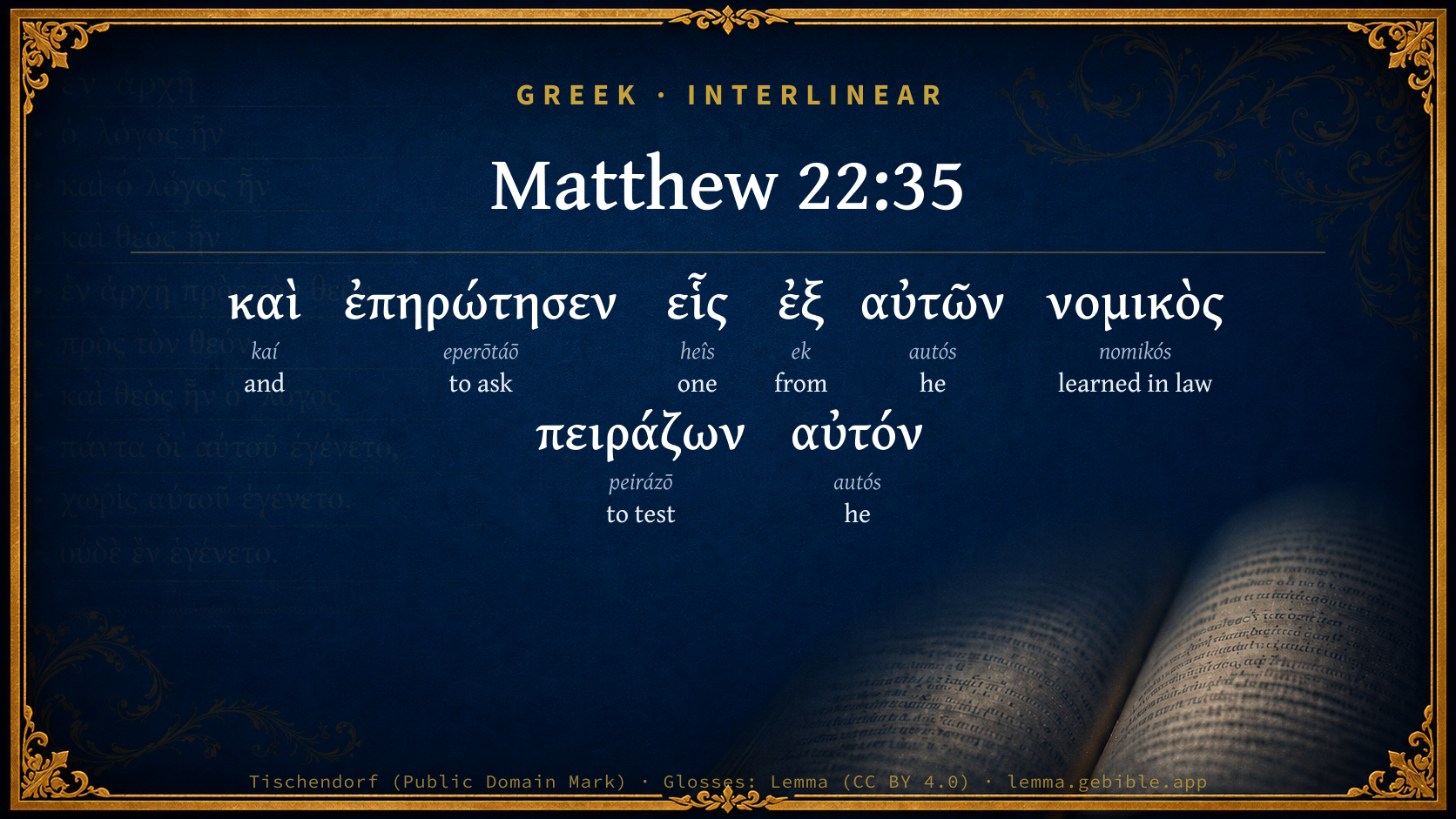
Greek (Tischendorf 8th ed.) Matthew 22:35 appears in the Greek New Testament. The text above is from the Tischendorf 8th edition. Each word links to its Strong’s number and a concise gloss. Click any word for its full Thayer’s Greek Lexicon entry.
Download image
Cite this verse

Matthew 22:35 (World English Bible). Public Domain. Lemma interlinear Bible study tool, https://lemma.gebible.app/v/matthew/22/35.

Show BibTeX & RIS
BibTeX
RIS
English Translation
One of them, a lawyer, asked him a question, testing him.
World English Bible · Public Domain
Highlights
  • 1 first appearance in the Greek New Testament
Full analysis ↓
Download a study sheet

One document with this verse’s original text, its word-by-word gloss line, the meaning frame, cross-references with their text, attributed commentary, and full source and license credits — printable, and it pastes into notes with its structure intact.

This verse Autodidact and up

Study sheet (.html) Plain text (.txt)

A passage Seminary Student

Up to 50 verses in one chapter. A passage sheet keeps up to 6 commentary sources and 12 cross-references per verse, in the order this page ranks them, and says so on the sheet whenever that leaves anything out. Ask for a single verse and you get the Autodidact verse sheet above.

Everything on this page stays free to read, with no account — the sheet is a download of what is already on screen, not access to it.

Want to remove ads? Support Godless Engineer
Compare translations 3

The same verse in 3 English versions, stacked beneath the original-language interlinear above. Click any original word for its lexicon entry.

Each is an independent rendering of the whole verse — the interlinear is not word-aligned to these translations.

Highlighted words mark where these versions differ — a whole-verse word diff, not a word-by-word alignment.

  • World English Bible Public Domain
    One of them, a lawyer, asked him a question, testing him.
  • King James Version Public Domain
    Then one of them, which was a lawyer, asked him a question, tempting him, and saying,
  • unfoldingWord Literal Text CC BY-SA 4.0
    And one of them, a lawyer, questioned, testing him—

unfoldingWord Literal Text — © unfoldingWord, licensed CC BY-SA 4.0. Word-aligned USFM3 via Door43 (git.door43.org/unfoldingWord/en_ult).

Versions to compare (up to 4)

3 of 4 selected

Show all 19 translations

Every available English version of this verse, each an independent rendering of the whole verse.

  • World English Bible Public Domain
    One of them, a lawyer, asked him a question, testing him.
  • Berean Standard Bible Public Domain
    One of them, an expert in the law, tested Him with a question:
  • Majority Standard Bible Public Domain
    One of them, an expert in the law, tested Him with a question:
  • King James Version Public Domain
    Then one of them, which was a lawyer, asked him a question, tempting him, and saying,
  • American Standard Version (1901) Public Domain
    And one of them, a lawyer, asked him a question, trying him:
  • Revised Version (1885) Public Domain
    And one of them, a lawyer, asked him a question, tempting him,
  • Geneva Bible (1599) Public Domain
    And one of them, which was an expounder of the Lawe, asked him a question, tempting him, and saying,
  • Douay-Rheims (1899) Public Domain
    And one of them, a doctor of the law, asking him, tempting him:
  • Young's Literal Translation Public Domain
    and one of them, a lawyer, did question, tempting him, and saying,
  • Literal Standard Version CC BY-SA 4.0
    and one of them, a lawyer, questioned, tempting Him, and saying,
  • Unlocked Literal Bible CC BY-SA 4.0
    One of them, a lawyer, asked him a question, testing him—
  • unfoldingWord Literal Text CC BY-SA 4.0
    And one of them, a lawyer, questioned, testing him—
  • Darby Bible Public Domain
    And one of them, a lawyer, demanded, tempting him, and saying,
  • World Messianic Bible Public Domain
    One of them, a Torah scholar, asked him a question, testing him.
  • Webster's Bible Public Domain
    Then one of them who was a lawyer, asked him a question, tempting him, and saying,
  • Free Bible Version CC BY-SA 4.0
    One of them, who was a legal expert, asked him a question to try to trap him:
  • Bible in Basic English Public Domain
    And one of them, a teacher of the law, put a question to him, testing him, and saying,
  • Text-Critical English NT CC BY 4.0
    And one of them, a lawyer, asked Jesus a question to test him:
  • Tyndale New Testament (1534) Public Domain
    and one of them which was a doctoure of lawe axed a question temptinge him and sayinge:

Literal Standard Version (2020), Covenant Press — licensed CC BY-SA 4.0. Text via the HelloAO Bible API (eBible.org). Unlocked Literal Bible (unfoldingWord) — licensed CC BY-SA 4.0. Text via the HelloAO Bible API (eBible.org). unfoldingWord Literal Text — © unfoldingWord, licensed CC BY-SA 4.0. Word-aligned USFM3 via Door43 (git.door43.org/unfoldingWord/en_ult). Free Bible Version, Dr. Jonathan Gallagher — licensed CC BY-SA 4.0. Text via the HelloAO Bible API (eBible.org).

Word by word

More ways to search: Search by grammar → Find every occurrence → Compare this word →

Practice this passage: Drill this verse → Learn its vocabulary →

About this verse

These counts appear in no published source. They are computed here, from the morphology-tagged text and Lemma’s own curated glosses. What Lemma adds →

8
words
7
distinct lemmas
Gospels
section

Notable vocabulary

The rarest word here is νομικὸς learned in law G3544 — appearing just 9 times in the whole Greek New Testament.

First appearance in Scripture

This word makes its first canonical appearance in the Greek New Testament here:

  • νομικὸς learned in law G3544

Shared distinctive vocabulary

νομικὸς learned in law G3544 occurs in 9 verses of the Greek New Testament. Also found in:

Repetition

A word recurs within this verse:

  • αὐτῶν he G846 ×2

Cross-references

7

Topical passages linked to Matthew 22:35 in the Treasury of Scripture Knowledge — connected by theme and wording, ordered by reader-vote popularity; previews shown in the World English Bible.

  • Luke 7:30 But the Pharisees and the lawyers rejected the counsel of God, not being baptized by him themselves.
  • Luke 10:25–37 Behold, a certain lawyer stood up and tested him, saying, "Teacher, what shall I do to inherit eternal life?"
  • Luke 11:45–46 One of the lawyers answered him, "Teacher, in saying this you insult us also."
  • Luke 11:52 Woe to you lawyers! For you took away the key of knowledge. You didn't enter in yourselves, and those who were entering in, you hindered."
  • Luke 14:3 Jesus, answering, spoke to the lawyers and Pharisees, saying, "Is it lawful to heal on the Sabbath?"
  • Matthew 22:18 But Jesus perceived their wickedness, and said, "Why do you test me, you hypocrites?
  • Titus 3:13 Send Zenas, the lawyer, and Apollos on their journey speedily, that nothing may be lacking for them.

Cross-references courtesy of OpenBible.info (CC BY 4.0).

Commentary

Notes on Matthew 22:35 from classic Christian and Jewish commentators (each source and its license shown beneath its notes). The classic Christian expositions comment on the surrounding passage and are grouped to its opening verse, so a note may address several verses; the Jewish commentaries on the Tanakh (Rashi and others) are per-verse, so they appear only where the commentator wrote on this verse.

Lemma curates 59 commentaries, every one of them public domain or Creative Commons licensed, each selected and text-cleaned for this edition rather than reprinted as found. About our sources →

Bengel's Gnomon

Johann Albrecht Bengel

Mat 22:35. Εἷς ἐξ αὐτῶν, one of them) This man is less blamed by our Lord; wherefore he seems to have been led on by others.—νομικὸς, a lawyer) How great soever he was, and proud of that abundance of knowledge which he was now about to exhibit.—νομικὸς = γραμματεύς, a scribe, in Luk 11:45; Luk 11:44; Luk 11:53; and νομοδιδάσκαλος, a doctor of the law, in Luk 5:17; Luk 5:21.

Bengel's Gnomon of the New Testament — English translation (T&T Clark, Edinburgh, 1860) — public domain. Text from a community e-Sword module.

Meyer's Critical & Exegetical Commentary

Heinrich August Wilhelm Meyer

Mat_22:35. Νομικός] the only instance in Matt.; it is met with in none of the other Gospels except that of Luke. It occurs, besides, in Tit_3:13. The word is used to signify one who is conversant with the law, ἐπιστήμων τῶν νόμων (Photius), Plut. Sull. 36; Strabo, xii. p. 539; Diog. L. vi. 54; Epictet. i. 13; Anthol. xi. 382. 19. It is impossible to show that there is any essential difference of meaning between this word and γραμματεύς (see note on Mat_2:4); comp. on the contrary, Luk_11:52-53.

The term νομικός is more specific (jurisconsultus), and more strictly Greek; γραμματεύς, on the other hand, is more general (literatus), and more Hebrew in its character (סֹפֵר). The latter is also of more frequent occurrence in the Apocr.; while the former is met with only in 4Ma_5:3. In their character of teachers they are designated νομοδιδάσκαλοι, Luk_5:17; Act_5:37; 1Ti_1:7.

πειράζων αὐτόν] different from Mar_12:28 ff., and indicating that the question was dictated by a malicious intention (Augustine, Grotius). The ensnaring character of the question was to be found in the circumstance that, if Jesus had specified any particular ποιότης of a great commandment (see on Mat_22:36), His reply would have been made use of, in accordance with the casuistical hair-splitting of the schools, for the purpose of assailing or defaming Him on theological grounds. He specifies, however, those two commandments themselves, in which all the others are essentially included, thereby giving His answer indirectly, as though He had said: supreme love to God, and sincerest love of our neighbour, constitute the ποιότης about which thou inquirest. This love must form the principle, spirit, life of all that we do.

Meyer — Critical and Exegetical Commentary on the New Testament — English translation by Peter Christie, edited by Frederick Crombie (T&T Clark, 1880) — public domain. Text from a community e-Sword module.

Expositor's Greek Testament

ed. W. Robertson Nicoll

Mat 22:35 . εἷς ἐξ αὐτῶν one of the men who met together to consult, after witnessing the discomfiture of the scribes, acting in concert with them, and hoping to do better. νομικὸς : here only in Mt., several times in Lk. for the scribe class = a man well up in the law.

The Expositor's Greek Testament, edited by W. Robertson Nicoll (1897–1910) — public domain. Text from a community e-Sword module.

Geneva Bible (1599)

Geneva Bible translators

A scribe, so saith Mark 12:28, now what a scribe is, see Matt. 2:4.

Geneva Bible (1599) marginal notes — public domain. Text via Bolls.life.

Adam Clarke's Commentary

Verse 35. A lawyer] νομικος, a teacher of the law. What is called lawyer, in the common translation, conveys a wrong idea to most readers: my old MS. renders the word in the same way I have done. These teachers of the law were the same as the scribes, or what Dr. Wotton calls letter-men, whom he supposes to be the same as the Karaites, a sect of the Jews who rejected all the traditions of the elders, and admitted nothing but the written word. See Wotton's Mishna, vol. i. p. 78. These are allowed to have kept more closely to the spiritual meaning of the law and prophets than the Pharisees did; and hence the question proposed by the lawyer, (Mark, Mr 12:28, calls him one of the scribes,) or Karaite, was of a more spiritual or refined nature than any of the preceding.

Adam Clarke's Commentary on the Bible (1810–1826) — public domain. Text from a community e-Sword/MySword module.

Ellicott's Commentary for English Readers

(35) A lawyer.—The precise distinction between the “lawyer” and the other scribes rested, probably, on technicalities that have left little or no trace behind them. The word suggests the thought of a section of the scribes who confined their attention to the Law, while the others included in their studies the writings of the Prophets also. In Luk_7:30; Luk_11:45, they appear as distinct from the Pharisees. The question asked by the “lawyer” here and in Luk_10:25 falls in with this view. So it would seem, in Tit_3:13, that Zenas the “lawyer” was sent for to settle the strivings about the Law that prevailed in Crete.

Tempting him.—There does not appear to have been in this instance any hostile purpose in the mind of the questioner; nor does the word necessarily imply it. (Comp. Joh_6:6; 2Co_13:5, where it is used in the sense of “trying,” “examining.”) It would seem, indeed, as if our Lord’s refutation of the Sadducees had drawn out a certain measure of sympathy and reverence from those whose minds were not hardened in hypocrisy. They came now to test His teaching on other points. What answer would He give to the much-debated question of the schools, as to which was the great commandment of the Law? Would He fix on circumcision, or the Sabbath, or tithes, or sacrifice, as that which held the place of pre-eminence? The fact that they thus, as it were, examined Him as if they were His judges, showed an utterly imperfect recognition of His claims as a Prophet and as the Christ; but the “lawyer” who appeared as their representative was, at least, honest in his purpose, and “not far from the kingdom of God” (Mar_12:34).

A Bible Commentary for English Readers, edited by Charles John Ellicott (1878–1897) — public domain. Text from a community e-Sword module.

The Cambridge Bible for Schools and Colleges

gen. ed. J. J. S. Perowne

35. one of them, which was a lawyer] i. e. an interpreter of the written law, as distinguished from the “traditions” or unwritten law.

The Cambridge Bible for Schools and Colleges (gen. ed. J. J. S. Perowne; Cambridge University Press, 1878–1918) — public domain. Text from a community e-Sword module.

John Gill's Exposition

This is the first and great commandment. Whether the object of it is considered, who is the first and chief good; or the manner in which it is to be observed, which requires and engrosses the whole heart, soul, and mind, and all the strength and power of man; or its being the principle from whence all the duties, and actions of men should flow, and the end to which all are to be referred; and is not only a compendium of the duties of the first table of the decalogue, but of all others that can be thought to, and do, belong to God. This is the first command in order of nature, time, dignity, and causality; God being the first cause of all things, infinitely above all creatures, and love to him being the source, spring and cause of love to the neighbour; and it is the greatest in its object, nature, manner, and end. That this command, and these words our Lord cites, are so full and comprehensive, the Jews themselves cannot deny. A noted writer of their's (x) says,

"the root of "all the commandments" is, when a man loves God with all his soul, and cleaves unto him.

And, says (y) another,

"in this verse only, "thou shalt love the Lord thy God", &c,

, "the ten words, or decalogue, are comprehended".

(x) Aben Ezra in Exod. xxxi. 18. (y) Tzeror Hammor, fol. 138. 1.

John Gill's Exposition of the Whole Bible (1746–1763) — public domain (CC PDM 1.0). Text via the HelloAO Bible API.

Trapp's Complete Commentary

John Trapp

35 Then one of them, which was a lawyer, asked him a question, tempting him, and saying,

Ver. 35. Then one of them which was a lawyer] Pareus gathereth out of Mark, Mar 12:28, that this lawyer was one of them that had applauded Christ for his conquest over the Sadducees in the last conflict, Luk 20:39, and that for a penance he was enjoined by his fellow Pharisees to undertake this following disputation with Christ: Ad liberandum igitur se uspicione, partes disputandi adversus eum nunc ibi imponi a collegio patitur.

Tempting him, and saying] Saint Peter saith, "They found no guile in his mouth," which implies that they sought it, 1Pe 2:22. There are those who hear us merely to catch, cavil, and quarrel.

John Trapp, A Commentary or Exposition upon All the Books of the Old and New Testament (1647–1656) — public domain. Text from a community e-Sword module.

Whedon's Commentary on the Bible

Daniel D. Whedon

35. One of them — Who seems to have been of their party, and knew too their plots and plans. He will try Jesus with a profound question, and fairly see what is his depth. A lawyer — One who was professedly well read in the law of Moses.

Daniel D. Whedon (gen. ed.), Commentary on the Old and New Testaments (1874–1909) — public domain. Text from a community e-Sword module.

The Pulpit Commentary

A lawyer; nomikov , called by St. Mark "a scribe a term of wider signification, which would include "lawyers." Vulgate, legis doctor, which gives the right sense; for such were teachers and expounders of the Mosaic Law. This man was put forth by the Pharisees as an expert, who would not be so easily discomfited as the Sadducees had been. Tempting him. Trying him; (comp. 1Ki_10:1) putting him to the test, not altogether maliciously, but partly from curiosity, and partly from a desire to hear Christ"s opinion on a much disputed point. It is evident, from St. Mark"s account, that Christ was pleased with him personally, for he said to him, "Thou art not far from the kingdom of God." Those who put this lawyer forward had, of course, sinister motives, and hoped to make capital from Christ"s answer; but the man himself seems to have been straightforward and honest. We have had the terra "tempting" used in a hostile sense, (Mat_16:1 Mat_19:3) but there is no necessity for so taking it; and it seems to imply here merely the renewal of the attack on Christ.

The Pulpit Commentary (1880–1919), ed. H.D.M. Spence-Jones & Joseph S. Exell — public domain. Text from a community e-Sword module.

John Wesley's Explanatory Notes

A scribe asking him a question, trying him - Not, as it seems, with any ill design: but barely to make a further trial of that wisdom, which he had shown in silencing the Sadducees.

John Wesley, Explanatory Notes Upon the Whole Bible (1754–1765) — public domain. Text via the GEBible commentary corpus.

Scofield Reference Notes

C. I. Scofield

lawyer

(Greek - νομικός," "of the law"; occurs also Luk 7:30; Luk 10:25; Luk 11:45; Luk 11:46; Luk 11:52; Luk 14:3; Tit 3:13. Except in the last instance, "lawyer" is another name for "scribe."

(See Scofield "Mat 2:4"). In Tit 3:13 the term has the modern meaning.

The Scofield Reference Bible (1917 edition), notes by C. I. Scofield — public domain. Text from a community e-Sword module.

The People's New Testament

B. W. Johnson

35. A lawyer. An expounder of the law of Moses. A scribe (see Mark). Tempting him. Trying him.

B. W. Johnson's The People's New Testament with Notes (1889–1891) — public domain. Electronic text from the Christian Classics Ethereal Library (CCEL) ThML edition.

Cambridge Greek Testament for Schools and Colleges

35. Omit καὶ λέγων before διδάσκαλε with אBL, versions, and patristic evidence.

35. εἷς ἐξ αὐτῶν νομικός, i.e. an interpreter of the written law, as distinguished from the ‘traditions’ or unwritten law.

Cambridge Greek Testament for Schools and Colleges (Cambridge University Press, 1896; 21 vols, various authors incl. Carr, Maclear, Plummer, Farrar, Lumby, Moule, M. R. James, Simcox) — public domain. Text from a community e-Sword module.

Alford’s Greek Testament

Henry Alford

35. νομικός] These were Mosaic jurists, whose special province was the interpretation of the Law. γραμματεύς is a wider term, including them.

πειράζων] see above.

Henry Alford, The Greek Testament (1849–1861) — public domain. Text from a community e-Sword module.

International Critical Commentary

35. And one of them asked Him, testing Him.]

Mk. here records the story of a scribe who, approving of Christ’s answers, himself asked a question, and expressed great approval of the answer which he received. The story ends with a statement of Christ’s appreciation of the character of His questioner. In Mt. the incident takes a different turn. The Pharisees gather together, and one of them puts a question to Christ, testing Him. The whole of Mk.’s continuation of the narrative after Christ’s answer is omitted. It is difficult to see in the continual mention of the Pharisees in Mt. any other purpose than a desire to prepare the way for the chapter of denunciation of the scribes and Pharisees which is to follow in ch. 23. Cf. 21:45 “the chief priests and the Pharisees,” 22:15 “the Pharisees,” 34 “the Pharisees,” 41 “the Pharisees.” This may account for the unfavourable view taken here of Mk.’s scribe. He was a Pharisee, and came to Christ with hostile intent. Consequently the approval expressed of him by Christ must be dropped, and with it goes what may have seemed to the editor the somewhat patronising words of the scribe in Mar 12:32, Mar 12:33. Cf. the omission of the reproachful οὐ μέλει σοι from Mar 4:38 = Mat 8:25, and of the somewhat sarcastic question from Mar 6:37 = Mat 14:17.

In this way Mat 22:34-40 might be explained as due to editorial revision of Mar 12:28-34. But another factor has to be taken into account. Lk. in the parallel to Mk. abbreviates the whole section into one sentence: “And certain of the scribes answered and said, Teacher, Thou hast well said. For no one dared to ask Him anything.” Two reasons for this shortening may be conjectured—(a) Lk. found Mk.’s narrative to be not free from objection; (b) he had already inserted a similar story free from the objectionable element in 10:25-27. Now, Luk 10:25-27 agrees in some points with Mat 22:34-40 against Mar_12. In both, according to the usual text, the questioner is described as νομικός. In both he comes to test Christ—πειράζων, Mt 35; ἐκπειράζων, Lk 25. Both stories have a definite reference to the law, ἐν τῷ νόμῳ; and both omit the quotation from Deu 6:4, and partially assimilate Mk.’s quotation of Deu 6:5 to the Hebrew by substituting ἐν for Mk.’s ἐκ (= LXX.). Lk., however, has both prepositions. These facts are rather difficult to explain. We might suppose that Mt. and Lk. were both acquainted with a narrative of a lawyer who came to tempt Christ. Lk. inserted it in ch. 10, and afterwards omitted the somewhat similar narrative of Mar_12, whilst Mt. substituted it for the story of Mar_12. Or Mt.’s text may be regarded as a revision of Mk.’s, and Luk 10:25-27 may be entirely independent, or affected by reminiscence of Mt. and Mk. on the part of Lk.

(M?)

35. νομικός, Om. 1 e S1 Arm Orig. The word occurs seven times in Lk., not in Mk., nor elsewhere in Mt.

International Critical Commentary — older volumes (1896–1929), various authors — public domain. Text from a community e-Sword module.

Lesson kit

Teaching starters — assembled from the data on this page, not authored interpretation. Every prompt links to the verse data it draws on. Edit before teaching.

Matthew, in the Gospels, opens this verse with 8 words (7 distinct Greek lemmas). Its most distinctive word is nomikós (“learned in law”). A historical commentator’s framing appears above. Read the whole chapter for the surrounding context.

Discussion questions

  1. What does “learned in law” (nomikós) contribute to the verse as a whole?
  2. The word “learned in law” first appears here in Scripture. What is being introduced at this debut?
  3. Luke 7:30 shares the word «learned in law» with this verse. How do the two illuminate each other?
  4. “he” occurs 2× in this one verse. What is the effect of the repetition?
  5. These translations render this verse differently; the difference is in the English rendering, not the original. What questions does that raise?
  6. Reading how Bengel's Gnomon and Meyer's Critical & Exegetical Commentary read this verse, where do the two commentators agree and where do they part?

Things to notice

  • 1 word makes its first canonical appearance in Scripture here.
  • These translations choose different wording for 7 words in this verse.
  • “he” occurs 2× in this single verse.
  • 7 distinct Greek lemmas span 8 words in this verse.

Reading settings

Reading text

Shown beneath each verse's original-language words.

Old Testament
Old Testament edition

Read the OT as the Masoretic Hebrew (MT) or the Greek Septuagint (LXX).

English shown for the Greek Septuagint (in the Hebrew ↔ Greek comparison).

Comparing translations? Open the Compare panel on any verse page to stack up to four side by side.