
Matthew 21:9

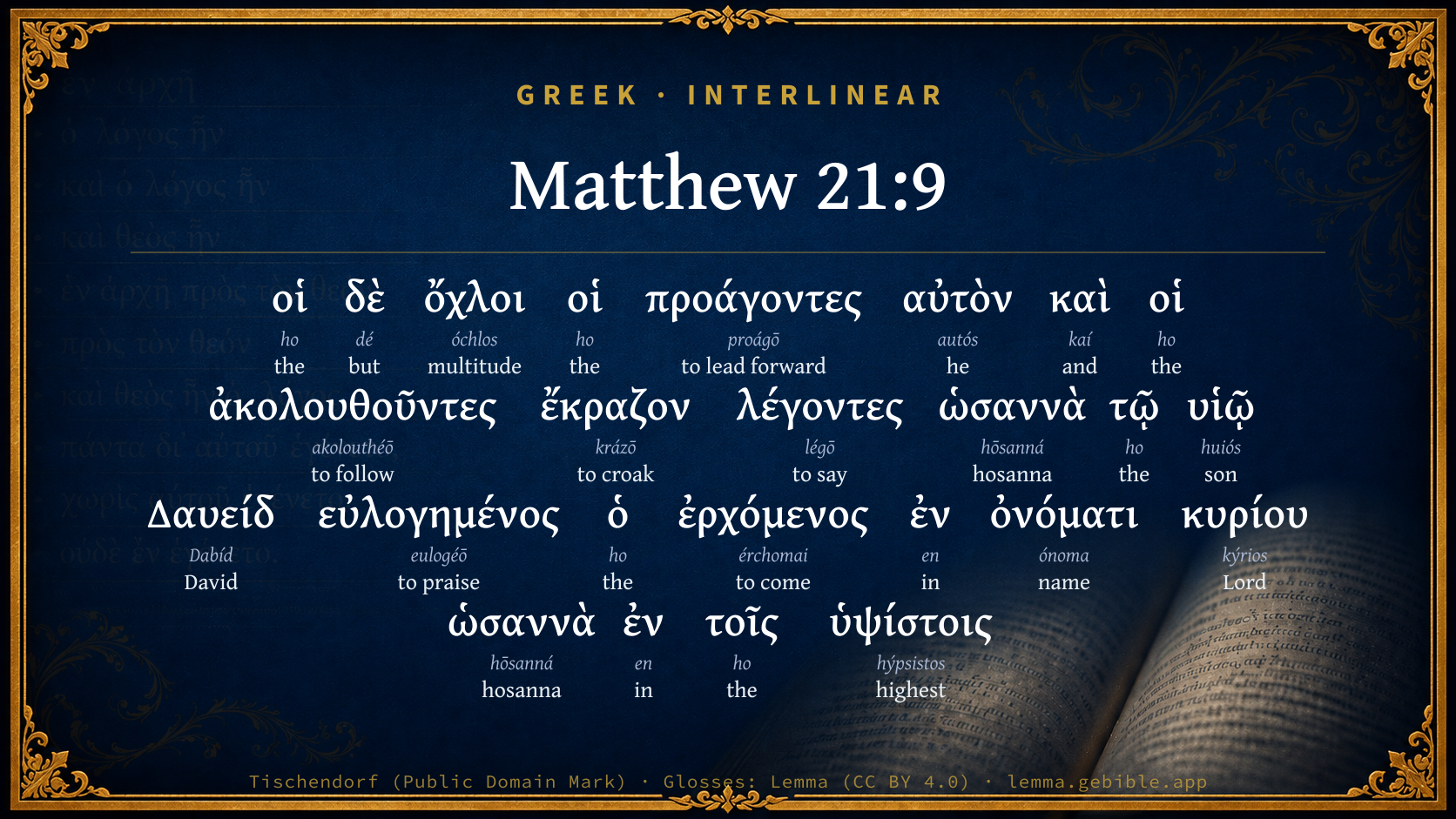
Greek (Tischendorf 8th ed.) Matthew 21:9 appears in the Greek New Testament. The text above is from the Tischendorf 8th edition. Each word links to its Strong’s number and a concise gloss. Click any word for its full Thayer’s Greek Lexicon entry.
Download image
Cite this verse

Matthew 21:9 (World English Bible). Public Domain. Lemma interlinear Bible study tool, https://lemma.gebible.app/v/matthew/21/9.

Show BibTeX & RIS
BibTeX
RIS
English Translation
The multitudes who went before him, and who followed kept shouting, "Hosanna to the son of David! Blessed is he who comes in the name of the Lord! Hosanna in the highest!"
World English Bible · Public Domain
Highlights
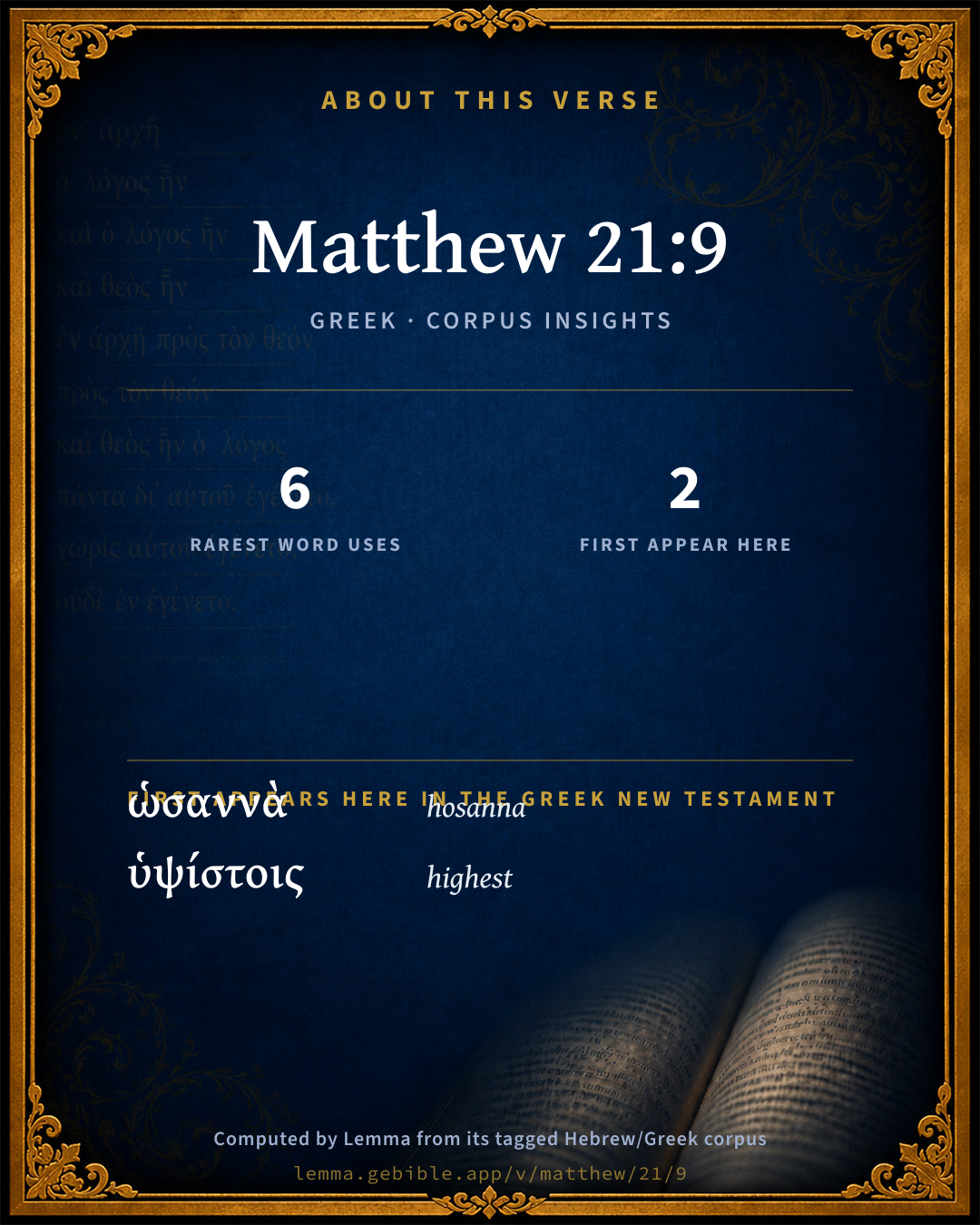
  • 2 first appearances in the Greek New Testament
Full analysis ↓
Download a study sheet

One document with this verse’s original text, its word-by-word gloss line, the meaning frame, cross-references with their text, attributed commentary, and full source and license credits — printable, and it pastes into notes with its structure intact.

This verse Autodidact and up

Study sheet (.html) Plain text (.txt)

A passage Seminary Student

Up to 50 verses in one chapter. A passage sheet keeps up to 6 commentary sources and 12 cross-references per verse, in the order this page ranks them, and says so on the sheet whenever that leaves anything out. Ask for a single verse and you get the Autodidact verse sheet above.

Everything on this page stays free to read, with no account — the sheet is a download of what is already on screen, not access to it.

Want to remove ads? Support Godless Engineer
Compare translations 3

The same verse in 3 English versions, stacked beneath the original-language interlinear above. Click any original word for its lexicon entry.

Each is an independent rendering of the whole verse — the interlinear is not word-aligned to these translations.

Highlighted words mark where these versions differ — a whole-verse word diff, not a word-by-word alignment.

  • World English Bible Public Domain
    The multitudes who went before him, and who followed kept shouting, "Hosanna to the son of David! Blessed is he who comes in the name of the Lord! Hosanna in the highest!"
  • King James Version Public Domain
    And the multitudes that went before, and that followed, cried, saying, Hosanna to the son of David: Blessed is he that cometh in the name of the Lord; Hosanna in the highest.
  • unfoldingWord Literal Text CC BY-SA 4.0
    Now the crowds going before him and following were crying out, saying, “Hosanna to the Son of David! Blessed is the one coming in the name of the Lord! Hosanna in the highest!”

unfoldingWord Literal Text — © unfoldingWord, licensed CC BY-SA 4.0. Word-aligned USFM3 via Door43 (git.door43.org/unfoldingWord/en_ult).

Versions to compare (up to 4)

3 of 4 selected

Show all 19 translations

Every available English version of this verse, each an independent rendering of the whole verse.

  • World English Bible Public Domain
    The multitudes who went before him, and who followed kept shouting, "Hosanna to the son of David! Blessed is he who comes in the name of the Lord! Hosanna in the highest!"
  • Berean Standard Bible Public Domain
    The crowds that went ahead of Him and those that followed were shouting: “Hosanna to the Son of David!” “Blessed is He who comes in the name of the Lord!” “Hosanna in the highest!”
  • Majority Standard Bible Public Domain
    The crowds that went ahead of Him and those that followed were shouting: “Hosanna to the Son of David!” “Blessed is He who comes in the name of the Lord!” “Hosanna in the highest!”
  • King James Version Public Domain
    And the multitudes that went before, and that followed, cried, saying, Hosanna to the son of David: Blessed is he that cometh in the name of the Lord; Hosanna in the highest.
  • American Standard Version (1901) Public Domain
    And the multitudes that went before him, and that followed, cried, saying, Hosanna to the son of David: Blessed `is' he that cometh in the name of the Lord; Hosanna in the highest.
  • Revised Version (1885) Public Domain
    And the multitudes that went before him, and that followed, cried, saying, Hosanna to the son of David: Blessed is he that cometh in the name of the Lord; Hosanna in the highest.
  • Geneva Bible (1599) Public Domain
    Moreouer, the people that went before, and they also that followed, cried, saying, Hosanna to the Sonne of Dauid, Blessed be hee that commeth in the Name of the Lord, Hosanna thou which art in the highest heauens.
  • Douay-Rheims (1899) Public Domain
    And the multitudes that went before and that followed, cried, saying: Hosanna to the son of David: Blessed is he that cometh in the name of the Lord: Hosanna in the highest.
  • Young's Literal Translation Public Domain
    and the multitudes who were going before, and who were following, were crying, saying, `Hosanna to the Son of David, blessed is he who is coming in the name of the Lord; Hosanna in the highest.'
  • Literal Standard Version CC BY-SA 4.0
    and the multitudes who were going before, and who were following, were crying, saying, “Hosanna to the Son of David, blessed is He who is coming in the Name of the LORD; Hosanna in the highest!”
  • Unlocked Literal Bible CC BY-SA 4.0
    Then the crowds that went before Jesus and those that followed him were shouting, “Hosanna to the son of David! Blessed is the one who comes in the name of the Lord! Hosanna in the highest!”
  • unfoldingWord Literal Text CC BY-SA 4.0
    Now the crowds going before him and following were crying out, saying, “Hosanna to the Son of David! Blessed is the one coming in the name of the Lord! Hosanna in the highest!”
  • Darby Bible Public Domain
    And the crowds who went before him and who followed cried, saying, Hosanna to the Son of David; blessed [be] he who comes in the name of [the] Lord; hosanna in the highest.
  • World Messianic Bible Public Domain
    The multitudes who went in front of him, and those who followed, kept shouting, “Hoshia'na to the son of David! Blessed is he who comes in the name of the Lord! Hoshia'na in the highest!”
  • Webster's Bible Public Domain
    And the multitudes that went before, and that followed, cried, saying, Hosanna to the son of David: blessed is he that cometh in the name of the Lord: Hosanna in the highest.
  • Free Bible Version CC BY-SA 4.0
    The crowds that went ahead of him and those that followed were all shouting, “Hosanna to the son of David! Blessed is he who comes in the name of the Lord! Hosanna in the highest!”
  • Bible in Basic English Public Domain
    And those who went before him, and those who came after, gave loud cries, saying, Glory to the Son of David: A blessing on him who comes in the name of the Lord: Glory in the highest.
  • Text-Critical English NT CC BY 4.0
    The crowds that went ahead of him and those that followed were crying out, “Hosanna to the Son of David! Blessed is he who comes in the name of the Lord! Hosanna in the highest!”
  • Tyndale New Testament (1534) Public Domain
    Moreover the people that went before and they also that came after cryed sayinge: Hosanna to the sonne of David. Blessed be he that cometh in the name of the Lorde Hosanna in the hyest.

Literal Standard Version (2020), Covenant Press — licensed CC BY-SA 4.0. Text via the HelloAO Bible API (eBible.org). Unlocked Literal Bible (unfoldingWord) — licensed CC BY-SA 4.0. Text via the HelloAO Bible API (eBible.org). unfoldingWord Literal Text — © unfoldingWord, licensed CC BY-SA 4.0. Word-aligned USFM3 via Door43 (git.door43.org/unfoldingWord/en_ult). Free Bible Version, Dr. Jonathan Gallagher — licensed CC BY-SA 4.0. Text via the HelloAO Bible API (eBible.org).

Word by word

More ways to search: Search by grammar → Find every occurrence → Compare this word →

Practice this passage: Drill this verse → Learn its vocabulary →

ὡσαννὰ
hōsanná
G5614
“hosanna”
Hebrew transliteration
Part of Speech
Hebrew transliteration
Full Thayer's Definition

Origin: of hebrew origin H3467 and G4994

TDNT: 20:22,1

1. hosanna 2. be propitious
  1. οἱ ho G3588 “the” Article, Nominative, Plural, Masculine
  2. δὲ dé G1161 “but” Conjunction
  3. ὄχλοι óchlos G3793 “multitude” Noun, Nominative, Plural, Masculine
  4. οἱ ho G3588 “the” Article, Nominative, Plural, Masculine
  5. προάγοντες proágō G4254 “to lead forward” Verb, Present, Active, Participle, Nominative, Plural, Masculine
  6. αὐτὸν autós G846 “he” Personal pronoun, Accusative, Singular, Masculine
  7. καὶ kaí G2532 “and” Conjunction
  8. οἱ ho G3588 “the” Article, Nominative, Plural, Masculine
  9. ἀκολουθοῦντες akolouthéō G190 “to follow” Verb, Present, Active, Participle, Nominative, Plural, Masculine
  10. ἔκραζον krázō G2896 “to croak” Verb, Imperfect, Active, Indicative, 3rd person, Plural
  11. λέγοντες légō G3004 “to say” Verb, Present, Active, Participle, Nominative, Plural, Masculine
  12. τῷ ho G3588 “the” Article, Dative, Singular, Masculine
  13. υἱῷ huiós G5207 “son” Noun, Dative, Singular, Masculine
  14. Δαυείδ Dabíd G1138 “David” Noun, Proper, indeclinable
  15. εὐλογημένος eulogéō G2127 “to praise” Verb, Perfect, Passive, Participle, Nominative, Singular, Masculine
  16. ὁ ho G3588 “the” Article, Nominative, Singular, Masculine
  17. ἐρχόμενος érchomai G2064 “to come” Verb, Present, Middle or Passive deponent, Participle, Nominative, Singular, Masculine
  18. ἐν en G1722 “in” Preposition
  19. ὀνόματι ónoma G3686 “name” Noun, Dative, Singular, Neuter
  20. κυρίου kýrios G2962 “Lord” Noun, Genitive, Singular, Masculine
  21. ὡσαννὰ hōsanná G5614 “hosanna” Hebrew transliteration
  22. ἐν en G1722 “in” Preposition
  23. τοῖς ho G3588 “the” Article, Dative, Plural, Neuter
  24. ὑψίστοις hýpsistos G5310 “highest” Adjective, Dative, Plural, Neuter, Superlative

About this verse

These counts appear in no published source. They are computed here, from the morphology-tagged text and Lemma’s own curated glosses. What Lemma adds →

25
words
18
distinct lemmas
Gospels
section

Notable vocabulary

The rarest word here is ὡσαννὰ hosanna G5614 — appearing just 6 times in the whole Greek New Testament.

First appearance in Scripture

These words make their first canonical appearance in the Greek New Testament here:

  • ὡσαννὰ hosanna G5614
  • ὑψίστοις highest G5310

Shared distinctive vocabulary

ὡσαννὰ hosanna G5614 occurs in 5 verses of the Greek New Testament. Also found in:
Repetition

Words recur within this verse:

Cross-references

8

Topical passages linked to Matthew 21:9 in the Treasury of Scripture Knowledge — connected by theme and wording, ordered by reader-vote popularity; previews shown in the World English Bible.

  • Psalms 118:24–26 This is the day that Yahweh has made. We will rejoice and be glad in it!
  • Luke 2:14 "Glory to God in the highest, On earth peace, good will toward men."
  • John 12:13–15 they took the branches of the palm trees, and went out to meet him, and cried out, "Hosanna! Blessed is he who comes in the name of the Lord, the King of Israel!"
  • Matthew 23:39 For I tell you, you will not see me from now on, until you say, 'Blessed is he who comes in the name of the Lord!'"
  • Luke 19:37–38 As he was now getting near, at the descent of the Mount of Olives, the whole multitude of the disciples began to rejoice and praise God with a loud voice for all the mighty works which they had seen,
  • Matthew 9:27 As Jesus passed by from there, two blind men followed him, calling out and saying, "Have mercy on us, son of David!"
  • Matthew 21:15 But when the chief priests and the scribes saw the wonderful things that he did, and the children who were crying in the temple and saying, "Hosanna to the son of David!" they were indignant,
  • Mark 11:9–10 Those who went in front, and those who followed, cried out, "Hosanna! Blessed is he who comes in the name of the Lord!

Cross-references courtesy of OpenBible.info (CC BY 4.0).

Commentary

Notes on Matthew 21:9 from classic Christian and Jewish commentators (each source and its license shown beneath its notes). The classic Christian expositions comment on the surrounding passage and are grouped to its opening verse, so a note may address several verses; the Jewish commentaries on the Tanakh (Rashi and others) are per-verse, so they appear only where the commentator wrote on this verse.

Lemma curates 59 commentaries, every one of them public domain or Creative Commons licensed, each selected and text-cleaned for this edition rather than reprinted as found. About our sources →

Joseph Benson's Commentary

Mat 21:9-11. And the multitude that went before, and that followed — In this triumphal procession, cried, saying — Probably from a divine impulse; for certainly most of them understood not the words they uttered, Hosanna — (Lord, save us,) which was a solemn word in frequent use among the Jews. The meaning is, “We sing Hosanna to the son of David. Blessed is he, the Messiah, of the Lord. Save, thou that art in the highest heavens.” Our Lord restrained all public tokens of honour from the people till now, lest the envy of his enemies should interrupt his preaching before the time. But this reason now ceasing, he suffered their acclamations, that they might be a public testimony against their wickedness, who, in four or five days after, cried out, Crucify him, crucify him. The expressions recorded by the other evangelists are somewhat different from these: but all of them were undoubtedly used by some or others of the multitude. And all the city was moved — Was in a great commotion at so uncommon an appearance, saying, Who is this? — That comes in all this pomp, and is attended with these high congratulations And the multitude — Namely, that came along with him, said, This is Jesus the prophet of Nazareth — What a stumbling- block was this! If he was of Nazareth? he could not be the Messiah. But they who earnestly desired to know the truth would not stumble thereat: for, upon inquiry, (which such would not fail to make,) they would find, he was not of Nazareth, but Bethlehem. Thus Sion’s king comes to Sion; and the daughter of Sion had notice of his coming long before; and yet he is not attended by the great ones of the country, nor met by the magistrates of the city in their formalities, as might have been expected. The keys of the city are not presented to him, nor is he conducted, as he ought to have been, with all possible ceremony, to the thrones of judgment, the thrones of the house of David, Psa 122:5. Here is nothing of all this: yet he has his attendants; and those a very great multitude. But alas! they are only the common people (the rabble, we should have been apt to call them) that grace the solemnity of Christ’s triumph. The chief priests and elders are not among them. We find them afterward, indeed, intermixed with the multitude that reviled him when he hung on the cross, but none of them are here joining with the multitude that did him honour! Ye see, here, your calling, brethren; not many mighty, or noble, attend on Christ; but the foolish things of the world, and base things, and things that are despised. Such is what has been termed the triumph of Christ! But what sort of a triumph is it? Not like the triumphs of the potentates and conquerors of the world: but the triumph of humility, self-denial, meekness, and love, over the pride, vain glory, ambition, and selfishness of carnal and worldly- minded men.

Joseph Benson's Commentary on the Old and New Testaments (1811–1818) — public domain. Text from a community e-Sword module.

Bengel's Gnomon

Johann Albrecht Bengel

Mat 21:9.[913] Ὡσαννὰ, Hosanna) i.e. הושיעה נא, Save, I pray. The LXX. render Psalms 118(117):25—Ὦ ΚΎΡΙΕ ΣῶΣΟΝ ΔΉ· Ὦ ΚΎΡΙΕ ΕὐΌΔΩΣΟΝ ΔΉ)—O Lord, do save: O Lord, do give prosperity. The words, Ἰησοῦς, (Jesus) in Mat 21:11, נושע (having salvation) in Zec 9:9, and ὡσαννὰ, in the present verse, are all cognate terms.—τῷ, κ.τ.λ., to the, etc.) We sing Hosanna, say they (as was foretold by the prophets), to the Son of David. Agreeable to the account given by the Evangelists of our Lord’s entry, is that which Isidore Clarius says that he heard from a certain Jew, viz., that these words, “Hosanna! Blessed is He that cometh,” etc., were customarily said by the priests, when victims were offered for sacrifice. And the formula, Hosanna, was so frequently uttered, that they even gave that name to the branches which were carried about on the Feast of Tabernacles.[914]—εὑλογημένος, κ.τ.λ., blessed, etc.) Thus the LXX. in Psalms 118(117):26, which psalm formed part of the Hallel, or Paschal hymn, which they would have to recite in a few days’ time.—ἐν ὀνόματι, in the name) These words should be construed with εὐλογημένος, (blessed), according to the Hebrew accents.[915]—ἐν τοῖς ὑψίστοις, in the highest) Succour [us], O Thou who art in the highest.

[913] οἱ προάγοντες—ἀκολουθοῦντες, that went before—and that followed) Of whom the former had gone from the city to meet Him; the latter had gathered themselves together to Jesus, either at Jericho or elsewhere, as He was passing along.—V. g.

[914] Hartwell Horne says on this subject: “During the continuance of this feast, they carried in their hands branches of palm trees, olives, citrons, myrtles, and willows (Lev 23:40; Neh 8:15; 2Ma 10:7); singing, Hosanna, save I beseech thee (Psa 118:25); in which words they prayed for the coming of the Messiah. These branches also bore the name of Hosanna, as well as all the days of the Feast. In the same manner was Jesus Christ conducted into Jerusalem by the believing Jews, who, considering Him to be the promised Messiah, expressed their boundless joy at finding in Him the accomplishment of those petitions which they had so often offered to God for His coming, at the Feast of Tabernacles. (Mat 21:8-9.) During its continuance, they walked in procession round the altar with the above-mentioned branches in their hands, amid the sound of trumpets, singing Hosanna; and on the last, or seventh day of the Feast, they compassed the altar seven times. This was called the Great Hosanna. To this last ceremony St John probably alludes in Rev 7:9-10, where he describes the saints as standing before the Throne, “clothed with white robes, and palms in their hands; and saying, Salvation to our God, which sitteth upon the throne, and unto the Lamb.”—(I. B.)

[915] i.e. Bengel would render it, “Blessed in the name of the Lord, etc.” In a note to his German Version, he says, “That is, Let him, who cometh here, he in the name of the LORD blessed” For some account of the Hebrew Accents, see p. 132, f.n. 5.—(I. B.)

But Engl. Ver., “Cometh in the name of the Lord:” joining ἐν ὀνόματι, with ἑρχόμενος.—ED.

Bengel's Gnomon of the New Testament — English translation (T&T Clark, Edinburgh, 1860) — public domain. Text from a community e-Sword module.

Meyer's Critical & Exegetical Commentary

Heinrich August Wilhelm Meyer

Mat_21:9 ff. Ὡσαννά] הוֹשִׂיעָה נָא, Psa_118:25, bestow blessing!addressed to God. The dative is due to the meaning of the verb (opitulare) contained in ὡσαννά.

ὡσαννὰ ἐν τοῖς ὑψίστ.] Grant blessing in the highest places (Luk_2:14), i.e. in the highest heaven (Eph_4:10), where Thy throne is fixed, and from which let it descend upon the Messiah. The interpretation of Fritzsche, Olshausen: let blessing be proclaimed (by the angels) in heaven! is far-fetched. No less so is that of de Wette, Bleek: let Hosanna be confirmed in heaven, let it be ratified by God! Nor is ἐν τ. ὑψ. equivalent to ὁ ὢν τ. ὑψ. (grant blessing, O Thou who art in heaven), as Beza, Vatablus, Calovius, Bengel, Kuinoel, are disposed to think.

ἐν ὀνόμ. κυρίου] i.e. as sent by God to be His representative, Joh_5:43.

Speaking generally, the exclamation may be described as an outburst of enthusiasm expressing itself, in a free and impromptu manner, in language borrowed from the hymn for the feast of Tabernacles, Psalms 118. (Succoth iv. 5).

ἐσείσθη] was thrown into a state of commotion (Pind. Pyth. iv. 484; Soph. Ant. 163), on account of the sensation created by this Messianic entry into the city. The excitement was contagious.

ὁ προφήτης] the well-known prophet. The crowds that accompanied Him had, in most explicit terms, designated Him the Messiah; but the less interested people of the city wished above all to ascertain His name and rank. Hence the full reply, Ἰησοῦς … Γαλιλ., in which the ὁ ἀπὸ Ναζαρ. τ. Γαλιλ. doubtless betrays somewhat of the Galilean consciousness of the multitude, inasmuch as it was for most part composed of Galileans.

REMARK.

The triumphal entry of Jesus is not a final attempt to establish the Messianic kingdom in a political sense (Wolfenb. Fragm.), such a kingdom having been entirely foreign to His purpose and His function. It is rather to be regarded as His last public and solemn appearance as the Messiah,an appearance which, coming as it did immediately before His passion, was on the one hand a matter of deep personal interest because of the necessary bearing it was felt to have upon the mission of His life; while, if taken in connection with what happened so soon after, it was calculated, on the other hand, to destroy all expectations of a merely political kind. The time was now come when Jesus felt that, just because He was the Messiah, it behoved Him to do somethingand for this He appropriates the prophets symbol of the Prince of Peaceby way of contrast to His practice hitherto of forbidding the publication of His Messiahship. This step, which, from the fact of the crisis being so near, might now be taken without risk, He had postponed till the eve of His death,a circumstance of the utmost significance as regarded the sense in which His Messiahship was to be understood. This incident, too, was one of the things for which His hour had not previously come (Joh_6:15). Comp. note on Joh_7:5 f. Strauss asserts that there is here the possibility at least of a mythical story, though his objections are far from being to the point. See, on the other hand, Ebrard and Bleek. According to Wittichen, Jahrb. f. D. Theol. 1862, p. 365, Jesus did not intend this incident to be regarded in any other light than as an ordinary festival procession, but the multitude, without consulting Him, turned it into an occasion for a Messianic demonstration. This is not in keeping with the unusual preparations mentioned in Mat_21:2; comp. Mat_21:7.

Meyer — Critical and Exegetical Commentary on the New Testament — English translation by Peter Christie, edited by Frederick Crombie (T&T Clark, 1880) — public domain. Text from a community e-Sword module.

Expositor's Greek Testament

ed. W. Robertson Nicoll

Mat 21:9 . οἱ ὄχλοι : the crowd divided into two, one in front, one in rear, Jesus between. ἔκραζον : lip homage followed the carpeting of the way, in words borrowed from the Psalter (Psa 118:25-26 ), and variously interpreted by commentators. Ὡσαννὰ τῷ υἱῷ Δ . Hosanna (we sing) to the son of David (Bengel). εὐλογημένος , etc. (and we say), “Blessed, etc.,” repeating words from the Hallel used at the passover season. Ὡσαννὰ ἐν τοῖς ὑψίστοις = may our Hosanna on earth be echoed and ratified in heaven! All this homage by deed and word speaks to a great enthusiasm, the outcome of the Galilean ministry; for the crowd consists of Galileans. Perhaps the incident at Jericho, the healing of the blind men, and the vociferated title Son of David with which they saluted the Healer, gave the keynote. A little matter moves a crowd when it happens at the right moment. The mood of a festive season was on them.

The Expositor's Greek Testament, edited by W. Robertson Nicoll (1897–1910) — public domain. Text from a community e-Sword module.

Geneva Bible (1599)

Geneva Bible translators

Well be it to him that cometh in the name of the Lord, that is to say, whom the Lord hath given us for our king.

This was an ancient kind of crying which they used in the feast of Tabernacles, when they carried boughs according as God commanded, Lev. 23:40. And the word is corruptly made of two, for we should say, Hoshiangna, which is as much to say, as Save I pray thee.

Geneva Bible (1599) marginal notes — public domain. Text via Bolls.life.

Adam Clarke's Commentary

Verse 9. Hosanna to the son of David] When persons applied to the king for help, or for a redress of grievances, they used the word hosanna, or rather from the Hebrew הושיעה נא HOSHIAH NA! Save now! or, Save, we beseech thee! - redress our grievances, and give us help from oppression! Thus both the words and actions of the people prove that they acknowledged Christ as their king, and looked to him for deliverance. How easily might he have assumed the sovereignty at this time, had he been so disposed! For instances of the use of this form of speech, see 2Sa 14:4; 2Kg 6:26; Ps 118:25.

Son of David] A well-known epithet of the Messiah. He who cometh in the name, c. He who comes in the name and authority of the Most High.

Hosanna in the highest] Either meaning, Let the heavenly hosts join with us in magnifying this august Being! - or, Let the utmost degrees of hosanna, of salvation, and deliverance, be communicated to thy people! Probably there is an allusion here to the custom of the Jews in the feast of tabernacles. During the first seven days of that feast, they went once round the altar, each day, with palm and other branches in their hands, singing HOSANNA: but on the eighth day of that feast they walked seven times round the altar, singing the hosanna and this was termed the hosanna rabba, the GREAT hosanna: i.e. Assist with the greatest succour. Probably answering to the τοις υψιστοις of the evangelist, for on this day they beg the most speedy and powerful help against their enemies, and likewise pray for a prosperous and fruitful year. See STEHLIN'S Jewish Traditions, vol. ii. p. 322.

Adam Clarke's Commentary on the Bible (1810–1826) — public domain. Text from a community e-Sword/MySword module.

Ellicott's Commentary for English Readers

(9) Hosanna.—We gather, by comparing the four Gospels, the full nature of the mingled cries that burst from the multitude. (1.) As here, “Hosanna.” The word was a Hebrew imperative, “Save us, we beseech thee,” and had come into liturgical use from Psalms 118. That Psalm belonged specially to the Feast of Tabernacles (see Perowne on Psalms 118), and as such, was naturally associated with the palm-branches; the verses from it now chanted by the people are said to have been those with which the inhabitants of Jerusalem were wont to welcome the pilgrims who came up to keep the feast. The addition of “Hosanna to the Son of David” made it a direct recognition of the claims of Jesus to be the Christ; that of “Hosanna in the highest” (comp. Luk_2:14) claimed heaven as in accord with earth in this recognition. (2.) “Blessed be” (“the King” in St. Luke) “He that cometh in the name of the Lord.” These words, too, received a special personal application. The welcome was now given, not to the crowd of pilgrims, but to the King. (3.) As in St. Luke, one of the cries was an echo of the angels’ hymn at the Nativity, “Peace on earth, and glory in the highest” (Luk_2:14). (4.) As in St. Mark, “Blessed be the kingdom of our father David.” We have to think of these shouts as filling the air as He rides slowly on in silence. He will not check them at the bidding of the Pharisees (Luk_19:39), but His own spirit is filled with quite other thoughts than theirs. And those who watched Him saw the tears streaming down His cheeks as He looked on the walls and towers of the city, and heard, what the crowds manifestly did not hear, His lamentation over its coming fall (Luk_19:41).

A Bible Commentary for English Readers, edited by Charles John Ellicott (1878–1897) — public domain. Text from a community e-Sword module.

The Cambridge Bible for Schools and Colleges

gen. ed. J. J. S. Perowne

9. Hosanna] Hebr. “hoshiah-na,” “save now,” “save I pray.” Na is a particle of entreaty added to imperatives. They are the first words of Psa_118:25, “Save now I beseech thee, O Lord; O Lord, I beseech thee, send now prosperity,” a verse which was sung in solemn procession round the altar at the feast of Tabernacles and on other occasions. The multitude recognise the Messiah in Jesus and address to Him the strains of their most joyous festival. St Luke paraphrases the expression for his Gentile readers, “glory in the highest.”

Blessed is he that cometh in the name of the Lord] (Psa_118:26). “He that cometh” (Habba) was a recognised Messianic title. St Mark and St John add “Blessed be the kingdom of our father, David (‘the king of Israel,’ John), that cometh in the name of the Lord.” St Luke has “Blessed be the king that cometh,” &c., and mentions that the multitude began to rejoice and praise God with a loud voice for all the mighty works that they had seen.” These shouts of triumph—which are the “gospel” or heralding of the King—must have sounded across the valley of Kedron up to the precincts and porches of the Temple.

“Bethany stands in a shallow hollow scooped out of the shoulder of the hill. The path follows this till the descent begins at a turn where the first view of the Temple is caught. First appeared the castles and walls of the city of David; and immediately afterwards the glittering roof of the Temple and the gorgeous royal arcade of Herod with its long range of battlements overhanging the southern edge of Moriah.”—Tristram’s Topography of Holy Land.

The entry into Jerusalem must not be regarded as an isolated fact. It was a culminating outburst of feeling. It is clear that the expectation of the kingdom was raised to the highest pitch. The prostration of Salome at the feet of the Prince; the request of her sons; the dispute among the ten; the gathering crowds; the cry of Bartimæus; the triumphal entry, are all signs of this feeling.

For us the Royal Entry is a figure, a parable through external sights and sounds of the true and inner secret kingdom of God.

The Cambridge Bible for Schools and Colleges (gen. ed. J. J. S. Perowne; Cambridge University Press, 1878–1918) — public domain. Text from a community e-Sword module.

John Gill's Exposition

And the multitudes that went before,.... That is, that went before Christ; accordingly the Syriac, Arabic, Persic, and Ethiopic versions, and Munster's Hebrew Gospel, read, "that went before him": these seem to be the much people that met him from Jerusalem,

and that followed him; which were perhaps those that came from Jericho, and other parts;

cried, saying, Hosanna to the Son of David: by calling Jesus the Son of David, they owned and proclaimed him to be the Messiah; this being the usual title by which the Messiah was known among the Jews; see the note on Mat 1:1 and by crying and saying Hosanna to him, which was done with loud acclamations, and the united shouts of both companies, before and behind; they ascribe all praise, honour, glory, and blessing to him, and wish him all prosperity, happiness, and safety. The word is an Hebrew word, and is compounded of and which signifies, "save I beseech"; and which words stand in Psa 118:25 to which the multitude had reference, as appears from what follows; and are formed into one word, "Hosana", or "Hosanna", in which form it frequently appears in the Jewish writings; and because of the often use of it at the feast of tabernacles, that feast was called "Hosanna", and the seventh day of it was called "the great Hosanna" (d). Moreover, the "Lulabs", or the bundles made of branches of palm trees, and boughs of willow and myrtle, which they carried in their hands at the feast of tabernacles, often go by this name: it is said (e),

"the Egyptian myrtle is right or fit "for the Hosanna".''

That is, to be put into the "Lulab", or bundle of boughs and branches, which was carried about, and shaken at the above feast. Again (f),

"it is a tradition of R. Meir, that it was the practice of the honourable men of Jerusalem, to bind their "Lulabs" with golden threads says Rabbah, these are they , "that bind the Hosanna": the gloss on it is, "that bind the Lulabs", of the house of the head of the captivity; for in binding the Hosanna of the house of the head of the captivity, they leave in it an hand's breadth and says the same Rabbah, a man may not hold an Hosanna in a linen cloth.''

Once more (g),

"says R. Zera, a man may not prepare "an Hosanna" for a child, on a good day.''

Sometimes the Hosanna seems to be distinguished from the "Lulab", and then by the "Lulab" is meant, only the branches of palm tree; and by the Hosanna, the boughs of willow and myrtle; as when (h),

"Rabbah says, a man may not fix the "Lulab", "in the Hosanna".''

And a little after says the same,

"a man may not bind the "Lulab" with the "Hosanna".''

Now these bundles might be so called, because they were lifted up and shaken, when the above words out of Psa 118:25 were recited: for thus it is said (i),

"when do they shake, that is, their "Lulabs", or "Hosannas?" At those words, "O give thanks unto the Lord", Psa 118:1 the beginning and end; and at those words, "Save now I beseech thee", Psa 118:25. The house of Hillell, and the house of Shammai say also at those words, "O Lord I beseech thee, send now prosperity": says R. Akiba, I have observed Rabban Gamaliel and Rabbi Joshua, that all the people shook their Lulabs, but they did not shake, only at those words, Save now I beseech thee, O Lord.''

Hence some have thought, that these are meant by the Hosanna in this text; and that the sense is, that the multitude cried, saying, These branches of palm trees we carry in our hands, and strow by the way side, are in honour to the Son of David, the true Messiah, Jesus of Nazareth: but then this sense will not agree with the following clause, "Hosanna in the highest": it may therefore be further observed, that certain prayers and songs of praise, were called "Hosannas": hence we read (k) of , "the Hosannas of the sabbath"; which consisted of various sentences in praise of the sabbath, and thanksgiving to God for it, and are concluded with this word "Hosanna"; and of various petitions that God would save them, as he had done others; and at the end of each petition, is this word. As also of (l) , "the Hosannas of the great Hosanna"; which are certain words of prayer and praise, used on the seventh day of the feast of tabernacles: and whereas at that feast the "Hallell", or hymn, was sung, which concluded with the 118th Psalm where the words, "Save now I beseech thee, O Lord", stand, from whence this word is formed; the true sense and meaning of it here appears to be this; that the multitude that attended Christ to Jerusalem, as they went along, sung songs of praise to him, as the true Messiah; particularly, applying the above passage to him, and earnestly wished him all success and prosperity; and importunately prayed for salvation by him; adding,

Blessed is he that cometh in the name of the Lord: which words are taken also out of Psa 118:26 and is an ascription of blessing and praise to Jesus, the Messiah; who being sent by God, came from him with his authority, as his apostle, and as representing him; and contains another petition for him, that he might be crowned with the blessings of divine goodness, for his people; and be blessed and praised by them, for all the spiritual blessings they are blessed with in him. And very properly and pertinently were those words used and applied to Christ, since the Psalm from whence they are taken belongs to him: the whole of it is, by some Jewish interpreters (m), said to be spoken concerning him; and particularly, he is designed in Psa 118:22 by the stone the builders refused, as is clear from Mat 21:42 of this chapter, and from Act 4:11 and Pe1 2:7 and which is allowed by some Jewish writers, ancient and modern (n); and Psa 118:27 the words following these, are by them interpreted of the days of the Messiah, the times of Gog and Magog, and the future age (o). And others of them said, as Mark observes, Mar 11:10. "Blessed be the kingdom of our father David, that cometh in the name of the Lord"; See Gill on Mar 11:10. Moreover, as it may be thought others of the people said, as Luke relates, Luk 19:38.

Blessed be the king that cometh in the name of the Lord; See Gill on Luk 19:38. To which is added,

Hosanna in the highest; that is, let songs of praise be sung to God, who is in the highest heavens, for all his grace and goodness vouchsafed to the sons of men, through Christ his beloved Son; or let not only all salvation, happiness, and prosperity attend the Messiah, David's son, here on earth, but all glory and felicity in the highest heavens, above which he will be exalted.

(d) Seder Tephillot. fol. 298. 2. (e) T. Bab. Succa, fol. 33. 1. (f) Ib. fol. 37. 1. (g) Ib. fol. 45. 2. Vid. Maimon. Hilch. Lulab, c. 8. sect. 10. (h) Maimon. Hilch, Lulab, fol. 37. 2. (i) Misn. Succ, c. 3. sect. 9. (k) Seder Tephillot, fol. 297. 1. (l) Ib. fol. 298. 2. (m) Vid. Kimchi in Psal. cxviii. 1. (n) Zohar in Exod. fol. 93. 3. Jarchi in Mic. v. 2. (o) T. Hicros. Megilla, fol. 73. 1.

John Gill's Exposition of the Whole Bible (1746–1763) — public domain (CC PDM 1.0). Text via the HelloAO Bible API.

Trapp's Complete Commentary

John Trapp

9 And the multitudes that went before, and that followed, cried, saying, Hosanna to the Son of David: Blessed is he that cometh in the name of the Lord; Hosanna in the highest.

Ver. 9. Hosanna to the Son of David] So they acknowledge Christ to be the true Messiah, and congratulate him his kingdom over the Church; and yet a few days after, these same, at the instigation of the priests and Pharisees, cry, Crucify: dealing by Christ as Xerxes did by his steersman, whom he crowned in the morning, and then took off his head in the afternoon of the same day: or as the fickle Israelites dealt by David, 2Sa 20:1-2, where we shall find the same hands that all the while fought for David to be all theirs, do now fight against him under the son of Bichri, to be none of theirs.

John Trapp, A Commentary or Exposition upon All the Books of the Old and New Testament (1647–1656) — public domain. Text from a community e-Sword module.

Albert Barnes' Notes on the Bible

Hosanna to the son of David ... - The word “hosanna” means “save now,” or “save, I beseech thee.” It is a Syriac word, and was a form of acclamation used among the Jews. It was probably used in the celebration of their great festivals. During those festivals they sang Ps. 115; Ps. 116; Psa 117:1-2; Ps. 118. In the chanting or singing of those psalms, the Jewish writers inform us that the people responded frequently “hallelujah, or hosanna.” Their use of it on this occasion was a joyful acclamation, and an invocation of a divine blessing by the “Messiah.”

Son of David - The Messiah.

Blessed be he ... - That is, blessed be the “Messiah This passage is taken from Psa 118:25-26. To come “in the name of the Lord” here means to come “by the authority” of the Lord, or to come “commissioned” by him to reveal his will. The Jews had commonly applied this to the Messiah.

Hosanna in the highest - This may mean either “Hosanna in the highest, loftiest strains,” or it may be for a prayer to God “Save now, O thou that dwellest in the highest heaven, or among the highest angels.” Perhaps the whole song of hosanna may be a prayer to the Supreme God, as well as a note of triumphant acclamation: “Save now, O thou supremely great and glorious God; save by the Messiah that comes in thy name.”

Mark adds that they shouted, “Blessed be the kingdom of our father David, that cometh in the name of the Lord.” That is, the kingdom “promised” to David, 1Ki 2:4; 1Ki 8:25. “Coming in the name” of the Lord here evidently means coming according to the “promise” of the Lord. The sense may be thus expressed: “Prosperity to the reign of our father David, advancing now according to the promise made to him, and about to be established by the long predicted Messiah, his descendant.”

Luke adds Luk 19:38 that they said, “Peace in heaven and glory in the highest.” The word “peace” is used here as significant of joy, triumph, exultation at this event. There will be increased peace and rejoicing in heaven from the accession of the redeemed: there will be augmented glory - new songs of praise “among the highest angels.”

There is no contradiction here among the evangelists. Among such a multitude, the shouts of exultation and triumph would by no means be confined to the same words. Some would say one thing and some another; and one evangelist recorded what was said by a part of the multitude, and another what was said by another part.

Albert Barnes' Notes on the Bible (1834–1885) — public domain. Text from a community e-Sword/MySword module.

Haydock's Catholic Bible Commentary

Hosanna,[2] or hosiah-na, was an acclamation of the Jews: when applied to God, means save us, I beseech Thee; when applied to a sovereign prince, means vivat, in Latin, or long live the king. (Bible de Vence) --- Hosanna, says St. Jerome, is the same as, Save, I beseech thee. (Psalm cxvii.) Some will have the word Hosanna directed to Christ himself, and the sense to be, Save us, O thou Son of David; others understand Hosanna, directed to God, as if the people said, Save, O Lord, this our king; by which the people wished peace, safety, and prosperity to Jesus their Messias. (Witham) ---It appears that the Holy Ghost, on this occasion secretly inspired their tongues, and through their means caused loud thanks to be offered to Jesus, for an approaching blessing, of which as yet they had no conception. --- These same words of acclamation are daily used in the preface of the mass, and represent the exultations of both priest and people, expecting, as it were, and rejoicing at his coming. (Bristow)

===============================

[BIBLIOGRAPHY]

Hosanna filio David. Greek: ta uio Dauid. See Maldonat.

====================

George Leo Haydock (1774–1849), Haydock's Catholic Family Bible and Commentary, 1859 edition — public domain. Excludes Psalms (Douay-Rheims chapter numbering differs from Protestant) and Deuterocanonical books (Catholic canon only).

Whedon's Commentary on the Bible

Daniel D. Whedon

9. Multitudes that went before, and that followed — The procession formed in two separate parts. The foremost led the way as an advance guard; then Jesus, riding; and last, the rear band. Stanley assumes that the front band came from the city, and the rear from Bethany, and thus describes the scene:

“Two vast streams of people met that day. The one poured out from the city, and as they came through the gardens, whose clusters of palms rose on the southeastern corner of Olivet, they cut down the long branches, as was their wont at the feast of tabernacles, and moved upward toward Bethany with loud shouts of welcome. From Bethany streamed forth the crowds who had assembled there on the previous night, and who name testifying to the great event at the sepulchre of Lazarus. The road soon loses sight of Bethany. It is now a rough, but still broad and well-defined mountain track, winding over rock and loose stones; a steep declivity below on the left; the stooping shoulder of Olivet above it on the right; fig-trees, below and above, here and there growing out of the rocky soil.

“The two streams met midway. Half of the vast mass turning round preceded, the other half followed. Gradually the long procession swept up and over the ridge, where first begins ‘the descent of the Mount of Olives’ toward Jerusalem. At this point the first view is caught of the southeastern corner of the city. The temple and the more northern portions are hid by the slope of Olivet on the right; what is seen is only Mount Zion, then covered with houses to its base, surmounted by the castle of Herod, on the supposed site of the palace of David, from which that portion of Jerusalem, emphatically called the ‘city of David,’ derived its name. It was at this precise point, as He drew near at the descent of the Mount of Olives, (may it not have been from the site thus opening upon them?) that the shout of triumph burst forth from the multitude: ‘Hosanna to the Son of David: Blessed is he that cometh in the name of the Lord.’” — Stanley.

Hosanna — This is the Hebrew word for save now, being the original of the first two words of Psa_118:25. It was a supplicatory phrase for the person in respect to whom it was uttered, expressive of congratulation and triumphal acclamation. It was customarily used at the feast of tabernacles and other festivals, all of which were commemorative of the Messiah to come. Now they performed the celebration as for the Messiah, truly come. Blessed is he that cometh in the name of the Lord — That is, as his ambassador. In the highest — In the highest degree, or the highest strains. Or, as most commentators think, in the highest heavens.

John informs us that it was the people that were with him when he raised Lazarus, whose testimony excited an enthusiasm in his favour. For this cause it was that the people met him. Joh_12:17-18. Luke adds that the Pharisees requested Jesus to rebuke the applause. When Jesus drew nigh to the city he wept over it. Luk_19:41. Stanley thus traces the event:

“Again the procession advanced. The road descends a slight declivity, and the glimpse of the city is again withdrawn behind the intervening ridge of Olivet. A few moments, and the path mounts again; it climbs a rugged ascent, it reaches a ridge of smooth rocks, and in an instant the whole city bursts into view. Then must have risen before the traveller the Temple tower; then must have spread the Temple courts, then the magnificent city, with its background — long since vanished away — of gardens and suburbs, or the western plateau behind. Immediately below is the Valley of the Kedron, here seen in its greatest depth, as it joins the Valley of Hinnom, and thus giving full effect to the great peculiarity of Jerusalem, seen only on its eastern side, its situation as of a city rising out of a deep abyss. It is hardly possible to doubt that this rise and turn of the road, this rocky ledge, was the exact point where the multitude paused again, and ‘He, when he beheld the city, wept over it.’”

Daniel D. Whedon (gen. ed.), Commentary on the Old and New Testaments (1874–1909) — public domain. Text from a community e-Sword module.

The Pulpit Commentary

The multitudes that went before, and that followed. These expressions point to two separate bodies, which combined in escorting Jesus at a certain portion of the route. We learn from St. John (Joh_12:18) that much people, greatly excited by the news of the raising of Lazarus, when they heard that he was in the neighbourhood, hurried forth from Jerusalem to meet and do him honour. These, when they met the other procession with Jesus riding in the midst, turned back again and preceded him into the city. St. Luke identifies the spot as "at the descent of the Mount of Olives." "As they approached the shoulder of the hill," says Dr. Geikie ("The Life of Christ," 2:397), "where the road bends downwards to the north, the sparse vegetation of the eastern slope changed, as in a moment, to the rich green of garden and trees, and Jerusalem in its glory rose before them. It is hard for us to imagine now the splendour of the view. The city of God, seated on her hills, shone at the moment in the morning sun. Straight before stretched the vast white walls and buildings of the temple, its courts glittering with gold, rising one above the other; the steep sides of the hill of David crowned with lofty walls; the mighty castles towering above them; the sumptuous palace of Herod in its green parks; and the picturesque outlines of the streets." Hosanna to the Son of David! "Hosanna!" is compounded of two words meaning "save" and "now," or, "I pray," and is written in full Hoshia-na, translated by the Septuagint, Swson dh . The expressions uttered by the people are mostly derived from Psalm 118., which formed part of the great Hallel (Psalm 113-118) sung at the Feast of Tabernacles. "Hosanna!" was originally a formula of prayer and supplication, but later became a term of joy and congratulation. So here the cry signifies "Blessings on or, "Jehovah bless the Son of David!" i.e. the Messiah, acknowledging Jesus to be he, the promised Prince of David"s line. Thus we say, "God save the king!" This, which Ewald calls the first Christian hymn, gave to Palm Sunday, in some parts of the Church, the name of the "day of Hosannas," and was incorporated into the liturgical service both in East and West. Blessed... of the Lord:. (Psa_118:26) The formula is taken in two ways, the words, "ill the Name of the Lord," being connected either with "blessed" or with "cometh." In the former case the cry signifies, "The blessing of Jehovah rest on him who cometh!" i.e., Messiah; (Mat_11:3 Rev_1:8) in the latter, the meaning is, "Blessing on him who cometh with Divine mission, sent with the authority of Jehovah!" The second interpretation seems to be correct. In the highest. (comp. Luk_2:14) The people cry to God to ratify in heaven the blessing which they invoke on earth. This homage and the title of Messiah Jesus now accepts as his due, openly asserting his claims, and by his acquiescence encouraging the excitement. St. Matthew omits the touching scene of Christ"s lamentations over Jerusalem, as he passed the spot where Roman legions would, a generation hence, encamp against the doomed city.

The Pulpit Commentary (1880–1919), ed. H.D.M. Spence-Jones & Joseph S. Exell — public domain. Text from a community e-Sword module.

John Wesley's Explanatory Notes

The multitudes cried, saying - Probably from a Divine impulse; for certainly most of them understood not the words they uttered. Hoseanna - (Lord save us) was a solemn word in frequent use among the Jews. The meaning is, "We sing hosanna to the Son of David. Blessed is he, the Messiah, of the Lord. Save. Thou that art in the highest heavens." Our Lord restrained all public tokens of honour from the people till now, lest the envy of his enemies should interrupt his preaching before the time. But this reason now ceasing, he suffered their acclamations, that they might be a public testimony against their wickedness, who in four or five days after cried out, Crucify him, crucify him. The expressions recorded by the other evangelists are somewhat different from these: but all of them were undoubtedly used by some or others of the multitude.

John Wesley, Explanatory Notes Upon the Whole Bible (1754–1765) — public domain. Text via the GEBible commentary corpus.

The People's New Testament

B. W. Johnson

9. Hosanna. A Greek modification of the Hebrew words rendered, “Save now, I beseech thee,” in Ps. 118:25, the next verse of which formed part of their song, “Blessed,” etc. It is used as an expression of praise, like hallelujah. That cometh in the name of the Lord. The words are taken in part from Ps. 118:25, 26, a hymn which belonged to the great hallelujah chanted at the end of the Paschal Supper and the Feast of Tabernacles. The people were accustomed to apply it to the Messiah.

B. W. Johnson's The People's New Testament with Notes (1889–1891) — public domain. Electronic text from the Christian Classics Ethereal Library (CCEL) ThML edition.

unfoldingWord translationNotes

Door43 World Missions Community

Hosanna

This word means "save us," but it can also mean "praise God!"

the son of David

Jesus was not David's literal son, so this may be translated as "descendant of king David." However, "Son of David" is also a title for the Messiah, and the crowd was probably calling Jesus by this title.

in the name of the Lord

Here "in the name" means "in the power" or "as a representative." AT: "in the power of the Lord" or "as the representative of the Lord" (See: Metonymy)

Hosanna in the highest

Here "highest" refers to God who rules from the highest heaven. AT: "Praise God, who is in the highest heaven" or "Praise be to God" (See: Metonymy)

all the city was stirred

Here "city" refers to the people living there. AT: "many people from all over the city were stirred" (See: Metonymy)

stirred

"excited"

translationWords

Jesus

son

David

bless

name

lord

Jerusalem

prophet

Nazareth

Galilee

unfoldingWord translationNotes — © Distant Shores Media and the Door43 World Missions Community, licensed CC BY-SA 4.0. Source: git.door43.org/Door43/en_tn.

Cambridge Greek Testament for Schools and Colleges

9. Ὡσαννά. Hebr. ‘hoshiah-na,’ ‘save now,’ ‘save I pray.’ Na is a particle of entreaty added to imperatives. They are the first words of Psa 118:25, ‘Save now, I beseech thee, O Lord; O Lord, I beseech thee, send now prosperity,’ a verse which was sung in solemn procession round the altar at the feast of Tabernacles and on other occasions. As they sang these words it was the custom to carry young branches of palm, and the boughs of myrtle and willow, which were brandished or shaken at intervals. (See Lightfoot, Hor. Hebr. ad loc.)

τῷ υἱῷ Δ. Dative of general reference. The ‘Salvation’ is in some way connected with the Son of David as the cause or instrument of it. See Clyde’s Greek Synt. § 15.

The multitude recognise the Messiah in Jesus and address to Him the strains and observe the ritual of their most joyous festival. The shouts of ‘hosanna’ must have been significant in another way to the disciples. The verb is from the same root and had nearly the same sound as the name Jesus. See note Mat 21:5.

The thought of ‘salvation’ is so closely connected with the feast of Tabernacles, that to this day the name ‘hosanna’ is given to the bundles of branches, to the prayers at the feast, and to the feast itself. See Wetstein ad loc., and cp. Rev 7:9-10.

St Luke paraphrases the expression for his Gentile readers, ‘glory in the highest.’

εὐλογημένος ὁ ἐρχόμενος ἐν ὀνόματι κυρίου. ‘According to the accents the rendering would be, “Blessed in the name of the Lord be he that cometh.” Dean Perowne on Psa 118:26. ‘He that cometh’ (Habba) was a recognised Messianic title. St Mark adds ‘Blessed be the kingdom of our father David, that cometh in the name of the Lord.’ St Luke has ‘Blessed be the king that cometh,’ &c., and mentions that the multitude ‘began to rejoice and praise God with a loud voice for all the mighty works that they had seen.’ St John reports the words thus, ‘Blessed is the King of Israel that cometh in the name of the Lord.’ These shouts of triumph—which were the ‘gospel’ or heralding of the King—must have sounded across the valley of Kedron up to the precincts and porches of the Temple.

‘Bethany stands in a shallow hollow scooped out of the shoulder of the hill. The path follows this till the descent begins at a turn where the first view of the Temple is caught. First appeared the castles and walls of the city of David; and immediately afterwards the glittering roof of the Temple and the gorgeous royal arcade of Herod with its long range of battlements overhanging the southern edge of Moriah.’—Tristram’s Topography of Holy Land.

The entry into Jerusalem must not be regarded as an isolated fact. It was a culminating outburst of feeling. It is clear that the expectation of the kingdom was raised to the highest pitch. The prostration of Salome at the feet of the Prince; the request of her sons; the dispute among the ten; the gathering crowds; the cry of Bartimæus; the triumphal entry, are all signs of this feeling.

For us the Royal Entry is a figure, a parable through external sights and sounds of the true and inner secret kingdom of God.

Cambridge Greek Testament for Schools and Colleges (Cambridge University Press, 1896; 21 vols, various authors incl. Carr, Maclear, Plummer, Farrar, Lumby, Moule, M. R. James, Simcox) — public domain. Text from a community e-Sword module.

Alford’s Greek Testament

Henry Alford

9.] Which was a royal honour: see 2Ki 9:13.

ὁ πλεῖστος ὄχλος, the greater part of the multitude. Meyer refers to Plato, Rep. iii. p. 397 d; Thuc. vii. 78, in both which the same expression occurs; and Xen. Anab. iii. 2. 36, ὁ πολὺς ὄχλος.

κλ. ἀπ. τ. δένδ. = τὰ βάϊα τῶν φοινίκων John, = στιβάδας Mark: see 1 Macc. 13:51: 2 Macc. 10:7.

ὡσαννά] from Psa 118:25, הוֹשִׁיעָה נָּא, σῶσον δή LXX; a formula originally of supplication, but conventionally of gratulation, so that it is followed by a dative, and by ἐν τοῖς ὑψ., meaning, ‘may it be also ratified in heaven!’ see 1Ki 1:36: Luk 2:14, where however it is an assertion, not a wish. This is far better than Grotius’s interpretation, ‘idem valere quod summè; ut si Latinè dicas terque quaterque.’ ἐν ὀν. κυρ. is to be joined with ὁ ἐρχ., not with εὐλογ., and forms a title of the Messiah. Luke adds βασιλεύς, John καὶ ὁ βασ. τοῦ Ἰσρ.

Henry Alford, The Greek Testament (1849–1861) — public domain. Text from a community e-Sword module.

International Critical Commentary

(M) 9. And the multitudes who were going before, and who were following, were crying, saying, Hosanna to the son of David: Blessed is He who cometh in the name of the Lord; Hosanna in the highest places.] Mk. has: “And they who were going before, and they who were following, were crying, Hosanna: Blessed be He that cometh in the name of the Lord: Blessed is the coming kingdom of our father David; Hosanna in the highest places.”—δέ] for καί, as often.—Ὡσαννά] See Dalm. Words, 220 f. The word is derived from Psa 118:25, Psa 118:26 הושיעה נא . . . ברוך הבא בשם יהוה = “give salvation now—Blessed be He that cometh in the name of the Lord.” הושיעה נא is addressed to God, and is a prayer for help and deliverance. In the source from which Mk. drew, הושיעה had been shortened into the common form הושע. Cf. Dalm. Gram. p. 249. Mk., as often, retains a Hebrew or Aramaic phrase; and it is probable that he, without necessarily “being ignorant of its origin and meaning,” believed that it had become a cry of greeting and homage, like our “hail” or “welcome.” Only on this ground can we explain his ὡσαννὰ ἐν τοῖς ὑψίστοις, which can only mean, “let those in the heights of heaven say, Hosanna.” Mt., who adds to the first Ὡσαννά the words τῷ υἱῷ Δαυεΐδ, must also have supposed ὡσαννά to be a cry of acclamation. He need not have been ignorant of its philological meaning. The multitudes cried “Hosanna,” i.e. “glory, or hail, or welcome to David’s son.” εὐλογημένος ὁ ἐρχόμενος ἐν ὀνόματι Κυρίου is the LXX. of Psa 118:26. Mk. adds a clause: εὐλογημένη ἡ ἐρχομένη βασιλεία τοῦ πατρὸς ἡμῶν Δαυεΐδ, which Mt. omits as tautologous.—ὡσαννὰ ἐν τοῖς ὑψίστοις] Lk. also understood ὡσαννά to be a cry of acclamation; he renders it by δόξα. See note on Luk 19:38.

International Critical Commentary — older volumes (1896–1929), various authors — public domain. Text from a community e-Sword module.

Vincent's Word Studies in the New Testament

Marvin R. Vincent

Hosanna. O save !

Marvin R. Vincent, Word Studies in the New Testament (1887–1900) — public domain. Text from a community e-Sword/MySword module.

Lesson kit

Teaching starters — assembled from the data on this page, not authored interpretation. Every prompt links to the verse data it draws on. Edit before teaching.

Matthew, in the Gospels, opens this verse with 25 words (18 distinct Greek lemmas). Its most distinctive word is hōsanná (“hosanna”). A historical commentator’s framing appears above. Read the whole chapter for the surrounding context.

Discussion questions

  1. How does “hosanna” (hōsanná) shape what this verse is saying?
  2. 2 words here appear for the first time in Scripture. What is being introduced at this debut?
  3. Matthew 21:15 shares the word «hosanna» with this verse. How do the two illuminate each other?
  4. “hosanna” occurs 2× in this one verse. What is the effect of the repetition?
  5. The translations on this page render this verse differently — a whole-verse word diff, not a word-by-word alignment. What might account for the different wordings?
  6. Reading how Joseph Benson's Commentary and Bengel's Gnomon read this verse, where do the two commentators agree and where do they part?

Things to notice

  • 2 words make their first canonical appearance in Scripture here.
  • These translations choose different wording for 19 words in this verse.
  • “hosanna” occurs 2× in this single verse.
  • 18 distinct Greek lemmas span 25 words in this verse.

Reading settings

Reading text

Shown beneath each verse's original-language words.

Old Testament
Old Testament edition

Read the OT as the Masoretic Hebrew (MT) or the Greek Septuagint (LXX).

English shown for the Greek Septuagint (in the Hebrew ↔ Greek comparison).

Comparing translations? Open the Compare panel on any verse page to stack up to four side by side.