
Matthew 18:28

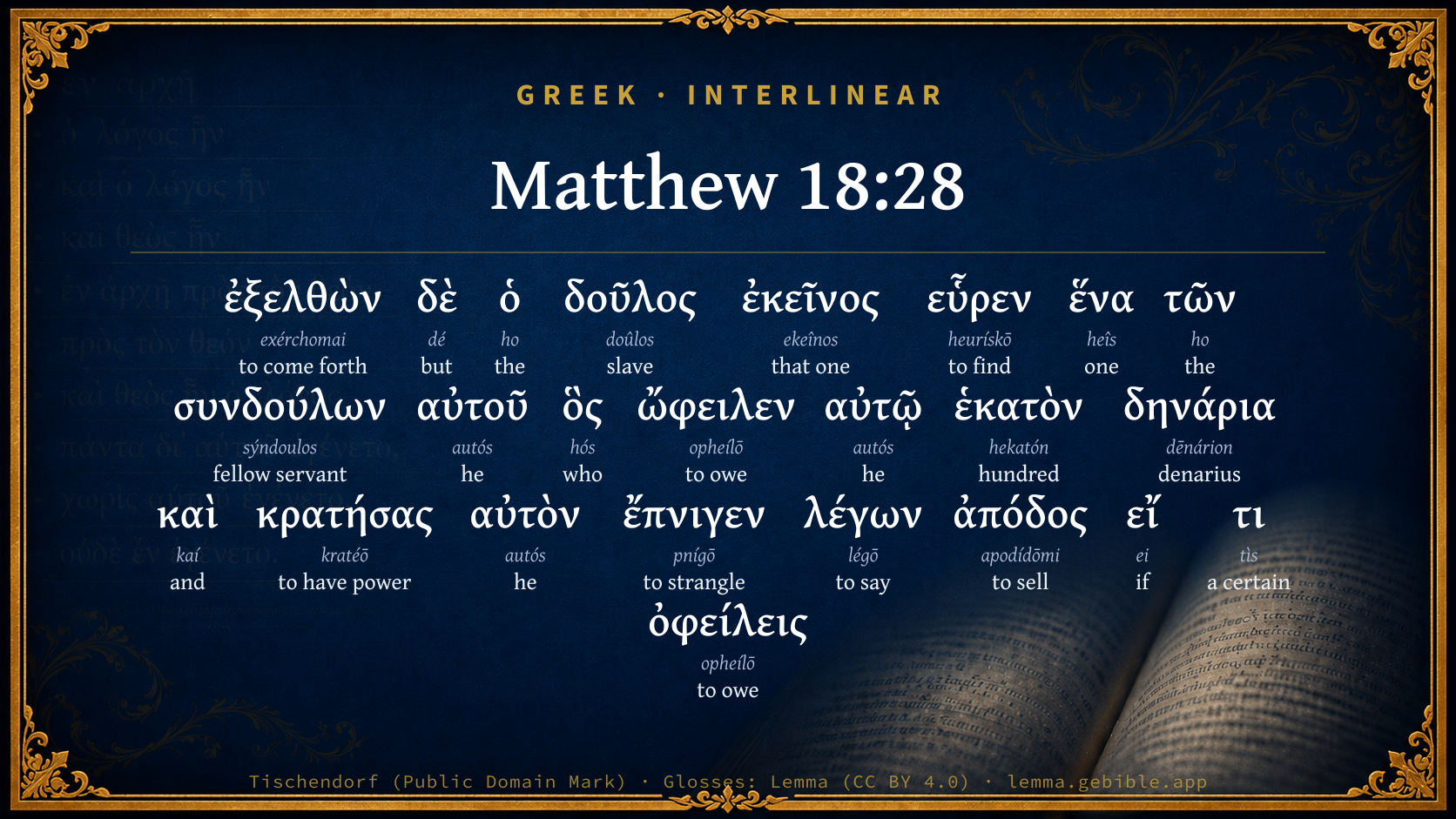
Greek (Tischendorf 8th ed.) Matthew 18:28 appears in the Greek New Testament. The text above is from the Tischendorf 8th edition. Each word links to its Strong’s number and a concise gloss. Click any word for its full Thayer’s Greek Lexicon entry.
Download image
Cite this verse

Matthew 18:28 (World English Bible). Public Domain. Lemma interlinear Bible study tool, https://lemma.gebible.app/v/matthew/18/28.

Show BibTeX & RIS
BibTeX
RIS
English Translation
"But that servant went out, and found one of his fellow servants, who owed him one hundred denarii, and he grabbed him, and took him by the throat, saying, 'Pay me what you owe!'
World English Bible · Public Domain
Highlights
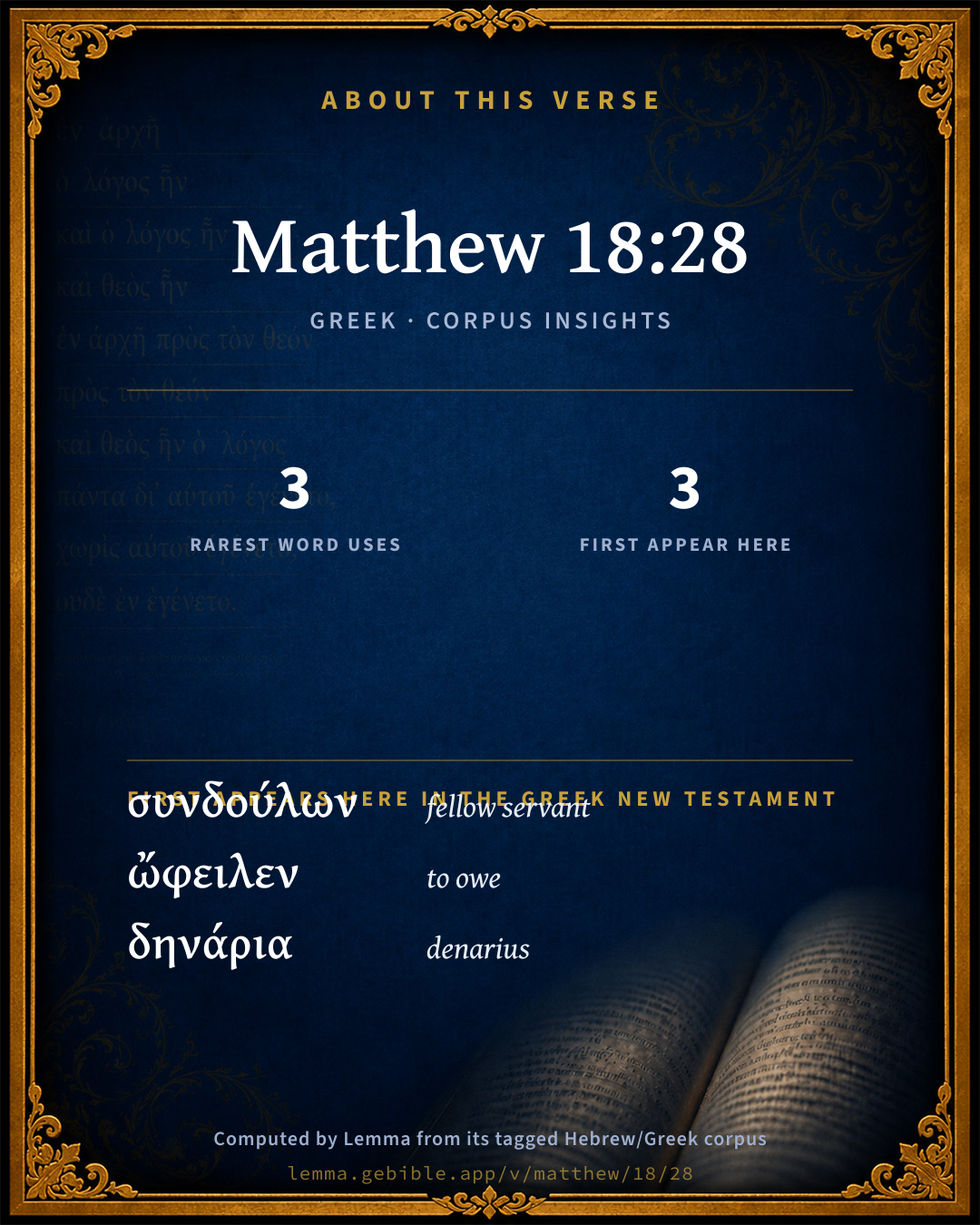
  • 3 first appearances in the Greek New Testament
Full analysis ↓
Download a study sheet

One document with this verse’s original text, its word-by-word gloss line, the meaning frame, cross-references with their text, attributed commentary, and full source and license credits — printable, and it pastes into notes with its structure intact.

This verse Autodidact and up

Study sheet (.html) Plain text (.txt)

A passage Seminary Student

Up to 50 verses in one chapter. A passage sheet keeps up to 6 commentary sources and 12 cross-references per verse, in the order this page ranks them, and says so on the sheet whenever that leaves anything out. Ask for a single verse and you get the Autodidact verse sheet above.

Everything on this page stays free to read, with no account — the sheet is a download of what is already on screen, not access to it.

Want to remove ads? Support Godless Engineer
Compare translations 3

The same verse in 3 English versions, stacked beneath the original-language interlinear above. Click any original word for its lexicon entry.

Each is an independent rendering of the whole verse — the interlinear is not word-aligned to these translations.

Highlighted words mark where these versions differ — a whole-verse word diff, not a word-by-word alignment.

  • World English Bible Public Domain
    "But that servant went out, and found one of his fellow servants, who owed him one hundred denarii, and he grabbed him, and took him by the throat, saying, 'Pay me what you owe!'
  • King James Version Public Domain
    But the same servant went out, and found one of his fellowservants, which owed him an hundred pence: and he laid hands on him, and took him by the throat, saying, Pay me that thou owest.
  • unfoldingWord Literal Text CC BY-SA 4.0
    But having gone out, that slave found one of his fellow slaves, who owed him 100 denarii, and having seized him, he choked, saying, ‘Repay whatever you owe.’

unfoldingWord Literal Text — © unfoldingWord, licensed CC BY-SA 4.0. Word-aligned USFM3 via Door43 (git.door43.org/unfoldingWord/en_ult).

Versions to compare (up to 4)

3 of 4 selected

Show all 19 translations

Every available English version of this verse, each an independent rendering of the whole verse.

  • World English Bible Public Domain
    "But that servant went out, and found one of his fellow servants, who owed him one hundred denarii, and he grabbed him, and took him by the throat, saying, 'Pay me what you owe!'
  • Berean Standard Bible Public Domain
    But when that servant went out, he found one of his fellow servants who owed him a hundred denarii. He grabbed him and began to choke him, saying, ‘Pay back what you owe me!’
  • Majority Standard Bible Public Domain
    But when that servant went out, he found one of his fellow servants who owed him a hundred denarii. He grabbed him and began to choke him, saying, ‘Pay back what you owe me!’
  • King James Version Public Domain
    But the same servant went out, and found one of his fellowservants, which owed him an hundred pence: and he laid hands on him, and took him by the throat, saying, Pay me that thou owest.
  • American Standard Version (1901) Public Domain
    But that servant went out, and found one of his fellow-servants, who owed him a hundred shillings: and he laid hold on him, and took `him' by the throat, saying, Pay what thou owest.
  • Revised Version (1885) Public Domain
    But that servant went out, and found one of his fellow-servants, which owed him a hundred pence: and he laid hold on him, and took him by the throat, saying, Pay what thou owest.
  • Geneva Bible (1599) Public Domain
    But when the seruant was departed, hee found one of his felow seruants, which ought him an hundred pence, and he layde hands on him, and thratled him, saying, Pay me that thou owest.
  • Douay-Rheims (1899) Public Domain
    But when that servant was gone out, he found one of his fellow servants that owed him an hundred pence: and laying hold of him, throttled him, saying: Pay what thou owest.
  • Young's Literal Translation Public Domain
    `And, that servant having come forth, found one of his fellow-servants who was owing him an hundred denaries, and having laid hold, he took him by the throat, saying, Pay me that which thou owest.
  • Literal Standard Version CC BY-SA 4.0
    And that servant having come forth, found one of his fellow-servants who was owing him one hundred denarii, and having laid hold, he took him by the throat, saying, Pay me that which you owe.
  • Unlocked Literal Bible CC BY-SA 4.0
    But that servant went out and found one of his fellow servants, who owed him one hundred denarii. He grasped him, took him by the throat, and said, 'Pay me what you owe.'
  • unfoldingWord Literal Text CC BY-SA 4.0
    But having gone out, that slave found one of his fellow slaves, who owed him 100 denarii, and having seized him, he choked, saying, ‘Repay whatever you owe.’
  • Darby Bible Public Domain
    But that bondman having gone out, found one of his fellow-bondmen who owed him a hundred denarii. And having seized him, he throttled him, saying, Pay [me] if thou owest anything.
  • World Messianic Bible Public Domain
    “But that servant went out and found one of his fellow servants who owed him one hundred denarii, and he grabbed him and took him by the throat, saying, ‘Pay me what you owe!’
  • Webster's Bible Public Domain
    But the same servant went out, and found one of his fellow-servants, who owed him a hundred pence: and he laid hands on him, and took him by the throat, saying, Pay me what thou owest.
  • Free Bible Version CC BY-SA 4.0
    But when that same servant went out he found one of his fellow-servants who owed him just a hundred denarii. He grabbed him by the neck and choked him, saying, ‘Pay me back what you owe me!’
  • Bible in Basic English Public Domain
    But that servant went out, and meeting one of the other servants, who was in debt to him for one hundred pence, he took him by the throat, saying, Make payment of your debt.
  • Text-Critical English NT CC BY 4.0
    But that servant went out and found one of his fellow servants who owed him a hundred denarii. He grabbed him and began to choke him, saying, ‘Repay me what yoʋ owe.’
  • Tyndale New Testament (1534) Public Domain
    And the sayde servaut wet oute and founde one of his felowes which ought him an hundred pence and leyed hondes on him and toke him by the throote sayinge: paye me that thou owest.

Literal Standard Version (2020), Covenant Press — licensed CC BY-SA 4.0. Text via the HelloAO Bible API (eBible.org). Unlocked Literal Bible (unfoldingWord) — licensed CC BY-SA 4.0. Text via the HelloAO Bible API (eBible.org). unfoldingWord Literal Text — © unfoldingWord, licensed CC BY-SA 4.0. Word-aligned USFM3 via Door43 (git.door43.org/unfoldingWord/en_ult). Free Bible Version, Dr. Jonathan Gallagher — licensed CC BY-SA 4.0. Text via the HelloAO Bible API (eBible.org).

Word by word

More ways to search: Search by grammar → Find every occurrence → Compare this word →

Practice this passage: Drill this verse → Learn its vocabulary →

ἔπνιγεν
pnígō
G4155
“to strangle”
Verb, Imperfect, Active, Indicative, 3rd person, Singular
Part of Speech
Verb
Tense
Imperfect
Voice
Active
Mood
Indicative
Person
3rd person
Number
Singular
Full Thayer's Definition

Origin: strengthened from G4154

TDNT: 13:35,9

1. to choke, strangle a. of thorns crowding out the seed in the field and hindering its growth 2. to wring one's neck, throttle
  1. ἐξελθὼν exérchomai G1831 “to come forth” Verb, Aorist, Active, Participle, Nominative, Singular, Masculine
  2. δὲ dé G1161 “but” Conjunction
  3. ὁ ho G3588 “the” Article, Nominative, Singular, Masculine
  4. δοῦλος doûlos G1401 “slave” Noun, Nominative, Singular, Masculine
  5. ἐκεῖνος ekeînos G1565 “that one” Demonstrative pronoun, Nominative, Singular, Masculine
  6. εὗρεν heurískō G2147 “to find” Verb, Aorist, Active, Indicative, 3rd person, Singular
  7. ἕνα heîs G1520 “one” Adjective, Accusative, Singular, Masculine
  8. τῶν ho G3588 “the” Article, Genitive, Plural, Masculine
  9. συνδούλων sýndoulos G4889 “fellow servant” Noun, Genitive, Plural, Masculine
  10. αὐτοῦ autós G846 “he” Personal pronoun, Genitive, Singular, Masculine
  11. ὃς hós G3739 “who” Relative pronoun, Nominative, Singular, Masculine
  12. ὤφειλεν opheílō G3784 “to owe” Verb, Imperfect, Active, Indicative, 3rd person, Singular
  13. αὐτῷ autós G846 “he” Personal pronoun, Dative, Singular, Masculine
  14. ἑκατὸν hekatón G1540 “hundred” Adjective, Numeral (indeclinable)
  15. δηνάρια dēnárion G1220 “denarius” Noun, Accusative, Plural, Neuter
  16. καὶ kaí G2532 “and” Conjunction
  17. κρατήσας kratéō G2902 “to have power” Verb, Aorist, Active, Participle, Nominative, Singular, Masculine
  18. αὐτὸν autós G846 “he” Personal pronoun, Accusative, Singular, Masculine
  19. λέγων légō G3004 “to say” Verb, Present, Active, Participle, Nominative, Singular, Masculine
  20. ἀπόδος apodídōmi G591 “to sell” Verb, Aorist, Active, Imperative, 2nd person, Singular
  21. εἴ ei G1487 “if” Conditional
  22. τι tìs G5100 “a certain” Indefinite pronoun, Accusative, Singular, Neuter
  23. ὀφείλεις opheílō G3784 “to owe” Verb, Present, Active, Indicative, 2nd person, Singular

About this verse

These counts appear in no published source. They are computed here, from the morphology-tagged text and Lemma’s own curated glosses. What Lemma adds →

24
words
20
distinct lemmas
Gospels
section

Notable vocabulary

The rarest word here is ἔπνιγεν to strangle G4155 — appearing just 3 times in the whole Greek New Testament.

First appearance in Scripture

These words make their first canonical appearance in the Greek New Testament here:

  • συνδούλων fellow servant G4889
  • ὤφειλεν to owe G3784
  • δηνάρια denarius G1220

Shared distinctive vocabulary

ἔπνιγεν to strangle G4155 occurs in 3 verses of the Greek New Testament. Also found in:
Repetition

Words recur within this verse:

  • ὤφειλεν to owe G3784 ×2
  • αὐτοῦ he G846 ×3
  • ὁ the G3588 ×2

Cross-references

7

Topical passages linked to Matthew 18:28 in the Treasury of Scripture Knowledge — connected by theme and wording, ordered by reader-vote popularity; previews shown in the World English Bible.

  • Ezekiel 45:9 Thus says the Lord Yahweh: Let it suffice you, princes of Israel: remove violence and spoil, and execute justice and righteousness; dispossessing my people, says the Lord Yahweh.
  • Matthew 20:2 When he had agreed with the laborers for a denarius a day, he sent them into his vineyard.
  • Deuteronomy 15:2 This is the manner of the release: every creditor shall release that which he has lent to his neighbor; he shall not exact it of his neighbor and his brother; because Yahweh's release has been proclaimed.
  • Isaiah 58:3 Why have we fasted, [say they], and you don't see? [why] have we afflicted our soul, and you take no knowledge? Behold, in the day of your fast you find [your own] pleasure, and exact all your labors.
  • Nehemiah 5:7 Then I consulted with myself, and contended with the nobles and the rulers, and said to them, You exact usury, everyone of his brother. I held a great assembly against them.
  • Nehemiah 5:10–11 I likewise, my brothers and my servants, do lend them money and grain. Please let us leave off this usury.
  • Nehemiah 10:31 and if the peoples of the land bring wares or any grain on the Sabbath day to sell, that we would not buy of them on the Sabbath, or on a holy day; and that we would forego the seventh year, and the exaction of every debt.

Cross-references courtesy of OpenBible.info (CC BY 4.0).

Commentary

Notes on Matthew 18:28 from classic Christian and Jewish commentators (each source and its license shown beneath its notes). The classic Christian expositions comment on the surrounding passage and are grouped to its opening verse, so a note may address several verses; the Jewish commentaries on the Tanakh (Rashi and others) are per-verse, so they appear only where the commentator wrote on this verse.

Lemma curates 59 commentaries, every one of them public domain or Creative Commons licensed, each selected and text-cleaned for this edition rather than reprinted as found. About our sources →

Joseph Benson's Commentary

Mat 18:28-30. But the same servant — Thus graciously freed from such an immense debt; went out — From the presence of his master; and found one of his fellow-servants which owed him a hundred pence — A hundred Roman denarii, each in value about seven pence halfpenny sterling, and the whole amounting only to three pounds two shillings and sixpence. And he took him by the throat, saying, Pay me that thou owest — Thus, by demanding this trifling sum in so rough a manner, and that immediately on coming out of the palace where so much lenity and mercy had been shown him in a matter of far greater importance, he manifested a most base, selfish, unfeeling, and cruel disposition. The word επνιγε, rendered, he took him by the throat, implies that he almost strangled him. And his fellow-servant fell down at his feet — As he had done at his lord’s feet; and besought him, saying, Have patience with me, &c. — Using the very words which he himself had used but just before on the like occasion. And he would not — Having so soon forgot, or not considering, the much greater mercy that had been shown to himself so lately, in the like circumstances, by their common master; but, being insolent and inexorable, and resolved not to wait a moment, he went with him before a magistrate, and cast him into prison — Protesting he should lie there till he should pay the whole debt.

Joseph Benson's Commentary on the Old and New Testaments (1811–1818) — public domain. Text from a community e-Sword module.

Tyndale Open Study Notes

Tyndale Open Resources

18:28 a few thousand dollars: The first servant’s debt was about one million times greater than this sum owed to him.

Tyndale Open Study Notes — © Tyndale Open Resources, licensed CC BY-SA 4.0. Text via the HelloAO Bible API.

Bengel's Gnomon

Johann Albrecht Bengel

Mat 18:28. Ἐξελθὼν, having gone forth) being now released from his difficulties. Before the accounts had been examined, he treated his fellow-servant more tenderly; the very joy of recovered liberty, or restored health, etc., is accompanied by a greater danger of sin:[844] see Joh 5:14; 2Ki 20:13.[845]—ἑκατὸν δηνάρια, a hundred denarii)[846] The names of coins are neuter in Greek. This was a sufficiently large debt for a fellow-servant: but nothing in comparison with even a single talent, and ten thousand is a hundred times a hundred.—ἈΠΌΔΟς, Κ.Τ.Λ., pay, etc.) An importunate demand.—εἰ, if)[847] a particle of some force for since.

[844] So that it is even then in particular, that one becomes liable to anger.—V. g.

[845] See Jer 34:8-16.—(I. B.)

[846] E. V. “An hundred pence.” The denarius was about sevenpence three farthings.—(I. B.)

[847] Bengel reads εἴ τι ὀφείλεις, which he interprets, IF, i.e. SINCE thou owest me something. E. M. has ὅ τι ὀφείλεις—that which, or whatsoever thou owest.—(I. B.)

BCD Orig. 3,622a read εἴ τι. But abc Vulg. Lucifer support the ὅ τι of Rec. Text.—ED.

Εὗρεν, he found) After you have experienced the divine free favour, soon the opportunity will present itself to thee of adopting either a similar, or else a different mode of action.—V. g.

Ἕνα, one) It sometimes happens that one wishes well to all (other) men, and yet remains inimical and hostile at least to one particular person.—V. g.

Bengel's Gnomon of the New Testament — English translation (T&T Clark, Edinburgh, 1860) — public domain. Text from a community e-Sword module.

Meyer's Critical & Exegetical Commentary

Heinrich August Wilhelm Meyer

Mat_18:28. A hundred denarii, about forty Rhenish Gulden, or 23 thalers [about £3, 9s. sterling] (a denarius being not quite equal to a drachma), what a paltry debt compared with those talents of which there were a hundred times a hundred!

ἔπνιγε] Creditors (as the Roman law allowed them to do) often dragged their debtors before the judge, holding them by the throat. Clericus and Wetstein on this passage.

ἀπόδος, εἴ τι ὠφείλεις] εἴ τι is not to be taken, as is often done, as though it were equivalent to ὅ, τι. For where εἴ τι, like si quid, is used in the sense of quicquid (see Kühner, ad Xen. Anab. i. 10. 18), εἰ always has a conditional force, which would be out of place in the present instance; but, with Fritzsche and Olshausen, to trace the expression to Greek urbanity, would be quite incongruous here. Neither, however, are we to affirm, with Paulus and Baumgarten-Crusius, that the conditional expression is rather more severe in its tone, from representing the man as not being even certain in regard to the debt; for the certainty of the debt is implied in the terms of the passage, and, moreover, in the κρατήσας αὐτ. ἔπνιγε was necessarily to be presupposed on the part of the δοῦλος. No, the εἰ is simply the expression of a pitiless logic: PAY, if thou owest anything (ἀπόδος being emphatic). From the latter the former follows as matter of necessity. If thou owest anything (and such is the case), then thou must also pay,and therefore I arrest thee!

Meyer — Critical and Exegetical Commentary on the New Testament — English translation by Peter Christie, edited by Frederick Crombie (T&T Clark, 1880) — public domain. Text from a community e-Sword module.

Expositor's Greek Testament

ed. W. Robertson Nicoll

Mat 18:28-34 . The other side of the picture .

Mat 18:28 . ἕνα τ . συνδούλων ἀ .: a fellow -slave though a humble one, which he should have remembered, but did not. ἑκατὸν δηνάρια : some fifty shillings; an utterly insignificant debt, which, coming out from the presence of a king, who had remitted so much to him, he should not even have remembered, far less been in the mood to exact. κρατήσας α . ἔπνιγε : seizing, he choked, throttled him, after the brutal manner allowed by ancient custom, and even by Roman law. The act foretokens merciless treatment: no remission of debt to be looked for in this quarter. ἀπόδος εἴ τι ὀφ . In the εἴ τι some ingenious commentators (Fritzsche, e.g. ) have discovered Greek urbanity! (“Non sine urbanitate Graeci a conditionis vinculo aptarunt, quod a nulla conditione suspensum sit.”) Weiss comes nearer the truth when he sees in it an expression of “merciless logic”. He will have payment of whatever is due, were it only a penny.

The Expositor's Greek Testament, edited by W. Robertson Nicoll (1897–1910) — public domain. Text from a community e-Sword module.

Jamieson, Fausset & Brown

Robert Jamieson, A. R. Fausset & David Brown

But the same servant went out, and found one of his fellow servants--Mark the difference here. The first case is that of master and servant; in this case, both are on a footing of equality. (See Mat 18:33).

which owed him an hundred pence--If Jewish money is intended, this debt was to the other less than one to a million.

and he laid hands on him, and took him by the throat--he seized and throttled him.

saying, Pay me that thou owest--Mark the mercilessness even of the tone.

Jamieson, Fausset & Brown — Commentary Critical and Explanatory on the Whole Bible (1871) — public domain (CC PDM 1.0). Text via the HelloAO Bible API.

Adam Clarke's Commentary

Verse 28. A hundred pence] Rather denarii. The denarius was a Roman coin, worth about seven-pence halfpenny English. The original word should be retained, as our word penny does not convey the seventh part of the meaning. A hundred denarii would amount to about 3l. 2s. 6d. British, or, if reckoned as some do, at seven-pence three farthings, the sum would be 3l. 4s. 7d.

Took him by the throat] κρατησας αυτον επνιγε. There is no word I am acquainted with, which so fully expresses the meaning of the original, επνιγε, as the Anglo-saxon term throttle: it signified (like the Greek) to half choke a person, by seizing his throat.

Adam Clarke's Commentary on the Bible (1810–1826) — public domain. Text from a community e-Sword/MySword module.

Ellicott's Commentary for English Readers

(28) Which owed him an hundred pence.—Here the calculation is simpler than in Mat_18:24. The “hundred pence” are a hundred Roman denarii (the denarius being equal to sevenpence-halfpenny), a hundred days’ wages of the labourer and soldier, enough to provide a meal for 2,500 men (Joh_6:7). There is a considerable truthfulness in the choice of such a sum, which has, perhaps, been too little noticed. Had our Lord been seeking simply a rhetorical antithesis between the infinitely great and the infinitely little, it would have been easy to select some small coin, like the denarius, the as, or the quadrans, as the amount of the fellow-servant’s debt. But to the fishermen of Galilee the “hundred pence” would appear a really considerable sum, and when they came to interpret the parable they would thus be led to feel that it recognised that the offences which men commit against their brothers may, in themselves, be many and grievous enough. It is only when compared with their sins against God that they sink into absolute insignificance.

He laid hands on him.—We are shocked, and are meant to be shocked, by the brutal outrage with which the creditor enforces his claim, but it doubtless was but too faithful a picture of what the disciples had often witnessed, or, it may be, even practised. We are tempted to ask whether this really represents any phenomena of the spiritual life. Can a man who has really been justified and pardoned become thus merciless? The experience of every age, almost of every household, shows that the inconsistency is but too fatally common. The man is not consciously a hypocrite, but he is as yet “double minded” (Jas_1:8), and the baser self is not conquered. In the language of the later teaching of the New Testament the man’s faith is not one which “worketh by love” (Gal_5:6). He is justified, but not as yet sanctified.

A Bible Commentary for English Readers, edited by Charles John Ellicott (1878–1897) — public domain. Text from a community e-Sword module.

The Cambridge Bible for Schools and Colleges

gen. ed. J. J. S. Perowne

28. found] perhaps, even sought him out.

one of his fellowservants] By this is meant the debt of man to man, offences which men are bound to forgive one another.

an hundred pence] i. e. denarii. The Denarius was a day’s wages (ch. Mat_20:2). The sum therefore is about three months’ wages for an ordinary labourer, by no means a hopeless debt as the other was; see note ch. Mat_26:7.

The Cambridge Bible for Schools and Colleges (gen. ed. J. J. S. Perowne; Cambridge University Press, 1878–1918) — public domain. Text from a community e-Sword module.

John Gill's Exposition

So when his fellow servants saw what was done,.... What hard usage, and ill treatment, their fellow servant met with; the Syriac reads, "their fellow servants", being the fellow servants both of the creditor and the debtor:

they were very sorry; they were greatly grieved and troubled at the cruelty of the one, and the unhappiness of the other; being more tenderhearted, and of a more forgiving spirit than he:

and came and told unto their Lord all that was done; to their fellow servant, by one that had so lately received such favours from him: this may be expressive of the concern of some members of churches at such conduct: who, though they may not have strength and number sufficient to oppose such measures, yet being secretly grieved at such cruel methods, go to the throne of grace, and spread the case before the Lord, tell him all that is done by way of complaint; which, is no impeachment of his omniscience, only shows their trouble for such malpractices, and the sense they have, by whom only such grievances can be redressed.

John Gill's Exposition of the Whole Bible (1746–1763) — public domain (CC PDM 1.0). Text via the HelloAO Bible API.

Trapp's Complete Commentary

John Trapp

28 But the same servant went out, and found one of his fellowservants, which owed him an hundred pence: and he laid hands on him, and took him by the throat, saying, Pay me that thou owest.

Ver. 28. And he laid hands on him, and took him, &c.] Had he truly apprehended the pardon of his own sins, he would not have been so cruel to others. Had he thoroughly dyed his thoughts in the rich mercies of God, he would have shown more mercy to men. Therefore the apostles (when our Saviour had bidden them forgive, though it were often in the same day) said unto the Lord, "Increase our faith." As who should say, The more we can believe thy love and mercy to us, the readier shall we be to do all good offices to men. But how rigid and cruel was David to the Ammonites, while he lay in his sin, and before he had renewed his faith, 2Sa 12:30-31.

John Trapp, A Commentary or Exposition upon All the Books of the Old and New Testament (1647–1656) — public domain. Text from a community e-Sword module.

Albert Barnes' Notes on the Bible

But the same servant went out, and found one of his fellow-servants which owed him an hundred pence - Greek, δεναριον denarion; Latin, denarius; a Roman silver coin in common use. When Greece became subject to the Romans, and especially under the emperors, the denarius was regarded as of equal value with the Attic drachma - about 7 1/2 d. sterling, or 15 cents (circa 1880’s); consequently, this debt was about 15 dollars - a very small sum compared with what had been forgiven to the first servant. Perhaps our Saviour, by this, meant to teach that the offences which our fellow-men commit against us are very small and insignificant compared with our offences against God. Since God has forgiven us so much we ought to forgive each other the small offences which are committed.

Took him by the throat - Took him in a violent and rough manner - half choked or throttled him. This was the more criminal and base, as he had himself been so kindly treated and dealt so mildly with by his lord.

Besought - Entreated, pled with him.

Albert Barnes' Notes on the Bible (1834–1885) — public domain. Text from a community e-Sword/MySword module.

Whedon's Commentary on the Bible

Daniel D. Whedon

28. Went out — From his Lord’s presence, to inflict the severity. This sets the contrast in a more aggravating light. Fresh from the mercy of his Lord, he goes forth to inflict cruelty upon his fellow. So do men. They are, indeed, often at the same moment, spared of God and unsparing of others.

A hundred pence — He owed his Lord ten thousand talents; some ten or fifteen million dollars! He could not forgive a hundred pence, about fifteen dollars! This reminds us how much more God does forgive us than we can forgive others. Oglethorpe, governor of Georgia, said, in a passion, to Mr. Wesley: “That vile servant of mine misbehaves, though he knows I never forgive.” “Then,” said Mr. Wesley, “I hope you never sin.” The beautiful reproof overcame the angry governor.

Took him by the throat — Literally, grasping, he choked him. The plaintiff in a Roman suit customarily seized the defendant and drew him to the court. The present prosecutor performs the act with a merciless violence.

Daniel D. Whedon (gen. ed.), Commentary on the Old and New Testaments (1874–1909) — public domain. Text from a community e-Sword module.

The Pulpit Commentary

Went out straightway from his lord"s presence, where he had been so mercifully treated, while the remembrance of his free and undeserved forgiveness must have been still fresh. Found. Lighted upon by chance, as it were. Here, rather, was providentially offered an opportunity of showing that his lord"s goodness was not thrown away, but had entered his heart and controlled his conduct towards others. One of his fellow servants. An official of the king, but probably in an inferior position to that which he himself occupied. Seeing this man, he is reminded of a paltry debt which this person owed him. He remembers this fact; he forgets his late experience. A hundred pence; (denarii; see on Mat_20:2) equivalent to some of our money, and a sum not a millionth part of his own debt to his master; the proportion, as some say, may be stated more accurately as 1 to 1, 250, 000. The enormous difference between these two amounts represents the disproportion between the offences of our neighbours against us and those of which we are guilty towards God; and how small is the forgiveness on our side compared with that which God freely accords to our infinite debt to him! We must consider also the parties to whom these debts are owing on one side, the worm man; on the other, Almighty God. Took him by the throat (epnige); was throttling him. Thus precluding all prayer and remonstrance. Such brutal treatment was not what he himself had experienced. Pay me that thou owest; oti ofeileiv : quod debes. Many manuscripts and late editors (e.g. Lachmann, Tregelles, Tischendorf, Alford, Westcott and Hort) soften the demand by reading ei ti ofeileiv , si quid debes, "if thou owest aught," as though the creditor were ashamed of mentioning the paltry sum due; or else it is simply a fashion of speaking, not to be pressed as if any doubt was intimated concerning the debt. It might almost be rendered, "Pay, since thou owest something." Not thus had his lord addressed him in the first instance.

The Pulpit Commentary (1880–1919), ed. H.D.M. Spence-Jones & Joseph S. Exell — public domain. Text from a community e-Sword module.

Kretzmann's Popular Commentary

Paul E. Kretzmann

The Revolting lack of mercy:

v. 28. But the same servant went out and found one of his fellow-servants which owed him an hundred pence; and he laid hands on him, and took him by the throat, saying, Pay me that thou owest.

v. 29. And his fellow-servant fell down at his feet and besought him, saying, Have patience with me, and I will pay thee all.

v. 30. And he would not, but went and cast him into prison, till he should pay the debt.

Note the emphasis: Hardly had he left the presence of the king when this happened; it was the identical servant that had received such an immeasurable present of mercy. "He found," not accidentally, but after deliberate search; the malice of the deed brought out. The fellow-servant owed him but a hundred denarii , that is, at 162

/3

cents per denarius , less than seventeen dollars, an insignificant sum, one that could not even come into consideration beside the immense debt which the king had just canceled for him. But here is the height of brutality: Seizing him by the throat, he choked him, after the manner permitted a creditor according to Roman law. In the harshest possible form he threatens to bring him before the tribunal unless immediate payment be made. Taken by surprise and filled with fear, the fellow-servant fell down and implored and begged for extension of time. The sum being so small, he could easily find ways and means of paying, if his creditor would but have patience. But the latter had no intention of doing so, he wanted to wreak his vengeance upon the poor fellow. Going away, he cast him into prison until such a time as he would be able to make payment of the debt. It was the climax of harshness.

Paul E. Kretzmann, Popular Commentary of the Bible (1921–1924) — public domain. Text from a community e-Sword module.

The People's New Testament

B. W. Johnson

28. But the same servant went out. His own exhibition of brutality was immediately after the great mercy he had received. What follows shows that he had only been frightened, not converted. An hundred pence. The denarius, or penny, was a silver coin equal to from sixteen to eighteen cents. The whole debt would therefore be from sixteen to eighteen dollars. Its smallness compared with his debt to his lord is intended to show that our neighbors' sins against us are insignificant when contrasted with ours towards God. We need such boundless mercy that we ought to be prepared to give mercy freely. Took him by the throat. The great defaulter, who had been treated with such mercy, had no mercy.

B. W. Johnson's The People's New Testament with Notes (1889–1891) — public domain. Electronic text from the Christian Classics Ethereal Library (CCEL) ThML edition.

unfoldingWord translationNotes

Door43 World Missions Community

Connecting Statement:

Jesus continues telling a parable to his disciples. (See: Parables)

one hundred denarii

"100 denarii" or "one hundred days' wages" (See: Biblical Money and Numbers)

He grasped him

"The first servant grasped his fellow servant"

grasped

"took hold of" or "grabbed"

fell down

This shows that the fellow servant approached the first servant in the most humble way possible. See how you translated this in Matthew 18:26. (See: Symbolic Action)

and implored him

"and begged him"

translationWords

servant

patient

unfoldingWord translationNotes — © Distant Shores Media and the Door43 World Missions Community, licensed CC BY-SA 4.0. Source: git.door43.org/Door43/en_tn.

Cambridge Greek Testament for Schools and Colleges

28. εὗρεν, ‘found,’ perhaps even sought him out.

ἕνα τῶν συνδούλων. By this is meant the debt of man to man, offences which men are bound to forgive one another.

ἑκατὸν δηνάρια. The denarius was a day’s wage (ch. Mat 20:2). The sum therefore is about three months’ wages for an ordinary labourer, by no means a hopeless debt as the other was; see note, ch. Mat 26:7.

ἔπνιγεν, imperfect, not aor. 2, which does not appear to be used in the active. See Veitch and Lob. Phryn. 107.

Cambridge Greek Testament for Schools and Colleges (Cambridge University Press, 1896; 21 vols, various authors incl. Carr, Maclear, Plummer, Farrar, Lumby, Moule, M. R. James, Simcox) — public domain. Text from a community e-Sword module.

Alford’s Greek Testament

Henry Alford

28.] Perhaps we must not lay stress on ἐξελθών, as indicating any wrong frame of mind already begun, as Theophylact does:—the sequel shews how completely he had ‘gone out’ from the presence of his Lord. At all events the word corresponds to the time when the trial of our principle takes place: when we ‘go out’ from the presence of God in prayer and spiritual exercises, into the world. We may observe, that forgiveness of sin does not imply a change of heart or principle in the sinner.

The fellow-servant is probably not in the same station as himself, but none the less a fellow-servant. The insignificance of the sum is to shew us how trifling any offence against one another is in comparison to the vastness of our sin against God. Chrysostom finely remarks: ὁ δὲ οὐδὲ τὰ ῥήματα ᾐδέσθη διʼ ὧν ἐσώθη· καὶ γὰρ αὐτὸς ταὐτὰ εἰπὼν ἀπηλλάγη τῶν μυρίων ταλάντων· καὶ οὐδὲ τὸν λιμένα ἐπέγνω διʼ οὗ τὸ ναυάγιον διέφυγεν· οὐ τὸ σχῆμα τῆς ἱκετηρίας ἀνέμνησεν αὐτὸν τῆς τοῦ δεσπότου φιλανθρωπίας· ἀλλὰ πάντα ἐκεῖνα ὑπὸ τῆς πλεονεξίας καὶ τῆς ὠμότητος καὶ τῆς μνησικακίας ἐκβαλών, θηρίου παντὸς χαλεπώτερος ἦν, ἄγχων τὸν σύνδουλον. τί ποιεῖς, ἄνθρωπε; σεαυτὸν ἀπαιτῶν οὐκ αἰσθάνῃ, κατὰ σεαυτοῦ τὸ ξίφος ὠθῶν, καὶ τὴν ἀπόφασιν καὶ τὴν δωρεὰν ἀνακλούμενος; Hom. lxi. 4, p. 616.

ἔπνιγεν] So ‘obtorto collo ad prætorem trahor,’ Plaut. Pœnul. iii. 5. 45. See other examples in Wetstein. The εἴ τι ὀφείλεις, which is beyond doubt the true reading, must be understood as a haughty expression of one ashamed to meet the mention of the paltry sum really owing, and by this very expression generalizing his unforgiving treatment to all who owed him aught.

Henry Alford, The Greek Testament (1849–1861) — public domain. Text from a community e-Sword module.

International Critical Commentary

28. And that servant went out, and found one of his fellow-servants, who owed him one hundred denarii.] The denarius was worth about eightpence halfpenny.

And he seized him, and held him by the throat, saying, Pay anything thou owest.]

(L)

International Critical Commentary — older volumes (1896–1929), various authors — public domain. Text from a community e-Sword module.

Vincent's Word Studies in the New Testament

Marvin R. Vincent

Found. Either went in search of him, as he himself had been sought out by his Lord, or came upon him accidentally in the street.

A hundred pence [εκατον δηναρια] . Less than a millionth part of his own debt.

Took him by the throat [αυτον επνιγεν] . Lit., throttled. Wyc., strangled. Compare were choked, Mr 5:13. Creditors often dragged their debtors before the judge, as the Roman law allowed them to do, holding them by the throat. Thus Livy (iv. 53), relates how, a difficulty having arisen between the consul Valerius and one Menenius, the tribunes put an end to the contest, and the consul ordered into prison (collum torsisset, twisted the neck) the few who appealed. And Cicero (" Pro Cluentio, " 21) :

"Lead him to the judgment - seat with twisted neck [χολλο οβτορτο] ." Compare Cicero, "In 100 Verrem," 4 10.

What thou owest [ει τι οφειλεις] . Lit., If thou owest anything. Not that the creditor is uncertain about the fact of the debt, though some uncertainty about the exact amount may be implied. This would agree with found, in the sense of coming upon accidentally. Compare Mt 13:44. He came suddenly upon him and recognized him as a debtor, though not certain as to the amount of his debt. Meyer remarks, "The if is simply the expression of a pitiless logic. If thou owest anything (as thou dost) pay!" The word pay [αποδος] is emphatic in position.

Marvin R. Vincent, Word Studies in the New Testament (1887–1900) — public domain. Text from a community e-Sword/MySword module.

Lesson kit

Teaching starters — assembled from the data on this page, not authored interpretation. Every prompt links to the verse data it draws on. Edit before teaching.

Matthew, in the Gospels, opens this verse with 24 words (20 distinct Greek lemmas). Its most distinctive word is pnígō (“to strangle”). A historical commentator’s framing appears above. Read the whole chapter for the surrounding context.

Discussion questions

  1. What does “to strangle” (pnígō) contribute to the verse as a whole?
  2. 3 words make their first appearance in Scripture here. What does this debut establish?
  3. How does Matthew 13:7, which shares the word «to strangle», read alongside this verse?
  4. What does the repetition of “to owe” (2× in this one verse) do in this verse?
  5. These translations render this verse differently. What is at stake in choosing one wording over another?
  6. Compare how Joseph Benson's Commentary and Tyndale Open Study Notes read this verse. Where do they agree or differ?

Things to notice

  • 3 words make their first canonical appearance in Scripture here.
  • These translations choose different wording for 31 words in this verse.
  • “to owe” occurs 2× in this single verse.
  • 20 distinct Greek lemmas span 24 words in this verse.

Reading settings

Reading text

Shown beneath each verse's original-language words.

Old Testament
Old Testament edition

Read the OT as the Masoretic Hebrew (MT) or the Greek Septuagint (LXX).

English shown for the Greek Septuagint (in the Hebrew ↔ Greek comparison).

Comparing translations? Open the Compare panel on any verse page to stack up to four side by side.