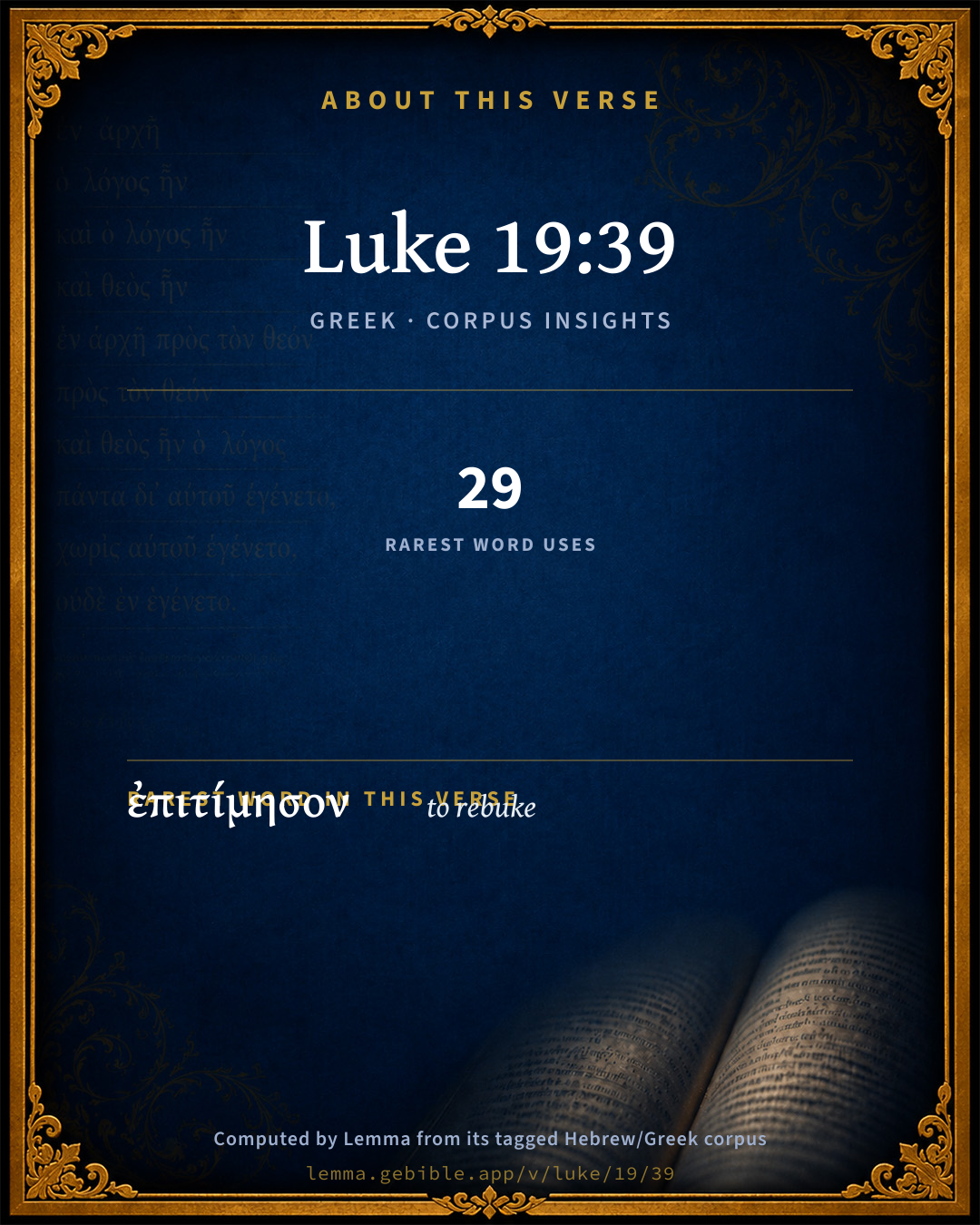
Luke 19:39

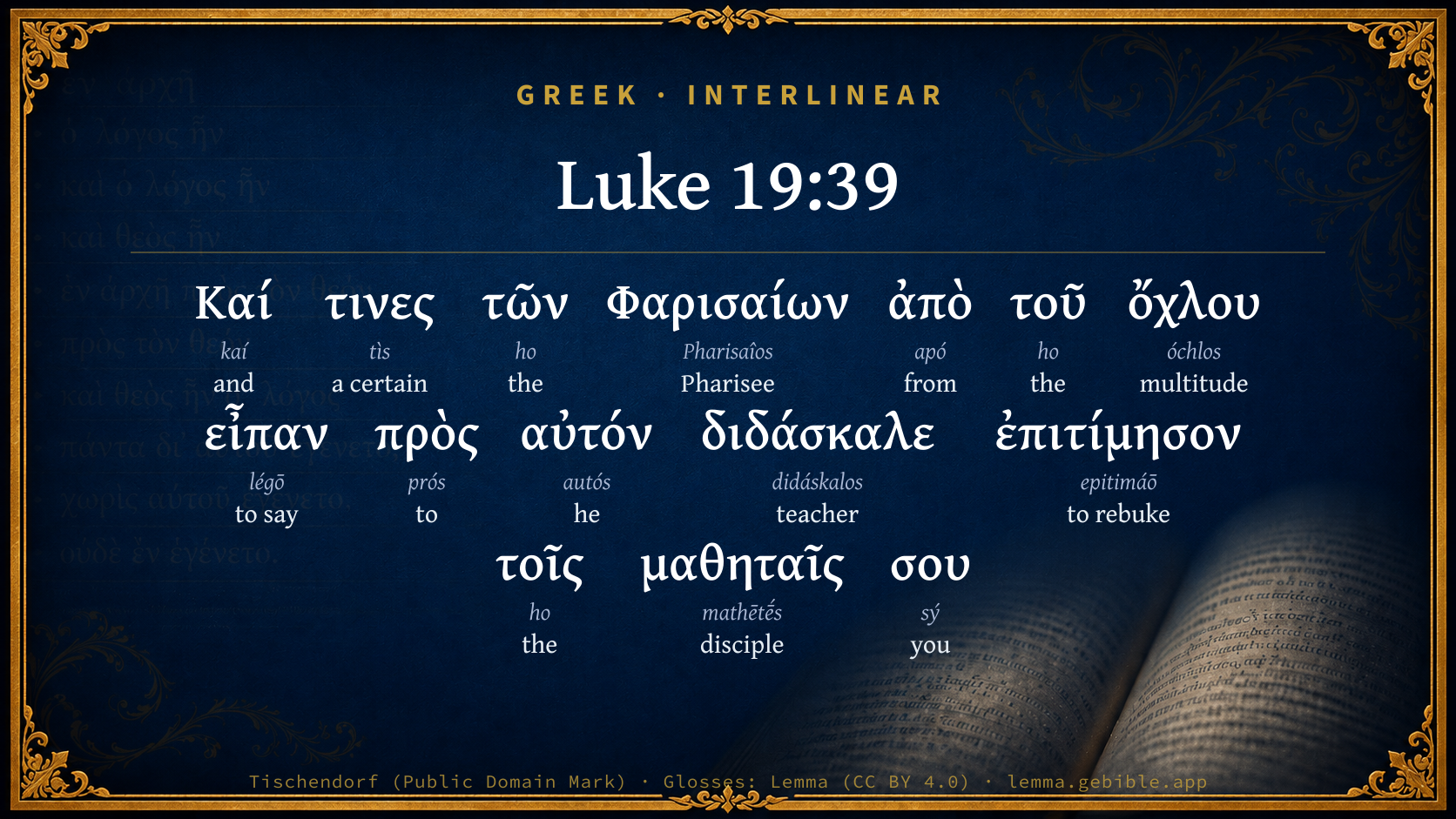
Greek (Tischendorf 8th ed.) Luke 19:39 appears in the Greek New Testament. The text above is from the Tischendorf 8th edition. Each word links to its Strong’s number and a concise gloss. Click any word for its full Thayer’s Greek Lexicon entry.
Download image
Cite this verse

Luke 19:39 (World English Bible). Public Domain. Lemma interlinear Bible study tool, https://lemma.gebible.app/v/luke/19/39.

Show BibTeX & RIS
BibTeX
RIS
English Translation
Some of the Pharisees from the multitude said to him, "Teacher, rebuke your disciples!"
World English Bible · Public Domain
Download a study sheet

One document with this verse’s original text, its word-by-word gloss line, the meaning frame, cross-references with their text, attributed commentary, and full source and license credits — printable, and it pastes into notes with its structure intact.

This verse Autodidact and up

Study sheet (.html) Plain text (.txt)

A passage Seminary Student

Up to 50 verses in one chapter. A passage sheet keeps up to 6 commentary sources and 12 cross-references per verse, in the order this page ranks them, and says so on the sheet whenever that leaves anything out. Ask for a single verse and you get the Autodidact verse sheet above.

Everything on this page stays free to read, with no account — the sheet is a download of what is already on screen, not access to it.

Want to remove ads? Support Godless Engineer
Compare translations 3

The same verse in 3 English versions, stacked beneath the original-language interlinear above. Click any original word for its lexicon entry.

Each is an independent rendering of the whole verse — the interlinear is not word-aligned to these translations.

Highlighted words mark where these versions differ — a whole-verse word diff, not a word-by-word alignment.

  • World English Bible Public Domain
    Some of the Pharisees from the multitude said to him, "Teacher, rebuke your disciples!"
  • King James Version Public Domain
    And some of the Pharisees from among the multitude said unto him, Master, rebuke thy disciples.
  • unfoldingWord Literal Text CC BY-SA 4.0
    And some of the Pharisees from the crowd said to him, “Teacher, rebuke your disciples.”

unfoldingWord Literal Text — © unfoldingWord, licensed CC BY-SA 4.0. Word-aligned USFM3 via Door43 (git.door43.org/unfoldingWord/en_ult).

Versions to compare (up to 4)

3 of 4 selected

Show all 19 translations

Every available English version of this verse, each an independent rendering of the whole verse.

  • World English Bible Public Domain
    Some of the Pharisees from the multitude said to him, "Teacher, rebuke your disciples!"
  • Berean Standard Bible Public Domain
    But some of the Pharisees in the crowd said to Him, “Teacher, rebuke Your disciples!”
  • Majority Standard Bible Public Domain
    But some of the Pharisees in the crowd said to Him, “Teacher, rebuke Your disciples!”
  • King James Version Public Domain
    And some of the Pharisees from among the multitude said unto him, Master, rebuke thy disciples.
  • American Standard Version (1901) Public Domain
    And some of the Pharisees from the multitude said unto him, Teacher, rebuke thy disciples.
  • Revised Version (1885) Public Domain
    And some of the Pharisees from the multitude said unto him, Master, rebuke thy disciples.
  • Geneva Bible (1599) Public Domain
    Then some of the Pharises of the companie sayd vnto him, Master, rebuke thy disciples.
  • Douay-Rheims (1899) Public Domain
    And some of the Pharisees, from amongst the multitude, said to him: Master, rebuke thy disciples.
  • Young's Literal Translation Public Domain
    And certain of the Pharisees from the multitude said unto him, `Teacher, rebuke thy disciples;'
  • Literal Standard Version CC BY-SA 4.0
    And certain of the Pharisees from the multitude said to Him, “Teacher, rebuke Your disciples”;
  • Unlocked Literal Bible CC BY-SA 4.0
    Some of the Pharisees in the multitude said to him, “Teacher, rebuke your disciples.”
  • unfoldingWord Literal Text CC BY-SA 4.0
    And some of the Pharisees from the crowd said to him, “Teacher, rebuke your disciples.”
  • Darby Bible Public Domain
    And some of the Pharisees from the crowd said to him, Teacher, rebuke thy disciples.
  • World Messianic Bible Public Domain
    Some of the Pharisees from the multitude said to him, “Rabbi, rebuke your disciples!”
  • Webster's Bible Public Domain
    And some of the Pharisees from among the multitude said to him, Master, rebuke thy disciples.
  • Free Bible Version CC BY-SA 4.0
    Some of the Pharisees who were in the crowd said to Jesus, “Teacher, stop your disciples from saying that.”
  • Bible in Basic English Public Domain
    And some of the Pharisees among the people said to him, Master, make your disciples be quiet.
  • Text-Critical English NT CC BY 4.0
    But some of the Pharisees from among the crowd said to Jesus, “Teacher, rebuke yoʋr disciples.”
  • Tyndale New Testament (1534) Public Domain
    And some of the Pharises of the company sayde vnto him: Master rebuke thy disciples.

Literal Standard Version (2020), Covenant Press — licensed CC BY-SA 4.0. Text via the HelloAO Bible API (eBible.org). Unlocked Literal Bible (unfoldingWord) — licensed CC BY-SA 4.0. Text via the HelloAO Bible API (eBible.org). unfoldingWord Literal Text — © unfoldingWord, licensed CC BY-SA 4.0. Word-aligned USFM3 via Door43 (git.door43.org/unfoldingWord/en_ult). Free Bible Version, Dr. Jonathan Gallagher — licensed CC BY-SA 4.0. Text via the HelloAO Bible API (eBible.org).

Word by word

More ways to search: Search by grammar → Find every occurrence → Compare this word →

Practice this passage: Drill this verse → Learn its vocabulary →

ἐπιτίμησον
epitimáō
G2008
“to rebuke”
Verb, Aorist, Active, Imperative, 2nd person, Singular
Part of Speech
Verb
Tense
Aorist
Voice
Active
Mood
Imperative
Person
2nd person
Number
Singular
Full Thayer's Definition

Origin: from G1909 and G5091

TDNT: 12:23,2

1. to show honour to, to honour 2. to raise the price of 3. to adjudge, award, in the sense of merited penalty 4. to tax with fault, rate, chide, rebuke, reprove, censure severely a. to admonish or charge sharply
  1. Καί kaí G2532 “and” Conjunction
  2. τινες tìs G5100 “a certain” Indefinite pronoun, Nominative, Plural, Masculine
  3. τῶν ho G3588 “the” Article, Genitive, Plural, Masculine
  4. Φαρισαίων Pharisaîos G5330 “Pharisee” Noun, Genitive, Plural, Masculine
  5. ἀπὸ apó G575 “from” Preposition
  6. τοῦ ho G3588 “the” Article, Genitive, Singular, Masculine
  7. ὄχλου óchlos G3793 “multitude” Noun, Genitive, Singular, Masculine
  8. εἶπαν légō G3004 “to say” Verb, Aorist, Active, Indicative, 3rd person, Plural
  9. πρὸς prós G4314 “to” Preposition
  10. αὐτόν autós G846 “he” Personal pronoun, Accusative, Singular, Masculine
  11. διδάσκαλε didáskalos G1320 “teacher” Noun, Vocative, Singular, Masculine
  12. τοῖς ho G3588 “the” Article, Dative, Plural, Masculine
  13. μαθηταῖς mathētḗs G3101 “disciple” Noun, Dative, Plural, Masculine
  14. σου sý G4771 “you” Personal pronoun, 2nd person, Genitive, Singular

About this verse

These counts appear in no published source. They are computed here, from the morphology-tagged text and Lemma’s own curated glosses. What Lemma adds →

15
words
13
distinct lemmas
Gospels
section

Shared distinctive vocabulary

ἐπιτίμησον to rebuke G2008 occurs in 29 verses of the Greek New Testament. Also found in:

Repetition

A word recurs within this verse:

Cross-references

9

Topical passages linked to Luke 19:39 in the Treasury of Scripture Knowledge — connected by theme and wording, ordered by reader-vote popularity; previews shown in the World English Bible.

  • Acts 4:1–2 As they spoke to the people, the priests and the captain of the temple and the Sadducees came to them,
  • Matthew 23:13 "Woe to you, scribes and Pharisees, hypocrites! For you devour widows' houses, and as a pretense you make long prayers. Therefore you will receive greater condemnation.
  • John 12:19 The Pharisees therefore said among themselves, "See how you accomplish nothing. Behold, the world has gone after him."
  • Acts 4:16–18 saying, "What shall we do to these men? Because indeed a notable miracle has been done through them, as can be plainly seen by all who dwell in Jerusalem, and we can't deny it.
  • James 4:5 Or do you think that the Scripture says in vain, "The Spirit who lives in us yearns jealously"?
  • Matthew 21:15–16 But when the chief priests and the scribes saw the wonderful things that he did, and the children who were crying in the temple and saying, "Hosanna to the son of David!" they were indignant,
  • John 12:10 But the chief priests conspired to put Lazarus to death also,
  • Isaiah 26:11 Yahweh, your hand is lifted up, yet they don't see: but they shall see [your] zeal for the people, and be disappointed; yes, fire shall devour your adversaries.
  • John 11:47–48 The chief priests therefore and the Pharisees gathered a council, and said, "What are we doing? For this man does many signs.

Cross-references courtesy of OpenBible.info (CC BY 4.0).

Commentary

Notes on Luke 19:39 from classic Christian and Jewish commentators (each source and its license shown beneath its notes). The classic Christian expositions comment on the surrounding passage and are grouped to its opening verse, so a note may address several verses; the Jewish commentaries on the Tanakh (Rashi and others) are per-verse, so they appear only where the commentator wrote on this verse.

Lemma curates 59 commentaries, every one of them public domain or Creative Commons licensed, each selected and text-cleaned for this edition rather than reprinted as found. About our sources →

Bengel's Gnomon

Johann Albrecht Bengel

Luk 19:39. Φαρισαίων, of the Pharisees) Unseasonable interrupters. [Whatever is not common, and of an every-day kind, seems an excess to inflated and envious hypocrisy; but the Divine power knows of no opponent that can check it.—Harm., p. 445.]

Bengel's Gnomon of the New Testament — English translation (T&T Clark, Edinburgh, 1860) — public domain. Text from a community e-Sword module.

Meyer's Critical & Exegetical Commentary

Heinrich August Wilhelm Meyer

Luk_19:39 ff. Peculiar to Luke, and as far as Luk_19:44 taken from tradition.

ἀπὸ τοῦ ὄχλου] from out of the multitude, among whom they found themselves.

ἐπιτίμησον] rebuke (this crying).

σιωπήσουσιν] (see the critical remarks) indicative after ἐάν, so that the meaning of ἄν clings wholly to the conditioning particle, and does not affect the verb: if these become silent. See Klotz, ad Devar. p. 474.

οἱ λίθοι κράξ.] The sense is: this outbreak of the divine praise is not to be restrained. Comp. Hab_2:11; Servius, ad Virg. Ecl. v. 28; Chagiga, f. 16. 1 : Ne dicas: quis testabitur contra me? Lapides domus ejus … testabuntur contra eum. See also the passages in Wetstein.

Luk_19:41. ἐπʼ αὐτήν] over it, comp. Luk_23:28. The direction of the weeping to its object; in the classical writers with a simple accusative, also with ἐπί τινι (Rev_18:11). Observe, further, the audible weeping of Jesus at the view of Jerusalem, not the silent δακρύειν as at the grave of Lazarus, Joh_11:35.

εἰ ἔγνως κ.τ.λ.] if only thou hadst known and, indeed, in this thy day, what belongs to thy salvation! Pathetic aposiopesis, and consequently an expression of the fruitlessness of the wish; comp. on Luk_22:42, and on Joh_6:62; Buttmann, Neut. Gr. p. 339 [E. T. 396]. Euthymius Zigabenus aptly says: εἰώθασι γὰρ οἱ κλαίοντες ἐπικόπτεσθαι τοὺς λόγους ὑπὸ τῆς τοῦ πάθους σφοδρότητος. What served for the salvation of Jerusalem was the reception of Jesus as the Messiah.

καὶ σύ] as my μαθηταί.

καί γε] et quidem. See on Act_2:18.

ἐν τῇ ἡμ. σου] i.e. in this day given to thee for thy deliverance. Comp. τὸν καιρὸν τῆς ἐπισκοπῆς σου, Luk_19:44; Psa_118:24.

νῦν δέ] as, however, now the circumstances actually are, but thus; often thus since Homer after conditional clauses (Joh_8:40; 1Co_12:20).

ἐκρύβη] by divine decree; see Joh_12:37 ff.; Rom_11:7 f.

Luk_19:43. ὅτι ἥξουσιν κ.τ.λ.] ὅτι on does not introduce what has been concealed (this is rather τὰ πρὸς εἰρήνην σου), but it brings a prophetic confirmation of the νῦν δὲ κ.τ.λ. that has just been said: for there shall come (not tarry), etc. The certainty of this miserable future proves that what serves for thy salvation has become veiled from thine eyes. Following Lachmann, only a comma is to be placed before ὅτι. In what follows, observe the solemn five-fold repetition of καί in the affecting unperiodic discourse. The first takes the place of ὅτε (Luk_17:22, Luk_23:44; Rom_2:16; Joh_4:21; and see on Mar_15:25).

χάρακα] masculine: a palisaded wall, Polyb. i. 29. 3, viii. 34. 3, x. 39. 1, xviii. 1. 1. On χάρακα βάλλειν, see Plut. Aem. P. 17, Marcell. 18. As a feminine, it is limited by the grammarians to the signification of vine-prop, but see Lobeck, ad Phryn. p. 61 f.

σοι] Comp. Xen. Mem. ii. 1. 14 : ταῖς πόλεσιν ἐρύματα περιβάλλονται. According to Herod. i. 163, and elsewhere, σέ might also be used. In the Jewish war the rampart was actually erected (hence Schenkel considers this point as vaticinium ex eventu), burnt up by the Jews, and replaced by Titus with a wall. See Joseph. v. 6. 2, v. 12. 2 ff.

συνέξουσι] keep close, see on Php_1:23.

Luk_19:44. ἐδαφιοῦσί σε] they shall level thee (Polyb. vi. 33. 6), i.e. make thee like to the ground. Comp. Amo_9:14; also κατασκάπτειν εἰς ἔδαφος, Thuc. iv. 109. 1. Comp. 3:68. 2. The following κ. τὰ τέκνα σ. ἐν σοί is added by a zeugma, so that now ἐδαφίζω has the signification, frequent in the LXX., to dash on the ground (Hos_14:1; Nah_3:10; Psa_137:9). The children of the city are its inhabitants, Mat_23:37; Luk_13:34; Gal_4:25. The city is figuratively regarded as a mother, hence τὰ τέκνα are not to be understood (Kuinoel) of the actual children (infantes).

τὸν καιρ. τ. ἐπισκ. σου] the time of the solicitude concerning thee, when God interested Himself for thee by means of the offer of the Messianic salvation through me. Comp. 1Pe_2:12; Pro_29:13; Job_29:4; Wis_2:10; Wis_3:7; Sir_18:19; 3Ma_5:42, and thereon Grimm, ἐπισκοπή in itself is a vox media, and in the LXX. and Apocrypha (Wis_14:11; Wis_19:15) is frequently also used when God concerns Himself with any one in punishment. The word does not occur in the classical writers.

Meyer — Critical and Exegetical Commentary on the New Testament — English translation by Peter Christie, edited by Frederick Crombie (T&T Clark, 1880) — public domain. Text from a community e-Sword module.

Expositor's Greek Testament

ed. W. Robertson Nicoll

Luk 19:39-44 . Pharisces murmur and Jesus weeps , peculiar to Lk. ἀπὸ τοῦ ὄχλου , from within the crowd, or on account of the crowd and what they had been saying = prae turba as in Luk 19:3 . Loesner cites from Philo instances of the use of ἀπὸ in this sense (but in reference to Luk 19:3 ).

The Expositor's Greek Testament, edited by W. Robertson Nicoll (1897–1910) — public domain. Text from a community e-Sword module.

Geneva Bible (1599)

Geneva Bible translators

When they linger which ought to be the chiefest preachers and setters forth of the kingdom of God, he will raise up others extraordinarily, in despite of them.

Geneva Bible (1599) marginal notes — public domain. Text via Bolls.life.

Ellicott's Commentary for English Readers

(39) And some of the Pharisees.—The comparative brevity of St. Luke’s description is more than compensated by the interest of the two narratives that follow, and which are found in his Gospel only. The section of the Pharisees that spoke was probably that which had all along more or less acknowledged our Lord as a “Master” (i.e., Teacher or Rabbi), and were willing to give Him what they thought a fair share of respect as such. To go beyond that, to receive Him as the promised “He that cometh,” as “the king of Israel, the Christ,” seemed to them but the wild frenzy of the disciples, which the Master ought to check.

A Bible Commentary for English Readers, edited by Charles John Ellicott (1878–1897) — public domain. Text from a community e-Sword module.

The Cambridge Bible for Schools and Colleges

gen. ed. J. J. S. Perowne

39. Master, rebuke thy disciples] St Matthew puts into the mouth of “the Chief Priests and scribes” the ruder interpellation, “Hearest thou what these say?”

The Cambridge Bible for Schools and Colleges (gen. ed. J. J. S. Perowne; Cambridge University Press, 1878–1918) — public domain. Text from a community e-Sword module.

John Gill's Exposition

And when he was come near, he beheld city,.... Of Jerusalem; being now nearer, and in a situation to take a full view of it, he lift up his eyes, and looking wistfully on it, and beholding the grandeur and magnificence of it, the number of the houses, and the stately structures in it, and knowing what calamities, in a few years, would come upon it; with which being affected, as man, he looked upon it,

and wept over it; touched with a tender concern for it, his natural passions moved, and tears fell plentifully from his eyes. This must be understood of Christ merely as man, and is a proof of the truth of his human nature, which had all the natural properties, and even the infirmities of it; and as affected with the temporal ruin of Jerusalem, and as concerned for its temporal welfare; and is not to be improved either against his proper deity, or the doctrines of distinguishing grace, relating to the spiritual and eternal salvation of God's elect; things that are foreign from the sense of this passage: some ancient Christians, and orthodox too, thinking that this was not so agreeable to Christ, but reflected some weakness and dishonour upon him, expunged this clause concerning his weeping; but we have another instance besides this; see Joh 11:35 and even the Jews themselves cannot think this to be unsuitable to the Messiah, when they represent the Shekinah, and God himself weeping over the destruction of the temple (p); and it is particularly (q) said by them of the Messiah, that he shall weep over the wicked among the Jews, according to Isa 53:5 and they encourage persons to mourn over Jerusalem: they say (r) whoever does any business on the ninth of Ab, (the day that city was destroyed,) and does not mourn over Jerusalem, shall not see its joy; but whoever does mourn over it, shall see its joy, according to Isa 66:10 (s).

(p) Zohar in Gen. fol. 114. 4. & in Exod. fol. 76. 1. T. Bab. Beracot, fol. 3. 2. Prafat Echa Rabbati, fol. 89. 4. (q) Zohar in Exod. fol. 85. 2. (r) T. Bab. Taanith, fol. 30. 2. (s) T. Bab Bathra, fol. 60. 2. & Caphtor, fol. 118. 2.

John Gill's Exposition of the Whole Bible (1746–1763) — public domain (CC PDM 1.0). Text via the HelloAO Bible API.

Matthew Poole's English Annotations

How peevish were these wretched Pharisees, to envy our Saviour this little triumph, of coming into the city upon an ass’s colt, with garments under him instead of a saddle, or any stately furniture and trappings, and attended by a company of poor people throwing their garments and boughs of trees in the way! Yet these they would have silenced. Our Saviour’s reply,

If these should hold their peace, the stones would immediately cry out, seemeth to have been a proverbial speech used amongst them, to signify a thing which could not be. This day was accomplished God’s decree in that particular passage of providence, concerning our Saviour, which could not be defeated.

Matthew Poole's English Annotations on the Holy Bible (1683–1685) — public domain. Text from a community e-Sword/MySword module.

Whedon's Commentary on the Bible

Daniel D. Whedon

39. Pharisees from among the multitude—They seemed to be spectators of the procession, who called to Jesus as he passed to moderate the voices of the chanters.

Daniel D. Whedon (gen. ed.), Commentary on the Old and New Testaments (1874–1909) — public domain. Text from a community e-Sword module.

The Pulpit Commentary

Vers. 39, 40. And some of the Pharisees from among the multitude said unto him, Master, rebuke thy disciples. And he answered and said unto them, I tell you that, if these should hold their peace, the stones would immediately cry out. These Pharisees were probably some of that great and influential sect who had all along listened with respect and attention to the Master, looking upon him as a most able and powerful Rabbi, but refusing to entertain any of the growing Messianic conceptions respecting his person. Godet graphically paints the scene in his suggestion that the words, "Rebuke thy disciples," were accompanied with an irritated and anxious look towards the frowning citadel of Antonia, where the Roman garrison of Jerusalem lay. It was there in full view of Jesus and the crowds. The anxious look seemed to say that the Romans were on the watch for any signs of disaffection on the part of the hated and suspected Jews. The answer of Jesus, continues the same writer, has a terrible majesty. "If I could silence all these," looking round on the impassioned faces of the multitude as they waved their palm branches in homage to their King, "the very stones on the ground would cry aloud." This striking imagery was a memory of our Lord of the prophecy of Habakkuk: "The stone shall cry out of the wall, and the beam out of the timber shall answer it". (Hab_2:11)

Vers. 39, 40. Suppression and expression.

It is not difficult to find the meaning of our Lord in this hyperbolical utterance of his. "Why should I silence my disciples?" he says. "Of what use would it be to suppress such strong feelings as theirs? Feeling will always find its vent. If suppressed in one form, it will express itself in another; if driven underground in one spot, it will only come up in another; if these human beings whose hearts are so filled with exultation were silenced, the very stones would cry out." It is useless, and worse than useless, to try to extinguish enthusiasm by a hard repressive commandment. The folly of suppression and the wisdom of allowing and inviting, indeed of providing, the means of suitable expression will apply to many things.

I YOUTHFUL CURIOSITY. Curiosity is an irrepressible thing; it will be satisfied. Age cannot extinguish it, try how it may. It may have occasion to check it, but its true wisdom is to guide it to take the necessary trouble to satisfy it in the best possible way. Curiosity is not a plant of the evil one; it is rooted in the soul by the heavenly Father; it is a main source of knowledge; it ought to be wisely but amply nourished. If we endeavour to suppress it we shall find that it will not be suppressed, but will find other ways of satisfaction than those we disallow.

II THE LOVE OF LIBERTY. A desire for freedom and independence is a strong sentiment of the human soul. Where intelligence exists there it will arise and assert itself. It will not be put down; it cannot be put out. Authority may "rebuke" it, as the Pharisees wanted Christ to act on this occasion; but the Lord of our nature knows that it will be heard and must be respected. Neither domestic, nor social, nor national, nor ecclesiastical despotism can survive beyond a certain time. The aspirations of the human soul for freedom will not be denied. If not permitted a wise and rightful form of action, they will take improper and harmful ones.

III THE RELIGIOUS SENTIMENT IN MAN. Philosophy has tried to silence the voice of faith; it has undertaken to rebuke the disciples; and it has temporarily and superficially succeeded. But it has found that so deep and so strong is the religious sentiment in man that when religion is driven down below the surface it comes out again in superstition in some form or other. The sense of the Supreme, a yearning of the human heart for the living God, is not to be erased from the soul, is not to be removed from the life of man.

IV DEFINITE RELIGIOUS CONVICTIONS. These also are not to be suppressed. Men have taken very various views of the doctrines of the Christian faith; and, as we know too well, opponents have not only "rebuked," but tried arrogantly and forcibly to silence, those who have differed from them. But they have not succeeded. Religious conviction is an inextinguishable force; slain in the persons of its champions, it rises again and reappears, often in tenfold power.

V RELIGIOUS ENTHUSIASM. To this the words of our Lord primarily and most properly apply. Religious fervour may frequently be disposed to take a form which we do not think the best, or even the suitable and becoming. But we must take care how we deal with it. It is not a thing to be suppressed; it is to be encouraged and enlightened and guided. It is, or it has within it, a true, living power; this power is of God, and is for good. Abruptly and harshly rebuked and silenced, it will only assert itself in other and probably still more questionable forms. Treated with Christian sympathy and encouragement, (see Mar_10:49, 50) informed and enlightened by superior intelligence, directed into wise channels, it may do a noble work for the Master and mankind.

1. Let not a young enthusiasm be mindful only of its own exuberance; let it be regardful of the judgment and feeling of experience.

2. Let experience be tolerant of eager-hearted enthusiasm, and be prepared to count it amongst its friends. C.

The Pulpit Commentary (1880–1919), ed. H.D.M. Spence-Jones & Joseph S. Exell — public domain. Text from a community e-Sword module.

John Wesley's Explanatory Notes

Rebuke thy disciples - Paying thee this immoderate honour.

John Wesley, Explanatory Notes Upon the Whole Bible (1754–1765) — public domain. Text via the GEBible commentary corpus.

unfoldingWord translationNotes

Door43 World Missions Community

in the multitude

"in the large crowd"

rebuke your disciples

"tell your disciples to stop doing these things"

I tell you

Jesus said this to emphasize what he would say next.

if these were silent ... cry out

This is a hypothetical situation. Some translators may need to make it clear what Jesus was implying when he said this: "no, I will not rebuke them, for if these people were to be silent ... cry out" (See: Hypothetical Situations and Assumed Knowledge and Implicit Information)

the stones would cry out

"the stones would call out praises"

translationWords

Pharisee

teacher

rebuke

disciple

unfoldingWord translationNotes — © Distant Shores Media and the Door43 World Missions Community, licensed CC BY-SA 4.0. Source: git.door43.org/Door43/en_tn.

Cambridge Greek Testament for Schools and Colleges

39. ἐπιτίμησον τοῖς μαθηταῖς σου. St Matthew puts into the mouth of “the Chief Priests and Scribes” the ruder interpellation, “Hearest thou what these say?”

Cambridge Greek Testament for Schools and Colleges (Cambridge University Press, 1896; 21 vols, various authors incl. Carr, Maclear, Plummer, Farrar, Lumby, Moule, M. R. James, Simcox) — public domain. Text from a community e-Sword module.

Alford’s Greek Testament

Henry Alford

39.] These Pharisees could hardly in any sense be μαθηταί of Jesus. Their spirit was just that of modern Socinianism: the prophetic expressions used, and the lofty epithets applied to Him, who was merely in their view a διδάσκαλος, offended them.

Henry Alford, The Greek Testament (1849–1861) — public domain. Text from a community e-Sword module.

International Critical Commentary

39, 40. Here Lk. is alone, not only in wording, but in substance. The remonstrance of these Pharisees is intrinsically probable. Having no power to check the multitude (Joh 12:19), and perhaps not daring to attempt it, they call on Jesus to do so. Possibly they wished to fasten the responsibility upon Him, and they may have been sent by the Sanhedrin to spy and report. This Messianic homage was offensive to them, and they feared a tumult which might cause trouble with Pilate.

39. ἀπὸ τοῦ ὄχλου. It matters very little whether we take these words with rives twv τινες τῶν φ. (AV. RV.) or with εἶπαν (Weiss, Hahn). Perhaps Διδάσκαλε implies that He is no more than a teacher: it is the way in which His critics and enemies commonly address Him (7:40, 20:21, 28; Mat 12:38, etc.). But comp. 21:7; Mar 4:38.

Syr-Sin. has, “Some of the people from amongst the crowd said unto Him Good Teacher, rebuke Thy disciples, that they shout not.”

International Critical Commentary — older volumes (1896–1929), various authors — public domain. Text from a community e-Sword module.

Lesson kit

Teaching starters — assembled from the data on this page, not authored interpretation. Every prompt links to the verse data it draws on. Edit before teaching.

Luke, in the Gospels, opens this verse with 15 words (13 distinct Greek lemmas). Its most distinctive word is epitimáō (“to rebuke”). A historical commentator’s framing appears above. Read the whole chapter for the surrounding context.

Discussion questions

  1. What does “to rebuke” (epitimáō) contribute to the verse as a whole?
  2. How does Matthew 8:26, which shares the word «to rebuke», read alongside this verse?
  3. What does the repetition of “the” (3× in this one verse) do in this verse?
  4. These translations render this verse differently. What is at stake in choosing one wording over another?
  5. Compare how Bengel's Gnomon and Meyer's Critical & Exegetical Commentary read this verse. Where do they agree or differ?

Things to notice

Reading settings

Reading text

Shown beneath each verse's original-language words.

Old Testament
Old Testament edition

Read the OT as the Masoretic Hebrew (MT) or the Greek Septuagint (LXX).

English shown for the Greek Septuagint (in the Hebrew ↔ Greek comparison).

Comparing translations? Open the Compare panel on any verse page to stack up to four side by side.