Matthew 21:14

Greek (Tischendorf 8th ed.) Matthew 21:14 appears in the Greek New Testament. The text above is from the Tischendorf 8th edition. Each word links to its Strong’s number and a concise gloss. Click any word for its full Thayer’s Greek Lexicon entry.
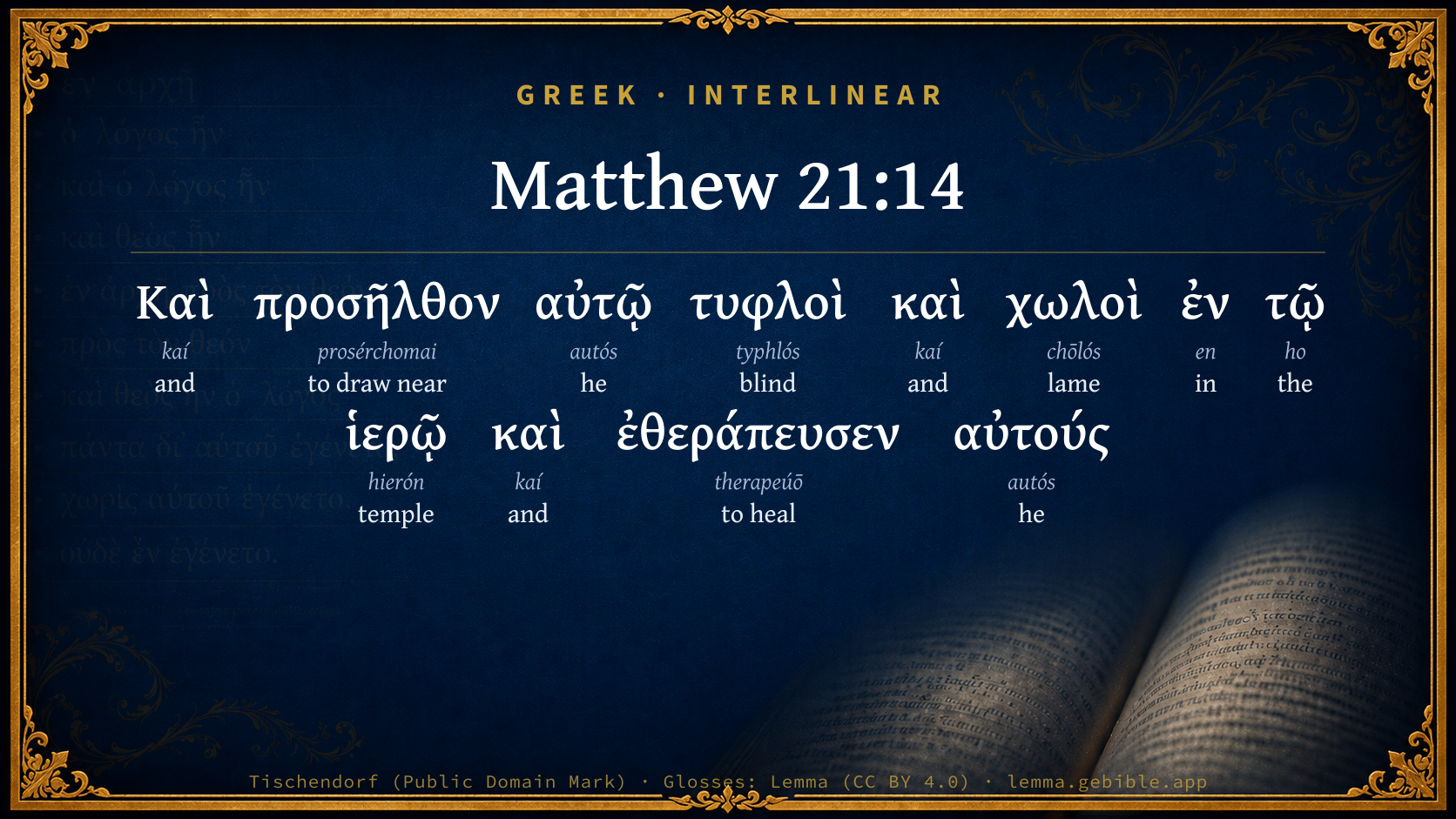
Download image
Cite this verse

Matthew 21:14 (World English Bible). Public Domain. Lemma interlinear Bible study tool, https://lemma.gebible.app/v/matthew/21/14.

Show BibTeX & RIS
BibTeX
RIS
English Translation
The blind and the lame came to him in the temple, and he healed them.
World English Bible · Public Domain
Download a study sheet

One document with this verse’s original text, its word-by-word gloss line, the meaning frame, cross-references with their text, attributed commentary, and full source and license credits — printable, and it pastes into notes with its structure intact.

This verse Autodidact and up

Study sheet (.html) Plain text (.txt)

A passage Seminary Student

Up to 50 verses in one chapter. A passage sheet keeps up to 6 commentary sources and 12 cross-references per verse, in the order this page ranks them, and says so on the sheet whenever that leaves anything out. Ask for a single verse and you get the Autodidact verse sheet above.

Everything on this page stays free to read, with no account — the sheet is a download of what is already on screen, not access to it.

Want to remove ads? Support Godless Engineer
Compare translations 3

The same verse in 3 English versions, stacked beneath the original-language interlinear above. Click any original word for its lexicon entry.

Each is an independent rendering of the whole verse — the interlinear is not word-aligned to these translations.

Highlighted words mark where these versions differ — a whole-verse word diff, not a word-by-word alignment.

  • World English Bible Public Domain
    The blind and the lame came to him in the temple, and he healed them.
  • King James Version Public Domain
    And the blind and the lame came to him in the temple; and he healed them.
  • unfoldingWord Literal Text CC BY-SA 4.0
    And the blind and the lame approached him in the temple, and he healed them.

unfoldingWord Literal Text — © unfoldingWord, licensed CC BY-SA 4.0. Word-aligned USFM3 via Door43 (git.door43.org/unfoldingWord/en_ult).

Versions to compare (up to 4)

3 of 4 selected

Show all 19 translations

Every available English version of this verse, each an independent rendering of the whole verse.

  • World English Bible Public Domain
    The blind and the lame came to him in the temple, and he healed them.
  • Berean Standard Bible Public Domain
    The blind and the lame came to Him at the temple, and He healed them.
  • Majority Standard Bible Public Domain
    The lame and the blind came to Him at the temple, and He healed them.
  • King James Version Public Domain
    And the blind and the lame came to him in the temple; and he healed them.
  • American Standard Version (1901) Public Domain
    And the blind and the lame came to him in the temple; and he healed them.
  • Revised Version (1885) Public Domain
    And the blind and the lame came to him in the temple: and he healed them.
  • Geneva Bible (1599) Public Domain
    Then the blinde, and the halt came to him in the Temple, and he healed them.
  • Douay-Rheims (1899) Public Domain
    And there came to him the blind and the lame in the temple; and he healed them.
  • Young's Literal Translation Public Domain
    And there came to him blind and lame men in the temple, and he healed them,
  • Literal Standard Version CC BY-SA 4.0
    And there came to Him blind and lame men in the temple, and He healed them,
  • Unlocked Literal Bible CC BY-SA 4.0
    Then the blind and the lame came to him in the temple, and he healed them.
  • unfoldingWord Literal Text CC BY-SA 4.0
    And the blind and the lame approached him in the temple, and he healed them.
  • Darby Bible Public Domain
    And blind and lame came to him in the temple, and he healed them.
  • World Messianic Bible Public Domain
    The lame and the blind came to him in the temple, and he healed them.
  • Webster's Bible Public Domain
    And the blind and the lame came to him in the temple; and he healed them.
  • Free Bible Version CC BY-SA 4.0
    The blind and the lame came to Jesus in the Temple, and he healed them.
  • Bible in Basic English Public Domain
    And the blind and the broken in body came to him in the Temple, and he made them well.
  • Text-Critical English NT CC BY 4.0
    Then the lame and the blind came to him in the temple courts, and he healed them.
  • Tyndale New Testament (1534) Public Domain
    And the blinde and the halt came to him in the temple and he healed them.

Literal Standard Version (2020), Covenant Press — licensed CC BY-SA 4.0. Text via the HelloAO Bible API (eBible.org). Unlocked Literal Bible (unfoldingWord) — licensed CC BY-SA 4.0. Text via the HelloAO Bible API (eBible.org). unfoldingWord Literal Text — © unfoldingWord, licensed CC BY-SA 4.0. Word-aligned USFM3 via Door43 (git.door43.org/unfoldingWord/en_ult). Free Bible Version, Dr. Jonathan Gallagher — licensed CC BY-SA 4.0. Text via the HelloAO Bible API (eBible.org).

Word by word

More ways to search: Search by grammar → Find every occurrence → Compare this word →

Practice this passage: Drill this verse → Learn its vocabulary →

About this verse

These counts appear in no published source. They are computed here, from the morphology-tagged text and Lemma’s own curated glosses. What Lemma adds →

12
words
9
distinct lemmas
Gospels
section

Notable vocabulary

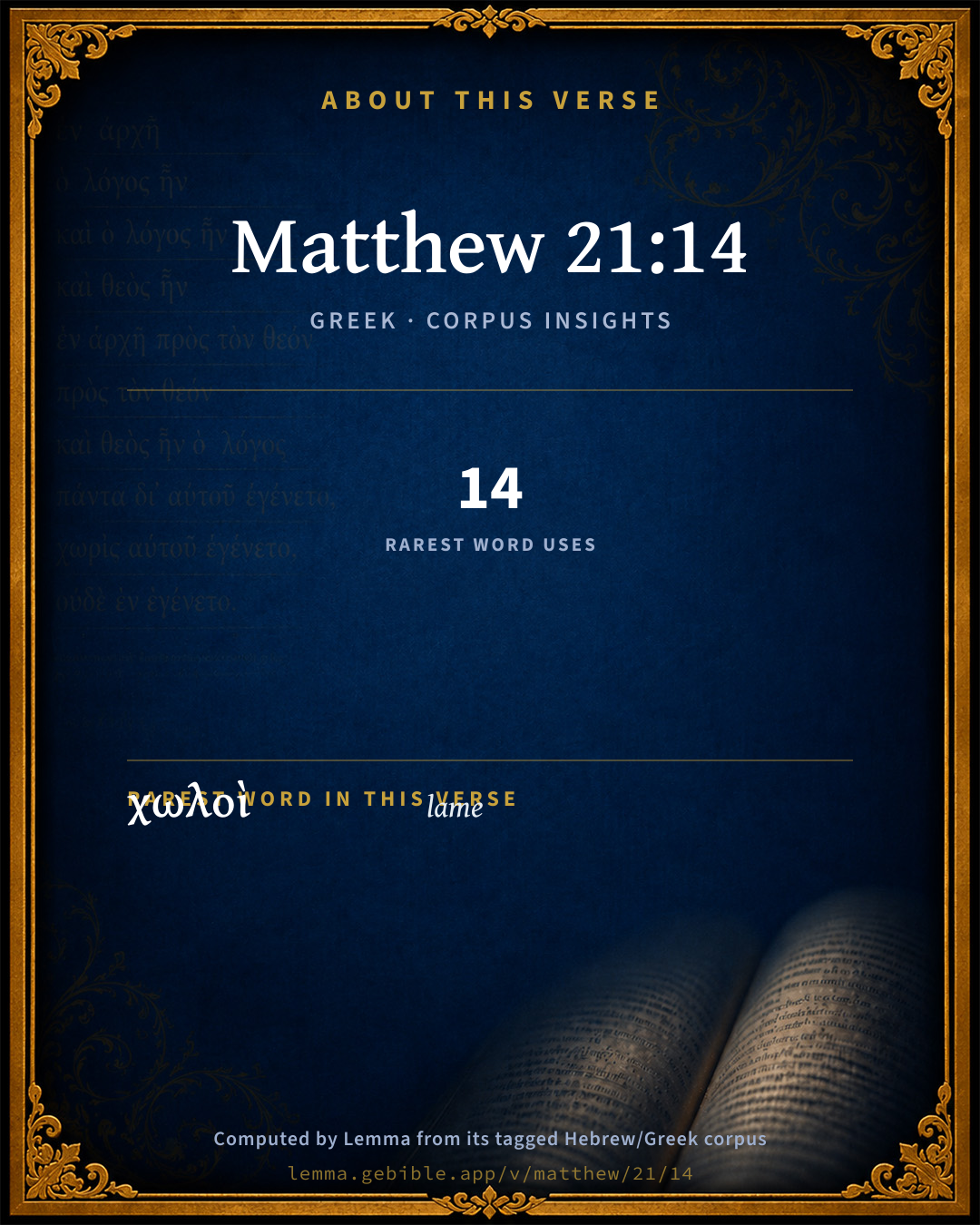
The rarest word here is χωλοὶ lame G5560 — appearing just 14 times in the whole Greek New Testament.

Shared distinctive vocabulary

χωλοὶ lame G5560 occurs in 14 verses of the Greek New Testament. Also found in:

Repetition

Words recur within this verse:

  • Καὶ and G2532 ×3
  • αὐτῷ he G846 ×2

Cross-references

6

Topical passages linked to Matthew 21:14 in the Treasury of Scripture Knowledge — connected by theme and wording, ordered by reader-vote popularity; previews shown in the World English Bible.

  • Isaiah 35:5 Then the eyes of the blind shall be opened, and the ears of the deaf shall be unstopped.
  • Matthew 4:23 Jesus went about in all Galilee, teaching in their synagogues, preaching the Gospel of the Kingdom, and healing every disease and every sickness among the people.
  • Matthew 9:35 Jesus went about all the cities and the villages, teaching in their synagogues, and preaching the Gospel of the Kingdom, and healing every disease and every sickness among the people.
  • Matthew 11:4–5 Jesus answered them, "Go and tell John the things which you hear and see:
  • Acts 3:1–9 Peter and John were going up into the temple at the hour of prayer, the ninth hour.
  • Acts 10:38 even Jesus of Nazareth, how God anointed him with the Holy Spirit and with power, who went about doing good and healing all who were oppressed by the devil, for God was with him.

Cross-references courtesy of OpenBible.info (CC BY 4.0).

Commentary

Notes on Matthew 21:14 from classic Christian and Jewish commentators (each source and its license shown beneath its notes). The classic Christian expositions comment on the surrounding passage and are grouped to its opening verse, so a note may address several verses; the Jewish commentaries on the Tanakh (Rashi and others) are per-verse, so they appear only where the commentator wrote on this verse.

Lemma curates 59 commentaries, every one of them public domain or Creative Commons licensed, each selected and text-cleaned for this edition rather than reprinted as found. About our sources →

Godbey's Commentary on the New Testament

William B. Godbey

TRIUMPHANT ENTRY

Joh 12:12-19; Mat 21:1-11; Mat 21:14-17; Luk 19:29-44; Mar 11:1-11. John: “On the morrow a great multitude, having come to the feast, hearing that Jesus comes into Jerusalem, took the branches of the palm-trees, and came out to meet Him, and continued to cry out, Hosanna! Blessed is He that cometh in the name of the Lord, the King of Israel!” Having arrived at Bethany Sunday evening, and lodged at the house of Mary, Martha, and Lazarus, on Monday morning Jesus goes to Jerusalem, over Mount Olivet, as the road then led. Now it goes around it, south of the summit.

Mark: “When they draw near to Jerusalem, to Bethphage and Bethany, near to the Mount of Olives, He sends forth two of His disciples, and says to them, Go ye into the village which is opposite you, and going into it, you will immediately find a colt tied, on which no one of men has sat. And if any one may say to you, Why do you do this? say that the Lord has need of him, and immediately he will send him hither. They departed, and found the colt tied at the door without, on the crossing of two roads, and they are loosing him; and certain ones of those standing there began to say to them, What are you doing, loosing the colt? And they said to them as Jesus commanded. And they led the colt to Jesus, and cast their garments on him, and He sat on him.” I made a specialty of pursuing this old road over the mountain which Jesus traveled on this notable occasion. Bethphage is about half-way from Bethany to the summit, on the mountain slope. From this place, in the journey, Jesus sent the two disciples, whose names are not given, with orders to go into a village on the mountain in full view, and bring to Him the young donkey, which had never been mounted. Matthew says they brought the mother along with the colt. Those donkeys have wonderful strength, utterly out of proportion to their size, which is quite diminutive. They are much used in the Holy Land, really more than any other domestic animal, the camel ranking next, and being used for all heavy burdens. Some get confused in the statement of Matthew that “He sat on them,” thinking that He rode both of the donkeys, which is untrue, as “them” does not refer to the animals, but to the clothes which they laid on the young animal, and on which Jesus sat. Why did Jesus ride the donkey? Why not a horse? The reason is very obvious. The horse is the symbol of war, being always used in battle; while the donkey, too slow for war, is the universal symbol of peace, and consequently the appropriate animal for the Prince of Peace to ride. Again, the donkey symbolizes humility, as he is the poor man’s animal, eating about as much as a sheep, hardy enough to live in the desert, and so small and tough that he can climb a mountain like a goat. Jesus came, the first time, in His humiliation, homeless and friendless, riding into Jerusalem on the donkey. He will come the second time in His glory, riding on a white cloud.

John: “Jesus, having found the young donkey, sat on him, as has been written, Fear not, daughter of Zion; behold, thy King cometh, sitting upon the colt of the donkey.” (Zec 9:9) That is certainly a very beautiful prophecy. As Jerusalem occupies the summit of Mount Zion, the application is clear and unmistakable.

Mark: “And many strew their garments in the way; and others cut down the branches from the trees, and continued to strew them in the way. Those going before and those following alter continued to shout, saying, Hosanna! Blessed is He that cometh in the name of the Lord! Blessed is the kingdom coming in the name of our father David I Hosanna in the highest!” Luke says: “He, drawing nigh to the descension of the Mount of Olives, the whole multitude of His disciples, rejoicing, began to praise God with a loud voice for all the miracles which they had seen.” After the gushing, Oriental style of saluting kings and conquerors, they threw down their garments for Him to ride over them, demonstrative of their perfect submission to His authority, and at the same time they strew His way with palm-leaves, which are so majestic and beautiful in Oriental climates, and vividly symbolic of royalty, conquest, and victory. They had waited three years for that wonderful hour, and now feel sure that the desideratum for which they had prayed, sighed, and cried to God so long is fast culminating into a glorious reality; and when they reach Jerusalem, they are very sanguine that He will be crowned King of the Jews. At that time there were no factories, and clothing was so scarce and costly, comparatively with our day, that we can hardly estimate the sacrifice which they so cheerfully and gladly made in throwing down the best apparel they had, in the dusty road, for the donkey to tread upon. O they are so glad to hail Him King of the Jews, little dreaming that this grand ovation was but a scintillation of the oncoming glory of the triumphant entry of King Jesus into Jerusalem on the white cloud, symbolized by the white donkey, when the mighty host of angels and glorified saints will accompany Him. Thus they witnessed an exultant prelibation of the grandest triumph in the history of redemption, when our Lord shall descend from heaven on the throne of His glory, accompanied by the celestial millions. The perfect submission they manifested by casting their garments beneath the tread of the donkey, and the royal triumphs emblemized by the palm-leaves strewn in the Conqueror’s path, and the joyous shout of the appreciative disciples, “Blessed is He that cometh in the name of the Lord! Glory in the highest!” O what a grand adumbration of our Lord’s triumphant return on the throne of His millennial glory, to girdle the globe with peace, righteousness, holiness, and victory! Satan will be chained and imprisoned; the six-thousand-year weekdays of toil, temptation, conflict, and suffering under the dark reign of Satan will be fled and gone, and the bright Sabbath of Eden return in millennial glories,

“Undimmed by sorrow, unhurt by time;”

the earth, exultant from the long winter of sin and oppression, will again leap into the life of perpetual springtime; and sterility, wintry storms, wasting tempests, will retreat forever before the glorious Sun of righteousness, rising on all the world, with healing in His wings, dissipating forever the long, dismal night of sin, and girdling the globe witch God’s hallowed millennial day. As the happy years roll on, the people will forget the awful suffering, conflict, and desolation of bygone ages. This shouting multitude caught a glimpse of the oncoming victory, and thought the long-prayed-for triumph had actually come. But it receded away, leaving bright memories which have inspired the saints in all subsequent ages. While we contemplate this symbolic adumbration of our Lord’s coming glory, let us all thank God and take courage, remembering that we are eighteen hundred and sixty-seven years nearer that glorious hour when the triumphant coming of our King shall not only verify the prophecies, but triumphantly fulfill the thrilling symbolism of this memorable occasion.

Joh 12:16. “And His disciples did not at first understand these things; but when Jesus was glorified, then they remembered that these things had been written in reference to Him, and they did them to Him.” When the Holy Ghost descended on them at Pentecost, sanctifying and flooding them with light on the precious Word, then they were able to tightly divide the Word of Truth, and separate the prophecies — some appertaining to His first coming, in humiliation; and others to His glorious coming in triumph. At the time of this public entry into Jerusalem, they were awfully disappointed, because He rendered Himself invisible and passed out of their hands when they came to crown Him King; but the Pentecostal baptism, which followed the glorification of Jesus, gave light on all these mysteries and filled them with joy.

“Then the multitude, being with Him, continued to testify that He called Lazarus out of the tomb, and raised him up from the dead.” Lazarus was then with Him, one of His loving disciples, and also a host of people who had actually witnessed that wonderful miracle, regarded as the greatest of our Savior’s ministry. Therefore the multitude came to Him because they heard that He had performed this miracle.

“Then the Pharisees said to one another, You see that you profit nothing. Behold, the world has gone after Him.” This grand ovation which Jesus received, along with the popular excitement over the resurrection of Lazarus, stirred the gall of the Pharisees and the higher clergy to the very bottom.

Luk 19:39 “And certain ones of the Pharisees from the crowd said to Him, “Teacher, rebuke Thy disciples.” Dead religion can’t stand hallelujah meetings. They are literal torture to dead professors and dry-bone preachers. “Responding, He said to them, I say unto you, that if they must keep silent, the rocks will shout.” We see that the Lord believes in shouting meetings. This was a more noisy time than you ever witnessed at a holiness camp, and yet the Lord rebuked no one for fanaticism, but commended the whole affair. The Lord is going to be praised with “a loud voice.” If the Churches will not do it, He will convert the drunkards and harlots, though their hearts be hard as stone, till they will shout His praises. The rocks did cry out the next Friday, when He hung on the cross, and they were rent with the earthquake shock.

“And when He drew nigh, seeing the city, He wept over it, saying, If thou hadst known, even in this thy day, the things appertaining to thy peace; but now they are hidden from thine eyes. Because the days shall come upon thee, and thine enemies will throw a blockade around thee, and encompass thee in a circle, and they will press thee on all sides; they will slay thee and thy children in thee, and will not leave in thee stone upon stone, because thou hast not known the time of thy visitation.” On the very spot, descending Mount Olivet, here referred to, where Jesus poured forth gushing tears, weeping over the city, we have a most conspicuous view of all Jerusalem. Christian money has built a beautiful, snowy-white stone church-edifice on that very spot. It is called “The Church of Jesus Weeping.” His omniscient eye saw the great and formidable Roman armies coiled round the city, like a huge boa-constrictor, cutting off all ingress and egress, dooming the inmates to famine, which, along with the sword, slew them so rapidly that interment was impossible. Consequently the pestilential exhalations, from the putrefying corpses, produced an awful pestilence, which swept its withering epidemic through the air, actually competing with the sword and famine by heaping the city with mountains of the dead. Josephus says the horrors of the siege actually beggared all possible description, Jesus, with immortal eyes, seeing the future like the present, gazes on these awful and shocking tragedies, while His pure, tender, unfallen human heart gives way to profoundest pity and lacerating sympathy, till His eyes flood with gushing tears. Only four days intervening till the bloody scene of Calvary is to seal the doom of that devoted city, and expedite the righteous judgments of the Almighty, the Holy Spirit, as we here see from the words of Jesus, having already been grieved away, while hell, with its black legions, has come to the front.

Mar 11:11. “Jesus came into Jerusalem, and into the temple; and looking round upon all things, the hour already being late, went out to Bethany with the twelve.” You must not forget that “temple,” in these Scriptures, simply means the Holy Campus, which is said now to contain thirty-five acres, with many valuable buildings on it, and more then than now; for none but the priests were admitted into the temple proper. Jesus, with His apostles, had lodged in Bethany the preceding night, and now goes back and lodges there Monday night. If He had lodged in the city, there is no doubt but His enemies would have attacked Him. Having lodged Sunday and Monday nights in Bethany, Tuesday and Wednesday nights in some of the villages on Mount Olivet, He remained in the city Thursday night, being arrested by His enemies at midnight.

Mat 21:10. “Jesus having come into Jerusalem, the whole city was stirred, saying, Who is this?” We do not wonder at the excitement and the inquiry which had been produced by an entrance so exceedingly demonstrative. Besides the native population, multitudes have already arrived in the city, that they may prepare for the oncoming Passover. As the children of Abraham, the most enterprising people in the world in all ages, had gone away into all the cities of the known world, there to sojourn and accumulate wealth, therefore to the great annual Passover they came from the ends of the earth. “And the multitudes continued to say, This is Jesus, the Prophet, from Nazareth of Galilee. The blind and the lame were coming to Him in the temple, and He healed them.” Many of them are there now. O how they thronged me, last November and December. begging for contributions, which I was only delighted to give, of course, in small value! Jerusalem this day is a practical Bible looking-glass. O what a glory when the blind and the lame all crowded around Him there in the great Temple Campus, and on their sightless eyeballs He poured the light of day, and made the lame to leap for joy!

“And the high priests and scribes, seeing the wonderful things which He did, and the children in the temple, crying, Hosanna to the Son of David, got mad, and said to Him, Do you hear what they are saying? And Jesus says to them, Yes; have you not read that out of the mouth of babes and sucklings Thou hast perfected praise?” (Psa 8:3.) We still see that Jesus believes in noisy meetings — none too young and none too old to shout aloud the praises of God. It made these big preachers and Church officers very mad; and they still get mad when you get up a sweeping holiness revival, and they hear the people praising the Lord with a loud voice, with no exception of age, sex, race, sect, or color.

William B. Godbey, Commentary on the New Testament (1896–1900) — public domain. Text from a community e-Sword module.

Bengel's Gnomon

Johann Albrecht Bengel

Mat 21:14. Ἐν τῷ ἱερῷ, in the temple) The right use of the temple; which was found fault with by His adversaries, who tolerated the abuse of the temple. No one else ever performed miracles in the temple; this was peculiar to the Messiah.

Bengel's Gnomon of the New Testament — English translation (T&T Clark, Edinburgh, 1860) — public domain. Text from a community e-Sword module.

Meyer's Critical & Exegetical Commentary

Heinrich August Wilhelm Meyer

Mat_21:14 ff. The insertion of Mat_21:14-16 from the apostolic tradition is peculiar to Matthew.

τὰ θαυμάσια] the only instance of this usage in the New Testament, though very common in classical Greek and the Sept.: the wonderful things, viz. the cleansing of the temple and the miraculous cures. This combination has suggested the use of the more comprehensive term.

Mat_21:16. ἀκούεις κ.τ.λ.] in a tone of rebuke, implying that He was the occasion of such impropriety, and was tolerating it.

ὅτι] recitative. The reply of Jesus, so profoundly conversant with the true sense of Scripture, is as much as to say that this shouting of the children is altogether befitting, as being the praise which, according to Psa_8:3, God has perfected.

νηπίων κ. θηλαζόντων] In explaining the words of the psalm, there is no need to have recourse to the fact that children usually received suck for two and three years (Grimms note on 2Ma_7:27), nor even to the idea of the children being transformed into adult instruments in effecting the triumph of Gods cause (Hofmann, Weiss, u. Erf. II. p. 118), but only to bear in mind that, as a genuine poet, the psalmist seemed to hear, in the noise and prattle of the babes and sucklings, a celebration of their Makers praise. But, inasmuch as those children who shouted in the temple were not νήπιοι (i.e. in connection with θηλάζ. infantes, Isa_11:8; 1Co_3:1), the scriptural warrant by which Jesus here justifies their hosannas may be said to be based upon an inference a minore ad majus. That is to say, if, according to Psa_8:3, God had already ordained praise from the mouths of sucklings, how much more has He done so from the mouths of those little ones who now shouted hosanna! The former, though unable to speak, and still at the mothers breast, are found praising God; how much more the latter, with their hosanna cries! These last are shouted in honour of the Messiah, who, however, is Gods Son and Representative, so that in His δόξα God is glorified (Joh_13:31; Joh_14:13; Php_2:11), nay, God glorifies Himself (Joh_12:28).

κ. ηὐλίσθη ἐκεῖ] Consequently He did not pass the night in the open air (in answer to Grotius), for neither in classical Greek do we always find αὐλίζεσθαι used in the sense of bivouacking (Apollonid. 14; Diod. Sic. xiii. 6). Comp. Tob_4:14; Tob_6:10; Tob_9:5; Jdg_19:9 f.

On Bethany, some 15 stadia from Jerusalem (Joh_11:18), see Tobler, Topogr. v. Jerus. II. p. 432 ff.; Robinson, Pal. II. p. 309 ff.; Sepp, Jerus. u. d. heil. Land, I. p. 583 ff. At present it is only a miserable village, known by the Arabic name of el-Aziriyeh (from el-Azir, i.e. Lazarus). For the name, see note on Joh_1:28.

Meyer — Critical and Exegetical Commentary on the New Testament — English translation by Peter Christie, edited by Frederick Crombie (T&T Clark, 1880) — public domain. Text from a community e-Sword module.

Expositor's Greek Testament

ed. W. Robertson Nicoll

Mat 21:14-17 , peculiar to Mt.

Mat 21:14 . τυφλοὶ καὶ χωλοὶ : that the blind and lame in the city should seek out Jesus is perfectly credible, though reported only by Mt. They would hear of the recent healing at Jericho, and of many other acts of healing, and desire to get a benefit for themselves.

The Expositor's Greek Testament, edited by W. Robertson Nicoll (1897–1910) — public domain. Text from a community e-Sword module.

Adam Clarke's Commentary

Verse 14. The blind and the lame came] Having condemned the profane use of the temple, he now shows the proper use of it. It is a house of prayer, where God is to manifest his goodness and power in giving sight to the spiritually blind, and feet to the lame. The Church or chapel in which the blind and the lame are not healed has no Christ in it, and is not worthy of attendance.

Adam Clarke's Commentary on the Bible (1810–1826) — public domain. Text from a community e-Sword/MySword module.

Ellicott's Commentary for English Readers

(14) The blind and the lame.—These, as we see from Act_3:2, and probably from Joh_9:1, thronged the approaches to the Temple, and asked alms of the worshippers. They now followed the great Healer into the Temple itself, and sought at His hands relief from their infirmities. If we were to accept the LXX. reading of the strange proverbial saying of 2Sa_5:8, “The blind and the lame shall not come into the house of the Lord,” it would seem as if this were a departure from the usual regulations of the Temple; but the words in italics are not in the Hebrew. Most commentators give an entirely different meaning to the proverb, and there is no evidence from Jewish writers that the blind and the lame were ever, as a matter of fact, excluded from the Temple. All that we can legitimately infer from the two passages is the contrast between the hasty, passionate words of the conquering king, and the tender compassion of the Son of David, to whom the blind and the lame were objects, not of antipathy, but pity.

A Bible Commentary for English Readers, edited by Charles John Ellicott (1878–1897) — public domain. Text from a community e-Sword module.

John Gill's Exposition

And the blind and the lame came to him,.... The Syriac and Ethiopic versions read, "they brought unto him the blind and the lame". The blind could not come to him unless they were led, nor the lame, unless they were carried: the sense therefore is, they came, being brought to him:

in the temple; that part of it, the court of the Gentiles, and mountain of the house, out of which he had cast the buyers and sellers, &c. and in the room of them, were brought in these objects of his pity:

and he healed them; to the blind he restored sight, and caused the lame to walk; which miracles he wrought in confirmation of the doctrine he preached: for all the other evangelists relate, that he taught in the temple.

John Gill's Exposition of the Whole Bible (1746–1763) — public domain (CC PDM 1.0). Text via the HelloAO Bible API.

Trapp's Complete Commentary

John Trapp

14 And the blind and the lame came to him in the temple; and he healed them.

Ver. 14. Came to him in the temple, and he healed them] So true was that testimony given of our Saviour, Luk 24:19, that he was a prophet mighty in deed, as well as in word, before God and all the people. Nos non eloquimur magna, sed vivimus, We are not eloquent but we survive, said the primitive Christians. Our lives as well as our lips should speak us right and real in religion; as Christ here, by his cures, gave a real answer to that question, Mat 21:10, Who is this? Let us learn to lead convincing lives; these are the best apologies when all is done.

John Trapp, A Commentary or Exposition upon All the Books of the Old and New Testament (1647–1656) — public domain. Text from a community e-Sword module.

Whedon's Commentary on the Bible

Daniel D. Whedon

14. Blind… came to him in the temple — Neander thinks it so strange that miracles should take place at this moment, that he pronounces the verses unhistorical! Verily, our Lord did not think the temple of God too sacred a place for deeds of mercy, nor the moment too valuable to put forth his power for poor humanity.

Daniel D. Whedon (gen. ed.), Commentary on the Old and New Testaments (1874–1909) — public domain. Text from a community e-Sword module.

The Pulpit Commentary

The blind and the lame came to him in the temple. This notice is peculiar to St. Matthew, though St. Luke (Luk_19:47) mentions that "he taught daily in the temple." An old expositor has remarked that Christ first as King purified his palace, and then took his seat therein, and of his royal bounty distributed gilts to his people. It was a new fulfilment of the prophecy of Isaiah, (Isa_35:4-6) which spake of Messiah coming to open the eyes of the blind, to unstop the ears of the deaf, to make the lame man leap as a hart. For acts of sacrilege which profaned the temple precincts, he substituted acts of mercy which hallowed them; the good Physician takes the place of the greedy trafficker; the den of thieves becomes a beneficent hospital. How many were the acts of healing, we are not told; but the words point to the relief of numberless sufferers, none of whom were sent empty away.

The Pulpit Commentary (1880–1919), ed. H.D.M. Spence-Jones & Joseph S. Exell — public domain. Text from a community e-Sword module.

Kretzmann's Popular Commentary

Paul E. Kretzmann

The confession of the children

v. 14. And the blind and the lame came to Him in the Temple; and He healed them.

v. 15. And when the chief priests and scribes saw the wonderful things that He did, and the children crying in the Temple and saying, Hosanna to the Son of David! they were sore displeased,

v. 16. and said unto Him, Hearest Thou what these say? And Jesus saith unto them, Yea; have ye never read, Out of the mouth of babes and sucklings Thou hast perfected praise?

Even in these last days the Lord continued the work of His healing ministry, in the very courts of the Temple, the Court of the Gentiles being used for various meetings. And the chief priests and scribes, fearing the multitudes, could at this time do nothing, although they were boiling with murderous indignation. But when the children that had come up with their parents to witness the Temple-service and to stay for the Passover, began to chant the song which had so grated upon the ears of the Pharisees on the day before; when their treble voices were lifted in the Hosanna of adoration and supplication, it was too much for the Jewish officials. Angrily they demanded of Him whether He did not hear. In reality they meant to say: Why do you not resent the blasphemy? For to be silent means to assent,—and incidentally to confess that their song was the truth. But Jesus had His answer ready. They accuse Him of deafness, of not hearing; He accuses them of blindness, of not being able to see, or of a poor memory in not being able to remember. It was plainly written, Psa 8:2, that babes and sucklings would sing the praises of the Messiah, and He accepted their confession with gladness. It confirmed the laudatory statements of the multitude in regard to His Messiahship. It was a tribute to His mission also to little children. "So absolutely is He pleased with their praise. He accepts it, and permits Himself to be proclaimed a king in Israel, and that the kingdom of Israel was His own kingdom and people. That makes them angry and foolish; that the high priests and great lords at Jerusalem could not suffer; that disturbs them most of all that they cry in the Temple, ’Hosanna!’ They are not concerned too much about the miracles; they permitted Him to make the blind to see, the lame to be straight, and to do more such miracles; but that He should want to come riding into the city with singing and pomp, and does not concern Himself about them, whom He should have asked for permission, that did not suit them at all. For all schismatics can easily judge the other man; they are waspish people, see the mote in the eyes of others, but are not aware of the beam in their own eyes. They think that the performance of miracles is indeed something, but to sing, for all of that, that He is a king and lord, that does not look well in a prophet. If He had first gone to the high priests and asked for permission, all might have been well; but that He does it without their permission, and that the poor bungler and beggar, who did not even own an ass, comes out so strongly against their will, and does not do so much as to look at them for permission, that is intolerable to them, that vexes them."

Paul E. Kretzmann, Popular Commentary of the Bible (1921–1924) — public domain. Text from a community e-Sword module.

Burkitt's Expository Notes on the New Testament

William Burkitt

Observe here, 1. That our blessed Saviour works his miracles not secretly in a corner, but openly in the temple, and submits them to the examination of all persons senses. A miracle is a supernatural action, which is obvious to sense. Popish miracles are talked of by many, but seen by none.

Observe, 2. That Christ’s enemies are never more incensed, than when his divine power is most exerted, and his divine nature owned and acknowledged. When the chief priests saw the miracles which Jesus did, and heard the children crying Hosanna to the Son of David, they, were sore displeased.

Observe, 3. That Christ can glorify himself by the mouth of babes and sucklings; he can form and fit up what instruments he pleases, to show forth his excellencies, and celebrate his praises. Out of the mouths of babes and suckling thou hast perfected praise.

William Burkitt's Expository Notes on the New Testament (1700–1703) — public domain. Text from a community e-Sword module.

International Critical Commentary

(E) 14. And there came to Him blind and lame in the temple; and He healed them.] Mk. has here: “And the chief priests and scribes heard, and were seeking how they might kill Him: for they feared Him, for all the multitude was amazed at His teaching.” Mt. substitutes for this an account of miracles done in the temple which the chief priests saw, and how they heard the children crying, Hosanna, and were vexed. He elsewhere substitutes a statement of healing for Mk.’s statement of teaching. See on 14:14, 19:2. He has already omitted Mk.’s reference to teaching, Mk v. 17. The editor seems to regard the first day as a day of action (vv. 14-15), the second as a day of teaching. Hence Mk.’s ἐδίδασκεν, 11:17 is, transferred to Mat 21:23, and Mar 11:18 πᾶς γὰρ ὁ ὄχλος ἐξεπλήσσετο ἐπὶ τῇ διδαχῇ αὐτοῦ to Mat 22:33.

International Critical Commentary — older volumes (1896–1929), various authors — public domain. Text from a community e-Sword module.

Lesson kit

Teaching starters — assembled from the data on this page, not authored interpretation. Every prompt links to the verse data it draws on. Edit before teaching.

Matthew, in the Gospels, opens this verse with 12 words (9 distinct Greek lemmas). Its most distinctive word is chōlós (“lame”). A historical commentator’s framing appears above. Read the whole chapter for the surrounding context.

Discussion questions

  1. What does “lame” (chōlós) contribute to the verse as a whole?
  2. Matthew 11:5 shares the word «lame» with this verse. How do the two illuminate each other?
  3. “and” occurs 3× in this one verse. What is the effect of the repetition?
  4. These translations render this verse differently. What is at stake in choosing one wording over another?
  5. Reading how Godbey's Commentary on the New Testament and Bengel's Gnomon read this verse, where do the two commentators agree and where do they part?

Things to notice

  • These translations choose different wording for 2 words in this verse.
  • “and” occurs 3× in this single verse.
  • 9 distinct Greek lemmas span 12 words in this verse.

Reading settings

Reading text

Shown beneath each verse's original-language words.

Old Testament
Old Testament edition

Read the OT as the Masoretic Hebrew (MT) or the Greek Septuagint (LXX).

English shown for the Greek Septuagint (in the Hebrew ↔ Greek comparison).

Comparing translations? Open the Compare panel on any verse page to stack up to four side by side.