Matthew 21:46

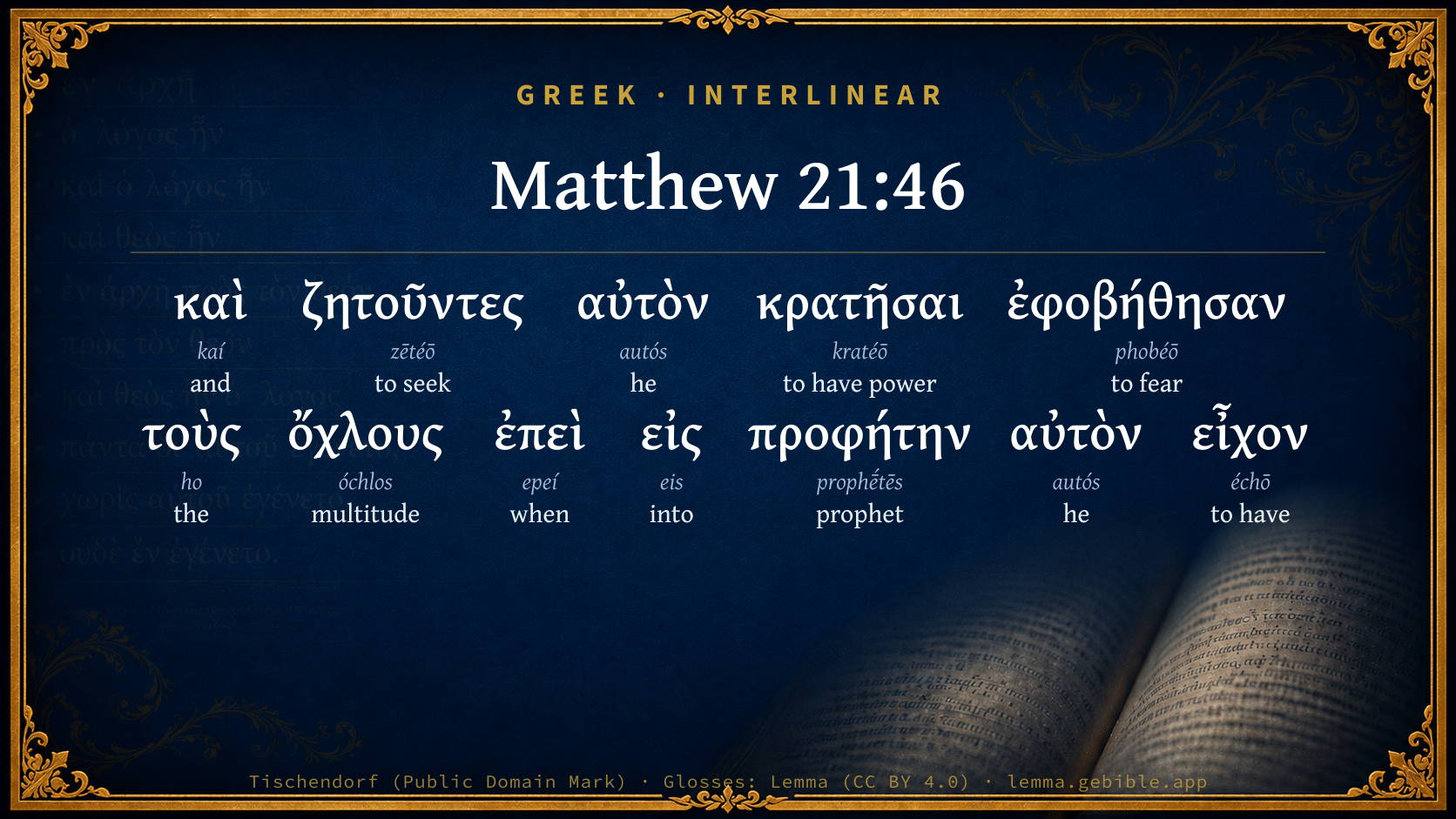
Greek (Tischendorf 8th ed.) Matthew 21:46 appears in the Greek New Testament. The text above is from the Tischendorf 8th edition. Each word links to its Strong’s number and a concise gloss. Click any word for its full Thayer’s Greek Lexicon entry.
Download image
Cite this verse

Matthew 21:46 (World English Bible). Public Domain. Lemma interlinear Bible study tool, https://lemma.gebible.app/v/matthew/21/46.

Show BibTeX & RIS
BibTeX
RIS
English Translation
When they sought to seize him, they feared the multitudes, because they considered him to be a prophet.
World English Bible · Public Domain
Download a study sheet

One document with this verse’s original text, its word-by-word gloss line, the meaning frame, cross-references with their text, attributed commentary, and full source and license credits — printable, and it pastes into notes with its structure intact.

This verse Autodidact and up

Study sheet (.html) Plain text (.txt)

A passage Seminary Student

Up to 50 verses in one chapter. A passage sheet keeps up to 6 commentary sources and 12 cross-references per verse, in the order this page ranks them, and says so on the sheet whenever that leaves anything out. Ask for a single verse and you get the Autodidact verse sheet above.

Everything on this page stays free to read, with no account — the sheet is a download of what is already on screen, not access to it.

Want to remove ads? Support Godless Engineer
Compare translations 3

The same verse in 3 English versions, stacked beneath the original-language interlinear above. Click any original word for its lexicon entry.

Each is an independent rendering of the whole verse — the interlinear is not word-aligned to these translations.

Highlighted words mark where these versions differ — a whole-verse word diff, not a word-by-word alignment.

  • World English Bible Public Domain
    When they sought to seize him, they feared the multitudes, because they considered him to be a prophet.
  • King James Version Public Domain
    But when they sought to lay hands on him, they feared the multitude, because they took him for a prophet.
  • unfoldingWord Literal Text CC BY-SA 4.0
    And seeking to seize him, they feared the crowds, because they were regarding him as a prophet.

unfoldingWord Literal Text — © unfoldingWord, licensed CC BY-SA 4.0. Word-aligned USFM3 via Door43 (git.door43.org/unfoldingWord/en_ult).

Versions to compare (up to 4)

3 of 4 selected

Show all 19 translations

Every available English version of this verse, each an independent rendering of the whole verse.

  • World English Bible Public Domain
    When they sought to seize him, they feared the multitudes, because they considered him to be a prophet.
  • Berean Standard Bible Public Domain
    Although they wanted to arrest Him, they were afraid of the crowds, because the people regarded Him as a prophet.
  • Majority Standard Bible Public Domain
    Although they wanted to arrest Him, they were afraid of the crowds, because the people regarded Him as a prophet.
  • King James Version Public Domain
    But when they sought to lay hands on him, they feared the multitude, because they took him for a prophet.
  • American Standard Version (1901) Public Domain
    And when they sought to lay hold on him, they feared the multitudes, because they took him for a prophet.
  • Revised Version (1885) Public Domain
    And when they sought to lay hold on him, they feared the multitudes, because they took him for a prophet.
  • Geneva Bible (1599) Public Domain
    And they seeking to laye handes on him, feared the people, because they tooke him as a Prophet.
  • Douay-Rheims (1899) Public Domain
    And seeking to lay hands on him, they feared the multitudes: because they held him as a prophet.
  • Young's Literal Translation Public Domain
    and seeking to lay hold on him, they feared the multitudes, seeing they were holding him as a prophet.
  • Literal Standard Version CC BY-SA 4.0
    and seeking to lay hold on Him, they feared the multitudes, seeing they were holding Him as a prophet.
  • Unlocked Literal Bible CC BY-SA 4.0
    Seeking to arrest him, they were afraid of the crowd, because the people regarded him as a prophet.
  • unfoldingWord Literal Text CC BY-SA 4.0
    And seeking to seize him, they feared the crowds, because they were regarding him as a prophet.
  • Darby Bible Public Domain
    And seeking to lay hold of him, they were afraid of the crowds, because they held him for a prophet.
  • World Messianic Bible Public Domain
    When they sought to seize him, they feared the multitudes, because they considered him to be a prophet.
  • Webster's Bible Public Domain
    But when they sought to lay hands on him, they feared the multitude, because they took him for a prophet.
  • Free Bible Version CC BY-SA 4.0
    They wanted him arrested, but they were afraid of what the people would do because the people believed he was a prophet.
  • Bible in Basic English Public Domain
    And though they had a desire to take him, they were in fear of the people, because in their eyes he was a prophet.
  • Text-Critical English NT CC BY 4.0
    Although they were looking for a way to arrest him, they were afraid of the crowds, because the people regarded him as a prophet.
  • Tyndale New Testament (1534) Public Domain
    And they wet about to laye hondes on him but they feared the people because they tooke him as a Prophet.

Literal Standard Version (2020), Covenant Press — licensed CC BY-SA 4.0. Text via the HelloAO Bible API (eBible.org). Unlocked Literal Bible (unfoldingWord) — licensed CC BY-SA 4.0. Text via the HelloAO Bible API (eBible.org). unfoldingWord Literal Text — © unfoldingWord, licensed CC BY-SA 4.0. Word-aligned USFM3 via Door43 (git.door43.org/unfoldingWord/en_ult). Free Bible Version, Dr. Jonathan Gallagher — licensed CC BY-SA 4.0. Text via the HelloAO Bible API (eBible.org).

Word by word

More ways to search: Search by grammar → Find every occurrence → Compare this word →

Practice this passage: Drill this verse → Learn its vocabulary →

About this verse

These counts appear in no published source. They are computed here, from the morphology-tagged text and Lemma’s own curated glosses. What Lemma adds →

12
words
11
distinct lemmas
Gospels
section

Shared distinctive vocabulary

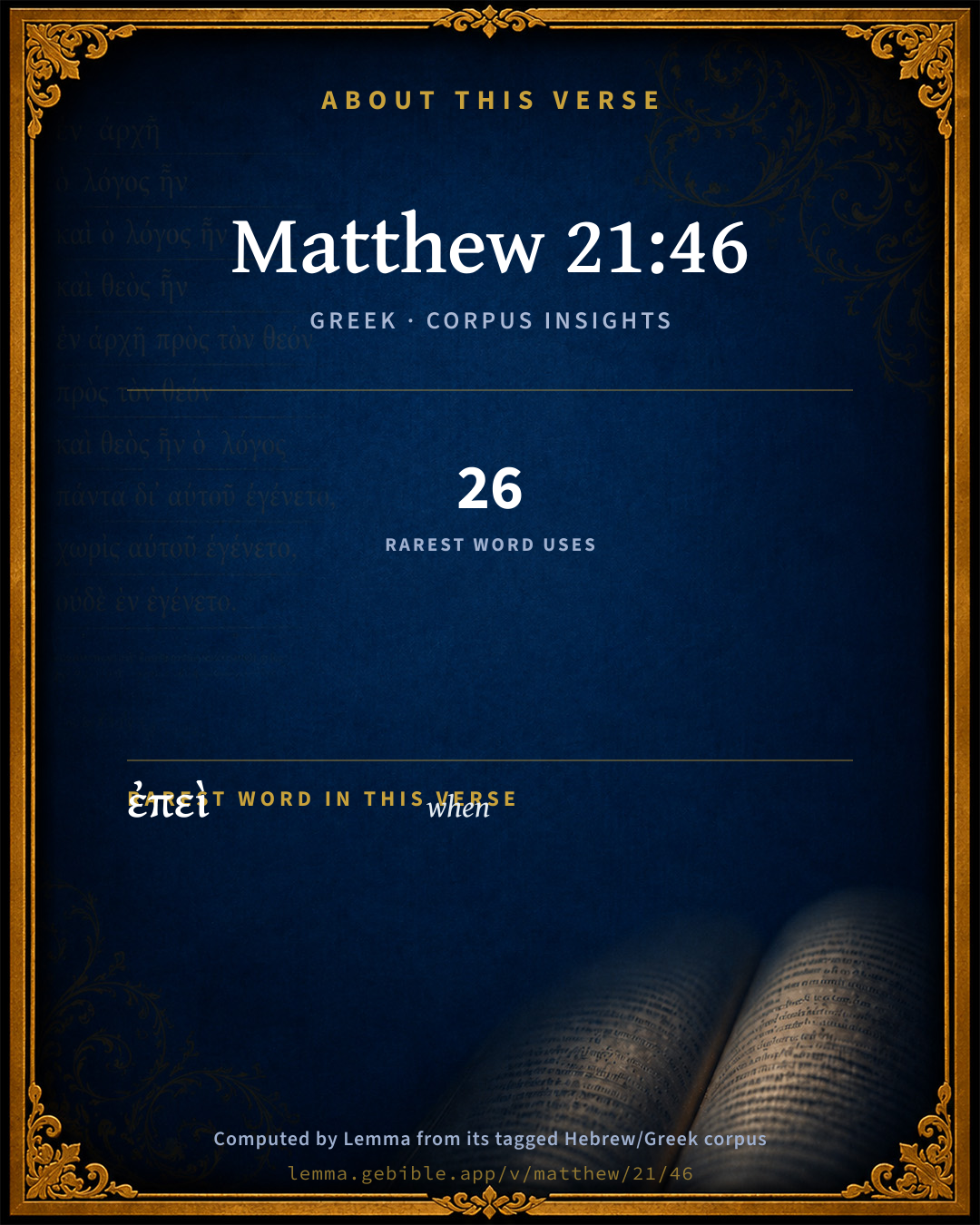
ἐπεὶ when G1893 occurs in 26 verses of the Greek New Testament. Also found in:

Repetition

A word recurs within this verse:

  • αὐτὸν he G846 ×2

Cross-references

11

Topical passages linked to Matthew 21:46 in the Treasury of Scripture Knowledge — connected by theme and wording, ordered by reader-vote popularity; previews shown in the World English Bible.

  • Matthew 21:11 The multitudes said, "This is the prophet, Jesus, from Nazareth of Galilee."
  • Matthew 21:26 But if we say, 'From men,' we fear the multitude, for all hold John as a prophet."
  • 2 Samuel 12:7–13 Nathan said to David, "You are the man. This is what Yahweh, the God of Israel, says: 'I anointed you king over Israel, and I delivered you out of the hand of Saul.
  • Proverbs 9:7–9 He who corrects a mocker invites insult. He who reproves a wicked man invites abuse.
  • Isaiah 29:1 Ho Ariel, Ariel, the city where David encamped! add you year to year; let the feasts come round:
  • Luke 7:16 Fear took hold of all, and they glorified God, saying, "A great prophet has arisen among us!" and, "God has visited his people!"
  • Luke 7:39 Now when the Pharisee who had invited him saw it, he said to himself, "This man, if he were a prophet, would have perceived who and what kind of woman this is who touches him, that she is a sinner."
  • John 7:7 The world can't hate you, but it hates me, because I testify about it, that its works are evil.
  • John 7:40–41 Many of the multitude therefore, when they heard these words, said, "This is truly the prophet."
  • Acts 2:22 "Men of Israel, hear these words! Jesus of Nazareth, a man approved by God to you by mighty works and wonders and signs which God did by him in the midst of you, even as you yourselves know,
  • Proverbs 15:12 A scoffer doesn't love to be reproved; He will not go to the wise.

Cross-references courtesy of OpenBible.info (CC BY 4.0).

Commentary

Notes on Matthew 21:46 from classic Christian and Jewish commentators (each source and its license shown beneath its notes). The classic Christian expositions comment on the surrounding passage and are grouped to its opening verse, so a note may address several verses; the Jewish commentaries on the Tanakh (Rashi and others) are per-verse, so they appear only where the commentator wrote on this verse.

Lemma curates 59 commentaries, every one of them public domain or Creative Commons licensed, each selected and text-cleaned for this edition rather than reprinted as found. About our sources →

Geneva Bible (1599)

Geneva Bible translators

The wicked can do nothing, but what God will.

Geneva Bible (1599) marginal notes — public domain. Text via Bolls.life.

Jamieson, Fausset & Brown

Robert Jamieson, A. R. Fausset & David Brown

But when they sought to lay hands on him--which Luke (Luk 20:19) says they did "the same hour," hardly able to restrain their rage.

they feared the multitude--rather, "the multitudes."

because they took him for a prophet--just as they feared to say John's baptism was of men, because the masses took him for a prophet (Mat 21:26). Miserable creatures! So, for this time, "they left Him and went their way" (Mar 12:12).

Next: Matthew Chapter 22

Jamieson, Fausset & Brown — Commentary Critical and Explanatory on the Whole Bible (1871) — public domain (CC PDM 1.0). Text via the HelloAO Bible API.

Adam Clarke's Commentary

Verse 46. They sought to lay hands on him, they feared the multitude] Restraining and preventing grace is an excellent blessing, particularly where it leads to repentance and salvation; but he who abstains from certain evils, only through fear of scandal or punishment, has already committed them in his heart, and is guilty before God. The intrepidity of our Lord is worthy of admiration and imitation; in the very face of his most inveterate enemies, he bears a noble testimony to the truth, reproves their iniquities, denounces the Divine judgments, and, in the very teeth of destruction, braves danger and death! A true minister of Christ fears nothing but God, when his glory is concerned: a hireling fears every thing, except Him whom he ought to fear.

This last journey of our Lord to Jerusalem is a subject of great importance; it is mentioned by all the four evangelists, and has been a subject of criticism and cavil to some unsanctified minds. He has been accused of "attempting, by this method, to feel how far the populace were disposed to favour his pretensions in establishing himself as a king in the land; or, at least, by his conduct in this business, he gave much cause for popular seditions." Every circumstance in the case refutes this calumny.

1. His whole conduct had proved that his kingdom was not of this world, and that he sought not the honour that cometh from man.

2. He had in a very explicit manner foretold his own premature death, and particularly at this time.

3. It is evident, from what he had said to his disciples, that he went up to Jerusalem at this time for the express purpose of being sacrificed, and not of erecting a secular kingdom.

4. What he did at this time was to fulfil a declaration of God delivered by two prophets, upwards of 700 years before, relative to his lowliness, poverty, and total deadness to all secular rule and pomp. See Isa 62:11; Zec 9:9.

5. All the time he spent now in Jerusalem, which was about five days, he spent in teaching, precisely in the same way he had done for three years past; nor do we find that he uttered one maxim dissimilar to what he formerly taught, or said a word calculated to produce any sensation on the hearts of the populace, but that of piety towards God; and in the parable of the man and his two sons, the husbandmen and the vineyard, he spoke in such a way to the rulers of the people as to show that he knew they were plotting his destruction; and that, far from fleeing from the face of danger, or strengthening his party against his enemies, he was come to wait at the foot of the altar till his blood should be poured out for the sin of the world!

6. Had he affected any thing of a secular kind, he had now the fairest opportunity to accomplish his designs. The people had already received him as Jesus the prophet; now they acknowledge him as the Christ or MESSIAH, and sing the hosannah to him, as immediately appointed by Heaven to be their deliverer.

7. Though, with the character of the Messiah, the Jews had connected that of secular royalty, and they now, by spreading their clothes in the way, strewing branches, c., treat him as a royal person, and one appointed to govern the kingdom yet of this he appears to take no notice, farther than to show that an important prophecy was thus fulfilled: he went as usual into the temple, taught the people pure and spiritual truths, withdrew at night from the city, lodged in private at Mount Olivet; and thus most studiously and unequivocally showed that his sole aim was to call the people back to purity and holiness, and prepare them for that kingdom of righteousness, peace, and joy in the Holy Ghost, which he was about, by his passion, death, resurrection, ascension, and the mission of the Holy Spirit, to set up in the earth.

8. Could a person who worked such miracles as he was in the daily habit of working-miracles which proved he possessed unlimited power and unerring wisdom, need subterfuges, or a colouring for any design he wished to accomplish? He had only to put forth that power essentially resident in himself, and all resistance to his will must be annihilated. In short, every circumstance of the case shows at once the calumny and absurdity of the charge. But, instead of lessening, or tendering suspicious this or any other part of our Lord's conduct, it shows the whole in a more luminous and glorious point of view; and thus the wrath of man praises him.

9. That he was a king, that he was born of a woman and came into the world for this very purpose, he took every occasion to declare; but all these declarations showed that his kingdom was spiritual: he would not even interfere with the duty of the civil magistrate to induce an avaricious brother to do justice to the rest of the family, Lu 12:13, when probably a few words from such an authority would have been sufficient to have settled the business; yet to prevent all suspicion, and to remove every cause for offence, he absolutely refused to interfere, and took occasion from the very circumstance to declaim against secular views, covetousness, and worldly ambition! O how groundless does every part of his conduct prove this charge of secular ambition to be!

Such was the spirit of the Master: such must be the spirit of the disciple. He that will reign with Christ, must be humbled and suffer with him. This is the royal road. The love of the world, in its power and honours, is as inconsistent with the spirit of the Gospel as the love of the grossest vice. If any man love the world, the love of the Father is not in him. Reader, take occasion from this refuted calumny, to imitate thy Lord in the spirituality of his life, to pass through things temporal so as not to lose those that are eternal, that thou mayest reign with him in the glory of his kingdom. Amen.

Adam Clarke's Commentary on the Bible (1810–1826) — public domain. Text from a community e-Sword/MySword module.

Ellicott's Commentary for English Readers

(46) When they sought to lay hands.—We must remember that they had once before made a like attempt, and had been baffled (Joh_7:44-46). Now circumstances were even more against them. The Prophet was surrounded by His own disciples, and by an admiring crowd. Open violence they did not dare to venture on, and they had to fall back upon the more crooked paths of stratagem and treachery.

A Bible Commentary for English Readers, edited by Charles John Ellicott (1878–1897) — public domain. Text from a community e-Sword module.

The Cambridge Bible for Schools and Colleges

gen. ed. J. J. S. Perowne

46. when they sought to lay hands on him] The Sanhedrin aimed at two things: (1) to seize Jesus quickly, for the Passover (during which no hostile measures could be taken) was close at hand; and because Jesus might be expected to quit Jerusalem after the feast. (2) To seize Him apart from the people; for the Galilæans would suffer no one to lay hands on their King and Prophet. Treachery alone enabled the Jews to secure their end.

The Cambridge Bible for Schools and Colleges (gen. ed. J. J. S. Perowne; Cambridge University Press, 1878–1918) — public domain. Text from a community e-Sword module.

John Gill's Exposition

But when they sought to lay hands on him,.... Not that they attempted by any outward action to apprehend him, and carry him off, or by any immediate act of violence to take away his life; but they secretly wished, and earnestly desired to do it: they were so irritated and provoked, that they could scarcely keep their hands off of him, and could have been glad of an opportunity of satiating their revenge upon him: and whereby they would but have fulfilled what he in this parable had prophetically said of them: and yet so hardened were they, though they understood his meaning, they were not deterred thereby, but on another account:

they feared the multitude; which were now about Christ, lest there should be a tumult, and they should take the part of Christ against them, to which they seemed inclined; when their lives, had they attempted anything of this nature, would have been in a great deal of danger:

because they took him for a prophet; by the doctrines which he taught, by the boldness and freedom of speech he used, and by the miracles he wrought: wherefore, though they might not all of them believe that he was the Messiah, or that prophet Moses spoke of; yet, since it was exceeding manifest, that he was a teacher sent of God, and endowed with very wonderful gifts; and from whom many of them had received singular benefits, if not for their souls, yet for their bodies; being healed by him of their lameness, or blindness, or other diseases; therefore would not suffer him to be abused, and ill treated by them: so that, as Mark says, "they left him, and went their way"; to consult together what was proper to be done, and wait for a better opportunity to seize him.

Next: Matthew Chapter 22

John Gill's Exposition of the Whole Bible (1746–1763) — public domain (CC PDM 1.0). Text via the HelloAO Bible API.

Trapp's Complete Commentary

John Trapp

46 But when they sought to lay hands on him, they feared the multitude, because they took him for a prophet.

Ver. 46. But when they sought to lay hands on him] And so showed themselves to be the same our Saviour spake of, Mat 21:39; Mat 21:42. As the pope and his emissaries do well approve themselves to be that false prophet, and his locusts, set forth in the Revelation. Their daily practice is a dear commentary upon that obscure prophecy, which the ancient Fathers, that lived not to see it fulfilled, could not tell what to say to. Future things are best understood by their events.

John Trapp, A Commentary or Exposition upon All the Books of the Old and New Testament (1647–1656) — public domain. Text from a community e-Sword module.

Whedon's Commentary on the Bible

Daniel D. Whedon

46. They feared the multitude — During all his quiet teachings in the temple during the Passion Week, and under his most terrible rebukes, they are, as it were, spell-bound, and unable to lift a hand against him until his work is done. They took him for a prophet — As the conscience of the common people was in favour of John the Baptist, so now was it so far on the side of Christ as to receive him, not indeed as the Son, but as a messenger to the vineyard.

Daniel D. Whedon (gen. ed.), Commentary on the Old and New Testaments (1874–1909) — public domain. Text from a community e-Sword module.

The Pulpit Commentary

They feared the multitude. They did not dare to lay violent hands on Jesus in the presence of the excited crowd, which would have withstood any such attack at this moment. A Prophet (see ver. 11). If they did not recognize him as Messiah, they regarded him as one inspired by God, and having a Divine mission. This accounts for the joyful acquiescence of the Pharisaical party in the offer of Judas, when he proposed to betray his Master in the absence of the multitude.

The Pulpit Commentary (1880–1919), ed. H.D.M. Spence-Jones & Joseph S. Exell — public domain. Text from a community e-Sword module.

The People's New Testament

B. W. Johnson

46. When they sought to lay hands on him. Jerusalem was filled with people, and the demonstration, two days before, on Sunday, showed that thousands of Galileans, at least, regarded him a prophet. Hence, they find some darker and safer way than an open assault in the day. None can oppose Christ without injury. Even the silent opposition of indifference will cause us to be “broken” unless repented of. To continue our opposition until the day of grace is over will result in irretrievable ruin. Those who are “ground to powder” are beyond hope.

B. W. Johnson's The People's New Testament with Notes (1889–1891) — public domain. Electronic text from the Christian Classics Ethereal Library (CCEL) ThML edition.

Cambridge Greek Testament for Schools and Colleges

46. εἰς has the more ancient evidence, ὡς the more numerous later codices in its favour.

Nisan 9 (Palm Sunday)

46. ζητοῦντες αὐτὸν κρατῆσαι. The Sanhedrin aimed at two things: (1) to seize Jesus quickly, for the Passover (during which no hostile measures could be taken) was close at hand; and because Jesus might be expected to quit Jerusalem after the feast. (2) To seize Him apart from the people; for the Galilæans would suffer no one to lay hands on their King and Prophet, Treachery alone enabled the Jews to secure their end.

Cambridge Greek Testament for Schools and Colleges (Cambridge University Press, 1896; 21 vols, various authors incl. Carr, Maclear, Plummer, Farrar, Lumby, Moule, M. R. James, Simcox) — public domain. Text from a community e-Sword module.

Alford’s Greek Testament

Henry Alford

46.] All three Evangelists have this addition. St. Mark besides says καὶ ἀφέντες αὐτὸν ἀπῆλθον, answering to our ch. 22:22. Supposing Mark’s insertion of these words to be in the right place, we have the following parable spoken to the people and disciples: see below.

Henry Alford, The Greek Testament (1849–1861) — public domain. Text from a community e-Sword module.

International Critical Commentary

(M) 46. And seeking to arrest Him, they feared the multitudes, since they held Him for a prophet.] Mk. has: “They were seeking to arrest Him, and feared the multitude: for they perceived that He spoke the parable with reference to them. And leaving Him, they went away.” Mt., who has another parable to insert, omits the last clause. Mt.’s slight changes of Mk. are intentional. ἔγνωσαν γάρ in Mk. explains not the immediately preceding clause, but ἐζήτουν αὐτὸν κρατῆσαι. Mt. places the clauses in logical order: (a) the motive, “they perceived that He spoke about them”; (b) the consequent action, “seeking to arrest Him”; (c) the hindrance, “they feared the people.” Then to maintain the external form of Mk.’s sentence, he adds another clause stating the ground of ἐφοβήθησαν.—ὄχλους] as often, for Mk.’s singular. εἰς προφήτην, according to Wellhausen, is Aramaic. We should expect ὡς, as in v. 26.

International Critical Commentary — older volumes (1896–1929), various authors — public domain. Text from a community e-Sword module.

Lesson kit

Teaching starters — assembled from the data on this page, not authored interpretation. Every prompt links to the verse data it draws on. Edit before teaching.

Matthew, in the Gospels, opens this verse with 12 words (11 distinct Greek lemmas). Its most distinctive word is epeí (“when”). A historical commentator’s framing appears above. Read the whole chapter for the surrounding context.

Discussion questions

  1. The word epeí carries the sense “when.” How does it shape the verse?
  2. How does Matthew 18:32, which shares the word «when», read alongside this verse?
  3. What does the repetition of “he” (2× in this one verse) do in this verse?
  4. The translations on this page render this verse differently — a whole-verse word diff, not a word-by-word alignment. What might account for the different wordings?
  5. Compare how Geneva Bible (1599) and Jamieson, Fausset & Brown read this verse. Where do they agree or differ?

Things to notice

Reading settings

Reading text

Shown beneath each verse's original-language words.

Old Testament
Old Testament edition

Read the OT as the Masoretic Hebrew (MT) or the Greek Septuagint (LXX).

English shown for the Greek Septuagint (in the Hebrew ↔ Greek comparison).

Comparing translations? Open the Compare panel on any verse page to stack up to four side by side.