
Matthew 21:45

Greek (Tischendorf 8th ed.) Matthew 21:45 appears in the Greek New Testament. The text above is from the Tischendorf 8th edition. Each word links to its Strong’s number and a concise gloss. Click any word for its full Thayer’s Greek Lexicon entry.
Download image
Cite this verse

Matthew 21:45 (World English Bible). Public Domain. Lemma interlinear Bible study tool, https://lemma.gebible.app/v/matthew/21/45.

Show BibTeX & RIS
BibTeX
RIS
English Translation
When the chief priests and the Pharisees heard his parables, they perceived that he spoke about them.
World English Bible · Public Domain
Download a study sheet

One document with this verse’s original text, its word-by-word gloss line, the meaning frame, cross-references with their text, attributed commentary, and full source and license credits — printable, and it pastes into notes with its structure intact.

This verse Autodidact and up

Study sheet (.html) Plain text (.txt)

A passage Seminary Student

Up to 50 verses in one chapter. A passage sheet keeps up to 6 commentary sources and 12 cross-references per verse, in the order this page ranks them, and says so on the sheet whenever that leaves anything out. Ask for a single verse and you get the Autodidact verse sheet above.

Everything on this page stays free to read, with no account — the sheet is a download of what is already on screen, not access to it.

Want to remove ads? Support Godless Engineer
Compare translations 3

The same verse in 3 English versions, stacked beneath the original-language interlinear above. Click any original word for its lexicon entry.

Each is an independent rendering of the whole verse — the interlinear is not word-aligned to these translations.

Highlighted words mark where these versions differ — a whole-verse word diff, not a word-by-word alignment.

  • World English Bible Public Domain
    When the chief priests and the Pharisees heard his parables, they perceived that he spoke about them.
  • King James Version Public Domain
    And when the chief priests and Pharisees had heard his parables, they perceived that he spake of them.
  • unfoldingWord Literal Text CC BY-SA 4.0
    And the chief priests and the Pharisees, having heard his parables, knew that he is speaking about them.

unfoldingWord Literal Text — © unfoldingWord, licensed CC BY-SA 4.0. Word-aligned USFM3 via Door43 (git.door43.org/unfoldingWord/en_ult).

Versions to compare (up to 4)

3 of 4 selected

Show all 19 translations

Every available English version of this verse, each an independent rendering of the whole verse.

  • World English Bible Public Domain
    When the chief priests and the Pharisees heard his parables, they perceived that he spoke about them.
  • Berean Standard Bible Public Domain
    When the chief priests and Pharisees heard His parables, they knew that Jesus was speaking about them.
  • Majority Standard Bible Public Domain
    When the chief priests and Pharisees heard His parables, they knew that Jesus was speaking about them.
  • King James Version Public Domain
    And when the chief priests and Pharisees had heard his parables, they perceived that he spake of them.
  • American Standard Version (1901) Public Domain
    And when the chief priests and the Pharisees heard his parables, they perceived that he spake of them.
  • Revised Version (1885) Public Domain
    And when the chief priests and the Pharisees heard his parables, they perceived that he spake of them.
  • Geneva Bible (1599) Public Domain
    And when the chiefe Priestes and Pharises had heard his parables, they perceiued that hee spake of them.
  • Douay-Rheims (1899) Public Domain
    And when the chief priests and Pharisees had heard his parables, they knew that he spoke of them.
  • Young's Literal Translation Public Domain
    And the chief priests and the Pharisees having heard his similes, knew that of them he speaketh,
  • Literal Standard Version CC BY-SA 4.0
    And the chief priests and the Pharisees having heard His allegories, knew that He speaks of them,
  • Unlocked Literal Bible CC BY-SA 4.0
    When the chief priests and the Pharisees heard his parables, they understood he was speaking about them.
  • unfoldingWord Literal Text CC BY-SA 4.0
    And the chief priests and the Pharisees, having heard his parables, knew that he is speaking about them.
  • Darby Bible Public Domain
    And the chief priests and the Pharisees, having heard his parables, knew that he spoke about them.
  • World Messianic Bible Public Domain
    When the chief priests and the Pharisees heard his parables, they perceived that he spoke about them.
  • Webster's Bible Public Domain
    And when the chief priests and Pharisees had heard his parables, they perceived that he spoke of them.
  • Free Bible Version CC BY-SA 4.0
    When the chief priests and the Pharisees heard his illustrations, they realized he was speaking about them.
  • Bible in Basic English Public Domain
    And when his stories came to the ears of the chief priests and the Pharisees, they saw that he was talking of them.
  • Text-Critical English NT CC BY 4.0
    When the chief priests and the Pharisees heard Jesus' parables, they knew he was speaking about them.
  • Tyndale New Testament (1534) Public Domain
    And when the chefe prestes and Pharises hearde these similitudes they perceaved that he spake of the.

Literal Standard Version (2020), Covenant Press — licensed CC BY-SA 4.0. Text via the HelloAO Bible API (eBible.org). Unlocked Literal Bible (unfoldingWord) — licensed CC BY-SA 4.0. Text via the HelloAO Bible API (eBible.org). unfoldingWord Literal Text — © unfoldingWord, licensed CC BY-SA 4.0. Word-aligned USFM3 via Door43 (git.door43.org/unfoldingWord/en_ult). Free Bible Version, Dr. Jonathan Gallagher — licensed CC BY-SA 4.0. Text via the HelloAO Bible API (eBible.org).

Word by word

More ways to search: Search by grammar → Find every occurrence → Compare this word →

Practice this passage: Drill this verse → Learn its vocabulary →

παραβολὰς
parabolḗ
G3850
“parable”
Noun, Accusative, Plural, Feminine
Part of Speech
Noun
Case
Accusative
Number
Plural
Gender
Feminine
Full Thayer's Definition

Origin: from G3846

TDNT: 17:24,8

1. a placing of one thing by the side of another, juxtaposition, as of ships in battle 2. metaph. a. a comparing, comparison of one thing with another, likeness, similitude b. an example by which a doctrine or precept is illustrated c. a narrative, fictitious but agreeable to the laws and usages of human life, by which either the duties of men or the things of God, particularly the nature and history of God's kingdom are figuratively portrayed d. a parable: an earthly story with a heavenly meaning 3. a pithy and instructive saying, involving some likeness or comparison and having preceptive or admonitory force a. an aphorism, a maxim 4. a proverb 5. an act by which one exposes himself or his possessions to danger, a venture, a risk
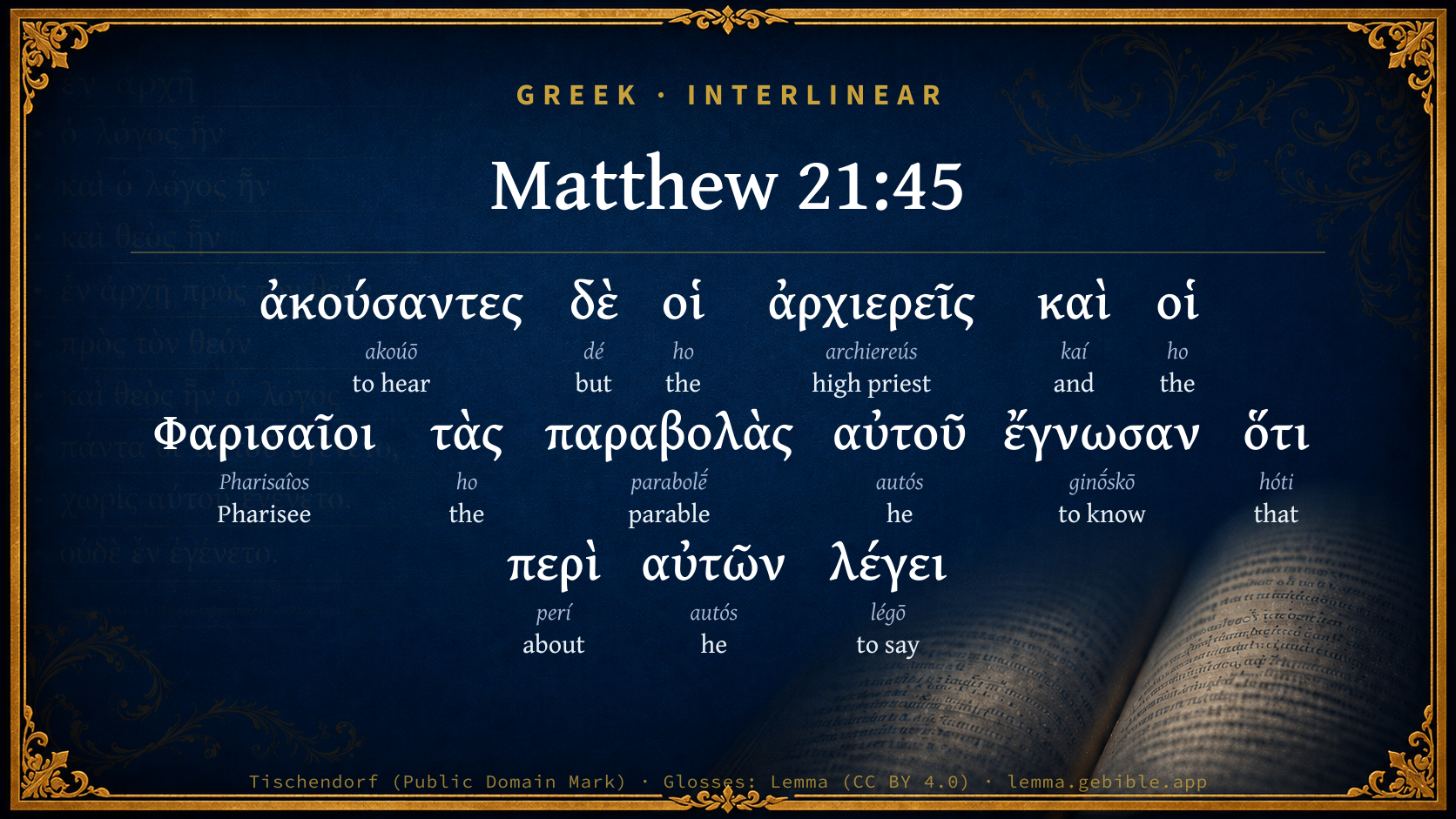
  1. ἀκούσαντες akoúō G191 “to hear” Verb, Aorist, Active, Participle, Nominative, Plural, Masculine
  2. δὲ dé G1161 “but” Conjunction
  3. οἱ ho G3588 “the” Article, Nominative, Plural, Masculine
  4. ἀρχιερεῖς archiereús G749 “high priest” Noun, Nominative, Plural, Masculine
  5. καὶ kaí G2532 “and” Conjunction
  6. οἱ ho G3588 “the” Article, Nominative, Plural, Masculine
  7. Φαρισαῖοι Pharisaîos G5330 “Pharisee” Noun, Nominative, Plural, Masculine
  8. τὰς ho G3588 “the” Article, Accusative, Plural, Feminine
  9. αὐτοῦ autós G846 “he” Personal pronoun, Genitive, Singular, Masculine
  10. ἔγνωσαν ginṓskō G1097 “to know” Verb, Aorist, Active, Indicative, 3rd person, Plural
  11. ὅτι hóti G3754 “that” Conjunction
  12. περὶ perí G4012 “about” Preposition
  13. αὐτῶν autós G846 “he” Personal pronoun, Genitive, Plural, Masculine
  14. λέγει légō G3004 “to say” Verb, Present, Active, Indicative, 3rd person, Singular

About this verse

These counts appear in no published source. They are computed here, from the morphology-tagged text and Lemma’s own curated glosses. What Lemma adds →

15
words
12
distinct lemmas
Gospels
section

Shared distinctive vocabulary

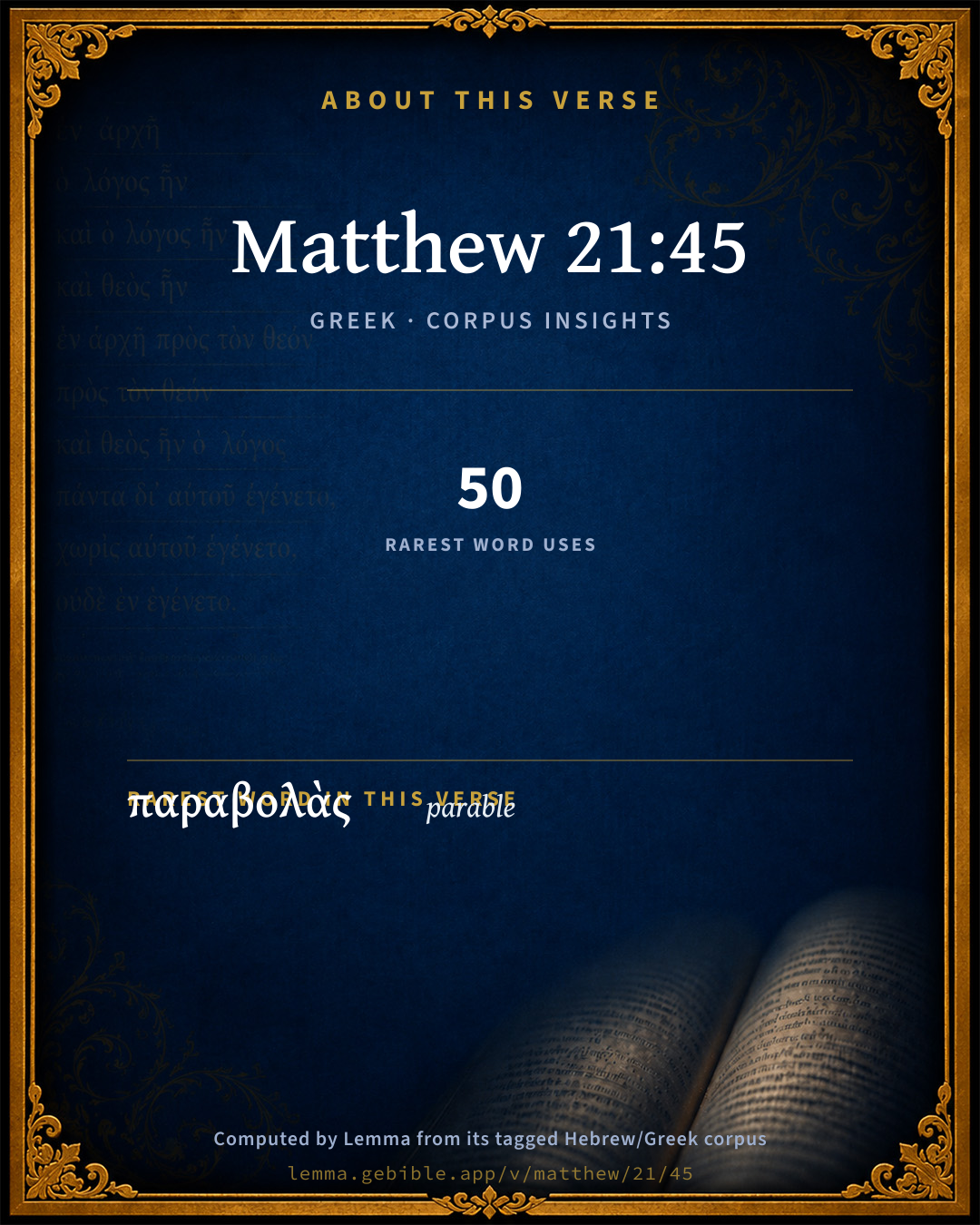
παραβολὰς parable G3850 occurs in 48 verses of the Greek New Testament. Also found in:
Repetition

Words recur within this verse:

  • οἱ the G3588 ×3
  • αὐτοῦ he G846 ×2

Cross-references

3

Topical passages linked to Matthew 21:45 in the Treasury of Scripture Knowledge — connected by theme and wording, ordered by reader-vote popularity; previews shown in the World English Bible.

  • Luke 20:19 The chief priests and the scribes sought to lay hands on Him that very hour, but they feared the people--for they knew He had spoken this parable against them.
  • Luke 11:45 One of the lawyers answered him, "Teacher, in saying this you insult us also."
  • Matthew 12:12 Of how much more value then is a man than a sheep! Therefore it is lawful to do good on the Sabbath day."

Cross-references courtesy of OpenBible.info (CC BY 4.0).

Commentary

Notes on Matthew 21:45 from classic Christian and Jewish commentators (each source and its license shown beneath its notes). The classic Christian expositions comment on the surrounding passage and are grouped to its opening verse, so a note may address several verses; the Jewish commentaries on the Tanakh (Rashi and others) are per-verse, so they appear only where the commentator wrote on this verse.

Lemma curates 59 commentaries, every one of them public domain or Creative Commons licensed, each selected and text-cleaned for this edition rather than reprinted as found. About our sources →

The Biblical Illustrator

Joseph S. Exell

Mat_21:45-46

They feared the multitude, because they took Him for a prophet.

The adaptation of the gospel to the circumstances of the poor

The multitude were pleased with Christ and took Him for a prophet. The pleasure which our text indicates may be referred to wrong motives; they were glad to see others humbled and rebuked. We often repine at the superiority of those above us, and are gratified when any wound is inflicted on their vanity. Not that Christ desired by artful means to gain the favour of the inferior orders. Often in theological controversy men applaud not from love of the truth, but because some one has been repulsed. We take the supposition that the pleasure of the multitude, in part at least, was produced by the general tenor of Christs preaching, and not by a triumphant exposure of the sins of their rulers. Let us examine into the causes from which it came to pass that discourses which were distasteful to the great amongst the Jews found acceptance with the multitude. No doubt reasons could be derived from the peculiar circumstances of the Jewish nation; their expectation of a temporal prince, which was stronger in the higher classes than in the lower. Had the lower classes been left to themselves, it is probable that the Christ who healed their sick would have been accepted. But this is true of our own day-the multitudes, as distinguished from others, have an interest in hearing the gospel. It gains a hold on them which makes them take Christ for a prophet. Here it is that the Almighty has introduced one of those counterpoises which cause good and evil to be distributed with considerable equality notwithstanding the marked difference in human conditions. Wealth and learning are great advantages viewed in reference to the present life; but in regard to the other life the circumstances of their life facilitate their eternal good. The poor man has little to attach him to earth; the rich is surrounded by things that fascinate him, also there are prejudices against the gospel peculiar to the rich which the illiterate cannot share. The gospel sets the poor amongst princes; the rich and great cling to artificial distinctions. The poverty of Christ was an offence to the rich; it was an attraction to the poor. The gospel cannot reach the heart without supernatural power of the Holy Spirit; but if we take the doctrines of Christianity-the mediatorial work-imputation of righteousness-we might contend that the common people are in a better position than others to admit them. In the outcasts of society there is not found that haughty self-reliance; the gospel is more welcome to them. The Bible seems to have been composed with express reference to the poor. But we must not overlook the fact that those who took Christ for a prophet finally rejected and crucified Him. Be ye doers of the word, and not hearers only. (H. Melvill, B. D.)

The Biblical Illustrator, edited by Joseph S. Exell (c. 1880s–1900s) — public domain. Text from a community e-Sword module.

Tyndale Open Study Notes

Tyndale Open Resources

21:45 This explanation fits with Matthew’s theme of God’s judgment on the Jewish leaders who misled the people of Israel (see 23:13-15).

Tyndale Open Study Notes — © Tyndale Open Resources, licensed CC BY-SA 4.0. Text via the HelloAO Bible API.

Bengel's Gnomon

Johann Albrecht Bengel

Mat 21:45.[950] Λέγει, He is speaking) They perceived that Jesus had not yet concluded what He had to say. See ch. Mat 22:1.

[950] περὶ αὐτῶν) as being the ‘husbandmen’ and the ‘builders.’—V. g.

Bengel's Gnomon of the New Testament — English translation (T&T Clark, Edinburgh, 1860) — public domain. Text from a community e-Sword module.

Meyer's Critical & Exegetical Commentary

Heinrich August Wilhelm Meyer

Mat_21:45 f. It was the hint contained in this concluding remark that led Jesus at once to follow up what had been already said with another parabolic address directed against His enemies.

οἱ ἀρχιερεῖς κ. οἱ Φαρις.] identical with the οἱ ἀρχ. κ. οἱ πρεσβύτεροι of Mat_21:23, so that, in the present instance, the latter are designated by the name of the party to which they belonged.

ἔγνωσαν] what had now become clear to them from what was said, Mat_21:42-44. The confident manner in which they express themselves in Mat_21:41 bears up to that point no trace of such knowledge, otherwise we should have to suppose that they consciously pronounced their own condemnation.

εἰς (see critical remarks) προφήτην: held Him as a prophet, i.e. in Him they felt they possessed a prophet; on εἰς, which is met with in later writers in the sense of the predicate, see Bernhardy, p. 219.

Meyer — Critical and Exegetical Commentary on the New Testament — English translation by Peter Christie, edited by Frederick Crombie (T&T Clark, 1880) — public domain. Text from a community e-Sword module.

Expositor's Greek Testament

ed. W. Robertson Nicoll

Mat 21:45 . he priests and Pharisees of course perceived the drift of these parabolic speeches about the two sons, the vine-dressers, and the rejected stone, and (Mat 21:46 ) would have apprehended Him on the spot (Luk 20:19 ) had they not feared the people. ἐπεὶ , since, introducing the reason of the fear, same as in Mat 21:26 . εἰς προφήτην = ὡς π ., Mat 21:26 , and in Mat 14:5 , also in reference to John. On this use of εἰς vide Winer, § 32, 4, b.

The Expositor's Greek Testament, edited by W. Robertson Nicoll (1897–1910) — public domain. Text from a community e-Sword module.

Jamieson, Fausset & Brown

Robert Jamieson, A. R. Fausset & David Brown

And when the chief priests and Pharisees had heard his parables--referring to that of the Two Sons and this one of the Wicked Husbandmen.

they perceived that he spake of them.

Jamieson, Fausset & Brown — Commentary Critical and Explanatory on the Whole Bible (1871) — public domain (CC PDM 1.0). Text via the HelloAO Bible API.

Adam Clarke's Commentary

Verse 45. The chief priests - perceived that he spoke of them.] The most wholesome advice passes for an affront with those who have shut their hearts against the truth. When that which should lead to repentance only kindles the flame of malice and revenge, there is but little hope of the salvation of such persons.

Adam Clarke's Commentary on the Bible (1810–1826) — public domain. Text from a community e-Sword/MySword module.

Ellicott's Commentary for English Readers

(45) They perceived that he spake of them.—The real or affected unconsciousness of the drift of our Lord’s teaching was at last broken through. The last words had been too clear and pointed to leave any room for doubt, and they were roused to a passionate desire for revenge.

A Bible Commentary for English Readers, edited by Charles John Ellicott (1878–1897) — public domain. Text from a community e-Sword module.

John Gill's Exposition

And when the chief priests and Pharisees,.... Which latter, though not before mentioned, were many of them of the grand sanhedrim, as well as the chief priests, scribes, and elders: "had heard his parables"; that of the two sons being sent into the vineyard, and that of the letting out the vineyard to husbandmen,

they perceived that he spake of them: they plainly saw that they were designed by the son, that promised to go into the vineyard, but did not; only talked of works, but did not do them: and that they were the husbandmen that acted the ungrateful part to the householder, and the cruel one to his servants, and would to his son, their own consciences told them they were the men. They knew that the whole was levelled against them, and designed for them, and exactly hit their case.

John Gill's Exposition of the Whole Bible (1746–1763) — public domain (CC PDM 1.0). Text via the HelloAO Bible API.

Trapp's Complete Commentary

John Trapp

45 And when the chief priests and Pharisees had heard his parables, they perceived that he spake of them.

Ver. 45. They perceived that he spake of them] Who told them so, but their own guilty consciences? Every man hath a domestic chaplain within his own bosom, that preacheth over the sermon to him again, and comes over him with, "Thou art the man." Conscience is said to accuse or excuse in the mean while, μεταξυ αλληλων, Rom 2:15. In the interim between sermon and sermon, conviction and conviction. So that personal and nominal application is therefore needless, because every man hath a discursive faculty within him, applying several truths to every man’s particular uses. And, ubi generalis de vitiis disputatio est, ibi nullius personae est iniuria, saith Jerome: Where the discourse against vice is general, no man can justly complain of a personal injury. By preaching, Christ many times smites the earth, Isa 11:4, that is, the consciences of carnal men glued to the earth. God’s words hit them full in the teeth, and make them spit blood. Now if they rage, as tigers, tear themselves at the noise of a drum, if they fly in the faces of their teachers, and seek revenge upon them, they are commonly cast into a reprobate sense, and seldom escape the visible vengeance of God.

John Trapp, A Commentary or Exposition upon All the Books of the Old and New Testament (1647–1656) — public domain. Text from a community e-Sword module.

Haydock's Catholic Bible Commentary

They understood that he spoke of them. This parable, though immediately addressed to the Jews, contains an admirable instruction for Christians. For, what the Jews have suffered for their wickedness and ingratitude, has also been the faith of many Christian kingdoms, and the mournful lot of many once flourishing happy churches, whose candlesticks are removed, and light extinct. The same conduct God observes with regard to particular persons, in punishment of their repeatedly abusing his graces; he at last withdraws them, and leaves the culprit to himself, and to the miserable consequences of this merited privation of grace.

George Leo Haydock (1774–1849), Haydock's Catholic Family Bible and Commentary, 1859 edition — public domain. Excludes Psalms (Douay-Rheims chapter numbering differs from Protestant) and Deuterocanonical books (Catholic canon only).

Matthew Poole's English Annotations

Mark hath much the same, Mar 12:12; so hath Luke, Luk 20:19,20; but Luke adds, They watched him, and sent forth spies, which should feign themselves just men, that they might take hold of his words, that so they might deliver him unto the power and authority of the governor. These wretched men were convinced in their own consciences, they perceived that he spake of them. They had nothing to oppose to what he said. They could not deny but that the psalmist, Psa 118:22, spake of the Messias. They could not but own that they were the builders, and that they had refused him. Yet their lusts and interests would not suffer then, to obey these convictions, to receive and to embrace Christ, and prevent that ruin which was coming upon them. They durst not apprehend Christ for fear of the people. They had nothing to lay to his charge; they therefore send out spies to watch him, to see if they could catch any thing from him in discourse, whereof to accuse him before Pilate, the Roman governor in Judea at this time.

Matthew Poole's English Annotations on the Holy Bible (1683–1685) — public domain. Text from a community e-Sword/MySword module.

The Pulpit Commentary

Pharisees. They have not been specially mentioned hitherto, but they formed the majority in the Sanhedrin, and are properly here named by the evangelist. He spake of them. They could not fail, especially after ver. 43, to see the drift of the parables; their own consciences must have made them feel that they themselves were herein signified, their motives and conduct fully discovered. But, as bad men always act, instead of repenting of the evil, they are only exasperated against him who detected them, and only desire the more to wreak their vengeance upon him.

Ver. 45-Mat_22:14. The marriage of the King"s Son.

This parable, taken along with the parable of the two sons and the parable of the wicked husbandmen, forms a climax to them. In the first, God is represented as a Father issuing a command; in the second, as a Householder who expects the performance of a contract; in the third parable, God appears as a King, not commanding, but looking for acceptance of an enviable invitation. Already the kingdom of God had been likened to a feast, but here prominence is given to the circumstance of the host being a King, and the occasion the marriage of his son, and it is impossible to avoid the impression that our Lord meant to indicate that he was the King"s Son. He and John had both familiarized the people with the title Bridegroom as applied to the Messiah. But it is rather from God"s side than from man"s the Bridegroom is here viewed. In Christ God and man are made one. No union can be so close. And in this, the greatest event in God"s reign, and the indestructible glory of humanity, God might well expect that men should rejoice with him. Proclamation had been made, invitation given, and people remained wholly indifferent. The earnest sincerity of God in seeking our good in this matter is marked by one or two unmistakable traits.

1. By the King"s willing observance of every form of courtesy. One of these is the sending of a second messenger to announce the actual readiness of the feast. And so God had not only sent the prophets, bidding the Jews expect this festival, but sent John to remind and bring them. And so he still offers his blessings in ways which leave the reluctant without apology, he considers your needs and your feelings, and what he offers is that in which he has his own chief joy fellowship with his Son.

2. By his wrath against the murderers. You may be so little in earnest about God"s invitation that you scarcely seriously consider whether it is to be accepted or not, but nothing can so occupy him as to turn his observation from you. To save sinners from destruction is his grand purpose, and no success in other parts of his government can repay him for failure here. The last scene in the parable forms an appendix directed to a special section in the audience. Seeing the gates of the kingdom thrown open, and absolute, unconditioned freedom of entrance given, the ill living and godless might be led to overlook the great moral change requisite in all who enter God"s presence and propose to hold intercourse with him. The refusal of the wedding dress provided was not only studied contempt and insult, but showed alienation of spirit, disaffection, want of sympathy with the feelings of the king. The guest must have lacked the festive spirit, and was therefore "a spot in the feast." He sits there out of harmony with the spirit of the occasion, and disloyal to his king. Therefore is his punishment swift and sudden. The eye of the king marks the intruder, and neither the outer darkness of an Eastern street, nor the pitchy blackness in which he lies unseen and helpless, can hide him from that gaze of his Lord which he feels to be imprinted on his conscience forever. In applying this parable, we may mark:

(1) That there is no way of accepting God"s invitation without accepting his spirit, character, and ways. There is no real acceptance, no abiding in God"s favour, where there is no growing likeness to him. Conformity to God, ability to rejoice with God and in God, humble and devoted reverence, these are great attainments; but these constitute our wedding garment, without which we cannot remain in his presence or abide his searching eye. No associating of yourself with those that love him, no outward entrance into his presence, will avail; it is the heart you bear towards him that wilt determine your destiny.

(2) There is abundant encouragement to all who are willing and desirous to put on the Lord Jesus. It is the first duty of every host to make his guest feel at home, and therefore does God provide us not only with great outward blessings, but with all that can make us feel easy and glad in his presence. He offers not only enjoyment, but power to enjoy. If you are conscious that you could not be easy in God"s presence without great alterations in your character, your invitation is guarantee that these will be made. If you could not be easy in his presence without knowing that he was aware of all you had thought and done against him, and forgave you; if you could not eat at the table of one against whom you harboured ill will, nor enjoy any entertainment without genuine love of your host; then this will be communicated to you on your acceptance of God"s invitation. Does your unfitness, even more than your unworthiness, deter you? Here you see that God invites you as you are. D.

The Pulpit Commentary (1880–1919), ed. H.D.M. Spence-Jones & Joseph S. Exell — public domain. Text from a community e-Sword module.

MacLaren's Expositions of Holy Scripture

Alexander MacLaren

Matthew

THE VINEYARD AND ITS KEEPERS

Mat 21:33 - Mat 21:46.

This parable was apparently spoken on the Tuesday of the Passion Week. It was a day of hand-to-hand conflict with the Jewish authorities and of exhausting toil, as the bare enumeration of its incidents shows. It included all that Matthew records between Mat 21:20 of this chapter and the end of the twenty-fifth chapter-the answer to the deputation from the Sanhedrin; the three parables occasioned by it, namely, those of the two sons, this one, and that of the marriage of the king’s son; the three answers to the traps of the Pharisees and Herodians about the tribute, of the Sadducees about the resurrection, and of the ruler about the chief commandment; Christ’s question to His questioners about the Son and Lord of David; the stern woes hurled at the unmasked hypocrites; to which must be added, from other gospels, the sweet eulogium on the widow’s mite, and the deep saying to the Greeks about the corn of wheat, with, possibly, the incident of the woman taken in adultery; and then, following all these, the solemn prophecies of the end contained in Mat 24:1 - Mat 24:51 and Mat 25:1 - Mat 25:46, spoken on the way to Bethany, as the evening shadows were falling. What a day! What a fountain of wisdom and love which poured out such streams! The pungent severity of this parable, with its transparent veil of narrative, is only appreciated by keeping clearly in view the circumstances and the listeners. They had struck at Jesus with their question as to His authority, and He parries the blow. Now it is His turn, and the sharp point goes home.

I. The first stage is the preparation of the vineyard, in which three steps are marked.

It is planted and furnished with all appliances needful for making wine, which is its great end. The direct divine origin of the religious ideas and observances of ‘Judaism’ is thus asserted by Christ. The only explanation of them is that God enclosed that bit of the wilderness, and with His own hands set growing there these exotics. Neither the theology nor the ritual is of man’s establishing. We need not seek for special meanings for wall, wine-press, and tower. They simply express the completeness of the equipment of the vineyard, as in Isaiah’s song, which lies at the foundation of the parable, and suggest his question, ‘What could have been done more?’ Thus furnished, the vineyard is next handed over to the husbandmen, who, in Matthew, are exclusively the rulers, while in Luke they are the people. No doubt it was ‘like people, like priest.’ The strange dominion of the Pharisees rested entirely on popular consent, and their temper accurately indexed that of the nation. The Sanhedrin was the chief object at which Christ aimed the parable. But it only gave form and voice to the national spirit, and ‘the people loved to have it so.’ National responsibilities are not to be slipped out of by being shifted on to the broad shoulders of governments or influential men. Who lets them be governments and influential?

‘Guv’ment ain’t to answer for it,

God will send the bill to you.’

Christ here teaches both rulers and ruled the ground and purpose of their privileges. They prided themselves on these as their own, but they were only tenants. They made their ‘boast of the law’; but they forgot that fruit was the end of the divine planting and equipment. Holiness and glad obedience were what God sought, and when He found them, He was refreshed as with ‘grapes in the wilderness.’

Having installed the husbandmen, the owner goes into another country. The cluster of miracles which inaugurate an epoch of revelation are not continued beyond its beginning. Centuries of comparative divine silence followed the planting of the vineyard. Having given us our charge, God, as it were, steps aside to leave us room to work as we will, and so to display what we are made of. He is absent in so far as conspicuous oversight and retribution are concerned. He is present to help, love, and bless. The faithful husbandman has Him always near, a joy and a strength, else no fruit would grow; but the sin and misery of the unfaithful are that they think of Him as far off.

II. Then comes the habitual ill-treatment of the messengers.

These are, of course, the prophets, whose office was not only to foretell, but to plead for obedience and trust, the fruits sought by God. The whole history of the nation is summed up in this dark picture. Generation after generation of princes, priests, and people had done the same thing. There is no more remarkable historical fact than that of the uniform hostility of the Jews to the prophets. That a nation of such a sort as always to hate and generally to murder them should have had them in long succession, throughout its history, is surely inexplicable on any naturalistic hypothesis. Such men were not the natural product of the race, nor of its circumstances, as their fate shows. How did they spring up? No ‘philosophy of Jewish history’ explains the anomaly except the one stated here,-’He sent His servants.’ We are told nowadays that the Jews had a natural genius for religion, just as the Greeks for art and thought, and the Romans for law and order, and that that explains the origin of the prophets. Does it explain their treatment?

The hostility of the husbandmen grows with indulgence. From beating they go on to killing, and stoning is a specially savage form of killing. The opposition which began, as the former parable tells us, with polite hypocrisy and lip obedience, changed, under the stimulus of prophetic appeals, to honest refusal, and from that to violence which did not hesitate to slay. The more God pleads with men, the more self-conscious and bitter becomes their hatred; and the more bitter their hatred, the more does He plead, sending other messengers, more perhaps in number, or possibly of more weight, with larger commission and clearer light. Thus both the antagonistic forces grow, and the worse men become, the louder and more beseeching is the call of God to them. That is always true; and it is also ever true that he who begins with ‘I go, sir, and goes not, is in a fair way to end with stoning the prophets.

Christ treats the whole long series of violent rejections as the acts of the same set of husbandmen. The class or nation was one, as a stream is one, though all its particles are different; and the Pharisees and scribes, who stood with frowning hatred before Him as He spoke, were the living embodiment of the spirit which had animated all the past. In so far as they inherited their taint, and repeated their conduct, the guilt of all the former generations was laid at their door. They declared themselves their predecessors’ heirs; and as they reproduced their actions, they would have to bear the accumulated weight of the consequences.

III. Mat 21:37 - Mat 21:39 tell of the mission of the Son and of its fatal issue.

Three points are prominent in them. The first is the unique position which Christ here claims, with unwonted openness and decisiveness, as apart from and far above all the prophets. They constitute one order, but He stands alone, sustaining a closer relation to God. They were faithful ‘as servants,’ but He ‘as a Son,’ or, as Mark has it, ‘the only and beloved Son.’ The listeners understood Him well enough. The assertion, which seemed audacious blasphemy to them, fitted in with all His acts in that last week, which was not only the crisis of His life, but of the nation’s fate. Rulers and people must decide whether they will own or reject their King, and they must do it with their eyes open. Jesus claimed to fill a unique position. Was He right or wrong in His claim? If He was wrong, what becomes of His wisdom, His meekness, His religion? Is a religious teacher, who made the mistake of thinking that He was the Son of God in a sense in which no other man is so, worthy of admiration? If He was right, what becomes of a Christianity which sees in Him only the foremost of the prophets?

The next point marked is the owner’s vain hope, in sending his Son. He thought that He would be welcomed, and He was disappointed. It was His last attempt. Christ knew Himself to be God’s last appeal, as He is to all men, as well as to that generation. He is the last arrow in God’s quiver. When it has shot that bolt, the resources even of divine love are exhausted, and no more can be done for the vineyard than He has done for it. We need not wonder at unfulfilled hopes being here ascribed to God. The startling thought only puts into language the great mystery which besets all His pleadings with men, which are carried on, though they often fail, and which must, therefore, in view of His foreknowledge, be regarded as carried on with the knowledge that they will fail. That is the long-suffering patience of God. The difficulty is common to the words of the parable and to the facts of God’s unwearied pleading with impenitent men. Its surface is a difficulty, its heart is an abyss of all-hoping charity.

The last point is the vain calculation of the husbandmen. Christ puts hidden motives into plain words, and reveals to these rulers what they scarcely knew of their own hearts. Did they, in their secret conclaves, look each other in the face, and confess that He was the Heir? Did He not Himself ground His prayer for their pardon on their ignorance? But their ignorance was not entire, else they had had no sin; neither was their knowledge complete, else they had had no pardon. Beneath many an obstinate denial of Him lies a secret confession, or misgiving, which more truly speaks the man than does the loud negation. And such strange contradictions are men, that the secret conviction is often the very thing which gives bitterness and eagerness to the hostility. So it was with some of those whose hidden suspicions are here set in the light. How was the rulers’ or the people’s wish to ‘seize on His inheritance’ their motive for killing Jesus? Their great sin was their desire to have their national prerogatives, and yet to give no true obedience. The ruling class clung to their privileges and forgot their responsibilities, while the people were proud of their standing as Jews, and careless of God’s service. Neither wished to be reminded of their debt to the Lord of the vineyard, and their hostility to Jesus was mainly because He would call on them for fruits. If they could get this unwelcome and persistent voice silenced, they could go on in the comfortable old fashion of lip-service and real selfishness. It is an account, in vividly parabolic language, not only of their hostility, but of that of many men who are against Him. They wish to possess life and its good, without being for ever pestered with reminders of the terms on which they hold it, and of God’s desire for their love and obedience. They have a secret feeling that Christ has the right to ask for their hearts, and so they often turn from Him angrily, and sometimes hate Him.

With what sad calmness does Jesus tell the fate of the son, so certain that it is already as good as done! It was done in their counsels, and yet He does not cease to plead, if perchance some hearts may be touched and withdraw themselves from the confederacy of murder.

IV. We have next the self-condemnation from unwilling lips.

Our Lord turns to the rulers with startling and dramatic suddenness, which may have thrown them off their guard, so that their answer leaped out before they had time to think whom it hit. His solemn earnestness laid a spell on them, which drew their own condemnation from them, though they had penetrated the thin veil of the parable, and knew full well who the husbandmen were. Nor could they refuse to answer a question about legal punishments for dishonesty, which was put to them, the fountains of law, without incurring a second time the humiliation just inflicted when He had forced them to acknowledge that they, the fountains of knowledge, did not know where John came from. So from all these motives, and perhaps from a mingling of audacity, which would brazen it out and pretend not to see the bearing of the question, they answer. Like Caiaphas in his counsel, and Pilate with his writing on the Cross, and many another, they spoke deeper things than they knew, and confessed beforehand how just the judgments were, which followed the very lines marked out by their own words.

V. Then come the solemn application and naked truth of the parable.

We have no need to dwell on the cycle of prophecies concerning the corner-stone, nor on the original application of the psalm. We must be content with remarking that our Lord, in this last portion of His address, throws away even the thin veil of parable, and speaks the sternest truth in the nakedest words. He puts His own claim in the plainest fashion, as the corner-stone on which the true kingdom of God was to be built. He brands the men who stood before Him as incompetent builders, who did not know the stone needed for their edifice when they saw it. He declares, with triumphant confidence, the futility of opposition to Himself-even though it kill Him. He is sure that God will build on Him, and that His place in the building, which shall rise through the ages, will be, to even careless eyes, the crown of the manifest wonders of God’s hand. Strange words from a Man who knew that in three days He would be crucified! Stranger still that they have come true! He is the foundation of the best part of the best men; the basis of thought, the motive for action, the pattern of life, the ground of hope, for countless individuals; and on Him stands firm the society of His Church, and is hung all the glory of His Father’s house.

Christ confirms the sentence just spoken by the rulers on themselves, but with the inversion of its clauses. All disguise is at an end. The fatal ‘you’ is pronounced. The husbandmen’s calculation had been that killing the heir would make them lords of the vineyard; the grim fact was that they cast themselves out when they cast him out. He is the heir. If we desire the inheritance, we must get it through Him, and not kill or reject, but trust and obey Him. The sentence declares the two truths, that possession of the vineyard depends on honouring the Son, and on bringing forth the fruits. The kingdom has been taken from the churches of Asia Minor, Africa, and Syria, because they bore no fruit. It is not held by us on other conditions. Who can venture to speak of the awful doom set forth in the last words here? It has two stages: one a lesser misery, which is the lot of him who stumbles against the stone, while it lies passive to be built on; one more dreadful, when it has acquired motion and comes down with irresistible impetus. To stumble at Christ, or to refuse His grace, and not to base our lives and hopes on Him is maiming and damage, in many ways, here and now. But suppose the stone endowed with motion, what can stand against it? And suppose that the Christ, who is now offered for the rock on which we may pile our hopes and never be confounded, comes to judge, will He not crush the mightiest opponent as the dust of the summer threshing-floor?

Alexander MacLaren, Expositions of Holy Scripture (1904–1910) — public domain. Text from a community e-Sword module.

Kretzmann's Popular Commentary

Paul E. Kretzmann

The result:

v. 45. And when the chief priests and Pharisees had heard His parables, they perceived that He spake of them

v. 46. But when they sought to lay hands on Him, they feared the multitude, because they took Him for a prophet.

Their actual or assumed denseness finally had to give way to understanding, with the application made in such a blunt manner. But instead of turning from the wickedness of their ways, the bitterness of their hatred is only intensified. They would have taken Jesus away on the spot, had they not feared the people. An arrest at this time would have caused a riot, since the great multitudes gathered together in the courts of the Temple and throughout the city firmly held that He was a prophet, and would not have permitted harm to come upon Him.

Summary.Jesus makes a triumphant entry into Jerusalem, drives out the merchants and money-changers from the Temple, accepts the praise of the children, curses the fig-tree, upholds His authority, and tells the parables of the two sons and of the wicked husbandmen.

Paul E. Kretzmann, Popular Commentary of the Bible (1921–1924) — public domain. Text from a community e-Sword module.

Burkitt's Expository Notes on the New Testament

William Burkitt

When the chief priests came to understand that these parable were all applied to them, that they were the murderers of the king’s son, that they were the builders that rejected the chief corner-stone, they are enraged at the close application made to themselves; and had not fear restrained them, they would have laid violent hands upon him.

Learn thence, That nothing doth more provoke and exasperate unsound hypocrites, than the particular application, and close coming home of the word of God unto their hearts and consciences. So long as the truths of God are generally delivered, sinners are easy looking upon themselves as unconcerned: but when the word of God comes close to them, and says, Thou art the man, this is thy wickedness; they are angry at the message, and rage at the messenger.

William Burkitt's Expository Notes on the New Testament (1700–1703) — public domain. Text from a community e-Sword module.

The People's New Testament

B. W. Johnson

45. When the chief priests and Pharisees had heard, etc. When the application of the parable was made, they perceived that they were meant and that they had condemned themselves.

B. W. Johnson's The People's New Testament with Notes (1889–1891) — public domain. Electronic text from the Christian Classics Ethereal Library (CCEL) ThML edition.

unfoldingWord translationNotes

Door43 World Missions Community

Connecting Statement:

The religious leaders react to the parable that Jesus told.

his parables

"Jesus' parables"

translationWords

chief priests

Pharisee

parable

prophet

unfoldingWord translationNotes — © Distant Shores Media and the Door43 World Missions Community, licensed CC BY-SA 4.0. Source: git.door43.org/Door43/en_tn.

International Critical Commentary

(M) 45. And the chief priest and the Pharisees heard His parables, and perceived that He speaks about them.]

International Critical Commentary — older volumes (1896–1929), various authors — public domain. Text from a community e-Sword module.

Lesson kit

Teaching starters — assembled from the data on this page, not authored interpretation. Every prompt links to the verse data it draws on. Edit before teaching.

Matthew, in the Gospels, opens this verse with 15 words (12 distinct Greek lemmas). Its most distinctive word is parabolḗ (“parable”). A historical commentator’s framing appears above. Read the whole chapter for the surrounding context.

Discussion questions

  1. The word parabolḗ carries the sense “parable.” How does it shape the verse?
  2. Matthew 13:3 shares the word «parable» with this verse. How do the two illuminate each other?
  3. “the” occurs 3× in this one verse. What is the effect of the repetition?
  4. These translations render this verse differently. What is at stake in choosing one wording over another?
  5. Reading how The Biblical Illustrator and Tyndale Open Study Notes read this verse, where do the two commentators agree and where do they part?

Things to notice

Reading settings

Reading text

Shown beneath each verse's original-language words.

Old Testament
Old Testament edition

Read the OT as the Masoretic Hebrew (MT) or the Greek Septuagint (LXX).

English shown for the Greek Septuagint (in the Hebrew ↔ Greek comparison).

Comparing translations? Open the Compare panel on any verse page to stack up to four side by side.