
Matthew 25:5

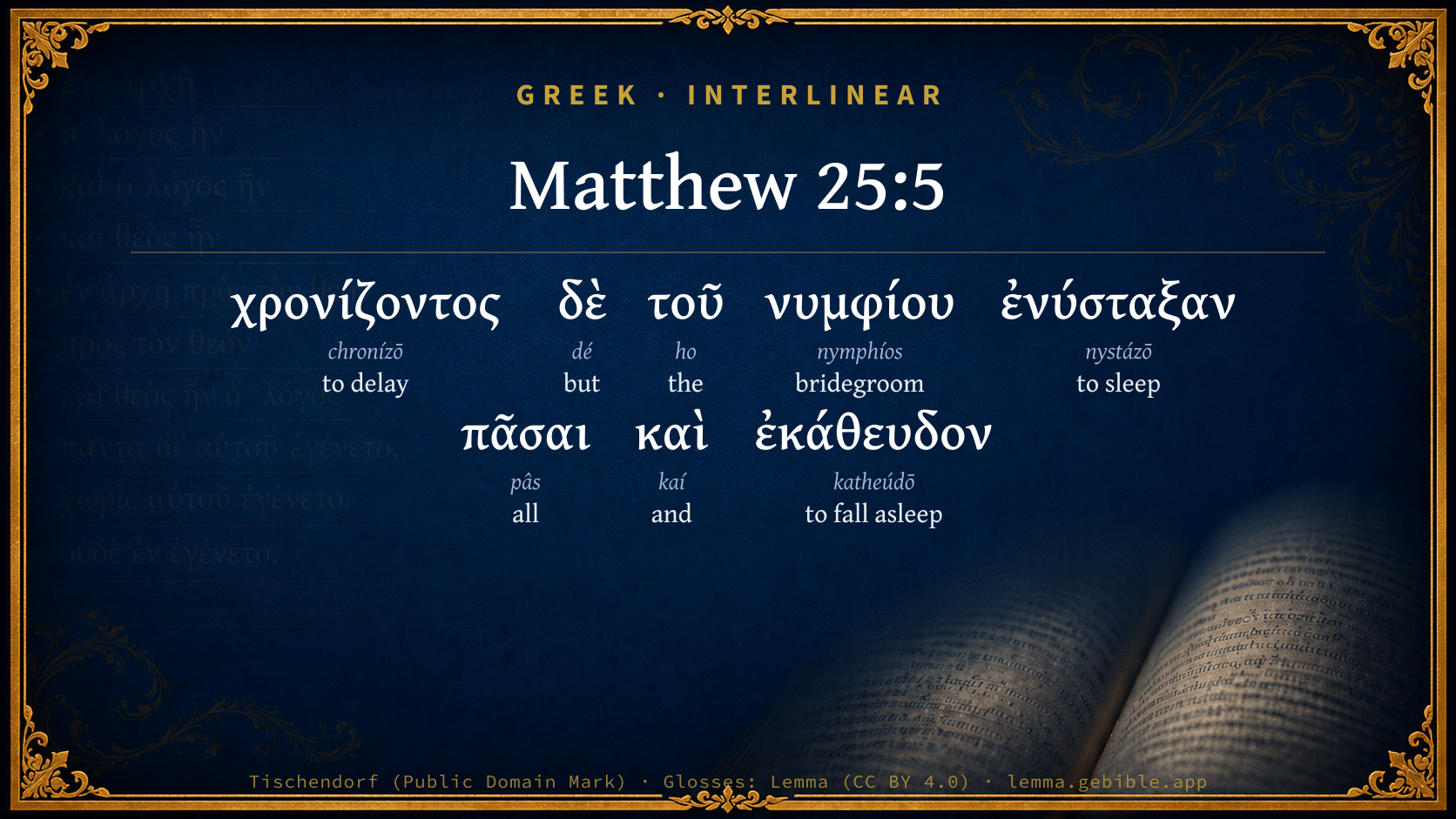
Greek (Tischendorf 8th ed.) Matthew 25:5 appears in the Greek New Testament. The text above is from the Tischendorf 8th edition. Each word links to its Strong’s number and a concise gloss. Click any word for its full Thayer’s Greek Lexicon entry.
Download image
Cite this verse

Matthew 25:5 (World English Bible). Public Domain. Lemma interlinear Bible study tool, https://lemma.gebible.app/v/matthew/25/5.

Show BibTeX & RIS
BibTeX
RIS
English Translation
Now while the bridegroom delayed, they all slumbered and slept.
World English Bible · Public Domain
Highlights
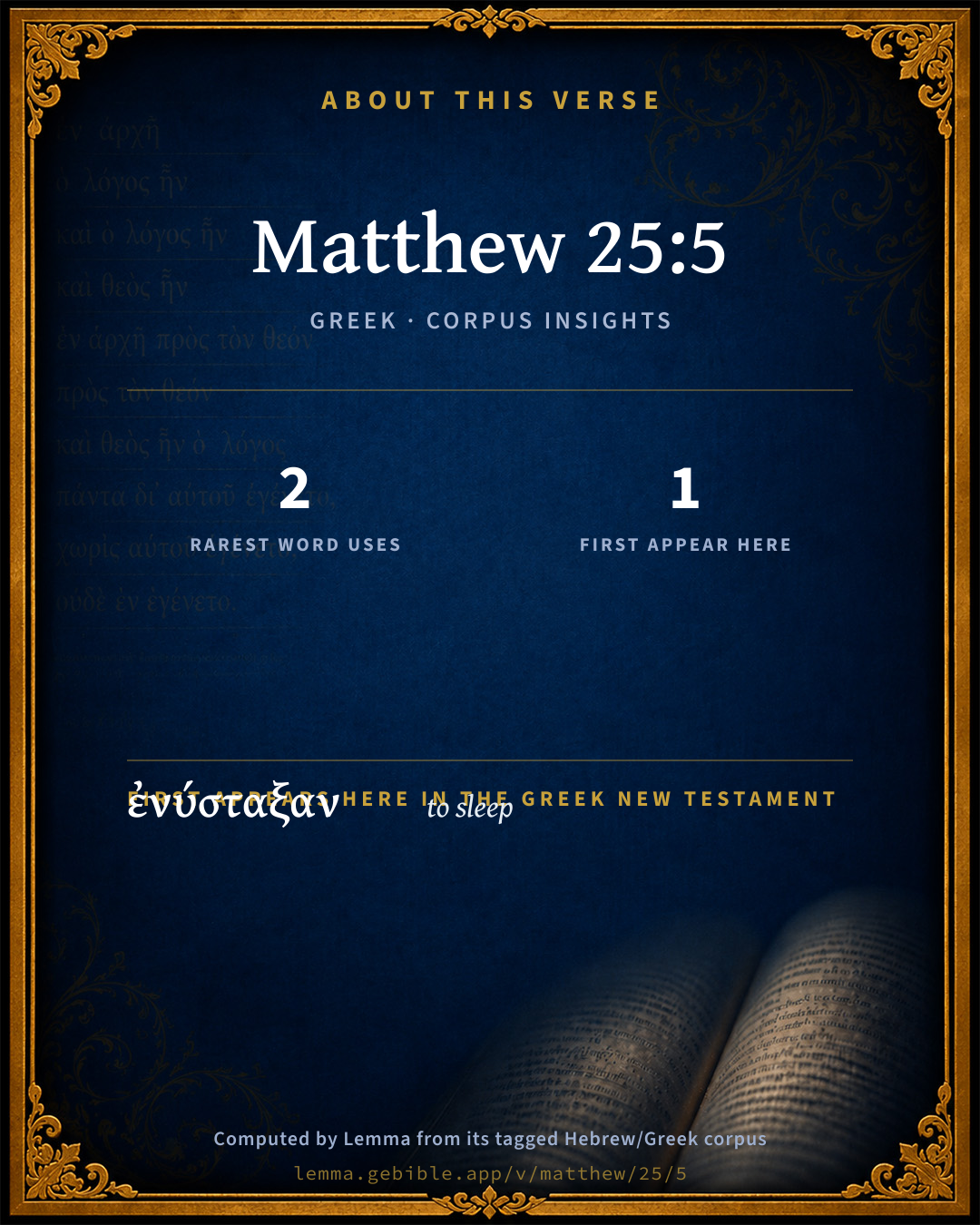
  • 1 first appearance in the Greek New Testament
Full analysis ↓
Download a study sheet

One document with this verse’s original text, its word-by-word gloss line, the meaning frame, cross-references with their text, attributed commentary, and full source and license credits — printable, and it pastes into notes with its structure intact.

This verse Autodidact and up

Study sheet (.html) Plain text (.txt)

A passage Seminary Student

Up to 50 verses in one chapter. A passage sheet keeps up to 6 commentary sources and 12 cross-references per verse, in the order this page ranks them, and says so on the sheet whenever that leaves anything out. Ask for a single verse and you get the Autodidact verse sheet above.

Everything on this page stays free to read, with no account — the sheet is a download of what is already on screen, not access to it.

Want to remove ads? Support Godless Engineer
Compare translations 3

The same verse in 3 English versions, stacked beneath the original-language interlinear above. Click any original word for its lexicon entry.

Each is an independent rendering of the whole verse — the interlinear is not word-aligned to these translations.

Highlighted words mark where these versions differ — a whole-verse word diff, not a word-by-word alignment.

  • World English Bible Public Domain
    Now while the bridegroom delayed, they all slumbered and slept.
  • King James Version Public Domain
    While the bridegroom tarried, they all slumbered and slept.
  • unfoldingWord Literal Text CC BY-SA 4.0
    But the bridegroom delaying, they all became sleepy and were sleeping.

unfoldingWord Literal Text — © unfoldingWord, licensed CC BY-SA 4.0. Word-aligned USFM3 via Door43 (git.door43.org/unfoldingWord/en_ult).

Versions to compare (up to 4)

3 of 4 selected

Show all 19 translations

Every available English version of this verse, each an independent rendering of the whole verse.

  • World English Bible Public Domain
    Now while the bridegroom delayed, they all slumbered and slept.
  • Berean Standard Bible Public Domain
    When the bridegroom was delayed, they all became drowsy and fell asleep.
  • Majority Standard Bible Public Domain
    When the bridegroom was delayed, they all became drowsy and fell asleep.
  • King James Version Public Domain
    While the bridegroom tarried, they all slumbered and slept.
  • American Standard Version (1901) Public Domain
    Now while the bridegroom tarried, they all slumbered and slept.
  • Revised Version (1885) Public Domain
    Now while the bridegroom tarried, they all slumbered and slept.
  • Geneva Bible (1599) Public Domain
    Nowe while the bridegrome taried long, all slumbred and slept.
  • Douay-Rheims (1899) Public Domain
    And the bridegroom tarrying, they all slumbered and slept.
  • Young's Literal Translation Public Domain
    `And the bridegroom tarrying, they all nodded and were sleeping,
  • Literal Standard Version CC BY-SA 4.0
    And the bridegroom lingering, they all nodded and were sleeping,
  • Unlocked Literal Bible CC BY-SA 4.0
    Now while the bridegroom was delayed, they all got sleepy and slept.
  • unfoldingWord Literal Text CC BY-SA 4.0
    But the bridegroom delaying, they all became sleepy and were sleeping.
  • Darby Bible Public Domain
    Now the bridegroom tarrying, they all grew heavy and slept.
  • World Messianic Bible Public Domain
    Now while the bridegroom delayed, they all slumbered and slept.
  • Webster's Bible Public Domain
    While the bridegroom tarried, they all slumbered and slept.
  • Free Bible Version CC BY-SA 4.0
    The bridegroom took a long time and all the girls became drowsy and fell asleep.
  • Bible in Basic English Public Domain
    Now the husband was a long time in coming, and they all went to sleep.
  • Text-Critical English NT CC BY 4.0
    When the bridegroom was delayed, they all became drowsy and slept.
  • Tyndale New Testament (1534) Public Domain
    Whill the brydgrome taryed all slombred and slepte.

Literal Standard Version (2020), Covenant Press — licensed CC BY-SA 4.0. Text via the HelloAO Bible API (eBible.org). Unlocked Literal Bible (unfoldingWord) — licensed CC BY-SA 4.0. Text via the HelloAO Bible API (eBible.org). unfoldingWord Literal Text — © unfoldingWord, licensed CC BY-SA 4.0. Word-aligned USFM3 via Door43 (git.door43.org/unfoldingWord/en_ult). Free Bible Version, Dr. Jonathan Gallagher — licensed CC BY-SA 4.0. Text via the HelloAO Bible API (eBible.org).

Word by word

More ways to search: Search by grammar → Find every occurrence → Compare this word →

Practice this passage: Drill this verse → Learn its vocabulary →

About this verse

These counts appear in no published source. They are computed here, from the morphology-tagged text and Lemma’s own curated glosses. What Lemma adds →

8
words
8
distinct lemmas
Gospels
section

Notable vocabulary

The rarest word here is ἐνύσταξαν to sleep G3573 — appearing just 2 times in the whole Greek New Testament.

First appearance in Scripture

This word makes its first canonical appearance in the Greek New Testament here:

  • ἐνύσταξαν to sleep G3573

Shared distinctive vocabulary

ἐνύσταξαν to sleep G3573 occurs in 2 verses of the Greek New Testament. Also found in:
Cross-references

19

Topical passages linked to Matthew 25:5 in the Treasury of Scripture Knowledge — connected by theme and wording, ordered by reader-vote popularity; previews shown in the World English Bible.

  • Habakkuk 2:3 For the vision is yet for the appointed time, and it hurries toward the end, and won't prove false. Though it takes time, wait for it; because it will surely come. It won't delay.
  • 1 Thessalonians 5:6–8 so then let's not sleep, as the rest do, but let's watch and be sober.
  • 2 Peter 3:4–9 and saying, "Where is the promise of his coming? For, from the day that the fathers fell asleep, all things continue as they were from the beginning of the creation."
  • Matthew 24:48 But if that evil servant should say in his heart, 'My lord is delaying his coming,'
  • Luke 20:9 He began to tell the people this parable. "A man planted a vineyard, and rented it out to some farmers, and went into another country for a long time.
  • Matthew 25:19 "Now after a long time the lord of those servants came, and reconciled accounts with them.
  • Mark 14:37–38 He came and found them sleeping, and said to Peter, "Simon, are you sleeping? Couldn't you watch one hour?
  • Luke 12:45 But if that servant says in his heart, 'My lord delays his coming,' and begins to beat the menservants and the maidservants, and to eat and drink, and to be drunken,
  • Hebrews 10:36–37 For you need endurance so that, having done the will of God, you may receive the promise.
  • Song of Solomon 3:1 By night on my bed, I sought him whom my soul loves. I sought him, but I didn't find him.
  • Song of Solomon 5:2 I was asleep, but my heart was awake. It is the voice of my beloved who knocks: Open to me, my sister, my love, my dove, my undefiled; For my head is filled with dew, My hair with the dampness of the night.
  • Jonah 1:5–6 Then the mariners were afraid, and cried every man to his god. They threw the cargo that was in the ship into the sea, to lighten it. But Jonah had gone down into the innermost parts of the ship, and he was laying down, and was fast asleep.
  • Matthew 26:40 He came to the disciples, and found them sleeping, and said to Peter, "What, couldn't you watch with me for one hour?
  • Matthew 26:43 He came again and found them sleeping, for their eyes were heavy.
  • Luke 18:8 I tell you that he will avenge them quickly. Nevertheless, when the Son of Man comes, will he find faith on the earth?"
  • Romans 13:11 Do this, knowing the time, that it is already time for you to awaken out of sleep, for salvation is now nearer to us than when we first believed.
  • Ephesians 5:14 Therefore he says, "Awake, you who sleep, and arise from the dead, and Christ will shine on you."
  • 1 Peter 5:8 Be sober and self-controlled. Be watchful. Your adversary the devil, walks around like a roaring lion, seeking whom he may devour.
  • Revelation 2:25 Nevertheless, hold firmly that which you have, until I come.

Cross-references courtesy of OpenBible.info (CC BY 4.0).

Commentary

Notes on Matthew 25:5 from classic Christian and Jewish commentators (each source and its license shown beneath its notes). The classic Christian expositions comment on the surrounding passage and are grouped to its opening verse, so a note may address several verses; the Jewish commentaries on the Tanakh (Rashi and others) are per-verse, so they appear only where the commentator wrote on this verse.

Lemma curates 59 commentaries, every one of them public domain or Creative Commons licensed, each selected and text-cleaned for this edition rather than reprinted as found. About our sources →

Joseph Benson's Commentary

Mat 25:5. While the bridegroom tarried — That is, before they were called to attend him; they all slumbered and slept — That is, all Christians, so called, good and bad, sincere and hypocrites, those who really love and wait for the bridegroom, and those who only profess to do so; lie down together in the sleep of death: all, while the bridegroom delays to come, slumber in the grave, with respect to their bodies, and sleep till the great call, that shall awake them to different situations. This is undoubtedly the meaning of this clause, if by the coming of the bridegroom we understand Christ’s coming to raise the dead and judge mankind, which seems evidently to be primarily intended thereby. But if we also consider it as referring to calamities coming on the Jews, or to his calling us hence by death, the spiritual slumbering and sleeping of the professors of Christianity must be intended, and the meaning of the clause must be, that while Christ defers to come in these senses, instead of accounting his long-suffering salvation, (2Pe 3:15,) and improving it accordingly, they become unwatchful, remiss and careless, lukewarm and indolent. So it was with the professors at Laodicea and Sardis, who are therefore called upon to be zealous and repent, to be watchful, and to strengthen the things which remained, which were ready to die; Christ threatening that if they would not watch, he would come unexpectedly as a thief cometh. And even the wise, who have oil in their vessels, and their lamps burning; who have saving grace in their hearts, and whose conduct is generally exemplary, while Christ delays to call them hence by death, too often, like the church of Ephesus, leave in some degree their first love, lose their watchful spirit, and abate of their zeal and diligence in doing well, and their patience in suffering ill.

Joseph Benson's Commentary on the Old and New Testaments (1811–1818) — public domain. Text from a community e-Sword module.

Tyndale Open Study Notes

Tyndale Open Resources

25:5 Both the prudent and the foolish bridesmaids sleep while waiting. The parable criticizes only the foolish bridesmaids’ failure to bring enough oil.

Tyndale Open Study Notes — © Tyndale Open Resources, licensed CC BY-SA 4.0. Text via the HelloAO Bible API.

Bengel's Gnomon

Johann Albrecht Bengel

Mat 25:5. Ἐνύσταξαν, dozed) The Hebrew verb נום, to slumber or doze, is rendered by the LXX., νυστάζειν. Dozing takes place, either after sleep, as in Pro 6:10, or before it, as in Isa 5:27, which is the case in the present passage.—[πᾶσαι, all) The prudent also fell asleep, and that not without peril; but when they awoke, they had still oil enough. During the sleep of those, who have not previously enough thereof, their oil comes to an end.—B. G. V.]

Bengel's Gnomon of the New Testament — English translation (T&T Clark, Edinburgh, 1860) — public domain. Text from a community e-Sword module.

Meyer's Critical & Exegetical Commentary

Heinrich August Wilhelm Meyer

Mat_25:5-6. The virgins, who, Mat_25:1, have left the house of the bride (in opposition to Cremer and Lange, who suppose ἐξῆλθον to contain a prolepsis), and therefore are no longer there, have betaken themselves to some house on the way [ἐξέρχεσθε, observe), in order there to await the passing by of the bridegroom. The coming of the latter was delayed on till midnight; the maids who sat waiting began to get wearied, they nodded (aorist), and slept (imperfect). Comp. Isa_5:27; Psa_21:4. Vulgate: dormitaverunt mines et dormierunt.

ἰδοὺ ὁ νυμφίος (without ἔρχεται, see critical remarks): behold the bridegroom! The cry of the people who see him coming a little way off. They are made aware of his approach from seeing the light of the torches or lamps carried by those who accompanied him in the procession.

Meyer — Critical and Exegetical Commentary on the New Testament — English translation by Peter Christie, edited by Frederick Crombie (T&T Clark, 1880) — public domain. Text from a community e-Sword module.

Expositor's Greek Testament

ed. W. Robertson Nicoll

Mat 25:5 . χρονίζοντος τ . ν .: no reason given for delay, a possibility in natural life, the point on which the spiritual lesson, “be ready,” hinges. ἐνύσταζαν , they nodded, aorist, because a transient state; ἐκάθευδον , and remained for some time in slumber, imperfect, because the state continuous. Carr (Camb. N. T.) cites Plato, Apol. Socr. , as illustrating the discriminating use of the two verbs in reference to the two stages of sleep. πᾶσαι , all , sleep in the circumstances perfectly natural and, everything being ready, perfectly harmless.

The Expositor's Greek Testament, edited by W. Robertson Nicoll (1897–1910) — public domain. Text from a community e-Sword module.

Geneva Bible (1599)

Geneva Bible translators

Their eyes being heavy with sleep.

Geneva Bible (1599) marginal notes — public domain. Text via Bolls.life.

Adam Clarke's Commentary

Verse 5. The bridegroom tarried] The coming of the bridegroom to an individual may imply his death: his coming to the world-the final judgment. The delay - the time from a man's birth till his death, in the first case; in the second, the time from the beginning to the end of the world.

Slumbered and slept.] Or, ενυϚαξαν και εκαθευδον, they became drowsy and fell asleep. As sleep is frequently used in the sacred writings for death, so drowsiness, which precedes sleep, may be considered as pointing out the decays of the constitution, and the sicknesses which precede death. The other explanations which are given of this place must be unsatisfactory to every man who is not warped by some point in his creed, which must be supported at every expense. Carelessness disposed them to drowsiness, drowsiness to sleep, deep sleep, which rendered them as unconscious of their danger as they were before inattentive to their duty. The Anglo-Saxon has hit the meaning of the original well - [Anglo-Saxon] of which my old MS. Bible gives a literal version, in the English of the 14th century: forsothe-alle nappeden and sleptyn.

Adam Clarke's Commentary on the Bible (1810–1826) — public domain. Text from a community e-Sword/MySword module.

Ellicott's Commentary for English Readers

(5) While the bridegroom tarried.—Strictly speaking, the time thus described includes the whole interval between our Lord’s Ascension and His final Advent; but looking to the law of “springing and germinant accomplishments,” which we have recognised as applicable to the whole subject, we may see in it that which answers to any period in the history of any church, or, indeed, in the life of any member of a church, in which things go smoothly and as after the routine of custom. At such a time even the wise and good are apt to slumber, and the crisis, which is to them, if not to the world at large, as the bridegroom’s coming, takes them by surprise; but they have, what the foolish have not, the reserved force of steadfast faith and divine help to fall back upon. We may note that the “delay” in this case is followed by a less glaring form of evil than that in Mat_24:48. Not reckless and brutal greed, but simple apathy and neglect is the fault noted for condemnation.

Slumbered and slept.—The first word implies the “nodding” which indicates the first approach of drowsiness, the second the continuous sleeping.

A Bible Commentary for English Readers, edited by Charles John Ellicott (1878–1897) — public domain. Text from a community e-Sword module.

The Cambridge Bible for Schools and Colleges

gen. ed. J. J. S. Perowne

5. the bridegroom] The thought of Christ as the Bridegroom of the Church is hardly appropriate here, for in the parable the maidens, and not the bride, are the expectant Church. The thought of the “children of the bridechamber,” ch. Mat_9:15, is a nearer parallel.

they all slumbered and slept] Sleep represents the ignorance as to the time of Christ’s coming; it is not to be interpreted of unwatchfulness, it is not a guilty or imprudent sleep, as in the parable of the thief coming by night (ch. Mat_24:43).

slumbered and slept] Rather, “nodded” from drowsiness, and fell asleep.

The Cambridge Bible for Schools and Colleges (gen. ed. J. J. S. Perowne; Cambridge University Press, 1878–1918) — public domain. Text from a community e-Sword module.

John Gill's Exposition

While the bridegroom tarried,.... The space of time here referred to, is either from the ascension of Christ, to his coming to take vengeance on the Jews; or from thence to his second coming; or rather from the time of some general expectation by the saints, of the near approach of Christ, till such time he does come: for as there was a general expectation of the coming of Christ before he came in the flesh, so there will be a general expectation of Christ being near at hand some time before his second coming; and because such an expectation will not be answered, or Christ will not come so soon as was hoped for, and expected, a general drowsiness, and security, and unconcernedness, especially about the coming of Christ, will fall upon the churches. Thus, in the last century, there was among the people of God, in these kingdoms, a general expectation of Christ's speedy coming; but being in this disappointed, professors of all sorts are fallen asleep, and do not at all, or very little, at least very few, concern themselves about it: in a word, this interval of time seems to regard that period which is pointed out by the Laodicean church state, which will usher in the coming of Christ, and the last judgment. Now Christ, the bridegroom, may be said to tarry, not with respect to the time fixed by the Father and himself; for as this is settled, though unknown to man, it will not be passed by him; he does not, nor will he tarry beyond the appointed time: but either with respect to the time fixed by men; or with respect to the declaration of Christ, and his apostles, that he would come "quickly", and the length of time since; or rather with respect to the expectations of the saints, and their impatience. The reason why he tarries is, because his time is not come, and there are many things to be done first; there is to be a glorious spread of the Gospel all over the world; all the elect must be gathered in, both among Jews and Gentiles; and the man of sin must be destroyed; and the ungodly must fill up the measure of their iniquities; and Christ tarries to try the graces of his people, who should exercise faith in his coming, by looking, watching, and waiting for it, desirous of it, and hastening unto it; being ready for him, prepared to receive him, and to go with him to the nuptial-chamber; but instead of this

they all slumbered and slept: which is not to be understood as if that one only slumbered, and the other slept; that is, that the wise virgins slumbered, and the foolish virgins slept; for the wise virgins, or true believers, are elsewhere said to sleep, and formal professors to slumber; but both these are spoken of them all: and by this slumber, and sleep, is not meant a natural death; though that is sometimes called a sleep, and to which true believers are subject, as well as others; yet all at the coming of Christ will not be asleep in this sense: and were this intended, their resurrection would be designed by their "arising", in the seventh verse; and so the resurrection of the saints, and of others, would be together, which is not true, for the dead in Christ will rise first; and would be also before the coming of Christ, whereas the resurrection of the saints is not till at his coming; and it would look, by the account in some following verses, as if grace might be had, or, at least, be thought to be had, after the resurrection: nor is this to be understood of the dead sleep of sin: a death in sin may be signified by sleeping, and be so called, and conviction be an awakening out of it; but the foolish virgins were always asleep in this sense, and were never truly and thoroughly awaked; and wise virgins never do, nor can, fall into this sleep; for being quickened by Christ, they never die again: nor of a judicial slumber and sleep, which the saints are never given up to; but a dead, lifeless, and sleepy frame of spirit in the wise virgins: which lies in grace not being in exercise; in a slothfulness to perform religious duties; in taking up a satisfaction with the outward parts of religion; in an indifference about the interest of Christ; in an unconcernedness at the omission of duty, or commission of sin; and in an entire ease of mind with regard to such a frame and state: the causes of it are a body of sin; an anxious care of the world; a being weary of spiritual exercises, and a leaving them off; abstaining from an awakening ministry, and spiritual conversation; and keeping company with sleepy and slothful professors, or the men of the world: and often it arises from ease, peace, and liberty; and sometimes from long watchfulness, and waiting for the bridegroom's coming; in which, being disappointed, such a frame of spirit ensues: and also in the foolish virgins it intends great carnal security in themselves; a rest and confidence in their external profession; and a laying aside all thoughts of Christ, and his coming to judgment: for a difference there is between the sleep and slumbering of the one and of the other; the wise virgins are children of the day, and not of the night; though they sleep, their hearts wake, and they sleep with grace in their hearts; neither of which can be said of the foolish virgins, or formal professors: as to the phraseology here used, the Jews would distinguish upon it, for they make a difference between slumbering and sleeping:

"they do not dismiss (the company) after the passover with the sweet-meats: if some of them sleep, they may eat, but if all of them, they may not eat. R. Jose says, "if they slumber" they may eat; "if they sleep they may not eat" (n): which Maimonides thus (o) explains, "if they slumber"; that is, if they begin to sleep, but are not yet overwhelmed with sleep, but bear when others speak to them, and answer immediately to them that call them: "if they sleep": if they are oppressed with a deep sleep.''

Though the phrase , which I should choose to render, "he slumbered and slept", is often said (p) of the same person, without any distinction, as here.

(n) Misn. Pesachim, c. 10. sect. 8. & Maimon. Hilch. Chametz Umetzah, c. 8. sect. 14. (o) In Misn. ib. (p) T. Bab. Bava Kama, fol. 47. 2. & 65. 1. & 67. 2.

John Gill's Exposition of the Whole Bible (1746–1763) — public domain (CC PDM 1.0). Text via the HelloAO Bible API.

Trapp's Complete Commentary

John Trapp

5 While the bridegroom tarried, they all slumbered and slept.

Ver. 5. While the bridegroom tarried] Tarry he doth. 1. To exercise our patience. 2. To eneager our desires. 3. That his elect may be all gathered. 4. That the mystery of iniquity may be fulfilled. 5. That the prophecies may be accomplished, &c.

They all slumbered] The wise ones also slept, but their hearts awakened, Son 5:2; they slept but half asleep, they napped and nodded (ενυαταξαν), they slept with open eyes as the lion doth; the spirit was willing to wake, but the flesh was weak and overweighed it. They slumbered, but it was by candle light, they had their lamps burning by them, which the foolish had not.

John Trapp, A Commentary or Exposition upon All the Books of the Old and New Testament (1647–1656) — public domain. Text from a community e-Sword module.

Albert Barnes' Notes on the Bible

The bridegroom tarried - That is, while they waited for him. It was uncertain at what time he would come. He delayed longer than they expected.

All slumbered and slept - Waiting until near midnight, they fell into repose. This circumstance is not to be pressed to prove that all Christians will be asleep, or cold and careless, when the Lord Jesus shall come. “Many” may be so, but many, also, will be looking for his coming. This circumstance is designed simply to show more clearly the “duty of being ready,” Mat 25:13. It does not mean to affirm it “as a fact” that none will be ready.

Albert Barnes' Notes on the Bible (1834–1885) — public domain. Text from a community e-Sword/MySword module.

Haydock's Catholic Bible Commentary

And while the bridegroom (Jesus Christ) tarried, i.e. delayed his coming, and thus protracted the time of repentance, they all slumbered and slept; viz. they all died. Hence St. Paul, nolo vos ignorare de dormientibus. But the reason why Jesus Christ says they slumbered is, because they were to rise again: and by the expression, whilst the bridegroom tarried, Christ wishes to shew us that a very short time will elapse between his first and second coming. (St. Jerome)

George Leo Haydock (1774–1849), Haydock's Catholic Family Bible and Commentary, 1859 edition — public domain. Excludes Psalms (Douay-Rheims chapter numbering differs from Protestant) and Deuterocanonical books (Catholic canon only).

Whedon's Commentary on the Bible

Daniel D. Whedon

5. The bridegroom tarried — While the judgment day remained in the distance. It is a view on which the New Testament is emphatic, and which false interpretation at the present day has very much obscured, that the final judge is ready, is waiting, is on the point of coming, and so is to be expected, to be looked for, to be prepared for.

They all slumbered and slept — The living wait for the Son of man in life, the dead in death.

The following extract from Ward’s View of the Hindoos will in some degree illustrate the circumstances of this parable: “At a marriage the procession of which I saw some years ago, the bridegroom came from a distance, and the bride lived at Serampore, to which place the bridegroom was to come by water. After waiting two hours, at length, near midnight, it was announced, as if in the very words of Scripture, ‘Behold the bridegroom cometh, go ye out to meet him.’ All the persons employed now lighted their lamps, and ran with them in their hands to fill up their stations in the procession; some of them had lost their lamps, and were unprepared, and it was then too late to seek them, and the cavalcade moved forward to the house of the bride, at which place the company entered a large and splendidly illuminated area before the house, covered with an awning, where a great multitude of friends, dressed in their best apparel, were seated upon mats. The bridegroom was carried in the arms of a friend and placed upon a superb seat in the midst of the company, where he sat a short time and then went into the house, the door of which was immediately shut and guarded by sepoys. I and others expostulated with the doorkeeper, but in vain. Never was I so struck with our Lord’s beautiful parable as at this moment. ‘And the door was shut!’ I was exceedingly anxious to be present while the marriage formulas were repeated, but was obliged to depart in disappointment.”

In this case the nuptials took place at the bride’s house; in the case of the parable at the bridegroom’s; as appears from the foolish virgins being excluded by him. Mat_25:12.

Daniel D. Whedon (gen. ed.), Commentary on the Old and New Testaments (1874–1909) — public domain. Text from a community e-Sword module.

The Pulpit Commentary

While the bridegroom tarried. (Mat_24:48) We may suppose that all had lighted their lamps at first, in expectation of being immediately called to meet the bridegroom. But he came not. The advent of Christ was not to be as speedy as the disciples imagined. No one could divine when it would take place. As St. Augustine says, "Latet ultimus dies, ut observetur omnis dies." See here a figure of each Christian"s probation. They all slumbered (enustaxan) and slept (ekayeudon) The first verb implies the nodding and napping of persons sitting up at night; the second means "they began to sleep," actually. All, wise and foolish, did this; so in itself it was not sinful, it was only natural. To such drowsiness the best of Christians are liable. The bow cannot be kept always strung; "Neque semper arcum tendit Apollo." Having made all preparations, the virgins ceased for a while to think of the bridegroom"s coming. The Fathers take this sleep to be an image of death, the awaking to be the resurrection, when the difference between the two classes is known and displayed. But this would imply that all the faithful will be dead when the Lord comes, which is contrary to 1Th_4:17. Nor, on the other hand, is it conceivable that they whose lamps are kept burning till the day of death will be unprovided when the Lord comes.

The Pulpit Commentary (1880–1919), ed. H.D.M. Spence-Jones & Joseph S. Exell — public domain. Text from a community e-Sword module.

John Wesley's Explanatory Notes

While the bridegroom delayed - That is, before they were called to attend him, they all slumbered and slept - Were easy and quiet, the wise enjoying a true, the foolish a false peace.

John Wesley, Explanatory Notes Upon the Whole Bible (1754–1765) — public domain. Text via the GEBible commentary corpus.

Burkitt's Expository Notes on the New Testament

William Burkitt

That is, whilst Christ delays his coming to persons by death and judgment, they are not so diligent as they ought, to prepare themselves for death and judgment. Instead of being upon their watch and guard, they slumbered and slept.

Note, That not only visible professors, but the holiest and best of Christians, are very prone to spiritual slumber. While the bridegroom tarried, they all slumbered and slept. Spiritual slumber consists in this: when graces are not lively and kept in exercise, particularly faith, hope, and love; when there is an abatement of our love and zeal, an intermission of our care and watchfulness; this is a degree of spiritual slumber: yet the saints’ slumber is not a prevailing slumber; it is not an universal slumber, it is not in all the faculties of the soul; if there be deadness in the affections, yet there is no searedness in the conscience.

I sleep, says the church, but my heart awaketh, Son 5:2. Still there is a principle in the soul which takes God’s part, and the Christian groans under the burden to his dull and drowsy state. But the greatest wisdom is to maintain a constant watch, that we may at no time be surprised by the bridegroom’s coming, or be in a confusion when death and judgment shall overtake us. Blessed are those virgins whose lamps always burn bright!

William Burkitt's Expository Notes on the New Testament (1700–1703) — public domain. Text from a community e-Sword module.

The People's New Testament

B. W. Johnson

5. While the bridegroom tarried. This suggests that the heavenly Bridegroom will not return as soon as the church expects him. We have a hint of the same kind in Matt. 24:48. They all slumbered and slept. Literally, “nodded and fell asleep.” The thought is that the Bridegroom came at an unexpected moment.

B. W. Johnson's The People's New Testament with Notes (1889–1891) — public domain. Electronic text from the Christian Classics Ethereal Library (CCEL) ThML edition.

unfoldingWord translationNotes

Door43 World Missions Community

Now

This word is used here to mark a break in the main story line. Here Jesus starts to tell a new part of the story.

while the bridegroom was delayed

This can be stated in active form. AT: "while the bridegroom was taking a long time to arrive" (See: Active or Passive)

they all got sleepy

"all ten virgins got sleepy"

there was a cry

"someone shouted"

unfoldingWord translationNotes — © Distant Shores Media and the Door43 World Missions Community, licensed CC BY-SA 4.0. Source: git.door43.org/Door43/en_tn.

Cambridge Greek Testament for Schools and Colleges

5. τοῦ νυμφίου. The thought of Christ as the Bridegroom of the Church is hardly appropriate here, for in the parable the maidens, and not the bride, are the expectant Church. The thought of the ‘children of the bridechamber,’ ch. Mat 9:15, is a nearer parallel.

ἐνύσταξαν πᾶσαι κ.τ.λ. ‘Nodded from drowsiness, and fell asleep.’ The two stages of sleep are noted in Plato, Apol. Socr., p. 31, ὑμεῖς δʼ ἴσως τάχʼ ἂν ἀχθόμενοι ὥσπερ οἱ νυστάζοντες ἐγειρόμενοι … εἶτα τὸν λοιπὸν βίον καθεύδοντες διατελοῖτʼ ἄν. Sleep represents the ignorance as to the time of Christ’s coming; it is not to be interpreted of unwatchfulness, it is not a guilty or imprudent sleep, as in the parable of the thief coming by night (ch. Mat 24:43).

Cambridge Greek Testament for Schools and Colleges (Cambridge University Press, 1896; 21 vols, various authors incl. Carr, Maclear, Plummer, Farrar, Lumby, Moule, M. R. James, Simcox) — public domain. Text from a community e-Sword module.

Alford’s Greek Testament

Henry Alford

5-7. χρονίζ.] compare ch. 24:48. But the thought of the foolish virgins is very different from that of the wicked servant: his—‘there will be plenty of time, my Lord tarrieth;’—theirs, ‘surely He will soon be here, there is no need of a store of oil.’ This may serve to shew how altogether diverse is the ground of the two parables.

ἐν. πᾶσ. κ. ἐκ.] I believe no more is meant here than that all, being weak by nature, gave way to drowsiness: as indeed the wakefulness of the holiest Christian, compared with what it should be, is a sort of slumber:—but, the while, how much difference was there between them!

ἐνύστ.] dormitabant: we have Aristoph. Vesp. 12, ὕπνος νυστακτής and Plato, Rep. p. 405 c, speaks of a νυστάζων δικαστής. Wordsw., after Hilary, understands this verse of sleep in death. But, not to mention that this will not fit the machinery of the parable (see below on ver. 8), it would assume (πᾶσαι) that none of the faithful would be living on earth when the Lord comes.

κραυγὴ γ.] see Isa 62:5-7: and the porter’s duty, Mar 13:34. This warning cry is before the coming: see ver. 10.

γέγονεν, not, was, but to be rendered present, graphically setting the reality before us: there ariseth a cry.

πᾶσαι] All now seem alike—all wanted their lamps trimmed—but for the neglectful, there is not wherewith! It is not enough to have burnt, but to be burning, when He comes. Raise the wick as they will, what avails it if the oil is spent?

ἐκόσμησαν] “by pouring on fresh oil, and removing the fungi about the wick: for the latter purpose a sharp-pointed wire was attached to the lamp, which is still seen in the bronze lamps found in sepulchres. Virgil’s Moretum, ‘Et producit acu stupas humore carentes.’ ” Webst. and Wilk.

8,

Henry Alford, The Greek Testament (1849–1861) — public domain. Text from a community e-Sword module.

International Critical Commentary

5. And while the bridegroom delayed, all slumbered and slept.]

(L)

International Critical Commentary — older volumes (1896–1929), various authors — public domain. Text from a community e-Sword module.

Vincent's Word Studies in the New Testament

Marvin R. Vincent

Slumbered and slept [ενυσταξαν και εκαθευδον] . Slumbered is, literally, nodded. Note the variation of tense. Nodded is aorist, denoting a transient act, the initial stage of slumber. They dropped their heads. Slept is imperfect, of continuous slumber.

Marvin R. Vincent, Word Studies in the New Testament (1887–1900) — public domain. Text from a community e-Sword/MySword module.

Lesson kit

Teaching starters — assembled from the data on this page, not authored interpretation. Every prompt links to the verse data it draws on. Edit before teaching.

Matthew, in the Gospels, opens this verse with 8 words (8 distinct Greek lemmas). Its most distinctive word is nystázō (“to sleep”). A historical commentator’s framing appears above. Read the whole chapter for the surrounding context.

Discussion questions

  1. What does “to sleep” (nystázō) contribute to the verse as a whole?
  2. The word “to sleep” first appears here in Scripture. What is being introduced at this debut?
  3. 2 Peter 2:3 shares the word «to sleep» with this verse. How do the two illuminate each other?
  4. The translations on this page render this verse differently — a whole-verse word diff, not a word-by-word alignment. What might account for the different wordings?
  5. Reading how Joseph Benson's Commentary and Tyndale Open Study Notes read this verse, where do the two commentators agree and where do they part?

Things to notice

  • 1 word makes its first canonical appearance in Scripture here.
  • These translations choose different wording for 10 words in this verse.
  • 8 distinct Greek lemmas span 8 words in this verse.

Reading settings

Reading text

Shown beneath each verse's original-language words.

Old Testament
Old Testament edition

Read the OT as the Masoretic Hebrew (MT) or the Greek Septuagint (LXX).

English shown for the Greek Septuagint (in the Hebrew ↔ Greek comparison).

Comparing translations? Open the Compare panel on any verse page to stack up to four side by side.