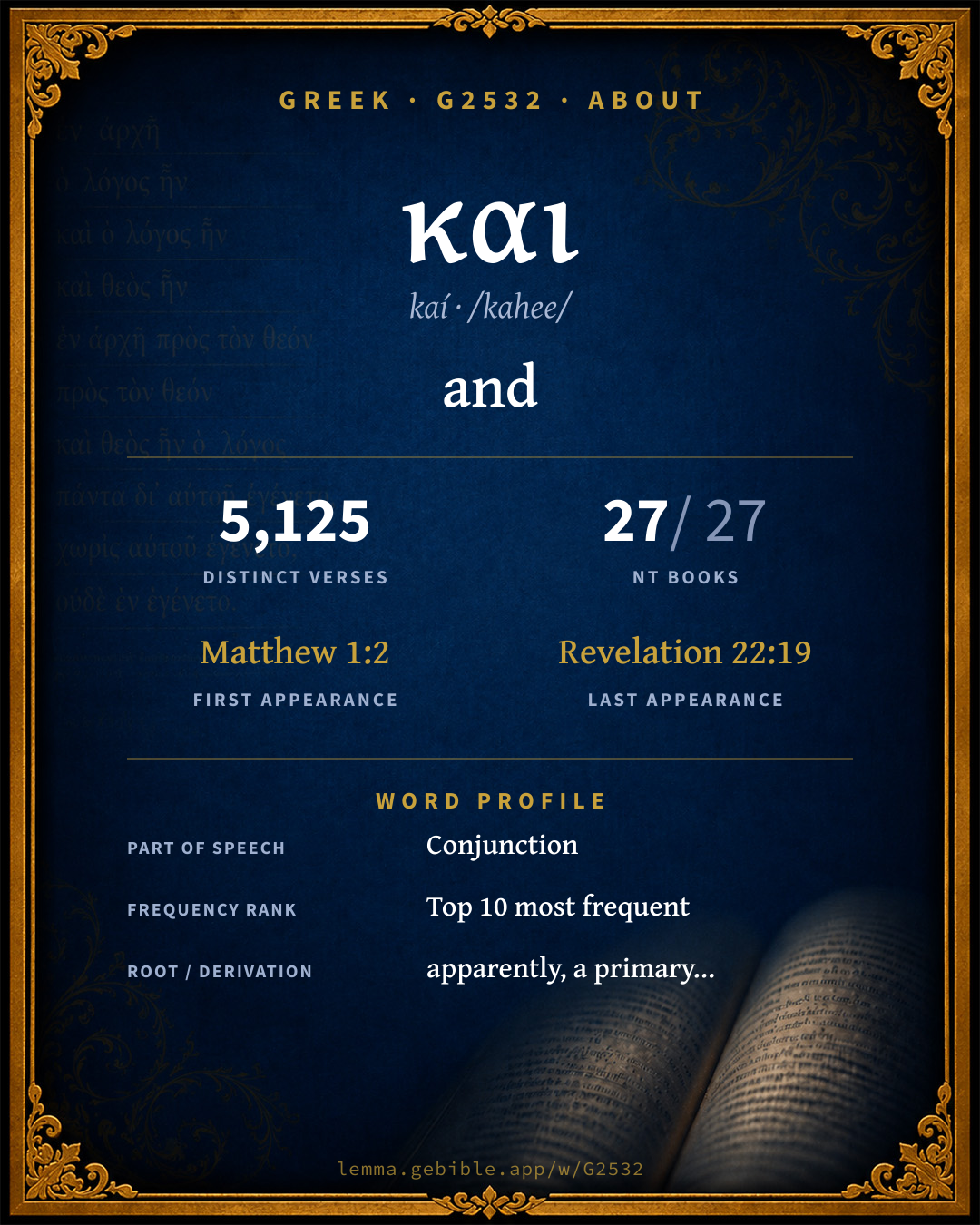
καί
and
Full lexicon entry — Thayer's Greek Lexicon
From Thayer's Greek Lexicon
Where this word appears
Grammar key — what these labels mean
Part of speech
- Conjunction
- A joining word linking words or clauses.
Page 4 of 26 — showing verses 601–800 of 5,125 distinct verses where G2532 appears, across 27 books. Click any verse to open its interlinear word-by-word view. Verse text shown in the World English Bible for context — . Each verse’s Greek form is shown with its reference; the English is not keyword-highlighted, since the data carries no word-level English alignment. Use “Compare translations” on any verse to read it across multiple English versions. This concordance covers the Greek New Testament; Septuagint (Greek Old Testament) occurrences of this word are not indexed here.
Matthew 704 verses
- Matthew 25:42 καὶ καὶ conj conj for I was hungry, and you didn't give me food to eat; I was thirsty, and you gave me no drink;
- Matthew 25:43 καὶ καὶ καὶ καὶ conj conj conj conj I was a stranger, and you didn't take me in; naked, and you didn't clothe me; sick, and in prison, and you didn't visit me.'
- Matthew 25:44 καὶ καὶ conj conj "Then they will also answer, saying, 'Lord, when did we see you hungry, or thirsty, or a stranger, or naked, or sick, or in prison, and didn't help you?'
- Matthew 25:46 καὶ conj These will go away into eternal punishment, but the righteous into eternal life."
- Matthew 26:1 Καὶ conj It happened, when Jesus had finished all these words, that he said to his disciples,
- Matthew 26:2 καὶ conj "You know that after two days the Passover is coming, and the Son of Man will be delivered up to be crucified."
- Matthew 26:3 καὶ conj Then the chief priests, the scribes, and the elders of the people were gathered together in the court of the high priest, who was called Caiaphas.
- Matthew 26:4 καὶ καὶ conj conj They took counsel together that they might take Jesus by deceit, and kill him.
- Matthew 26:7 καὶ conj a woman came to him having an alabaster jar of very expensive ointment, and she poured it on his head as he sat at the table.
- Matthew 26:9 καὶ conj For this ointment might have been sold for much, and given to the poor."
- Matthew 26:13 καὶ conj Most assuredly I tell you, wherever this Gospel is preached in the whole world, what this woman has done will also be spoken of as a memorial of her."
- Matthew 26:15 καὶ conj and said, "What are you willing to give me, that I should deliver him to you?" They weighed out for him thirty pieces of silver.
- Matthew 26:16 καὶ conj From that time he sought opportunity to betray him.
- Matthew 26:18 καὶ conj He said, "Go into the city to a certain person, and tell him, 'The Teacher says, "My time is at hand. I will keep the Passover at your house with my disciples."'"
- Matthew 26:19 καὶ καὶ conj conj The disciples did as Jesus commanded them, and they prepared the Passover.
- Matthew 26:21 καὶ conj As they were eating, he said, "Most assuredly I tell you that one of you will betray me."
- Matthew 26:22 καὶ conj They were exceedingly sorrowful, and each began to ask him, "It isn't me, is it, Lord?"
- Matthew 26:26 καὶ καὶ conj conj As they were eating, Jesus took bread, gave thanks for it, and broke it. He gave to the disciples, and said, "Take, eat; this is my body."
- Matthew 26:27 καὶ καὶ conj conj He took the cup, gave thanks, and gave to them, saying, "All of you drink it,
- Matthew 26:30 Καὶ conj When they had sung a hymn, they went out to the Mount of Olives.
- Matthew 26:31 καὶ conj Then Jesus said to them, "All of you will be made to stumble because of me tonight, for it is written, 'I will strike the shepherd, and the sheep of the flock will be scattered.'
- Matthew 26:35 καὶ conj Peter said to him, "Even if I must die with you, I will not deny you." All of the disciples also said likewise.
- Matthew 26:36 καὶ conj Then Jesus came with them to a place called Gethsemane, and said to his disciples, "Sit here, while I go there and pray."
- Matthew 26:37 καὶ καὶ καὶ conj conj conj He took with him Peter and the two sons of Zebedee, and began to be sorrowful and severely troubled.
- Matthew 26:38 καὶ conj Then he said to them, "My soul is exceedingly sorrowful, even to death. Stay here, and watch with me."
- Matthew 26:39 καὶ καὶ conj conj He went forward a little, fell on his face, and prayed, saying, "My Father, if it is possible, let this cup pass away from me; nevertheless, not what I desire, but what you desire."
- Matthew 26:40 καὶ καὶ καὶ conj conj conj He came to the disciples, and found them sleeping, and said to Peter, "What, couldn't you watch with me for one hour?
- Matthew 26:41 καὶ conj Watch and pray, that you don't enter into temptation. The spirit indeed is willing, but the flesh is weak."
- Matthew 26:43 καὶ conj He came again and found them sleeping, for their eyes were heavy.
- Matthew 26:44 καὶ conj He left them again, went away, and prayed a third time, saying the same words.
- Matthew 26:45 καὶ καὶ καὶ conj conj conj Then he came to his disciples, and said to them, "Sleep on now, and take your rest. Behold, the hour is at hand, and the Son of Man is betrayed into the hands of sinners.
- Matthew 26:47 Καὶ καὶ καὶ καὶ conj conj conj conj While he was still speaking, behold, Judas, one of the twelve, came, and with him a great multitude with swords and clubs, from the chief priest and elders of the people.
- Matthew 26:49 καὶ καὶ conj conj Immediately he came to Jesus, and said, "Hail, Rabbi!" and kissed him.
- Matthew 26:50 καὶ conj Jesus said to him, "Friend, why are you here?" Then they came and laid hands on Jesus, and took him.
- Matthew 26:51 καὶ καὶ conj conj Behold, one of those who were with Jesus stretched out his hand, and drew his sword, and struck the servant of the high priest, and struck off his ear.
- Matthew 26:53 καὶ conj Or do you think that I couldn't ask my Father, and he would even now send me more than twelve legions of angels?
- Matthew 26:55 καὶ καὶ conj conj In that hour Jesus said to the multitudes, "Have you come out as against a robber with swords and clubs to seize me? I sat daily in the temple teaching, and you didn't arrest me.
- Matthew 26:57 καὶ conj Those who had taken Jesus led him away to Caiaphas the high priest, where the scribes and the elders were gathered together.
- Matthew 26:58 καὶ conj But Peter followed him from a distance, to the court of the high priest, and entered in and sat with the officers, to see the end.
- Matthew 26:59 καὶ conj Now the chief priests, the elders, and the whole council sought false testimony against Jesus, that they might put him to death;
- Matthew 26:60 καὶ conj and they found none. Even though many false witnesses came forward, they found none. But at last two false witnesses came forward,
- Matthew 26:61 καὶ conj and said, "This man said, 'I am able to destroy the temple of God, and to build it in three days.'"
- Matthew 26:62 καὶ conj The high priest stood up, and said to him, "Have you no answer? What is this that these testify against you?"
- Matthew 26:63 καὶ conj But Jesus held his peace. The high priest answered him, "I adjure you by the living God, that you tell us whether you are the Christ, the Son of God."
- Matthew 26:64 καὶ conj Jesus said to him, "You have said it. Nevertheless, I tell you, henceforth you will see the Son of Man sitting at the right hand of Power, and coming on the clouds of the sky."
- Matthew 26:67 καὶ conj Then they spit in his face and beat him with their fists, and some slapped him,
- Matthew 26:69 καὶ καὶ conj conj Now Peter was sitting outside in the court, and a maid came to him, saying, "You were also with Jesus, the Galilean!"
- Matthew 26:71 καὶ conj When he had gone out onto the porch, someone else saw him, and said to those who were there, "This man also was with Jesus of Nazareth."
- Matthew 26:72 καὶ conj Again he denied it with an oath, "I don't know the man."
- Matthew 26:73 καὶ καὶ conj conj After a little while those who stood by came and said to Peter, "Surely you are also one of them, for your speech makes you known."
- Matthew 26:74 καὶ καὶ conj conj Then he began to curse and to swear, "I don't know the man!" Immediately the rooster crowed.
- Matthew 26:75 καὶ καὶ conj conj Peter remembered the word which Jesus had said to him, "Before the rooster crows, you will deny me three times." He went out and wept bitterly.
- Matthew 27:1 καὶ conj Now when morning had come, all the chief priests and the elders of the people took counsel against Jesus to put him to death:
- Matthew 27:2 καὶ καὶ conj conj and they bound him, and led him away, and delivered him up to Pontius Pilate, the governor.
- Matthew 27:3 καὶ conj Then Judas, who betrayed him, when he saw that Jesus was condemned, felt remorse, and brought back the thirty pieces of silver to the chief priests and elders,
- Matthew 27:5 καὶ καὶ conj conj He threw down the pieces of silver in the sanctuary, and departed. He went away and hanged himself.
- Matthew 27:9 καὶ conj Then that which was spoken through Jeremiah the prophet was fulfilled, saying, "They took the thirty pieces of silver, The price of him upon whom a price had been set, Whom some of the children of Israel priced,
- Matthew 27:10 καὶ conj And they gave them for the potter's field, As the Lord commanded me."
- Matthew 27:11 καὶ conj Now Jesus stood before the governor: and the governor asked him, saying, "Are you the King of the Jews?" Jesus said to him, "So you say."
- Matthew 27:12 καὶ καὶ conj conj When he was accused by the chief priests and elders, he answered nothing.
- Matthew 27:14 καὶ conj He gave him no answer, not even one word, so that the governor marveled greatly.
- Matthew 27:19 καὶ conj While he was sitting on the judgment seat, his wife sent to him, saying, "Have nothing to do with that righteous man, for I have suffered many things this day in a dream because of him."
- Matthew 27:20 καὶ conj Now the chief priests and the elders persuaded the multitudes to ask for Barabbas, and destroy Jesus.
- Matthew 27:25 καὶ καὶ conj conj All the people answered, "May his blood be on us, and on our children!"
- Matthew 27:28 καὶ conj They stripped him, and put a scarlet robe on him.
- Matthew 27:29 καὶ καὶ καὶ conj conj conj They braided a crown of thorns and put it on his head, and a reed in his right hand; and they kneeled down before him, and mocked him, saying, "Hail, King of the Jews!"
- Matthew 27:30 καὶ καὶ conj conj They spat on him, and took the reed and struck him on the head.
- Matthew 27:31 καὶ καὶ conj conj When they had mocked him, they took the robe off of him, and put his clothes on him, and led him away to crucify him.
- Matthew 27:33 καὶ conj They came to a place called "Golgotha," that is to say, "The place of a skull."
- Matthew 27:34 καὶ conj They gave him sour wine to drink mixed with gall. When he had tasted it, he would not drink.
- Matthew 27:36 καὶ conj and they sat and watched him there.
- Matthew 27:37 καὶ conj They set up over his head the accusation against him written, "THIS IS JESUS, THE KING OF THE JEWS."
- Matthew 27:38 καὶ conj Then there were two robbers crucified with him, one on his right hand and one on the left.
- Matthew 27:40 καὶ καὶ καὶ conj conj conj and saying, "You who destroy the temple, and build it in three days, save yourself! If you are the Son of God, come down from the cross!"
- Matthew 27:41 καὶ conj Likewise the chief priests also mocking, with the scribes, the Pharisees, and the elders, said,
- Matthew 27:42 καὶ conj "He saved others, but he can't save himself. If he is the King of Israel, let him come down from the cross now, and we will believe in him.
- Matthew 27:44 καὶ conj The robbers also who were crucified with him cast on him the same reproach.
- Matthew 27:48 καὶ καὶ καὶ conj conj conj Immediately one of them ran, and took a sponge, and filled it with vinegar, and put it on a reed, and gave him a drink.
- Matthew 27:51 καὶ καὶ καὶ conj conj conj Behold, the veil of the temple was torn in two from the top to the bottom. The earth quaked and the rocks were split.
- Matthew 27:52 καὶ καὶ conj conj The tombs were opened, and many bodies of the saints who had fallen asleep were raised;
- Matthew 27:53 καὶ καὶ conj conj and coming out of the tombs after his resurrection, they entered into the holy city and appeared to many.
- Matthew 27:54 καὶ καὶ conj conj Now the centurion, and those who were with him watching Jesus, when they saw the earthquake, and the things that were done, feared exceedingly, saying, "Truly this was the Son of God."
- Matthew 27:56 καὶ καὶ καὶ conj conj conj Among them were Mary Magdalene, Mary the mother of James and Joses, and the mother of the sons of Zebedee.
- Matthew 27:57 καὶ conj When evening had come, a rich man from Arimathaea, named Joseph, who himself was also Jesus' disciple came.
- Matthew 27:59 καὶ conj Joseph took the body, and wrapped it in a clean linen cloth,
- Matthew 27:60 καὶ καὶ conj conj and laid it in his own new tomb, which he had hewn out in the rock, and he rolled a great stone to the door of the tomb, and departed.
- Matthew 27:61 καὶ conj Mary Magdalene was there, and the other Mary, sitting opposite the tomb.
- Matthew 27:62 καὶ conj Now on the next day, which was the day after the Preparation Day, the chief priests and the Pharisees were gathered together to Pilate,
- Matthew 27:64 καὶ καὶ conj conj Command therefore that the tomb be made secure until the third day, lest perhaps his disciples come at night and steal him away, and tell the people, 'He is risen from the dead;' and the last deception will be worse than the first."
- Matthew 28:1 καὶ conj Now after the Sabbath, as it began to dawn on the first day of the week, Mary Magdalene and the other Mary came to see the tomb.
- Matthew 28:2 καὶ καὶ καὶ conj conj conj Behold, there was a great earthquake, for an angel of the Lord descended from the sky, and came and rolled away the stone from the door, and sat on it.
- Matthew 28:3 καὶ conj His appearance was like lightning, and his clothing white as snow.
- Matthew 28:4 καὶ conj For fear of him, the guards shook, and became like dead men.
- Matthew 28:7 καὶ καὶ conj conj Go quickly and tell his disciples, 'He has risen from the dead, and behold, he goes before you into Galilee; there you will see him.' Behold, I have told you."
- Matthew 28:8 καὶ καὶ conj conj They departed quickly from the tomb with fear and great joy, and ran to bring his disciples word.
- Matthew 28:9 καὶ καὶ conj conj As they went to tell his disciples, behold, Jesus met them, saying, "Rejoice!" They came and took hold of his feet, and worshiped him.
- Matthew 28:10 καὶ conj Then Jesus said to them, "Don't be afraid. Go tell my brothers that they should go into Galilee, and there they will see me."
- Matthew 28:12 καὶ conj When they were assembled with the elders, and had taken counsel, they gave a large amount of silver to the soldiers,
- Matthew 28:14 καὶ καὶ conj conj If this comes to the governor's ears, we will persuade him and make you free of worry."
- Matthew 28:15 καὶ conj So they took the money and did as they were told. This saying was spread abroad among the Jews, and continues until this day.
- Matthew 28:17 καὶ conj When they saw him, they bowed down to him, but some doubted.
- Matthew 28:18 καὶ καὶ conj conj Jesus came to them and spoke to them, saying, "All authority has been given to me in heaven and on earth.
- Matthew 28:19 καὶ καὶ conj conj Therefore go, and make disciples of all nations, baptizing them in the name of the Father and of the Son and of the Holy Spirit,
- Matthew 28:20 καὶ conj teaching them to observe all things that I commanded you. Behold, I am with you always, even to the end of the age." Amen.
Mark 556 verses
- Mark 1:4 καὶ conj John came baptizing in the wilderness and preaching the baptism of repentance for forgiveness of sins.
- Mark 1:5 καὶ καὶ καὶ conj conj conj All the country of Judea and all those of Jerusalem went out to him. They were baptized by him in the Jordan river, confessing their sins.
- Mark 1:6 καὶ καὶ καὶ καὶ conj conj conj conj John was clothed with camel's hair and a leather belt around his loins. He ate locusts and wild honey.
- Mark 1:7 καὶ conj He preached, saying, "After me comes he who is mightier than I, the thong of whose sandals I am not worthy to stoop down and loosen.
- Mark 1:9 Καὶ καὶ conj conj It happened in those days, that Jesus came from Nazareth of Galilee, and was baptized by John in the Jordan.
- Mark 1:10 καὶ καὶ conj conj Immediately coming up from the water, he saw the heavens parting, and the Spirit descending on him like a dove.
- Mark 1:11 καὶ conj A voice came out of the sky, "You are my beloved Son, in whom I am well pleased."
- Mark 1:12 Καὶ conj Immediately the Spirit drove him out into the wilderness.
- Mark 1:13 καὶ καὶ καὶ conj conj conj He was there in the wilderness forty days tempted by Satan. He was with the wild animals; and the angels were ministering to him.
- Mark 1:15 καὶ καὶ conj conj and saying, "The time is fulfilled, and the Kingdom of God is at hand! Repent, and believe in the Gospel."
- Mark 1:16 Καὶ καὶ conj conj Passing along by the sea of Galilee, he saw Simon and Andrew the brother of Simon casting a net in the sea, for they were fishermen.
- Mark 1:17 καὶ καὶ conj conj Jesus said to them, "Come after me, and I will make you into fishers for men."
- Mark 1:18 καὶ conj Immediately they left their nets, and followed him.
- Mark 1:19 καὶ καὶ καὶ conj conj conj Going on a little further from there, he saw James the son of Zebedee, and John, his brother, who were also in the boat mending the nets.
- Mark 1:20 καὶ καὶ conj conj Immediately he called them, and they left their father, Zebedee, in the boat with the hired servants, and went after him.
- Mark 1:21 Καὶ καὶ conj conj They went into Capernaum, and immediately on the Sabbath day he entered into the synagogue and taught.
- Mark 1:22 καὶ καὶ conj conj They were astonished at his teaching, for he taught them as having authority, and not as the scribes.
- Mark 1:23 Καὶ καὶ conj conj Immediately there was in their synagogue a man with an unclean spirit, and he cried out,
- Mark 1:24 καὶ conj saying, "Ha! What do we have to do with you, Jesus, you Nazarene? Have you come to destroy us? I know you who you are: the Holy One of God!"
- Mark 1:25 καὶ καὶ conj conj Jesus rebuked him, saying, "Be quiet, and come out of him!"
- Mark 1:26 καὶ καὶ conj conj The unclean spirit, convulsing him and crying with a loud voice, came out of him.
- Mark 1:27 καὶ καὶ καὶ conj conj conj They were all amazed, so that they questioned among themselves, saying, "What is this? A new teaching? For with authority he commands even the unclean spirits, and they obey him!"
- Mark 1:28 καὶ conj The report of him went out immediately everywhere into all the region of Galilee and its surrounding area.
- Mark 1:29 Καὶ καὶ καὶ conj conj conj Immediately, when they had come out of the synagogue, they came into the house of Simon and Andrew, with James and John.
- Mark 1:30 καὶ conj Now Simon's wife's mother lay sick with a fever, and immediately they told him about her.
- Mark 1:31 καὶ καὶ καὶ conj conj conj He came and took her by the hand, and raised her up. The fever left her, and she served them.
- Mark 1:32 καὶ conj At evening, when the sun had set, they brought to him all who were sick, and those who were possessed by demons.
- Mark 1:33 καὶ conj All the city was gathered together at the door.
- Mark 1:34 καὶ καὶ καὶ conj conj conj He healed many who were sick with various diseases, and cast out many demons. He didn't allow the demons to speak, because they knew him.
- Mark 1:35 Καὶ καὶ conj conj Early in the night, he rose up and went out, and departed into a deserted place, and prayed there.
- Mark 1:36 καὶ καὶ conj conj Simon and those who were with him followed after him;
- Mark 1:37 καὶ καὶ conj conj and they found him, and told him, "Everyone is looking for you."
- Mark 1:38 καὶ conj He said to them, "Let's go elsewhere into the next towns, that I may preach there also, because for this reason I came forth."
- Mark 1:39 καὶ καὶ conj conj He went into their synagogues throughout all Galilee, preaching and casting out demons.
- Mark 1:40 Καὶ καὶ conj conj There came to him a leper, begging him, kneeling down to him, and saying to him, "If you want to, you can make me clean."
- Mark 1:41 καὶ καὶ conj conj Being moved with compassion, he stretched out his hand, and touched him, and said to him, "I want to. Be made clean."
- Mark 1:42 καὶ καὶ conj conj When he had said this, immediately the leprosy departed from him, and he was made clean.
- Mark 1:43 καὶ conj He strictly warned him, and immediately sent him out,
- Mark 1:44 καὶ καὶ conj conj and said to him, "See you say nothing to anybody, but go show yourself to the priest, and offer for your cleansing the things which Moses commanded, for a testimony to them."
- Mark 1:45 καὶ καὶ conj conj But he went out, and began to proclaim it much, and to spread about the matter, so that Jesus could no more openly enter into a city, but was outside in desert places: and they came to him from everywhere.
- Mark 2:1 Καὶ conj When he entered again into Capernaum after some days, it was heard that he was in the house.
- Mark 2:2 καὶ καὶ conj conj Immediately many were gathered together, so that there was no more room, not even around the door; and he spoke the word to them.
- Mark 2:3 καὶ conj Four people came, carrying a paralytic to him.
- Mark 2:4 καὶ καὶ conj conj When they could not come near to him for the crowd, they removed the roof where he was. When they had broken it up, they let down the mat that the paralytic was lying on.
- Mark 2:5 καὶ conj Jesus, seeing their faith, said to the paralytic, "Son, your sins are forgiven you."
- Mark 2:6 καὶ conj But there were some of the scribes sitting there, and reasoning in their hearts,
- Mark 2:8 καὶ conj Immediately Jesus, perceiving in his spirit that they so reasoned within themselves, said to them, "Why do you reason these things in your hearts?
- Mark 2:9 καὶ καὶ conj conj Which is easier, to tell the paralytic, 'Your sins are forgiven;' or to say, 'Arise, and take up your bed, and walk?'
- Mark 2:11 καὶ conj "I tell you, arise, take up your mat, and go to your house."
- Mark 2:12 καὶ καὶ καὶ conj conj conj He arose, and immediately took up the mat, and went out in front of them all; so that they were all amazed, and glorified God, saying, "We never saw anything like this!"
- Mark 2:13 Καὶ καὶ καὶ conj conj conj He went out again by the seaside. All the multitude came to him, and he taught them.
- Mark 2:14 καὶ καὶ καὶ conj conj conj As he passed by, he saw Levi, the son of Alphaeus, sitting at the tax office, and he said to him, "Follow me." And he arose and followed him.
- Mark 2:15 καὶ καὶ καὶ καὶ καὶ conj conj conj conj conj It happened, that he was reclining at the table in his house, and many tax collectors and sinners sat down with Jesus and his disciples, for there were many, and they followed him.
- Mark 2:16 καὶ καὶ καὶ καὶ καὶ conj conj conj conj conj The scribes and the Pharisees, when they saw that he was eating with the sinners and tax collectors, said to his disciples, "Why is it that he eats and drinks with tax collectors and sinners?"
- Mark 2:17 καὶ conj When Jesus heard it, he said to them, "Those who are healthy have no need for a physician, but those who are sick. I came not to call the righteous, but sinners to repentance."
- Mark 2:18 Καὶ καὶ καὶ καὶ καὶ conj conj conj conj conj John's disciples and the Pharisees were fasting, and they came and asked him, "Why do John's disciples and the disciples of the Pharisees fast, but your disciples don't fast?"
- Mark 2:19 καὶ conj Jesus said to them, "Can the groomsmen fast while the bridegroom is with them? As long as they have the bridegroom with them, they can't fast.
- Mark 2:20 καὶ conj But the days will come when the bridegroom will be taken away from them, and then will they fast in that day.
- Mark 2:21 καὶ conj No one sews a piece of unshrunk cloth on an old garment, or else the patch shrinks and the new tears away from the old, and a worse hole is made.
- Mark 2:22 καὶ καὶ καὶ conj conj conj No one puts new wine into old wineskins, or else the new wine will burst the skins, and the wine pours out, and the skins will be destroyed; but they put new wine into fresh wineskins."
- Mark 2:23 Καὶ καὶ conj conj It happened that he was going on the Sabbath day through the grain fields, and his disciples began, as they went, to pluck the ears of grain.
- Mark 2:24 καὶ conj The Pharisees said to him, "Behold, why do they do that which is not lawful on the Sabbath day?"
- Mark 2:25 καὶ καὶ καὶ conj conj conj He said to them, "Did you never read what David did, when he had need, and was hungry--he, and they who were with him?
- Mark 2:26 καὶ καὶ καὶ conj conj conj How he entered into the house of God when Abiathar was high priest, and ate the show bread, which it is not lawful to eat except for the priests, and gave also to those who were with him?"
- Mark 2:27 καὶ καὶ conj conj He said to them, "The Sabbath was made for man, not man for the Sabbath.
- Mark 2:28 καὶ conj Therefore the Son of Man is lord even of the Sabbath."
- Mark 3:1 Καὶ καὶ conj conj He entered again into the synagogue, and there was a man there who had his hand withered.
- Mark 3:2 καὶ conj They watched him, whether he would heal him on the Sabbath day, that they might accuse him.
- Mark 3:3 καὶ conj He said to the man who had his hand withered, "Stand up."
- Mark 3:4 καὶ conj He said to them, "Is it lawful on the Sabbath day to do good, or to do harm? To save a life, or to kill?" But they were silent.
- Mark 3:5 καὶ καὶ καὶ conj conj conj When he had looked around at them with anger, being grieved at the hardening of their hearts, he said to the man, "Stretch out your hand." He stretched it out, and his hand was restored as healthy as the other.
- Mark 3:6 καὶ conj The Pharisees went out, and immediately conspired with the Herodians against him, how they might destroy him.
- Mark 3:7 Καὶ καὶ καὶ conj conj conj Jesus withdrew to the sea with his disciples, and a great multitude followed him from Galilee, from Judea,
- Mark 3:8 καὶ καὶ καὶ καὶ καὶ conj conj conj conj conj from Jerusalem, from Idumaea, beyond the Jordan, and those from around Tyre and Sidon. A great multitude, hearing what great things he did, came to him.
- Mark 3:9 καὶ conj He spoke to his disciples that a little boat should stay near him because of the crowd, so that they wouldn't press on him.
- Mark 3:11 καὶ καὶ conj conj The unclean spirits, whenever they saw him, fell down before him, and cried, "You are the Son of God!"
- Mark 3:12 καὶ conj He sternly warned them that they should not make him known.
- Mark 3:13 Καὶ καὶ καὶ conj conj conj He went up into the mountain, and called to himself those whom he wanted, and they went to him.
- Mark 3:14 καὶ καὶ conj conj He appointed twelve, that they might be with him, and that he might send them out to preach,
- Mark 3:15 καὶ conj and to have authority to heal sicknesses and to cast out demons:
- Mark 3:16 καὶ καὶ conj conj Simon, to whom he gave the name Peter;
- Mark 3:17 καὶ καὶ καὶ conj conj conj James the son of Zebedee; John, the brother of James, and he surnamed them Boanerges, which means, Sons of Thunder;
- Mark 3:18 καὶ καὶ καὶ καὶ καὶ καὶ καὶ καὶ conj conj conj conj conj conj conj conj Andrew; Philip; Bartholomew; Matthew; Thomas; James, the son of Alphaeus; Thaddaeus; Simon the Zealot;
- Mark 3:19 καὶ καὶ Καὶ conj conj conj and Judas Iscariot, who also betrayed him. He came into a house.
- Mark 3:20 καὶ conj The multitude came together again, so that they could not so much as eat bread.
- Mark 3:21 καὶ conj When his friends heard it, they went out to seize him: for they said, "He is insane."
- Mark 3:22 καὶ καὶ conj conj The scribes who came down from Jerusalem said, "He has Beelzebul," and, "By the prince of the demons he casts out the demons."
- Mark 3:23 καὶ conj He summoned them, and said to them in parables, "How can Satan cast out Satan?
- Mark 3:24 καὶ conj If a kingdom is divided against itself, that kingdom cannot stand.
- Mark 3:25 καὶ conj If a house is divided against itself, that house cannot stand.
- Mark 3:26 καὶ καὶ conj conj If Satan has risen up against himself, and is divided, he can't stand, but has an end.
- Mark 3:27 καὶ conj But no one can enter into the house of the strong man to plunder, unless he first binds the strong man; and then he will plunder his house.
- Mark 3:28 καὶ conj Most assuredly I tell you, all of the children of men's sins will be forgiven them, including their blasphemies with which they may blaspheme;
- Mark 3:31 Καὶ καὶ καὶ conj conj conj His mother and his brothers came, and standing outside, they sent to him, calling him.
- Mark 3:32 καὶ καὶ καὶ καὶ conj conj conj conj A multitude was sitting around him, and they told him, "Behold, your mother, your brothers, and your sisters are outside looking for you."
- Mark 3:33 καὶ καὶ conj conj He answered them, "Who are my mother and my brothers?"
About this entry
At a glance — auto-summarized from this page’s data, not written by a person. Every figure links to its source below. This summary describes the numbers; it doesn’t interpret them.
At its core, και (kaí) means “and.” Scripture first uses it in Matthew 1:2. With 5,125 verses in 27 books, it is one of the most common word in the Greek New Testament. Sharing its root, it stands alongside καγω, καιγε and καιπερ. Each statement above links to its evidence; the full detail follows below.
Gloss history
Strong's 1890 vs modern scholarship

About this word
Strong's G2532 catalogs a Greek word from the Greek New Testament.
These counts are not copied from any lexicon or concordance. They are computed here, from the morphology-tagged Greek New Testament. What Lemma adds →
- 5,125
- distinct verses
- The word appears in 5,125 distinct verses.
- 27 / 27
- NT books
- The word appears in 27 of 27 New Testament books.
- #2
- by frequency
- Top 10 most frequent Greek words (rank 2 of 5,347 Greek words by occurrence).
View all 5,125 occurrences in the concordance →
By section of the New Testament
By traditional corpus
Conventional, traditional groupings — biblical authorship is debated, so this is a traditional corpus grouping, not an authorship claim. Some books belong to more than one corpus (Luke is in both the Gospels and the Lukan corpus, and so on), so these shares overlap and need not total 100%. Each figure is a share of the word’s 5,125 distinct verses.
- Gospels 2,619 verses · 51%
- Lukan (Luke–Acts) 1,489 verses · 29%
- Pauline corpus 1,026 verses · 20%
- Johannine 995 verses · 19%
- Revelation 370 verses · 7%
- General (Catholic) Epistles 277 verses · 5%
- Hebrews 173 verses · 3%
How translations render this word
Counts come from each version’s own published word-to-Strong’s tagging or interlinear alignment — an approximate guide to how each version renders this word, not a word-level alignment the data otherwise carries. Because each total is that version’s own tagged count, the per-version totals vary from one another and need not match the appearance or distinct-verse counts above. These counts may also differ from a printed concordance because Lemma counts each distinctly tagged rendering and does not collapse phrase taggings into a single head-word total. This is a fixed set of word-tagged versions (KJV, ASV, BSB, ULT) and does not change with the reading translation you choose elsewhere. Each version’s license is shown beside its name below (and on Sources).
- King James Version: And 8,097×, Also 500×, Even 101×
- American Standard Version: And 7,750×, Also 433×, Even 110×
- Berean Standard Bible: And 5,240×, Then 278×, Also 156×
- unfoldingWord Literal Text: And 7,949×, Also 596×, But 132×
King James Version Public Domain
Renders G2532 across 9,091 tagged occurrences — most commonly:
Plus other, less common renderings. Plus 72 renderings that appear only once — usually multi-word phrases or single function words the recovered tagging swept in, not distinct renderings. Not rendered by a distinct English word in 156 further occurrences.
American Standard Version Public Domain
Renders G2532 across 8,928 tagged occurrences — most commonly:
Plus other, less common renderings. Plus 227 renderings that appear only once — usually multi-word phrases or single function words the recovered tagging swept in, not distinct renderings. Not rendered by a distinct English word in 83 further occurrences.
Berean Standard Bible Public Domain
Renders G2532 across 6,415 tagged occurrences — most commonly:
Plus other, less common renderings. Plus 44 renderings that appear only once — usually multi-word phrases or single function words the recovered tagging swept in, not distinct renderings. Not rendered by a distinct English word in 2,467 further occurrences.
unfoldingWord Literal Text CC BY-SA 4.0
Renders G2532 across 9,016 tagged occurrences — most commonly:
Plus other, less common renderings. Plus 20 renderings that appear only once — usually multi-word phrases or single function words the recovered tagging swept in, not distinct renderings. Not rendered by a distinct English word in 3 further occurrences.
Senses in Thayer's
The 1 sense Thayer's distinguishes for this word, in lexicon order (not ranked by frequency or importance). The full entry — with sub-senses — is in the Lexicon Entry tab.
- and, also, even, indeed, but Frequency count based on 1894 Scrivener Greek New Testament.
Word origin
Origin: apparently, a primary particle, having a copulative and sometimes also a cumulative force
Apparently a primary particle having a copulative and sometimes also a cumulative force; and also even so then too etc.; often used in connection (or composition) with other particles or small words : - and also both but even for if indeed likewise moreover or so that then therefore when yea yet.
— Strong’s Exhaustive Concordance (1890), public domain.
Forms in the corpus
The 5 distinct written forms G2532 takes in the Greek New Testament, most frequent first — each parse links to that case’s occurrences in the concordance.
| Form | Parsing | Example | Uses |
|---|---|---|---|
| καὶ kaì | Conjunction | Matthew 1:2 | 8,661 |
| Καὶ Kaì | Conjunction | Matthew 4:21 | 274 |
| καί kaí | Conjunction | Matthew 15:4 | 29 |
| Καί Kaí | Conjunction | Luke 19:39 | 4 |
| και kai | Conjunction | John 7:53 | 1 |
Same root — word family
Other Thayer's entries built from the same root as G2532, grouped by Strong’s listed origin. These share a root / origin per the lexicon — not necessarily a shared meaning. Each links to that word’s own entry.
Derived from this word
- καγω kagṓ G2504 and I
- καιγε kaíge G2534 and indeed
- καιπερ kaíper G2539 although
- καιτοι kaítoi G2543 and yet
- κακει kakeî G2546 and there
- κακειθεν kakeîthen G2547 of place
- κακεινος kakeînos G2548 and he
- καν kán G2579 and if
Compare all same-root words → Showing 4 of 9 — not the complete family. They share a root, not necessarily a meaning.
Septuagint usage
The same Greek word και appears 47,643 times in the Greek Old Testament (Septuagint), across 18,587 verses in 38 books.
- 47,643
- LXX occurrences
- Tagged occurrences of this Greek word in the Septuagint.
- 18,587
- verses
- Distinct Septuagint verses containing this word.
- 38 / 39
- OT books
- The word appears in 38 of the 39 Old Testament books.
Sample Septuagint occurrences
- Genesis 1:1 καί
- Exodus 1:3 καί
- Leviticus 1:1 καί
- Numbers 1:1 καί
- Deuteronomy 1:1 καί
- Joshua 1:1 καί
- Judges 1:1 καί
- Ruth 1:1 καί
- 1 Samuel 1:1 καί
- 2 Samuel 1:1 καί
- 1 Kings 1:1 καί
- 2 Kings 1:1 καί
Septuagint occurrences (same lexeme)
Every verse where the same Strong’s number (G2532) appears in the Greek Septuagint — showing the first 50 of 18,587. Verse text shown in the World English Bible for context; the Greek form is the matched word — the English is not keyword-highlighted.
- Genesis 1:1 καί In the beginning God created the heavens and the earth.
- Genesis 1:2 καί Now the earth was formless and empty. Darkness was on the surface of the deep. God's Spirit was hovering over the surface of the waters.
- Genesis 1:3 καί God said, "Let there be light," and there was light.
- Genesis 1:4 καί God saw the light, and saw that it was good. God divided the light from the darkness.
- Genesis 1:5 καί God called the light Day, and the darkness he called Night. There was evening and there was morning, one day.
- Genesis 1:6 καί God said, "Let there be an expanse in the midst of the waters, and let it divide the waters from the waters."
- Genesis 1:7 καί God made the expanse, and divided the waters which were under the expanse from the waters which were above the expanse, and it was so.
- Genesis 1:8 καί God called the expanse sky. There was evening and there was morning, a second day.
- Genesis 1:9 καί God said, "Let the waters under the sky be gathered together to one place, and let the dry land appear," and it was so.
- Genesis 1:10 καί God called the dry land Earth, and the gathering together of the waters he called Seas. God saw that it was good.
- Genesis 1:11 καί God said, "Let the earth put forth grass, herbs yielding seed, and fruit trees bearing fruit after their kind, with its seed in it, on the earth," and it was so.
- Genesis 1:12 καί The earth brought forth grass, herbs yielding seed after their kind, and trees bearing fruit, with its seed in it, after their kind: and God saw that it was good.
- Genesis 1:13 καί There was evening and there was morning, a third day.
- Genesis 1:14 καί God said, "Let there be lights in the expanse of sky to divide the day from the night; and let them be for signs, and for seasons, and for days and years;
- Genesis 1:15 καί and let them be for lights in the expanse of sky to give light on the earth," and it was so.
- Genesis 1:16 καί God made the two great lights: the greater light to rule the day, and the lesser light to rule the night. He also made the stars.
- Genesis 1:17 καί God set them in the expanse of sky to give light to the earth,
- Genesis 1:18 καί and to rule over the day and over the night, and to divide the light from the darkness. God saw that it was good.
- Genesis 1:19 καί There was evening and there was morning, a fourth day.
- Genesis 1:20 καί God said, "Let the waters swarm with swarms of living creatures, and let birds fly above the earth in the open expanse of sky."
- Genesis 1:21 καί God created the large sea creatures, and every living creature that moves, with which the waters swarmed, after their kind, and every winged bird after its kind. God saw that it was good.
- Genesis 1:22 καί God blessed them, saying, "Be fruitful, and multiply, and fill the waters in the seas, and let birds multiply on the earth."
- Genesis 1:23 καί There was evening and there was morning, a fifth day.
- Genesis 1:24 καί God said, "Let the earth bring forth living creatures after their kind, cattle, creeping things, and animals of the earth after their kind," and it was so.
- Genesis 1:25 καί God made the animals of the earth after their kind, and the cattle after their kind, and everything that creeps on the ground after its kind. God saw that it was good.
- Genesis 1:26 καί God said, "Let us make man in our image, after our likeness: and let them have dominion over the fish of the sea, and over the birds of the sky, and over the cattle, and over all the earth, and over every creeping thing that creeps on the earth."
- Genesis 1:27 καί God created man in his own image. In God's image he created him; male and female he created them.
- Genesis 1:28 καί God blessed them. God said to them, "Be fruitful, multiply, fill the earth, and subdue it. Have dominion over the fish of the sea, over the birds of the sky, and over every living thing that moves on the earth."
- Genesis 1:29 καί God said, "Behold, I have given you every herb yielding seed, which is on the surface of all the earth, and every tree, which bears fruit yielding seed. It will be your food.
- Genesis 1:30 καί To every animal of the earth, and to every bird of the sky, and to everything that creeps on the earth, in which there is life, I have given every green herb for food." And it was so.
- Genesis 1:31 καί God saw everything that he had made, and, behold, it was very good. There was evening and there was morning, the sixth day.
- Genesis 2:1 καί The heavens and the earth were finished, and all the host of them.
- Genesis 2:2 καί On the seventh day God finished his work which he had made; and he rested on the seventh day from all his work which he had made.
- Genesis 2:3 καί God blessed the seventh day, and made it holy, because he rested in it from all his work which he had created and made.
- Genesis 2:4 καί This is the history of the generations of the heavens and of the earth when they were created, in the day that Yahweh God made earth and the heavens.
- Genesis 2:5 καί No plant of the field was yet in the earth, and no herb of the field had yet sprung up; for Yahweh God had not caused it to rain on the earth. There was not a man to till the ground,
- Genesis 2:6 καί but a mist went up from the earth, and watered the whole surface of the ground.
- Genesis 2:7 καί Yahweh God formed man from the dust of the ground, and breathed into his nostrils the breath of life; and man became a living soul.
- Genesis 2:8 καί Yahweh God planted a garden eastward, in Eden, and there he put the man whom he had formed.
- Genesis 2:9 καί Out of the ground Yahweh God made every tree to grow that is pleasant to the sight, and good for food; the tree of life also in the midst of the garden, and the tree of the knowledge of good and evil.
- Genesis 2:12 καί and the gold of that land is good. There is aromatic resin and the onyx stone.
- Genesis 2:13 καί The name of the second river is Gihon: the same river that flows through the whole land of Cush.
- Genesis 2:14 καί The name of the third river is Hiddekel: this is the one which flows in front of Assyria. The fourth river is the Euphrates.
- Genesis 2:15 καί Yahweh God took the man, and put him into the garden of Eden to dress it and to keep it.
- Genesis 2:16 καί Yahweh God commanded the man, saying, "Of every tree of the garden you may freely eat:
- Genesis 2:17 καί but of the tree of the knowledge of good and evil, you shall not eat of it: for in the day that you eat of it you will surely die."
- Genesis 2:18 καί Yahweh God said, "It is not good that the man should be alone; I will make him a helper suitable for him."
- Genesis 2:19 καί Out of the ground Yahweh God formed every animal of the field, and every bird of the sky, and brought them to the man to see what he would call them. Whatever the man called every living creature, that was its name.
- Genesis 2:20 καί The man gave names to all cattle, and to the birds of the sky, and to every animal of the field; but for man there was not found a helper suitable for him.
- Genesis 2:21 καί Yahweh God caused a deep sleep to fall on the man, and he slept; and he took one of his ribs, and closed up the flesh in its place.
These are occurrences of the same Greek lexeme (G2532) in the Septuagint — not a translation of any one Hebrew word. The store carries no word-level Hebrew↔Greek alignment, so no Hebrew original is asserted here. Counts come from the recovered LXX Strong's tagging — high-frequency vocabulary is well covered, while rare or late forms may be untagged — so they reflect tagged occurrences and may slightly undercount.