
Matthew 22:21

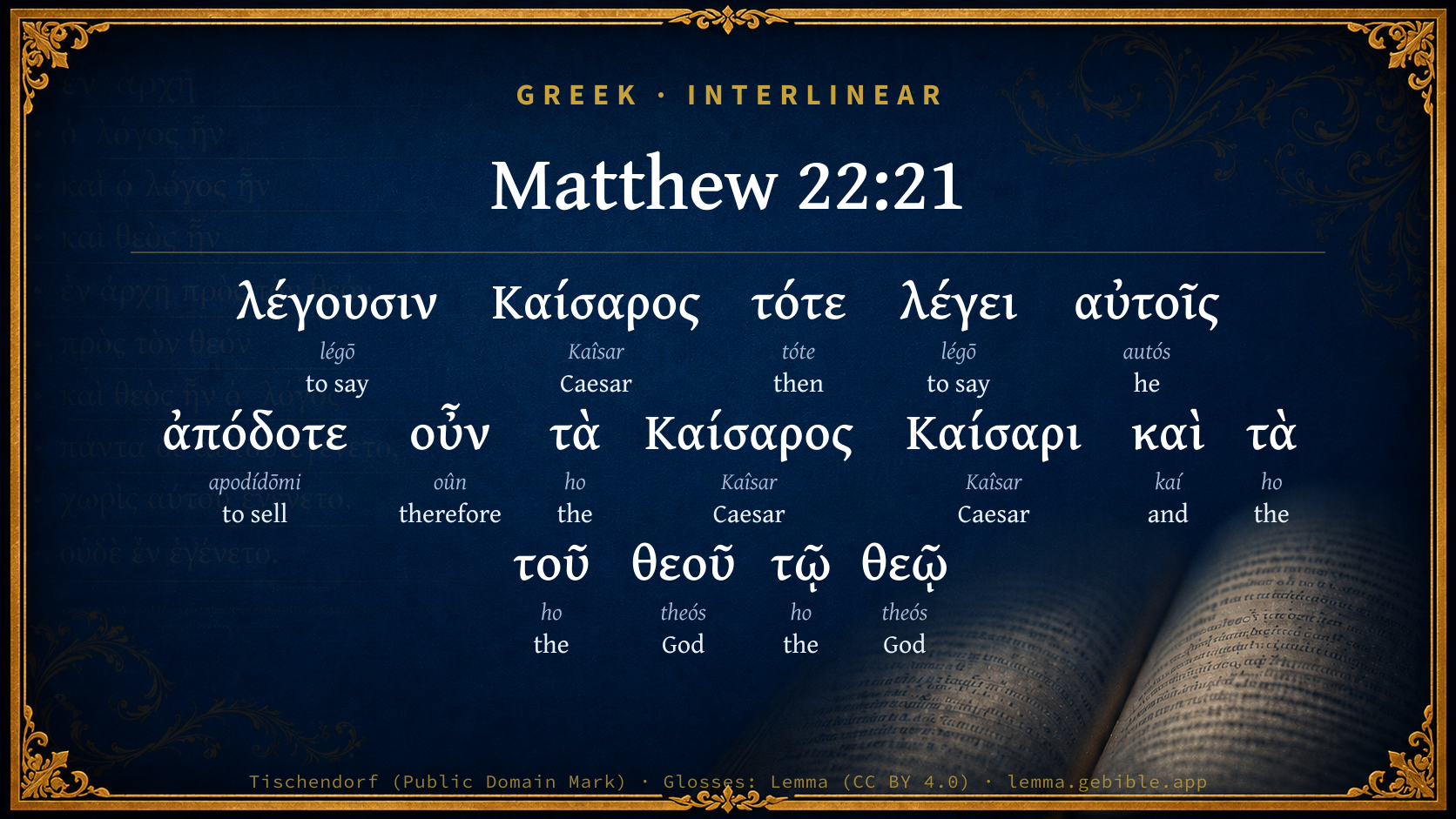
Greek (Tischendorf 8th ed.) Matthew 22:21 appears in the Greek New Testament. The text above is from the Tischendorf 8th edition. Each word links to its Strong’s number and a concise gloss. Click any word for its full Thayer’s Greek Lexicon entry.
Download image
Cite this verse

Matthew 22:21 (World English Bible). Public Domain. Lemma interlinear Bible study tool, https://lemma.gebible.app/v/matthew/22/21.

Show BibTeX & RIS
BibTeX
RIS
English Translation
They said to him, "Caesar's." Then he said to them, "Give therefore to Caesar the things that are Caesar's, and to God the things that are God's."
World English Bible · Public Domain
Download a study sheet

One document with this verse’s original text, its word-by-word gloss line, the meaning frame, cross-references with their text, attributed commentary, and full source and license credits — printable, and it pastes into notes with its structure intact.

This verse Autodidact and up

Study sheet (.html) Plain text (.txt)

A passage Seminary Student

Up to 50 verses in one chapter. A passage sheet keeps up to 6 commentary sources and 12 cross-references per verse, in the order this page ranks them, and says so on the sheet whenever that leaves anything out. Ask for a single verse and you get the Autodidact verse sheet above.

Everything on this page stays free to read, with no account — the sheet is a download of what is already on screen, not access to it.

Want to remove ads? Support Godless Engineer
Compare translations 3

The same verse in 3 English versions, stacked beneath the original-language interlinear above. Click any original word for its lexicon entry.

Each is an independent rendering of the whole verse — the interlinear is not word-aligned to these translations.

Highlighted words mark where these versions differ — a whole-verse word diff, not a word-by-word alignment.

  • World English Bible Public Domain
    They said to him, "Caesar's." Then he said to them, "Give therefore to Caesar the things that are Caesar's, and to God the things that are God's."
  • King James Version Public Domain
    They say unto him, Caesar's. Then saith he unto them, Render therefore unto Caesar the things which are Caesar's; and unto God the things that are God's.
  • unfoldingWord Literal Text CC BY-SA 4.0
    They say, “Caesar’s.” Then he says to them, “Therefore, give back the things of Caesar to Caesar, and the things of God to God.”

unfoldingWord Literal Text — © unfoldingWord, licensed CC BY-SA 4.0. Word-aligned USFM3 via Door43 (git.door43.org/unfoldingWord/en_ult).

Versions to compare (up to 4)

3 of 4 selected

Show all 19 translations

Every available English version of this verse, each an independent rendering of the whole verse.

  • World English Bible Public Domain
    They said to him, "Caesar's." Then he said to them, "Give therefore to Caesar the things that are Caesar's, and to God the things that are God's."
  • Berean Standard Bible Public Domain
    “Caesar’s,” they answered. So Jesus told them, “Give to Caesar what is Caesar’s, and to God what is God’s.”
  • Majority Standard Bible Public Domain
    “Caesar’s,” they answered. So Jesus told them, “Give to Caesar what is Caesar’s, and to God what is God’s.”
  • King James Version Public Domain
    They say unto him, Caesar's. Then saith he unto them, Render therefore unto Caesar the things which are Caesar's; and unto God the things that are God's.
  • American Standard Version (1901) Public Domain
    They say unto him, Caesar's. Then saith he unto them, Render therefore unto Caesar the things that are Caesar's; and unto God the things that are God's.
  • Revised Version (1885) Public Domain
    They say unto him, Caesar’s. Then saith he unto them, Render therefore unto Caesar the things that are Caesar’s; and unto God the things that are God’s.
  • Geneva Bible (1599) Public Domain
    They sayd vnto him, Cesars. Then sayd he vnto them, Giue therefore to Cesar, the things which are Cesars, and giue vnto God, those things which are Gods.
  • Douay-Rheims (1899) Public Domain
    They say to him: Caesar's. Then he saith to them: Render therefore to Caesar the things that are Caesar's; and to God, the things that are God's.
  • Young's Literal Translation Public Domain
    they say to him, `Caesar's;' then saith he to them, `Render therefore the things of Caesar to Caesar, and the things of God to God;'
  • Literal Standard Version CC BY-SA 4.0
    They say to Him, “Caesar’s”; then He says to them, “Render therefore the things of Caesar to Caesar, and the things of God to God”;
  • Unlocked Literal Bible CC BY-SA 4.0
    They said to him, “Caesar's.” Then Jesus said to them, “Then give to Caesar the things that are Caesar's, and to God the things that are God's.”
  • unfoldingWord Literal Text CC BY-SA 4.0
    They say, “Caesar’s.” Then he says to them, “Therefore, give back the things of Caesar to Caesar, and the things of God to God.”
  • Darby Bible Public Domain
    They say to him, Caesar's. Then he says to them, Pay then what is Caesar's to Caesar, and what is God's to God.
  • World Messianic Bible Public Domain
    They said to him, “Caesar’s.” Then he said to them, “Give therefore to Caesar the things that are Caesar’s, and to God the things that are God’s.”
  • Webster's Bible Public Domain
    They say to him, Cesar's. Then saith he to them, Render therefore to Cesar, the things which are Cesar's; and to God, the things that are God's.
  • Free Bible Version CC BY-SA 4.0
    “Caesar's,” they replied. “You should give back to Caesar what belongs to Caesar, and to God what belongs to God,” he told them.
  • Bible in Basic English Public Domain
    They say to him, Caesar's. Then he said to them, Give to Caesar the things which are Caesar's, and to God the things which are God's.
  • Text-Critical English NT CC BY 4.0
    They said to him, “Caesar's.” So he said to them, “Then render to Caesar the things that are Caesar's, and to God the things that are God's.”
  • Tyndale New Testament (1534) Public Domain
    They sayde vnto him: Cesars. Then sayde he vnto them. Geve therfore to Cesar that which is Cesars: and geve vnto god that which is goddes.

Literal Standard Version (2020), Covenant Press — licensed CC BY-SA 4.0. Text via the HelloAO Bible API (eBible.org). Unlocked Literal Bible (unfoldingWord) — licensed CC BY-SA 4.0. Text via the HelloAO Bible API (eBible.org). unfoldingWord Literal Text — © unfoldingWord, licensed CC BY-SA 4.0. Word-aligned USFM3 via Door43 (git.door43.org/unfoldingWord/en_ult). Free Bible Version, Dr. Jonathan Gallagher — licensed CC BY-SA 4.0. Text via the HelloAO Bible API (eBible.org).

Word by word

More ways to search: Search by grammar → Find every occurrence → Compare this word →

Practice this passage: Drill this verse → Learn its vocabulary →

Καίσαρος
Kaîsar
G2541
“Caesar”
Noun, Genitive, Singular, Masculine
Part of Speech
Noun
Case
Genitive
Number
Singular
Gender
Masculine
Full Thayer's Definition

Origin: of Latin origin

TDNT: None

Caesar = "severed" 1. the surname of Julius Caesar, which adopted by Octavius Augustus and his successors afterwards became a title, and was appropriated by the Roman emperors as part of their title
  1. λέγουσιν légō G3004 “to say” Verb, Present, Active, Indicative, 3rd person, Plural
  2. τότε tóte G5119 “then” Adverb
  3. λέγει légō G3004 “to say” Verb, Present, Active, Indicative, 3rd person, Singular
  4. αὐτοῖς autós G846 “he” Personal pronoun, Dative, Plural, Masculine
  5. ἀπόδοτε apodídōmi G591 “to sell” Verb, Aorist, Active, Imperative, 2nd person, Plural
  6. οὖν oûn G3767 “therefore” Conjunction
  7. τὰ ho G3588 “the” Article, Accusative, Plural, Neuter
  8. Καίσαρος Kaîsar G2541 “Caesar” Noun, Genitive, Singular, Masculine
  9. Καίσαρι Kaîsar G2541 “Caesar” Noun, Dative, Singular, Masculine
  10. καὶ kaí G2532 “and” Conjunction
  11. τὰ ho G3588 “the” Article, Accusative, Plural, Neuter
  12. τοῦ ho G3588 “the” Article, Genitive, Singular, Masculine
  13. θεοῦ theós G2316 “God” Noun, Genitive, Singular, Masculine
  14. τῷ ho G3588 “the” Article, Dative, Singular, Masculine
  15. θεῷ theós G2316 “God” Noun, Dative, Singular, Masculine

About this verse

These counts appear in no published source. They are computed here, from the morphology-tagged text and Lemma’s own curated glosses. What Lemma adds →

16
words
9
distinct lemmas
Gospels
section

Shared distinctive vocabulary

Καίσαρος Caesar G2541 occurs in 23 verses of the Greek New Testament. Also found in:
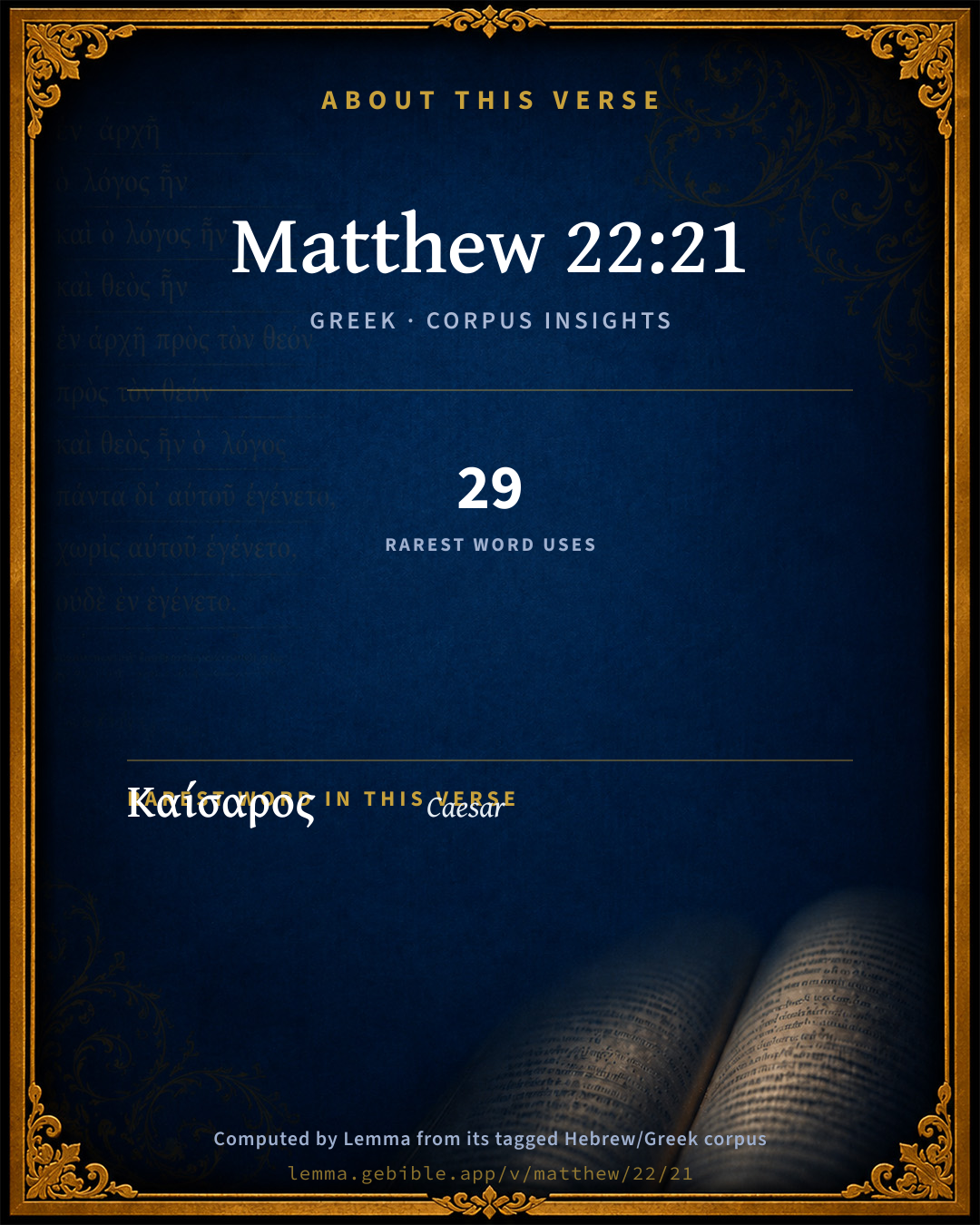
Repetition

Words recur within this verse:

  • Καίσαρος Caesar G2541 ×3
  • λέγουσιν to say G3004 ×2
  • θεοῦ God G2316 ×2
  • τὰ the G3588 ×4

Cross-references

14

Topical passages linked to Matthew 22:21 in the Treasury of Scripture Knowledge — connected by theme and wording, ordered by reader-vote popularity; previews shown in the World English Bible.

  • Romans 13:7 Give therefore to everyone what you owe: taxes to whom taxes are due; customs to whom customs; respect to whom respect; honor to whom honor.
  • Proverbs 24:21 My son, fear Yahweh and the king. Don't join those who are rebellious:
  • Acts 4:19 But Peter and John answered them, "Whether it is right in the sight of God to listen to you rather than to God, judge for yourselves,
  • Malachi 1:6–8 "A son honors his father, and a servant his master. If I am a father, then where is my honor? And if I am a master, where is the respect due me? Says Yahweh of Hosts to you, priests, who despise my name. You say, 'How have we despised your name?'
  • Matthew 22:37 Jesus said to him, "'You shall love the Lord your God with all your heart, and with all your soul, and with all your mind.'
  • 1 Peter 2:13–17 Therefore subject yourselves to every ordinance of man for the Lord's sake: whether to the king, as supreme;
  • Daniel 6:20–23 When he came near to the den to Daniel, he cried with a lamentable voice; the king spoke and said to Daniel, Daniel, servant of the living God, is your God, whom you serve continually, able to deliver you from the lions?
  • Luke 23:2 They began to accuse him, saying, "We found this man perverting the nation, forbidding paying taxes to Caesar, and saying that he himself is Christ, a king."
  • Acts 5:29 But Peter and the apostles answered, "We must obey God rather than men.
  • Matthew 4:10 Then Jesus said to him, "Get behind me, Satan! For it is written, 'You shall worship the Lord your God, and him only shall you serve.'"
  • Matthew 17:25–27 He said, "Yes." When he came into the house, Jesus anticipated him, saying, "What do you think, Simon? From whom do the kings of the earth receive toll or tribute? From their children, or from strangers?"
  • Daniel 3:16–18 Shadrach, Meshach, and Abednego answered the king, Nebuchadnezzar, we have no need to answer you in this matter.
  • Daniel 6:10–11 When Daniel knew that the writing was signed, he went into his house (now his windows were open in his chamber toward Jerusalem) and he kneeled on his knees three times a day, and prayed, and gave thanks before his God, as he did before.
  • Malachi 3:8–10 Will a man rob God? Yet you rob me! But you say, 'How have we robbed you?' In tithes and offerings.

Cross-references courtesy of OpenBible.info (CC BY 4.0).

Commentary

Notes on Matthew 22:21 from classic Christian and Jewish commentators (each source and its license shown beneath its notes). The classic Christian expositions comment on the surrounding passage and are grouped to its opening verse, so a note may address several verses; the Jewish commentaries on the Tanakh (Rashi and others) are per-verse, so they appear only where the commentator wrote on this verse.

Lemma curates 59 commentaries, every one of them public domain or Creative Commons licensed, each selected and text-cleaned for this edition rather than reprinted as found. About our sources →

Tyndale Open Study Notes

Tyndale Open Resources

22:21 Jesus outwitted his opponents by affirming the honor due to Caesar, while clearly differentiating it from the supreme honor and allegiance due to God. Loyalty to God does not necessarily entail disloyalty to the governing authorities. Jesus was acknowledging two dominions, Caesar’s and God’s, the latter having priority (Acts 4:19).

Tyndale Open Study Notes — © Tyndale Open Resources, licensed CC BY-SA 4.0. Text via the HelloAO Bible API.

Bengel's Gnomon

Johann Albrecht Bengel

Mat 22:21. Ἀπόδοτε, render) sc. as it is just.—οὖν, therefore) In these days the coins of one country are used promiscuously in others, as happens with French money in Germany; but none except Roman money appears to have been current at that time in Judea. But if the Jews had not been subject to Cæsar, they were not of such a disposition as to have employed foreign coin, especially when stamped with heathen likenesses (imaginibus).—καὶ, κ.τ.λ., and, etc.) The one duty is not, as you suppose, destroyed by the other. The things which are God’s, those which have been set apart and dedicated to Him are not Cæsar’s; but the things which are Cæsar’s are, in some sort, also God’s.[961]—τὰ τοῦ Θεοῦ, the things that are God’s) whose cause you wish to appear to plead; see Mat 22:16.

[961] Very frequently human sagacity fastens only upon one side, whichever side it be, of Duties [having a twofold side or aspect]: true wisdom weighs all things at the same time and together. These hypocrites were thinking thus: tribute ought to be given either to God for the use of the Temple, or else to Cæsar. Jesus saith, It is right, according to divine law, that both be done. So also the Sadducees were thinking thus: If the resurrection be admitted, the wife must be given back either to the first brother, or to the second, etc. But Truth subjoins the reply, She is to be given back not even to any one out of them all.—V. g.

Bengel's Gnomon of the New Testament — English translation (T&T Clark, Edinburgh, 1860) — public domain. Text from a community e-Sword module.

Meyer's Critical & Exegetical Commentary

Heinrich August Wilhelm Meyer

Mat_22:21 f. There He catches them in their own trap, Luther. The pointing to the image and inscription furnishes the questioners with ocular demonstration of the actual existence and practical recognition of Caesars sway, and from these Jesus infers not merely the lawfulness, but the duty of paying to Caesar what belongs to Caesar (namely, the money, which shows, by the stamp it bears, the legitimacy of the existing rule); but He also recognises at the same time the necessity of attending to their theocratic duties, which are not to be regarded as in any way compromised by their political circumstances: and to God what is Gods (what you derive from Him in virtue of His dominion over you). By this is not meant simply the temple tribute, nor the repentance which God may have desired to awaken through punishing them with a foreign rule (Ebrard), nor merely the life of the soul (Tertullian, Erasmus, Neander); but everything, in short, of a material, religious, and ethical nature, which God, as sovereign of the theocratic people, is entitled to exact from them as His due. By the τὰ Καίσαρος, on the other hand, we are not to understand merely the civil tax, but everything to which Caesar was entitled in virtue of his legitimate rule over the theocratic nation. So with this reply Jesus disposes of the ensnaring question, answering it immediately with decision and clearness, and with that admirable tact which is only met with where there is a moral insight into the whole domain of duty; in a quick and overpowering manner He disarmed His adversaries, and laid the foundation for the Christian doctrine which was more fully developed afterwards (Rom_13:1 ff.; 1Ti_2:1 f.; 1Pe_2:13 f., 17), that it is the duty of the Christian not to rebel against the existing rulers, but to conjoin obedience to their authority with obedience to God. At the same time, there cannot be a doubt that, although, in accordance with the question, Jesus chooses to direct His reply to the first and not to the second of those two departments of duty (in answer to Klostermanns note on Mark), the second is to be regarded as the unconditional and absolute standard, not only for the first of the duties here mentioned (comp. Act_5:29), but for every other. Chrysostom observes that: what is rendered to Caesar must not be τὴν εὐσέβειαν παραβλάπτοντα, otherwise it is οὐκέτι Καίσαρος, ἀλλὰ τοῦ διαβόλου φόρος καὶ τέλος. Thus the second part of the precept serves to dispose of any collision among our duties which accidental circumstances might bring about (Rom_13:5). According to de Wette, Jesus, in the first part of His reply, does not refer the matter inquired about to the domain of conscience at all, but treats it as belonging only to the sphere of politics (Luk_12:14), and then adds in the second part: You can and ought to serve God, in the first place, with your moral and religious dispositions, and should not mix up with His service what belongs to the domain of civil authority. But such a severance of the two is not in accordance with the context; for the answer would in that case be an answer to an alternative question based on the general thought: is it lawful to be subject to Caesar, or to God only? Whereas the reply of Jesus is: you ought to do both things, you ought to be subject to God and to Caesar as well; the one duty is inseparable from the other! Thus our Lord rises above the alternative, which was based on theocratic notions of a one-sided and degenerate character, to the higher unity of the true theocracy, which demands no revolutions of any kind, and also looks upon the right moral conception of the existing civil rule as necessarily part and parcel of itself (Joh_19:11), and consequently a simple yes or no in reply to the question under consideration is quite impossible.

ἀπόδοτε] the ordinary expression for paying what it is ones duty to pay, as in Mat_20:8, Mat_21:41; Rom_13:7.

Mat_22:22. ἐθαύμασαν] conspicuo modo ob responsum tutum et verum, Bengel. Οὐκ ἐπίστευσαν δέ, Euthymius Zigabenus.

Meyer — Critical and Exegetical Commentary on the New Testament — English translation by Peter Christie, edited by Frederick Crombie (T&T Clark, 1880) — public domain. Text from a community e-Sword module.

Expositor's Greek Testament

ed. W. Robertson Nicoll

Mat 22:21 . ἀπόδοτε , the ordinary word for paying dues (Meyer), yet there is point in Chrysostom’s remark: οὐ γάρ ἐστι τοῦτο δοῦναι , ἀλλʼ ἀποδοῦναι · καὶ τοῦτο καὶ ἀπὸ τῆς εἰκόνος , καὶ ἀπὸ τῆς ἐπιγραφῆς δείκνυται (H. lxx.). The image and inscription showed that giving (Mat 22:17 ) tribute to Caesar was only giving back to him his own. This was an unanswerable argumentum ad hominem as addressed to men who had no scruple about using Caesar’s coin for ordinary purposes, but of course it did not settle the question. The previous question might be raised, Had Caesar a right to coin money for Palestine, i.e. , to rule over it? The coin showed that he was ruler de facto , but not necessarily de jure , unless on the doctrine that might is right. The really important point in Christ’s answer is, not what is said but what is implied, viz. , that national independence is not an ultimate good , nor the patriotism that fights for it an ultimate virtue . This doctrine Jesus held in common with the prophets. He virtually asserted it by distinguishing between the things of Caesar and the things of God. To have treated these as one, the latter category absorbing the former, would have been to say: The kingdom of God means the kingdom restored to Israel. By treating them as distinct Jesus said in effect: The kingdom of God is not of this world, it is possible to be a true citizen of the kingdom and yet quietly submit to the civil rule of a foreign potentate. This is the permanent didactic significance of the shrewd reply, safe and true ( tutum et verum , Bengel), by which Jesus outwitted His crafty foes.

The Expositor's Greek Testament, edited by W. Robertson Nicoll (1897–1910) — public domain. Text from a community e-Sword module.

Adam Clarke's Commentary

Verse 21. They say unto him, Caesars.] The image was the head of the emperor; the superscription, his titles. JULIUS CAESAR was the first who caused his image to be struck on the Roman coin. Tiberius was emperor at this time.

Render therefore unto Caesar] The conclusion is drawn from their own premises. You acknowledge this to be Caesar's coin; this coin is current, in your land; the currency of this coin shows the country to be under the Roman government; and your acknowledgment that it is Caesar's proves you have submitted. Don't therefore be unjust; but render to Caesar the things which you acknowledge to be his; at the same time, be not impious, but render unto God the thing's which belong to God.

This answer is full of consummate wisdom. It establishes the limits, regulates the rights, and distinguishes the jurisdiction of the two empires of heaven and earth. The image of princes stamped on their coin denotes that temporal things belong all to their government. The image of God stamped on the soul denotes that all its faculties and powers belong to the Most High, and should be employed in his service.

But while the earth is agitated and distracted with the question of political rights and wrongs, the reader will naturally ask, What does a man owe to Caesar? - to the civil government under which he lives? Our Lord has answered the question - That which IS Caesar's. But what is it that is Caesar's? 1. Honour. 2. Obedience. And 3. Tribute.

1. The civil government under which a man lives, and by which he is protected, demands his honour and reverence.

2. The laws which are made for the suppression of evil doers, and the maintenance of good order, which are calculated to promote the benefit of the whole, and the comfort of the individual should be religiously obeyed.

3. The government that charges itself with the support and defence of the whole, should have its unavoidable expenses, however great, repaid by the people, in whose behalf they are incurred; therefore we should pay tribute.

But remember, if Caesar should intrude into the things of God, coin a new creed, or broach a new Gospel, and affect to rule the conscience, while he rules the state, in these things Caesar is not to be obeyed; he is taking the things of God, and he must not get them. Give not therefore God's things to Caesar, and give not Caesar's things to God. That which belongs to the commonwealth should, on no account whatever, be devoted to religious uses; and let no man think he has pleased God, by giving that to charitable or sacred uses which he has purloined from the state. The tribute of half a shekel, which the law, (Ex 30:13-14,) required every person above twenty years of age to pay to the temple, was, after the destruction of the temple, in the time of Vespasian, paid into the emperor's exchequer. This sum, Melanethon supposes, amounted annually to THREE TONS OF GOLD.

Adam Clarke's Commentary on the Bible (1810–1826) — public domain. Text from a community e-Sword/MySword module.

Ellicott's Commentary for English Readers

(21) Render therefore unto Cæsar.—As far as the immediate question was concerned, this was of course an answer in the affirmative. It recognised the principle that the acceptance of the emperor’s coinage was an admission of his de facto sovereignty. But the words that followed raised the discussion into a higher region, and asserted implicitly that that admission did not interfere with the true spiritual freedom of the people, or with their religious duties. They might still “render to God the things that were His”—i.e. (1), the tithes, tribute, offerings which belonged to the polity and worship that were the appointed witnesses of His sovereignty, and (2) the faith, love, and obedience which were due to Him from every Israelite. The principle which the words involved was obviously wider in its range than the particular occasion to which it was thus applied. In all questions of real or seeming collision between secular authority and spiritual freedom, the former claims obedience as a de facto ordinance of God up to the limit where it encroaches on the rights of conscience, and prevents men from worshipping and serving Him. Loyal obedience in things in different on the part of the subject, a generous tolerance (such as the Roman empire at this time exercised towards the religion of Israel) on the part of the State, were the two correlative elements upon which social order and freedom depended. Questions might arise, as they have arisen in all ages of the Church, as to whether the limit has, or has not, been transgressed in tins or that instance, and for these the principle does not, and in the nature of things could not, provide a direct answer. What it does prescribe is that all such questions should be approached in the temper which seeks to reconcile the two obligations, not in that which exaggerates and perpetuates their antagonism. Least of all does it sanction the identification of the claims of this or that form of ecclesiastical polity with the “things that are God’s.”

A Bible Commentary for English Readers, edited by Charles John Ellicott (1878–1897) — public domain. Text from a community e-Sword module.

The Cambridge Bible for Schools and Colleges

gen. ed. J. J. S. Perowne

21. Render therefore unto Cesar the things which are Cesar’s] The Jewish doctors laid down the principle that “He is king whose coin passes current.” St Paul expands this principle, which underlies our Lord’s answer (Rom_13:1 foll. Cp. also 1Pe_2:13-17). Render = “pay back as due.”

and unto God the things that are God’s] The claim of the kingdom of Heaven is equally cogent. As the subjects and “husbandmen” of God, the Jews owe Him service and fruit. Neither in regard to Cæsar nor to God do the facts of the case leave any doubt as to what is due, and to whom, nor does obedience to the one of necessity clash with obedience to the other.

The Cambridge Bible for Schools and Colleges (gen. ed. J. J. S. Perowne; Cambridge University Press, 1878–1918) — public domain. Text from a community e-Sword module.

John Gill's Exposition

These understanding that the former had not succeeded, came with a knotty question, with which they had often puzzled the Pharisees, and hoped they should nonplus Christ with it, showing the absurdity of the doctrine of the resurrection, an article which they denied; as it follows,

which say, that there is no resurrection of the dead: they denied that there were angels and spirits, and the immortality of the soul; they affirmed, that the soul died with the body, and that there was no future state: the rise of this sect, and of these notions of their's, was this, as the Jews relate (w).

"Antigonus, a man of Socho, used to say, be not as servants, that serve their master on account of receiving a reward, but be as servants that serve their master, not on account of receiving a reward; and let the fear of heaven (God) be upon you, so that your reward may be double in the world to come: this man had two disciples, who altered his words, and taught the disciples, and the disciples their disciples, and they stood and narrowly examined them, and said, what did our fathers see, to say this thing? Is it possible, that a labourer should work all day, and not take his reward at evening? But if our fathers had known that there is another world, and that there is , "a resurrection of the dead", they would not have said thus: they stood and separated from the law, and of them there were two parties, the Sadducees and Baithusites; the Sadducees on account of Sadoc, and the Baithusites on account of Baithus.''

The Syriac version reads, "and they said" and the Ethiopic version also, "saying, there is no resurrection of the dead"; taking the sense to be, that they at this time declared their sense of this doctrine, and according to a settled notion of their's, affirmed before Christ, that there was no such thing; that never any was raised from the dead, nor never will; and they were desirous of entering into a controversy with him about it:

and asked him; put the following question to him, in order to expose the weakness and absurdity of such a doctrine.

(w) Abot R. Nathan, c. 5. fol. 3. 1.

John Gill's Exposition of the Whole Bible (1746–1763) — public domain (CC PDM 1.0). Text via the HelloAO Bible API.

Trapp's Complete Commentary

John Trapp

21 They say unto him, Caesar’s. Then saith he unto them, Render therefore unto Caesar the things which are Caesar’s; and unto God the things that are God’s.

Ver. 21. Render therefore unto Caesar] Not give, but render; as who should say, Ye give him but what belongs to him; ye do him but right, ye help him but to his own, and that which he may justly require of you, In reddendo hostimentum patrocinii et defensionis, in lieu of his care toward you.

And unto God the things that are God’s] The Greek article is twice repeated, when he speaks of God more than when of Caesar; to show, saith one, that our special care should be, τα του θεου τω θεω, to give God his due. For if Caesar will take to himself God’s part, by commanding that which is sinful, to pay him such a tribute, Non est tributum Caesaris, sed servitium diaboli, saith Chrysostom, it is not a paying of tribute to Caesar, but a doing service to the devil. Cur non et animam nostrum Dei imaginem soli Deo consignemus, saith one. Let God only have our soul, since it bears his image. That was a witless and wicked speech of him, that said, that he had two souls in one body, the one for God, if he pleased, the other for any one else that would. But that was a gallant speech of the Prince of Condee, who being taken prisoner by Charles IX of France, and put to his choice whether he would go to mass or be put to death, or suffer perpetual imprisonment? Ut eligeret ex his tribus unum vel missam, vel mortem, vel perpetuum carcerem, &c. (Hist. Gall.) The former, said he, by God’s grace, I will never do. And for the two latter, let the king do with me what he pleaseth. God, I hope, will turn all to the best.

John Trapp, A Commentary or Exposition upon All the Books of the Old and New Testament (1647–1656) — public domain. Text from a community e-Sword module.

Haydock's Catholic Bible Commentary

Render therefore to Cæsar the things that are Cæsar’s. He neither directly decided the question, nor offended the Herodians. They admired his wisdom, were quite disappointed, and retired with confusion. (Witham) --- The reasoning of Christ appears to be this: As you are the subjects of Cæsar, which you plainly acknowledge by admitting his coin, upon which he inscribes himself lord of Asia, Syria, and Judæa, &c. it is but just you pay him the tribute due from subjects to their sovereign; nor have you any reason to object on the plea of religion, since he demands of you for the exigencies of the public service only temporal things, and such are in some respects already his own, by being stamped with his own image and superscription. But spiritual things, which belong to God alone, as your souls, stamped with his image, divine worship, religious homage, &c. God, not Cæsar, demands of you. "Give therefore to Cæsar what belongeth to Cæsar, and to God what belongeth to God." (Tirinus) --- What our Saviour here commands us to give to God, is nothing else but our heart and affections. Here our divine Lord likewise shews us, how we are to steer the middle course between the two extremes, into which some persons fall. Some say that all must be given to God, and nothing to Cæsar, i.e. all our time must be given to the care of our soul, and none to the care of the body; but Christ teaches that some must be given to the one, and part to the other. (Origen) --- Although Christ clearly establishes here the strict obligation of paying to Cæsar what belongs to Cæsar, yet he is afterwards accused, as we have mentioned above, (see note on ver. 17) as if he forbade tribute to be paid to Cæsar. In like manner, in spite of the most explicit declarations of the Catholic Church, respecting her loyalty and subjection to temporal powers, her enemies fail not to calumniate here doctrine as inimical to the state, and subversive of due subordination. But let our opponents attend to the following authority and public declaration of Pope Clement XIV. addressed to all Catholic bishops in the Christian world. "Be careful," says he, "that those whose instruction in the law of the gospel is committed to your charge, be made sensible from their very infancy of their sacred obligation of loyalty to their kings, of respect to their authority, and of submission to their laws, not only for wrath, but for conscience sake." --- But princes should not exact, and subjects should not affect to give them ecclesiastical jurisdiction. St. Athanasius quotes the following strong words from an epistle of the famous confessor Hosius, to Constantius, the Arian emperor: "Cease, I beseech thee, and remember that thou art mortal. Fear the day of judgment, and meddle not with ecclesiastical matters; neither do thou command us in this kind, but rather learn of us. To thee God hath committed the empire; to us he hath committed what belongs to the Church. And as he who, with a malicious eye, hath designs upon thine empire, opposeth the ordinance of God; so do thou also beware lest, by an improper interference in ecclesiastical matters, thou be made guilty of a great crime. For it is written, Give to Cæsar, &c. Therefore, neither is it lawful for us on earth to hold the empire, neither hast thou, O emperor, power over incense and sacred things." (St. Athansius, ep. ad solit. vitam agentes.) --- And St. Ambrose to Valentinian, the emperor, (who by the ill counsel of his mother Justina, an Arian, required of St. Ambrose to have one church in Milan made over to the Arian heretics) saith: "We pay that which is Cæsar’s to Cæsar, and that which is God’s to God. Tribute is Cæsar’s; it is not denied. The Church is God’s; it cannot verily be yielded to Cæsar; because the temple of God cannot be Cæsar’s right. Be it said, as all must allow to the honour of the emperor, for what is more honourable than that the emperor be said to be the son of the Church? A good emperor is within the Church, but not above the Church." (St. Ambrose, lib. v. epist. Orat. de Basil, trad.)

George Leo Haydock (1774–1849), Haydock's Catholic Family Bible and Commentary, 1859 edition — public domain. Excludes Psalms (Douay-Rheims chapter numbering differs from Protestant) and Deuterocanonical books (Catholic canon only).

Whedon's Commentary on the Bible

Daniel D. Whedon

21. They say unto him, Cesar’s — And thus they acknowledge that Cesar’s superiority is peacefully submitted to in the quiet of society and the commercial exchanges. The things which are Cesar’s — If you consent to receive the gift of peace and order from Cesar, you must consent to render the payment of the expenses of his government.

In this reply our Lord evades the peculiarity of every party, yet sustains the truth in question. The Herodians cannot complain, for Cesar’s government is not attacked. The Pharisees cannot complain, for his decision is but their own confession put in shape. The very Gaulonites cannot complain; for he does not decide that there are no just grounds for revolutionizing the government from the foundations, and asserting independence alike of Cesar’s coin and Cesar’s authority. All he decides is, that while Cesar’s government is the acknowledged government, it must receive its dues. Our Lord refused to act as a political patriot or as a political arbiter. He simply decides as a religious teacher that government is right, and that an acknowledged government must receive the dues of a government. Unto God the things that are God’s — But Cesar has no right to infringe the rights of God. Human laws are limited by the divine law. The Christian must as far as possible comply with both. Where the human law conflicts with the divine, he must obey the latter and suffer the consequences.

Daniel D. Whedon (gen. ed.), Commentary on the Old and New Testaments (1874–1909) — public domain. Text from a community e-Sword module.

The Pulpit Commentary

Caesar"s. They are constrained to answer that the coin bears the effigy of the Roman emperor. Render (apodote , give back, as a due) therefore unto Caesar the things which are Caesar"s (ta Kaisarov). Rabbinism ruled that the right of coinage appertained to the ruler of a state, and was a proof of de facto government, which it was unlawful to resist. The current coin, which they used in their daily transactions, showed that the Jews were no longer independent, but set under and acquiescing in a foreign domination. Being subjects of Caesar, it was their duty to submit to his demands, and to pay the taxes which he had a right to levy. This was an answer to the insidious question propounded. Christ does not take either side in the controversy; he makes no question of the mutual rights of conquered and conquerors; he utters no aspiration for the recovery of independence; he uses facts as they are, and points to habitual practice as a sufficient solution of the difficulty. No reply could be wiser or simpler. Herein he gives a lesson for all time. No plea of religion can hold good against obedience to lawful authority. "Render to all their dues," says St. Paul: (Rom_13:7) "tribute to whom tribute is due; custom to whom custom; fear to whom fear; honour to whom honour." The things that are God"s; ta tou Yeou . The things of God arc ourselves our life, powers, faculties, means; to use these in God"s service is our duty and our privilege. There need be no conflict between religion and politics, Church and state. Let a citizen do his duty to God, and he will find his obligations to the civil power are coincident and harmonious. Let the state respect the rights of God and of conscience, and there will he no collision between itself and the Church, but both will peaceably cooperate for the good of the community. Had the Jews rendered to God his dues, they would never have been reduced to their present state of subjection and debasement; would never have had to pay tribute to a foreign nation.

Christ keeping to his province.

The coin produced was probably a silver denarius of the reign of Tiberius Caesar, and it bore on its face the head of the emperor, and had an inscription running round it, containing his name and titles. To understand how this question was intended to entangle Christ, we must remember that the Mosaic injunction, "Thou mayest not set a stranger over thee", (Deu_17:15) was made by the rabbis to mean that they must not pay tribute to any foreign power. The Romans levied a poll tax on each individual, and this tax was particularly offensive to the patriotic party. If they could make Jesus take part with the zealots, they could accuse him to the Romans as a dangerous person and fomenter of rebellion. The answer of Jesus is very variously explained, and has even been taken as a watchword of particular religious schools. But the answer is really a refusal to answer; and in this its skilfulness is seen.

I CHRIST"S REPROACH. "Why tempt ye me, ye hypocrites?" This must have annoyed them, and made them fear that they would do but little with him. This impressed the people, who were listening, and made them feesure that he was more than a match for the entanglers.

II CHRIST"S REQUEST. "Show me a penny." As it had to be a coin that tribute to Caesar could be paid in, and not a shekel with which payments in support of God"s temple were made, it had to have the head of the reigning Caesar on it. Christ evidently examined it in view of the people, who were anxiously watching; and he made his questioners say distinctly whose image was on the coin. It was not God"s temple; it was Caesar.

III CHRIST"S REPLY. "Caesar"s is it? then it is nothing to me. I am the servant of God. I have nothing to say on such a matter. It is not in my province. If Caesar"s head is on the coin, no doubt it belongs to him; then give it him if it is his." Jesus had no authority to urge the claims of Caesar; he came to urge the claims of God. And he meant to keep to his province. If they wanted to know anything about the Word and will of God, he was ready to explain and teach. But Caesar had better mind his own business, and he would mind his. In our time, earnest effort is being made to obliterate the distinction between the "secular" and the "sacred." The distinction is real and abiding. Our Lord set his seal upon it. They may run in harmony, but they run, and they always must run, along distinct lines. R.T.

The Pulpit Commentary (1880–1919), ed. H.D.M. Spence-Jones & Joseph S. Exell — public domain. Text from a community e-Sword module.

John Wesley's Explanatory Notes

They say to him, Caesar's - Plainly acknowledging, by their having received his coin, that they were under his government. And indeed this is a standing rule. The current coin of every nation shows who is the supreme governor of it. Render therefore, ye Pharisees, to Caesar the things which ye yourselves acknowledge to be Ciaesar's: and, ye Herodians, while ye are zealous for Caesar, see that ye render to God the things that are God's.

John Wesley, Explanatory Notes Upon the Whole Bible (1754–1765) — public domain. Text via the GEBible commentary corpus.

The People's New Testament

B. W. Johnson

21. Render to Cæsar. The use of Cæsar's coin as the current money was an acknowledgment of Cæsar. Let them return his coin when demanded. Unto God the things that are God's. Obedience in moral and spiritual things. Faith, love, obedience and liberal giving for God's work. We are to obey the human government over us, and to obey God. When the first requires us to disobey God, we are to obey him, whatever may be the peril. Acts 5:29.

B. W. Johnson's The People's New Testament with Notes (1889–1891) — public domain. Electronic text from the Christian Classics Ethereal Library (CCEL) ThML edition.

Cambridge Greek Testament for Schools and Colleges

21. ἀπόδοτε οὖν τὰ Καίσαρος Καίσαρι. ‘Pay back therefore.’ The Jewish doctors laid down the principle that ‘He is king whose coin passes current.’ St Paul expands this principle, which underlies our Lord’s answer (Rom 13:1 foll.). The claim of earthly rulers to obedience rests on the delegated authority of God. Cæsar has a claim to tribute because his ἐξουσία is of God—he is God’s viceroy. In the providence of God the Jews had become subject to Cæsar, therefore the lower duty of tribute was due to Cæsar, the higher duty of obedience was due to God. ‘Cæsar and God’ are not therefore opposed terms, as they are often taken to be. Submission is due to Cæsar because submission is due to God. It is the Suzerain enjoining proper submission to his vassal-prince, ‘the powers that be are ordained of God.’

καὶ τὰ τοῦ θεοῦ τῷ θεῷ. The claim of the kingdom of heaven is equally cogent. As the subjects and ‘husbandmen’ of God, the Jews owe Him service and fruit. Neither in regard to Cæsar nor to God do the facts of the case leave any doubt as to what is due, and to whom, nor does obedience to the one of necessity clash with obedience to the other.

The deep importance of the words consists in this. They define the nature of the Kingdom of God. It is not a Jewish theocracy excluding Rome, but a divine supreme kingdom existing side by side with the Roman empire, or any other empire or kingdom, not an imperium in imperio, but an imperium supra imperium.

Cambridge Greek Testament for Schools and Colleges (Cambridge University Press, 1896; 21 vols, various authors incl. Carr, Maclear, Plummer, Farrar, Lumby, Moule, M. R. James, Simcox) — public domain. Text from a community e-Sword module.

International Critical Commentary

21. Then He saith to them, Render therefore to Cæsar the things of Cæsar, and to God the things of God.] So Mk., with “And Jesus said” and no οὖν, which occurs in Mk. about four times as against about fifty-six occurrences in Mt. For the meaning, see Swete.

(M)

International Critical Commentary — older volumes (1896–1929), various authors — public domain. Text from a community e-Sword module.

Lesson kit

Teaching starters — assembled from the data on this page, not authored interpretation. Every prompt links to the verse data it draws on. Edit before teaching.

Matthew, in the Gospels, opens this verse with 16 words (9 distinct Greek lemmas). Its most distinctive word is Kaîsar (“Caesar”). A historical commentator’s framing appears above. Read the whole chapter for the surrounding context.

Discussion questions

  1. What does “Caesar” (Kaîsar) contribute to the verse as a whole?
  2. How does Matthew 22:17, which shares the word «Caesar», read alongside this verse?
  3. What does the repetition of “Caesar” (3× in this one verse) do in this verse?
  4. These translations render this verse differently; the difference is in the English rendering, not the original. What questions does that raise?
  5. Compare how Tyndale Open Study Notes and Bengel's Gnomon read this verse. Where do they agree or differ?

Things to notice

  • These translations choose different wording for 11 words in this verse.
  • “Caesar” occurs 3× in this single verse.
  • 9 distinct Greek lemmas span 16 words in this verse.

Reading settings

Reading text

Shown beneath each verse's original-language words.

Old Testament
Old Testament edition

Read the OT as the Masoretic Hebrew (MT) or the Greek Septuagint (LXX).

English shown for the Greek Septuagint (in the Hebrew ↔ Greek comparison).

Comparing translations? Open the Compare panel on any verse page to stack up to four side by side.