

Matthew 22:6
Greek (Tischendorf 8th ed.) Matthew 22:6 appears in the Greek New Testament. The text above is from the Tischendorf 8th edition. Each word links to its Strong’s number and a concise gloss. Click any word for its full Thayer’s Greek Lexicon entry.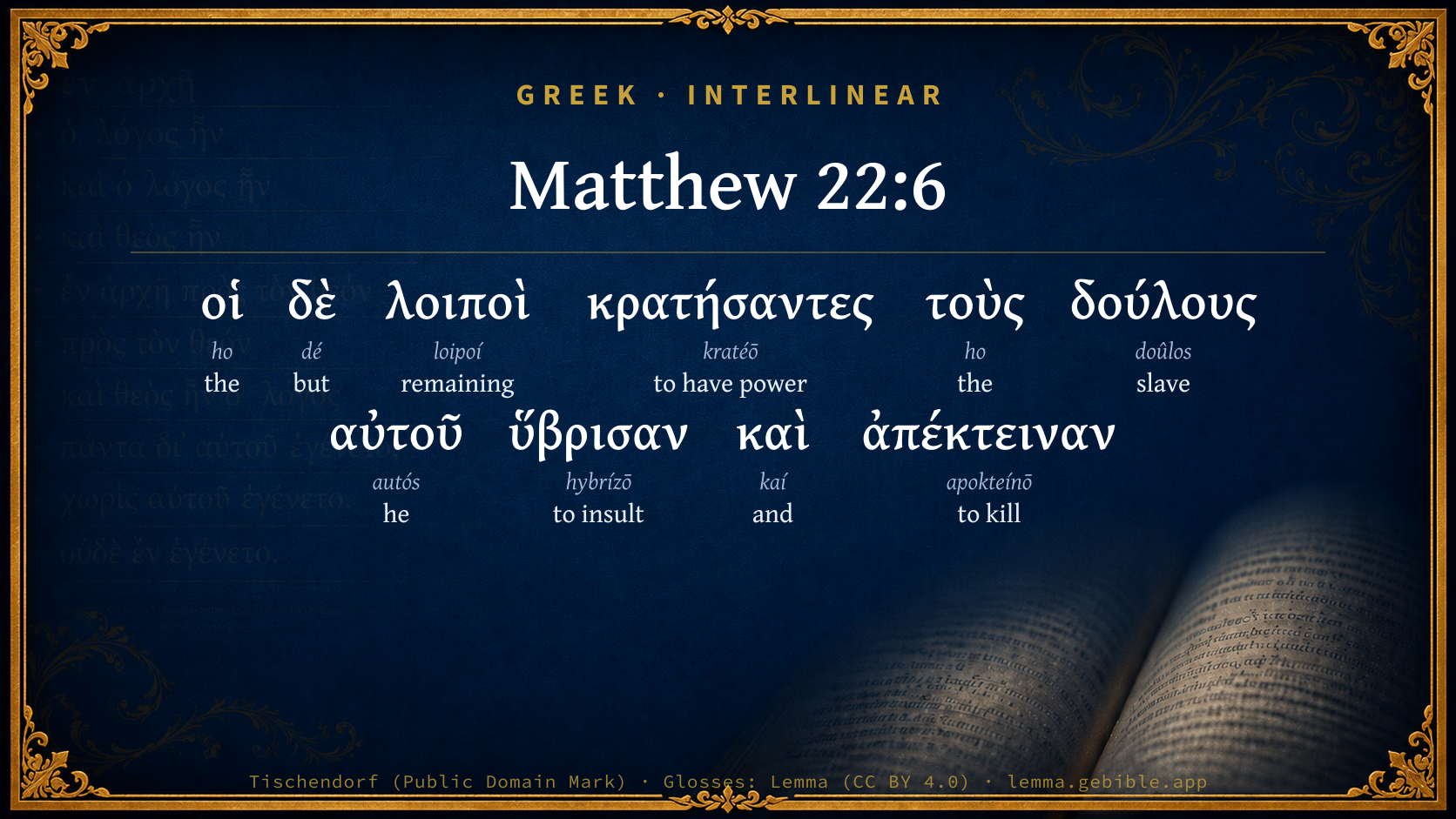
and the rest grabbed his servants, and treated them shamefully, and killed them.
Download a study sheet
One document with this verse’s original text, its word-by-word gloss line, the meaning frame, cross-references with their text, attributed commentary, and full source and license credits — printable, and it pastes into notes with its structure intact.
This verse Autodidact and up
A passage Seminary Student
Up to 50 verses in one chapter. A passage sheet keeps up to 6 commentary sources and 12 cross-references per verse, in the order this page ranks them, and says so on the sheet whenever that leaves anything out. Ask for a single verse and you get the Autodidact verse sheet above.
Everything on this page stays free to read, with no account — the sheet is a download of what is already on screen, not access to it.
Compare translations 3
The same verse in 3 English versions, stacked beneath the original-language interlinear above. Click any original word for its lexicon entry.
Each is an independent rendering of the whole verse — the interlinear is not word-aligned to these translations.
Highlighted words mark where these versions differ — a whole-verse word diff, not a word-by-word alignment.
-
World English Bible Public Domain
and the rest grabbed his servants, and treated them shamefully, and killed them.
-
King James Version Public Domain
And the remnant took his servants, and entreated them spitefully, and slew them.
-
unfoldingWord Literal Text CC BY-SA 4.0
But the rest, having seized his servants, mistreated and killed.
unfoldingWord Literal Text — © unfoldingWord, licensed CC BY-SA 4.0. Word-aligned USFM3 via Door43 (git.door43.org/unfoldingWord/en_ult).
Show all 19 translations
Every available English version of this verse, each an independent rendering of the whole verse.
-
World English Bible Public Domain
and the rest grabbed his servants, and treated them shamefully, and killed them.
-
Berean Standard Bible Public Domain
The rest seized his servants, mistreated them, and killed them.
-
Majority Standard Bible Public Domain
The rest seized his servants, mistreated them, and killed them.
-
King James Version Public Domain
And the remnant took his servants, and entreated them spitefully, and slew them.
-
American Standard Version (1901) Public Domain
and the rest laid hold on his servants, and treated them shamefully, and killed them.
-
Revised Version (1885) Public Domain
and the rest laid hold on his servants, and entreated them shamefully, and killed them.
-
Geneva Bible (1599) Public Domain
And the remnant tooke his seruants, and intreated them sharpely, and slewe them.
-
Douay-Rheims (1899) Public Domain
And the rest laid hands on his servants, and having treated them contumeliously, put them to death.
-
Young's Literal Translation Public Domain
and the rest, having laid hold on his servants, did insult and slay `them'.
-
Literal Standard Version CC BY-SA 4.0
and the rest, having laid hold on his servants, mistreated and slew [them].
-
Unlocked Literal Bible CC BY-SA 4.0
The others seized the king's servants, treated them shamefully, and killed them.
-
unfoldingWord Literal Text CC BY-SA 4.0
But the rest, having seized his servants, mistreated and killed.
-
Darby Bible Public Domain
And the rest, laying hold of his bondmen, ill-treated and slew [them].
-
World Messianic Bible Public Domain
and the rest grabbed his servants, treated them shamefully, and killed them.
-
Webster's Bible Public Domain
And the remnant took his servants, and treated them spitefully, and slew them.
-
Free Bible Version CC BY-SA 4.0
The rest grabbed the king's servants, mistreated them, and killed them.
-
Bible in Basic English Public Domain
And the rest put violent hands on his servants, and did evil to them, and put them to death.
-
Text-Critical English NT CC BY 4.0
The rest seized his servants, mistreated them, and killed them.
-
Tyndale New Testament (1534) Public Domain
the remnaunt toke his seruantes and intreated them vngodly and slewe them.
Literal Standard Version (2020), Covenant Press — licensed CC BY-SA 4.0. Text via the HelloAO Bible API (eBible.org). Unlocked Literal Bible (unfoldingWord) — licensed CC BY-SA 4.0. Text via the HelloAO Bible API (eBible.org). unfoldingWord Literal Text — © unfoldingWord, licensed CC BY-SA 4.0. Word-aligned USFM3 via Door43 (git.door43.org/unfoldingWord/en_ult). Free Bible Version, Dr. Jonathan Gallagher — licensed CC BY-SA 4.0. Text via the HelloAO Bible API (eBible.org).
Word by word
More ways to search: Search by grammar → Find every occurrence → Compare this word →
Practice this passage: Drill this verse → Learn its vocabulary →
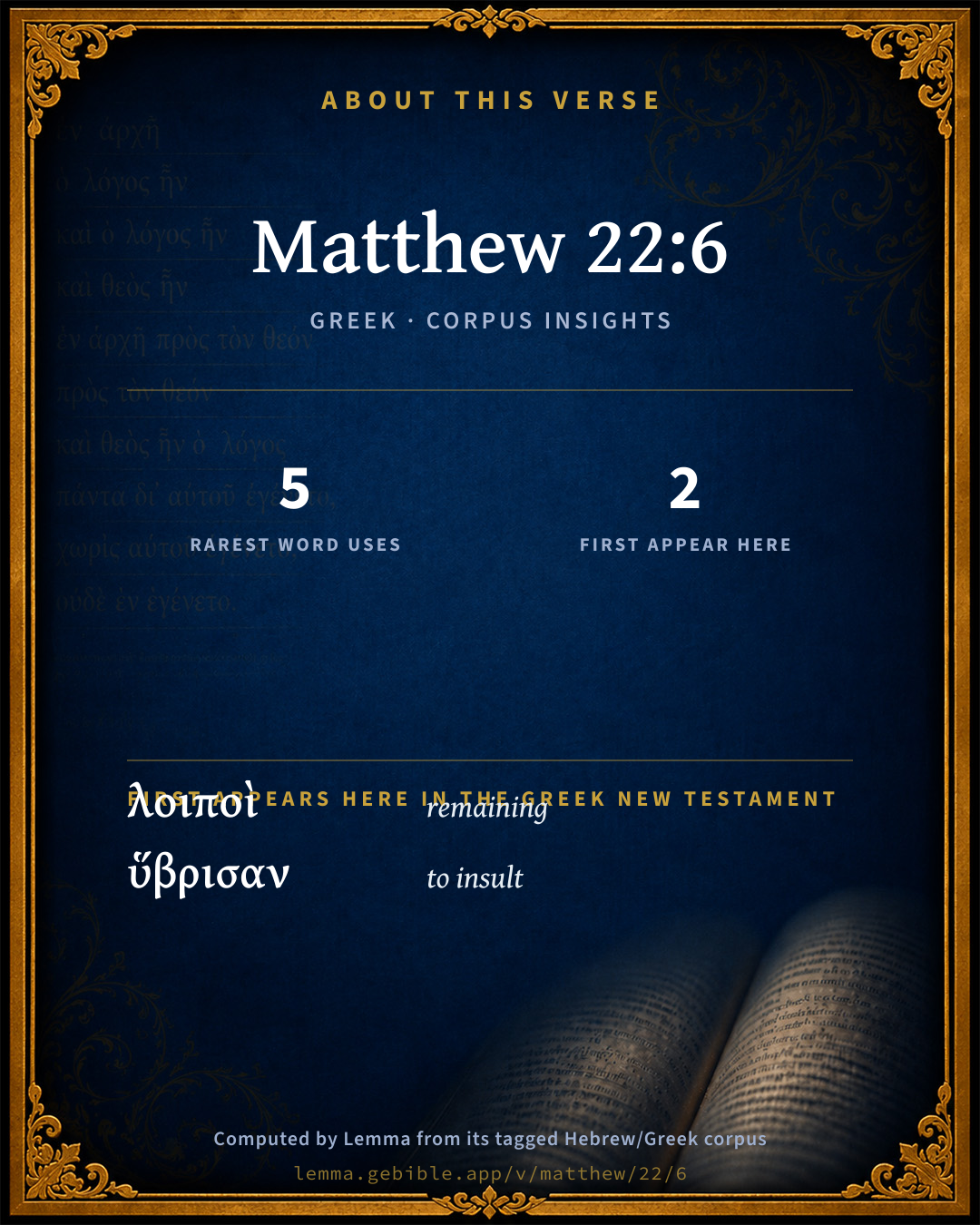
- Appears 5× in the Greek New Testament
- First appears here
- Part of Speech
- Verb
- Tense
- Aorist
- Voice
- Active
- Mood
- Indicative
- Person
- 3rd person
- Number
- Plural
Full Thayer's Definition
- οἱ ho G3588 “the” Article, Nominative, Plural, Masculine
- δὲ dé G1161 “but” Conjunction
- λοιποὶ loipoí G3062 “remaining” Adjective, Nominative, Plural, Masculine
- κρατήσαντες kratéō G2902 “to have power” Verb, Aorist, Active, Participle, Nominative, Plural, Masculine
- τοὺς ho G3588 “the” Article, Accusative, Plural, Masculine
- δούλους doûlos G1401 “slave” Noun, Accusative, Plural, Masculine
- αὐτοῦ autós G846 “he” Personal pronoun, Genitive, Singular, Masculine
- ὕβρισαν hybrízō G5195 “to insult” Verb, Aorist, Active, Indicative, 3rd person, Plural
- καὶ kaí G2532 “and” Conjunction
- ἀπέκτειναν apokteínō G615 “to kill” Verb, Aorist, Active, Indicative, 3rd person, Plural
About this verse
These counts appear in no published source. They are computed here, from the morphology-tagged text and Lemma’s own curated glosses. What Lemma adds →
- 10
- words
- 9
- distinct lemmas
- Gospels
- section
Notable vocabulary
The rarest word here is ὕβρισαν to insult G5195 — appearing just 5 times in the whole Greek New Testament.
First appearance in Scripture
These words make their first canonical appearance in the Greek New Testament here:
Shared distinctive vocabulary
ὕβρισαν to insult G5195 occurs in 5 verses of the Greek New Testament. Also found in:
Repetition
A word recurs within this verse:
- οἱ the G3588 ×2
Cross-references
12Topical passages linked to Matthew 22:6 in the Treasury of Scripture Knowledge — connected by theme and wording, ordered by reader-vote popularity; previews shown in the World English Bible.
- John 15:19–20 If you were of the world, the world would love its own. But because you are not of the world, since I chose you out of the world, therefore the world hates you.
- Matthew 5:10–12 Blessed are those who have been persecuted for righteousness' sake, For theirs is the Kingdom of Heaven.
- Matthew 10:12–18 As you enter into the household, greet it.
- Matthew 10:22–25 You will be hated by all men for my name's sake, but he who endures to the end will be saved.
- Matthew 21:35–39 The farmers took his servants, beat one, killed another, and stoned another.
- Matthew 23:34–37 Therefore, behold, I send to you prophets, wise men, and scribes. Some of them you will kill and crucify; and some of them you will scourge in your synagogues, and persecute from city to city;
- John 16:2–3 They will put you out of the synagogues. Yes, the time comes that whoever kills you will think that he offers service to God.
- Acts 4:1–3 As they spoke to the people, the priests and the captain of the temple and the Sadducees came to them,
- Acts 5:40–41 They agreed with him. Summoning the apostles, they beat them and charged them not to speak in the name of Jesus, and let them go.
- Acts 7:51–57 "You stiff-necked and uncircumcised in heart and ears, you always resist the Holy Spirit! As your fathers did, so you do.
- Acts 8:1 Saul was consenting to his death. A great persecution arose against the assembly which was in Jerusalem in that day. They were all scattered abroad throughout the regions of Judea and Samaria, except for the apostles.
- 1 Thessalonians 2:14–15 For you, brothers, became imitators of the assemblies of God which are in Judea in Christ Jesus; for you also suffered the same things from your own countrymen, even as they did from the Jews;
Cross-references courtesy of OpenBible.info (CC BY 4.0).
Lesson kit
Teaching starters — assembled from the data on this page, not authored interpretation. Every prompt links to the verse data it draws on. Edit before teaching.
Matthew, in the Gospels, opens this verse with 10 words (9 distinct Greek lemmas). Its most distinctive word is hybrízō (“to insult”). A historical commentator’s framing appears above. Read the whole chapter for the surrounding context.
Discussion questions
- How does “to insult” (hybrízō) shape what this verse is saying?
- 2 words here appear for the first time in Scripture. What is being introduced at this debut?
- Luke 11:45 shares the word «to insult» with this verse. How do the two illuminate each other?
- “the” occurs 2× in this one verse. What is the effect of the repetition?
- These translations render this verse differently. What is at stake in choosing one wording over another?
- Reading how Joseph Benson's Commentary and Bengel's Gnomon read this verse, where do the two commentators agree and where do they part?
Things to notice
- 2 words make their first canonical appearance in Scripture here.
- These translations choose different wording for 13 words in this verse.
- “the” occurs 2× in this single verse.
- 9 distinct Greek lemmas span 10 words in this verse.
Commentary
Notes on Matthew 22:6 from classic Christian and Jewish commentators (each source and its license shown beneath its notes). The classic Christian expositions comment on the surrounding passage and are grouped to its opening verse, so a note may address several verses; the Jewish commentaries on the Tanakh (Rashi and others) are per-verse, so they appear only where the commentator wrote on this verse.
Lemma curates 59 commentaries, every one of them public domain or Creative Commons licensed, each selected and text-cleaned for this edition rather than reprinted as found. About our sources →
Joseph Benson's Commentary
Joseph Benson's Commentary on the Old and New Testaments (1811–1818) — public domain. Text from a community e-Sword module.
Bengel's Gnomon
Johann Albrecht Bengel
Bengel's Gnomon of the New Testament — English translation (T&T Clark, Edinburgh, 1860) — public domain. Text from a community e-Sword module.
Expositor's Greek Testament
ed. W. Robertson Nicoll
The Expositor's Greek Testament, edited by W. Robertson Nicoll (1897–1910) — public domain. Text from a community e-Sword module.
Jamieson, Fausset & Brown
Robert Jamieson, A. R. Fausset & David Brown
Jamieson, Fausset & Brown — Commentary Critical and Explanatory on the Whole Bible (1871) — public domain (CC PDM 1.0). Text via the HelloAO Bible API.
Ellicott's Commentary for English Readers
A Bible Commentary for English Readers, edited by Charles John Ellicott (1878–1897) — public domain. Text from a community e-Sword module.
John Gill's Exposition
John Gill's Exposition of the Whole Bible (1746–1763) — public domain (CC PDM 1.0). Text via the HelloAO Bible API.
Trapp's Complete Commentary
John Trapp
John Trapp, A Commentary or Exposition upon All the Books of the Old and New Testament (1647–1656) — public domain. Text from a community e-Sword module.
Albert Barnes' Notes on the Bible
Albert Barnes' Notes on the Bible (1834–1885) — public domain. Text from a community e-Sword/MySword module.
Haydock's Catholic Bible Commentary
George Leo Haydock (1774–1849), Haydock's Catholic Family Bible and Commentary, 1859 edition — public domain. Excludes Psalms (Douay-Rheims chapter numbering differs from Protestant) and Deuterocanonical books (Catholic canon only).
Whedon's Commentary on the Bible
Daniel D. Whedon
Daniel D. Whedon (gen. ed.), Commentary on the Old and New Testaments (1874–1909) — public domain. Text from a community e-Sword module.
The Pulpit Commentary
The Pulpit Commentary (1880–1919), ed. H.D.M. Spence-Jones & Joseph S. Exell — public domain. Text from a community e-Sword module.
The People's New Testament
B. W. Johnson
B. W. Johnson's The People's New Testament with Notes (1889–1891) — public domain. Electronic text from the Christian Classics Ethereal Library (CCEL) ThML edition.
Alford’s Greek Testament
Henry Alford
Henry Alford, The Greek Testament (1849–1861) — public domain. Text from a community e-Sword module.
International Critical Commentary
International Critical Commentary — older volumes (1896–1929), various authors — public domain. Text from a community e-Sword module.