Matthew 25:28

Greek (Tischendorf 8th ed.) Matthew 25:28 appears in the Greek New Testament. The text above is from the Tischendorf 8th edition. Each word links to its Strong’s number and a concise gloss. Click any word for its full Thayer’s Greek Lexicon entry.
Download image
Cite this verse

Matthew 25:28 (World English Bible). Public Domain. Lemma interlinear Bible study tool, https://lemma.gebible.app/v/matthew/25/28.

Show BibTeX & RIS
BibTeX
RIS
English Translation
Take away therefore the talent from him, and give it to him who has the ten talents.
World English Bible · Public Domain
Download a study sheet

One document with this verse’s original text, its word-by-word gloss line, the meaning frame, cross-references with their text, attributed commentary, and full source and license credits — printable, and it pastes into notes with its structure intact.

This verse Autodidact and up

Study sheet (.html) Plain text (.txt)

A passage Seminary Student

Up to 50 verses in one chapter. A passage sheet keeps up to 6 commentary sources and 12 cross-references per verse, in the order this page ranks them, and says so on the sheet whenever that leaves anything out. Ask for a single verse and you get the Autodidact verse sheet above.

Everything on this page stays free to read, with no account — the sheet is a download of what is already on screen, not access to it.

Want to remove ads? Support Godless Engineer
Compare translations 3

The same verse in 3 English versions, stacked beneath the original-language interlinear above. Click any original word for its lexicon entry.

Each is an independent rendering of the whole verse — the interlinear is not word-aligned to these translations.

Highlighted words mark where these versions differ — a whole-verse word diff, not a word-by-word alignment.

  • World English Bible Public Domain
    Take away therefore the talent from him, and give it to him who has the ten talents.
  • King James Version Public Domain
    Take therefore the talent from him, and give it unto him which hath ten talents.
  • unfoldingWord Literal Text CC BY-SA 4.0
    Therefore, take away the talent from him and give it to the one having the ten talents.

unfoldingWord Literal Text — © unfoldingWord, licensed CC BY-SA 4.0. Word-aligned USFM3 via Door43 (git.door43.org/unfoldingWord/en_ult).

Versions to compare (up to 4)

3 of 4 selected

Show all 19 translations

Every available English version of this verse, each an independent rendering of the whole verse.

  • World English Bible Public Domain
    Take away therefore the talent from him, and give it to him who has the ten talents.
  • Berean Standard Bible Public Domain
    Therefore take the talent from him and give it to the one who has ten talents.
  • Majority Standard Bible Public Domain
    Therefore take the talent from him and give it to the one who has ten talents.
  • King James Version Public Domain
    Take therefore the talent from him, and give it unto him which hath ten talents.
  • American Standard Version (1901) Public Domain
    Take ye away therefore the talent from him, and give it unto him that hath the ten talents.
  • Revised Version (1885) Public Domain
    Take ye away therefore the talent from him, and give it unto him that hath the ten talents.
  • Geneva Bible (1599) Public Domain
    Take therefore the talent from him, and giue it vnto him which hath tenne talents.
  • Douay-Rheims (1899) Public Domain
    Take ye away therefore the talent from him, and give it to him that hath ten talents.
  • Young's Literal Translation Public Domain
    `Take therefore from him the talent, and give to him having the ten talents,
  • Literal Standard Version CC BY-SA 4.0
    Take therefore from him the talent, and give to him having the ten talents,
  • Unlocked Literal Bible CC BY-SA 4.0
    Therefore take away the talent from him and give it to the servant who has ten talents.
  • unfoldingWord Literal Text CC BY-SA 4.0
    Therefore, take away the talent from him and give it to the one having the ten talents.
  • Darby Bible Public Domain
    Take therefore the talent from him, and give it to him that has the ten talents:
  • World Messianic Bible Public Domain
    Take away therefore the talent from him and give it to him who has the ten talents.
  • Webster's Bible Public Domain
    Take therefore the talent from him, and give it to him who hath ten talents.
  • Free Bible Version CC BY-SA 4.0
    Take the talent away from him, and give it to the one with ten talents.
  • Bible in Basic English Public Domain
    Take away, then, his talent and give it to him who has the ten talents.
  • Text-Critical English NT CC BY 4.0
    Therefore take the talent from him and give it to the one who has ten talents.
  • Tyndale New Testament (1534) Public Domain
    Take therfore the talent from him and geve it vnto him which hath.x. talentes

Literal Standard Version (2020), Covenant Press — licensed CC BY-SA 4.0. Text via the HelloAO Bible API (eBible.org). Unlocked Literal Bible (unfoldingWord) — licensed CC BY-SA 4.0. Text via the HelloAO Bible API (eBible.org). unfoldingWord Literal Text — © unfoldingWord, licensed CC BY-SA 4.0. Word-aligned USFM3 via Door43 (git.door43.org/unfoldingWord/en_ult). Free Bible Version, Dr. Jonathan Gallagher — licensed CC BY-SA 4.0. Text via the HelloAO Bible API (eBible.org).

Word by word

More ways to search: Search by grammar → Find every occurrence → Compare this word →

Practice this passage: Drill this verse → Learn its vocabulary →

τάλαντον
tálanton
G5007
“talent”
Noun, Accusative, Singular, Neuter
Part of Speech
Noun
Case
Accusative
Number
Singular
Gender
Neuter
Full Thayer's Definition

Origin: from a presumed derivative of the original form of tlao (to bear, equivalent to G5342 )

TDNT: None

1. the scale of a balance, a balance, a pair of scales 2. that which is weighed, a talent a. a weight varying in different places and times b. a sum of money weighing a talent and varying in different states and according to the changes in the laws regulating currency 1. the Attic talent was equal to 60 Attic minae or 6000 drachmae 2. a talent of silver in Israel weighed about 100 pounds (45 kg) 3. a talent of gold in Israel weighed about 200 pounds (91 kg)
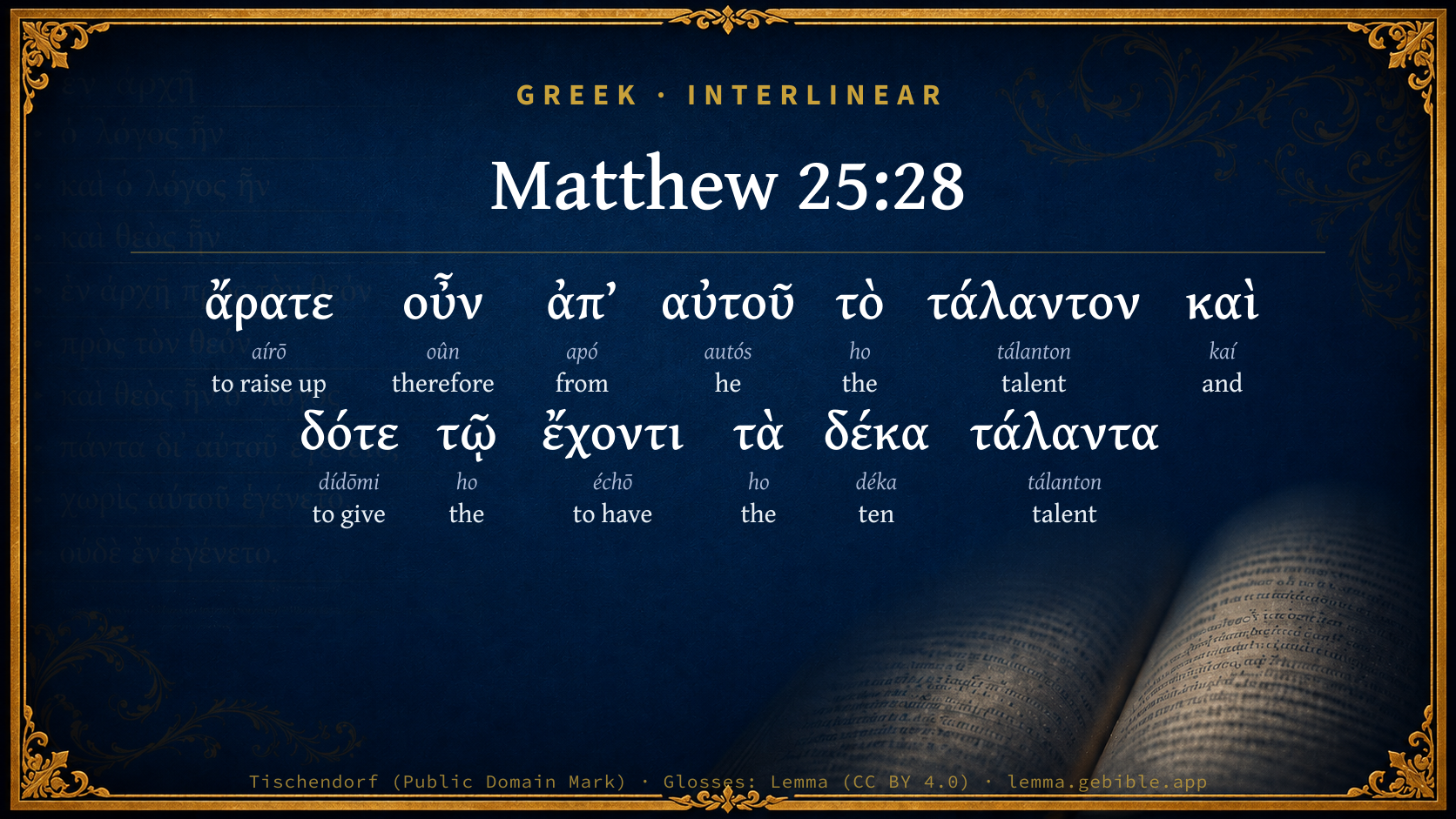
  1. ἄρατε aírō G142 “to raise up” Verb, Aorist, Active, Imperative, 2nd person, Plural
  2. οὖν oûn G3767 “therefore” Conjunction
  3. ἀπ’ apó G575 “from” Preposition
  4. αὐτοῦ autós G846 “he” Personal pronoun, Genitive, Singular, Masculine
  5. τὸ ho G3588 “the” Article, Accusative, Singular, Neuter
  6. καὶ kaí G2532 “and” Conjunction
  7. δότε dídōmi G1325 “to give” Verb, Aorist, Active, Imperative, 2nd person, Plural
  8. τῷ ho G3588 “the” Article, Dative, Singular, Masculine
  9. ἔχοντι échō G2192 “to have” Verb, Present, Active, Participle, Dative, Singular, Masculine
  10. τὰ ho G3588 “the” Article, Accusative, Plural, Neuter
  11. δέκα déka G1176 “ten” Adjective, Numeral (indeclinable)
  12. τάλαντα tálanton G5007 “talent” Noun, Accusative, Plural, Neuter

About this verse

These counts appear in no published source. They are computed here, from the morphology-tagged text and Lemma’s own curated glosses. What Lemma adds →

13
words
10
distinct lemmas
Gospels
section

Notable vocabulary

The rarest word here is τάλαντον talent G5007 — appearing just 15 times in the whole Greek New Testament.

Shared distinctive vocabulary

τάλαντον talent G5007 occurs in 8 verses of the Greek New Testament. Also found in:

Repetition

Words recur within this verse:

  • τάλαντον talent G5007 ×2
  • τὸ the G3588 ×3

Cross-references

2

Topical passages linked to Matthew 25:28 in the Treasury of Scripture Knowledge — connected by theme and wording, ordered by reader-vote popularity; previews shown in the World English Bible.

  • Luke 19:24 He said to those who stood by, 'Take the mina away from him, and give it to him who has the ten minas.'
  • Luke 10:42 but one thing is needed. Mary has chosen the good part, which will not be taken away from her."

Cross-references courtesy of OpenBible.info (CC BY 4.0).

Commentary

Notes on Matthew 25:28 from classic Christian and Jewish commentators (each source and its license shown beneath its notes). The classic Christian expositions comment on the surrounding passage and are grouped to its opening verse, so a note may address several verses; the Jewish commentaries on the Tanakh (Rashi and others) are per-verse, so they appear only where the commentator wrote on this verse.

Lemma curates 59 commentaries, every one of them public domain or Creative Commons licensed, each selected and text-cleaned for this edition rather than reprinted as found. About our sources →

Joseph Benson's Commentary

Mat 25:28-29. Take therefore the talent from him — Ye angels, the ministers of my will, take from him the blessing which he has thus abused, and give it unto him which hath ten talents — As a further token of my acceptance and favour. The master, who in disposing of the talents at first acted as an absolute owner and bountiful benefactor, now acts as a judge, and takes the talent from the unfaithful servant to punish him, and gives it to him that was eminently faithful, to reward him. And this may be applied, 1st, To any of the blessings of this life, such as wealth, honour, authority over others, health, strength, &c. Men are intrusted with these, that they may use them for the glory of God, and the good of their fellow-creatures: and he that conscientiously uses them for these ends, (which is signified in the next verse by having them; that is, having them to a good purpose,) shall have abundance, perhaps, of these things themselves, but if not, abundance of comfort in them, and of better things; but from him that hath not — That is, that hath these things as if he had them not, not doing good with them; they shall be taken away. Giving to the poor, and in other ways doing good with our talents, is trading with what we have, and the returns will be rich. The meal in the barrel, and the oil in the cruise will be multiplied, 1Ki 17:14; but those that are niggardly and uncharitable will find that those riches which are so acquired and hoarded, Will perish by evil travail, or are kept by the owners thereof to their hurt, Ecc 5:13-14. And it often happens that Providence strangely transfers property from those that do not do good with it to those that do. And other gifts and endowments are frequently taken from those who do not employ them according to the design of the great Master, and are given to others who are disposed to make a better use of them. 2d, We may apply it to the means of grace. They who are diligent in improving the opportunities and advantages they have, may expect to have them continued and increased; but they who know not and improve not the day of their visitation, shall have the things that belong to their peace hid from their eyes. In proof of this, see what God did first to Shiloh, and then to Jerusalem, and to the churches of the Lesser Asia, mentioned Revelation 2., 3. 3d, We may apply it to spiritual gifts. He that hath these, and doth good with them, shall retain them and find them greatly enlarged, for they will improve by exercise, and brighten by use: but as to those who stir not up the gift that is in them, who do not exert themselves according to their capacity, their gifts rust and decay, and die away like a neglected fire.

Joseph Benson's Commentary on the Old and New Testaments (1811–1818) — public domain. Text from a community e-Sword module.

Meyer's Critical & Exegetical Commentary

Heinrich August Wilhelm Meyer

Mat_25:28-30. Οὖν] because his conduct was so inexcusable.

Mat_25:29. Justification of this mode of proceeding, by appealing to a principle founded on universal experience, and which was to find its verification in the case before us. Comp. Mat_13:12.

τοῦ δὲ μὴ ἔχοντος] see critical remarks. The genitive, here placed first for sake of emphasis, might be regarded as dependent on ἀρθήσεται (Fritzsche), in accordance, that is, with the construction of verbs of depriving with τινός τι (Kühner, II. 1, p. 282). Inasmuch, however, as the ἀπʼ αὐτοῦ which follows would thus be superfluous and clumsy, it is better to take the genitive as absolute: as for him who has not (the poor man); comp. Thuc. v. 18. 8, and Krüger thereon. We thus obtain duobus membris factis ex uno oppositio nervosior (Dissen, ad Dem. de cor. p. 272). For ὁ ἔχων, the rich man, comp. Isocr. vii. 55 and Benseler thereon.

For Mat_25:30, comp. Mat_8:12, Mat_13:42; Mat_13:50, Mat_22:13, Mat_24:51. The verse is not here out of place, but acquires a certain solemnity from its resemblance to the conclusion of ch. 24. (in opposition to Weiss, 1864, p. 129).

Teaching of the parable.

By a faithful use, after my departure, of those varied endowments which I have bestowed on each of you according to his special capacity, you are to do your utmost to promote my cause. For when I return and reckon with you (Mat_25:19), then those who have exerted themselves in a dutiful manner will receive a distinguished reward in the kingdom of the Messiah; but those who have allowed their gifts, however small, to lie unused, will be deprived of that which has been entrusted to them, and be cast into Gehenna. For more minute and specific interpretations, all of them of a more or less arbitrary character, see Origen, Chrysostom, Theophylact. The reference to all Christian endowments generally (1 Corinthians 12), is to be regarded rather as an application of the parable in a more comprehensive sense.

Meyer — Critical and Exegetical Commentary on the New Testament — English translation by Peter Christie, edited by Frederick Crombie (T&T Clark, 1880) — public domain. Text from a community e-Sword module.

Expositor's Greek Testament

ed. W. Robertson Nicoll

Mat 25:28 . ἄρατε , etc., take the one talent from the man who made no use of it; and give it to the man who will make most use of it.

The Expositor's Greek Testament, edited by W. Robertson Nicoll (1897–1910) — public domain. Text from a community e-Sword module.

Ellicott's Commentary for English Readers

(28) Take therefore the talent from him.—The sentence passed on the slothful servant confirms the view which sees in the “talents” the external opportunities given to a man for the use of his abilities. The abilities themselves cannot be thus transferred; the opportunities can, and often are, even in the approximate working out of the law of retribution which we observe on earth. Here also men give to him that hath, and faithful work is rewarded by openings for work of a higher kind. So, assuming a law, if not of continuity, at least of analogy, to work behind the veil, we may see in our Lord’s words that one form of the penalty of the slothful will be to see work which might have been theirs to do, done by those who have been faithful while on earth.

A Bible Commentary for English Readers, edited by Charles John Ellicott (1878–1897) — public domain. Text from a community e-Sword module.

John Gill's Exposition

Take therefore the talent from him,.... This shows it was not special grace, which is intended by the talent; for the gift and calling of special grace are without repentance, and are that good part which shall not be taken away: but gifts may fail, cease, and vanish; they may be taken away from men, and men from them; a right arm may be clean dried up, and a right eye be utterly darkened:

and give it unto him which hath ten talents; for to diligent and laborious ministers of the word, more spiritual light and knowledge is given: but this is not to be understood, as though other men's gifts are, properly speaking, taken away from them, and bestowed on them; but that their gifts appear the more illustrious through the slothfulness of others.

John Gill's Exposition of the Whole Bible (1746–1763) — public domain (CC PDM 1.0). Text via the HelloAO Bible API.

Trapp's Complete Commentary

John Trapp

28 Take therefore the talent from him, and give it unto him which hath ten talents.

Ver. 28. Take therefore the talent from him] God will take his own, and be gone from an unworthy people or person, Hos 2:9. The idol shepherd’s "arm shall be clean dried up, and his right eye utterly darkened," Zec 11:17. It is no hard matter to observe a wane and decay of God’s gifts in them that use them not; till at last, Zedekiah like, they may say, "When did the Spirit depart from me?" 1Ki 22:24. And as many of Ishbosheth’s friends shrank together with Abner, so do men’s abilities fail amain, when once they begin to fail, till at last God lays them aside, as so many broken vessels, and cause them to be forgotten, as dead men out of mind, Psa 31:21.

John Trapp, A Commentary or Exposition upon All the Books of the Old and New Testament (1647–1656) — public domain. Text from a community e-Sword module.

Matthew Poole's English Annotations

God often in this life deprives men and women of those gifts which he hath given them, and they do not make use of for the glory of his name, and the good of their and others’ souls, the great ends for which he hath entrusted them with them. But this seems not to be here intended, this text referring to the day of judgment: all therefore that we are to understand by this is; That no man’s gifts, whether of nature or providence, of what advantage soever they have been to him in this life, will be of any profit to him in the day of judgment, unless he hath in this life used them to the ends for which God gave them. In that day he will lose all; and the glory of heaven shall not be the portion of them that have had great talents of learning, wit, riches, honours, spiritual gifts, or any thing of that nature, but of those only who have used these things to the honour and glory of God, and to the advantage of their own and others’ souls. For all those that have been unprofitable, hell will be their portion at last, where their misery will be, as of those that live in extreme darkness, continual weeping and gnashing of teeth. The substance of what is in Mat 25:29 we met with Mat 13:12,

To him that hath shall be given, & c.; but I think the proverbial speech here is applied differently from the application of it there. There, him that hath seemeth to signify, him that hath an actual possession; for it is said before,

Because it is given unto you to know the mysteries of the kingdom of heaven. So that I take that text to contain a promise of the increase of grace to those that have the seed of God; whereas the appearances of it in others shall not last, but vanish away. Here, plainly, him that hath signifieth, him that maketh a good and true use of what he hath; and thus the parable expounds it. So as the sense is, He that hath any talents from God, and maketh use of them, and improves them for the honour and glory of God, shall be rewarded with further gifts of grace or glory. But if a man hath not, that is, hath, but is as if he had not, making no use of what he hath for the glory of God, those gifts and talents which he hath shall be of no profit and advantage, but miserable disadvantage to him at last.

Matthew Poole's English Annotations on the Holy Bible (1683–1685) — public domain. Text from a community e-Sword/MySword module.

Whedon's Commentary on the Bible

Daniel D. Whedon

28. Take therefore the talent from him — Take from him all farther probation and chance for doing service.

Daniel D. Whedon (gen. ed.), Commentary on the Old and New Testaments (1874–1909) — public domain. Text from a community e-Sword module.

The Pulpit Commentary

The sentence on the unprofitable servant follows. It is to be observed that he is punished, not for fraud, theft, malversation, but for omission. He had left undone that which he ought to have done. Take therefore the talent from him. The forfeiture of the talent was just and natural. It was given to him for a special purpose; he had not carried this out; therefore it could be his no longer. A limb unused loses its powers; grace unemployed is withdrawn. God"s Spirit will not always strive with man. There comes a time when, if wilfully resisted and not exercised, it ceases to inspire and to influence. Well may we pray, "Take not thy Holy Spirit from us!" Give it, etc. This is done on the principle stated in the next verse and Mat_13:12. God"s work must be done; his gifts are not lost; they are transferred to another who has proved himself worthy of such a charge. As the servant who had the ten talents lied already brought in his account and had received his reward, it seems, at first, difficult to understand how additional work and responsibility should be given to him. But it is the blessedness of Christ"s servants that they rejoice in a new trust received, in added opportunities of serving him, whether in this life or in the life to come, and all the increase which they make is their own eternally and augments their joy.

The Pulpit Commentary (1880–1919), ed. H.D.M. Spence-Jones & Joseph S. Exell — public domain. Text from a community e-Sword module.

Burkitt's Expository Notes on the New Testament

William Burkitt

These words contain the sentence denounced by Christ upon the slothful servant: his punishment is first a punishment of loss: Take ye the talent from him.

Learn hence, That not improving the gifts of God given as talents to us, provokes God to take them from us, as well as misimproving. From him that hath not; that is, from him that improveth not, shall be taken that which he hath.

2. Follows the punishment of sense: Cast him into outer darkness, where is weeping and gnashing of teeth.

Learn thence, That hell is a place and state of inexpressible misery and torment; a dismal place, as being deprived of the sight and enjoyment of God, of Christ, of saints, and of angels; a doleful place, full of over-whelming sorrow and despairing grief. The gnashing of their teeth, signifies their being full of rage and indignation against God, against the saints, and against themselves.

William Burkitt's Expository Notes on the New Testament (1700–1703) — public domain. Text from a community e-Sword module.

The People's New Testament

B. W. Johnson

28. Take therefore the talent from him. He had shown himself unworthy of the trust. He had enjoyed opportunity to serve the lord, but had utterly neglected it; therefore the opportunity was taken away. The application is easy. Give it to him which hath ten. Because he has shown himself worthy of great trusts.

B. W. Johnson's The People's New Testament with Notes (1889–1891) — public domain. Electronic text from the Christian Classics Ethereal Library (CCEL) ThML edition.

unfoldingWord translationNotes

Door43 World Missions Community

Connecting Statement:

Jesus concludes the parable about the servants and the talents. (See: Parables and Biblical Money)

take away the talent

The master is speaking to other servants.

talent

A "talent" was worth twenty years' wages. Avoid translating this into modern money. See how you translated this in Matthew 25:15. (See: Biblical Money)

who possesses

It is implied that the person who possesses something also uses it wisely. AT: "who uses well what he has" (See: Assumed Knowledge and Implicit Information)

more will be given

This can be stated in active form. AT: "God will give more" or "I will give more" (See: Active or Passive)

even more abundantly

"even much more"

from anyone who does not possess anything

It is implied that the person does possess something but he does not use it wisely. AT: "from anyone does not use well what he has" (See: Assumed Knowledge and Implicit Information)

will be taken away

This can be stated in active form. AT: "God will take away" or "I will take away" (See: Active or Passive)

the outer darkness

Here "outer darkness" is a metonym for the place where God sends those who reject them. This is a place that is completely separated from God forever. See how you translated this in Matthew 8:12. AT: "the dark place away from God" (See: Metonymy)

weeping and grinding of teeth

"Grinding of teeth" is symbolic action, representing extreme sadness and suffering. See how you translated this in Matthew 8:12. AT: "weeping and expressing their extreme suffering" (See: Symbolic Action)

translationWords

servant

possess

darkness

unfoldingWord translationNotes — © Distant Shores Media and the Door43 World Missions Community, licensed CC BY-SA 4.0. Source: git.door43.org/Door43/en_tn.

Alford’s Greek Testament

Henry Alford

28-31.] This command is answered in Luk 19:25, by a remonstrance from those addressed, which the Master overrules by stating the great law of his Kingdom. In ch. 13:12 we have explained this as applied to the system of teaching by parables. Here it is predicated of the whole Christian life. It is the case even in nature: a limb used is strengthened; disused, becomes weak. The transference of the talent is not a matter of justice between man and man, but is done in illustration of this law, and in virtue of that sovereign power by which God does what He will with his own: see Rom 11:29, and note there.

In τὸ σκ. τὸ ἐξ. there is again an allusion to the marriage supper of the Lamb, from which the useless servant being excluded, gnashes his teeth with remorse without: see ch. 22:13.

Henry Alford, The Greek Testament (1849–1861) — public domain. Text from a community e-Sword module.

International Critical Commentary

28. Take therefore from him the talent, and give to him who hath the ten talents.]

(L)

International Critical Commentary — older volumes (1896–1929), various authors — public domain. Text from a community e-Sword module.

Lesson kit

Teaching starters — assembled from the data on this page, not authored interpretation. Every prompt links to the verse data it draws on. Edit before teaching.

Matthew, in the Gospels, opens this verse with 13 words (10 distinct Greek lemmas). Its most distinctive word is tálanton (“talent”). A historical commentator’s framing appears above. Read the whole chapter for the surrounding context.

Discussion questions

  1. The word tálanton carries the sense “talent.” How does it shape the verse?
  2. How does Matthew 18:24, which shares the word «talent», read alongside this verse?
  3. What does the repetition of “talent” (2× in this one verse) do in this verse?
  4. The translations on this page render this verse differently — a whole-verse word diff, not a word-by-word alignment. What might account for the different wordings?
  5. Compare how Joseph Benson's Commentary and Meyer's Critical & Exegetical Commentary read this verse. Where do they agree or differ?

Things to notice

  • These translations choose different wording for 6 words in this verse.
  • “talent” occurs 2× in this single verse.
  • 10 distinct Greek lemmas span 13 words in this verse.

Reading settings

Reading text

Shown beneath each verse's original-language words.

Old Testament
Old Testament edition

Read the OT as the Masoretic Hebrew (MT) or the Greek Septuagint (LXX).

English shown for the Greek Septuagint (in the Hebrew ↔ Greek comparison).

Comparing translations? Open the Compare panel on any verse page to stack up to four side by side.