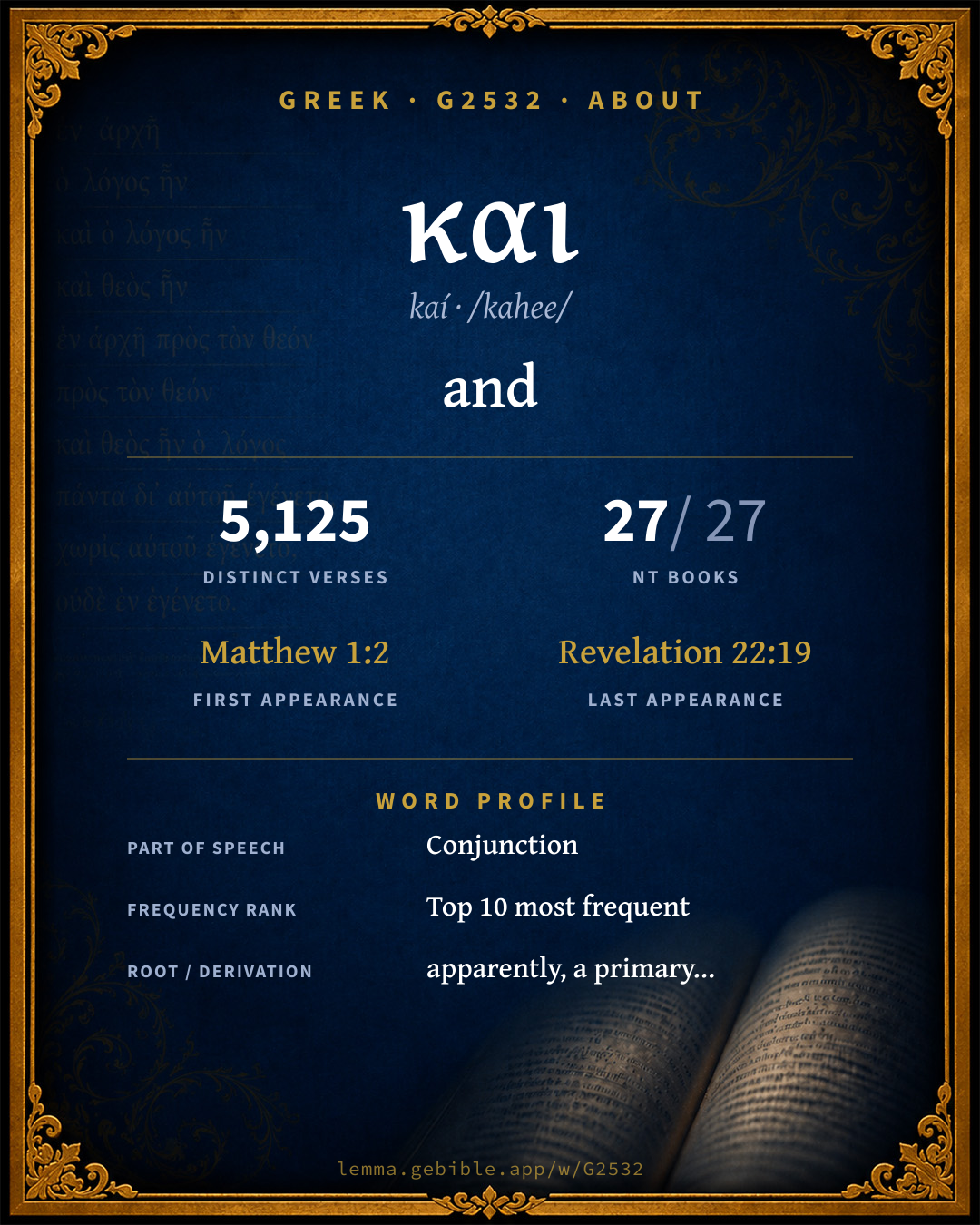
καί
and
Full lexicon entry — Thayer's Greek Lexicon
From Thayer's Greek Lexicon
Where this word appears
Grammar key — what these labels mean
Part of speech
- Conjunction
- A joining word linking words or clauses.
Every verse where G2532 appears in the Book of 1 Corinthians — 199 distinct verses. Click any verse to open its interlinear word-by-word view. Verse text shown in the World English Bible for context — . Each verse’s Greek form is shown with its reference; the English is not keyword-highlighted, since the data carries no word-level English alignment. Use “Compare translations” on any verse to read it across multiple English versions. This concordance covers the Greek New Testament; Septuagint (Greek Old Testament) occurrences of this word are not indexed here.
1 Corinthians
- 1 Corinthians 1:1 καὶ conj Paul, called to be an apostle of Jesus Christ through the will of God, and our brother Sosthenes,
- 1 Corinthians 1:2 καὶ conj to the assembly of God which is at Corinth; those who are sanctified in Christ Jesus, called to be saints, with all who call on the name of our Lord Jesus Christ in every place, both theirs and ours:
- 1 Corinthians 1:3 καὶ καὶ conj conj Grace to you and peace from God our Father and the Lord Jesus Christ.
- 1 Corinthians 1:5 καὶ conj that in everything you were enriched in him, in all speech and all knowledge;
- 1 Corinthians 1:8 καὶ conj who will also confirm you until the end, blameless in the day of our Lord Jesus Christ.
- 1 Corinthians 1:10 καὶ καὶ conj conj Now I beg you, brothers, through the name of our Lord, Jesus Christ, that you all speak the same thing and that there be no divisions among you, but that you be perfected together in the same mind and in the same judgment.
- 1 Corinthians 1:14 καὶ conj I thank God that I baptized none of you, except Crispus and Gaius,
- 1 Corinthians 1:16 καὶ conj (I also baptized the household of Stephanas; besides them, I don't know whether I baptized any other.)
- 1 Corinthians 1:19 καὶ conj For it is written, "I will destroy the wisdom of the wise, I will bring the discernment of the discerning to nothing."
- 1 Corinthians 1:22 καὶ καὶ conj conj For Jews ask for signs, Greeks seek after wisdom,
- 1 Corinthians 1:24 καὶ καὶ conj conj but to those who are called, both Jews and Greeks, Christ is the power of God and the wisdom of God.
- 1 Corinthians 1:25 καὶ conj Because the foolishness of God is wiser than men, and the weakness of God is stronger than men.
- 1 Corinthians 1:27 καὶ conj but God chose the foolish things of the world that he might put to shame those who are wise. God chose the weak things of the world, that he might put to shame the things that are strong;
- 1 Corinthians 1:28 καὶ καὶ conj conj and God chose the lowly things of the world, and the things that are despised, and the things that are not, that he might bring to nothing the things that are:
- 1 Corinthians 1:30 καὶ καὶ conj conj But of him, you are in Christ Jesus, who was made to us wisdom from God, and righteousness and sanctification, and redemption:
- 1 Corinthians 2:2 καὶ conj For I determined not to know anything among you, except Jesus Christ, and him crucified.
- 1 Corinthians 2:3 καὶ καὶ conj conj I was with you in weakness, in fear, and in much trembling.
- 1 Corinthians 2:4 καὶ καὶ καὶ conj conj conj My speech and my preaching were not in persuasive words of human wisdom, but in demonstration of the Spirit and of power,
- 1 Corinthians 2:9 καὶ καὶ conj conj But as it is written, "Things which an eye didn't see, and an ear didn't hear, Which didn't enter into the heart of man, These God has prepared for those who love him."
- 1 Corinthians 2:10 καὶ conj But to us, God revealed them through the Spirit. For the Spirit searches all things, yes, the deep things of God.
- 1 Corinthians 2:11 καὶ conj For who among men knows the things of a man, except the spirit of the man, which is in him? Even so, no one knows the things of God, except God's Spirit.
- 1 Corinthians 2:13 καὶ conj Which things also we speak, not in words which man's wisdom teaches, but which the Holy Spirit teaches, comparing spiritual things with spiritual things.
- 1 Corinthians 2:14 καὶ conj Now the natural man doesn't receive the things of God's Spirit, for they are foolishness to him, and he can't know them, because they are spiritually discerned.
- 1 Corinthians 3:3 καὶ καὶ conj conj for you are still fleshly. For insofar as there is jealousy, strife, and factions among you, aren't you fleshly, and don't you walk in the ways of men?
- 1 Corinthians 3:5 καὶ conj Who then is Apollos, and who is Paul, but servants through whom you believed; and each as the Lord gave to him?
- 1 Corinthians 3:8 καὶ conj Now he who plants and he who waters are the same, but each will receive his own reward according to his own labor.
- 1 Corinthians 3:13 καὶ conj each man's work will be revealed. For the Day will declare it, because it is revealed in fire; and the fire itself will test what sort of work each man's work is.
- 1 Corinthians 3:16 καὶ conj Don't you know that you are a temple of God, and that God's Spirit lives in you?
- 1 Corinthians 3:20 καὶ conj And again, "The Lord knows the reasoning of the wise, that it is worthless."
- 1 Corinthians 4:1 καὶ conj So let a man think of us as Christ's servants, and stewards of God's mysteries.
- 1 Corinthians 4:5 καὶ καὶ καὶ conj conj conj Therefore judge nothing before the time, until the Lord comes, who will both bring to light the hidden things of darkness, and reveal the counsels of the hearts. Then each man will get his praise from God.
- 1 Corinthians 4:6 καὶ conj Now these things, brothers, I have in a figure transferred to myself and Apollos for your sakes, that in us you might learn not to think beyond the things which are written, that none of you be puffed up against one another.
- 1 Corinthians 4:7 καὶ conj For who makes you different? And what do you have that you didn't receive? But if you did receive it, why do you boast as if you had not received it?
- 1 Corinthians 4:8 καὶ καὶ conj conj You are already filled. You have already become rich. You have come to reign without us. Yes, and I wish that you did reign, that we also might reign with you.
- 1 Corinthians 4:9 καὶ καὶ conj conj For, I think that God has displayed us, the apostles, last of all, like men sentenced to death. For we are made a spectacle to the world, both to angels and men.
- 1 Corinthians 4:11 καὶ καὶ καὶ καὶ καὶ conj conj conj conj conj Even to this present hour we hunger, thirst, are naked, are beaten, and have no certain dwelling place.
- 1 Corinthians 4:12 καὶ conj We toil, working with our own hands. When people curse us, we bless. Being persecuted, we endure.
- 1 Corinthians 4:17 καὶ conj Because of this I have sent Timothy to you, who is my beloved and faithful child in the Lord, who will remind you of my ways which are in Christ, even as I teach everywhere in every assembly.
- 1 Corinthians 4:19 καὶ conj But I will come to you shortly, if the Lord is willing. And I will know, not the word of those who are puffed up, but the power.
- 1 Corinthians 5:1 καὶ conj It is actually reported that there is sexual immorality among you, and such sexual immorality as is not even named among the Gentiles, that one has his father's wife.
- 1 Corinthians 5:2 καὶ καὶ conj conj You are puffed up, and didn't rather mourn, that he who had done this deed might be removed from among you.
- 1 Corinthians 5:4 καὶ conj In the name of our Lord Jesus Christ, you being gathered together, and my spirit, with the power of our Lord Jesus Christ,
- 1 Corinthians 5:7 καὶ conj Purge out the old yeast, that you may be a new lump, even as you are unleavened. For indeed Christ, our Passover, has been sacrificed in our place.
- 1 Corinthians 5:8 καὶ καὶ conj conj Therefore let us keep the feast, not with old yeast, neither with the yeast of malice and wickedness, but with the unleavened bread of sincerity and truth.
- 1 Corinthians 5:10 καὶ conj yet not at all meaning with the sexual sinners of this world, or with the covetous and extortioners, or with idolaters; for then you would have to leave the world.
- 1 Corinthians 6:1 καὶ conj Dare any of you, having a matter against his neighbor, go to law before the unrighteous, and not before the saints?
- 1 Corinthians 6:2 καὶ conj Don't you know that the saints will judge the world? And if the world is judged by you, are you unworthy to judge the smallest matters?
- 1 Corinthians 6:6 καὶ conj But brother goes to law with brother, and that before unbelievers!
- 1 Corinthians 6:8 καὶ καὶ conj conj No, but you yourselves do wrong, and defraud, and that against your brothers.
- 1 Corinthians 6:11 καὶ καὶ conj conj Such were some of you, but you were washed. But you were sanctified. But you were justified in the name of the Lord Jesus, and in the Spirit of our God.
- 1 Corinthians 6:13 καὶ καὶ καὶ καὶ conj conj conj conj "Foods for the belly, and the belly for foods," but God will bring to nothing both it and them. But the body is not for sexual immorality, but for the Lord; and the Lord for the body.
- 1 Corinthians 6:14 καὶ καὶ conj conj Now God raised up the Lord, and will also raise us up by his power.
- 1 Corinthians 6:19 καὶ conj Or don't you know that your body is a temple of the Holy Spirit which is in you, which you have from God? You are not your own,
- 1 Corinthians 7:2 καὶ conj But, because of sexual immoralities, let each man have his own wife, and let each woman have her own husband.
- 1 Corinthians 7:3 καὶ conj Let the husband render to his wife the affection owed her, and likewise also the wife to her husband.
- 1 Corinthians 7:4 καὶ conj The wife doesn't have authority over her own body, but the husband. Likewise also the husband doesn't have authority over his own body, but the wife.
- 1 Corinthians 7:5 καὶ conj Don't deprive one another, unless it is by consent for a season, that you may give yourselves to fasting and prayer, and may be together again, that Satan doesn't tempt you because of your lack of self-control.
- 1 Corinthians 7:7 καὶ conj Yet I wish that all men were like me. However each man has his own gift from God, one of this kind, and another of that kind.
- 1 Corinthians 7:8 καὶ conj But I say to the unmarried and to widows, it is good for them if they remain even as I am.
- 1 Corinthians 7:11 καὶ καὶ conj conj (but if she departs, let her remain unmarried, or else be reconciled to her husband), and that the husband not leave his wife.
- 1 Corinthians 7:12 καὶ conj But to the rest I--not the Lord--say, if any brother has an unbelieving wife, and she is content to live with him, let him not leave her.
- 1 Corinthians 7:13 καὶ καὶ conj conj The woman who has an unbelieving husband, and he is content to live with her, let her not leave her husband.
- 1 Corinthians 7:14 καὶ conj For the unbelieving husband is sanctified in the wife, and the unbelieving wife is sanctified in the husband. Otherwise your children would be unclean, but now are they holy.
- 1 Corinthians 7:17 καὶ conj Only, as the Lord has distributed to each man, as God has called each, so let him walk. So I command in all the assemblies.
- 1 Corinthians 7:19 καὶ conj Circumcision is nothing, and uncircumcision is nothing, but the keeping of the commandments of God.
- 1 Corinthians 7:21 καὶ conj Were you called being a bondservant? Don't let that bother you, but if you get an opportunity to become free, use it.
- 1 Corinthians 7:28 καὶ καὶ conj conj But if you marry, you have not sinned. If a virgin marries, she has not sinned. Yet such will have oppression in the flesh, and I want to spare you.
- 1 Corinthians 7:29 καὶ conj But I say this, brothers: the time is short, that from now on, both those who have wives may be as though they had none;
- 1 Corinthians 7:30 καὶ καὶ καὶ conj conj conj and those who weep, as though they didn't weep; and those who rejoice, as though they didn't rejoice; and those who buy, as though they didn't possess;
- 1 Corinthians 7:31 καὶ conj and those who use the world, as not using it to the fullest. For the mode of this world passes away.
- 1 Corinthians 7:34 καὶ καὶ καὶ καὶ καὶ conj conj conj conj conj There is also a difference between a wife and a virgin. The unmarried woman cares about the things of the Lord, that she may be holy both in body and in spirit. But she who is married cares about the things of the world--how she may please her husband.
- 1 Corinthians 7:35 καὶ conj This I say for your own profit; not that I may ensnare you, but for that which is appropriate, and that you may attend to the Lord without distraction.
- 1 Corinthians 7:36 καὶ conj But if any man thinks that he is behaving inappropriately toward his virgin, if she is past the flower of her age, and if need so requires, let him do what he desires. He doesn't sin. Let them marry.
- 1 Corinthians 7:37 καὶ conj But he who stands steadfast in his heart, having no necessity, but has power over his own heart, to keep his own virgin, does well.
- 1 Corinthians 7:38 καὶ καὶ conj conj So then both he who gives his own virgin in marriage does well, and he who doesn't give her in marriage does better.
- 1 Corinthians 8:4 καὶ conj Therefore concerning the eating of things sacrificed to idols, we know that no idol is anything in the world, and that there is no other God but one.
- 1 Corinthians 8:5 καὶ καὶ conj conj For though there are things that are called "gods," whether in the heavens or on earth; as there are many "gods" and many "lords;"
- 1 Corinthians 8:6 καὶ καὶ καὶ conj conj conj yet to us there is one God, the Father, of whom are all things, and we for him; and one Lord, Jesus Christ, through whom are all things, and we live through him.
- 1 Corinthians 8:7 καὶ conj However, that knowledge isn't in all men. But some, with consciousness of the idol until now, eat as of a thing sacrificed to an idol, and their conscience, being weak, is defiled.
- 1 Corinthians 8:12 καὶ conj Thus, sinning against the brothers, and wounding their conscience when it is weak, you sin against Christ.
- 1 Corinthians 9:4 καὶ conj Have we no right to eat and to drink?
- 1 Corinthians 9:5 καὶ καὶ καὶ conj conj conj Have we no right to take along a wife who is a believer, even as the rest of the apostles, and the brothers of the Lord, and Cephas?
- 1 Corinthians 9:6 καὶ conj Or have only Barnabas and I no right to not work?
- 1 Corinthians 9:7 καὶ καὶ conj conj What soldier ever serves at his own expense? Who plants a vineyard, and doesn't eat of its fruit? Or who feeds a flock, and doesn't drink from the flock's milk?
- 1 Corinthians 9:8 καὶ conj Do I speak these things according to the ways of men? Or doesn't the law also say the same thing?
- 1 Corinthians 9:10 καὶ conj or does he say it assuredly for our sake? Yes, it was written for our sake, because he who plows ought to plow in hope, and he who threshes in hope should partake of his hope.
- 1 Corinthians 9:14 καὶ conj Even so the Lord ordained that those who proclaim the Gospel should live from the Gospel.
- 1 Corinthians 9:20 καὶ conj To the Jews I became as a Jew, that I might gain Jews; to those who are under the law, as under the law, that I might gain those who are under the law;
- 1 Corinthians 9:27 καὶ conj but I beat my body and bring it into submission, lest by any means, after I have preached to others, I myself should be rejected.
- 1 Corinthians 10:1 καὶ conj Now I would not have you ignorant, brothers, that our fathers were all under the cloud, and all passed through the sea;
- 1 Corinthians 10:2 καὶ καὶ conj conj and were all baptized into Moses in the cloud and in the sea;
- 1 Corinthians 10:3 καὶ conj and all ate the same spiritual food;
- 1 Corinthians 10:4 καὶ conj and all drank the same spiritual drink. For they drank of a spiritual rock that followed them, and the rock was Christ.
- 1 Corinthians 10:7 καὶ καὶ conj conj Neither be idolaters, as some of them were. As it is written, "The people sat down to eat and drink, and rose up to play."
- 1 Corinthians 10:8 καὶ conj Neither let us commit sexual immorality, as some of them committed, and in one day twenty-three thousand fell.
- 1 Corinthians 10:9 καὶ conj Neither let us test the Lord, as some of them tested, and perished by the serpents.
- 1 Corinthians 10:10 καὶ conj Neither grumble, as some of them also grumbled, and perished by the destroyer.
- 1 Corinthians 10:13 καὶ conj No temptation has taken you except what is common to man. God is faithful, who will not allow you to be tempted above what you are able, but will with the temptation also make the way of escape, that you may be able to endure it.
- 1 Corinthians 10:20 καὶ conj But I say that the things which the Gentiles sacrifice, they sacrifice to demons, and not to God, and I don't desire that you would have communion with demons.
- 1 Corinthians 10:21 καὶ καὶ conj conj You can't both drink the cup of the Lord and the cup of demons. You can't both partake of the table of the Lord, and of the table of demons.
- 1 Corinthians 10:26 καὶ conj for "the earth is the Lord's, and its fullness."
- 1 Corinthians 10:27 καὶ conj But if one of those who don't believe invites you to a meal, and you are inclined to go, eat whatever is set before you, asking no questions for the sake of conscience.
- 1 Corinthians 10:28 καὶ conj But if anyone says to you, "This was offered to idols," don't eat it for the sake of the one who told you, and for the sake of conscience. For "the earth is the Lord's, and all its fullness."
- 1 Corinthians 10:32 καὶ καὶ καὶ conj conj conj Give no occasions for stumbling, either to Jews, or to Greeks, or to the assembly of God;
- 1 Corinthians 11:2 καὶ conj Now I praise you, brothers, that you remember me in all things, and hold firm the traditions, even as I delivered them to you.
- 1 Corinthians 11:5 καὶ conj But every woman praying or prophesying with her head unveiled dishonors her head. For it is one and the same thing as if she were shaved.
- 1 Corinthians 11:6 καὶ conj For if a woman is not covered, let her also be shorn. But if it is shameful for a woman to be shorn or shaved, let her be covered.
- 1 Corinthians 11:7 καὶ conj For a man indeed ought not to have his head covered, because he is the image and glory of God, but the woman is the glory of the man.
- 1 Corinthians 11:9 καὶ conj for neither was man created for the woman, but woman for the man.
- 1 Corinthians 11:12 καὶ conj For as woman came from man, so a man also comes through a woman; but all things are from God.
- 1 Corinthians 11:18 καὶ conj For first of all, when you come together in the assembly, I hear that divisions exist among you, and I partly believe it.
- 1 Corinthians 11:19 καὶ conj For there also must be factions among you, that those who are approved may be revealed among you.
- 1 Corinthians 11:21 καὶ conj For in your eating each one takes his own supper before others. One is hungry, and another is drunken.
- 1 Corinthians 11:22 καὶ καὶ conj conj What, don't you have houses to eat and to drink in? Or do you despise God's assembly, and put them to shame who don't have? What shall I tell you? Shall I praise you? In this I don't praise you.
- 1 Corinthians 11:23 καὶ conj For I received from the Lord that which also I delivered to you, that the Lord Jesus on the night in which he was betrayed took bread.
- 1 Corinthians 11:24 καὶ καὶ conj conj When he had given thanks, he broke it, and said, "Take, eat. This is my body, which is broken for you. Do this in memory of me."
- 1 Corinthians 11:25 καὶ conj In the same way he also took the cup, after supper, saying, "This cup is the new covenant in my blood. Do this, as often as you drink, in memory of me."
- 1 Corinthians 11:26 καὶ conj For as often as you eat this bread and drink this cup, you proclaim the Lord's death until he comes.
- 1 Corinthians 11:27 καὶ conj Therefore whoever eats this bread or drinks the Lord's cup in a manner unworthy of the Lord will be guilty of the body and the blood of the Lord.
- 1 Corinthians 11:28 καὶ καὶ conj conj But let a man examine himself, and so let him eat of the bread, and drink of the cup.
- 1 Corinthians 11:29 καὶ καὶ conj conj For he who eats and drinks in an unworthy manner eats and drinks judgment to himself, if he doesn't discern the Lord's body.
- 1 Corinthians 11:30 καὶ καὶ conj conj For this cause many among you are weak and sickly, and not a few sleep.
- 1 Corinthians 12:3 καὶ conj Therefore I make known to you that no man speaking by God's Spirit says, "Jesus is accursed." No one can say, "Jesus is Lord," but by the Holy Spirit.
- 1 Corinthians 12:5 καὶ καὶ conj conj There are various kinds of service, and the same Lord.
- 1 Corinthians 12:6 καὶ conj There are various kinds of workings, but the same God, who works all things in all.
- 1 Corinthians 12:11 καὶ conj But the one and the same Spirit works all of these, distributing to each one separately as he desires.
- 1 Corinthians 12:12 καὶ καὶ conj conj For as the body is one, and has many members, and all the members of the body, being many, are one body; so also is Christ.
- 1 Corinthians 12:13 καὶ καὶ conj conj For in one Spirit we were all baptized into one body, whether Jews or Greeks, whether bond or free; and were all given to drink into one Spirit.
- 1 Corinthians 12:14 καὶ conj For the body is not one member, but many.
- 1 Corinthians 12:16 καὶ conj If the ear would say, "Because I'm not the eye, I'm not part of the body," it's not therefore not part of the body.
- 1 Corinthians 12:23 καὶ καὶ conj conj Those parts of the body which we think to be less honorable, on those we bestow more abundant honor; and our unpresentable parts have more abundant propriety;
- 1 Corinthians 12:26 καὶ conj When one member suffers, all the members suffer with it. Or when one member is honored, all the members rejoice with it.
- 1 Corinthians 12:27 καὶ conj Now you are the body of Christ, and members individually.
- 1 Corinthians 12:28 καὶ conj God has set some in the assembly: first apostles, second prophets, third teachers, then miracle workers, then gifts of healings, helps, governments, and various kinds of languages.
- 1 Corinthians 12:31 καὶ conj But earnestly desire the best gifts. Moreover, I show a most excellent way to you.
- 1 Corinthians 13:1 καὶ conj If I speak with the languages of men and of angels, but don't have love, I have become sounding brass, or a clanging cymbal.
- 1 Corinthians 13:2 καὶ καὶ καὶ καὶ conj conj conj conj If I have the gift of prophecy, and know all mysteries and all knowledge; and if I have all faith, so as to remove mountains, but don't have love, I am nothing.
- 1 Corinthians 13:3 καὶ καὶ conj conj If I dole out all my goods to feed the poor, and if I give my body to be burned, but don't have love, it profits me nothing.
- 1 Corinthians 13:9 καὶ conj For we know in part, and we prophesy in part;
- 1 Corinthians 13:12 καὶ conj For now we see in a mirror, dimly, but then face to face. Now I know in part, but then I will know fully, even as I was also fully known.
- 1 Corinthians 14:3 καὶ καὶ conj conj But he who prophesies speaks to men for their edification, exhortation, and consolation.
- 1 Corinthians 14:8 καὶ conj For if the trumpet gave an uncertain sound, who would prepare himself for war?
- 1 Corinthians 14:9 καὶ conj So also you, unless you uttered by the tongue words easy to understand, how would it be known what is spoken? For you would be speaking into the air.
- 1 Corinthians 14:10 καὶ conj There are, it may be, so many kinds of sounds in the world, and none of them is without meaning.
- 1 Corinthians 14:11 καὶ conj If then I don't know the meaning of the sound, I would be to him who speaks a foreigner, and he who speaks would be a foreigner to me.
- 1 Corinthians 14:12 καὶ conj So also you, since you are zealous for spiritual gifts, seek that you may abound to the building up of the assembly.
- 1 Corinthians 14:15 καὶ καὶ conj conj What is it then? I will pray with the spirit, and I will pray with the understanding also. I will sing with the spirit, and I will sing with the understanding also.
- 1 Corinthians 14:19 καὶ conj However in the assembly I would rather speak five words with my understanding, that I might instruct others also, than ten thousand words in another language.
- 1 Corinthians 14:21 καὶ καὶ conj conj In the law it is written, "By men of strange languages and by the lips of strangers I will speak to this people. Not even thus will they hear me, says the Lord."
- 1 Corinthians 14:23 καὶ conj If therefore the whole assembly is assembled together and all speak with other languages, and unlearned or unbelieving people come in, won't they say that you are crazy?
- 1 Corinthians 14:25 καὶ conj And thus the secrets of his heart are revealed. So he will fall down on his face and worship God, declaring that God is among you indeed.
- 1 Corinthians 14:27 καὶ καὶ conj conj If any man speaks in another language, let it be two, or at the most three, and in turn; and let one interpret.
- 1 Corinthians 14:28 καὶ conj But if there is no interpreter, let him keep silent in the assembly, and let him speak to himself, and to God.
- 1 Corinthians 14:29 καὶ conj Let the prophets speak, two or three, and let the others discern.
- 1 Corinthians 14:31 καὶ conj For you all can prophesy one by one, that all may learn, and all may be exhorted.
- 1 Corinthians 14:32 καὶ conj The spirits of the prophets are subject to the prophets,
- 1 Corinthians 14:34 καὶ conj let your wives keep silent in the assemblies, for it has not been permitted for them to speak; but let them be in subjection, as the law also says.
- 1 Corinthians 14:39 καὶ conj Therefore, brothers, desire earnestly to prophesy, and don't forbid speaking with other languages.
- 1 Corinthians 14:40 καὶ conj Let all things be done decently and in order.
- 1 Corinthians 15:1 καὶ καὶ conj conj Now I declare to you, brothers, the Gospel which I preached to you, which also you received, in which you also stand,
- 1 Corinthians 15:2 καὶ conj by which also you are saved, if you hold firmly the word which I preached to you--unless you believed in vain.
- 1 Corinthians 15:3 καὶ conj For I delivered to you first of all that which I also received: that Christ died for our sins according to the Scriptures,
- 1 Corinthians 15:4 καὶ καὶ conj conj that he was buried, that he was raised on the third day according to the Scriptures,
- 1 Corinthians 15:5 καὶ conj and that he appeared to Cephas, then to the twelve.
- 1 Corinthians 15:10 καὶ conj But by the grace of God I am what I am. His grace which was bestowed on me was not futile, but I worked more than all of them; yet not I, but the grace of God which was with me.
- 1 Corinthians 15:11 καὶ conj Whether then it is I or they, so we preach, and so you believed.
- 1 Corinthians 15:14 καὶ καὶ conj conj If Christ has not been raised, then our preaching is in vain, and your faith also is in vain.
- 1 Corinthians 15:15 καὶ conj Yes, we are found false witnesses of God, because we testified about God that he raised up Christ, whom he didn't raise up, if it is so that the dead are not raised.
- 1 Corinthians 15:18 καὶ conj Then they also who are fallen asleep in Christ have perished.
- 1 Corinthians 15:21 καὶ conj For since death came by man, the resurrection of the dead also came by man.
- 1 Corinthians 15:22 καὶ conj For as in Adam all die, so also in Christ all will be made alive.
- 1 Corinthians 15:24 καὶ καὶ καὶ conj conj conj Then the end comes, when he will deliver up the Kingdom to God, even the Father; when he will have abolished all rule and all authority and power.
- 1 Corinthians 15:28 καὶ conj When all things have been subjected to him, then the Son will also himself be subjected to him who subjected all things to him, that God may be all in all.
- 1 Corinthians 15:29 καὶ conj Or else what will they do who are baptized for the dead? If the dead aren't raised at all, why then are they baptized for the dead?
- 1 Corinthians 15:30 καὶ conj Why do we also stand in jeopardy every hour?
- 1 Corinthians 15:32 καὶ conj If I fought with animals at Ephesus for human purposes, what does it profit me? If the dead are not raised, then "let us eat and drink, for tomorrow we die."
- 1 Corinthians 15:34 καὶ conj Wake up righteously, and don't sin, for some have no knowledge of God. I say this to your shame.
- 1 Corinthians 15:37 καὶ conj That which you sow, you don't sow the body that will be, but a bare grain, maybe of wheat, or of some other kind.
- 1 Corinthians 15:38 καὶ conj But God gives it a body even as it pleased him, and to each seed a body of its own.
- 1 Corinthians 15:40 καὶ καὶ conj conj There are also celestial bodies, and terrestrial bodies; but the glory of the celestial differs from that of the terrestrial.
- 1 Corinthians 15:41 καὶ καὶ conj conj There is one glory of the sun, another glory of the moon, and another glory of the stars; for one star differs from another star in glory.
- 1 Corinthians 15:42 καὶ conj So also is the resurrection of the dead. It is sown in corruption; it is raised in incorruption.
- 1 Corinthians 15:44 καὶ conj It is sown a natural body; it is raised a spiritual body. There is a natural body and there is also a spiritual body.
- 1 Corinthians 15:45 καὶ conj So also it is written, "The first man, Adam, became a living soul." The last Adam became a life-giving spirit.
- 1 Corinthians 15:48 καὶ καὶ καὶ conj conj conj As is the one made of dust, such are those who are also made of dust; and as is the heavenly, such are they also that are heavenly.
- 1 Corinthians 15:49 καὶ καὶ conj conj As we have borne the image of those made of dust, let's also bear the image of the heavenly.
- 1 Corinthians 15:50 καὶ conj Now I say this, brothers, that flesh and blood can't inherit the Kingdom of God; neither does corruption inherit incorruption.
- 1 Corinthians 15:52 καὶ καὶ conj conj in a moment, in the twinkling of an eye, at the last trumpet. For the trumpet will sound, and the dead will be raised incorruptible, and we will be changed.
- 1 Corinthians 15:53 καὶ conj For this corruptible must put on incorruption, and this mortal must put on immortality.
- 1 Corinthians 15:54 καὶ conj But when this corruptible will have put on incorruption, and this mortal will have put on immortality, then what is written will happen: "Death is swallowed up in victory."
- 1 Corinthians 16:1 καὶ conj Now concerning the collection for the saints, as I commanded the assemblies of Galatia, you do likewise.
- 1 Corinthians 16:6 καὶ conj But with you it may be that I will stay, or even winter, that you may send me on my journey wherever I go.
- 1 Corinthians 16:9 καὶ καὶ conj conj for a great and effective door has opened to me, and there are many adversaries.
- 1 Corinthians 16:12 καὶ conj Now concerning Apollos, the brother, I strongly urged him to come to you with the brothers; and it was not at all his desire to come now; but he will come when he has an opportunity.
- 1 Corinthians 16:15 καὶ conj Now I beg you, brothers (you know the house of Stephanas, that it is the first fruits of Achaia, and that they have set themselves to minister to the saints),
- 1 Corinthians 16:16 καὶ καὶ καὶ conj conj conj that you also be in subjection to such, and to everyone who helps in the work and labors.
- 1 Corinthians 16:17 καὶ καὶ conj conj I rejoice at the coming of Stephanas, Fortunatus, and Achaicus; for that which was lacking on your part, they supplied.
- 1 Corinthians 16:18 καὶ conj For they refreshed my spirit and yours. Therefore acknowledge those who are like that.
- 1 Corinthians 16:19 καὶ conj The assemblies of Asia greet you. Aquila and Priscilla greet you much in the Lord, together with the assembly that is in their house.
About this entry
At a glance — auto-summarized from this page’s data, not written by a person. Every figure links to its source below. This summary describes the numbers; it doesn’t interpret them.
At its core, και (kaí) means “and.” Scripture first uses it in Matthew 1:2. With 5,125 verses in 27 books, it is one of the most common word in the Greek New Testament. Sharing its root, it stands alongside καγω, καιγε and καιπερ. Each statement above links to its evidence; the full detail follows below.
Gloss history
Strong's 1890 vs modern scholarship

About this word
Strong's G2532 catalogs a Greek word from the Greek New Testament.
These counts are not copied from any lexicon or concordance. They are computed here, from the morphology-tagged Greek New Testament. What Lemma adds →
- 5,125
- distinct verses
- The word appears in 5,125 distinct verses.
- 27 / 27
- NT books
- The word appears in 27 of 27 New Testament books.
- #2
- by frequency
- Top 10 most frequent Greek words (rank 2 of 5,347 Greek words by occurrence).
View all 5,125 occurrences in the concordance →
By section of the New Testament
By traditional corpus
Conventional, traditional groupings — biblical authorship is debated, so this is a traditional corpus grouping, not an authorship claim. Some books belong to more than one corpus (Luke is in both the Gospels and the Lukan corpus, and so on), so these shares overlap and need not total 100%. Each figure is a share of the word’s 5,125 distinct verses.
- Gospels 2,619 verses · 51%
- Lukan (Luke–Acts) 1,489 verses · 29%
- Pauline corpus 1,026 verses · 20%
- Johannine 995 verses · 19%
- Revelation 370 verses · 7%
- General (Catholic) Epistles 277 verses · 5%
- Hebrews 173 verses · 3%
How translations render this word
Counts come from each version’s own published word-to-Strong’s tagging or interlinear alignment — an approximate guide to how each version renders this word, not a word-level alignment the data otherwise carries. Because each total is that version’s own tagged count, the per-version totals vary from one another and need not match the appearance or distinct-verse counts above. These counts may also differ from a printed concordance because Lemma counts each distinctly tagged rendering and does not collapse phrase taggings into a single head-word total. This is a fixed set of word-tagged versions (KJV, ASV, BSB, ULT) and does not change with the reading translation you choose elsewhere. Each version’s license is shown beside its name below (and on Sources).
- King James Version: And 8,097×, Also 500×, Even 101×
- American Standard Version: And 7,750×, Also 433×, Even 110×
- Berean Standard Bible: And 5,240×, Then 278×, Also 156×
- unfoldingWord Literal Text: And 7,949×, Also 596×, But 132×
King James Version Public Domain
Renders G2532 across 9,091 tagged occurrences — most commonly:
Plus other, less common renderings. Plus 72 renderings that appear only once — usually multi-word phrases or single function words the recovered tagging swept in, not distinct renderings. Not rendered by a distinct English word in 156 further occurrences.
American Standard Version Public Domain
Renders G2532 across 8,928 tagged occurrences — most commonly:
Plus other, less common renderings. Plus 227 renderings that appear only once — usually multi-word phrases or single function words the recovered tagging swept in, not distinct renderings. Not rendered by a distinct English word in 83 further occurrences.
Berean Standard Bible Public Domain
Renders G2532 across 6,415 tagged occurrences — most commonly:
Plus other, less common renderings. Plus 44 renderings that appear only once — usually multi-word phrases or single function words the recovered tagging swept in, not distinct renderings. Not rendered by a distinct English word in 2,467 further occurrences.
unfoldingWord Literal Text CC BY-SA 4.0
Renders G2532 across 9,016 tagged occurrences — most commonly:
Plus other, less common renderings. Plus 20 renderings that appear only once — usually multi-word phrases or single function words the recovered tagging swept in, not distinct renderings. Not rendered by a distinct English word in 3 further occurrences.
Senses in Thayer's
The 1 sense Thayer's distinguishes for this word, in lexicon order (not ranked by frequency or importance). The full entry — with sub-senses — is in the Lexicon Entry tab.
- and, also, even, indeed, but Frequency count based on 1894 Scrivener Greek New Testament.
Word origin
Origin: apparently, a primary particle, having a copulative and sometimes also a cumulative force
Apparently a primary particle having a copulative and sometimes also a cumulative force; and also even so then too etc.; often used in connection (or composition) with other particles or small words : - and also both but even for if indeed likewise moreover or so that then therefore when yea yet.
— Strong’s Exhaustive Concordance (1890), public domain.
Forms in the corpus
The 5 distinct written forms G2532 takes in the Greek New Testament, most frequent first — each parse links to that case’s occurrences in the concordance.
| Form | Parsing | Example | Uses |
|---|---|---|---|
| καὶ kaì | Conjunction | Matthew 1:2 | 8,661 |
| Καὶ Kaì | Conjunction | Matthew 4:21 | 274 |
| καί kaí | Conjunction | Matthew 15:4 | 29 |
| Καί Kaí | Conjunction | Luke 19:39 | 4 |
| και kai | Conjunction | John 7:53 | 1 |
Same root — word family
Other Thayer's entries built from the same root as G2532, grouped by Strong’s listed origin. These share a root / origin per the lexicon — not necessarily a shared meaning. Each links to that word’s own entry.
Derived from this word
- καγω kagṓ G2504 and I
- καιγε kaíge G2534 and indeed
- καιπερ kaíper G2539 although
- καιτοι kaítoi G2543 and yet
- κακει kakeî G2546 and there
- κακειθεν kakeîthen G2547 of place
- κακεινος kakeînos G2548 and he
- καν kán G2579 and if
Compare all same-root words → Showing 4 of 9 — not the complete family. They share a root, not necessarily a meaning.
Septuagint usage
The same Greek word και appears 47,643 times in the Greek Old Testament (Septuagint), across 18,587 verses in 38 books.
- 47,643
- LXX occurrences
- Tagged occurrences of this Greek word in the Septuagint.
- 18,587
- verses
- Distinct Septuagint verses containing this word.
- 38 / 39
- OT books
- The word appears in 38 of the 39 Old Testament books.
Sample Septuagint occurrences
- Genesis 1:1 καί
- Exodus 1:3 καί
- Leviticus 1:1 καί
- Numbers 1:1 καί
- Deuteronomy 1:1 καί
- Joshua 1:1 καί
- Judges 1:1 καί
- Ruth 1:1 καί
- 1 Samuel 1:1 καί
- 2 Samuel 1:1 καί
- 1 Kings 1:1 καί
- 2 Kings 1:1 καί
Septuagint occurrences (same lexeme)
Every verse where the same Strong’s number (G2532) appears in the Greek Septuagint — showing the first 50 of 18,587. Verse text shown in the World English Bible for context; the Greek form is the matched word — the English is not keyword-highlighted.
- Genesis 1:1 καί In the beginning God created the heavens and the earth.
- Genesis 1:2 καί Now the earth was formless and empty. Darkness was on the surface of the deep. God's Spirit was hovering over the surface of the waters.
- Genesis 1:3 καί God said, "Let there be light," and there was light.
- Genesis 1:4 καί God saw the light, and saw that it was good. God divided the light from the darkness.
- Genesis 1:5 καί God called the light Day, and the darkness he called Night. There was evening and there was morning, one day.
- Genesis 1:6 καί God said, "Let there be an expanse in the midst of the waters, and let it divide the waters from the waters."
- Genesis 1:7 καί God made the expanse, and divided the waters which were under the expanse from the waters which were above the expanse, and it was so.
- Genesis 1:8 καί God called the expanse sky. There was evening and there was morning, a second day.
- Genesis 1:9 καί God said, "Let the waters under the sky be gathered together to one place, and let the dry land appear," and it was so.
- Genesis 1:10 καί God called the dry land Earth, and the gathering together of the waters he called Seas. God saw that it was good.
- Genesis 1:11 καί God said, "Let the earth put forth grass, herbs yielding seed, and fruit trees bearing fruit after their kind, with its seed in it, on the earth," and it was so.
- Genesis 1:12 καί The earth brought forth grass, herbs yielding seed after their kind, and trees bearing fruit, with its seed in it, after their kind: and God saw that it was good.
- Genesis 1:13 καί There was evening and there was morning, a third day.
- Genesis 1:14 καί God said, "Let there be lights in the expanse of sky to divide the day from the night; and let them be for signs, and for seasons, and for days and years;
- Genesis 1:15 καί and let them be for lights in the expanse of sky to give light on the earth," and it was so.
- Genesis 1:16 καί God made the two great lights: the greater light to rule the day, and the lesser light to rule the night. He also made the stars.
- Genesis 1:17 καί God set them in the expanse of sky to give light to the earth,
- Genesis 1:18 καί and to rule over the day and over the night, and to divide the light from the darkness. God saw that it was good.
- Genesis 1:19 καί There was evening and there was morning, a fourth day.
- Genesis 1:20 καί God said, "Let the waters swarm with swarms of living creatures, and let birds fly above the earth in the open expanse of sky."
- Genesis 1:21 καί God created the large sea creatures, and every living creature that moves, with which the waters swarmed, after their kind, and every winged bird after its kind. God saw that it was good.
- Genesis 1:22 καί God blessed them, saying, "Be fruitful, and multiply, and fill the waters in the seas, and let birds multiply on the earth."
- Genesis 1:23 καί There was evening and there was morning, a fifth day.
- Genesis 1:24 καί God said, "Let the earth bring forth living creatures after their kind, cattle, creeping things, and animals of the earth after their kind," and it was so.
- Genesis 1:25 καί God made the animals of the earth after their kind, and the cattle after their kind, and everything that creeps on the ground after its kind. God saw that it was good.
- Genesis 1:26 καί God said, "Let us make man in our image, after our likeness: and let them have dominion over the fish of the sea, and over the birds of the sky, and over the cattle, and over all the earth, and over every creeping thing that creeps on the earth."
- Genesis 1:27 καί God created man in his own image. In God's image he created him; male and female he created them.
- Genesis 1:28 καί God blessed them. God said to them, "Be fruitful, multiply, fill the earth, and subdue it. Have dominion over the fish of the sea, over the birds of the sky, and over every living thing that moves on the earth."
- Genesis 1:29 καί God said, "Behold, I have given you every herb yielding seed, which is on the surface of all the earth, and every tree, which bears fruit yielding seed. It will be your food.
- Genesis 1:30 καί To every animal of the earth, and to every bird of the sky, and to everything that creeps on the earth, in which there is life, I have given every green herb for food." And it was so.
- Genesis 1:31 καί God saw everything that he had made, and, behold, it was very good. There was evening and there was morning, the sixth day.
- Genesis 2:1 καί The heavens and the earth were finished, and all the host of them.
- Genesis 2:2 καί On the seventh day God finished his work which he had made; and he rested on the seventh day from all his work which he had made.
- Genesis 2:3 καί God blessed the seventh day, and made it holy, because he rested in it from all his work which he had created and made.
- Genesis 2:4 καί This is the history of the generations of the heavens and of the earth when they were created, in the day that Yahweh God made earth and the heavens.
- Genesis 2:5 καί No plant of the field was yet in the earth, and no herb of the field had yet sprung up; for Yahweh God had not caused it to rain on the earth. There was not a man to till the ground,
- Genesis 2:6 καί but a mist went up from the earth, and watered the whole surface of the ground.
- Genesis 2:7 καί Yahweh God formed man from the dust of the ground, and breathed into his nostrils the breath of life; and man became a living soul.
- Genesis 2:8 καί Yahweh God planted a garden eastward, in Eden, and there he put the man whom he had formed.
- Genesis 2:9 καί Out of the ground Yahweh God made every tree to grow that is pleasant to the sight, and good for food; the tree of life also in the midst of the garden, and the tree of the knowledge of good and evil.
- Genesis 2:12 καί and the gold of that land is good. There is aromatic resin and the onyx stone.
- Genesis 2:13 καί The name of the second river is Gihon: the same river that flows through the whole land of Cush.
- Genesis 2:14 καί The name of the third river is Hiddekel: this is the one which flows in front of Assyria. The fourth river is the Euphrates.
- Genesis 2:15 καί Yahweh God took the man, and put him into the garden of Eden to dress it and to keep it.
- Genesis 2:16 καί Yahweh God commanded the man, saying, "Of every tree of the garden you may freely eat:
- Genesis 2:17 καί but of the tree of the knowledge of good and evil, you shall not eat of it: for in the day that you eat of it you will surely die."
- Genesis 2:18 καί Yahweh God said, "It is not good that the man should be alone; I will make him a helper suitable for him."
- Genesis 2:19 καί Out of the ground Yahweh God formed every animal of the field, and every bird of the sky, and brought them to the man to see what he would call them. Whatever the man called every living creature, that was its name.
- Genesis 2:20 καί The man gave names to all cattle, and to the birds of the sky, and to every animal of the field; but for man there was not found a helper suitable for him.
- Genesis 2:21 καί Yahweh God caused a deep sleep to fall on the man, and he slept; and he took one of his ribs, and closed up the flesh in its place.
These are occurrences of the same Greek lexeme (G2532) in the Septuagint — not a translation of any one Hebrew word. The store carries no word-level Hebrew↔Greek alignment, so no Hebrew original is asserted here. Counts come from the recovered LXX Strong's tagging — high-frequency vocabulary is well covered, while rare or late forms may be untagged — so they reflect tagged occurrences and may slightly undercount.