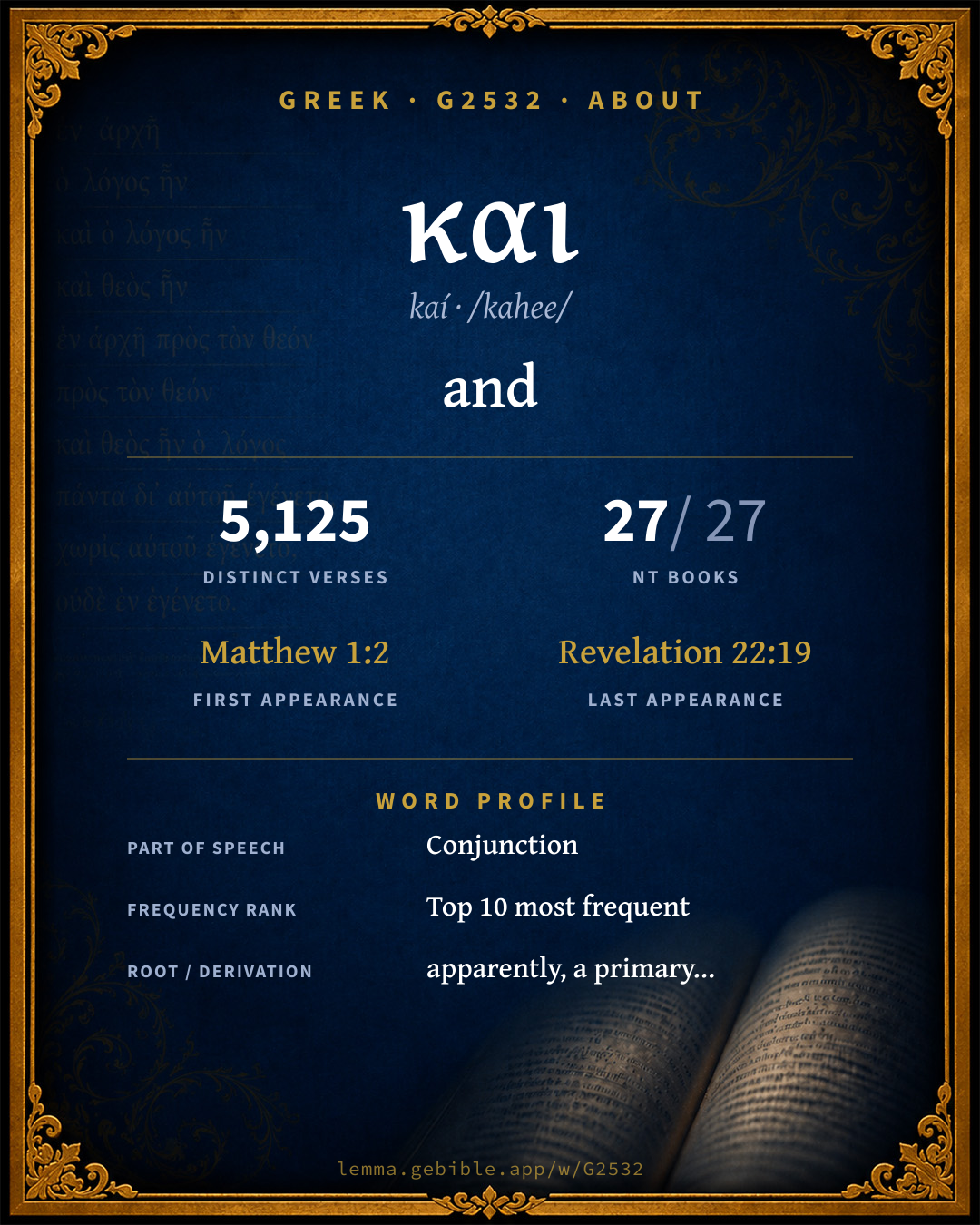
καί
and
Full lexicon entry — Thayer's Greek Lexicon
From Thayer's Greek Lexicon
Where this word appears
Grammar key — what these labels mean
Part of speech
- Conjunction
- A joining word linking words or clauses.
Page 2 of 26 — showing verses 201–400 of 5,125 distinct verses where G2532 appears, across 27 books. Click any verse to open its interlinear word-by-word view. Verse text shown in the World English Bible for context — . Each verse’s Greek form is shown with its reference; the English is not keyword-highlighted, since the data carries no word-level English alignment. Use “Compare translations” on any verse to read it across multiple English versions. This concordance covers the Greek New Testament; Septuagint (Greek Old Testament) occurrences of this word are not indexed here.
Matthew 704 verses
- Matthew 10:40 καὶ conj He who receives you receives me, and he who receives me receives him who sent me.
- Matthew 10:41 καὶ conj He who receives a prophet in the name of a prophet will receive a prophet's reward: and he who receives a righteous man in the name of a righteous man will receive a righteous man's reward.
- Matthew 10:42 καὶ conj Whoever gives one of these little ones just a cup of cold water to drink in the name of a disciple, most assuredly I tell you he will in no way lose his reward."
- Matthew 11:1 Καὶ καὶ conj conj It happened that when Jesus had finished directing his twelve disciples, he departed from there to teach and preach in their cities.
- Matthew 11:4 καὶ καὶ conj conj Jesus answered them, "Go and tell John the things which you hear and see:
- Matthew 11:5 καὶ καὶ καὶ καὶ conj conj conj conj the blind receive their sight, the lame walk, the lepers are cleansed, the deaf hear, the dead are raised up, and the poor have good news preached to them.
- Matthew 11:6 καὶ conj Blessed is he who finds no occasion for stumbling in me."
- Matthew 11:9 καὶ conj But why did you go out? To see a prophet? Yes, I tell you, and much more than a prophet.
- Matthew 11:12 καὶ conj From the days of John the Baptizer until now, the Kingdom of Heaven suffers violence, and the violent take it by force.
- Matthew 11:13 καὶ conj For all the prophets and the law prophesied until John.
- Matthew 11:14 καὶ conj If you are willing to receive it, this is Elijah, who is to come.
- Matthew 11:17 καὶ καὶ conj conj and say, 'We played the flute for you, and you didn't dance. We mourned for you, and you didn't lament.'
- Matthew 11:18 καὶ conj For John came neither eating nor drinking, and they say, 'He has a demon.'
- Matthew 11:19 καὶ καὶ καὶ καὶ καὶ conj conj conj conj conj The Son of Man came eating and drinking, and they say, 'Behold, a gluttonous man and a drunkard, a friend of tax collectors and sinners!' But wisdom is justified by her children."
- Matthew 11:21 καὶ καὶ conj conj "Woe to you, Chorazin! Woe to you, Bethsaida! For if the mighty works had been done in Tyre and Sidon which were done in you, they would have repented long ago in sackcloth and ashes.
- Matthew 11:22 καὶ conj But I tell you, it will be more tolerable for Tyre and Sidon on the day of judgment than for you.
- Matthew 11:23 καὶ conj You, Capernaum, who are exalted to Heaven, you will go down to Hades. For if the mighty works had been done in Sodom which were done in you, it would have remained until this day.
- Matthew 11:25 καὶ καὶ καὶ conj conj conj At that time, Jesus answered, "I thank you, Father, Lord of heaven and earth, that you hid these things from the wise and understanding, and revealed them to infants.
- Matthew 11:27 καὶ καὶ conj conj All things have been delivered to me by my Father. No one knows the Son, except the Father; neither does anyone know the Father, except the Son, and he to whom the Son desires to reveal him.
- Matthew 11:28 καὶ conj "Come to me, all you who labor and are heavily burdened, and I will give you rest.
- Matthew 11:29 καὶ καὶ καὶ conj conj conj Take my yoke upon you, and learn from me, for I am gentle and lowly in heart; and you will find rest for your souls.
- Matthew 11:30 καὶ conj For my yoke is easy, and my burden is light."
- Matthew 12:1 καὶ καὶ conj conj At that time, Jesus went on the Sabbath day through the grain fields. His disciples were hungry and began to pluck heads of grain and to eat.
- Matthew 12:3 καὶ conj But he said to them, "Haven't you read what David did, when he was hungry, and those who were with him;
- Matthew 12:4 καὶ conj how he entered into the house of God, and ate the show bread, which was not lawful for him to eat, neither for those who were with him, but only for the priests?
- Matthew 12:5 καὶ conj Or have you not read in the law, that on the Sabbath day, the priests in the temple profane the Sabbath, and are guiltless?
- Matthew 12:7 καὶ conj But if you had known what this means, 'I desire mercy, and not sacrifice,' you would not have condemned the guiltless.
- Matthew 12:9 Καὶ conj He departed there, and went into their synagogue.
- Matthew 12:10 καὶ καὶ conj conj And behold there was a man with a withered hand. They asked him, "Is it lawful to heal on the Sabbath day?" that they might accuse him.
- Matthew 12:11 καὶ καὶ conj conj He said to them, "What man is there among you, who has one sheep, and if this one falls into a pit on the Sabbath day, won't he grab on to it, and lift it out?
- Matthew 12:13 καὶ καὶ conj conj Then he told the man, "Stretch out your hand." He stretched it out; and it was restored whole, just like the other.
- Matthew 12:15 καὶ καὶ conj conj Jesus, perceiving that, withdrew from there. Great multitudes followed him; and he healed them all,
- Matthew 12:16 καὶ conj and charged them that they should not make him known:
- Matthew 12:18 καὶ conj "Behold, my servant whom I have chosen; My beloved in whom my soul is well pleased: I will put my Spirit on him. He will proclaim justice to the Gentiles.
- Matthew 12:20 καὶ conj He won't break a bruised reed. He won't quench a smoking flax, Until he leads justice to victory.
- Matthew 12:21 καὶ conj In his name, the Gentiles will hope."
- Matthew 12:22 καὶ καὶ καὶ conj conj conj Then one possessed by a demon, blind and mute, was brought to him and he healed him, so that the blind and mute man both spoke and saw.
- Matthew 12:23 καὶ καὶ conj conj All the multitudes were amazed, and said, "Can this be the son of David?"
- Matthew 12:25 καὶ conj Knowing their thoughts, Jesus said to them, "Every kingdom divided against itself is brought to desolation, and every city or house divided against itself will not stand.
- Matthew 12:26 καὶ conj If Satan casts out Satan, he is divided against himself. How then will his kingdom stand?
- Matthew 12:27 καὶ conj If I by Beelzebul cast out demons, by whom do your children cast them out? Therefore they will be your judges.
- Matthew 12:29 καὶ καὶ conj conj Or how can one enter into the house of the strong man, and plunder his goods, unless he first bind the strong man? Then he will plunder his house.
- Matthew 12:30 καὶ conj "He who is not with me is against me, and he who doesn't gather with me, scatters.
- Matthew 12:31 καὶ conj Therefore I tell you, every sin and blasphemy will be forgiven men, but the blasphemy against the Spirit will not be forgiven men.
- Matthew 12:32 καὶ conj Whoever speaks a word against the Son of Man, it will be forgiven him; but whoever speaks against the Holy Spirit, it will not be forgiven him, neither in this age, nor in that which is to come.
- Matthew 12:33 καὶ καὶ conj conj "Either make the tree good, and its fruit good, or make the tree corrupt, and its fruit corrupt; for the tree is known by its fruit.
- Matthew 12:35 καὶ conj The good man out of his good treasure brings out good things, and the evil man out of his evil treasure brings out evil things.
- Matthew 12:37 καὶ conj For by your words you will be justified, and by your words you will be condemned."
- Matthew 12:38 καὶ conj Then certain of the scribes and Pharisees answered, "Teacher, we want to see a sign from you."
- Matthew 12:39 καὶ καὶ conj conj But he answered them, "An evil and adulterous generation seeks after a sign, but no sign will be given it but the sign of Jonah the prophet.
- Matthew 12:40 καὶ καὶ conj conj For as Jonah was three days and three nights in the belly of the whale, so will the Son of Man be three days and three nights in the heart of the earth.
- Matthew 12:41 καὶ καὶ conj conj The men of Nineveh will stand up in the judgment with this generation, and will condemn it, for they repented at the preaching of Jonah; and behold, someone greater than Jonah is here.
- Matthew 12:42 καὶ καὶ conj conj The queen of the south will rise up in the judgment with this generation, and will condemn it, for she came from the ends of the earth to hear the wisdom of Solomon; and behold, someone greater than Solomon is here.
- Matthew 12:43 καὶ conj But the unclean spirit, when he is gone out of the man, passes through waterless places, seeking rest, and doesn't find it.
- Matthew 12:44 καὶ καὶ καὶ conj conj conj Then he says, 'I will return into my house from which I came out,' and when he has come back, he finds it empty, swept, and put in order.
- Matthew 12:45 καὶ καὶ καὶ καὶ conj conj conj conj Then he goes, and takes with himself seven other spirits more evil than he is, and they enter in and dwell there. The last state of that man becomes worse than the first. Even so will it be also to this evil generation."
- Matthew 12:46 καὶ conj While he was yet speaking to the multitudes, behold, his mother and his brothers stood outside, seeking to speak to him.
- Matthew 12:47 καὶ conj One said to him, "Behold, your mother and your brothers stand outside, seeking to speak to you."
- Matthew 12:48 καὶ conj But he answered him who spoke to him, "Who is my mother? Who are my brothers?"
- Matthew 12:49 καὶ καὶ conj conj He stretched out his hand towards his disciples, and said, "Behold, my mother and my brothers!
- Matthew 12:50 καὶ καὶ conj conj For whoever does the will of my Father who is in heaven, he is my brother, and sister, and mother."
- Matthew 13:2 καὶ καὶ conj conj Great multitudes gathered to him, so that he entered into a boat, and sat, and all the multitude stood on the beach.
- Matthew 13:3 καὶ conj He spoke to them many things in parables, saying, "Behold, a farmer went out to sow.
- Matthew 13:4 καὶ καὶ καὶ conj conj conj As he sowed, some seeds fell by the roadside, and the birds came and devoured them.
- Matthew 13:5 καὶ conj Others fell on rocky ground, where they didn't have much soil, and immediately they sprang up, because they had no depth of earth.
- Matthew 13:6 καὶ conj When the sun had risen, they were scorched. Because they had no root, they withered away.
- Matthew 13:7 καὶ καὶ conj conj Others fell among thorns. The thorns grew up and choked them:
- Matthew 13:8 καὶ conj and others fell on good soil, and yielded fruit: some one hundred times as much, some sixty, and some thirty.
- Matthew 13:10 Καὶ conj The disciples came, and said to him, "Why do you speak to them in parables?"
- Matthew 13:12 καὶ καὶ conj conj For whoever has, to him will be given, and he will have abundance, but whoever doesn't have, from him will be taken away even that which he has.
- Matthew 13:13 καὶ conj Therefore I speak to them in parables, because seeing they don't see, and hearing, they don't hear, neither do they understand.
- Matthew 13:14 καὶ καὶ καὶ καὶ conj conj conj conj In them the prophecy of Isaiah is fulfilled, which says, 'By hearing you will hear, And will in no way understand; Seeing you will see, And will in no way perceive:
- Matthew 13:15 καὶ καὶ καὶ καὶ καὶ καὶ conj conj conj conj conj conj For this people's heart has grown callous, Their ears are dull of hearing, They have closed their eyes; Or else perhaps they might perceive with their eyes, Hear with their ears, Understand with their heart, And should turn again; And I would heal them.'
- Matthew 13:16 καὶ conj "But blessed are your eyes, for they see; and your ears, for they hear.
- Matthew 13:17 καὶ καὶ καὶ καὶ conj conj conj conj For most assuredly I tell you that many prophets and righteous men desired to see the things which you see, and didn't see them; and to hear the things which you hear, and didn't hear them.
- Matthew 13:19 καὶ καὶ conj conj When anyone hears the word of the Kingdom, and doesn't understand it, the evil one comes, and snatches away that which has been sown in his heart. This is what was sown by the roadside.
- Matthew 13:20 καὶ conj What was sown on the rocky places, this is he who hears the word, and immediately with joy receives it;
- Matthew 13:22 καὶ καὶ καὶ conj conj conj What was sown among the thorns, this is he who hears the word, but the cares of this age and the deceitfulness of riches choke the word, and he becomes unfruitful.
- Matthew 13:23 καὶ καὶ conj conj What was sown on the good ground, this is he who hears the word, and understands it, who most assuredly bears fruit, and brings forth, some one hundred times as much, some sixty, and some thirty."
- Matthew 13:25 καὶ καὶ conj conj but while people slept, his enemy came and sowed darnel also among the wheat, and went away.
- Matthew 13:26 καὶ καὶ conj conj But when the blade sprang up and brought forth fruit, then the darnel appeared also.
- Matthew 13:30 καὶ καὶ conj conj Let both grow together until the harvest, and in the harvest time I will tell the reapers, "First, gather up the darnel, and bind them in bundles to burn them; but gather the wheat into my barn."'"
- Matthew 13:32 καὶ καὶ conj conj which indeed is smaller than all seeds. But when it is grown, it is greater than the herbs, and becomes a tree, so that the birds of the air come and lodge in its branches."
- Matthew 13:34 καὶ conj Jesus spoke all these things in parables to the multitudes; and without a parable, he didn't speak to them,
- Matthew 13:36 καὶ conj Then Jesus sent the multitudes away, and went into the house. His disciples came to him, saying, "Explain to us the parable of the darnel of the field."
- Matthew 13:40 καὶ conj As therefore the darnel is gathered up and burned with fire; so will it be at the end of this age.
- Matthew 13:41 καὶ καὶ conj conj The Son of Man will send out his angels, and they will gather out of his Kingdom all things that cause stumbling, and those who do iniquity,
- Matthew 13:42 καὶ καὶ conj conj and will cast them into the furnace of fire. There will be weeping and the gnashing of teeth.
- Matthew 13:44 καὶ καὶ καὶ conj conj conj "Again, the Kingdom of Heaven is like a treasure hidden in the field, which a man found, and hid. In his joy, he goes and sells all that he has, and buys that field.
- Matthew 13:46 καὶ conj who having found one pearl of great price, he went and sold all that he had, and bought it.
- Matthew 13:47 καὶ conj "Again, the Kingdom of Heaven is like a dragnet, that was cast into the sea, and gathered some fish of every kind,
- Matthew 13:48 καὶ conj which, when it was filled, they drew up on the beach. They sat down, and gathered the good into containers, but the bad they threw away.
- Matthew 13:49 καὶ conj So will it be in the end of the world. The angels will come forth, and separate the wicked from among the righteous,
- Matthew 13:50 καὶ καὶ conj conj and will cast them into the furnace of fire. There will be the weeping and the gnashing of teeth."
- Matthew 13:52 καὶ conj He said to them, "Therefore, every scribe who has been made a disciple in the Kingdom of Heaven is like a man who is a householder, who brings out of his treasure new and old things."
- Matthew 13:53 Καὶ conj It happened that when Jesus had finished these parables, he departed from there.
- Matthew 13:54 Καὶ καὶ καὶ conj conj conj Coming into his own country, he taught them in their synagogue, so that they were astonished, and said, "Where did this man get this wisdom, and these mighty works?
- Matthew 13:55 καὶ καὶ καὶ καὶ conj conj conj conj Isn't this the carpenter's son? Isn't his mother called Mary, and his brothers, James, Joses, Simon, and Judas?
- Matthew 13:56 καὶ conj Aren't all of his sisters with us? Where then did this man get all of these things?"
- Matthew 13:57 καὶ καὶ conj conj They were offended by him. But Jesus said to them, "A prophet is not without honor, except in his own country, and in his own house."
- Matthew 13:58 καὶ conj He didn't do many mighty works there because of their unbelief.
- Matthew 14:2 καὶ καὶ conj conj and said to his servants, "This is John the Baptizer. He is risen from the dead. That is why these powers work in him."
- Matthew 14:3 καὶ conj For Herod had laid hold of John, and bound him, and put him in prison for the sake of Herodias, his brother Philip's wife.
- Matthew 14:5 καὶ conj When he would have put him to death, he feared the multitude, because they counted him as a prophet.
- Matthew 14:6 καὶ conj But when Herod's birthday came, the daughter of Herodias danced among them and pleased Herod.
- Matthew 14:9 καὶ καὶ conj conj The king was grieved, but for the sake of his oaths, and of those who sat at the table with him, he commanded it to be given,
- Matthew 14:10 καὶ conj and he sent and beheaded John in the prison.
- Matthew 14:11 καὶ καὶ καὶ conj conj conj His head was brought on a platter, and given to the young lady: and she brought it to her mother.
- Matthew 14:12 καὶ καὶ καὶ conj conj conj His disciples came, and took the body, and buried it; and they went and told Jesus.
- Matthew 14:13 καὶ conj Now when Jesus heard this, he withdrew from there in a boat, to a deserted place apart. When the multitudes heard it, they followed him on foot from the cities.
- Matthew 14:14 Καὶ καὶ καὶ conj conj conj Jesus went out, and he saw a great multitude. He had compassion on them, and healed their sick.
- Matthew 14:15 καὶ conj When evening had come, his disciples came to him, saying, "This place is deserted, and the hour is already late. Send the multitudes away, that they may go into the villages, and buy themselves food."
- Matthew 14:17 καὶ conj They told him, "We only have here five loaves and two fish."
- Matthew 14:19 καὶ καὶ καὶ conj conj conj He commanded the multitudes to sit down on the grass; and he took the five loaves and the two fish, and looking up to heaven, he blessed, broke and gave the loaves to the disciples, and the disciples gave to the multitudes.
- Matthew 14:20 καὶ καὶ καὶ conj conj conj They all ate, and were filled. They took up twelve baskets full of that which remained left over from the broken pieces.
- Matthew 14:21 καὶ conj Those who ate were about five thousand men, besides women and children.
- Matthew 14:22 Καὶ καὶ conj conj Immediately Jesus made the disciples get into the boat, and to go ahead of him to the other side, while he sent the multitudes away.
- Matthew 14:23 καὶ conj After he had sent the multitudes away, he went up into the mountain by himself to pray. When evening had come, he was there alone.
- Matthew 14:26 καὶ conj When the disciples saw him walking on the sea, they were troubled, saying, "It's a ghost!" and they cried out for fear.
- Matthew 14:29 καὶ καὶ conj conj He said, "Come!" Peter stepped down from the boat, and walked on the waters to come to Jesus.
- Matthew 14:30 καὶ conj But when he saw that the wind was strong, he was afraid, and beginning to sink, he cried out, saying, "Lord, save me!"
- Matthew 14:31 καὶ conj Immediately Jesus stretched out his hand, took hold of him, and said to him, "You of little faith, why did you doubt?"
- Matthew 14:32 καὶ conj When they got up into the boat, the wind ceased.
- Matthew 14:34 Καὶ conj When they had crossed over, they came to the land of Gennesaret.
- Matthew 14:35 καὶ καὶ conj conj When the men of that place recognized him, they sent into all that surrounding region, and brought to him all who were sick,
- Matthew 14:36 καὶ καὶ conj conj and they begged him that they might just touch the fringe of his garment. As many as touched it were made whole.
- Matthew 15:1 καὶ conj Then Pharisees and scribes came to Jesus from Jerusalem, saying,
- Matthew 15:3 καὶ conj He answered them, "Why do you also disobey the commandment of God because of your tradition?
- Matthew 15:4 καὶ καί conj conj For God commanded, 'Honor your father and your mother,' and, 'He who speaks evil of father or mother, let him be put to death.'
- Matthew 15:6 καὶ conj he shall not honor his father or mother.' You have made the commandment of God void because of your tradition.
- Matthew 15:10 Καὶ καὶ conj conj He summoned the multitude, and said to them, "Hear, and understand.
- Matthew 15:16 καὶ conj So Jesus said, "Do you also still not understand?
- Matthew 15:17 καὶ conj Don't you understand that whatever goes into the mouth passes into the belly, and then out of the body?
- Matthew 15:21 Καὶ καὶ conj conj Jesus went out from there, and withdrew into the region of Tyre and Sidon.
- Matthew 15:22 καὶ conj Behold, a Canaanite woman came out from those borders, and cried, saying, "Have mercy on me, Lord, you son of David! My daughter is severely demonized!"
- Matthew 15:23 καὶ conj But he answered her not a word. His disciples came and begged him, saying, "Send her away; for she cries after us."
- Matthew 15:26 καὶ conj But he answered, "It is not appropriate to take the children's bread and throw it to the dogs."
- Matthew 15:27 καὶ conj But she said, "Yes, Lord, but even the dogs eat the crumbs which fall from their masters' table."
- Matthew 15:28 καὶ conj Then Jesus answered her, "Woman, great is your faith! Be it done to you even as you desire." And her daughter was healed from that hour.
- Matthew 15:29 Καὶ καὶ conj conj Jesus departed there, and came near to the sea of Galilee; and he went up into the mountain, and sat there.
- Matthew 15:30 καὶ καὶ καὶ καὶ conj conj conj conj Great multitudes came to him, having with them the lame, blind, mute, maimed, and many others, and they put them down at his feet. He healed them,
- Matthew 15:31 καὶ καὶ καὶ conj conj conj so that the multitude wondered when they saw the mute speaking, injured whole, lame walking, and blind seeing--and they glorified the God of Israel.
- Matthew 15:32 καὶ καὶ conj conj Jesus summoned his disciples and said, "I have compassion on the multitude, because they continue with me now three days and have nothing to eat. I don't want to send them away fasting, or they might faint on the way."
- Matthew 15:33 καὶ conj The disciples said to him, "Where should we get so many loaves in a deserted place as to satisfy so great a multitude?"
- Matthew 15:34 καὶ καὶ conj conj Jesus said to them, "How many loaves do you have?" They said, "Seven, and a few small fish."
- Matthew 15:35 καὶ conj He commanded the multitude to sit down on the ground;
- Matthew 15:36 καὶ καὶ καὶ conj conj conj and he took the seven loaves and the fish. He gave thanks and broke them, and gave to the disciples, and the disciples to the multitudes.
- Matthew 15:37 καὶ καὶ καὶ conj conj conj They all ate, and were filled. They took up seven baskets full of the broken pieces that were left over.
- Matthew 15:38 καὶ conj Those who ate were four thousand men, besides women and children.
- Matthew 15:39 καὶ καὶ conj conj Then he sent away the multitudes, got into the boat, and came into the borders of Magdala.
- Matthew 16:1 Καὶ καὶ conj conj The Pharisees and Sadducees came, and testing him, asked him to show them a sign from heaven.
- Matthew 16:3 καὶ conj In the morning, 'It will be foul weather today, for the sky is red and threatening.' Hypocrites! You know how to discern the appearance of the sky, but you can't discern the signs of the times!
- Matthew 16:4 καὶ καὶ καὶ conj conj conj An evil and adulterous generation seeks after a sign, and there will be no sign given to it, except the sign of the prophet Jonah." He left them, and departed.
- Matthew 16:5 Καὶ conj The disciples came to the other side and had forgotten to take bread.
- Matthew 16:6 καὶ καὶ conj conj Jesus said to them, "Take heed and beware of the yeast of the Pharisees and Sadducees."
- Matthew 16:9 καὶ conj Don't you yet perceive, neither remember the five loaves for the five thousand, and how many baskets you took up?
- Matthew 16:10 καὶ conj Nor the seven loaves for the four thousand, and how many baskets you took up?
- Matthew 16:11 καὶ conj How is it that you don't perceive that I didn't speak to you concerning bread? But beware of the yeast of the Pharisees and Sadducees."
- Matthew 16:12 καὶ καὶ conj conj Then they understood that he didn't tell them to beware of the yeast of bread, but of the teaching of the Pharisees and Sadducees.
- Matthew 16:17 καὶ conj Jesus answered him, "Blessed are you, Simon Bar Jonah, for flesh and blood has not revealed this to you, but my Father who is in heaven.
- Matthew 16:18 καὶ καὶ conj conj I also tell you that you are Peter, and on this rock I will build my assembly, and the gates of Hades will not prevail against it.
- Matthew 16:19 καὶ καὶ conj conj I will give to you the keys of the Kingdom of Heaven, and whatever you bind on earth will be bound in heaven; and whatever you release on earth will be released in heaven."
- Matthew 16:21 καὶ καὶ καὶ καὶ καὶ conj conj conj conj conj From that time, Jesus began to show his disciples that he must go to Jerusalem and suffer many things from the elders, chief priests, and scribes, and be killed, and the third day be raised up.
- Matthew 16:22 καὶ conj Peter took him aside, and began to rebuke him, saying, "Far be it from you, Lord! This will never be done to you."
- Matthew 16:24 καὶ καὶ conj conj Then Jesus said to his disciples, "If anyone desires to come after me, let him deny himself, and take up his cross, and follow me.
- Matthew 16:27 καὶ conj For the Son of Man will come in the glory of his Father with his angels, and then he will render to everyone according to his deeds.
- Matthew 17:1 Καὶ καὶ καὶ καὶ conj conj conj conj After six days, Jesus took with him Peter, James, and John his brother, and brought them up into a high mountain by themselves.
- Matthew 17:2 καὶ καὶ conj conj He was transfigured before them. His face shone like the sun, and his garments became as white as the light.
- Matthew 17:3 καὶ καὶ conj conj Behold, Moses and Elijah appeared to them talking with him.
- Matthew 17:4 καὶ καὶ conj conj Peter answered, and said to Jesus, "Lord, it is good for us to be here. If you want, let's make three tents here: one for you, one for Moses, and one for Elijah."
- Matthew 17:5 καὶ conj While he was still speaking, behold, a bright cloud overshadowed them. Behold, a voice came out of the cloud, saying, "This is my beloved Son, in whom I am well pleased. Listen to him."
- Matthew 17:6 καὶ καὶ conj conj When the disciples heard it, they fell on their faces, and were very afraid.
- Matthew 17:7 καὶ καὶ καὶ conj conj conj Jesus came and touched them and said, "Get up, and don't be afraid."
- Matthew 17:9 καὶ conj As they were coming down from the mountain, Jesus commanded them, saying, "Don't tell anyone what you saw, until the Son of Man has risen from the dead."
- Matthew 17:10 Καὶ conj His disciples asked him, saying, "Then why do the scribes say that Elijah must come first?"
- Matthew 17:11 καὶ conj Jesus answered them, "Elijah indeed comes first, and will restore all things,
- Matthew 17:12 καὶ καὶ conj conj but I tell you that Elijah has come already, and they didn't recognize him, but did to him whatever they wanted to. Even so the Son of Man will also suffer by them."
- Matthew 17:14 Καὶ conj When they came to the multitude, a man came to him, kneeling down to him, saying,
- Matthew 17:15 καὶ καὶ καὶ conj conj conj "Lord, have mercy on my son, for he is epileptic, and suffers grievously; for he often falls into the fire, and often into the water.
- Matthew 17:16 καὶ καὶ conj conj So I brought him to your disciples, and they could not cure him."
- Matthew 17:17 καὶ conj Jesus answered, "Faithless and perverse generation! How long will I be with you? How long will I bear with you? Bring him here to me."
- Matthew 17:18 καὶ καὶ καὶ conj conj conj Jesus rebuked him, the demon went out of him, and the boy was cured from that hour.
- Matthew 17:20 καὶ καὶ conj conj He said to them, "Because of your unbelief. For most assuredly I tell you, if you have faith as a grain of mustard seed, you will tell this mountain, 'Move from here to there,' and it will move; and nothing will be impossible for you.
- Matthew 17:23 καὶ καὶ καὶ conj conj conj and they will kill him, and the third day he will be raised up." They were exceedingly sorry.
- Matthew 17:24 καὶ conj When they had come to Capernaum, those who collected the didrachma coins came to Peter, and said, "Doesn't your teacher pay the didrachma?"
- Matthew 17:25 καὶ conj He said, "Yes." When he came into the house, Jesus anticipated him, saying, "What do you think, Simon? From whom do the kings of the earth receive toll or tribute? From their children, or from strangers?"
- Matthew 17:27 καὶ καὶ καὶ conj conj conj But, lest we cause them to stumble, go to the sea, and cast a hook, and take up the first fish that comes up. When you have opened its mouth, you will find a stater coin. Take that, and give it to them for me and you."
- Matthew 18:2 καὶ conj Jesus called a little child to himself, and set him in the midst of them,
- Matthew 18:3 καὶ καὶ conj conj and said, "Most assuredly I tell you, unless you turn, and become as little children, you will in no way enter into the Kingdom of Heaven.
- Matthew 18:5 καὶ conj Whoever receives one such little child in my name receives me,
- Matthew 18:6 καὶ conj but whoever causes one of these little ones who believe in me to stumble, it would be better for him that a huge millstone should be hung around his neck, and that he should be sunk in the depths of the sea.
- Matthew 18:8 καὶ conj If your hand or your foot causes you to stumble, cut it off, and cast it from you. It is better for you to enter into life maimed or crippled, rather than having two hands or two feet to be cast into the eternal fire.
- Matthew 18:9 καὶ καὶ conj conj If your eye causes you to stumble, pluck it out, and cast it from you. It is better for you to enter into life with one eye, rather than having two eyes to be cast into the Gehenna of fire.
- Matthew 18:12 καὶ conj "What do you think? If a man has one hundred sheep, and one of them goes astray, doesn't he leave the ninety-nine, go to the mountains, and seek that which has gone astray?
- Matthew 18:13 καὶ conj If he finds it, most assuredly I tell you, he rejoices over it more than over the ninety-nine which have not gone astray.
- Matthew 18:15 καὶ conj "If your brother sins against you, go, show him his fault between you and him alone. If he listens to you, you have gained back your brother.
- Matthew 18:17 καὶ καὶ conj conj If he refuses to listen to them, tell it to the assembly. If he refuses to hear the assembly also, let him be to you as a Gentile or a tax collector.
- Matthew 18:18 καὶ conj Most assuredly I tell you, whatever things you will bind on earth will be bound in heaven, and whatever things you will release on earth will be released in heaven.
- Matthew 18:21 καὶ conj Then Peter came and said to him, "Lord, how often shall my brother sin against me, and I forgive him? Until seven times?"
- Matthew 18:25 καὶ καὶ καὶ καὶ conj conj conj conj But because he couldn't pay, his lord commanded him to be sold, with his wife, his children, and all that he had, and payment to be made.
About this entry
At a glance — auto-summarized from this page’s data, not written by a person. Every figure links to its source below. This summary describes the numbers; it doesn’t interpret them.
At its core, και (kaí) means “and.” Scripture first uses it in Matthew 1:2. With 5,125 verses in 27 books, it is one of the most common word in the Greek New Testament. Sharing its root, it stands alongside καγω, καιγε and καιπερ. Each statement above links to its evidence; the full detail follows below.
Gloss history
Strong's 1890 vs modern scholarship

About this word
Strong's G2532 catalogs a Greek word from the Greek New Testament.
These counts are not copied from any lexicon or concordance. They are computed here, from the morphology-tagged Greek New Testament. What Lemma adds →
- 5,125
- distinct verses
- The word appears in 5,125 distinct verses.
- 27 / 27
- NT books
- The word appears in 27 of 27 New Testament books.
- #2
- by frequency
- Top 10 most frequent Greek words (rank 2 of 5,347 Greek words by occurrence).
View all 5,125 occurrences in the concordance →
By section of the New Testament
By traditional corpus
Conventional, traditional groupings — biblical authorship is debated, so this is a traditional corpus grouping, not an authorship claim. Some books belong to more than one corpus (Luke is in both the Gospels and the Lukan corpus, and so on), so these shares overlap and need not total 100%. Each figure is a share of the word’s 5,125 distinct verses.
- Gospels 2,619 verses · 51%
- Lukan (Luke–Acts) 1,489 verses · 29%
- Pauline corpus 1,026 verses · 20%
- Johannine 995 verses · 19%
- Revelation 370 verses · 7%
- General (Catholic) Epistles 277 verses · 5%
- Hebrews 173 verses · 3%
How translations render this word
Counts come from each version’s own published word-to-Strong’s tagging or interlinear alignment — an approximate guide to how each version renders this word, not a word-level alignment the data otherwise carries. Because each total is that version’s own tagged count, the per-version totals vary from one another and need not match the appearance or distinct-verse counts above. These counts may also differ from a printed concordance because Lemma counts each distinctly tagged rendering and does not collapse phrase taggings into a single head-word total. This is a fixed set of word-tagged versions (KJV, ASV, BSB, ULT) and does not change with the reading translation you choose elsewhere. Each version’s license is shown beside its name below (and on Sources).
- King James Version: And 8,097×, Also 500×, Even 101×
- American Standard Version: And 7,750×, Also 433×, Even 110×
- Berean Standard Bible: And 5,240×, Then 278×, Also 156×
- unfoldingWord Literal Text: And 7,949×, Also 596×, But 132×
King James Version Public Domain
Renders G2532 across 9,091 tagged occurrences — most commonly:
Plus other, less common renderings. Plus 72 renderings that appear only once — usually multi-word phrases or single function words the recovered tagging swept in, not distinct renderings. Not rendered by a distinct English word in 156 further occurrences.
American Standard Version Public Domain
Renders G2532 across 8,928 tagged occurrences — most commonly:
Plus other, less common renderings. Plus 227 renderings that appear only once — usually multi-word phrases or single function words the recovered tagging swept in, not distinct renderings. Not rendered by a distinct English word in 83 further occurrences.
Berean Standard Bible Public Domain
Renders G2532 across 6,415 tagged occurrences — most commonly:
Plus other, less common renderings. Plus 44 renderings that appear only once — usually multi-word phrases or single function words the recovered tagging swept in, not distinct renderings. Not rendered by a distinct English word in 2,467 further occurrences.
unfoldingWord Literal Text CC BY-SA 4.0
Renders G2532 across 9,016 tagged occurrences — most commonly:
Plus other, less common renderings. Plus 20 renderings that appear only once — usually multi-word phrases or single function words the recovered tagging swept in, not distinct renderings. Not rendered by a distinct English word in 3 further occurrences.
Senses in Thayer's
The 1 sense Thayer's distinguishes for this word, in lexicon order (not ranked by frequency or importance). The full entry — with sub-senses — is in the Lexicon Entry tab.
- and, also, even, indeed, but Frequency count based on 1894 Scrivener Greek New Testament.
Word origin
Origin: apparently, a primary particle, having a copulative and sometimes also a cumulative force
Apparently a primary particle having a copulative and sometimes also a cumulative force; and also even so then too etc.; often used in connection (or composition) with other particles or small words : - and also both but even for if indeed likewise moreover or so that then therefore when yea yet.
— Strong’s Exhaustive Concordance (1890), public domain.
Forms in the corpus
The 5 distinct written forms G2532 takes in the Greek New Testament, most frequent first — each parse links to that case’s occurrences in the concordance.
| Form | Parsing | Example | Uses |
|---|---|---|---|
| καὶ kaì | Conjunction | Matthew 1:2 | 8,661 |
| Καὶ Kaì | Conjunction | Matthew 4:21 | 274 |
| καί kaí | Conjunction | Matthew 15:4 | 29 |
| Καί Kaí | Conjunction | Luke 19:39 | 4 |
| και kai | Conjunction | John 7:53 | 1 |
Same root — word family
Other Thayer's entries built from the same root as G2532, grouped by Strong’s listed origin. These share a root / origin per the lexicon — not necessarily a shared meaning. Each links to that word’s own entry.
Derived from this word
- καγω kagṓ G2504 and I
- καιγε kaíge G2534 and indeed
- καιπερ kaíper G2539 although
- καιτοι kaítoi G2543 and yet
- κακει kakeî G2546 and there
- κακειθεν kakeîthen G2547 of place
- κακεινος kakeînos G2548 and he
- καν kán G2579 and if
Compare all same-root words → Showing 4 of 9 — not the complete family. They share a root, not necessarily a meaning.
Septuagint usage
The same Greek word και appears 47,643 times in the Greek Old Testament (Septuagint), across 18,587 verses in 38 books.
- 47,643
- LXX occurrences
- Tagged occurrences of this Greek word in the Septuagint.
- 18,587
- verses
- Distinct Septuagint verses containing this word.
- 38 / 39
- OT books
- The word appears in 38 of the 39 Old Testament books.
Sample Septuagint occurrences
- Genesis 1:1 καί
- Exodus 1:3 καί
- Leviticus 1:1 καί
- Numbers 1:1 καί
- Deuteronomy 1:1 καί
- Joshua 1:1 καί
- Judges 1:1 καί
- Ruth 1:1 καί
- 1 Samuel 1:1 καί
- 2 Samuel 1:1 καί
- 1 Kings 1:1 καί
- 2 Kings 1:1 καί
Septuagint occurrences (same lexeme)
Every verse where the same Strong’s number (G2532) appears in the Greek Septuagint — showing the first 50 of 18,587. Verse text shown in the World English Bible for context; the Greek form is the matched word — the English is not keyword-highlighted.
- Genesis 1:1 καί In the beginning God created the heavens and the earth.
- Genesis 1:2 καί Now the earth was formless and empty. Darkness was on the surface of the deep. God's Spirit was hovering over the surface of the waters.
- Genesis 1:3 καί God said, "Let there be light," and there was light.
- Genesis 1:4 καί God saw the light, and saw that it was good. God divided the light from the darkness.
- Genesis 1:5 καί God called the light Day, and the darkness he called Night. There was evening and there was morning, one day.
- Genesis 1:6 καί God said, "Let there be an expanse in the midst of the waters, and let it divide the waters from the waters."
- Genesis 1:7 καί God made the expanse, and divided the waters which were under the expanse from the waters which were above the expanse, and it was so.
- Genesis 1:8 καί God called the expanse sky. There was evening and there was morning, a second day.
- Genesis 1:9 καί God said, "Let the waters under the sky be gathered together to one place, and let the dry land appear," and it was so.
- Genesis 1:10 καί God called the dry land Earth, and the gathering together of the waters he called Seas. God saw that it was good.
- Genesis 1:11 καί God said, "Let the earth put forth grass, herbs yielding seed, and fruit trees bearing fruit after their kind, with its seed in it, on the earth," and it was so.
- Genesis 1:12 καί The earth brought forth grass, herbs yielding seed after their kind, and trees bearing fruit, with its seed in it, after their kind: and God saw that it was good.
- Genesis 1:13 καί There was evening and there was morning, a third day.
- Genesis 1:14 καί God said, "Let there be lights in the expanse of sky to divide the day from the night; and let them be for signs, and for seasons, and for days and years;
- Genesis 1:15 καί and let them be for lights in the expanse of sky to give light on the earth," and it was so.
- Genesis 1:16 καί God made the two great lights: the greater light to rule the day, and the lesser light to rule the night. He also made the stars.
- Genesis 1:17 καί God set them in the expanse of sky to give light to the earth,
- Genesis 1:18 καί and to rule over the day and over the night, and to divide the light from the darkness. God saw that it was good.
- Genesis 1:19 καί There was evening and there was morning, a fourth day.
- Genesis 1:20 καί God said, "Let the waters swarm with swarms of living creatures, and let birds fly above the earth in the open expanse of sky."
- Genesis 1:21 καί God created the large sea creatures, and every living creature that moves, with which the waters swarmed, after their kind, and every winged bird after its kind. God saw that it was good.
- Genesis 1:22 καί God blessed them, saying, "Be fruitful, and multiply, and fill the waters in the seas, and let birds multiply on the earth."
- Genesis 1:23 καί There was evening and there was morning, a fifth day.
- Genesis 1:24 καί God said, "Let the earth bring forth living creatures after their kind, cattle, creeping things, and animals of the earth after their kind," and it was so.
- Genesis 1:25 καί God made the animals of the earth after their kind, and the cattle after their kind, and everything that creeps on the ground after its kind. God saw that it was good.
- Genesis 1:26 καί God said, "Let us make man in our image, after our likeness: and let them have dominion over the fish of the sea, and over the birds of the sky, and over the cattle, and over all the earth, and over every creeping thing that creeps on the earth."
- Genesis 1:27 καί God created man in his own image. In God's image he created him; male and female he created them.
- Genesis 1:28 καί God blessed them. God said to them, "Be fruitful, multiply, fill the earth, and subdue it. Have dominion over the fish of the sea, over the birds of the sky, and over every living thing that moves on the earth."
- Genesis 1:29 καί God said, "Behold, I have given you every herb yielding seed, which is on the surface of all the earth, and every tree, which bears fruit yielding seed. It will be your food.
- Genesis 1:30 καί To every animal of the earth, and to every bird of the sky, and to everything that creeps on the earth, in which there is life, I have given every green herb for food." And it was so.
- Genesis 1:31 καί God saw everything that he had made, and, behold, it was very good. There was evening and there was morning, the sixth day.
- Genesis 2:1 καί The heavens and the earth were finished, and all the host of them.
- Genesis 2:2 καί On the seventh day God finished his work which he had made; and he rested on the seventh day from all his work which he had made.
- Genesis 2:3 καί God blessed the seventh day, and made it holy, because he rested in it from all his work which he had created and made.
- Genesis 2:4 καί This is the history of the generations of the heavens and of the earth when they were created, in the day that Yahweh God made earth and the heavens.
- Genesis 2:5 καί No plant of the field was yet in the earth, and no herb of the field had yet sprung up; for Yahweh God had not caused it to rain on the earth. There was not a man to till the ground,
- Genesis 2:6 καί but a mist went up from the earth, and watered the whole surface of the ground.
- Genesis 2:7 καί Yahweh God formed man from the dust of the ground, and breathed into his nostrils the breath of life; and man became a living soul.
- Genesis 2:8 καί Yahweh God planted a garden eastward, in Eden, and there he put the man whom he had formed.
- Genesis 2:9 καί Out of the ground Yahweh God made every tree to grow that is pleasant to the sight, and good for food; the tree of life also in the midst of the garden, and the tree of the knowledge of good and evil.
- Genesis 2:12 καί and the gold of that land is good. There is aromatic resin and the onyx stone.
- Genesis 2:13 καί The name of the second river is Gihon: the same river that flows through the whole land of Cush.
- Genesis 2:14 καί The name of the third river is Hiddekel: this is the one which flows in front of Assyria. The fourth river is the Euphrates.
- Genesis 2:15 καί Yahweh God took the man, and put him into the garden of Eden to dress it and to keep it.
- Genesis 2:16 καί Yahweh God commanded the man, saying, "Of every tree of the garden you may freely eat:
- Genesis 2:17 καί but of the tree of the knowledge of good and evil, you shall not eat of it: for in the day that you eat of it you will surely die."
- Genesis 2:18 καί Yahweh God said, "It is not good that the man should be alone; I will make him a helper suitable for him."
- Genesis 2:19 καί Out of the ground Yahweh God formed every animal of the field, and every bird of the sky, and brought them to the man to see what he would call them. Whatever the man called every living creature, that was its name.
- Genesis 2:20 καί The man gave names to all cattle, and to the birds of the sky, and to every animal of the field; but for man there was not found a helper suitable for him.
- Genesis 2:21 καί Yahweh God caused a deep sleep to fall on the man, and he slept; and he took one of his ribs, and closed up the flesh in its place.
These are occurrences of the same Greek lexeme (G2532) in the Septuagint — not a translation of any one Hebrew word. The store carries no word-level Hebrew↔Greek alignment, so no Hebrew original is asserted here. Counts come from the recovered LXX Strong's tagging — high-frequency vocabulary is well covered, while rare or late forms may be untagged — so they reflect tagged occurrences and may slightly undercount.