
Matthew 24:45

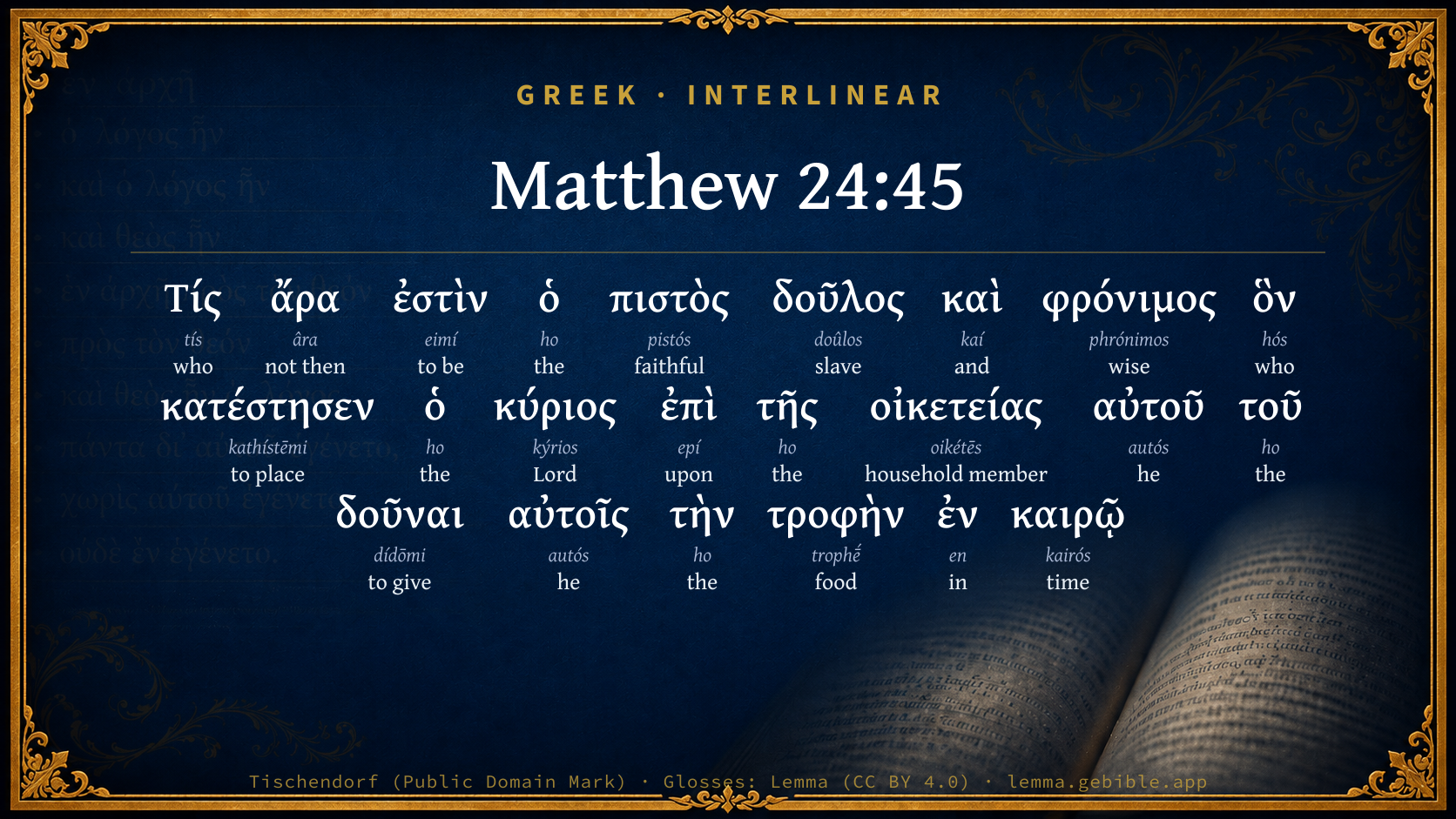
Greek (Tischendorf 8th ed.) Matthew 24:45 appears in the Greek New Testament. The text above is from the Tischendorf 8th edition. Each word links to its Strong’s number and a concise gloss. Click any word for its full Thayer’s Greek Lexicon entry.
Download image
Cite this verse

Matthew 24:45 (World English Bible). Public Domain. Lemma interlinear Bible study tool, https://lemma.gebible.app/v/matthew/24/45.

Show BibTeX & RIS
BibTeX
RIS
English Translation
"Who then is the faithful and wise servant, whom his lord has set over his household, to give them their food in due season?
World English Bible · Public Domain
Highlights
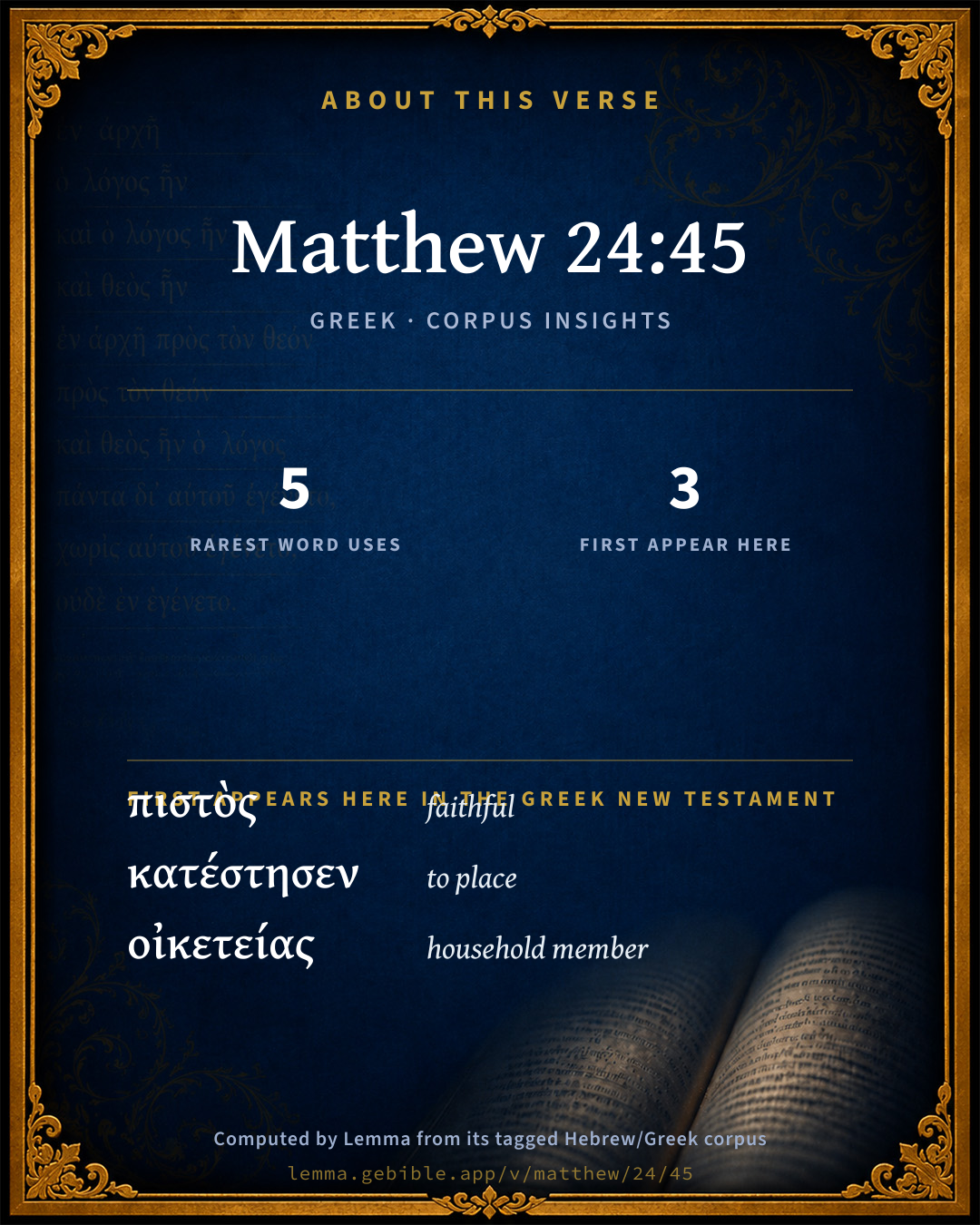
  • 3 first appearances in the Greek New Testament
Full analysis ↓
Download a study sheet

One document with this verse’s original text, its word-by-word gloss line, the meaning frame, cross-references with their text, attributed commentary, and full source and license credits — printable, and it pastes into notes with its structure intact.

This verse Autodidact and up

Study sheet (.html) Plain text (.txt)

A passage Seminary Student

Up to 50 verses in one chapter. A passage sheet keeps up to 6 commentary sources and 12 cross-references per verse, in the order this page ranks them, and says so on the sheet whenever that leaves anything out. Ask for a single verse and you get the Autodidact verse sheet above.

Everything on this page stays free to read, with no account — the sheet is a download of what is already on screen, not access to it.

Want to remove ads? Support Godless Engineer
Compare translations 3

The same verse in 3 English versions, stacked beneath the original-language interlinear above. Click any original word for its lexicon entry.

Each is an independent rendering of the whole verse — the interlinear is not word-aligned to these translations.

Highlighted words mark where these versions differ — a whole-verse word diff, not a word-by-word alignment.

  • World English Bible Public Domain
    "Who then is the faithful and wise servant, whom his lord has set over his household, to give them their food in due season?
  • King James Version Public Domain
    Who then is a faithful and wise servant, whom his lord hath made ruler over his household, to give them meat in due season?
  • unfoldingWord Literal Text CC BY-SA 4.0
    Who then is the faithful and wise slave whom the master has appointed over his household to give them their food in time?

unfoldingWord Literal Text — © unfoldingWord, licensed CC BY-SA 4.0. Word-aligned USFM3 via Door43 (git.door43.org/unfoldingWord/en_ult).

Versions to compare (up to 4)

3 of 4 selected

Show all 19 translations

Every available English version of this verse, each an independent rendering of the whole verse.

  • World English Bible Public Domain
    "Who then is the faithful and wise servant, whom his lord has set over his household, to give them their food in due season?
  • Berean Standard Bible Public Domain
    Who then is the faithful and wise servant, whom the master has put in charge of his household, to give the others their food at the proper time?
  • Majority Standard Bible Public Domain
    Who then is the faithful and wise servant, whom his master has put in charge of his household, to give the others their food at the proper time?
  • King James Version Public Domain
    Who then is a faithful and wise servant, whom his lord hath made ruler over his household, to give them meat in due season?
  • American Standard Version (1901) Public Domain
    Who then is the faithful and wise servant, whom his lord hath set over his household, to give them their food in due season?
  • Revised Version (1885) Public Domain
    Who then is the faithful and wise servant, whom his lord hath set over his household, to give them their food in due season?
  • Geneva Bible (1599) Public Domain
    Who then is a faithfull seruaunt and wise, whom his master hath made ruler ouer his household, to giue them meate in season?
  • Douay-Rheims (1899) Public Domain
    Who, thinkest thou, is a faithful and wise servant, whom his lord hath appointed over his family, to give them meat in season.
  • Young's Literal Translation Public Domain
    `Who, then, is the servant, faithful and wise, whom his lord did set over his household, to give them the nourishment in season?
  • Literal Standard Version CC BY-SA 4.0
    Who, then, is the servant, faithful and wise, whom his lord set over his household, to give them the nourishment in season?
  • Unlocked Literal Bible CC BY-SA 4.0
    So who is the faithful and wise servant whom his master has set over his household in order to give them their food at the right time?
  • unfoldingWord Literal Text CC BY-SA 4.0
    Who then is the faithful and wise slave whom the master has appointed over his household to give them their food in time?
  • Darby Bible Public Domain
    Who then is the faithful and prudent bondman whom his lord has set over his household, to give them food in season?
  • World Messianic Bible Public Domain
    “Who then is the faithful and wise servant, whom his lord has set over his household, to give them their food in due season?
  • Webster's Bible Public Domain
    Who then is a faithful and wise servant, whom his Lord hath made ruler over his household, to give them food in due season?
  • Free Bible Version CC BY-SA 4.0
    For who is the trustworthy and thoughtful servant? It's the one his master puts in charge of his household to provide them with food at the proper time.
  • Bible in Basic English Public Domain
    Who is the true and wise servant, whom his lord has put over those in his house, to give them their food at the right time?
  • Text-Critical English NT CC BY 4.0
    “Who then is the faithful and wise servant, whom his master has set over his household, to give them their food at the proper time?
  • Tyndale New Testament (1534) Public Domain
    If there be any faithfull servaut and wyse whome his master hath made ruler over his housholde to geve the meate in season convenient:

Literal Standard Version (2020), Covenant Press — licensed CC BY-SA 4.0. Text via the HelloAO Bible API (eBible.org). Unlocked Literal Bible (unfoldingWord) — licensed CC BY-SA 4.0. Text via the HelloAO Bible API (eBible.org). unfoldingWord Literal Text — © unfoldingWord, licensed CC BY-SA 4.0. Word-aligned USFM3 via Door43 (git.door43.org/unfoldingWord/en_ult). Free Bible Version, Dr. Jonathan Gallagher — licensed CC BY-SA 4.0. Text via the HelloAO Bible API (eBible.org).

Word by word

More ways to search: Search by grammar → Find every occurrence → Compare this word →

Practice this passage: Drill this verse → Learn its vocabulary →

οἰκετείας
oikétēs
G3610
“household member”
Noun, Genitive, Singular, Feminine
Part of Speech
Noun
Case
Genitive
Number
Singular
Gender
Feminine
Full Thayer's Definition

Origin: from G3611

TDNT: None

1. one who lives in the same house as another, spoken of all who are under the authority of one and the same householder a. a servant, a domestic
  1. Τίς tís G5101 “who” Interrogative pronoun, Nominative, Singular, Masculine
  2. ἄρα âra G687 “not then” Particle, Interrogative
  3. ἐστὶν eimí G1510 “to be” Verb, Present, Active, Indicative, 3rd person, Singular
  4. ὁ ho G3588 “the” Article, Nominative, Singular, Masculine
  5. πιστὸς pistós G4103 “faithful” Adjective, Nominative, Singular, Masculine
  6. δοῦλος doûlos G1401 “slave” Noun, Nominative, Singular, Masculine
  7. καὶ kaí G2532 “and” Conjunction
  8. φρόνιμος phrónimos G5429 “wise” Adjective, Nominative, Singular, Masculine
  9. ὃν hós G3739 “who” Relative pronoun, Accusative, Singular, Masculine
  10. κατέστησεν kathístēmi G2525 “to place” Verb, Aorist, Active, Indicative, 3rd person, Singular
  11. ὁ ho G3588 “the” Article, Nominative, Singular, Masculine
  12. κύριος kýrios G2962 “Lord” Noun, Nominative, Singular, Masculine
  13. ἐπὶ epí G1909 “upon” Preposition
  14. τῆς ho G3588 “the” Article, Genitive, Singular, Feminine
  15. αὐτοῦ autós G846 “he” Personal pronoun, Genitive, Singular, Masculine
  16. τοῦ ho G3588 “the” Article, Genitive, Singular, Neuter
  17. δοῦναι dídōmi G1325 “to give” Verb, Aorist, Active, Infinitive
  18. αὐτοῖς autós G846 “he” Personal pronoun, Dative, Plural, Masculine
  19. τὴν ho G3588 “the” Article, Accusative, Singular, Feminine
  20. τροφὴν trophḗ G5160 “food” Noun, Accusative, Singular, Feminine
  21. ἐν en G1722 “in” Preposition
  22. καιρῷ kairós G2540 “time” Noun, Dative, Singular, Masculine

About this verse

These counts appear in no published source. They are computed here, from the morphology-tagged text and Lemma’s own curated glosses. What Lemma adds →

23
words
18
distinct lemmas
Gospels
section

Notable vocabulary

The rarest word here is οἰκετείας household member G3610 — appearing just 5 times in the whole Greek New Testament.

First appearance in Scripture

These words make their first canonical appearance in the Greek New Testament here:

  • πιστὸς faithful G4103
  • κατέστησεν to place G2525
  • οἰκετείας household member G3610

Shared distinctive vocabulary

οἰκετείας household member G3610 occurs in 5 verses of the Greek New Testament. Also found in:
Repetition

Words recur within this verse:

Cross-references

22

Topical passages linked to Matthew 24:45 in the Treasury of Scripture Knowledge — connected by theme and wording, ordered by reader-vote popularity; previews shown in the World English Bible.

  • Matthew 25:21 "His lord said to him, 'Well done, good and faithful servant. You have been faithful over a few things, I will set you over many things. Enter into the joy of your lord.'
  • 1 Corinthians 4:1–2 So let a man think of us as Christ's servants, and stewards of God's mysteries.
  • Matthew 25:23 "His lord said to him, 'Well done, good and faithful servant. You have been faithful over a few things, I will set you over many things. Enter into the joy of your lord.'
  • Luke 12:41–43 Peter said to him, "Lord, are you telling this parable to us, or to everybody?"
  • Luke 16:10–12 He who is faithful in a very little is faithful also in much. He who is dishonest in a very little is also dishonest in much.
  • Matthew 25:35–40 for I was hungry, and you gave me food to eat; I was thirsty, and you gave me drink; I was a stranger, and you took me in;
  • 2 Timothy 2:2 The things which you have heard from me among many witnesses, commit the same to faithful men, who will be able to teach others also.
  • John 21:15–17 So when they had eaten their breakfast, Jesus said to Simon Peter, "Simon, son of Jonah, do you love me more than these?" He said to him, "Yes, Lord; you know that I have affection for you." He said to him, "Feed my lambs."
  • Acts 20:28 Take heed, therefore, to yourselves, and to all the flock, in which the Holy Spirit has made you overseers, to shepherd the assembly of the Lord and God which he purchased with his own blood.
  • 1 Timothy 1:12 And I thank him who enabled me, Christ Jesus our Lord, because he counted me faithful, appointing me to service;
  • Matthew 10:16 "Behold, I send you out as sheep in the midst of wolves. Therefore be wise as serpents, and harmless as doves.
  • Luke 19:17 "He said to him, 'Well done, you good servant! Because you were found faithful with very little, you shall have authority over ten cities.'
  • Hebrews 3:5 Moses indeed was faithful in all his house as a servant, for a testimony of those things which were afterward to be spoken,
  • Revelation 2:13 "I know your works and where you dwell, where Satan's throne is. You hold firmly to my name, and didn't deny my faith in the days of Antipas my witness, my faithful one, who was killed among you, where Satan dwells.
  • Matthew 7:24 "Everyone therefore who hears these words of mine, and does them, I will liken him to a wise man, who built his house on a rock.
  • Matthew 13:52 He said to them, "Therefore, every scribe who has been made a disciple in the Kingdom of Heaven is like a man who is a householder, who brings out of his treasure new and old things."
  • 1 Corinthians 3:1–2 Brothers, I couldn't speak to you as to spiritual, but as to fleshly, as to babies in Christ.
  • 1 Peter 4:10–11 According as each has received a gift, be ministering it among yourselves, as good stewards of the grace of God in its various forms.
  • 1 Peter 5:1–3 I exhort the elders among you, as a fellow elder, and a witness of the sufferings of Christ, and who will also share in the glory that will be revealed.
  • Ezekiel 34:2 Son of man, prophesy against the shepherds of Israel, prophesy, and tell them, even to the shepherds, Thus says the Lord Yahweh: Woe to the shepherds of Israel who feed themselves! Shouldn't the shepherds feed the sheep?
  • Matthew 25:2 Five of them were foolish, and five were wise.
  • Ephesians 4:11–13 He gave some to be apostles; and some, prophets; and some, evangelists; and some, shepherds and teachers;

Cross-references courtesy of OpenBible.info (CC BY 4.0).

Where the printed editions differ

1 variant

Places in this verse where the major printed Greek editions disagree on the wording in a way that affects the translation — a comparison of editions, not a manuscript-by-manuscript collation. The editions are the modern critical texts (Nestlé-Aland 28/27, SBL, Westcott-Hort, Tregelles, Tyndale House) and the traditional texts behind the KJV (the Textus Receptus and the Byzantine/Majority text). It is not a claim about which reading is original.

  1. Different wording
    οἰκετείας

    “household”

    In NA28NA27TynSBLWHTreg Not in TRByz

    θεραπείας (therapeias) 'service' occurs in traditional manuscripts (TR+Byz) instead of οἰκετείας (oiketeias) 'household' in older manuscripts (NA28+NA27+Tyn+SBL+WH+Treg)

Textual data: Translators Amalgamated Greek New Testament (STEPBible TAGNT) · CC BY 4.0.

Commentary

Notes on Matthew 24:45 from classic Christian and Jewish commentators (each source and its license shown beneath its notes). The classic Christian expositions comment on the surrounding passage and are grouped to its opening verse, so a note may address several verses; the Jewish commentaries on the Tanakh (Rashi and others) are per-verse, so they appear only where the commentator wrote on this verse.

Lemma curates 59 commentaries, every one of them public domain or Creative Commons licensed, each selected and text-cleaned for this edition rather than reprinted as found. About our sources →

Albert Barnes' Notes on the Bible

This passage is, in fact, “a parable,” though it is not expressly so called. The design is to show that his disciples should act as if they were each moment expecting his return. This he illustrates by the conduct of a servant who did not expect his master soon to return, who acted with great impropriety, and who was accordingly punished.

Mat 24:45

Who, then, is a faithful and wise servant ... - By the conduct of a faithful and wise servant Jesus intends to denote a faithful Christian, a servant of God, or a teacher of religion.

Whom his lord - His master.

The word here has no reference to God. It means the “lord” or master of the servant. Applied to Christian teachers, in the spiritual meaning of the parable, it refers to “Christ,” who has appointed them as teachers, and who is their Lord and Master, Joh 13:13-14.

Over his household - His family. Christian ministers are the servants of God appointed over the church, the family of Christ, 1Th 5:12-13; 1Co 3:5; 1Co 4:1-2; 1Co 12:28.

Meat in due season - The word “meat” here means food of all kinds. When the Bible was translated into English, the word included, as the original does, all kinds of provisions requisite to support and nourish life.

In due season - As they need it, or in the accustomed times. This was the office of a steward. Among the ancients this office was often filled by a “slave” - one who had shown himself trusty and faithful. The duty was to have a general superintendence over the affairs of the family. Applied to Christian ministers, it means that they are to feed the flock of God, to “minister” to their needs, and to do it as they need it, Joh 21:15-17; Act 20:28; 1Co 4:1-2.

Mat 24:47

Shall make him ruler ... - Shall confirm his appointment over his household, and, as a reward, shall place him over all his property.

This does not mean that ministers will have a higher rank or office, but is a circumstance of “the parable” or story, designed to show the effect of faithfulness. Faithful servants of Christ shall be rewarded. This will be done by His approbation, and by the rewards of the heavenly world.

Mat 24:48

That evil servant - If that servant, so appointed, having this office, should be evil or wicked.

Say in his heart - Secretly suppose.

Delayeth his coming - Will not return in a long time; or does not return as soon as was expected, and perhaps may not at all.

Mat 24:49

Smite his fellow-servants ... - This is the conduct of a wicked servant, who, supposing he would not be called to account, and abusing his authority, gave himself up to oppression, carousing, and debauchery.

It is designed to represent the conduct of ministers who are unfaithful and overbearing, and who abuse their trust in the church.

Mat 24:51

Shall cut him asunder - This kind of punishment was anciently practiced.

Sometimes it was done by the sword. sometimes by saws. It was practiced among the Chaldeans Dan 2:5; Dan 3:29, and among the Hebrews, 2Sa 12:31; 1Sa 15:33; 1Ki 3:25; Heb 11:37. It was also practiced by the Egyptians and Romans. It is not, perhaps, here to be taken literally, but signifies that the wicked servant should be severely punished.

Hypocrites - See the notes at Mat 6:2. They are spoken of here as the worst of people.

Weeping and gnashing of teeth - See the notes at Mat 8:12-13. The unfaithful and wicked minister of God, who lives without expectation or fear of judgment, shall suffer the severest punishment inflicted on sinners in the world of woe.

Albert Barnes' Notes on the Bible (1834–1885) — public domain. Text from a community e-Sword/MySword module.

The Biblical Illustrator

Joseph S. Exell

Mat_24:45; Mat_24:51

Who, then, is that faithful and wise servant.

I. The particular relation in which we are here represented as standing to the one that is above us.

II. The representation that is here given of that attitude in which the servant is found who is obedient to his Master. There are terms used particularly descriptive of the conduct of the individual.

1. Fidelity.

2. Wisdom is associated with faithfulness-faithful and wise.

3. Habitual and persevering continuance in well-doing.

III. The blessedness which is included in this benediction of the Master.

1. Blessed at the appearance of Christ, also while he lives, in his present activity.

2. Positive reward.

3. Contrast the deception of the evil servant. (T. Binney, D. D.)

The faithful servant and his reward

I. The character of the faithful servant.

1. The faithful servant is one whose service is sincere.

2. The faithful servant is one whose service is unreserved, limited only by his capability.

3. His service is uniform.

4. His service is according to the prescribed rule, If a man strive for masteries, yet is he not crowned, except he strive lawfully.

5. His service is that of faith-the living faith of the heart in the truth of God as revealed to us in Jesus Christ.

II. His reward. The reward is here made to depend upon the servant being found occupying the position assigned him, with all fidelity, when his Lord cometh. We must not infer that the faithful servant is not blessed prior to his Lords coming, at the hour of death. Nor do his onerous duties diminish, but rather contribute to, the blessedness of the faithful servant. He has to suffer, it is true; but these minister to his blessedness. The master promotes his servant to the highest post of honour because of his fidelity in an inferior position. He is made a ruler. These pleasures will be internally progressive. The reward, however, will not be equal in degree. It is a matter of the first importance to determine whether we are in deed and truth the servants of Christ. (R. Scott.)

The activity of service

Christs departure from this earth is no reason for His Churchs inaction, but the source of her activity. Far from withdrawing His Churchs interests from earth by His withdrawal, He endows it with more effective energies, larger capacities for action. She can do more on earth, and not less, now He is gone. He shows this by picture after picture. He tells us that we are to be a society carefully and shrewdly organized, and this organization is to he formed with a view to work, production, fruit. We are to be organized with a view to our capacities, so to be arranged as to serve best for direct, present, practical usefulness here on earth; we are to be as a house which a householder has left, in which house every one is in his place, each according to his gift; and in this house there will be careful provision, that each shall have his food in due season-food brought him prepared through the hands of officers appointed for that one service, while at the door will ever sit the porter, who will have the office of watching while the others work. How careful, how orderly it all is! No loose shiftiness to fill up an interval. No indifference as to what may be done in the long waiting time. His going does not destroy or diminish the seriousness or care with which the interval is to be organized. How busy it all is to be. What! did we fancy that the haste and urgency of worldly business would conflict with the solemnity of watching for the Lord? Why, this kingdom of His is to be, during all the waiting time, like a house of business. It will be as a merchant house, in which everybody is bent on making all he can out of the money given him. He gives no picture of a Church ever on its knees at some silent shrine, praying for a far-off time. He foresees a body of men busy and intent, absorbed in the practical use of their gifts, bent on turning five talents into ten or two into four. (Canon Scott-Holland.)

The Biblical Illustrator, edited by Joseph S. Exell (c. 1880s–1900s) — public domain. Text from a community e-Sword module.

Joseph Benson's Commentary

Mat 24:45-51. Who then is the faithful and wise servant — Which of you aspires after this character? Wise — Every moment retaining the clearest conviction that all he now has is only intrusted to him as a steward: Faithful — Thinking, speaking, and acting continually in a manner suitable to that conviction. Whom his lord hath made ruler over his household — This evidently chiefly concerns the ministers of the gospel. See notes on Luk 12:42, &c. Blessed is that servant, &c. — “You, the ministers of religion, ought to be peculiarly faithful in the discharge of your duty; for it is not an ordinary trust that is committed to your charge. You are stewards, whose business it is to take care of the whole family, and who, because of the influence which your example may have upon others, ought to be remarkably diligent. Your duty is to be well acquainted with the stores of evangelical truths, and to understand how they may be best applied. You should know likewise the various characters of the persons under your charge, that you may be able to give every one of them his portion of meat in due season. Verily, he shall make him ruler over all his goods — If when I come I find you thus employed, I will highly reward you with the glories and joys of my kingdom, even as an earthly master bestows particular marks of respect on such servants as have been remarkably faithful in any important trust.” But if that evil servant — Now become evil, having put away faith and a good conscience, shall say in his heart, My lord delayeth, &c. — “On the other hand, if you behave like wicked stewards, who, because their lord delays his coming, beat their fellow-servants and get drunk with sots and epicures; if you tyrannise over the consciences of your brethren, neglect the duties of your function, and give yourselves up to sensual pleasures, I will come when you little think of it, and will make you dreadful examples of my indignation, by the severe punishments which I will inflict upon you.” And shall cut him asunder — Tearing and cutting persons into several pieces, was one of the severest kinds of punishment anciently used, and is here put for the extreme misery that awaits the persons here described in the other world. And appoint him his portion with the hypocrites — The worst of sinners. If ministers are the persons here primarily intended, there is a peculiar propriety in the expression. For no hypocrisy can be baser than to call ourselves ministers of Christ while we are the slaves of avarice, ambition, or sensuality. Wherever such are found, may God reform them by his grace, or disarm them of that power and influence which they continually abuse to his dishonour, and to their own aggravated damnation!

Joseph Benson's Commentary on the Old and New Testaments (1811–1818) — public domain. Text from a community e-Sword module.

Lange's Commentary on the Holy Scriptures

SECOND SECTION

JUDGMENT ON THE RULERS OF THE CHURCH

Mat_24:45-51

(Luk_12:35-46—The Gospelfor the 27th Sunday after Trinity, Mat_24:37-51)

45Who then is a [the, ὁ] faithful and wise servant, whom his58 lord hath made ruler the lord set, κατέστησεν59 over his household60, to give them meat [food, τὴν τροφήν] in 46due season? Blessed is that servant, whom his lord when he cometh shall find so doing. 47Verily I say unto you, That he shall make him ruler [set him] over all his goods. 48But and if [But if, ἐὰν δέ] that evil servant shall say in his heart, My lord delayeth his coming; 49And shall begin to smite [beat] his fellow servants, and to eat and drink [and shall eat and drink]61with the drunken; 50The lord of that servant shall [will] come in a day when he looketh not for him [it], and in an hour that he is not aware of 51[when he is not aware, ἡ οὐ γινὠσκει], And shall [will] cut him asunder, and appoint him his portion with the hypocrites: there shall be weeping and gnashing of teeth.

EXEGETICAL AND CRITICAL

Mat_24:45. Who then is?—That is, in conformity with the previous instructions. The Lord shows in a parable that the judgment will begin upon those in office in the Church. He shows the contrast between the faithful and the unfaithful servant, but dwelling finally upon the latter. The τίς is not instead of εί̔ τις. According to Bengel and de Wette, it is encouraging: May every one be such a servant. According to Meyer, there is a change of construction: the characteristics of the servant ought to follow; but in the vivacity of the discourse the commendation and the characteristics go together. But the description of the servant which has gone before—faithful and wise—is in favor of de Wette.

Whom the lord hath made ruler.—This being appointed of the Lord has stress laid upon it in the case of the faithful servant. In the case of κακὸς δοῦλος ἐκεῖνος it is omitted, and the σύνδουλοι are made prominent.—Over his household.—We read θεραπεια, which makes it more definite that the office of rulership has for its end only to provide nourishment for the house. The office is the office of ruler, only so far as it actually imparts spiritual food in the office of teacher. Watching is here indicated in its concrete form, as fidelity to the calling. It is connected with faith, as not watching is connected with unbelief.

Mat_24:47. Verily I say unto you, ... ruler over all.—The description of the perfect κληρονομία. Comp. Rom_8:17.

Mat_24:48. But and if that evil servant shall say.—The ἐκεῖνος is not only δεικτικῶς, but also prophetically significant. The faithful servant was hypothetically mentioned in the form of exhortation; the wicked servant is exhibited as a very definite form in the future, and brought near to present view. The evil conduct of the wicked servant springs from unbelief, which, however, in his official position, he can utter only in his heart. But his unbelief is specifically unbelief in regard to the coming of the Lord and His award.—My lord delayeth.—The expression marks an internal mocking frivolity. But his bad conduct is evidently exhibited in two aspects: first, as a despotic and proud bearing to his fellow- servants, whom he abuses instead of giving them nourishment; and secondly, as laxity of conduct toward the wicked members of the household and the uninvited guests, with whom he commits all kinds of riot and debauchery. Meyer: First, we have his conduct toward his fellow-servants, and then his conduct outside62 the οὶκετεία; and, under the rule of such a steward, the household generally is to some extent given over to wickedness. Such a dissolute hospitality, also, is signified, as makes all drunkards from without welcome. The fellow-servants here must be understood of such as are faithful servants of their absent master.—The great historical contrast between the Inquisition and Indulgences will easily occur to the reader.

Mat_24:51. And cut him asunder: διχοτομήσει.—The expression is so significant that Meyer properly holds fast the literal rendering, “to cut into two parts,” and rejects all generalizing interpretations, such as scourging (Paulus, de Wette, etc.), mutilation (Michaelis), exclusion from service (Beza), and extreme punishment (Chrysostom). It is emphatically the punishment of the theocracy, cutting in two, sawing asunder,—1Sa_15:33; 2Sa_12:31 (Heb_11:37),—which here figuratively expresses a sudden and annihilating destruction, and possibly not without reference to the double-mindedness of the condemned, or even to the duplicity of the Anti-Christianity which will finally bring spiritual despotism to its doom (see Rev_13:1; Rev_13:11).

With the hypocrites.—The further doom of the wicked servant after the judgment of the great day of Christ’s coming. “Even the Rabbins send the hypocrites to Gehenna.” The wicked servant is a hypocrite, not only because he thinks to present himself at last under the guise of fidelity, and must have showed false colors from the beginning (Meyer), but especially because, in his ill-treatment of the fellow-servants, he assumes the semblance of official zeal.

DOCTRINAL AND ETHICAL

1. The parable of the good and wicked servants applies specially to the disciples, and with them to spiritual officers in the Church, although not without application to Christians generally. It is to be observed, that, according to Luke, Peter gave the Lord occasion to utter it. Yet the whole context shows that it belongs to the general eschatological instruction which we find in Matthew; that is, it naturally connects itself with the discourse concerning the last things, and opens the series of parables and declarations which introduce the judgment of the end of the world, the day that winds up the present age. This connection makes the contrast between the good and wicked servant more than a mere exhortation; it assumes a prophetic aspect, as indeed is seen in the definite expressions which pervade it.

2. In regard to the rulership of the two servants, it is observable that he who humbly serves his fellow servants, faithfully giving them their food (the word and spiritual nourishment generally), is represented as being set over the household by his lord, and that it is promised that he should be set over all his lord’s goods. But the wicked servant, who despotically set himself over the household and house, is not represented as having been appointed; in his supposed official correction of his subordinates, he appears to be a reckless injurer of his equal fellow servants.

HOMILETICAL AND PRACTICAL

The faithful servant and the wicked servant in the Church: 1. Their opposite spirit: the one waits for the coming of the Lord, the other puts no faith in that coming. 2. Their acts: the one takes care of the household’s nourishment, the other makes himself a despotic lord, who abuses the faithful, and wastes the goods of the house in riotous living. 3. Their recompense: blessed and miserable surprise at the advent of the Lord. The one is elevated to the highest dignity, the other is condemned and destroyed on the spot.—The faithful servant waits for his Lord, while he waits upon the Church with the Lord’s word.—The contradiction in the life of the wicked servant: 1. In his spirit: mocking unbelief of the self deception, which supposes that in his lord’s long absence he must take the whole government, instead of the mere provision of food. 2. In his deportment: fearful severity against the better of the household; perfect laxity toward the wicked, and fellowship with their wickedness.—That servant who assumes the highest place in hypocrisy will encounter the sharpest doom.—The divided heart will be punished by a perfect dividing asunder of the life.—The great schism of the Greek and Latin Church, an earn est sign of judgment.—The great schisms in the Occidental, and in the Protestant Church, and their bearing upon the end of ecclesiasticism on earth.—The twofold judgment over perfected unfaithfulness: 1. A sudden surprise; 2. an endless punishment.—The punishment of unfaithfulness in office the punishment of the hypocrite.

Footnotes:

[58]Mat_24:45.—Αὑτοῦ is missing In B., D, L., at, [Cod. Sinait], and thrown out by Lachmann and Tischendorf.

[59]Mat_24:45.—[Cod. Sinait. reads here: καταστησει, shall set, for κατέστησεν. Anticipated from Mat_24:47.—P. S.]

[60]Mat_24:45 —Lachmann and Tischendorf: οἰκετεία, following B., L., al. It likewise means household, the body of servants. But for internal reasons the text, rec: θεραπεία, which has sufficient witnesses, is preferable. [Cod. sinait. reads: οικια.—P.S]

[61] Mat_24:49.—Codd. B., C.,D [and the critical editions], read: ἐσθίῃ δὲ καὶ πίνῃ [instead of the infinitives ἐσθίειν καὶ πίνειν, depending on ἄρξηται.—P.S.]

[62][The Edinb. trsl. has just the reverse: within. The servants constitute the household, the guests are the outsiders.—P. S.]

Lange's Commentary on the Holy Scriptures (Critical, Doctrinal, and Homiletical), ed. John Peter Lange, English translation edited by Philip Schaff (1864–1880) — public domain. Text from a community e-Sword module.

F. W. Grant's Numerical Bible

Subdivision 2. (Mat 24:45-51; Mat 25:1-30.)

Separative judgment between true and false in the fellowship of faith - the Church.

Here He introduces the parables which show us, by way of appendix to the Jewish aspect, the relation of His coming to the Church, but in a veiled manner. It was, in fact, what as yet they would not be able to enter into. The three parables which follow all remind us that in the Kingdom as committed in His absence to the hands of men, the true and the false would be mingled together, and at His coming only would the evil be purged out. Here we have therefore that separative judgment seen in relationship to what is professedly a fellowship of faith. The three parables have to do with - 1st. the use and abuse of authority; 2nd. the Christian expectation of the Lord, the going forth to meet Him; and 3rd. the special deposit committed to each, and the heart towards Him as shown by the way the trust is discharged. We may notice that in all this part we have no reference to Daniel or to Old Testament prophecy any more. All in it belongs to the mysteries of the Kingdom unknown to the prophets of old, and which the very form of the parable expresses (Mat 13:34-35). In what is commonly called the "parable" of the sheep and goats which follows, we have what is no longer that, but plain speech enough, the sheep and goats being only used by way of figurative illustration.

1. The coming of the Lord is, throughout these parables, the governing object. He is leaving the world as rejected by it; and it is characterized for the Christian as the place of that rejection. But He leaves it to prepare for His people a place in heaven, and He comes again to introduce them there, where He is. Israel has still the earthly promises; but the Church is a stranger here; for her portion and her heart are with Christ in another scene. In the meanwhile she is the representative of her Lord however upon earth, put in charge of His interests on it, and responsible to serve and glorify Him.

(1) In the first parable here it is of ministry that the Lord speaks, pressing the responsibility of him whom his Lord has set over His household, to give them food in due season. The value He puts upon such service is emphatically declared. Blessed shall he be whom his Lord, when He cometh, shall find doing this in faithfulness and wisdom. He will even set him over all that He has.

It is service, as the same blessed Speaker has taught us not long since, that not only leads on to rule, but qualifies for it: just because all rule with God is service. "Love seeketh not her own." To seek one’s own is the misery of a fallen creature, and in heaven no such beggar’s badge can anywhere be found. Its places of trust are places of service therefore, new ability to serve, - to satisfy love’s desire, and pour out of fulness which shall find even there some room for happy overflow, if yet we know little what. Thus, then, the Lord looks at service here as qualifying for service, higher and fuller there - reaping in the same sort as that which has been sown: and that is the law of harvest.

(2) But there is another side which we are to consider: for "if that evil servant shall say in his heart, my lord delayeth his coming, and shall begin to smite his fellow-servants, and shall eat and drink with the drunken; the lord of that servant shall come in an hour when he looketh not for him, and shall cut him asunder and appoint him his portion with the hypocrites." Plainly the man is a hypocrite: it is no case of ignorance merely as to prophetic teaching; it is what his heart says, whether his prophetic views are right or wrong. He, too, like Israel when the Lord came, wants the vineyard for himself, and this he shows by his conduct: he usurps authority over his fellow-servants, and associates himself with loose livers; it does not say that he becomes drunken, but a man is known by the company he keeps; and he is perhaps worse than his company because of the profession he makes. He is a hypocrite, and his doctrine (whether publicly professed or not) comes from his heart, as so much false doctrine does. We are apt to be easily persuaded of that which we want to be true; and so in this case.

Primarily, it is the individual of whom the Lord speaks, but we cannot be aware of the history of the Church without realizing that there is a wider significance; and that along with the decline of the expectation of the Lord’s speedy return; and with the coincident assertion of the Church’s heirship to Israel’s promises, there did in fact ensue that hierarchical transformation of ministry into lordship which culminated at last in papal domination and the necessarily lax manners of the growing world-church. The grain of mustard-seed, enlarged into a tree, sent down its roots proportionately into the earth; and the parable of the transformation soon became its justification also. But this brings the judgment of the world upon the professing church itself: "upon thee goodness, if thou continue in His goodness, otherwise thou also shalt be cut off" (Rom 11:22). The true saints being removed to be with their Lord in heaven, there is left upon earth nothing but a decaying carcase, to which the eagles will presently gather. Upon every one so left, the awful doom will come which the Lord announces: "the Lord of that servant shall cut him asunder and appoint him his portion with the hypocrites; there shall be wailing and gnashing of teeth."

2. The second parable deals still more directly with the Church’s expectancy of Christ, which is indeed the very point of it; the figure of a marriage has been already used by the Lord in a parable of the Kingdom (Mat 22:1-46) but there neither bridegroom nor bride is actually brought in; although the bridegroom is named as the King’s son. The gathering of the guests is there the central feature of the parable; here it is the going forth to meet the bridegroom; and the Bridegroom Himself takes the most important place in it.

The bride is still not seen;* but not surely because the virgins are the bride in another aspect, as so many think. This is not more against the unity of thought than it is against the connection; or the orderly development of the revelation. For the heavenly bride has not yet been revealed; and the prophecy as a whole is evidently from the Jewish standpoint, from which the Baptist speaks when he says, "He that hath the bride is the bridegroom" (Joh 3:23) Israel is the bride, as with the Old Testament prophets, and it is when Christ comes to take Israel into relationship to Himself, that on the way Christians are called out to meet Him and come with Him to the marriage. The very fact of being called out to meet Him shows who they are. Jewish disciples could not be called out to meet Him; and it is a New Testament truth altogether that "when Christ who is our life shall appear, then shall we also appear with Him in glory."** Thus the bride is Jewish and the virgins are Christian; and if we will remember this, every feature of the parable becomes harmonious.

{*There is, however, a reading "and the bride" at the end of the first verse, which Westcott and Hort insert in their margin, and which Trench (Notes on the Parables) approves as to the sense, as conformed to the Jewish customs. Probably it is this conformity that has led to the interpolation, which is certainly opposed to the plain meaning of the parable. The marriage could not have taken place before the virgins are called out to meet the bridegroom.

**In Zec 14:5 "the Lord my God shall come, and all the holy ones with Thee" does not necessarily imply more than "angels"; and so with Enoch’s prophecy which Jude quotes: "The Lord cometh with ten thousand of His saints," or "holy ones."}

(1) "Then shall the Kingdom of heaven be likened unto ten virgins, who took their lamps and went forth to meet the bridegroom."

The connective "then" has certainly a meaning, and as certainly connects this parable with that which has gone before; nay, even with the judgment upon the evil servant. But that will not suffice to make it mean all that interpreters have taken from it. But it is when the end is reached that the "likeness" of the Kingdom to what is here before us will be fully complete. Nevertheless the parable takes us back to the beginning of the Church’s history - to the time of first freshness, when the heathen world around was witness not only that they had "turned to God from idols, to serve the living and true God," but also "to wait for His Son from heaven; even Jesus, who delivered them from the wrath to come" (1Th 1:9-10). What is referred to here is certainly not the fact of what at last took place when the midnight cry had aroused the sleepers, and when in fact the unpreparedness to go forth together immediately manifested itself. As yet the virgins are one, as it would seem, in heart and hope. Afterwards we find the tarrying of the bridegroom, the falling asleep, the startling cry; but not as yet.

The being "virgins" must not be pressed too far, nor yet lost sight of. Hebrew customs are illustrated in it all, even in the number, for "ten lamps or torches were the usual number in marriage processions"; still that does not in the least prevent there being a deeper meaning, for Scripture selects what it can turn to spiritual profit. Thus, though the virgins are not (from the point of view taken here) the bride, or the espoused, yet we are not to refuse the conception naturally attaching to such, of purity, of separation from the world; while the number ten; as well as five, show that this is their responsibility rather than necessarily the reality of their condition. And this comes out clearly in the sequel, though it has been lost sight of by many, in a way that has not only led to misconstruction of the parable but has perverted important truth. The going out to meet the bridegroom is, in the first place and essentially, in desire and expectation of heart, though it results in a positive "going forth" from the world and its associations. A heart in heaven can be fairly measured by the reality of pilgrim- and stranger-ship on earth.

(2) A great and fundamental contrast is found to exist between two classes of these virgins: "five of them were foolish and five were wise." And their folly or wisdom is shown in regard to that for which they had come out: "the foolish took their lamps, and took no oil with them; but the wise took oil in their vessels with their lamps."

Here naturally the difference between those of whom I have just spoken and other interpreters comes out. We are told that in this parable all are spoken of as "virgins;" while in those that precede and follow it, all are spoken of as "servants." They are therefore all alike true Christians - "Christians with no stain upon the genuineness of their profession, but whose Christianity lacks that maturity of growth, depth of consecration, and perfection of development which can alone entitle to the highest honors and joys of the kingdom." And this is supposed to be shown in the fact that their lack in the case spoken of here "is not of oil in their lamps, but of oil in their vessels with their lamps" - an extra supply of grace, which the wise virgins carried with them.

A lamp without any oil is, no doubt, a foolish thing enough; too foolish, it might be supposed, for any to think of. Spiritually, however, alas! there is no difficulty at all in the conception of what is seen continually, men satisfied with the form without the power; and this is even the special characteristic of the last days (2Ti 3:1; 2Ti 3:5). "The lamps consisted of a round receptacle for pitch or oil for the wick. This was placed in a hollow cup or deep saucer which was fastened by a pointed end into a long wooden pole, on which it was borne aloft." It is distinctly said that the "foolish took their lamps and took no oil with them"; but we cannot definitely say whether the "vessels" in which the wise took their oil were just the receptacles on the top of the poles or something separate altogether from the lamps. The foolish have no oil, no power of the Spirit to make "a burning and a shining light" for Christ; and this their end demonstrates absolutely.

(3) The bridegroom tarries, and this has its effect upon them all. Wise and foolish alike, they become drowsy and sleep. So in the history of the professing church the expectation of the Lord grew languid and ceased. The expectation of the conversion of the world came in to replace the true Christian hope of being taken out of it, the millennial reign being finally interpreted by the event, of the overthrow of paganism in the Roman empire. After Constantine, but one prominent teacher is known to have favored what was then called "chiliasm"; and he an unsound man.* There was no longer a watcher to disturb the slumberers.

{*Apollinaris the Younger, bishop of Laodicea (died A.D. 390).}

In the middle of the night, however, a cry is heard, "Behold the Bridegroom; come ye out to meet Him;" and this rouses all the virgins. It is more, surely, than a revival of the doctrine of the Lord’s coming which is indicated by this: it is a definite announcement, rather, of His being at hand, which is followed so promptly by His actual arrival that there is no time for those who are awakened unprepared to remedy their condition.

(4) All are aroused; and then comes the conviction on the part of the foolish, "Our lamps are going out." It is urged therefore that they had been lighted up to this time, and that they must have had oil in them, for this to be; but the parables appeal so constantly to the thoughts and feelings of men; that the argument is an unsafe one. The words are their cry only, not necessarily fact at all. And the "ninety and nine just persons who need no repentance" in the well-known fifteenth of Luke, are they in fact such, or in their own thoughts? Surely in their own thoughts only; they are in fact the Pharisees whom the Lord has before Him. So here, it is not necessarily the fact that the lamps were ever lit; and the warning is a solemn one, that one may have a good enough light to welcome the Bridegroom, when He is not there, and find, when faced with the reality, that the light reckoned on expires at once!

The foolish show their folly by their appeal to the wise. In the spiritual application of these things, none but fools could make it; for while a true soul, with the eyes on the wrong object, might fall almost into despair, yet none surely could expect to borrow from another of the grace that was in him to make a light wherewith to meet the Bridegroom. The wise virgins direct them to those that sell, to buy for themselves; and in fact Scripture exhorts men elsewhere to "buy," though "without money and without price" (Isa 55:1). Such "selling" speaks of fixed terms upon which alone the one who seeks may obtain what he desires; and in this way, paradoxical as it may seem, we may buy without money. Nay, the very terms of the gospel are that "the gift of God" cannot be "purchased with money," or with anything that religiously might be its equivalent. The pride that will not take a free gift as such must be sent empty away.

5 They are too late, these foolish ones; for "while they were gone away to buy, the bridegroom came; and they that were ready went in with him to the marriage, and the door was shut. Afterwards came also the other virgins, saying, Lord, Lord, open unto us." But they are shut out; shut out, if (as all seems to indicate) it is the earthly marriage, from the earthly joy and blessing, as well as the heavenly; and in any case this is the truth of it. The Lord disowns any knowledge of them; and this He could not do of His own. All that is said of them too sadly agrees with this.*

{* Alford, Olshausen, and others deny the finality of the judgment here but Schaff is wrong in asserting that millenarian commentators in general take this view. He should at least own that there are many exceptions.}

3. (1) The parable which now follows speaks of the special trusts committed to the servants of the Lord in the time of His absence from them. They are left to care for His interests, and the "talents" are not what is ordinarily taken to be that, - some natural endowment or capacity, - but something added to this, while taking it fully into account: to each one is given "according to his own ability." It cannot be further defined than as being like money in different amounts, possibilities of gain for Christ, what in His love to God and man He counts such. The deposit itself increases by wise use of it; the sphere of service grows larger, as we serve; and this is a point insisted on. The five talents grow to ten; the two to four: capacity necessarily growing also by experience, as we know so well. How little in spiritual things are we any of us shut up to mediocrity, as we are prone to imagine, and suffer seriously by the imagination too.

(2) This is presently seen in the conduct of the three depicted here, though it is not, of course, at all a sufficient account of it. Yet it is worthy of note that the man who hides his lord’s money in the ground, is not the one who has received five talents, or even the man who has received but two. And we understand well how natural this is, that it should be the receiver of the smallest gift who makes no use of it. It need not be so: the man of splendid natural ability, and who has corresponding opportunities and super-added endowments may be the very one to forfeit all by his neglect or perversion of them. Still the appropriateness and power of exhortation for us in this circumstance of the parable must not be on this account overlooked. It is the little gift which tends to be despised as little; to the great injury of the people and the cause of Christ. For thus the mass of Christians almost drop out of responsibility, drop into inactivity, more or less complete, - practically give up their talent into the hands of those they esteem better qualified than themselves; who, however, cannot do the work thus imposed upon them, and it remains undone; but this is the largest part of all the Church’s work! How necessary to remember that "much more they that are feeble are necessary," and to give a right answer to the prophet’s question; "Who has despised the day of small things?"

Suppose we have but one talent, every day’s believing use of it will carry us on some way towards two. We are not shut up within the limits of God’s first gift. We may shut ourselves up; and by hiding our talent in the earth, both lose what we have and the capacity for gaining more. For the rule is, "to him that hath" - in the way of increase - "shall more be given; but from him that hath not, even that which he hath shall be taken away."

(3) Another thing becomes manifest in result: that it is not the amount with which we are entrusted that ensures the reward, but the faithfulness shown as to it. The servant who had the five talents has gained five talents; but he who has gained but two has as much doubled his capital as the other has, and is received with the same approval into the joy of his lord. It would be possible for the one with the smaller trust, to win even the higher approbation; and it is something for the Lord to find one of His own willing to serve as cheerfully in a humbler as in a higher position. To a love that "seeketh not her own," all would be equal here, though love itself may "covet earnestly the best gifts," these meaning fuller capacity for love’s sweet service.

(4) As principles all these things apply to every Christian; yet we are not allowed to suppose that the man who hides his lord’s money in the absolute way here described is possibly, after all, a Christian. His plea for it here is total unbelief, and expressed in such a way as would be impossible to the stoutest-hearted in the day which is referred to. But the Lord puts into language of the most out-spoken character what the conduct supposed would really mean. Faith would argue as to every gift of God that He who gave it had made no mistake, and that the possession of anything wherewith to serve was sufficient warrant for service; and love would prize the opportunity for this as blessing from the divine Source of blessing. The man before us is a mere accuser of his Lord; but so would He teach us to judge the legal spirit which, even in a believer, would render one incapable of using frankly and fully whatever he is possessed of, in the service of Him who has bestowed it. If we abhor the awful blasphemy which this man utters, let us abhor the unfaithful and cowardly refusal of our responsibilities which means the entertainment (however disguised) of traitorous thoughts like these. "Faith worketh by love"; and love is the free spirit of service. Lack of the one is, therefore, lack of the other; while we may be sure, and for that reason; that no true believer could be found as this man, with his Lord’s talent lying entirely unused.

5 Accordingly the judgment here is absolute condemnation. He is condemned out of his own mouth, for if his master were what he thought him, he should have given his money to the bankers, that he might have received his own with interest. He is cast out into the outer darkness, which speaks of the awful darkness, away from God who is light, and of purer eyes than to behold iniquity.

F. W. Grant, The Numerical Bible (4th ed., 1903) — public domain. Text from a community e-Sword module.

Tyndale Open Study Notes

Tyndale Open Resources

24:45-51 This parable and the three that follow (25:1-13, 14-30, 31-46) each dramatize the need for faithful obedience during the delay of Jesus’ second coming.

24:45 servant: It is possible that Jesus’ listeners would have thought of God’s special servants, the prophets and lawgivers; however, Jesus so frequently used servant figuratively that it is more likely a description of every disciple’s responsibility (see 10:24-25; 13:27-28; 18:23-35; 20:26).

Tyndale Open Study Notes — © Tyndale Open Resources, licensed CC BY-SA 4.0. Text via the HelloAO Bible API.

Bengel's Gnomon

Johann Albrecht Bengel

Mat 24:45. Τίς ἄρα ἐστὶν, κ.τ.λ., who then is, etc.) Who is there who would wish to be such? The ἄρα (then) in Luk 12:42, refers to the question in the preceding verse; but here it expresses the magnitude and rarity of the matter.—πιστὸς καὶ φρόνιμος, faithful and prudent) Two cardinal virtues of a good servant, of which faithfulness (fides) is more frequently praised, because it is seated in the will, and has as its associate, prudence,[1072] given from above.—δοῦλος, servant) i.e. pastor. The article[1073] is emphatic.—θεραπείας,[1074] household) i.e. flock.—τοῦ διδόναι, to give) This refers to the epithet faithful.[1075] The opposite is exhibited in Mat 24:49.—τὴν τροφὴν, their food) in just quality and measure; corresponding with the expression τὸ σιτομέτριον (their portion of meat) in Luk 12:42.—ἐν καιρῷ, in due season) This refers to the epithet prudent.

[1072] Prudence is the characteristic of those who do not live from day to day (i.e. making no preparation for the morrow), but who so behave themselves as they would wish that they had behaved themselves when, sooner or later, their Lord shall come.—V. g.

[1073] The Greek is “ὁ πιστὸς δοῦλος καὶ φρόνιμος;” lit.” THE faithful servant and prudent;” rendered in E. V. “A faithful and wise servant.—(I. B.)

[1074] So D and Rec. Text. But BLΔ, οἰκετείας. abcd Vulg. Hil., ‘familiam.’—ED.

[1075] i.e. Faithful in respect of giving.—ED.

Bengel's Gnomon of the New Testament — English translation (T&T Clark, Edinburgh, 1860) — public domain. Text from a community e-Sword module.

Meyer's Critical & Exegetical Commentary

Heinrich August Wilhelm Meyer

Mat_24:45 f. Τίς ἄρα, κ.τ.λ.] who therefore, considering the necessity for preparedness thus indicated. The inference itself is presented in the form of an allegory, the δοῦλος representing the disciples whom the Lord has appointed to be the guides of His church, in which they are required to show themselves faithful (1Co_4:1 f.) and prudent, the former by a disposition habitually determining their whole behaviour and characterized by devotion to the will of the Lord, the latter by the intelligent choice of ways and means, by taking proper advantage of circumstances, etc. The τίς is not equivalent to εἴ τις (Castalio, Grotius), which it never can be; but Mat_24:45 asks: who then is the faithful slave? and Mat_24:46 contains the answer; the latter, however, being so framed that instead of simply saying, in accordance with the terms of the question, it is he, whom his lord, on his return, etc., prominence is given to the blessedness of the servant here in view. According to Bengel, Fritzsche, Fleck, de Wette, our question touchingly conveys the idea of seeking for: quis tandem, etc., hunc scire pervelim. To this, however, there is the logical objection, that the relative clause of Mat_24:45 would in that case have to be regarded as expressing the characteristic feature in the faithful and wise slave, whereas this feature is first mentioned in the relative clause of Mat_24:46, which clause therefore must contain the answer to the question, τίς ἄρα ἐστὶν ὁ πιστὸς δ. κ. φρ.

οἰκετεία, domestic servants, Lucian, Merc. cond. 15; Strabo, xiv. p. 668. Comp. οἰκετία, Symmachus, Job_1:3; Lobeck, ad Phryn. p. 505.

οὕτως] thus, in accordance with duty assigned him in Mat_24:45; the principal emphasis being on this word, it is put at the end of the sentence.

Meyer — Critical and Exegetical Commentary on the New Testament — English translation by Peter Christie, edited by Frederick Crombie (T&T Clark, 1880) — public domain. Text from a community e-Sword module.

Expositor's Greek Testament

ed. W. Robertson Nicoll

Mat 24:45 . τίς , who, taken by Grotius, Kuinoel, Schott, etc. = εἴ τις , si quis , supposing a case. But, as Fritzsche points out, the article before π . δοῦλος is inconsistent with this sense. πιστὸς , φρόνιμος : two indispensable qualities in an upper servant, trusty and judicious. θεραπείας (T. R.), service = body of servants, οἰκετείας (B., W.H [134] ), household = domestics.

[134] Westcott and Hort.

The Expositor's Greek Testament, edited by W. Robertson Nicoll (1897–1910) — public domain. Text from a community e-Sword module.

Adam Clarke's Commentary

Verse 45. Who then is a faithful and wise servant] All should live in the same expectation of the coming of Christ, which a servant has with respect to the return of his master, who, in departing for a season, left the management of his affairs to him; and of which management he is to give an exact account on his master's return.

Here is an abstract of the duties of a minister of Christ.

1. He is appointed, not by himself, but by the vocation and mission of his Master.

2. He must look on himself, not as the master of the family, but as the servant.

3. He must be scrupulously faithful and exact in fulfilling the commands of his Master.

4. His fidelity must be ever accompanied by wisdom and prudence.

5. He must give the domestics - the sacred family, their food; and this food must be such as to afford them true nourishment. And

6. This must be done in its season. There are certain portions of the bread of life which lose their effect by being administered out of proper season, or to improper persons.

Adam Clarke's Commentary on the Bible (1810–1826) — public domain. Text from a community e-Sword/MySword module.

Ellicott's Commentary for English Readers

(45) Who then is a faithful . . .?—Better, Who then is the faithful and wise servant? The latter word in the Greek is that which ethical writers had used to express the moral wisdom which adapts means to ends, as contrasted with the wisdom of pure contemplation on the one hand, or technical skill on the other.

To give them meat in due season.—Better, to give them their food. In the parallel passage of Luk_12:42, the word used means “a measure or fixed portion of meal or flour.” The comparison brings before us one function of the minister of Christ. He is to supply men with the spiritual food which they need for the sustenance of their higher life. It may be the “spiritual milk” of 1Pe_2:2, Heb_5:12, 1Co_3:2; it may be the “strong meat” or “solid food.” There is an art, as it were, of spiritual dietetics, which requires tact and discernment as well as faithfulness. The wise servant will seek to discover not only the right kind of food, but the right season for giving it. An apparent parallel presents itself in the common interpretation of “rightly dividing the word of truth” (2Ti_2:15), but the imagery implied in that phrase is probably of an entirely different character. (See Note there.)

A Bible Commentary for English Readers, edited by Charles John Ellicott (1878–1897) — public domain. Text from a community e-Sword module.

The Cambridge Bible for Schools and Colleges

gen. ed. J. J. S. Perowne

45. Who then is a faithful and wise servant] The steward was generally a slave whom his master had chosen on account of his trustworthiness and intelligence to be the steward of his estate, his villicus or dispensator. The word “dispensation,” in such expressions as “the present dispensation,” “the Christian dispensation,” has passed into religious language from this and the parallel passages.

his household] all his other slaves, Lat. familia.

to give them meat in due season] The daily (diarium) or monthly (menstruum) allowance; cp. “Cum servis urbana diaria rodere mavis?” Hor. Ep. i. 14. 41. This imagery, drawn from a large Roman estate (latifundium), has given rise to the often-recurring thought of the Stewardship of the Apostles and Ministers of Christ. “Stewards of the mysteries of God,” 1Co_4:1; “blameless, as the steward of God,” Tit_1:7.

45–51. The Stewards of God

Luk_12:41-48, where this parable is joined on to the preceding one by a question of St Peter, “Lord, speakest thou this parable unto us, or even to all?” Mar_13:37 has “what I say unto you I say unto all, Watch.” Here, and throughout the discourse, the disciples are specially addressed.

The Cambridge Bible for Schools and Colleges (gen. ed. J. J. S. Perowne; Cambridge University Press, 1878–1918) — public domain. Text from a community e-Sword module.

John Gill's Exposition

Blessed is that servant whom his Lord, when he cometh,.... Whether in a way of judgment, as against Jerusalem; or at death, when he comes to remove him out of time, into eternity; or at the day of judgment, when he, the righteous judge, will give the crown of righteousness to him:

shall find so doing; acting the faithful and wise part, ruling the household of God well; giving to all wholesome food, a proper portion of it, and that in the right time.

John Gill's Exposition of the Whole Bible (1746–1763) — public domain (CC PDM 1.0). Text via the HelloAO Bible API.

Trapp's Complete Commentary

John Trapp

45 Who then is a faithful and wise servant, whom his lord hath made ruler over his household, to give them meat in due season?

Ver. 45. Who then is a faithful and wise servant] So every man ought to be, but ministers especially, who should so far surpass others in these good qualities, as Saul did the people, than whom he was higher by head and shoulders. They should be faithful in all God’s house as servants, as stewards and dispensers of the mysteries of God, to give to every man his portion, his due measure of food, {σιτομετριον, Luk 12:42} and that which is fit for him, not (as he in the emblem did) straw to the dog, and a bone to the ass, &c., but to every one his portion, 1Co 4:1.

John Trapp, A Commentary or Exposition upon All the Books of the Old and New Testament (1647–1656) — public domain. Text from a community e-Sword module.

Matthew Poole's English Annotations

We have much the same, Luk 12:42-44, whether spake at the same time, and upon the same occasion, or no, I know not. It is said there, Luk 12:41, that Peter gave occasion to this discourse, by saying, Lord, speakest thou this parable unto us, or even to all? Our Saviour replies as here, only Luke saith, Who is that faithful and wise steward? The question intimates that there are but a few such. This discourse plainly refers to the ministers of the gospel, whom Christ leaveth in trust with his church,

to give them their meat in due season. He declareth the blessedness of those ministers that shall be found faithfully discharging their trust, and that the Lord in the day of judgment will exalt them to a much greater honour, according to that of Dan 12:3, They that be wise shall shine as the brightness of the firmament; and they that turn many to righteousness as the stars for ever and ever.

Matthew Poole's English Annotations on the Holy Bible (1683–1685) — public domain. Text from a community e-Sword/MySword module.

Whedon's Commentary on the Bible

Daniel D. Whedon

45. Servant — Our Lord now slightly changes the image from a householder watching for the thief, to a servant waiting for his master.

The family here is properly the Church of God, considered as a great congregation, through all ages, waiting for the coming of Christ. It is that Church of all ages to whom he said of the Lord’s supper: “Ye do show forth the Lord’s death until he come.” The servant seems to be more specially the ministry of Christ through the ages; to whom he said: “Lo, I am with you until the end of the world.”

Daniel D. Whedon (gen. ed.), Commentary on the Old and New Testaments (1874–1909) — public domain. Text from a community e-Sword module.

The Pulpit Commentary

Who then (tiv ara; )? In Luk_12:41, etc, Christ utters this parabolic discourse in reply to Peter"s question, "Lord, speakest thou this parable unto us, or even to all?" He now turns his exhortation to those in authority over the house, specially to the ministers and stewards of his mysteries, proposing it in an interrogative form, not only because the man he wants is difficult to find, but in order that each may put the question to himself, and see if he reaches the high standard suggested. Is a (o , the) faithful and wise (fronimov , prudens, practically wise) servant. The idea is that some good and true slave is raised to the stewardship of his master"s household, like Eliezer whom Abram advanced to this position. (Gen_15:2) Hath made ruler (katesthsen , hath set) over his household (epi thv yerapeiav autou , see on ver. 47). The word yerapeia is used classically for a body of attendants, the servants that form the family, the menage. Christ asks Where is one to be found fit for this position in his Church? It is the Lord who selects and appoints the steward; he is neither self-constituted nor appointed by those over whom he rules. To give them meat (thn , their food) in due season. It was the duty of such an officer to dispense the regular allowance of daily food to the members of the household. So the stewards of the mysteries of Christ have to feed his flock with spiritual food, with the Word and sacraments, and. to do this wisely and discreetly, according to the capacity, advancement, and circumstances of each recipient. The exhortation holds good for others as well as the clergy, civil rulers, the rich, all men. All our endowments, mental, spiritual, physical, material, are the gift of God, and are to be used in his service and to the good of others.

Vers. 45-51. The two servants.

Our Lord here applies his teaching about the suddenness of the advent of the unforeseen judgment to the conduct of his servants. In view of the possibility of being called to account at any moment, what manner of men should we be? Jesus gives us contrasted pictures of two very different servants as they are found at his coming, and of their consequent fate.

I THE FAITHFUL AND WISE SERVANT.

1. His character. No doubt his known fidelity and wisdom furnish the reasons for his appointment to an important office.

(1) The first requisite is fidelity. Our business is not to please ourselves, but to serve our Master.

(2) The second requisite is wisdom. This is more than acuteness of intellect. It is a moral faculty, the right use of the intellect.

2. His trust.

(1) A post of responsibility. God is the supreme Lord, yet he grants to the several provinces of his kingdom a considerable measure of" home-rule." He does not humiliate by driving us like cattle; he gives us scope for the exercise of our powers and the proof of our fidelity.

(2) A post of useful service. The servant is to provide food for the household. He is a steward of the previsions of the family. God trusts his servants to feed his family. If they are unfaithful, the children will starve.

3. His conduct. He simply does what is required of him. His Master finds him "so doing." He is not expected to devise novelties of self-willed service. He cannot exceed his duty. But it is enough if he does it. Christ looks for simple obedience service according to his will.

4. His reward. This is in the form of promotion. The faithful servant is to serve still, but in a higher position. God does not reward service by granting idleness or selfish indulgence in luxury, which would mean no reward to the true servant. As it is a great honour to be permitted to serve, it cannot be a reward to be set aside from further service; the great reward is just the privilege of larger service.

II THE EVIL SERVANT.

1. His excuse. "My lord tarrieth." This is but a thought of his heart, yet it bears fatal fruit in his life, Evidently the miserable man is an "eye servant." He has no sense of duty, no interest in his work. A lazy, dishonourable slave, he will not work if he can escape. The very delay of his master, which is meant to enlarge his honourable trust, he seems to regard as a mark of indifference, as though he would blame his lord for apparently neglecting the household. Here we see the hypocrisy of which the man is accused later.

2. His vile conduct.

(1) Cruelty. He beats his fellow servants. He abuses his position of trust. Instead of feeding the household, he flogs it. The very power that was given to him for good uses he turns to evil. The shepherd has become a wolf. So has it been in the Church of Christ with men in high office.

(2) Intemperance. The man is tyrannical and ill-tempered, because he is weak and self-indulgent. No men are at heart so cold and cruel as those who live for their own pleasures. Selfishness and sensuality lead directly to hardness and harshness in dealing with other people. All this is essentially degrading. The honoured steward becomes the boon companion of low drunkards.

3. His shock of surprise. Because his lord tarried, he began to think he should never be called to account. He was the more amazed and confounded with the sudden advent of his master. Christ will come in judgment to men who never expect him.

4. His awful doom. To such a man, and not to the abandoned outcast, Christ threatens the most fearful punishment. The professed servant of God, the man in trust and honour who abuses his privileges, will be the victim of the direst wrath of Heaven. W.F.A.

The Pulpit Commentary (1880–1919), ed. H.D.M. Spence-Jones & Joseph S. Exell — public domain. Text from a community e-Sword module.

John Wesley's Explanatory Notes

Who then is the faithful and wise servant - Which of you aspires after this character? Wise - Every moment retaining the clearest conviction, that all he now has is only intrusted to him as a steward: Faithful - Thinking, speaking, and acting continually, in a manner suitable to that conviction.

John Wesley, Explanatory Notes Upon the Whole Bible (1754–1765) — public domain. Text via the GEBible commentary corpus.

Scofield Reference Notes

C. I. Scofield

faithful

See, Luk 12:42-46; 1Co 4:2. It is faithfulness, not ability, in the Lord’s service that is first approved by Him.

The Scofield Reference Bible (1917 edition), notes by C. I. Scofield — public domain. Text from a community e-Sword module.

Kretzmann's Popular Commentary

Paul E. Kretzmann

The faithful servant:

v. 45. Who, then, is a faithful and wise servant, whom his lord hath made ruler over his household to give them meat in due season?

v. 46. Blessed is that servant whom his lord when he cometh shall find so doing.

v. 47. Verily I say unto you, That he shall make him ruler over all his goods.

If a master entrusts to one of his slaves, during his absence, the care of the entire household, the supervision of all the servants, such a slave will show that the trust has not been misplaced by being doubly faithful and judicious at such a time. He will not become negligent and careless on account of some delay of his lord in returning, but will redouble his efforts every day, in order to be found worthy by the master. Such faithfulness will be rewarded by happiness and blessing upon the lord’s return. The slave will be given still more authority; he will be placed in charge of the entire estate. Even so the disciples of Christ, to whom He has entrusted His means of grace, will be undaunted by the taunts of the world and by the seeming delay of their Lord in returning: they will remain faithful in the discharge of their duties as Christians and not grow lax.

Paul E. Kretzmann, Popular Commentary of the Bible (1921–1924) — public domain. Text from a community e-Sword module.

Burkitt's Expository Notes on the New Testament

William Burkitt

These words may be applied two ways.

1. To all the faithful servants of Christ in general.

Thence learn, That for a person to spend and end his days in the service of Christ, and doing his will, gives good assurance of a blessed condition. Blessed is that servant.

2. To the ministers of the gospel in special may these words be applied.

And here observe, 1. The character and duty of a gospel-minister: He is the steward of Christ’s household to give them their meat in due season.

Observe, 2. The qualifications requisite in such stewards, faithfulness and prudence: Who then is that faithful and wise steward?

Observe, 3. The reward insured to such stewards as answer these qualifications: Blessed is that servant.

Learn hence, That the ministers of the gospel are in a special sense the stewards of Christ’s household.

2. That faithfulness and prudence are the necessary and indispensable qualifications of Christ’s stewards.

3. That wherever these qualifications are found, Christ will graciously and abundantly reward them.

Our faithfulness must respect God, ourselves, and our flock, and includes our integrity of heart, purity of intention, industry of endeavour, impartiality in our administrations.

Prudence appears in the choice of suitable subjects, in the choice of fit language, in exciting our own affections in order to the moving of our people’s.

Ministerial prudence will teach us, by the strictness and gravity of our deportment, to maintain our esteem in the consciences of our people. It will assist us to bear reproach, and direct us to give reproof; he that is silent cannot be innocent; reprove we must, or we cannot be faithful; but prudently, or we cannot be successful.

William Burkitt's Expository Notes on the New Testament (1700–1703) — public domain. Text from a community e-Sword module.

The People's New Testament

B. W. Johnson

45. Who then is a faithful and wise servant? In Luke 12:42–46, is given a similar parable in answer to a question of Peter. There the Lord speaks of “the faithful and wise steward;” here he describes a steward, but speaks of him as a servant. Ruler. Preachers, elders, deacons, Sunday-school superintendents, teachers. Household. All under their religious charge.

B. W. Johnson's The People's New Testament with Notes (1889–1891) — public domain. Electronic text from the Christian Classics Ethereal Library (CCEL) ThML edition.

unfoldingWord translationNotes

Door43 World Missions Community

Connecting Statement:

Jesus continues his proverb of a master and servants to illustrate that his disciples should be prepared for his return.

So who is the faithful and wise servant whom his master ... time?

Jesus uses this question to make his disciples think. AT: "So who is the faithful and wise servant? He is the one whom his master ... time." or "Be like the faithful and wise servant, whom his master ... time." (See: Rhetorical Question)

give them their food

"give the people in the master's home their food"

Truly I say to you

"I tell you the truth." This adds emphasis to what Jesus says next.

translationWords

faithful

wise

servant

lord

household

bless

amen

unfoldingWord translationNotes — © Distant Shores Media and the Door43 World Missions Community, licensed CC BY-SA 4.0. Source: git.door43.org/Door43/en_tn.

Cambridge Greek Testament for Schools and Colleges

45–51. THE STEWARDS OF GOD

Luk 12:41-48, where this parable is joined on to the preceding one by a question of St Peter, ‘Lord, speakest thou this parable unto us, or even to all?’ Mar 13:37 has ‘what I say unto you I say unto all, Watch.’ Here, and throughout the discourse, the disciples are specially addressed.

οἰκετείας, the correct reading, according to the best criticism, is strictly speaking wider than θεραπείας, including not only the θεράποντες, but also the γυνὴ and τέκνα, here however it means the household of slaves, Lat. familia.

The imagery is drawn from a large estate (latifundium) or household, over which an honest and intelligent slave would be appointed as steward (οἰκονόμος, Lat. vilicus or dispensator), part of his duty being to give the daily allowance (τροφήν, or σιτομέτριον, Luke. Lat. diarium, Hor. Ep. I. 14. 41) to the slaves.

From this short parable springs the conception of the stewardship of the Christian ministry expanded in the Epistles and indelibly fixed in religious thought. Cp. 1Co 4:1-2, οὕτως ἡμᾶς λογιζέσθω ἄνθρωπος, ὡς ὑπηρέτας Χριστοῦ καὶ οἰκονόμους μυστηρίων θεοῦ. ὧδε λοιπὸν ζητεῖται ἐν τοῖς οἰκονόμοις ἵνα πιστός τις εὑρεθῇ κ.τ.λ. Tit 1:7, δεῖ γὰρ τὸν ἐπίσκοπον ἀνέγκλητον εἶναι ὡς θεοῦ οἰκονόμον. 1Pe 4:10, ὡς καλοὶ οἰκονόμοι ποικίλης χάριτος θεοῦ. And from the Latin Version of this and parallel passages such expressions as ‘the present dispensation,’ ‘the Christian dispensation,’ are derived. It is deeply interesting to trace in a few and simple words of Christ the genesis of such great and fruitful thoughts which are the very life of the Church and of society.

45. οἰκετείας, for θεραπείας (Luk 12:42) on good authority. The rare word οἰκετείας could not have been inserted as an explanation, whereas this may well have been the case with θεραπείας. א reads οἰκίας.

Cambridge Greek Testament for Schools and Colleges (Cambridge University Press, 1896; 21 vols, various authors incl. Carr, Maclear, Plummer, Farrar, Lumby, Moule, M. R. James, Simcox) — public domain. Text from a community e-Sword module.

Alford’s Greek Testament

Henry Alford

45-47.] Our Lord had given this parabolic exhortation before, Luk 12:42-46. Many of these His last sayings in public are solemn repetitions of, and references to, things already said by Him. That this was the case in the present instance, is almost demonstrable, from the implicit allusion in Luk 12:36, to the return from the wedding, which is here expanded into the parable of ch. 25:1 ff. How much more natural that our Lord should have preserved in his parabolic discourses the same leading ideas, and again and again gathered his precepts round them,—than that the Evangelists should have thrown into utter and inconsistent confusion, words which would have been treasured up so carefully by them that heard them;—to say nothing of the promised help of the Spirit to bring to mind all that He had said to them.

τίς ἄρα ἐστ.] a question asked that each one may put it to himself,—and to signify the high honour of such an one.

πιστ. κ. φρ.] Prudence in a servant can be only the consequence of faithfulness to his master.

This verse is especially addressed to the Apostles and ministers of Christ. The δοῦναι τὴν τροφήν (= τὸ σιτομέτριον Luk 12:42) answers to ἐργάτην ἀνεπαίσχυντον, ὀρθοτομοῦντα τὸν λόγον τῆς ἀληθ. in 2Ti 2:15.

On ver. 47, compare ch. 25:21: 1Ti 3:13: Rev 2:26; Rev 3:21, which last two passages answer to the promise here, that each faithful servant shall be over all his master’s goods. That promotion shall not be like earthly promotion, wherein the eminence of one excludes that of another,—but rather like the diffusion of love, in which, the more each has, the more there is for all.

Henry Alford, The Greek Testament (1849–1861) — public domain. Text from a community e-Sword module.

International Critical Commentary

(L) 45. Who then is the faithful and prudent slave, whom the master set over his establishment, to give to them their food in season?]

International Critical Commentary — older volumes (1896–1929), various authors — public domain. Text from a community e-Sword module.

Vincent's Word Studies in the New Testament

Marvin R. Vincent

In due season [ες καιρω] . At the regular hours which his Lord observes when at home; and not delaying because he thinks that his Lord delayeth his coming (ver. 48), but doing his duty in its appointed time.

Marvin R. Vincent, Word Studies in the New Testament (1887–1900) — public domain. Text from a community e-Sword/MySword module.

Lesson kit

Teaching starters — assembled from the data on this page, not authored interpretation. Every prompt links to the verse data it draws on. Edit before teaching.

Matthew, in the Gospels, opens this verse with 23 words (18 distinct Greek lemmas). Its most distinctive word is oikétēs (“household member”). A historical commentator’s framing appears above. Read the whole chapter for the surrounding context.

Discussion questions

  1. How does “household member” (oikétēs) shape what this verse is saying?
  2. 3 words make their first appearance in Scripture here. What does this debut establish?
  3. How does Luke 16:13, which shares the word «household member», read alongside this verse?
  4. What does the repetition of “the” (5× in this one verse) do in this verse?
  5. The translations on this page render this verse differently — a whole-verse word diff, not a word-by-word alignment. What might account for the different wordings?
  6. Compare how Albert Barnes' Notes on the Bible and The Biblical Illustrator read this verse. Where do they agree or differ?

Things to notice

  • 3 words make their first canonical appearance in Scripture here.
  • These translations choose different wording for 14 words in this verse.
  • “the” occurs 5× in this single verse.
  • 18 distinct Greek lemmas span 23 words in this verse.

Reading settings

Reading text

Shown beneath each verse's original-language words.

Old Testament
Old Testament edition

Read the OT as the Masoretic Hebrew (MT) or the Greek Septuagint (LXX).

English shown for the Greek Septuagint (in the Hebrew ↔ Greek comparison).

Comparing translations? Open the Compare panel on any verse page to stack up to four side by side.