

Matthew 21:41
Greek (Tischendorf 8th ed.) Matthew 21:41 appears in the Greek New Testament. The text above is from the Tischendorf 8th edition. Each word links to its Strong’s number and a concise gloss. Click any word for its full Thayer’s Greek Lexicon entry.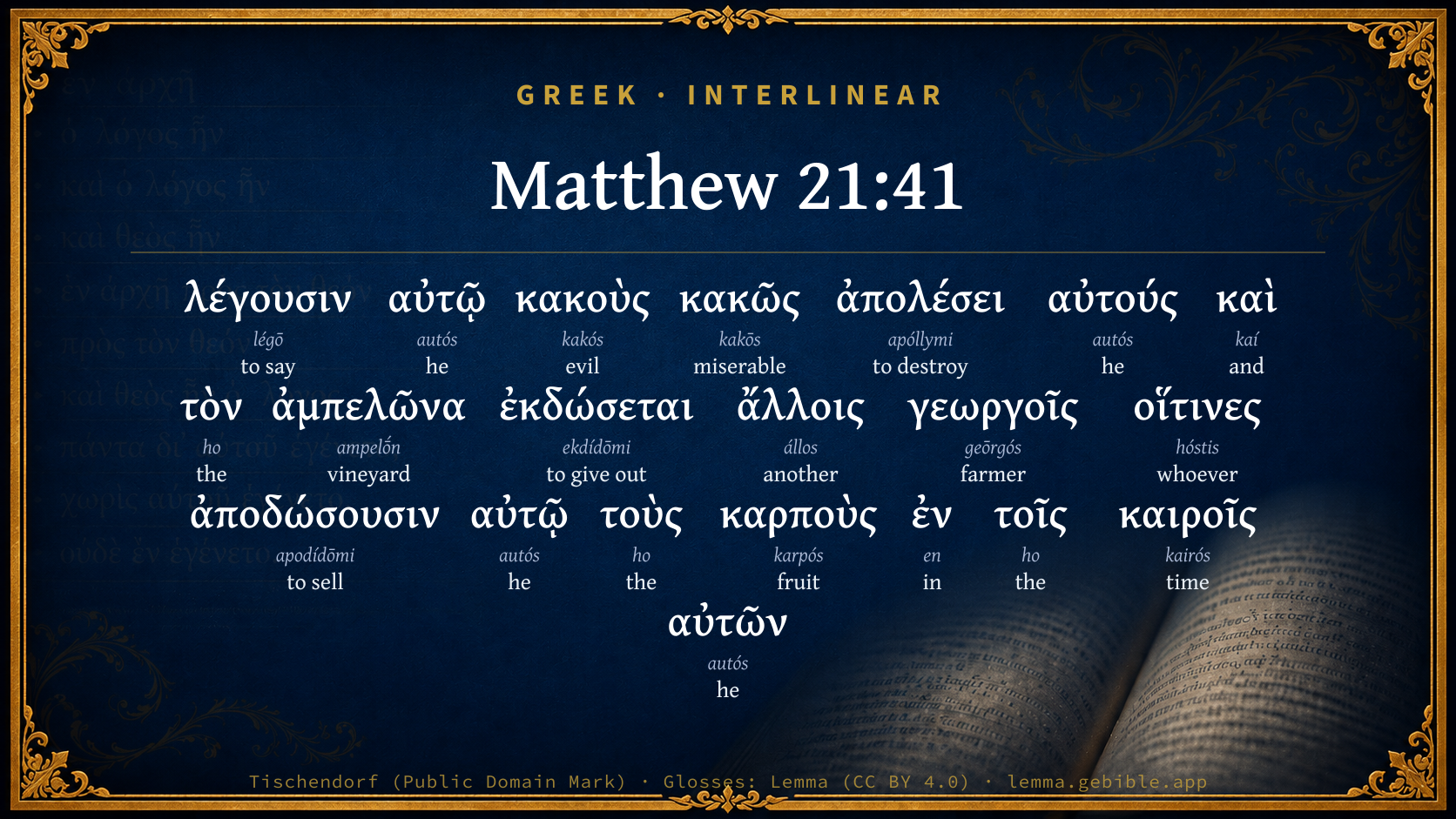
They told him, "He will miserably destroy those miserable men, and will lease out the vineyard to other farmers, who will give him the fruit in its season."
Download a study sheet
One document with this verse’s original text, its word-by-word gloss line, the meaning frame, cross-references with their text, attributed commentary, and full source and license credits — printable, and it pastes into notes with its structure intact.
This verse Autodidact and up
A passage Seminary Student
Up to 50 verses in one chapter. A passage sheet keeps up to 6 commentary sources and 12 cross-references per verse, in the order this page ranks them, and says so on the sheet whenever that leaves anything out. Ask for a single verse and you get the Autodidact verse sheet above.
Everything on this page stays free to read, with no account — the sheet is a download of what is already on screen, not access to it.
Compare translations 3
The same verse in 3 English versions, stacked beneath the original-language interlinear above. Click any original word for its lexicon entry.
Each is an independent rendering of the whole verse — the interlinear is not word-aligned to these translations.
Highlighted words mark where these versions differ — a whole-verse word diff, not a word-by-word alignment.
-
World English Bible Public Domain
They told him, "He will miserably destroy those miserable men, and will lease out the vineyard to other farmers, who will give him the fruit in its season."
-
King James Version Public Domain
They say unto him, He will miserably destroy those wicked men, and will let out his vineyard unto other husbandmen, which shall render him the fruits in their seasons.
-
unfoldingWord Literal Text CC BY-SA 4.0
They say to him, “He will severely destroy those evil ones, and he will rent out the vineyard to other farmers who will repay him the fruits in their times.”
unfoldingWord Literal Text — © unfoldingWord, licensed CC BY-SA 4.0. Word-aligned USFM3 via Door43 (git.door43.org/unfoldingWord/en_ult).
Show all 19 translations
Every available English version of this verse, each an independent rendering of the whole verse.
-
World English Bible Public Domain
They told him, "He will miserably destroy those miserable men, and will lease out the vineyard to other farmers, who will give him the fruit in its season."
-
Berean Standard Bible Public Domain
“He will bring those wretches to a wretched end,” they replied, “and will rent out the vineyard to other tenants who will give him his share of the fruit at harvest time.”
-
Majority Standard Bible Public Domain
“He will bring those wretches to a wretched end,” they replied, “and will rent out the vineyard to other tenants who will give him his share of the fruit at harvest time.”
-
King James Version Public Domain
They say unto him, He will miserably destroy those wicked men, and will let out his vineyard unto other husbandmen, which shall render him the fruits in their seasons.
-
American Standard Version (1901) Public Domain
They say unto him, He will miserably destroy those miserable men, and will let out the vineyard unto other husbandmen, who shall render him the fruits in their seasons.
-
Revised Version (1885) Public Domain
They say unto him, He will miserably destroy those miserable men, and will let out the vineyard unto other husbandmen, which shall render him the fruits in their seasons.
-
Geneva Bible (1599) Public Domain
They saide vnto him, Hee will cruelly destroy those wicked men, and will let out his vineyard vnto other husbandmen, which shall deliuer him the fruites in their seasons.
-
Douay-Rheims (1899) Public Domain
They say to him: He will bring those evil men to an evil end; and will let out his vineyard to other husbandmen, that shall render him the fruit in due season.
-
Young's Literal Translation Public Domain
They say to him, `Evil men -- he will evilly destroy them, and the vineyard will give out to other husbandmen, who will give back to him the fruits in their seasons.'
-
Literal Standard Version CC BY-SA 4.0
They say to Him, “Evil men—he will grievously destroy them, and will give out the vineyard to other farmers who will give back to him the fruits in their seasons.”
-
Unlocked Literal Bible CC BY-SA 4.0
They said to him, “He will destroy those miserable men in the most severe way, and will then rent out the vineyard to other vine growers, men who will give him his share of crops at the harvest time.”
-
unfoldingWord Literal Text CC BY-SA 4.0
They say to him, “He will severely destroy those evil ones, and he will rent out the vineyard to other farmers who will repay him the fruits in their times.”
-
Darby Bible Public Domain
They say to him, He will miserably destroy those evil [men], and let out the vineyard to other husbandmen, who shall render him the fruits in their seasons.
-
World Messianic Bible Public Domain
They told him, “He will miserably destroy those miserable men, and will lease out the vineyard to other farmers who will give him the fruit in its season.”
-
Webster's Bible Public Domain
They say to him, He will miserably destroy those wicked men, and will let out his vineyard to other husbandmen, who will render him the fruits in their seasons.
-
Free Bible Version CC BY-SA 4.0
The chief priests and elders said to Jesus, “He will put to death those wicked men in the most awful way, and rent out the vineyard to other farmers who will be sure to give him his fruit at harvest-time.”
-
Bible in Basic English Public Domain
They say to him, He will put those cruel men to a cruel death, and will let out the vine-garden to other workmen, who will give him the fruit when it is ready.
-
Text-Critical English NT CC BY 4.0
They said to him, “He will bring those wretches to a wretched end and lease the vineyard to other farmers who will give him the fruits in their seasons.”
-
Tyndale New Testament (1534) Public Domain
They sayde vnto him: he will cruellye destroye those evyll persons and wyll let out his vyneyarde vnto other husbandmen which shall delyver him the frute at tymes convenient.
Literal Standard Version (2020), Covenant Press — licensed CC BY-SA 4.0. Text via the HelloAO Bible API (eBible.org). Unlocked Literal Bible (unfoldingWord) — licensed CC BY-SA 4.0. Text via the HelloAO Bible API (eBible.org). unfoldingWord Literal Text — © unfoldingWord, licensed CC BY-SA 4.0. Word-aligned USFM3 via Door43 (git.door43.org/unfoldingWord/en_ult). Free Bible Version, Dr. Jonathan Gallagher — licensed CC BY-SA 4.0. Text via the HelloAO Bible API (eBible.org).
Word by word
More ways to search: Search by grammar → Find every occurrence → Compare this word →
Practice this passage: Drill this verse → Learn its vocabulary →
- Appears 4× in the Greek New Testament
- First appears at Matthew 21:33
- Part of Speech
- Verb
- Tense
- Future
- Voice
- Middle deponent
- Mood
- Indicative
- Person
- 3rd person
- Number
- Singular
Full Thayer's Definition
- λέγουσιν légō G3004 “to say” Verb, Present, Active, Indicative, 3rd person, Plural
- αὐτῷ autós G846 “he” Personal pronoun, Dative, Singular, Masculine
- κακοὺς kakós G2556 “evil” Adjective, Accusative, Plural, Masculine
- κακῶς kakōs G2560 “miserable” Adverb
- ἀπολέσει apóllymi G622 “to destroy” Verb, Future, Active, Indicative, 3rd person, Singular
- αὐτούς autós G846 “he” Personal pronoun, Accusative, Plural, Masculine
- καὶ kaí G2532 “and” Conjunction
- τὸν ho G3588 “the” Article, Accusative, Singular, Masculine
- ἀμπελῶνα ampelṓn G290 “vineyard” Noun, Accusative, Singular, Masculine
- ἐκδώσεται ekdídōmi G1554 “to give out” Verb, Future, Middle deponent, Indicative, 3rd person, Singular
- ἄλλοις állos G243 “another” Adjective, Dative, Plural, Masculine
- γεωργοῖς geōrgós G1092 “farmer” Noun, Dative, Plural, Masculine
- οἵτινες hóstis G3748 “whoever” Relative pronoun, Nominative, Plural, Masculine
- ἀποδώσουσιν apodídōmi G591 “to sell” Verb, Future, Active, Indicative, 3rd person, Plural
- αὐτῷ autós G846 “he” Personal pronoun, Dative, Singular, Masculine
- τοὺς ho G3588 “the” Article, Accusative, Plural, Masculine
- καρποὺς karpós G2590 “fruit” Noun, Accusative, Plural, Masculine
- ἐν en G1722 “in” Preposition
- τοῖς ho G3588 “the” Article, Dative, Plural, Masculine
- καιροῖς kairós G2540 “time” Noun, Dative, Plural, Masculine
- αὐτῶν autós G846 “he” Personal pronoun, Genitive, Plural, Masculine
About this verse
These counts appear in no published source. They are computed here, from the morphology-tagged text and Lemma’s own curated glosses. What Lemma adds →
- 21
- words
- 16
- distinct lemmas
- Gospels
- section
Notable vocabulary
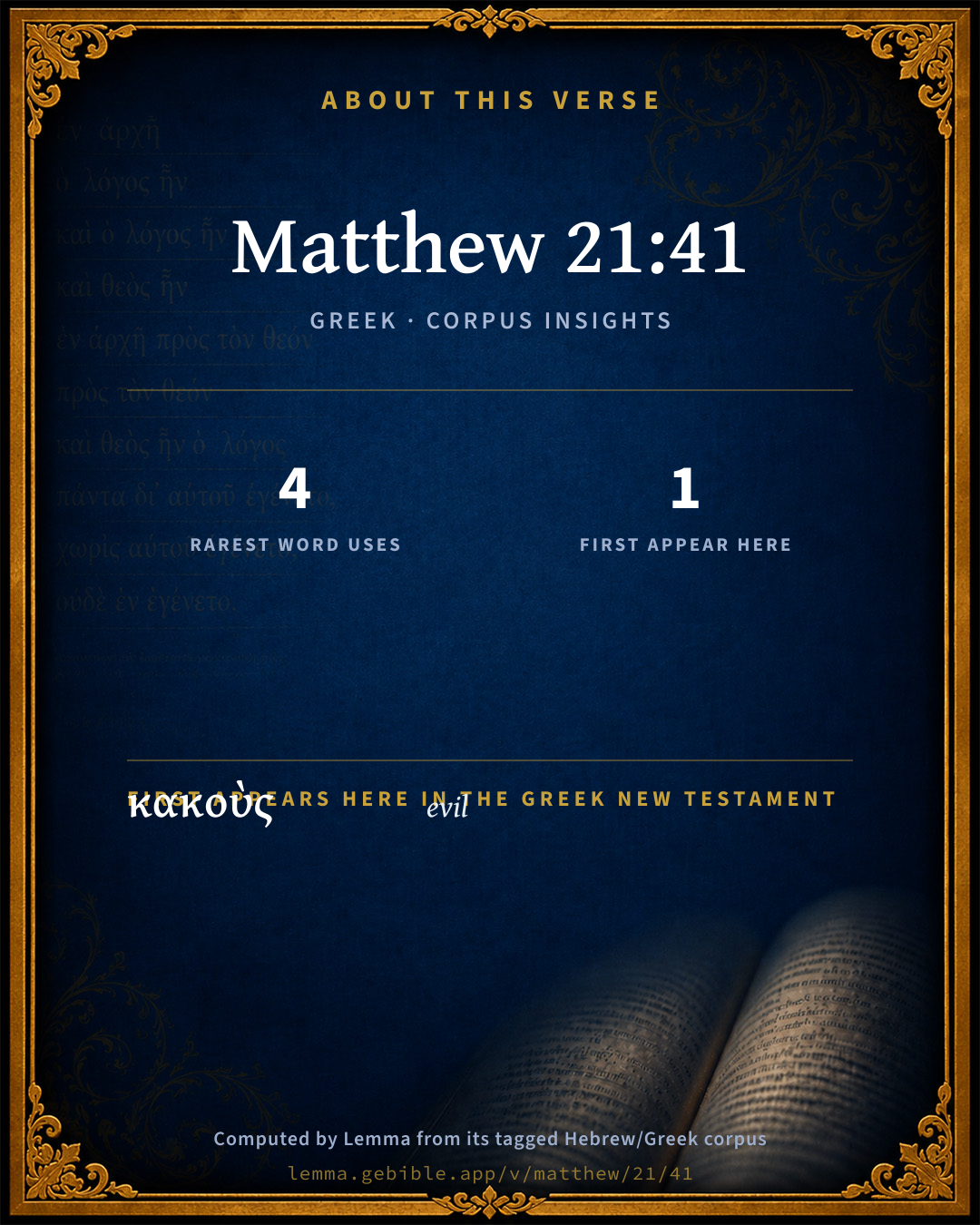
The rarest word here is ἐκδώσεται to give out G1554 — appearing just 4 times in the whole Greek New Testament.
First appearance in Scripture
This word makes its first canonical appearance in the Greek New Testament here:
- κακοὺς evil G2556
Shared distinctive vocabulary
ἐκδώσεται to give out G1554 occurs in 4 verses of the Greek New Testament. Also found in:
Cross-references
35Topical passages linked to Matthew 21:41 in the Treasury of Scripture Knowledge — connected by theme and wording, ordered by reader-vote popularity; previews shown in the World English Bible.
- Acts 18:6 When they opposed him and blasphemed, he shook out his clothing and said to them, "Your blood be on your own heads! I am clean. From now on, I will go to the Gentiles!"
- Matthew 21:43 "Therefore I tell you, the Kingdom of God will be taken away from you, and will be given to a nation bringing forth its fruits.
- Isaiah 5:5–7 Now I will tell you what I will do to my vineyard. I will take away its hedge, and it will be eaten up. I will break down its wall of it, and it will be trampled down.
- Matthew 22:6–7 and the rest grabbed his servants, and treated them shamefully, and killed them.
- Acts 28:28 "Be it known therefore to you, that the salvation of God is sent to the Gentiles. They will also listen."
- Leviticus 26:14–46 "'But if you will not listen to me, and will not do all these commandments;
- Deuteronomy 28:59–68 then Yahweh will make your plagues wonderful, and the plagues of your seed, even great plagues, and of long continuance, and sore sicknesses, and of long continuance.
- Psalms 2:4–5 He who sits in the heavens will laugh. The Lord will have them in derision.
- Psalms 2:9 You shall break them with a rod of iron. You shall dash them in pieces like a potter's vessel."
- Isaiah 49:5–7 Now says Yahweh who formed me from the womb to be his servant, to bring Jacob again to him, and that Israel be gathered to him (for I am honorable in the eyes of Yahweh, and my God is become my strength);
- Isaiah 66:19–21 I will set a sign among them, and I will send such as escape of them to the nations, to Tarshish, Pul, and Lud, who draw the bow, to Tubal and Javan, to the isles afar off, who have not heard my fame, neither have seen my glory; and they shall declare my glory among the nations.
- Daniel 9:26 After the sixty-two weeks the Anointed One shall be cut off, and shall have nothing: and the people of the prince who shall come shall destroy the city and the sanctuary; and the end of it shall be with a flood, and even to the end shall be war; desolations are determined.
- Zechariah 11:8–10 I cut off the three shepherds in one month; for my soul was weary of them, and their soul also loathed me.
- Zechariah 12:12 The land will mourn, every family apart; the family of the house of David apart, and their wives apart; the family of the house of Nathan apart, and their wives apart;
- Zechariah 13:8 It shall happen that in all the land," says Yahweh, Two parts in it will be cut off and die; But the third will be left in it.
- Zechariah 14:2–3 For I will gather all nations against Jerusalem to battle; and the city will be taken, the houses rifled, and the women ravished. half of the city will go out into captivity, and the rest of the people will not be cut off from the city.
- Malachi 4:1–6 "For, behold, the day comes, it burns as a furnace; and all the proud, and all who work wickedness, will be stubble; and the day that comes will burn them up," says Yahweh of Hosts, "that it shall leave them neither root nor branch.
- Matthew 3:12 His winnowing fork is in his hand, and he will thoroughly cleanse his threshing floor. He will gather his wheat into the barn, but the chaff he will burn up with unquenchable fire."
- Matthew 8:11–12 I tell you that many will come from the east and the west, and will sit down with Abraham, Isaac, and Jacob in the Kingdom of Heaven,
- Matthew 23:35–38 that on you may come all the righteous blood shed on the earth, from the blood of righteous Abel to the blood of Zachariah son of Barachiah, whom you killed between the sanctuary and the altar.
- Matthew 24:21–22 for then there will be great oppression, such as has not been from the beginning of the world until now, no, nor ever will be.
- Luke 13:28–29 There will be weeping and gnashing of teeth, when you see Abraham, Isaac, Jacob, and all the prophets, in the Kingdom of God, and yourselves being thrown outside.
- Luke 14:23–24 "The lord said to the servant, 'Go out into the highways and hedges, and compel them to come in, that my house may be filled.
- Luke 17:32–37 Remember Lot's wife!
- Luke 19:41–44 When he drew near, he saw the city and wept over it,
- Luke 21:22–24 For these are days of vengeance, that all things which are written may be fulfilled.
- Acts 13:46–48 Paul and Barnabas spoke out boldly, and said, "It was necessary that God's word should be spoken to you first. Since indeed you thrust it from you, and judge yourselves unworthy of eternal life, behold, we turn to the Gentiles.
- Acts 15:7 When there had been much discussion, Peter rose up and said to them, "Brothers, you know that a good while ago God made choice among you, that by my mouth the Gentiles should hear the word of the Gospel, and believe.
- Acts 28:8 It happened that the father of Publius lay sick of fever and dysentery. Paul entered in to him, prayed, and laying his hands on him, healed him.
- Romans 9:1–11 I tell the truth in Christ. I am not lying, my conscience testifying with me in the Holy Spirit,
- Romans 15:9–18 and that the Gentiles might glorify God for his mercy. As it is written, "Therefore will I give praise to you among the Gentiles, And sing to your name."
- 1 Thessalonians 2:16 forbidding us to speak to the Gentiles that they may be saved; to fill up their sins always. But wrath has come on them to the uttermost.
- Hebrews 2:3 how will we escape if we neglect so great a salvation-- which at the first having been spoken through the Lord, was confirmed to us by those who heard;
- Hebrews 12:25 See that you don't refuse him who speaks. For if they didn't escape when they refused him who warned on the Earth, how much more will we not escape who turn away from him who warns from heaven,
- Isaiah 65:15 You shall leave your name for a curse to my chosen; and the Lord Yahweh will kill you; and he will call his servants by another name:
Cross-references courtesy of OpenBible.info (CC BY 4.0).
Lesson kit
Teaching starters — assembled from the data on this page, not authored interpretation. Every prompt links to the verse data it draws on. Edit before teaching.
Matthew, in the Gospels, opens this verse with 21 words (16 distinct Greek lemmas). Its most distinctive word is ekdídōmi (“to give out”). A historical commentator’s framing appears above. Read the whole chapter for the surrounding context.
Discussion questions
- The word ekdídōmi carries the sense “to give out.” How does it shape the verse?
- The word “evil” first appears here in Scripture. What is being introduced at this debut?
- Matthew 21:33 shares the word «to give out» with this verse. How do the two illuminate each other?
- “he” occurs 4× in this one verse. What is the effect of the repetition?
- These translations render this verse differently; the difference is in the English rendering, not the original. What questions does that raise?
- Reading how Tyndale Open Study Notes and Bengel's Gnomon read this verse, where do the two commentators agree and where do they part?
Things to notice
- 1 word makes its first canonical appearance in Scripture here.
- These translations choose different wording for 25 words in this verse.
- “he” occurs 4× in this single verse.
- 16 distinct Greek lemmas span 21 words in this verse.
Commentary
Notes on Matthew 21:41 from classic Christian and Jewish commentators (each source and its license shown beneath its notes). The classic Christian expositions comment on the surrounding passage and are grouped to its opening verse, so a note may address several verses; the Jewish commentaries on the Tanakh (Rashi and others) are per-verse, so they appear only where the commentator wrote on this verse.
Lemma curates 59 commentaries, every one of them public domain or Creative Commons licensed, each selected and text-cleaned for this edition rather than reprinted as found. About our sources →
Tyndale Open Study Notes
Tyndale Open Resources
Tyndale Open Study Notes — © Tyndale Open Resources, licensed CC BY-SA 4.0. Text via the HelloAO Bible API.
Bengel's Gnomon
Johann Albrecht Bengel
Bengel's Gnomon of the New Testament — English translation (T&T Clark, Edinburgh, 1860) — public domain. Text from a community e-Sword module.
Expositor's Greek Testament
ed. W. Robertson Nicoll
The Expositor's Greek Testament, edited by W. Robertson Nicoll (1897–1910) — public domain. Text from a community e-Sword module.
Geneva Bible (1599)
Geneva Bible translators
Geneva Bible (1599) marginal notes — public domain. Text via Bolls.life.
Jamieson, Fausset & Brown
Robert Jamieson, A. R. Fausset & David Brown
Jamieson, Fausset & Brown — Commentary Critical and Explanatory on the Whole Bible (1871) — public domain (CC PDM 1.0). Text via the HelloAO Bible API.
Adam Clarke's Commentary
Adam Clarke's Commentary on the Bible (1810–1826) — public domain. Text from a community e-Sword/MySword module.
Ellicott's Commentary for English Readers
A Bible Commentary for English Readers, edited by Charles John Ellicott (1878–1897) — public domain. Text from a community e-Sword module.
The Cambridge Bible for Schools and Colleges
gen. ed. J. J. S. Perowne
The Cambridge Bible for Schools and Colleges (gen. ed. J. J. S. Perowne; Cambridge University Press, 1878–1918) — public domain. Text from a community e-Sword module.
John Gill's Exposition
John Gill's Exposition of the Whole Bible (1746–1763) — public domain (CC PDM 1.0). Text via the HelloAO Bible API.
Trapp's Complete Commentary
John Trapp
John Trapp, A Commentary or Exposition upon All the Books of the Old and New Testament (1647–1656) — public domain. Text from a community e-Sword module.
Haydock's Catholic Bible Commentary
George Leo Haydock (1774–1849), Haydock's Catholic Family Bible and Commentary, 1859 edition — public domain. Excludes Psalms (Douay-Rheims chapter numbering differs from Protestant) and Deuterocanonical books (Catholic canon only).
Whedon's Commentary on the Bible
Daniel D. Whedon
Daniel D. Whedon (gen. ed.), Commentary on the Old and New Testaments (1874–1909) — public domain. Text from a community e-Sword module.
The Pulpit Commentary
The Pulpit Commentary (1880–1919), ed. H.D.M. Spence-Jones & Joseph S. Exell — public domain. Text from a community e-Sword module.
John Wesley's Explanatory Notes
John Wesley, Explanatory Notes Upon the Whole Bible (1754–1765) — public domain. Text via the GEBible commentary corpus.
The People's New Testament
B. W. Johnson
B. W. Johnson's The People's New Testament with Notes (1889–1891) — public domain. Electronic text from the Christian Classics Ethereal Library (CCEL) ThML edition.
Cambridge Greek Testament for Schools and Colleges
Cambridge Greek Testament for Schools and Colleges (Cambridge University Press, 1896; 21 vols, various authors incl. Carr, Maclear, Plummer, Farrar, Lumby, Moule, M. R. James, Simcox) — public domain. Text from a community e-Sword module.
Alford’s Greek Testament
Henry Alford
Henry Alford, The Greek Testament (1849–1861) — public domain. Text from a community e-Sword module.
Vincent's Word Studies in the New Testament
Marvin R. Vincent
Marvin R. Vincent, Word Studies in the New Testament (1887–1900) — public domain. Text from a community e-Sword/MySword module.