
Matthew 25:32

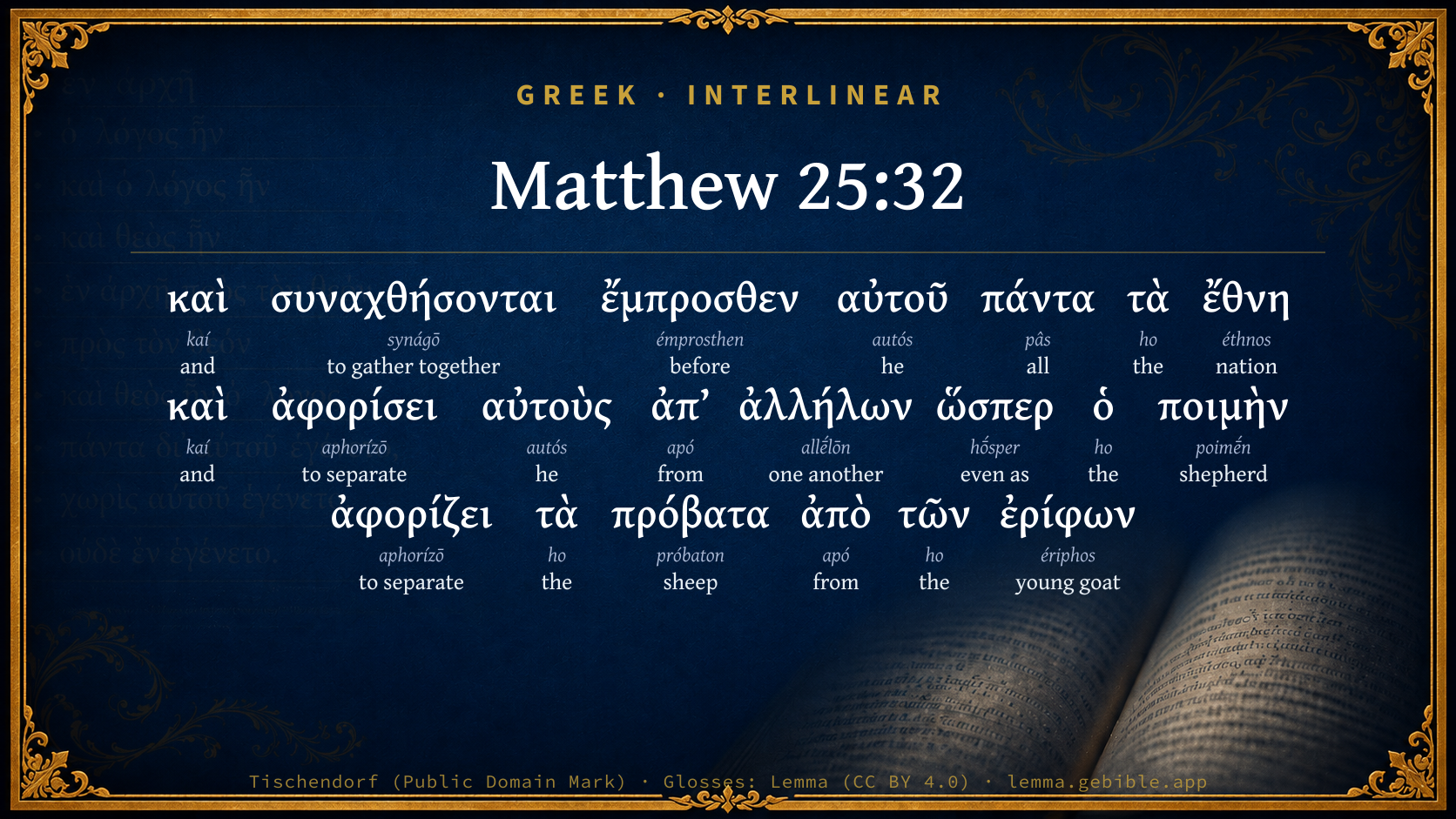
Greek (Tischendorf 8th ed.) Matthew 25:32 appears in the Greek New Testament. The text above is from the Tischendorf 8th edition. Each word links to its Strong’s number and a concise gloss. Click any word for its full Thayer’s Greek Lexicon entry.
Download image
Cite this verse

Matthew 25:32 (World English Bible). Public Domain. Lemma interlinear Bible study tool, https://lemma.gebible.app/v/matthew/25/32.

Show BibTeX & RIS
BibTeX
RIS
English Translation
Before him all the nations will be gathered, and he will separate them one from another, as a shepherd separates the sheep from the goats.
World English Bible · Public Domain
Highlights
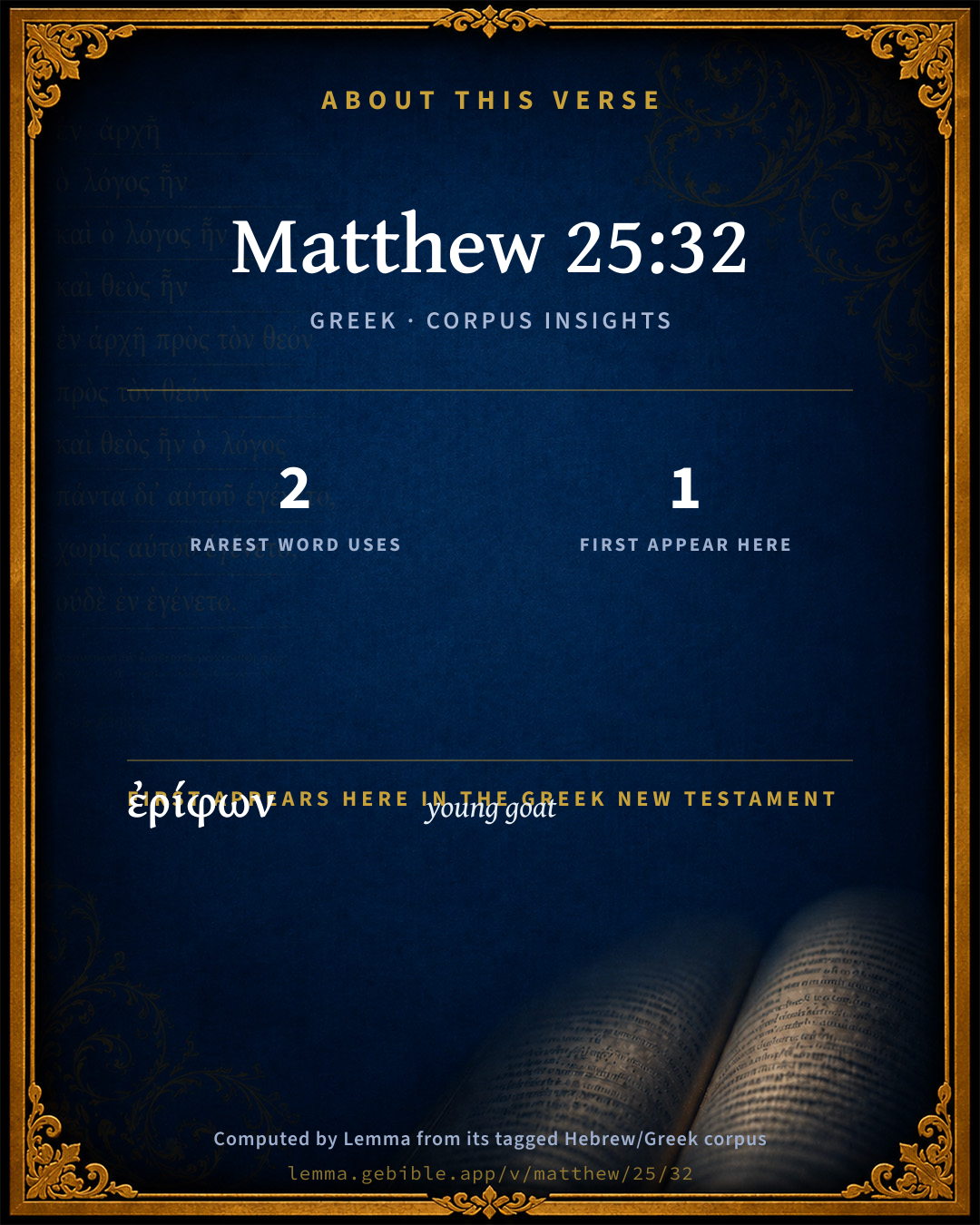
  • 1 first appearance in the Greek New Testament
Full analysis ↓
Download a study sheet

One document with this verse’s original text, its word-by-word gloss line, the meaning frame, cross-references with their text, attributed commentary, and full source and license credits — printable, and it pastes into notes with its structure intact.

This verse Autodidact and up

Study sheet (.html) Plain text (.txt)

A passage Seminary Student

Up to 50 verses in one chapter. A passage sheet keeps up to 6 commentary sources and 12 cross-references per verse, in the order this page ranks them, and says so on the sheet whenever that leaves anything out. Ask for a single verse and you get the Autodidact verse sheet above.

Everything on this page stays free to read, with no account — the sheet is a download of what is already on screen, not access to it.

Want to remove ads? Support Godless Engineer
Compare translations 3

The same verse in 3 English versions, stacked beneath the original-language interlinear above. Click any original word for its lexicon entry.

Each is an independent rendering of the whole verse — the interlinear is not word-aligned to these translations.

Highlighted words mark where these versions differ — a whole-verse word diff, not a word-by-word alignment.

  • World English Bible Public Domain
    Before him all the nations will be gathered, and he will separate them one from another, as a shepherd separates the sheep from the goats.
  • King James Version Public Domain
    And before him shall be gathered all nations: and he shall separate them one from another, as a shepherd divideth his sheep from the goats:
  • unfoldingWord Literal Text CC BY-SA 4.0
    And before him will be gathered all the nations, and he will separate them from one another, just as the shepherd separates the sheep from the goats.

unfoldingWord Literal Text — © unfoldingWord, licensed CC BY-SA 4.0. Word-aligned USFM3 via Door43 (git.door43.org/unfoldingWord/en_ult).

Versions to compare (up to 4)

3 of 4 selected

Show all 19 translations

Every available English version of this verse, each an independent rendering of the whole verse.

  • World English Bible Public Domain
    Before him all the nations will be gathered, and he will separate them one from another, as a shepherd separates the sheep from the goats.
  • Berean Standard Bible Public Domain
    All the nations will be gathered before Him, and He will separate the people one from another, as a shepherd separates the sheep from the goats.
  • Majority Standard Bible Public Domain
    All the nations will be gathered before Him, and He will separate the people one from another, as a shepherd separates the sheep from the goats.
  • King James Version Public Domain
    And before him shall be gathered all nations: and he shall separate them one from another, as a shepherd divideth his sheep from the goats:
  • American Standard Version (1901) Public Domain
    and before him shall be gathered all the nations: and he shall separate them one from another, as the shepherd separateth the sheep from the goats;
  • Revised Version (1885) Public Domain
    and before him shall be gathered all the nations: and he shall separate them one from another, as the shepherd separateth the sheep from the goats:
  • Geneva Bible (1599) Public Domain
    And before him shalbe gathered all nations, and he shall seperate them one from another, as a shepheard separateth the sheepe from ye goates.
  • Douay-Rheims (1899) Public Domain
    And all nations shall be gathered together before him, and he shall separate them one from another, as the shepherd separateth the sheep from the goats:
  • Young's Literal Translation Public Domain
    and gathered together before him shall be all the nations, and he shall separate them from one another, as the shepherd doth separate the sheep from the goats,
  • Literal Standard Version CC BY-SA 4.0
    and all the nations will be gathered together before Him, and He will separate them from one another, as the shepherd separates the sheep from the goats,
  • Unlocked Literal Bible CC BY-SA 4.0
    Before him will be gathered all the nations, and he will separate the people one from another, as a shepherd separates the sheep from the goats.
  • unfoldingWord Literal Text CC BY-SA 4.0
    And before him will be gathered all the nations, and he will separate them from one another, just as the shepherd separates the sheep from the goats.
  • Darby Bible Public Domain
    and all the nations shall be gathered before him; and he shall separate them from one another, as the shepherd separates the sheep from the goats;
  • World Messianic Bible Public Domain
    Before him all the nations will be gathered, and he will separate them one from another, as a shepherd separates the sheep from the goats.
  • Webster's Bible Public Domain
    And before him shall be gathered all nations: and he will separate them one from another, as a shepherd divideth his sheep from the goats:
  • Free Bible Version CC BY-SA 4.0
    Everyone will be brought before him. He will separate them from one another, as a shepherd separates the sheep from the goats.
  • Bible in Basic English Public Domain
    And before him all the nations will come together; and they will be parted one from another, as the sheep are parted from the goats by the keeper.
  • Text-Critical English NT CC BY 4.0
    All the nations will be gathered before him, and he will separate them from one another as a shepherd separates the sheep from the goats.
  • Tyndale New Testament (1534) Public Domain
    and before him shalbe Gaddred all nacions. And he shall seperate the one from a nother as a shepherde deuideth the shepe from the gootes.

Literal Standard Version (2020), Covenant Press — licensed CC BY-SA 4.0. Text via the HelloAO Bible API (eBible.org). Unlocked Literal Bible (unfoldingWord) — licensed CC BY-SA 4.0. Text via the HelloAO Bible API (eBible.org). unfoldingWord Literal Text — © unfoldingWord, licensed CC BY-SA 4.0. Word-aligned USFM3 via Door43 (git.door43.org/unfoldingWord/en_ult). Free Bible Version, Dr. Jonathan Gallagher — licensed CC BY-SA 4.0. Text via the HelloAO Bible API (eBible.org).

Word by word

More ways to search: Search by grammar → Find every occurrence → Compare this word →

Practice this passage: Drill this verse → Learn its vocabulary →

ἐρίφων
ériphos
G2056
“young goat”
Noun, Genitive, Plural, Masculine
Part of Speech
Noun
Case
Genitive
Number
Plural
Gender
Masculine
Full Thayer's Definition

Origin: perhaps from the same as G2053 (through the idea of hairiness)

TDNT: None

a. a kid, a young goat
  1. καὶ kaí G2532 “and” Conjunction
  2. συναχθήσονται synágō G4863 “to gather together” Verb, Future, Passive, Indicative, 3rd person, Plural
  3. ἔμπροσθεν émprosthen G1715 “before” Preposition
  4. αὐτοῦ autós G846 “he” Personal pronoun, Genitive, Singular, Masculine
  5. πάντα pâs G3956 “all” Adjective, Nominative, Plural, Neuter
  6. τὰ ho G3588 “the” Article, Nominative, Plural, Neuter
  7. ἔθνη éthnos G1484 “nation” Noun, Nominative, Plural, Neuter
  8. καὶ kaí G2532 “and” Conjunction
  9. ἀφορίσει aphorízō G873 “to separate” Verb, Future, Active, Indicative, 3rd person, Singular
  10. αὐτοὺς autós G846 “he” Personal pronoun, Accusative, Plural, Masculine
  11. ἀπ’ apó G575 “from” Preposition
  12. ἀλλήλων allḗlōn G240 “one another” Reciprocal pronoun, Genitive, Plural, Neuter
  13. ὥσπερ hṓsper G5618 “even as” Adverb
  14. ὁ ho G3588 “the” Article, Nominative, Singular, Masculine
  15. ποιμὴν poimḗn G4166 “shepherd” Noun, Nominative, Singular, Masculine
  16. ἀφορίζει aphorízō G873 “to separate” Verb, Present, Active, Indicative, 3rd person, Singular
  17. τὰ ho G3588 “the” Article, Accusative, Plural, Neuter
  18. πρόβατα próbaton G4263 “sheep” Noun, Accusative, Plural, Neuter
  19. ἀπὸ apó G575 “from” Preposition
  20. τῶν ho G3588 “the” Article, Genitive, Plural, Masculine

About this verse

These counts appear in no published source. They are computed here, from the morphology-tagged text and Lemma’s own curated glosses. What Lemma adds →

21
words
14
distinct lemmas
Gospels
section

Notable vocabulary

The rarest word here is ἐρίφων young goat G2056 — appearing just 2 times in the whole Greek New Testament.

First appearance in Scripture

This word makes its first canonical appearance in the Greek New Testament here:

  • ἐρίφων young goat G2056

Shared distinctive vocabulary

ἐρίφων young goat G2056 occurs in 2 verses of the Greek New Testament. Also found in:
Repetition

Words recur within this verse:

  • ἀφορίσει to separate G873 ×2
  • τὰ the G3588 ×4
  • καὶ and G2532 ×2
  • αὐτοῦ he G846 ×2
  • ἀπ’ from G575 ×2

Cross-references

20

Topical passages linked to Matthew 25:32 in the Treasury of Scripture Knowledge — connected by theme and wording, ordered by reader-vote popularity; previews shown in the World English Bible.

  • Malachi 3:18 Then you shall return and discern between the righteous and the wicked, between him who serves God and him who doesn't serve him.
  • Matthew 13:49 So will it be in the end of the world. The angels will come forth, and separate the wicked from among the righteous,
  • 2 Corinthians 5:10 For we must all be revealed before the judgment seat of Christ; that each one may receive the things in the body, according to what he has done, whether good or bad.
  • Psalms 98:9 Let them sing before Yahweh, For he comes to judge the earth. He will judge the world with righteousness, And the peoples with equity.
  • Ezekiel 34:17–22 As for you, O my flock, thus says the Lord Yahweh: Behold, I judge between sheep and sheep, the rams and the male goats.
  • Psalms 96:13 Before Yahweh; for he comes, For he comes to judge the earth. He will judge the world with righteousness, The peoples with his truth.
  • Matthew 3:12 His winnowing fork is in his hand, and he will thoroughly cleanse his threshing floor. He will gather his wheat into the barn, but the chaff he will burn up with unquenchable fire."
  • Psalms 1:5 Therefore the wicked shall not stand in the judgment, Nor sinners in the congregation of the righteous.
  • Psalms 50:3–5 Our God comes, and does not keep silent. A fire devours before him. It is very tempestuous around him.
  • John 10:14 I am the good shepherd. I know my own, and I'm known by my own;
  • Revelation 20:12–15 I saw the dead, the great and the small, standing before the throne, and they opened books. Another book was opened, which is the book of life. The dead were judged out of the things which were written in the books, according to their works.
  • Ezekiel 20:38 and I will purge out from among you the rebels, and those who disobey against me; I will bring them forth out of the land where they sojourn, but they shall not enter into the land of Israel: and you shall know that I am Yahweh.
  • Matthew 13:42–43 and will cast them into the furnace of fire. There will be weeping and the gnashing of teeth.
  • Romans 2:12 For as many as have sinned without law will also perish without the law. As many as have sinned under the law will be judged by the law.
  • Romans 2:16 in the day when God will judge the secrets of men, according to my Gospel, by Jesus Christ.
  • Romans 14:10–12 But you, why do you judge your brother? Or you again, why do you despise your brother? For we will all stand before the judgment seat of Christ.
  • 1 Corinthians 4:5 Therefore judge nothing before the time, until the Lord comes, who will both bring to light the hidden things of darkness, and reveal the counsels of the hearts. Then each man will get his praise from God.
  • John 10:27 My sheep hear my voice, and I know them, and they follow me.
  • Psalms 78:52 But he led forth his own people like sheep, And guided them in the wilderness like a flock.
  • Acts 17:30–31 The times of ignorance therefore God overlooked. But now he commands that all people everywhere should repent,

Cross-references courtesy of OpenBible.info (CC BY 4.0).

Commentary

Notes on Matthew 25:32 from classic Christian and Jewish commentators (each source and its license shown beneath its notes). The classic Christian expositions comment on the surrounding passage and are grouped to its opening verse, so a note may address several verses; the Jewish commentaries on the Tanakh (Rashi and others) are per-verse, so they appear only where the commentator wrote on this verse.

Lemma curates 59 commentaries, every one of them public domain or Creative Commons licensed, each selected and text-cleaned for this edition rather than reprinted as found. About our sources →

Joseph Benson's Commentary

Mat 25:32-33. Before him shall be gathered all nations — That is, all the individuals of all nations and ages; not only all that are found alive at the time of his appearing, and are changed in a moment, and rendered immortal, that they may be capable of enjoying eternal happiness, or of suffering everlasting misery, but all that had ever lived from the beginning to the end of time. All of every clime, country, and place, great and small, even from the remotest corners of the world. And he shall separate them one from another — According to their different characters, (which he most perfectly knows,) with as much ease as a shepherd divideth his sheep, which belong to his flock, from the goats, which may be mingled with them, and places them in distinct companies. And he shall set the sheep — The righteous, whom he will own as such, and who are termed sheep on account of their innocence, meekness, and usefulness; on his right hand — In token of his favour to them, and of the further honours he purposes to bestow upon them. And the goats — That is, the wicked, called goats because of the exorbitancy of their lusts; on his left — To intimate his displeasure against them, and their final removal from among his people; nor shall the haughtiest and mightiest sinner be able to resist that appointment by which he is placed in this situation. “I cannot imagine,” says Dr. Doddridge, “a more magnificent image than this; the assembled world distinguished with such unerring penetration, and distributed into two grand classes, with as much ease as sheep and goats are ranged by a shepherd in different companies.” The wicked and the godly in this world dwell together in the same kingdoms, cities, churches, families, and are not with certainty distinguishable always one from another: such are the infirmities of saints, such the hypocrisies of sinners, and one event frequently happening to both; but in that day they will be separated and parted for ever: for the Lord both knows them that are his, and them that are not, and he can and will separate them: and the separation will be so exact, that the most inconsiderable saint shall not be lost in the crowd of sinners, nor the most plausible sinner hid in the crowd of saints, Psa 1:5; but every one shall go to his own place. Dr. Whitby thinks, that there is an allusion here to the received custom of the Jews in capital causes, to place them who are to be acquitted on the right hand, in the sanhedrim, and those who were to receive the sentence of condemnation, on the left.

Joseph Benson's Commentary on the Old and New Testaments (1811–1818) — public domain. Text from a community e-Sword module.

Bengel's Gnomon

Johann Albrecht Bengel

Mat 25:32. Ἀφοριεῖ, he shall separate) The separation will not be complete before then.

Bengel's Gnomon of the New Testament — English translation (T&T Clark, Edinburgh, 1860) — public domain. Text from a community e-Sword module.

Expositor's Greek Testament

ed. W. Robertson Nicoll

Mat 25:32 . πάντα τὰ ἔθνη naturally suggests the heathen peoples as distinct from Jews, though the latter may be included, notwithstanding the fact that in one respect their judgment day had already come (Mat 24:15-22 ). ἀφοριεῖ : first a process of separation as in the interpretation of the parable of the tares (Mat 13:40 ). τά πρόβατα ἀπὸ τῶν ἐρίφων , the sheep from the young goats. Sheep and goats, though feeding together under the care of the same shepherd, seem of their own accord to separate into two companies. Tristram and Furrer bear witness to this.

The Expositor's Greek Testament, edited by W. Robertson Nicoll (1897–1910) — public domain. Text from a community e-Sword module.

Adam Clarke's Commentary

Verse 32. All nations] Literally, all the nations - all the Gentile world; the Jews are necessarily included, but they were spoken of in a particular manner in the preceding chapter.

He shall separate them] Set each kind apart by themselves.

As a shepherd divideth, c.] It does not appear that sheep and goats were ever penned or housed together, though they might feed in the same pasture yet even this was not done but in separate flocks; so Virgil, Eclog. vii. v. 2.

Compulerantque greges Corydon et Thyrsis in unum;

Thyrsis OVES, Corydon distentas lacte

CAPELLAS.

"Thyrsis and Corydon drove their flocks together: Thyrsin his sheep; and Corydon his goats, their udders distended with milk."

These two shepherds had distinct flocks, which fed in the same pasture, but separately; and they are only now driven together, for the convenience of the two shepherds, during the time of their musical contest.

Adam Clarke's Commentary on the Bible (1810–1826) — public domain. Text from a community e-Sword/MySword module.

Ellicott's Commentary for English Readers

(32) Before him shall be gathered all nations.—Better, all the nations, or even better, perhaps, all the Gentiles. The word is that which, when used, as here, with the article, marks out, with scarcely an exception, the heathen nations of the world as distinguished from God’s people Israel (as, e.g., in Rom_15:11-12; Eph_2:11). The word, thus taken, serves as the key to the distinctive teaching that follows. We have had in this chapter, (1) in the Wise and Foolish Virgins, the law of judgment for all members of the Church of Christ; (2) in the Talents, that for all who hold any office or ministry in the Church: now we have (3) the law by which those shall be judged who have lived and died as heathens, not knowing the name of Christ, and knowing God only as revealed in Nature or in the law written in their hearts. Every stage in what follows confirms this interpretation.

As a shepherd divideth his sheep from the goats.—Elsewhere the shepherd’s work is the symbol of protective, self-sacrificing love, and, as such, our Lord had emphatically claimed for Himself the title of the Good Shepherd (Joh_10:14). Here we are reminded that even the shepherd has at times to execute the sentence of judgment which involves separation. The “right” hand and the “left” are used, according to the laws of what we might almost call a natural symbolism, as indicating respectively good and evil, acceptance and rejection.

A Bible Commentary for English Readers, edited by Charles John Ellicott (1878–1897) — public domain. Text from a community e-Sword module.

John Gill's Exposition

And before him shall be gathered all nations..... That is, all that have professed the Christian religion in all the nations of the world, whether Jews or Gentiles, high or low, rich or poor, wise and foolish, such as have had greater or lesser talents; though it is also true of every individual of mankind of every nation, tribe and family, of every sex, age, and state, that ever has been, is, or will be. Yet Christian professors seem only here intended, as the following distinction of them, their final state, and the reasons of it show. This collection of them before Christ, the righteous judge, will be made by the holy angels, who will come with him for this purpose; and being mighty, as they are, will be able to accomplish great a work; and especially as being under the direction, influence, and authority of so divine, glorious, and illustrious a person, as the son of man will then to all appear to be,

And he shall separate them one from another, as a shepherd divideth his sheep from the goats: they shall be gathered before him, as they were together in their visible church state, as being all under a profession of religion; some wise, some foolish virgins; some sheep, and others goats; some industrious, diligent, faithful, and laborious servants; others wicked, slothful, and unprofitable ones; many of whom pass undistinguished and undiscovered now: but then the judge, who is of quick understanding, will easily discern the one from the other; such as have the oil of grace in the vessels of their hearts, together with their lamps, from such as have only the outward visible lamp of a profession, but destitute of the grace of God; and good and faithful servants, who have made a right use of their gifts, from such who have been negligent, careless, and remiss; and though these have been folded together, sheep and goats, in the sheepfold of the church, where they have all bore the character of the sheep of Christ; yet now when the chief shepherd appears, who knows his own sheep, and calls them by name, he will as easily separate the one from the other, and more so, than any shepherd, among men, can part a flock consisting of sheep and goats. Hypocrites in Zion shall now be no more, nor sinners stand any longer in the congregation of the righteous, nor both together as one body, and on one side in judgment.

John Gill's Exposition of the Whole Bible (1746–1763) — public domain (CC PDM 1.0). Text via the HelloAO Bible API.

Trapp's Complete Commentary

John Trapp

32 And before him shall be gathered all nations: and he shall separate them one from another, as a shepherd divideth his sheep from the goats:

Ver. 32. And before him shall be gathered all] Then shall Adam see all his nephews at once; none shall be excused for absence at this general assizes, none shall appear by a proxy, all shall be compelled to come in and hear their sentence; which may be, as some conceive, a long while adoing. It may be made evident (saith one) from Scripture and reason, that this day of Christ’s kingly office in judging all men shall last haply longer than his private administration now (wherein he is less glorious) in governing the world. Things shall not be suddenly shuffled up at last day, as some imagine. (Mr Shepeard’s Sincere Convert, p. 87.)

And he shall separate them] Before he hears their causes; which is an argument of singular skill in the Judge; it being the course of other judges to proceed, Secundum allegata et probata. accoprding to their deeds. But he shall set men’s sins in order before their eyes, Psa 50:21, with items of the particulars.

John Trapp, A Commentary or Exposition upon All the Books of the Old and New Testament (1647–1656) — public domain. Text from a community e-Sword module.

Albert Barnes' Notes on the Bible

And before him ... - At his coming to judgment the world will be burned up, 2Pe 3:10, 2Pe 3:12; Rev 20:11. The dead in Christ that is, all true Christians - will be raised up from their graves, 1Th 4:16. The living will be changed - i. e., will be made like the glorified bodies of those that are raised from the dead, 1Co 15:52-54; 1Th 4:17. All the wicked will rise and come forth to judgment, Joh 5:28-29; Dan 12:2; Mat 13:41-42; Rev 20:13. Then shall the world be judged, the righteous saved, and the wicked punished.

And he shall separate ... - Shall determine respecting their character, and shall appoint them their doom accordingly.

Albert Barnes' Notes on the Bible (1834–1885) — public domain. Text from a community e-Sword/MySword module.

Whedon's Commentary on the Bible

Daniel D. Whedon

32. All nations — Of all ages and all continents. Assyria, Persia, Greece, Rome, Russia, England, and America shall, with all their populations, come up before God. All the lesser tribes and all the unorganized wanderers shall appear; for “every eye shall see him.” Rev_1:7.

That it is a judicial arraignment of individuals, and not of organic nations, is plain; because the merits and demerits upon which they are judged are purely individual, and not national, (Mat_25:35-40; Mat_25:42-45.) So in Mat_28:19, the apostles are commanded to go teach all nations, baptizing them, etc. That is, the entire nation is to be baptized by the baptism of every individual in it. Mark expresses it: “Preach the gospel to every creature.” So “we must all appear before the judgment seat of Christ, that every one may receive the things done in the body.” 2Co_5:10. He hath appointed a day in which he will judge the world.

Separate them — The separation is even previous to the judgment. This strikingly and, as we may say, undesignedly coincides with the view everywhere clearly expressed or implied, that the resurrection, though one in general time, is yet twofold. It is of the just and of the unjust, (Act_24:15;) it is unto life and unto damnation, (Joh_5:29;) it is unto everlasting life and unto shame and everlasting contempt. Dan_12:2. The saints strive for a better resurrection, a glorious resurrection; and Paul strove to attain to an extra resurrection, εξαναστασις. Php_3:11. Every man shall be in his own order. 1Co_15:23. And Christ here so arrays them right and left, that their position decides their destiny before their sentences pronounce it. As a shepherd — Here is a slight simile running through some three lines, from which interpreters of a certain class have taken license to misname this whole description of sixteen full verses, “The parable of the sheep and the goats.” The allusion to the shepherd is very transient, being a slight simile, and illustrates but a single point, namely, the separation before the judgment.

In this allusion, as in other Scripture allusions of the same kind, no doubt some reference is made to the character of the two animals. The goat is especially a repulsive animal, and so a fit image for wicked men; and in Hebrew there is a single word which seems to designate the goat and a demon. And similarly, in all ages perhaps, the right hand has had the preference, and the right hand seat has been the place of honour.

Daniel D. Whedon (gen. ed.), Commentary on the Old and New Testaments (1874–1909) — public domain. Text from a community e-Sword module.

The Pulpit Commentary

Shall be gathered. (Mat_24:31) The angels shall gather them, the dead being first raised to life. All (ta , the) nations. Not the heathen only, but all mankind (see preliminary note). The criteria upon which the judgment proceeds, in the following verses, seem to imply that all men have the opportunity of receiving or rejecting the gospel. (Mat_24:14 Mar_13:10 Rom_11:32) How this can apply to those who died before the incarnation of Christ and the consequent evangelization of the world, we know not, though we may believe that, ere the end comes, Christ will have been preached in every quarter of the globe. That some process of enlightenment goes on in the unseen world we learn from the mysterious passage, in 1Pe_3:18-20; but we have no reason to suppose that probation is extended to the other life, or that souls will there have the offer of accepting or repelling the claims of Jesus. (but see Php_2:10 1Pe_4:6) By describing mankind as "all the nations," Christ shows the minute particularity of the judgment, which will enter into distinctions of country, race, etc., and while it is universal will be strictly impartial. He is the Shepherd of all mankind, whether considered as sheep or goats, and can therefore distinguish and class them perfectly. Those who have never heard of Christ (if such there shall be) can be tried only by the standard of natural religion. (Rom_1:20) Shall separate them (autouv). Individuals of all the nations. Hitherto good and bad had been mingled together, often indistinguishable by man"s eye or judgment; now an eternal distinction is made by an unerring hand. (Mat_13:49) The ideals already found Eze_34:17, "Behold, I judge between cattle and cattle, between the rams and the he goats." As a shepherd divideth his sheep from the goats. The flocks of sheep and goats generally keep together during the day, (Gen_30:33) but are separated at night or when being driven. The Syrian goat is usually black. The Lord delights in employing simple pastoral illustrations in his teaching.

The Pulpit Commentary (1880–1919), ed. H.D.M. Spence-Jones & Joseph S. Exell — public domain. Text from a community e-Sword module.

Scofield Reference Notes

C. I. Scofield

And before him

This judgment is to be distinguished from the judgment of the great white throne. Here there is no resurrection; the persons judged are living nations; no books are opened; three classes are present, sheep, goats, and brethren; the time is at the return of Christ (Mat 25:31); and the scene is on the earth. All these particulars are in contrast with Rev 20:11-15.

The test in this judgment is the treatment accorded by the nations to those whom Christ here call "my brethren." These "brethren" are the Jewish Remnant who will have preached the Gospel of the kingdom to all nations during the tribulation. See "Remnant" Isa 1:9; Rom 11:5.

The test in Rev 20:11-15 is the possession of eternal life. See, for the other six judgments: (See Scofield "Joh 12:31") 1Co 11:31" See Scofield "2Co 5:10" See Scofield "Eze 20:37" See Scofield "Jud 1:6" See Scofield "Rev 20:12"

The Scofield Reference Bible (1917 edition), notes by C. I. Scofield — public domain. Text from a community e-Sword module.

The People's New Testament

B. W. Johnson

32. Before him shall be gathered all nations. It will be the day of the final account of all the world. He shall separate them. Now for the first time the separation takes place. The two classes have been mingled on the earth; every nation, country, town and city has had its wicked as well as righteous; nay, even into the church the bad have crept, but now they are separated forever.

B. W. Johnson's The People's New Testament with Notes (1889–1891) — public domain. Electronic text from the Christian Classics Ethereal Library (CCEL) ThML edition.

Cambridge Greek Testament for Schools and Colleges

32. πάντα τὰ ἔθνη. Either (1) all the nations of the world, including the Jews; or (2) all the Gentiles. The almost invariable use of τὰ ἔθνη to signify the Gentiles; the unconsciousness of service to Christ shewn by just and unjust alike; the simplicity of the standard proposed by the Judge, favour the second interpretation. On the other hand the special warning to the Apostles, and to the Jewish race, in the previous parts of the discourse render it probable that Jews and Christians are not excluded from this picture of the judgment. The unconsciousness of the judged may be referred not to ignorance of Christ, but to unconsciousness that in relieving the distressed they were actually relieving Christ. The simplicity of the standard may be intended to include what is called ‘natural’ religion, as well as revealed religion. The nations are judged by a standard of justice which all recognise. (Read Rom 1:18-20; Rom 2:9-16.)

ὥσπερ ὁ ποιμὴν κ.τ.λ. Cp. Eze 34:17, ‘And as for you, O my flock, thus saith the Lord God; Behold, I judge between cattle and cattle, between the rams and the he goats.’ ‘The sheep and goats are always seen together under the same shepherd and in company; yet they never trespass on the domain of each other … When folded together at night they may always be seen gathered in distinct groups; and so, round the wells they appear instinctively to classify themselves apart, as they wait for the troughs to be filled.’—Tristram.

Cambridge Greek Testament for Schools and Colleges (Cambridge University Press, 1896; 21 vols, various authors incl. Carr, Maclear, Plummer, Farrar, Lumby, Moule, M. R. James, Simcox) — public domain. Text from a community e-Sword module.

Alford’s Greek Testament

Henry Alford

32.] The expression πάντα τὰ ἔθνη implies all the nations of the world, as distinguished from the ἐκλεκτοί already gathered to Him, just as the Gentiles were by that name distinguished from his chosen people the Jews. Among these are “the other sheep which He has, not of this fold,” Joh 10:16.

ἀφοριεῖ κ.τ.λ.] see Eze 34:17. The sheep are those referred to in Rom 2:7, Rom 2:10; the goats in ib. vv. 8, 9, where this same judgment according to works is spoken of.

Henry Alford, The Greek Testament (1849–1861) — public domain. Text from a community e-Sword module.

International Critical Commentary

32. And there shall be gathered before Him all the nations: and He shall separate them from one another as the shepherd separates the sheep from the goats.] For expressions in Jewish literature of the idea of a universal judgment, see Volz, Jüd. Eschat, 85.

ἀφορίσει] again in 13:49. In view of the necessary reference of αὐτούς to τὰ ἔθνη, it is impossible to limit the αὐτούς to members of the Jewish Christian community. The Gentiles are judged by the standard of their conduct to Jewish Christians, the τῶν ἀδελφῶν μου of v. 40.

(L)

International Critical Commentary — older volumes (1896–1929), various authors — public domain. Text from a community e-Sword module.

Vincent's Word Studies in the New Testament

Marvin R. Vincent

All the nations [παντα τα εθνη] . The whole human race; though the word is generally employed in the New Testament to denote Gentiles as distinguished from Jews.

Separate them [αυτους] . Masculine, while the word nations is neuter. Nations are regarded as gathered collectively; but in contemplating the act of separation the Lord regards the individuals.

The sheep from the goats (or kids, so Rev. in margin). "The bald division of men into sheep and goats is, in one sense, so easy as not to be worth performing; and in another sense it is so hard as only to be possible for something with supernatural insight" (John Morley, " Voltaire "). Goats are an appropriate figure, because the goat was regarded as a comparatively worthless animal. Hence the point of the elder son's complaint in the parable of the Prodigal : Not so much as a kid (Luk 14:29). The diminutive [εριφια] expresses contempt.

Marvin R. Vincent, Word Studies in the New Testament (1887–1900) — public domain. Text from a community e-Sword/MySword module.

Lesson kit

Teaching starters — assembled from the data on this page, not authored interpretation. Every prompt links to the verse data it draws on. Edit before teaching.

Matthew, in the Gospels, opens this verse with 21 words (14 distinct Greek lemmas). Its most distinctive word is ériphos (“young goat”). A historical commentator’s framing appears above. Read the whole chapter for the surrounding context.

Discussion questions

  1. What does “young goat” (ériphos) contribute to the verse as a whole?
  2. The word “young goat” first appears here in Scripture. What is being introduced at this debut?
  3. Luke 15:29 shares the word «young goat» with this verse. How do the two illuminate each other?
  4. “to separate” occurs 2× in this one verse. What is the effect of the repetition?
  5. These translations render this verse differently. What is at stake in choosing one wording over another?
  6. Reading how Joseph Benson's Commentary and Bengel's Gnomon read this verse, where do the two commentators agree and where do they part?

Things to notice

  • 1 word makes its first canonical appearance in Scripture here.
  • These translations choose different wording for 5 words in this verse.
  • “to separate” occurs 2× in this single verse.
  • 14 distinct Greek lemmas span 21 words in this verse.

Reading settings

Reading text

Shown beneath each verse's original-language words.

Old Testament
Old Testament edition

Read the OT as the Masoretic Hebrew (MT) or the Greek Septuagint (LXX).

English shown for the Greek Septuagint (in the Hebrew ↔ Greek comparison).

Comparing translations? Open the Compare panel on any verse page to stack up to four side by side.