
Matthew 23:25

Greek (Tischendorf 8th ed.) Matthew 23:25 appears in the Greek New Testament. The text above is from the Tischendorf 8th edition. Each word links to its Strong’s number and a concise gloss. Click any word for its full Thayer’s Greek Lexicon entry.
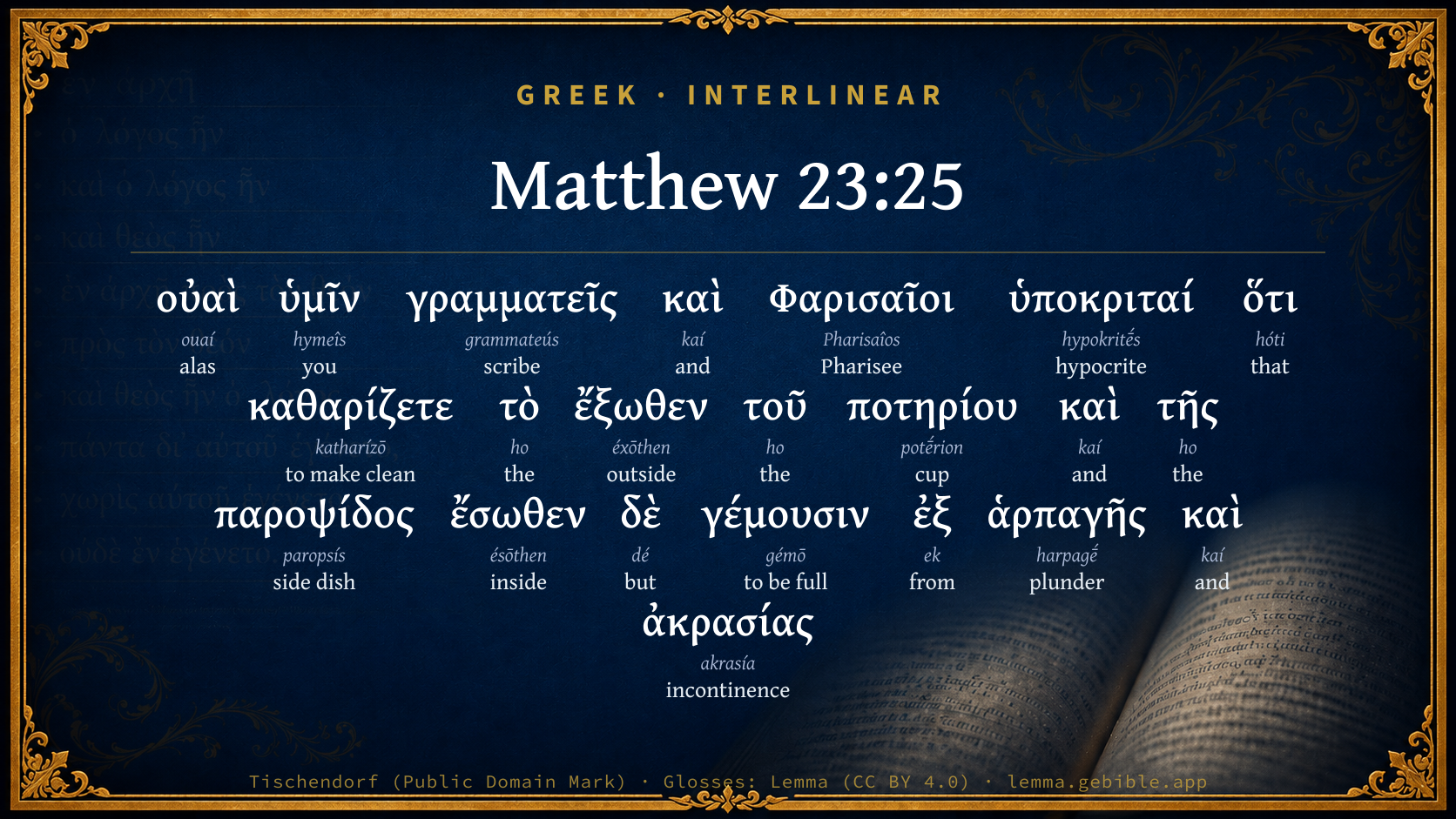
Download image
Cite this verse

Matthew 23:25 (World English Bible). Public Domain. Lemma interlinear Bible study tool, https://lemma.gebible.app/v/matthew/23/25.

Show BibTeX & RIS
BibTeX
RIS
English Translation
"Woe to you, scribes and Pharisees, hypocrites! For you clean the outside of the cup and of the platter, but within they are full of extortion and unrighteousness.
World English Bible · Public Domain
Highlights
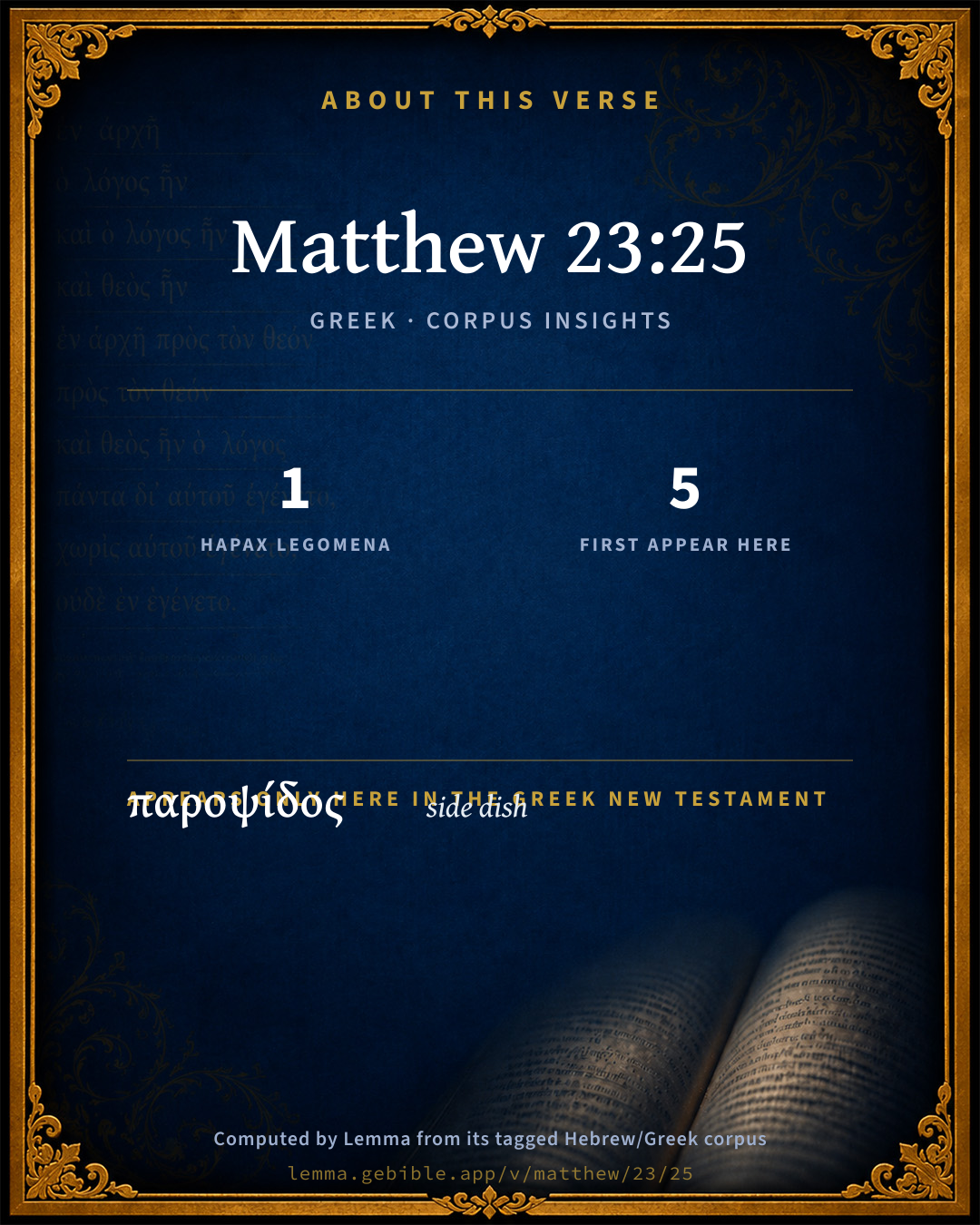
  • 1 hapax legomenon — only here in the Greek New Testament
  • 5 first appearances in the Greek New Testament
Full analysis ↓
Download a study sheet

One document with this verse’s original text, its word-by-word gloss line, the meaning frame, cross-references with their text, attributed commentary, and full source and license credits — printable, and it pastes into notes with its structure intact.

This verse Autodidact and up

Study sheet (.html) Plain text (.txt)

A passage Seminary Student

Up to 50 verses in one chapter. A passage sheet keeps up to 6 commentary sources and 12 cross-references per verse, in the order this page ranks them, and says so on the sheet whenever that leaves anything out. Ask for a single verse and you get the Autodidact verse sheet above.

Everything on this page stays free to read, with no account — the sheet is a download of what is already on screen, not access to it.

Want to remove ads? Support Godless Engineer
Compare translations 3

The same verse in 3 English versions, stacked beneath the original-language interlinear above. Click any original word for its lexicon entry.

Each is an independent rendering of the whole verse — the interlinear is not word-aligned to these translations.

Highlighted words mark where these versions differ — a whole-verse word diff, not a word-by-word alignment.

  • World English Bible Public Domain
    "Woe to you, scribes and Pharisees, hypocrites! For you clean the outside of the cup and of the platter, but within they are full of extortion and unrighteousness.
  • King James Version Public Domain
    Woe unto you, scribes and Pharisees, hypocrites! for ye make clean the outside of the cup and of the platter, but within they are full of extortion and excess.
  • unfoldingWord Literal Text CC BY-SA 4.0
    Woe to you, scribes and Pharisees, hypocrites! For you clean the outside of the cup and of the plate, but inside they are full of greed and lack of self-control.

unfoldingWord Literal Text — © unfoldingWord, licensed CC BY-SA 4.0. Word-aligned USFM3 via Door43 (git.door43.org/unfoldingWord/en_ult).

Versions to compare (up to 4)

3 of 4 selected

Show all 19 translations

Every available English version of this verse, each an independent rendering of the whole verse.

  • World English Bible Public Domain
    "Woe to you, scribes and Pharisees, hypocrites! For you clean the outside of the cup and of the platter, but within they are full of extortion and unrighteousness.
  • Berean Standard Bible Public Domain
    Woe to you, scribes and Pharisees, you hypocrites! You clean the outside of the cup and dish, but inside they are full of greed and self-indulgence.
  • Majority Standard Bible Public Domain
    Woe to you, scribes and Pharisees, you hypocrites! You clean the outside of the cup and dish, but inside they are full of greed and unrighteousness.
  • King James Version Public Domain
    Woe unto you, scribes and Pharisees, hypocrites! for ye make clean the outside of the cup and of the platter, but within they are full of extortion and excess.
  • American Standard Version (1901) Public Domain
    Woe unto you, scribes and Pharisees, hypocrites! for ye cleanse the outside of the cup and of the platter, but within they are full from extortion and excess.
  • Revised Version (1885) Public Domain
    Woe unto you, scribes and Pharisees, hypocrites! for ye cleanse the outside of the cup and of the platter, but within they are full from extortion and excess.
  • Geneva Bible (1599) Public Domain
    Wo be to you, Scribes and Pharises, hypocrites: for ye make cleane the vtter side of the cup, and of the platter: but within they are ful of briberie and excesse.
  • Douay-Rheims (1899) Public Domain
    Woe to you scribes and Pharisees, hypocrites; because you make clean the outside of the cup and of the dish, but within you are full of rapine and uncleanness.
  • Young's Literal Translation Public Domain
    `Wo to you, Scribes and Pharisees, hypocrites! because ye make clean the outside of the cup and the plate, and within they are full of rapine and incontinence.
  • Literal Standard Version CC BY-SA 4.0
    Woe to you, scribes and Pharisees, hypocrites! Because you make clean the outside of the cup and the plate, and within they are full of robbery and self-indulgence.
  • Unlocked Literal Bible CC BY-SA 4.0
    Woe to you, scribes and Pharisees, hypocrites! For you clean the outside of the cup and of the plate, but inside they are full of greed and self-indulgence.
  • unfoldingWord Literal Text CC BY-SA 4.0
    Woe to you, scribes and Pharisees, hypocrites! For you clean the outside of the cup and of the plate, but inside they are full of greed and lack of self-control.
  • Darby Bible Public Domain
    Woe to you, scribes and Pharisees, hypocrites, for ye make clean the outside of the cup and of the dish, but within they are full of rapine and intemperance.
  • World Messianic Bible Public Domain
    “Woe to you, scribes and Pharisees, hypocrites! For you clean the outside of the cup and of the platter, but within they are full of extortion and unrighteousness.
  • Webster's Bible Public Domain
    Woe to you, scribes and Pharisees, hypocrites! for ye make clean the outside of the cup and of the platter, but within they are full of extortion and excess.
  • Free Bible Version CC BY-SA 4.0
    What a disaster is coming on you religious teachers and Pharisees, you hypocrites! You clean the outside of the cup and the plate, but inside you're full of greed and self-indulgence.
  • Bible in Basic English Public Domain
    A curse is on you, scribes and Pharisees, false ones! for you make clean the outside of the cup and of the plate, but inside they are full of violent behaviour and uncontrolled desire.
  • Text-Critical English NT CC BY 4.0
    “Woe to you, scribes and Pharisees, hypocrites! For you cleanse the outside of the cup and the dish, but the inside is filled with the fruits of your robbery and unrighteousness.
  • Tyndale New Testament (1534) Public Domain
    Wo be to you scribes and pharises ypocrites which make clene the vtter syde of the cuppe and of the platter: but within they are full of brybery and excesse.

Literal Standard Version (2020), Covenant Press — licensed CC BY-SA 4.0. Text via the HelloAO Bible API (eBible.org). Unlocked Literal Bible (unfoldingWord) — licensed CC BY-SA 4.0. Text via the HelloAO Bible API (eBible.org). unfoldingWord Literal Text — © unfoldingWord, licensed CC BY-SA 4.0. Word-aligned USFM3 via Door43 (git.door43.org/unfoldingWord/en_ult). Free Bible Version, Dr. Jonathan Gallagher — licensed CC BY-SA 4.0. Text via the HelloAO Bible API (eBible.org).

Word by word

More ways to search: Search by grammar → Find every occurrence → Compare this word →

Practice this passage: Drill this verse → Learn its vocabulary →

παροψίδος
paropsís
G3953
“side dish”
Noun, Genitive, Singular, Feminine
Part of Speech
Noun
Case
Genitive
Number
Singular
Gender
Feminine
Full Thayer's Definition

Origin: from G3844 and the base of G3795

TDNT: None

1. a side dish, a dish of dainties or choice food suited not so much to satisfy as to gratify the appetite a. a side accompaniment of the more solid food 2. the dish itself in which the delicacies are served up
  1. οὐαὶ ouaí G3759 “alas” Interjection
  2. ὑμῖν hymeîs G5210 “you” Personal pronoun, 2nd person, Dative, Plural
  3. γραμματεῖς grammateús G1122 “scribe” Noun, Vocative, Plural, Masculine
  4. καὶ kaí G2532 “and” Conjunction
  5. Φαρισαῖοι Pharisaîos G5330 “Pharisee” Noun, Vocative, Plural, Masculine
  6. ὑποκριταί hypokritḗs G5273 “hypocrite” Noun, Vocative, Plural, Masculine
  7. ὅτι hóti G3754 “that” Conjunction
  8. καθαρίζετε katharízō G2511 “to make clean” Verb, Present, Active, Indicative, 2nd person, Plural
  9. τὸ ho G3588 “the” Article, Accusative, Singular, Neuter
  10. ἔξωθεν éxōthen G1855 “outside” Adverb
  11. τοῦ ho G3588 “the” Article, Genitive, Singular, Neuter
  12. ποτηρίου potḗrion G4221 “cup” Noun, Genitive, Singular, Neuter
  13. καὶ kaí G2532 “and” Conjunction
  14. τῆς ho G3588 “the” Article, Genitive, Singular, Feminine
  15. ἔσωθεν ésōthen G2081 “inside” Adverb
  16. δὲ dé G1161 “but” Conjunction
  17. γέμουσιν gémō G1073 “to be full” Verb, Present, Active, Indicative, 3rd person, Plural
  18. ἐξ ek G1537 “from” Preposition
  19. ἁρπαγῆς harpagḗ G724 “plunder” Noun, Genitive, Singular, Feminine
  20. καὶ kaí G2532 “and” Conjunction
  21. ἀκρασίας akrasía G192 “incontinence” Noun, Genitive, Singular, Feminine

About this verse

These counts appear in no published source. They are computed here, from the morphology-tagged text and Lemma’s own curated glosses. What Lemma adds →

22
words
18
distinct lemmas
Gospels
section

Notable vocabulary

1 hapax legomenon — a word that appears only here in the entire Greek New Testament:

  • παροψίδος side dish G3953

First appearance in Scripture

These words make their first canonical appearance in the Greek New Testament here:

  • ἔξωθεν outside G1855
  • παροψίδος side dish G3953
  • γέμουσιν to be full G1073
  • ἁρπαγῆς plunder G724
  • ἀκρασίας incontinence G192

Shared distinctive vocabulary

ἀκρασίας incontinence G192 occurs in 2 verses of the Greek New Testament. Also found in:
Repetition

Words recur within this verse:

Cross-references

4

Topical passages linked to Matthew 23:25 in the Treasury of Scripture Knowledge — connected by theme and wording, ordered by reader-vote popularity; previews shown in the World English Bible.

  • Luke 11:39–40 The Lord said to him, "Now you Pharisees cleanse the outside of the cup and of the platter, but your inward part is full of extortion and wickedness.
  • Matthew 15:19–20 For out of the heart come forth evil thoughts, murders, adulteries, sexual sins, thefts, false testimony, and blasphemies.
  • Isaiah 28:7–8 Even these reel with wine, and stagger with strong drink; the priest and the prophet reel with strong drink, they are swallowed up of wine, they stagger with strong drink; they err in vision, they stumble in judgment.
  • Mark 7:4–13 They don't eat when they come from the marketplace, unless they bathe themselves, and there are many other things, which they have received to hold to: washings of cups, pitchers, bronze vessels, and couches.)

Cross-references courtesy of OpenBible.info (CC BY 4.0).

Where the printed editions differ

1 variant

Places in this verse where the major printed Greek editions disagree on the wording in a way that affects the translation — a comparison of editions, not a manuscript-by-manuscript collation. The editions are the modern critical texts (Nestlé-Aland 28/27, SBL, Westcott-Hort, Tregelles, Tyndale House) and the traditional texts behind the KJV (the Textus Receptus and the Byzantine/Majority text). It is not a claim about which reading is original.

  1. Different wording
    ἀκρασίας.

    “self-indulgence.”

    In NA28NA27TynSBLWHTregTR Not in Byz

    ἀδικίας (adikias) 'of unrighteousness' occurs in a few manuscripts (Byz) instead of ἀκρασίας. (akrasias) 'self-indulgence.' in older manuscripts (NA28+NA27+Tyn+SBL+WH+Treg+TR)

Textual data: Translators Amalgamated Greek New Testament (STEPBible TAGNT) · CC BY 4.0.

Commentary

Notes on Matthew 23:25 from classic Christian and Jewish commentators (each source and its license shown beneath its notes). The classic Christian expositions comment on the surrounding passage and are grouped to its opening verse, so a note may address several verses; the Jewish commentaries on the Tanakh (Rashi and others) are per-verse, so they appear only where the commentator wrote on this verse.

Lemma curates 59 commentaries, every one of them public domain or Creative Commons licensed, each selected and text-cleaned for this edition rather than reprinted as found. About our sources →

The Biblical Illustrator

Joseph S. Exell

Mat_23:25-28

For ye make clean the outside of the cup.

Moral ablution

By this allusion to the cup and platter the Saviour taught that it is necessary to cleanse the heart first, that the external conduct might be pure.

I. Why must we cleanse ourselves from sin?

1. Because it renders us injurious to our fellow-men.

2. Because it hinders prayer.

3. Because it renders us offensive to God.

4. Because it is destructive to ourselves.

II. How may we cleanse ourselves from sin?

1. Not by merely desiring to be cleansed.

2. Not by external reformations.

3. Not by scrupulous attention to religious ordinances.

4. Not by mere repentance.

5. But by faith in the only cleansing element-the precious blood of Jesus.

III. When may we cleanse ourselves from sin? Now!

1. Delay increases the difficulty.

2. The present the only time of which we are sure.

3. Gods commands brook no delay, etc. (A. Tucker.)

Hypocrisy contradictory

Hypocrites are like pictures on canvas, they show fairest at farthest. A hypocrites profession is in folio, but his sincerity is so abridged that it is contained in decimo-sexto, nothing in the world to speak of. A hypocrite is like the Sicilian Etna, flaming at the mouth when it hath snow at the foot. Their mouths talk hotly, but their feet walk coldly. The nightingale hath a sweet voice, but a lean carcase; a voice, and nothing else but a voice: and so have all hypocrites. (Adams.)

Hypocrisy deceptive

As a thick wood that giveth great shadow doth delight the eyes of the beholders greatly with the variety of flourishing trees and pleasant plants, so that it seemeth to be ordained only for pleasures sake, and yet within is full of poisonous serpents, ravening wolves, and other wild beasts; even so a hypocrite, when outwardly he seemeth holy and to be well furnished with all sorts of virtues, doth please well the eyes of his beholders; but within him there lurketh pride, envy, covetousness, and all manner of wickedness, like wild and cruel beasts wandering in the wood of his heart. (Cawdray.)

Whited sepulchres:-Appearances not always to be trusted

Hypocrites seem as glow-worms, to have both light and heat; but touch them and they have neither. The Egyptian temples were beautiful on the outside, when within ye should find nothing but some serpent or crocodile. Apothecaries boxes oft have goodly titles when yet they hold not one dram of any good drug. A certain stranger coming on embassage unto the senators of Rome, and colouring his hoary hair and pale cheeks with vermilion hue, a grave senator espying the deceit stood up and said, What sincerity are we to expect from this mans hands, whose locks, and looks, and lips, do lie? Think the same of-all painted hypocrites. These we may compare(as Lucian doth his Grecians) to a fair gilt bossed book; look within it, and there is the tragedy of Thyestes; or perhaps Arrius Thalya; the name of a muse, the matter heresy; or Conradus Vorstius book-monster that hath De Deo in the front, but atheism and blasphemy in the text. (J. Trapp.)

False appearances

If yon go into a churchyard some snowy day, when the snow has been falling thick enough to cover every monument and tombstone, how beautiful and white does everything appear! But remove the snow, dig down beneath, and you find rottenness and putrefaction-dead mens bones and all uncleanness. How like that churchyard on such a day is the mere professor-fair outside, sinful, unholy within! The grass grows green upon the sides of a mountain that holds a volcano in its bowels. (T. Guthrie, D. D.)

Emblem of hypocrisy

A very capital painter in London exhibited a piece representing a friar habited in his canonicals. View the painting at a distance, and you would think the friar to be in a praying attitude. His hands are clasped together, and held horizontally to his breast; his eyes meekly demissed like those of the publican in the gospel, and the good man appears to be quite absorbed in humble adoration and devout recollection. But take a nearer survey, and the deception vanishes. The book which seemed to be before him is discovered to be a punch-bowl into which the rascal is all the while, in reality, only squeezing a lemon. How lively a representation of a hypocrite! (G. S. Bowes.)

There is a spice of hypocrisy in us all. (S. Rutherford.)

The hypocrite-the man that stole the livery of heaven to serve the devil in. (R. Pollok.)

The hypocrite takes a partial Christ

The hypocrite maps out the road to Zion, knows it well, has sounded with plummet the depths of the promises, can talk about them. But he has accepted a two-parts Christ; there is perhaps a little pet sin, snugly tucked up in a warm corner of his heart, that he is unwilling to part with. Christ is his Priest, his Prophet, but he will not have Him as his King.

Hypocrisy sometimes difficult to discover

Formality frequently takes its dwelling near the chambers of integrity, and so assumes its name; the soul not suspecting that hell should make so near an approach to heaven. A rotten post, though covered with gold, is more fit to be burned in the fire than for the building of a fabric. The dial of our faces does not infallibly show the time of day in our hearts; the humblest looks may enamel the former, while unbounded pride covers the latter. Unclean spirits may inhabit the chamber when they look not out at the window. (Archbishop Secker.)

Posthumous testimony to the great and good

I. A serious charge.

1. A too late recognition of goodness which, when living, was ignored or persecuted.

2. A pretended veneration of the characters of the pious dead.

3. In truth a signalizing of their own goodness.

II. A false defence.

1. Their character belied their profession-persecutors of Jesus would hardly have been defenders of Isaiah, etc.

2. Betrayed great ignorance of their own character.

III. A solemn verdict.

1. Pronounced guilty of the righteous blood shed by their party.

2. Hypocrites for pretending a veneration for departed worth while they persecuted living goodness.

Tombs

Tombs are the clothes of the dead: a grave is but a plain suit, and a rich monument is one embroidered. Tombs ought, in some sort, to be proportioned, not to the wealth, but deserts of the party interred. Yet may we see some rich man of mean worth loaden under a tomb big enough for a prince to bear. There were officers appointed in the Grecian games who always, by public authority, did pluck down the statues erected to the victors if they exceeded the true symmetry and proportion of their bodies. The shortest, plainest, and truest epitaphs are the best. Mr. Camden, in his Remains, presents us with examples of great men who had little epitaphs. And when once I asked a witty gentleman what epitaph was fitted to be written on Mr. Camdens tomb, Let it be, said he, Camdens Remains. I say also, the plainest; for except the sense lie above ground, few will trouble themselves to dig for it. Lastly, it must be true; not, as in some monuments where the red veins in the marble may seem to blush at the falsehoods written on it. He was a witty man that first taught a stone to speak; but he was a wicked man that taught it first to lie. (N. Rogers.)

God searches the heart

Momus, the heathen god of ridicule, complained that Jupiter had not made a window in the human breast, so that it might be seen what was passing within. To an omniscient God no window is needed, every thought, and wish, and intention being perfectly discerned.

Garnished tombs

The tombs of saints in Egypt are held in great veneration. They are covered with a circular building in the form of a cupola, and are regularly whitewashed, repaired, rebuilt, and decorated, as was the case with the Jews. In the larger tombs lamps are kept constantly burning, as amongst the Romanists, and no Christian is allowed to enter. At Pera the tablets are all upright, and surmounted with turbans, tarbooshes, or flowers. The dignity of the person in the grave is displayed by the kind of turban at the top of the stone. Most were of white marble, and many richly gilt and ornamented. They are about the size of our railway mile-posts, and are as thick on the ground as nine-pins. The flowers denote females. Some are painted green, these were descendants of Mahomet. (Gadsby.)

Whitened sepulchres

In the plains of Sahrai-Sirwan Rawlinson noticed many whitewashed obelisks placed on any elevations which occurred conveniently, some rising to the height of fifteen feet, a modern example of whitened sepulchres. The custom of garnishing the sepulchres prevails more or less throughout Persia.

Outward purification must begin within

I. It is a characteristic of fallen men that they are apt to content themselves with cleansing the outside. They are at greater pains to seem pure than to be pure.

II. Though outward purity is desirable, and even measurably praiseworthy, yet, if it be not the fruit of a purified heart, it is unreliable and comparatively valueless. For the welfare of this life it is better that one should be winning than repulsive, moral than immoral. It is better to have a washed outside than to have both outside and inside filthy. If outside only it is unreliable; has no inherent permanency.

III. A cleansed heart is a sure producer of genuine and permanent purity of life. Learn:

1. That God estimates character by the state of the heart.

2. That man has a corrupt heart, and is therefore loathsome in Gods sight.

3. That to have Gods favour man must be cleansed, and that to be effectual it must begin in his heart.

4. That there is such a thing as being effectually cleansed and rendered acceptable to the Holy One. (T. Williston.)

Deception deceived

So it ever comes to pass that we are punished for deceiving others by being ourselves deceived. Our success secures our delusion. When an act which is properly an indication of some good motive is repeatedly performed in the sight of those who cannot see the heart, they take for granted the motive and give us the credit of it-provided only the act be of the class which it is the fashion of the day and place to applaud as religious. We are assumed to be what, at first, we know we are not. But in time this knowledge fades away; we accept as the independently formed judgment of others that which really rested upon our own successful deception; we come to consider our conduct as in itself sufficient proof of the motive which is universally assumed to be its source. We move in a circle of hypocrisy, and it becomes difficult to decide whether we are the authors or the victims of the delusion. We are, in fact, both. (J. C. Coghlan, D. D.)

The Biblical Illustrator, edited by Joseph S. Exell (c. 1880s–1900s) — public domain. Text from a community e-Sword module.

Joseph Benson's Commentary

Mat 23:25-26. Wo unto you, hypocrites! for ye make clean the outside of the cup, &c. — This is the sixth wo. They were at great pains to appear virtuous, and to have a decent external conduct, while they neglected to beautify their inward man with true holiness, and a conformity to the divine goodness, or with the graces of God’s Holy Spirit, which in the sight of God are ornaments of great price, and render men dear and valuable to all who know what true religion and virtue are. But within they — Namely, the cup and platter; are full of extortion and excess — Which ye swallow down without the least scruple. Gr. αρπαγης και ακρασιας, rapine and intemperance. The censure is double, (taking intemperance in the vulgar sense.) These miserable men procured unjustly what they used intemperately. No wonder tables so furnished prove a snare, as many find by sad experience. Thus luxury punishes fraud, while it feeds disease with the fruits of injustice. But intemperance, in the full sense, takes in not only all kinds of outward intemperance, particularly in eating and drinking, but all intemperate or immoderate desires, whether of honour, gain, or sensual pleasure. It must be observed, however that instead of ακρασιας, intemperance, very many manuscripts and ancient versions have the word αδικιας, which, says Dr. Campbell, “suits much better with all the accounts we have in other places of the character of the Pharisees, who are never accused of intemperance, though often of injustice. The former vice is rarely found with those who, like the Pharisees, make great pretensions to religion.” Thou blind Pharisee, cleanse first that which is within the cup, &c. — And is not so much exposed to view. Cleanse first thy mind, thy inward man, from evil dispositions and affections, and of course thy outward behaviour will be righteous and good.

Joseph Benson's Commentary on the Old and New Testaments (1811–1818) — public domain. Text from a community e-Sword module.

Bengel's Gnomon

Johann Albrecht Bengel

Mat 23:25. Τὸ ἔξωθεν, that which is without) sc. the external surface.—ἔσωθεν δἑ, but within) where the meat and drink are.—Υέμουσιν, they are full) sc. the cup and dish.—ἁρπργῆς, of rapacity, extortion) see Mat 23:14.—καἰ ἀκρασίας, and excess) Excess,ἀκρασία, is opposed to abstinence, not only in meat and drink, but also in money and gain. With this idea, Aristotle (Eth. Nicom. vii. 6) says that the particular thing should be mentioned in regard to which any one is remarkable for excess or the opposite; as gain, honour, anger, etc. And this is evident in the present passage, from the use of the synonymous term, ἁρπαγη. Gregory Nazianzen says, ἀκρασία ἐμοι πᾶν τὸ περιττὺν καὶ ὑπὲρ τὴν χρείαν, everything which is superfluous and more than necessary, is, in my opinion, ἀκρασία.

Bengel's Gnomon of the New Testament — English translation (T&T Clark, Edinburgh, 1860) — public domain. Text from a community e-Sword module.

Meyer's Critical & Exegetical Commentary

Heinrich August Wilhelm Meyer

Mat_23:25. But inwardly they (the cup and the plate) are filled from extortion and excess (ἀκρασίας, see critical notes). That with which they are filled, viz. the wine and the meat, has been obtained through extortion and excess. Plunder (Heb_10:34, common in classical writers) and exorbitance have contributed to fill them. On γέμειν ἐκ, see on Joh_7:3. The simple genitive (Mat_23:27) would only be equivalent to: they are full of plunder, etc.

ἀκρασίας] a later form of ἀκρατείας. See on 1Co_7:5.

Meyer — Critical and Exegetical Commentary on the New Testament — English translation by Peter Christie, edited by Frederick Crombie (T&T Clark, 1880) — public domain. Text from a community e-Sword module.

Expositor's Greek Testament

ed. W. Robertson Nicoll

Mat 23:25-26 . Fifth woe , directed against externalism (Luk 11:39-41 ). τῆς παροψίδος , the dish, on which viands were served. In classics it meant the meat, not the dish ( τὸ ὄψον οὐχὶ δὲ τὸ ἀγγεῖον , Phryn., p. 176). Rutherford (New Phryn., p. 265) remarks that our word “dish” has the same ambiguity. ἔσωθεν δὲ γέμουσιν ἐξ : within both cup and plate are full of, or from. ἐκ is either redundant or it points to the fulness as resulting from the things following: filled with wine and meat purchased by the wages of unrighteousness: luxuries acquired by plunder and licence. The verb γέμουσι occurs again in Mat 23:27 without ἐκ , and this is in favour of the second view. But on the other hand in Mat 23:26 the vessels are conceived of as defiled by ἁρπαγή and ἀκρασία , therefore presumably as filled with them. Here as in Mat 6:22-23 , the physical and ethical are mixed in the figure.

The Expositor's Greek Testament, edited by W. Robertson Nicoll (1897–1910) — public domain. Text from a community e-Sword module.

Geneva Bible (1599)

Geneva Bible translators

Hypocrites are too much careful of outward things, and the inward they utterly contemn.

Geneva Bible (1599) marginal notes — public domain. Text via Bolls.life.

Jamieson, Fausset & Brown

Robert Jamieson, A. R. Fausset & David Brown

within they are full of extortion--In Luke (Luk 11:39) the same word is rendered "ravening," that is, "rapacity."

Jamieson, Fausset & Brown — Commentary Critical and Explanatory on the Whole Bible (1871) — public domain (CC PDM 1.0). Text via the HelloAO Bible API.

Adam Clarke's Commentary

Verse 25. Ye make clean the outside] The Pharisees were exceedingly exact in observing all the washings and purifications prescribed by the law; but paid no attention to that inward purity which was typified by them. A man may appear clean without, who is unclean within; but outward purity will not avail in the sight of God, where inward holiness is wanting.

Extortion and excess.] 'Αρπαγης και ακρασιας, rapine and intemperance; but instead of ακρασιας, intemperance, many of the very best MSS., CEFGHKS, and more than a hundred others, the Syriac, Arabic, Ethiopic, Slavonic, with Chrysostorn, Euthym., and Theophylact, have αδικιας injustice, which Griesbach has admitted into the text instead of ακρασιας. The latter Syriac has both. Several MSS. and versions have ακαθαρσιας, uncleanness; others have πλεονεξιας, covetousness; some have πονηριας, wickedness; and two of the ancients have iniquitate, iniquity. Suppose we put them all together, the character of the Pharisee will not be overcharged. They were full of rapine and intemperance, injustice and uncleanness, covetousness, wickedness, and iniquity.

Adam Clarke's Commentary on the Bible (1810–1826) — public domain. Text from a community e-Sword/MySword module.

Ellicott's Commentary for English Readers

(25) The outside of the cup and of the platter.—The latter word in the Greek indicates what we should call a “side-dish,” as distinct from the “charger” of Mat_14:11. The “outside” includes the inner surface. (Comp., as regards the practice, Mar_7:4.)

Are full of extortion and excess.—The two words point (1) to the source from which the viands and the wine came—the cup and the platter were filled with, or out of the proceeds of, extortion; (2) that to which they tended—they overflowed with unrestrained self-indulgence.

A Bible Commentary for English Readers, edited by Charles John Ellicott (1878–1897) — public domain. Text from a community e-Sword module.

The Cambridge Bible for Schools and Colleges

gen. ed. J. J. S. Perowne

25. are full] Observe how swiftly and naturally Eastern speech passes from the figurative to the literal. The outside of the cup and platter is the external behaviour and conduct of the Pharisee, the inside of the cup is his heart and real life.

extortion] The same Greek word is translated “ravening,” Luk_11:39. Instances of this sin are alluded to Mat_23:14-15. See notes.

excess] Opposed to sobriety and self-control. Luke in the parallel passage has “wickedness.”

The Cambridge Bible for Schools and Colleges (gen. ed. J. J. S. Perowne; Cambridge University Press, 1878–1918) — public domain. Text from a community e-Sword module.

John Gill's Exposition

Thou blind Pharisee,.... Well might Christ call such an one a blind Pharisee, who was so scrupulously careful to cleanse his cup and platter; and yet made no conscience of filling them with what was gotten in an unjust way, and so defiled himself and them:

cleanse first that which is within the cup and platter, that the outside of them may be clean also: get food and drink in an honest way, remove all extortion and oppression out of thine hands, and luxury and intemperance from thy table; and so shall the outward cleanness of thy cup and dish, be no reproach unto thee, or testimony against thee, of thine hypocrisy. So the great concern of all men should be, inward purity; that their hearts be purified by faith in the blood of Christ, and sprinkled from an evil conscience by the same; that principles of grace and holiness be formed in them by the Spirit of God; and then their outward lives and conversations being influenced thereby, will be honourable and agreeable to their professions. Otherwise, an external reformation, or an outward show of holiness, and bare pretensions to it, without internal grace, will never be of any avail in the sight of God.

John Gill's Exposition of the Whole Bible (1746–1763) — public domain (CC PDM 1.0). Text via the HelloAO Bible API.

Trapp's Complete Commentary

John Trapp

25 Woe unto you, scribes and Pharisees, hypocrites! for ye make clean the outside of the cup and of the platter, but within they are full of extortion and excess.

Ver. 25. Ye make clean the outside] True Ephraimites, or rather Canaanites, so they are called, Hos 12:7-8, that is, mere natural men, Eze 16:4; the balances of deceit were in their hands, they loved to oppress, yet so long as thereby they grew rich, they flattered themselves, and said, "In all my labours they shall find none iniquity in me, that were sin." Hypocrites if they can but make fair to the worldward it is enough. But as the fish sepia is exposed by the black colour which she casteth out to cover her; so the hypocrite is convinced by the very show of godliness under which he hoped to have lurked. God so discovers his deceitful courses, as that his wickedness is shown before the whole congregation, Pro 26:26.

John Trapp, A Commentary or Exposition upon All the Books of the Old and New Testament (1647–1656) — public domain. Text from a community e-Sword module.

Albert Barnes' Notes on the Bible

The cup and the platter - The drinking-cup and the dish containing food. The Pharisees were diligent in observing all the washings and obligations required by their traditions. See the notes at Mar 7:4.

Full of extortion and excess - The outside appeared well; the inside was filled with the fruit of extortion, oppression, and wickedness. The meaning is, that though they took much pains to appear well, yet they obtained a living by extortion and crime. Their cups, neat as they appeared outward, were filled, not with the fruits of honest industry, but with that which had been extorted from the poor by wicked arts. Instead of “excess,” many manuscripts and editions of the Greek Testament read “wickedness.”

Albert Barnes' Notes on the Bible (1834–1885) — public domain. Text from a community e-Sword/MySword module.

Haydock's Catholic Bible Commentary

Woe to you. Jesus Christ here condemns, in forcible language, the principal vices of the Pharisees, viz. their hypocrisy, false devotion, boundless ambition, insatiable avarice, false zeal, and ignorance in deciding upon cases of conscience. St. Luke represents our Saviour as saying this to the Pharisees at dinner; (Chap. xi.) so that Christ must either have repeated these things at different times; or, St. Matthew according to custom, must have added them to other words of our Saviour, which, though spoken on another occasion, had some connection with the same subject. In vain do you, Pharisees, boast of your external sanctity. Do not imagine, that fornication, adultery, and other actions, are the only sins to be attended to; and that pride, avarice, anger, and other spiritual sins, are of no moment. He who made the body, made also the soul; and it is of equal consequence that both be kept clean and free from sin. (Nicholas de Lyra.) --- By the similitude of the cup, and of whited sepulchres, as also that of building the sepulchres of the prophets, he shews that they did all their actions purposely to be seen by men, and that this was their only motive in all they did. (Idem. [Nicholas de Lyra.]) --- Like Ezekiel’s bitter roll, we have here a dreadful list of woes, like as many thunderbolts, levelled against hypocrisy, avarice, ambition, and all bitter zeal. We should be careful not to suffer such rank weeds to grow up in our soil, to the ruin of all good.

George Leo Haydock (1774–1849), Haydock's Catholic Family Bible and Commentary, 1859 edition — public domain. Excludes Psalms (Douay-Rheims chapter numbering differs from Protestant) and Deuterocanonical books (Catholic canon only).

Matthew Poole's English Annotations

Luke hath this, Luk 11:39,40, as occasioned by the Pharisees wondering that he washed not before dinner; instead of extortion and excess, he hath ravening and wickedness, and addeth, Ye fools, did not he that made that which is without make that which is within also? But the same thing might be spoken at two several times. He speaks there to the Pharisee, with whom he dined, Mat 23:37. Here he speaks to the disciples and the multitude. Our Saviour’s design here seemeth to me not to be a condemning of their legal or traditional washings of pots and cups, which he elsewhere reflects upon, but, by way of allusion only, to blame them that in their whole conversation they rather studied an external purity, than the inward purity of the heart, whereas if they would first have looked at purity of heart, the other would have followed that. A man may be outwardly pure, and inwardly filthy and impure; but no man can have a pure heart, but he will live a pure and holy life, for the external acts are but the impure acts of the soul: Out of the abundance of the heart the mouth speaketh, and according to the inclinations and affections of the heart the foot moveth, the hand and all the bodily members act. For our Saviour’s application of this to their traditional washings, I shall speak to it when I come to Luk 11:39.

Matthew Poole's English Annotations on the Holy Bible (1683–1685) — public domain. Text from a community e-Sword/MySword module.

Whedon's Commentary on the Bible

Daniel D. Whedon

25. Extortion and excess — The SIXTH WOE is pronounced upon moral hypocrisy, in which men will show a fair exterior of conduct, while they are in secret practising the most abundant wickedness. The two forms of profligacy which our Lord selects are secret commercial dishonesty and secret licentiousness.

Daniel D. Whedon (gen. ed.), Commentary on the Old and New Testaments (1874–1909) — public domain. Text from a community e-Sword module.

The Pulpit Commentary

The sixth woe against merely external purification. (Mar_7:4 Luk_11:39) Ye make clean the outside of the cup and of the platter. Thus the Lord typically denotes the Pharisees" external ceremonialism, their legal purity. They looked, so to speak, to the cleanliness of the outside of the cup that contained their drink, and the platter that held their food. Such cleansing would, of course, have no effect on the drink or meat itself. They are full of (gemousin ex , are full from) extortion and excess (akrasiav). For this last word the manuscripts offer many variations, arising, probably, from its uucommoness. It seems, however, to be genuine. But we find it altered into "unrighteousness," "impurity," Vulgate, immunditia, "intemperance," "covetousness," "wickedness." The vessels are conceived as filled with contents acquired by violence and used without self-control.

Vers. 25-28. Fatal blindness.

Our Lord continues to denounce woes against hypocrites, both for what they do and for what they are. The relation between doing and being is constant. These things are written for our learning.

I THE HYPOCRITE IS WOEFULLY GUILTY.

1. He is guilty of heart wickedness.

(1) Under the utmost ceremonial strictness, like the garnished tomb enclosing "dead men"s bones and all uncleanness," is concealed the greatest moral laxity. Thus"Nature, like a beauteous wall, Doth oft close in pollution." (Shakespeare.)

(2) As an adorned tomb is but the garniture of death and corruption, so is the external sanctity of the Pharisee in disgusting contrast to his inward turpitude.

(3) The meat and drink in the platter and cup, externally so scrupulously cleansed, are the nourishment and refreshment of the hypocrite. His luxuries are procured by means nefarious and corrupt (see ver. 14). The hypocrite is selfish to cruelty.

(4) The nourishment and refreshment of the Pharisee is, in the estimation of Christ, filth and poison. Luxury punishes fraud, feeding disease with fruits of injustice. The disease and death thus nourished are moral more than physical.

2. He is guilty of deceiving others.

(1) The cleansed outside of the cup and platter, and the whiting on the sepulchre, are intended to be seen; and so is the piety of the hypocrite. The purpose is to divert attention from the filth and rottenness within.

(2) The success is often too well assured. Man surveys surfaces. His vision does not search substances. To do this requires experiment which he is too lazy to institute.

(3) Hence the professed belief in human nature.

(a) Unconverted men must be hypocrites to be endured. Society would be intolerable but for its veneer.

(b) The children of nature are readily deceived in a world of hypocrites. Their pride and self-conceit leads them to credit themselves with virtues; and the Pharisee deceives them.

(c) But that religious persons should "believe in human nature" only shows how successfully the hypocrite may even "deceive the very elect.

(d) The believers in human nature are liable to trust in it instead of Christ for their salvation, and perish in their delusion.

3. He is guilty of insulting God.

(1) He ignores God. While he strives after the praise of men, he leaves God out of the account. Is God to be treated as nobody with impunity!

(2) He degrades God. Affecting the praise of men rather than the praise of God, he treats the Creator as inferior to his creatures. Will this insolence be endured forever?

(3) As the whitening of the sepulchre was intended to warn passengers to avoid its defiling contact, so should the sham piety of the Pharisee warn honest men away from the sphere of his moral infection. (see Luk_11:44)

(4) Let the sinner be alarmed at the formidableness of the impending woe. Let him repent, amend, and sue for mercy.

II THE HYPOCRITE IS CRIMINALLY BLIND.

1. God requires truth in the heart.

(1) He is himself essentially holy. This means that his nature must repel from him everything that is unholy. God must needs wage eternal war against sin.

(2) But his grace has made possible his reconciliation to the sinner.

(a) In the provision of the atonement.

(b) In the gift of the Holy Spirit.

(c) Through faith the righteousness of the Law may not only become "imputed to us," but also "fulfilled in us.

(3) The life will be holy when the heart is clean. "The heart may be a temple of God or a grave; a heaven or a hell" (Slier). The cleansing of the inside affects the outside, but not contrariwise. "Cleanse first the inside of the cup and of the platter, that the outside. thereof may become clean also.

(4) There is a cleansing that is external even after the heart is clean. This our Lord evinced when he washed the feet of his disciples.

2. The hypocrite imposes upon himself.

(1) He is criminally blind to the folly that avoids those scandalous sins which would spoil his reputation with men, while he allows the heart wickedness which renders him odious to God. (see Psa_5:9) Jesus saw the filth within the cup and platter, and the rottenness within the sepulchre.

(2) He is criminally blind to the fact that in imposing upon his fellows he does not impose upon his Maker. The same Jesus who showed the Pharisee the extortion and excesses of the heart will show these things to him again in the day of woe.

(3) The hypocrite is criminally blind to the fact that the life is cleansed in the heart. Those only are externally clean who are inwardly pure. Christ views the profession in relation to the state of the heart. In this light he will judge the works of men at the last great day. J.A.M.

The Pulpit Commentary (1880–1919), ed. H.D.M. Spence-Jones & Joseph S. Exell — public domain. Text from a community e-Sword module.

John Wesley's Explanatory Notes

Full of rapine and intemperance - The censure is double (taking intemperance in the vulgar sense.) These miserable men procured unjustly what they used intemperately. No wonder tables so furnished prove a snare, as many find by sad experience. Thus luxury punishes fraud while it feeds disease with the fruits of injustice. But intemperance in the full sense takes in not only all kinds of outward intemperance, particularly in eating and drinking, but all intemperate or immoderate desires, whether of honour, gain, or sensual pleasure.

John Wesley, Explanatory Notes Upon the Whole Bible (1754–1765) — public domain. Text via the GEBible commentary corpus.

Kretzmann's Popular Commentary

Paul E. Kretzmann

The sixth woe:

v. 25. Woe unto you, scribes and Pharisees, hypocrites! For ye make clean the outside of the cup and of the platter, but within they are full of extortion and excess.

v. 26. Thou blind Pharisee, cleanse first that which is within the cup and platter, that the outside of them may be clean also.

A picture taken from the well-known strictness of the Pharisees in the matter of washings and purifications prescribed by law. In all such outward forms, also in the precepts concerning eating and drinking, they took care to maintain an unblemished appearance before men. But incidentally the results of robbery and incontinence filled their pockets. In true purity it is essential that the inside of the platter and cup be clean first; the purity of the exterior will follow as a matter of course. There can be no real piety, no true righteousness of life, unless the inward man is first renewed. Conversion must precede sanctification. A person may train himself to observe the outward semblance of proper form and even of Christian virtues, but without a change of heart all this avails nothing. "He says: Externally everything is so clean that it could not be better. But how is it in your heart? He does not speak of the cup or of the platter, but of the heart that it is full of uncleanness. He does not reject their purity altogether. For they should clean first of all what was inside. This purity which ye not only observe, but also teach, when ye think if the garment of purple is brushed, and everything, bed and dress, is clean, that is your righteousness, and do not hinder this purity, but even teach it, and are still inside full of robbery, devouring, uncleanness, and even defend this doctrine and life. It cannot be sin that ye rob and steal everything they have from the poor people!"

Paul E. Kretzmann, Popular Commentary of the Bible (1921–1924) — public domain. Text from a community e-Sword module.

Burkitt's Expository Notes on the New Testament

William Burkitt

Our Saviour doth not here condemn their legal, or traditional washing of pots of cups, or any external decency and cleanliness in conversation; but his design is to shew them the vanity of outward purity, without inward sancity, and to convince them of the necessity of cleansing the heart, in order to the purifying and reforming the life: plainly intimating,

1. That men’s lives could no be so bad, if their hearts were not worse, all the obliquity fo their lives proceeding from the impurity of their hearts and natures.

2. That an holy heart will be accompanied with an holy life. A man may be outwardly pure, and yet inwardly filthy; but he that has a pure heart will live a pure and holy life. Cleanse that which is within the cup, that the outside may be clean also.

William Burkitt's Expository Notes on the New Testament (1700–1703) — public domain. Text from a community e-Sword module.

The People's New Testament

B. W. Johnson

25, 26. Ye make clean the outside, etc. The figure is plain. Its application rebukes scrupulous care of outside forms, while neglecting to have the heart pure.

B. W. Johnson's The People's New Testament with Notes (1889–1891) — public domain. Electronic text from the Christian Classics Ethereal Library (CCEL) ThML edition.

unfoldingWord translationNotes

Door43 World Missions Community

Woe to you ... hypocrites!

"How terrible it will be for you ... hypocrites!" See how you translated this in Matthew 11:21.

For you clean the outside of the cup and of the plate, but inside they are full of greed and self-indulgence

This is a metaphor that means the scribes and Pharisees appear pure on the outside to others, but on the inside they are wicked. (See: Metaphor)

they are full of greed and self-indulgence

"they want what others have, and they act in the interest of the self"

You blind Pharisee

The Pharisees were spiritually blind. Although they thought of themselves as teachers, they were unable to understand God's truth. (See: Metaphor)

Clean first the inside of the cup and of the plate, so that the outside may become clean also

This is a metaphor that means that if they would become pure in their inner being, then the result is that they would be pure on the outside as well. (See: Metaphor)

translationWords

woe

scribe

Pharisee

hypocrite

unfoldingWord translationNotes — © Distant Shores Media and the Door43 World Missions Community, licensed CC BY-SA 4.0. Source: git.door43.org/Door43/en_tn.

Cambridge Greek Testament for Schools and Colleges

25. παροψίς, ‘a side dish on which viands are served.’ The classical meaning is ‘a side dish’ in the sense of the viands themselves. See Lob. Phryn. 176. The word was introduced into Latin: ‘quam multa magnaque paropside cenat.’ Juv. Sat. III. 142.

ἔσωθεν δὲ γέμουσιν κ.τ.λ. Observe how swiftly and naturally Eastern speech passes from the figurative to the literal. The outside of the cup and platter is the external behaviour and conduct of the Pharisee, the inside of the cup is his heart and real life.

ἐξ ἁρπαγῆς καὶ ἀκρασίας, ‘of rapacity and incontinence.’ ἀκρασία occurs also 1Co 7:5. It is opposed to ἐγκράτεια, Arist. Eth. Nic. VII. 4. 2. ἐκ is either (1) redundant, denoting that out of which the vessel is filled, and helping out the meaning of the genitive (comp. the gradual introduction of de to express the Latin genitive, resulting in the French genitive with de), or (2) denotes result, ‘are full as the result of’ &c. With either meaning cp. Joh 12:3, ἡ δὲ οἰκία ἐπληρώθη ἐκ τῆς ὀσμῆς τοῦ μύρου.

Cambridge Greek Testament for Schools and Colleges (Cambridge University Press, 1896; 21 vols, various authors incl. Carr, Maclear, Plummer, Farrar, Lumby, Moule, M. R. James, Simcox) — public domain. Text from a community e-Sword module.

Alford’s Greek Testament

Henry Alford

25-28.] This woe is founded not on a literally, but a typically denoted practice of the Pharisees. Our Lord, in the ever-deepening denunciation of His discourse, has now arrived at the delineation of their whole character and practices by a parabolic similitude.

γέμουσιν ἐξ] not, ‘are filled by’ (Dr. Burton), but, are full of: מָלֵא מִן in Hebrew. The straining out of the gnat is a cleansing pertaining to the ἔξωθεν, as compared with the inner composition of the wine itself, of which the cup is full: see Rev 18:3.

ἵνα γέν. The exterior is not in reality pure when the interior is foul: it is not ‘a clean cup,’ unless both exterior and interior be clean: ‘alias enim illa mundities externa non est mundities.’ Bengel.

Observe, the emphasis is on γένηται: “that its exterior also may not appear to be, but really become, pure.”

τάφ. κεκον.] The Jews used once a year (on the fifteenth of the month Adar) to whitewash the spots where graves were, that persons might not be liable to uncleanness by passing over them (see Num 19:16).

This goes to the root of the mischief at once: ‘your heart is not a temple of the living God, but a grave of pestilent corruption: not a heaven, but a hell. And your religion is but the whitewash—hardly skin-deep.’

Henry Alford, The Greek Testament (1849–1861) — public domain. Text from a community e-Sword module.

International Critical Commentary

25. Woe to you, scribes and Pharisees, hypocrites! for ye cleanse the outside of the cup and of the platter, but within they are full of rapacity and wantonness.] Luk 11:39 has: “Now, ye Pharisees cleanse the outside of the cup and the plate (πίναξ), but your inside is full of rapacity and wickedness.—γέμουσιν] The verb is usually followed by a genitive. ἐκ here signifies that the contents of the vessels are obtained by immoral methods.

25. For the purification of vessels, see Schürer, II. ii. 106 ff., and B. Kelim. The verse is aimed at the excessive importance attached to the ceremonial cleanness or uncleanness of utensils. After all, what does this matter, provided that they are used for honourable purposes? But if they be used to contain food gained in a dishonest manner, they may rightly be regarded as unclean.

(L)

International Critical Commentary — older volumes (1896–1929), various authors — public domain. Text from a community e-Sword module.

Vincent's Word Studies in the New Testament

Marvin R. Vincent

Platter [παροψιδος] . para, beside, oyon, meat. A side - dish, with the accompanying sense of something dainty; later, as here, the dish itself as distinguished from its contents.

Excess [ακρασιας] . aj, not, kratov, power. Hence conduct which shows a want of power over one's self : incontinence or intemperance..

Marvin R. Vincent, Word Studies in the New Testament (1887–1900) — public domain. Text from a community e-Sword/MySword module.

Lesson kit

Teaching starters — assembled from the data on this page, not authored interpretation. Every prompt links to the verse data it draws on. Edit before teaching.

Matthew, in the Gospels, opens this verse with 22 words (18 distinct Greek lemmas). Its most distinctive word is paropsís (“side dish”). A historical commentator’s framing appears above. Read the whole chapter for the surrounding context.

Discussion questions

  1. What does “side dish” (paropsís) contribute to the verse as a whole?
  2. This verse holds 1 word here found nowhere else in the Greek New Testament. What might the rare word draw attention to?
  3. 5 words here appear for the first time in Scripture. What is being introduced at this debut?
  4. 1 Corinthians 7:5 shares the word «incontinence» with this verse. How do the two illuminate each other?
  5. “and” occurs 3× in this one verse. What is the effect of the repetition?
  6. These translations render this verse differently; the difference is in the English rendering, not the original. What questions does that raise?
  7. Reading how The Biblical Illustrator and Joseph Benson's Commentary read this verse, where do the two commentators agree and where do they part?

Things to notice

  • 1 word in this verse appears nowhere else in the Greek New Testament.
  • 5 words make their first canonical appearance in Scripture here.
  • These translations choose different wording for 11 words in this verse.
  • “and” occurs 3× in this single verse.
  • 18 distinct Greek lemmas span 22 words in this verse.

Reading settings

Reading text

Shown beneath each verse's original-language words.

Old Testament
Old Testament edition

Read the OT as the Masoretic Hebrew (MT) or the Greek Septuagint (LXX).

English shown for the Greek Septuagint (in the Hebrew ↔ Greek comparison).

Comparing translations? Open the Compare panel on any verse page to stack up to four side by side.