
Matthew 25:30

Greek (Tischendorf 8th ed.) Matthew 25:30 appears in the Greek New Testament. The text above is from the Tischendorf 8th edition. Each word links to its Strong’s number and a concise gloss. Click any word for its full Thayer’s Greek Lexicon entry.
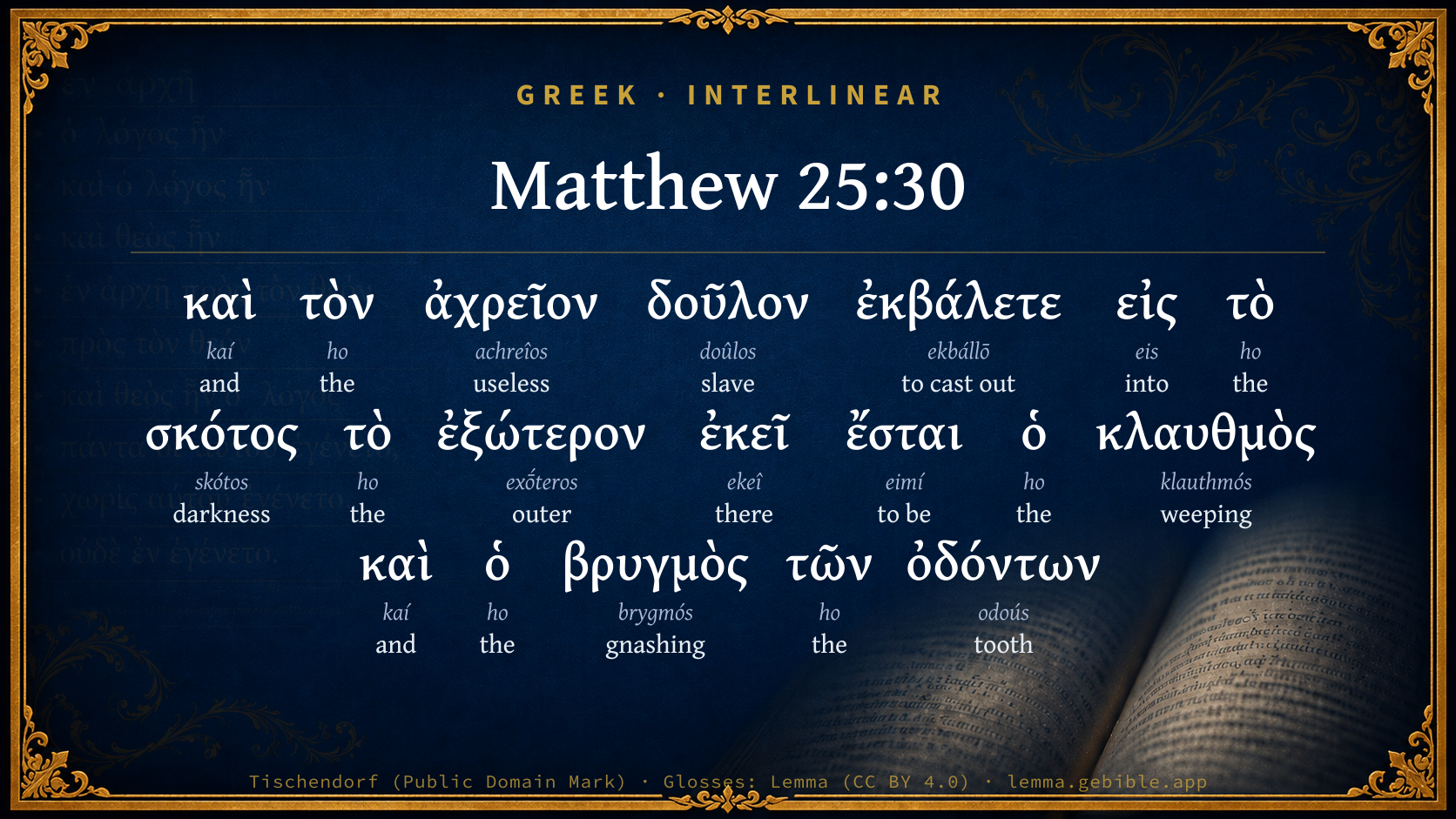
Download image
Cite this verse

Matthew 25:30 (World English Bible). Public Domain. Lemma interlinear Bible study tool, https://lemma.gebible.app/v/matthew/25/30.

Show BibTeX & RIS
BibTeX
RIS
English Translation
Throw out the unprofitable servant into the outer darkness, where there will be weeping and gnashing of teeth.'
World English Bible · Public Domain
Highlights
  • 1 first appearance in the Greek New Testament
Full analysis ↓
Download a study sheet

One document with this verse’s original text, its word-by-word gloss line, the meaning frame, cross-references with their text, attributed commentary, and full source and license credits — printable, and it pastes into notes with its structure intact.

This verse Autodidact and up

Study sheet (.html) Plain text (.txt)

A passage Seminary Student

Up to 50 verses in one chapter. A passage sheet keeps up to 6 commentary sources and 12 cross-references per verse, in the order this page ranks them, and says so on the sheet whenever that leaves anything out. Ask for a single verse and you get the Autodidact verse sheet above.

Everything on this page stays free to read, with no account — the sheet is a download of what is already on screen, not access to it.

Want to remove ads? Support Godless Engineer
Compare translations 3

The same verse in 3 English versions, stacked beneath the original-language interlinear above. Click any original word for its lexicon entry.

Each is an independent rendering of the whole verse — the interlinear is not word-aligned to these translations.

Highlighted words mark where these versions differ — a whole-verse word diff, not a word-by-word alignment.

  • World English Bible Public Domain
    Throw out the unprofitable servant into the outer darkness, where there will be weeping and gnashing of teeth.'
  • King James Version Public Domain
    And cast ye the unprofitable servant into outer darkness: there shall be weeping and gnashing of teeth.
  • unfoldingWord Literal Text CC BY-SA 4.0
    And throw the worthless slave out into the outer darkness, where there will be weeping and grinding of the teeth.’

unfoldingWord Literal Text — © unfoldingWord, licensed CC BY-SA 4.0. Word-aligned USFM3 via Door43 (git.door43.org/unfoldingWord/en_ult).

Versions to compare (up to 4)

3 of 4 selected

Show all 19 translations

Every available English version of this verse, each an independent rendering of the whole verse.

  • World English Bible Public Domain
    Throw out the unprofitable servant into the outer darkness, where there will be weeping and gnashing of teeth.'
  • Berean Standard Bible Public Domain
    And throw that worthless servant into the outer darkness, where there will be weeping and gnashing of teeth.’
  • Majority Standard Bible Public Domain
    And throw that worthless servant into the outer darkness, where there will be weeping and gnashing of teeth.’
  • King James Version Public Domain
    And cast ye the unprofitable servant into outer darkness: there shall be weeping and gnashing of teeth.
  • American Standard Version (1901) Public Domain
    And cast ye out the unprofitable servant into the outer darkness: there shall be the weeping and the gnashing of teeth.
  • Revised Version (1885) Public Domain
    And cast ye out the unprofitable servant into the outer darkness: there shall be the weeping and gnashing of teeth.
  • Geneva Bible (1599) Public Domain
    Cast therefore that vnprofitable seruant into vtter darkenes: there shalbe weeping and gnasshing of teeth.
  • Douay-Rheims (1899) Public Domain
    And the unprofitable servant cast ye out into the exterior darkness. There shall be weeping and gnashing of teeth.
  • Young's Literal Translation Public Domain
    and the unprofitable servant cast ye forth to the outer darkness; there shall be the weeping and the gnashing of the teeth.
  • Literal Standard Version CC BY-SA 4.0
    and cast forth the unprofitable servant into the outer darkness; there will be the weeping and the gnashing of the teeth.
  • Unlocked Literal Bible CC BY-SA 4.0
    Throw the worthless servant into the outer darkness, where there will be weeping and grinding of teeth.'
  • unfoldingWord Literal Text CC BY-SA 4.0
    And throw the worthless slave out into the outer darkness, where there will be weeping and grinding of the teeth.’
  • Darby Bible Public Domain
    And cast out the useless bondman into the outer darkness; there shall be the weeping and the gnashing of teeth.
  • World Messianic Bible Public Domain
    Throw out the unprofitable servant into the outer darkness, where there will be weeping and gnashing of teeth.’
  • Webster's Bible Public Domain
    And cast ye the unprofitable servant into utter darkness: there shall be weeping and gnashing of teeth.
  • Free Bible Version CC BY-SA 4.0
    Now throw this useless servant out into the darkness where there'll be crying and gnashing of teeth.’
  • Bible in Basic English Public Domain
    And put out the servant who is of no profit into the outer dark: there will be weeping and cries of sorrow.
  • Text-Critical English NT CC BY 4.0
    And throw that worthless servant into the outer darkness. In that place there will be weeping and gnashing of teeth.’
  • Tyndale New Testament (1534) Public Domain
    And cast that vnprofitable servaunt into vtter dercknes: there shalbe wepynge and gnasshinge of teeth.

Literal Standard Version (2020), Covenant Press — licensed CC BY-SA 4.0. Text via the HelloAO Bible API (eBible.org). Unlocked Literal Bible (unfoldingWord) — licensed CC BY-SA 4.0. Text via the HelloAO Bible API (eBible.org). unfoldingWord Literal Text — © unfoldingWord, licensed CC BY-SA 4.0. Word-aligned USFM3 via Door43 (git.door43.org/unfoldingWord/en_ult). Free Bible Version, Dr. Jonathan Gallagher — licensed CC BY-SA 4.0. Text via the HelloAO Bible API (eBible.org).

Word by word

More ways to search: Search by grammar → Find every occurrence → Compare this word →

Practice this passage: Drill this verse → Learn its vocabulary →

ἀχρεῖον
achreîos
G888
“useless”
Adjective, Accusative, Singular, Masculine
Part of Speech
Adjective
Case
Accusative
Number
Singular
Gender
Masculine
Full Thayer's Definition

Origin: from G1 (as a negative particle) and a derivative of G5534 [cf G5532 ]

TDNT: None

1. useless, good for nothing
  1. καὶ kaí G2532 “and” Conjunction
  2. τὸν ho G3588 “the” Article, Accusative, Singular, Masculine
  3. δοῦλον doûlos G1401 “slave” Noun, Accusative, Singular, Masculine
  4. ἐκβάλετε ekbállō G1544 “to cast out” Verb, Aorist, Active, Imperative, 2nd person, Plural
  5. εἰς eis G1519 “into” Preposition
  6. τὸ ho G3588 “the” Article, Accusative, Singular, Neuter
  7. σκότος skótos G4655 “darkness” Noun, Accusative, Singular, Neuter
  8. τὸ ho G3588 “the” Article, Accusative, Singular, Neuter
  9. ἐξώτερον exṓteros G1857 “outer” Adjective, Accusative, Singular, Neuter, Comparative
  10. ἐκεῖ ekeî G1563 “there” Adverb
  11. ἔσται eimí G1510 “to be” Verb, Future, Middle deponent, Indicative, 3rd person, Singular
  12. ὁ ho G3588 “the” Article, Nominative, Singular, Masculine
  13. κλαυθμὸς klauthmós G2805 “weeping” Noun, Nominative, Singular, Masculine
  14. καὶ kaí G2532 “and” Conjunction
  15. ὁ ho G3588 “the” Article, Nominative, Singular, Masculine
  16. βρυγμὸς brygmós G1030 “gnashing” Noun, Nominative, Singular, Masculine
  17. τῶν ho G3588 “the” Article, Genitive, Plural, Masculine
  18. ὀδόντων odoús G3599 “tooth” Noun, Genitive, Plural, Masculine

About this verse

These counts appear in no published source. They are computed here, from the morphology-tagged text and Lemma’s own curated glosses. What Lemma adds →

19
words
13
distinct lemmas
Gospels
section

Notable vocabulary

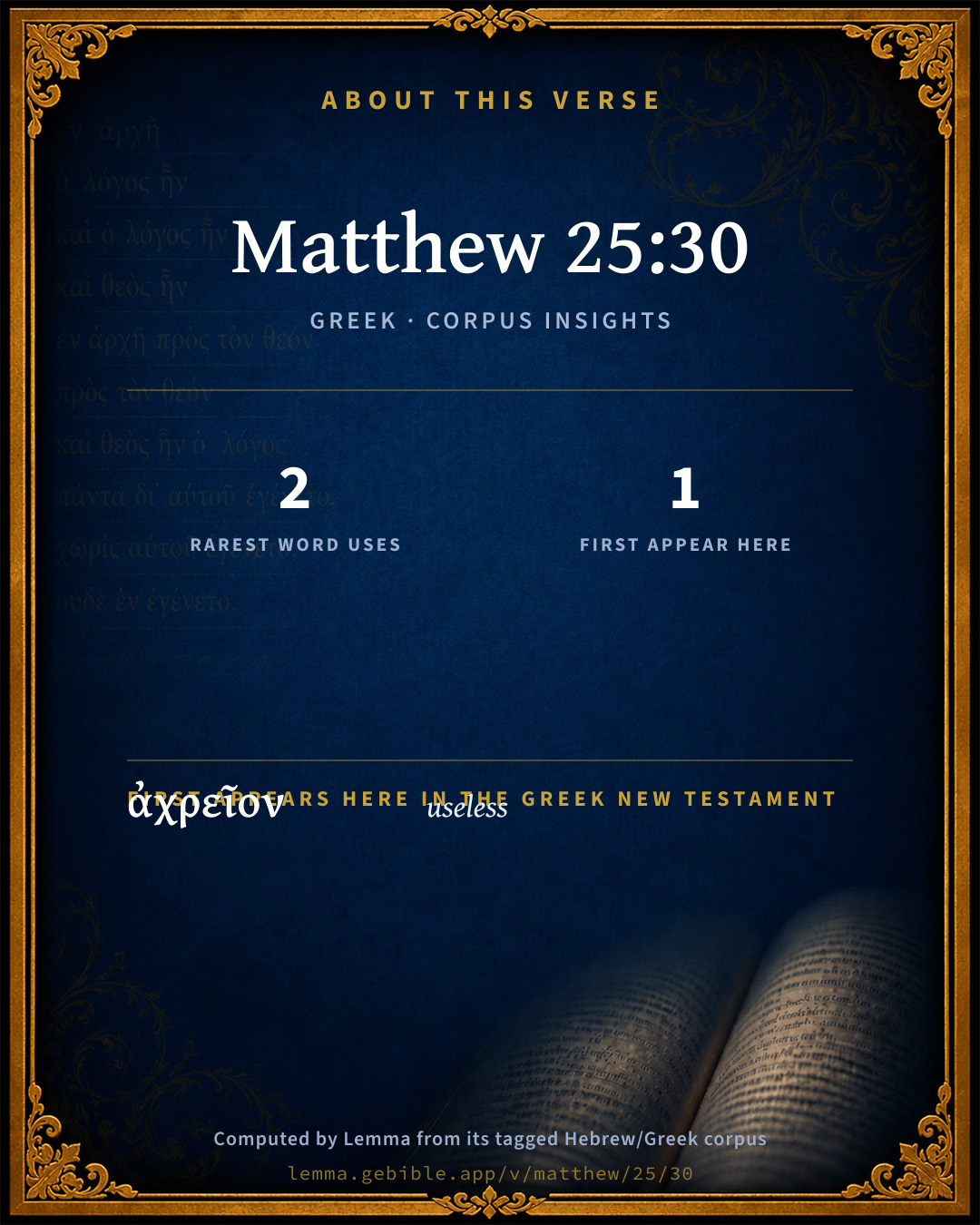
The rarest word here is ἀχρεῖον useless G888 — appearing just 2 times in the whole Greek New Testament.

First appearance in Scripture

This word makes its first canonical appearance in the Greek New Testament here:

  • ἀχρεῖον useless G888

Shared distinctive vocabulary

ἀχρεῖον useless G888 occurs in 2 verses of the Greek New Testament. Also found in:
Repetition

Words recur within this verse:

Cross-references

18

Topical passages linked to Matthew 25:30 in the Treasury of Scripture Knowledge — connected by theme and wording, ordered by reader-vote popularity; previews shown in the World English Bible.

  • Matthew 8:12 but the children of the Kingdom will be thrown out into the outer darkness. There will be weeping and the gnashing of teeth."
  • Matthew 13:50 and will cast them into the furnace of fire. There will be the weeping and the gnashing of teeth."
  • Matthew 22:13 Then the king said to the servants, 'Bind him hand and foot, take him away, and throw him into the outer darkness; there is where the weeping and grinding of teeth will be.'
  • Hebrews 6:7–8 For the land which has drunk the rain that comes often on it, and brings forth a crop suitable for them for whose sake it is also tilled, receives blessing from God;
  • Revelation 3:15–16 "I know your works, that you are neither cold nor hot. I wish you were cold or hot.
  • Titus 3:14 Let our people also learn to maintain good works for necessary uses, that they may not be unfruitful.
  • Jude 1:13 wild waves of the sea, foaming out their own shame; wandering stars, for whom the blackness of darkness has been reserved forever.
  • Jeremiah 15:1–2 Then said Yahweh to me, Though Moses and Samuel stood before me, yet my mind would not be toward this people: cast them out of my sight, and let them go forth.
  • Matthew 13:42 and will cast them into the furnace of fire. There will be weeping and the gnashing of teeth.
  • Matthew 24:51 and will cut him in pieces, and appoint his portion with the hypocrites; there is where the weeping and grinding of teeth will be.
  • Luke 13:28 There will be weeping and gnashing of teeth, when you see Abraham, Isaac, Jacob, and all the prophets, in the Kingdom of God, and yourselves being thrown outside.
  • John 15:6 If a man doesn't remain in me, he is thrown out as a branch, and is withered; and they gather them, throw them into the fire, and they are burned.
  • Ezekiel 15:2–5 Son of man, what is the vine tree more than any tree, the vine-branch which is among the trees of the forest?
  • Matthew 3:10 "Even now the axe lies at the root of the trees. Therefore, every tree that doesn't bring forth good fruit is cut down, and cast into the fire.
  • Matthew 5:13 "You are the salt of the earth, but if the salt has lost its flavor, with what will it be salted? It is then good for nothing, but to be cast out and trodden under the feet of men.
  • Luke 14:34–35 Salt is good, but if the salt becomes flat and tasteless, with what do you season it?
  • 2 Peter 2:17 These are wells without water, clouds driven by a storm; for whom the blackness of darkness has been reserved forever.
  • Revelation 21:8 But for the cowardly, unbelieving, sinners, abominable, murderers, sexually immoral, sorcerers, idolaters, and all liars, their part is in the lake that burns with fire and sulfur, which is the second death."

Cross-references courtesy of OpenBible.info (CC BY 4.0).

Commentary

Notes on Matthew 25:30 from classic Christian and Jewish commentators (each source and its license shown beneath its notes). The classic Christian expositions comment on the surrounding passage and are grouped to its opening verse, so a note may address several verses; the Jewish commentaries on the Tanakh (Rashi and others) are per-verse, so they appear only where the commentator wrote on this verse.

Lemma curates 59 commentaries, every one of them public domain or Creative Commons licensed, each selected and text-cleaned for this edition rather than reprinted as found. About our sources →

Joseph Benson's Commentary

Mat 25:30. And cast ye the unprofitable servant — Who has so wickedly abused my goodness; into outer darkness — The darkness which is without the heavenly city, even the horrible darkness of hell. There, instead of the light and joy possessed by those who are admitted to the marriage- supper of the Lamb, shall be weeping and gnashing of teeth — Through the worm that dieth not, and the fire that is not quenched. There shall be the weeping of the careless, thoughtless sinner, and the gnashing of teeth of the proud and stubborn. See notes on Mat 8:12; Mat 13:42; Mat 22:13. But why does this servant meet with this punishment? What had he done? It is true he had not done good. But neither is he charged with doing any harm. Why, for this reason, for barely doing no harm, he is consigned to outer darkness. He is pronounced a wicked, because he was a slothful, an unprofitable servant. So mere harmlessness, on which many build their hope of salvation, was the cause of his damnation! Observe this well, reader; slothful servants, who do nothing with respect to the purpose of their being sent into the world, nothing to answer the end of their birth and baptism, who are no way serviceable to the glory of God, or the good of others, will be reckoned with as unprofitable servants. A slothful servant is a withered member in the body, a barren tree in the vineyard, an idle drone in the hive, that is good for nothing. In one sense, indeed, we are all unprofitable servants, Luk 17:10. We cannot profit God, Job 22:2; but to others, and to ourselves, it is required that we be profitable; and if we be not, Christ will not own us as his servants.

Joseph Benson's Commentary on the Old and New Testaments (1811–1818) — public domain. Text from a community e-Sword module.

Bengel's Gnomon

Johann Albrecht Bengel

Mat 25:30. Ἀχρεῖον, unprofitable) sc. now and hereafter;[1097] cf. Gnomon on Mat 25:21, and Luk 16:11.—ἀχρεῖος is in Attic Greek written ἄχρειος, according to Eustathius.—ἐκβάλετε, κ.τ.λ., cast forth, etc.) There is a contrast between this and Mat 25:21. The Lord Himself commands [the good servants] to enter; He desires His attendants to cast out [the unprofitable one], as in ch. Mat 22:13.[1098]

[1097] Even though he had caused no loss to his master.—V. g.

[1098] Cf. Gnomon on ch. Mat 7:24.—(I. B.)

Ἀχρεῖος, though translated by Bengel, unprofitable, useless, is not to be confounded with ἄχρηστος, which more strictly expresses that meaning. A slave that has done all that his master commands is ἀχρεῖος, not in the sense that he is worthless, useless, which could not be said of such a servant, but he is one οὗ οὐκ ἔστι χρεία, a person to whom the master owes nothing, with whom he could dispense, Act 17:25. God receives no benefit from man for which He owes a return, Luk 17:10. Here, in Mat 25:30, though the servant had been also ἄχρηστος, unprofitable, useless, and slothful, yet the idea conveyed by the ἀχρεῖος is not this, but its consequence: for he who is useless by doing no work is not wanted (the latter expressing the true force of ἀχρεῖος:). The ἄχρηστος, besides being useless, causes also loss to his master. See Tittm. Syn. Gr. Test.—ED.

Bengel's Gnomon of the New Testament — English translation (T&T Clark, Edinburgh, 1860) — public domain. Text from a community e-Sword module.

Expositor's Greek Testament

ed. W. Robertson Nicoll

Mat 25:30 . ἀχρεῖον , useless. Palairet renders injuriosum ; Kypke, improbum . Being useless, he was both injurious and unjust. The useless man does wrong all round, and there is no place for him either in this world or in the Kingdom of God. His place is in the outer darkness.

Difference of opinion prevails as to whether this parable refers to the use of material goods for the Kingdom of God, or to the use of spiritual gifts. It is not, perhaps, possible to decide in ignorance of the historical occasion of the parable, nor is it necessary, as the same law applies.

The Expositor's Greek Testament, edited by W. Robertson Nicoll (1897–1910) — public domain. Text from a community e-Sword module.

Adam Clarke's Commentary

Verse 30. Weeping and gnashing of teeth.] See Clarke on Mt 8:12, a note necessary for the illustration of this, and the foregoing parable.

Adam Clarke's Commentary on the Bible (1810–1826) — public domain. Text from a community e-Sword/MySword module.

Ellicott's Commentary for English Readers

(30) Cast ye the unprofitable servant . . .—We have had so far the special punishment of sloth, but it is not complete without the solemn and emphatic recurrence of the “darkness” and “gnashing of teeth.”

A Bible Commentary for English Readers, edited by Charles John Ellicott (1878–1897) — public domain. Text from a community e-Sword module.

The Cambridge Bible for Schools and Colleges

gen. ed. J. J. S. Perowne

31–46. The Day of Judgment

32. all nations] Either (1) all the nations of the world, including the Jews; or (2) all the Gentiles. The almost invariable use of τὰ ἔθνη to signify the Gentiles; the unconsciousness of service to Christ shewn by just and unjust alike; the simplicity of the standard proposed by the Judge, favour the second interpretation. On the other hand the special warning to the Apostles, and to the Jewish race, in the previous parts of the discourse render it probable that Jews and Christians are not excluded from this picture of the judgment. The unconsciousness of the judged may be referred not to ignorance of Christ, but to unconsciousness that in relieving the distressed they were actually relieving Christ. The simplicity of the standard may be intended to include what is called “natural” religion, as well as revealed religion. The nations are judged by a standard of justice which all recognise. (Read Rom_1:18-20; Rom_2:9-16.)

as a shepherd divideth his sheep from the goats] “The sheep and goats are always seen together under the same shepherd and in company; yet they never trespass on the domain of each other.… When folded together at night they may always be seen gathered in distinct groups; and so, round the wells they appear instinctively to classify themselves apart, as they wait for the troughs to be filled.”—Tristram, Natural History of the Bible, pp. 89, 90. The goat was not in evil repute in the East, as contrasted with the sheep; on the contrary, the he-goat was a symbol of dignity, so that the point of analogy is merely the separation between the sheep and the goats.

The Cambridge Bible for Schools and Colleges (gen. ed. J. J. S. Perowne; Cambridge University Press, 1878–1918) — public domain. Text from a community e-Sword module.

John Gill's Exposition

And cast ye the unprofitable servant,.... All the servants of Christ are unprofitable with respect to God; for no man can be profitable to him, as he that is wise may be profitable to himself, or others; or in a way of merit, since when they have done the most and best, they have done but their duty: but this man was unprofitable with respect to himself, having not improved the gift and talent bestowed on him; and with respect to men, being of no use for the conversion of sinners, or the comfort of saints, or the edifying of the body of Christ; and brought no honour to his master, and was of no service for the spreading of his Gospel, and the enlargement of his kingdom and interest; and therefore, as one good for nothing, the ministering angels are bid to take him, and cast him

into outer darkness: there shall be weeping and gnashing of teeth: he shall be turned out of doors into outer darkness, to be a companion of other unhappy creatures; who are also without, bewailing their miserable condition, and reflecting on their past conduct; whilst faithful, diligent, and laborious servants will be within, partaking of a rich entertainment, prepared by their Lord, accompanied with joy unspeakable, and full of glory:

See Gill on Mat 8:12.

John Gill's Exposition of the Whole Bible (1746–1763) — public domain (CC PDM 1.0). Text via the HelloAO Bible API.

Trapp's Complete Commentary

John Trapp

30 And cast ye the unprofitable servant into outer darkness: there shall be weeping and gnashing of teeth.

Ver. 30. And cast ye the unprofitable servant] Αχρειος, useless. That had his soul for salt only, to keep his body from putrefying, that worthless, sapless, useless man, that is no more missed when gone than the parings of one’s nails, that never did good among his people, Eze 18:18, but lived wickedly, and therefore died wickedly. Away with such a fellow, saith Christ, from off the earth, which he hath burdened, ετωσιον αχθος αρουρης. Hom.

John Trapp, A Commentary or Exposition upon All the Books of the Old and New Testament (1647–1656) — public domain. Text from a community e-Sword module.

Albert Barnes' Notes on the Bible

And cast ... - See the notes at Mat 8:12. The spiritual meaning of the parable may be thus summed up:

The servants of God are not all endowed with equal gifts and talents. All, whatever may be their ability, are bound to employ their talents in promoting his honor, and in a proper improvement of them. By employing their talents in a proper manner, they improve and strengthen them. They will be judged according to the improvements which they have made. All sinners look on God as a hard master, and as unreasonable and tyrannical. People will be judged not merely for “doing wrong, but for neglecting to do right.” If the servant who kept the talent entire without injuring it, and who returned it to his master as he received it, was nevertheless judged, condemned, and cast away, what must they expect who abuse their talents, destroy by drunkenness and lust the noble faculties conferred on them, and squander the property that might be employed in advancing the interests of morals and religion!

Albert Barnes' Notes on the Bible (1834–1885) — public domain. Text from a community e-Sword/MySword module.

Haydock's Catholic Bible Commentary

And the unprofitable servant. Thus not only the rapacious, the unjust, and evil doers, but also all those who neglect to do good, are punished with the greatest severity. Let Christians listen to these words, and while time will permit them, embrace the means of salvation. (St. John Chrysostom, hom. lxxix.) --- Let no one suffer his talent to lie uncultivated, and, as it were, hidden and buried in this unhappy earth of the world and the flesh, which engages all their thoughts and affections more than the honour and glory of God, or the eternal welfare of their own or their neighbour’s souls. --- The foregoing parables manifestly tend to excite in us great watchfulness, under the just apprehension of the strict account which hereafter we must give of our respective talents. Jesus, therefore, naturally concludes these parables with a description of that awful day which is to succeed the final reckoning, and which will unalterably fix our abode either in eternal happiness, or in eternal misery. In this description we are to remark, 1. the preparations for this awful scene; 2. the sentence pronounced by the judge; 3. the execution of this sentence.

George Leo Haydock (1774–1849), Haydock's Catholic Family Bible and Commentary, 1859 edition — public domain. Excludes Psalms (Douay-Rheims chapter numbering differs from Protestant) and Deuterocanonical books (Catholic canon only).

Whedon's Commentary on the Bible

Daniel D. Whedon

30. Cast ye the unprofitable servant into outer darkness — This is the consummation of judgment. Loss of all farther means of divine favour, and rejection from the life and glory of the divine presence. See note on Mat_8:12.

Daniel D. Whedon (gen. ed.), Commentary on the Old and New Testaments (1874–1909) — public domain. Text from a community e-Sword module.

The Pulpit Commentary

Cast ye the unprofitable servant into the outer darkness. (Mat_24:30, 3l. There those that are gathered are "the elect," nothing being said concerning the rest of mankind; here we have the forecast completed, both righteous and unrighteous receiving their sentence. "All the nations" usually represent all Gentiles distinguished from the Jews. But there is nothing to indicate separate judgment for the Jew and Gentile. Equally unlikely is the notion that the transaction is confined to the heathen, whether the opinion is grounded on a supposed extension of the mercies of Christ to those ignorant of him, but having lived according to the laws of natural religion; or whether it assumes as certain that believers will not be judged at all (an erroneous deduction from Joh_5:24). It seems, on the one hand, incongruous that persons who have never heard of Christ should be addressed as "blessed of my Father," etc., ver. 34: and it seems, on the other hand, monstrous that such, having failed through ignorance and lack of teaching, should be condemned to awful punishment. That Christians alone are the persons who are thus assembled for judgment is not likely. Is there, then, to be no inquisition held on the life and Character of non-Christians? Are they wholly to escape the great assize? If not, where else does Christ refer to their case? What reason can be given for the exclusion of this great majority from the account of the proceedings at the last day? It appears, on the whole, to be safest to consider "all the nations" as meaning the whole race of men, who, dead and living, small and great, Jew and Gentile, shall stand before God to be judged according to their works. (Rev_20:11-13) This is not a parable, but a statement of future proceedings by him who himself shall conduct them. It is not a full account of details, but an indication of the kind of criteria which shall govern the verdicts given.

When (otan de , but when). The particle, unnoticed in the Authorized Version, indicates the distinction between this section and the preceding parables, the latter exemplifying the judgment specially on Christians, this setting forth the judgment on the whole world. Son of man. With his glorified body, such as he was seen at his Transfiguration. (Act_1:11) In his glory. The term occurs twice in this verse, as elsewhere (Mat_16:27 Mat_19:28 Mat_24:30, where see notes) denoting that then his humiliation will have passed away, and he will appear as he is. All the holy angels with him. "Holy" is probably a transcriber"s addition, which has crept into the later text. The Vulgate omits it. At this time all the family of heaven and earth shall be assembled. (Mat_16:27 Deu_33:2) Of angels and men none shall be wanting. "Omnes angeli, omnes nationes. Quanta celebritas!" (Bengel). Then shall he sit, etc. He shall take his seat as Judge on his glorious throne trey., (Mat_20:11) surrounded by the angels and the saints. (Jud_1:14 Rev_19:14) Observe, this was spoken three days before his death. (comp. Mat_26:53, Mat_26:64)

Vers. 31-46. The last judgment.

I THE JUDGE.

1. His glory. The Lord was sitting on the Mount of Olives, looking sadly back upon the holy city and the temple which he had finally left. He had been rejected by the hierarchy of the chosen nation; the shadow of the cross was falling on him; in three days would come the awful agony and the tremendous sacrifice. He knew all this with the clear calm knowledge of Divine omniscience; but his thoughts dwelt, that Tuesday afternoon, not on his own sufferings now so near, but on the great results of his incarnation and atonement which were to be manifested in the far-distant future, the salvation of his chosen, and, alas! the condemnation of the impenitent. With the cross in near prospect, he speaks of himself as the King the king of all nations; the Son of man indeed, still in our human nature, for the two whole and perfect natures, the Godhead and the manhood, once joined together in the one Person of Christ, were never thenceforth to be divided; but coming in his glory, himself in that body of glory of which a passing glimpse had been vouchsafed to the three most favoured apostles on the Mount of the Transfiguration, surrounded by the holy angels, his attendants and ministers. Then shall he sit upon the throne of his glory, that great white throne which St. John saw in that awful vision of the great day which was revealed to him for our instruction and warning. No human words could describe the glory of the Judge. St. John could only say that from his face the earth and the heaven fled away; and there was found no place for them.

2. The gathering of all nations before him. The parables of the virgins and the talents are parables of judgment; but they deal with a portion only of the tremendous subject. Judgment, St. Peter says, "must begin at the house of God." These two parables embrace in their range only Christian people, those who have gone forth to meet the heavenly Bridegroom, and the immediate servants of the Lord. The first parable represents the judgment of the inner life of the soul; the second, the judgment of the outward life of obedience or idleness. Each parable reveals to us one of the many aspects of that tremendous assize. Now parable passes into prophecy. A wider scene is opened out the judgment of the whole world. Our thoughts are no longer to be concentrated on a portion only of the vast multitude. All nations are gathered together before the Son of man; quick and dead alike; all the countless millions that have been born unto the world from the Creation to the great day; every one from Adam the first man to the newborn babe all, summoned by the voice of the archangel and the trump of God, gathered together by the attendant angels, all shall stand before the Judge. His eye will range over those countless hosts. He knows the whole history of each individual. The books of which we read in the Revelation represent the infinite knowledge of God. "The dead were judged out of those things which were written in the books, according to their works." The Judge will divide the thronging crowds with unerring accuracy, as a shepherd divideth his sheep from the goats. The division will be as easy to the Almighty Judge; the differences, often almost invisible to us, as clearly marked in his sight. "He shall set the sheep on his right hand, but the goats on the left.

II THE BLESSED.

1. The welcome. The Lord describes himself as the heavenly King. He knew that in three days the mocking title, "This is Jesus, the King of the Jews," would be set above his head as he hung dying on the cross. But he knew also, in his inmost consciousness, that he was indeed King of kings and Lord of lords. The kingdom of heaven was his by right. It was he who should hereafter open that kingdom to the blessed: "Come, ye blessed of my Father," he will say. Come; for it is his will that his chosen should be with him to behold his glory, and to share his glory. Come; for their salvation is his joy, the joy for which he endured the cross. He bringeth home rejoicing the sheep that once was lost. He saith unto his friends, "Rejoice with me." Come; for he loveth them with an everlasting love, a love stronger than death. He calls them blessed, "Ye blessed of my Father;" for the Father had pronounced them blessed. He had chosen them by his electing grace; he had given them to the only begotten Son; they were "elect according to the foreknowledge of God the Father, through sanctification of the Spirit, unto obedience and sprinkling of the blood of Jesus Christ." He bids them take possession of the kingdom the kingdom of glory, that glory which passeth all that eye hath seen, or ear hath heard, or that hath entered into the heart of man. That kingdom had been prepared for them from the foundation of the world; even before the world was, (Eph_1:4) God knew, in the fulness of his Divine omniscience, each elected spirit, and predestinated each to be conformed to the image of his Son. The kingdom had long been theirs in the purpose of God; now it was to be theirs in possession.

2. The ground of the welcome. They had loved the Lord; they had tended him (he said) in distress and sorrow; they had laid him, the Lord God Almighty, under obligations by their love and tenderness. He would reward them now. The righteous are bewildered with that wondrous welcome. It is a joy almost too great for them to bear a sweetness so penetrating that the heart well nigh faints in the intensity of its rapture. They knew that nothing they had done could deserve that unutterable blessedness now opened to their view. They can see, as they look back on their past lives, no deeds so good and holy as the Lord had said. They had learned of him the grace of humility, those of them who were Christians; those who had not heard the gospel (for surely many heathen men will be among the number of the blessed) had shown the law of love written in their hearts, and were a law unto themselves, doing by nature things contained in the Law. (Rom_2:14, Rom_2:15) None of them fully understood the preciousness of acts of unselfish love. They felt their own shortcomings; in their self-abasement they had ever thought themselves the chief of sinners. But the King now shows to them the meaning of their deeds of love. Charity, that chiefest of graces, springs out of faith. It looks to Christ, and rests in Christ as its ultimate centre. It is so, in some sense, even with the good deeds of heathen men; for Christ is the Saviour of all men. Christ died for all men; and all who in truth and earnestness seek after God, consciously or unconsciously, follow Christ. "We must all appear before the judgment seat of Christ; that every one may receive the things done in his body." The judgment will be, as Holy Scripture says in many places, according unto works; but those works spring out of faith, and derive their whole spiritual value from the faith and love which prompted them. The Lord, in this place, speaks of one class only of holy deeds. He does not exclude other Christian graces, other forms of obedience. All will, we may be sure, be taken into account in the judgment. But in this prophecy, as in many of his parables, the Lord takes one aspect of God"s dealings with mankind. He insists on that one aspect, and impresses it forcibly upon his hearers. One important truth is best driven home by being presented alone; other balancing truths can be taught on other occasions. We must study the Scriptures as a whole. One part explains another; one part suggests the necessary qualifications for the interpretation of another.

III THE LOST.

1. The condemnation. "Depart from me, ye cursed." Very awful and tremendous words. All the more so as coming from his mouth who bade all men, "Come unto me;" who came not into the world "to condemn the world, but that the world through him might be saved." He had loved those lost souls; he had called them again and again; he had wept over their hardness and unbelief. But they would not come unto him that they might have life. They resisted the Holy Ghost; they closed their eyes in wilful blindness; they persevered in disobedience till their heart was hardened by the deceitfulness of sin, and there was no more hope of amendment. Now they must depart from him whom in life they would not hear; they must depart, and that into the eternal fire prepared (not for them; it was not the will of God that any should perish; he willeth that all men should be saved) "for the devil and his angels." They had loved darkness rather than light; they must dwell in the great outer darkness away from the light of God"s presence. They had listened to the tempting voice of Satan; they must share his doom.

2. The ground of condemnation. They had done no good; they had lived only for themselves. They had seen sorrow and distress and poverty all around them; they had shown no love, no pity, no sympathy. And in neglecting the poor, the afflicted, they had neglected Christ the Lord. For the poor are his representatives. "He that hath pity on the poor lendeth to the Lord;" and he that careth not for the poor careth not for Christ, who is present in his poor, who bids us love one another as he hath loved us. They who have no pity on the poor would not have ministered to the Lord if they had lived when he had not where to lay his head, when holy women ministered to him of their substance. And these shall go away into eternal punishment. They are not accused of any crime of theft, or murder, or impurity; but they were without love, and he that loveth not knoweth not God who is love, and cannot enter into heaven which is the home of love. It is a most solemn thought that this tremendous condemnation was incurred, not by crime, not by actual sin, but by neglect of duty, by selfishness and want of love. Let us rouse ourselves to a sense of the danger of selfishness; let us covet earnestly the best gifts, especially that highest gift of love. "The righteous shall go into life eternal." It is love, the Lord saith, which is the mark of the blessed; "charity never faileth.

LESSONS.

1. The Lord is at hand. He shall sit on the throne of his glory. On which side shall we be set on the right hand or on the left?

2. "Come, ye blessed." There is no joy so intense, so rapturous; may it be ours!

3. Then follow after charity.

4. "Depart from me, ye cursed." There is no misery so awful; God in his mercy save us from it!

5. Then follow Christ the Lord; love the brethren; imitate the example of the King.

Vers. 31-46. The judgment of the nations.

The two earlier parables of judgment refer to those who are in confessed relationship with God. The parable of the ten virgins represents the relationship of friendship, that of people who would share in the joys of God"s home, as friends at a wedding feast; the parable of the talents represents a less intimate relationship, that of service; the talents are committed to their proprietor"s "own servants." Now the scene changes, and we are brought out to the larger world of the nations; the judgment of those who do not know Christ as their Friend or consciously serve him as their Master is here typified. To Jews this would mean the judgment of the Gentiles; to Christians it represents the judgment of the heathen, with those, also, who live in Christendom, but who do not give their adherence to any of the Churches.

I CHRIST WILL JUDGE THE WORLD.

1. There will be a judgment of the world. This is not to be confined to the Church; it will not be only for those who acknowledge Christ. We cannot escape from it by ignoring the rule of Christ. The most heedless and careless, the most worldly and unspiritual, the most sceptical and materialistic, will be brought before the bar of the universal judgment.

2. This judgment will be in the hands of Christ. It will be conducted by the "Son of man," who, even when acting as a Judge, is to be regarded as a Shepherd dividing his flocks. Therefore the judgment will be conducted with humanity and with sympathy, with the discrimination of knowledge gained in experience.

II THE JUDGMENT OF CHRIST WILL RESULT IN A TWOFOLD DIVISION.

1. There will be two classes. All are not condemned; but all are not approved. Even Jesus with all his graciousness must reprobate what is wrong. His gospel is not a security of salvation for the sinful impenitent.

2. There will be but two. These are the main divisions. All characters tend either downward or upward. We are all either in the narrow way or in the broad way either sheep or goats.

3. These classes will be separated. At present they are united. There will be a revelation and a division, and each man will then go to his own place.

III THE GROUND OF JUDGMENT WILL BE MEN"S CONDUCT TOWARDS OTHER PEOPLE. It will not be a profession of religion, nor a creed, nor a performance of acts of worship. Christ looks chiefly to conduct in the world. He takes what is done to one of his brethren as the test. This is just the same as if it were done to him, because he is so perfectly sympathetic, that he feels what is done to his brother exactly as though it were done to himself. The rule is for the judgment of the heathen and those outside the Church of Christ. More is expected of Christ"s own confessed followers lamps well supplied with oil of grace, and faithful use of entrusted talents. But such people cannot be excused from what is expected even of the heathen. We can all best serve Christ by ministering to his brethren. This is what he most cares for.

IV THE JUDGMENT WILL RESULT IN BLESSEDNESS AND PUNISHMENT.

1. There is the joy of the kingdom for the sheep on the right hand. It is remarkable to see that the kingdom was prepared for such from the foundation of the world. From the first its blessings were for many who are not in any visible Church, for many who do not know themselves to be Christians.

2. There is punishment for the goats on the left hand. The hard and selfish are those who receive this punishment. They will not escape it because of their ignorance or their refusal to recognize Christ. It will be unbearably awful. W.F.A.

Vers. 31-46. The judgment.

No human imagination avails to grasp the conception of the judgment of a world the great white throne, the voice of the archangel, the generations of all time gathering from all quarters. There is one feature of the judgment which is here and elsewhere made prominent that Christ himself is to be Judge. The Father hath given him authority to execute judgment also, "because he is the Son of man." Jesus Christ is that Person through whom God has seen fit to transact with men from the first, and it will be so to the end. It is in the Person of Christ that God has been accepted or rejected of men; and it is fit that in this Person also men be accepted or rejected of God. We shall be judged by One who can read our soul with his own human knowledge of men and their ways. There are only two points in this great subject which will now be taken up:

(1) the duration of the doom pronounced;

(2) the grounds on which it proceeds.

I Round these words of our Lord a sea of controversy has continually raged. In every generation there are numbers who explicitly declare that they cannot believe in the everlasting punishment of any of their fellow creatures. And although many do so from mere thoughtlessness, in others it arises from the feeling that it would be inconsistent with their own expectation of happiness, and with their best ideas of God. Men of feeble imagination, to whom the doctrine is little more than a form of words, have little temptation to rebel against it. But there are others to whom it makes life an intolerable misery; and rather than resign all mental comfort and happiness, they resign their belief in eternal punishment. But belief is not to be determined by our wish, but by Scripture and reason. If we turn to our Lord"s teaching, and try to make out whether he taught universal restoration, the distinct conclusion seems to be that he did not. His words here are a fair sample of his teaching on this point, and apparently he meant by them to convey the impression which every simple-minded, unbiassed reader receives from them, that the duration of the punishment of the lost equalled the duration of the blessedness of the saved. The word translated "everlasting" in the one clause and "eternal" in the other is the same in both clauses. And though this is scarcely the place to discuss the meaning of a Greek word, so much has been said of the proper translation of the word being "age long," that it is necessary to guard against the accepting of such an account as sufficient. Even in its first original sense there is prominent the idea of enduring to the end, of permanence. So that in the course of time it became the commonest term to express that which lasts, in opposition to that which passes away. It occurs everywhere in the Epistle to the Hebrews, the purpose of which Epistle is to bring out the enduring, permanent, absolute, final, eternal nature of the Christian religion in opposition to the temporary, transient nature of the Old Testament dispensation. Plato falls into almost the very language of Paul, and says of the heavens and the earth that these visible things are temporal, but the unseen is eternal, abides; and in saying this he uses the word used here. But no doubt besides its application to what is absolutely eternal, as to God himself, the word may legitimately be applied to epochs long but not eternal. But unquestionably it conveys the idea that what is spoken of will last so long as its subject lasts unless something is said to the contrary. The bliss promised and the punishment threatened would be understood to last so tong as the subject of them lasts unless an explicit intimation were given that it would not be so. But so far from this, the New Testament everywhere implies that the state of things introduced by Christ and his work is a final and permanent stare, suitably described by the word that is applied to God himself when he is called Eternal. It is to be noted also that the Jews of our Lord"s time certainly believed in a final judgment and irreversible doom; and it is not to be believed that our Lord should have used the very figures and language used by them if he had had any new doctrine to publish regarding the future.

II The grounds on which the final separation proceeds must commend themselves to the most blunted conscience. The friends of mankind are to share the destiny of the great Friend of our race, the haters of mankind are to partake with the great enemy. At first sight the duties taken account of seem the easiest. But the spirit of Christ is that which induced him to pity us and come down for our help, and it is this spirit of love which is fundamental. The man who is like him in this will one day be like him in all else. "Love is of God," and will still be recognized by God as belonging to him. It is worthy of observation that those who were rewarded for these deeds of charity were not aware that in doing them they had been serving Christ. His explanation of this to them reminds us of the device of Eastern princes of wandering through their dominions in disguise, that they may learn the feeling of their subjects. So does Christ even now dwell incognito among his own, in the habit of the poor and sick and oppressed; and, asking help from one and another, he finds who they are who have listened to his commandment that we should love one another, and who they are who are fulfilling his work of mercy upon earth. And this identification of himself with all that is base and wretched has its basis in the substantial facts of his earthly life. His life was spent for the relief of men, but it was merely part of the fulfilment of an eternal purpose. He is no less desirous of relieving the miseries of this present age than he was of relieving those who were around him upon earth. And as we would think gratefully and lovingly of one who in our absence cared for some brother or parent, wife or child, who stood in need of help, so does Christ think highly of him who considers and cares for any weak brother of his for whom he died, and whom when he comes he will claim for his own. Are you prepared for this judgment? We are not asked what we have felt, or thought, or believed, but what we have done. It is conduct which shows if you are of the spirit of Christ, capable of enjoying what he counts a blessed life. His aim was the only right aim, the only aim which in the judgment will be taken account of. Every one who tries this finds it is radical, that it involves regeneration, that he cannot adopt it as his real aim in life without giving himself up to God.. D.

Vers. 31-46. The great assize.

It has been well observed by Dr. Doddridge that our Lord here proceeds to speak of the great day of retribution, in a description which is one of the noblest instances of the true sublime anywhere to be found. Portions of the description are undoubtedly parabolic, the intention evidently being to give prominence to certain important principles; but otherwise it is a solemn anticipation of what will one day become history. We may consider

I THE ARRANGEMENT OF THE COURT. And conspicuous here is:

1. The appearance of the Judge.

(1) "The Son of man." Under this title the Lord comes to us as the Divine Word or Truth made flesh, and so accommodated to our apprehension. In this quality God reveals himself as our Redeemer and Saviour; and in this quality he will appear as our Judge. Accordingly, we learn, "Neither hath the Father the Godhead as distinct from the manhood any man, but he hath given all judgment unto the Son." Again, "And because he is the Son of man". (cf. Joh_5:22, 27 Act_17:3 Rom_2:16)

(2) But it is the "Son of man in his glory. " He came to redeem us in his humiliation. In his second advent his humanity will be beatified. This was anticipated in the vision of the Transfiguration. (see Joh_1:14) The Deity of the Son of man will then be more gloriously visible.

(3) "And all his angels with him." Angels rather shade than enhance the glory of the Lord. They are the "clouds" in which elsewhere the Son of man is described as coming. (see Dan_7:13 Mat_24:30 Mat_26:64 Rev_1:7) They come to moderate the effect of that face, the fire of which will kindle the final conflagration. (cf. 2Pe_3:7 Rev_20:11)

(4) "Then shall he sit upon the throne of his glory," or "glorious throne." Agreeably to this he speaks as "the King" (ver. 34). Surely it is impossible, in the light of this Scripture, were there no other, to doubt the proper Deity of our blessed Lord.

2. The vast assembly.

(1) "And before him were gathered all the nations." Though the particular illustration which follows has reference to those only from among them who had heard the gospel, yet these words imply that the whole human race will congregate there. (see Act_17:31) Witness, then, all the men from every clime, and all the generations of the ages.

(2) Such a congregation presupposes a general resurrection. Elsewhere we are taught that this will take place. (cf. Dan 12:2Jo Dan_5:28, Dan_5:29) So the dead, small and great, stand before the throne. (Rev_20:12)

(3) Added to the vast aggregate of humanity, "all the angels" are present. This doubtless brings prominently before us the holy angels; but their presence suggests also that of the fallen. And we read further on of the "everlasting fire prepared for the devil and his angels" (ver. 34). They were probably the first judged. They were the first in transgression, the first cursed, and so likewise the first doomed. (see Rev_20:1-3)

3. The solemn discrimination.

(1) All nations are assembled before the King for his inspection. The process of the inspection is not here described; but elsewhere we are assured that "every one of us shall give account of himself unto God". (Rom_14:12) Neither is time here specified which the inspection may occupy. It will probably extend throughout the great period of a thousand years described by John. (see Re 20)

(2) The discrimination eventuates in separation (ver. 32). The sheep is the symbol of peaceableness and innocency. The goat, on the contrary, a quarrelsome, lascivious, and ill-scented creature, describes the impure. The sheep pass to the "right hand," a position which, according to the rabbins, expresses approbation and eminence. The goats pass to the "left," which, they say, expresses disapprobation and rejection. The Romans recognized a similar distinction (see "AEn.," 6:540).

(3) The angels will be employed as instruments in this great service. (see Mat_13:30, Mat_13:39-43) Note: Men who can agree in matters of worldly business, and even in matters of morals, will yet separate when they come to the higher plane of religion. The spirituality of the future state is the touchstone.

II THE AWARD OF THE RIGHTEOUS.

1. They are commended.

(1) Because they showed kindness to the disciples of Christ They gave meat to the hungry, drink to the thirsty; clothing to the naked; hospitality to the stranger; attention to the sick; encouragement to the prisoner.

(2) Because they did all this from the pure motive of love to Jesus. So he takes it home. I was hungry," etc.; "ye did it unto me. " What dignity does this stamp upon the lowliest offices and acts. (see Eph_6:5-7 Col_3:17 Heb_6:10)

(3) Therefore are they greeted as "blessed of the Father." Such acts of kindness evince them to be the children of that blessed Father who "maketh his sun to rise on the evil and the good, and sendeth rain on the just and the unjust". (see Mat_5:43-48) "It is more blessed to give than to receive." It is more God-like.

2. They are promoted.

(1) "Come, ye blessed children of my Father;" come nearer to me, the "Son of man," the" King" of glory. "My brethren" (ver. 40). Jesus never directly calls his disciples his brethren until after his resurrection. Jesus glorified is more nearly related to the men regenerated than Jesus unglorified to men unregenerated. It is when the Lord is glorified in us that we become truly those whom he acknowledges as his brethren. (cf. Mat_28:10 Joh_13:1, margin Revised Version; Joh_20:17) Yet is there a becoming reverence which prevents the disciple from speaking thus familiarly of the Lord. Even James does not presume to call himself "the Lord"s brother," neither does Jude, who distinguishes himself rather as "the brother of James". (cf. Jam_1:1 Jud_1:1)

(2) "Inherit the kingdom." This implies the crown; (2Ti_4:8) the throne; (Rev_3:21) the sceptre. (Rev_2:26, Rev_2:27)

(3) "Prepared for you from the foundation of the world," viz. in the terms of the everlasting covenant which promises rewards to the obedience of faith. "For you," viz. who have done the works which prove the genuineness of faith. Note: The disavowal by the righteous of the virtue ascribed to them is designed to show the absence of all idea of merit from true righteousness. The good do good for its own sake for the Lord"s sake who is goodness itself.

(4) All this is summed up as "eternal life." This is union with Christ, who is that Life. (see 1Jn_5:12, 1Jn_5:20)

III THE DOOM OF THE WICKED.

1. They are convicted.

(1) They are impeached with want of sympathy with Christ. "Ye gave me no meat," etc. They would not consider Christ in his disciples.

(2) Special pleading will be of no avail before the judgment seat of Christ. "When saw we thee," etc.? Sinners are more ready to lay claim to virtues to which they have no right, than to confess the evils of which they are guilty. But they will get their answer. "Forasmuch," etc. Note: Virtue cannot receive the slightest wound of which Jesus does not instantly feel the smart. (see Act_9:4, Act_9:5)

(3) The offences here alleged are negative. This does not say that positive wickedness shall escape. The murderer, the adulterer, the thief, the liar, the blasphemer, every sinner will have his sinfulness brought home to him.

2. They are degraded.

(1) "Depart from me from your last hope of mercy and salvation. "Ye cursed." In departing from me whom you refused to accept as your Curse bearer (hwla), bear now your own deserved execration.

(2) Depart "into eternal fire." This is afterwards described as "eternal punishment." Hell is that horrid centre in which all the lines of sin and misery meet. The Greek word construed "eternal" is to be understood in the New Testament, not so much in the light of its etymology as in that of its usage. When applied to the world, it has no limit except the duration of the world. (see Rom_16:25, Revised Version; Jud_1:7) When applied to the world to come, it has no limit. (see Mar_9:43; see also Isa_33:14 Dan_12:2 2Th_1:9 Rev_14:11 Rev_20:10)

(3) "Prepared for the devil and his angels." Note: There is a ringleader among devils. "What must be the nature and misery of a confinement with those powerful, active, sagacious beings, whose minds are all malice, fraud, and cruelty, and whose endless being is a succession of rage, revenge, and despair?" (Dwight).

(4) "And these shall go away," etc. Those who refused to accept the invitation to "come," will have to obey the order to "go." "Every word has a terror in it, like that of the trumpet of Mount Sinai, waxing louder and louder" (Henry). J.A.M.

The Son of man exercising judgment.

The advent of Messiah was, in the Jewish mind, associated with general judgment. The people looked forward with dread to the Messianic era. There are some who can regard the passage commencing with this verse as descriptive. Others regard it as parabolic, with the scenery taken from men"s ideas of the afterlife. It is difficult to follow the passage as descriptive, because human thought and human language are incapable of dealing with actual events beyond the earthly sphere. What we may find in it is an indication of what Christ makes the basis of his judgment of men. There are two things which may reasonably surprise us.

I OUR JUDGE IS THE "SON OF MAN." It may be said that God is our Judge. But that brings in the element of fear. It seems to us that he must have an absolute and awful standard, and tested by it there will be no chance at all for any of us. "If thou wert strict to mark iniquity, who should stand?" But the God who judges us is revealed to us as the "Son of man," and then confidence takes the place of fear. The Son of man is one of us; he has passed through our experience, he knows us. And what we feel is that, if abstract justice needs to be qualified by a consideration of circumstances, he can safely so qualify it. This point may be illustrated by our familiar distinction between "justice" and "equity." "Justice" is precisely and exactly what the law lays down; and that is what we, rightly or wrongly, expect from God. "Equity" is that law applied with due consideration of relations between man and man, or of special human infirmity. And that is what we expect from the "Son of man from One "in all points tempted like as we are." Christ in no sense relieves the august solemnity of judgment, but he makes us fully, freely, lovingly, willing to accept his appraisement.

II OUR JUDGE USES AN UNEXPECTED BASIS or JUDGMENT. We should be puzzled with it if the parable dealt with the world and sinners. It pictures the judgment of Christ"s disciples. Eastern flocks are made up of sheep and goats, but all are the shepherd"s property and care. Christ seems to propose judging on a basis of mere humanity or charitableness. But he goes deeper than that. The charity of which he speaks is the most satisfactory revelation of character, and it is character, not action, that is the basis of his judgment. R.T.

The Pulpit Commentary (1880–1919), ed. H.D.M. Spence-Jones & Joseph S. Exell — public domain. Text from a community e-Sword module.

John Wesley's Explanatory Notes

Cast ye the unprofitable servant into the outer darkness - For what? what had he done? It is true he had not done good. But neither is he charged with doing any harm. Why, for this reason, for barely doing no harm, he is consigned to outer darkness. He is pronounced a wicked, because he was a slothful, an unprofitable servant. So mere harmlessness, on which many build their hope of salvation, was the cause of his damnation! There shall be the weeping - Of the careless thoughtless sinner; and the gnashing of teeth - Of the proud and stubborn. The same great truth, that there is no such thing as negative goodness, is in this chapter shown three times:

1. In the parable of the virgins;

2. In the still plainer parable of the servants, who had received the talents; and

3. In a direct unparabolical declaration of the manner wherein our Lord will proceed at the last day. The several parts of each of these exactly answers each other, only each rises above the preceding.

John Wesley, Explanatory Notes Upon the Whole Bible (1754–1765) — public domain. Text via the GEBible commentary corpus.

The People's New Testament

B. W. Johnson

30. Cast ye the unprofitable servant into outer darkness. A state of banishment from the presence of the Lord. Have you a trust from the Lord? Are you useful to him according to your ability?

B. W. Johnson's The People's New Testament with Notes (1889–1891) — public domain. Electronic text from the Christian Classics Ethereal Library (CCEL) ThML edition.

International Critical Commentary

30. And cast the unprofitable servant into the outer darkness: there shall be the wailing and the gnashing of teeth.]

“These shall be bound in prison,” Shabbath 152b Cf. on 8:12.

(L)

International Critical Commentary — older volumes (1896–1929), various authors — public domain. Text from a community e-Sword module.

Lesson kit

Teaching starters — assembled from the data on this page, not authored interpretation. Every prompt links to the verse data it draws on. Edit before teaching.

Matthew, in the Gospels, opens this verse with 19 words (13 distinct Greek lemmas). Its most distinctive word is achreîos (“useless”). A historical commentator’s framing appears above. Read the whole chapter for the surrounding context.

Discussion questions

  1. The word achreîos carries the sense “useless.” How does it shape the verse?
  2. The word “useless” first appears here in Scripture. What is being introduced at this debut?
  3. Luke 17:10 shares the word «useless» with this verse. How do the two illuminate each other?
  4. “the” occurs 6× in this one verse. What is the effect of the repetition?
  5. These translations render this verse differently. What is at stake in choosing one wording over another?
  6. Reading how Joseph Benson's Commentary and Bengel's Gnomon read this verse, where do the two commentators agree and where do they part?

Things to notice

  • 1 word makes its first canonical appearance in Scripture here.
  • These translations choose different wording for 12 words in this verse.
  • “the” occurs 6× in this single verse.
  • 13 distinct Greek lemmas span 19 words in this verse.

Reading settings

Reading text

Shown beneath each verse's original-language words.

Old Testament
Old Testament edition

Read the OT as the Masoretic Hebrew (MT) or the Greek Septuagint (LXX).

English shown for the Greek Septuagint (in the Hebrew ↔ Greek comparison).

Comparing translations? Open the Compare panel on any verse page to stack up to four side by side.